
<?xml version="1.0" encoding="utf-8" ?>
<rdf:RDF xmlns:rdf="http://www.w3.org/1999/02/22-rdf-syntax-ns#" xmlns:dc="http://purl.org/dc/elements/1.1/" xmlns:syn="http://purl.org/rss/1.0/modules/syndication/" xmlns="http://purl.org/rss/1.0/">


<channel rdf:about="http://bic.iwlearn.org/en/search_rss">
  <title>English</title>
  <link>http://bic.iwlearn.org</link>

  <description>
    
            These are the search results for the query, showing results 101 to 115.
        
  </description>


  <image rdf:resource="http://bic.iwlearn.org/logo.png"/>

  <items>
    <rdf:Seq>
      
        <rdf:li rdf:resource="http://bic.iwlearn.org/en/atlas/atlas/96-ecological-preconditions-for-the-spread-of-zooanthroponoses-map/ecological-preconditions-for-the-spread-of-zooanthroponoses-map"/>
      
      
        <rdf:li rdf:resource="http://bic.iwlearn.org/en/atlas/atlas/96-ecological-preconditions-for-the-spread-of-zooanthroponoses-map"/>
      
      
        <rdf:li rdf:resource="http://bic.iwlearn.org/en/atlas/atlas/95-disturbance-of-wildlife-map/disturbance-of-wildlife-map"/>
      
      
        <rdf:li rdf:resource="http://bic.iwlearn.org/en/atlas/atlas/95-disturbance-of-wildlife-map"/>
      
      
        <rdf:li rdf:resource="http://bic.iwlearn.org/en/atlas/atlas/94-disturbance-of-forest-lands-map/disturbance-of-forest-lands-map"/>
      
      
        <rdf:li rdf:resource="http://bic.iwlearn.org/en/atlas/atlas/94-disturbance-of-forest-lands-map"/>
      
      
        <rdf:li rdf:resource="http://bic.iwlearn.org/en/atlas/atlas/93-the-disturbance-of-vegetation-in-the-lake-baikal-basin-map/the-disturbance-of-vegetation-in-the-lake-baikal-basin-map"/>
      
      
        <rdf:li rdf:resource="http://bic.iwlearn.org/en/atlas/atlas/93-the-disturbance-of-vegetation-in-the-lake-baikal-basin-map"/>
      
      
        <rdf:li rdf:resource="http://bic.iwlearn.org/en/atlas/atlas/92-pasture-degradation-map/pasture-degradation-map"/>
      
      
        <rdf:li rdf:resource="http://bic.iwlearn.org/en/atlas/atlas/92-pasture-degradation-map"/>
      
      
        <rdf:li rdf:resource="http://bic.iwlearn.org/en/atlas/atlas/91-soil-degradation-and-contamination-map/soil-degradation-and-contamination-map"/>
      
      
        <rdf:li rdf:resource="http://bic.iwlearn.org/en/atlas/atlas/91-soil-degradation-and-contamination-map"/>
      
      
        <rdf:li rdf:resource="http://bic.iwlearn.org/en/atlas/atlas/90-conventional-symbols-mining-enterprises-map/conventional-symbols-mining-enterprises-map"/>
      
      
        <rdf:li rdf:resource="http://bic.iwlearn.org/en/atlas/atlas/90-conventional-symbols-mining-enterprises-map"/>
      
      
        <rdf:li rdf:resource="http://bic.iwlearn.org/en/atlas/atlas/89-the-quality-of-surface-water-map/the-quality-of-surface-water-map"/>
      
    </rdf:Seq>
  </items>

</channel>


  <item rdf:about="http://bic.iwlearn.org/en/atlas/atlas/96-ecological-preconditions-for-the-spread-of-zooanthroponoses-map/ecological-preconditions-for-the-spread-of-zooanthroponoses-map">
    <title>Ecological preconditions for the spread of zooanthroponoses map</title>
    <link>http://bic.iwlearn.org/en/atlas/atlas/96-ecological-preconditions-for-the-spread-of-zooanthroponoses-map/ecological-preconditions-for-the-spread-of-zooanthroponoses-map</link>
    <description></description>
    <content:encoded xmlns:content="http://purl.org/rss/1.0/modules/content/"><![CDATA[<p><img class="image-inline" src="../../../resolveuid/4a82e413db8e4342a234cf1f9b12e673/@@images/image/preview" /></p>
<p><a href="http://bic.iwlearn.org/en/atlas/photos/copy_of__96_ECOLOGICALPRECONDITIONSFORTHESPREADOFZOOANTHROPONOSES.png" class="internal-link">Open full size</a></p>
<p align="center"><b>Environmental prerequisites of the spread of zooanthroponoses</b></p>
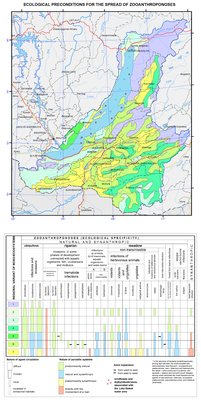
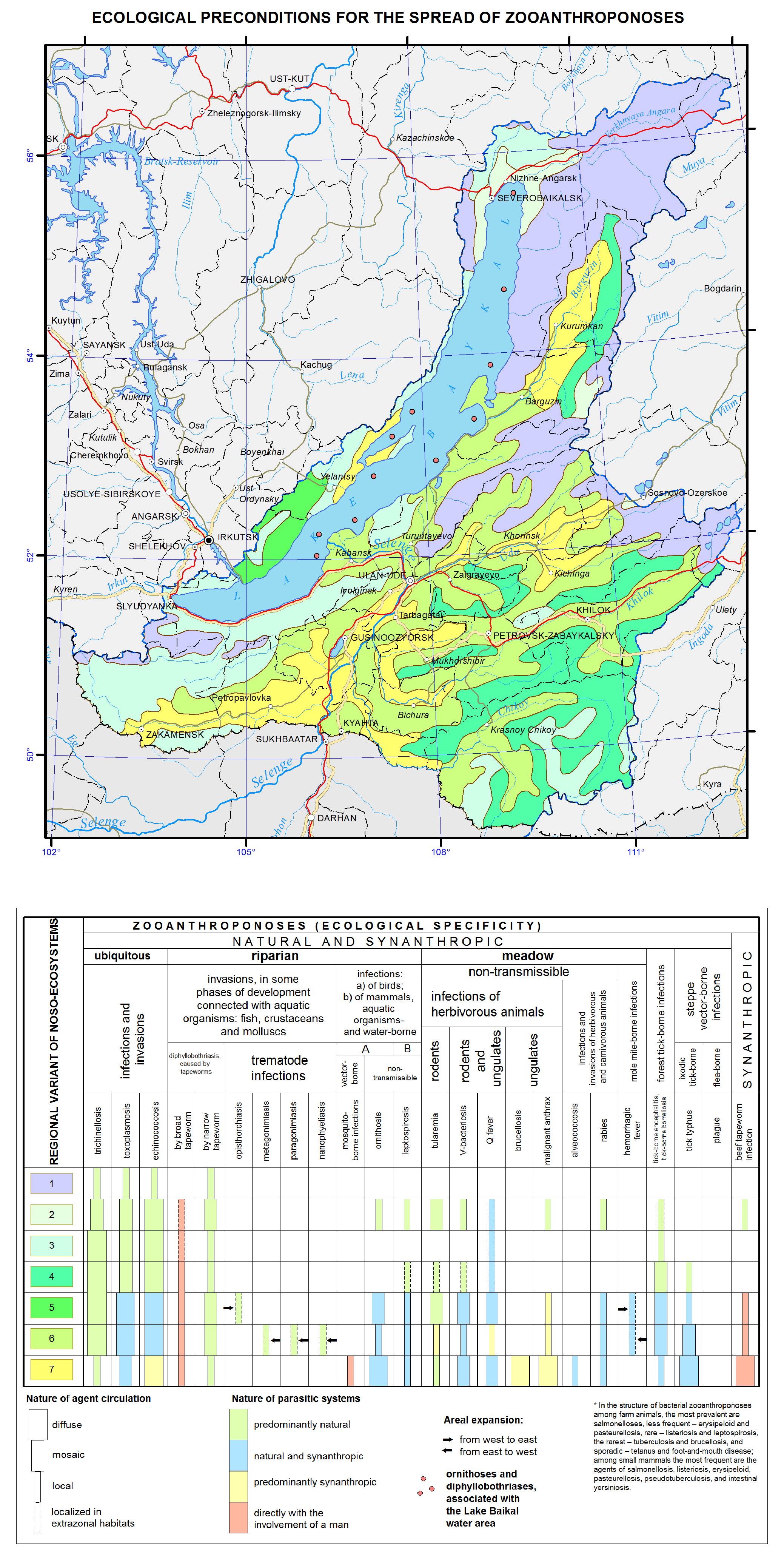
<p>The synthetic map “Environmental prerequisites of the spread of zooanthroponoses” is intended primarily for institutions working on the issues of nature conservation, environmental management, and human safety (in a broad sense of the term), as well as for the territory development planners. In the process of compiling the map, an ecological classification of zooanthroponoses was developed based on their relations with natural complexes and groups of animals. This classification subdivides them into ubiquitous (widely, almost universally spread), riparian, meadow, forest, and steppe groups. Each of these groups combines ecologically close species of pathogens with similar needs for heat and moisture and circulating in the same type of biocenosis.</p>
<p>The map shows a territorial distribution of spatial units of the nosoecological division of different taxonomic ranks: nosoecological belts, zones, and regional variants of zonal nosoecosystems. The aforementioned ecological groups of pathogens dominate in corresponding nosoecosystems of the high rank (zonal). In this case, representatives of other ecological groups are usually widespread in local habitats. The map gives a key to the development of a strategy aimed at preventing the spread of zooanthroponoses in the system of sustainable environmental management. There is a reason to believe that different ecological groups of pathogens perform different roles in maintaining the stability of biocenoses and preserving the natural environment. Representatives of the riparian and meadow groups regulate the quantitative composition of the vertebrate animals’ population (mostly rodents), stopping their mass reproduction and thus preventing the destruction of vegetation. Apparently, pathogens of the forest group (in particular, the tick-borne encephalitis virus) are able to regulate the qualitative composition of a biocenosis, protecting it from alien species, i.e. inhabitants of other (neighboring) terrain types (meadow, steppe), the number of which is subject to significant fluctuations. In seems that pathogens of the group of ubiquitous zooanthroponoses can perform various functions regulating qualitative and quantitative characteristics, but only in the group of parasites associated with vertebrates in a given biocenosis, thereby ensuring survival and well-being to their hosts.</p>
<p>These functional differences can become the basis for the development of a system of the differentiated (by landscape types) prevention of the spread of zooanthroponoses taking into account the issue of the nature and human health protection. The current level of research gives grounds to consider the regulation of the epizootic process as reasonable in those parasitic systems (riparian and meadow), where the function of pathogens is the reduction of the hosts’ number. The prevention of the spread of most zooanthroponoses (included in the riparian and meadow groups) should be carried out to optimize the density of animal population through a sustainable use of meadow vegetation by humans and the timely crops harvesting. The consequences of the human intervention in the process of circulation of pathogens regulating qualitative parameters of the structure of biocenoses are less obvious. The intensity of pathogen circulation of almost all zooanthroponoses (infections and invasions) increases in habitable and populated areas, which is due both to the introduction of farm animals, the increased concentration of which favors the development of infections, and to the human impact on the environment accompanied by the increase in the number of rodents, a change in the chemistry of soils, creation of artificial ponds, etc.</p>]]></content:encoded>
    <dc:publisher>No publisher</dc:publisher>
    <dc:creator>Alexander Ayurzhanaev</dc:creator>
    <dc:rights></dc:rights>
    <dc:date>2014-10-13T05:30:00Z</dc:date>
    <dc:type>Page</dc:type>
  </item>


  <item rdf:about="http://bic.iwlearn.org/en/atlas/atlas/96-ecological-preconditions-for-the-spread-of-zooanthroponoses-map">
    <title>096. Ecological preconditions for the spread of zooanthroponoses map</title>
    <link>http://bic.iwlearn.org/en/atlas/atlas/96-ecological-preconditions-for-the-spread-of-zooanthroponoses-map</link>
    <description></description>
    
    <dc:publisher>No publisher</dc:publisher>
    <dc:creator>Alexander Ayurzhanaev</dc:creator>
    <dc:rights></dc:rights>
    <dc:date>2014-10-13T05:20:00Z</dc:date>
    <dc:type>Folder</dc:type>
  </item>


  <item rdf:about="http://bic.iwlearn.org/en/atlas/atlas/95-disturbance-of-wildlife-map/disturbance-of-wildlife-map">
    <title>Disturbance of wildlife map</title>
    <link>http://bic.iwlearn.org/en/atlas/atlas/95-disturbance-of-wildlife-map/disturbance-of-wildlife-map</link>
    <description></description>
    <content:encoded xmlns:content="http://purl.org/rss/1.0/modules/content/"><![CDATA[<p><img class="image-inline" src="../../../resolveuid/aa5f1fc957814c299126182a77b64f96/@@images/image/preview" /></p>
<p><a href="http://bic.iwlearn.org/en/atlas/photos/copy_of__95_Disturbanceofwildlife.png" class="internal-link">Open full size</a></p>
<p align="center"><strong>Disturbance of fauna</strong></p>
<p align="center"><strong> </strong></p>
<p>The growth of industry and agriculture, increase of population and its demands from the second half of the 20th century have interfered with the Lake Baikal ecosystems, leaving very few places untouched by people’s activities. Anthropogenic impact on the wild animals of the Baikal basin was also quite considerable. Indigenous animals and intact habitats are preserved only on the restricted territories, where human activities are limited by special factors (reserve status, hard access, harsh natural conditions, etc.)</p>
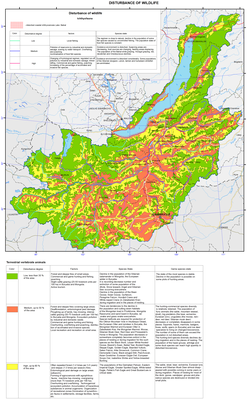
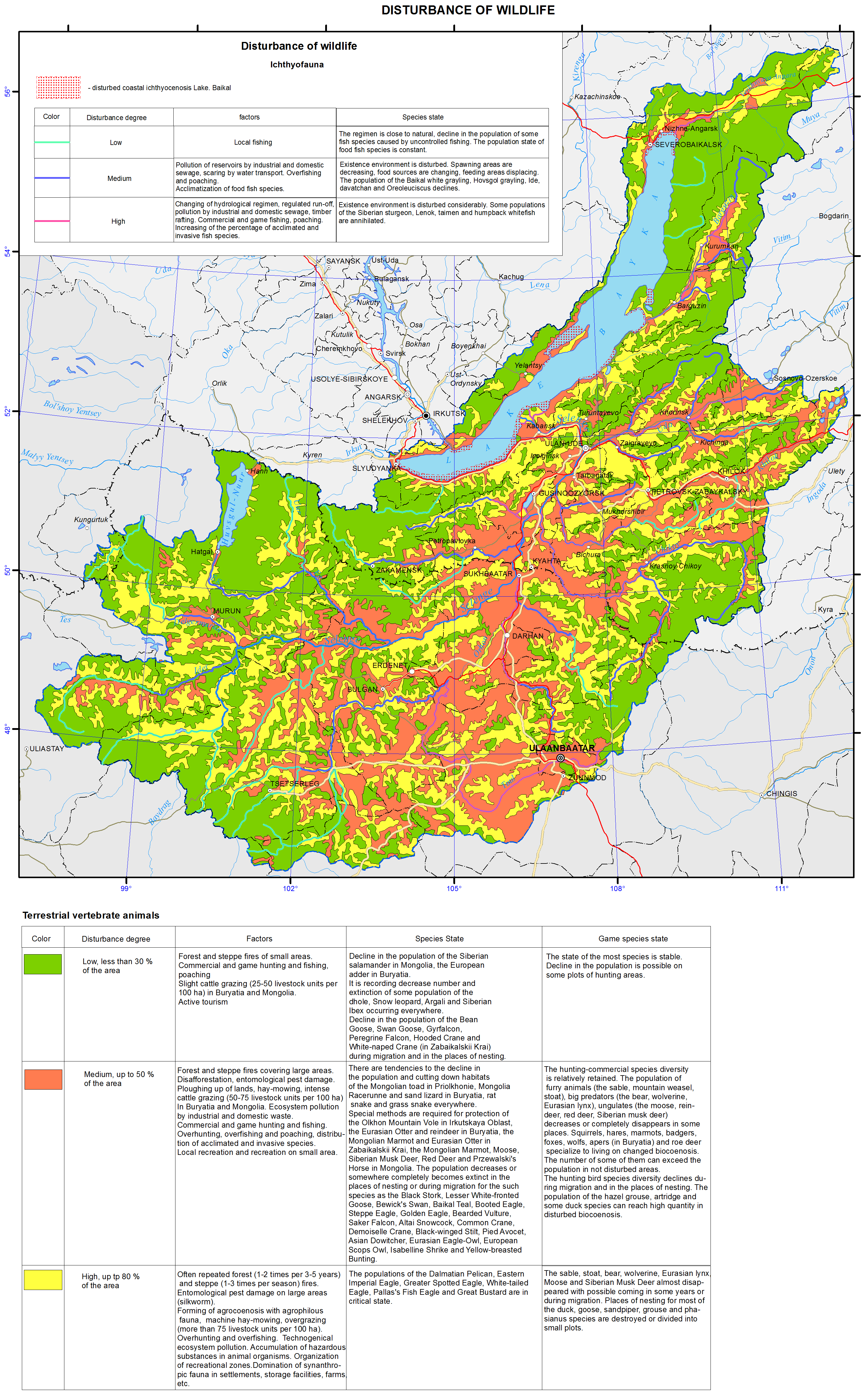
<p>The disturbance of wild animals is regarded as any change of the existing populations and communities manifested in the decrease in size, loss, and fragmentation of habitats, variations in species composition, including introduction of new species, and changes in the ecosystems. As a result, the indigenous species or communities can no longer exist [Belov et al., 2002] The disturbance of zoocenosis directly correlates with the intensity of human activities. As a rule, the mostly disturbed fauna complexes are located in the basins of major rivers, where people settled long time ago. The composition of species in these areas is represented by flexible eurytopic species, as well as synanthropic and invasive animals. Quite often the species not common for the biocenosis of some ecosystems start to dominate, when the ecosystem has been disturbed.</p>
<p>Plowing, cattle grazing, forest cuts, fires, construction works, mining, and solid and gaseous pollutant emissions influence the vertebrates fauna directly or indirectly causing changes of ecosystems, reduction in the size of animal populations, and fragmentation or full transformation of communities. Agriculture is the major factor that determines the fauna of the most part of the basin. Overgrazing and plowing deteriorate habitats, transform structure and species composition of vertebrates, and destroy nests of ground-nestling birds. Fauna complexes of the steppe zone suffer most from the abovementioned two factors. In highly degraded steppes, vertebrates are extinct almost totally. Logging and steppe and forest fires greatly affect the habitats of vertebrate animals, its species’ composition, structure, and abundance of certain species. A complex multilayered ecosystem is replaced by open spaces with altered protective, feeding, and microclimatic conditions that bring about significant changes of vertebrates. Post-fire changes in ecosystems are so drastic that restoration of certain species of vertebrates does not happen for decades.</p>
<p>Invasive alien species are justly regarded as one of the two most hazardous threats to biodiversity, coming second only to the devastation of habitats. In the XX century, intentional and unintentional introduction of various animals as a result of intensive economic activities became a global problem of the biotic exchange between biogeographical regions [Tishkov et al., 1995]. The significance of this problem has not been fully recognized yet. In the Baikal basin, the zones where fauna suffers from the introduction of alien species, are localized in the areas of long-term anthropogenic activities; however, there is a clear trend towards areal expansion of the adventive species of fauna. Introduction of alien species has an adverse impact on biodiversity and the structure and functioning of ecosystems. Synanthropes invade settlements, warehouses, industrial buildings, causing economic loss.</p>
<p><span>Diversity of fauna and the abundance of animals made hunting very attractive in the Baikal basin. As a result of long-term and intensive harvesting of birds and animals, their populations were put at risk of extinction; many of these species were listed in the regional Red Books. At present, hunting is not so popular, which has an ambiguous effect on the animal populations. Some species (Far Eastern red deer, wolf, squirrel, muskrat, Siberian striped weasel, and ermine) grow in number due to the reduced harvesting pressure and the extension of the areas disturbed by anthropogenic factor (deforested and post-fire lands). Populations of other species (roe deer, Siberian musk deer, and sable) are shrinking in size due to poaching. Hoofed mammals in Mongolia are on the margin of their habitats; therefore, their populations are rather small and require special protection and size regulation. Populations of other species are stable in size over the years, and the fluctuations are determined by natural dynamics.</span></p>
<p>Pollution and drainage of water bodies, changes in their hydrological regime due to damming, increase of water intake, disposal of wastewater by dilution, and unlimited fishing had a negative effect on the populations of many fish species, especially valuable commercial species. The rise of the Baikal water level by one meter after the construction of the Irkutsk hydro power plant reduced spawning areas of some fish species, changed nutritive base and feeding places that caused weight loss of some fish species [Monitoring …, 1991; Hydropower …, 1999] Some nestling grounds of semi-aquatic birds in the river estuaries were flooded. There is also evidence that some species of fish and freshwater seal (nerpa) accumulate heavy metals, radioactive isotopes, and chlororganic compounds [Grachev, 2002].</p>
<p>The map “Disturbance of fauna” gives an idea about the present state of the communities of the vertebrate animals in the Baikal basin. The map was created with the use of methodological guidelines for making evaluation maps developed by scientists at the V.B. Sochava Institute of Geography SB RAS [Belov et al., 2002]. The key information about the changes of the regional fauna complexes was obtained from the cartographic materials, Landsat space images, statistics on forest fires, forest cuts, and industrial pollution, and from other published materials [Atlas of the Trans-Baikal region, 1967; National atlas: Mongolian People’s Republic, 1990; Atlas of ecosystems of Mongolia, 2005]. The map was developed on the basis of vegetation maps and flora disturbance maps published in the abovementioned atlases. The map’s explanatory note distinguishes three stages of disturbance of the indigenous ecological fauna complexes and ichthyofauna. Additionally, we provide information about extinct and near-extinct vertebrate animals and primary causes of the fauna complexes’ disturbance and degradation. This map can serve as a resource for developing recommendations on the protection and rational use of the Baikal basin’s wildlife.</p>
<p> </p>
<p align="center">References</p>
<p>Atlas of the Trans-Baikal region. (1967). Moscow-Irkutsk. p 176.</p>
<p>Belov, A. V., Lyamkin, V. F., &amp; Sokolova, L. P. (2002). <i>The cartographic study of the biota</i>. Irkutsk: Oblmashinform. p 160.</p>
<p>Atutov, A. A., Pronin, N. M., &amp; Tulokhonov, A. K. (1999). <i>Hydropower industry and the ecosystem conditions of Lake Baikal</i>. Novosibirsk: SB RAS Publishing. p 281.</p>
<p>Grachev, M. A. (2002). <i>On the current state of the Baikal ecosystem</i>. Novosibirsk: SB RAS Publishing. p 156.</p>
<p>National atlas: Mongolian People’s Republic. (1990). Moscow-Ulaanbaatar. p 144.</p>
<p>Israel, Y. A., Anokhin, Y. A. (1991). <i>Monitoring of the state of Lake Baikal</i>. Leningrad: Hydrometeoizdat. p 262.</p>
<p>Tishkov, A. A., Maslyakov, V. Y., &amp; Tsarevskaya, N. G. (1995). Anthropogenic transformation of biodiversity in the process of unintentional introduction of organisms (biogeographical consequences). <i>Bulletin of the Russian Academy of Sciences: Geography</i>, 4. p 74-85.</p>
<p>Atlas of ecosystems of Mongolia. (2005). Moscow. p 48.</p>]]></content:encoded>
    <dc:publisher>No publisher</dc:publisher>
    <dc:creator>Alexander Ayurzhanaev</dc:creator>
    <dc:rights></dc:rights>
    <dc:date>2014-10-13T05:20:00Z</dc:date>
    <dc:type>Page</dc:type>
  </item>


  <item rdf:about="http://bic.iwlearn.org/en/atlas/atlas/95-disturbance-of-wildlife-map">
    <title>095. Disturbance of wildlife map</title>
    <link>http://bic.iwlearn.org/en/atlas/atlas/95-disturbance-of-wildlife-map</link>
    <description></description>
    
    <dc:publisher>No publisher</dc:publisher>
    <dc:creator>Alexander Ayurzhanaev</dc:creator>
    <dc:rights></dc:rights>
    <dc:date>2014-10-13T05:15:00Z</dc:date>
    <dc:type>Folder</dc:type>
  </item>


  <item rdf:about="http://bic.iwlearn.org/en/atlas/atlas/94-disturbance-of-forest-lands-map/disturbance-of-forest-lands-map">
    <title>Disturbance of forest lands map</title>
    <link>http://bic.iwlearn.org/en/atlas/atlas/94-disturbance-of-forest-lands-map/disturbance-of-forest-lands-map</link>
    <description></description>
    <content:encoded xmlns:content="http://purl.org/rss/1.0/modules/content/"><![CDATA[<p><img class="image-inline" src="../../../resolveuid/1511981ab9c346ecad42fcaa40699021/@@images/image/preview" /></p>
<p><a href="http://bic.iwlearn.org/en/atlas/photos/copy_of__94_DisturbanceofForestLands.png" class="internal-link">Open full size</a></p>
<p align="center"><strong>Disturbance of forest land</strong></p>
<p align="center"><strong> </strong></p>
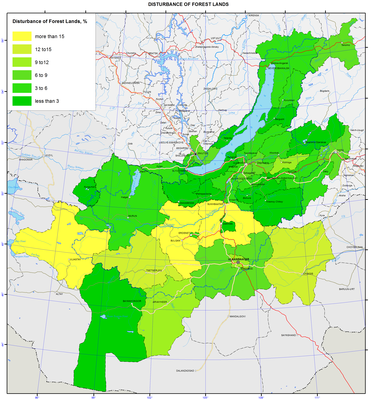
<p>Under the disturbed land we understand the value that reflects the ratio of the reforestation fund area to the area of forest lands (on the forest fund lands and other land categories, where forests are located). Reforestation Fund consolidates the areas of forest land with stands, damaged by fires, pests and logging. Forest land in contrast to non-forest one represents a category with the following main functions: cultivation, conservation, improving the properties of the main forest forming species. The major part of the forest land is forested and the rest is not covered by forest (burnt areas, dead stands, slashes, clearing sand wastelands). There the reforestation measures are conducted, thus, they contribute to natural regeneration.</p>
<p>On the territory of the Russian part of the Baikal basin, the average disturbance of forest land is 6.1%. It is fluctuating from 0.06 % in the Krasnochikoysky district of Zabaikalsky krai to 9% in the Kizhinginsky district of the Republic of Buryatia. In the Mongolian part of the basin, the disturbance of forest land is higher than in Russia – on the average 9.7%. However, in aimags it is fluctuating from 0.1 to 19.9 %. In six aimags the disturbance of forest lands is more considerable – more than 10%. Such a situation in Mongolia is possibly caused by more accurate description of forest areas with damaged forest stands.</p>]]></content:encoded>
    <dc:publisher>No publisher</dc:publisher>
    <dc:creator>Alexander Ayurzhanaev</dc:creator>
    <dc:rights></dc:rights>
    <dc:date>2014-10-13T05:10:00Z</dc:date>
    <dc:type>Page</dc:type>
  </item>


  <item rdf:about="http://bic.iwlearn.org/en/atlas/atlas/94-disturbance-of-forest-lands-map">
    <title>094. Disturbance of forest lands map</title>
    <link>http://bic.iwlearn.org/en/atlas/atlas/94-disturbance-of-forest-lands-map</link>
    <description></description>
    
    <dc:publisher>No publisher</dc:publisher>
    <dc:creator>Alexander Ayurzhanaev</dc:creator>
    <dc:rights></dc:rights>
    <dc:date>2014-10-13T04:50:00Z</dc:date>
    <dc:type>Folder</dc:type>
  </item>


  <item rdf:about="http://bic.iwlearn.org/en/atlas/atlas/93-the-disturbance-of-vegetation-in-the-lake-baikal-basin-map/the-disturbance-of-vegetation-in-the-lake-baikal-basin-map">
    <title>The disturbance of vegetation in the lake Baikal basin map</title>
    <link>http://bic.iwlearn.org/en/atlas/atlas/93-the-disturbance-of-vegetation-in-the-lake-baikal-basin-map/the-disturbance-of-vegetation-in-the-lake-baikal-basin-map</link>
    <description></description>
    <content:encoded xmlns:content="http://purl.org/rss/1.0/modules/content/"><![CDATA[<p><img class="image-inline" src="../../../resolveuid/9768ae7881774f00bbb4e1df766e8cc8/@@images/image/preview" /></p>
<p><a href="http://bic.iwlearn.org/en/atlas/photos/copy_of__93_ThedisturbanceofvegetationinthelakeBaikalbasin.png" class="internal-link">Open full size</a></p>
<p align="center"><strong>Vegetation disturbance</strong></p>
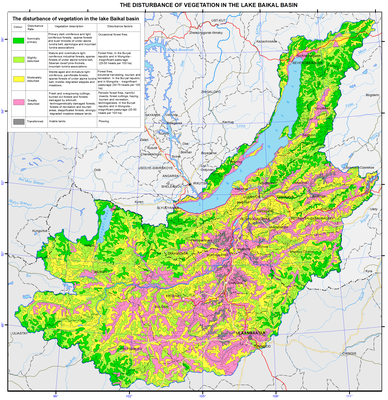
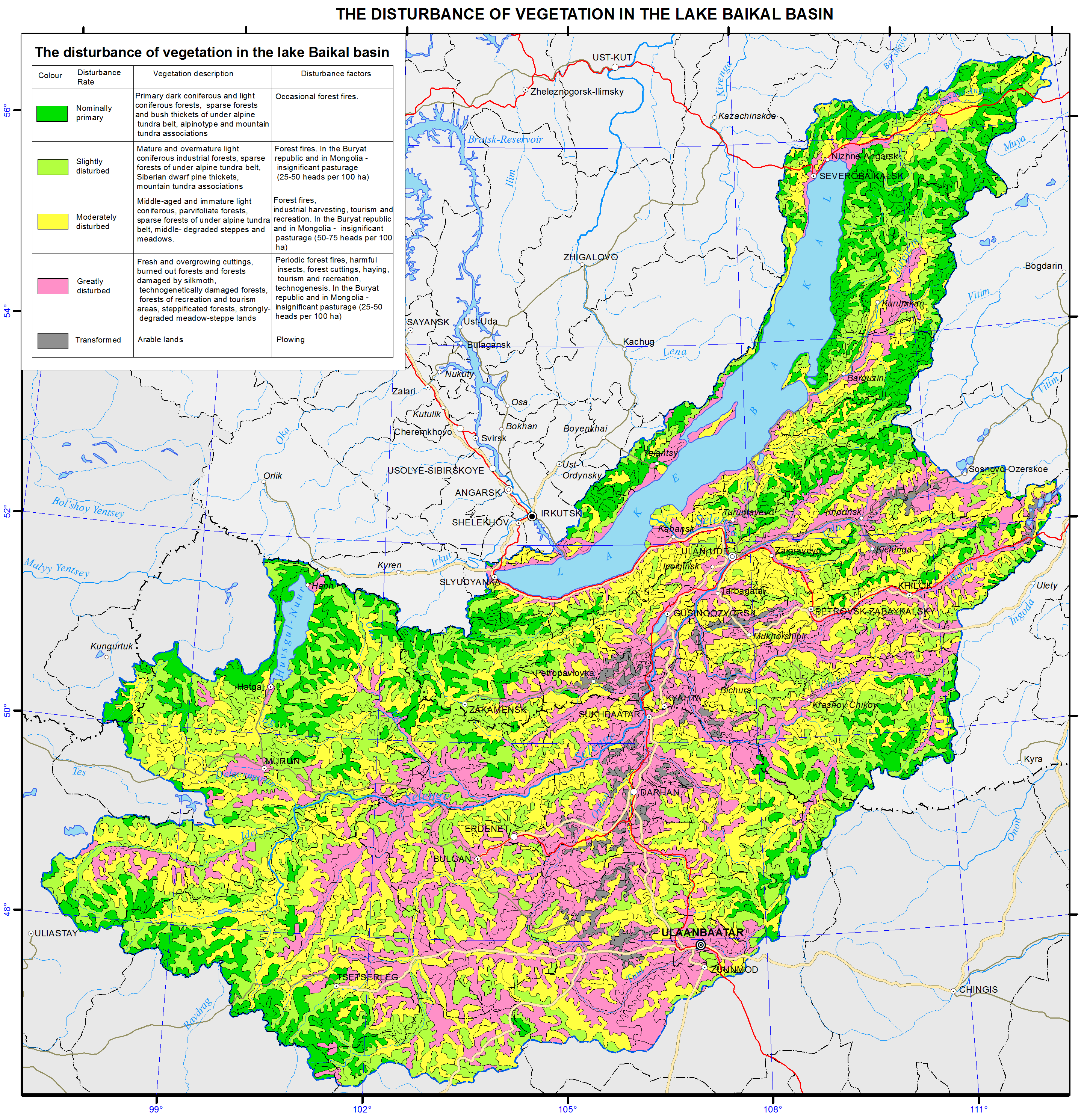
<p>A cartographic evaluation of the anthropogenic disturbance of vegetation is the most effective method for solving numerous issues of environmental protection and the rational use of biotic resources in the Baikal basin. It was carried out taking into account the major changes in the floristic composition and cenotic structure of vegetation, which is developing mainly under the influence of anthropogenic factors. The degree of anthropogenic disturbance of the vegetation was determined by deviation criteria of the composition and structure of plant communities from their native state.</p>
<p>The evaluation is based on a modern universal map “Vegetation of the Baikal basin” 1:4, 000,000, which is created on the principles of a structural-dynamic classification of vegetation taking into account its main regional-typological features and dynamic processes caused by human and natural factors. Thus, invariants of epistructures of plant communities were established and thereby the base (zero) estimation level was defined, which was the starting point for the countdown of actual spontaneous and human-induced changes in the vegetation cover.</p>
<p>Besides the universal geobotanic map, basic cartographic sources were used in assessing the vegetation disturbances. These sources provide information about the boundaries of arable land and farmland and forests damaged by technogenesis, recreation, and harmful insects, burnt sites and regenerated cutover stands. Forest and land use management materials and Google 2013 surveying satellite images were used.</p>
<p>The disturbance of vegetation of the Baikal basin is determined primarily by its use as an industrial and agricultural resource, which is based on forests, grasslands and steppes.</p>
<p>Industrial logging leads to a change of indigenous coniferous stands to small-leaved, less valuable for the economy. Abandoned semi-subsistence raw materials on slashes increase forest fire debris and entomological danger. Light coniferous forests located in the riversides, especially on fertile soils used for agriculture, are often cut.</p>
<p>Besides logging, the forests in Irkutsk oblast, the Republic of Buryatia, Zabaikalsky krai, as well as in Mongolia are annually exposed to forest fire. Fire damages not only the forest but also the community of other vegetation types - mountain tundra, subalpine elfin cedar thickets, yerniks, steppes and others. That leads to the accumulation of large burnt areas, replacing native forests derivatives.</p>
<p>Negative impact on the steppe vegetation is also caused by plowing and irrational use of grazing territory. As for the pastural digression of vegetation, it has completely or partially changed the floristic composition and structure of many steppe and meadow communities.</p>
<p>In Mongolia, grazing currently remains the main type of agriculture. Here they raise cattle, sheep, camels, goats and horses, as well as Mongolian yaks and reindeer. Alpine pastures are even mountain-tundra, cryophyte steppe, marshy meadow and steppe. Vegetation communities of middle mountain, foothill, lowland areas and basins are widely used for pasture. Vegetation communities of floodplains and lakeshores with forest, meadow, prairie and wetland vegetation are especially strongly disturbed [Banzragch, et al, 1990].</p>
<p>In general, in Mongolia, as well as in Irkutsk oblast, the Republic of Buryatia and Zabaikalsky krai in the remote and undeveloped alpine areas, where there is no human activities, undisturbed (indigenous) vegetation is provisionally preserved. According to the development and availability of the areas, the assessment of vegetation disturbance is changing.</p>
<p>As a result of the analysis and assessment of vegetation communities, five categories of vegetation disturbance are identified on the map – conditionally drastic, weakly, moderately, and strongly disturbed and reformed.</p>
<p> </p>
<p align="center">References</p>
<p>Banzragch, D., Beckett, U., Buyan-Orshih, H., Munkhbayar, S., &amp; Tsedendash, T. (1990). The map: Types of pastures. Scale 1:3,000,000. <i>National atlas of the Mongolian People’s Republic</i>. Moscow-Ulaanbaatar. p 102-103.</p>]]></content:encoded>
    <dc:publisher>No publisher</dc:publisher>
    <dc:creator>Alexander Ayurzhanaev</dc:creator>
    <dc:rights></dc:rights>
    <dc:date>2014-10-13T00:25:00Z</dc:date>
    <dc:type>Page</dc:type>
  </item>


  <item rdf:about="http://bic.iwlearn.org/en/atlas/atlas/93-the-disturbance-of-vegetation-in-the-lake-baikal-basin-map">
    <title>093. The disturbance of vegetation in the lake Baikal basin map</title>
    <link>http://bic.iwlearn.org/en/atlas/atlas/93-the-disturbance-of-vegetation-in-the-lake-baikal-basin-map</link>
    <description></description>
    
    <dc:publisher>No publisher</dc:publisher>
    <dc:creator>Alexander Ayurzhanaev</dc:creator>
    <dc:rights></dc:rights>
    <dc:date>2014-10-13T00:15:00Z</dc:date>
    <dc:type>Folder</dc:type>
  </item>


  <item rdf:about="http://bic.iwlearn.org/en/atlas/atlas/92-pasture-degradation-map/pasture-degradation-map">
    <title>Pasture degradation map</title>
    <link>http://bic.iwlearn.org/en/atlas/atlas/92-pasture-degradation-map/pasture-degradation-map</link>
    <description></description>
    <content:encoded xmlns:content="http://purl.org/rss/1.0/modules/content/"><![CDATA[<p><img class="image-inline" src="../../../resolveuid/143d2c9cfc4847ab92628a40b6d077ae/@@images/image/preview" /></p>
<p><a href="http://bic.iwlearn.org/en/atlas/photos/copy_of__92_PastureDegradation.png" class="internal-link">Open full size</a></p>
<p align="center"><strong>Pasture </strong><strong>D</strong><strong>egradation</strong></p>
<p align="center"><strong> </strong></p>
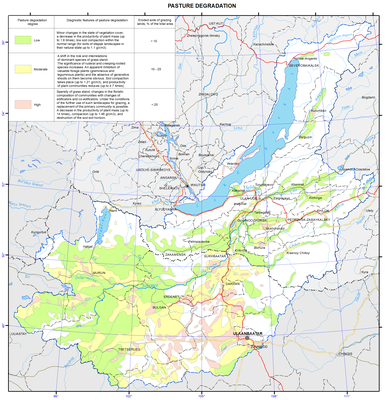
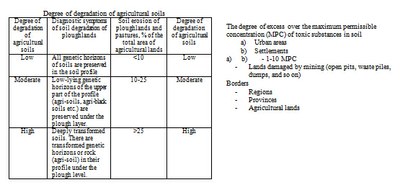
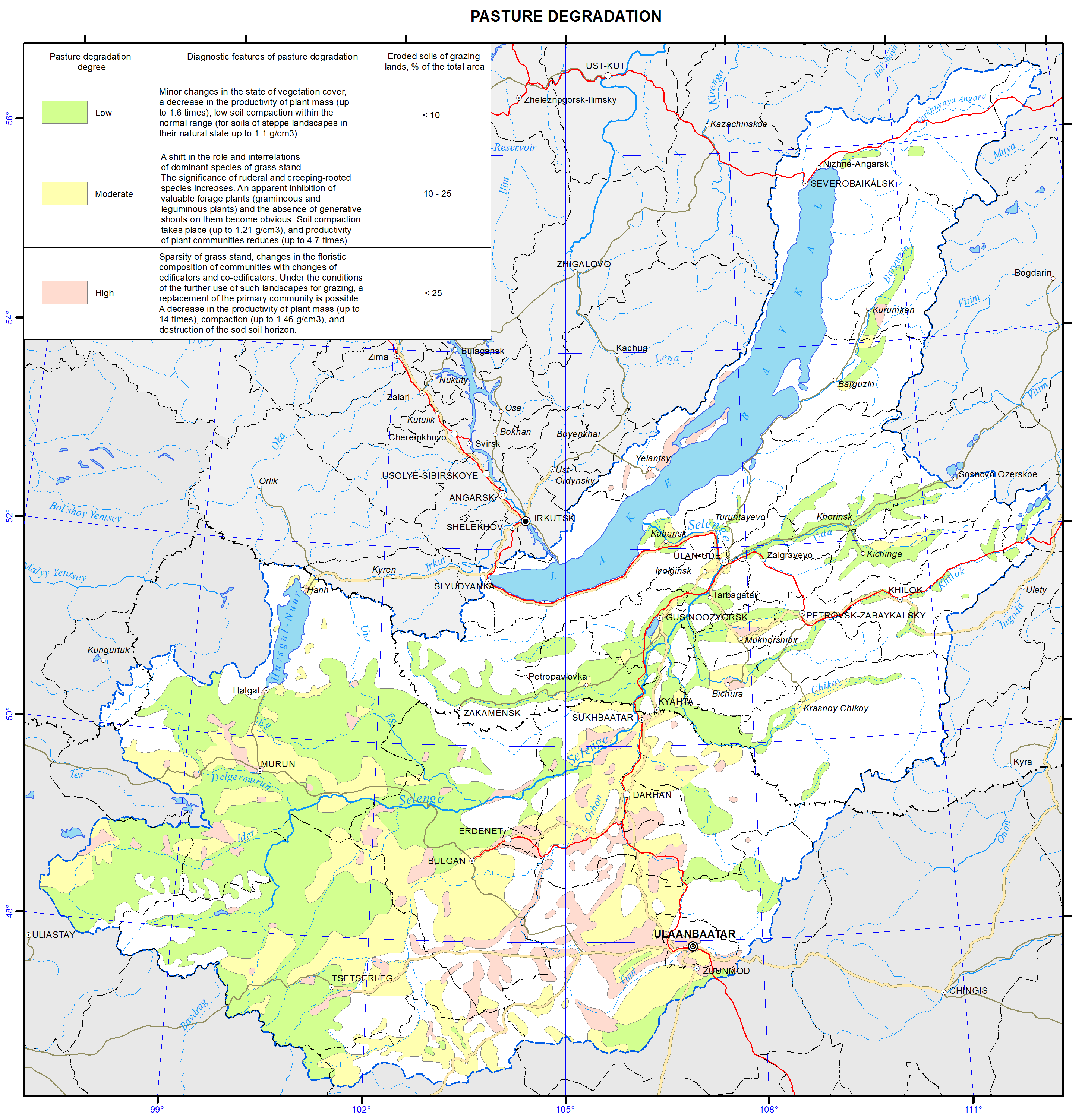
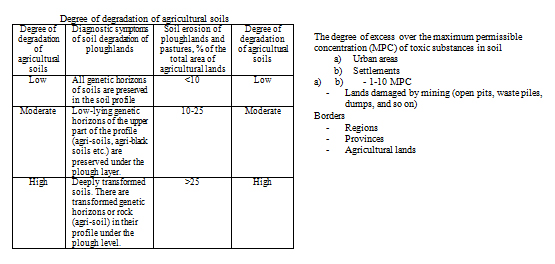
<p>Under the conditions of a complex geomorphological structure of the territory, uneven particle-size distribution, and often thin profile of soils, degradation processes are dominated by linear and sheet erosion. Based on the intensity of development of water erosion and deflation processes and, consequently, different disturbances of the soil profile, as well as according to the results of evaluating the areal development of all types of erosion processes, three degrees of land degradation are shown on the map in shading: slight, moderate, and severe. They were determined by the share of the main categories of eroded soils as a percentage of the agricultural lands area. Twenty-four percent, up to 42%, 47%, and more than 60% of developed lands are eroded in varying degrees in the Baikal region, in the territory of the Republic of Buryatia, in the Olkhon district, and in some areas of Mongolia, respectively.</p>
<p>As a result of a special analysis and assessment of the pasture condition, three categories of the degree of their degradation are distinguished in the map “Pasture degradation”, namely: low, moderate, and high. The map’s explanatory note explains the diagnostic features of pasture degradation. The predominant part of pastures experiencing moderate anthropogenic impact is classified as slightly or moderately disturbed.</p>
<p>In general, the map is the basis for preventing the development of dangerous geo-ecological situations in the region, organizing environmental activities, and optimizing the management of the biogeochemical environment of the population’s life-sustaining activities.</p>
<p> </p>
<p align="center">References</p>
<p>Dorzhgotov, D. and Batkhishig, O. (2009). Soils: The soil and geographical zoning of Mongolia. <i>National Atlas of Mongolia</i>. Ulaanbaatar. p 120-122.</p>
<p>Dorzhgotov, D. (1976). <i>Soil classification of Mongolia</i>. Ulaanbaatar. p 170.</p>
<p>Dorzhgotov, D. (2003). <i>Soils of Mongolia</i>. Ulaanbaatar. p 370.</p>
<p>Kuzmin, V. A. (2004). The soil cover: The soil and ecological zoning of Irkutsk oblast. <i>Atlas of Irkutsk oblast</i>. Irkutsk. p 40-41.</p>
<p>Nechaeva, E. G., Belozertseva, I. A., Naprasnikova, E. V., Vorobyeva, I. B., Dubynina, S. S., Davydova, N. D., &amp; Vlasova N. V. (2010). <i>Monitoring and forecasting of the substance-dynamical state of geosystems in Siberian regions</i>. Novosibirsk: Nauka. p 315.</p>
<p>Nechaeva, E. G. (2001). Landscape-geochemical zoning of Asian Russia. <i>Geography and Natural Resources, 1.</i> p 12-18.</p>
<p>Nechaeva, E. G., Belozertseva, I. A., Davydova, N. D., &amp; Sorokovoy, A. A. (2009). The map of degradation and contamination of the soil cover. Scale 1:5,000,000. <i>Electronic atlas of natural resources, economy, and population of the Baikal Region</i>. Irkutsk: V.B. Sochava Institute of Geography SB RAS.</p>
<p>Sochava, V. B., Timofeev, D. A. (1968). Physical and geographical regions of North Asia. <i>Proceedings of the Institute of Geography of Siberia and the Far East, 19</i>. p 3-19.</p>
<p>Ubugunov, L. L., Badmaev, N. B., Ubugunova, V. I., Gyninova, A. B., Balsanova, L. D., Ubugunov, V. L., Gonchikov, B. N., &amp; Tsybikdorzhiev, T. D-T. (2011). <i>Soil map of Buryatia. Scale 1:3,000,000</i>. Ulan-Ude: Institute of General and Experimental Biology SB RAS.</p>
<p>Khismatullin, S. D. (1991). Erosion on agricultural lands of Irkutsk oblast. <i>Geography and Natural Resources, 4</i>. p 49-61.</p>
<p>Shishov, L. L., Tonkonogov, V. D., Lebedeva, I. I., &amp; Gerasimova, M. I. (2004). <i>Classification and diagnostics of soils of Russia</i>. Smolensk: Oikumena. p 342.</p>
<p>Degradation of ecosystems. (2005). In E. A. Vostokova &amp; P. D. Gunin (Eds.), <i>Atlas of Ecosystems of Mongolia</i>. Moscow. p 44.</p>]]></content:encoded>
    <dc:publisher>No publisher</dc:publisher>
    <dc:creator>Alexander Ayurzhanaev</dc:creator>
    <dc:rights></dc:rights>
    <dc:date>2014-10-10T06:50:00Z</dc:date>
    <dc:type>Page</dc:type>
  </item>


  <item rdf:about="http://bic.iwlearn.org/en/atlas/atlas/92-pasture-degradation-map">
    <title>092. Pasture degradation map</title>
    <link>http://bic.iwlearn.org/en/atlas/atlas/92-pasture-degradation-map</link>
    <description></description>
    
    <dc:publisher>No publisher</dc:publisher>
    <dc:creator>Alexander Ayurzhanaev</dc:creator>
    <dc:rights></dc:rights>
    <dc:date>2014-10-10T06:40:00Z</dc:date>
    <dc:type>Folder</dc:type>
  </item>


  <item rdf:about="http://bic.iwlearn.org/en/atlas/atlas/91-soil-degradation-and-contamination-map/soil-degradation-and-contamination-map">
    <title>Soil degradation and contamination map</title>
    <link>http://bic.iwlearn.org/en/atlas/atlas/91-soil-degradation-and-contamination-map/soil-degradation-and-contamination-map</link>
    <description></description>
    <content:encoded xmlns:content="http://purl.org/rss/1.0/modules/content/"><![CDATA[<p><img class="image-inline" src="../../../resolveuid/dc0128e97e2e4ba2af493a1d5ef326ef/@@images/image/preview" /></p>
<p><a href="http://bic.iwlearn.org/en/atlas/photos/copy_of__91_Soildegradationandcontamination.png" class="internal-link">Open full size</a></p>
<p align="center"><strong>Soil degradation and contamination</strong></p>
<p align="center"><strong> </strong></p>
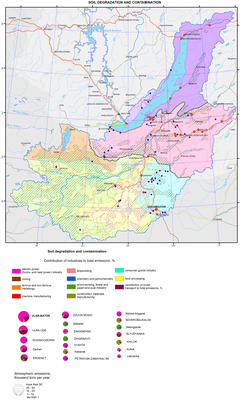
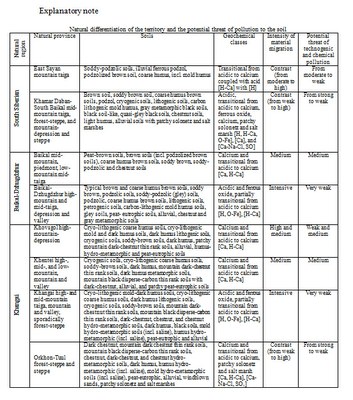
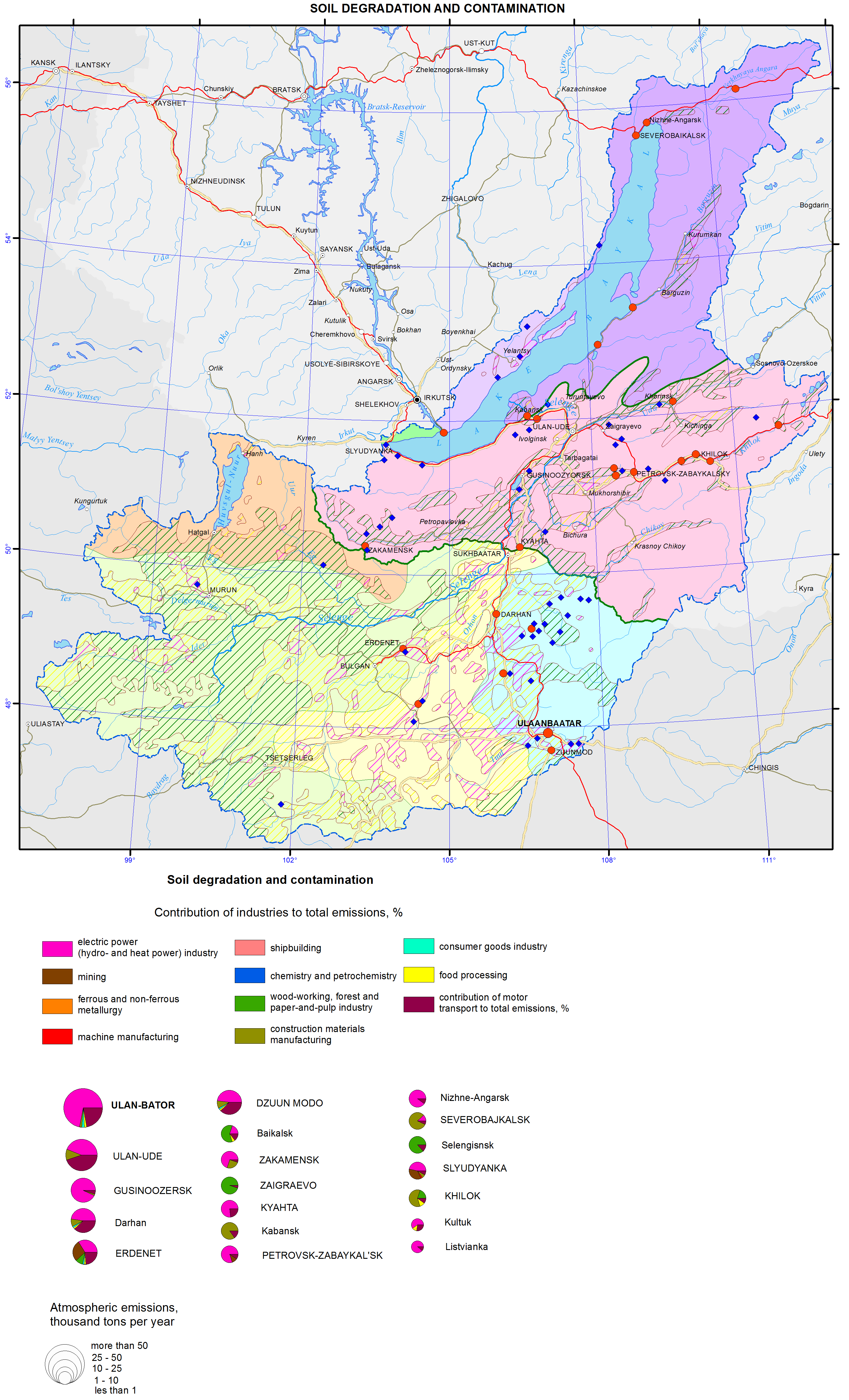
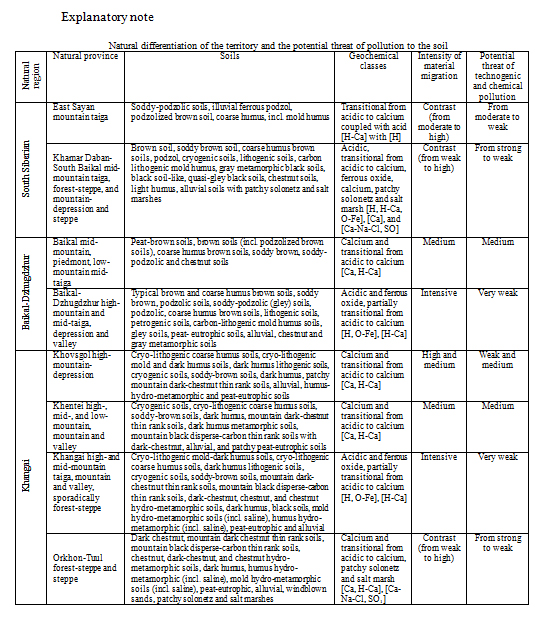
<p>The background basis of this map is the differentiation of the soil cover according to the conditions of its self-purification capacity, controlled by the processes of migration and accumulation of chemical elements. In this regard, the largest territory units are landscape-geochemical areas. They are distinguished based on the boundaries of the major lithological-geomorphological structures and bioclimatic conditions.</p>
<p>More fractional territory subdivisions are landscape-geochemical provinces, singled out based on a complex of factors of potential contamination of soils and their degradation in the process of different types of nature management. Among these factors is the zonal and altitude-belt specificity of bioclimatic conditions, determined by hydrothermal parameters of the territory. The possibility of involving elements-pollutants of the environment in the biological cycle and the food chain of living organisms depends on them. The rate of development of biochemical processes of pollutants transformation in the soil medium and neutralization of their toxic action also depends on the amount and ratio of heat and moisture. Another equally important factor of self-purification of the soil cover is the water migration of material. Criteria for determining the differentiation of the territory according to the intensity of material migration (IMM) are topography and true altitude (TA) of the area. Weak IMM is peculiar to lowland plain surfaces with TA below 200 m; medium IMM – to low-mountain relief terrain, and high and low plateau with TA from 400 to 600 m; high IMM – to middle altitudes and steep slopes with TA of 600-1000 m; and intensive IMM – to high mountains with TA above 1000 m. Mountain-depression landscapes widespread within the given territory are characterized by contrast migration: from intense to weak.</p>
<p>Geochemical classes, denoted by the indices of typomorphic elements, contain the integral characteristics of the soil medium, which is depositing with respect to the pollutants. The classes reflect alkaline-acid and redox conditions of the environment peculiar to different landscapes: the main factors of functioning of the migration-accumulation mechanism in soils and formation of various geochemical barriers, where elements-pollutants may deposit.</p>
<p>Based on these main criteria for evaluating the self-purification capacity of soils taking into account the location of currently functioning sources of industrial emissions into the environment within the territory, an assessment of the hazard level of its technogenic-chemical pollution was made.</p>
<p>Against the background of the degree of the potential hazard of soil contamination estimated according to the natural factors, the main sources of pollution are shown. They are industrial and boiler facilities of the towns of Slyudyanka, Baikalsk, Severobaikalsk, Nizhneangarsk, Listvyanka, Ulan-Ude, Gusinoozersk, Petrovsk-Zabaikalsk, Kyakhta, Ulaanbaatar, Darkhan, Erdenet, Zuunmod, etc. Virtually all industrial complexes are located in the conditions with insufficient self-purification of the environment, and those ones, emissions of which are heading toward<b> </b>the Baikal depression, represent a factor of environmental risk for it. The map shows the areas of soil contamination with the exceedance of pollutants MPC, their total emissions, industrial sources, and their contribution to air pollution. The pollution halos, 1-10 times exceeding the MPC values in the sum of the priority toxic elements (hazard class I-III), are contoured with a linear map sign. Emission rates into the atmosphere are presented in a pie chart for the sources with emissions of more than one thousand tons per year. The proportion (%) of different industries in the gross emissions is marked in the diagram. Halos with the emission sources of less than one thousand tons per year cover a small area, and in the given scale they are marked with point signs.</p>
<p>A significant contribution to the mechanical degradation and contamination of the soil cover in the Baikal basin, rich with various mineral resources, is made by their industrial development. Conventional signs mark the lands of mining industry (quarries, terricones, dumps, etc.). The most significant in size and intensive in the degree of disturbance of the soil cover and the geological environment are objects, registered in the Gusinoozersky and Erdenetsogt coal basins.</p>
<p><img class="image-inline" src="../../../../resolveuid/e766171404184f27b2846f1714ce7648/@@images/image/preview" /></p>
<p><a href="http://bic.iwlearn.org/en/photos/91.jpg" class="internal-link">Open full size</a></p>
<p><img class="image-inline" src="../../../../resolveuid/f544375ea10f4320b5d6edd91e462b56/@@images/image/preview" /></p>
<p><a href="http://bic.iwlearn.org/en/photos/911.jpg" class="internal-link">Open full size</a></p>]]></content:encoded>
    <dc:publisher>No publisher</dc:publisher>
    <dc:creator>Alexander Ayurzhanaev</dc:creator>
    <dc:rights></dc:rights>
    <dc:date>2014-10-10T06:25:00Z</dc:date>
    <dc:type>Page</dc:type>
  </item>


  <item rdf:about="http://bic.iwlearn.org/en/atlas/atlas/91-soil-degradation-and-contamination-map">
    <title>091. Soil degradation and contamination map</title>
    <link>http://bic.iwlearn.org/en/atlas/atlas/91-soil-degradation-and-contamination-map</link>
    <description></description>
    
    <dc:publisher>No publisher</dc:publisher>
    <dc:creator>Alexander Ayurzhanaev</dc:creator>
    <dc:rights></dc:rights>
    <dc:date>2014-10-10T06:20:00Z</dc:date>
    <dc:type>Folder</dc:type>
  </item>


  <item rdf:about="http://bic.iwlearn.org/en/atlas/atlas/90-conventional-symbols-mining-enterprises-map/conventional-symbols-mining-enterprises-map">
    <title>Conventional symbols mining enterprises map</title>
    <link>http://bic.iwlearn.org/en/atlas/atlas/90-conventional-symbols-mining-enterprises-map/conventional-symbols-mining-enterprises-map</link>
    <description></description>
    <content:encoded xmlns:content="http://purl.org/rss/1.0/modules/content/"><![CDATA[<p><img class="image-inline" src="../../../resolveuid/de155f20f4d84770a2d77f9a7045b9b5/@@images/image/preview" /></p>
<p><a href="http://bic.iwlearn.org/en/atlas/photos/copy_of__90_ConventionalsymbolsMiningenterprises.png" class="internal-link">Open full size</a></p>
<p><img class="image-inline" src="../../../../resolveuid/08757ef24dc744fe811734814b13d6b5/@@images/image/preview" /></p>
<p><a href="http://bic.iwlearn.org/en/photos/copy_of__90_Table_1_Legend_ConventionalsymbolsMiningenterprises.png" class="internal-link">Open full size</a></p>
<p><img class="image-inline" src="../../../../resolveuid/3798776aa21f476a9973ead6458c2523/@@images/image/preview" /></p>
<p><a href="http://bic.iwlearn.org/en/photos/copy_of__90_Table_2_Legend_ConventionalsymbolsMiningenterprises.png" class="internal-link">Open full size</a></p>
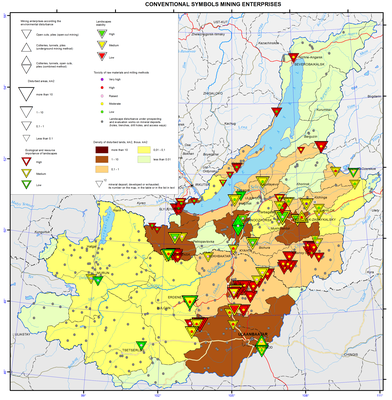
<p align="center"><strong>Environmental impact of mining industry</strong></p>
<p>Mining industry is one of the sectors strongly and comprehensively affecting the environment. The intensive use of land lots for mining mineral resources leads to the destruction of the surface ground layer, creation of mining openings, disturbance of the hydrological regime of rivers, soil and surface and underground water pollution, and destruction of the environmental integrity and natural landscapes.</p>
<p>The importance of mining industry for Siberia and Mongolia is explained by their mineral resources specialization. Within the context of transitioning to sustainable (balanced) development, the high cost-effectiveness of the mining industry along with environmental compliance and the increase of social and living standards of the population are especially important.</p>
<p>This map reflecting the impact of mining on the environment was created to reveal the ecological component of sustainable development in the Baikal basin.</p>
<p>In the process of creating this map, the following library and published data were used: “National atlas of the Mongolian People’s Republic” (1990), “The ecological and geographic map of the Russian Federation” (1996), “Atlas of social and economic development of Russia” (2009), and “National atlas of Mongolia” (2009), etc. High-resolution satellite images (made in 2010-2013) were deciphered and used to examine the landscape structure of the territory. The state of the industrial sector and environment in the areas of mineral resources management was determined.</p>
<p>The objects of ecological evaluation were mineral deposits and mining enterprises. The information about them is provided on the basic maps that are part of this Atlas: “Fuel-energy resources and their development”, “Resources of ferrous, non-ferrous, and rare metals and their extraction”, “Basic types of nonmetallic materials, resources, and development”.</p>
<p>The biggest part of the researched area is part of the central and buffer zones of the Baikal Natural Territory within the Russian Federation. The Baikal basin in Mongolia is a natural continuation of this buffer zone. According to the Russian law “On the Protection of Lake Baikal”, the ecological zoning of the Baikal Natural Territory is the main tool for its implementation. Specific conservation restrictions are applied in the central ecological zone surrounding the Lake Baikal depression. Among the types of activities prohibited in this zone are the extraction of crude oil, natural gas, and radioactive and metal ores and the exploration and mining of previously undeveloped new deposits. The extraction of mineral resources within the water area of Baikal, in its water-protection zone, and in spawning rivers and their water-protection zones is prohibited.</p>
<p>In the buffer zone, the prospected and prepared for the development deposits, as well as mining operations are located within the ecological districts of Type 6, which includes industrial districts with a regulated intensive development. This type of districts is characterized by highly valuable landscapes and their components with an average or low sensitivity to stress. They mostly include the valley, piedmont, steppe and sub-taiga landscapes. The reason for singling out these districts is the importance of mining for the economy of the region. However, mining operations should not negatively affect the ecological system of Lake Baikal.</p>
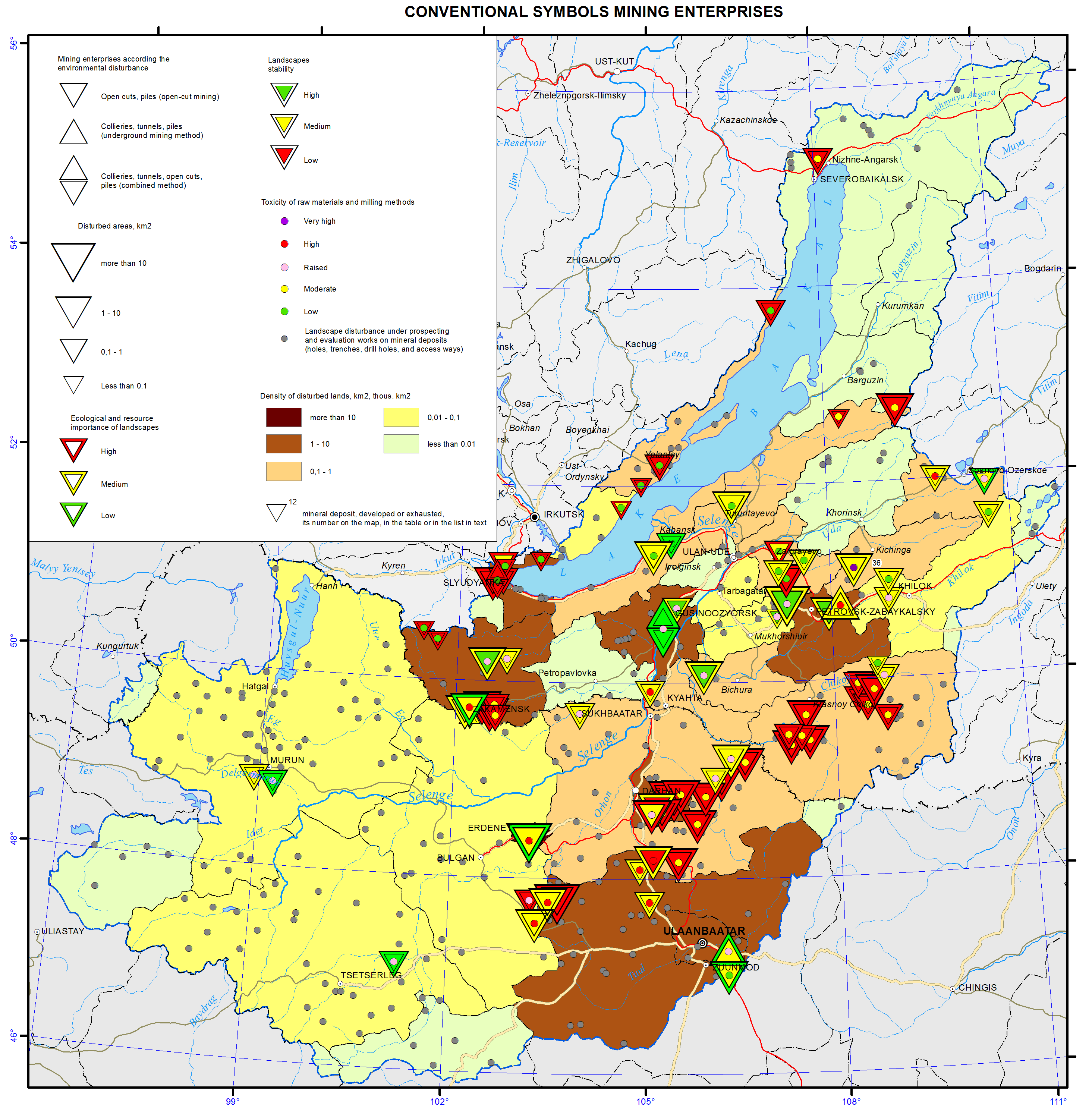
<p>The cartographic evaluation of the technogenic disturbances of landscapes within the studied territories is provided for 380 mineral deposits. At present, 75 deposits are being developed. At 12 deposits mining operations are suspended, and they are either moth-balled or turned into reserves. The impact of mining enterprises on the environment is primarily determined by mining methods, the toxicity of raw materials and reagents used in processing, and landscape features.</p>
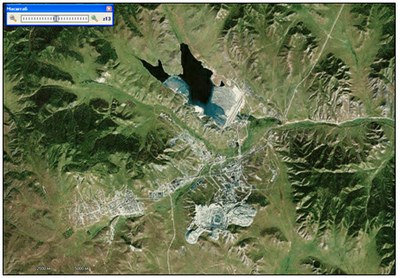
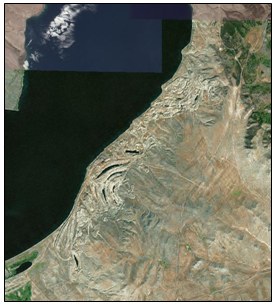
<p>The maximum impact on the environment, which is manifested in the drastic transformation of the relief with the formation of the technogenic denudation and accumulated forms, is caused by open-pit mining operations that remain a preferred mining method in the majority of cases due to economic considerations. On the territory under observation, 73 deposits are being developed by the open-pit mining method, and only 2 deposits are developed by the underground mining methods (the Bom-Gorkhon tungsten deposit and Nalaikh brown coal deposit). The main indicator of technogenic impact on the lithosphere is the area of disturbed land in square km, which is assessed using the following grades: I – over 10 km<sup>2 </sup>– the strongest impact, II – 1-10 km<sup>2</sup> – strong impact, III – 0.1-1 km<sup>2 </sup>– moderate impact, IV – less than 0.1 km<sup>2 </sup>– weak impact. The largest disturbed land areas have been formed as a result of mining operations at the deposits of Erdenetiyn ovoo (Fig. 1), Gusinoozersky (Fig. 2), and Olon-Shibirskoe.</p>
<p>Sizable areas of disturbed lands in river valleys form due to the placer gold mining, which results in the intensification of erosion, change of structure and productivity of floodplains, pollution and deformation of riverbeds, decrease of groundwater level, and destruction of biotic components of ecosystems. On the surveyed territory, there are about 30 sites, where placer gold is being mined. Nearly all of them are located in the mountain river valleys of the Krasny Chikoy and Zakamensk district and the Selenge and Tov aimags. The maximum size of the disturbed land (about 40 sq. km) was found in the Tuul river valley (Fig. 3).</p>
<p>At the undeveloped deposits, the main source of the impact on the lithosphere are exploration works, including the development of drill holes and trenches, drilling, construction and exploitation of temporary roads and settlements. The area of such disturbances is relatively small and conventionally accepted as 0.01 sq. km.</p>
<p>The background indicator of technogenic disturbances of lands is the density (prevalence) of disturbances. This indicator is determined as a ratio of the total area of the disturbed land in an administrative district to the total area of this district. The following grades of disturbance are used (sq. km / thou. sq. km): I – over 10 – very high, II – 1.0 to 10 – high, III – 0.1 to 1.0 –intermediate, IV – 0.01 to 0.1 – low, V – less than 0.01 – lowest. Using this scale, the following aimags and districts have been classified as territories with a very high and high levels of land disturbance: the Orkhon, Darkhan-Uul, and Tuv aimags, Ulaanbaatar, the Petrovsk-Zabaikalsky, Zakamensky, Slyudyansky and Selenginsky districts.</p>
<p>At several operating mines, such as Olon-Shibirsky (coal), Tumurtolgoy (iron), Erdenetiyn ovoo (copper, molybdenum), Bom-Gorkhon (tungsten), Boroo (gold), etc., the extracted mineral resources undergo primary processing. In order to store or bury tailings, tailings ponds and dumps are created (Fig. 4). If built without paying due attention to filtering and other factors, they pose environmental risks and become the source of contamination of surface and ground water, as well as the atmosphere (dust). The most serious environmental consequences are found at the tailings ponds of the Erdenet Mining Company, Dzhidinsky tungsten-molybdenum mill (now shut down) and Kyakhta mill (currently not operating).</p>
<p>Extracted raw materials and enrichment products are classified into five categories of toxicity according to the degree of their ecological risk: I – very high: rare metal and radioactive ores, II – high: ores of nonferrous and precious metals, fluorite, III – increased: coal and brown coal, iron ores, IV – moderate: placer gold and tungsten, V – low: nonmetallic raw materials.</p>
<p>For every mining enterprise, environmental components (nature, economy, and people’s health) are differentiated by the degree of technogenic impact.</p>
<p>A negative impact on the environment and health is exemplified by the dumps and tailings ponds of the non-operating Dzhidinsky tungsten-molybdenum mill, which is located within the administrative borders of Zakamensk (Fig. 5). The production waste accumulated during the 50 years of the mill’s operations is a strong source of pollution contaminating the surface and ground water with toxic components and the air (dusting).</p>
<p>The mining enterprises are shown as symbols of varying shapes, sizes, structures and colors. The shape designates a mining method, the size shows the degree of land disturbance. The external contour (rim) shows landscape stability, while the internal contour points at its significance. The color of the contour corresponds to the values of indicators. A circle in the center of the map and its color show the level of toxicity or ecological risk of extracted materials and their enrichment products. The circles on the map designate the deposits undergoing different stages of geological exploration. The density of disturbed lands in administrative districts is reflected on the map using the quantitative background technique.</p>
<p>The map shows that the majority of mining enterprises is concentrated in the central most developed part of the territory. On the southwestern flank within the Mongolian part of the basin, there are many deposits, the majority of which are currently not developed. The lands are least disturbed in the northeast. In the central ecological zone of the Baikal Natural Territory, there are three operating non-ore deposits (the Angasolka deposit of construction stone, Slyudyanka cement marble deposit, and Tarakanovsky cement limestone deposit) located over 4 km away from the coast of Lake Baikal. The extracted materials belong to the low class of ecological risk. The development of these deposits is not included into the types of activities prohibited in the central ecological zone of the Baikal Natural Territory and does not significantly affect the ecosystem of Lake Baikal.</p>
<p> </p>
<p align="center">References</p>
<p class="2">National atlas of Mongolia. (2009).</p>
<p class="HTML2">Atlas of social and economic development of Russia. (2009). Мoscow: Cartography. p 155-215.</p>
<p class="2">The ecological and geographic map of the Russian Federation. Scale 1:4,000,000 (1996). Мoscow: GUGC.</p>
<p>National atlas of the Mongolian People’s Republic. (1990). Moscow-Ulaanbaatar. p 144</p>
<p><img class="image-inline" src="../../../../resolveuid/1b1af0f8ec3b418cbe232b3125811eb9/@@images/image/preview" /></p>
<p><span>Fig. 1. Production and social infrastructure facilities at the copper molybdenum deposit Erdenetiyn Ovoo. There is a tailings pond in the northern part of the photo. The open pit is shown in the southern part, while production and residential zones – in the southwest.</span></p>
<p><img class="image-inline" src="../../../../resolveuid/fd7e37dcc9df4a8bacaced41c825b59b/@@images/image/preview" /></p>
<p><span>Fig. 2. The nature of soil degradation at the Gusinoozersk brown coal field: open pits filled with water and waste rock dumps.</span><img class="image-inline" src="../../../../resolveuid/6d9ef6b6ca2f4b2ba064251afd75adf7/@@images/image/preview" /></p>
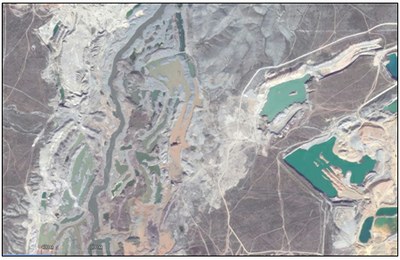
<p><span>Fig. 3. Technogenic damages to the Tuul valley landscapes at a placer gold mine.</span><img class="image-inline" src="../../../../resolveuid/a719c9aec59645b98782e559f3312ec7/@@images/image/preview" /></p>
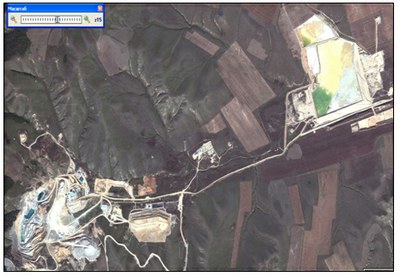
<p><span>Fig. 4. Boroo gold mine: open pit is in the southwestern part of the photo, tailings pond is in the northeastern part of the photo.</span></p>]]></content:encoded>
    <dc:publisher>No publisher</dc:publisher>
    <dc:creator>Alexander Ayurzhanaev</dc:creator>
    <dc:rights></dc:rights>
    <dc:date>2014-10-10T06:15:00Z</dc:date>
    <dc:type>Page</dc:type>
  </item>


  <item rdf:about="http://bic.iwlearn.org/en/atlas/atlas/90-conventional-symbols-mining-enterprises-map">
    <title>090. Conventional symbols mining enterprises map</title>
    <link>http://bic.iwlearn.org/en/atlas/atlas/90-conventional-symbols-mining-enterprises-map</link>
    <description></description>
    
    <dc:publisher>No publisher</dc:publisher>
    <dc:creator>Alexander Ayurzhanaev</dc:creator>
    <dc:rights></dc:rights>
    <dc:date>2014-10-10T06:05:00Z</dc:date>
    <dc:type>Folder</dc:type>
  </item>


  <item rdf:about="http://bic.iwlearn.org/en/atlas/atlas/89-the-quality-of-surface-water-map/the-quality-of-surface-water-map">
    <title>The quality of surface water map</title>
    <link>http://bic.iwlearn.org/en/atlas/atlas/89-the-quality-of-surface-water-map/the-quality-of-surface-water-map</link>
    <description></description>
    <content:encoded xmlns:content="http://purl.org/rss/1.0/modules/content/"><![CDATA[<p><img class="image-inline" src="../../../resolveuid/3cc359d4dd04415da70142efb3968ce6/@@images/image/preview" /></p>
<p><a href="http://bic.iwlearn.org/en/atlas/photos/copy_of__89_Thequalityofsurfacewater.png" class="internal-link">Open full size</a></p>
<p align="center"><strong>Quality of surface waters</strong><strong> </strong></p>
<p align="center"><strong> </strong></p>
<p>The quality of surface water depends on the combination of natural properties, conditions of self-purification of water bodies, and the input of contaminants from ambient environments. Hydrochemical and hydrobiological parameters are the main characteristics for water quality assessment. They are measured at the network of observations sites in accordance to a standard procedure, as well as by sanitary-epidemiological organizations and appropriate agencies.</p>
<p>Water quality is one of the main parameters of human activity, and it is strictly regulated in Russia and other countries. Exploitation of water bodies for different economic purposes is stipulated by several standards defining the list of chemical and biological elements in the water and their permissible concentrations. The water designated for household and recreational purposes has the strictest requirements to the water quality. The standards for water bodies designated for fisheries are less strict and used in comparative assessments of the quality of natural waters.</p>
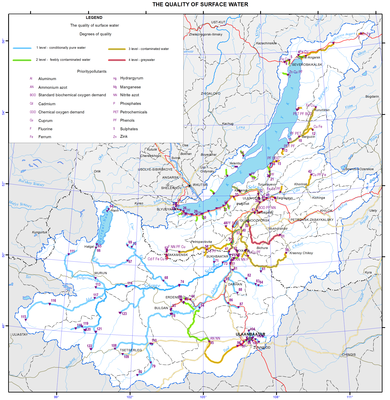
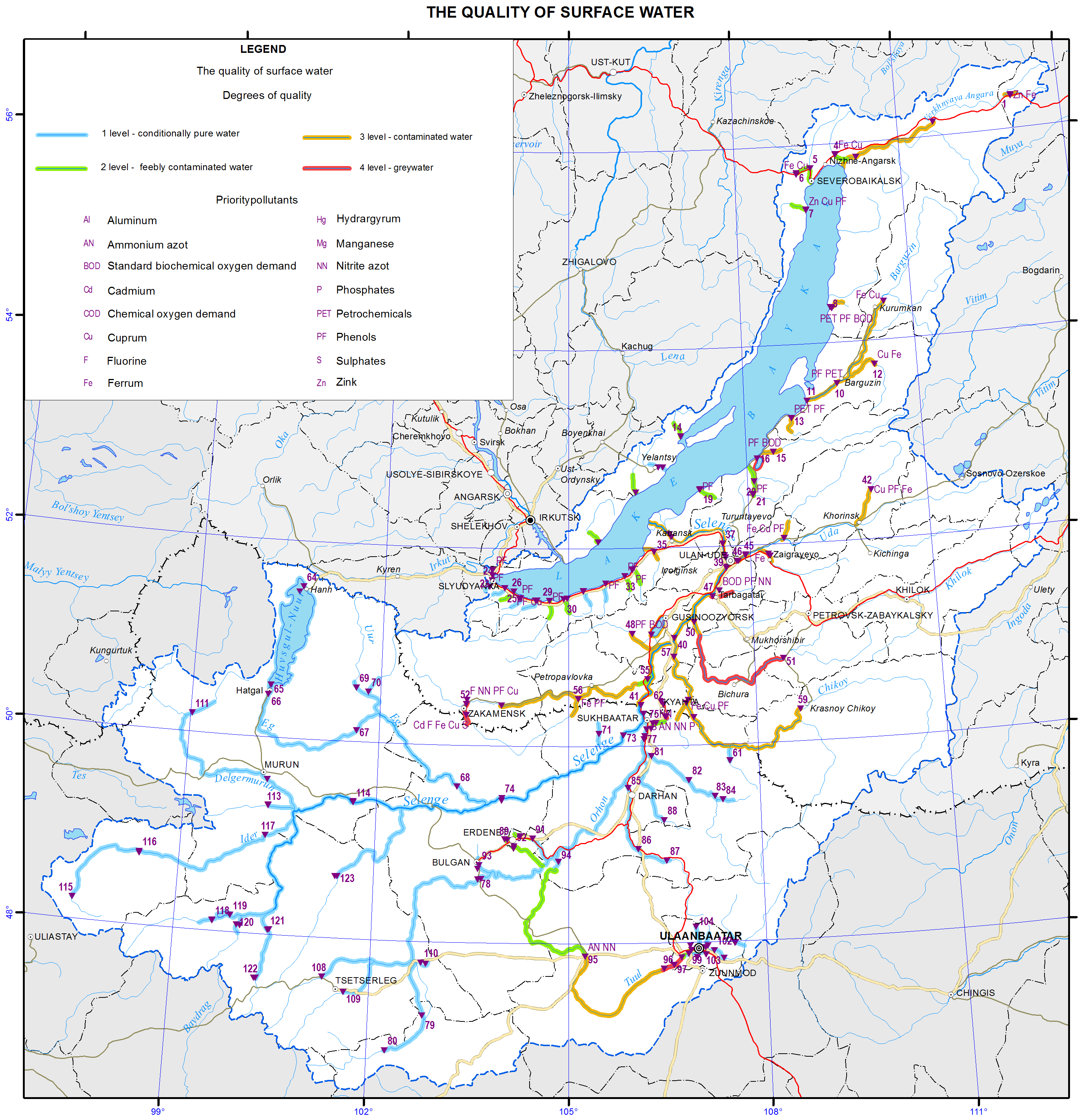
<p>Qualitative characteristics of surface water summarised from the territorial reports are presented in the form of a map “Quality of surface water”, whose scale and information fullness are determined by the size of the lake’s catchment area. The original information for this map was taken from the governmental reports “On the state of Lake Baikal and measures for its protection” of the Republic of Buryatia and Irkutsk oblast, “Annual report on the quality of surface waters of the Russian Federation”, and the data provided by Mongolian scientists [National …, 2012, 2013; National …, 2013; Annual …, 2012]. To assess the state of water bodies, a specific index of water pollution (SIWP) was calculated from the most common contaminants of surface waters (see Methodology Instructions RD 52.24 643-2002). Water quality was assessed using SIWP and, as a result, five classes (categories) of water quality were identified in the examined water objects.</p>
<p>The water quality in the basin of the Selenga (the largest tributary of Lake Baikal) on the territory of Mongolia was classified according to the procedure similar to the Russian one. The main list and standards of chemical elements (dissolved oxygen, suspended particles, acidity, etc.) are almost identical for both countries [The harmonised monitoring program…, 2012]. The final classification of water bodies of the Selenga basin on the Mongolian territory was based on the calculated values of the water pollution index [Davaa, <a href="http://fofj.org/">http://fofj.org</a>] and brought into conformity with Russian classification.</p>
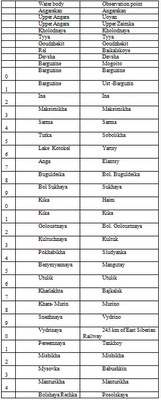
<p>On the map, the water quality classes of water bodies are depicted by colored lines and supplemented by marks showing the places where samples of chemical elements that were the main pollutants for the given segment of the water body were taken. In the lake’s catchment area, the integral characteristic of the quality of surface water varies over a wide range from “conditionally clean” to “dirty” preeminently due to the different levels of economic development of the region.</p>
<p>The major part of the lake catchment area belongs to the Selenga basin; the upper and central parts of the river are in Mongolia. The Selenga and a number of its large tributaries mainly cross underdeveloped territories and are not subject to significant pollution. The main large rivers of this area (the Delger-Muren, Ider, Orkhon, and Selenga) are characterized by high environmental indicators and practically pure (Class 1). The water in some areas of the hydrographic network of these streams that are adjacent to developed regions and subject to anthropogenic effect belong to Class 2 (“slightly polluted”). The Tuul river experiencing a severe anthropogenic impact (around Ulaanbaatar) significantly differs from other streams on the Mongolian territory: its surface water quality is classified as Class 4 (“dirty”). The main pollutants of this river are ammonium and nitrite nitrogen, phosphate, and sulphate. However, due to its self-purification processes occurring in the mouth area at the confluence with the Orkhon river the Tuul river water recovers to Class 1. The water in the Khiagt river on the northern border of Mongolia is also of low quality. This river brings its Class 4 waters to the territory of Buryatia (the Kyakhtinka river). Relatively low characteristics of the water quality (Classes 2 and 3) are recorded in some developed areas – in the Khangol (the town of Erdenet) and Orkhon (the town of Sukhbaatar) rivers.</p>
<p>Up to the confluence with the Orkhon, the water quality of the Selenga in Mongolia is regarded as Classes 1 and 2. Further, below Sukhbaatar and the Orkhon’s mouth, the Selenga crosses the border to Russia. In Buryatia, its water quality is classified as Class 3 (“polluted”). The main pollutants of the river at the cross-section of Naushki are compounds of aluminium, iron and copper, the values of which exceed maximum permissible concentrations. Furtheron, the Dzhida river (together with the Modonkul river – Class 4) and the Kyakhtinka river (Class 4) join the Selenga. The first one is affected by the discharges of mine and drainage waters from the non-functional company JSC “Dzhida Combine”, while the second one contains elevated maximum permissible concentrations of 11 elements due to the transboundary transfer (the Khiagt river).</p>
<p>Large tributaries of the Selenga joining this river downstream bring polluted waters of Class 3. The most unfavourable situation is observed at some sites of the rivers Kuitunka, Chikoy, Khilok, and Uda, whose water quality is regarded as “polluted”. The main pollutants are different forms of nitrogen, organic substances, and phenol. The water in the lower Selenga is characterised as Class 3.</p>
<p>The quality of surface water in other largest tributaries of Lake Baikal is also low. Such large rivers as the Upper Angara, Barguzin and Turka have polluted waters of Class 3, whilst the water in smaller rivers such as the Tiya, Kholodnaya, Kika, Snezhnaya, Utulik, Buguldeika, and other are of Class 2. Phenols in combination with oil products, zinc, copper, and organic substances are typical contaminants of these rivers.</p>
<p>There is a scarce information on water quality in the lakes located on the examined territory as no monitoring has been conducted there. The exception is Lake Gusinoe, whose water quality is of Class 3 (“polluted”). The main pollutants of this lake are phenols, oil products, copper, and other substances. Moreover, the lake is subject to thermal pollution from the Gusinoozerskaya Thermal Power Plant. Another water body, Lake Kotokel, located within the Baikal basin has a very low water quality. The use of its water is prohibited for any purposes, except for technical use, which is confirmed by Decree No. 4 “On the Initiation of Restrictive Measures at Lake Kotokel” of the Chief Sanitary Inspector of the Republic of Buryatia, dated June 6, 2009, [On the state of …, 2013].</p>
<p>It should be noted that against the backdrop of the increased water discharge into water bodies of this territory in 2012, there is a trend of significant improvement of surface water quality of the Baikal basin.<b> </b>The water quality indicators in the majority of water bodies have been improved by 1-2 classes as compared to 2011 and previous years (On the state of …, 2012, 2013; Annual report …, 2012). <b> </b></p>
<p> </p>
<p align="center">References</p>
<p>Ministry of Natural Resources of the Russian Federation. (2012). <i>On the state of Lake Baikal and measures for its protection in 2011: State report</i>. Moscow. Retrieved from <a href="http://www.mnr.gov.ru/">http://www.mnr.gov.ru</a></p>
<p>Ministry of Natural Resources of the Russian Federation. (2013). <i>On the state of Lake Baikal and measures for its protection in 2012: State report</i>. Moscow. Retrieved from <a href="http://www.mnr.gov.ru/">http://www.mnr.gov.ru</a></p>
<p class="Default">The Sochava Institute of Geography SB RAS. (2013). <i>On the state and conservation of the environment in Irkutsk oblast in 2012: State report</i>. Irkutsk: The Sochava Institute of Geography SB RAS. p 337.</p>
<p>Hydrochemical Institute. (2012). <i>Annual report on the quality of surface waters of the Russian Federation in 2012</i>. Retrieved from <a href="http://www.ghi.aaanet.ru/">http://www.ghi.aaanet.ru</a></p>
<p>Methodology Instructions. <i>Method for a comprehensive assessment of pollution of surface waters using hydrochemical parameters</i>. RD 52.24.643-2002. Retrieved from <a href="http://www.opengost.ru/">www.OpenGost.ru</a></p>
<p class="Default">The Baikal Basin Information Center. (2012). <i>The harmonised monitoring program of water quality in the Selenga river basin</i>. Retrieved from <a href="http://baikal.iwlearn.org/">http://baikal.iwlearn.org/</a></p>
<p>Davaa, G., Oyunbaatar, D., &amp; Sugita. M. Surface water of Mongolia. Retrieved from <a href="http://fofj.org/">http://fofj.org/</a></p>
<p><img class="image-inline" src="../../../resolveuid/8ab4a641f7b64366a44f343cf70ed99b/@@images/image/preview" /></p>
<p><img class="image-inline" src="../../../resolveuid/d67bd6b239a943d3b369bf30ba816b82/@@images/image/preview" /></p>
<p><img class="image-inline" src="../../../resolveuid/58e43f91ba454fddb0ea9db3a53dc998/@@images/image/preview" /></p>
<p><img class="image-inline" src="../../../resolveuid/aa16f1c966d841e9ab2ad897cb711f3b/@@images/image/preview" /></p>]]></content:encoded>
    <dc:publisher>No publisher</dc:publisher>
    <dc:creator>Alexander Ayurzhanaev</dc:creator>
    <dc:rights></dc:rights>
    <dc:date>2014-10-10T05:55:00Z</dc:date>
    <dc:type>Page</dc:type>
  </item>


</rdf:RDF>