<?xml version="1.0" encoding="utf-8" ?>
<rdf:RDF xmlns:rdf="http://www.w3.org/1999/02/22-rdf-syntax-ns#" xmlns:dc="http://purl.org/dc/elements/1.1/" xmlns:syn="http://purl.org/rss/1.0/modules/syndication/" xmlns="http://purl.org/rss/1.0/">


<channel rdf:about="http://bic.iwlearn.org/en/search_rss">
  <title>English</title>
  <link>http://bic.iwlearn.org</link>

  <description>
    
            These are the search results for the query, showing results 151 to 165.
        
  </description>


  <image rdf:resource="http://bic.iwlearn.org/logo.png"/>

  <items>
    <rdf:Seq>
      
        <rdf:li rdf:resource="http://bic.iwlearn.org/en/atlas/atlas/78a-comfort-of-available-housing-russian-part-map/comfort-of-available-housing-russian-part-map"/>
      
      
        <rdf:li rdf:resource="http://bic.iwlearn.org/en/atlas/atlas/78b-comfort-of-available-housing-mongolian-part-map"/>
      
      
        <rdf:li rdf:resource="http://bic.iwlearn.org/en/atlas/atlas/77-housing-conditions-map-1/housing-conditions-map"/>
      
      
        <rdf:li rdf:resource="http://bic.iwlearn.org/en/atlas/atlas/78a-comfort-of-available-housing-russian-part-map"/>
      
      
        <rdf:li rdf:resource="http://bic.iwlearn.org/en/atlas/atlas/76-net-migration-rate-map/net-migration-rate-map"/>
      
      
        <rdf:li rdf:resource="http://bic.iwlearn.org/en/atlas/atlas/77-housing-conditions-map-1"/>
      
      
        <rdf:li rdf:resource="http://bic.iwlearn.org/en/atlas/atlas/76-net-migration-rate-map"/>
      
      
        <rdf:li rdf:resource="http://bic.iwlearn.org/en/atlas/atlas/75-urbanization-map/urbanization-map"/>
      
      
        <rdf:li rdf:resource="http://bic.iwlearn.org/en/atlas/atlas/75-urbanization-map"/>
      
      
        <rdf:li rdf:resource="http://bic.iwlearn.org/en/atlas/atlas/74-natural-population-increase-map/natural-population-increase-map"/>
      
      
        <rdf:li rdf:resource="http://bic.iwlearn.org/en/atlas/atlas/73-population-dynamics-map/population-dynamics-map"/>
      
      
        <rdf:li rdf:resource="http://bic.iwlearn.org/en/atlas/atlas/74-natural-population-increase-map"/>
      
      
        <rdf:li rdf:resource="http://bic.iwlearn.org/en/atlas/atlas/72-rural-population-density-and-urban-settlement-population-size-2013-map/rural-population-density-and-urban-settlement-population-size-2013-map"/>
      
      
        <rdf:li rdf:resource="http://bic.iwlearn.org/en/atlas/atlas/73-population-dynamics-map"/>
      
      
        <rdf:li rdf:resource="http://bic.iwlearn.org/en/atlas/atlas/72-rural-population-density-and-urban-settlement-population-size-2013-map"/>
      
    </rdf:Seq>
  </items>

</channel>


  <item rdf:about="http://bic.iwlearn.org/en/atlas/atlas/78a-comfort-of-available-housing-russian-part-map/comfort-of-available-housing-russian-part-map">
    <title>Comfort of available housing (Russian part) map</title>
    <link>http://bic.iwlearn.org/en/atlas/atlas/78a-comfort-of-available-housing-russian-part-map/comfort-of-available-housing-russian-part-map</link>
    <description></description>
    <content:encoded xmlns:content="http://purl.org/rss/1.0/modules/content/"><![CDATA[<p><img class="image-inline" src="../../../resolveuid/e572f2f71eb24baf94284a47db833b51/@@images/image/preview" /></p>
<p><a href="http://bic.iwlearn.org/en/atlas/photos/copy_of__78a_ComfortofAvailableHousingRussianpart.png" class="internal-link">Open full size</a></p>
<p align="center"><b><b>Urban amenities of the housing fund in </b></b></p>
<p align="center"><b><b>the Russian part of the basin</b></b></p>
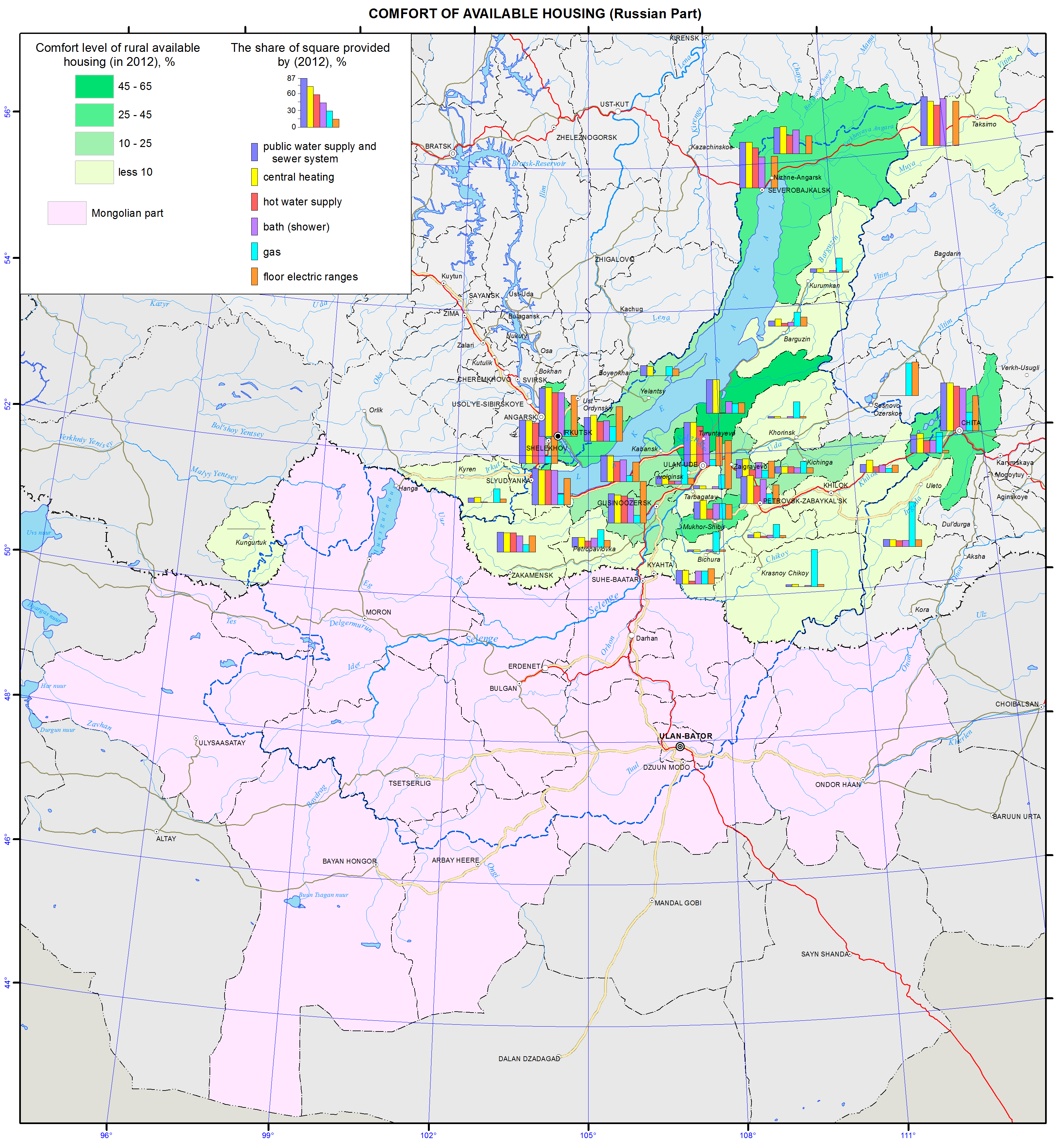
<p>The share of housing properties with urban amenities is an important factor for ecological well-being of the Baikal basin. Russian statistical data identify the following components of urban amenities: running water, sewage, central heating, hot water supply, baths (showers), and gas and electric stoves. According to the current statistical regulations, all housing properties today are considered to be equipped with central heating irrespectively of the source of heat supply (heat and electric power plant, industrial or local boiler plants, individual boilers). As a rule, the characteristics of the degree of provision with urban amenities is calculated using relative indicators – a percentage of the area of housing properties equipped with the above listed amenities compared to the total area of the housing fund (in %).</p>
<p>Spatial differences in the comfort level are quite significant in the region. Such regional centres as Irkutsk, Chita, and Ulan-Ude, as well as a town of the republican subordination Severobaikalsk have relatively high levels of urban development. However, a specific share of the housing fund equipped with urban amenities of every second administrative district of the region is less than 25%. Engineering amenities are absent in the Tere-Khol district of Tuva, Yeravna District of Buryatia (except for gas and electric stoves), and Olkhon district of Irkutsk oblast (indicators for running water, heating, gas and electric stoves do not exceed 20%).</p>
<p>The standard indicators of engineering amenities exceed 50% only in every sixth administrative district. The leaders are the Muisky district in Buryatia (due to new housing built during the Baikal-Amur Mainline construction) and Shelekhov and Slyudyanka Districts in the industrial belt surrounding Big Irkutsk (Irkutsk oblast). Almost half of the housing in three more districts has water supply, sewage and central heating: the Severobaikalsk and Kabansk districts in the Republic of Buryatia and the Irkutsk district in Irkutsk oblast.</p>
<p>Rural housing of the region has the lowest indicators of the degree of provision with urban amenities. The map shows the degree of availability of engineering amenities in rural settlements in administrative districts split into four conventionally identified groups according to the first four amenity indicators (i.e., without gas and electric stoves, as it will artificially improve the situation). In every second rural district, less than 10% of housing facilities are equipped with water supply, sewage, central heating, and baths (4<sup>th</sup> group). In five districts, this indicator is 10-25% (3<sup>rd</sup> group) (an average level for the region, but two times lower than the average for rural areas of the SFD): the Zaigraevsky, Ivolginsky, Kabansky and Kizhingsky districts in the Republic of Buryatia and Chita district in Zabaikalsky krai. The leader is the Pribaikalsky district of the Republic of Buryatia (1<sup>st</sup> group: 45-65 %, which is close to the average indicator of the SFD). This district is followed by three other districts with relatively high levels of development of the rural housing fund: the Severobaikalsky and Selenginsky districts in the Republic of Buryatia and the Irkutsk district in Irkutsk oblast (2<sup>nd</sup> group).</p>
<p>The analysis of indicators of housing development (as of 2012) in the administrative districts of the Russian part of the Baikal basin demonstrates a very low level of modern housing development, high contrasts between urban and rural settlements, and an extremely low level of comfort of rural territories.</p>
<p> </p>
<p align="center">References</p>
<p>Statistical Compendium. (2013). <i>Housing and communal services of Zabaikalsky krai</i>. Chita: Zabaikalkraistat. p 112.</p>
<p>Statistical Compendium. (2013). <i>Housing and communal services of the Irkutsk oblast in 2012</i>. Irkutsk: Irkutskstat, 2013. p 76.</p>
<p>Statistical Compendium. (2013). <i>Housing services of the Republic of Buryatia</i>. Ulan-Ude: Buryatstat. p 35.</p>]]></content:encoded>
    <dc:publisher>No publisher</dc:publisher>
    <dc:creator>Alexander Ayurzhanaev</dc:creator>
    <dc:rights></dc:rights>
    <dc:date>2014-10-09T07:05:00Z</dc:date>
    <dc:type>Page</dc:type>
  </item>


  <item rdf:about="http://bic.iwlearn.org/en/atlas/atlas/78b-comfort-of-available-housing-mongolian-part-map">
    <title>078b. Comfort of available housing (Mongolian part) map</title>
    <link>http://bic.iwlearn.org/en/atlas/atlas/78b-comfort-of-available-housing-mongolian-part-map</link>
    <description></description>
    
    <dc:publisher>No publisher</dc:publisher>
    <dc:creator>Alexander Ayurzhanaev</dc:creator>
    <dc:rights></dc:rights>
    <dc:date>2014-10-09T07:05:00Z</dc:date>
    <dc:type>Folder</dc:type>
  </item>


  <item rdf:about="http://bic.iwlearn.org/en/atlas/atlas/77-housing-conditions-map-1/housing-conditions-map">
    <title>Housing conditions map</title>
    <link>http://bic.iwlearn.org/en/atlas/atlas/77-housing-conditions-map-1/housing-conditions-map</link>
    <description></description>
    <content:encoded xmlns:content="http://purl.org/rss/1.0/modules/content/"><![CDATA[<p><img class="image-inline" src="../../../resolveuid/266abffde1814cdfabfc19269b5171ad/@@images/image/preview" /></p>
<p><a href="http://bic.iwlearn.org/en/atlas/photos/copy_of__77_HousingConditions.png" class="internal-link">Open full size</a></p>
<p align="center"><strong>Housing</strong></p>
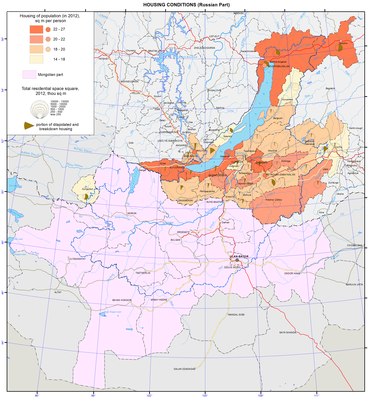
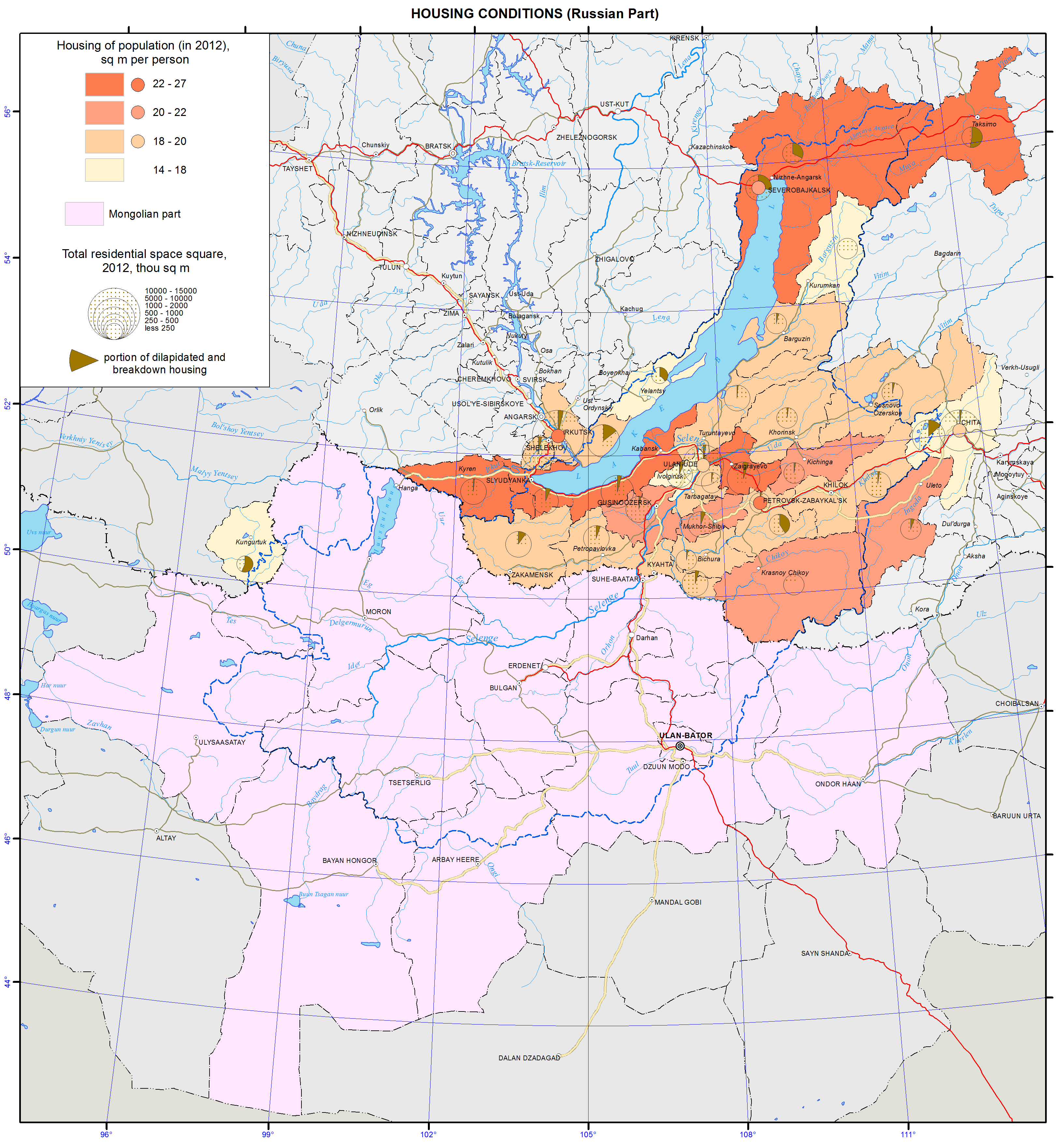
<p>The most important indicator of the quality of modern life is the character of living conditions (“roof over head”), which combines a specific indicator of housing supply and an especially important from the ecological standpoint specific indicator of the meterage of old and dilapidated housing. The main information resources used for calculations included the data of the territorial bodies of the Federal State Statistics Service of Irkutsk oblast, the Republics of Buryatia and Tuva, and Zabaikalsky krai, as well as online resources.</p>
<p>Spatial differences in the living conditions in the low-level administrative divisions (district municipalities) and urban settlements (urban municipalities) are represented by: a) a total indicator and b) a specific per capita (m²/person) indicator. According to Russian definitions, a housing fund is a collection of all housing properties regardless of the forms of ownership including residential properties, special properties (hostels, shelters, temporary public housing, nursery homes for lonely seniors, orphanages, boarding homes for persons with disabilities and veterans, and boarding schools), apartments, residential properties of businesses, and other residential properties in buildings suitable for residence. Meanwhile, the housing fund does not include residential properties of the cottage-recreational complex, i.e. summer cottages, sports and tourist facilities, rest homes and other. It should be noted that the total area of residential buildings does not include communal space (stairwells, elevator lobbies, common corridors, lobbies and other), as well as non-residential space occupied by any institutions.</p>
<p>The background of the map is the per capita housing supply in administrative districts and cities. The cartogram shows a specific provision of the population with housing in district municipalities and urban entities. This rate for all four subjects of Russia in the basin is much lower than both the Russian and Siberian Federal District (SFD) averages (23.4 m²/person and 22.1 m²/person, respectively).</p>
<p>Spatial differences in the region according to this indicator of housing conditions are quite sharp (a two-fold difference between the minimum and maximum values – 14.1 and 29.9 m²/person (in the Tere-Khol district of the Republic of Tuva and the Zaigraevsky district in the Republic of Buryatia, respectively). Among urban settlements, Petrovsk-Zabaikalsky has the highest per capita rate of housing provision – 23.4 m²/pers., which equals to the average Russian indicators (2012), while the outsider is Chita (19.9 m²/person).</p>
<p>In terms of specific housing supply, all district and urban entities in the region are divided into four groups taking into account the average index for the SFD ( 22.1 m²/person). The category of high-status areas (Group 1 with more than 22.1 m²/person) includes slightly over 20% of the total number of territories. Thus, almost 4/5 of municipalities of the district and city levels in the Baikal basin belong to the areas, where a specific housing supply indicator is lower than the average for the SFD.</p>
<p>The housing fund in the Baikal basin is 46.8 million m² (2012). More than two fifths of it belong to the Republic of Buryatia (41.3 %), about two fifths to the Irkutsk oblast (37.5%), and more than one fifth to the Zabaikalsky krai (21.5%), while the contribution of Tuva is only 0.1%. The urban sector predominates – more than 3/4 (75. 8%). In the Baikal basin’s regions, this picture is highly contrasting: in Irkutsk oblast the share of the urban housing fund exceeds 9/10 (90.7%), while in the neighboring Republic of Buryatia it is less than 2/3 (59.8%).</p>
<p>The share of old and dilapidated housing is an indicative negative indicator of the quality of the housing fund. It represents a total share of more than 5% (this indicator has increased manifold in comparison with 1990).</p>
<p> </p>
<p align="center">References</p>
<p>Statistical Compendium. (2013). <i>Housing and utilities of Zabaikalsky krai</i>. Chita: Zabaikalkraistat. p 112.</p>
<p>Statistical Compendium. (2013). <i>Housing and utilities of Irkutsk oblast in 2012</i>. Irkutsk: Irkutskstat. p 76.</p>
<p>Statistical Compendium. (2013). <i>Housing of the Republic of Buryatia</i>. Ulan-Ude: Buryatstat. p 35.</p>
<p>Statistical Compendium. (2013). <i>Districts of the Republic of Buryatia</i>. Ulan-Ude: Buryatstat. p 102.</p>
<p>Federal State Statistics Service. <i>Database of municipal indicators</i>. Retrieved from http://www.gks.ru/dbscripts/munst/munst.htm</p>]]></content:encoded>
    <dc:publisher>No publisher</dc:publisher>
    <dc:creator>Alexander Ayurzhanaev</dc:creator>
    <dc:rights></dc:rights>
    <dc:date>2014-10-09T06:55:00Z</dc:date>
    <dc:type>Page</dc:type>
  </item>


  <item rdf:about="http://bic.iwlearn.org/en/atlas/atlas/78a-comfort-of-available-housing-russian-part-map">
    <title>078a. Comfort of available housing (Russian part) map</title>
    <link>http://bic.iwlearn.org/en/atlas/atlas/78a-comfort-of-available-housing-russian-part-map</link>
    <description></description>
    
    <dc:publisher>No publisher</dc:publisher>
    <dc:creator>Alexander Ayurzhanaev</dc:creator>
    <dc:rights></dc:rights>
    <dc:date>2014-10-09T06:55:00Z</dc:date>
    <dc:type>Folder</dc:type>
  </item>


  <item rdf:about="http://bic.iwlearn.org/en/atlas/atlas/76-net-migration-rate-map/net-migration-rate-map">
    <title>Net migration rate map</title>
    <link>http://bic.iwlearn.org/en/atlas/atlas/76-net-migration-rate-map/net-migration-rate-map</link>
    <description></description>
    <content:encoded xmlns:content="http://purl.org/rss/1.0/modules/content/"><![CDATA[<p><img class="image-inline" src="../../../resolveuid/4d4641d334934b2b87c9198f3643ef38/@@images/image/preview" /></p>
<p><a href="http://bic.iwlearn.org/en/atlas/photos/copy_of__76_Netmigrationrate.png" class="internal-link">Open full size</a></p>
<p align="center"><strong>Population</strong></p>
<p>The population maps focus on current patterns of the settlement and demographic situation in the Baikal basin. They relate to a complex of underlying social, economic and ecological factors.</p>
<p>The population maps of the Baikal basin are based on the statistical data of the Federal State Statistics Service of the Russian Federation and National Statistical Office of <em>Mongolia</em>. Also important were the data from population censuses of Russia and Mongolia and the data of the current measurements of demographic events. The authors used statistical sources to calculate indicators for territories included into the Baikal basin.</p>
<p>The distribution of settlements within the Baikal basin is quite irregular. There are four locations of the regional concentration of the population. In Irkutsk oblast, the main settlement belt along the Trans-Siberian Railway stretches from the western border of the region up to Lake Baikal. Here, there are many agricultural settlements and the majority of large administrative and economic centers, where manufacturing sector dominates the economy. Irkutsk – a large multi-functional center – tops the group of these settlements. Only sparsely populated the Olkhon and Slyudyanka districts and part of the Irkutsk district fully lie within the Baikal basin. In the direct vicinity of Lake Baikal, but in the Angara basin, there are cities of Irkutsk and Shelekhov. In the Republic of Buryatia, there is a major settlement area around Ulan-Ude with a maximum concentration to the south of the city. Geographic differences in the specialization of settlements have emerged. Settlements involved in manufacturing and transportation are overwhelmingly dominant along the Trans-Siberian Railway. In Southern Buryatia, there are mostly agricultural settlements. In Zabaikalsky krai, there are three settlement networks: settlements involved in manufacturing and transportation located along the railway; mining settlements near deposits; and agricultural settlements located south of Chita in the forest-steppe and steppe zone. In Mongolia, the population is mainly concentrated in the central region – from Ulaanbaatar in the south to Sukhbaatar in the north. Three largest cities of the country and more than a half of its population are located in this area. The other territories of the Mongolian part of the Baikal basin are sparsely populated.</p>
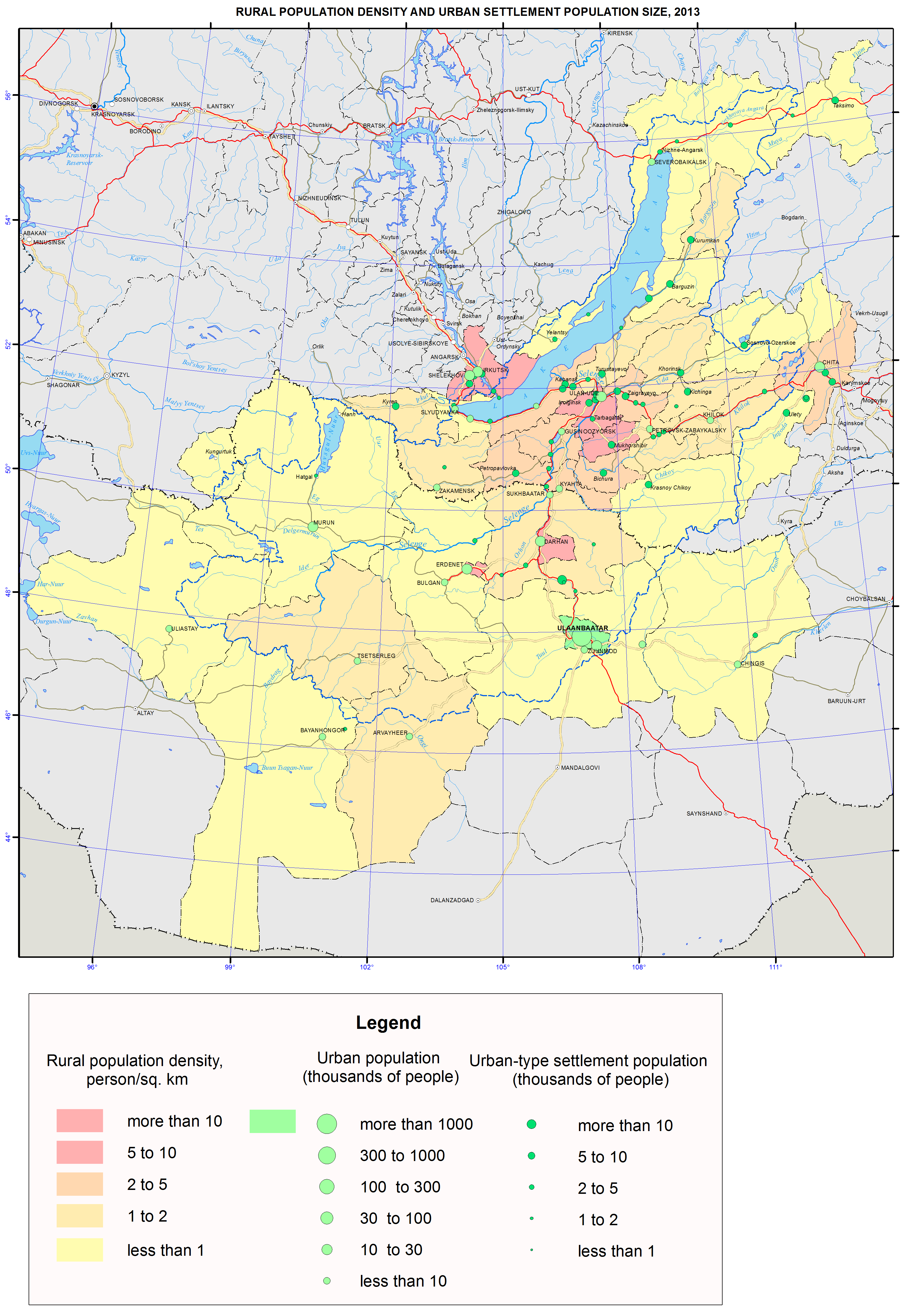
<p>Distribution of the population and the degree of the settlement of the territory are displayed on the maps “Density of population (as of 1.1.2013)”; “Density of rural population and population size of urban settlements (as of 1.1.1989)”; “Density of rural population and population size of urban settlements (as of 1.1.2013)”.</p>
<p>The Baikal region belongs to sparsely and unevenly populated territories. The population density of the Baikal basin is 17 times lower than the world’s average of 53 persons/km<sup>2</sup>. The population density in the Russian part of the basin is 2.9 persons/km<sup>2</sup>, which is nine times lower than in the European part of Russia (26 persons/km<sup>2</sup>).</p>
<p>The intra-regional differentiation of settlement patterns is stipulated by several spatial gradients of the population density decrease, with the main gradient leading from the center (capitals and administrative centers) to the periphery. Other gradients are also present in particular territories. Thus, in the Russian part of the basin, the population density tends to decrease as it goes from the south to the north and from the west to the east. The Russian-Mongolian border for the most part rather separates than unites the areas of settlement, except for one direction. The core of this direction is the Selenga Valley, where an area with a highly dense population has formed between Ulaanbaatar and Ulan-Ude.</p>
<p>The territories around large cities, like the regional centers Irkutsk, Ulan-Ude and Chita, are most densely populated. Along with the areas with dense population, there are also virtually unpopulated territories of tens of thousands square kilometers in area. The distribution of rural population is less contrasting than the urban one. The main clusters of rural population are located in the forest-steppe and steppe zones, where the density of population may reach 10-20 persons/km<sup>2</sup>. Rural population is mainly concentrated in the south of Irkutsk oblast (around Irkutsk) and in the central part of Buryatia (south of Ulan-Ude).</p>
<p>The major cities of the Russian part of the basin grew along the transportation lines. Thus, 11 out of 13 towns are located along the railways. Only Zakamensk and Kyakhta are located away from the railroad. In the Mongolian part of the basin, the connection of urban settlements to transportation lines is less pronounced with only five out of 12 towns being situated on the railways.</p>
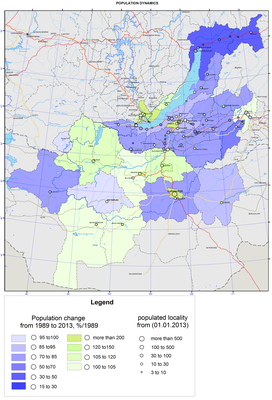
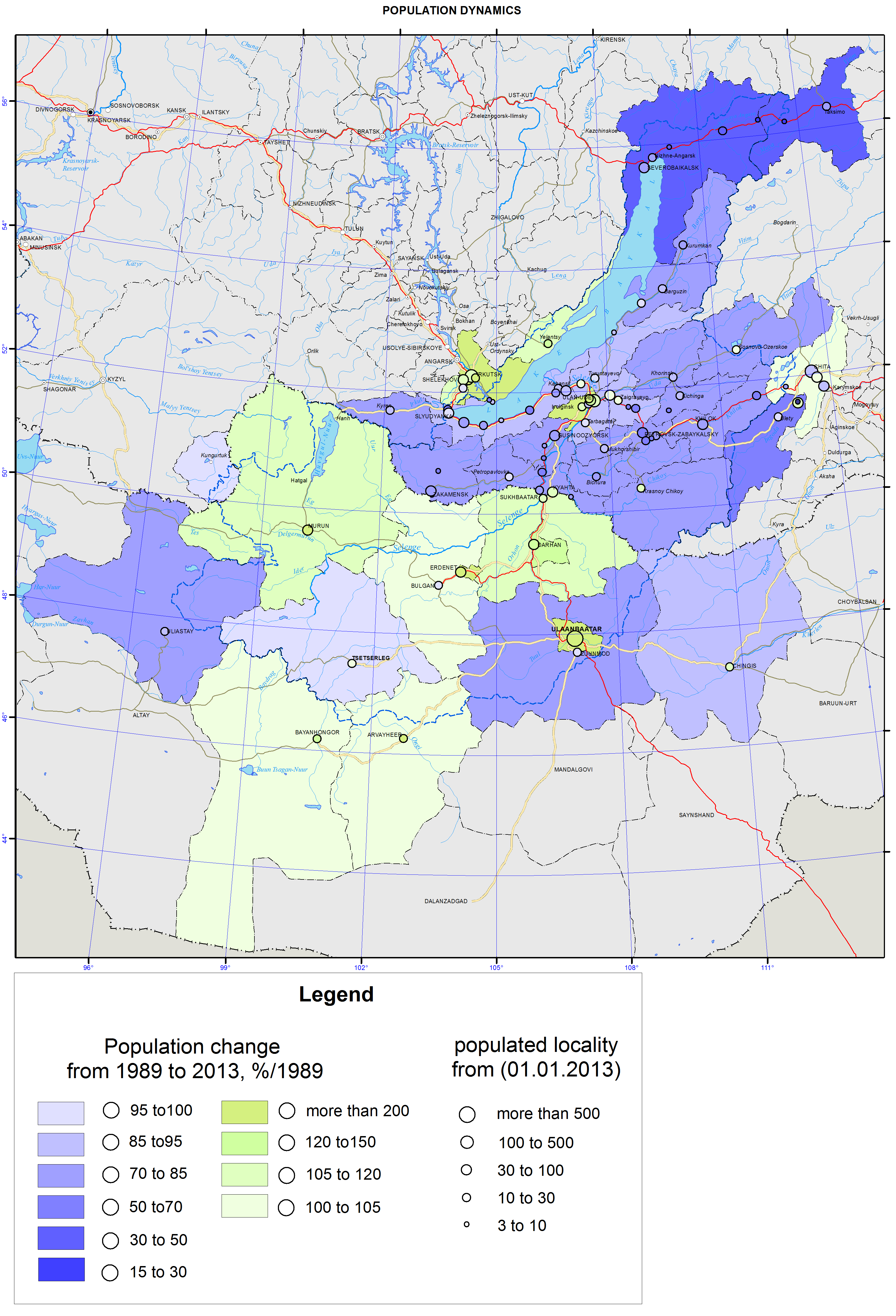
<p>The map “Dynamics of the population size (1989-2013)” shows considerable changes in the population size – a situation, where a high concentration of the population in a few largest centers is followed by depopulation of vast territories.</p>
<p>In the Russian part of the basin, there were two clear patterns of the population size dynamics from 1989 to 2013. Firstly, the decrease of population tends to be more pronounced from the southwest to the northeast. Secondly, the population dynamics in regional centers (Irkutsk, Ulan-Ude, and Chita) and their suburbs is relatively positive. Population growth is observed only in the Irkutsk, Shelekhov, and Olkhon districts of Irkutsk oblast, Ivolga district of the Republic of Buryatia and Chita district of Zabaikalsky krai. The record level growth of population (over 160 %) was recorded in the suburban Ivolginsky and Irkutsk districts. The biggest drop in the population takes place in the localities that are classified as districts of the Far North, with the Muisky and Severobaikalsky districts of the Republic of Buryatia loosing over half of their population.</p>
<p>In the Mongolian part of the Baikal basin, population growth is registered on over a half of the nation’s territory. The main Mongolian cities – Ulaanbaatar, the capital of Mongolia, (244 % to the level of 1989), Erdenet, and Darkhan are the fastest growing cities. The Khovsgol and Selenga aimags also demonstrate a significant growth of population. The population in the four aimags of Arkhangai, Zavkhan, Tov, and Khentei decreases due to an outward migration of residents.</p>
<p>The contrasting nature of the population dynamics within the Baikal basin is quite distinct:</p>
<p>– The Russian part of the Baikal basin is characterized by the type of the population dynamics, where an outward migration is several times higher than a natural population decline;</p>
<p>–        The Mongolian part is characterized by the type of the population dynamics, where a natural increase of population prevails over inward migration.</p>
<p>Territorial specifics of demographic development are shown on the map “Natural increase of population”.</p>
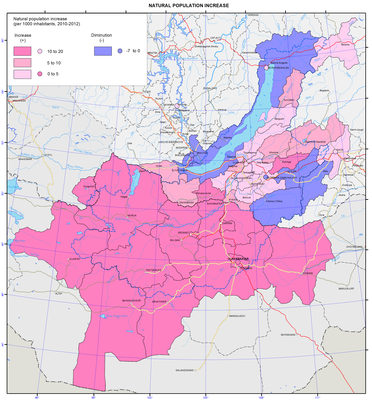
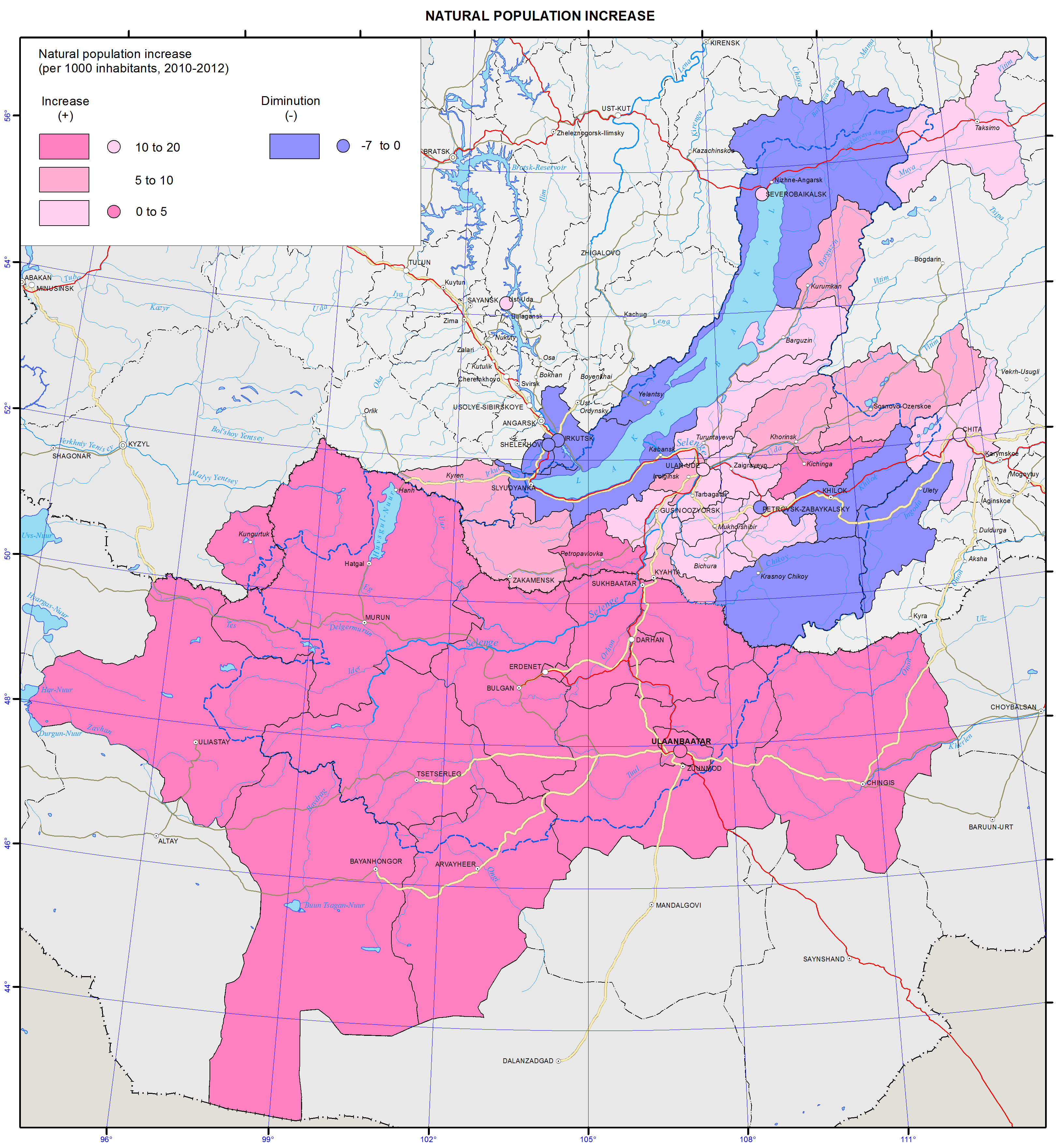
<p>In the Baikal basin, different modes of reproduction of population exist along with a wide variety of quantitative parameters of demographic processes. In general, it is possible to identify two types of population reproduction. Thus, all of Mongolia, Tuva and part of Buryatia are characterized by an expanded type of reproduction with high birth rates, average mortality, and a significant natural growth. The Baikal region of Irkutsk oblast, Zabaikalsky krai, and most of Buryatia is characterized by a narrow type of reproduction with low birth rates, high mortality, and a natural population decline or insignificant natural growth. The annual natural growth of the population in Mongolian aimags is 17-19%. In the Russian part of the basin, natural movement of the population led to mixed results, where 23 municipalities showed population increase, while 10 municipalities had natural decline. With an average natural population increase of 1.4 per mille, there were significant variations – from the decline ranging from -5 to -6% (in the Petrovsk-Zabaikalsky, Irkutsk and Olkhon districts) to the increase exceeding 10 pro mille (10.4% in the Dzhida district, 12.1% in the Kizhinga District, and 16.0% in the Tere-Khol district). The natural population increase in the Mongolian capital Ulaanbaatar was 17.2%, while the increase in the Russian regional centers Ulan-Ude and Chita was 4.3% and 3.4%, respectively, with the decline of -2.7 % in Irkutsk.</p>
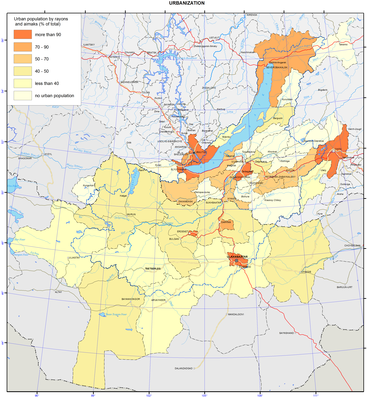
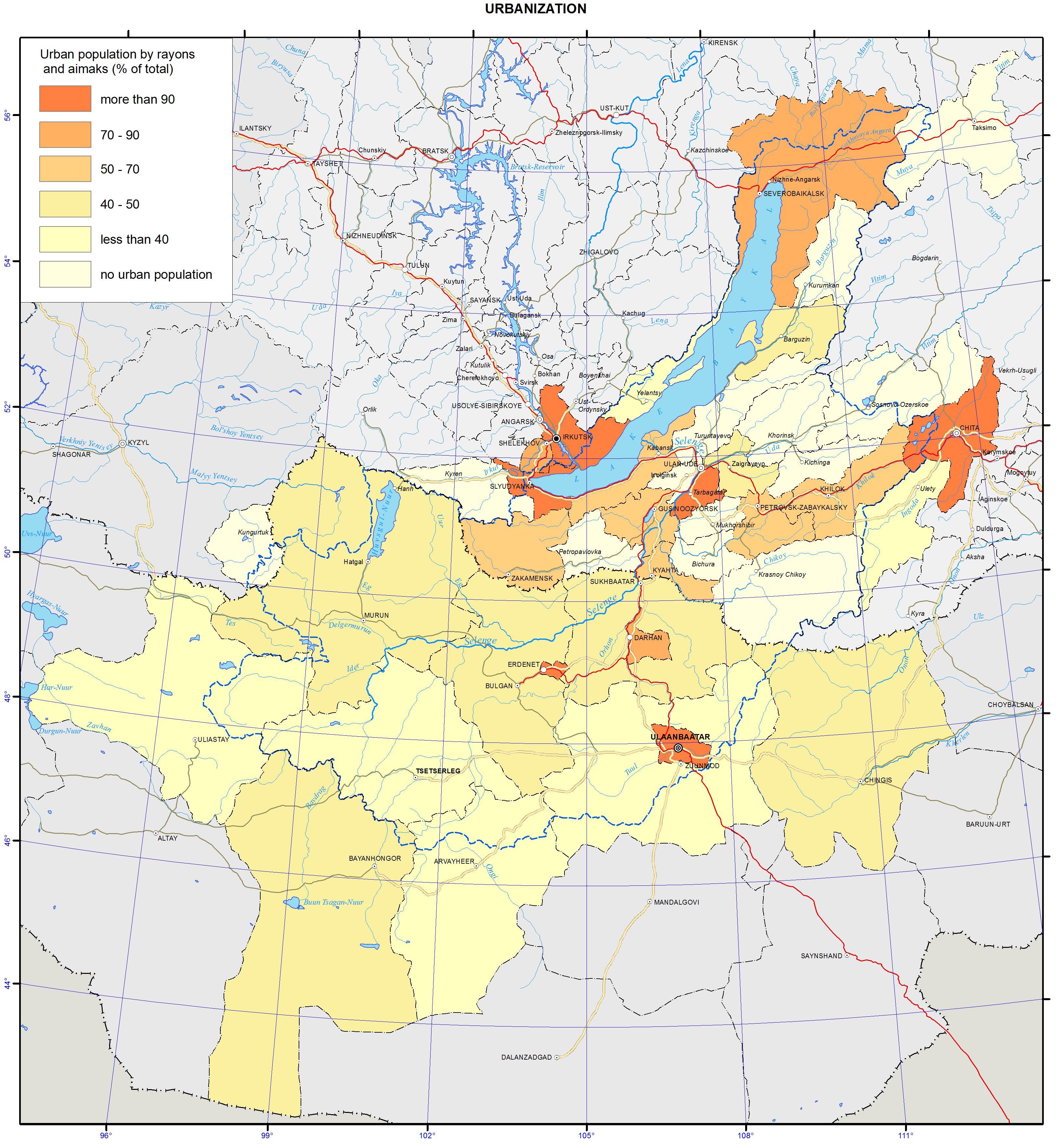
<p>The map “Urbanization of the territory” shows the proportion of urban population in Russian municipal districts and Mongolian aimags. The share of urban population exceeds 74% of the entire population and is composed of a few territories. The level of the urbanization of the population exceeds the world’s average (51%) by nearly one and half times, however, the level of the urbanization of the territory is low. Urban territories mainly include settlements located along the railways, as well as densely populated administrative centers. In the Mongolian part of the Baikal basin, only Ulaanbaatar and the Orkhon and Darkhan-uul aimags are highly urbanized, while the remaining nine aimags have only a small share of urban population (17.5%-34.9 %). In Mongolia, administrative centers of every aimag must be urban settlements. However, in Russia, the legislation does not mandate municipalities to have urban settlements. Therefore, in the Russian part of the basin, as of 2013, 14 districts did not have urban population at all. Some settlements (Barguzin, Ivolginsk, Kyren, and Khorinsk) rejected their urban status in the process of municipal reforms of the 2000s. The population of Mongolian towns within the basin nearly doubled in 1989-2013, with the population of Ulaanbaatar growing from 540.6 to 1,318.1 thousand people. The population of the largest cities in the Russian part of the basin did not change that much: in Irkutsk, it grew from 572.4 to 606.1 thousand people, in Ulan-Ude – from 352.5 to 416.1, while in Chita it declined from 365.8 to 331.3 thousand people.</p>
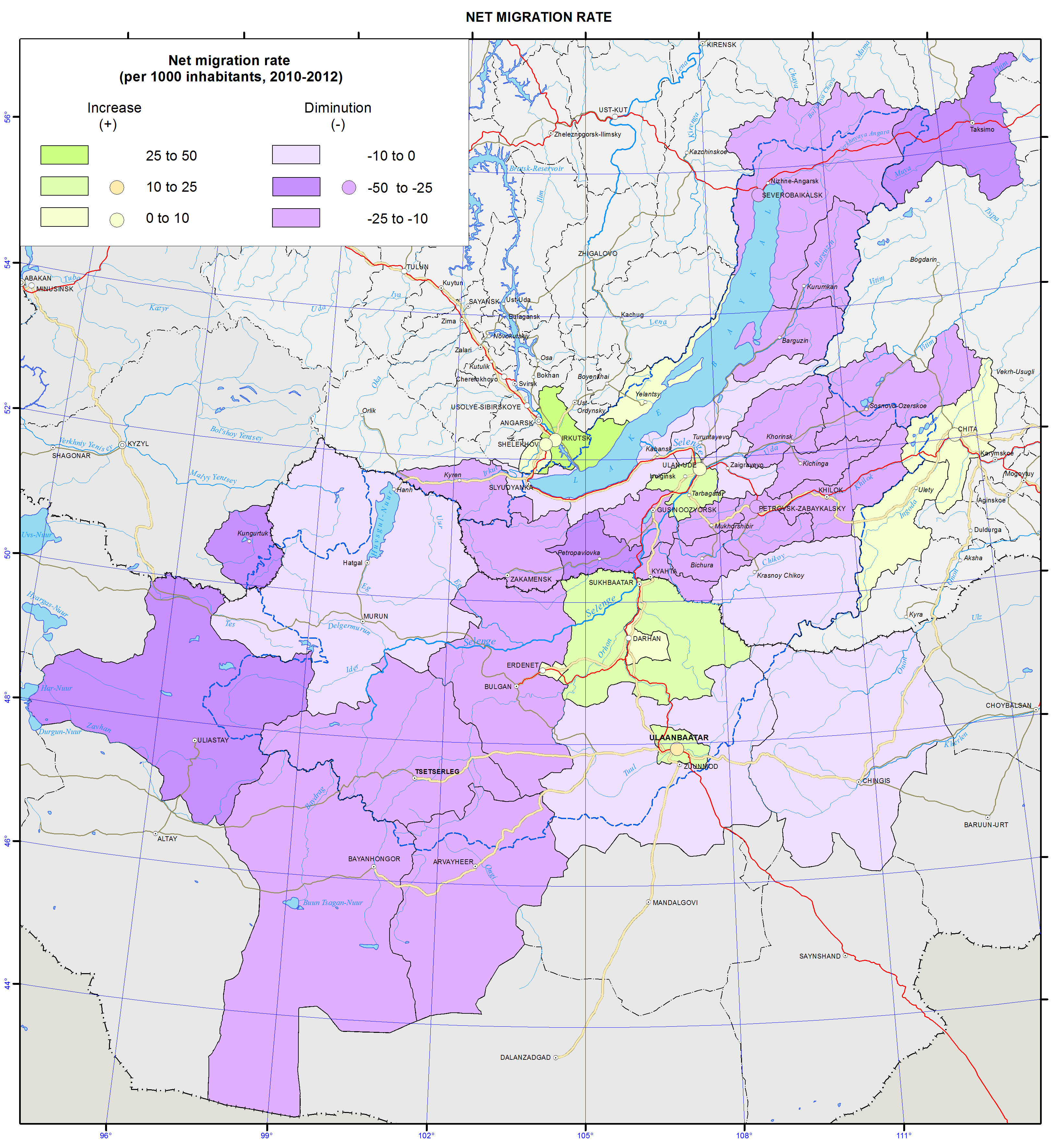
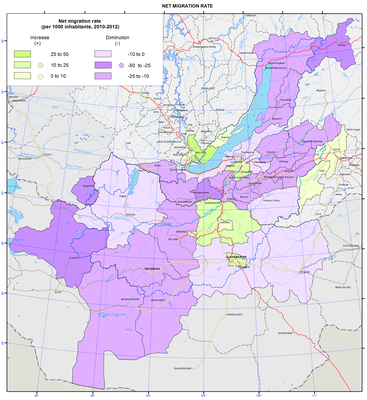
<p>The main results of migration processes in 2010-2012 are shown on the map “Migratory increase of population”.</p>
<p>In Russia, including the Baikal basin, the last two decades witnessed a significant decrease of migration activity of the population. However, outward migration from the region remains high and reproduces almost annually from the mid-1990s up to now. Population movement has mostly become intra-regional – the intra-regional migration turnover makes about 2/3 of relocations in the Baikal basin. The intra-Russian interregional migration causes migration losses, while migratory relationships with the CIS countries contribute to a considerable growth of population.</p>
<p>Redistribution of the population between the constituent parts of the Baikal region is intensive including some tens of thousands people annually. In 2010-2012, on average 66.5 thousand people arrived, and 58.6 thousand left. In the Baikal region, the average annual migration increment was 7.9 thousand people. However, it was due to the growth in the attractive for migrants cities of Irkutsk and the Irkutsk district (+9.3 thousand people), Ulan-Ude (+3.4 thousand people) and Chita (+2.9 thousand people). The total growth of the population in these cities was 15.6 thousand people. The rest of the region experienced the outflow of residents totaling 7.7 thousand people. Migration redistribution leads to the growth of the population in regional centers and their suburbs. Only 10 municipalities had a migratory growth, while the rest 24 showed a decline. The intensity of migrant arrivals is highest (twice as high as average) in the suburban Irkutsk and Ivolginsky districts, while the intensity of departures is highest (twice as high as average) in the undeveloped Dzhida, Kizhinga and Muisky districts. Against this backdrop, the Russian part of the Baikal basin has two migration poles – the Irkutsk and Dzhida districts, where an average annual migration balance is +47.4% and -46.0%, accordingly.</p>
<p>In general, the majority of territories is characterized by a progressive outward migration, which is compounded by unfavorable structural features of the outflow (with young and educated groups of people leaving the region). The results of migration movement are clearly expressed in terms of the center-periphery relationship: there are three areas of migration growth in the Russian part of the basin (Irkutsk, Ulan-Ude, and Chita with their suburban districts) and one in the Mongolian part, which combines the capital Ulaanbaatar and the aimags lying to the north of it –  Selenge, Orkhon, and Darkhan.</p>]]></content:encoded>
    <dc:publisher>No publisher</dc:publisher>
    <dc:creator>Alexander Ayurzhanaev</dc:creator>
    <dc:rights></dc:rights>
    <dc:date>2014-10-09T06:50:00Z</dc:date>
    <dc:type>Page</dc:type>
  </item>


  <item rdf:about="http://bic.iwlearn.org/en/atlas/atlas/77-housing-conditions-map-1">
    <title>077. Housing conditions map</title>
    <link>http://bic.iwlearn.org/en/atlas/atlas/77-housing-conditions-map-1</link>
    <description></description>
    
    <dc:publisher>No publisher</dc:publisher>
    <dc:creator>Alexander Ayurzhanaev</dc:creator>
    <dc:rights></dc:rights>
    <dc:date>2014-10-09T06:50:00Z</dc:date>
    <dc:type>Folder</dc:type>
  </item>


  <item rdf:about="http://bic.iwlearn.org/en/atlas/atlas/76-net-migration-rate-map">
    <title>076. Net migration rate map</title>
    <link>http://bic.iwlearn.org/en/atlas/atlas/76-net-migration-rate-map</link>
    <description></description>
    
    <dc:publisher>No publisher</dc:publisher>
    <dc:creator>Alexander Ayurzhanaev</dc:creator>
    <dc:rights></dc:rights>
    <dc:date>2014-10-09T06:35:00Z</dc:date>
    <dc:type>Folder</dc:type>
  </item>


  <item rdf:about="http://bic.iwlearn.org/en/atlas/atlas/75-urbanization-map/urbanization-map">
    <title>Urbanization map</title>
    <link>http://bic.iwlearn.org/en/atlas/atlas/75-urbanization-map/urbanization-map</link>
    <description></description>
    <content:encoded xmlns:content="http://purl.org/rss/1.0/modules/content/"><![CDATA[<p><img class="image-inline" src="../../../resolveuid/767f6abb0c704cba970528bf2a00e734/@@images/image/preview" /></p>
<p><a href="http://bic.iwlearn.org/en/atlas/photos/copy_of__75_Urbanization.png" class="internal-link">Open full size</a></p>
<p align="center"><strong>Population</strong></p>
<p>The population maps focus on current patterns of the settlement and demographic situation in the Baikal basin. They relate to a complex of underlying social, economic and ecological factors.</p>
<p>The population maps of the Baikal basin are based on the statistical data of the Federal State Statistics Service of the Russian Federation and National Statistical Office of <em>Mongolia</em>. Also important were the data from population censuses of Russia and Mongolia and the data of the current measurements of demographic events. The authors used statistical sources to calculate indicators for territories included into the Baikal basin.</p>
<p>The distribution of settlements within the Baikal basin is quite irregular. There are four locations of the regional concentration of the population. In Irkutsk oblast, the main settlement belt along the Trans-Siberian Railway stretches from the western border of the region up to Lake Baikal. Here, there are many agricultural settlements and the majority of large administrative and economic centers, where manufacturing sector dominates the economy. Irkutsk – a large multi-functional center – tops the group of these settlements. Only sparsely populated the Olkhon and Slyudyanka districts and part of the Irkutsk district fully lie within the Baikal basin. In the direct vicinity of Lake Baikal, but in the Angara basin, there are cities of Irkutsk and Shelekhov. In the Republic of Buryatia, there is a major settlement area around Ulan-Ude with a maximum concentration to the south of the city. Geographic differences in the specialization of settlements have emerged. Settlements involved in manufacturing and transportation are overwhelmingly dominant along the Trans-Siberian Railway. In Southern Buryatia, there are mostly agricultural settlements. In Zabaikalsky krai, there are three settlement networks: settlements involved in manufacturing and transportation located along the railway; mining settlements near deposits; and agricultural settlements located south of Chita in the forest-steppe and steppe zone. In Mongolia, the population is mainly concentrated in the central region – from Ulaanbaatar in the south to Sukhbaatar in the north. Three largest cities of the country and more than a half of its population are located in this area. The other territories of the Mongolian part of the Baikal basin are sparsely populated.</p>
<p>Distribution of the population and the degree of the settlement of the territory are displayed on the maps “Density of population (as of 1.1.2013)”; “Density of rural population and population size of urban settlements (as of 1.1.1989)”; “Density of rural population and population size of urban settlements (as of 1.1.2013)”.</p>
<p>The Baikal region belongs to sparsely and unevenly populated territories. The population density of the Baikal basin is 17 times lower than the world’s average of 53 persons/km<sup>2</sup>. The population density in the Russian part of the basin is 2.9 persons/km<sup>2</sup>, which is nine times lower than in the European part of Russia (26 persons/km<sup>2</sup>).</p>
<p>The intra-regional differentiation of settlement patterns is stipulated by several spatial gradients of the population density decrease, with the main gradient leading from the center (capitals and administrative centers) to the periphery. Other gradients are also present in particular territories. Thus, in the Russian part of the basin, the population density tends to decrease as it goes from the south to the north and from the west to the east. The Russian-Mongolian border for the most part rather separates than unites the areas of settlement, except for one direction. The core of this direction is the Selenga Valley, where an area with a highly dense population has formed between Ulaanbaatar and Ulan-Ude.</p>
<p>The territories around large cities, like the regional centers Irkutsk, Ulan-Ude and Chita, are most densely populated. Along with the areas with dense population, there are also virtually unpopulated territories of tens of thousands square kilometers in area. The distribution of rural population is less contrasting than the urban one. The main clusters of rural population are located in the forest-steppe and steppe zones, where the density of population may reach 10-20 persons/km<sup>2</sup>. Rural population is mainly concentrated in the south of Irkutsk oblast (around Irkutsk) and in the central part of Buryatia (south of Ulan-Ude).</p>
<p>The major cities of the Russian part of the basin grew along the transportation lines. Thus, 11 out of 13 towns are located along the railways. Only Zakamensk and Kyakhta are located away from the railroad. In the Mongolian part of the basin, the connection of urban settlements to transportation lines is less pronounced with only five out of 12 towns being situated on the railways.</p>
<p>The map “Dynamics of the population size (1989-2013)” shows considerable changes in the population size – a situation, where a high concentration of the population in a few largest centers is followed by depopulation of vast territories.</p>
<p>In the Russian part of the basin, there were two clear patterns of the population size dynamics from 1989 to 2013. Firstly, the decrease of population tends to be more pronounced from the southwest to the northeast. Secondly, the population dynamics in regional centers (Irkutsk, Ulan-Ude, and Chita) and their suburbs is relatively positive. Population growth is observed only in the Irkutsk, Shelekhov, and Olkhon districts of Irkutsk oblast, Ivolga district of the Republic of Buryatia and Chita district of Zabaikalsky krai. The record level growth of population (over 160 %) was recorded in the suburban Ivolginsky and Irkutsk districts. The biggest drop in the population takes place in the localities that are classified as districts of the Far North, with the Muisky and Severobaikalsky districts of the Republic of Buryatia loosing over half of their population.</p>
<p>In the Mongolian part of the Baikal basin, population growth is registered on over a half of the nation’s territory. The main Mongolian cities – Ulaanbaatar, the capital of Mongolia, (244 % to the level of 1989), Erdenet, and Darkhan are the fastest growing cities. The Khovsgol and Selenga aimags also demonstrate a significant growth of population. The population in the four aimags of Arkhangai, Zavkhan, Tov, and Khentei decreases due to an outward migration of residents.</p>
<p>The contrasting nature of the population dynamics within the Baikal basin is quite distinct:</p>
<p>– The Russian part of the Baikal basin is characterized by the type of the population dynamics, where an outward migration is several times higher than a natural population decline;</p>
<p>–        The Mongolian part is characterized by the type of the population dynamics, where a natural increase of population prevails over inward migration.</p>
<p>Territorial specifics of demographic development are shown on the map “Natural increase of population”.</p>
<p>In the Baikal basin, different modes of reproduction of population exist along with a wide variety of quantitative parameters of demographic processes. In general, it is possible to identify two types of population reproduction. Thus, all of Mongolia, Tuva and part of Buryatia are characterized by an expanded type of reproduction with high birth rates, average mortality, and a significant natural growth. The Baikal region of Irkutsk oblast, Zabaikalsky krai, and most of Buryatia is characterized by a narrow type of reproduction with low birth rates, high mortality, and a natural population decline or insignificant natural growth. The annual natural growth of the population in Mongolian aimags is 17-19%. In the Russian part of the basin, natural movement of the population led to mixed results, where 23 municipalities showed population increase, while 10 municipalities had natural decline. With an average natural population increase of 1.4 per mille, there were significant variations – from the decline ranging from -5 to -6% (in the Petrovsk-Zabaikalsky, Irkutsk and Olkhon districts) to the increase exceeding 10 pro mille (10.4% in the Dzhida district, 12.1% in the Kizhinga District, and 16.0% in the Tere-Khol district). The natural population increase in the Mongolian capital Ulaanbaatar was 17.2%, while the increase in the Russian regional centers Ulan-Ude and Chita was 4.3% and 3.4%, respectively, with the decline of -2.7 % in Irkutsk.</p>
<p>The map “Urbanization of the territory” shows the proportion of urban population in Russian municipal districts and Mongolian aimags. The share of urban population exceeds 74% of the entire population and is composed of a few territories. The level of the urbanization of the population exceeds the world’s average (51%) by nearly one and half times, however, the level of the urbanization of the territory is low. Urban territories mainly include settlements located along the railways, as well as densely populated administrative centers. In the Mongolian part of the Baikal basin, only Ulaanbaatar and the Orkhon and Darkhan-uul aimags are highly urbanized, while the remaining nine aimags have only a small share of urban population (17.5%-34.9 %). In Mongolia, administrative centers of every aimag must be urban settlements. However, in Russia, the legislation does not mandate municipalities to have urban settlements. Therefore, in the Russian part of the basin, as of 2013, 14 districts did not have urban population at all. Some settlements (Barguzin, Ivolginsk, Kyren, and Khorinsk) rejected their urban status in the process of municipal reforms of the 2000s. The population of Mongolian towns within the basin nearly doubled in 1989-2013, with the population of Ulaanbaatar growing from 540.6 to 1,318.1 thousand people. The population of the largest cities in the Russian part of the basin did not change that much: in Irkutsk, it grew from 572.4 to 606.1 thousand people, in Ulan-Ude – from 352.5 to 416.1, while in Chita it declined from 365.8 to 331.3 thousand people.</p>
<p>The main results of migration processes in 2010-2012 are shown on the map “Migratory increase of population”.</p>
<p>In Russia, including the Baikal basin, the last two decades witnessed a significant decrease of migration activity of the population. However, outward migration from the region remains high and reproduces almost annually from the mid-1990s up to now. Population movement has mostly become intra-regional – the intra-regional migration turnover makes about 2/3 of relocations in the Baikal basin. The intra-Russian interregional migration causes migration losses, while migratory relationships with the CIS countries contribute to a considerable growth of population.</p>
<p>Redistribution of the population between the constituent parts of the Baikal region is intensive including some tens of thousands people annually. In 2010-2012, on average 66.5 thousand people arrived, and 58.6 thousand left. In the Baikal region, the average annual migration increment was 7.9 thousand people. However, it was due to the growth in the attractive for migrants cities of Irkutsk and the Irkutsk district (+9.3 thousand people), Ulan-Ude (+3.4 thousand people) and Chita (+2.9 thousand people). The total growth of the population in these cities was 15.6 thousand people. The rest of the region experienced the outflow of residents totaling 7.7 thousand people. Migration redistribution leads to the growth of the population in regional centers and their suburbs. Only 10 municipalities had a migratory growth, while the rest 24 showed a decline. The intensity of migrant arrivals is highest (twice as high as average) in the suburban Irkutsk and Ivolginsky districts, while the intensity of departures is highest (twice as high as average) in the undeveloped Dzhida, Kizhinga and Muisky districts. Against this backdrop, the Russian part of the Baikal basin has two migration poles – the Irkutsk and Dzhida districts, where an average annual migration balance is +47.4% and -46.0%, accordingly.</p>
<p>In general, the majority of territories is characterized by a progressive outward migration, which is compounded by unfavorable structural features of the outflow (with young and educated groups of people leaving the region). The results of migration movement are clearly expressed in terms of the center-periphery relationship: there are three areas of migration growth in the Russian part of the basin (Irkutsk, Ulan-Ude, and Chita with their suburban districts) and one in the Mongolian part, which combines the capital Ulaanbaatar and the aimags lying to the north of it –  Selenge, Orkhon, and Darkhan.</p>]]></content:encoded>
    <dc:publisher>No publisher</dc:publisher>
    <dc:creator>Alexander Ayurzhanaev</dc:creator>
    <dc:rights></dc:rights>
    <dc:date>2014-10-09T06:10:00Z</dc:date>
    <dc:type>Page</dc:type>
  </item>


  <item rdf:about="http://bic.iwlearn.org/en/atlas/atlas/75-urbanization-map">
    <title>075. Urbanization map</title>
    <link>http://bic.iwlearn.org/en/atlas/atlas/75-urbanization-map</link>
    <description></description>
    
    <dc:publisher>No publisher</dc:publisher>
    <dc:creator>Alexander Ayurzhanaev</dc:creator>
    <dc:rights></dc:rights>
    <dc:date>2014-10-09T06:05:00Z</dc:date>
    <dc:type>Folder</dc:type>
  </item>


  <item rdf:about="http://bic.iwlearn.org/en/atlas/atlas/74-natural-population-increase-map/natural-population-increase-map">
    <title>Natural population increase map</title>
    <link>http://bic.iwlearn.org/en/atlas/atlas/74-natural-population-increase-map/natural-population-increase-map</link>
    <description></description>
    <content:encoded xmlns:content="http://purl.org/rss/1.0/modules/content/"><![CDATA[<p><img class="image-inline" src="../../../resolveuid/99cc30ad5f61489c9fbdba132b5425e2/@@images/image/preview" /></p>
<p><a href="http://bic.iwlearn.org/en/atlas/photos/copy2_of__74_Naturalpopulationincrease.png" class="internal-link">Open full size</a></p>
<p align="center"><strong>Population</strong></p>
<p>The population maps focus on current patterns of the settlement and demographic situation in the Baikal basin. They relate to a complex of underlying social, economic and ecological factors.</p>
<p>The population maps of the Baikal basin are based on the statistical data of the Federal State Statistics Service of the Russian Federation and National Statistical Office of <em>Mongolia</em>. Also important were the data from population censuses of Russia and Mongolia and the data of the current measurements of demographic events. The authors used statistical sources to calculate indicators for territories included into the Baikal basin.</p>
<p>The distribution of settlements within the Baikal basin is quite irregular. There are four locations of the regional concentration of the population. In Irkutsk oblast, the main settlement belt along the Trans-Siberian Railway stretches from the western border of the region up to Lake Baikal. Here, there are many agricultural settlements and the majority of large administrative and economic centers, where manufacturing sector dominates the economy. Irkutsk – a large multi-functional center – tops the group of these settlements. Only sparsely populated the Olkhon and Slyudyanka districts and part of the Irkutsk district fully lie within the Baikal basin. In the direct vicinity of Lake Baikal, but in the Angara basin, there are cities of Irkutsk and Shelekhov. In the Republic of Buryatia, there is a major settlement area around Ulan-Ude with a maximum concentration to the south of the city. Geographic differences in the specialization of settlements have emerged. Settlements involved in manufacturing and transportation are overwhelmingly dominant along the Trans-Siberian Railway. In Southern Buryatia, there are mostly agricultural settlements. In Zabaikalsky krai, there are three settlement networks: settlements involved in manufacturing and transportation located along the railway; mining settlements near deposits; and agricultural settlements located south of Chita in the forest-steppe and steppe zone. In Mongolia, the population is mainly concentrated in the central region – from Ulaanbaatar in the south to Sukhbaatar in the north. Three largest cities of the country and more than a half of its population are located in this area. The other territories of the Mongolian part of the Baikal basin are sparsely populated.</p>
<p>Distribution of the population and the degree of the settlement of the territory are displayed on the maps “Density of population (as of 1.1.2013)”; “Density of rural population and population size of urban settlements (as of 1.1.1989)”; “Density of rural population and population size of urban settlements (as of 1.1.2013)”.</p>
<p>The Baikal region belongs to sparsely and unevenly populated territories. The population density of the Baikal basin is 17 times lower than the world’s average of 53 persons/km<sup>2</sup>. The population density in the Russian part of the basin is 2.9 persons/km<sup>2</sup>, which is nine times lower than in the European part of Russia (26 persons/km<sup>2</sup>).</p>
<p>The intra-regional differentiation of settlement patterns is stipulated by several spatial gradients of the population density decrease, with the main gradient leading from the center (capitals and administrative centers) to the periphery. Other gradients are also present in particular territories. Thus, in the Russian part of the basin, the population density tends to decrease as it goes from the south to the north and from the west to the east. The Russian-Mongolian border for the most part rather separates than unites the areas of settlement, except for one direction. The core of this direction is the Selenga Valley, where an area with a highly dense population has formed between Ulaanbaatar and Ulan-Ude.</p>
<p>The territories around large cities, like the regional centers Irkutsk, Ulan-Ude and Chita, are most densely populated. Along with the areas with dense population, there are also virtually unpopulated territories of tens of thousands square kilometers in area. The distribution of rural population is less contrasting than the urban one. The main clusters of rural population are located in the forest-steppe and steppe zones, where the density of population may reach 10-20 persons/km<sup>2</sup>. Rural population is mainly concentrated in the south of Irkutsk oblast (around Irkutsk) and in the central part of Buryatia (south of Ulan-Ude).</p>
<p>The major cities of the Russian part of the basin grew along the transportation lines. Thus, 11 out of 13 towns are located along the railways. Only Zakamensk and Kyakhta are located away from the railroad. In the Mongolian part of the basin, the connection of urban settlements to transportation lines is less pronounced with only five out of 12 towns being situated on the railways.</p>
<p>The map “Dynamics of the population size (1989-2013)” shows considerable changes in the population size – a situation, where a high concentration of the population in a few largest centers is followed by depopulation of vast territories.</p>
<p>In the Russian part of the basin, there were two clear patterns of the population size dynamics from 1989 to 2013. Firstly, the decrease of population tends to be more pronounced from the southwest to the northeast. Secondly, the population dynamics in regional centers (Irkutsk, Ulan-Ude, and Chita) and their suburbs is relatively positive. Population growth is observed only in the Irkutsk, Shelekhov, and Olkhon districts of Irkutsk oblast, Ivolga district of the Republic of Buryatia and Chita district of Zabaikalsky krai. The record level growth of population (over 160 %) was recorded in the suburban Ivolginsky and Irkutsk districts. The biggest drop in the population takes place in the localities that are classified as districts of the Far North, with the Muisky and Severobaikalsky districts of the Republic of Buryatia loosing over half of their population.</p>
<p>In the Mongolian part of the Baikal basin, population growth is registered on over a half of the nation’s territory. The main Mongolian cities – Ulaanbaatar, the capital of Mongolia, (244 % to the level of 1989), Erdenet, and Darkhan are the fastest growing cities. The Khovsgol and Selenga aimags also demonstrate a significant growth of population. The population in the four aimags of Arkhangai, Zavkhan, Tov, and Khentei decreases due to an outward migration of residents.</p>
<p>The contrasting nature of the population dynamics within the Baikal basin is quite distinct:</p>
<p>– The Russian part of the Baikal basin is characterized by the type of the population dynamics, where an outward migration is several times higher than a natural population decline;</p>
<p>–        The Mongolian part is characterized by the type of the population dynamics, where a natural increase of population prevails over inward migration.</p>
<p>Territorial specifics of demographic development are shown on the map “Natural increase of population”.</p>
<p>In the Baikal basin, different modes of reproduction of population exist along with a wide variety of quantitative parameters of demographic processes. In general, it is possible to identify two types of population reproduction. Thus, all of Mongolia, Tuva and part of Buryatia are characterized by an expanded type of reproduction with high birth rates, average mortality, and a significant natural growth. The Baikal region of Irkutsk oblast, Zabaikalsky krai, and most of Buryatia is characterized by a narrow type of reproduction with low birth rates, high mortality, and a natural population decline or insignificant natural growth. The annual natural growth of the population in Mongolian aimags is 17-19%. In the Russian part of the basin, natural movement of the population led to mixed results, where 23 municipalities showed population increase, while 10 municipalities had natural decline. With an average natural population increase of 1.4 per mille, there were significant variations – from the decline ranging from -5 to -6% (in the Petrovsk-Zabaikalsky, Irkutsk and Olkhon districts) to the increase exceeding 10 pro mille (10.4% in the Dzhida district, 12.1% in the Kizhinga District, and 16.0% in the Tere-Khol district). The natural population increase in the Mongolian capital Ulaanbaatar was 17.2%, while the increase in the Russian regional centers Ulan-Ude and Chita was 4.3% and 3.4%, respectively, with the decline of -2.7 % in Irkutsk.</p>
<p>The map “Urbanization of the territory” shows the proportion of urban population in Russian municipal districts and Mongolian aimags. The share of urban population exceeds 74% of the entire population and is composed of a few territories. The level of the urbanization of the population exceeds the world’s average (51%) by nearly one and half times, however, the level of the urbanization of the territory is low. Urban territories mainly include settlements located along the railways, as well as densely populated administrative centers. In the Mongolian part of the Baikal basin, only Ulaanbaatar and the Orkhon and Darkhan-uul aimags are highly urbanized, while the remaining nine aimags have only a small share of urban population (17.5%-34.9 %). In Mongolia, administrative centers of every aimag must be urban settlements. However, in Russia, the legislation does not mandate municipalities to have urban settlements. Therefore, in the Russian part of the basin, as of 2013, 14 districts did not have urban population at all. Some settlements (Barguzin, Ivolginsk, Kyren, and Khorinsk) rejected their urban status in the process of municipal reforms of the 2000s. The population of Mongolian towns within the basin nearly doubled in 1989-2013, with the population of Ulaanbaatar growing from 540.6 to 1,318.1 thousand people. The population of the largest cities in the Russian part of the basin did not change that much: in Irkutsk, it grew from 572.4 to 606.1 thousand people, in Ulan-Ude – from 352.5 to 416.1, while in Chita it declined from 365.8 to 331.3 thousand people.</p>
<p>The main results of migration processes in 2010-2012 are shown on the map “Migratory increase of population”.</p>
<p>In Russia, including the Baikal basin, the last two decades witnessed a significant decrease of migration activity of the population. However, outward migration from the region remains high and reproduces almost annually from the mid-1990s up to now. Population movement has mostly become intra-regional – the intra-regional migration turnover makes about 2/3 of relocations in the Baikal basin. The intra-Russian interregional migration causes migration losses, while migratory relationships with the CIS countries contribute to a considerable growth of population.</p>
<p>Redistribution of the population between the constituent parts of the Baikal region is intensive including some tens of thousands people annually. In 2010-2012, on average 66.5 thousand people arrived, and 58.6 thousand left. In the Baikal region, the average annual migration increment was 7.9 thousand people. However, it was due to the growth in the attractive for migrants cities of Irkutsk and the Irkutsk district (+9.3 thousand people), Ulan-Ude (+3.4 thousand people) and Chita (+2.9 thousand people). The total growth of the population in these cities was 15.6 thousand people. The rest of the region experienced the outflow of residents totaling 7.7 thousand people. Migration redistribution leads to the growth of the population in regional centers and their suburbs. Only 10 municipalities had a migratory growth, while the rest 24 showed a decline. The intensity of migrant arrivals is highest (twice as high as average) in the suburban Irkutsk and Ivolginsky districts, while the intensity of departures is highest (twice as high as average) in the undeveloped Dzhida, Kizhinga and Muisky districts. Against this backdrop, the Russian part of the Baikal basin has two migration poles – the Irkutsk and Dzhida districts, where an average annual migration balance is +47.4% and -46.0%, accordingly.</p>
<p>In general, the majority of territories is characterized by a progressive outward migration, which is compounded by unfavorable structural features of the outflow (with young and educated groups of people leaving the region). The results of migration movement are clearly expressed in terms of the center-periphery relationship: there are three areas of migration growth in the Russian part of the basin (Irkutsk, Ulan-Ude, and Chita with their suburban districts) and one in the Mongolian part, which combines the capital Ulaanbaatar and the aimags lying to the north of it –  Selenge, Orkhon, and Darkhan.</p>]]></content:encoded>
    <dc:publisher>No publisher</dc:publisher>
    <dc:creator>Alexander Ayurzhanaev</dc:creator>
    <dc:rights></dc:rights>
    <dc:date>2014-10-09T03:45:00Z</dc:date>
    <dc:type>Page</dc:type>
  </item>


  <item rdf:about="http://bic.iwlearn.org/en/atlas/atlas/73-population-dynamics-map/population-dynamics-map">
    <title>Population dynamics map</title>
    <link>http://bic.iwlearn.org/en/atlas/atlas/73-population-dynamics-map/population-dynamics-map</link>
    <description></description>
    <content:encoded xmlns:content="http://purl.org/rss/1.0/modules/content/"><![CDATA[<p><img class="image-inline" src="../../../resolveuid/0a8da59d4bb34bfc8c204303dd39e863/@@images/image/preview" /></p>
<p><a href="http://bic.iwlearn.org/en/atlas/photos/copy_of__73_PopulationDynamics.png" class="internal-link">Open full size</a></p>
<p align="center"><strong>Population</strong></p>
<p>The population maps focus on current patterns of the settlement and demographic situation in the Baikal basin. They relate to a complex of underlying social, economic and ecological factors.</p>
<p>The population maps of the Baikal basin are based on the statistical data of the Federal State Statistics Service of the Russian Federation and National Statistical Office of <em>Mongolia</em>. Also important were the data from population censuses of Russia and Mongolia and the data of the current measurements of demographic events. The authors used statistical sources to calculate indicators for territories included into the Baikal basin.</p>
<p>The distribution of settlements within the Baikal basin is quite irregular. There are four locations of the regional concentration of the population. In Irkutsk oblast, the main settlement belt along the Trans-Siberian Railway stretches from the western border of the region up to Lake Baikal. Here, there are many agricultural settlements and the majority of large administrative and economic centers, where manufacturing sector dominates the economy. Irkutsk – a large multi-functional center – tops the group of these settlements. Only sparsely populated the Olkhon and Slyudyanka districts and part of the Irkutsk district fully lie within the Baikal basin. In the direct vicinity of Lake Baikal, but in the Angara basin, there are cities of Irkutsk and Shelekhov. In the Republic of Buryatia, there is a major settlement area around Ulan-Ude with a maximum concentration to the south of the city. Geographic differences in the specialization of settlements have emerged. Settlements involved in manufacturing and transportation are overwhelmingly dominant along the Trans-Siberian Railway. In Southern Buryatia, there are mostly agricultural settlements. In Zabaikalsky krai, there are three settlement networks: settlements involved in manufacturing and transportation located along the railway; mining settlements near deposits; and agricultural settlements located south of Chita in the forest-steppe and steppe zone. In Mongolia, the population is mainly concentrated in the central region – from Ulaanbaatar in the south to Sukhbaatar in the north. Three largest cities of the country and more than a half of its population are located in this area. The other territories of the Mongolian part of the Baikal basin are sparsely populated.</p>
<p>Distribution of the population and the degree of the settlement of the territory are displayed on the maps “Density of population (as of 1.1.2013)”; “Density of rural population and population size of urban settlements (as of 1.1.1989)”; “Density of rural population and population size of urban settlements (as of 1.1.2013)”.</p>
<p>The Baikal region belongs to sparsely and unevenly populated territories. The population density of the Baikal basin is 17 times lower than the world’s average of 53 persons/km<sup>2</sup>. The population density in the Russian part of the basin is 2.9 persons/km<sup>2</sup>, which is nine times lower than in the European part of Russia (26 persons/km<sup>2</sup>).</p>
<p>The intra-regional differentiation of settlement patterns is stipulated by several spatial gradients of the population density decrease, with the main gradient leading from the center (capitals and administrative centers) to the periphery. Other gradients are also present in particular territories. Thus, in the Russian part of the basin, the population density tends to decrease as it goes from the south to the north and from the west to the east. The Russian-Mongolian border for the most part rather separates than unites the areas of settlement, except for one direction. The core of this direction is the Selenga Valley, where an area with a highly dense population has formed between Ulaanbaatar and Ulan-Ude.</p>
<p>The territories around large cities, like the regional centers Irkutsk, Ulan-Ude and Chita, are most densely populated. Along with the areas with dense population, there are also virtually unpopulated territories of tens of thousands square kilometers in area. The distribution of rural population is less contrasting than the urban one. The main clusters of rural population are located in the forest-steppe and steppe zones, where the density of population may reach 10-20 persons/km<sup>2</sup>. Rural population is mainly concentrated in the south of Irkutsk oblast (around Irkutsk) and in the central part of Buryatia (south of Ulan-Ude).</p>
<p>The major cities of the Russian part of the basin grew along the transportation lines. Thus, 11 out of 13 towns are located along the railways. Only Zakamensk and Kyakhta are located away from the railroad. In the Mongolian part of the basin, the connection of urban settlements to transportation lines is less pronounced with only five out of 12 towns being situated on the railways.</p>
<p>The map “Dynamics of the population size (1989-2013)” shows considerable changes in the population size – a situation, where a high concentration of the population in a few largest centers is followed by depopulation of vast territories.</p>
<p>In the Russian part of the basin, there were two clear patterns of the population size dynamics from 1989 to 2013. Firstly, the decrease of population tends to be more pronounced from the southwest to the northeast. Secondly, the population dynamics in regional centers (Irkutsk, Ulan-Ude, and Chita) and their suburbs is relatively positive. Population growth is observed only in the Irkutsk, Shelekhov, and Olkhon districts of Irkutsk oblast, Ivolga district of the Republic of Buryatia and Chita district of Zabaikalsky krai. The record level growth of population (over 160 %) was recorded in the suburban Ivolginsky and Irkutsk districts. The biggest drop in the population takes place in the localities that are classified as districts of the Far North, with the Muisky and Severobaikalsky districts of the Republic of Buryatia loosing over half of their population.</p>
<p>In the Mongolian part of the Baikal basin, population growth is registered on over a half of the nation’s territory. The main Mongolian cities – Ulaanbaatar, the capital of Mongolia, (244 % to the level of 1989), Erdenet, and Darkhan are the fastest growing cities. The Khovsgol and Selenga aimags also demonstrate a significant growth of population. The population in the four aimags of Arkhangai, Zavkhan, Tov, and Khentei decreases due to an outward migration of residents.</p>
<p>The contrasting nature of the population dynamics within the Baikal basin is quite distinct:</p>
<p>– The Russian part of the Baikal basin is characterized by the type of the population dynamics, where an outward migration is several times higher than a natural population decline;</p>
<p>–        The Mongolian part is characterized by the type of the population dynamics, where a natural increase of population prevails over inward migration.</p>
<p>Territorial specifics of demographic development are shown on the map “Natural increase of population”.</p>
<p>In the Baikal basin, different modes of reproduction of population exist along with a wide variety of quantitative parameters of demographic processes. In general, it is possible to identify two types of population reproduction. Thus, all of Mongolia, Tuva and part of Buryatia are characterized by an expanded type of reproduction with high birth rates, average mortality, and a significant natural growth. The Baikal region of Irkutsk oblast, Zabaikalsky krai, and most of Buryatia is characterized by a narrow type of reproduction with low birth rates, high mortality, and a natural population decline or insignificant natural growth. The annual natural growth of the population in Mongolian aimags is 17-19%. In the Russian part of the basin, natural movement of the population led to mixed results, where 23 municipalities showed population increase, while 10 municipalities had natural decline. With an average natural population increase of 1.4 per mille, there were significant variations – from the decline ranging from -5 to -6% (in the Petrovsk-Zabaikalsky, Irkutsk and Olkhon districts) to the increase exceeding 10 pro mille (10.4% in the Dzhida district, 12.1% in the Kizhinga District, and 16.0% in the Tere-Khol district). The natural population increase in the Mongolian capital Ulaanbaatar was 17.2%, while the increase in the Russian regional centers Ulan-Ude and Chita was 4.3% and 3.4%, respectively, with the decline of -2.7 % in Irkutsk.</p>
<p>The map “Urbanization of the territory” shows the proportion of urban population in Russian municipal districts and Mongolian aimags. The share of urban population exceeds 74% of the entire population and is composed of a few territories. The level of the urbanization of the population exceeds the world’s average (51%) by nearly one and half times, however, the level of the urbanization of the territory is low. Urban territories mainly include settlements located along the railways, as well as densely populated administrative centers. In the Mongolian part of the Baikal basin, only Ulaanbaatar and the Orkhon and Darkhan-uul aimags are highly urbanized, while the remaining nine aimags have only a small share of urban population (17.5%-34.9 %). In Mongolia, administrative centers of every aimag must be urban settlements. However, in Russia, the legislation does not mandate municipalities to have urban settlements. Therefore, in the Russian part of the basin, as of 2013, 14 districts did not have urban population at all. Some settlements (Barguzin, Ivolginsk, Kyren, and Khorinsk) rejected their urban status in the process of municipal reforms of the 2000s. The population of Mongolian towns within the basin nearly doubled in 1989-2013, with the population of Ulaanbaatar growing from 540.6 to 1,318.1 thousand people. The population of the largest cities in the Russian part of the basin did not change that much: in Irkutsk, it grew from 572.4 to 606.1 thousand people, in Ulan-Ude – from 352.5 to 416.1, while in Chita it declined from 365.8 to 331.3 thousand people.</p>
<p>The main results of migration processes in 2010-2012 are shown on the map “Migratory increase of population”.</p>
<p>In Russia, including the Baikal basin, the last two decades witnessed a significant decrease of migration activity of the population. However, outward migration from the region remains high and reproduces almost annually from the mid-1990s up to now. Population movement has mostly become intra-regional – the intra-regional migration turnover makes about 2/3 of relocations in the Baikal basin. The intra-Russian interregional migration causes migration losses, while migratory relationships with the CIS countries contribute to a considerable growth of population.</p>
<p>Redistribution of the population between the constituent parts of the Baikal region is intensive including some tens of thousands people annually. In 2010-2012, on average 66.5 thousand people arrived, and 58.6 thousand left. In the Baikal region, the average annual migration increment was 7.9 thousand people. However, it was due to the growth in the attractive for migrants cities of Irkutsk and the Irkutsk district (+9.3 thousand people), Ulan-Ude (+3.4 thousand people) and Chita (+2.9 thousand people). The total growth of the population in these cities was 15.6 thousand people. The rest of the region experienced the outflow of residents totaling 7.7 thousand people. Migration redistribution leads to the growth of the population in regional centers and their suburbs. Only 10 municipalities had a migratory growth, while the rest 24 showed a decline. The intensity of migrant arrivals is highest (twice as high as average) in the suburban Irkutsk and Ivolginsky districts, while the intensity of departures is highest (twice as high as average) in the undeveloped Dzhida, Kizhinga and Muisky districts. Against this backdrop, the Russian part of the Baikal basin has two migration poles – the Irkutsk and Dzhida districts, where an average annual migration balance is +47.4% and -46.0%, accordingly.</p>
<p>In general, the majority of territories is characterized by a progressive outward migration, which is compounded by unfavorable structural features of the outflow (with young and educated groups of people leaving the region). The results of migration movement are clearly expressed in terms of the center-periphery relationship: there are three areas of migration growth in the Russian part of the basin (Irkutsk, Ulan-Ude, and Chita with their suburban districts) and one in the Mongolian part, which combines the capital Ulaanbaatar and the aimags lying to the north of it –  Selenge, Orkhon, and Darkhan.</p>]]></content:encoded>
    <dc:publisher>No publisher</dc:publisher>
    <dc:creator>Alexander Ayurzhanaev</dc:creator>
    <dc:rights></dc:rights>
    <dc:date>2014-10-09T03:35:00Z</dc:date>
    <dc:type>Page</dc:type>
  </item>


  <item rdf:about="http://bic.iwlearn.org/en/atlas/atlas/74-natural-population-increase-map">
    <title>074. Natural population increase map</title>
    <link>http://bic.iwlearn.org/en/atlas/atlas/74-natural-population-increase-map</link>
    <description></description>
    
    <dc:publisher>No publisher</dc:publisher>
    <dc:creator>Alexander Ayurzhanaev</dc:creator>
    <dc:rights></dc:rights>
    <dc:date>2014-10-09T03:35:00Z</dc:date>
    <dc:type>Folder</dc:type>
  </item>


  <item rdf:about="http://bic.iwlearn.org/en/atlas/atlas/72-rural-population-density-and-urban-settlement-population-size-2013-map/rural-population-density-and-urban-settlement-population-size-2013-map">
    <title>Rural population density and urban settlement population size, 2013 map</title>
    <link>http://bic.iwlearn.org/en/atlas/atlas/72-rural-population-density-and-urban-settlement-population-size-2013-map/rural-population-density-and-urban-settlement-population-size-2013-map</link>
    <description></description>
    <content:encoded xmlns:content="http://purl.org/rss/1.0/modules/content/"><![CDATA[<p><img class="image-inline" src="../../../resolveuid/af5951e96fc844c1ab80014138f880e3/@@images/image/preview" /></p>
<p><a href="http://bic.iwlearn.org/en/atlas/photos/copy_of__72_Ruralpopulationdensityandurbansettlementpopulationsize2013.png" class="internal-link">Open full size</a></p>
<p align="center"><strong>Population</strong></p>
<p>The population maps focus on current patterns of the settlement and demographic situation in the Baikal basin. They relate to a complex of underlying social, economic and ecological factors.</p>
<p>The population maps of the Baikal basin are based on the statistical data of the Federal State Statistics Service of the Russian Federation and National Statistical Office of <em>Mongolia</em>. Also important were the data from population censuses of Russia and Mongolia and the data of the current measurements of demographic events. The authors used statistical sources to calculate indicators for territories included into the Baikal basin.</p>
<p>The distribution of settlements within the Baikal basin is quite irregular. There are four locations of the regional concentration of the population. In Irkutsk oblast, the main settlement belt along the Trans-Siberian Railway stretches from the western border of the region up to Lake Baikal. Here, there are many agricultural settlements and the majority of large administrative and economic centers, where manufacturing sector dominates the economy. Irkutsk – a large multi-functional center – tops the group of these settlements. Only sparsely populated the Olkhon and Slyudyanka districts and part of the Irkutsk district fully lie within the Baikal basin. In the direct vicinity of Lake Baikal, but in the Angara basin, there are cities of Irkutsk and Shelekhov. In the Republic of Buryatia, there is a major settlement area around Ulan-Ude with a maximum concentration to the south of the city. Geographic differences in the specialization of settlements have emerged. Settlements involved in manufacturing and transportation are overwhelmingly dominant along the Trans-Siberian Railway. In Southern Buryatia, there are mostly agricultural settlements. In Zabaikalsky krai, there are three settlement networks: settlements involved in manufacturing and transportation located along the railway; mining settlements near deposits; and agricultural settlements located south of Chita in the forest-steppe and steppe zone. In Mongolia, the population is mainly concentrated in the central region – from Ulaanbaatar in the south to Sukhbaatar in the north. Three largest cities of the country and more than a half of its population are located in this area. The other territories of the Mongolian part of the Baikal basin are sparsely populated.</p>
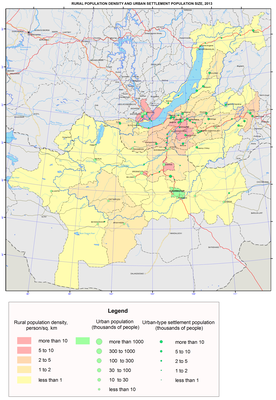
<p>Distribution of the population and the degree of the settlement of the territory are displayed on the maps “Density of population (as of 1.1.2013)”; “Density of rural population and population size of urban settlements (as of 1.1.1989)”; “Density of rural population and population size of urban settlements (as of 1.1.2013)”.</p>
<p>The Baikal region belongs to sparsely and unevenly populated territories. The population density of the Baikal basin is 17 times lower than the world’s average of 53 persons/km<sup>2</sup>. The population density in the Russian part of the basin is 2.9 persons/km<sup>2</sup>, which is nine times lower than in the European part of Russia (26 persons/km<sup>2</sup>).</p>
<p>The intra-regional differentiation of settlement patterns is stipulated by several spatial gradients of the population density decrease, with the main gradient leading from the center (capitals and administrative centers) to the periphery. Other gradients are also present in particular territories. Thus, in the Russian part of the basin, the population density tends to decrease as it goes from the south to the north and from the west to the east. The Russian-Mongolian border for the most part rather separates than unites the areas of settlement, except for one direction. The core of this direction is the Selenga Valley, where an area with a highly dense population has formed between Ulaanbaatar and Ulan-Ude.</p>
<p>The territories around large cities, like the regional centers Irkutsk, Ulan-Ude and Chita, are most densely populated. Along with the areas with dense population, there are also virtually unpopulated territories of tens of thousands square kilometers in area. The distribution of rural population is less contrasting than the urban one. The main clusters of rural population are located in the forest-steppe and steppe zones, where the density of population may reach 10-20 persons/km<sup>2</sup>. Rural population is mainly concentrated in the south of Irkutsk oblast (around Irkutsk) and in the central part of Buryatia (south of Ulan-Ude).</p>
<p>The major cities of the Russian part of the basin grew along the transportation lines. Thus, 11 out of 13 towns are located along the railways. Only Zakamensk and Kyakhta are located away from the railroad. In the Mongolian part of the basin, the connection of urban settlements to transportation lines is less pronounced with only five out of 12 towns being situated on the railways.</p>
<p>The map “Dynamics of the population size (1989-2013)” shows considerable changes in the population size – a situation, where a high concentration of the population in a few largest centers is followed by depopulation of vast territories.</p>
<p>In the Russian part of the basin, there were two clear patterns of the population size dynamics from 1989 to 2013. Firstly, the decrease of population tends to be more pronounced from the southwest to the northeast. Secondly, the population dynamics in regional centers (Irkutsk, Ulan-Ude, and Chita) and their suburbs is relatively positive. Population growth is observed only in the Irkutsk, Shelekhov, and Olkhon districts of Irkutsk oblast, Ivolga district of the Republic of Buryatia and Chita district of Zabaikalsky krai. The record level growth of population (over 160 %) was recorded in the suburban Ivolginsky and Irkutsk districts. The biggest drop in the population takes place in the localities that are classified as districts of the Far North, with the Muisky and Severobaikalsky districts of the Republic of Buryatia loosing over half of their population.</p>
<p>In the Mongolian part of the Baikal basin, population growth is registered on over a half of the nation’s territory. The main Mongolian cities – Ulaanbaatar, the capital of Mongolia, (244 % to the level of 1989), Erdenet, and Darkhan are the fastest growing cities. The Khovsgol and Selenga aimags also demonstrate a significant growth of population. The population in the four aimags of Arkhangai, Zavkhan, Tov, and Khentei decreases due to an outward migration of residents.</p>
<p>The contrasting nature of the population dynamics within the Baikal basin is quite distinct:</p>
<p>– The Russian part of the Baikal basin is characterized by the type of the population dynamics, where an outward migration is several times higher than a natural population decline;</p>
<p>–        The Mongolian part is characterized by the type of the population dynamics, where a natural increase of population prevails over inward migration.</p>
<p>Territorial specifics of demographic development are shown on the map “Natural increase of population”.</p>
<p>In the Baikal basin, different modes of reproduction of population exist along with a wide variety of quantitative parameters of demographic processes. In general, it is possible to identify two types of population reproduction. Thus, all of Mongolia, Tuva and part of Buryatia are characterized by an expanded type of reproduction with high birth rates, average mortality, and a significant natural growth. The Baikal region of Irkutsk oblast, Zabaikalsky krai, and most of Buryatia is characterized by a narrow type of reproduction with low birth rates, high mortality, and a natural population decline or insignificant natural growth. The annual natural growth of the population in Mongolian aimags is 17-19%. In the Russian part of the basin, natural movement of the population led to mixed results, where 23 municipalities showed population increase, while 10 municipalities had natural decline. With an average natural population increase of 1.4 per mille, there were significant variations – from the decline ranging from -5 to -6% (in the Petrovsk-Zabaikalsky, Irkutsk and Olkhon districts) to the increase exceeding 10 pro mille (10.4% in the Dzhida district, 12.1% in the Kizhinga District, and 16.0% in the Tere-Khol district). The natural population increase in the Mongolian capital Ulaanbaatar was 17.2%, while the increase in the Russian regional centers Ulan-Ude and Chita was 4.3% and 3.4%, respectively, with the decline of -2.7 % in Irkutsk.</p>
<p>The map “Urbanization of the territory” shows the proportion of urban population in Russian municipal districts and Mongolian aimags. The share of urban population exceeds 74% of the entire population and is composed of a few territories. The level of the urbanization of the population exceeds the world’s average (51%) by nearly one and half times, however, the level of the urbanization of the territory is low. Urban territories mainly include settlements located along the railways, as well as densely populated administrative centers. In the Mongolian part of the Baikal basin, only Ulaanbaatar and the Orkhon and Darkhan-uul aimags are highly urbanized, while the remaining nine aimags have only a small share of urban population (17.5%-34.9 %). In Mongolia, administrative centers of every aimag must be urban settlements. However, in Russia, the legislation does not mandate municipalities to have urban settlements. Therefore, in the Russian part of the basin, as of 2013, 14 districts did not have urban population at all. Some settlements (Barguzin, Ivolginsk, Kyren, and Khorinsk) rejected their urban status in the process of municipal reforms of the 2000s. The population of Mongolian towns within the basin nearly doubled in 1989-2013, with the population of Ulaanbaatar growing from 540.6 to 1,318.1 thousand people. The population of the largest cities in the Russian part of the basin did not change that much: in Irkutsk, it grew from 572.4 to 606.1 thousand people, in Ulan-Ude – from 352.5 to 416.1, while in Chita it declined from 365.8 to 331.3 thousand people.</p>
<p>The main results of migration processes in 2010-2012 are shown on the map “Migratory increase of population”.</p>
<p>In Russia, including the Baikal basin, the last two decades witnessed a significant decrease of migration activity of the population. However, outward migration from the region remains high and reproduces almost annually from the mid-1990s up to now. Population movement has mostly become intra-regional – the intra-regional migration turnover makes about 2/3 of relocations in the Baikal basin. The intra-Russian interregional migration causes migration losses, while migratory relationships with the CIS countries contribute to a considerable growth of population.</p>
<p>Redistribution of the population between the constituent parts of the Baikal region is intensive including some tens of thousands people annually. In 2010-2012, on average 66.5 thousand people arrived, and 58.6 thousand left. In the Baikal region, the average annual migration increment was 7.9 thousand people. However, it was due to the growth in the attractive for migrants cities of Irkutsk and the Irkutsk district (+9.3 thousand people), Ulan-Ude (+3.4 thousand people) and Chita (+2.9 thousand people). The total growth of the population in these cities was 15.6 thousand people. The rest of the region experienced the outflow of residents totaling 7.7 thousand people. Migration redistribution leads to the growth of the population in regional centers and their suburbs. Only 10 municipalities had a migratory growth, while the rest 24 showed a decline. The intensity of migrant arrivals is highest (twice as high as average) in the suburban Irkutsk and Ivolginsky districts, while the intensity of departures is highest (twice as high as average) in the undeveloped Dzhida, Kizhinga and Muisky districts. Against this backdrop, the Russian part of the Baikal basin has two migration poles – the Irkutsk and Dzhida districts, where an average annual migration balance is +47.4% and -46.0%, accordingly.</p>
<p>In general, the majority of territories is characterized by a progressive outward migration, which is compounded by unfavorable structural features of the outflow (with young and educated groups of people leaving the region). The results of migration movement are clearly expressed in terms of the center-periphery relationship: there are three areas of migration growth in the Russian part of the basin (Irkutsk, Ulan-Ude, and Chita with their suburban districts) and one in the Mongolian part, which combines the capital Ulaanbaatar and the aimags lying to the north of it –  Selenge, Orkhon, and Darkhan.</p>]]></content:encoded>
    <dc:publisher>No publisher</dc:publisher>
    <dc:creator>Alexander Ayurzhanaev</dc:creator>
    <dc:rights></dc:rights>
    <dc:date>2014-10-09T03:30:00Z</dc:date>
    <dc:type>Page</dc:type>
  </item>


  <item rdf:about="http://bic.iwlearn.org/en/atlas/atlas/73-population-dynamics-map">
    <title>073. Population dynamics map</title>
    <link>http://bic.iwlearn.org/en/atlas/atlas/73-population-dynamics-map</link>
    <description></description>
    
    <dc:publisher>No publisher</dc:publisher>
    <dc:creator>Alexander Ayurzhanaev</dc:creator>
    <dc:rights></dc:rights>
    <dc:date>2014-10-09T03:30:00Z</dc:date>
    <dc:type>Folder</dc:type>
  </item>


  <item rdf:about="http://bic.iwlearn.org/en/atlas/atlas/72-rural-population-density-and-urban-settlement-population-size-2013-map">
    <title>072. Rural population density and urban settlement population size, 2013 map</title>
    <link>http://bic.iwlearn.org/en/atlas/atlas/72-rural-population-density-and-urban-settlement-population-size-2013-map</link>
    <description></description>
    
    <dc:publisher>No publisher</dc:publisher>
    <dc:creator>Alexander Ayurzhanaev</dc:creator>
    <dc:rights></dc:rights>
    <dc:date>2014-10-09T03:25:00Z</dc:date>
    <dc:type>Folder</dc:type>
  </item>


</rdf:RDF>