<?xml version="1.0" encoding="utf-8" ?>
<rdf:RDF xmlns:rdf="http://www.w3.org/1999/02/22-rdf-syntax-ns#" xmlns:dc="http://purl.org/dc/elements/1.1/" xmlns:syn="http://purl.org/rss/1.0/modules/syndication/" xmlns="http://purl.org/rss/1.0/">


<channel rdf:about="http://bic.iwlearn.org/en/search_rss">
  <title>English</title>
  <link>http://bic.iwlearn.org</link>

  <description>
    
            These are the search results for the query, showing results 172 to 186.
        
  </description>


  <image rdf:resource="http://bic.iwlearn.org/logo.png"/>

  <items>
    <rdf:Seq>
      
        <rdf:li rdf:resource="http://bic.iwlearn.org/en/atlas/atlas/69-functional-ecological-settlement-types-map"/>
      
      
        <rdf:li rdf:resource="http://bic.iwlearn.org/en/atlas/atlas/68-transport-infrastructure-map"/>
      
      
        <rdf:li rdf:resource="http://bic.iwlearn.org/en/atlas/atlas/67-crop-map/crop-map"/>
      
      
        <rdf:li rdf:resource="http://bic.iwlearn.org/en/atlas/atlas/67-crop-map"/>
      
      
        <rdf:li rdf:resource="http://bic.iwlearn.org/en/atlas/atlas/66-animal-industry-map/animal-industry-map"/>
      
      
        <rdf:li rdf:resource="http://bic.iwlearn.org/en/atlas/atlas/66-animal-industry-map"/>
      
      
        <rdf:li rdf:resource="http://bic.iwlearn.org/en/atlas/atlas/65-construction-map/construction-map"/>
      
      
        <rdf:li rdf:resource="http://bic.iwlearn.org/en/atlas/atlas/64-industry-and-its-environmental-impact-map/industry-and-its-environmental-impact-map"/>
      
      
        <rdf:li rdf:resource="http://bic.iwlearn.org/en/atlas/atlas/65-construction-map"/>
      
      
        <rdf:li rdf:resource="http://bic.iwlearn.org/en/atlas/atlas/64-industry-and-its-environmental-impact-map"/>
      
      
        <rdf:li rdf:resource="http://bic.iwlearn.org/en/atlas/atlas/63-environmental-functions-map/environmental-functions-map"/>
      
      
        <rdf:li rdf:resource="http://bic.iwlearn.org/en/atlas/atlas/62-environmental-potential-map/environmental-potential-map"/>
      
      
        <rdf:li rdf:resource="http://bic.iwlearn.org/en/atlas/atlas/63-environmental-functions-map"/>
      
      
        <rdf:li rdf:resource="http://bic.iwlearn.org/en/atlas/atlas/61-susceptibility-to-external-input-map/susceptibility-to-external-input-map"/>
      
      
        <rdf:li rdf:resource="http://bic.iwlearn.org/en/atlas/atlas/62-environmental-potential-map"/>
      
    </rdf:Seq>
  </items>

</channel>


  <item rdf:about="http://bic.iwlearn.org/en/atlas/atlas/69-functional-ecological-settlement-types-map">
    <title>069. Functional-ecological settlement types map</title>
    <link>http://bic.iwlearn.org/en/atlas/atlas/69-functional-ecological-settlement-types-map</link>
    <description></description>
    
    <dc:publisher>No publisher</dc:publisher>
    <dc:creator>Alexander Ayurzhanaev</dc:creator>
    <dc:rights></dc:rights>
    <dc:date>2014-10-09T02:55:00Z</dc:date>
    <dc:type>Folder</dc:type>
  </item>


  <item rdf:about="http://bic.iwlearn.org/en/atlas/atlas/68-transport-infrastructure-map">
    <title>068. Transport infrastructure map</title>
    <link>http://bic.iwlearn.org/en/atlas/atlas/68-transport-infrastructure-map</link>
    <description></description>
    
    <dc:publisher>No publisher</dc:publisher>
    <dc:creator>Alexander Ayurzhanaev</dc:creator>
    <dc:rights></dc:rights>
    <dc:date>2014-10-09T02:55:00Z</dc:date>
    <dc:type>Folder</dc:type>
  </item>


  <item rdf:about="http://bic.iwlearn.org/en/atlas/atlas/67-crop-map/crop-map">
    <title>Crop map</title>
    <link>http://bic.iwlearn.org/en/atlas/atlas/67-crop-map/crop-map</link>
    <description></description>
    <content:encoded xmlns:content="http://purl.org/rss/1.0/modules/content/"><![CDATA[<p><img class="image-inline" src="../../../resolveuid/b9322bdbd11f42b7af42cfbc406bc154/@@images/image/preview" /></p>
<p><a href="http://bic.iwlearn.org/en/atlas/photos/copy_of__67_Crop.png" class="internal-link">Open full size</a></p>
<p align="center"><b>The use of agricultural lands: livestock husbandry and crop production</b></p>
<p>The agricultural production is one of the leading sectors of the economic complex of Mongolia. Two branches are traditionally presented in the structure of the gross agricultural production; they are livestock husbandry and crop production. A specific feature of Mongolia is the predominance of livestock products and reliance on the pasture management system. On a national scale, the agriculture of the Baikal region of the Russian Federation holds a modest place: less than 1% of agricultural production. In the East Siberian economic region Irkutsk oblast ranks second in the production of agricultural products after Krasnoyarsk krai; the Republic of Buryatia and Zabaikalsky krai rank third and fourth, respectively. Among the regions, included into the Siberian Federal District, Irkutsk oblast, the Republic of Buryatia, and Zabaikalsky krai rank 5th, 8th and 9thin the agricultural production, respectively. In the economy of Irkutsk oblast the agriculture plays a minor role. Its aim is to meet the needs of the local population in agricultural products. In Zabaikalsky krai and the Republic of Buryatia the agriculture is one of the leading production branches, which plays a key role in the livelihood of the population. The branch accounts for about 8.1% of the gross regional product in Irkutsk oblast, 12% - in Zabaikalsky krai, and 11.5% - in the Republic of Buryatia.</p>
<p>The agriculture develops under extreme environmental conditions: the agricultural territory belongs mainly to an area of ​​low biological activity, andits significant part is characterized by cold climate. Bioclimatic potential of the agricultural zone is 2-2.5 times lower than in the European agricultural zone. Consequently, to get a unit of agricultural production in the region requires more energy expenditures.</p>
<p>The agriculture of regions within the Lake Baikal basin includes two major branches, namely: livestock hus band dry and crop production, the shares of which in the gross agricultural output vary regionally: in Irkutsk oblast they are approximately equal; in Zabaikalsky krai, the Republic of Buryatia and Mongolia the leading branch of agriculture is livestock husbandry, the proportion of which is over 70%.</p>
<p>Areas of agricultural lands, which are in use by commercial farm units, engaged in the agricultural production, decrease year by year. Disposal of agricultural lands from agriculture is registered in almost all districts of the region. The main reason for the reduction of lands dedicated to agricultural production is the termination of activities of enterprises and organizations, and peasant farms. Another reason is the expiration of the agricultural tenancy (or temporary use) and its non-renewal by agricultural producers.</p>
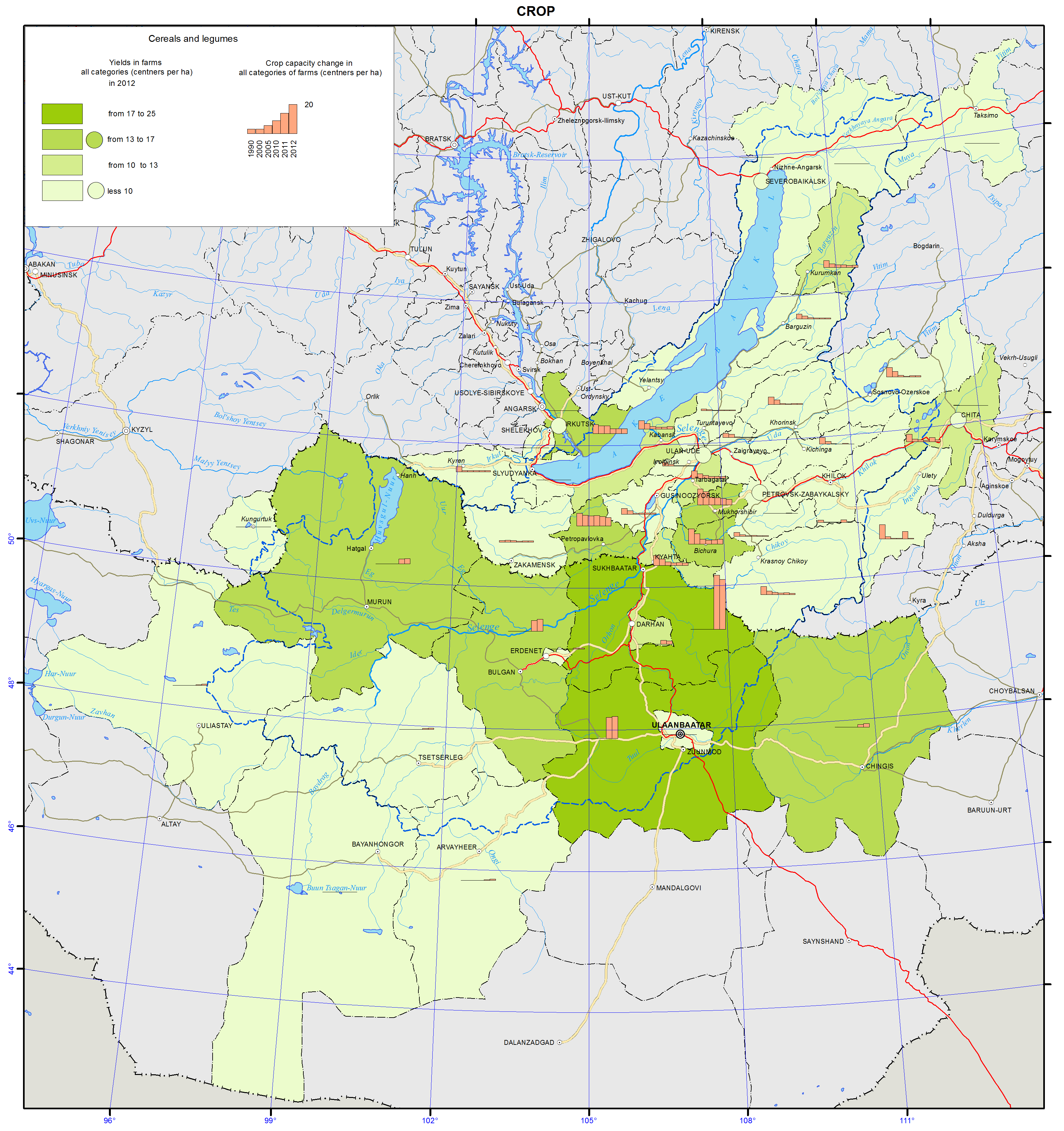
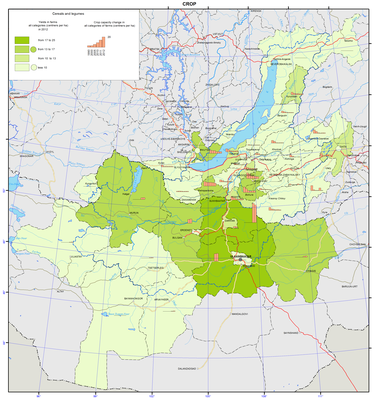
<p>About 1% of agricultural lands of Russia are located within the Baikal region. The main agricultural lands are located in the forest-steppe areas and along river valleys. However, the provision of the population with agricultural lands per capita is sufficient, for example, in Irkutsk oblastit amounts to 1.1 ha, and in Zabaikalsky krai it is 6 ha (average provision index for Russia is 1.5 ha). In the total area of agricultural lands of Irkutsk oblast the share of arable lands accounts for 69%, the proportion of pastures is 20%, and meadows and hayfields cover 10%. In Zabaikalsky krai the largest areas are occupied by forage lands, meadows and hayfields, the proportion of which exceeds 80%. In the structure of agricultural lands of the Republic of Buryatia the share of arable lands is 30%. Sown lands are used mainly for cereal crops (more than 75%), among which wheat occupies more than 45%. The yield of cereals on the average is low (8-9 centners per ha), but in some farms it can reach up to 20 and more centners per ha. Potatoes and vegetables are widely cultivated for one’s own needs. Sown lands under these crops amount to slightly more than 8%, of them under vegetables is 1.0%. Vegetable production is concentrated mainly around cities and settlements. In Irkutsk oblast in the Baikal natural territory lands of four districts, namely, Irkutsky, Shelekhovsky, Slyudyansky and Olkhonsky, are involved into the agricultural exploitation. Furthermore, two districts –Olkhonsky and Irkutsky – are typically “agricultural”, where agriculture is one of the leading sectors of the economic complex. In contrast to the Irkutsky and Olkhonsky districts, in the Sludyansky district the scarcity of land resources does not allow to develop agricultural production, but the district has formed a high-intensity horticultural sector with commercial cultivation of strawberries. Currently, this resource is not included in the turnover of the legal economy of the district; it is not processed on a commercial scale, and it is realized by private buyers, who do not pay taxes. Processing of local horticultural resources is included in the plan of the production diversification in the town of Baikalsk within the framework of the program of the Baikalsk Pulp and Paper Mill conversion. In Mongolia, the total sown areas of ​​cereal crops and potatoes amount to 283.6 thousand ha and 13.6 thousand ha, respectively. Currently, the leaders in the production of cereals and potatoes are the Selenge and Bulgan aimaks.</p>
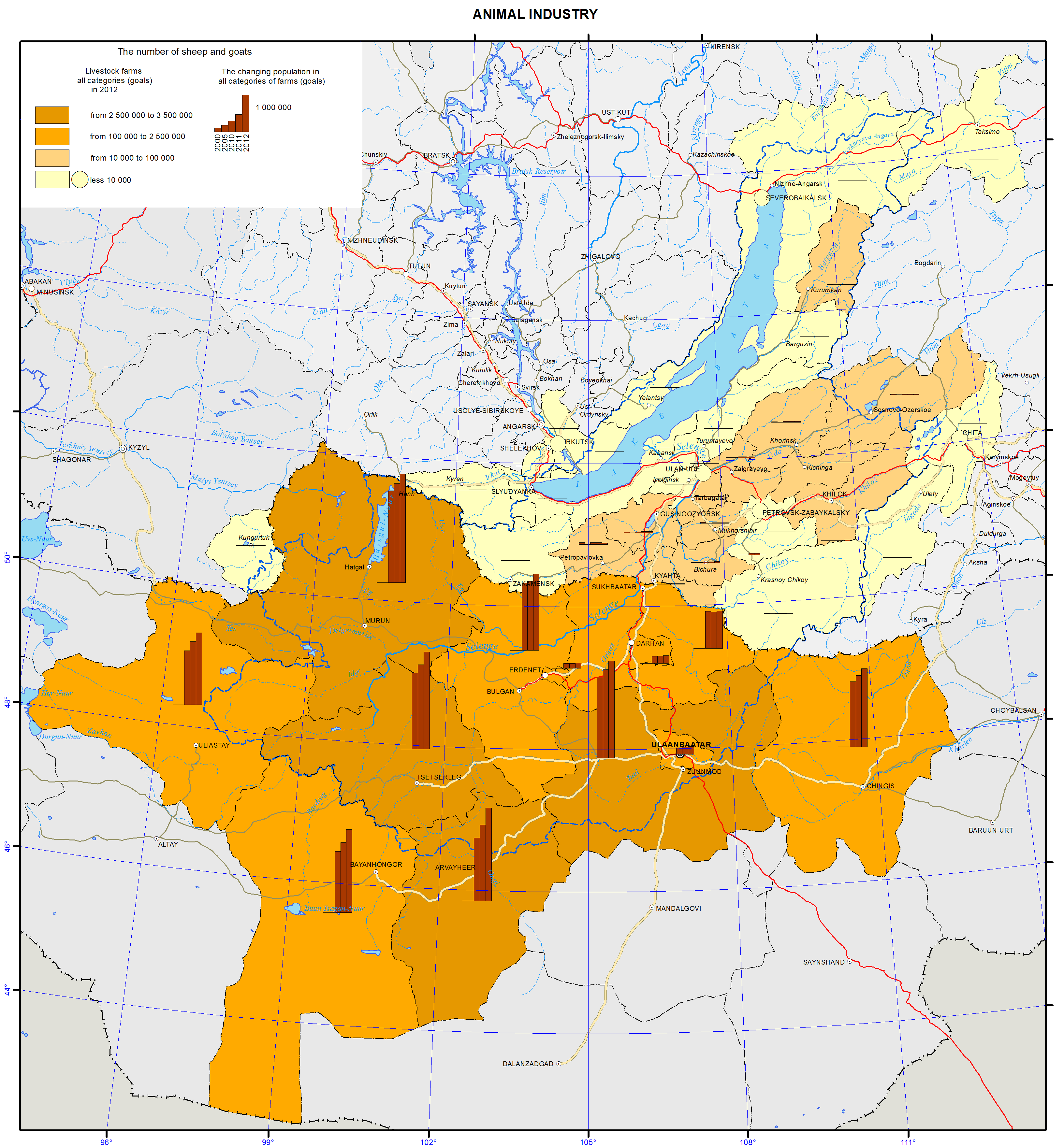
<p>In the structure of the gross agricultural output a quintessential role belongs to the livestock husbandry. The development of the livestock husbandry, especially sheep and beef cattle breeding, is facilitated by the presence of large areas of dry grazing lands, where valuable forage herbs grow, and by a thin snow cover in winter, enabling year-round cattle grazing along with relatively small quantities of fodder procured for winter. In the structure of the fodder base for all species the proportion of natural coarse and green forage accounts for 75 to 85% of all fodder. The foundation stock of farm animals is managed in the private sector. The livestock husbandry is represented by various branches; in the forest area of the region it is dairy-meat farming, and in the south, including Mongolia, it is distant-pasture beef-dairy and beef cattle breeding, meat-wool sheep breeding, and horse and pig husbandry. Moreover, goat breeding is traditionally represented in the aimaks of Mongolia, and camel husbandry is an auxiliary branch. Most farms produce milk and beef, implementing the so-called full cycle of a herd based on internal specialization of farms, producing milk and breeding young-stock.</p>]]></content:encoded>
    <dc:publisher>No publisher</dc:publisher>
    <dc:creator>Alexander Ayurzhanaev</dc:creator>
    <dc:rights></dc:rights>
    <dc:date>2014-10-09T02:50:00Z</dc:date>
    <dc:type>Page</dc:type>
  </item>


  <item rdf:about="http://bic.iwlearn.org/en/atlas/atlas/67-crop-map">
    <title>067. Crop map</title>
    <link>http://bic.iwlearn.org/en/atlas/atlas/67-crop-map</link>
    <description></description>
    
    <dc:publisher>No publisher</dc:publisher>
    <dc:creator>Alexander Ayurzhanaev</dc:creator>
    <dc:rights></dc:rights>
    <dc:date>2014-10-09T02:50:00Z</dc:date>
    <dc:type>Folder</dc:type>
  </item>


  <item rdf:about="http://bic.iwlearn.org/en/atlas/atlas/66-animal-industry-map/animal-industry-map">
    <title>Animal industry map</title>
    <link>http://bic.iwlearn.org/en/atlas/atlas/66-animal-industry-map/animal-industry-map</link>
    <description></description>
    <content:encoded xmlns:content="http://purl.org/rss/1.0/modules/content/"><![CDATA[<p><img class="image-inline" src="../../../resolveuid/1231dff299c8448f95fae9f5bc59b31d/@@images/image/preview" /></p>
<p><a href="http://bic.iwlearn.org/en/atlas/photos/copy_of__66_Animalindustry.png" class="internal-link">Open full size</a></p>
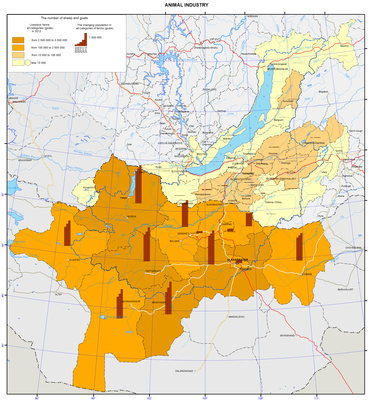
<p align="center"><strong>The use of agricultural lands: livestock husbandry and crop production</strong></p>
<p>The agricultural production is one of the leading sectors of the economic complex of Mongolia. Two branches are traditionally presented in the structure of the gross agricultural production; they are livestock husbandry and crop production. A specific feature of Mongolia is the predominance of livestock products and reliance on the pasture management system. On a national scale, the agriculture of the Baikal region of the Russian Federation holds a modest place: less than 1% of agricultural production. In the East Siberian economic region Irkutsk oblast ranks second in the production of agricultural products after Krasnoyarsk krai; the Republic of Buryatia and Zabaikalsky krai rank third and fourth, respectively. Among the regions, included into the Siberian Federal District, Irkutsk oblast, the Republic of Buryatia, and Zabaikalsky krai rank 5th, 8th and 9thin the agricultural production, respectively. In the economy of Irkutsk oblast the agriculture plays a minor role. Its aim is to meet the needs of the local population in agricultural products. In Zabaikalsky krai and the Republic of Buryatia the agriculture is one of the leading production branches, which plays a key role in the livelihood of the population. The branch accounts for about 8.1% of the gross regional product in Irkutsk oblast, 12% - in Zabaikalsky krai, and 11.5% - in the Republic of Buryatia.</p>
<p>The agriculture develops under extreme environmental conditions: the agricultural territory belongs mainly to an area of ​​low biological activity, andits significant part is characterized by cold climate. Bioclimatic potential of the agricultural zone is 2-2.5 times lower than in the European agricultural zone. Consequently, to get a unit of agricultural production in the region requires more energy expenditures.</p>
<p>The agriculture of regions within the Lake Baikal basin includes two major branches, namely: livestock hus band dry and crop production, the shares of which in the gross agricultural output vary regionally: in Irkutsk oblast they are approximately equal; in Zabaikalsky krai, the Republic of Buryatia and Mongolia the leading branch of agriculture is livestock husbandry, the proportion of which is over 70%.</p>
<p>Areas of agricultural lands, which are in use by commercial farm units, engaged in the agricultural production, decrease year by year. Disposal of agricultural lands from agriculture is registered in almost all districts of the region. The main reason for the reduction of lands dedicated to agricultural production is the termination of activities of enterprises and organizations, and peasant farms. Another reason is the expiration of the agricultural tenancy (or temporary use) and its non-renewal by agricultural producers.</p>
<p>About 1% of agricultural lands of Russia are located within the Baikal region. The main agricultural lands are located in the forest-steppe areas and along river valleys. However, the provision of the population with agricultural lands per capita is sufficient, for example, in Irkutsk oblastit amounts to 1.1 ha, and in Zabaikalsky krai it is 6 ha (average provision index for Russia is 1.5 ha). In the total area of agricultural lands of Irkutsk oblast the share of arable lands accounts for 69%, the proportion of pastures is 20%, and meadows and hayfields cover 10%. In Zabaikalsky krai the largest areas are occupied by forage lands, meadows and hayfields, the proportion of which exceeds 80%. In the structure of agricultural lands of the Republic of Buryatia the share of arable lands is 30%. Sown lands are used mainly for cereal crops (more than 75%), among which wheat occupies more than 45%. The yield of cereals on the average is low (8-9 centners per ha), but in some farms it can reach up to 20 and more centners per ha. Potatoes and vegetables are widely cultivated for one’s own needs. Sown lands under these crops amount to slightly more than 8%, of them under vegetables is 1.0%. Vegetable production is concentrated mainly around cities and settlements. In Irkutsk oblast in the Baikal natural territory lands of four districts, namely, Irkutsky, Shelekhovsky, Slyudyansky and Olkhonsky, are involved into the agricultural exploitation. Furthermore, two districts –Olkhonsky and Irkutsky – are typically “agricultural”, where agriculture is one of the leading sectors of the economic complex. In contrast to the Irkutsky and Olkhonsky districts, in the Sludyansky district the scarcity of land resources does not allow to develop agricultural production, but the district has formed a high-intensity horticultural sector with commercial cultivation of strawberries. Currently, this resource is not included in the turnover of the legal economy of the district; it is not processed on a commercial scale, and it is realized by private buyers, who do not pay taxes. Processing of local horticultural resources is included in the plan of the production diversification in the town of Baikalsk within the framework of the program of the Baikalsk Pulp and Paper Mill conversion. In Mongolia, the total sown areas of ​​cereal crops and potatoes amount to 283.6 thousand ha and 13.6 thousand ha, respectively. Currently, the leaders in the production of cereals and potatoes are the Selenge and Bulgan aimaks.</p>
<p>In the structure of the gross agricultural output a quintessential role belongs to the livestock husbandry. The development of the livestock husbandry, especially sheep and beef cattle breeding, is facilitated by the presence of large areas of dry grazing lands, where valuable forage herbs grow, and by a thin snow cover in winter, enabling year-round cattle grazing along with relatively small quantities of fodder procured for winter. In the structure of the fodder base for all species the proportion of natural coarse and green forage accounts for 75 to 85% of all fodder. The foundation stock of farm animals is managed in the private sector. The livestock husbandry is represented by various branches; in the forest area of the region it is dairy-meat farming, and in the south, including Mongolia, it is distant-pasture beef-dairy and beef cattle breeding, meat-wool sheep breeding, and horse and pig husbandry. Moreover, goat breeding is traditionally represented in the aimaks of Mongolia, and camel husbandry is an auxiliary branch. Most farms produce milk and beef, implementing the so-called full cycle of a herd based on internal specialization of farms, producing milk and breeding young-stock.</p>]]></content:encoded>
    <dc:publisher>No publisher</dc:publisher>
    <dc:creator>Alexander Ayurzhanaev</dc:creator>
    <dc:rights></dc:rights>
    <dc:date>2014-10-09T02:45:00Z</dc:date>
    <dc:type>Page</dc:type>
  </item>


  <item rdf:about="http://bic.iwlearn.org/en/atlas/atlas/66-animal-industry-map">
    <title>066. Animal industry map</title>
    <link>http://bic.iwlearn.org/en/atlas/atlas/66-animal-industry-map</link>
    <description></description>
    
    <dc:publisher>No publisher</dc:publisher>
    <dc:creator>Alexander Ayurzhanaev</dc:creator>
    <dc:rights></dc:rights>
    <dc:date>2014-10-09T02:45:00Z</dc:date>
    <dc:type>Folder</dc:type>
  </item>


  <item rdf:about="http://bic.iwlearn.org/en/atlas/atlas/65-construction-map/construction-map">
    <title>Construction map</title>
    <link>http://bic.iwlearn.org/en/atlas/atlas/65-construction-map/construction-map</link>
    <description></description>
    <content:encoded xmlns:content="http://purl.org/rss/1.0/modules/content/"><![CDATA[<p><img class="image-inline" src="../../../resolveuid/8417731d026043d89b5977e9bbd4e6c2/@@images/image/preview" /></p>
<p><a href="http://bic.iwlearn.org/en/atlas/photos/copy_of__65_Construction.png" class="internal-link">Open full size</a></p>
<p align="center"><strong>Construction</strong></p>
<p align="center"><strong> </strong></p>
<p>Construction industry in the Baikal basin is one of the growth points of its economy and ecological well-being. One of the main indicators of the construction industry is the square meterage of the built civil and industrial facilities. Generally, it reflects its social and economic status in some regions. A current characterization of a segment of the construction sector – the residential construction – is conducted based on the observation of governmental statistical data [Districts…, 2013; Construction in Zabaikalsky krai, 2013; Construction in Russia, 2012; Construction and commissioning…, 2013] and the Internet resources [Federal State Statistics Service].</p>
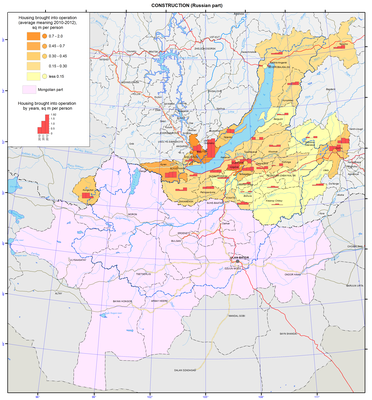
<p>In the past three years (2010 to 2012), construction put-in-place increased three-fold (from 0.4 to 1.2 million sq. m). Judging by the growth of the absolute values of the residential construction put-in-place, Irkutsk oblast – the most urbanized region in the basin – tops the list with over a half of the volume of commissioned residential housing in the Baikal basin (2012).  The Republic of Buryatia is the second (26.2 %), and Zabaikalsky krai is the third (19.3 %).</p>
<p>The most important characteristics of residential development is the annual square meterage of the built housing (m²/person), which is presented as a background indicator of the map. By absolute indicators, Russia reached the pre-reform level of residential development in 2007. However, the specific indicator of the floor space of commissioned housing both in the country in general and in the Baikal basin in particular does not exceed 0.5 m²/person (in developed countries the annual construction capacity is at least 1 m² per capita, while the annual growth of housing put-in-place is 4.5-5.0 %) [Federal State Statistics Service]. Territorial differentiation of municipalities of the region according to this important indicator is quite contrasting. High specific indicators and the stable growth dynamics as a result of the implementation of targeted state programs facilitating residential development are observed across the whole territory except for the Republic of Tuva. Irkutsk oblast is leading, with its indicators being twice as high as the indicators of other regions (0.81 m²/person against the average regional indicator of 0.45 m²/person).</p>
<p>The residential construction sector of the region is distinguished by:</p>
<p>− The contrasting nature of its geography both in absolute and standard specific basic values;</p>
<p>− The current focal points of growth – Irkutsk and the Ivolginsky district (Republic of Buryatia).</p>
<p>The most important instruments for improving residential development are targeted state programs of regional and municipal levels. These programs focus on the implementation of comprehensive measures for the development of large-scale residential construction in the region. The key “driver” of the so-needed residential development in the municipalities of the lower level is the social and economic planning using various regional programs.</p>
<p align="center"> </p>
<p align="center">References</p>
<p>Statistical Compendium. (2013). <i>Districts of the Republic of Buryatia</i>. Ulan-Ude: Buryatstat. p 102.</p>
<p>Statistical Compendium. (2013). <i>Construction in Zabaikalsky krai</i>. Chita: Zabaikalkraistat. p 47.</p>
<p>Statistical Compendium. (2012). <i>Construction in Russia</i>. Moscow: Rosstat. p 220.</p>
<p>Statistical Compendium. (2013). <i>Construction and commissioning of facilities in Irkutsk oblast</i>. Irkutsk: Irkutskstat. p 36.</p>
<p>Federal State Statistics Service. <i>Database of municipal indicators</i>. Retrieved from http://www.gks.ru/dbscripts/munst/munst.htm</p>]]></content:encoded>
    <dc:publisher>No publisher</dc:publisher>
    <dc:creator>Alexander Ayurzhanaev</dc:creator>
    <dc:rights></dc:rights>
    <dc:date>2014-10-09T02:35:00Z</dc:date>
    <dc:type>Page</dc:type>
  </item>


  <item rdf:about="http://bic.iwlearn.org/en/atlas/atlas/64-industry-and-its-environmental-impact-map/industry-and-its-environmental-impact-map">
    <title>Industry and Its environmental impact map</title>
    <link>http://bic.iwlearn.org/en/atlas/atlas/64-industry-and-its-environmental-impact-map/industry-and-its-environmental-impact-map</link>
    <description></description>
    <content:encoded xmlns:content="http://purl.org/rss/1.0/modules/content/"><![CDATA[<p><img class="image-inline" src="../../../resolveuid/d05b4397c3f24c3bb86e32d2904c4076/@@images/image/preview" /></p>
<p><a href="http://bic.iwlearn.org/en/atlas/photos/copy_of__64_IndustryandItsEnvironmentalImpact.png" class="internal-link">Open full size</a></p>
<p align="center"><strong>Industrial and its impact on the environment</strong></p>
<p>Today, economic activity significantly influences the environment, and the main impact factor is the industry. The higher the concentration of industrial facilities, the more extensive the area of environmental changes is. This can be seen in the Baikal basin. Any change in one of the areas of the environment is reflected in the other (lithosphere disturbances indirectly affect the surface water and groundwater regimes, predetermining the dust and gas pollution, etc.).</p>
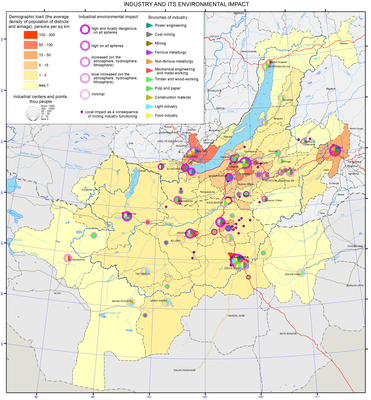
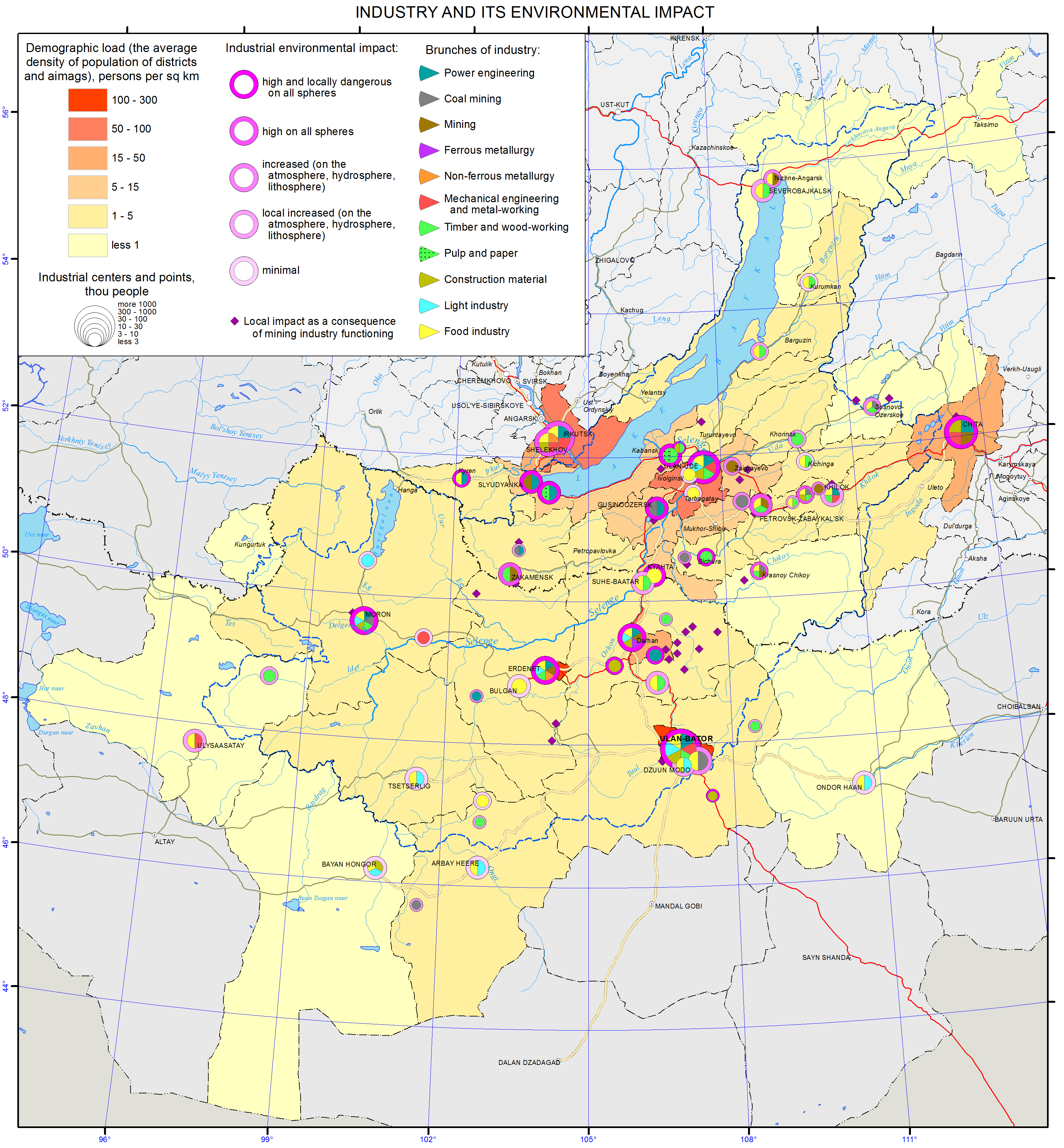
<p>The map “Industry and its impact on the environment” presents the results of the research of the industrial impact on the environment in the Baikal basin. The object of the map is an industrial center, as it is one of the most common forms of the territorial organization of industrial production representing a local group of companies (within the boundaries of a settlement).</p>
<p>The map depicts industrial centers with symbols. The symbol’s size shows the total population, the inner sectors – industry branches, circled sectors – the dominant impact on the environmental components. The areas disturbed by the mining industry (open-pits, waste heaps, dumps, etc.) and emissions (for large settlements) are shown separately. The areas with a maximum impact on the environment are identified based on the analysis of the industry’s impact on different environments.</p>
<p>The research results make it possible to draw the following conclusions.</p>
<p>The maximum industry impact on the environment is registered in the Republic of Buryatia. The impact on the environment is observed in all its settlements. The areas of the maximum negative impact on all environments are the Zakamensky, Kyakhtinsky, Gusinoozersky, Nizhne-Selenginsky and Ulan-Ude industrial hubs.</p>
<p>Major industries have negative impacts, e.g. the fuel and energy, mining, pulp and paper, and food industries. The main pollutants are the Ulan-Ude Central Heating Power Plant (CHPP)-1, Aviation Plant, Locomotive Repair Plant, glass factory, Selenginsky Pulp and Cardboard Mill, as well as light and food industries. Large and medium-sized waste dumps of consumer and industrial waste also significantly damage the environment [Impact...].</p>
<p>In Zabaikalsky krai, there is a local impact on the environment by the electrical energy, mining, and food industries. The largest area of a negative impact on the environment is the Chita industrial hub, where the main polluters are fuel-and-energy companies (the Chita Thermal Power Plant (TPP)-1 and TPP -2), mechanical engineering and metalworking plants, and transportation.</p>
<p>Industrial development in the part of Irkutsk oblast included into the Baikal basin is rather weak with the exception of the towns of Baikalsk and Slyudyanka. Here, the main polluters are mining (marble mining), transportation, and energy companies. In Baikalsk, the main source of pollution – the Baikalsk Pulp and Paper Mill – is currently closed, but the consequences of its activities in the form of pollution of the adjacent portion of the lake and the huge volume of stockpiled solid wastes still remain. Fuel and energy companies and transportation still significantly contribute to the air pollution. The administrative center of Irkutsk oblast – Irkutsk – has been continuously listed as one of the most polluted cities. The main air pollutants in Irkutsk are vehicle exhaust gas (52% of emissions) and unfiltered thermal power supply (46% of emissions). Manufacturing is responsible for about 2% of all emissions. Under certain circulatory patterns, some portion of atmospheric pollutants from Irkutsk can get into the Baikal basin and the lake’s water area. Therefore, according to the environmental zoning, this city is included into the zone of atmospheric impact. Irkutsk Aviation Plant is the main source of wastewater discharge into the Angara river, while the Irkutsk Furniture Factory — into the Irkut river. However, this pollution does not get into the Baikal catchment area. A growing number of unauthorized landfill sites around the city represents a particular problem. In the Olkhon district, the major source of environmental pollution is recreational activity resulting in the problem associated with the disposal of solid waste.</p>
<p>In Mongolia, among the main areas of industrial impact on the environment are industrial centers, where the majority of population is concentrated and industrial enterprises are located (Ulaanbaatar, Darkhan, Erdenet, etc.), as well as local mining areas and light industry companies (wool and leather processing). In Mongolia, the impact of industry on water resources is particularly acute. In the last 20 years, out of five thousand rivers and lakes 852 rivers and 1,131 lakes have dried up due to mining [Basayev]. In addition, intensive water pollution (water quality of Pollution Class 3-4) is observed in all selected areas and large industrial centers. The main water pollutants are oil products and phenols. Increased oxidation is also registered.</p>
<p>Uneven economic development of the territory is accompanied by an unequal impact on the environment. As a result, the most negative impact takes place in large industrial centers with a high concentration of industrial enterprises that are characterized by significant emissions of air pollutants and large-volume wastewater discharges. The natural resources potential of the area has determined the development of the mining industry, which poses the greatest risk of pollution by toxic substances from tailings ponds to the land and surface and groundwater.<b></b></p>
<p> </p>
<p align="center">References</p>
<p>The Information Portal Lake Baikal.<i> Impact of economic activities on the environment</i>. Retrieved from http://www.baikal-center.ru/books/element.php?ID=1387#</p>
<p>Basayev, S. Gold Rush in Mongolia hurts Lake Baikal. <i>Buryatia.Asia. </i>Retrieved from <a href="http://buryatia.asia/zolotodobyvayushhaya-promyshlennost-mongolii-udarila-po-ekologii-ozera-bajkal/">http://buryatia.asia/zolotodobyvayushhaya-promyshlennost-mongolii-udarila-po-ekologii-ozera-bajkal/</a></p>]]></content:encoded>
    <dc:publisher>No publisher</dc:publisher>
    <dc:creator>Alexander Ayurzhanaev</dc:creator>
    <dc:rights></dc:rights>
    <dc:date>2014-10-09T02:30:00Z</dc:date>
    <dc:type>Page</dc:type>
  </item>


  <item rdf:about="http://bic.iwlearn.org/en/atlas/atlas/65-construction-map">
    <title>065. Construction map</title>
    <link>http://bic.iwlearn.org/en/atlas/atlas/65-construction-map</link>
    <description></description>
    
    <dc:publisher>No publisher</dc:publisher>
    <dc:creator>Alexander Ayurzhanaev</dc:creator>
    <dc:rights></dc:rights>
    <dc:date>2014-10-09T02:30:00Z</dc:date>
    <dc:type>Folder</dc:type>
  </item>


  <item rdf:about="http://bic.iwlearn.org/en/atlas/atlas/64-industry-and-its-environmental-impact-map">
    <title>064. Industry and Its environmental impact map</title>
    <link>http://bic.iwlearn.org/en/atlas/atlas/64-industry-and-its-environmental-impact-map</link>
    <description></description>
    
    <dc:publisher>No publisher</dc:publisher>
    <dc:creator>Alexander Ayurzhanaev</dc:creator>
    <dc:rights></dc:rights>
    <dc:date>2014-10-09T02:25:00Z</dc:date>
    <dc:type>Folder</dc:type>
  </item>


  <item rdf:about="http://bic.iwlearn.org/en/atlas/atlas/63-environmental-functions-map/environmental-functions-map">
    <title>Environmental functions map</title>
    <link>http://bic.iwlearn.org/en/atlas/atlas/63-environmental-functions-map/environmental-functions-map</link>
    <description></description>
    <content:encoded xmlns:content="http://purl.org/rss/1.0/modules/content/"><![CDATA[<p><img class="image-inline" src="../../../resolveuid/a8df77559e8b4619b64773bf33684f76/@@images/image/preview" /></p>
<p><a href="http://bic.iwlearn.org/en/atlas/photos/copy_of__63_Environmentalfunctions.png" class="internal-link">Open full size</a></p>
<p align="center"><strong>Ecological functions of landscapes</strong></p>
<p align="center"><strong> </strong></p>
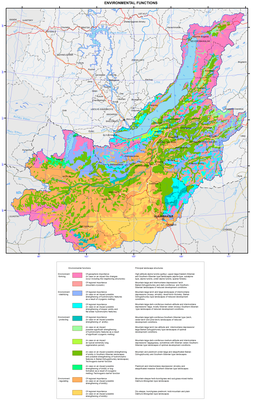
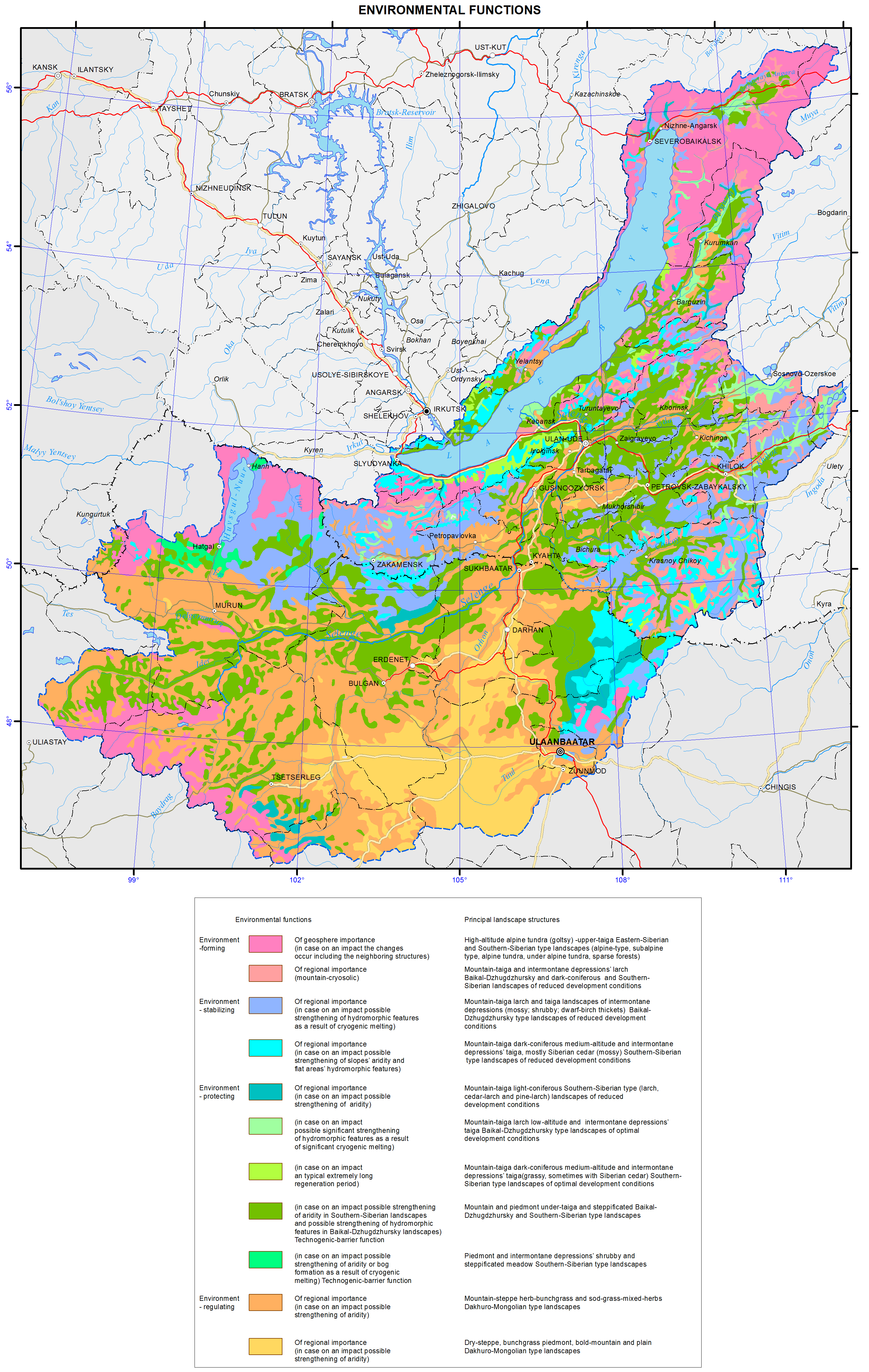
<p>This map represents the groups of landscapes with similar nature protecting (ecological) functions [Polikarpov et al., 1980, p. 184-194]. They are divided into groups depending on these functions: environment-forming function of geospheric and regional significance, environment-regulating, environment-stabilising, and environment-protective.</p>
<p>The landscapes of goletz, tundra and sparse wood perform the main environment-forming “water-production” function. Of special significance is their snow and water collecting function. These landscapes experience large hydrological loads as they transform the water and transfer it to the subsurface flow. To date, the production of pure water is the most important ecological function as pure water is becoming the most valuable product on the planet. The significance of these landscapes increases due to the protection of depth and purity of Lake Baikal waters.</p>
<p>The environment-stabilizing function is characteristic of all mountain-taiga (moss) landscapes of reduced and limited development – from mountain-taiga shrub-moss dark coniferous and larch communities to shrub and moss-shrub dark coniferous and larch-taiga landscapes in the intermountain depression and valleys with yernik and mixed undergrowth. Their moss cover provides certain ecological conditions. These landscapes are more stable and after external pressure they, as a rule, recover fast. Together with goletz and upper-taiga landscapes, they determine the fundamental set of mechanisms of internal and external interactions of landscapes.</p>
<p>South Siberian and Central Asian (Daurian-Mongolian) steppe landscapes are referred to the group with environment-regulating functions. On the whole, they are characterized by insufficient wetness [Geosystems …, 1991; Eco-geographic …, 1996]. Their role in the flow regulation is rather small. However, under conditions of intense water evaporation they have a very important regulating significance: plant components of these landscapes support the existing ecological balance whose changes can cause the disturbance of the moisture regime and, as a result, the landscape structure. This function specifically intensifies under the conditions of anthropogenic pressure. As a result, all steppe landscapes share high soil-protective significance as they fulfil a technogenic barrier function.</p>
<p>“Herb” landscapes perform environment-protective function: mountain-taiga larch landscapes of optimal development, piedmont and larch-taiga landscapes of optimal development in intermountain depressions, piedmont sub-taiga larch, mountain-taiga pinewood, piedmont sub-taiga pinewood landscapes. Insufficient moistening is characteristic of these landscapes, and changes of their vegetative component can cause changes in hydrological regime towards aridity and, as a result, disruption of landscape structure. Their water and soil-protective role increases. They are characterised by high concentration of different economic activity. Therefore, these landscapes are of technogenic barrier significance.</p>
<p><b> </b></p>
<p align="center"><b>References</b></p>
<p><i>Atlas of Irkutsk Oblast: Ecological Conditions for Development</i>. (2004) – M. – Irkutsk,. – 90 p.</p>
<p><i>Geosystems of taiga and steppe contact: South of Central Siberia</i>. (1991) / Chief Ed. A. Krauklis. – Novosibirsk: Nauka. – 214 p.</p>
<p>Isachenko, A.G. (1990). Intensity of functioning and productivity of geosystems // <i>Izv. AS USSR. Ser. Geogr.</i>– 5. – P. 5-17.</p>
<p>Correlation eco-phytocoenotic map, scale 1:7,500,000. (1977). / Buks I.I., Baiborodin V.N., Timirbaeva L.S. // <i>Eco-phytocoenotic complexes of Asian Russia (mapping experience)</i>. – Irkutsk.</p>
<p>Landscapes of South-East Siberia: map, scale 1:1,500,000 (1977). / Mikheev, V.S., Ryashin, V.A. – M.: GUGK, – 4 p.</p>
<p>Mikheev, V.C. (1987). <i>Landscape and geographic supply of Siberian complex problems.</i> – Novosibirsk: Nauka. Sib. Depart. – 205 p.</p>
<p>Mikheev, V.C. (1988). <i>Materials for territorial complex scheme of nature protection (TerKSOP)</i>. – Irkutsk. – 63 p.</p>
<p><i>National Atlas of Mongolian People’s Republic.</i> (1990). Ulan-Bator-Moscow. –  144 p.</p>
<p>Polikarpov, N.P.,. Chebakova, N.M, Nazimova, D.I. (1980). <i>Climate and mountain forests of South Siberia</i>. – Novosibirsk: Nauka. – 225 p.</p>
<p>Sochava, V.B. (2005). <i>Theoretical and applied geography. Selected Proceedings</i> / V.B. Sochava. – Novosibirsk: Nauka. – 288 p.</p>
<p><i>Eco-geographic map of the Russian Federation: map, scale 1:4,000,000.</i> (1996). – M.: Fed. Service of Geodesy and Cartography of Russia. – 4 p.</p>]]></content:encoded>
    <dc:publisher>No publisher</dc:publisher>
    <dc:creator>Alexander Ayurzhanaev</dc:creator>
    <dc:rights></dc:rights>
    <dc:date>2014-10-09T02:20:00Z</dc:date>
    <dc:type>Page</dc:type>
  </item>


  <item rdf:about="http://bic.iwlearn.org/en/atlas/atlas/62-environmental-potential-map/environmental-potential-map">
    <title>Environmental potential map</title>
    <link>http://bic.iwlearn.org/en/atlas/atlas/62-environmental-potential-map/environmental-potential-map</link>
    <description></description>
    <content:encoded xmlns:content="http://purl.org/rss/1.0/modules/content/"><![CDATA[<p><img class="image-inline" src="../../../resolveuid/cd180f768bae443e971a32edb5f4a0a2/@@images/image/preview" /></p>
<p><a href="http://bic.iwlearn.org/en/atlas/photos/copy_of__62_Environmentalpotential.png" class="internal-link">Open full size</a></p>
<p align="center"><strong>Ecological landscape potential (ELP)</strong></p>
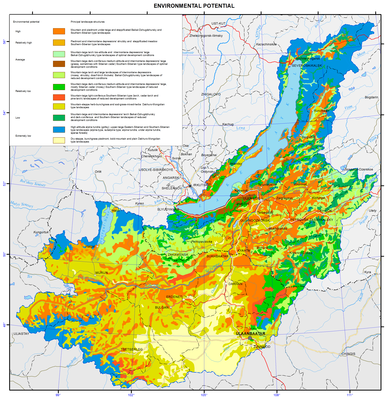
<p>The map characterises the ability of landscapes to create specific local human environment. It was compiled on the basis of ecological interpretation of landscape characteristics and consequent zoning of the Baikal basin taking into account comfort level of landscapes for human activity.</p>
<p>The ratio of heat and moisture supply of landscapes, as well as productivity of their plant (low, moderate, elevated, and high), was used to indicate ecological comfort of landscapes (lack of heat, excess of moisture, etc.).</p>
<p>Relative estimating categories (very low, low, moderate, high, and very high) are used for ELP characterisation. In the map legend, they are correlated with factors of integral functioning intensity.</p>]]></content:encoded>
    <dc:publisher>No publisher</dc:publisher>
    <dc:creator>Alexander Ayurzhanaev</dc:creator>
    <dc:rights></dc:rights>
    <dc:date>2014-10-09T02:15:00Z</dc:date>
    <dc:type>Page</dc:type>
  </item>


  <item rdf:about="http://bic.iwlearn.org/en/atlas/atlas/63-environmental-functions-map">
    <title>063. Environmental functions map</title>
    <link>http://bic.iwlearn.org/en/atlas/atlas/63-environmental-functions-map</link>
    <description></description>
    
    <dc:publisher>No publisher</dc:publisher>
    <dc:creator>Alexander Ayurzhanaev</dc:creator>
    <dc:rights></dc:rights>
    <dc:date>2014-10-09T02:15:00Z</dc:date>
    <dc:type>Folder</dc:type>
  </item>


  <item rdf:about="http://bic.iwlearn.org/en/atlas/atlas/61-susceptibility-to-external-input-map/susceptibility-to-external-input-map">
    <title>Susceptibility to external input map</title>
    <link>http://bic.iwlearn.org/en/atlas/atlas/61-susceptibility-to-external-input-map/susceptibility-to-external-input-map</link>
    <description></description>
    <content:encoded xmlns:content="http://purl.org/rss/1.0/modules/content/"><![CDATA[<p><img class="image-inline" src="../../../resolveuid/13cdf5ce57c34f61889f86691bb1add2/@@images/image/preview" /></p>
<p><a href="http://bic.iwlearn.org/en/atlas/photos/copy_of__61_Susceptibilitytoexternalinput.png" class="internal-link">Open full size</a></p>
<p align="center"><b>Landscape sensitivity to external effects</b><b> </b></p>
<p align="center"><b> </b></p>
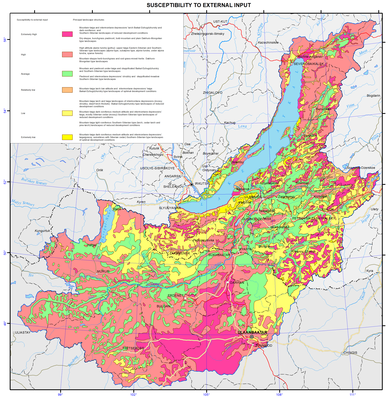
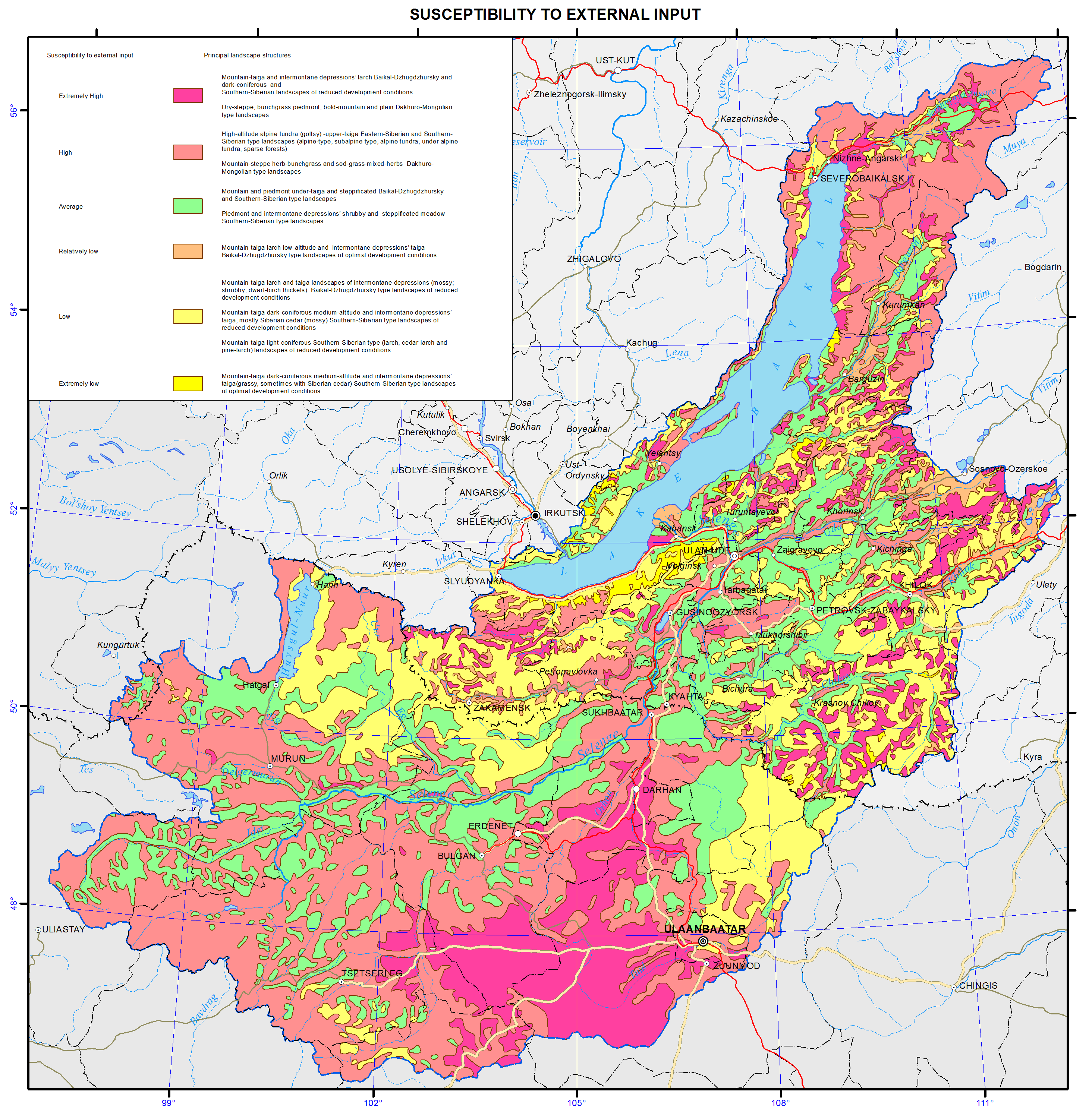
<p>The map of landscape sensitivity characterizes common respond of landscapes to external effects including the anthropogenic impact. Landscape sensitivity is defined by “self-regulation” [Sochava, 2005] – an ability to retain the structure of landscapes within the certain boundaries for a certain period of time.</p>
<p>Landscape sensitivity in the Baikal basin is strongly interdependent on landscape types. “Integral intensity of functioning … and productivity of landscapes” [Isachenko, 1990] are indicators of sensitivity. Sensitivity correlates with heat and moisture supply of landscapes “according to the optimality principle”, as well as with plant biological productivity “according to the maximum principle: the more the better” [Sochava, 2005].</p>
<p>Sensitivity increases as the deviation of heat and moisture ratio from the ecological optimum rises. Landscapes with optimal combinations of heat and moisture supply and with high biological productivity are less sensitive to anthropogenic pressure. The most sensitive landscapes are with low and very low biological productivity, which develop under extreme conditions.</p>
<p>The sensitivity in the map legend is characterised by relative estimating categories such as “very high”, “high”, “moderate”, “low”, and “very low”.</p>]]></content:encoded>
    <dc:publisher>No publisher</dc:publisher>
    <dc:creator>Alexander Ayurzhanaev</dc:creator>
    <dc:rights></dc:rights>
    <dc:date>2014-10-09T02:10:00Z</dc:date>
    <dc:type>Page</dc:type>
  </item>


  <item rdf:about="http://bic.iwlearn.org/en/atlas/atlas/62-environmental-potential-map">
    <title>062. Environmental potential map</title>
    <link>http://bic.iwlearn.org/en/atlas/atlas/62-environmental-potential-map</link>
    <description></description>
    
    <dc:publisher>No publisher</dc:publisher>
    <dc:creator>Alexander Ayurzhanaev</dc:creator>
    <dc:rights></dc:rights>
    <dc:date>2014-10-09T02:10:00Z</dc:date>
    <dc:type>Folder</dc:type>
  </item>


</rdf:RDF>