<?xml version="1.0" encoding="utf-8" ?>
<rdf:RDF xmlns:rdf="http://www.w3.org/1999/02/22-rdf-syntax-ns#" xmlns:dc="http://purl.org/dc/elements/1.1/" xmlns:syn="http://purl.org/rss/1.0/modules/syndication/" xmlns="http://purl.org/rss/1.0/">


<channel rdf:about="http://bic.iwlearn.org/en/search_rss">
  <title>English</title>
  <link>http://bic.iwlearn.org</link>

  <description>
    
            These are the search results for the query, showing results 182 to 196.
        
  </description>


  <image rdf:resource="http://bic.iwlearn.org/logo.png"/>

  <items>
    <rdf:Seq>
      
        <rdf:li rdf:resource="http://bic.iwlearn.org/en/atlas/atlas/63-environmental-functions-map/environmental-functions-map"/>
      
      
        <rdf:li rdf:resource="http://bic.iwlearn.org/en/atlas/atlas/62-environmental-potential-map/environmental-potential-map"/>
      
      
        <rdf:li rdf:resource="http://bic.iwlearn.org/en/atlas/atlas/63-environmental-functions-map"/>
      
      
        <rdf:li rdf:resource="http://bic.iwlearn.org/en/atlas/atlas/61-susceptibility-to-external-input-map/susceptibility-to-external-input-map"/>
      
      
        <rdf:li rdf:resource="http://bic.iwlearn.org/en/atlas/atlas/62-environmental-potential-map"/>
      
      
        <rdf:li rdf:resource="http://bic.iwlearn.org/en/atlas/atlas/61-susceptibility-to-external-input-map"/>
      
      
        <rdf:li rdf:resource="http://bic.iwlearn.org/en/atlas/atlas/60-environmental-landscapes-map/environmental-landscapes-map"/>
      
      
        <rdf:li rdf:resource="http://bic.iwlearn.org/en/atlas/atlas/59-hunting-resources-map/hunting-resources-map"/>
      
      
        <rdf:li rdf:resource="http://bic.iwlearn.org/en/atlas/atlas/60-environmental-landscapes-map"/>
      
      
        <rdf:li rdf:resource="http://bic.iwlearn.org/en/atlas/atlas/59-hunting-resources-map"/>
      
      
        <rdf:li rdf:resource="http://bic.iwlearn.org/en/atlas/atlas/58-hunting-resources-map/hunting-resources-map"/>
      
      
        <rdf:li rdf:resource="http://bic.iwlearn.org/en/atlas/atlas/58-hunting-resources-map"/>
      
      
        <rdf:li rdf:resource="http://bic.iwlearn.org/en/atlas/atlas/57-hunting-resources-map/hunting-resources-map"/>
      
      
        <rdf:li rdf:resource="http://bic.iwlearn.org/en/atlas/atlas/57-hunting-resources-map"/>
      
      
        <rdf:li rdf:resource="http://bic.iwlearn.org/en/atlas/atlas/56-hunting-resources-map/hunting-resources-map"/>
      
    </rdf:Seq>
  </items>

</channel>


  <item rdf:about="http://bic.iwlearn.org/en/atlas/atlas/63-environmental-functions-map/environmental-functions-map">
    <title>Environmental functions map</title>
    <link>http://bic.iwlearn.org/en/atlas/atlas/63-environmental-functions-map/environmental-functions-map</link>
    <description></description>
    <content:encoded xmlns:content="http://purl.org/rss/1.0/modules/content/"><![CDATA[<p><img class="image-inline" src="../../../resolveuid/a8df77559e8b4619b64773bf33684f76/@@images/image/preview" /></p>
<p><a href="http://bic.iwlearn.org/en/atlas/photos/copy_of__63_Environmentalfunctions.png" class="internal-link">Open full size</a></p>
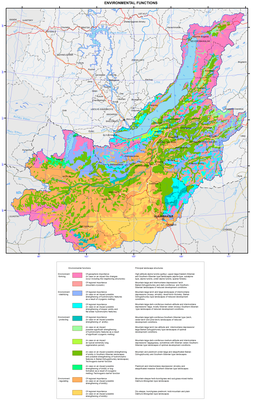
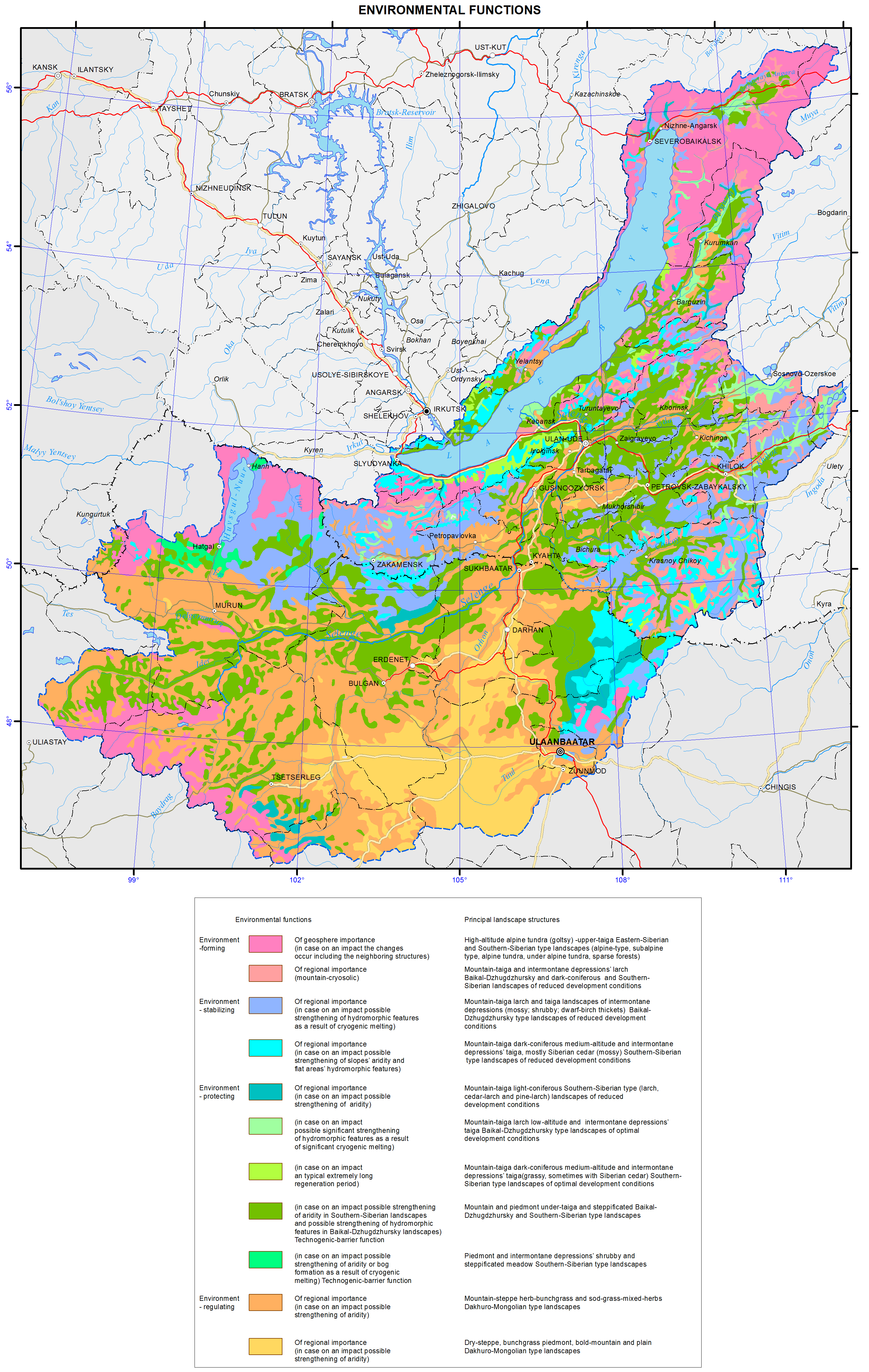
<p align="center"><strong>Ecological functions of landscapes</strong></p>
<p align="center"><strong> </strong></p>
<p>This map represents the groups of landscapes with similar nature protecting (ecological) functions [Polikarpov et al., 1980, p. 184-194]. They are divided into groups depending on these functions: environment-forming function of geospheric and regional significance, environment-regulating, environment-stabilising, and environment-protective.</p>
<p>The landscapes of goletz, tundra and sparse wood perform the main environment-forming “water-production” function. Of special significance is their snow and water collecting function. These landscapes experience large hydrological loads as they transform the water and transfer it to the subsurface flow. To date, the production of pure water is the most important ecological function as pure water is becoming the most valuable product on the planet. The significance of these landscapes increases due to the protection of depth and purity of Lake Baikal waters.</p>
<p>The environment-stabilizing function is characteristic of all mountain-taiga (moss) landscapes of reduced and limited development – from mountain-taiga shrub-moss dark coniferous and larch communities to shrub and moss-shrub dark coniferous and larch-taiga landscapes in the intermountain depression and valleys with yernik and mixed undergrowth. Their moss cover provides certain ecological conditions. These landscapes are more stable and after external pressure they, as a rule, recover fast. Together with goletz and upper-taiga landscapes, they determine the fundamental set of mechanisms of internal and external interactions of landscapes.</p>
<p>South Siberian and Central Asian (Daurian-Mongolian) steppe landscapes are referred to the group with environment-regulating functions. On the whole, they are characterized by insufficient wetness [Geosystems …, 1991; Eco-geographic …, 1996]. Their role in the flow regulation is rather small. However, under conditions of intense water evaporation they have a very important regulating significance: plant components of these landscapes support the existing ecological balance whose changes can cause the disturbance of the moisture regime and, as a result, the landscape structure. This function specifically intensifies under the conditions of anthropogenic pressure. As a result, all steppe landscapes share high soil-protective significance as they fulfil a technogenic barrier function.</p>
<p>“Herb” landscapes perform environment-protective function: mountain-taiga larch landscapes of optimal development, piedmont and larch-taiga landscapes of optimal development in intermountain depressions, piedmont sub-taiga larch, mountain-taiga pinewood, piedmont sub-taiga pinewood landscapes. Insufficient moistening is characteristic of these landscapes, and changes of their vegetative component can cause changes in hydrological regime towards aridity and, as a result, disruption of landscape structure. Their water and soil-protective role increases. They are characterised by high concentration of different economic activity. Therefore, these landscapes are of technogenic barrier significance.</p>
<p><b> </b></p>
<p align="center"><b>References</b></p>
<p><i>Atlas of Irkutsk Oblast: Ecological Conditions for Development</i>. (2004) – M. – Irkutsk,. – 90 p.</p>
<p><i>Geosystems of taiga and steppe contact: South of Central Siberia</i>. (1991) / Chief Ed. A. Krauklis. – Novosibirsk: Nauka. – 214 p.</p>
<p>Isachenko, A.G. (1990). Intensity of functioning and productivity of geosystems // <i>Izv. AS USSR. Ser. Geogr.</i>– 5. – P. 5-17.</p>
<p>Correlation eco-phytocoenotic map, scale 1:7,500,000. (1977). / Buks I.I., Baiborodin V.N., Timirbaeva L.S. // <i>Eco-phytocoenotic complexes of Asian Russia (mapping experience)</i>. – Irkutsk.</p>
<p>Landscapes of South-East Siberia: map, scale 1:1,500,000 (1977). / Mikheev, V.S., Ryashin, V.A. – M.: GUGK, – 4 p.</p>
<p>Mikheev, V.C. (1987). <i>Landscape and geographic supply of Siberian complex problems.</i> – Novosibirsk: Nauka. Sib. Depart. – 205 p.</p>
<p>Mikheev, V.C. (1988). <i>Materials for territorial complex scheme of nature protection (TerKSOP)</i>. – Irkutsk. – 63 p.</p>
<p><i>National Atlas of Mongolian People’s Republic.</i> (1990). Ulan-Bator-Moscow. –  144 p.</p>
<p>Polikarpov, N.P.,. Chebakova, N.M, Nazimova, D.I. (1980). <i>Climate and mountain forests of South Siberia</i>. – Novosibirsk: Nauka. – 225 p.</p>
<p>Sochava, V.B. (2005). <i>Theoretical and applied geography. Selected Proceedings</i> / V.B. Sochava. – Novosibirsk: Nauka. – 288 p.</p>
<p><i>Eco-geographic map of the Russian Federation: map, scale 1:4,000,000.</i> (1996). – M.: Fed. Service of Geodesy and Cartography of Russia. – 4 p.</p>]]></content:encoded>
    <dc:publisher>No publisher</dc:publisher>
    <dc:creator>Alexander Ayurzhanaev</dc:creator>
    <dc:rights></dc:rights>
    <dc:date>2014-10-09T02:20:00Z</dc:date>
    <dc:type>Page</dc:type>
  </item>


  <item rdf:about="http://bic.iwlearn.org/en/atlas/atlas/62-environmental-potential-map/environmental-potential-map">
    <title>Environmental potential map</title>
    <link>http://bic.iwlearn.org/en/atlas/atlas/62-environmental-potential-map/environmental-potential-map</link>
    <description></description>
    <content:encoded xmlns:content="http://purl.org/rss/1.0/modules/content/"><![CDATA[<p><img class="image-inline" src="../../../resolveuid/cd180f768bae443e971a32edb5f4a0a2/@@images/image/preview" /></p>
<p><a href="http://bic.iwlearn.org/en/atlas/photos/copy_of__62_Environmentalpotential.png" class="internal-link">Open full size</a></p>
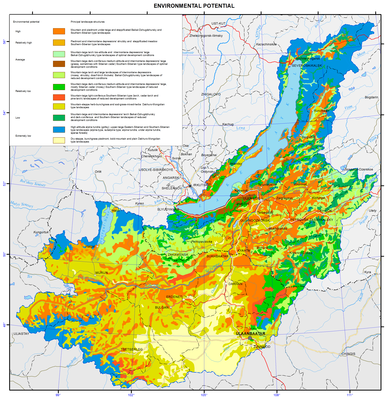
<p align="center"><strong>Ecological landscape potential (ELP)</strong></p>
<p>The map characterises the ability of landscapes to create specific local human environment. It was compiled on the basis of ecological interpretation of landscape characteristics and consequent zoning of the Baikal basin taking into account comfort level of landscapes for human activity.</p>
<p>The ratio of heat and moisture supply of landscapes, as well as productivity of their plant (low, moderate, elevated, and high), was used to indicate ecological comfort of landscapes (lack of heat, excess of moisture, etc.).</p>
<p>Relative estimating categories (very low, low, moderate, high, and very high) are used for ELP characterisation. In the map legend, they are correlated with factors of integral functioning intensity.</p>]]></content:encoded>
    <dc:publisher>No publisher</dc:publisher>
    <dc:creator>Alexander Ayurzhanaev</dc:creator>
    <dc:rights></dc:rights>
    <dc:date>2014-10-09T02:15:00Z</dc:date>
    <dc:type>Page</dc:type>
  </item>


  <item rdf:about="http://bic.iwlearn.org/en/atlas/atlas/63-environmental-functions-map">
    <title>063. Environmental functions map</title>
    <link>http://bic.iwlearn.org/en/atlas/atlas/63-environmental-functions-map</link>
    <description></description>
    
    <dc:publisher>No publisher</dc:publisher>
    <dc:creator>Alexander Ayurzhanaev</dc:creator>
    <dc:rights></dc:rights>
    <dc:date>2014-10-09T02:15:00Z</dc:date>
    <dc:type>Folder</dc:type>
  </item>


  <item rdf:about="http://bic.iwlearn.org/en/atlas/atlas/61-susceptibility-to-external-input-map/susceptibility-to-external-input-map">
    <title>Susceptibility to external input map</title>
    <link>http://bic.iwlearn.org/en/atlas/atlas/61-susceptibility-to-external-input-map/susceptibility-to-external-input-map</link>
    <description></description>
    <content:encoded xmlns:content="http://purl.org/rss/1.0/modules/content/"><![CDATA[<p><img class="image-inline" src="../../../resolveuid/13cdf5ce57c34f61889f86691bb1add2/@@images/image/preview" /></p>
<p><a href="http://bic.iwlearn.org/en/atlas/photos/copy_of__61_Susceptibilitytoexternalinput.png" class="internal-link">Open full size</a></p>
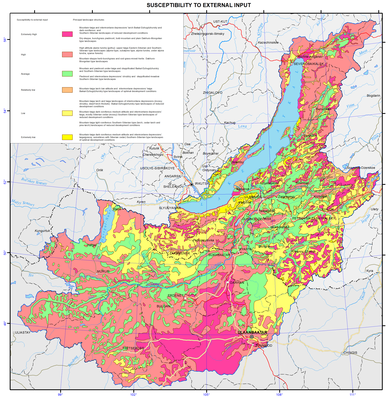
<p align="center"><b>Landscape sensitivity to external effects</b><b> </b></p>
<p align="center"><b> </b></p>
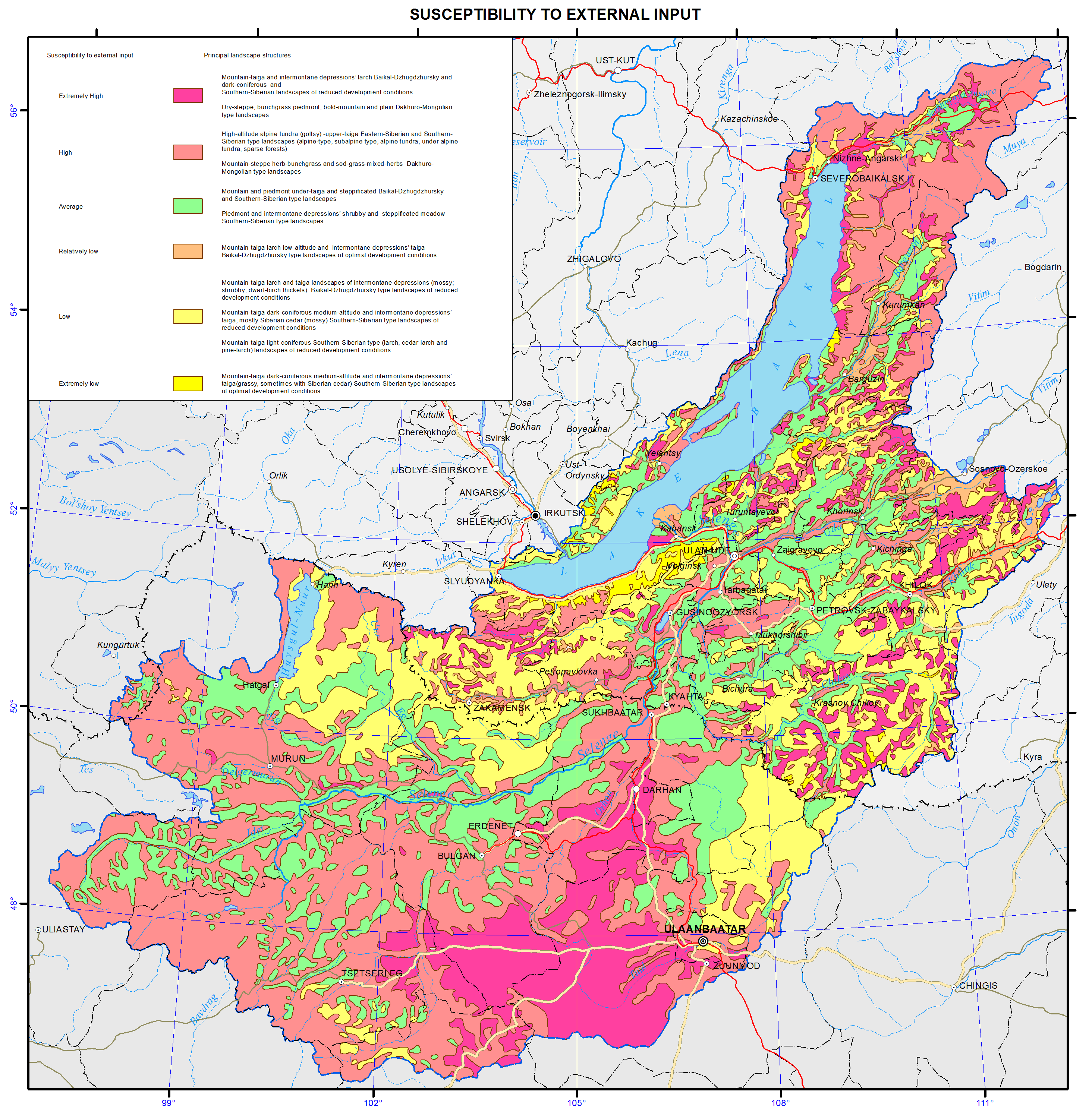
<p>The map of landscape sensitivity characterizes common respond of landscapes to external effects including the anthropogenic impact. Landscape sensitivity is defined by “self-regulation” [Sochava, 2005] – an ability to retain the structure of landscapes within the certain boundaries for a certain period of time.</p>
<p>Landscape sensitivity in the Baikal basin is strongly interdependent on landscape types. “Integral intensity of functioning … and productivity of landscapes” [Isachenko, 1990] are indicators of sensitivity. Sensitivity correlates with heat and moisture supply of landscapes “according to the optimality principle”, as well as with plant biological productivity “according to the maximum principle: the more the better” [Sochava, 2005].</p>
<p>Sensitivity increases as the deviation of heat and moisture ratio from the ecological optimum rises. Landscapes with optimal combinations of heat and moisture supply and with high biological productivity are less sensitive to anthropogenic pressure. The most sensitive landscapes are with low and very low biological productivity, which develop under extreme conditions.</p>
<p>The sensitivity in the map legend is characterised by relative estimating categories such as “very high”, “high”, “moderate”, “low”, and “very low”.</p>]]></content:encoded>
    <dc:publisher>No publisher</dc:publisher>
    <dc:creator>Alexander Ayurzhanaev</dc:creator>
    <dc:rights></dc:rights>
    <dc:date>2014-10-09T02:10:00Z</dc:date>
    <dc:type>Page</dc:type>
  </item>


  <item rdf:about="http://bic.iwlearn.org/en/atlas/atlas/62-environmental-potential-map">
    <title>062. Environmental potential map</title>
    <link>http://bic.iwlearn.org/en/atlas/atlas/62-environmental-potential-map</link>
    <description></description>
    
    <dc:publisher>No publisher</dc:publisher>
    <dc:creator>Alexander Ayurzhanaev</dc:creator>
    <dc:rights></dc:rights>
    <dc:date>2014-10-09T02:10:00Z</dc:date>
    <dc:type>Folder</dc:type>
  </item>


  <item rdf:about="http://bic.iwlearn.org/en/atlas/atlas/61-susceptibility-to-external-input-map">
    <title>061. Susceptibility to external input map</title>
    <link>http://bic.iwlearn.org/en/atlas/atlas/61-susceptibility-to-external-input-map</link>
    <description></description>
    
    <dc:publisher>No publisher</dc:publisher>
    <dc:creator>Alexander Ayurzhanaev</dc:creator>
    <dc:rights></dc:rights>
    <dc:date>2014-10-09T02:05:00Z</dc:date>
    <dc:type>Folder</dc:type>
  </item>


  <item rdf:about="http://bic.iwlearn.org/en/atlas/atlas/60-environmental-landscapes-map/environmental-landscapes-map">
    <title>Environmental landscapes  map</title>
    <link>http://bic.iwlearn.org/en/atlas/atlas/60-environmental-landscapes-map/environmental-landscapes-map</link>
    <description></description>
    <content:encoded xmlns:content="http://purl.org/rss/1.0/modules/content/"><![CDATA[<p><img class="image-inline" src="../../../resolveuid/f3ef729f165c401482e6b4eb394f24f1/@@images/image/preview" /></p>
<p><a href="http://bic.iwlearn.org/en/atlas/photos/copy_of__60_Environmentallandscapes.png" class="internal-link">Open full size</a></p>
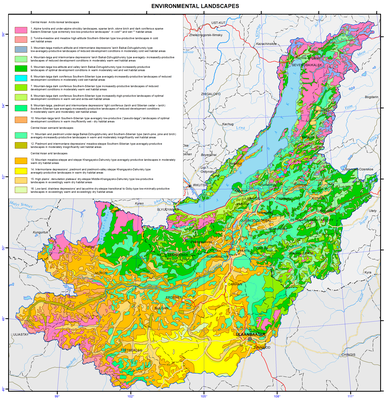
<p align="center"><b>Environment resources: ecological resources of landscapes in the </b><b>B</b><b>aikal basin</b></p>
<p>This package contains small-scale overview maps with the most common patterns of ecological resources of landscapes in the Baikal basin. The definition “ecological resource”, which is identical to the definition “ecological potential”, means the ability of landscapes to provide people with all necessary conditions for existence, i.e. to create specific local environment.</p>
<p>The structure of the map package was developed as applicable to the solution of practical problems of information support of regional programmes on rational use and protection of natural landscapes. The information base of the package consists of literature sources [Geosystems …, 1991; Isachenko, 1990; Mikheev, 1987, 1988; Polikarpov et al., 1980; Sochava, 2005], cartographic material [Atlas …, 2004; National Atlas …, 1990; Correlation …, 1977; Landscapes …, 1977; Eco-geographic …, 1996] and Internet resources. <b> </b></p>
<p><b> </b></p>
<p align="center"> </p>
<p align="center"><b>Landscape-ecological complexes</b></p>
<p>This map is a mosaic of 16 structural landscape subdivisions belonging to 2 subcontinents (Northern and Central Asia) and 3 types of natural conditions (arctic-boreal, semiarid and arid) [Geosystems …, 1991].</p>
<p>Typological classification of landscapes (goletz, subgoletz, upper taiga, taiga, subtaiga and steppe) reflects altitude-zonal differentiation of environmental conditions, as well as depression and piedmont effects of their manifestation. Regional range of landscapes classification (Baikal-Dzhugdzhurskiye, South-Siberian, Central Asian, Khangaisko-Daurskiye, Srednekhalkhasko-Mongolian) includes sector differentiation of environmental conditions formed under the influence of prevailing air masses of different direction (mainly western and eastern transfer), as well as interpenetration and uniqueness of natural phenomena in the basin of Lake Baikal.</p>
<p>According to the material and energy exchange, the North-Asian goletz, taiga and subtaiga landscapes are subdivided into subgroups of natural conditions: extreme, reduced, limited and optimal development. South-Siberian and Central Asian steppe landscapes are subdivided into arid, dry and very dry landscapes depending on moisture supply of these landscapes.</p>
<p>The legend of the map also presents numerical values of integral intensity of landscape functioning (heat and moisture supply of landscapes and plant biological productivity) [Eco-geographic …, 1996]:</p>
<p>- heat supply (total mean daily temperatures over 10ºC): cold (600-800ºC), moderately cold (800-1200 ºC), moderately warm (1200-1600 ºC) and warm (1600-2000 ºC);</p>
<p>- moisture supply (radiation dryness index according to M. Budyko): perhumid (less than 0.5), humid (0.5-0.9),  subhumid (1.0-1.4), insufficiently humid (1.5-1.9), dry (2.0-2.4), and very dry (over 2.5);</p>
<p>- plant biological productivity (annual growth of plants at appropriate values of heat and moisture expressed in dry mass of organic matter of terrestrial and underground parts of plants): very low (less than 20 metric centners/ha), low (20-40 metric centners/ha), mean (40-60 metric centners/ha), elevated (60-80 metric centners/ha), and high (over 80 metric centners/ha).</p>
<p>This map is used as an interpretation basis for the development of derived assessment and recommendation maps of the environment.</p>]]></content:encoded>
    <dc:publisher>No publisher</dc:publisher>
    <dc:creator>Alexander Ayurzhanaev</dc:creator>
    <dc:rights></dc:rights>
    <dc:date>2014-10-09T01:55:00Z</dc:date>
    <dc:type>Page</dc:type>
  </item>


  <item rdf:about="http://bic.iwlearn.org/en/atlas/atlas/59-hunting-resources-map/hunting-resources-map">
    <title>Hunting resources. Wild fowl map</title>
    <link>http://bic.iwlearn.org/en/atlas/atlas/59-hunting-resources-map/hunting-resources-map</link>
    <description></description>
    <content:encoded xmlns:content="http://purl.org/rss/1.0/modules/content/"><![CDATA[<p><img class="image-inline" src="../../../resolveuid/c91994aa9d884df9be1a105391080f51/@@images/image/preview" /></p>
<p><a href="http://bic.iwlearn.org/en/atlas/photos/copy_of__59_Huntingresources.png" class="internal-link">Open full size</a></p>
<p align="center"><strong>Game animals</strong></p>
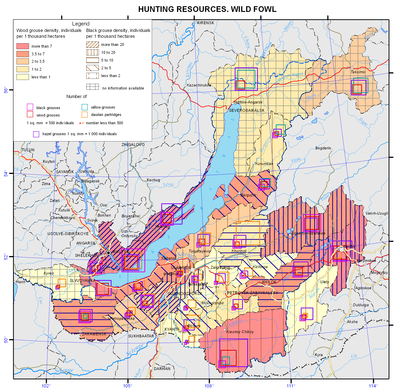
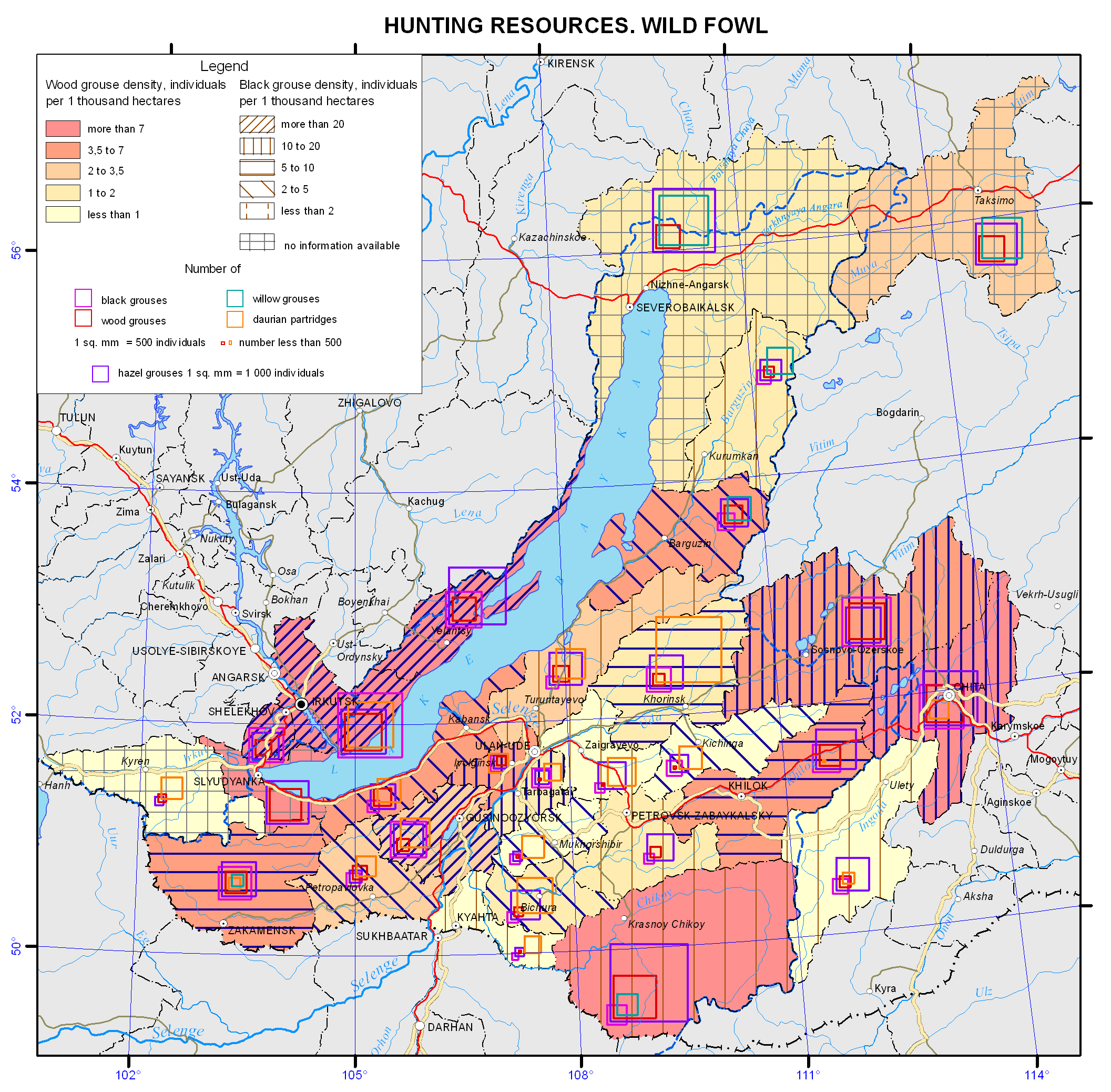
<p>The resource potential of game animals of the Baikal basin has long been characterized by the abundance and high species diversity. This is due to the location of the territory at the intersection of Central-Asian, European-Siberian and East-Asian faunas, where representatives of all of these complexes, including species valuable for hunting, are found. Within the region, there are four typological landscape complexes, corresponding to the zonal and regional landscape subdivisions, namely: mountain-taiga, goletz, forest-steppe, and steppe. Each of them is characterized by a set of habitat types, the quality and quantity of which influence the number of animals.</p>
<p>The wildlife of the <b><i>mountain taiga </i></b>is the richest and most diverse; there manifestations of latitudinal zonality in the distribution of vegetation are complicated by the features of altitudinal zonality of its location in the mountains depending on the steepness and exposure of slopes. This creates prerequisites to spread the spectrum of landscape-ecological diversity of the conditions of animal habitats, and possibilities for most of them to choose the most valuable biotopes and, eventually, to increase in the number. In the mountain taiga squirrel, hazel grouse, sable, bear, and in some places musk deer are numerous. Siberian stag and roe deer inhabiting light slopes, forest openings and woodlots, as well as elk, inhabiting waterlogged intermountain depressions, creek valleys and wide plots of terraces in the coastal area of Lake Baikal, are common. Wolf is numerous in some places; wood grouse and fox are common; lynx and wolverine are less common. Unique populations of reindeer and black-capped marmot survived in high-mountain belts of ridges on both sides of Lake Baikal thanks to the good protection.</p>
<p>Nerpa (Baikal seal) occupies a special place, being the only representative of the family of pinnipeds on Lake Baikal. Its largest rookery is located on the Malye Ushkanyi Islands.</p>
<p>The <b><i>goletz complex</i></b> is characterized by a significantly lower abundance of game animals. Willow and rock ptarmigan, reindeer and ermine belong to permanent residents. This complex can be roughly considered a complementing link to the mountain-taiga one since so many game animals, especially the ungulates, as well as bear, are connected with the highlands by systematic seasonal migrations.</p>
<p>The <b><i>forest-steppe and steppe complexes</i></b> stretch in narrow discontinuous bands in the south of the region. They are represented by the Central-Asian mountain steppes and are not distinguished by the abundance of game animals. Only roe deer in the forest-steppe continues to hold the background position among other species, while tarbagan, once numerous in the steppe, has lost its former significance as a result of plowing of the Transbaikalian steppes and its extermination as a carrier of epizootic plague in the course of antiplague measures. Other species characteristic of the forest-steppe zone, namely, badger and raccoon dog, and of the steppe zone, namely, tolai hare, manul, and dzeren, are small in number. Some of them (dzeren and manul) are protected.</p>
<p>The status of game animals is examined only for the Russian part of the Baikal basin. In connection with the reorganizational measures in the Russian hunting sector over the past two decades, some negative manifestations can be noticed in the usage patterns of species valuable for hunting and in the dynamics of their numbers. A number of problems arose, connected mainly with wild ungulates, especially Siberian stag, roe deer, elk, wild reindeer, and in some places musk deer. Concerning these species ​​an undisputed conclusion was made (as, indeed, for other regions) that “the current dynamics of populations of wild ungulates in Russia is determined mainly by hunters (poachers to a greater extent), large predators, and, locally, snowy winters, and not by a natural cyclicity and changes in the productivity of phytocenoses” [Kozhichev, 2002; Danilkin, 2010].</p>
<p>Among large predators the greatest harm is done by wolves. The wolf problem arose due to the loosening of its control. The damage from this predator to the ungulates (Siberian stag and, especially, roe deer) in different regions of Buryatia reaches 8-30% of the autumn herd [Noskov, 2008]. In recent years, in consequence of the irregular decrease in the number of Siberian stag (poaching and death by predators) in conjunction with the legal shooting in Buryatia a crisis situation with the population of this deer was created [Noskov, 2008]. The damage from wolves only in Transbaikalia in 2011 amounted to11.6 million roubles to agriculture and 70-80 million rubles to hunting [Samoilov, Kayukova, 2013]. Because of the large number of wolves in some areas of Transbaikalia an emergency situation was declared [Samoilov, Kayukova, 2013].</p>
<p>In the current situation, the negative effects are smoothed out to some extent through a network of specially protected natural areas. Thus, in Buryatia, 7-8% of the total number of Siberian stag and roe deer are protected within the territories of 13 nature reserves (zakazniks) and 3 reserved areas (zapovedniks) [Noskov, 2008]. Reindeer is listed in the Red Book of the Republic of Buryatia. Measures to protect the hunting grounds, especially in the areas of concentration of animals, are taken.</p>
<p>Another situation formed with respect to fur-bearing species of hunting. This is due to the fall in world prices for raw fur. Eighteen million pelts of caged mink from China were mass-marketed [Romanov, 2008]. Because of low prices for Chinese mink, squirrel or muskrat fur coats turned out to be more expensive. As a result, squirrel and muskrat are in little demand on the market. The same situation takes place with other species, namely: fox, Siberian weasel, and ermine. Rare lynx and wolverine pelts are used mainly on the domestic market.</p>
<p>A diametrically opposite situation is with sable enabling Russia to achieve a dominant position in the world market as an exclusive supplier of sable fur. Demand and prices for sable pelts have increased. The price for a sable at an auction averages 220-250 dollars. As opposed to the past years, sable is not endangered as there are less professional hunters. Besides, remote hunting lands are not utilized. They have become a kind of sable reserves, where sables multiply and settle throughout the taiga.</p>
<p>The analysis of the status of hunting fauna in the Baikal basin revealed a number of trends in the features of its use, also characteristic of other regions of the country, in particular, the problem of protecting ungulates. A positive phenomenon is a continued status of sable as the leader in the world fur market, and a removal of the danger of its extermination due to changes in socio-economic conditions, which is important in contrast with previous years.</p>
<p>At the same time, unlike the majority of Siberian regions where a trend of rapid increase in the area of publicly available lands accelerated, in the region under consideration this phenomenon is minimized. This is indicative of targeted optimization of the utilization of game animals resources on the basis of improving forms of hunting management and prospects of its development in the region. Thus, the calculations [Dambiev et al., 2011] made it possible to estimate the socio-economic significance of hunting nature management in the Republic of Buryatia in 2010 as amounting to 1.1 billion roubles. Among them natural products of hunting (furs, meat, etc.) are estimated at 150 million roubles, while the social impact of tourism associated with hunting reaches 450 million roubles. The remaining portion is accounted for by other socio-economic relevance. Therefore, the current state of game fauna in the study region is characterized as conditionally stable. As a result of satisfactory organization of protection of game animals in the region, their number corresponds to a primitive stage of market hunting management.<b></b></p>
<p align="center">References</p>
<p>Dambiev, A.G., Kambalin, V.S., and Noskov, V.T. (2011). <i>Hunting nature management of the Republic of Buryatia: problems and prospects.</i> Irkutsk: Izd-vo Irkutskoi  selskokhozyaistvennoi akademii. - 109 p.</p>
<p>Danilkin, A. (2010). <i>Wild ungulates of Russia: patterns of population dynamics, in Okhota i okhotnichie khozyaistvo</i>, no.10, pp. 1-4.</p>
<p>Kozhichev, R. (2002). Siberian roe deer in Irkutsk oblast: what to do? in <i>Okhota i okhotnichie khozyaistvo</i>, , no. 12, pp. 4-5.</p>
<p>Noskov, V.T. (2008). <i>Game animals of Buryatia</i>. Ulan-Ude: Izd-vo FGOU VP. “BGSKhA” im. V.V. Filippova, , 223 p.</p>
<p>Romanov, V.I. (2008). Organizational obstacles for producing hunting fur in Eastern Siberia in Protection and sustainable use of animal and plant resources. <i>Proceedings of the International Scientific Conference, May, 29 – June, 1, 2008</i>. Irkutsk: Izd-vo Irkutskoi selskokhozyaistvennoi akademii, pp. 134-136.</p>
<p>Samoilov, E.B. and Kayukova, S.N. (2013). <i>Invasion of wolves in Transbaikalia</i>.  Irkutsk: Izd-vo IrGSKhA, pp. 261-263.</p>]]></content:encoded>
    <dc:publisher>No publisher</dc:publisher>
    <dc:creator>Alexander Ayurzhanaev</dc:creator>
    <dc:rights></dc:rights>
    <dc:date>2014-10-09T01:55:00Z</dc:date>
    <dc:type>Page</dc:type>
  </item>


  <item rdf:about="http://bic.iwlearn.org/en/atlas/atlas/60-environmental-landscapes-map">
    <title>060. Environmental landscapes map</title>
    <link>http://bic.iwlearn.org/en/atlas/atlas/60-environmental-landscapes-map</link>
    <description></description>
    
    <dc:publisher>No publisher</dc:publisher>
    <dc:creator>Alexander Ayurzhanaev</dc:creator>
    <dc:rights></dc:rights>
    <dc:date>2014-10-09T01:55:00Z</dc:date>
    <dc:type>Folder</dc:type>
  </item>


  <item rdf:about="http://bic.iwlearn.org/en/atlas/atlas/59-hunting-resources-map">
    <title>059. Hunting resources. Wild fowl map</title>
    <link>http://bic.iwlearn.org/en/atlas/atlas/59-hunting-resources-map</link>
    <description></description>
    
    <dc:publisher>No publisher</dc:publisher>
    <dc:creator>Alexander Ayurzhanaev</dc:creator>
    <dc:rights></dc:rights>
    <dc:date>2014-10-09T01:50:00Z</dc:date>
    <dc:type>Folder</dc:type>
  </item>


  <item rdf:about="http://bic.iwlearn.org/en/atlas/atlas/58-hunting-resources-map/hunting-resources-map">
    <title>Hunting resources. Squirrel and hare map</title>
    <link>http://bic.iwlearn.org/en/atlas/atlas/58-hunting-resources-map/hunting-resources-map</link>
    <description></description>
    <content:encoded xmlns:content="http://purl.org/rss/1.0/modules/content/"><![CDATA[<p><img class="image-inline" src="../../../resolveuid/e2a290cdf91246f7ba5244c4422504fd/@@images/image/preview" /></p>
<p><a href="http://bic.iwlearn.org/en/atlas/photos/copy_of__58_Huntingresources.png" class="internal-link">Open full size</a></p>
<p align="center"><strong>Game animals</strong></p>
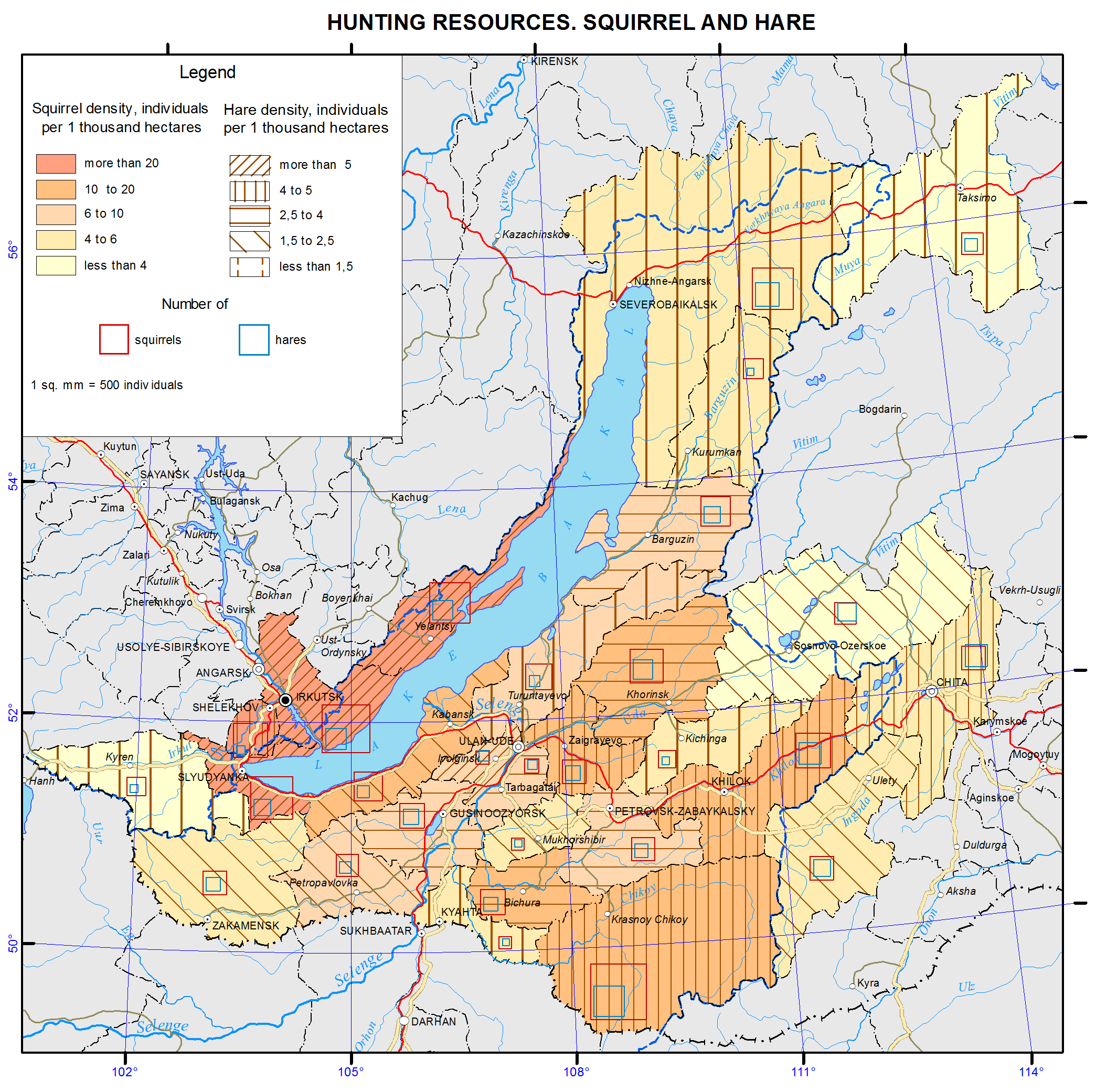
<p>The resource potential of game animals of the Baikal basin has long been characterized by the abundance and high species diversity. This is due to the location of the territory at the intersection of Central-Asian, European-Siberian and East-Asian faunas, where representatives of all of these complexes, including species valuable for hunting, are found. Within the region, there are four typological landscape complexes, corresponding to the zonal and regional landscape subdivisions, namely: mountain-taiga, goletz, forest-steppe, and steppe. Each of them is characterized by a set of habitat types, the quality and quantity of which influence the number of animals.</p>
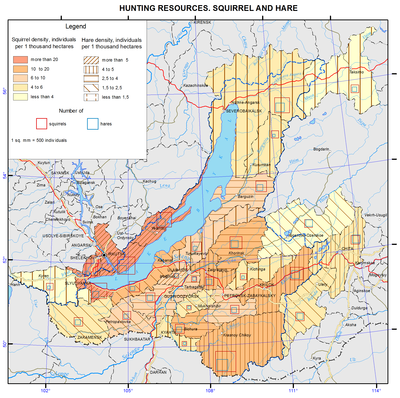
<p>The wildlife of the <b><i>mountain taiga </i></b>is the richest and most diverse; there manifestations of latitudinal zonality in the distribution of vegetation are complicated by the features of altitudinal zonality of its location in the mountains depending on the steepness and exposure of slopes. This creates prerequisites to spread the spectrum of landscape-ecological diversity of the conditions of animal habitats, and possibilities for most of them to choose the most valuable biotopes and, eventually, to increase in the number. In the mountain taiga squirrel, hazel grouse, sable, bear, and in some places musk deer are numerous. Siberian stag and roe deer inhabiting light slopes, forest openings and woodlots, as well as elk, inhabiting waterlogged intermountain depressions, creek valleys and wide plots of terraces in the coastal area of Lake Baikal, are common. Wolf is numerous in some places; wood grouse and fox are common; lynx and wolverine are less common. Unique populations of reindeer and black-capped marmot survived in high-mountain belts of ridges on both sides of Lake Baikal thanks to the good protection.</p>
<p>Nerpa (Baikal seal) occupies a special place, being the only representative of the family of pinnipeds on Lake Baikal. Its largest rookery is located on the Malye Ushkanyi Islands.</p>
<p>The <b><i>goletz complex</i></b> is characterized by a significantly lower abundance of game animals. Willow and rock ptarmigan, reindeer and ermine belong to permanent residents. This complex can be roughly considered a complementing link to the mountain-taiga one since so many game animals, especially the ungulates, as well as bear, are connected with the highlands by systematic seasonal migrations.</p>
<p>The <b><i>forest-steppe and steppe complexes</i></b> stretch in narrow discontinuous bands in the south of the region. They are represented by the Central-Asian mountain steppes and are not distinguished by the abundance of game animals. Only roe deer in the forest-steppe continues to hold the background position among other species, while tarbagan, once numerous in the steppe, has lost its former significance as a result of plowing of the Transbaikalian steppes and its extermination as a carrier of epizootic plague in the course of antiplague measures. Other species characteristic of the forest-steppe zone, namely, badger and raccoon dog, and of the steppe zone, namely, tolai hare, manul, and dzeren, are small in number. Some of them (dzeren and manul) are protected.</p>
<p>The status of game animals is examined only for the Russian part of the Baikal basin. In connection with the reorganizational measures in the Russian hunting sector over the past two decades, some negative manifestations can be noticed in the usage patterns of species valuable for hunting and in the dynamics of their numbers. A number of problems arose, connected mainly with wild ungulates, especially Siberian stag, roe deer, elk, wild reindeer, and in some places musk deer. Concerning these species ​​an undisputed conclusion was made (as, indeed, for other regions) that “the current dynamics of populations of wild ungulates in Russia is determined mainly by hunters (poachers to a greater extent), large predators, and, locally, snowy winters, and not by a natural cyclicity and changes in the productivity of phytocenoses” [Kozhichev, 2002; Danilkin, 2010].</p>
<p>Among large predators the greatest harm is done by wolves. The wolf problem arose due to the loosening of its control. The damage from this predator to the ungulates (Siberian stag and, especially, roe deer) in different regions of Buryatia reaches 8-30% of the autumn herd [Noskov, 2008]. In recent years, in consequence of the irregular decrease in the number of Siberian stag (poaching and death by predators) in conjunction with the legal shooting in Buryatia a crisis situation with the population of this deer was created [Noskov, 2008]. The damage from wolves only in Transbaikalia in 2011 amounted to11.6 million roubles to agriculture and 70-80 million rubles to hunting [Samoilov, Kayukova, 2013]. Because of the large number of wolves in some areas of Transbaikalia an emergency situation was declared [Samoilov, Kayukova, 2013].</p>
<p>In the current situation, the negative effects are smoothed out to some extent through a network of specially protected natural areas. Thus, in Buryatia, 7-8% of the total number of Siberian stag and roe deer are protected within the territories of 13 nature reserves (zakazniks) and 3 reserved areas (zapovedniks) [Noskov, 2008]. Reindeer is listed in the Red Book of the Republic of Buryatia. Measures to protect the hunting grounds, especially in the areas of concentration of animals, are taken.</p>
<p>Another situation formed with respect to fur-bearing species of hunting. This is due to the fall in world prices for raw fur. Eighteen million pelts of caged mink from China were mass-marketed [Romanov, 2008]. Because of low prices for Chinese mink, squirrel or muskrat fur coats turned out to be more expensive. As a result, squirrel and muskrat are in little demand on the market. The same situation takes place with other species, namely: fox, Siberian weasel, and ermine. Rare lynx and wolverine pelts are used mainly on the domestic market.</p>
<p>A diametrically opposite situation is with sable enabling Russia to achieve a dominant position in the world market as an exclusive supplier of sable fur. Demand and prices for sable pelts have increased. The price for a sable at an auction averages 220-250 dollars. As opposed to the past years, sable is not endangered as there are less professional hunters. Besides, remote hunting lands are not utilized. They have become a kind of sable reserves, where sables multiply and settle throughout the taiga.</p>
<p>The analysis of the status of hunting fauna in the Baikal basin revealed a number of trends in the features of its use, also characteristic of other regions of the country, in particular, the problem of protecting ungulates. A positive phenomenon is a continued status of sable as the leader in the world fur market, and a removal of the danger of its extermination due to changes in socio-economic conditions, which is important in contrast with previous years.</p>
<p>At the same time, unlike the majority of Siberian regions where a trend of rapid increase in the area of publicly available lands accelerated, in the region under consideration this phenomenon is minimized. This is indicative of targeted optimization of the utilization of game animals resources on the basis of improving forms of hunting management and prospects of its development in the region. Thus, the calculations [Dambiev et al., 2011] made it possible to estimate the socio-economic significance of hunting nature management in the Republic of Buryatia in 2010 as amounting to 1.1 billion roubles. Among them natural products of hunting (furs, meat, etc.) are estimated at 150 million roubles, while the social impact of tourism associated with hunting reaches 450 million roubles. The remaining portion is accounted for by other socio-economic relevance. Therefore, the current state of game fauna in the study region is characterized as conditionally stable. As a result of satisfactory organization of protection of game animals in the region, their number corresponds to a primitive stage of market hunting management.<b></b></p>
<p align="center">References</p>
<p>Dambiev, A.G., Kambalin, V.S., and Noskov, V.T. (2011). <i>Hunting nature management of the Republic of Buryatia: problems and prospects.</i> Irkutsk: Izd-vo Irkutskoi  selskokhozyaistvennoi akademii. - 109 p.</p>
<p>Danilkin, A. (2010). <i>Wild ungulates of Russia: patterns of population dynamics, in Okhota i okhotnichie khozyaistvo</i>, no.10, pp. 1-4.</p>
<p>Kozhichev, R. (2002). Siberian roe deer in Irkutsk oblast: what to do? in <i>Okhota i okhotnichie khozyaistvo</i>, , no. 12, pp. 4-5.</p>
<p>Noskov, V.T. (2008). <i>Game animals of Buryatia</i>. Ulan-Ude: Izd-vo FGOU VP. “BGSKhA” im. V.V. Filippova, , 223 p.</p>
<p>Romanov, V.I. (2008). Organizational obstacles for producing hunting fur in Eastern Siberia in Protection and sustainable use of animal and plant resources. <i>Proceedings of the International Scientific Conference, May, 29 – June, 1, 2008</i>. Irkutsk: Izd-vo Irkutskoi selskokhozyaistvennoi akademii, pp. 134-136.</p>
<p>Samoilov, E.B. and Kayukova, S.N. (2013). <i>Invasion of wolves in Transbaikalia</i>.  Irkutsk: Izd-vo IrGSKhA, pp. 261-263.</p>]]></content:encoded>
    <dc:publisher>No publisher</dc:publisher>
    <dc:creator>Alexander Ayurzhanaev</dc:creator>
    <dc:rights></dc:rights>
    <dc:date>2014-10-09T01:45:00Z</dc:date>
    <dc:type>Page</dc:type>
  </item>


  <item rdf:about="http://bic.iwlearn.org/en/atlas/atlas/58-hunting-resources-map">
    <title>058. Hunting resources. Squirrel and hare map</title>
    <link>http://bic.iwlearn.org/en/atlas/atlas/58-hunting-resources-map</link>
    <description></description>
    
    <dc:publisher>No publisher</dc:publisher>
    <dc:creator>Alexander Ayurzhanaev</dc:creator>
    <dc:rights></dc:rights>
    <dc:date>2014-10-09T01:40:00Z</dc:date>
    <dc:type>Folder</dc:type>
  </item>


  <item rdf:about="http://bic.iwlearn.org/en/atlas/atlas/57-hunting-resources-map/hunting-resources-map">
    <title>Hunting resources. Fur-bearing animals map</title>
    <link>http://bic.iwlearn.org/en/atlas/atlas/57-hunting-resources-map/hunting-resources-map</link>
    <description></description>
    <content:encoded xmlns:content="http://purl.org/rss/1.0/modules/content/"><![CDATA[<p><img class="image-inline" src="../../../resolveuid/cda03ffdcb44441cb11554ce5d32cbfd/@@images/image/preview" /></p>
<p>Open full size</p>
<p align="center"><strong>Game animals</strong></p>
<p>The resource potential of game animals of the Baikal basin has long been characterized by the abundance and high species diversity. This is due to the location of the territory at the intersection of Central-Asian, European-Siberian and East-Asian faunas, where representatives of all of these complexes, including species valuable for hunting, are found. Within the region, there are four typological landscape complexes, corresponding to the zonal and regional landscape subdivisions, namely: mountain-taiga, goletz, forest-steppe, and steppe. Each of them is characterized by a set of habitat types, the quality and quantity of which influence the number of animals.</p>
<p>The wildlife of the <b><i>mountain taiga </i></b>is the richest and most diverse; there manifestations of latitudinal zonality in the distribution of vegetation are complicated by the features of altitudinal zonality of its location in the mountains depending on the steepness and exposure of slopes. This creates prerequisites to spread the spectrum of landscape-ecological diversity of the conditions of animal habitats, and possibilities for most of them to choose the most valuable biotopes and, eventually, to increase in the number. In the mountain taiga squirrel, hazel grouse, sable, bear, and in some places musk deer are numerous. Siberian stag and roe deer inhabiting light slopes, forest openings and woodlots, as well as elk, inhabiting waterlogged intermountain depressions, creek valleys and wide plots of terraces in the coastal area of Lake Baikal, are common. Wolf is numerous in some places; wood grouse and fox are common; lynx and wolverine are less common. Unique populations of reindeer and black-capped marmot survived in high-mountain belts of ridges on both sides of Lake Baikal thanks to the good protection.</p>
<p>Nerpa (Baikal seal) occupies a special place, being the only representative of the family of pinnipeds on Lake Baikal. Its largest rookery is located on the Malye Ushkanyi Islands.</p>
<p>The <b><i>goletz complex</i></b> is characterized by a significantly lower abundance of game animals. Willow and rock ptarmigan, reindeer and ermine belong to permanent residents. This complex can be roughly considered a complementing link to the mountain-taiga one since so many game animals, especially the ungulates, as well as bear, are connected with the highlands by systematic seasonal migrations.</p>
<p>The <b><i>forest-steppe and steppe complexes</i></b> stretch in narrow discontinuous bands in the south of the region. They are represented by the Central-Asian mountain steppes and are not distinguished by the abundance of game animals. Only roe deer in the forest-steppe continues to hold the background position among other species, while tarbagan, once numerous in the steppe, has lost its former significance as a result of plowing of the Transbaikalian steppes and its extermination as a carrier of epizootic plague in the course of antiplague measures. Other species characteristic of the forest-steppe zone, namely, badger and raccoon dog, and of the steppe zone, namely, tolai hare, manul, and dzeren, are small in number. Some of them (dzeren and manul) are protected.</p>
<p>The status of game animals is examined only for the Russian part of the Baikal basin. In connection with the reorganizational measures in the Russian hunting sector over the past two decades, some negative manifestations can be noticed in the usage patterns of species valuable for hunting and in the dynamics of their numbers. A number of problems arose, connected mainly with wild ungulates, especially Siberian stag, roe deer, elk, wild reindeer, and in some places musk deer. Concerning these species ​​an undisputed conclusion was made (as, indeed, for other regions) that “the current dynamics of populations of wild ungulates in Russia is determined mainly by hunters (poachers to a greater extent), large predators, and, locally, snowy winters, and not by a natural cyclicity and changes in the productivity of phytocenoses” [Kozhichev, 2002; Danilkin, 2010].</p>
<p>Among large predators the greatest harm is done by wolves. The wolf problem arose due to the loosening of its control. The damage from this predator to the ungulates (Siberian stag and, especially, roe deer) in different regions of Buryatia reaches 8-30% of the autumn herd [Noskov, 2008]. In recent years, in consequence of the irregular decrease in the number of Siberian stag (poaching and death by predators) in conjunction with the legal shooting in Buryatia a crisis situation with the population of this deer was created [Noskov, 2008]. The damage from wolves only in Transbaikalia in 2011 amounted to11.6 million roubles to agriculture and 70-80 million rubles to hunting [Samoilov, Kayukova, 2013]. Because of the large number of wolves in some areas of Transbaikalia an emergency situation was declared [Samoilov, Kayukova, 2013].</p>
<p>In the current situation, the negative effects are smoothed out to some extent through a network of specially protected natural areas. Thus, in Buryatia, 7-8% of the total number of Siberian stag and roe deer are protected within the territories of 13 nature reserves (zakazniks) and 3 reserved areas (zapovedniks) [Noskov, 2008]. Reindeer is listed in the Red Book of the Republic of Buryatia. Measures to protect the hunting grounds, especially in the areas of concentration of animals, are taken.</p>
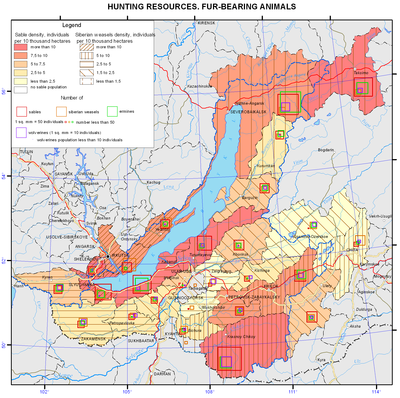
<p>Another situation formed with respect to fur-bearing species of hunting. This is due to the fall in world prices for raw fur. Eighteen million pelts of caged mink from China were mass-marketed [Romanov, 2008]. Because of low prices for Chinese mink, squirrel or muskrat fur coats turned out to be more expensive. As a result, squirrel and muskrat are in little demand on the market. The same situation takes place with other species, namely: fox, Siberian weasel, and ermine. Rare lynx and wolverine pelts are used mainly on the domestic market.</p>
<p>A diametrically opposite situation is with sable enabling Russia to achieve a dominant position in the world market as an exclusive supplier of sable fur. Demand and prices for sable pelts have increased. The price for a sable at an auction averages 220-250 dollars. As opposed to the past years, sable is not endangered as there are less professional hunters. Besides, remote hunting lands are not utilized. They have become a kind of sable reserves, where sables multiply and settle throughout the taiga.</p>
<p>The analysis of the status of hunting fauna in the Baikal basin revealed a number of trends in the features of its use, also characteristic of other regions of the country, in particular, the problem of protecting ungulates. A positive phenomenon is a continued status of sable as the leader in the world fur market, and a removal of the danger of its extermination due to changes in socio-economic conditions, which is important in contrast with previous years.</p>
<p>At the same time, unlike the majority of Siberian regions where a trend of rapid increase in the area of publicly available lands accelerated, in the region under consideration this phenomenon is minimized. This is indicative of targeted optimization of the utilization of game animals resources on the basis of improving forms of hunting management and prospects of its development in the region. Thus, the calculations [Dambiev et al., 2011] made it possible to estimate the socio-economic significance of hunting nature management in the Republic of Buryatia in 2010 as amounting to 1.1 billion roubles. Among them natural products of hunting (furs, meat, etc.) are estimated at 150 million roubles, while the social impact of tourism associated with hunting reaches 450 million roubles. The remaining portion is accounted for by other socio-economic relevance. Therefore, the current state of game fauna in the study region is characterized as conditionally stable. As a result of satisfactory organization of protection of game animals in the region, their number corresponds to a primitive stage of market hunting management.<b></b></p>
<p align="center">References</p>
<p>Dambiev, A.G., Kambalin, V.S., and Noskov, V.T. (2011). <i>Hunting nature management of the Republic of Buryatia: problems and prospects.</i> Irkutsk: Izd-vo Irkutskoi  selskokhozyaistvennoi akademii. - 109 p.</p>
<p>Danilkin, A. (2010). <i>Wild ungulates of Russia: patterns of population dynamics, in Okhota i okhotnichie khozyaistvo</i>, no.10, pp. 1-4.</p>
<p>Kozhichev, R. (2002). Siberian roe deer in Irkutsk oblast: what to do? in <i>Okhota i okhotnichie khozyaistvo</i>, , no. 12, pp. 4-5.</p>
<p>Noskov, V.T. (2008). <i>Game animals of Buryatia</i>. Ulan-Ude: Izd-vo FGOU VP. “BGSKhA” im. V.V. Filippova, , 223 p.</p>
<p>Romanov, V.I. (2008). Organizational obstacles for producing hunting fur in Eastern Siberia in Protection and sustainable use of animal and plant resources. <i>Proceedings of the International Scientific Conference, May, 29 – June, 1, 2008</i>. Irkutsk: Izd-vo Irkutskoi selskokhozyaistvennoi akademii, pp. 134-136.</p>
<p>Samoilov, E.B. and Kayukova, S.N. (2013). <i>Invasion of wolves in Transbaikalia</i>.  Irkutsk: Izd-vo IrGSKhA, pp. 261-263.</p>]]></content:encoded>
    <dc:publisher>No publisher</dc:publisher>
    <dc:creator>Alexander Ayurzhanaev</dc:creator>
    <dc:rights></dc:rights>
    <dc:date>2014-10-09T01:25:00Z</dc:date>
    <dc:type>Page</dc:type>
  </item>


  <item rdf:about="http://bic.iwlearn.org/en/atlas/atlas/57-hunting-resources-map">
    <title>057. Hunting resources. Fur-bearing animals map</title>
    <link>http://bic.iwlearn.org/en/atlas/atlas/57-hunting-resources-map</link>
    <description></description>
    
    <dc:publisher>No publisher</dc:publisher>
    <dc:creator>Alexander Ayurzhanaev</dc:creator>
    <dc:rights></dc:rights>
    <dc:date>2014-10-09T01:10:00Z</dc:date>
    <dc:type>Folder</dc:type>
  </item>


  <item rdf:about="http://bic.iwlearn.org/en/atlas/atlas/56-hunting-resources-map/hunting-resources-map">
    <title>Hunting resources. Predators map</title>
    <link>http://bic.iwlearn.org/en/atlas/atlas/56-hunting-resources-map/hunting-resources-map</link>
    <description></description>
    <content:encoded xmlns:content="http://purl.org/rss/1.0/modules/content/"><![CDATA[<p><img class="image-inline" src="../../../resolveuid/6bc109a885774ac2aeb1d93c94b5b4ba/@@images/image/preview" /></p>
<p><a href="http://bic.iwlearn.org/en/atlas/photos/copy_of__56_Huntingresources.png" class="internal-link">Open full size</a></p>
<p align="center"><strong>Game animals</strong></p>
<p>The resource potential of game animals of the Baikal basin has long been characterized by the abundance and high species diversity. This is due to the location of the territory at the intersection of Central-Asian, European-Siberian and East-Asian faunas, where representatives of all of these complexes, including species valuable for hunting, are found. Within the region, there are four typological landscape complexes, corresponding to the zonal and regional landscape subdivisions, namely: mountain-taiga, goletz, forest-steppe, and steppe. Each of them is characterized by a set of habitat types, the quality and quantity of which influence the number of animals.</p>
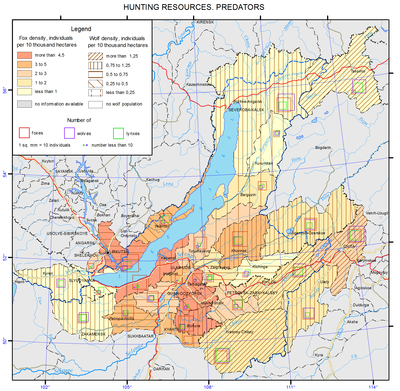
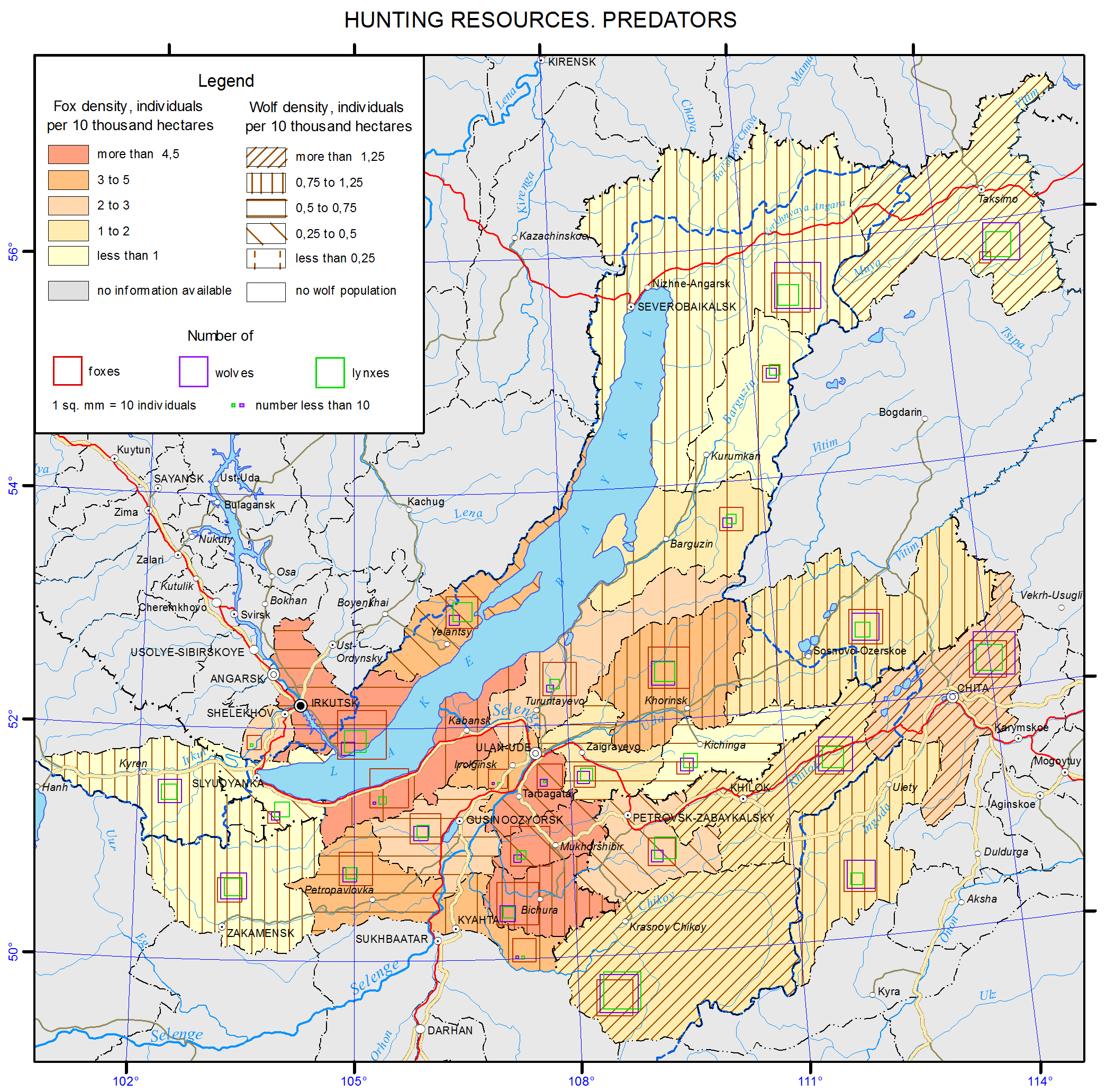
<p>The wildlife of the <b><i>mountain taiga </i></b>is the richest and most diverse; there manifestations of latitudinal zonality in the distribution of vegetation are complicated by the features of altitudinal zonality of its location in the mountains depending on the steepness and exposure of slopes. This creates prerequisites to spread the spectrum of landscape-ecological diversity of the conditions of animal habitats, and possibilities for most of them to choose the most valuable biotopes and, eventually, to increase in the number. In the mountain taiga squirrel, hazel grouse, sable, bear, and in some places musk deer are numerous. Siberian stag and roe deer inhabiting light slopes, forest openings and woodlots, as well as elk, inhabiting waterlogged intermountain depressions, creek valleys and wide plots of terraces in the coastal area of Lake Baikal, are common. Wolf is numerous in some places; wood grouse and fox are common; lynx and wolverine are less common. Unique populations of reindeer and black-capped marmot survived in high-mountain belts of ridges on both sides of Lake Baikal thanks to the good protection.</p>
<p>Nerpa (Baikal seal) occupies a special place, being the only representative of the family of pinnipeds on Lake Baikal. Its largest rookery is located on the Malye Ushkanyi Islands.</p>
<p>The <b><i>goletz complex</i></b> is characterized by a significantly lower abundance of game animals. Willow and rock ptarmigan, reindeer and ermine belong to permanent residents. This complex can be roughly considered a complementing link to the mountain-taiga one since so many game animals, especially the ungulates, as well as bear, are connected with the highlands by systematic seasonal migrations.</p>
<p>The <b><i>forest-steppe and steppe complexes</i></b> stretch in narrow discontinuous bands in the south of the region. They are represented by the Central-Asian mountain steppes and are not distinguished by the abundance of game animals. Only roe deer in the forest-steppe continues to hold the background position among other species, while tarbagan, once numerous in the steppe, has lost its former significance as a result of plowing of the Transbaikalian steppes and its extermination as a carrier of epizootic plague in the course of antiplague measures. Other species characteristic of the forest-steppe zone, namely, badger and raccoon dog, and of the steppe zone, namely, tolai hare, manul, and dzeren, are small in number. Some of them (dzeren and manul) are protected.</p>
<p>The status of game animals is examined only for the Russian part of the Baikal basin. In connection with the reorganizational measures in the Russian hunting sector over the past two decades, some negative manifestations can be noticed in the usage patterns of species valuable for hunting and in the dynamics of their numbers. A number of problems arose, connected mainly with wild ungulates, especially Siberian stag, roe deer, elk, wild reindeer, and in some places musk deer. Concerning these species ​​an undisputed conclusion was made (as, indeed, for other regions) that “the current dynamics of populations of wild ungulates in Russia is determined mainly by hunters (poachers to a greater extent), large predators, and, locally, snowy winters, and not by a natural cyclicity and changes in the productivity of phytocenoses” [Kozhichev, 2002; Danilkin, 2010].</p>
<p>Among large predators the greatest harm is done by wolves. The wolf problem arose due to the loosening of its control. The damage from this predator to the ungulates (Siberian stag and, especially, roe deer) in different regions of Buryatia reaches 8-30% of the autumn herd [Noskov, 2008]. In recent years, in consequence of the irregular decrease in the number of Siberian stag (poaching and death by predators) in conjunction with the legal shooting in Buryatia a crisis situation with the population of this deer was created [Noskov, 2008]. The damage from wolves only in Transbaikalia in 2011 amounted to11.6 million roubles to agriculture and 70-80 million rubles to hunting [Samoilov, Kayukova, 2013]. Because of the large number of wolves in some areas of Transbaikalia an emergency situation was declared [Samoilov, Kayukova, 2013].</p>
<p>In the current situation, the negative effects are smoothed out to some extent through a network of specially protected natural areas. Thus, in Buryatia, 7-8% of the total number of Siberian stag and roe deer are protected within the territories of 13 nature reserves (zakazniks) and 3 reserved areas (zapovedniks) [Noskov, 2008]. Reindeer is listed in the Red Book of the Republic of Buryatia. Measures to protect the hunting grounds, especially in the areas of concentration of animals, are taken.</p>
<p>Another situation formed with respect to fur-bearing species of hunting. This is due to the fall in world prices for raw fur. Eighteen million pelts of caged mink from China were mass-marketed [Romanov, 2008]. Because of low prices for Chinese mink, squirrel or muskrat fur coats turned out to be more expensive. As a result, squirrel and muskrat are in little demand on the market. The same situation takes place with other species, namely: fox, Siberian weasel, and ermine. Rare lynx and wolverine pelts are used mainly on the domestic market.</p>
<p>A diametrically opposite situation is with sable enabling Russia to achieve a dominant position in the world market as an exclusive supplier of sable fur. Demand and prices for sable pelts have increased. The price for a sable at an auction averages 220-250 dollars. As opposed to the past years, sable is not endangered as there are less professional hunters. Besides, remote hunting lands are not utilized. They have become a kind of sable reserves, where sables multiply and settle throughout the taiga.</p>
<p>The analysis of the status of hunting fauna in the Baikal basin revealed a number of trends in the features of its use, also characteristic of other regions of the country, in particular, the problem of protecting ungulates. A positive phenomenon is a continued status of sable as the leader in the world fur market, and a removal of the danger of its extermination due to changes in socio-economic conditions, which is important in contrast with previous years.</p>
<p>At the same time, unlike the majority of Siberian regions where a trend of rapid increase in the area of publicly available lands accelerated, in the region under consideration this phenomenon is minimized. This is indicative of targeted optimization of the utilization of game animals resources on the basis of improving forms of hunting management and prospects of its development in the region. Thus, the calculations [Dambiev et al., 2011] made it possible to estimate the socio-economic significance of hunting nature management in the Republic of Buryatia in 2010 as amounting to 1.1 billion roubles. Among them natural products of hunting (furs, meat, etc.) are estimated at 150 million roubles, while the social impact of tourism associated with hunting reaches 450 million roubles. The remaining portion is accounted for by other socio-economic relevance. Therefore, the current state of game fauna in the study region is characterized as conditionally stable. As a result of satisfactory organization of protection of game animals in the region, their number corresponds to a primitive stage of market hunting management.<b></b></p>
<p align="center">References</p>
<p>Dambiev, A.G., Kambalin, V.S., and Noskov, V.T. (2011). <i>Hunting nature management of the Republic of Buryatia: problems and prospects.</i> Irkutsk: Izd-vo Irkutskoi  selskokhozyaistvennoi akademii. - 109 p.</p>
<p>Danilkin, A. (2010). <i>Wild ungulates of Russia: patterns of population dynamics, in Okhota i okhotnichie khozyaistvo</i>, no.10, pp. 1-4.</p>
<p>Kozhichev, R. (2002). Siberian roe deer in Irkutsk oblast: what to do? in <i>Okhota i okhotnichie khozyaistvo</i>, , no. 12, pp. 4-5.</p>
<p>Noskov, V.T. (2008). <i>Game animals of Buryatia</i>. Ulan-Ude: Izd-vo FGOU VP. “BGSKhA” im. V.V. Filippova, , 223 p.</p>
<p>Romanov, V.I. (2008). Organizational obstacles for producing hunting fur in Eastern Siberia in Protection and sustainable use of animal and plant resources. <i>Proceedings of the International Scientific Conference, May, 29 – June, 1, 2008</i>. Irkutsk: Izd-vo Irkutskoi selskokhozyaistvennoi akademii, pp. 134-136.</p>
<p>Samoilov, E.B. and Kayukova, S.N. (2013). <i>Invasion of wolves in Transbaikalia</i>.  Irkutsk: Izd-vo IrGSKhA, pp. 261-263.</p>]]></content:encoded>
    <dc:publisher>No publisher</dc:publisher>
    <dc:creator>Alexander Ayurzhanaev</dc:creator>
    <dc:rights></dc:rights>
    <dc:date>2014-10-09T00:55:00Z</dc:date>
    <dc:type>Page</dc:type>
  </item>


</rdf:RDF>