<?xml version="1.0" encoding="utf-8" ?>
<rdf:RDF xmlns:rdf="http://www.w3.org/1999/02/22-rdf-syntax-ns#" xmlns:dc="http://purl.org/dc/elements/1.1/" xmlns:syn="http://purl.org/rss/1.0/modules/syndication/" xmlns="http://purl.org/rss/1.0/">


<channel rdf:about="http://bic.iwlearn.org/en/search_rss">
  <title>English</title>
  <link>http://bic.iwlearn.org</link>

  <description>
    
            These are the search results for the query, showing results 201 to 215.
        
  </description>


  <image rdf:resource="http://bic.iwlearn.org/logo.png"/>

  <items>
    <rdf:Seq>
      
        <rdf:li rdf:resource="http://bic.iwlearn.org/en/atlas/atlas/54-hunting-grounds-map"/>
      
      
        <rdf:li rdf:resource="http://bic.iwlearn.org/en/atlas/atlas/53-timber-stock-of-the-main-groups-of-forest-forming-tree-species-map/timber-stock-of-the-main-groups-of-forest-forming-tree-species-map"/>
      
      
        <rdf:li rdf:resource="http://bic.iwlearn.org/en/atlas/atlas/53-timber-stock-of-the-main-groups-of-forest-forming-tree-species-map"/>
      
      
        <rdf:li rdf:resource="http://bic.iwlearn.org/en/atlas/atlas/52-forest-resources-and-their-use-map/forest-resources-and-their-use-map"/>
      
      
        <rdf:li rdf:resource="http://bic.iwlearn.org/en/atlas/atlas/52-forest-resources-and-their-use-map"/>
      
      
        <rdf:li rdf:resource="http://bic.iwlearn.org/en/atlas/atlas/51-land-resources-use-map"/>
      
      
        <rdf:li rdf:resource="http://bic.iwlearn.org/en/atlas/atlas/51-land-resources-use-map/land-resources-use-map"/>
      
      
        <rdf:li rdf:resource="http://bic.iwlearn.org/en/atlas/atlas/50-population-farmland-provision-and-land-use-category-map/population-farmland-provision-and-land-use-category-map"/>
      
      
        <rdf:li rdf:resource="http://bic.iwlearn.org/en/atlas/atlas/50-population-farmland-provision-and-land-use-category-map"/>
      
      
        <rdf:li rdf:resource="http://bic.iwlearn.org/en/atlas/atlas/49-recreational-resources-of-climate-map/recreational-resources-of-climate-map"/>
      
      
        <rdf:li rdf:resource="http://bic.iwlearn.org/en/atlas/atlas/49-recreational-resources-of-climate-map"/>
      
      
        <rdf:li rdf:resource="http://bic.iwlearn.org/en/atlas/atlas/48-mineral-waters-map/mineral-waters-map"/>
      
      
        <rdf:li rdf:resource="http://bic.iwlearn.org/en/atlas/atlas/48-mineral-waters-map"/>
      
      
        <rdf:li rdf:resource="http://bic.iwlearn.org/en/atlas/atlas/47-natural-resources-of-the-ground-waters-map/natural-resources-of-the-ground-waters-map"/>
      
      
        <rdf:li rdf:resource="http://bic.iwlearn.org/en/atlas/atlas/47-natural-resources-of-the-ground-waters-map"/>
      
    </rdf:Seq>
  </items>

</channel>


  <item rdf:about="http://bic.iwlearn.org/en/atlas/atlas/54-hunting-grounds-map">
    <title>054. Hunting grounds map</title>
    <link>http://bic.iwlearn.org/en/atlas/atlas/54-hunting-grounds-map</link>
    <description></description>
    
    <dc:publisher>No publisher</dc:publisher>
    <dc:creator>Alexander Ayurzhanaev</dc:creator>
    <dc:rights></dc:rights>
    <dc:date>2014-10-08T07:55:00Z</dc:date>
    <dc:type>Folder</dc:type>
  </item>


  <item rdf:about="http://bic.iwlearn.org/en/atlas/atlas/53-timber-stock-of-the-main-groups-of-forest-forming-tree-species-map/timber-stock-of-the-main-groups-of-forest-forming-tree-species-map">
    <title>Timber stock of the main groups of forest forming tree species map</title>
    <link>http://bic.iwlearn.org/en/atlas/atlas/53-timber-stock-of-the-main-groups-of-forest-forming-tree-species-map/timber-stock-of-the-main-groups-of-forest-forming-tree-species-map</link>
    <description></description>
    <content:encoded xmlns:content="http://purl.org/rss/1.0/modules/content/"><![CDATA[<p><img class="image-inline" src="../../../resolveuid/6c9a45dca85f4516a5d1ce01853851c3/@@images/image/preview" /></p>
<p><a href="http://bic.iwlearn.org/en/atlas/photos/copy_of__53_TimberStockoftheMainGroupsofForestFormingTreeSpecies.png" class="internal-link">Open full size</a></p>
<p align="center"><strong>Forest resources and their use</strong></p>
<p align="center"><strong> </strong></p>
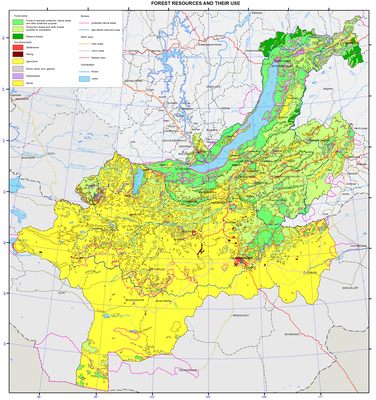
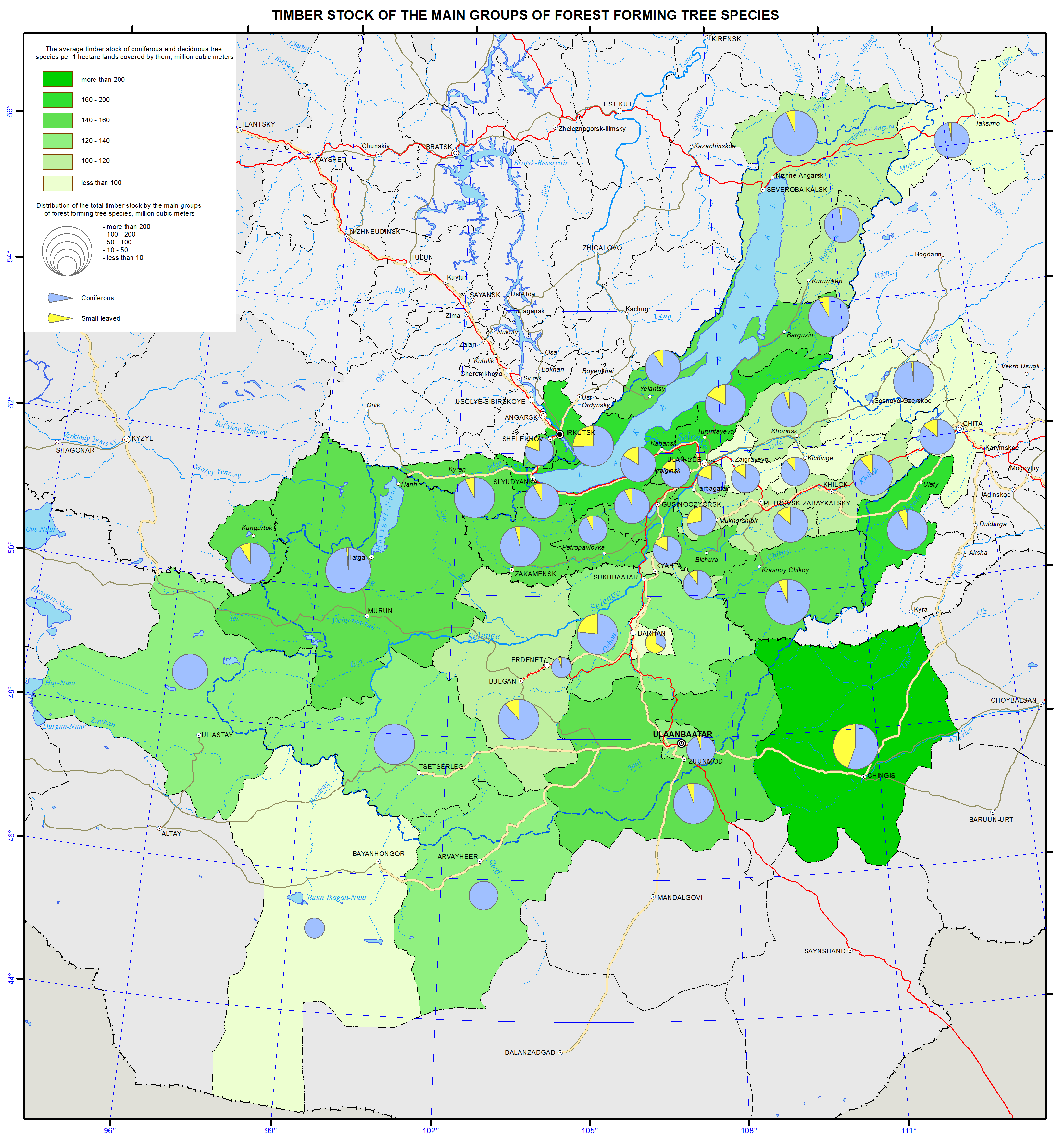
<p>The Baikal basin is a truly enormous treasury of "green gold." As of January 1, 2011 the forest area is 32103.6 thousand hectares in the Russian part of the basin and 10354.3 thousand hectares in Mongolia. Total timber reserves in the Russian part of the basin are 2,795,800,000 m3, with a stock of the conifers 2.443.000.000 m<sup>3</sup> (87.4 %). In Mongolia the total timber reserves is 1.373.100.000 m<sup>3</sup>.</p>
<p>The basic map shows the forests of nature conservation and other preservation patterns, as well as merchantable and other forests, suitable for commercial use, and reserved forests. It should be said that the division of forest lands into protected, merchantable and reserved is characteristic only of the Russian Federation. However, in the territory of Mongolia forests of special importance and in need of protection are distinguished, such as forest areas up to 100 hectares, forests on the slopes of the mountain areas of more than 30 degrees, etc.</p>
<p>Protected forests in Russia include forests subject to reclamation in order to maintain environmental, water protection, safety, sanitation, health and other useful features while using these forests providing compatibility with their intended purpose. Within the Baikal basin there is a high proportion of protected forests, due their ecosystemic, environment protection and water protection functions, as well as the important ecological role of montane forests. Merchantable<b> </b>forests are those which should be developed for the purposes of sustainable, maximum-efficiency rate production of high quality wood and other forest resources, as well as their conversion products ensuring the preservation of beneficial functions of forests. As far as the reserved forests are concerned, those are the forests not planned for logging for next twenty years. These forests are mostly located in the northern part of the region, in the permafrost zone, off-road area and are unattractive for development.</p>
<p>The insert map "Timber reserves by groups of the major forest forming species" shows the average reserves of softwood and hardwood forests (m3) per hectare of land covered by them. The average stand of timber per unit of the covered area is one of the indicators characterizing the productivity of forests, depending on growing conditions of stands, their species, and stands sparsity. The average stand of conifers and deciduous trees per hectare in the Russian part of the Baikal basin is 132.5 m3 (the global average is 100 m3/ha ), and it is fluctuating from 79-82 m3/ha (mostly in the steppe regions of Zabaikalsky krai, the Republic of Buryatia (Zaigraevsky, Chita districts) to 160 -170 m3/ha and up in the mid- and north areas (Uletovsky district of Transbaikalia, Kabansky and Severobaikalsky districts of the Republic of Buryatia, Irkutsky and Slyudyansky districts of Irkutsk oblast). Within the Mongolian part of the basin the average reserve of coniferous and deciduous tree stands is 126.6 m3 per one hectare with fluctuations in the aimaks from 81 to 205 m3 per ha. The highest average stand of timber per unit of forest area is characteristic of the northern mountainous areas of Mongolia.</p>
<p>Also this map shows the distribution of the total stand of timber by major groups of forest forming species (in million m3) with the method of cartodiagram. This index demonstrates forest-resource security area, which varies significantly in the districts of the Russian part of the basin and Mongolian aimaks (from 1.5 to 481 million m3). For correct depiction of the amount of total stand of timber within municipalities a conventional stepped scale for the circular cartodiagram was worked out, which enables to judge about the stands of timber for each group using the percentage between the major groups of forest forming species (coniferous, deciduous and shrubs).</p>
<p>Forest use is determined by the activities that have priority development within the forest vegetation areas. Timber harvesting is most developed among all kinds of forest utilization in the Russian part of the Baikal basin regulated by allowable cutting rates. Forests are actively used for recreation, hunting activities, etc.</p>
<p>In the analysis of forest utilization the following trends for all forests of the Baikal basin are revealed in recent years. They are reduction of coniferous stands, mostly maturing and mature stands; replacement of coniferous species by deciduous ones; widespread illegal logging, reduction of forested area due to fires, forest damage by pests, deforestation, and insufficient reforestation.</p>]]></content:encoded>
    <dc:publisher>No publisher</dc:publisher>
    <dc:creator>Alexander Ayurzhanaev</dc:creator>
    <dc:rights></dc:rights>
    <dc:date>2014-10-08T07:50:00Z</dc:date>
    <dc:type>Page</dc:type>
  </item>


  <item rdf:about="http://bic.iwlearn.org/en/atlas/atlas/53-timber-stock-of-the-main-groups-of-forest-forming-tree-species-map">
    <title>053. Timber stock of the main groups of forest forming tree species map</title>
    <link>http://bic.iwlearn.org/en/atlas/atlas/53-timber-stock-of-the-main-groups-of-forest-forming-tree-species-map</link>
    <description></description>
    
    <dc:publisher>No publisher</dc:publisher>
    <dc:creator>Alexander Ayurzhanaev</dc:creator>
    <dc:rights></dc:rights>
    <dc:date>2014-10-08T07:50:00Z</dc:date>
    <dc:type>Folder</dc:type>
  </item>


  <item rdf:about="http://bic.iwlearn.org/en/atlas/atlas/52-forest-resources-and-their-use-map/forest-resources-and-their-use-map">
    <title>Forest resources and their use map</title>
    <link>http://bic.iwlearn.org/en/atlas/atlas/52-forest-resources-and-their-use-map/forest-resources-and-their-use-map</link>
    <description></description>
    <content:encoded xmlns:content="http://purl.org/rss/1.0/modules/content/"><![CDATA[<p><img class="image-inline" src="../../../resolveuid/700ad65621bc487bbc5893966fe93356/@@images/image/preview" /></p>
<p><a href="http://bic.iwlearn.org/en/atlas/photos/copy_of__52_Forestresourcesandtheiruse.png" class="internal-link">Open full size</a></p>
<p align="center"><strong>Forest resources and their use</strong></p>
<p align="center"><strong> </strong></p>
<p>The Baikal basin is a truly enormous treasury of "green gold." As of January 1, 2011 the forest area is 32103.6 thousand hectares in the Russian part of the basin and 10354.3 thousand hectares in Mongolia. Total timber reserves in the Russian part of the basin are 2,795,800,000 m3, with a stock of the conifers 2.443.000.000 m<sup>3</sup> (87.4 %). In Mongolia the total timber reserves is 1.373.100.000 m<sup>3</sup>.</p>
<p>The basic map shows the forests of nature conservation and other preservation patterns, as well as merchantable and other forests, suitable for commercial use, and reserved forests. It should be said that the division of forest lands into protected, merchantable and reserved is characteristic only of the Russian Federation. However, in the territory of Mongolia forests of special importance and in need of protection are distinguished, such as forest areas up to 100 hectares, forests on the slopes of the mountain areas of more than 30 degrees, etc.</p>
<p>Protected forests in Russia include forests subject to reclamation in order to maintain environmental, water protection, safety, sanitation, health and other useful features while using these forests providing compatibility with their intended purpose. Within the Baikal basin there is a high proportion of protected forests, due their ecosystemic, environment protection and water protection functions, as well as the important ecological role of montane forests. Merchantable<b> </b>forests are those which should be developed for the purposes of sustainable, maximum-efficiency rate production of high quality wood and other forest resources, as well as their conversion products ensuring the preservation of beneficial functions of forests. As far as the reserved forests are concerned, those are the forests not planned for logging for next twenty years. These forests are mostly located in the northern part of the region, in the permafrost zone, off-road area and are unattractive for development.</p>
<p>The insert map "Timber reserves by groups of the major forest forming species" shows the average reserves of softwood and hardwood forests (m3) per hectare of land covered by them. The average stand of timber per unit of the covered area is one of the indicators characterizing the productivity of forests, depending on growing conditions of stands, their species, and stands sparsity. The average stand of conifers and deciduous trees per hectare in the Russian part of the Baikal basin is 132.5 m3 (the global average is 100 m3/ha ), and it is fluctuating from 79-82 m3/ha (mostly in the steppe regions of Zabaikalsky krai, the Republic of Buryatia (Zaigraevsky, Chita districts) to 160 -170 m3/ha and up in the mid- and north areas (Uletovsky district of Transbaikalia, Kabansky and Severobaikalsky districts of the Republic of Buryatia, Irkutsky and Slyudyansky districts of Irkutsk oblast). Within the Mongolian part of the basin the average reserve of coniferous and deciduous tree stands is 126.6 m3 per one hectare with fluctuations in the aimaks from 81 to 205 m3 per ha. The highest average stand of timber per unit of forest area is characteristic of the northern mountainous areas of Mongolia.</p>
<p>Also this map shows the distribution of the total stand of timber by major groups of forest forming species (in million m3) with the method of cartodiagram. This index demonstrates forest-resource security area, which varies significantly in the districts of the Russian part of the basin and Mongolian aimaks (from 1.5 to 481 million m3). For correct depiction of the amount of total stand of timber within municipalities a conventional stepped scale for the circular cartodiagram was worked out, which enables to judge about the stands of timber for each group using the percentage between the major groups of forest forming species (coniferous, deciduous and shrubs).</p>
<p>Forest use is determined by the activities that have priority development within the forest vegetation areas. Timber harvesting is most developed among all kinds of forest utilization in the Russian part of the Baikal basin regulated by allowable cutting rates. Forests are actively used for recreation, hunting activities, etc.</p>
<p>In the analysis of forest utilization the following trends for all forests of the Baikal basin are revealed in recent years. They are reduction of coniferous stands, mostly maturing and mature stands; replacement of coniferous species by deciduous ones; widespread illegal logging, reduction of forested area due to fires, forest damage by pests, deforestation, and insufficient reforestation.</p>]]></content:encoded>
    <dc:publisher>No publisher</dc:publisher>
    <dc:creator>Alexander Ayurzhanaev</dc:creator>
    <dc:rights></dc:rights>
    <dc:date>2014-10-08T07:45:00Z</dc:date>
    <dc:type>Page</dc:type>
  </item>


  <item rdf:about="http://bic.iwlearn.org/en/atlas/atlas/52-forest-resources-and-their-use-map">
    <title>052. Forest resources and their use map</title>
    <link>http://bic.iwlearn.org/en/atlas/atlas/52-forest-resources-and-their-use-map</link>
    <description></description>
    
    <dc:publisher>No publisher</dc:publisher>
    <dc:creator>Alexander Ayurzhanaev</dc:creator>
    <dc:rights></dc:rights>
    <dc:date>2014-10-08T07:45:00Z</dc:date>
    <dc:type>Folder</dc:type>
  </item>


  <item rdf:about="http://bic.iwlearn.org/en/atlas/atlas/51-land-resources-use-map">
    <title>051. Land resources use map</title>
    <link>http://bic.iwlearn.org/en/atlas/atlas/51-land-resources-use-map</link>
    <description></description>
    
    <dc:publisher>No publisher</dc:publisher>
    <dc:creator>Alexander Ayurzhanaev</dc:creator>
    <dc:rights></dc:rights>
    <dc:date>2014-10-08T07:40:00Z</dc:date>
    <dc:type>Folder</dc:type>
  </item>


  <item rdf:about="http://bic.iwlearn.org/en/atlas/atlas/51-land-resources-use-map/land-resources-use-map">
    <title>Land resources use map</title>
    <link>http://bic.iwlearn.org/en/atlas/atlas/51-land-resources-use-map/land-resources-use-map</link>
    <description></description>
    <content:encoded xmlns:content="http://purl.org/rss/1.0/modules/content/"><![CDATA[<p><img class="image-inline" src="../../../resolveuid/8ba0f7f48b7741d9bb3d492e6981fac2/@@images/image/preview" /></p>
<p><a href="http://bic.iwlearn.org/en/atlas/photos/copy_of__51_Landresourcesuse.png" class="internal-link">Open full size</a></p>
<p align="center"><strong>L</strong><strong>and resources and their use</strong></p>
<p align="center"><strong> </strong></p>
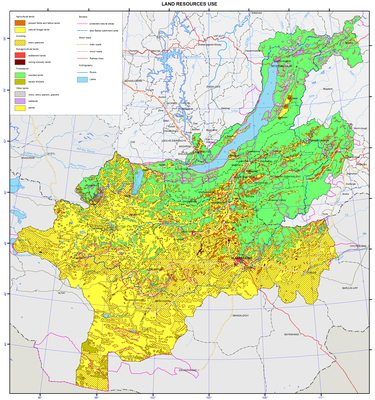
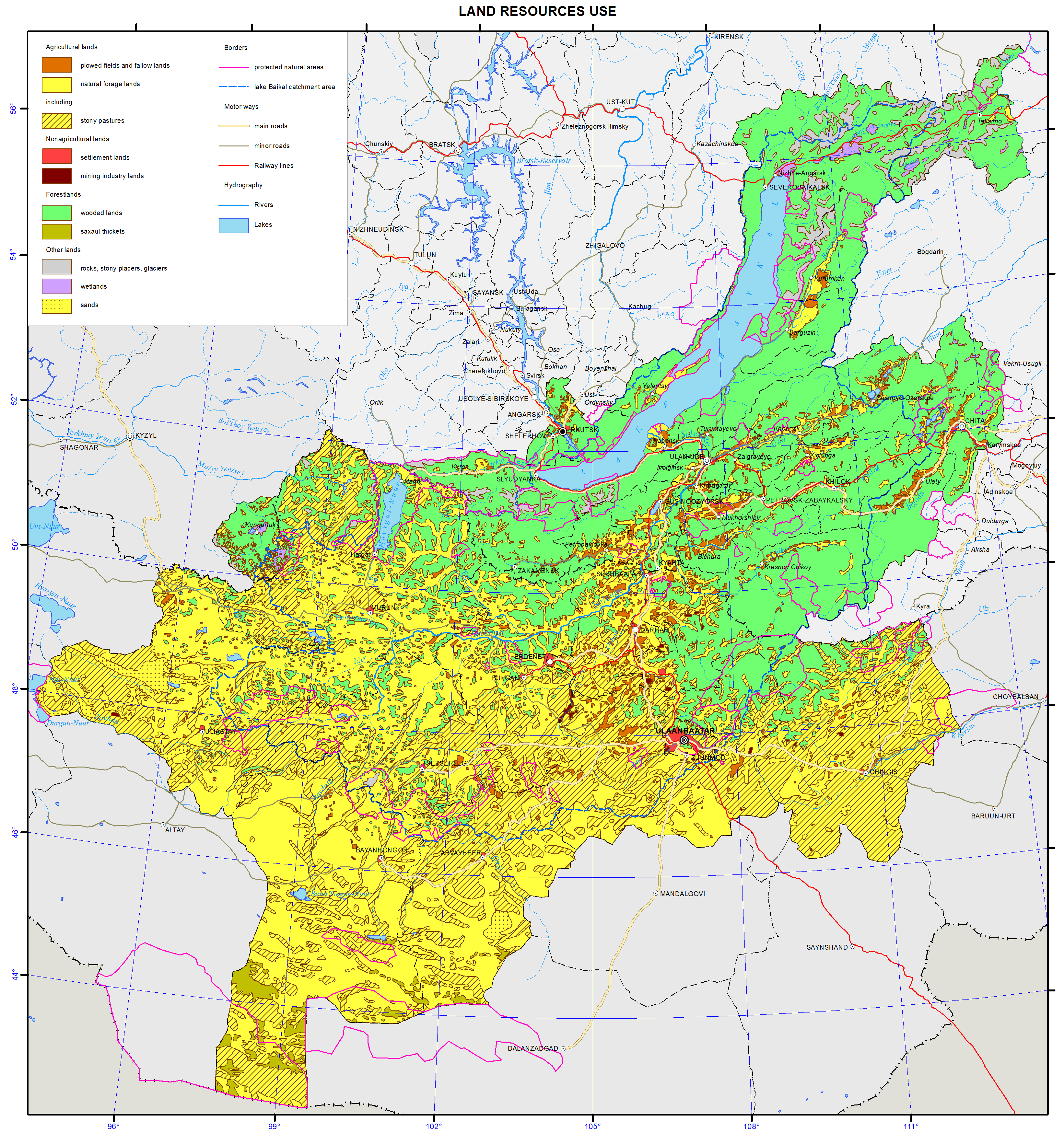
<p>Land resources are the main spatial basis, a store of various types of mineral resources for many branches of industry, as well as a basic means of production for agriculture and forestry. For the latter branches land resources and soil fertility are important means of growing crops and forest stands. For other types of land use (residential, transport, etc.) the role of land resources is reduced mainly to the role of the operational basis for spatial location of specific objects inherent to these types of land use.</p>
<p>Under the working legislation and established practice state land registration in the Russian Federation is carried out on land categories and agricultural lands, forms of ownership and types of land rights, as well as their use for agricultural production and other needs. Land registration in Mongolia is carried out similarly (with minor changes).</p>
<p>On the basic map the land fund structure on agricultural lands is presented as a quality background. The latter ones are defined as land, systematically used or usable for specific economic purposes and different in their natural and historical features. Land carries material properties typical of land use as an economic phenomenon.</p>
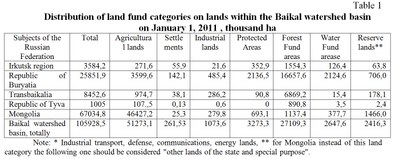
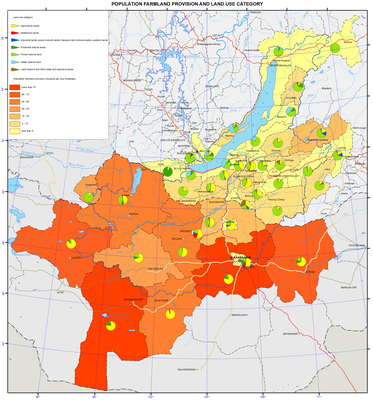
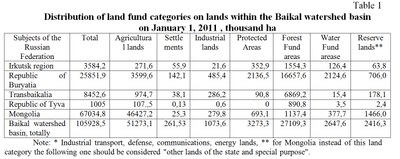
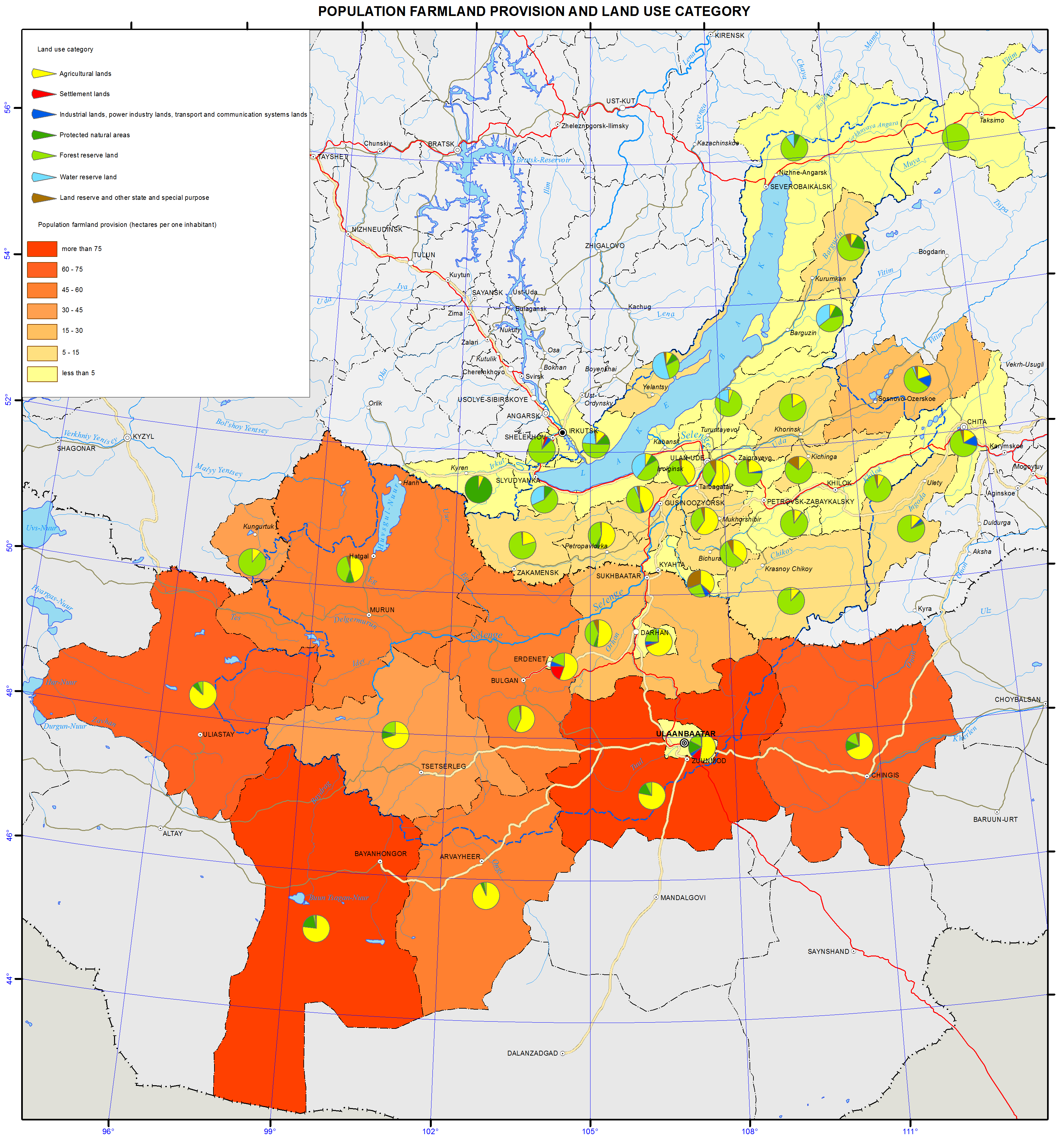
<p>The second map and the Table represent the layout of the land fund on land categories and the index of availability of agricultural land. Land categories are land plots distinguished according to their intended use (agricultural land, settlements, industry, energy, transport, communication, defense and security, etc., forest, water resources, reserves, etc.). Mongolia is characterized by the absence of the concept of "land reserve". However, a large share of the land fund structure there belongs to public land for special purposes, which consists not only of lands of defense and security and protected areas, but lands, used in ways uncharacteristic of Russia. Therefore, in the map legend the category "lands of state and special purpose" applies only to Mongolia, excluding the land of specially protected natural areas and defense and security lands. The latter ones are included in the respective land categories.</p>
<p>The availability index of farmland is the ratio of agricultural land area (in hectares) belonging to the agricultural land to the number of residents living in the municipality. Farmland is an essential part of land, which is a potential resource for the formation of local food base. The average area of agricultural land per capita (within Russian territory, except Tere-Khol district of the Republic of Tyva) amounts to 3.7 hectares; it ranges from 0.06 ha within Sludyansky district of Irkutsk oblast to 22.9 ha in the Eravninsky district of the Republic of Buryatia. Within the Mongolian territory the indicators of the agricultural land per aimak inhabitant, is on the average significantly higher than in the Russian part of the basin as it amounts to about 45 hectares. Minimum rates are found in the Ulaanbaatar, Darkhan, and Orkhon aimaks, which is connected, first of all, with the high population numbers in these aimaks and relatively smaller areas of agricultural land compared to other aimaks.</p>
<p style="text-align: center; "><img class="image-inline" src="../../../resolveuid/fac9e5ab3b094d459f6b4045e311a305/@@images/image/preview" /></p>
<p>In 1990 – 2010 the reduction of agricultural area for most municipalities is registered in the Russian part of the basin, which is directly linked to their withdrawal from agricultural use. The main reason of the reduction of such agricultural areas was shutdown of many agricultural enterprises, organizations, and farms and transfer of the withdrawn lands, for the most part, to the land redistribution fund. Another reason is the expiration of the land leasehold (or temporary use) and non renewal of its agricultural productivity. The agricultural land reduction is caused by negative processes became widespread due to the sharp reduction of valuable land protection measures from water and wind erosion, flooding, bogging, waterlogging and other processes. It should be noted that the actual outflow of productive land is much higher. Previously transferred farmland reserves are overgrown with shrubs and low forests and lose their agricultural value.</p>
<p>In Mongolia problems of agricultural lands reduction are currently not registered because of their significant amount due to natural factors and historical specific features of agriculture.<b> </b></p>]]></content:encoded>
    <dc:publisher>No publisher</dc:publisher>
    <dc:creator>Alexander Ayurzhanaev</dc:creator>
    <dc:rights></dc:rights>
    <dc:date>2014-10-08T07:40:00Z</dc:date>
    <dc:type>Page</dc:type>
  </item>


  <item rdf:about="http://bic.iwlearn.org/en/atlas/atlas/50-population-farmland-provision-and-land-use-category-map/population-farmland-provision-and-land-use-category-map">
    <title>Population farmland provision and land use category map</title>
    <link>http://bic.iwlearn.org/en/atlas/atlas/50-population-farmland-provision-and-land-use-category-map/population-farmland-provision-and-land-use-category-map</link>
    <description></description>
    <content:encoded xmlns:content="http://purl.org/rss/1.0/modules/content/"><![CDATA[<p><img class="image-inline" src="../../../resolveuid/7076546f4cd346f79bcca36fd99bd1f2/@@images/image/preview" /></p>
<p><a href="http://bic.iwlearn.org/en/atlas/photos/copy_of__50_Populationfarmlandprovisionandlandusecategory.png" class="internal-link">Open full size</a></p>
<p align="center"><strong>L</strong><strong>and resources and their use</strong></p>
<p align="center"><strong> </strong></p>
<p>Land resources are the main spatial basis, a store of various types of mineral resources for many branches of industry, as well as a basic means of production for agriculture and forestry. For the latter branches land resources and soil fertility are important means of growing crops and forest stands. For other types of land use (residential, transport, etc.) the role of land resources is reduced mainly to the role of the operational basis for spatial location of specific objects inherent to these types of land use.</p>
<p>Under the working legislation and established practice state land registration in the Russian Federation is carried out on land categories and agricultural lands, forms of ownership and types of land rights, as well as their use for agricultural production and other needs. Land registration in Mongolia is carried out similarly (with minor changes).</p>
<p>On the basic map the land fund structure on agricultural lands is presented as a quality background. The latter ones are defined as land, systematically used or usable for specific economic purposes and different in their natural and historical features. Land carries material properties typical of land use as an economic phenomenon.</p>
<p>The second map and the Table represent the layout of the land fund on land categories and the index of availability of agricultural land. Land categories are land plots distinguished according to their intended use (agricultural land, settlements, industry, energy, transport, communication, defense and security, etc., forest, water resources, reserves, etc.). Mongolia is characterized by the absence of the concept of "land reserve". However, a large share of the land fund structure there belongs to public land for special purposes, which consists not only of lands of defense and security and protected areas, but lands, used in ways uncharacteristic of Russia. Therefore, in the map legend the category "lands of state and special purpose" applies only to Mongolia, excluding the land of specially protected natural areas and defense and security lands. The latter ones are included in the respective land categories.</p>
<p>The availability index of farmland is the ratio of agricultural land area (in hectares) belonging to the agricultural land to the number of residents living in the municipality. Farmland is an essential part of land, which is a potential resource for the formation of local food base. The average area of agricultural land per capita (within Russian territory, except Tere-Khol district of the Republic of Tyva) amounts to 3.7 hectares; it ranges from 0.06 ha within Sludyansky district of Irkutsk oblast to 22.9 ha in the Eravninsky district of the Republic of Buryatia. Within the Mongolian territory the indicators of the agricultural land per aimak inhabitant, is on the average significantly higher than in the Russian part of the basin as it amounts to about 45 hectares. Minimum rates are found in the Ulaanbaatar, Darkhan, and Orkhon aimaks, which is connected, first of all, with the high population numbers in these aimaks and relatively smaller areas of agricultural land compared to other aimaks.</p>
<p style="text-align: center; "><img class="image-inline" src="../../../resolveuid/f7ed95da114240cfaea041e530f8d09f/@@images/image/preview" /></p>
<p>In 1990 – 2010 the reduction of agricultural area for most municipalities is registered in the Russian part of the basin, which is directly linked to their withdrawal from agricultural use. The main reason of the reduction of such agricultural areas was shutdown of many agricultural enterprises, organizations, and farms and transfer of the withdrawn lands, for the most part, to the land redistribution fund. Another reason is the expiration of the land leasehold (or temporary use) and non renewal of its agricultural productivity. The agricultural land reduction is caused by negative processes became widespread due to the sharp reduction of valuable land protection measures from water and wind erosion, flooding, bogging, waterlogging and other processes. It should be noted that the actual outflow of productive land is much higher. Previously transferred farmland reserves are overgrown with shrubs and low forests and lose their agricultural value.</p>
<p>In Mongolia problems of agricultural lands reduction are currently not registered because of their significant amount due to natural factors and historical specific features of agriculture.<b> </b></p>]]></content:encoded>
    <dc:publisher>No publisher</dc:publisher>
    <dc:creator>Alexander Ayurzhanaev</dc:creator>
    <dc:rights></dc:rights>
    <dc:date>2014-10-08T07:35:00Z</dc:date>
    <dc:type>Page</dc:type>
  </item>


  <item rdf:about="http://bic.iwlearn.org/en/atlas/atlas/50-population-farmland-provision-and-land-use-category-map">
    <title>050. Population farmland provision and land use category map</title>
    <link>http://bic.iwlearn.org/en/atlas/atlas/50-population-farmland-provision-and-land-use-category-map</link>
    <description></description>
    
    <dc:publisher>No publisher</dc:publisher>
    <dc:creator>Alexander Ayurzhanaev</dc:creator>
    <dc:rights></dc:rights>
    <dc:date>2014-10-08T07:30:00Z</dc:date>
    <dc:type>Folder</dc:type>
  </item>


  <item rdf:about="http://bic.iwlearn.org/en/atlas/atlas/49-recreational-resources-of-climate-map/recreational-resources-of-climate-map">
    <title>Recreational resources of climate map</title>
    <link>http://bic.iwlearn.org/en/atlas/atlas/49-recreational-resources-of-climate-map/recreational-resources-of-climate-map</link>
    <description></description>
    <content:encoded xmlns:content="http://purl.org/rss/1.0/modules/content/"><![CDATA[<p><img class="image-inline" src="../../../resolveuid/b13e4cc0ddbc4a00847fc93bb8e655d3/@@images/image/preview" /></p>
<p><a href="http://bic.iwlearn.org/en/atlas/photos/copy_of__49_RecreationalResourcesofClimate.png" class="internal-link">Open full size</a></p>
<p align="center"><b><b>Recreational climate resources</b></b></p>
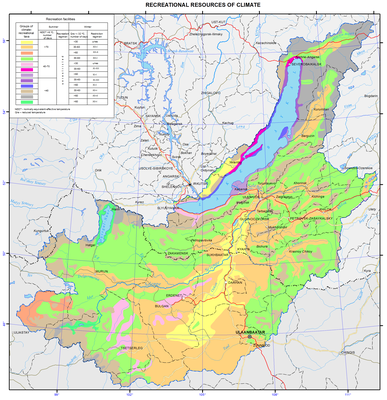
<p>A complex of several climatic factors, such as high sunshine duration (from 2800 hours per annum in the south of the basin to 1500 hours per annum in the north), wide range of heat supply (the sum of mean daily temperatures above 10° C varies from 2400 in the south of the basin to 244 in the highlands), sustained low temperatures in the hollow land forms, and predominantly low wind velocities contribute to the formation of local climates with highly varied suitability for seasonal recreation. Background climatic characteristics of diverse territories, such as hollow, valley, low-, mid-, and high-altitude vary considerably. Their main features in this case are characterized by a number of differently directed indices, whose combined impact on humans can have a similar effect. The same air temperature has a dissimilar thermal effect on a human body in the case of different wind velocities and different air humidity.</p>
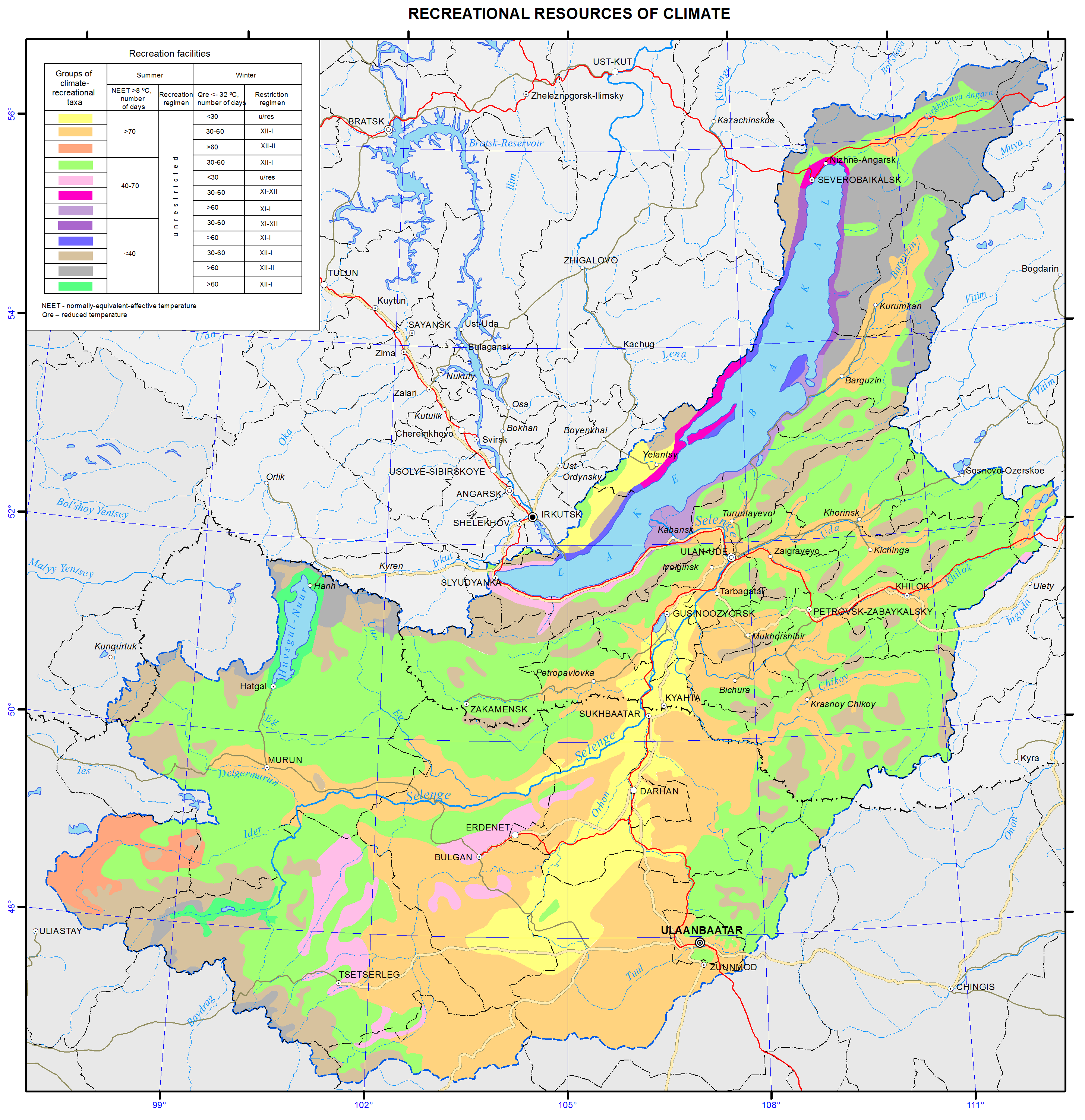
<p>Normal-equivalent-effective temperature (NEET) method is often used to take into consideration their combined influence upon the thermal state of man. The levels of comfortable perception of heat according to the NEET scale vary within a broad range depending on the degree of man’s adaptation to environmental conditions. The use of the duration of NEET values above 8 °C for the background assessment of contrasting territories demonstrated its validity [Bashalkhanova et al., 2012].</p>
<p>Reduced temperature (Qred) indicates heat losses from the open surface of human body in the wintertime under a combined effect of air temperature and wind velocity [Khairulin and Karpenko, 2005]. With Qred below −32 °C, the risk of frostbite increases, so recreation in the open air is limited.</p>
<p>In the total form the complex of the most important characteristics of climatic resources favorable for recreation is represented by the duration of periods with NEET above 8 °C and those limiting it – by Qred below −32 °C.</p>
<p class="a0">Spatial distribution of indicators under study is dependent on a complex interaction of the main climate forcing factors, such as radiative and circulatory ones as well as the underlying surface properties, which provide a variety of mesoclimatic conditions, manifestation of latitudinal and altitudinal zonality elements and local patterns for recreational activity</p>
<p>In summer the variety of landscape conditions exerts considerable influence on climatic regimes formation alongside with the latitudinal factor. The plain-valley mesoclimates combining the steppe, steppificated, and subtaiga piedmont pine landscapes of slopes, plains and river valleys are characterized by the broadest possibilities for recreation and treatment of the population [Landscapes…, 1977; National…1990]. The duration of days with the NEET above 8 °C is highest. Recreational resources of the climate of uplands and mountainous territories are substantially lower; they are characterized by a shorter duration of the favorable period. The duration decreases dramatically depending on the latitudinal and altitudinal location of natural complexes. For instance, for the dark coniferous landscapes of uplands, dark coniferous and larch piedmont and intermontane depressions as well as bogged larch depressions on the plains its duration is from 40 to 70 days. In the mountain-taiga landscapes of flat (sometimes slope) surfaces as well as in dark coniferous landscapes of high slopes and plateaus, this period is less than 40 days. In high mountains with goletz, subgoletz and, partly, mountain-taiga larch forests, the mean monthly NEETs do not reach 8 °C.</p>
<p>The low recreational potential of the climate in winter is conditioned by circulation and astronomical factors. In the subtypes of climates weakly differing in summer (plain-valley, narrow valley and highlands) elements of latitudinal zonality are clearly traced. The period of possible limitation of recreation in the open air in the northern and southern parts of the basin can differ nearly twofold. Meanwhile the stagnant phenomena in orographically isolated intermontane depressions and closed river valleys are accompanied by the longest period of Qred below −32 °C, which reveals more favorable conditions on their slopes. The severity of winters for open surfaces of slopes and summits obeys the wind regime.</p>
<p>Quite special conditions occur on the shores of Lake Baikal. The warming (in winter) and cooling (in summer) influence of the lake’s water masses showed a shift toward a decrease in climatic-physiological comfort of landscapes when compared with their counterparts outside the influence zone. This is largely due to the large horizontal temperature gradients between land and lake, which are often the cause of strong winds, the exceptional variety, unpredictability and velocity of which are well known. For that reason, on certain parts of the shore, especially in the west, in the mountain-taiga pine and larch landscapes the number of days with the NEET above 8 °C is lowest (less than 40 days). Meanwhile, in the wind-proof parts of the shore (Peschanaya Bay, the Kuchelga river valley, etc.) the conditions for recreation are optimal. In winter the dependence of the climatic-recreational potential on the location grows even further. In some shore areas relatively favorable in the summer season, the length of the period of reduced temperature below −32 °C differs substantially.</p>
<p>On the whole, the recreation resources of the climate across the territory are relatively varied. Given the availability of mud-bath resources in the depressions and broad river valleys with a shorter length of the limiting period, there is a possibility of launching the sanatorium-and-spa treatment. Of considerable interest are the middle mountains of Khangai and the interfluves of the Selenga and Orkhon rivers. The climatic resources of other territories are more suitable for extensive development and promotion of tourism and stationary recreation. Because of the low heat availability and abrupt fluctuations in the temperature-wind regime, the shores of Lake Baikal and Lake Hovsgol are favorable for recreation of healthy people only. Obviously, depending on the characteristics of heat and moisture exchange and on the regime of the local circulation, the period for different kinds of recreation is variable. Thus, the slopes of the Khamar-Daban on the southern shores of Lake Baikal are most favorable for the winter kinds of recreation due to the abundance of snow, and the appropriate combination of temperature and wind regimes. The shores of Middle Baikal characterized by a long duration of sunshine are more favorable for summer recreation.</p>
<p class="a0">The experience of the cartographic analysis and multiscale assessment of recreational resources of the climate showed that in a number of cases climate resources essential for the recreation of people and conditioned by microclimatic differences may considerably exceed their latitudinal background parameters. Thus, a comprehensive expert examination of the recreational resources of the climate is important when a certain area is selected for implementation of investment projects.</p>
<p align="center">References</p>
<p>Bashalkhanova, L.B., Veselova, V.N. and Korytny, L.M. (2012). <i>Resource Dimension of Social Conditions for the Life of the Population of East Siberia</i>, Novosibirsk: Geo, 221 p. [in Russian].</p>
<p><i>Landscapes of the South of East Siberia (1:1 500 000 Map)</i>. (1977). V.S. Mikheev and V.A. Ryashin, Moscow: GUGK, 4 sh. [in Russian].<i></i></p>
<p><i>Mongol ulsyn undesnii atlas</i>. (2009). Ulaan-Baatar: SHUA. Gazarzuin khurzelen. - 248 p. [in Mongolian].</p>]]></content:encoded>
    <dc:publisher>No publisher</dc:publisher>
    <dc:creator>Alexander Ayurzhanaev</dc:creator>
    <dc:rights></dc:rights>
    <dc:date>2014-10-08T07:25:00Z</dc:date>
    <dc:type>Page</dc:type>
  </item>


  <item rdf:about="http://bic.iwlearn.org/en/atlas/atlas/49-recreational-resources-of-climate-map">
    <title>049. Recreational resources of climate map</title>
    <link>http://bic.iwlearn.org/en/atlas/atlas/49-recreational-resources-of-climate-map</link>
    <description></description>
    
    <dc:publisher>No publisher</dc:publisher>
    <dc:creator>Alexander Ayurzhanaev</dc:creator>
    <dc:rights></dc:rights>
    <dc:date>2014-10-08T07:25:00Z</dc:date>
    <dc:type>Folder</dc:type>
  </item>


  <item rdf:about="http://bic.iwlearn.org/en/atlas/atlas/48-mineral-waters-map/mineral-waters-map">
    <title>Mineral waters map</title>
    <link>http://bic.iwlearn.org/en/atlas/atlas/48-mineral-waters-map/mineral-waters-map</link>
    <description></description>
    <content:encoded xmlns:content="http://purl.org/rss/1.0/modules/content/"><![CDATA[<p><img class="image-inline" src="../../../resolveuid/c6afd68e36b64110bdddd43d637b238c/@@images/image/preview" /></p>
<p><a href="http://bic.iwlearn.org/en/atlas/photos/copy_of__48_Mineralwaters.png" class="internal-link">Open full size</a></p>
<p align="center"><strong>Mineral springs</strong></p>
<p align="center"><strong> </strong></p>
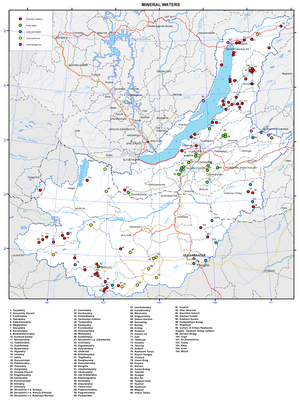
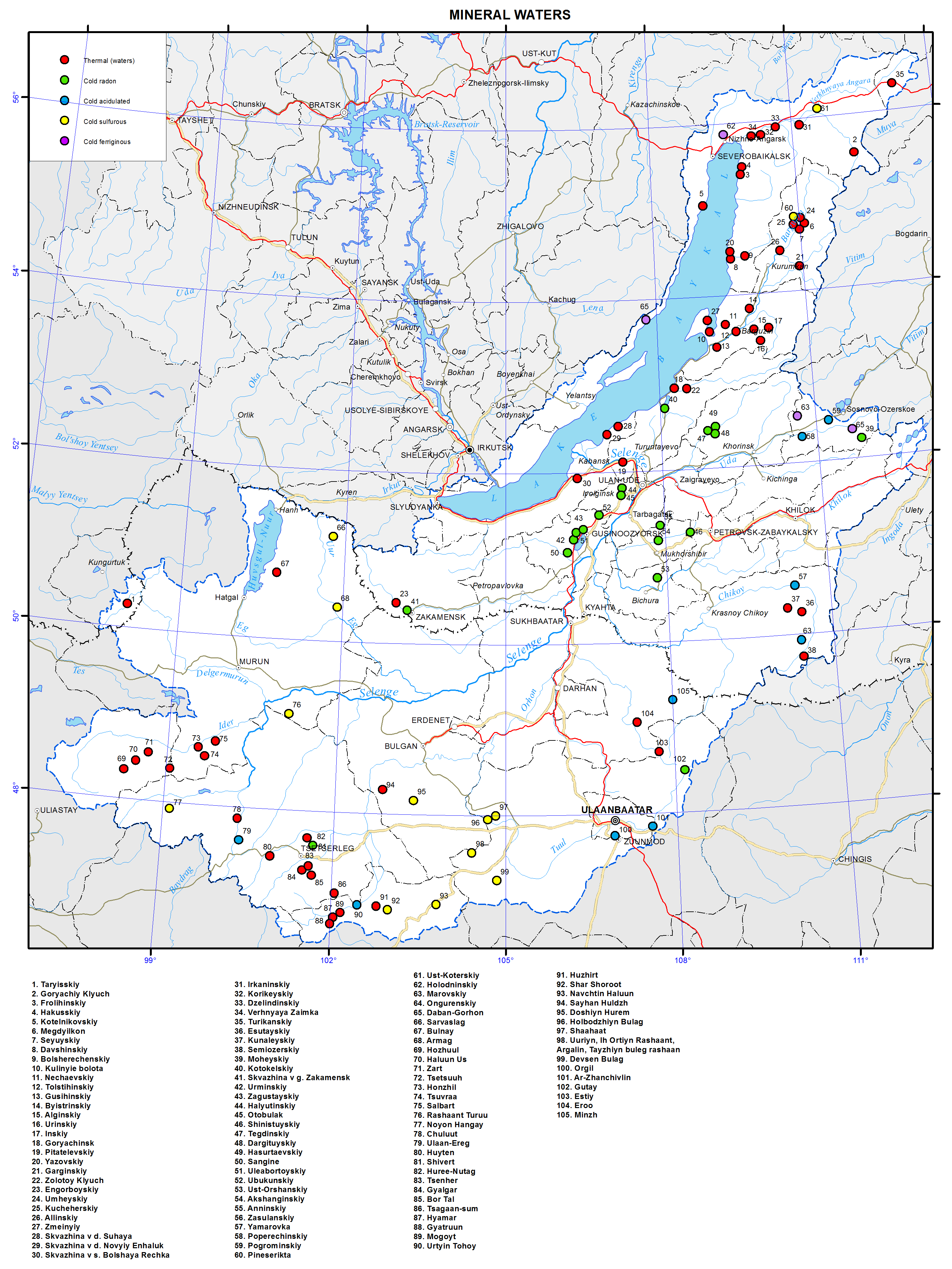
<p>The map is based on generalizing monographs, maps of mineral waters and field research data obtained by the authors.</p>
<p>The map depicts mineral springs, the water of which can be used for balneological purposes according to its physical and chemical properties. These characteristics include: water temperature (hot springs); radon content (cold radon springs), content of free carbon dioxide (carbonic cold springs), content of sulphate sulfur (cold hydrogen sulfide springs) and iron (ferrous cold springs).</p>
<p>This map can be used for the organization of sanatorium-and-spa construction, as well as for planning of underground thermal water use in thermal engineering.<b> </b></p>
<p align="center">References</p>
<p>Borisenko, I.M., Zamana, L. (1978). <i>Mineral water of Buryatia</i>. - Ulan-Ude: Buryat kn. izd-vo. - 163 p.</p>
<p>Map of the Republic of Tyva (tourism objects, objects of nature, arzhaans, photos).(2012). - M1:1000000, Kyzyl.</p>
<p>Lomonosov, I.S., Kustov, Yu.I., Pinneker, E.V. (1977). <i>Mineral water in Baikal region</i>. – Irkutsk: Vost. Sib . kn. izd-vo. - 224 p.</p>
<p><i>Mineral water of southern part of Eastern Siberia.</i> Vol.II. (1962) – M.-L.: Izd. AN USSR. - 199 p.</p>
<p>Pissarsky, B.I., Nambar, B, Ariyadagva, B. (2003). <i>Map of mineral waters in Mongolia</i>. 1:2500000, - Ulaanbaatar.</p>]]></content:encoded>
    <dc:publisher>No publisher</dc:publisher>
    <dc:creator>Alexander Ayurzhanaev</dc:creator>
    <dc:rights></dc:rights>
    <dc:date>2014-10-08T05:50:00Z</dc:date>
    <dc:type>Page</dc:type>
  </item>


  <item rdf:about="http://bic.iwlearn.org/en/atlas/atlas/48-mineral-waters-map">
    <title>048. Mineral waters map</title>
    <link>http://bic.iwlearn.org/en/atlas/atlas/48-mineral-waters-map</link>
    <description></description>
    
    <dc:publisher>No publisher</dc:publisher>
    <dc:creator>Alexander Ayurzhanaev</dc:creator>
    <dc:rights></dc:rights>
    <dc:date>2014-10-08T05:45:00Z</dc:date>
    <dc:type>Folder</dc:type>
  </item>


  <item rdf:about="http://bic.iwlearn.org/en/atlas/atlas/47-natural-resources-of-the-ground-waters-map/natural-resources-of-the-ground-waters-map">
    <title>Natural resources of the ground waters map</title>
    <link>http://bic.iwlearn.org/en/atlas/atlas/47-natural-resources-of-the-ground-waters-map/natural-resources-of-the-ground-waters-map</link>
    <description></description>
    <content:encoded xmlns:content="http://purl.org/rss/1.0/modules/content/"><![CDATA[<p><img class="image-inline" src="../../../resolveuid/91d7cbf115014934aa1883b1a2596bb2/@@images/image/preview" /></p>
<p><a href="http://bic.iwlearn.org/en/atlas/photos/copy_of__47_Naturalresourcesofthegroundwaters.png" class="internal-link">Open full size</a></p>
<p align="center"><strong>Natural groundwater resources</strong></p>
<p align="center"><strong> </strong></p>
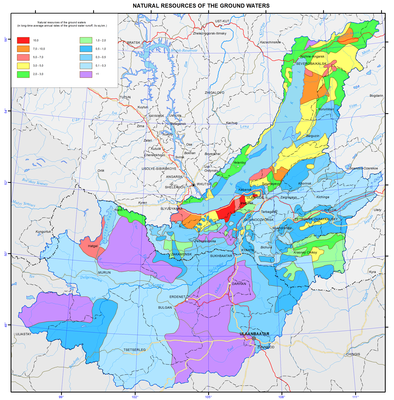
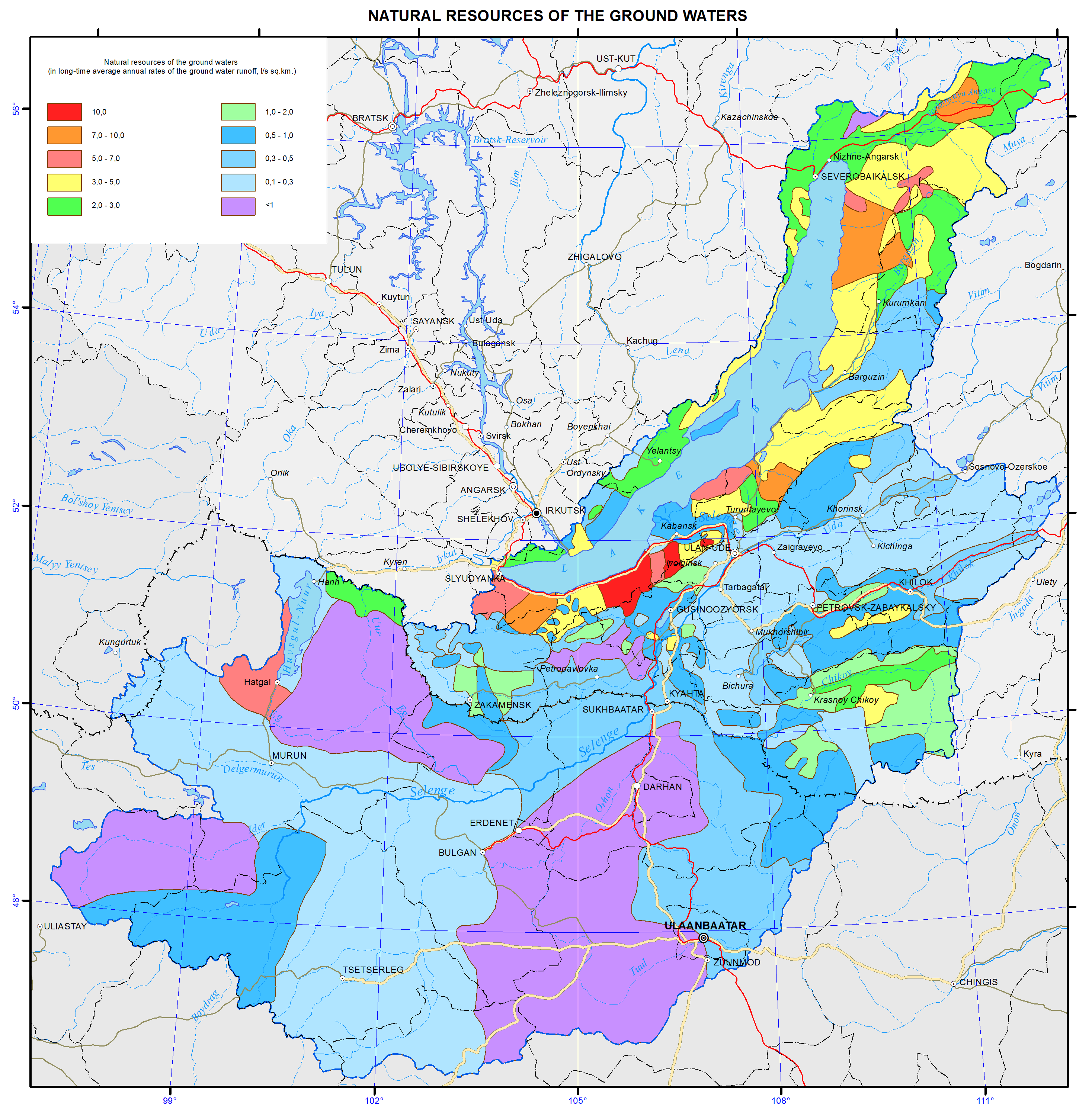
<p>The map is based on the monograph by B.I. Pisarsky (1987) using medium-scale hydrogeological maps for Irkutsk oblast, the Republic of Buryatia and Tyva, Transbaikalia and Mongolia. The area principle of mapping of natural groundwater resources (in units of groundwater flow) was applied, as the complex hydrological and geochemical method of partitioning the hydrograph of the total stream flow was the principal one in the course of its comprehensive assessment. Mapping was carried out by the reference catchments located within the same aquifer system and characterized by the homogeneity of geological and hydrogeological conditions and sufficiently long series of runoff observations. For part of the territory where information was either not available or sparse, the mapping method was based on hydrological and hydrogeological analogy.</p>
<p>The color map is based on the energy principle. Cold colors correspond to low values of the rate of subsurface water flow, warm colors to the high values. Extremes of the spectrum of white correspond to the extreme values of the intensity of subsurface flow. Ranking of values of natural groundwater resources and class gradation are brought into compliance with that existing in this area [Natural Resources..., 1976]. A more fractional division of low classes is caused by the low values of rate of subsurface water flow in the territory of Mongolia, occupying a significant part of the Baikal basin.</p>
<p>Distribution of natural groundwater resources in the Baikal basin is extremely uneven; nevertheless it is generally subject to the vertical zonation and latitudinal zonality. Anomalous values of the rate of subsurface water flow are confined to the basins with complex hydrogeological conditions.<b> </b></p>
<p align="center">References</p>
<p><i>Natural groundwater resources in southern East Siberia</i>. (1976). - Novosibirsk: Nauka. - 127 p.</p>
<p>Pisarsky, B.I. (1987). <i>Laws of formation of subsurface drainage basin of Lake Baikal</i>. - Novosibirsk: Nauka,- 158 p.</p>]]></content:encoded>
    <dc:publisher>No publisher</dc:publisher>
    <dc:creator>Alexander Ayurzhanaev</dc:creator>
    <dc:rights></dc:rights>
    <dc:date>2014-10-08T03:35:00Z</dc:date>
    <dc:type>Page</dc:type>
  </item>


  <item rdf:about="http://bic.iwlearn.org/en/atlas/atlas/47-natural-resources-of-the-ground-waters-map">
    <title>047. Natural resources of the ground waters map</title>
    <link>http://bic.iwlearn.org/en/atlas/atlas/47-natural-resources-of-the-ground-waters-map</link>
    <description></description>
    
    <dc:publisher>No publisher</dc:publisher>
    <dc:creator>Alexander Ayurzhanaev</dc:creator>
    <dc:rights></dc:rights>
    <dc:date>2014-10-08T03:30:00Z</dc:date>
    <dc:type>Folder</dc:type>
  </item>


</rdf:RDF>