
<?xml version="1.0" encoding="utf-8" ?>
<rdf:RDF xmlns:rdf="http://www.w3.org/1999/02/22-rdf-syntax-ns#" xmlns:dc="http://purl.org/dc/elements/1.1/" xmlns:syn="http://purl.org/rss/1.0/modules/syndication/" xmlns="http://purl.org/rss/1.0/">


<channel rdf:about="http://bic.iwlearn.org/en/search_rss">
  <title>English</title>
  <link>http://bic.iwlearn.org</link>

  <description>
    
            These are the search results for the query, showing results 205 to 219.
        
  </description>


  <image rdf:resource="http://bic.iwlearn.org/logo.png"/>

  <items>
    <rdf:Seq>
      
        <rdf:li rdf:resource="http://bic.iwlearn.org/en/atlas/atlas/52-forest-resources-and-their-use-map"/>
      
      
        <rdf:li rdf:resource="http://bic.iwlearn.org/en/atlas/atlas/51-land-resources-use-map"/>
      
      
        <rdf:li rdf:resource="http://bic.iwlearn.org/en/atlas/atlas/51-land-resources-use-map/land-resources-use-map"/>
      
      
        <rdf:li rdf:resource="http://bic.iwlearn.org/en/atlas/atlas/50-population-farmland-provision-and-land-use-category-map/population-farmland-provision-and-land-use-category-map"/>
      
      
        <rdf:li rdf:resource="http://bic.iwlearn.org/en/atlas/atlas/50-population-farmland-provision-and-land-use-category-map"/>
      
      
        <rdf:li rdf:resource="http://bic.iwlearn.org/en/atlas/atlas/49-recreational-resources-of-climate-map/recreational-resources-of-climate-map"/>
      
      
        <rdf:li rdf:resource="http://bic.iwlearn.org/en/atlas/atlas/49-recreational-resources-of-climate-map"/>
      
      
        <rdf:li rdf:resource="http://bic.iwlearn.org/en/atlas/atlas/48-mineral-waters-map/mineral-waters-map"/>
      
      
        <rdf:li rdf:resource="http://bic.iwlearn.org/en/atlas/atlas/48-mineral-waters-map"/>
      
      
        <rdf:li rdf:resource="http://bic.iwlearn.org/en/atlas/atlas/47-natural-resources-of-the-ground-waters-map/natural-resources-of-the-ground-waters-map"/>
      
      
        <rdf:li rdf:resource="http://bic.iwlearn.org/en/atlas/atlas/47-natural-resources-of-the-ground-waters-map"/>
      
      
        <rdf:li rdf:resource="http://bic.iwlearn.org/en/atlas/atlas/46-water-resources-and-consumptive-water-use-map/water-resources-and-consumptive-water-use-map"/>
      
      
        <rdf:li rdf:resource="http://bic.iwlearn.org/en/atlas/atlas/46-water-resources-and-consumptive-water-use-map"/>
      
      
        <rdf:li rdf:resource="http://bic.iwlearn.org/en/atlas/atlas/45-main-types-of-non-metallic-materials-map/main-types-of-non-metallic-materials-map"/>
      
      
        <rdf:li rdf:resource="http://bic.iwlearn.org/en/atlas/atlas/44-ferrous-nonferrous-rare-and-precious-metal-resources-and-their-extraction-map/ferrous-nonferrous-rare-and-precious-metal-resources-and-their-extraction-map"/>
      
    </rdf:Seq>
  </items>

</channel>


  <item rdf:about="http://bic.iwlearn.org/en/atlas/atlas/52-forest-resources-and-their-use-map">
    <title>052. Forest resources and their use map</title>
    <link>http://bic.iwlearn.org/en/atlas/atlas/52-forest-resources-and-their-use-map</link>
    <description></description>
    
    <dc:publisher>No publisher</dc:publisher>
    <dc:creator>Alexander Ayurzhanaev</dc:creator>
    <dc:rights></dc:rights>
    <dc:date>2014-10-08T07:45:00Z</dc:date>
    <dc:type>Folder</dc:type>
  </item>


  <item rdf:about="http://bic.iwlearn.org/en/atlas/atlas/51-land-resources-use-map">
    <title>051. Land resources use map</title>
    <link>http://bic.iwlearn.org/en/atlas/atlas/51-land-resources-use-map</link>
    <description></description>
    
    <dc:publisher>No publisher</dc:publisher>
    <dc:creator>Alexander Ayurzhanaev</dc:creator>
    <dc:rights></dc:rights>
    <dc:date>2014-10-08T07:40:00Z</dc:date>
    <dc:type>Folder</dc:type>
  </item>


  <item rdf:about="http://bic.iwlearn.org/en/atlas/atlas/51-land-resources-use-map/land-resources-use-map">
    <title>Land resources use map</title>
    <link>http://bic.iwlearn.org/en/atlas/atlas/51-land-resources-use-map/land-resources-use-map</link>
    <description></description>
    <content:encoded xmlns:content="http://purl.org/rss/1.0/modules/content/"><![CDATA[<p><img class="image-inline" src="../../../resolveuid/8ba0f7f48b7741d9bb3d492e6981fac2/@@images/image/preview" /></p>
<p><a href="http://bic.iwlearn.org/en/atlas/photos/copy_of__51_Landresourcesuse.png" class="internal-link">Open full size</a></p>
<p align="center"><strong>L</strong><strong>and resources and their use</strong></p>
<p align="center"><strong> </strong></p>
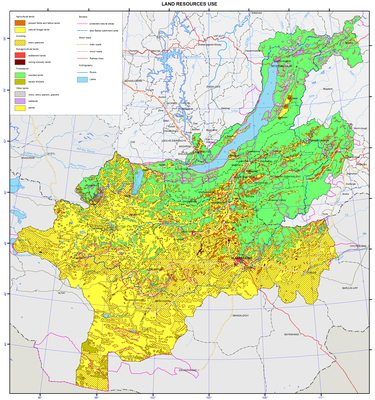
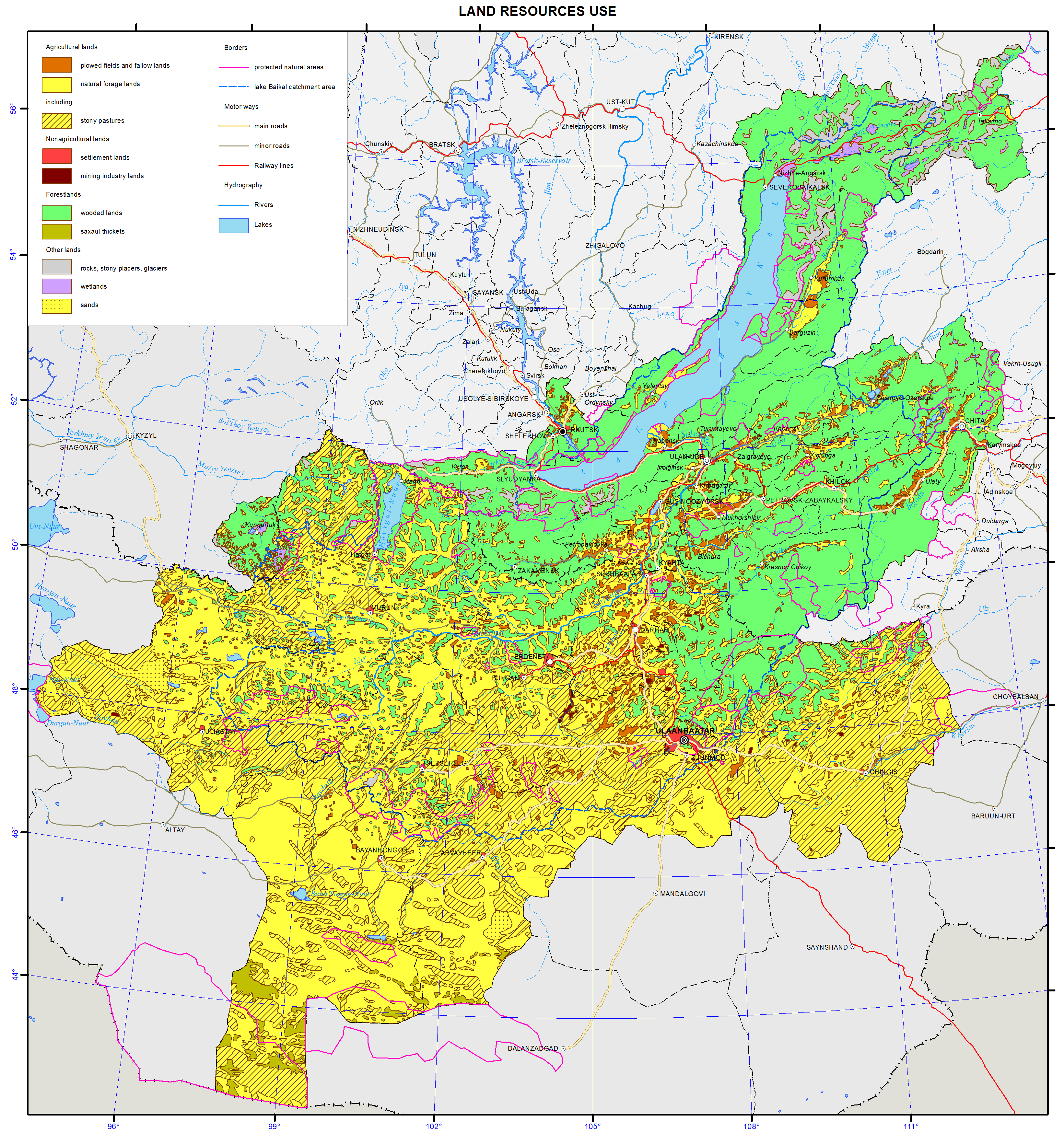
<p>Land resources are the main spatial basis, a store of various types of mineral resources for many branches of industry, as well as a basic means of production for agriculture and forestry. For the latter branches land resources and soil fertility are important means of growing crops and forest stands. For other types of land use (residential, transport, etc.) the role of land resources is reduced mainly to the role of the operational basis for spatial location of specific objects inherent to these types of land use.</p>
<p>Under the working legislation and established practice state land registration in the Russian Federation is carried out on land categories and agricultural lands, forms of ownership and types of land rights, as well as their use for agricultural production and other needs. Land registration in Mongolia is carried out similarly (with minor changes).</p>
<p>On the basic map the land fund structure on agricultural lands is presented as a quality background. The latter ones are defined as land, systematically used or usable for specific economic purposes and different in their natural and historical features. Land carries material properties typical of land use as an economic phenomenon.</p>
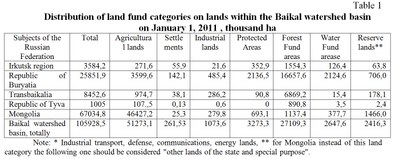
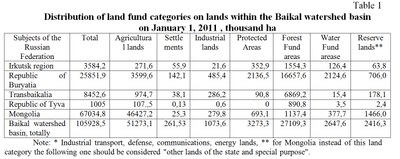
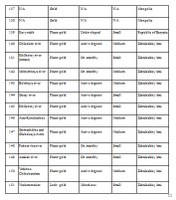
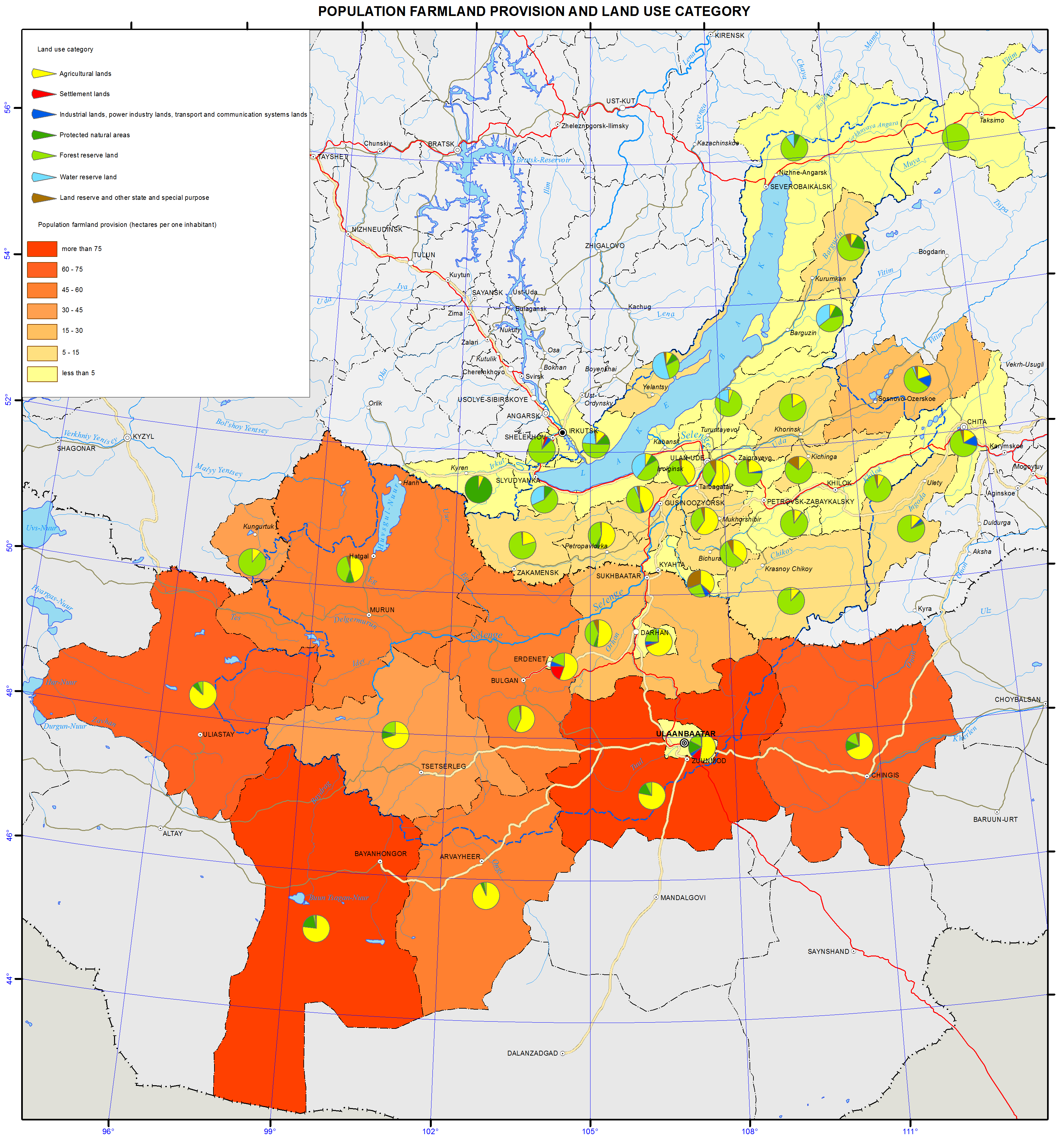
<p>The second map and the Table represent the layout of the land fund on land categories and the index of availability of agricultural land. Land categories are land plots distinguished according to their intended use (agricultural land, settlements, industry, energy, transport, communication, defense and security, etc., forest, water resources, reserves, etc.). Mongolia is characterized by the absence of the concept of "land reserve". However, a large share of the land fund structure there belongs to public land for special purposes, which consists not only of lands of defense and security and protected areas, but lands, used in ways uncharacteristic of Russia. Therefore, in the map legend the category "lands of state and special purpose" applies only to Mongolia, excluding the land of specially protected natural areas and defense and security lands. The latter ones are included in the respective land categories.</p>
<p>The availability index of farmland is the ratio of agricultural land area (in hectares) belonging to the agricultural land to the number of residents living in the municipality. Farmland is an essential part of land, which is a potential resource for the formation of local food base. The average area of agricultural land per capita (within Russian territory, except Tere-Khol district of the Republic of Tyva) amounts to 3.7 hectares; it ranges from 0.06 ha within Sludyansky district of Irkutsk oblast to 22.9 ha in the Eravninsky district of the Republic of Buryatia. Within the Mongolian territory the indicators of the agricultural land per aimak inhabitant, is on the average significantly higher than in the Russian part of the basin as it amounts to about 45 hectares. Minimum rates are found in the Ulaanbaatar, Darkhan, and Orkhon aimaks, which is connected, first of all, with the high population numbers in these aimaks and relatively smaller areas of agricultural land compared to other aimaks.</p>
<p style="text-align: center; "><img class="image-inline" src="../../../resolveuid/fac9e5ab3b094d459f6b4045e311a305/@@images/image/preview" /></p>
<p>In 1990 – 2010 the reduction of agricultural area for most municipalities is registered in the Russian part of the basin, which is directly linked to their withdrawal from agricultural use. The main reason of the reduction of such agricultural areas was shutdown of many agricultural enterprises, organizations, and farms and transfer of the withdrawn lands, for the most part, to the land redistribution fund. Another reason is the expiration of the land leasehold (or temporary use) and non renewal of its agricultural productivity. The agricultural land reduction is caused by negative processes became widespread due to the sharp reduction of valuable land protection measures from water and wind erosion, flooding, bogging, waterlogging and other processes. It should be noted that the actual outflow of productive land is much higher. Previously transferred farmland reserves are overgrown with shrubs and low forests and lose their agricultural value.</p>
<p>In Mongolia problems of agricultural lands reduction are currently not registered because of their significant amount due to natural factors and historical specific features of agriculture.<b> </b></p>]]></content:encoded>
    <dc:publisher>No publisher</dc:publisher>
    <dc:creator>Alexander Ayurzhanaev</dc:creator>
    <dc:rights></dc:rights>
    <dc:date>2014-10-08T07:40:00Z</dc:date>
    <dc:type>Page</dc:type>
  </item>


  <item rdf:about="http://bic.iwlearn.org/en/atlas/atlas/50-population-farmland-provision-and-land-use-category-map/population-farmland-provision-and-land-use-category-map">
    <title>Population farmland provision and land use category map</title>
    <link>http://bic.iwlearn.org/en/atlas/atlas/50-population-farmland-provision-and-land-use-category-map/population-farmland-provision-and-land-use-category-map</link>
    <description></description>
    <content:encoded xmlns:content="http://purl.org/rss/1.0/modules/content/"><![CDATA[<p><img class="image-inline" src="../../../resolveuid/7076546f4cd346f79bcca36fd99bd1f2/@@images/image/preview" /></p>
<p><a href="http://bic.iwlearn.org/en/atlas/photos/copy_of__50_Populationfarmlandprovisionandlandusecategory.png" class="internal-link">Open full size</a></p>
<p align="center"><strong>L</strong><strong>and resources and their use</strong></p>
<p align="center"><strong> </strong></p>
<p>Land resources are the main spatial basis, a store of various types of mineral resources for many branches of industry, as well as a basic means of production for agriculture and forestry. For the latter branches land resources and soil fertility are important means of growing crops and forest stands. For other types of land use (residential, transport, etc.) the role of land resources is reduced mainly to the role of the operational basis for spatial location of specific objects inherent to these types of land use.</p>
<p>Under the working legislation and established practice state land registration in the Russian Federation is carried out on land categories and agricultural lands, forms of ownership and types of land rights, as well as their use for agricultural production and other needs. Land registration in Mongolia is carried out similarly (with minor changes).</p>
<p>On the basic map the land fund structure on agricultural lands is presented as a quality background. The latter ones are defined as land, systematically used or usable for specific economic purposes and different in their natural and historical features. Land carries material properties typical of land use as an economic phenomenon.</p>
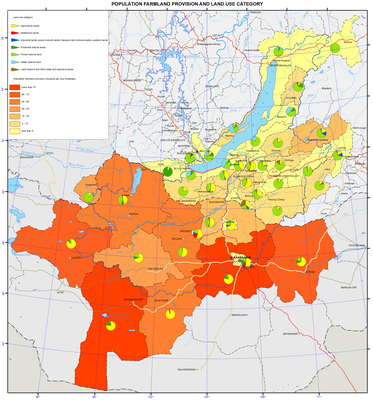
<p>The second map and the Table represent the layout of the land fund on land categories and the index of availability of agricultural land. Land categories are land plots distinguished according to their intended use (agricultural land, settlements, industry, energy, transport, communication, defense and security, etc., forest, water resources, reserves, etc.). Mongolia is characterized by the absence of the concept of "land reserve". However, a large share of the land fund structure there belongs to public land for special purposes, which consists not only of lands of defense and security and protected areas, but lands, used in ways uncharacteristic of Russia. Therefore, in the map legend the category "lands of state and special purpose" applies only to Mongolia, excluding the land of specially protected natural areas and defense and security lands. The latter ones are included in the respective land categories.</p>
<p>The availability index of farmland is the ratio of agricultural land area (in hectares) belonging to the agricultural land to the number of residents living in the municipality. Farmland is an essential part of land, which is a potential resource for the formation of local food base. The average area of agricultural land per capita (within Russian territory, except Tere-Khol district of the Republic of Tyva) amounts to 3.7 hectares; it ranges from 0.06 ha within Sludyansky district of Irkutsk oblast to 22.9 ha in the Eravninsky district of the Republic of Buryatia. Within the Mongolian territory the indicators of the agricultural land per aimak inhabitant, is on the average significantly higher than in the Russian part of the basin as it amounts to about 45 hectares. Minimum rates are found in the Ulaanbaatar, Darkhan, and Orkhon aimaks, which is connected, first of all, with the high population numbers in these aimaks and relatively smaller areas of agricultural land compared to other aimaks.</p>
<p style="text-align: center; "><img class="image-inline" src="../../../resolveuid/f7ed95da114240cfaea041e530f8d09f/@@images/image/preview" /></p>
<p>In 1990 – 2010 the reduction of agricultural area for most municipalities is registered in the Russian part of the basin, which is directly linked to their withdrawal from agricultural use. The main reason of the reduction of such agricultural areas was shutdown of many agricultural enterprises, organizations, and farms and transfer of the withdrawn lands, for the most part, to the land redistribution fund. Another reason is the expiration of the land leasehold (or temporary use) and non renewal of its agricultural productivity. The agricultural land reduction is caused by negative processes became widespread due to the sharp reduction of valuable land protection measures from water and wind erosion, flooding, bogging, waterlogging and other processes. It should be noted that the actual outflow of productive land is much higher. Previously transferred farmland reserves are overgrown with shrubs and low forests and lose their agricultural value.</p>
<p>In Mongolia problems of agricultural lands reduction are currently not registered because of their significant amount due to natural factors and historical specific features of agriculture.<b> </b></p>]]></content:encoded>
    <dc:publisher>No publisher</dc:publisher>
    <dc:creator>Alexander Ayurzhanaev</dc:creator>
    <dc:rights></dc:rights>
    <dc:date>2014-10-08T07:35:00Z</dc:date>
    <dc:type>Page</dc:type>
  </item>


  <item rdf:about="http://bic.iwlearn.org/en/atlas/atlas/50-population-farmland-provision-and-land-use-category-map">
    <title>050. Population farmland provision and land use category map</title>
    <link>http://bic.iwlearn.org/en/atlas/atlas/50-population-farmland-provision-and-land-use-category-map</link>
    <description></description>
    
    <dc:publisher>No publisher</dc:publisher>
    <dc:creator>Alexander Ayurzhanaev</dc:creator>
    <dc:rights></dc:rights>
    <dc:date>2014-10-08T07:30:00Z</dc:date>
    <dc:type>Folder</dc:type>
  </item>


  <item rdf:about="http://bic.iwlearn.org/en/atlas/atlas/49-recreational-resources-of-climate-map/recreational-resources-of-climate-map">
    <title>Recreational resources of climate map</title>
    <link>http://bic.iwlearn.org/en/atlas/atlas/49-recreational-resources-of-climate-map/recreational-resources-of-climate-map</link>
    <description></description>
    <content:encoded xmlns:content="http://purl.org/rss/1.0/modules/content/"><![CDATA[<p><img class="image-inline" src="../../../resolveuid/b13e4cc0ddbc4a00847fc93bb8e655d3/@@images/image/preview" /></p>
<p><a href="http://bic.iwlearn.org/en/atlas/photos/copy_of__49_RecreationalResourcesofClimate.png" class="internal-link">Open full size</a></p>
<p align="center"><b><b>Recreational climate resources</b></b></p>
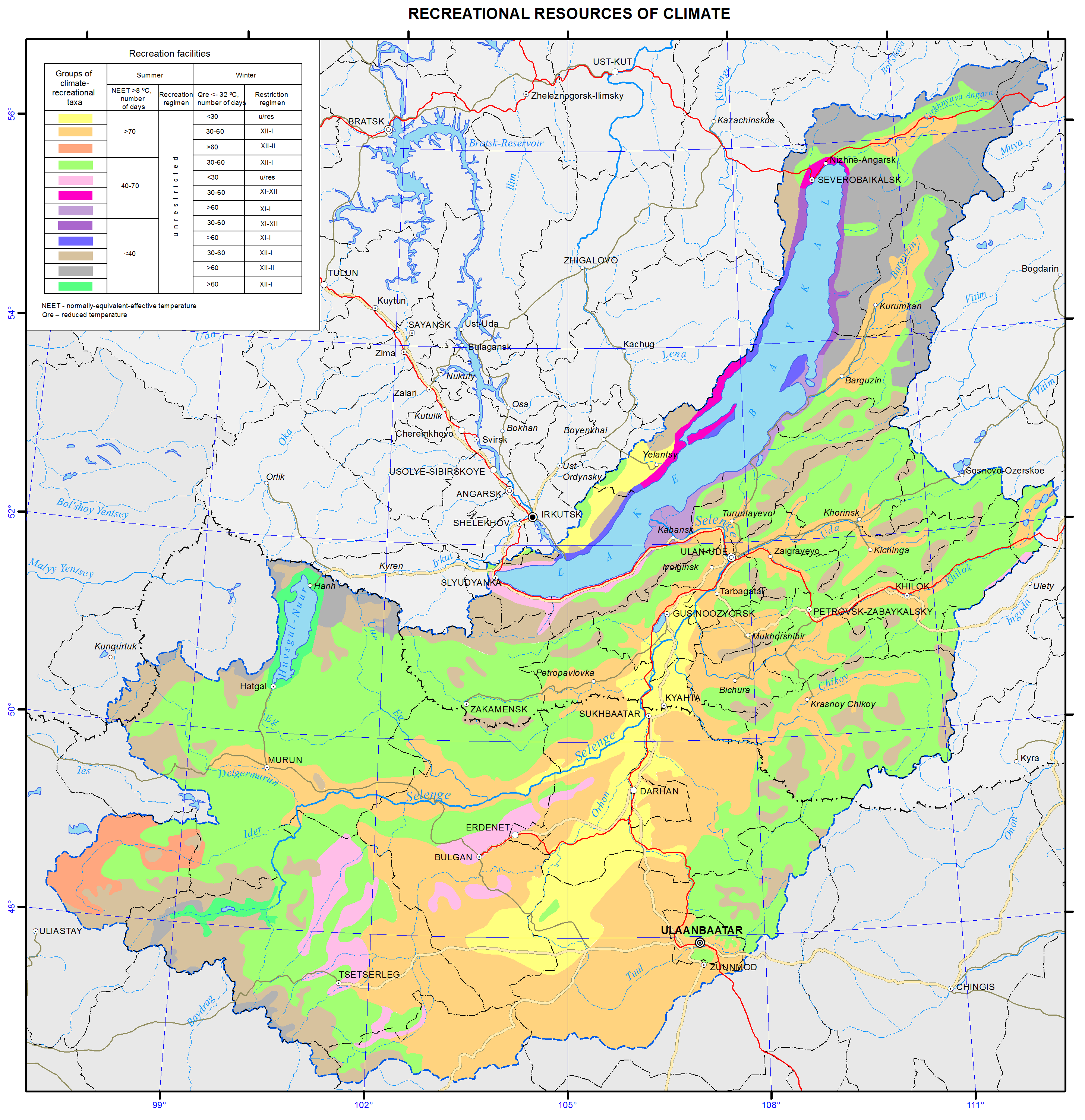
<p>A complex of several climatic factors, such as high sunshine duration (from 2800 hours per annum in the south of the basin to 1500 hours per annum in the north), wide range of heat supply (the sum of mean daily temperatures above 10° C varies from 2400 in the south of the basin to 244 in the highlands), sustained low temperatures in the hollow land forms, and predominantly low wind velocities contribute to the formation of local climates with highly varied suitability for seasonal recreation. Background climatic characteristics of diverse territories, such as hollow, valley, low-, mid-, and high-altitude vary considerably. Their main features in this case are characterized by a number of differently directed indices, whose combined impact on humans can have a similar effect. The same air temperature has a dissimilar thermal effect on a human body in the case of different wind velocities and different air humidity.</p>
<p>Normal-equivalent-effective temperature (NEET) method is often used to take into consideration their combined influence upon the thermal state of man. The levels of comfortable perception of heat according to the NEET scale vary within a broad range depending on the degree of man’s adaptation to environmental conditions. The use of the duration of NEET values above 8 °C for the background assessment of contrasting territories demonstrated its validity [Bashalkhanova et al., 2012].</p>
<p>Reduced temperature (Qred) indicates heat losses from the open surface of human body in the wintertime under a combined effect of air temperature and wind velocity [Khairulin and Karpenko, 2005]. With Qred below −32 °C, the risk of frostbite increases, so recreation in the open air is limited.</p>
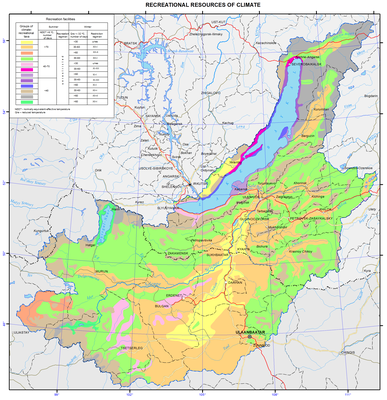
<p>In the total form the complex of the most important characteristics of climatic resources favorable for recreation is represented by the duration of periods with NEET above 8 °C and those limiting it – by Qred below −32 °C.</p>
<p class="a0">Spatial distribution of indicators under study is dependent on a complex interaction of the main climate forcing factors, such as radiative and circulatory ones as well as the underlying surface properties, which provide a variety of mesoclimatic conditions, manifestation of latitudinal and altitudinal zonality elements and local patterns for recreational activity</p>
<p>In summer the variety of landscape conditions exerts considerable influence on climatic regimes formation alongside with the latitudinal factor. The plain-valley mesoclimates combining the steppe, steppificated, and subtaiga piedmont pine landscapes of slopes, plains and river valleys are characterized by the broadest possibilities for recreation and treatment of the population [Landscapes…, 1977; National…1990]. The duration of days with the NEET above 8 °C is highest. Recreational resources of the climate of uplands and mountainous territories are substantially lower; they are characterized by a shorter duration of the favorable period. The duration decreases dramatically depending on the latitudinal and altitudinal location of natural complexes. For instance, for the dark coniferous landscapes of uplands, dark coniferous and larch piedmont and intermontane depressions as well as bogged larch depressions on the plains its duration is from 40 to 70 days. In the mountain-taiga landscapes of flat (sometimes slope) surfaces as well as in dark coniferous landscapes of high slopes and plateaus, this period is less than 40 days. In high mountains with goletz, subgoletz and, partly, mountain-taiga larch forests, the mean monthly NEETs do not reach 8 °C.</p>
<p>The low recreational potential of the climate in winter is conditioned by circulation and astronomical factors. In the subtypes of climates weakly differing in summer (plain-valley, narrow valley and highlands) elements of latitudinal zonality are clearly traced. The period of possible limitation of recreation in the open air in the northern and southern parts of the basin can differ nearly twofold. Meanwhile the stagnant phenomena in orographically isolated intermontane depressions and closed river valleys are accompanied by the longest period of Qred below −32 °C, which reveals more favorable conditions on their slopes. The severity of winters for open surfaces of slopes and summits obeys the wind regime.</p>
<p>Quite special conditions occur on the shores of Lake Baikal. The warming (in winter) and cooling (in summer) influence of the lake’s water masses showed a shift toward a decrease in climatic-physiological comfort of landscapes when compared with their counterparts outside the influence zone. This is largely due to the large horizontal temperature gradients between land and lake, which are often the cause of strong winds, the exceptional variety, unpredictability and velocity of which are well known. For that reason, on certain parts of the shore, especially in the west, in the mountain-taiga pine and larch landscapes the number of days with the NEET above 8 °C is lowest (less than 40 days). Meanwhile, in the wind-proof parts of the shore (Peschanaya Bay, the Kuchelga river valley, etc.) the conditions for recreation are optimal. In winter the dependence of the climatic-recreational potential on the location grows even further. In some shore areas relatively favorable in the summer season, the length of the period of reduced temperature below −32 °C differs substantially.</p>
<p>On the whole, the recreation resources of the climate across the territory are relatively varied. Given the availability of mud-bath resources in the depressions and broad river valleys with a shorter length of the limiting period, there is a possibility of launching the sanatorium-and-spa treatment. Of considerable interest are the middle mountains of Khangai and the interfluves of the Selenga and Orkhon rivers. The climatic resources of other territories are more suitable for extensive development and promotion of tourism and stationary recreation. Because of the low heat availability and abrupt fluctuations in the temperature-wind regime, the shores of Lake Baikal and Lake Hovsgol are favorable for recreation of healthy people only. Obviously, depending on the characteristics of heat and moisture exchange and on the regime of the local circulation, the period for different kinds of recreation is variable. Thus, the slopes of the Khamar-Daban on the southern shores of Lake Baikal are most favorable for the winter kinds of recreation due to the abundance of snow, and the appropriate combination of temperature and wind regimes. The shores of Middle Baikal characterized by a long duration of sunshine are more favorable for summer recreation.</p>
<p class="a0">The experience of the cartographic analysis and multiscale assessment of recreational resources of the climate showed that in a number of cases climate resources essential for the recreation of people and conditioned by microclimatic differences may considerably exceed their latitudinal background parameters. Thus, a comprehensive expert examination of the recreational resources of the climate is important when a certain area is selected for implementation of investment projects.</p>
<p align="center">References</p>
<p>Bashalkhanova, L.B., Veselova, V.N. and Korytny, L.M. (2012). <i>Resource Dimension of Social Conditions for the Life of the Population of East Siberia</i>, Novosibirsk: Geo, 221 p. [in Russian].</p>
<p><i>Landscapes of the South of East Siberia (1:1 500 000 Map)</i>. (1977). V.S. Mikheev and V.A. Ryashin, Moscow: GUGK, 4 sh. [in Russian].<i></i></p>
<p><i>Mongol ulsyn undesnii atlas</i>. (2009). Ulaan-Baatar: SHUA. Gazarzuin khurzelen. - 248 p. [in Mongolian].</p>]]></content:encoded>
    <dc:publisher>No publisher</dc:publisher>
    <dc:creator>Alexander Ayurzhanaev</dc:creator>
    <dc:rights></dc:rights>
    <dc:date>2014-10-08T07:25:00Z</dc:date>
    <dc:type>Page</dc:type>
  </item>


  <item rdf:about="http://bic.iwlearn.org/en/atlas/atlas/49-recreational-resources-of-climate-map">
    <title>049. Recreational resources of climate map</title>
    <link>http://bic.iwlearn.org/en/atlas/atlas/49-recreational-resources-of-climate-map</link>
    <description></description>
    
    <dc:publisher>No publisher</dc:publisher>
    <dc:creator>Alexander Ayurzhanaev</dc:creator>
    <dc:rights></dc:rights>
    <dc:date>2014-10-08T07:25:00Z</dc:date>
    <dc:type>Folder</dc:type>
  </item>


  <item rdf:about="http://bic.iwlearn.org/en/atlas/atlas/48-mineral-waters-map/mineral-waters-map">
    <title>Mineral waters map</title>
    <link>http://bic.iwlearn.org/en/atlas/atlas/48-mineral-waters-map/mineral-waters-map</link>
    <description></description>
    <content:encoded xmlns:content="http://purl.org/rss/1.0/modules/content/"><![CDATA[<p><img class="image-inline" src="../../../resolveuid/c6afd68e36b64110bdddd43d637b238c/@@images/image/preview" /></p>
<p><a href="http://bic.iwlearn.org/en/atlas/photos/copy_of__48_Mineralwaters.png" class="internal-link">Open full size</a></p>
<p align="center"><strong>Mineral springs</strong></p>
<p align="center"><strong> </strong></p>
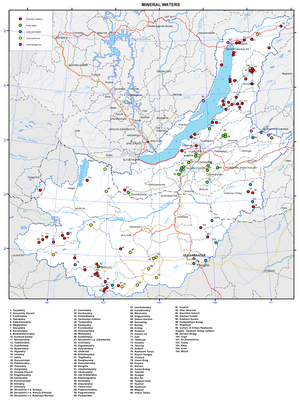
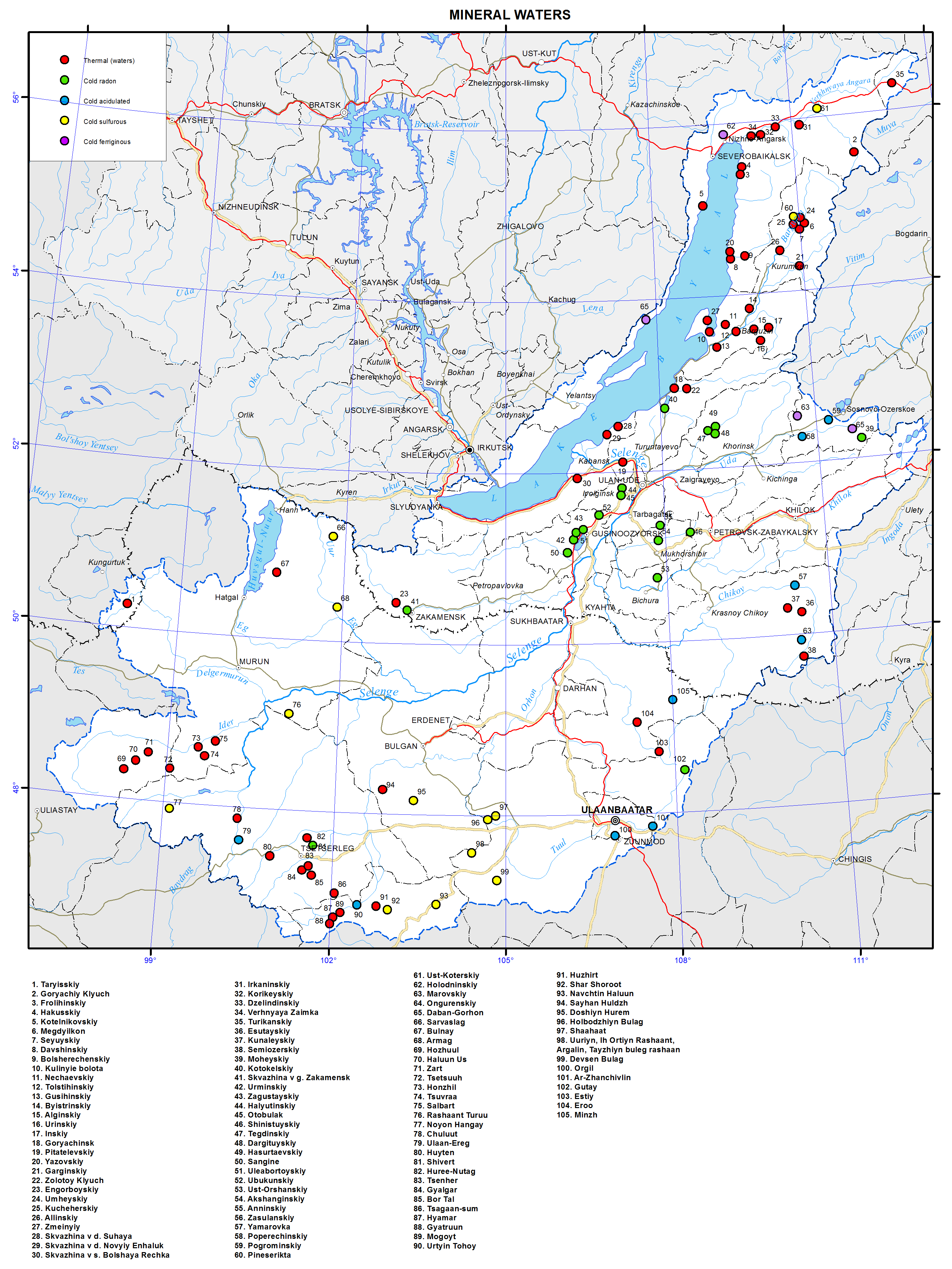
<p>The map is based on generalizing monographs, maps of mineral waters and field research data obtained by the authors.</p>
<p>The map depicts mineral springs, the water of which can be used for balneological purposes according to its physical and chemical properties. These characteristics include: water temperature (hot springs); radon content (cold radon springs), content of free carbon dioxide (carbonic cold springs), content of sulphate sulfur (cold hydrogen sulfide springs) and iron (ferrous cold springs).</p>
<p>This map can be used for the organization of sanatorium-and-spa construction, as well as for planning of underground thermal water use in thermal engineering.<b> </b></p>
<p align="center">References</p>
<p>Borisenko, I.M., Zamana, L. (1978). <i>Mineral water of Buryatia</i>. - Ulan-Ude: Buryat kn. izd-vo. - 163 p.</p>
<p>Map of the Republic of Tyva (tourism objects, objects of nature, arzhaans, photos).(2012). - M1:1000000, Kyzyl.</p>
<p>Lomonosov, I.S., Kustov, Yu.I., Pinneker, E.V. (1977). <i>Mineral water in Baikal region</i>. – Irkutsk: Vost. Sib . kn. izd-vo. - 224 p.</p>
<p><i>Mineral water of southern part of Eastern Siberia.</i> Vol.II. (1962) – M.-L.: Izd. AN USSR. - 199 p.</p>
<p>Pissarsky, B.I., Nambar, B, Ariyadagva, B. (2003). <i>Map of mineral waters in Mongolia</i>. 1:2500000, - Ulaanbaatar.</p>]]></content:encoded>
    <dc:publisher>No publisher</dc:publisher>
    <dc:creator>Alexander Ayurzhanaev</dc:creator>
    <dc:rights></dc:rights>
    <dc:date>2014-10-08T05:50:00Z</dc:date>
    <dc:type>Page</dc:type>
  </item>


  <item rdf:about="http://bic.iwlearn.org/en/atlas/atlas/48-mineral-waters-map">
    <title>048. Mineral waters map</title>
    <link>http://bic.iwlearn.org/en/atlas/atlas/48-mineral-waters-map</link>
    <description></description>
    
    <dc:publisher>No publisher</dc:publisher>
    <dc:creator>Alexander Ayurzhanaev</dc:creator>
    <dc:rights></dc:rights>
    <dc:date>2014-10-08T05:45:00Z</dc:date>
    <dc:type>Folder</dc:type>
  </item>


  <item rdf:about="http://bic.iwlearn.org/en/atlas/atlas/47-natural-resources-of-the-ground-waters-map/natural-resources-of-the-ground-waters-map">
    <title>Natural resources of the ground waters map</title>
    <link>http://bic.iwlearn.org/en/atlas/atlas/47-natural-resources-of-the-ground-waters-map/natural-resources-of-the-ground-waters-map</link>
    <description></description>
    <content:encoded xmlns:content="http://purl.org/rss/1.0/modules/content/"><![CDATA[<p><img class="image-inline" src="../../../resolveuid/91d7cbf115014934aa1883b1a2596bb2/@@images/image/preview" /></p>
<p><a href="http://bic.iwlearn.org/en/atlas/photos/copy_of__47_Naturalresourcesofthegroundwaters.png" class="internal-link">Open full size</a></p>
<p align="center"><strong>Natural groundwater resources</strong></p>
<p align="center"><strong> </strong></p>
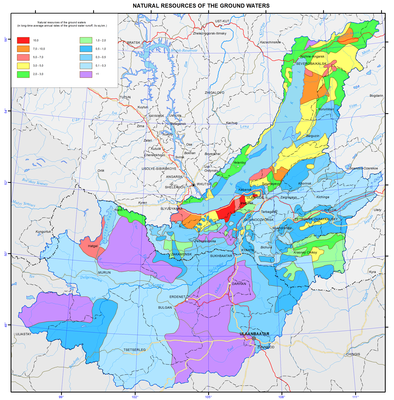
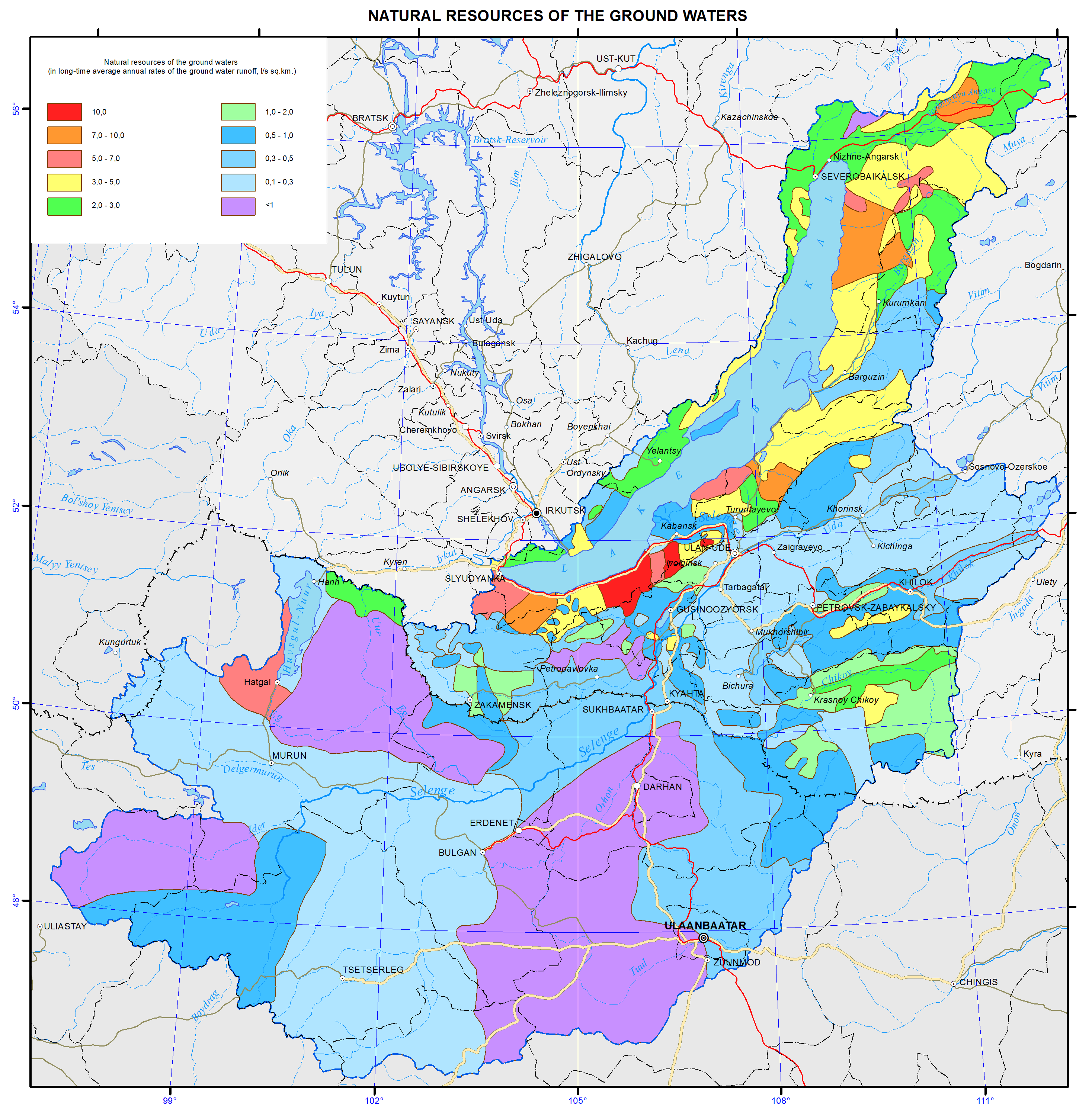
<p>The map is based on the monograph by B.I. Pisarsky (1987) using medium-scale hydrogeological maps for Irkutsk oblast, the Republic of Buryatia and Tyva, Transbaikalia and Mongolia. The area principle of mapping of natural groundwater resources (in units of groundwater flow) was applied, as the complex hydrological and geochemical method of partitioning the hydrograph of the total stream flow was the principal one in the course of its comprehensive assessment. Mapping was carried out by the reference catchments located within the same aquifer system and characterized by the homogeneity of geological and hydrogeological conditions and sufficiently long series of runoff observations. For part of the territory where information was either not available or sparse, the mapping method was based on hydrological and hydrogeological analogy.</p>
<p>The color map is based on the energy principle. Cold colors correspond to low values of the rate of subsurface water flow, warm colors to the high values. Extremes of the spectrum of white correspond to the extreme values of the intensity of subsurface flow. Ranking of values of natural groundwater resources and class gradation are brought into compliance with that existing in this area [Natural Resources..., 1976]. A more fractional division of low classes is caused by the low values of rate of subsurface water flow in the territory of Mongolia, occupying a significant part of the Baikal basin.</p>
<p>Distribution of natural groundwater resources in the Baikal basin is extremely uneven; nevertheless it is generally subject to the vertical zonation and latitudinal zonality. Anomalous values of the rate of subsurface water flow are confined to the basins with complex hydrogeological conditions.<b> </b></p>
<p align="center">References</p>
<p><i>Natural groundwater resources in southern East Siberia</i>. (1976). - Novosibirsk: Nauka. - 127 p.</p>
<p>Pisarsky, B.I. (1987). <i>Laws of formation of subsurface drainage basin of Lake Baikal</i>. - Novosibirsk: Nauka,- 158 p.</p>]]></content:encoded>
    <dc:publisher>No publisher</dc:publisher>
    <dc:creator>Alexander Ayurzhanaev</dc:creator>
    <dc:rights></dc:rights>
    <dc:date>2014-10-08T03:35:00Z</dc:date>
    <dc:type>Page</dc:type>
  </item>


  <item rdf:about="http://bic.iwlearn.org/en/atlas/atlas/47-natural-resources-of-the-ground-waters-map">
    <title>047. Natural resources of the ground waters map</title>
    <link>http://bic.iwlearn.org/en/atlas/atlas/47-natural-resources-of-the-ground-waters-map</link>
    <description></description>
    
    <dc:publisher>No publisher</dc:publisher>
    <dc:creator>Alexander Ayurzhanaev</dc:creator>
    <dc:rights></dc:rights>
    <dc:date>2014-10-08T03:30:00Z</dc:date>
    <dc:type>Folder</dc:type>
  </item>


  <item rdf:about="http://bic.iwlearn.org/en/atlas/atlas/46-water-resources-and-consumptive-water-use-map/water-resources-and-consumptive-water-use-map">
    <title>Water resources and consumptive water use map</title>
    <link>http://bic.iwlearn.org/en/atlas/atlas/46-water-resources-and-consumptive-water-use-map/water-resources-and-consumptive-water-use-map</link>
    <description></description>
    <content:encoded xmlns:content="http://purl.org/rss/1.0/modules/content/"><![CDATA[<p><img class="image-inline" src="../../../resolveuid/86495cfb5da141959b6184ef5070c772/@@images/image/preview" /></p>
<p><a href="http://bic.iwlearn.org/en/atlas/photos/copy_of__46_Waterresourcesandconsumptivewateruse.png" class="internal-link">Open full size</a></p>
<p align="center"><strong>Water resources and water consumption</strong></p>
<p>The river network of the Baikal basin comprises about 10.4 thousand streams. The catchment area of Lake Baikal is asymmetrical; large river systems drain the south-eastern and north-eastern parts of the basin. The most significant river systems are the Selenga river and its right tributaries, namely, the Chikoy, Khilok, and Uda rivers, as well as the Barguzin and Upper Angara rivers. About 53% of river waters are formed in the territory of the Republic of Buryatia, 27% ​​- in the territory of Mongolia, 16% - in the territory of Zabaikalsky krai, and 4% - in Irkutsk oblast. Annually about 60 km<sup>3</sup>of water flow in and out of Lake Baikal with water streams and through the Angara river.</p>
<p>The origins of most rivers are located on slopes of mountain ranges at altitudes of 1200-1400 m. Therefore, in the upper reaches, and for many rivers along their entire length, they are of mountain character. Riverbeds with deep erosional incisions are rocky. Within the greater part of their valleys a floodplain is almost absent. Only large rivers in the middle and lower reaches have a character close to the plain one [Hydroclimate… , 2013].</p>
<p>The most ancient river systems drain the western slopes of the mountains surrounding Lake Baikal; they are the Sarma, Buguldeika, and Anga rivers. The class of such systems also includes basins of the largest Selenga and Barguzin rivers. The river systems of the south-eastern and northern macroslopes of Lake Baikal, namely, the Utulik, Tyya, Upper Angara, Turka, etc., are relatively young.</p>
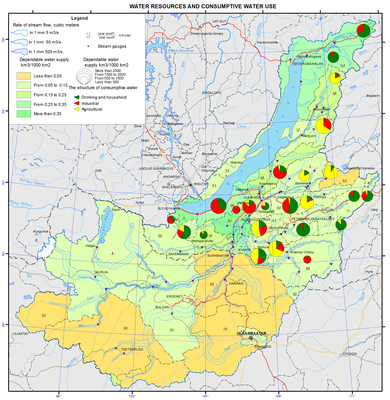
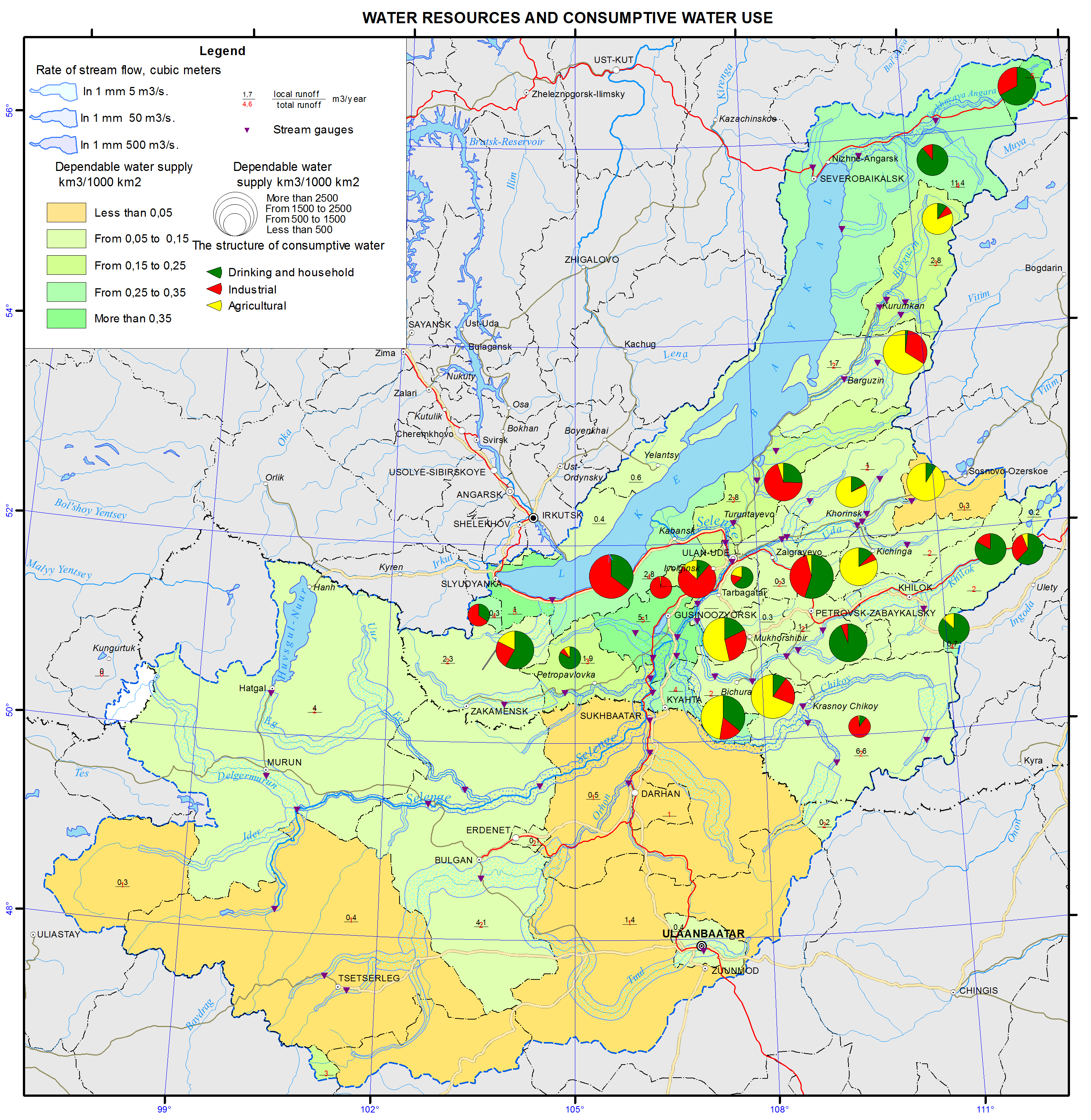
<p>Methods of structural hydrography were used to compile a map of the rate of stream flow. Calculations of the river flow were made for the entire river network of the basin and were based on the close connection between the structure of the river network and its average rate of stream flow at any point of the system [Amosova, Ilyicheva, and Korytny, 2012]. Based on topographic maps, a graph of the river network was constructed, and then structural parameters for each point of the confluence of streams were calculated. Structural modules, representing the ratio of the water flow rate (Q, m<sup>3</sup>/s) to the structural measure at the given point, were determined. Data of reference materials on all hydrometeorological sections on the average long-term runoff from 105 gauges served as initial hydrological information [Surface water resources ..., 1972; Hydrological ..., 1977].</p>
<p>The rate of stream flow of the river systems is shown as an along-riverbed scale band (curve). This technique is usually called the method of localized diagrams, which is a method of cartographic representation of phenomena that have a continuous or linear (band) distribution. In the present case, the curves are referred to a linear element of the space, i.e. to a riverbed. The curves are drawn on both sides of the riverbed; they are proportional to the stream flow. The width of the curves varies along the length of a river and at the points of confluence with tributaries, depending on their rate of stream flow. Three gradations of the rate of stream flow are distinguished due to the large range of water flow rates (more than 500 m<sup>3</sup>/s, 50-500 m<sup>3</sup>/s, and 5-50 m<sup>3</sup>/s), which largely corresponds to the division of rivers according to their size. The mapping starts with the average long-term water flow rate of at least 5 m<sup>3</sup>/s, as values of lower rate of stream flow are difficult to represent [Korytny, 2001].</p>
<p>Within the boundaries of the administrative units, the volumes of local and general stream flow are calculated. Available water supply of the territory with the local stream flow is shown using five gradations. Mountain areas with the river systems of the northern and southern parts of the Baikal depression are characterized by the largest water supply. Administrative units of the Mongolian part of the Selenga river basin are generally poorly provided with local resources of river flow (less than 0.05 and 0.05-0.15 km<sup>3</sup> per year).</p>
<p>The structure of water consumption is displayed using pie charts, the diameter of which corresponds to the volume of water consumption, and the area of sectors corresponds to the water use for various purposes, expressed as a percentage. On the whole, for the Baikal basin water consumption amounted to 502.050 thousand m<sup>3</sup> in 2011, of which 56.440 thousand m<sup>3 </sup>were taken for drinking and household purposes, 389.170 thousand m<sup>3</sup> - for production, and 56.440 thousand m<sup>3</sup>– for agricultural purposes. The main share of the river waters is drawn from the rivers of the Selenga basin. The largest consumers in the basin are the cities of Ulan-Ude and Severobaikalsk.<b></b></p>
<p align="center">References</p>
<p>Amosova, I.Yu., Ilyicheva, E.A., and Korytny, L.M. (2012). <i>Structural-and-hydrographic patterns of the river network structure of the Baikal Natural Territory.</i> www.channel2012.ru. Tomsk.</p>
<p><i>Hydrological regime of the Selenga basin rivers and methods of its calculation.</i> (1977). Ed. by V.A. Semenov and B. Myagmarzhav. Leningrad: Gidrometeoizdat, 237 p.</p>
<p><i>Hydroclimate studies of the Baikal Natural Territory.</i> (2013). Ed. by L.M. Korytny.  Novosibirsk: Akademicheskoe izd-vo “GEO”, 186 p.</p>
<p>Korytny, L.M. (1972). <i>The basin concept in nature management.</i> Irkutsk: Izd-vo IG SB RAS, 2001, 163 p.</p>
<p><i>Surface water resources of the USSR.</i> Vol. 16, issue 3. Leningrad: Gidrometeoizdat, 595 p.</p>]]></content:encoded>
    <dc:publisher>No publisher</dc:publisher>
    <dc:creator>Alexander Ayurzhanaev</dc:creator>
    <dc:rights></dc:rights>
    <dc:date>2014-10-08T03:20:00Z</dc:date>
    <dc:type>Page</dc:type>
  </item>


  <item rdf:about="http://bic.iwlearn.org/en/atlas/atlas/46-water-resources-and-consumptive-water-use-map">
    <title>046. Water resources and consumptive water use map</title>
    <link>http://bic.iwlearn.org/en/atlas/atlas/46-water-resources-and-consumptive-water-use-map</link>
    <description></description>
    
    <dc:publisher>No publisher</dc:publisher>
    <dc:creator>Alexander Ayurzhanaev</dc:creator>
    <dc:rights></dc:rights>
    <dc:date>2014-10-08T03:15:00Z</dc:date>
    <dc:type>Folder</dc:type>
  </item>


  <item rdf:about="http://bic.iwlearn.org/en/atlas/atlas/45-main-types-of-non-metallic-materials-map/main-types-of-non-metallic-materials-map">
    <title>Main types of nonmetallic materials map</title>
    <link>http://bic.iwlearn.org/en/atlas/atlas/45-main-types-of-non-metallic-materials-map/main-types-of-non-metallic-materials-map</link>
    <description></description>
    <content:encoded xmlns:content="http://purl.org/rss/1.0/modules/content/"><![CDATA[<p><img class="image-inline" src="../../../resolveuid/e609421c005a4d33a8cad29965afb9ce/@@images/image/preview" /></p>
<p><a href="http://bic.iwlearn.org/en/atlas/photos/copy_of__45_Maintypesofnonmetallicmaterials.png" class="internal-link">Open full size</a></p>
<p><img class="image-inline" src="../../../../resolveuid/b1d7d06c2c2f41659de254b9f3dcf0e7/@@images/image/preview" /></p>
<p><a href="http://bic.iwlearn.org/en/photos/copy_of__45_Table_Legend_Maintypesofnonmetallicmaterials.png" class="internal-link">Open full size</a></p>
<p align="center"><strong>The main types of nonmetallic raw materials: resources and development</strong></p>
<p>Nonmetallic mineral resources of the region are of great industrial importance. Within the Baikal basin there are deposits of mining-chemical, thermo-chemical, and optical raw materials, construction materials, mineral fertilizers, ornamental and precious stones.</p>
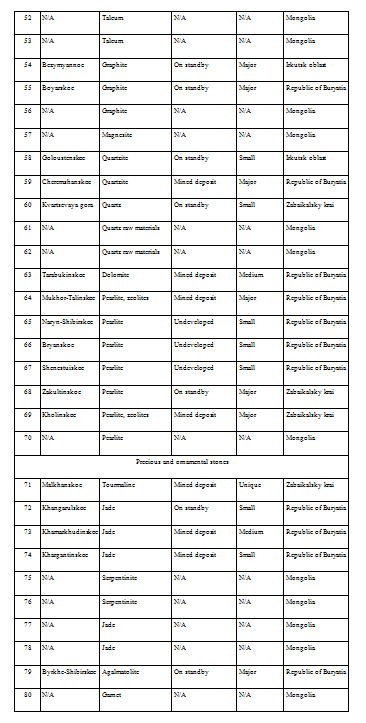
<p>Deposits of <i>raw quartz </i>belong to strategic types of mineral resources. The region has a large raw materials base explored and prepared for industrial development: there are deposits of especially pure granular quartz (Chulbonskoe, Nadyozhnoe, Goudzhekitskoe, and others) and quartzites (Cheremshanskoe and Goloustenskoe). The vast majority of deposits are located in the territory of Buryatia; there are all prerequisites for creating a large complex of plants for deep processing of raw quartz for high-tech industries. In prospect, the republic can become the largest producer and exporter of polysilicon and total energy systems. Currently, there is a development project of the Chulbonskoe granular quartz deposit in the Severobaikalsky municipal district to get the end-product in the form of photovoltaic systems.</p>
<p>Quartzites of the mined Cheremshanskoe deposit are of exceptionally high raw materials quality meeting industrial requirements for the production of industrial silicon, silicon carbide and ferrosilicon; in recent years, research is carried out on the purest varieties to produce high-purity silicon for  helioenergetics and growing of single crystals of piezoelectric quartz. The deposit has been mined since 1992 by ZAO (Closed Joint Stock Company) “Cheremshansky quartsit” with an annual output of about 200 thousand tons and is a mineral resource base of ZAO (Closed Joint Stock Company) “Kremniy” of the OK (United Company) RUSAL, one of the most cutting edge silicon production facilities in Russia and the country's only producer of refined silicon .</p>
<p>Quartzites of the Goloustenskoe deposit can be used in metallurgy, and in the production of silica bricks. Sources of high-quality abrasive raw materials are microquartzites of two large deposits, located in the Olkhonsky municipal district on the eastern slope of the Baikal Range, namely, Srednekedrovoe and Zavorotninskoe. The latter was developed from 1975 till 1993 by “Baikalkvartssamotsvety”; currently, the deposits are on the governmental standby.</p>
<p>Considerable reserves of raw <i>fluorspar </i>were explored in the Baikal basin in the Republic of Buryatia. Currently, one deposit is mined here. It is the medium Egitinskoe deposit in the Eravninsky district; extracted ore is processed at the ore-dressing plant of the Zabaikalsky mining complex. The Naranskoe deposit in the Selenginsky district was prepared for operation and was mined for some time. The Kyakhtinskaya fluorspar factory operated near the settlement of Khoronkhoy from 1966; first it worked on local raw materials, and then on raw materials imported from Mongolia. Currently, the factory is out of operation.</p>
<p>The region possesses large reserves of chemically pure <i>limestone</i>s: in the Olkhonsky municipal district there is the Ust-Anginskoe deposit, and in the Zaigraevsky district there is the Bilyutinskoe deposit developed for the production of calcium carbide and the Tatarsky Klyuch for the paint and coatings industry. Dolomites of the Tarabukinskoe deposit are used as a raw material for glass and metallurgical production.</p>
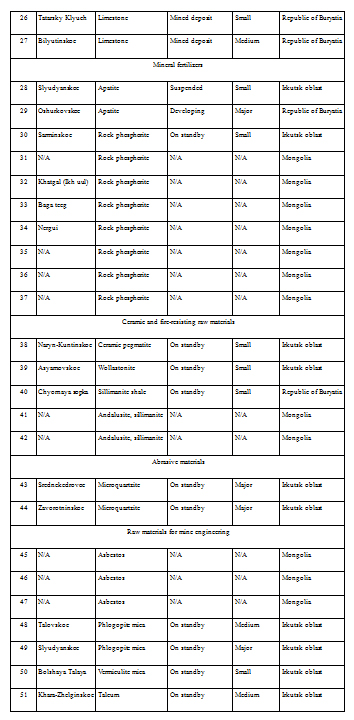
<p>Deposits of <i>phosphate</i> raw materials are known in Cisbaikalia. They are the Sarminskoe phosphorite deposit in the Olkhon municipal district and the Slyudyanskoe apatite deposit in the Sludyansky municipal district; in northern Mongolia large reserves of formation phosphorites in the Khovsgol phosphorite basin were discovered and previously explored. The main deposits of the basin are located in the immediate vicinity of Lake Khovsgol, which is an obstacle to their development. The large Oshurkovskoe apatite deposit is prepared for exploitation near the city of Ulan-Ude. On the basis of the approved ready reserves the Zabaikalsky apatite plant was under construction; it was closed down at the building phase of an ore-dressing plant because of possible deterioration of the environmental situation in the Baikal basin. Currently, there is a project of the deposit’s development based on environmentally friendly technologies for the extraction and beneficiation of ores. Taking into account a sustained deficit of phosphate raw materials in the country, an increase of the raw materials base for the production of phosphate fertilizers is a matter of economic security of Russia. The planned standard of production of apatite concentrate is 500 thousand tons per annum. Breakstone will be produced as a by-product in the same amount of 500 thousand tons per annum.</p>
<p>Considering the <i>ceramic and fire-resisting raw materials</i>, deposits of Irkutsk oblast should be pointed out. They are the Naryn-Kuntinskoe microcline pegmatite deposit, developed earlier for the needs of the “Sibfarfor” factory, the Kharginskoe glass sands deposit, on the basis of which the Taltsy plant was established in 1784 producing a variety of glass products for 170 years, and the Asyamovskoe deposit of wollastonite, a relatively new kind of mineral products with a number of unique properties and a growing range of applications. In the south of Buryatia a sillimanite (high-alumina) shales deposit named Chyornaya Sopka is known; its ores have simple mineral composition and are easily dressed. On the basis of the deposit a non-waste production with the release of sillimanite and quartz as commercial products can be created. All the above mentioned deposits are currently on the governmental standby.<i> </i></p>
<p><i>Phlogopite mica</i> deposits in the south of Lake Baikal have been known since the second half of the 18<sup>th</sup> century. Its regular commercial production using a ramified system of underground (tunnels, mines) and open (open pits) mine openings began in 1924 with the development of the electrical engineering industry in the country and lasted until 1973. From four to seven thousand tons of high-quality raw materials were mined annually in the Sludyansky district.<i></i></p>
<p><i>Graphite </i>is represented in the region by two large deposits, namely, the Bezymyannoe (the Slyudyansky municipal district) and Boyarskoe (the Kabansky municipal district) deposits. Ores of the Bezymyannoe deposit are high quality and free-milling according to the manufacturer's tests, but the deposit is located in close proximity to Lake Baikal. The Boyarskoe deposit has the largest reserves. Economic efficiency of its development in compliance with all environmental requirements can be quite high despite low average graphite content in the ore, thanks to its favorable transportation and geographical location.</p>
<p>In the past, a considerable part of the Baikal basin experienced intense volcanic activity, the product of which is <i>pearlite</i> deposits, among which the largest ones are Mukhor-Talinskoe, Zakultinskoe, and Kholinskoe. Currently, this raw material is produced by OAO (Joint Stock Company) “Perlit” on the Mukhor-Talinskoe deposit with the production output amounting to 1-10 thousand m<sup>3</sup> of raw material per annum over the last three years. The Kholinskoe pearlite and zeolite deposit is located on the border of the Republic of Buryatia and Zabaikalsky krai; the mining OOO (Limited Liability Company) “Kholinskie tseolity” develops the deposit. Nowadays, the capacity of the company mining such a valuable kind of mineral product as zeolites is small and amounts to only about 0.8 thousand tons.</p>
<p>Within the region there are a number of deposits of <i>precious and ornamental stones</i>. In Zabaikalsky krai, ZAO (Closed Joint Stock Company) “Turmalkhan” develops a unique deposit of jewelry tourmaline, which is the only one in Russia to date. In the Republic of Buryatia, OOO (Limited Liability Company) “Kaskad” exploits the Khargantinskoe deposit with an annual production of 20 tons of raw jade; ZAO (Closed Joint Stock Company) “MS Holding” started to develop the Khamarkhudinskoe jade deposit, where 510 tons were produced in 2012.</p>
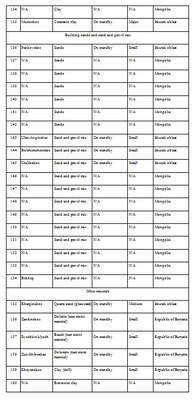
<p>To meet the needs of the construction industry the region possesses significant resources of <i>mineral construction materials</i>: numerous deposits of cement, brick, sand and gravel raw materials, building and facing stone are explored in the area. The raw materials base of the Angarsky cement plant is the large Slyudyanskoe deposit of cement marbles, being developed by the OOO (Limited Liability Company) “Karyer Pereval” with an annual output of about 900 thousand tons. The Tarakanovskoe deposit of cement limestone and Timlyuiskoe deposit of loam supply the Timlyuisky cement plant with raw materials. OOO (Limited Liability Company) “Timlyuitsement” produces 250-400 thousand tons of limestone and 20-35 thousand tons of loam annually.</p>
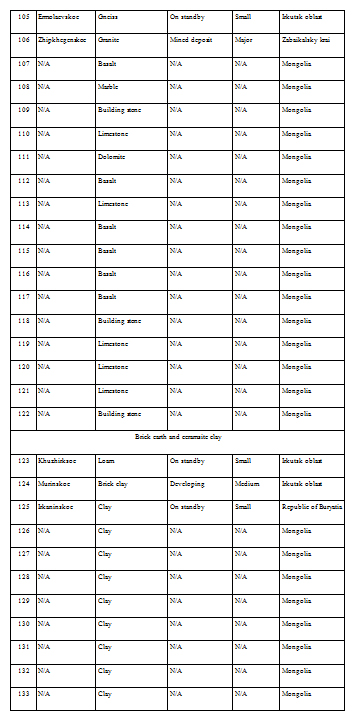
<p>Facing stone deposits are located on the western and south-eastern shores of Lake Baikal; they are Burovshchina and Novo-Burovshchinskoe deposits of pink marbles and Buguldeiskoe deposit of highly-ornamental statuary marble of various color shades: from snow-white to smoky-gray. Currently, stone is not produced on any of these deposits. Among building stone deposits AO (Joint Stock Company) RZhD exploits two: one of them is the medium Angasolskoe deposit in Irkutsk oblast and the other is the large Zhipkhegenskoe deposit in Zabaikalsky krai forming the raw materials base of the same-name crushed stone plants. Several deposits of building stone are situated in the coastal zone of Lake Baikal, namely, Baikalskoe, Ermolaevskoe, Dinamitnoe and others, rendering their development impossible.</p>
<p>The following deposits of brick and keramzite claysand loams were discovered: the Murinskoe and Khuzhirskoe deposits in Cisbaikalia and Irkaninskoe deposit in the Severobaikalsky municipal district, deposits of sand-gravel mix, including the Utulikskoe deposit of high-quality raw materials, the Pankovskoe deposit of building sands, and so on.</p>
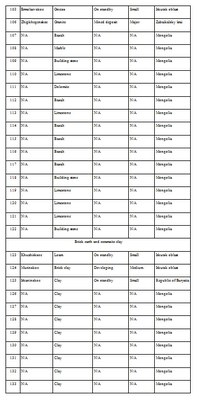
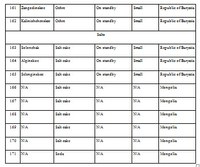
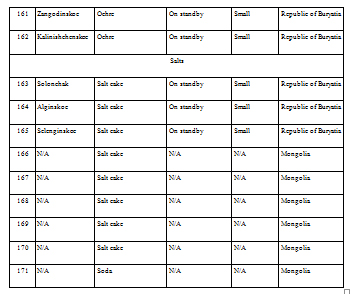
<p>Among <i>other</i> mineral resources of the region, the Zangodinskoe and Kalinishenskoe deposits of mineral paints, Khayanskoe deposit of drilling clays, several deposits of raw materials for stone casting, as well as deposits of mineral salts (sodium sulfate) should be mentioned. All deposits of these raw materials are small in terms of reserves and are on the governmental standby.</p>
<p>In Mongolia small deposits of asbestos, gypsum, graphite, talcum, magnesite, bentonite, ornamental stones (nephrite, serpentinite, lapis lasuli, ophicalcite, chalcedony, etc.), raw quartz, and mineral salts are known within the Baikal basin. As for construction materials there are deposits of building sand, brick, keramzite and ceramic clays, sand-gravel mix, building stone, etc.</p>
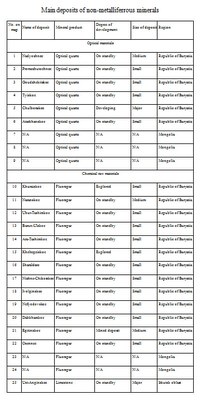
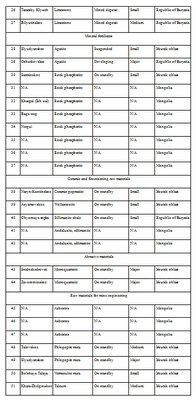
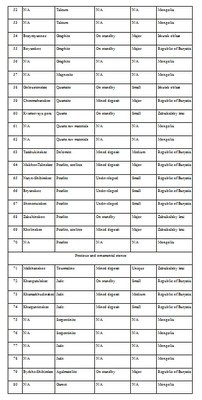
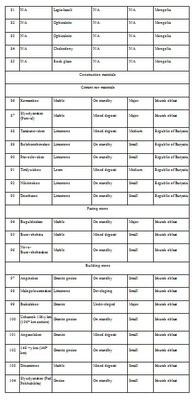
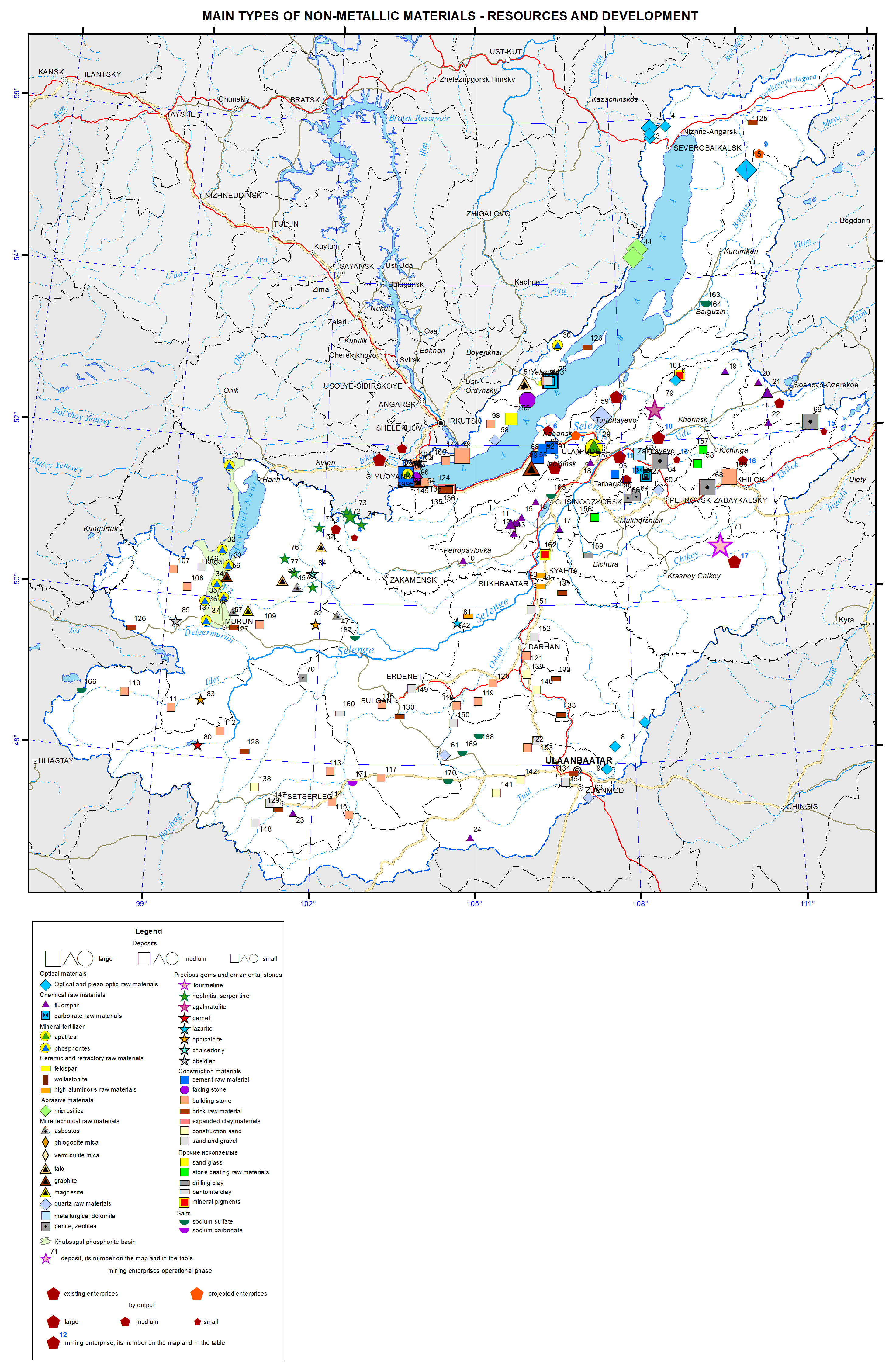
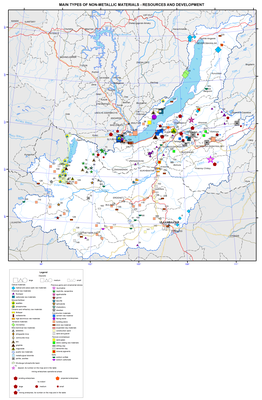
<p>The map presents the main nonmetallic mineral raw materials deposits, depending on their size and type of mineral product, as well as mining companies using symbols. The size of the symbol designating a company depends on the average production output over the recent three to five years or on the planned capacity of the objects designed and under construction; gradation is presented in the summary table. The color of the symbol corresponds to the operational phase of an enterprise. The Khubsugulsky phosphorite basin is shown with an areal.</p>
<p>Map construction required the use of the materials of the Regional Funds of Geological Information, maps of mineral resources of the A.P. Karpinsky Russian Geological Research Institute; materials of State Reports “On the Condition of Lake Baikal and Measures of its Protection” for 2010–2012; “National Atlas of the Mongolian People's Republic” (1990), “Atlas of Mongolia” in the Mongolian language (2010), and “Atlas of Socioeconomic Development of Russia” (2009). Information on deposits according to the types of raw materials and on mining companies is presented in the summary table.</p>
<p><img class="image-inline" src="../../../../resolveuid/d284b6f61e4c44f8ad43d46a668322d3/@@images/image/preview" /></p>
<p><a href="http://bic.iwlearn.org/en/photos/45.jpg" class="internal-link">Open full size</a></p>
<p><img class="image-inline" src="../../../../resolveuid/98bbb5cc2eef41158328f7f0eeb57425/@@images/image/preview" /></p>
<p><a href="http://bic.iwlearn.org/en/photos/451.jpg" class="internal-link">Open full size</a></p>
<p><img class="image-inline" src="../../../../resolveuid/a62eb843c052454cb3739df217414e92/@@images/image/preview" /></p>
<p><a href="http://bic.iwlearn.org/en/photos/452.jpg" class="internal-link">Open full size</a></p>
<p><img class="image-inline" src="../../../../resolveuid/6a6a2fd6be0d47ea9f98156bdefaf7d7/@@images/image/preview" /></p>
<p><a href="http://bic.iwlearn.org/en/photos/453.jpg" class="internal-link">Open full size</a></p>
<p><img class="image-inline" src="../../../../resolveuid/ae9af4a5656a4070a90f7207e47a3c60/@@images/image/preview" /></p>
<p><a href="http://bic.iwlearn.org/en/photos/454.jpg" class="internal-link">Open full size</a></p>
<p><img class="image-inline" src="../../../../resolveuid/dd33f181df6e436c924598b054fbd494/@@images/image/preview" /></p>
<p><a href="http://bic.iwlearn.org/en/photos/455.jpg" class="internal-link">Open full size</a></p>
<p><img class="image-inline" src="../../../../resolveuid/17b13986651f47f7bbddb28738053f17/@@images/image/mini" /></p>
<p><a href="http://bic.iwlearn.org/en/photos/456.jpg" class="internal-link">Open full size</a></p>]]></content:encoded>
    <dc:publisher>No publisher</dc:publisher>
    <dc:creator>Alexander Ayurzhanaev</dc:creator>
    <dc:rights></dc:rights>
    <dc:date>2014-10-08T01:50:00Z</dc:date>
    <dc:type>Page</dc:type>
  </item>


  <item rdf:about="http://bic.iwlearn.org/en/atlas/atlas/44-ferrous-nonferrous-rare-and-precious-metal-resources-and-their-extraction-map/ferrous-nonferrous-rare-and-precious-metal-resources-and-their-extraction-map">
    <title>Ferrous, nonferrous, rare and precious metal resources and their extraction map</title>
    <link>http://bic.iwlearn.org/en/atlas/atlas/44-ferrous-nonferrous-rare-and-precious-metal-resources-and-their-extraction-map/ferrous-nonferrous-rare-and-precious-metal-resources-and-their-extraction-map</link>
    <description></description>
    <content:encoded xmlns:content="http://purl.org/rss/1.0/modules/content/"><![CDATA[<p><img class="image-inline" src="../../../resolveuid/c0893da58701459699e0f5004007f3b0/@@images/image/preview" /></p>
<p><a href="http://bic.iwlearn.org/en/atlas/photos/copy_of__44_Ferrousnonferrousrareandpreciousmetalresourcesandtheirextraction.png" class="internal-link">Open full size</a></p>
<p><img class="image-inline" src="../../../../resolveuid/086337cddf4549b08338fd489baddd69/@@images/image/preview" /></p>
<p><a href="http://bic.iwlearn.org/en/photos/copy_of__44_Table.png" class="internal-link">Open full size</a></p>
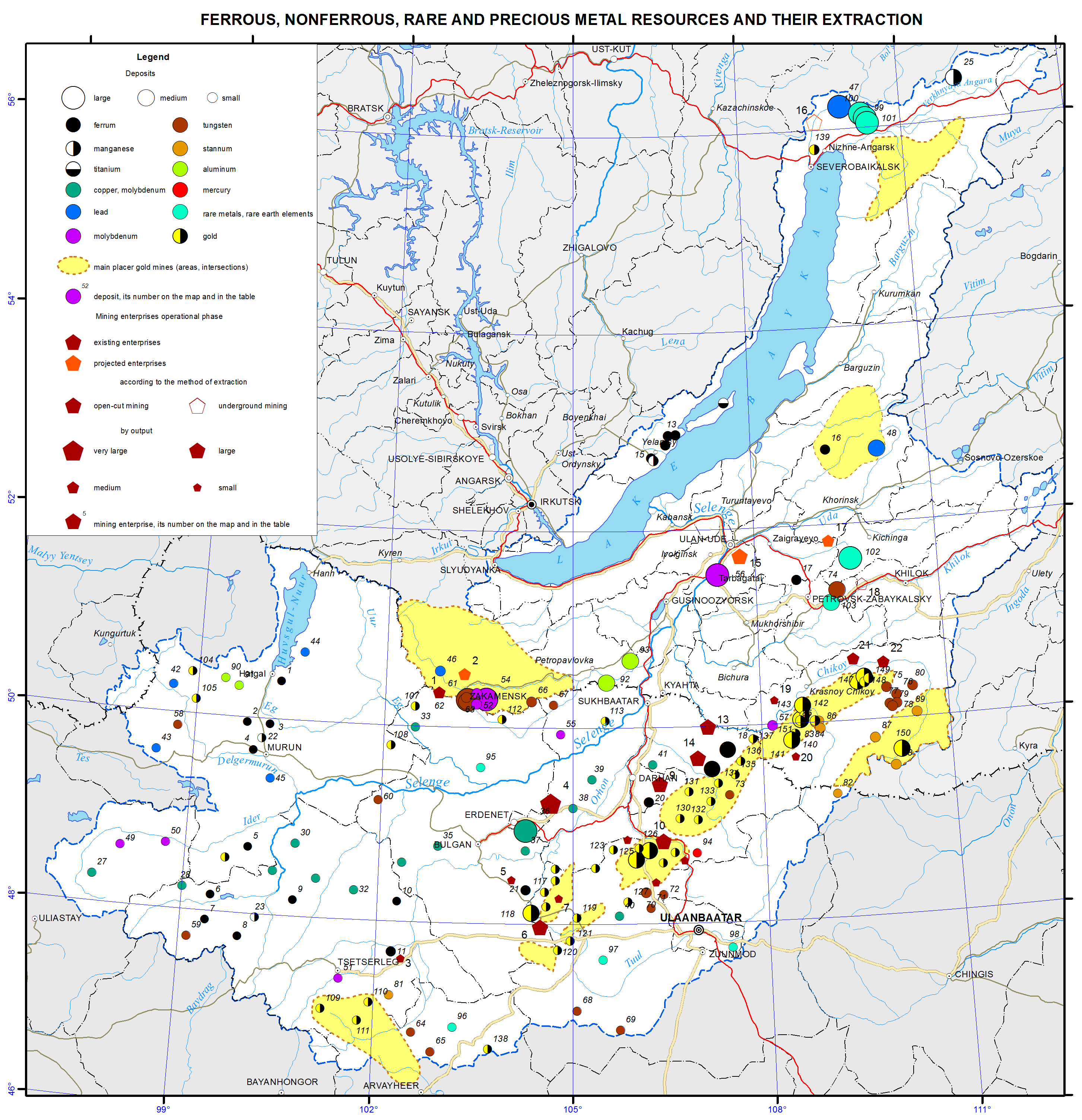
<p align="center"><strong>Resources of ferrous, nonferrous and rare metals and their mining</strong></p>
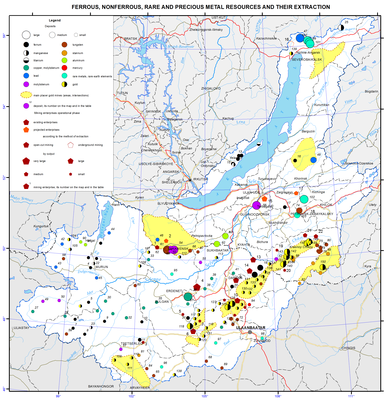
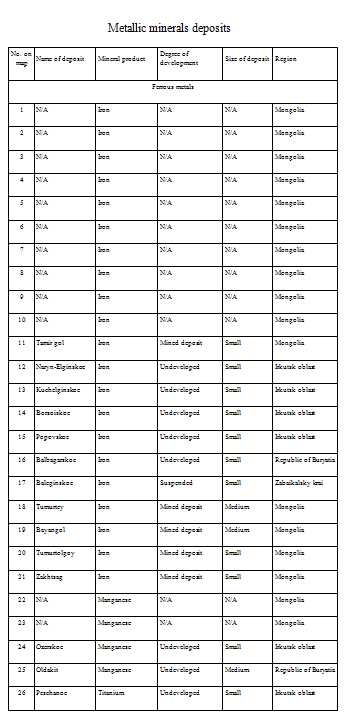
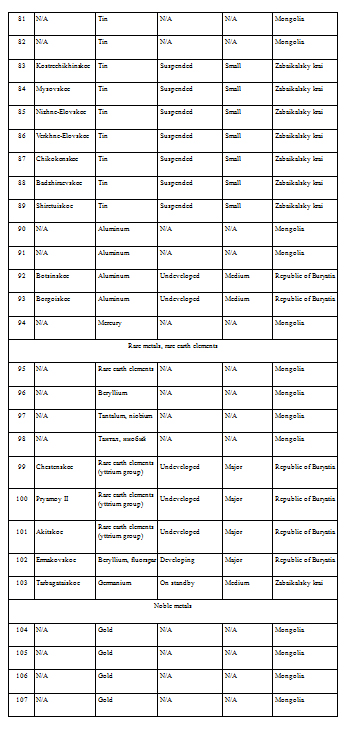
<p>Geological exploration exposed over 150 deposits of metallic minerals within the Baikal basin.<b> </b></p>
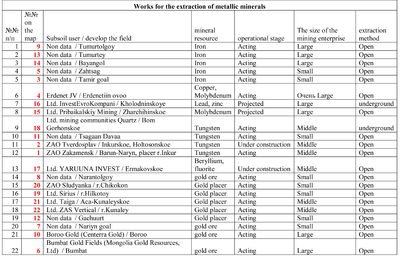
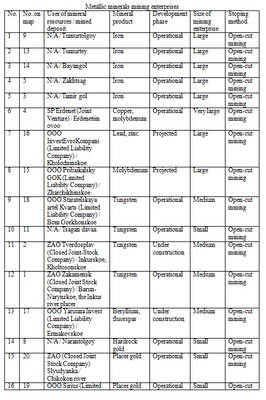
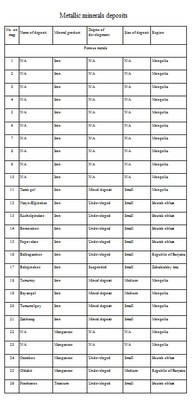
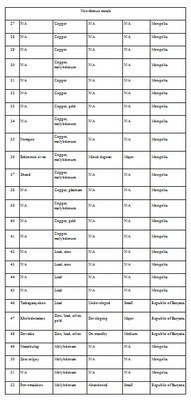
<p><b>Ferrous metals</b> are represented by a number of iron ore deposits of different genetic types, including two small magnetite deposits, namely, Balbagarskoe in the territory of the Khorinsky municipal district of the Republic of Buryatia and Baleginskoe in the Petrovsk-Zabaikalsky district of Zabaikalsky krai. In the 18<sup>th</sup>-19<sup>th</sup> centuries the Baleginsky mine supplied iron ore to the Petrovsky plant to procure iron and steel for the mines of the Nerchinsky district. In the Olkhonsky municipal district of Irkutsk oblast small iron ore deposits are known; they are mainly represented by brown iron ore deposits (Borsoiskoe, Kuchelginskoe, etc.). In the first half of the 18<sup>th</sup> century, ore from these deposits was used for the needs of the Anginsky (Laninsky) ironworks. The most promising iron ore deposits of Mongolia are the skarn type deposits such as Tumurtolgoy, Bayangol, and Tumurtey, forming the Bayangol iron ore zone in the north of the country. Currently, iron ore deposits in the region are developed only in the territory of Mongolia: small scale extraction of iron ore is underway on the Zakhtsag and Tamir gol deposits; over the recent years, the production on the deposits of the Bayangolskaya iron ore zone amounted to more than five million tons; primary processing is performed at the cleaning plants near the deposits; iron-ore concentrate is exported to China.</p>
<p>The Oldakit manganese deposit, medium in terms of reserves, is located in the Severobaikalsky municipal district less than 30 km from the Baikal-Amur Mainline. Given the fact that Russia is currently experiencing shortage of this raw material, the deposit may be of some interest. Moreover, several small deposits of manganese are known within the boundaries of the Baikal basin, including the Ozerskoe deposit (Olkhonsky district) developed in the 19<sup>th</sup> century for the needs of the Nikolaevsky ironworks.<b></b></p>
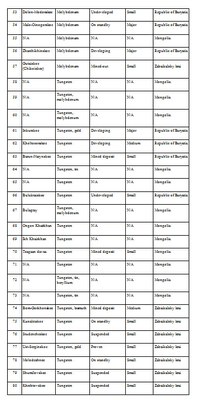
<p><b>Nonferrous metals</b>. Almost all reserves and resources of copper ores of the region are concentrated in complex copper-molybdenum and molybdenum-tungsten deposits of Mongolia, located within the Selenginsky volcanoplutonic belt. From 1978 to present a large deposit Erdenetiyn ovoo has been developed; on its basis a joint Soviet-Mongolian venture, the Erdenet Mining Company was established. The plant is engaged in open-pit mining and primary processing of copper-molybdenum ores and is one of the world leaders in the production of copper concentrate. Currently, the production output amounted to more than 25 million tons of ore, while the production of copper concentrate is about 350 thousand tons. In a globalizing world economy, the company faces the challenge of marketability of its products, which necessitates the construction of a copper-smelting plant. At present, the Erdenet Mining Company comprises a pilot plant for the production of pure cathode copper from off-balance and storage ore dump piles of KOO (Limited Liability Company) “Erdmin”, which is a joint venture of Erdenet Mining Company and the American company RCM.</p>
<p>Within the Baikal basin, the largest Kholodninskoe deposit of lead-zinc sulfide ores is explored and prepared for industrial development; its reserves amount to 11.2% of Russia’s total lead reserves and 34.1% of Russia’s total zinc reserves. Based on the economic indicators of development, the deposit is on par with the best world analogues. According to the feasibility study of final mining parameters, the annual production of the underground mine at the deposit should amount to three million tons of ore, 504 thousand tons of zinc concentrate, and 60.3 thousand tons of lead concentrate. In order to ensure environmental safety of production, provision is made for a circulating water supply system, transportation of wastes of the ore-dressing plant outside the catchment area of Lake Baikal using pipelines, and a number of other environmental measures. However, due to the fact that the deposit is located in the Central Ecological Zone of the Baikal Natural Territory (BNT), where mining activity is banned, the production license, owned by the KOO (Limited Liability Company) “InvestEuroCompany” was suspended until 2015. Among other objects of polymetallic raw materials in the region, the medium Davatkinskoe deposit, discovered and assessed in the Khorinsky municipal district of the Republic of Buryatia, should be pointed out.</p>
<p>In Buryatia there are two large deposits of molybdenum ores, namely, Zharchikhinskoe and Malo-Oinogorskoe, and small Pervomaiskoe (abandoned) and Dolon-Modonskoe (undeveloped) deposits. There is a project of the construction of the Pribaikalsky mining and processing plant on the basis of the Zharchikhinskoe deposit, located 40 km to the south of Ulan-Ude in close proximity to the highway and railway, with the molybdenum content in the ore of more than 0.1% and high technological and technical-economic indicators. Its effective development is possible, provided that all necessary environmental requirements are observed.</p>
<p>Tungsten in the region belongs to widespread elements. In the territory of the Zakamensky municipal district there is the Inkurskoe deposit of the stockwork geological-industrial type, which is comparable to the largest similar deposits of the world in terms of its reserves and tungsten content. The Kholtosonskoe deposit, located to the west of the Inkurskoe one, is the largest deposit of the vein type in Russia, and is considered to be unique not only in Russia but also in the world as to its characteristics. The Dzhidinsky tungsten-molybdenum mill operated from 1934 to 1996 on the basis of these two deposits as well as the Pervomaiskoe molybdenum deposit. After the closure of the mill, the tailings pond remained over the area of more than ​​one km<sup>2</sup>, forming the man-made Barun-Narynskoe deposit, the development of which has been started by OAO (Open Joint Stock Company) “Zakamensk” since 2010. A reclamation plant recycling the mill’s waste was built 1.5 km from the town of Zakamensk; the concentrate production amounts to about 300 tons per annum. ZAO (Closed Joint Stock Company) “Tverdosplav” is engaged in the construction of mining sites at the Inkurskoe and Kholtosonskoe deposits. It is planned to build a modern ore-dressing plant and a hydrometallurgical workshop for the processing of tungsten concentrates to produce commercial refined tungsten compounds. In the Petrovsk-Zabaikalsky municipal district of Zabaikalsky krai the prospectors' artel “Kvarts” mines the medium Bom-Gorkhonskoe tungsten deposit by the underground mining method. In recent years, the concentrate production amounted to around 600 tons. The remaining tungsten deposits within the territory of the Russian part of the Baikal basin are temporarily abandoned or are on the governmental standby.</p>
<p>A number of tungsten deposits are known in Mongolia. A small tungsten refinery plant was built on the Tsagaan davaa deposit; the concentrate production amounts to about 40 tons per annum; the final production is exported to the United States and China.</p>
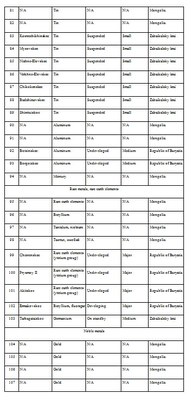
<p>Tin deposits located in the Krasnochikoysky district are small in terms of reserves and are currently mothballed.</p>
<p>In the Dzhidinsky district of Buryatia the medium Borgoiskoe (Al2O3 – 19.8% on average) and Botsinskoe (21.44%) deposits of nepheline-bearing rocks are prospectively explored; currently they remain undeveloped.<b></b></p>
<p><b>Rare metals.</b> In the Kizhinginsky municipal district of the Republic of Buryatia there is the Ermakovskoe deposit of beryllium ores containing 80% of the total beryllium reserves of Russia and unique as to the grade of ore. From 1978 the deposit was developed by the Zabaikalsky mining and processing plant; in 1990 the enterprise was mothballed. Beryllium is a strategic metal essential for the development of nuclear, aerospace, and aviation industry, and instrument engineering; it is used in the manufacture of telecommunications equipment. Currently, Russia’s demand of this metal is met through imports. Whereas it is necessary to restore the raw material and production independence of the country in beryllium, it is expected to resume the production of ore on the deposit, and create production on primary processing of ore, as well as hydrometallurgical production, the end product of which – beryllium hydroxide – will be delivered to the Ulbinsky metallurgical plant in Kazakhstan for processing and producing beryllium alloying compositions and metal. The work to create the beryllium production is included in the Federal Target Program on rare metals of paramount importance.</p>
<p>In the Severobaikalsky municipal district within the Central Ecological Zone of the BNT, three subsoil plots of the Federal importance with large prognostic resources of rare earth elements of the yttrium group are on the governmental standby. They are the Chestenskoe, Akitskoe and Pryamoy-II deposits.<b></b></p>
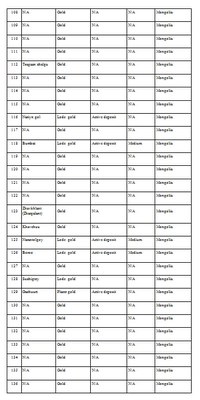
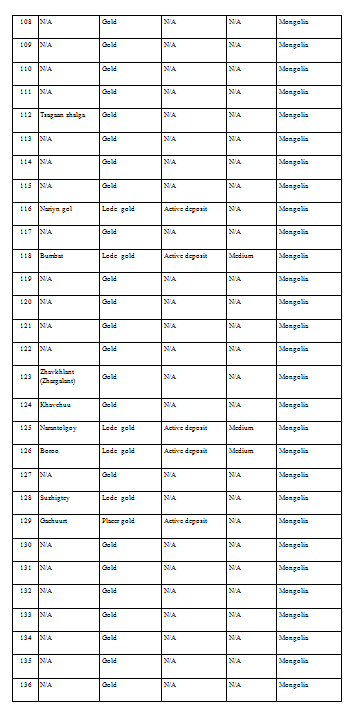
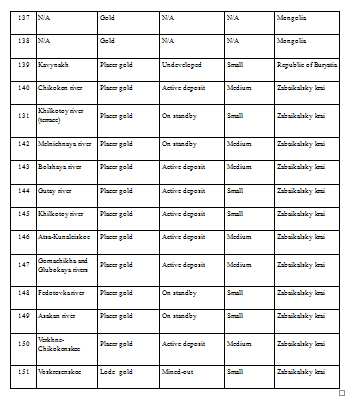
<p><b>Noble metals. </b>Within the Russian part of the Baikal basin there are no lode gold deposits (except the mined-out Voskresenskoe deposit in the Krasnochikoysky municipal district). Placer gold deposits are small or medium and are grouped into the gold-placer regions, namely: Dzhidinsky, Namaminsky, Yambuy-Tolutaisky, Chikoysky, and Baldzhikansky. In the Republic of Buryatia within the territory under consideration gold practically has not been produced over the recent three years (economically advantageous deposits are mined-out, and exploration and appraisal works require substantial expenditures); in the Krasnochikoysky district of the ​​Zabaikalsky krai, four prospectors' artels produce 300-400 kg of gold annually using the open-pit hydromechanical method.</p>
<p>Gold is the second most significant mineral resource of Mongolia after copper. The industrial mining of gold ores in the country was launched in the early 20<sup>th</sup> century by the Russian-Mongolian joint-stock company “Mongolor” in the Iro-Gol river basin, in the Khovsgol region and in the Boroo area. Primary deposits are usually of the vein type, more rarely – mineralized zones. The most significant primary deposits in terms of reserves include the Boroo deposit in the Boroo-Zuunmod region and the Bumbat deposit in the Zaamarsky gold field. The metal content in individual layers reaches 10 g/t. The deposits are developed by Canadians with the annual production of five and 1.5 tons of metal, respectively. Moreover, gold is currently mined on the Narantolgoy and Nariyn gol deposits.</p>
<p>Among the placers small and medium ones predominate, and only single ones are large placers in terms of reserves. Most placers are shallow single-layer, rarely double-layer; in rare cases deep placers occur. Dredging and separate production techniques are applied at the placer deposits. After mining by large companies, the remaining gold is mined by individual prospectors, whose number exceeded 10 thousand people according to the official data alone. In river valleys, where mining is possible, huge settlements are formed. As a result, in recent years the country faced an intensive shallowing and pollution of rivers, shrinking of grazing lands for cattle, and a process of desertification of the southern territory, and drinking water shortages for population occur. This is largely due to huge volumes of gold mining in the river valleys, illegal use of mercury and cyanides, and almost total lack of reclamation.</p>
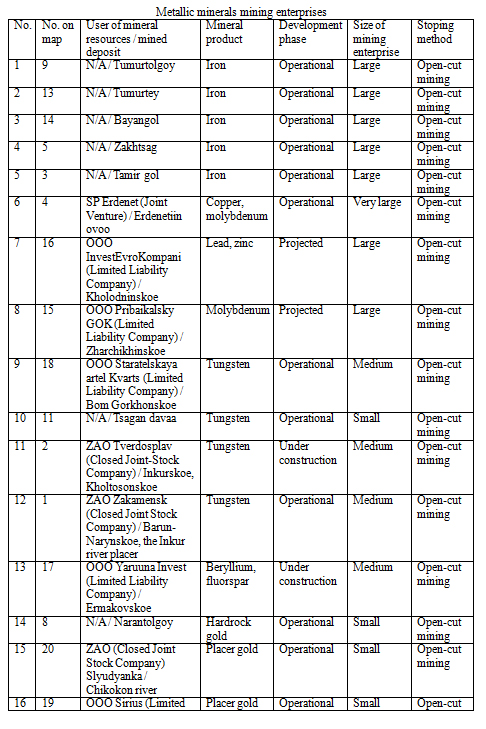
<p>The map symbols show metallic mineral deposits depending on their size and type of commercial minerals. Mining companies are also shown with symbols. The size of a symbol corresponds to the production output. The group of large companies include ferrous, nonferrous and rare metals producing enterprises with production ranging from 1 to 10 million tons of ore per annum, the group of medium ones comprises the production output of 0.1-1 million tons per annum,</p>
<p><img class="image-inline" src="../../../../resolveuid/b5bd74556d5045bcac18238e545cd3c4/@@images/image/preview" /></p>
<p><a href="http://bic.iwlearn.org/en/photos/44.jpg" class="internal-link">Open full size</a></p>
<p><img src="http://bic.iwlearn.org/en/photos/441.jpg/@@images/9854ac0a-f6fc-46c7-b910-b40a35514466.jpeg" alt="" class="image-inline" title="" /></p>
<p><a href="http://bic.iwlearn.org/en/photos/441.jpg" class="internal-link">Open full size</a></p>
<p>and small ones produce less than 0.1 million tons per annum. The Erdenet Mining Company is highlighted as a very large enterprise with an annual production of more than 20 million tons. The following gradation is accepted for gold mining: large companies are gold mines with the production of more than one ton per annum, medium companies are those producing 0.1-1 ton, and small ones are those with less than 0.1 tons produced. The color of the symbol corresponds to the exploitation phase of an enterprise: operating or projected and under construction; additional outline corresponds to the underground mining method. Gold-placer regions of the given territory are depicted by areals.</p>
<p>Table 1</p>
<p><img class="image-inline" src="../../../../resolveuid/f4a37e81d4d7431fbf95f7265a1b458e/@@images/image/preview" /></p>
<p><a href="http://bic.iwlearn.org/en/photos/442.jpg" class="internal-link">Open full size</a></p>
<p><img class="image-inline" src="../../../../resolveuid/1441b8be04934550bc0ebb4c83b9c44e/@@images/image/preview" /></p>
<p><a href="http://bic.iwlearn.org/en/photos/443.jpg" class="internal-link">Open full size</a></p>
<p><img class="image-inline" src="../../../../resolveuid/98c96c25632e4b9dba75b2fc82411706/@@images/image/preview" /></p>
<p><a href="http://bic.iwlearn.org/en/photos/444.jpg" class="internal-link">Open full size</a></p>
<p><img class="image-inline" src="../../../../resolveuid/1daaaef9f0114fa981b1592254b6aace/@@images/image/preview" /></p>
<p><a href="http://bic.iwlearn.org/en/photos/445.jpg" class="internal-link">Open full size</a></p>
<p><img class="image-inline" src="../../../../resolveuid/447e28e1422745858950a3147aee5e36/@@images/image/preview" /></p>
<p><a href="http://bic.iwlearn.org/en/photos/446.jpg" class="internal-link">Open full size</a></p>
<p><img class="image-inline" src="../../../../resolveuid/27ce7f6bf2034632ac0fd4ae1948ce81/@@images/image/mini" /></p>
<p><a href="http://bic.iwlearn.org/en/photos/447.jpg" class="internal-link">Open full size</a></p>]]></content:encoded>
    <dc:publisher>No publisher</dc:publisher>
    <dc:creator>Alexander Ayurzhanaev</dc:creator>
    <dc:rights></dc:rights>
    <dc:date>2014-10-08T01:20:00Z</dc:date>
    <dc:type>Page</dc:type>
  </item>


</rdf:RDF>