<?xml version="1.0" encoding="utf-8" ?>
<rdf:RDF xmlns:rdf="http://www.w3.org/1999/02/22-rdf-syntax-ns#" xmlns:dc="http://purl.org/dc/elements/1.1/" xmlns:syn="http://purl.org/rss/1.0/modules/syndication/" xmlns="http://purl.org/rss/1.0/">


<channel rdf:about="http://bic.iwlearn.org/en/search_rss">
  <title>English</title>
  <link>http://bic.iwlearn.org</link>

  <description>
    
            These are the search results for the query, showing results 221 to 235.
        
  </description>


  <image rdf:resource="http://bic.iwlearn.org/logo.png"/>

  <items>
    <rdf:Seq>
      
        <rdf:li rdf:resource="http://bic.iwlearn.org/en/atlas/atlas/42-landscape-stability-map/landscape-stability-map"/>
      
      
        <rdf:li rdf:resource="http://bic.iwlearn.org/en/atlas/atlas/41-physiographic-regionalization-map/physiographic-regionalization-map"/>
      
      
        <rdf:li rdf:resource="http://bic.iwlearn.org/en/atlas/atlas/40-geosystems-map/geosystems-map"/>
      
      
        <rdf:li rdf:resource="http://bic.iwlearn.org/en/atlas/atlas/39-ichthyogeographical-complexes-map/copy_of_39-ichthyogeographical-complexes-map"/>
      
      
        <rdf:li rdf:resource="http://bic.iwlearn.org/en/atlas/atlas/38-taxonomic-diversity-map/taxonomic-diversity-map"/>
      
      
        <rdf:li rdf:resource="http://bic.iwlearn.org/en/atlas/atlas/37-soil-ecological-zoning-map/soil-ecological-zoning-map"/>
      
      
        <rdf:li rdf:resource="http://bic.iwlearn.org/en/atlas/atlas/36-stability-of-soils-map/stability-of-soils-map"/>
      
      
        <rdf:li rdf:resource="http://bic.iwlearn.org/en/atlas/atlas/35-soils-map/soils-map"/>
      
      
        <rdf:li rdf:resource="http://bic.iwlearn.org/en/atlas/atlas/34-amount-of-forests-map/amount-of-forests-map"/>
      
      
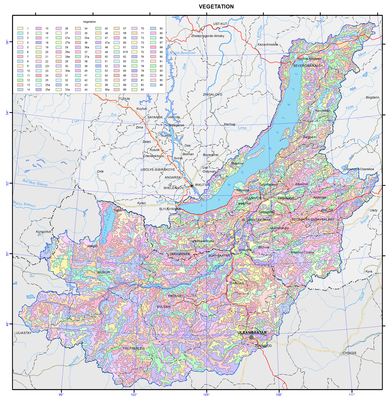
        <rdf:li rdf:resource="http://bic.iwlearn.org/en/atlas/atlas/33-vegetation-map/vegetation-map"/>
      
      
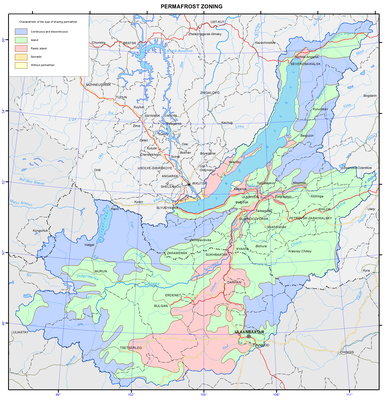
        <rdf:li rdf:resource="http://bic.iwlearn.org/en/atlas/atlas/32-permafrost-zoning-map/permafrost-zoning-map"/>
      
      
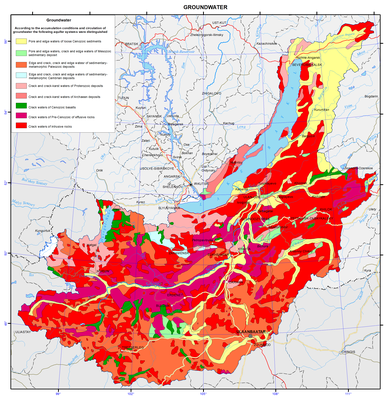
        <rdf:li rdf:resource="http://bic.iwlearn.org/en/atlas/atlas/31-groundwater-map/groundwater-map"/>
      
      
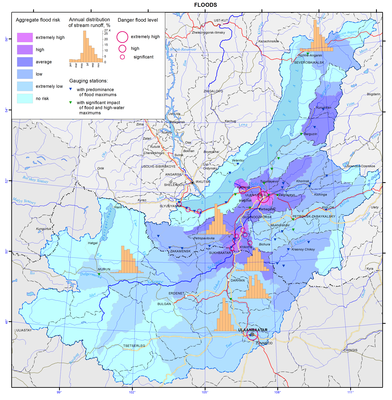
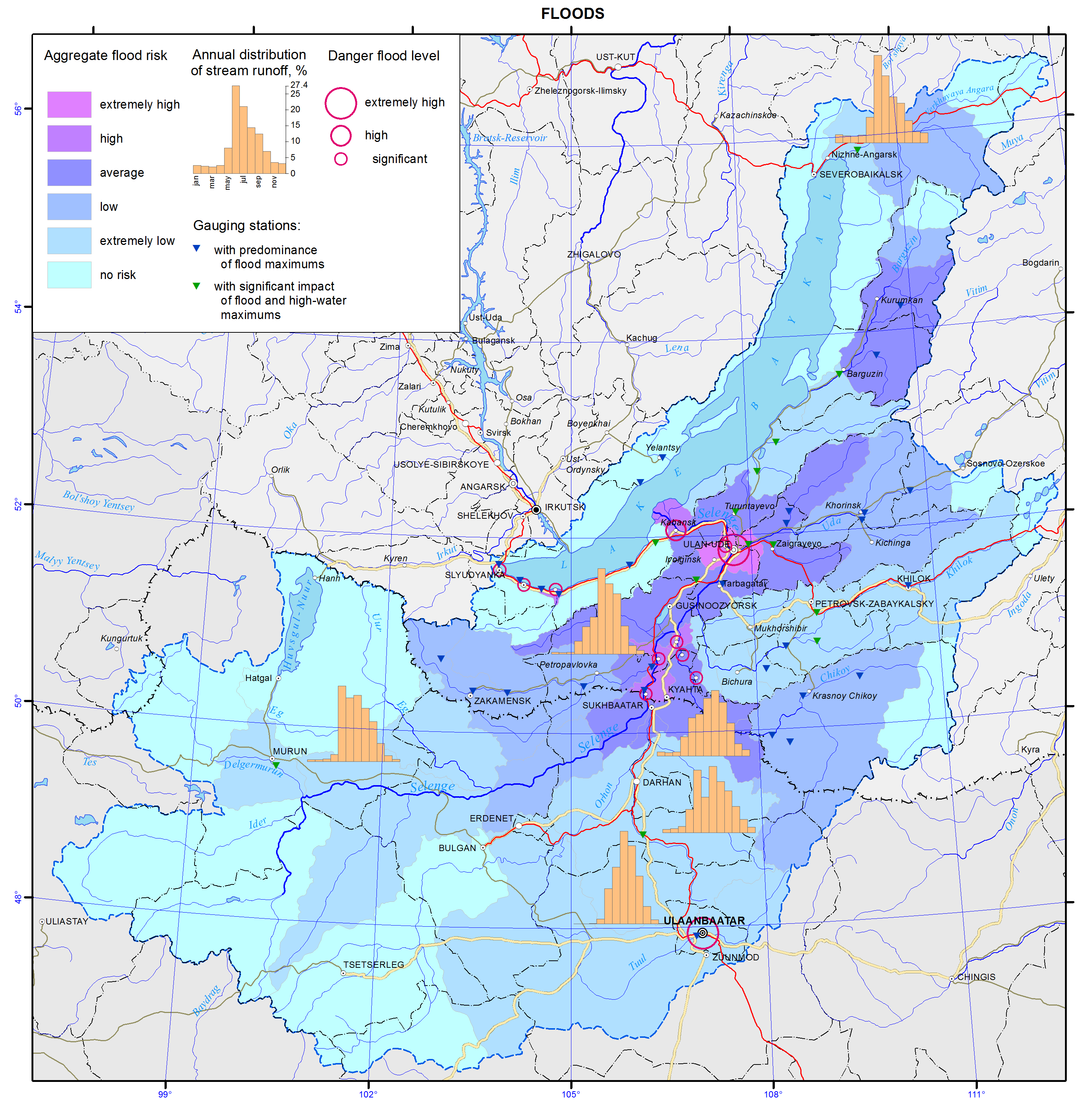
        <rdf:li rdf:resource="http://bic.iwlearn.org/en/atlas/atlas/29-floods-map/floods-map"/>
      
      
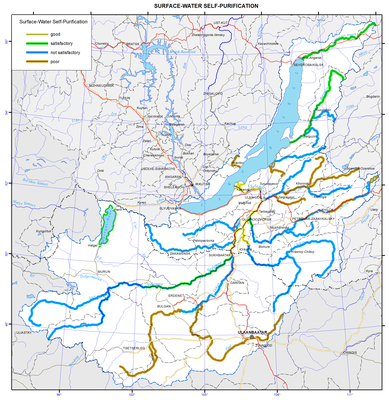
        <rdf:li rdf:resource="http://bic.iwlearn.org/en/atlas/atlas/30-surface-water-self-purification-map/surface-water-self-purification-map"/>
      
      
        <rdf:li rdf:resource="http://bic.iwlearn.org/en/atlas/atlas/27-minimum-summer-runoff-map/minimum-summer-runoff-map"/>
      
    </rdf:Seq>
  </items>

</channel>


  <item rdf:about="http://bic.iwlearn.org/en/atlas/atlas/42-landscape-stability-map/landscape-stability-map">
    <title>Landscape stability map</title>
    <link>http://bic.iwlearn.org/en/atlas/atlas/42-landscape-stability-map/landscape-stability-map</link>
    <description></description>
    <content:encoded xmlns:content="http://purl.org/rss/1.0/modules/content/"><![CDATA[<p><img class="image-inline" src="../../../../resolveuid/def380b90f9b43e4b12b647035d988e2/@@images/image/preview" /></p>
<p><a href="http://bic.iwlearn.org/en/photos/copy2_of__42_LandscapeStability.png" class="internal-link">Open full size</a></p>
<p><img class="image-inline" src="../../../../resolveuid/145d45f9d03741aa8547a78a340e3803/@@images/image/preview" /></p>
<p><img class="image-inline" src="../../../../resolveuid/e1c273139cad4e6d90a1922fc5d06091/@@images/image/preview" /></p>
<p align="center"><strong>Landscapes stability </strong></p>
<p align="center"><strong> </strong></p>
<p>Landscape stability is one of the most important parameters determining the state of the environment and changes occurring in it under the influence of natural and anthropogenic factors. The nature of landscape changes depends on the location in the geographical environment, their properties, and type and extent of the anthropogenic impact. Of particular importance is the estimation of landscapes stability of the Baikal basin, which is an environmentally critical area.</p>
<p>Landscape stability is a property of a geosystem to maintain its structure and the mode of functioning under changing conditions of its environment [Protection of landscapes..., 1982]. An assessment and mapping of landscapes stability are made according to the complex of natural and anthropogenic factors of influence. The natural factor is mainly determined by the influence of climate (indicators of heat-moisture supply) and the properties of lithological-and-geomorphological basis. The anthropogenic influencing factor is associated with the background nature management, which is based on spatially extensive use of natural resources, and lands, closely related to the zonal-belt features of natural landscapes. The background types of nature management in the study area include agriculture, mainly in steppe landscapes, forestry in taiga landscapes, as well as recreation.</p>
<p>Stability is considered in relation to landscapes of two levels: regional (geoms) and topological (groups of facies). A landscape map, compiled by the authors on the basis of landscape maps of the territory under consideration [Landscapes..., 1977; Landscapes..., 1990], was used for its mapping.</p>
<p>Stability of landscapes of the regional level – geoms – is determined based on the level of natural ecological potential of a landscape (EPL), the main indicator of which is the index of biological effectiveness of climate (TK) according to N.N. Ivanov [Ecological..., 2007, Ecological..., 2007]. Characterization and comparative assessment of this indicator is based on the ratio of heat and moisture, on which the biological productivity of a landscape and ecological capacity primarily depend. At the same time, the influence of latitudinal and altitudinal zonality on their distribution is traced. A single and continuous process of moisture and heat exchange not only forms the spatial differentiation and a type of a landscape, but also determines its stability. Landscapes with high values of TK and EPL are the most stable, while low values ​​of these parameters characterize unstable landscapes.</p>
<p>Twenty-two geoms are represented in the landscape structure of the territory under consideration. Mountain terrain predominates in the catchment area of ​​Lake Baikal. Therefore, this territory is characterized by the altitudinal belt differentiation of landscapes, which determines the degree of their stability.</p>
<p>At the regional level, according to the values ​​of these indicators, landscapes are subdivided into five ecological groups of geoms, to which the corresponding values ​​of stability, ranged on a five-point scale, are assigned. These values ​​are considered as the starting point, or background stability.</p>
<p>A geom unites groups of facies similar in structural-dynamic characteristics [Sochava, 1978]. This taxonomic unit is important in generalization of geotopological works. Inside a geom, stability was readjusted in respect of groups of facies with different dynamic categories. A set of variable states of these categories includes indigenous, pseudo-indigenous, serial and derivative geosystems under one epifacie. The highest natural and anthropogenic stability characterizes indigenous landscapes with well-established intrasystemic and external relations; many of them are notable for durability. Pseudo-indigenous landscapes, unlike indigenous ones, are modified as a result of hypertrophy of one of the components of the system. Serial facies in most cases are nondurable, quickly alternating with each other spontaneous geosystems, formed under the significant hypertrophy influence of various natural factors. In a range of transformation of geosystems they are characterized by the greatest variability and are prone to damage, and therefore they are classified as landscapes unstable to anthropogenic impacts. Derivative landscapes are variable states of geosystems caused by human influence. They are characterized by different degrees of stability.</p>
<p>The highest values ​​of stability, considered as the initial point corresponding to the background rate of stability of a geom, are set for indigenous facies. Further on, the initial point is reduced to three gradations, namely, for pseudo-indigenous, serial and derivative facies. For pseudo-indigenous facies a decrease in the stability by 1 point in relation to the initial point is possible; for serial facies it can amount to 1-2 points. For derivative facies deviations from the norm can reach 1-2 points towards an increase or decrease in the stability depending on the type of succession, namely, progressive stabilizing or digressive destabilizing.</p>
<p>To assess the anthropogenic stability of landscapes an analysis was made of disturbances of natural environment, arising under the influence of various types of human activities related to the background land use. According to the predominant nature of the background land use, the following types of functional load on the environment were distinguished: agricultural arable and grazing (mainly for steppe and forest-steppe landscapes), and forestry (for taiga landscapes) and recreation.</p>
<p>Stability of arable lands was largely determined by the intensity of erosion loss, soil deflation and pesticide pollution, and natural self-purification potential of soils. Stability of natural-forage lands was determined in respect of plant communities to grazing and haymaking and was assessed according to the degree of degradation of hayfields and pastures, susceptibility to erosion and deflation, and recoverability of vegetation and soils.</p>
<p>The most significant impact on the state of forests is made by commercial logging using the clear felling approach. Stability of forest landscapes was determined according to the degree of disturbance of forests by felling and fires, recreation, and agricultural use. Reforestation is influenced by changing temperature conditions, hydrophysical properties of soils, evolving erosion and cryogenic processes, deflation and waterlogging in felled and burnt areas. An important criterion for stability, i.e. forest bonitet, is an indicator of productivity and environmental growth conditions, evaluated by richness (trophicity) and moisture content of soil. Environmental factors, spontaneous and associated with the human activity, prevent natural reforestation; their progressive successions do not reach the original state. Such landscapes fall in the category of the most unstable.</p>
<p>Recreational stability is assessed referring to the mass recreation and tourist-excursion activities. Indicators of the degree of recreational digression of landscapes, depending on the type and intensity of recreational influence, sensitivity and recoverability of landscapes, which together define their recreational potential, served as stability criteria. Stability of landscapes is a key indicator, based on which the regulation of recreational loads is made.</p>
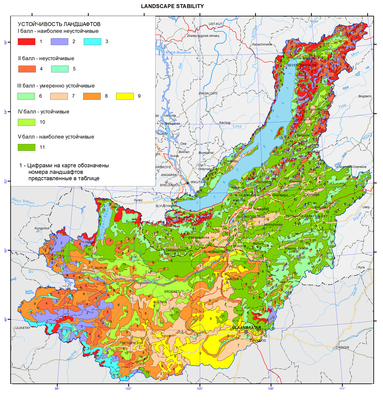
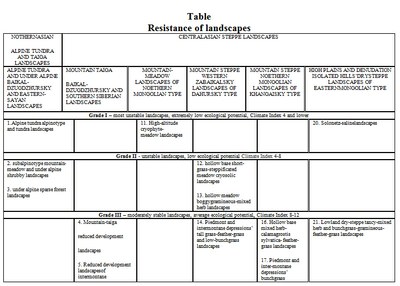
<p>The compiled map reflects the territorial diversity of landscape stability, characteristics of which is presented in the table.</p>
<p>The lowest and low (I-II points) stability characterize goletz and sub-goletz landscapes presented in major mountain ranges in the north-eastern and south-western parts of the territory. In the north-east, they are goletz and sub-goletz landscapes of the Baikalsky, Verkhne-Angarsky, Barguzinsky, and Ikatsky ridges in the framing of the Severo-Baikalskaya, Verkhne-Angarskaya and Barguzinskaya depressions. In the Khovsgol region and in Southern Cisbaikalia they include the Eastern Sayan mountain structures. In the south-west, alpine meadows, and subalpinotype and subgoletz landscapes of the Khangai and Khentei uplands are characterized by low stability.</p>
<p>Ecological potential of these landscapes is very low; TK is less than 8. The structure of geoms is dominated by serial groups of facies. They are characterized by severe climatic conditions and dissected mountainous terrain, active development of exogenous geological processes, and lack of heat and excess of moisture. The same values ​​of stability are assigned to steppe landscapes of depressions and valley bottoms, characterized by the excess of heat together with the lack of moisture, with manifestations of cryomorphism, waterlogging, water erosion and deflation, and soil salinization.</p>
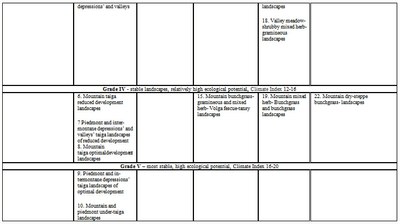
<p>In general, the Baikal basin is dominated by moderately stable and stable landscapes (III-IV points), distributed mainly in the central part of the territory. They are characterized by medium and relatively high ecological potential; the index of biological effectiveness of climate amounts to 8-16. Pseudo-indigenous geosystems with a relatively stable landscape structure predominate.</p>
<p>Landscapes of reduced development of mountain-taiga and taiga intermountain depressions and valleys, having dispersed distributional pattern and occurring in the Selenga-Vitim interfluve and to the north of the Khangai upland, are referred to the stability of III points.</p>
<p>The stability of III points also characterizes piedmont and plain relatively dry and arid steppes. They are located in the Barguzinskaya depression, in hollows of the Trans-Baikal type, to the north of the Khangai upland, and in the surroundings of the Khentei upland.</p>
<p>The group of geoms with the stability of IV points includes mountain-taiga landscapes of restrictive and optimal development, taiga piedmont landscapes of intermontane depressions and valleys of restrictive development, mountain low-bunchgrass and forbs-bunchgrass, and mountain dry steppes. The main areas of development of taiga landscapes of this stability group are low- and middle mountains to the south of the Eastern Sayan, the Primorsky ridge, Selenginskoe middle mountains, Vitimskoe plateau, Olekminsky Stanovik, Khentei-Chikoy upland, and others. Mountain steppes with IV points of stability are most commonly found in the Selenge-Orkhon interfluve.</p>
<p>Landscapes with the highest ecological potential for the region, and TK amounting to 16-20, are classified as the most stable (V points). In the Russian part of the territory, they are landscapes of piedmont and intermountain depressions of optimal development, as well as piedmont subtaiga landscapes. They are found in the Verkhne-Angarskaya and Barguzinskaya depressions, in the Selenga river delta, and in depressions of the Trans-Baikal type. In Mongolia they are represented by mountain subtaiga landscapes, the large area of which is middle and low mountains lying to the north of the Khangai upland in the central part of the basin of the Selenge and Orkhon rivers. The structure of geoms is dominated by pseudo-indigenous and indigenous geosystems. They are the nuclei of the ecological stability and reproduction of the environment [Mikheev, 2001]. In the landscape structure of the region their distribution area is in the transition zone between taiga and steppe landscapes with low background stability.</p>
<p>The conducted mapping of landscape stability is the basis for the assessment of the anthropogenic impact on the environment, and for substantiation of environmentally acceptable nature management in the Baikal basin.</p>
<p><b> </b></p>
<p align="center">References</p>
<p>Landscapes of the south of Eastern Siberia (map, scale 1:1500000). (1977). V.S. Mikheev and V.A. Ryashin. Moscow: GUGK, , 4 sheets.</p>
<p>Landscapes (map, scale 1:3000000) (1990). in <i>National Atlas. Mongolian People's Republic. </i>Ulaanbaatar–Moscow, pp. 83-85.</p>
<p>Mikheev, V.S. (2001). <i>Landscape synthesis of geographic knowledge.</i> Novosibirsk: Nauka, 216 p.</p>
<p><i>Protection of Landscapes. Explanatory Dictionary.</i> (1982). Moscow: Progress, 272 p.</p>
<p>Sochava, V.B. (1978). Introduction to the Theory of Geosystems. Novosibirsk: Nauka, 320 p.</p>
<p>Ecological potential of landscapes (map, scale 1:15000000). (2007). In <i>National Atlas of Russia.</i> Vol 2: Nature and Ecology. Moscow: PKO “Kartografiya”, p. 417.</p>
<p>Ecologo-geographical map (scale 1:15000000). (2007). In <i>National Atlas of Russia.</i> Vol. 2: Nature and Ecology. Moscow: PKO “Kartografiya”, pp. 454-456.</p>]]></content:encoded>
    <dc:publisher>No publisher</dc:publisher>
    <dc:creator>Alexander Ayurzhanaev</dc:creator>
    <dc:rights></dc:rights>
    <dc:date>2014-10-08T01:10:00Z</dc:date>
    <dc:type>Page</dc:type>
  </item>


  <item rdf:about="http://bic.iwlearn.org/en/atlas/atlas/41-physiographic-regionalization-map/physiographic-regionalization-map">
    <title>Physiographic regionalization map</title>
    <link>http://bic.iwlearn.org/en/atlas/atlas/41-physiographic-regionalization-map/physiographic-regionalization-map</link>
    <description></description>
    <content:encoded xmlns:content="http://purl.org/rss/1.0/modules/content/"><![CDATA[<p><img class="image-inline" src="../../../resolveuid/355a4a1876c542bcad6afa5d32ae02a3/@@images/image/preview" /></p>
<p><a href="http://bic.iwlearn.org/en/atlas/photos/copy_of__41_Physiographicregionalization.png" class="internal-link">Open full size</a></p>
<p align="center" class="1CxSpFirst"><b>Physical-geographical regionalization </b></p>
<p align="center" class="1CxSpMiddle"><b>and the landscape-typological structure (40-41)</b><b> </b></p>
<p align="center" class="1CxSpMiddle"><b> </b></p>
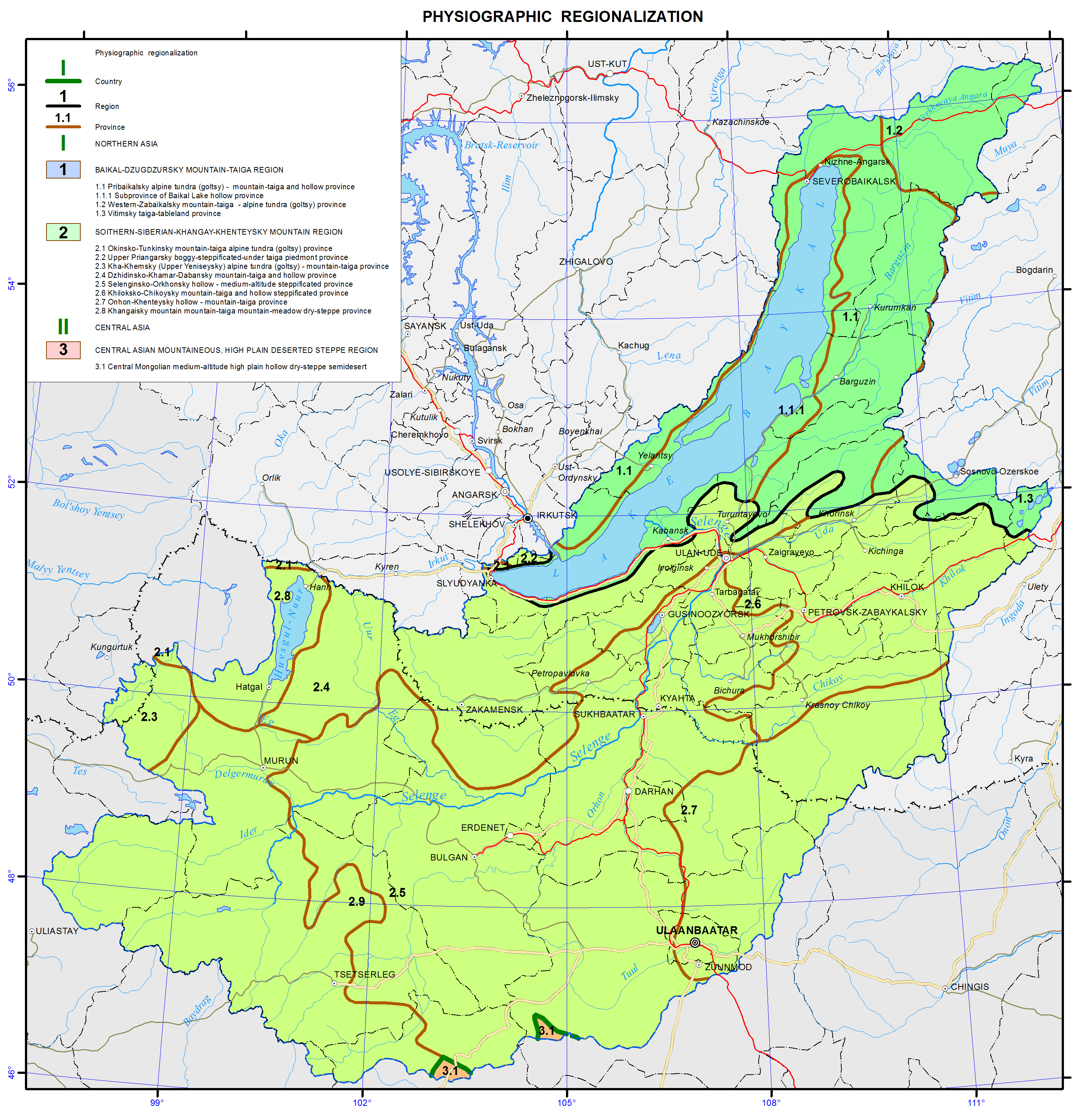
<p class="1CxSpMiddle">The materials presented uniformly consider physical-geographical regionalization and the landscape-typological structure of the Baikal basin. Map compilation was based on the idea of geosystems classification and the resultant works, including cartographic works on physical-geographical differentiation of the territory in the Russian Federation and Mongolia, which are presented below.</p>
<p class="1CxSpMiddle">The boundaries of physical-geographical structures (individual and typological) were integrally positioned on the same topographic base in the Mapinfo environment and verified according to the Landsat 7 multispectral satellite images (2000).</p>
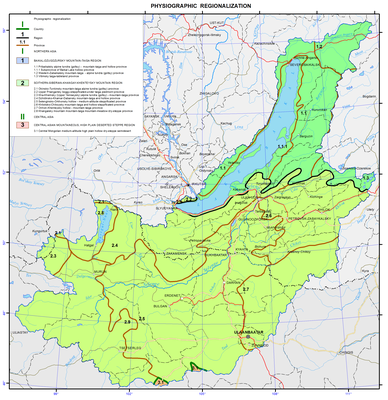
<p class="1CxSpMiddle">The physical-geographical regionalization map reflects individual heterogeneous regional natural formations. The featured physical-geographical regions and provinces characterize the territories with a similar geographical location, manifestation of morphotectonic geological and geomorphological features, latitudinal, vertical and bioclimatic zonation. Physical-geographical regions, countries and provinces are comparable across different research. Mountain areas of North Asian mountain megalocation on the edge sphere of the continent (Baikal-Dzhugdzhurskaya and South-Siberian-Khangai-Khentei) and their contact with the Central Asian desert-steppe region of the Central continental megalocation are presented within this territory. Intraregional differentiation into provinces is related to the specific manifestations of altitudinal differences and geological and geomorphological features in mosaics of geosystem types and their mobile components of soils and vegetation. The map shows three physical-geographical areas and 12 provinces.</p>
<p class="1CxSpMiddle">Landscape-typological structure shows the features of spatial mosaic of individual physical-geographical units, their internal structure of relatively homogeneous combinations of physical-geographical conditions. In accordance with the small scale, 39 geom groups are shown on the map. The geoms are distinguished according to the indicators of topological order, but generalized to the regional level [Sochava, 1978]. They combine topogeosystems of the certain zone or belt (within a physical-geographical region) characterized by similar structural features of soil cover, vegetation and hydrothermal regime. The vegetational component of a geom is adequate to a formation, soil one is close to the subtype of soils, and the climate regime is close to the modification of climate of a subzone, which arose under the influence of the structural properties of other components.</p>
<p class="1CxSpMiddle">Geosystems specific to North and Central Asia form the regional classification range. Their location, interpenetration and uniqueness of landscape situations in the Baikal basin are presented. Regional interpretation of landscape-typological units (geom groups on the geasystem map) characterizes their latitudinal and altitudinal differences, as well as shows their relation to various regional and typological complexes of natural conditions that may be disclosed in detail on a larger display scale of landscape structures and geosystem components.</p>
<p class="1CxSpMiddle">Multiscale mosaic character of the natural-territorial structure determines the landscape complexity of the territory, the local "contrasts" of economic use, and specificity of different local options of development.</p>
<p class="1CxSpMiddle"><b> </b></p>
<p align="center" class="1CxSpMiddle">References</p>
<p class="1CxSpMiddle">Sochava, V.B. (1978). <i>Introduction to the Theory of Geosystems.</i> Novosibirsk: Nauka . Sib. Otd., 320 p.</p>
<p class="1CxSpMiddle">Sochava, V.B. and Timofeev, D.A. (1968). Physical-geographical regions of North Asia. In: <i>Reports of the Institute of Geography of Siberia and the Far East</i>, vol. 19, pp. 3-19.</p>
<p class="1CxSpMiddle">Preobrazhensky, V.S., Fadeev, N.V., Mukhina, L.I., and Tomilov, G.M. (1959). Types of locality and natural zoning of the Buryat ASSR. Moscow: Izd-vo AN SSSR, 219 p.</p>
<p class="1CxSpMiddle">Landscapes of the south of Eastern Siberia. 1:1500000 Map; Physical-geographical regionalization. 1:8 000 000 Map. (1977). Mikheev, V.S., Ryashin, V.A. with the participation of Bogoyavlenskaya, N.G., Vetrova, S.D., Dmitrienko, L.S., Zhitlukhina, T.I., Kosmakova, O.P., Krotova, V.M., Smirnova, D.A. Ed. by V.B. Sochava. Moscow: GUGK, 1977.</p>
<p class="1CxSpMiddle">Mikheev, V.S. (1990). Physical-geographical regionalization. In: <i>Nature and environment protection in the Baikal watershed basin.</i> Novosibirsk: Nauka. Sib. Otd., pp. 21-29.</p>
<p class="1CxSpMiddle">Mikheev, V.S. and Ryashin, V.A. (1967). Landscapes; Physical-geographical regionalization. In: <i>Atlas of Transbaikalia</i>. Moscow-Irkutsk: GUGK, pp.70-71, p. 76, text pp.172-173.</p>
<p class="1CxSpMiddle">Batjargal, B., Mikheev, V.S., and Erdenechimeg, Zh. (1989). Landscapes (map 39, text p.103). Physical-geographical regionalization (map 45, text p.104). In: <i>Atlas of Lake Khovsgol.</i> Moscow: GUGK.</p>
<p class="1CxSpLast">Fadeeva, N.V., Smirnova, E.V., and Tulgaa, Kh. (1989). Landscapes and natural zoning in the atlas of the MPR. In: <i>The National Atlas of the Mongolian People's Republic (problematic and scientific content).</i> Novosibirsk: Nauka. Sib. Otd., pp. 109-125.</p>
<p>Dash, D., Smirnova, E.L., Tulgaa, Kh., and Fadeeva, N.V. (1990). Landscapes and natural zoning. Maps 145, 146 (scale 1:3 000 000) text p. 83. In: <i>The National Atlas of the MPR.</i> GUGK SSSR, GUGK MPR.</p>]]></content:encoded>
    <dc:publisher>No publisher</dc:publisher>
    <dc:creator>Alexander Ayurzhanaev</dc:creator>
    <dc:rights></dc:rights>
    <dc:date>2014-10-08T01:05:00Z</dc:date>
    <dc:type>Page</dc:type>
  </item>


  <item rdf:about="http://bic.iwlearn.org/en/atlas/atlas/40-geosystems-map/geosystems-map">
    <title>Geosystems map</title>
    <link>http://bic.iwlearn.org/en/atlas/atlas/40-geosystems-map/geosystems-map</link>
    <description></description>
    <content:encoded xmlns:content="http://purl.org/rss/1.0/modules/content/"><![CDATA[<p><img class="image-inline" src="../../../resolveuid/9a56821a06e54383a94740636f8c0c85/@@images/image/preview" /></p>
<p><a href="http://bic.iwlearn.org/en/atlas/photos/copy_of__40_Geosystems.png" class="internal-link">Open full size</a></p>
<p class="1" style="text-align: center; "><b>Physical-geographical regionalization </b></p>
<p style="text-align: center; "><b>and the landscape-typological structure</b></p>
<p align="center" class="1CxSpMiddle"><strong> </strong></p>
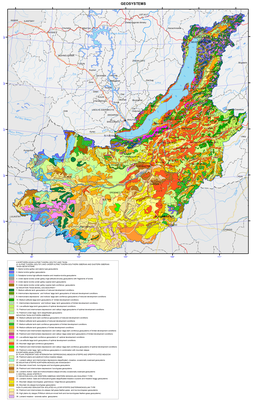
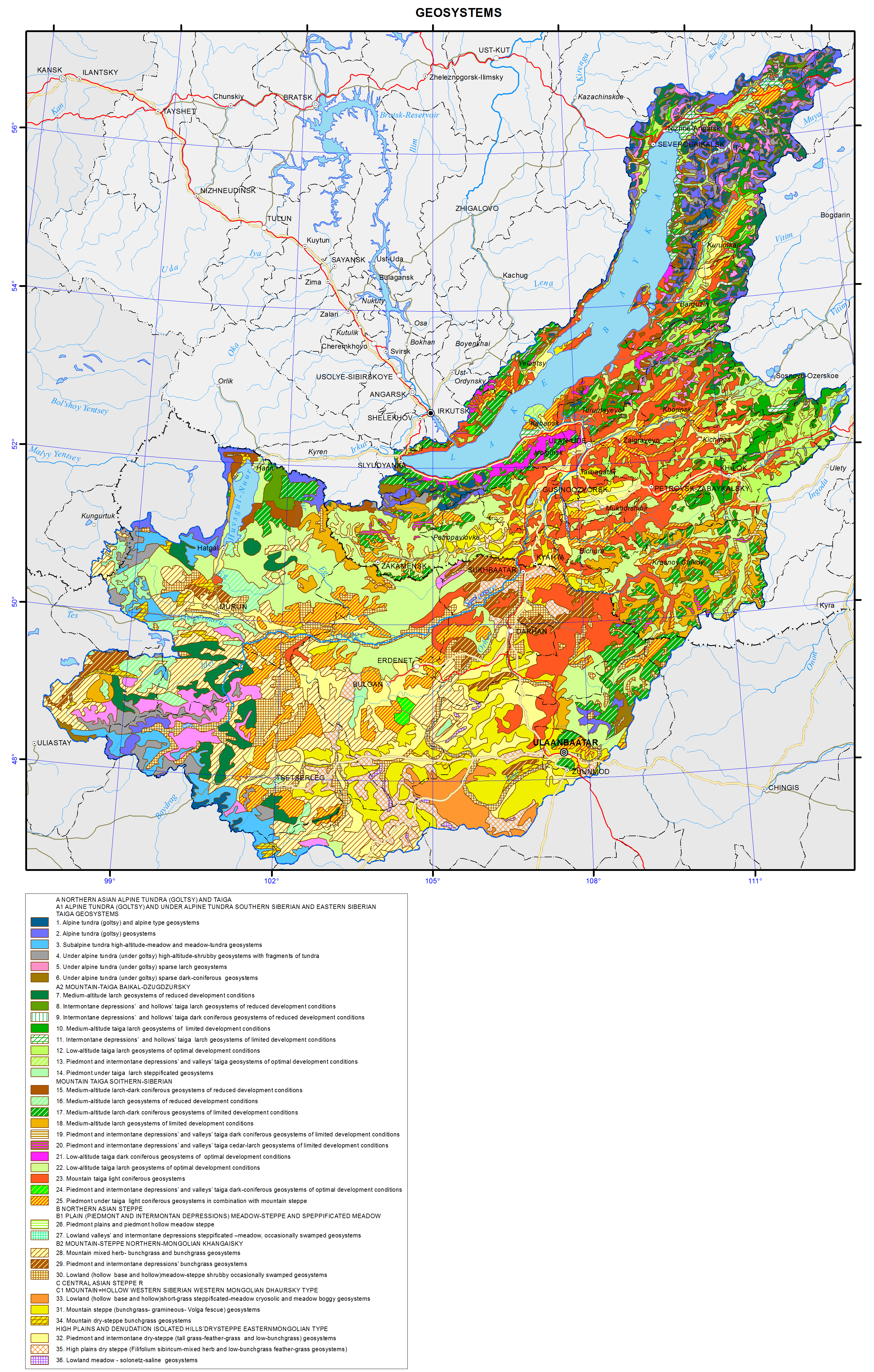
<p class="1CxSpFirst">The materials presented uniformly consider physical-geographical regionalization and the landscape-typological structure of the Baikal basin. Map compilation was based on the idea of geosystems classification and the resultant works, including cartographic works on physical-geographical differentiation of the territory in the Russian Federation and Mongolia, which are presented below.</p>
<p class="1CxSpMiddle">The boundaries of physical-geographical structures (individual and typological) were integrally positioned on the same topographic base in the Mapinfo environment and verified according to the Landsat 7 multispectral satellite images (2000).</p>
<p class="1CxSpMiddle">The physical-geographical regionalization map reflects individual heterogeneous regional natural formations. The featured physical-geographical regions and provinces characterize the territories with a similar geographical location, manifestation of morphotectonic geological and geomorphological features, latitudinal, vertical and bioclimatic zonation. Physical-geographical regions, countries and provinces are comparable across different research. Mountain areas of North Asian mountain megalocation on the edge sphere of the continent (Baikal-Dzhugdzhurskaya and South-Siberian-Khangai-Khentei) and their contact with the Central Asian desert-steppe region of the Central continental megalocation are presented within this territory. Intraregional differentiation into provinces is related to the specific manifestations of altitudinal differences and geological and geomorphological features in mosaics of geosystem types and their mobile components of soils and vegetation. The map shows three physical-geographical areas and 12 provinces.</p>
<p class="1CxSpMiddle">Landscape-typological structure shows the features of spatial mosaic of individual physical-geographical units, their internal structure of relatively homogeneous combinations of physical-geographical conditions. In accordance with the small scale, 39 geom groups are shown on the map. The geoms are distinguished according to the indicators of topological order, but generalized to the regional level [Sochava, 1978]. They combine topogeosystems of the certain zone or belt (within a physical-geographical region) characterized by similar structural features of soil cover, vegetation and hydrothermal regime. The vegetational component of a geom is adequate to a formation, soil one is close to the subtype of soils, and the climate regime is close to the modification of climate of a subzone, which arose under the influence of the structural properties of other components.</p>
<p class="1CxSpMiddle">Geosystems specific to North and Central Asia form the regional classification range. Their location, interpenetration and uniqueness of landscape situations in the Baikal basin are presented. Regional interpretation of landscape-typological units (geom groups on the geasystem map) characterizes their latitudinal and altitudinal differences, as well as shows their relation to various regional and typological complexes of natural conditions that may be disclosed in detail on a larger display scale of landscape structures and geosystem components.</p>
<p class="1CxSpMiddle">Multiscale mosaic character of the natural-territorial structure determines the landscape complexity of the territory, the local "contrasts" of economic use, and specificity of different local options of development.</p>
<p class="1CxSpMiddle"><b> </b></p>
<p align="center" class="1CxSpMiddle">References</p>
<p class="1CxSpMiddle">Sochava, V.B. (1978). <i>Introduction to the Theory of Geosystems.</i> Novosibirsk: Nauka . Sib. Otd., 320 p.</p>
<p class="1CxSpMiddle">Sochava, V.B. and Timofeev, D.A. (1968). Physical-geographical regions of North Asia. In: <i>Reports of the Institute of Geography of Siberia and the Far East</i>, vol. 19, pp. 3-19.</p>
<p class="1CxSpMiddle">Preobrazhensky, V.S., Fadeev, N.V., Mukhina, L.I., and Tomilov, G.M. (1959). Types of locality and natural zoning of the Buryat ASSR. Moscow: Izd-vo AN SSSR, 219 p.</p>
<p class="1CxSpMiddle">Landscapes of the south of Eastern Siberia. 1:1500000 Map; Physical-geographical regionalization. 1:8 000 000 Map. (1977). Mikheev, V.S., Ryashin, V.A. with the participation of Bogoyavlenskaya, N.G., Vetrova, S.D., Dmitrienko, L.S., Zhitlukhina, T.I., Kosmakova, O.P., Krotova, V.M., Smirnova, D.A. Ed. by V.B. Sochava. Moscow: GUGK, 1977.</p>
<p class="1CxSpMiddle">Mikheev, V.S. (1990). Physical-geographical regionalization. In: <i>Nature and environment protection in the Baikal watershed basin.</i> Novosibirsk: Nauka. Sib. Otd., pp. 21-29.</p>
<p class="1CxSpMiddle">Mikheev, V.S. and Ryashin, V.A. (1967). Landscapes; Physical-geographical regionalization. In: <i>Atlas of Transbaikalia</i>. Moscow-Irkutsk: GUGK, pp.70-71, p. 76, text pp.172-173.</p>
<p class="1CxSpMiddle">Batjargal, B., Mikheev, V.S., and Erdenechimeg, Zh. (1989). Landscapes (map 39, text p.103). Physical-geographical regionalization (map 45, text p.104). In: <i>Atlas of Lake Khovsgol.</i> Moscow: GUGK.</p>
<p class="1CxSpLast">Fadeeva, N.V., Smirnova, E.V., and Tulgaa, Kh. (1989). Landscapes and natural zoning in the atlas of the MPR. In: <i>The National Atlas of the Mongolian People's Republic (problematic and scientific content).</i> Novosibirsk: Nauka. Sib. Otd., pp. 109-125.</p>
<p>Dash, D., Smirnova, E.L., Tulgaa, Kh., and Fadeeva, N.V. (1990). Landscapes and natural zoning. Maps 145, 146 (scale 1:3 000 000) text p. 83. In: <i>The National Atlas of the MPR.</i> GUGK SSSR, GUGK MPR.</p>]]></content:encoded>
    <dc:publisher>No publisher</dc:publisher>
    <dc:creator>Alexander Ayurzhanaev</dc:creator>
    <dc:rights></dc:rights>
    <dc:date>2014-10-07T08:30:00Z</dc:date>
    <dc:type>Page</dc:type>
  </item>


  <item rdf:about="http://bic.iwlearn.org/en/atlas/atlas/39-ichthyogeographical-complexes-map/copy_of_39-ichthyogeographical-complexes-map">
    <title>Ichthyogeographical complexes map</title>
    <link>http://bic.iwlearn.org/en/atlas/atlas/39-ichthyogeographical-complexes-map/copy_of_39-ichthyogeographical-complexes-map</link>
    <description></description>
    <content:encoded xmlns:content="http://purl.org/rss/1.0/modules/content/"><![CDATA[<p><img class="image-inline" src="../../../resolveuid/acd3243c328b4c9ca4539d059f86f98c/@@images/image/preview" /></p>
<p><a href="http://bic.iwlearn.org/en/atlas/photos/copy_of__39_Ichthyogeographicalcomplexes.png" class="internal-link">Open full size</a></p>
<p><img class="image-inline" src="../../../../resolveuid/31da5e677e8a4d79aa1a55fc5df80b33/@@images/image/preview" /></p>
<p><a href="http://bic.iwlearn.org/en/photos/copy_of__39_Legend_Ichthyogeographicalcomplexes_1.png" class="internal-link">Open full size</a></p>
<p><img class="image-inline" src="../../../../resolveuid/fb8d6de2d349468384bdac4d232e13c5/@@images/image/preview" /></p>
<p><a href="http://bic.iwlearn.org/en/photos/copy_of__39_Legend_Ichthyogeographicalcomplexes_2.png" class="internal-link">Open full size</a></p>
<p class="a0" style="text-align: center; "><strong>Ichthyofauna</strong></p>
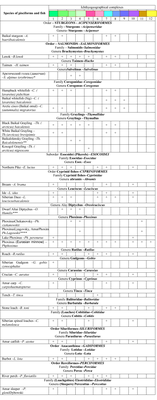
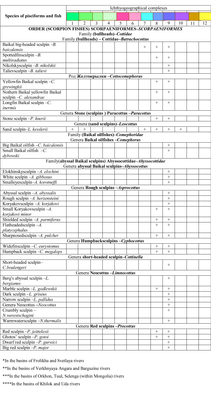
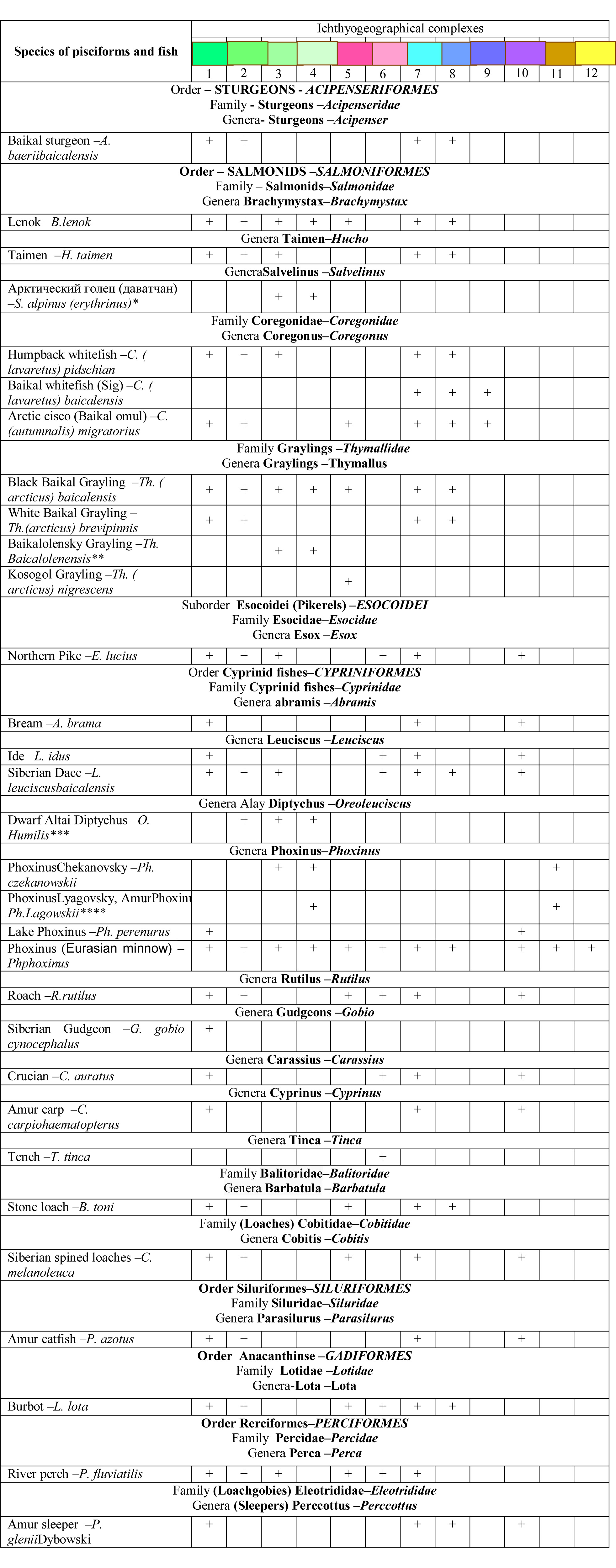
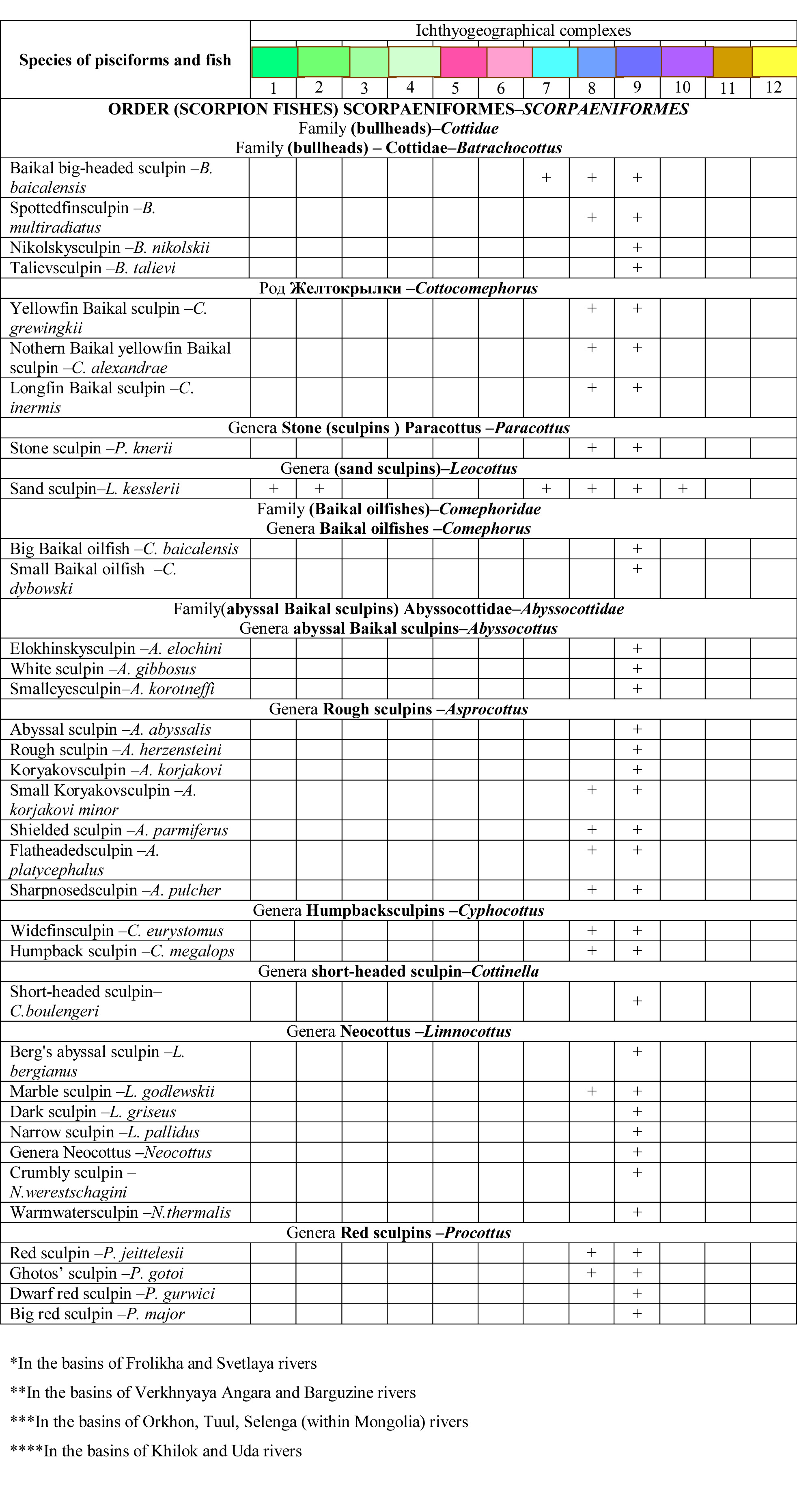
<p>Ichthyofauna of Lake Baikal and its basin comprises 67 species and subspecies including 6 naturalized ones. Within the bounds of the lake 57 species and subspecies are registered. Out of this number 34 are endemic golomyanka-goby fishes (Cottoidei) (Table) [The freshwater fish atlas…, 2003; Fishes of…, 2007; Fishes of the Mongolian…, 1983; Sideleva, 2003]. A certain conventionality in the assessment of the fish population composition according to species and subspecies should be highlighted. In terms of biodiversity such accounting is to an extent justified, but such characterization is insufficient for the assessment of ecosystem’s operation. For instance, omul which occupies a 350-meter water column comprises 3 morphoecological fish groups with various morphological diagnoses, behavior, rates of growth, deposition of fat and breeding grounds. The same can be noted in the case of cisco (3 morphogroups) and black and white graylings.  These are young “endemic” forms. Their age is within the limits of the Holocene, but they are new stable structural-functional formations “in the bioenergetic sense equivalent” to species [Reshetnikov, 1980]. With them considered the total fish composition of the basin increases to 71, and 61 in Lake Baikal. The results of immigration of various fish species in Lake Baikal for naturalization carried out in the 20<sup>th</sup> century testify to the fact that zones of life in the lake and its food supplies are quite rigidly fixed. Out of 33 species and intraspecific forms tested for immigration only the Amur carp, catfish, sleeper and Caspian bream survived in the lake (mostly in its “peripheries”), while peled survived in the lakes of the watershed basin. Rejection of non-Baikal fish species by Lake Baikal was also reflected in the analysis of the causes of “unmixing” of the Baikal fauna with the life around the lake.</p>
<p class="a1">According to current concepts [Vereshchagin, 1935; Kozhov, 1962; Taliev, 1955, etc.], Baikal’s ichthyofauna is divided into two ecologically and genetically diverse complexes: European-Siberian and native Baikal ones. In the recent years the “neoendemics” or new young endemic offshoots of widely spread species have been registered [Timoshkin, 1995].</p>
<p class="a1">The faunal classification by G.V. Nikol’sky (1953, 1980) is usually used in the course of analysis of fish distribution according to their biotope [Kozhov, 1960]. Despite some shortcomings [Sychevskaya, 1983] this classification is rather appropriate for reflecting the ecological specificities of the faunal complexes in the conditions of one and the same water body. It enables to observe their rigid differentiation in Lake Baikal [Mamontov, 1977; Sorokin, Sorokina, 1988].</p>
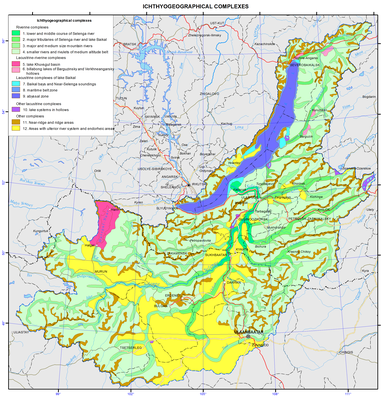
<p class="a1">The ichthyogeographic complexes</p>
<p class="a1"><i>Lake Baikal</i></p>
<p class="a1">1. System of lakes, sors, bays and near-delta shallow waters of Lake Baikal. Inhabits the boreal plain complex – limnophiles of the coastal-sor fish group (roach, perch, pike, orfe, crucian carp, etc.) occupy the entire system of interconnected lakes, bays and sors of Lake Baikal to a depth of 10-50 m. Sturgeon is the only exception for particular distribution to depths of 180 m. In Baikal it occupies an area of limnorheophiles. The lakes near Lake Baikal (Kotokel’, Dukhovoe, and Barmashovoe) can also be included here. Their ichthyofauna composition and productivity are dependent on a degree of their connection with Lake Baikal. The highest productivity occurs with the maximum, but not complete, disjunction with Baikal. Lake Kotokel’, one of the most productive lakes, is inhabited by 15 fish species (catfish, carp, bream, roach-bream hybrid, roach, dace, nerfling, crucian carp, river perch, sand sculpin, and stoneloach).  Lake Barmashovoe, previously uninhabited by fish, is now inhabited by river perch, roach, dace, and pike, which migrated there from sor-lake Arangatuy during water level increase on Lake Baikal [Fishes of…, 2007].</p>
<p class="a0"><i>2. Coastal zone of open Baikal</i>- the boreal piedmont complex - limnorheophiles of littoral and partially sublittoral areas (taimen, grayling, lenok, minnow, loach, etc.) occupy Baikal coastal open waters to a depth of 20-70 m, rarely up to 100 m.</p>
<p class="a0"><i>3. Abyssal zone.</i> Arctic freshwater complex (cisco, lawyer, omul) populate the slope and pelagic zone to a depth of up to 350 m — the Baikal autochthonous complex. It includes endemic Baikal scorpion fish: bullheads, deep dwelling Baikal sculpins and Baikal oilfish (golomyanka) that took the entire water column of the lake with the greatest diversity of benthic forms at depths of 600-700 m.</p>
<p class="a0">Due to the fact of high capacity of proper Baikal conditions qualitative changes in fish caused quantitative expression: higher environmental capacity corresponds to the density of endemic fish population (about 65 % of the fish biomass of the lake). This complex becomes the main one ensuring successful existence of the first three, including the Baikal seal, owing to fish diet [Sideleva, 2003].</p>
<p class="a">A complex set of species of different faunal assemblages and goby fish has led to a number of features in the structure of the fish community of Lake Baikal. According to the nature of habitat and behavior of species the Baikal communities include features of ocean ecotone communities, and according to the type of population dynamics (explosive nature) and to the composition they correspond to the Siberian biocoenoses [Mamontov, 1977].</p>
<p class="a">By the abundance of fish Baikal belongs to the golomyanka-goby fish type of a water body [Koryakov, 1972]. Success in assimilating the biotic and abiotic environment of Baikal by fish species of this complex lies primarily in their original biological qualities – absence of a swim bladder (and therefore availability to the deep-dwelling habitation), increased fertility, protection of spawn, occupation of all zones for spawning within the open Baikal, and finally, removal of the embryonic development of eggs in golomyankas in pelagic zone - in the body of a female, functioning as spawning substrate [Chernyaev, 1973, 1974]. These issues are important in theoretical and practical investigations of fish fauna and its rational use.</p>
<p class="a">Increase in the number of individuals in a behavior homogeneous group leads to their increased consumption, and in the future to an increase in the population, group or other biological heterogeneity, reducing predation pressure on certain groups. This developmental pattern became widespread among Baikal slow-moving benthic organisms. The development of variability of morphological characters, color and behavior accelerated their speciation. Among 34 endemics, 28 (82.5 %) are typically benthic forms.</p>
<p class="a1">Necessity of multivariancy of individuals in a population of the pelagic fish group weakens due to the formation of a high population size of the few species with small size of their body. This vector of species evolution became possible on the basis of the pelagic larval-fry stage which contributed to dispersal and acquisition of the entire littoral zone for spawning. They include sand sculpin and yellowfin Baikal sculpin. These species occupied biotopes from the shore area to a depth of 500-700 m. Further oecizing of Lake Baikal was feasible due to vivaparity of Baikal oilfish [Taliev, 1955; Chernyaev, 1973]. As a result it became possible to disseminate fry within the confines of general currents facilitating its dispersal in the water area and to settle practically the entire water column. By the number and rate of reproduction, pelagic species prevail over other species so much that they are used in the diet of Baikal seals (nerpa) and almost all the fish of the lake, including cannibalism of gobies themselves on their own fry. This leads to the populating of Lake Baikal by fish of the common Siberian complex and the entire Lake Baikal’s ecosystem stability in time.</p>
<p class="a1">River and lake systems of the basin reflect the interchange of mountain and plain spaces. They are inhabited by interpenetrating species of the boreal piedmont, boreal plain and Arctic freshwater complex of the Arctic province. The contemporary Arctic ichthyofauna is a derivate of a more thermophilic Neogen Euro-Siberian ichthyofauna that existed in the temperate zone of Eurasia. Its modern distribution is defined by a sharp differentiation of landscape and drainage system following the Alpine orogeny at the boundary of the Pliocene and the Pleistocene accompanied by a more pronounced delimitations of climatic zones [Sychevskaya, 1983].</p>
<p class="a1">Water bodies of the watershed area are inhabited by 33 species, including 27 species in the Selenga river (20 local species, two Baikal endemics, six natiralized species and dwarf Altai osman that has recently penetrated the Selenga river basin), and nine species in Lake Khovsgol, including the endemic Kosogol grayling and naturalized Baikal omul. The endemic Baikal-Lena grayling was detected in the fluviolacustrine system of northern mountain streams, while in the Upper Kichera lakes an isolated population of coastal-pelagic omul and homotypical ichthyocenoses formed by the Baikal-Lena grayling and Arctic char (Verkhneuyakchinskie lakes) (Table) [Fishes of Lake…, 2007]. <i></i></p>
<p class="a1"><i>4. Lower and upper courses of the Selenga river </i>– packings and spawning migrations of omul, sturgeon and Siberian whitefish, habitation and spawning of Siberian whitefish, graylings, lenok, burbot, taimen, dace, roach, pike, etc.</p>
<p class="a1"><i>5. Large tributaries of the Selenga river and of Lake </i>Baikal – packings and migration of omul, lenok, grayling, taimen, burbot, dace, carp, bream, dwarf osman, etc. <i></i></p>
<p class="a1"><i>6. Large and medium mountain streams and drainage high altitude </i>lakes – habitation of grayling, lenok, taimen, common minnow, spined loach, Siberian stone loach, dace, perch, roach and pike. The Upper Kichera lakes, Kulinda and Verkhnekicherskoe – habitation of omul, pike, burbot, Siberian stone loach, grayling, sand sculpin, stone sculpin, and common minnow. Svetlinskoe lake – habitation of three species: Arctic char, common minnow and Siberian stone loach. Lake Frolikha – 11 species, including lenok, Arctic char, grayling, pike, roach, perch, burbot, lake minnow and common minnow, spined loach, sand sculpin and stone sculpin. The Verkhneyakchinskie lakes (the Yakchai river) – habitation of Arctic char (small and dwarf) in one lake and one species of Baikal-Lena grayling in the other. <i></i></p>
<p class="a1"><i>7. Small streams and creeks of the medium-altitude mountain </i>belt – possible habitation of minnows and temporary entries of grayling for spawning. <i></i></p>
<p class="a1"><i>8. Lake system of the hollows </i>– water bodies diversified in size, hydroclimatic conditions and fish composition. A cluster analysis of interrelationship of fish species was carried out in order to characterize Transbaikalian ichthyocenoses [Biodiversity…, 1999]. Two fish complexes determine the ichthyocenoses structure of the lakes: 1 – roach, perch and pike; 2 – lenok and grayling. Other fish species have subdominant value and build up the distinctness of communities. The first complex is connected with the lake limnogenesis processes, while the second – with the tectonic processes, specific for the Baikal type intermontane hollows. The Eravna lakes: in the Shchuchye lake (one of the Eravna lakes) there are peled, perch, roach and pike. Fishes from this lake underwent a thorough study of their productional characteristics. The results were used for the analysis of fishes in the water bodies of the Eravna-Kharginsk lake system. The Gusino-Ubukinskaya group, small water bodies (roach-perch lake Shchuch’e, crucian carp lakes Kamyshovoe, Krugloe, Chernoe, and perch-dace Abramovskoe lake). The total of 10 species registered: Amur sleeper, sand sculpin, spined loach, perch, burbot, lake minnow, crucian carp, dace, roach, peled and omul. Lake Gusinoe is the largest one. It is inhabited by 22 species: taimen, lenok, carp, bream, Amur catfish and Amur sleeper and farmed omul and peled. The Ivano-Arakhlei lakes (Arakhlei, Shaksha, Undugun, and Irgen) are inhabited by 16 species. Mostly they are pike, roach, dace, crucian carp, European cisco, peled and omul.<i></i></p>
<p class="a1"><i>9. Meander lakes of the Verkhneangarskaya and Barguzinskaya hollows.</i> The major lake complexes host 15 to 20 species, such as roach, perch, pike, nerfling, crucian carp, tench, carp, catfish, bream and others. There are about 7000 lakes in the Upper Angara and Kichera basins. The largest one is the eutrophic Irkana lake hosting nine species, such as roach, perch, pike, crucian carp, dace, nerfling, lake minnow, burbot and tench. The Barguzin basin lakes (4918 lakes) are inhabited by 19 fish species. In the upper course (mesotrophic) lakes there are taimen, lenok, grayling, common minnow, burbot, sand sculpin, Siberian spined loach and stoneloach. In the middle course (eutrophic) lakes there are pike, roach, perch, nerfling, crucian carp, bream, burbot, catfish, tench, carp, lake minnow, etc. In the lower course eutrophic lakes there are pike, roach, perch, dace, nerfling, crucian carp, catfish and lake minnow.<i></i></p>
<p class="a1"><i>10. Ichthyocenosis of Lake Khovsgol.</i> Nine species. The species composition has been forming since the post-glacial period. In 1957 the Baikal omul was introduced. Nowadays the water body is characterized as the lenok-grayling type of water bodies [Tugarina, 2002; Fishes…, 1983]. The majority of fishes inhabit coastal areas (grayling dwells at depths down to 25 meters, burbot – down to 30 meters) with the highest concentration in the bay and the mouth of the Khankh-Gol river. In 1957 10 million Baikal omul eggs were additionally incubated in the mouth of the Ikh- Khankh-Gol river by Professor A. Dashidorzhi of the Mongolian University. The first omul was detected in the mouth of the Ikh-Khankh-Gol river in 1971. Beyond the bay area omul has not yet been detected. Lenok inhabits the depths of 7 to 12 meters. Habitation limits in the open littoral of the western shore are confined to the 25-30 meter isobaths. The generative river form of grayling inhabits the area from the edge of water to the 25-30 meter isobaths while the generative lake form reaches down to the 80-100 meter isobaths. The roach habitation zone is limited to depths of down to 15 meters. Minnow inhabits the shore edge down to the depth of 1-1.5 meters while stoneloach – down to 1-1.3 meters. These are usually backwaters. Siberian spine loach inhabits the areas with sand and slimy ground down to the depths of 3 to 5 meters. Perch is common in the littoral at the depths down to 10-15 meters. Burbot is common everywhere within the depths of down to 40 and rarely 70 meters. All deep tributaries of Lake Khovsgol are mainly used as spawning grounds of lenok, grayling, burbot, etc. The meander lakes of the Ikh-Khoroo-Gol and Egiin-Gol rivers as well as the Ongolik Bay are the spawning grounds of perch, roach and minnow. <i></i></p>
<p class="a1"><i>11. Near water-divide and water-divide areas.</i> Small fishless lakes.<i></i></p>
<p class="a1"><i>12. Territories with ulterior river net and closed drainage areas</i> are located beyond the limits of the ichthyogeographic complexes.<i> <b></b></i></p>
<p align="center" class="a1">References:</p>
<p class="a1"><i>The freshwater fish atlas of Russia : 2 vols.</i> (2003). / ed. Yu.S. Reshetnikov, Moscow: Nauka, Vol. 1 379 p., vol 2. 253 p.</p>
<p class="a1">Korsunov, V.M., Pronin, N.M., Gonchikov, G.G. et al. (1999). <i>Biodiversity of the Baikal Siberia</i>, Novosibirsk: Nauka, 350 p.</p>
<p class="a1">Vereshchagin, G.Yu. (1935). The two typobiological complexes of Baikal. <i>Trudy Limnologicheskoi stantsii</i>, vol. 6., pp. 199-212.</p>
<p class="a1">Kozhov, M.M. (1962). <i>Biology of Lake Baikal</i>, Moscow: Izd-vo AN SSSR,  315 p.</p>
<p class="a1">Koryakov, E.A. (1972). <i>The pelagic gobies of Baikal</i>, Moscow: Nauka, 1972, 155 p.</p>
<p class="a1">Mamontov, A.M. (1977). Ichthyocenoses, their dynamics and production. <i>Limnology of the coastal-sor zone of Baikal</i>, ed. by corr. member of the Academy of Sciences of the USSR N.A. Florensov. Novosibirsk: Nauka, pp. 263-288.</p>
<p class="a1">Nikol’skiy, G.V. (1953). <i>On the biological specifics of the faunal complexes and the significance of their analysis for zoogeography</i>, Moscow-Leningrad, pp. 65-76. .</p>
<p class="a1">Nikol’skiy, G.V. (1980). The species structure and tendencies of fish variability, Moscow: Pishchevaya promyshlennost’, 183 p.</p>
<p class="a1">Pronin, N.M., Matveev, A.M., Samusenok, V.P. et al., <i>Fishes of Lake Baikal and its basin</i>, Ulan-Ude: Izd-vo BNTs SO RAN, 2007, 284 p.</p>
<p class="a1">Reshetnikov Yu.S. (1983). <i>The ecology and classification of the Coregonidae</i>, Moscow: Nauka, 301 p.</p>
<p class="a1"><i>Fishes of the Mongolian Peoples’ Republic. </i>(1983). Moscow: Nauka, 277 p.</p>
<p class="a1">Sideleva, V.G. (2003). <i>The endemic fish of Lake Baikal,</i> Backhuys Publishers, Leiden, 270 p.<b></b></p>
<p class="a1">Sorokin, V.N., Sorokina, A.A., (1988). <i>Biology of the commercial fishes of Baikal</i>, Novosibirsk: Nauka, 214 p.</p>
<p class="a1">Sychevskaya, E.K. (1983). History of formation of Mongolia’s ichthyofauna and problem of faunal complexes, <i>Fishes of the Mongolian Peoples’ Republic</i>, Moscow: Nauka, pp. 225-249.</p>
<p class="a1">Taliev, D.N. (1955). <i>Bullheads (Cottoidei) of Baikal</i>, Moscow-Leningrad: Izd-vo AN SSSR, 602 p.</p>
<p class="a1">Timoshkin, O.A. (1995). Biodiversity of Baikal faunas: contemporary level of knowledge survey and study prospects, <i>Atlas and field guide of Baikal pelagobionts</i>, Novosibirsk: Nauka. Sib. Otd-nie, pp. 25-52.</p>
<p class="a1">Tugarina, P. Ya. (2002). <i>Fish ecology of Lake Khubsugul and their fishery potential,</i> Irkutsk: Izd-vo Irkutskogo gos. un-ta, 209 p.</p>
<p class="a1">Chernyaev, Zh.A. (1973). On the genesis of the Baikal bullheads (Cottoidei), <i>Zool. zhurn.</i>, vol. 52, #3, pp. 452-453, .</p>
<p>Chernyaev, Zh.A. (1974). The Morphoecological peculiarities of reproduction and development of big Baikal oilfish Comephorus baicalensis (Pallas), <i>Vopr. ikhtiologii</i>, 14(6), p. 990-1003.</p>]]></content:encoded>
    <dc:publisher>No publisher</dc:publisher>
    <dc:creator>Alexander Ayurzhanaev</dc:creator>
    <dc:rights></dc:rights>
    <dc:date>2014-10-07T08:20:00Z</dc:date>
    <dc:type>Page</dc:type>
  </item>


  <item rdf:about="http://bic.iwlearn.org/en/atlas/atlas/38-taxonomic-diversity-map/taxonomic-diversity-map">
    <title>Taxonomic diversity map</title>
    <link>http://bic.iwlearn.org/en/atlas/atlas/38-taxonomic-diversity-map/taxonomic-diversity-map</link>
    <description></description>
    <content:encoded xmlns:content="http://purl.org/rss/1.0/modules/content/"><![CDATA[<p><img class="image-inline" src="../../../resolveuid/6668b307b7f54a229157a9ca26fee3b4/@@images/image/preview" /></p>
<p><a href="http://bic.iwlearn.org/en/atlas/photos/copy_of__38_Taxonomicdiversity.png" class="internal-link">Open full size</a></p>
<p align="center"><strong>Taxonomic diversity of soil biotic communities</strong></p>
<p align="center"><strong> </strong></p>
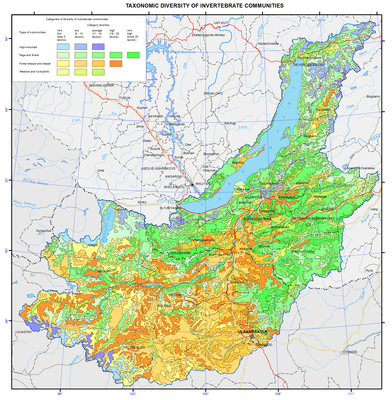
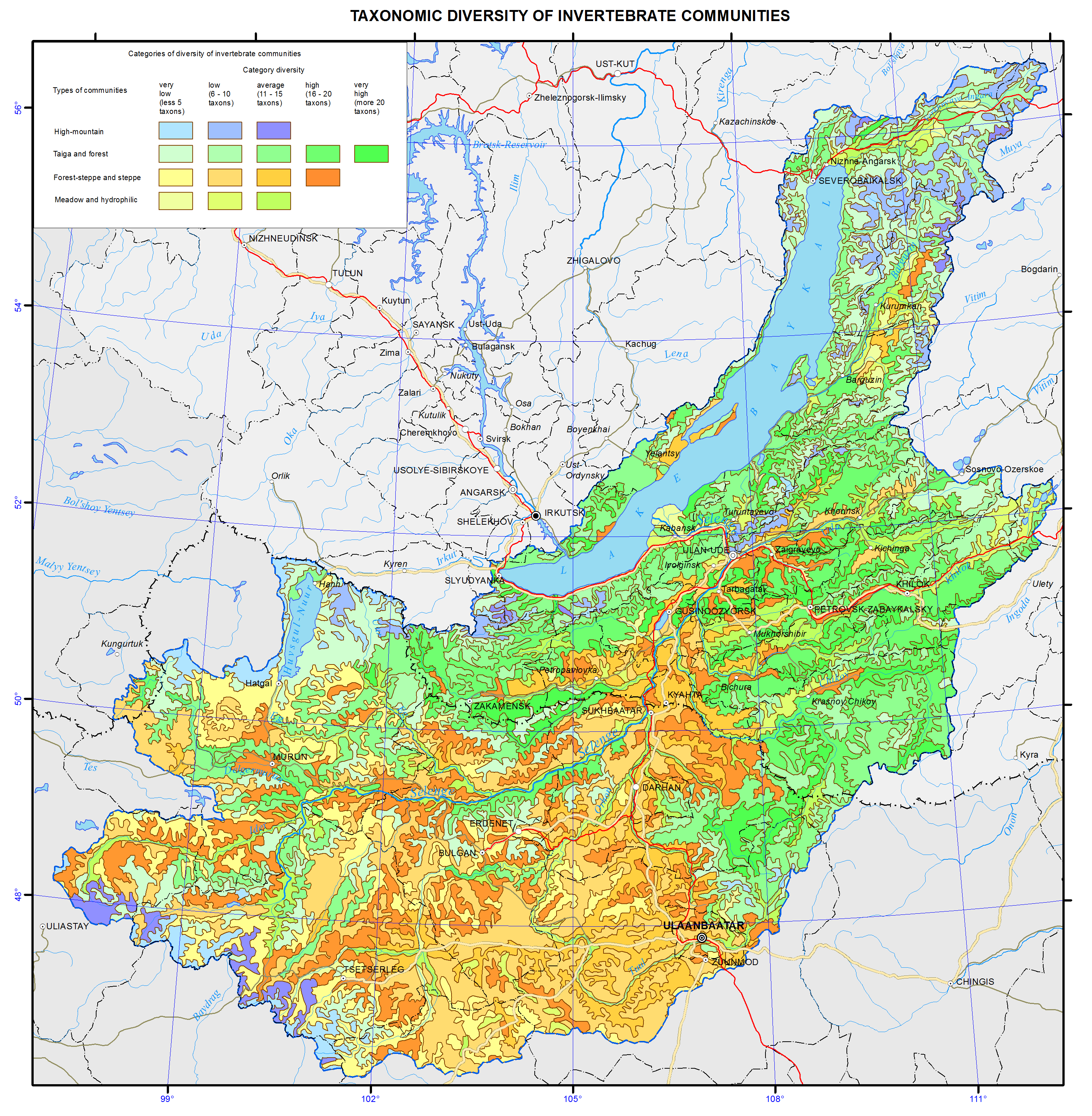
<p>Cartographic analysis of the spatial distribution of taxonomic diversity of invertebrate communities was carried out on the basis of the vegetation map of the Baikal basin.</p>
<p>The object of the analysis is the species (taxonomic) diversity of terrestrial invertebrates, forming community and having systemic and functional relationships. The main focus is on the mesopopulation (supraspecific taxonomic level), i.e. on relatively large invertebrates inhabiting soil and its surface.</p>
<p>The data were obtained as a result of a detailed study of the quantitative characteristics of invertebrate communities on key testing areas in taiga, mountain taiga and steppe geosystems of the Baikal basin. Numerous published and cartographic materials, information on soil cover and vegetation state were analyzed, and data on the heat and moisture supply to soils are taken into account. A method of soil-zoological and biogeocenotic studies with the application of the comparative-geographical approach was used in formulating and carrying out the work. Opportunities of landscape indication, based on theoretical concepts about the relation and interdependence of all natural components within a certain genetically homogeneous space, were used to compile map models of distribution of soil-biotic communities.</p>
<p>The structure of the animal population corresponding to the specific range of edaphic conditions ensuring normal functioning of soil organisms, was interpreted from the standpoint of the landscape-typological approach, i.e. correlation and subsequent identification (experimentally) of soil invertebrates in specific conditions of their habitat.</p>
<p>Spatial patterns of change in species diversity in gradients of environmental factors such as altitudinal zonality, temperature regime and moisture content of soil were identified on the most well-studied model groups of invertebrates in the Baikal region, namely, the representatives of the Lumbricidae, Carabidae, Staphylinidae, and Elateridae families.</p>
<p>As a result of a unified research methodology the communities of terrestrial invertebrates were united into four groups: alpine, taiga and forest, forest-steppe and steppe, and meadow and hydrophilic. Five categories of diversity of the structure were identified in each group according to the number of taxonomic units in a community: 1 - very low diversity (less than 5 taxa), 2 - low (6-10 taxa), 3 - medium (11-15 taxa), 4 - high (16-20 taxa), and 5 - very high (more than 20 taxa).</p>
<p>On the basis of the structural-dynamic analysis of differences in habitats and corresponding invertebrate complexes on the macrogeographical level, two main types of community structure are distinguished: mesothermohygrophile with a relatively small fraction of insects and a large fraction of annelids, and xeroresistant with significant participation of the class of insects. The first type includes zoocomplexes of taiga, forest and meadow biogeocenoses, represented mainly by moisture-loving forms, and the second one includes zoocomplexes of steppificated, steppes and radically anthropogenically disturbed biogeocenoses, dominated by insects with relatively short development cycles and largely adapted to moisture deficit. This corresponds to two main types of natural environment: of excess moisture - taiga with humid climate, and insufficient moisture - steppe with semihumid climate.</p>]]></content:encoded>
    <dc:publisher>No publisher</dc:publisher>
    <dc:creator>Alexander Ayurzhanaev</dc:creator>
    <dc:rights></dc:rights>
    <dc:date>2014-10-07T08:15:00Z</dc:date>
    <dc:type>Page</dc:type>
  </item>


  <item rdf:about="http://bic.iwlearn.org/en/atlas/atlas/37-soil-ecological-zoning-map/soil-ecological-zoning-map">
    <title>Soil-ecological zoning map</title>
    <link>http://bic.iwlearn.org/en/atlas/atlas/37-soil-ecological-zoning-map/soil-ecological-zoning-map</link>
    <description></description>
    <content:encoded xmlns:content="http://purl.org/rss/1.0/modules/content/"><![CDATA[<p><img class="image-inline" src="../../../resolveuid/e8259fb0bde84f5aabbe4c59eb83a14e/@@images/image/preview" /></p>
<p><a href="http://bic.iwlearn.org/en/atlas/photos/copy_of__37_Soilecologicalzoning.png" class="internal-link">Open full size</a></p>
<p><img class="image-inline" src="../../../resolveuid/39480f2187c8419ba823dbf6f4969ec0/@@images/image/preview" /></p>
<p><a href="http://bic.iwlearn.org/en/atlas/photos/copy_of__37_Legend_Soilecologicalzoning.png" class="internal-link">Open full size</a></p>
<p align="center" class="normalnavy"><strong>Soil-ecological zoning</strong></p>
<p align="center" class="normalnavy"><strong> </strong></p>
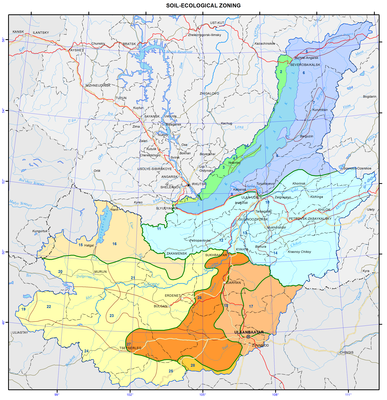
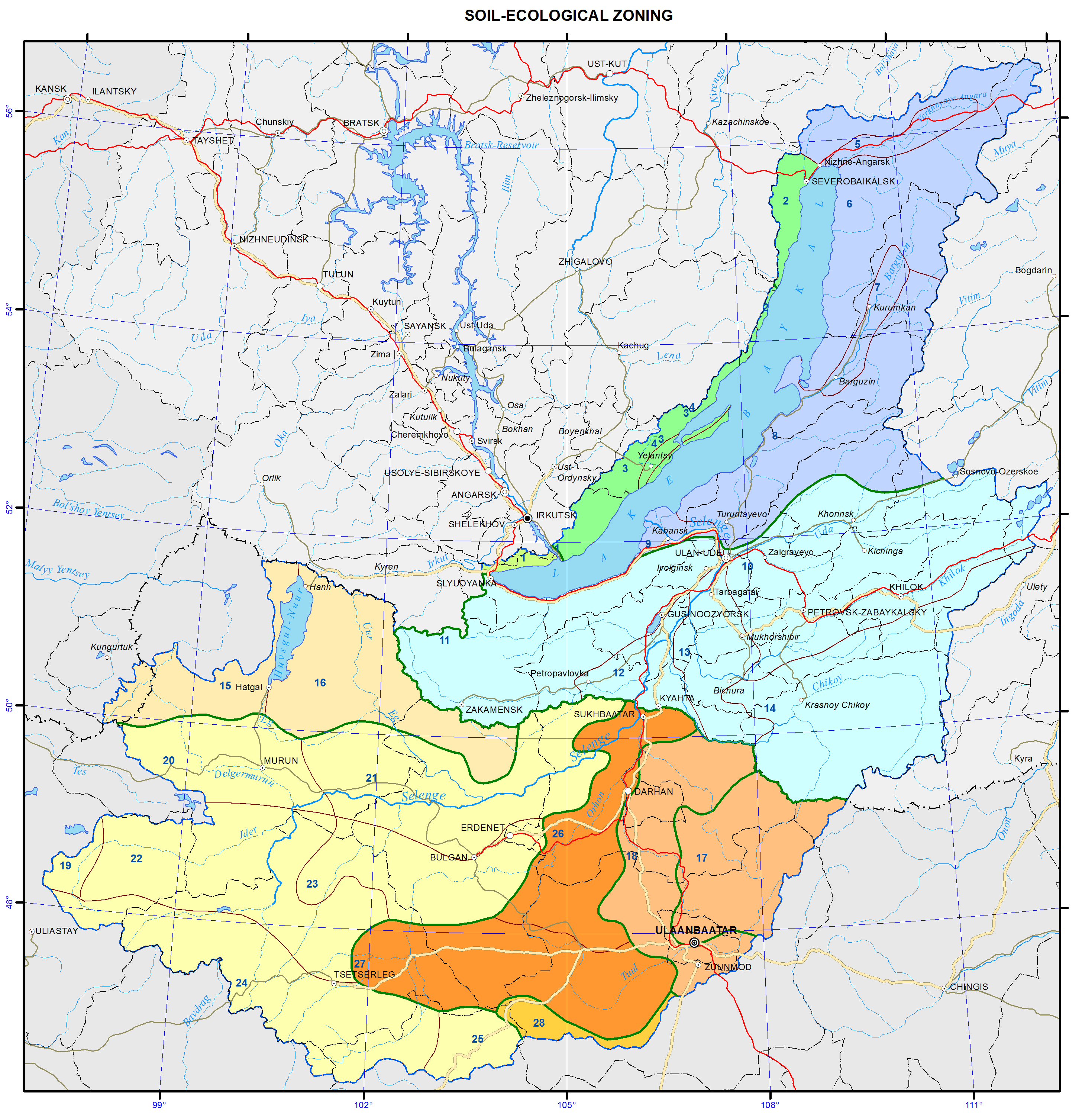
<p class="normalnavy">The principles of “Soil-ecological zoning of Irkutsk oblast” [Kuzmin, 2004], “Soil zoning of the Baikal region” [Kuzmin, 1993], and “Soil-geographical zoning of Mongolia” [Dorzhgotov, 2010], the map of the soil cover, information on soils, their connections with the natural conditions, obtained as a result of the in-house long-term research, and materials on geology, topography, and other natural components were used when developing the zoning.</p>
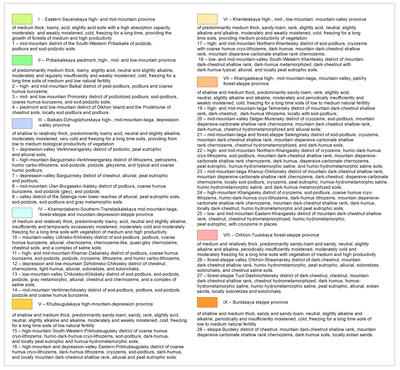
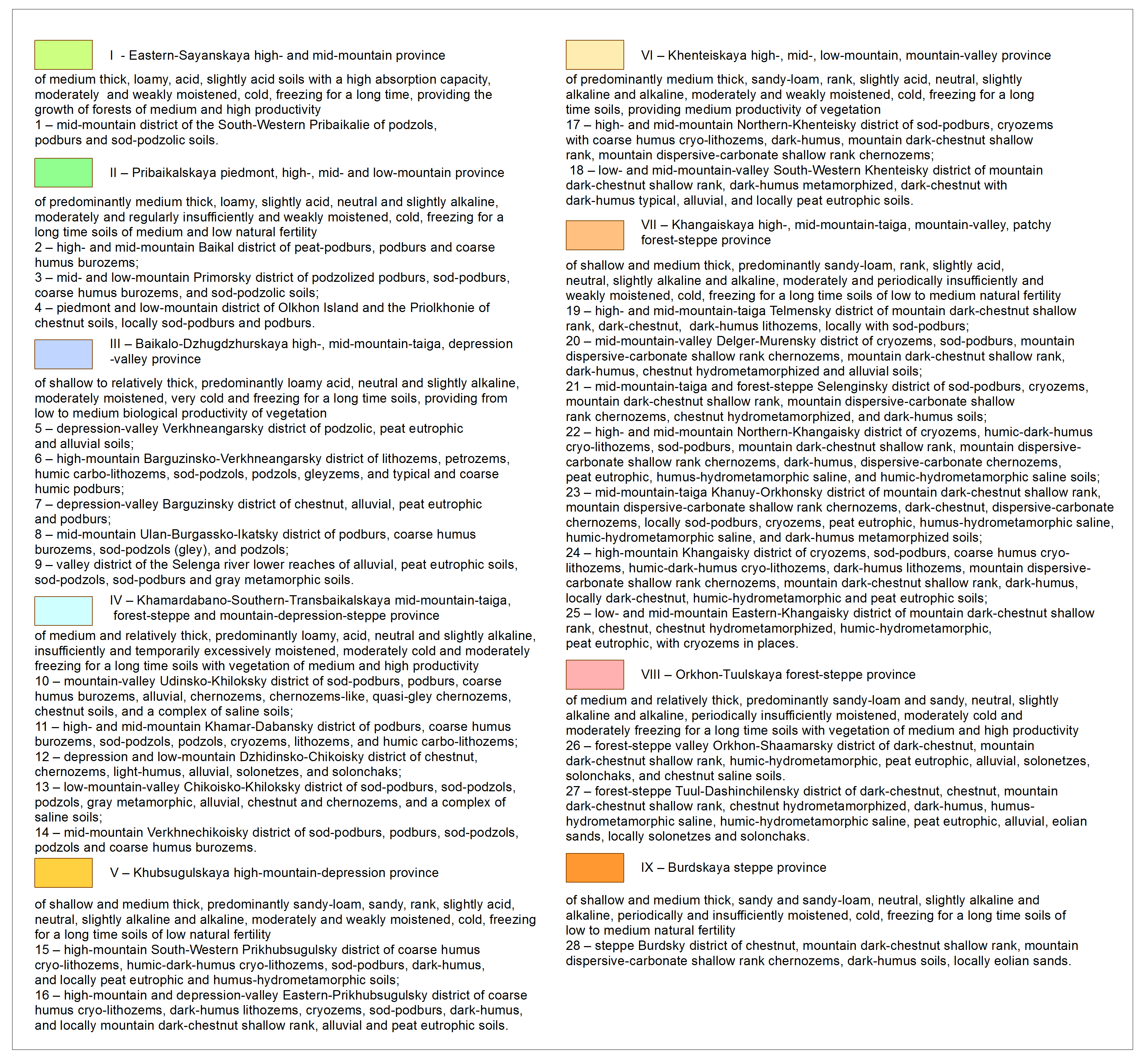
<p class="normalnavy">In the map of the soil-ecological zoning, nine provinces are singled out, reflecting the peculiarity of the surface topography, since the ratio of the heat and moisture balance, which serves as the basis for zoning, manifests itself against the background of the complex orography. Here bioclimatic factors play a key role. Twenty-eight districts are distinguished in the provinces according to the lithologic-geomorphological features. From the standpoint of the structural approach, the districts are regarded as territories with a specific regular change of several types of the soil cover structure, associated with the features of terrain and parent rocks.</p>
<p class="normalnavy">The complex of all natural conditions that influence the formation of the soil cover is taken into consideration in the soil-ecological zoning. Connections of soils with other components of the landscape are identified. It is necessary to consider regional features of the soil cover when planning the distribution of agricultural production, while knowledge of the interrelations of soils with the natural conditions is essential to develop the measures aimed at avoidance of negative consequences of the anthropogenic impact.</p>
<p class="normalnavy">The maps of soil cover can be used as independent scientific works, characterizing the soil cover of the area, which is an important component of the landscape, as a starting material for the soil (land) resources accounting, as a support material for planning the chemicalization of the agricultural production, agroforestal and erosion control measures, development of forest resources, environmental protection, as a basis for various types of zoning, and as a manual for students of higher education institutions.</p>
<p class="normalnavy"><b> </b></p>
<p align="center" class="normalnavy">References</p>
<p>Dorjgotov, D. and Batkhishig, O. (2009). Soils. Soil-geographical zoning of Mongolia, in <i>National Atlas of Mongolia</i>, Ulaanbaatar, pp. 120-122.</p>
<p>Dorjgotov, D. (1976). <i>Soil classification </i><i>of </i><i>Mongolia</i>.Ulaanbaatar, 170 p.</p>
<p>Dorjgotov, D. (2003). <i>Soils of Mongolia</i><i>.</i>Ulaanbaatar, 370 p.</p>
<p class="normalnavy"><i>Classification and Diagnostics of Soils of Russia.</i> (2013). Authors and compilers: Shishov, L.L., Tonkonogov, V.D., Lebedeva, I.I., and Gerasimova, M.I. Moscow: V.V. Dokuchaev Soil Science Institute RAAS,  <a href="http://soils.narod.ru/obekt/obekt.html">http://soils.narod.ru/obekt/obekt.html</a>.</p>
<p class="normalnavy">Kuzmin, V.A. (2004). <i>The soil cover. Soil-ecological zoning of Irkutsk oblast, in Atlas of Irkutsk Oblast,</i> pp. 40-41.</p>
<p class="normalnavy">Kuzmin, V.A. ( 1993). Soil zoning, in <i>Atlas of Baikal</i>, p. 130.</p>
<p class="normalnavy">Ubugunov, L.L., Ubugunova, V.I., Badmaev, N.B., Gyninova, A.B., Ubugunov, V.L., and Balsanova, L.D. (2012). Soils of Buryatia: diversity, taxonomy and classification, in  <i>Bulletin of the V.R. Filippov Buryat State Academy of Agriculture,</i> <a href="http://elibrary.ru/contents.asp?issueid=1019009&amp;selid=17784130">no. 2</a>, pp. 45-52.</p>
<p>Shishov, L.L., Tonkonogov, V.D., Lebedeva, I.I., and Gerasimova, M.I. (2004). <i>Classification and diagnostics of soils of Russia. </i>Smolensk: Izd-vo Oikumena, 342 p.</p>]]></content:encoded>
    <dc:publisher>No publisher</dc:publisher>
    <dc:creator>Alexander Ayurzhanaev</dc:creator>
    <dc:rights></dc:rights>
    <dc:date>2014-10-07T08:10:00Z</dc:date>
    <dc:type>Page</dc:type>
  </item>


  <item rdf:about="http://bic.iwlearn.org/en/atlas/atlas/36-stability-of-soils-map/stability-of-soils-map">
    <title>Stability of soils map</title>
    <link>http://bic.iwlearn.org/en/atlas/atlas/36-stability-of-soils-map/stability-of-soils-map</link>
    <description></description>
    <content:encoded xmlns:content="http://purl.org/rss/1.0/modules/content/"><![CDATA[<p><img class="image-inline" src="../../../resolveuid/ceda1ca4ff4e474a8eab0d83c596e2ea/@@images/image/preview" /></p>
<p><a href="http://bic.iwlearn.org/en/atlas/photos/copy_of__36_Stabilityofsoils.png" class="internal-link">Open full size</a></p>
<p style="text-align: center; "><b><a href="http://bic.iwlearn.org/en/atlas/photos/copy_of__36_Stabilityofsoils.png" class="internal-link"></a><span>Soil stability</span></b></p>
<p align="center"><strong> </strong></p>
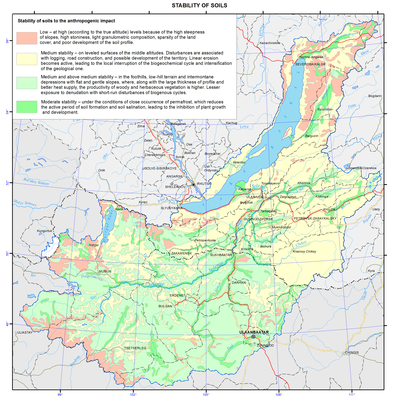
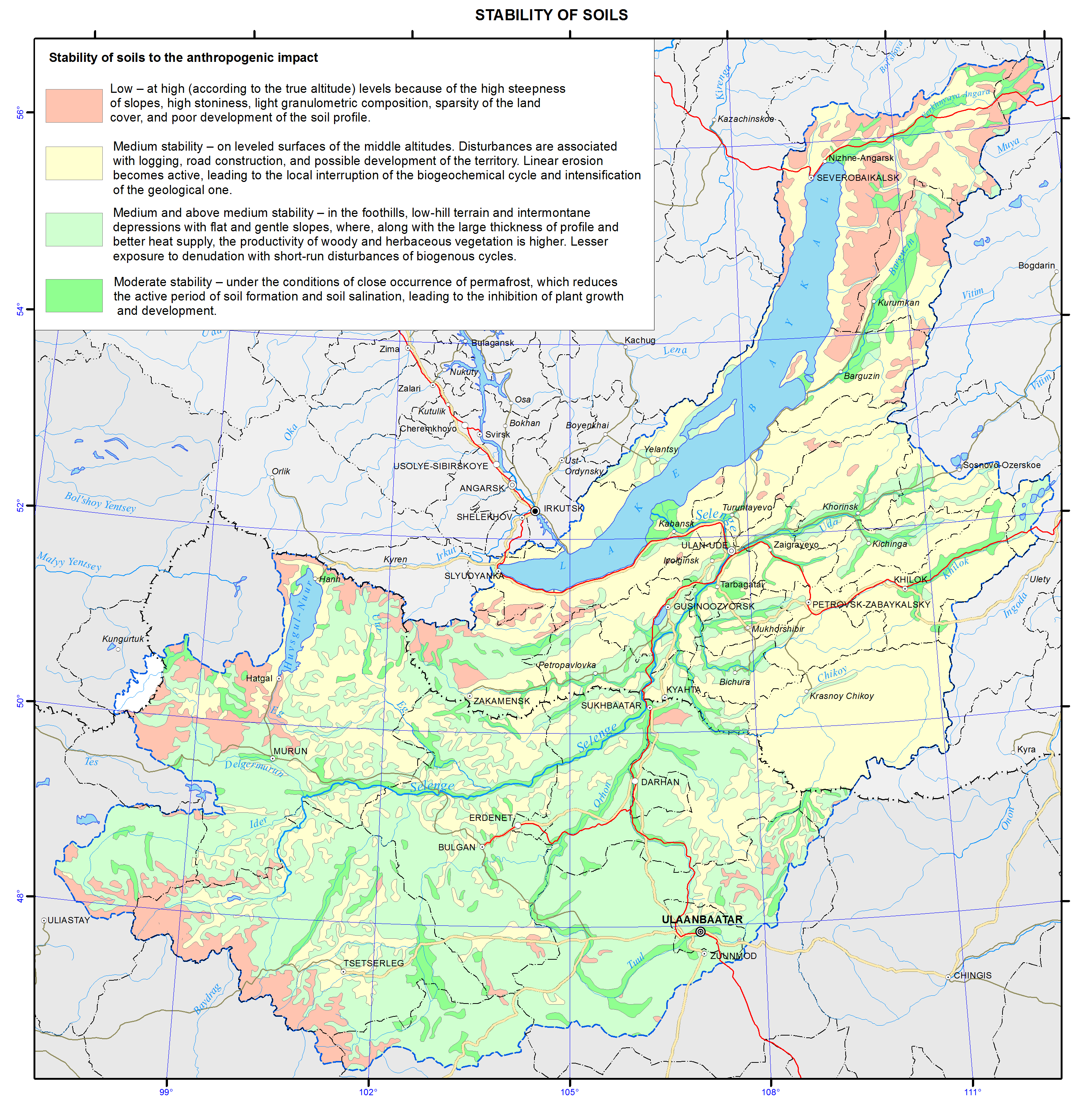
<p>A qualitative assessment of the soil stability (i.e. the resistance to external effects and the ability to restore the disturbed properties) was made with regard to the external and internal factors. In general, the stability decreases from low graded surfaces or gentle slopes with an increase in an altitude and steepness of slopes. In the same direction a change from loamy deposits to stony deposits with small thickness of the loose mass takes place, and heat supply changes for the worse. In total, four large subdivisions of soils were distinguished according to different degrees of stability: low, medium, medium and above medium, and moderate. Their characteristic is given in the legend to the map of the soil stability to the anthropogenic impact.</p>]]></content:encoded>
    <dc:publisher>No publisher</dc:publisher>
    <dc:creator>Alexander Ayurzhanaev</dc:creator>
    <dc:rights></dc:rights>
    <dc:date>2014-10-07T04:50:00Z</dc:date>
    <dc:type>Page</dc:type>
  </item>


  <item rdf:about="http://bic.iwlearn.org/en/atlas/atlas/35-soils-map/soils-map">
    <title>Soils map</title>
    <link>http://bic.iwlearn.org/en/atlas/atlas/35-soils-map/soils-map</link>
    <description></description>
    <content:encoded xmlns:content="http://purl.org/rss/1.0/modules/content/"><![CDATA[<p><img class="image-inline" src="../../../resolveuid/3ba30bb6ade8473c90467fcbff108b20/@@images/image/preview" /></p>
<p><a href="http://bic.iwlearn.org/en/atlas/photos/copy_of__35_Soils.png" class="internal-link">Open full size</a></p>
<p><img class="image-inline" src="../../../../resolveuid/64331fca7f0746a2b5e94e77bc3d82d5/@@images/image/preview" /></p>
<p><a href="http://bic.iwlearn.org/en/photos/copy_of__35_Legend1.png" class="internal-link">Open full size</a></p>
<p><img class="image-inline" src="../../../../resolveuid/4834bd689a214af680fc5e260a4a4455/@@images/image/preview" /></p>
<p><a href="http://bic.iwlearn.org/en/photos/copy_of__35_Legend2.png" class="internal-link">Open full size</a></p>
<p align="center"><strong>Soils</strong></p>
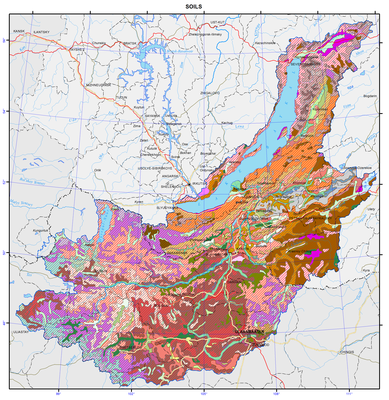
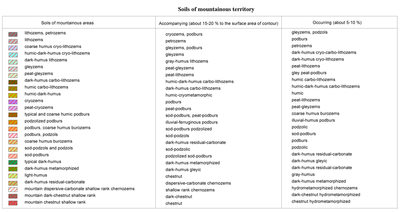
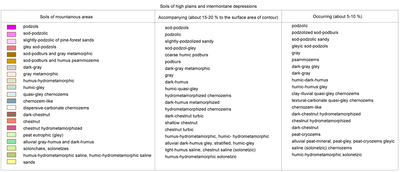
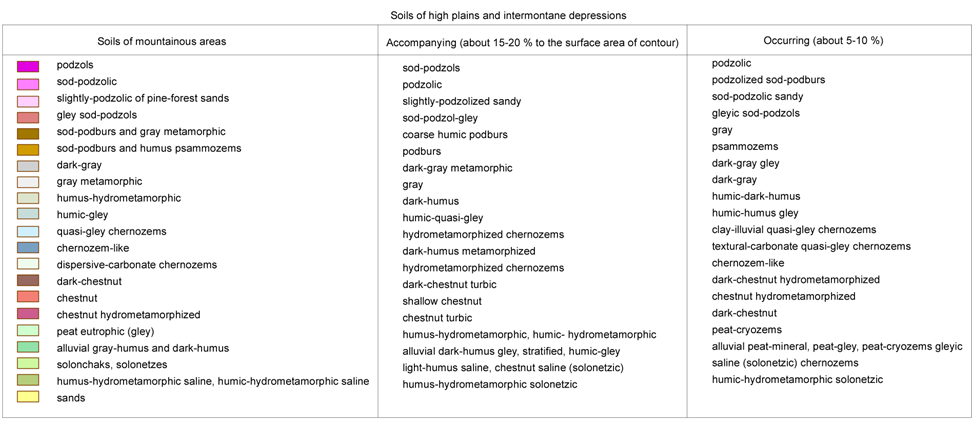
<p class="normalnavy">Soil associations are presented in the contours on the map. Combinations of soils, united in a contour, are associated with the altitudinal and expositional differentiation, and are determined by the character of mesorelief (combinations) and microrelief (complexes), and by the heterogeneity of the soil-forming material (mosaic). The predominant soil is the first in the legend, followed by accompanying and occurring soils. Most soils are distinguished at the type level, rarely at the subtype level.</p>
<p class="normalnavy">The great extension of the territory of the Baikal basin from south to north determines latitudinal variations of the thermal factor and the associated vegetation and soil cover. In addition to these basic regular patterns, the influence of exposure and meridional arid mountain zonality is manifested here. The role of permafrost and heterogeneity of parent rocks, complicated and insufficiently clear evolution of landscapes in the past, and their changing as a result of the human impact are essential.</p>
<p class="normalnavy">Within the mountain taiga, independent contours are distinguished in the south-western and north-eastern parts of Cisbaikalia. They are represented by combinations of soils with the eluvial-illuvial and undifferentiated profile. The Baikalsky Ridge and the North-Baikal Highland are dominated by podzols and podburs, involving peat-podburs and sod-podzols. They are characterized by a thin profile, which averages 30 cm in podzols of the highland, while in the mountains of Cisbaikalia it is about 40 cm. Thickness of the profile of podburs, which can be regarded as being in the early stage of soil formation, is even less.</p>
<p class="normalnavy">Soils of piedmont dry steppes of Cisbaikalia are common in the Priolkhonie region and on Olkhon Island. Formation of dry steppe landscapes with chestnut soils is due to the arid mountain zonality (location in the rain shadow). The lack of atmospheric moistening is compounded here by a high water penetration capacity of woody-loamy soils. The territory is similar to that of the dry steppe of Kazakhstan in the nature of moistening, and to the middle taiga of Yakutia in heat supply. A consequence of the extreme soil-climatic conditions is a low biological productivity. Agroecosystems here are in a state of crisis; the vegetation and soil cover undergoes degradation.</p>
<p>In the high-mountain part of the Khamar-Daban, Muisky, Verkhne-Angarsky and Barguzinsky ridges the basic soils are petrozems, peat-lithozems, and coarse humus lithozems. Coarse humus, humic and humic-dark-humus soils are formed under the sub-alpine meadows. On the northern slopes, in relatively low relief elements, and in areas composed of parent rocks of heavier particle-size distribution, gley podburs are formed.</p>
<p>Cryo-lithozems, petrozems and cryo-carbo-lithozems accompany nival dissected landscapes of the Khangai region of Mongolia. Cryozems (coarse humus) and peat-cryozems are developed in the sub-goletz altitudinal belt, locating in a relatively narrow band near the forest line. In soils of taiga massifs permafrost areas are of frequent occurrence; moreover, seasonal frost is longstanding, and cryoturbation phenomena and solifluction are usual.</p>
<p>The structure of the soil cover of the mountain-taiga zone of Transbaikalia is heterogeneous and is largely associated with the manifestation of vertical zonality, slope exposure, and permafrost. The main soil background is comprised of podburs, podzols, sod-podzols, sod-podburs, gray-humus, humic, humic-dark-humus soils and coarse humus burozems. The main background of the soil cover of taiga territories of Mongolia includes cryozems, podburs and dark-humus soils. Soils of podzolic type are rare here. In the upper part of the taiga belt, cryozems and podburs are formed; higher there are peat-lithozems. In mountainous taiga there occur steppe "islands" with chernozem-like soils. They can be found on steep parts of the southern slopes, facing the broad areas of intermontane depressions.</p>
<p>The natural-climatic zone of forest-steppe is dominated by gray metamorphic soils, which are formed on the foothill areas of depressions and on the northern slopes of hills inside intermontane lows or at the bottom part of the forested slopes of ridges, facing the steppe depressions. These soils occupy the largest areas in the forest-steppe of the southern part of the Trans-Baikal middle mountains. In the forest-steppe landscape belt of Mongolia of light-coniferous and mixed subshrub and herbaceous facies there occur dark-humus metamorphosed soils, located mainly along the southern slopes of ridges and hills. Gray humus soils formed under woody communities with forbs on carbonate rocks. This combination of soils, characteristic of different environmental conditions, is the main feature of the soil cover at the junction of taiga and steppe.</p>
<p>In steppe landscapes of Transbaikalia the main background of the soil cover is comprised of chernozems. They are formed under meadow and true steppes. The main massifs of these soils are located in the Tugnui-Sukhara basin: on the Tugnuisky ridge and on the southern slopes of the Zagansky ridge, on the northern slopes of the Kudarinskaya range and the Small Khamar-Daban, Monostoisky, and Borgoisky ridges. In the more northern part of the territory, chernozems are formed in individual spots on the north-western slopes of the Unegeteisky ridge and along the Uda and Itantsa river valleys.</p>
<p>The soil cover of dry steppe is dominated by chestnut soils. They occupy vast tracts in the Udinskaya, Priselenginskaya, and Borgoiskaya steppes, and wide gently sloping terraces in the valleys of large rivers; they are common on the southern slopes of the ridges. On the watersheds of high ridges there occur soils of the lithozem group. Humus psammozems are formed on aeolian sand deposits of the dry steppe zone, especially in the Selenga-Chikoy and Chikoy-Khilok interfluves, and on pine-forest sands.</p>
<p>Soils of the river valleys of Cisbaikalia and Transbaikalia are represented mainly by alluvial humic-gley, peat-gley, dark-humus, gray-humus, and dark-humus quasi-gley soils. In the structure of the soil cover of the floodplains of the upper and middle reaches of the rivers stratified alluvial soils are of frequent occurrence. In the steppe and especially in the dry steppe zones of Transbaikalia solonchaks and less frequently solonetzic soils are formed in the river floodplains. They occupy mostly lacustrine depressions and lower parts of gentle slopes, generally adjacent to the river floodplains, where there is a zone of accumulation of waters of the valley runoff enriched with soluble salts or a discharge of mineralized groundwaters. The most common types of salinization of solonchaks and solonetzic soils are sulfate-soda, soda-sulfate, sulfate, and chloride-sulphate. Large massifs of saline soils are widespread in the Borgoiskaya steppe and lacustrine lows of Lakes Verkhnee Beloe and Nizhnee Beloe. Their proportion in the Ivolginskaya depression is quite substantial. Solonetzic soils and solonchaks also occur in lacustrine depressions of the Bichursky district and the Tugnuiskaya steppe. In the Selenga river delta, in the Barguzin river valley, and in some other regions relatively large massifs are covered with bogs, where mainly peat eutrophic and peat eutrophic gley soils develop.</p>
<p>Soils of waterlogged meadows and lacustrine-boggy complexes of Mongolia are widespread in the near-shore zone of Lakes Khovsgol and Doot-Nur, in the Dzhargalant-Gol and Mungaral-Gol interfluve, in the northern and southern part of the Darkhatskaya depression, and along river valleys. Alluvial dark-humus soils are formed in river floodplains on elevated areas, in deltas, and on alluvial fans of temporary streams. Alluvial humic gley soils are formed under the conditions of additional inflow of moisture. In elevated locations of the riverbed floodplain of mountain rivers on sandy-gravel deposits gray-humus alluvial and stratified soils were formed. Alluvial peat-gley (peat-mineral) soils are formed in relatively low locations of river floodplains with the conditions of long-term surface and subsurface moistening, as well as on the edges of water bodies overgrown with bog vegetation. Humus-hydrometamorphic seasonally freezing for a long time soils are formed in the central floodplain of the rivers. In the lacustrine part of the depressions humic-hydrometamorphic (silty-humic) cryogenic soils are developed.</p>
<p>In the territory of Mongolia a series of relatively small contours of saline soils occurring in different parts of the country was distinguished. Processes of erosion and deflation are widespread, which is due to the shower precipitation pattern, and periodic occurrence of dust storms and strong winds, especially in spring when soil is dry and vegetation grows poorly.</p>]]></content:encoded>
    <dc:publisher>No publisher</dc:publisher>
    <dc:creator>Alexander Ayurzhanaev</dc:creator>
    <dc:rights></dc:rights>
    <dc:date>2014-10-07T03:20:00Z</dc:date>
    <dc:type>Page</dc:type>
  </item>


  <item rdf:about="http://bic.iwlearn.org/en/atlas/atlas/34-amount-of-forests-map/amount-of-forests-map">
    <title>Amount of forests map</title>
    <link>http://bic.iwlearn.org/en/atlas/atlas/34-amount-of-forests-map/amount-of-forests-map</link>
    <description></description>
    <content:encoded xmlns:content="http://purl.org/rss/1.0/modules/content/"><![CDATA[<p><img class="image-inline" src="../../../resolveuid/e05a83c83e7b4e7db7fe8776b08b7cd9/@@images/image/preview" /></p>
<p><a href="http://bic.iwlearn.org/en/atlas/photos/copy_of__34_Amountofforests.png" class="internal-link">Open full size</a></p>
<p align="center"><strong>Forest cover</strong></p>
<p align="center"><strong> </strong></p>
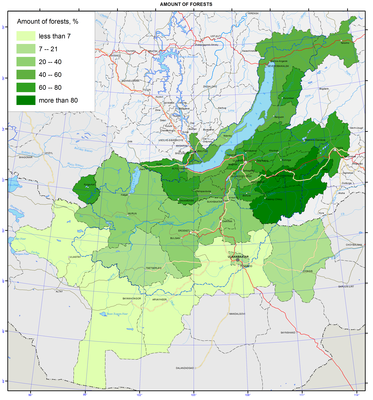
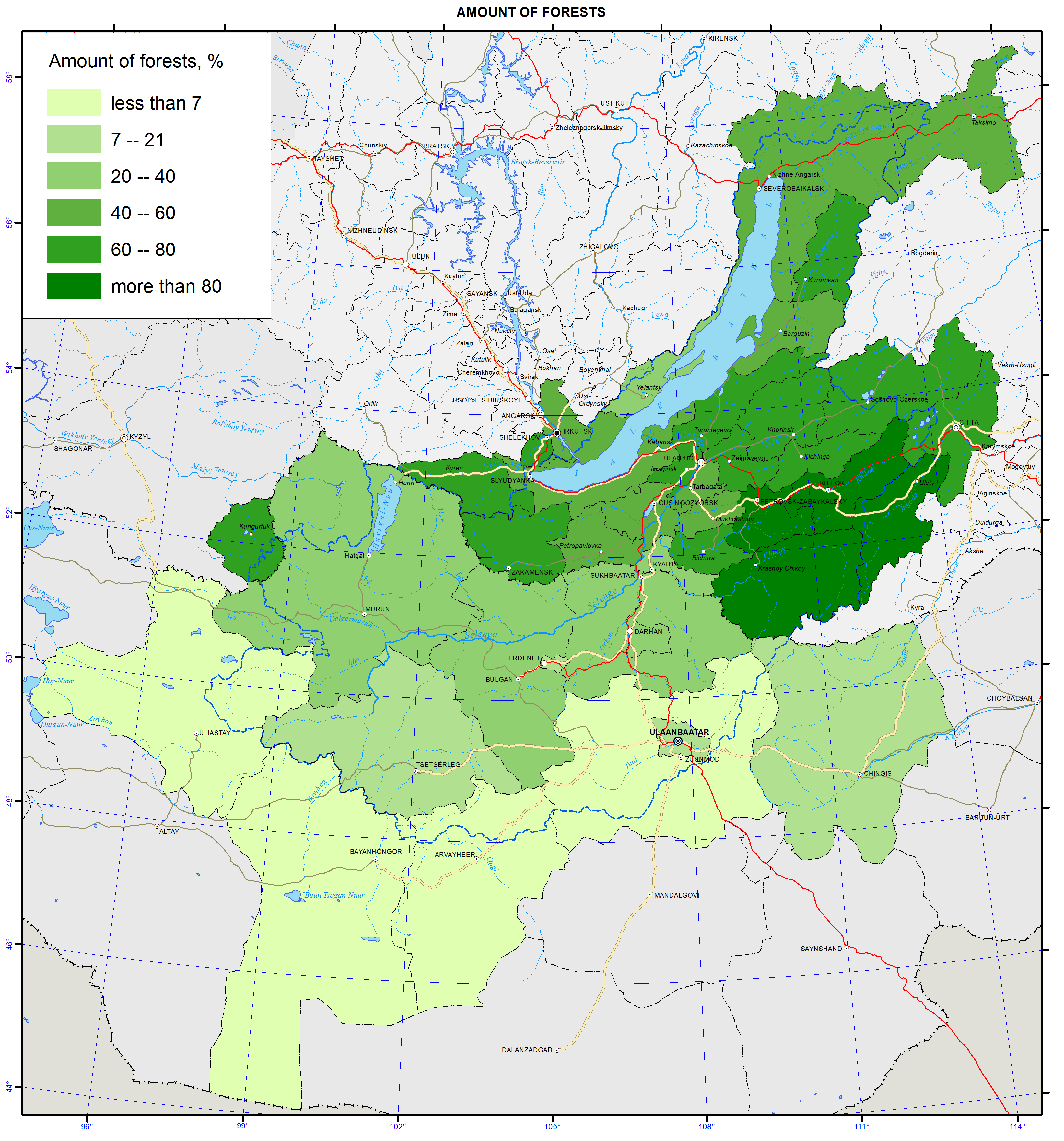
<p>Forest cover is a parameter reflecting the ratio of the total forested area (on forest lands and lands of other categories where forests are located) to the area of the municipality (district or aimak). Forest cover is an important indicator characterizing the forest availability, and, consequently, the ecological security and the features of the socio-economic development of a territory.</p>
<p>Average forest cover of the Baikal basin within the Russian territory is 62.5 %. Forest cover fluctuates here from 26.4 % in Kyakhtinsky district, located in the steppe part of the Republic of Buryatia, to 82-89 % in Krasnochikoysky, Petrovsk-Zabaikalsky, Uletovsky, and Khiloksky districts of Zabaikalsky krai. In Mongolia, the average forest cover is significantly lower than in the Russian part of the basin amounting to 11.5 %, and it ranges from 0.75 % (Uverkhangay aimak) to 35.0 % (Darkhan aimak).</p>
<p>Over the last decade (2000-2010) a decrease in forest cover in the most developed parts of the Baikal watershed basin is registered. This is associated with the reduction of forested lands due to areas, subjected to fire, cutting, and insect pests.</p>]]></content:encoded>
    <dc:publisher>No publisher</dc:publisher>
    <dc:creator>Alexander Ayurzhanaev</dc:creator>
    <dc:rights></dc:rights>
    <dc:date>2014-10-07T03:10:00Z</dc:date>
    <dc:type>Page</dc:type>
  </item>


  <item rdf:about="http://bic.iwlearn.org/en/atlas/atlas/33-vegetation-map/vegetation-map">
    <title>Vegetation map</title>
    <link>http://bic.iwlearn.org/en/atlas/atlas/33-vegetation-map/vegetation-map</link>
    <description></description>
    <content:encoded xmlns:content="http://purl.org/rss/1.0/modules/content/"><![CDATA[<p><img class="image-inline" src="../../../resolveuid/40417b8ce0134624aeae0efb715485d1/@@images/image/preview" /></p>
<p><a href="http://bic.iwlearn.org/en/atlas/photos/copy_of__33_Vegetation.png" class="internal-link">Open full size</a></p>
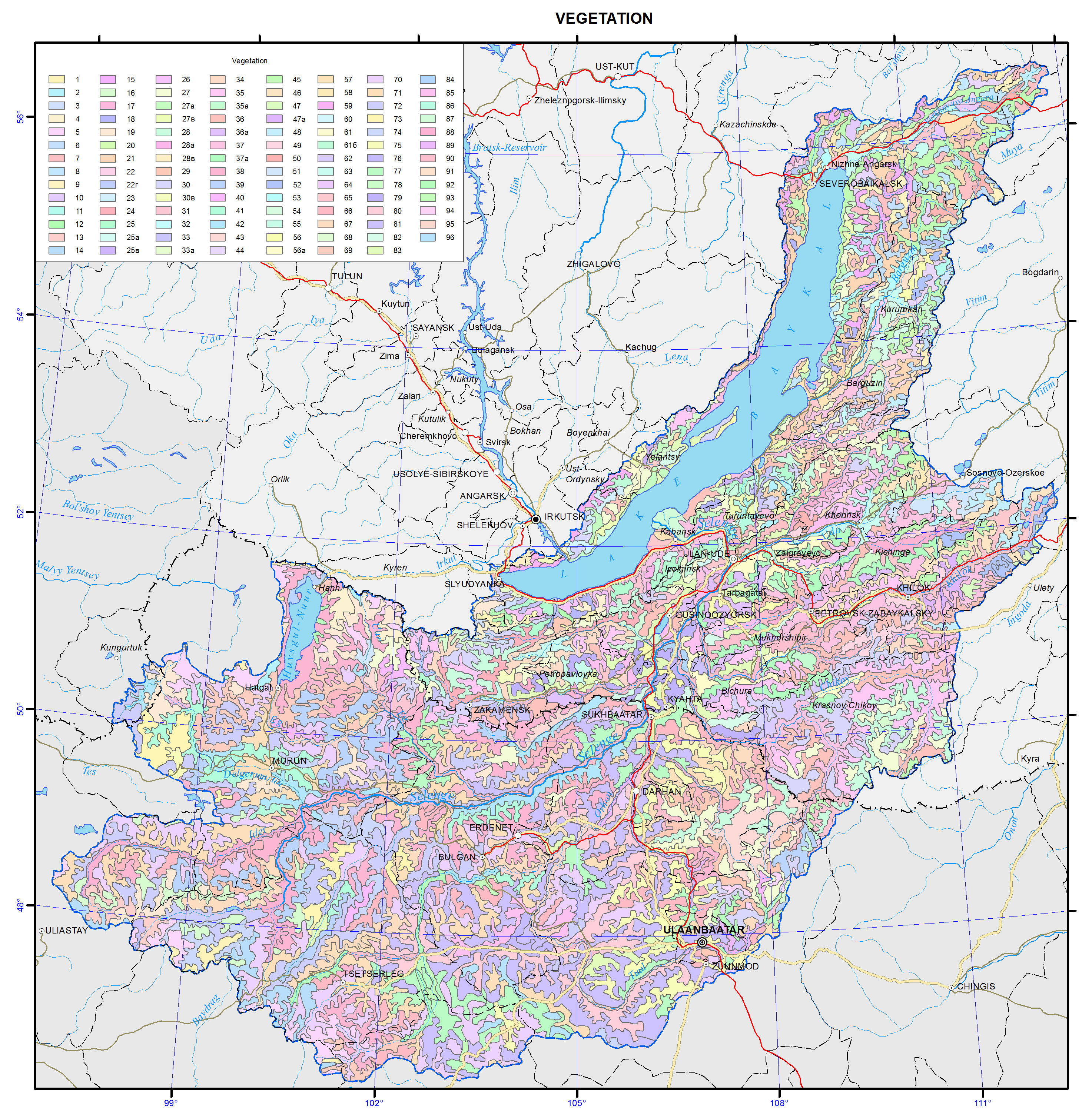
<p align="center" class="ac">Legend to the “Vegetation” map</p>
<p align="center"><b>GOLETZ (HIGH-MOUNTAIN) VEGETATION</b></p>
<p align="center"><b> </b></p>
<p align="center"><b>MOUNTAIN TUNDRAS</b></p>
<p align="center">PAN-ATLANTIC PHRATRY OF FORMATIONS</p>
<p align="center"><b>South-Siberian formations </b></p>
<p>1. <b>Stony tundras with the predominance of crustose lichens </b>(species of genera <i>Cetraria </i>Ach.<i>, Cladonia </i>Hill ex P. Browne<i>, </i>and <i>Alectoria </i>Ach.), <b>in places with clumps of fruticose lichens and with sparse vegetation groups</b> of <i>Hierochloë alpina </i>(Sw.) Roem. et Schult<i>., Luzula confusa </i>Lindeb.<i>,</i> <i>Saussurea congesta </i>Turcz<i>.,</i> on stony placers, comprised of granitoids in the upper parts of the goletz zone, <b>combined with subshrub</b><i> (Rhododendron aureum </i>Georgi,<i> Ledum palustre </i>L<i>., Dryas oxyodonta </i>Juz<i>.)</i><b>-lichen</b> <i>(Alectoria ochroleuca </i>(Hoffm.) A.Massal<i>., Cetraria islandica </i>(L.) Ach<i>.) </i><b>tundras</b> on flat tracts, covered with fine detritus of shale rocks or gneiss with mountain arctic-tundra primitive soils</p>
<p>2. <b>Moss-lichen</b> <i>(Aulacomnium turgidum </i>(Wahlenb.) Schwägr<i>., Dicranum elongatum </i>Schleich. ex Schwägr<i>., Cetraria cucullata </i>(Bellardi) Ach.) <b>tundras </b>on stony sunlit slopes, <b>combined with alpine-type small meadows</b> <i>(Ptilagrostis mongholica </i>(Turcz. ex Trin.) Griseb<i>., Festuca sphagnicola </i>B.Keller,<i> Kobresia myosuroides </i>(Vill.) Fiori<i>)</i> on rubble-silt talus fans in places of deep snow banks</p>
<p>3. <b>Mountain avens</b> <i>(Dryas oxyodonta </i>Juz., <i>D. punctata </i>Juz.<i>)-</i><b>lichen</b> <i>(Flavocetraria cucullata </i>(Bellardi) Kärnefelt et A.Thell<i>)</i> <b>tundras</b> on stony-rock-debris mountain ranges and convex sodded tracts with fine skeleton substrates,<b> combined with crowberry </b><i>(Empetrum sibiricum </i>V.N.Vassil<i>)-</i><b>yernik</b><i> (Betula rotundifolia </i>Spach<i>)</i> <b>communities</b> on flat uplands with loose fine earth and in wide hollows of mountain slopes</p>
<p>4.<b> </b><b>Grass</b><i> (Festuca ovina</i> L.<i>, Carex ensifolia </i>Turcz. ex Gorodk<i>., Pedicularis oederi </i>Vahl.<i>)</i>-<b>lichen</b> <i>(Cladonia alpestris </i>(L.) Rabench<i>.) </i><b>tundras often with shrubs</b> <i>(Betula rotundifolia </i>Spach., <i>Rhododendron aureum </i>Georgi<i>, Salix glauca </i>L<i>.) </i>on gentle slopes and well drained flat tracts with mountain-tundra humic gley soils, <b>combined with subshrub </b><i>(Empetrum sibiricum </i>V.N.Vassil<i>, Dryas oxyodonta </i>Juz<i>.)</i>-<b>moss</b> <i>(Cetraria laevigata </i>Rass.<i>, Cladonia stellaris </i>(Opiz) Pouzar et Vězda<i>)</i> <b>tundras</b> on concave tracts with peaty-gley soils</p>
<p align="center"><b> </b></p>
<p align="center"><b>North-Mongolian formations</b></p>
<p>5. <b>Lichen </b>(<i>species of genera Cladonia </i>Hill ex P. Browne<i>, Cetraria </i>Ach.<i>, Alectoria </i>Ach.<i>, Stereocaulon</i> Schreb.) <b>and moss</b> (<i>species of genera Aulacomnium </i>Schwägr.<i>, Polythrichum</i> Hedw., and others<i>)</i> <b>tundras</b> on mountain-tundra underdeveloped and destructive soils among stony placers and taluses in the goletz zone, <b>combined with sedge, kobresia</b><i> (Kobresia myosuroides </i>(Vill.) Fiori<i>, K. sibirica </i>(Turcz. ex Ledeb.) Boeck<i>.)</i><b>-sedge</b> <i>(Carex melanantha </i>C.A.Mey<i>, C. macrogyna </i>Turcz. ex Steud<i>) </i><b>and subshrub</b> <i>(Dryas oxyodonta </i>Juz,<i> Arctous alpina </i>(L.) Niedenzu<i>, Rhododendron aureum </i>Georg<i>i)</i>-<b>lichen</b> <i>(Cetraria laevigata </i>Rass.<i>, Cladonia stellaris </i>(Opiz) Pouzar et Vězda<i>)</i> <b>tundras </b>in high-mountain rigions on semi-sodded stony slopes with mountain-tundra humic-peaty-gley soils and on convex mountain slopes with mountain-tundra soddy and humic-soddy soils</p>
<p align="center"> </p>
<p align="center">PAN-PACIFIC phratry of formations<b> </b></p>
<p align="center"><b>Baikal-Dzhugdzhur formations</b></p>
<p>6<b>. Stony tundras with the sparse lichen cover </b><i>(Alectoria ochroleuca </i>(Hoffm.) Mass<i>., </i>реже with<i> Cetraria nivalis </i>(L.) Ach., <i>C.cucullata </i>(Bell.) Ach<i>.)</i> <b>and singly occurring vegetation groups</b> (<i>Potentilla elegans </i>Cham. et Schlecht<i>., Sibbaldia procumbens </i>L.<i>) </i>in the upper parts of the goletz zone with mountain arctic-tundra primitive soils</p>
<p>7. <b>Lichen </b><i>(Cetraria nivalis </i>(L.) Ach<i>., C.islandica </i>(L.) Ach<i>., C.chrysantha </i>Tuck.<i>, C.cucullata </i>(Bell.) Ach.<i>)</i> <b>tundras</b> in the upper parts of goletz plateaus on convex land forms with ledges of crystalline rocks, <b>combined with mountain avens </b><i>(Dryas punctata </i>Juz.<i>, D. Incise</i> Juz<i>.)</i><b>-lichen rock debris tundras </b>on dry slopes with gravelly peaty-loamy soils</p>
<p>8<b>. Grass </b><i>(Calamagrostis lapponica </i>(Wahlenb.) Hartm<i>., Carex globularis </i>L.<i>, C. ensifolia </i>Turcz. ex V.I. Krecz. <i>, Hierochloe alpina </i>(Sw.) Roem. et Schult<i>.</i><i>)-</i><b>lichen</b> <i>(Cladonia alpestris </i>(L.) Rabench<i>., C. sylvatica </i>(L.) Hoffm<i>., C. rangiferina </i>(L.) Web<i>.) </i><b>dry tundras</b> in the middle and lower parts of the goletz zone and in the subgoletz zone on slopes and placers with fine-earth peaty substrates,<b> combined with subshrub </b><i>(Empetrum sibiricum </i>V.N.Vassil<i>, Cassiope ericoides (</i>Pallas) D.Don.)-<b>Cladonia tundras</b> <b>and tracts of kobresia </b><i>(Kobresia myosuroides </i>(Vill.) Fiori<i>)</i><b> heathlands and high-mountain fescue </b><i>(Festuca lenensis </i>Drob<i>.) </i><b>steppes </b>on flat summits and gentle concave slopes with mountain tundra-meadow soils</p>
<p>9. <b>Subshrub </b><i>(Ledum decumbens </i>Small<i>.)</i>-<b>moss </b><i>(Drepanocladus uncinatus </i>(Hedw.) Warnst<i>., Racomitrium canescens</i> (Hedw.) Brid<i>.)</i>-<b>lichen</b><i> (Cetraria islandica </i>(L.) Ach.,<i> Cladonia rangiferina</i> (L.) Web.<i>)</i><b> tundras</b> on slopes with mountain-tundra humic-carbonate soils, <b>combined with wet tundras </b><i>(Carex tristis </i>M. Bieb<i>., Ledum palustre </i>L.<i>, Aulacomnium turgidum </i>(Wahl.) Schwaegr<i>.) </i><b>and</b><i> </i><b>nival small meadows</b> <i>(Bistorta vivipara </i>(L.) Delarbe<i>, Allium malyschevii </i>N.V.Friesen<i>)</i> in saddles and microdepressions with mountain tundra-meadow soils</p>
<p>10. <b>Subshrub</b> <i>(Vaccinium myrtilus L.)-</i><b>bergenia</b> <i>(Bergenia crassifolia </i>(L.) Fritsch)<i>-</i><b>lichen </b><i>(Stereocaulon paschale </i>(L.) Fr.,<i> Cladonia alpestris </i>(L.) Rabench<i>., C.rangiferina </i>(L.) Web<i>.) </i><b>tundras</b><i> </i><b>(heathlands),</b> <b>in places with golden rhododendron, Siberian dwarf pine and Middendorff’s dwarf birch </b>on summit surfaces and convex stony slopes with mountain-meadow light loamy gravelly soils, <b>combined with nival small meadows </b>on flat and concave slopes with mountain-meadow loamy soils</p>
<p>11. <b>Tundras turned to meadows</b> <i>(Festuca ovina </i>L.<i>, Lycopodium alpinum </i>L<i>., Hierochloe alpina </i>Roem. et Schult.<i>) </i>on sodded tracts of stony and rocky slopes, <b>combined with alpine-type  small meadows</b> <i>(Anemone sibirica </i>L.<i>, Oxytropis kusnetzovii </i>Kryl.<i>)</i> on concave and flat surfaces with soddy mountain-meadow light loamy soils, as well as<b> dwarf Siberian mountain pine</b><i> (Pinus pumila </i>(Pallas) Regel<i>)</i> <b>and yernik</b> <i>(Betula divaricata</i> Ledeb<i>.)</i> <b>vegetation</b> on stony slopes with gravelly weakly-humic soils</p>
<p align="center"><b> </b></p>
<p align="center"><b>MOUNTAIN (ALPINE-TYPE) MEADOWS AND HEATHLANDS</b></p>
<p align="center">ALTAI-TIAN-SHAN PHRATRY OF FORMATIONS</p>
<p align="center"><b>South-Siberian formations</b></p>
<p>12. <b>Alpine-type</b> <i>(Trollius sajanensis </i>(Malyschev) Sipliv<i>., Aquilegia glandulosa </i>Fischer ex Link<i>)</i> <b>and</b> <b>subalpine-type </b><i>(Geranium albiflorum </i>Ledeb<i>., Saussurea latifolia </i>Ledeb.<i>)</i> <b>meadows </b>on flat sodded tracts on bottoms of kars and on gently sloping plots with mountain tundra-meadow soils, <b>combined with shrubs vegetation</b> <i>(Betula rotundifolia </i>Spach,<i> Duschekia  fruticosa </i>(Rupr.) Pouzar<i>, Salix glauca </i>L.) on flat and concave slopes with mountain-tundra peaty-gley soils</p>
<p align="center"><b> </b></p>
<p align="center"><b>North-Mongolian formations</b></p>
<p>13. <b>High-mountain cryophyte meadows and heathlands </b><i>(Cerastium pseudosibiricum </i>J.Mayer<i>, Dryadanthe tetrandra </i>(Bunge) Juz<i>., Valeriana petrophylla </i>Bunge<i>)</i> in the transition area from the goletz to subgoletz zone on valley bottoms and at the foot of slopes with mountain tundra-meadow soils, combined with sedge-kobresia, kobresia-sedge and waterlogged sedge <i>(Carex macrogina </i>Turcz. ex Steud.<i>, C. orbicularis </i>Boott,<i> C. bigelowii </i>Torr.<i>) </i>meadows on mountain-meadow soddy-humic gleyic and cryogenic-meadow peaty-humic-gleyic soils</p>
<p>14. <b>Kobresia</b> <i>(Kobresia bellardii </i>(All.) Degl<i>.)</i> <b>and sedge</b> <i>(Carex rupestris </i>All.,<i> C. stenocarpa </i>Turcz.<i>)</i>-<b>kobresia meadows and heathlands </b>on flat summits of ranges, gentle slopes of all aspects, and in bottoms of non-waterlogged hollows with mountain tundra-meadow soils, <b>combined with stony-rock-debris placers and patches of high-mountain steppes</b> <i>(Kobresia simpliciuscula </i>Mack<i>., Ptilagrostis mongolica </i>Griseb<i>.,</i> <i>Festuca supina </i>Schur<i>., F. brevifolia </i>R. Br<i>., F. sphagnicola </i>B. Keller<i>) </i>on concave slopes and in wide bottoms of intermontane depressions with tundra-meadow rich humus soils            <i> </i></p>
<p> </p>
<p align="center"><b>TAIGA (BOREAL) VEGETATION</b></p>
<p align="center"><b> </b></p>
<p align="center"><b>SUBGOLETZ SPARSE FORESTS AND SHRUBS VEGETATION</b></p>
<p align="center">URAL-SIBERIAN PHRATRY OF FORMATIONS</p>
<p align="center"><b>South-Siberian formations</b></p>
<p align="center">Dark-coniferous<i> (Pinus sibirica </i>Du Tour<i>, Abies sibirica </i>Ledeb<i>., </i></p>
<p align="center"><i>Picea obovata </i>Ledeb.<i>) </i>sparse forests</p>
<p>15. <b>Spruce Siberian dwarf pine</b> <i>(Pinus pumila </i>(Pallas) Regel<i>)</i> <b>moss </b><i>(Pleurozium schreberi </i>(Brid.) Mitt<i>., Ptilium crista-castrensis</i> (Hedw.) De Not<i>.)</i>-<b>lichen</b> <i>(Cladonia mitis</i> Sandst<i>, Cetraria islsndica </i>(L.) Ach<i>., Stereocaulon paschale </i>(L.) Hoffm<i>.)</i> <b>sparse forests</b> on flat saddles, concave surfaces and slopes to river valleys with mountain cryogenic-taiga soils, <b>combined with stony tundras and placers </b>on convex tracts with mountain-tundra soils</p>
<p>16. <b>Siberian stone pine and larch </b><i>(Larix sibirica </i>Ledeb<i>.)</i>-<b>Siberian stone pine yernik </b><i>(Betula rotundifolia </i>Spasch<i>)</i><b> subshrub </b><i>(Vaccinium vitis-idaea </i>L<i>., V. uliginosum </i>L.<i>)-</i><b>moss</b> <i>(Dicranum scoparium </i>Hedw<i>., Pleurozium achreberi </i>(Brid.) Mitt<i>.)</i>-<b>lichen</b> <i>(Cladonia turgida </i>Hoffm<i>., C.uliginosa </i>(Ahti) Ahti<i>)</i> <b>sparse forests</b> on stony slopes and plateau-like rocky surfaces with mountain cryogenic-taiga soils, <b>combined with grass</b>-<b>shrubs</b> <b>vegetation </b>in microdepressions and sodded tracts with mountain-tundra soils</p>
<p>17. <b>Siberian stone pine with spruce and larch </b><i>(Larix sibirica </i>Ledeb<i>.)</i><b> dwarf Siberian mountain pine</b> <i>(Pinus pumila </i>(Pallas) Regel<i>)</i> <b>cowberry </b><i>(Vaccinium vitis-idaea </i>L<i>., Ledum palustre </i>L<i>.)</i>-<b>true-moss </b><i>(Pleurozium schreberi </i>(Brid.) Mitt<i>., Hylocomium splendens </i>(Hedw.) B.S.G.) <b>sparse forests </b>on convex watersheds and steep slopes of different aspects with shallow rank nonpodzolized soils, <b>combined with Siberian stone pine cowberry forests</b> on gentle and planate tracts with cryogenic-taiga soils</p>
<p>18.<b> Fir and spruce-fir sparse forests, in places with lanate birch </b><i>(Betula lanata </i>(Regel) V.N.Vassil.<i>),</i> <b>with</b> <b>golden rhododendron</b> <i>(Rhododendron aureum </i>Georgi<i>)</i> <b>and dwarf Siberian mountain pine</b><i> (Pinus pumila </i>(Pall.) Regel<i>)</i> <b>tall-grass </b><i>(Pteridium aquilinum </i>(L.) Kuhn.<i>, Dryopteris fragrans </i>(L.) Schott, <i>Athyriium filix-femina (</i>L.) Roth<i>, Anemone baicalensis </i>Turcz.<i>, Bupleurum multinerve </i>DC.<i>) </i>on stony slopes with mountain podzolic gravelly-sandy-loamy shallow soils, <b>combined with tracts of subalpine-type meadows</b> <i>(Geranium krylovii </i>Tzvelev<i>, Aconitum baicalense </i>Turcz. ex Rapaics<i>, Carex aterrima </i>Hoppe<i>)</i> in near-brooks habitats with mountain tundra-meadow soils</p>
<p align="center"> </p>
<p align="center">Light-coniferous <i>(Larix sibirica </i>Ledeb<i>.)</i> sparse forests</p>
<p>19. <b>Larch and Siberian stone pine-larch yernik </b><i>(Betula rotundifolia </i>Spach,<i> B. exilis </i>Sukaczev<i>, Salix glauca </i>L.)<i> </i><b>grass</b> <i>(Festuca ovina </i>L.,<i> Bistorta elliptica (Willd. ex Spreng.) </i><i>Kom., Artemisia dolosa Krasch.)-</i><b>moss</b><i> (Hylocomium splendens </i>(Hedw.) Bruch et al.,<i> Rhytidium rugosum </i>(Hedw.) Kindb<i>.), </i><b>in places with lichens</b> <i>(Cladonia alpestris</i> (L.)<i> </i>Rabenh.<i>, C.rangiferina </i>(L.) Web.<i>), </i><b>sparse forests </b>on steep slopes, aprons and high river terraces with cryogenic-taiga peaty-gleyic soils, <b>combined with larch marsh tea-cowberry sparse forests </b>on less steep slopes with the same soils <b>and patches of grass</b>-<b>lichen-moss</b> <b>tundras </b>on convex well drained surfaces with mountain arctic-tundra sandy and sandy-loamy shallow soils<b> </b></p>
<p align="center"> </p>
<p align="center">ANGARIDE PHRATRY OF FORMATIONS</p>
<p align="center"><b>Baikal-Dzhugdzhur formations</b></p>
<p align="center">Light-coniferous <i>(Larix dahurica </i>Laws.<i>)</i> sparse forests</p>
<p>20. <b>Larch sparse forests with dwarf Siberian mountain pine</b><i> (Pinus pumila </i>(Pal.) Regel<i>)</i>, <b>dwarf birch </b><i>(Betula divaricata </i>Ledeb.<i>),</i> <b>in places with Duschekia</b> <i>(Duschekia fruticosa </i>(Rupr.) Pouzar<i>) </i><b>moss </b><i>(Dicranum elonganum </i>Schleich. ex Schwaegr<i>., Aulacomnium turgidum </i>(Wahl.) Schwaegr<i>., Rhytidium rugosum </i>(Hedw.) Kindb<i>.)</i>-<b>lichen</b> <i>(Cladonia alpestris </i>(L.) Rabench<i>.)</i> on planate surfaces and gentle stony slopes with mountain cryogenic-taiga surface-ferruginized soils, <b>combined with shrubs</b> <i>(Benula nana </i>L<i>.)</i> <b>vegetation</b> on convex and flat surfaces with fine skeleton soils <b>and</b> <b>patches of alpine-type small meadows</b> <i>(Anemone sibirica</i> L.<i>, Aquilegia glandulosa </i>Fisch. ex Link<i>, Festuca altaica </i>Trin.<i>) </i>on sodded tracts on bottoms of kars and concave slopes with mountain-meadow soddy-humic light loamy soils<i> </i></p>
<p><i> </i></p>
<p align="center">BERINGIAN phratry of formations</p>
<p align="center"><b>Baikal-Dzhugdzhur formations</b></p>
<p align="center">Dwarf Siberian mountain pine<i> (Pinus pumila </i>(Pallas) Regel<i>)</i> vegetation</p>
<p>21. <b>Dwarf Siberian mountain pine vegetation with singly occurring trees </b><i>(Larix dahurica </i>Laws.<i>, Pinus sibirica </i>Du Tour.,<i> Betula lanata </i>(Regel) V.N.Vassil<i>.)</i> on slopes with coarse stony substrates and stony-rank immature soils, <b>combined with subshrub</b> <i>(Cassiope ericoides </i>(Pall.) D.Don<i>, Ribes fragrans </i>Pall<i>.)</i> <b>and meadow</b> <i>(Festuca altaica </i>Trin.<i>, Dracocephalum grandiflorum </i>L.<i>, Aquilegia glandulosa </i>Fisch. ex Link<i>)</i> <b>communities</b> in microrelief lows with mountain tundra-meadow soils</p>
<p align="center"><b> </b></p>
<p align="center"><b>MOUNTAIN-TAIGA FORESTS </b></p>
<p align="center">URAL-SIBERIAN PHRATRY OF FORMATIONS</p>
<p align="center"><b>Middle-Siberian formations</b></p>
<p align="center">Dark-coniferous <i>(Abies sibirica </i>Ledeb<i>., Pinus sibirica </i>Du Tour, and<i> Picea obovata </i>Ledeb.<i>) </i>forests<i> </i></p>
<p>22. <b>Fir-Siberian stone pine subshrub</b> <i>(Ledum palustre </i>L.<i>, Vaccinium vitis-idaea </i>L.<i>, Vaccinium uliginosum </i>L<i>.)</i>-<b>grass</b> <i>(Pyrola rotundifolia </i>L.<i>, Linnaea borealis </i>L.<i>, Carex macroura </i>Meinsh.<i>, </i>in places with tall grass - <i>Valeriana alternifolia </i>Ledeb<i>., Silene amoena </i>L<i>., Brachypodium pinnatum </i>(L.) Beauv., <i>Trollius asiaticus</i> L.<i>, Pulmonaria mollis </i>Wulfen ex Hornem.<i>)</i>-<b>true-moss</b> <i>(Pleurozium schreberi </i>(Brid.) Mitt.<i>, Hylocomium splendens </i>Bruch et al.) <b>forests </b>on summits and slopes of  high watersheds with coarse-skeleton soddy-podzolic soils</p>
<p>22d. Larch-pine with Siberian stone pine and fir subshrub-grass-true-moss anthropogenic series</p>
<p> </p>
<p align="center">Light-coniferous <i>(Larix sibirica </i>Ledeb.<i>) </i>forests<i> </i></p>
<p>23. <b>Larch and pine-larch cowberry-forb </b><i>(Saussurea controversa</i> D.C., <i>Polygala sibirica </i>L., <i>Scabiosa ochroleuca </i>L.<i>, Carex macroura </i>Meinsh.<i>, Calamagrostis arundinacea </i>(L.) Roth<i>.)</i> <b>forests</b> on slopes of different steepness with soddy-forest weakly podzolic or soddy-carbonate leached soils</p>
<p>24. <b>Larch with the inclusion of Siberian stone pine and spruce, in places with undergrowth of yernik</b> <i>(Betula fruticosa Pallas) </i><b>subshrub </b><i>(Ledum palustre </i>L., <i>Vaccinium uliginosum </i>L.<i>)</i>-<b>moss forests</b> in the lower parts of slopes of different aspects, in weakly waterlogged river terraces, drained creek valleys and in river valleys with podzolic deeply-freezing or seasonally-cryogenic soils</p>
<p align="center"><b> </b></p>
<p align="center"><b>South-Siberian formations</b></p>
<p align="center">Dark-coniferous <i>(Abies sibirica </i>Ledeb.<i>, Picea obovata </i>Ledeb<i>., </i></p>
<p align="center"><i>Pinus sibirica </i>Du Tour<i>) </i>forests<i> </i></p>
<p>25. <b>Siberian stone pine-fir bilberry</b><i> (Vaccinium myrtillus </i>L<i>.)</i>-<b>grass</b><i> (Equisetum sylvaticum </i>L.<i>, Moneses uniflora </i>(L.) A. Gray<i>, Trientalis europaea L., Carex iljinii</i> V. Krecz<i>.)</i>-<b>true-moss </b><i>(Hylocomium splendens </i>(Hedw.) B.S.G<i>., Polytrichum commune</i> Hedw<i>.) </i><b>forests </b>in interfluves on heads of watersheds and upper parts of slopes with podzolic sandy-loamy and light loamy soils</p>
<p>25a. Aspen-birch with fir and Siberian stone pine bilberry-grass-true-moss</p>
<p>anthropogenic series</p>
<p>25c. Larch with Siberian stone pine, fir, birch bilberry-grass-</p>
<p>true-moss anthropogenic series</p>
<p>26. <b>Siberian stone pine-fir with spruce and larch </b><i>(Larix sibirica</i> Ledeb<i>.)</i> <b>bilberry</b> <i>(Vaccinium myrtillus </i>L.)-<b>bergenia</b> <i>(Bergenia crassifolia </i>(L.) Fritsch)-<b>true-moss</b> <i>(Hylocomium splendens </i>(Hedw.) B.S.G.<i>, Polytrichum commune </i>Hedw.<i>) </i><b>forests </b>in the upper parts of the forest zone on convex surfaces, steep stony shady slopes and slopes to river valleys with weakly podzolic gravelly soils</p>
<p>27. <b>Fir-Siberian stone pine with spruce bilberry-small grass</b> <i>(Mitella nuda </i>L<i>., Trientalis europaea </i>L.,<i> Stellaria bungeana </i>Fenzl<i>.)</i>-<b>true-moss</b> <i>(Pleurozium schreberi </i>(Brid.) Mitt<i>., Ptilium crista-castrensis </i>(Hegw.) De Not.), <b>in places with bergenia</b> <i>(Bergenia crassifolia</i> (L.<i>) </i>Fritsch), <b>forests</b> on convex surfaces and steep stony slopes with shallow gravelly-loamy moistened soils</p>
<p>27a. Aspen-birch with Siberian stone pine and fir bilberry-small grass-</p>
<p>true-moss anthropogenic series</p>
<p>27c. Pine-larch with Siberian stone pine, fir, birch, aspen bilberry-</p>
<p>small grass-true-moss anthropogenic series</p>
<p>28. <b>Siberian stone pine with undergrowth of golden rhododendron </b><i>(Rhododendron aureum </i>Georgi) <b>bilberry-cowberry-true-moss</b> <i>(Pleurozium schreberi </i>(Brid.) Mitt.,<i> Dicranum congestum</i> Brid.<i>),</i> <b>in places with bergenia, forests </b>on mountain ranges and their slopes with humic weakly podzolized moderately loamy soils</p>
<p>28а. Siberian stone pine-birch with undergrowth of golden rhododendron</p>
<p>bilberry-cowberry-true-moss anthropogenic series</p>
<p>28c. Larch with Siberian stone pine with undergrowth of golden rhododendron</p>
<p>bilberry-cowberry-true-moss anthropogenic series</p>
<p>29. <b>Siberian stone pine with larch</b><i> (Larix sibirica </i>Led<i>eb.)</i> (<b>in places with fir and</b> <b>spruce)</b> <b>subshrub</b> <i>(Vaccinium myrtillus </i>L.<i>, Ledum palustre </i>L.<i>)</i>-<b>grass</b> <i>(Bergenia crassifolia </i>(L.) Tritsch<i>, Carex iljinii </i>V. Krecz.<i> </i>in places with tall grass)-<b>true-moss</b> <b>forests</b> on gentle shady slopes, saddles, and in intermontane depressions with cryogenic-taiga peaty-gley and peaty-weakly podzolic soils</p>
<p>30. <b>Siberian stone pine with the inclusion of spruce and larch marsh tea-cowberry-true-moss</b> <i>(Pleurozium schreberi </i>(Brid.) Mitt.<i>)</i> <b>forests </b>in the middle and the upper parts of steep sunlit slopes with soddy-forest brown-colored shallow fresh soils, <b>in places combined with bergenia Siberian stone pine woodlands, </b>on narrow crests of watersheds and their steep stony slopes with podzolic coarse-skeleton soils</p>
<p>30c. Larch with Siberian stone pine Marsh tea-cowberry-true-moss,</p>
<p>in places with bergenia, anthropogenic series</p>
<p>31. <b>Siberian stone pine-spruce with larch, in places fir-spruce with Duschekia and wild ash in the underwood, subshrub</b> <i>(Vaccinium vitis-idaea </i>L.<i>, V.myrtilus</i> L<i>., Rubus arcticus</i> L.)-<b>grass </b><i>(Linnaea borealis </i>L<i>., Pyrola rotundifolia </i>L.<i>, Equisetum palustre </i>L.<i>, Goodyera repens </i>(L.) R. Br.,<i> Lusula parviflora </i>(Ehrh.) Desv<i>.)</i>-<b>true-moss</b> <i>(Pleurozium schreberi </i>(Brid.) Mitt<i>., Polytrichum commune </i>Hedw.<i>)</i><b> forests</b> in the lower parts of gentle undulating shady slopes, intermontane depressions and on slopes to river valleys with loamy and peaty-humic wet soils</p>
<p>32. <b>Spruce with larch, in places with poplar</b> <i>(Populus suaveolens </i>Fischer<i>, P. laurifolia </i>Ledeb.<i>), </i><b>grass</b> <i>(</i><i>С</i><i>alamagrostis arundinacea </i>(L.) Roth<i>, C. langsdorffii </i>(Link) Trin., <i>Delfinium elatum </i>L.<i>, Viola uniflora </i>L.<i>, Vicia cracca </i>L.<i>, Orthilia secunda </i>L<i>. </i>Garcke., <i>Sanguisorba officinalis </i>L.<i>)-</i><b>subshrub </b><i>(Vaccinium vitis-idaea</i> L<i>., V. uliginosum </i>L<i>.) </i> <b>forests </b>in waterlogged valleys of brooks and rivers with peat-bog deeply freezing soils</p>
<p>33. <b>Poplar </b><i>(Populus suaveolens </i>Fischer)<b>-fir with spruce</b> <b>tall-grass</b> <i>(Solidago dahurica Kitag., Calamagrostis obtusata </i>Trin,<i> Hieracium umbellatum </i>L<i>., Agrostis stolonifera </i>L<i>.) </i><b>forests </b>along rivers on channel deposits, in creek valleys, wide concave depressions with deep sandy-loamy-humic soils</p>
<p>33а. Fir-birch with poplar and spruce tall-grass anthropogenic series</p>
<p align="center"> </p>
<p align="center">Light-coniferous<i> (Larix sibirica </i>Ledeb, <i>Pinus sylvestris </i>L.<i>) </i>forests</p>
<p>34. <b>Larch with undergrowth of small-leaved rhododendron </b><i>(Rhododendron parvifolium </i>Adams)<i> </i><b>and round-leaved birch </b><i>(Betula rotundifolia </i>Spach<i>)</i>-<b>grass<i> </i></b><i>(Pedicularis verticillata </i>L<i>., Delfinium crassifolium </i>Schrad. ex Spreng<i>., Carex amgunensis </i>F.Schmidt<i>)</i>-<b>moss</b> <i>(Rhytidium rugosum </i>(Hedw.) Kindb<i>)</i> <b>forests </b>on planate surfaces, rather steep sunlit slopes and on slopes of mountain valleys with soddy-carbonate leached soils</p>
<p>35. <b>Siberian stone pine-larch and larch with Siberian stone pine cowberry </b><i>(Vaccinium vitis-idaea </i>L<i>., Ledum palustre </i>L.<i>, Calamagrostis lapponica </i>(Wahlenb.) Hartm.<i>)</i><b> forests</b> on gentle slopes and aprons of different aspects, as well as on terraces of different levels with soddy-forest weakly podzolic loamy and sandy-loamy fresh soils</p>
<p>35а. Larch-birch cowberry anthropogenic series</p>
<p>36. <b>Larch and pine-larch with undergrowth of rhododendron</b> <i>(Rhododendron dauricum </i>L.<i>, </i>реже<i> Rh. ledebouri </i>Pojark.<i>) </i><b>marsh tea-cowberry-true-moss</b> <b>forests</b> on planate surfaces and slopes of different aspects with weakly podzolic sandy-loamy cryogenic soils</p>
<p>36а. Birch with larch and pine with undergrowth of Daurian rhododendron</p>
<p>marsh tea-cowberry-true-moss anthropogenic series</p>
<p>37. <b>Pine and larch-pine with undergrowth of Daurian rhododendron</b> <i>(Rhododendron dauricum L.) </i><b>and fruticose Duschekia </b><i>(Duschekia fruticosa </i>(Rupr.) Pouzar) <b>grass</b> <i>(Geum aleppicum </i>Jacq<i>., Crepis praemorsa </i>(L.) Tausch<i>, Euphorbia jenisseiensis </i>Baikov.<i>, Crepis praemorsa </i>(L.) Tausch<i>, Anemone crinita </i>Juz.<i>, Saussurea controversa </i>D.C.<i>)</i> <b>forests</b> on gentle slopes in the middle and lower parts of the forest zone, in intermontane depressions, and on slopes of different aspects to river valleys with soddy weakly podzolic soils</p>
<p>37а.<b> </b>Birch with larch and pine with undergrowth of rhododendron and</p>
<p>Duschekia grass anthropogenic series</p>
<p> </p>
<p align="center"><b>North-Mongolian formations</b></p>
<p align="center">Light-coniferous<i> (Larix sibirica </i>Ledeb.<i>, Pinus sylvestris </i>L<i>.)</i> forests</p>
<p>38. <b>Siberian stone pine-larch grass </b><i>(Linnaea borealis L., Vicia baicalensis </i>(Turcz.) B.Fedtsch.<i>, Calamagrostis obtusata </i>Trin<i>.)</i><b>-subshrub </b><i>(Vaccinium vitis-idaea </i>L.<i>, V. uliginosum </i>L<i>.)</i><b>-true-moss </b><i>(Hylocomium splendens </i>(Hedw.) B.S.G<i>., Pleurozium schreberi</i> (Brid.) Mitt<i>.) </i><b>forests </b>in the upper parts of the forest zone on planate surfaces and the upper parts of slopes with peaty-weakly podzolic cryogenic soils</p>
<p>39. <b>Larch with Siberian stone pine subshrub</b> <i>(Ledum palustre </i>L<i>., Vaccinium vitis-idaea</i> L.<i>)</i>-<b>bergenia</b> <i>(Bergenia crassifolia </i>Trisch<i>)</i>-<b>true-moss</b> <i>(Hylocomium splendens</i> (Hedw.) Bruch et al.,<i> Pleurozium schreberi </i>(Brid.) Mitt<i>. )</i><b> forests</b> on shady slopes, aprons, high terraces with soddy deeply-cryogenic shallow soils</p>
<p>40. <b>Larch with spruce, Siberian stone pine, less often fir with undergrowth of rhododendron </b><i>(Rhododendron dahuricum L.), </i><b>cowberry-true-moss</b><i> (Pleurozium schreberi</i> (Brid.) Mitt.) <b>forests</b> on steep stony slopes often to river valleys with soddy shallow rank soils</p>
<p>41. <b>Larch forb-<a href="http://ekolip.ru/oopt/spisok-kk/?SECTION_ID=32&amp;ELEMENT_ID=593">Rhytidium</a> and sedge-<a href="http://ekolip.ru/oopt/spisok-kk/?SECTION_ID=32&amp;ELEMENT_ID=593">Rhytidium</a></b> <i>(Festuca altaica </i>Trin.,<i> Carex amgunensis </i>Fr. Schmidt<i>, Pedicularis verticillata </i>L.<i>, Delphinium crassifolium </i>Schrader ex Sprengel<i>, Rhytidium rugosum </i>(Hedw.) Kindb<i>.)</i> <b>forests</b> of the middle and lower parts of shady slopes with soddy nonpodzolized, humic and peaty soils</p>
<p>42. <b>Larch (in places with pine) with undergrowth of Daurian rhododendron cowberry-grass </b><i>(</i><i>С</i><i>arex iljinii </i>V.I.Krecz<i>., Maianthemum bifolium </i>(L.)F.W.Schmidt<i>, Equisetum arvense </i>L.<i>) </i><b>forests</b> in the middle and lower parts of predominantly shady slopes and on slopes to river valleys with soddy taiga deeply-cryogenic deep soils</p>
<p>43. <b>Pine, in places birch-pine, with undergrowth of Daurian rhododendron forb </b><b>с</b><b> </b><b> and cowberry-forb </b><i>(Pyrola chlorantha </i>Swartz<i>, Maianthemum bifolium </i>(L.) F.W. Schmidt<i>, Trientalis europaea </i>L.<i>)</i><b> forests </b>on mountain slopes with soddy-forest, in places with weakly podzolic soils</p>
<p align="center"> </p>
<p align="center">ANGARIDE PHRATRY OF FORMATIONS</p>
<p align="center"><b>Baikal-Dzhugdzhur formations</b></p>
<p align="center">Light-coniferous<i> (Larix dahurica </i>Laws.,<i> Pinus sylvestris </i>L.) forests</p>
<p>44. <b>Larch with undergrowth of dwarf Siberian mountain pine and golden rhododendron </b><i>(Rhododendron aureum </i>Georgi<i>)</i> <b>small grass</b> <i>(Carex iljinii </i>V. Krecz.,<i> Linnaea borealis </i>L.<i>, Calamagrostis obtusata </i>Trin.<i>)</i>-<b>moss</b> <i>(Pleurozium schreberi</i> (Brid.)<i> </i>Mitt.<i>)-</i><b>lichen</b><i> (Cladonia alpestris </i>(L.) Rabench<i>, C. mitis</i> Sandst<i>.)</i> <b>forests </b>in the upper parts of the forest zone and subgoletz on convex surfaces and steep slopes of different aspects with peaty-humic acid длительно cryogenic loamy soils</p>
<p>45. <b>Larch, in places sparse, with undergrowth of dwarf Siberian mountain pine</b><i> (Pinus pumila </i>(Pallas) Regel<i>),</i> <b>marsh tea </b><i>(Ledum palustre </i>L.<i>)</i>-<b>true-moss </b><i>(Pleurozium schreberi</i> (Brid.) Mitt<i>., Polytrichum commune </i>Hedw.<i>) </i><b>forests </b>in the upper parts of the forest zone on watershed surfaces and stony slopes of different steepness and aspects, often on slopes of river valleys with loamy stony soils  <b> </b></p>
<p>46. <b>Larch with undergrowth of yernik </b><i>(Betula  middendorffii </i>Trautv. et Mey<i>.)</i> <b>and Duschekia </b><i>(Duschekia fruticosa </i>(Rupr.) Pouzar<i>) </i><b>subshrub</b> <i>(Vaccinium vitis-idaea </i>L.<i>, Ledum palustre</i> L.)-<b>true-moss</b> <i>(Pleurozium schreberi</i> (Brid.) Mitt<i>.)</i> <b>forests</b> in the middle and lower parts of stony slopes of different aspects, on watershed surfaces and on slopes to river valleys with loamy cryogenic soils, in places with crystalline rock debris</p>
<p>47. <b>Larch with undergrowth of Duschekia</b> (<i>Duschekia fruticosa </i>(Rupr.) Pouzar<i>)</i> <b>cowberry-grass </b><i>(Vaccinium vitis-idaea</i> L.,<i> Calamagrostis lapponica </i>Hartm.,<i> Carex cespitosa </i>L<i>., Equisetum palustre </i>L<i>.) </i><b>forests</b> in the middle and lower parts of gentle predominantly shady slopes with soddy-podzolic soils</p>
<p>47a. Birch with undergrowth of Duschekia cowberry-grass anthropogenic series</p>
<p>48. <b>Larch subshrub</b> <i>(Vaccinium uliginosum</i> L<i>., Ledum palustre </i>L<i>.)</i>-<b>moss</b> <i>(Pleurozium schreberi</i> (Brid.) Mitt<i>., Polytrichum commune </i>Hedw.<i>) </i><b>forests</b> on weakly waterlogged river terraces and aprons of slopes with peaty-gley alluvial cryogenic soils</p>
<p>49. <b>Larch with undergrowth of Daurian rhododendron</b> <i>(Rhododendron dahuricum </i>L<i>.)</i> <b>grass-cowberry-true-moss</b> <i>(Pleurozium schreberi </i>(Brid.) Mitt<i>., Vaccinium vitis-idaea</i> L.,<i> Carex iljinii </i>V.I. Krecz<i>., C. globularis </i>L.<i>, Linnaea borealis</i> L<i>.) </i><b>forests</b> on planate surfaces, in the middle and lower parts of slopes and drained tracts of valleys with soddy-podzolic soils</p>
<p>50. <b>Larch with undergrowth of yernik</b> <i>(Betula middendorfii </i>Trautv. et Mey<i>., B. exilis </i>Sukaczev<i>)</i> <b>forests,</b> <b>in places sparse, </b>on waterlogged tracts of above-floodplain terraces and mountain creek valleys with peaty-slimy-gley soils, combined with<b> spruce-larch and larch-spruce forests </b>in the lower parts of gentle slopes of different aspects with peat wet soils<b> </b></p>
<p>51. <b>Larch with undergrowth of yernik</b> <i>(Betula fruticosa </i>Pall.,<i> B. middendorffii </i>Trautv. et Mey<i>.)</i> <b>waterlogged forests </b>in the middle and lower parts of gentle and concave slopes and valleys of rivers and brooks with peaty-bog soils, <b>combined with yerniks vegetation and grass-moss</b> <i>(Tomenthypnum nitens </i>(Hedw.) Loeske<i>, Tuidium abietinum </i>(Schwaegr.) Dr. Sch. et Gmb<i>., Rhytidium rugosum (</i>Hedw.) Kindb<i>., Carex dioica </i>L<i>., C. limosa</i> L<i>., Caltha palustris </i>L.<i>, Equisetum fluviatila </i>L<i>., Cicuta virosa </i>L.<i>, Epilobium palustre</i> L<i>.)</i> <b>bogs </b>in waterlogged floodplains of streams and gentle slopes to river valleys with peat sphagnous-bog shallow wet soils</p>
<p>52. <b>Larch-pine with undergrowth of Daurian rhododendron</b> <i>(Rhododendron dahuricum </i>L.<i>)</i> <b>cowberry </b><i>(Vaccinium vitis-idaea </i>L<i>.)</i><b>-forb </b><i>(Calamagrostis arundinacea </i>(L.) Roth<i>, Geranium pseudosibiricum </i>J. Meyer<i>, Viola uniflora </i>L.) <b>forests </b>in the upper and middle parts of slopes of different aspects with moderately podzolic soils</p>
<p>53. <b>Larch-pine with undergrowth of Duschekia</b> (<i>Duschekia fruticosa </i>(Rupr.) Pouzar<i>)</i> <b>and Middendorff's birches </b><i>(Betula middendorffii </i>Trautv. et Mey<i>., B. exilis </i>Sukaczev<i>)</i> <b>bilberry</b> <i>(Vaccinium myrtillus </i>L.<i> </i>with the inclusion of<i> V. vitis-idaea </i>L<i>., Ledum palustre </i>L<i>.)</i>-<b>true-moss </b><i>(Pleurozium schreberi </i>(Brid.) Mitt<i>.)</i> <b>forests </b>on flat summits of low ranges and on their slopes with moderately podzolic heavy loamy soils</p>
<p>54. <b>Larch-spruce</b> <i>(Picea obovata </i>Ledeb<i>.)</i> <b>with Chosenia</b> <i>(Chosenia arbutifolia (Pall.) </i>A.K.Skvortsov<i>)</i> <b>and poplar</b> <i>(Populus suaveolens</i> Fischer<i>)</i> <b>subshrub </b><i>(Vaccinium vitis-idaea </i>L.<i>, V. uliginosum </i>L.,<i> Ledum palustre </i>L<i>.)-</i><b>forb</b><i> (Galium boreale </i>L<i>., Veratrum lobelianum </i>Bernh<i>., Trollius asiaticus </i>L.,<i> Thalictrum minus</i> L,<i> Linnaea borealis </i>L<i>., Maianthemum bifolium </i>(L.) F.W.Schmidt<i>.)</i>-<b>true-moss</b> <i>(Hylocomium splendens </i>(Hedw.) Bruch et al.,<i> Pleurozium schreberi </i>(Brid.) Mitt.,<i> Dicranum undulatum </i>Schrad. ex Dr<i>id., Ptilium crista-castrensis </i>(Hegw.) De Not<i>)</i> <b>forests</b> on pebble-beds along river channels and on floodplains with soddy-podzolic sandy-loamy soils</p>
<p align="center"> </p>
<p align="center"><b>PIEDMONT-DEPRESSION FORESTS</b></p>
<p align="center">URAL-SIBERIAN PHRATRY OF FORMATIONS</p>
<p align="center"><b>South-Siberian formations</b></p>
<p align="center">Light-coniferous <i>(Larix sibirica </i>Ledeb<i>, Pinus sylvestris </i>L.<i>) </i>forests</p>
<p>55. <b>Larch and pine-larch small reed-forb</b> <i>(Calamagrostis arundinacea </i>(L.) Roth<i>, C. epigeios </i>(L.) Roth s. str.<i>, C. langsdorffii </i>(Link) Tzvelev,<i> Serratula coronata </i>L.,<i> Euphorbia borealis </i>Baikov.<i>, Stellaria graminea </i>L<i>., Carex pallida </i>C.A.Meyer<i>)</i> <b>forests </b>in the lower parts of southern slopes with soddy forest soils,<b> in places combined with steppizated grass larch woods and tracts of steppes,</b> on sunlit low slopes and planate surfaces with rank and stony soils</p>
<p>56. <b>Pine with undergrowth of spiraea</b> <i>(Spiraea media </i>Franz Schmidt<i>),</i><b> cotoneaster</b><i> (Cotoneaster melanocarpus </i>Fisch. ex Blytt<i>.), </i><b>prickly wild rose</b><i> (Rosa acicularis </i>Lindle<i>y) </i><b>grass</b><i> (Pulsatilla patens </i>(L.) Miller<i>, Artemisia desertorum </i>Sprengel.<i>)</i> <b>steppizated forests</b> on sunlit slopes with sandy skeleton-stony soils, <b>combined with steppe formations </b>on the upper parts of waterless creek valleys with sandy-loamy soils<b> and tracts of blown sands</b></p>
<p>56a. Pine-birch grass series of anthropogenic transformation.</p>
<p>57.<b>Pine and larch-pine cowberry-bearberry</b> <i>(Arctostaphylos uva-ursi </i>(L.) Sprengel<i>)</i> <b>with patches of lichens</b> <i>(Cladonia alpestris </i>(L.)<i> </i>Rabench.<i>, C. amaurocreae </i>(Flörke) Schaer<i>, Cladonia rangiferina</i> (L.) Web<i>.)</i> <b>forests</b> on gentle sandy sunlit slopes and planate surfaces with rank shallow soils</p>
<p align="center"> </p>
<p align="center">ANGARIDE PHRATRY OF FORMATIONS<b> </b></p>
<p align="center"><b>Baikal-Dzhugdzhur formations</b></p>
<p align="center">Light-coniferous<i> (Larix dahurica </i>Laws.<i>) </i>forests</p>
<p>58. <b>Larch with undergrowth of fruticose willows</b> <i>(Salix lanata </i>L.<i>, S. rosmarinifolia </i>L.<i>, S. pyrolifolia </i>Ledeb.<i>)</i> <b>sedge</b> <i>(Carex diandra </i>Schrank<i>, C. meyeriana </i>Kunth<i>, C. capitata </i>L<i>., C. irriqua (Wahlenb.) </i><i>Hiitonen)</i>-<b>moss</b> <i>(Aulacomnium palustre </i>(Hedw.) Schwägr<i>.,  Sphagnum warnstorfii </i>Russow<i>, Sph. teres</i> (Schimp.) Engstr<i>., Tomenthypnum nitens </i>(Hedw.) Loeske<i>)</i> <b>waterlogged forests</b> in lower tracts of valleys with peaty cryogenic soils</p>
<p align="center"><b>SUBTAIGA (PIEDMONT) FORESTS</b></p>
<p align="center">URAL-SIBERIAN PHRATRY OF FORMATIONS</p>
<p align="center"><b>Middle-Siberian formations</b></p>
<p align="center">Light-coniferous <i>(Pinus sylvestris </i>L.<i>, Larix sibirica </i>Ledeb<i>.)</i> forests<i> </i></p>
<p>59. <b>Pine and larch-pine with undergrowth of rhododendron</b> <i>(Rhododendron dauricum </i>L.<i>)</i> <b>cowberry-grass</b> <i>(Vaccinium vitis idaea </i>L.<i>, Pulsatilla patens </i>(L.) Mill<i>., Aquilegia sibirica </i>Lam<i>., Limnas steleri </i>Trin<i>., Cypripedium guttatum </i>Sw.,<i> Vicia cracca</i> L.<i>, Trifolium lupinaster</i> L<i>.)</i> <b>forests </b>on planate surfaces and sunlit slopes with soddy forest and podzolic sandy and sandy-loamy soils,<b> combined with cowberry-bearberry</b> <i>(Arctostaphylos uva-ursi </i>(L.) Sp<i>reng.)</i> <b>forests</b> on dry sandy terraces and low slopes with sandy well-heated soils</p>
<p>60.<b> Pine and larch-pine grass</b> <i>(Saussurea propinqua </i>Iljin<i>, Latthyrus humilis </i>(Ser.) Spreng<i>., Maianthemum bifolium </i>(L.) F.W.Schmidt<i>, Aegopodium alpestre </i>Ledeb<i>., Carex pediformis </i>C.A.M.)-<b>cowberry forests </b>on flat lows and slopes of different aspects with soddy-forest weakly podzolic soils,<b> combined with gramineous</b> <i>(Brachypodium pinnatum </i>(L.) Beauv<i>., Calamagrostis arundinacea </i>(L.) Roth<i>)</i>-<b>forb </b><i>(Zigadenus sibiricus </i>(L.) A.Gray<i>, Euphorbia borealis </i>Baikov<i>., </i><i>Stellaria</i><i> </i><i>graminea</i><i> </i>L.,<i> Euphorbia jenisseiensis </i>Baikov<i>., Cirsium serratuloides </i>(L.) Hill<i>.)</i> <b>forests </b>on planate surfaces and gentle low slopes often to river valleys with soddy-forest and soddy-carbonate soils</p>
<p>61. <b>Pine and larch-pine with undergrowth of Duschekia</b> <i>(Duschekia fruticosa </i>(Rupr.) Pouzar<i>)</i> <b>cowberry-forb</b> <i>(Vaccinium vitis-idaea </i>L.<i>, Calamagrostis arundinacea </i>(L.) Roth., <i>Viola uniflora </i>L.<i>, Galium boreale </i>L<i>., Trollius asiaticus </i>L.<i>, Sanguisorba officinalis</i> L.) <b>often with marsh tea</b> <i>(Ledum palustre </i>L.<i>)</i> <b>and whortleberry </b><i>(Vaccinium uliginosum </i>L<i>.)</i> <b>forests</b> in the lower parts and on aprons of slopes, as well as along river banks with peaty-podzolic sandy-loamy soils</p>
<p>61b. Birch-aspen with pine and larch cowberry-forb with</p>
<p>marsh tea and whortleberry anthropogenic series</p>
<p><b> </b></p>
<p align="center"><b>YERNIKS, BOGS AND MEADOWS</b></p>
<p align="center">URAL-SIBERIAN PHRATRY OF FORMATIONS</p>
<p align="center"><b>Middle-Siberian formations</b></p>
<p>62. <b>Subshrub </b><i>(Vaccinium uliginosum </i>L.<i>, Chamedaphne calyculata </i>(L.) Moench<i>)</i>–sedge <i>(Carex meyeriana </i>Kunth<i>)</i>-<b>hypnum</b> <i>(Drepanocladus vernicosus </i>Warnst.<i>, D. sendtneri </i>(H.Muell.) Warnst<i>., Meesia triquetra</i> (Richter) Aongstr<i>.)</i> <b>bogs </b>on overmoistened tracts are often enclosed by peat bogs,<b> combined with marsh tea-moss pine forests, </b>in floodplain depressions with peaty wet soils<b> and sedge meadows </b>in interior deltas on more drained tracts of bogs with silt deposits and light loamy soils</p>
<p> </p>
<p align="center">ANGARIDE PHRATRY OF FORMATIONS</p>
<p align="center"><b>Baikal-Dzhugdzhur formations</b></p>
<p>63. <b>Yernik</b> <i>(Betula fruticosa </i>Pallas<i>, B. exilis </i>Sukaczev<b><i>) </i>vegetation with singly occurring larch </b><i>(Larix gmelinii </i>(Rupr.) Rupr.<i>) </i><b>and birch trees</b> <i>(Betula platyphylla </i>Sukaczev<i>)</i> in valleys and floodplains of rivers and brooks and lower tracts with peaty soils, <b>combined with grass bogs </b>in low floodplains <b>and sedge-small reed meadows</b> on river banks, along-channel natural levees and on gentle slopes to river valleys with loamy moist soils</p>
<p>64. <b>Sphagnum </b><i>(Sphagnum warnstorffii </i>Russ<i>., S. teres </i>(Schimp.) Aongstr. ex Hartm<i>.)</i> <b>oligotrophic</b> <b>bogs </b>in river floodplains, on gentle poorly drained slopes of ouvals, in saddles, in the upper reaches of brooks and creek valleys, on low flat watersheds and summits of столовых возвышенностей with overmoistened soils and permafrost,<b> combined with willow</b> <i>(Salis viminalis </i>L<i>., S.rosmarinifolia </i>L.<i>, S.triandra </i>L.<i>)</i> <b>vegetation </b>in the along-channel parts of rivers with грубыми sandy отложениями<b> </b></p>
<p>65. <b>Small reed-sedge and sedge</b> <i>(Carex pseudocuraica </i>Fr. Schmidt<i>, C. wiluica </i>Meinsh<i>., C. enervis </i>C.A.M.)-<b>small reed</b> <i>(Calamagrostis langsdorffii </i>Tri<i>n.)</i> <b>valley overmoistened meadows </b>on peaty-gley cryogenic soils,<b> in places combined with shrubs vegetation </b><i>(Rosa acicularis </i>Lindl.<i>, Spiraea salicifolia </i>L<i>., Betula exilis </i>Sukaczev,<i> Salis rosmarinifolia </i>L<i>.) </i>on summits of along-channel natural levees and low ridges of the central floodplains with sandy-loamy and loamy soils<i> </i></p>
<p> </p>
<p align="center"><b>FOREST-STEPPE COMPLEXES</b><b> </b></p>
<p align="center"><b> </b></p>
<p align="center"><b>Mountain</b></p>
<p align="center">URAL-SIBERIAN PHRATRY OF FORMATIONS</p>
<p align="center"><b>North-Mongolian formations</b></p>
<p align="center">Light-coniferous <i>(Larix sibirica </i>Ledeb<i>., Pinus sylvestris </i>L<i>.)</i> steppizated forests</p>
<p align="center">with tracts of steppes</p>
<p>66. <b>Complex of larch</b> (<i>Larix sibirica </i>Ledeb<i>.)</i> <b>and birch</b> <i>(Betula platyphylla </i>Sukaczev<i>)</i>-<b>larch</b><i> </i><b>grass</b> <i>(Calamagrostis obtusata </i>Trin.<i>, Carex amgunensis </i>Fr. Schmidt<i>, Iris ruthenica </i>Ker-Gawler s str.<i>, Paeonia anomala </i>L.<i>, Lilium pumilum </i>Delile<i>, Anemone crinita </i>Juz.<i>)</i> <b>steppizated forests and forb-sedge-oat-grass steppes</b> predominantly on shady slopes with meadow-forest глубоко cryogenic soils</p>
<p>67. <b>Complex of pine </b><i>(Pinus sylvestris </i>L<i>.)</i> and <b>birch </b><i>(Betula platyphylla</i> Sukaczev<i>)</i><b>-pine</b> <b>xerophytic-forb</b> <i>(Festuca lenensis</i> Drob., <i>Artemisia frigida </i>Willd., <i>A. laciniata </i>Drob<i>., Oxytropis oligantha </i>Bunge<i>, O. chionophylla </i>Schrenk<i>) </i><b>steppizated forests</b> <b>and shrubs</b> <i>(Ulmus pumila </i>L<i>., Cotoneaster melanocarpus </i>Fisch. ex Blytt<i>) </i><b>vegetation </b>on planate surfaces, mountain slopes and river terraces with weakly podzolic sandy soils   <b> </b></p>
<p> </p>
<p align="center"><b> </b></p>
<p align="center"><b>Piedmont</b></p>
<p align="center">URAL-SIBERIAN PHRATRY OF FORMATIONS</p>
<p align="center"><b>Middle-Siberian formations</b></p>
<p align="center">Light-coniferous <i>(Pinus sylvestris </i>L<i>.)</i> forests with tracts of steppes</p>
<p>68. <b>Complex of pine steppizated sparse-grass</b> <i>(Scabiosa ochroleuca </i>L<i>., Dracocephalum nutans </i>L<i>., Silene nutans</i> L<i>., Elymus gmelinii </i>(Ledeb.) Tzvelev<i>, Calamagrostis epigeios </i>(L.) Rhot.<i>)</i> <b>forests and steppe formations</b> on convex surfaces, dry pine-forest terraces, lower watersheds and their gentle slopes with fine sandy-loamy or loamy soils</p>
<p align="center"><b> </b></p>
<p align="center"><b>STEPPE VEGETATION</b></p>
<p align="center"><b> </b></p>
<p align="center"><b>STEPPES OF MOUNTAINS </b></p>
<p align="center">MONGOLIAN-CHINESE PHRATRY OF FORMATIONS</p>
<p align="center"><b>DRY STEPPES</b></p>
<p align="center"><b>South-Siberian formations</b></p>
<p>69. <b>Kobresia</b> (<i>Kobresia myosuroides </i>(Vill.) Fiori<i>, K. humilis</i> Meadow.)-<b>fescue</b> <i>(Festuca lenensis </i>Drobow<i>)</i> <b>high-mountain steppes </b>on convex surfaces and stony-rock debris slopes with mountain steppe carbonate-free soils,<b> combined with moss-lichen and lichen-moss tundras</b> on flat lows with tundra peaty-gley soils    <b> </b></p>
<p align="center"><b>North-Mongolian formations</b></p>
<p>70. <b>Forb-bunchgrass</b> <i>(Festuca lenensis</i> Drobow, <i>F. sibirica </i>Hackel<i> </i>ex Boss<i>., Poa attenuata </i>Trin.<i>, Koeleria cristata subsp. mongolica </i>Tzvelev,<i> Carex pediformis </i>C.A.Meyer<i>, Stellera chamaejasme </i>L<i>., Alyssum lenense </i>Adams<i>, Oxytropis nitens </i>Turcz.<i>, Phlojodicarpus sibiricus </i>Koso-Pol.,) <b>with shrubs</b> <i>(Cotoneaster melanocarpus </i>Fisch. ex<i> </i>Blytt.<i>, Ribes pulchellum </i>Turcz<i>., Pentaphylloides parvifolia </i>(Fischer ex Lehm.) Sojak<i>)</i> <b>steppes </b>on high planate tracts and in the upper parts of slopes of different aspects with mountain chernozems and dark-chestnut soils, <b>combined with forb-fescue and sedge-fescue steppe communities</b> on gravelly-stony and stony-rock debris slopes</p>
<p>71. <b>Forb-Leymus-feather-grass</b><i> (Stipa capillata </i>L.<i>, S. krylovii </i>Roshe<i>v., Leymus chinensis </i>(Trin.) Tzvelev<i>, Bupleurum scorzonerifolium </i>Willd.,<i> Galium verum</i> L.<i>, Aconogonon angustifolium </i>(Pallas) Hara, <i>Oxytropis filiformis </i>DC<i>., Astragalus melilotoides </i>Pallas) <b>steppes </b>on high plains,<b> </b>on sunlit slopes, in steppizated river valleys on low ridges and pebble-beds with dark-chestnut light loamy soils with the feaures of meadow soils <b>in combination with birch </b><i>(Betula platyphtlla </i>Sukaczev<i>)</i><b> and aspen </b><i>(Populus tremula </i>L<i>.) </i><b>grass </b><i>(Fragaria orientalis </i>Losinsk.<i>, Geranium pseudosibiricum </i>J.Meyer<i>, Campanula glomerata </i>L. s.str.<i>, Valeriana dubia </i>Bunge<i>, Vicia unijuga</i> A. Br.<i>) </i><b>steppizated forests </b>on northern slopes with soddy-forest and meadow-forest deeply cryogenic soils<b> </b></p>
<p align="center"><b>Central-Asian formations</b><i> </i></p>
<p>72. <b>Forb-fescue and forb</b> <i>(Rhinactinidia eremophylla </i>(Bunge) Novopokr. s. str.<i>, Peucedanum morisonii </i>Besser ex Sprengel<i>, Dracocephalum foetidum </i>Bunge<i>, Oxytropis oligantha </i>Bunge<i>, Saussurea sajanensis </i>Gudoschn.<i>, Potentilla fragarioides </i>L.<i>)</i>-<b>wheatgrass</b> <i>(Agropyron cristatum (</i>L.) Beauv.<i>)</i>-<b>fescue </b><i>(Festuca lenensis </i>Drobow) <b>steppes </b>on summits of watersheds and ranges with parent rock outcrops and in the upper parts slopes with mountain steppe carbonate-free soils,<b> combined with kobresia and sedge steppes</b> in depressions, along river valleys and creek valleys with clay soils</p>
<p>73. <b>Forb</b> <i>(Carex pediformis </i>C.A.Mey, <i>Aster alpinus </i>L.<i>, Artemisia frigida </i>Willd.<i>,</i> <i>Galium verum </i>L.<i>)</i>-<b>gramineous</b> <i>(Festuca valesiaca </i>Gaudin s. str.<i>, Poa attenuate Trin. s. str.)</i> <b>steppes </b>on stony slopes of different aspects, comprised of quartz-clay sandstones,<b> combined with forb-Koeleria and fescue-Leymus steppe groups</b> on dry slopes with light-chestnut and rank soils</p>
<p>74. <b>Forb</b> <i>(Serratula centauroides </i>L. s. str.<i>, Astragalus brevifolius </i>Ltdeb.<i>, Cleistogenes squarrosa </i>(Nrin.) Keng<i>, Asterothamnus heteropappoides </i>Novopokr<i>., Vincetoxicum sibiricum </i>(L.) Decne<i>)</i>-<b>gramineous</b> <i>(Agropyron criststum </i>(L.) Beauv.<i>)</i>-<b>feather-grass</b> <i>(Stipa glareosa </i>P. Smirnov<i>, S. krylovii </i>Roshev<i>) </i><b>with shrubs</b> (<i>Krascheninnikowia ceratoides </i>(L.)<i> </i>Gueldenst.<i>, Caragana bungei </i>Ledeb.<i>) </i><b>desert steppes</b> on rock debris slopes, among rocks, in intermontane valleys and slopes with sandy-loamy and rank-sandy-loamy soils</p>
<p align="center"><b> </b></p>
<p align="center"><b>MEADOW STEPPES</b></p>
<p align="center"><b>North-Mongolian formations</b></p>
<p>75. <b>Rich-forb-sedge-bluegrass </b><i>(Poa attenuate </i>Trin<i>., P. altaica </i>Trin.<i>, Festuca lenensis </i>Drobov<i>, Carex pediformis </i>C.A.Mey<i>, Filifolium sibiricum </i>(L.) Kitam.<i>, Scabiosa comosa </i>Fisch. ex Roem.et Schult.<i>)</i><b> meadow steppes, combined with forb-gramineous</b> <b>meadow-steppe communities</b> on planate surfaces, gentle sunlit slopes and in intermontane valleys with mountain chernozems and dark-chestnut  soils</p>
<p align="center"><b> </b></p>
<p align="center"><b>STEPPES OF FOOTHILLS, PLATEAUS AND HUMMOCKS </b></p>
<p align="center">TRANS-VOLGA-Kazakhstan PHRATRY OF FORMATIONS</p>
<p align="center"><b>MEADOW STEPPES</b></p>
<p align="center"><b>Middle-Siberian formations</b></p>
<p> </p>
<p>76. <b>Complex of saz </b><i>(Leymus paboanus </i>(Claus) Pilger<i>, Achnatherum splendens </i>(Trin.) Nevski<i>) </i><b>and Nitraria-sagebrush steppes with halophytic</b> <i>(Plantago cornuti </i>Gounan<i>, Limonium gmelinii </i>(Willd.) Kuntze<i>) </i><b>meadows</b> on shores of salt lakes, in the near-terrace part of steppe valleys, saline bottoms of waterless creek valleys and microdepressions with meadow carbonate alkali soils</p>
<p align="center"> </p>
<p align="center">MONGOLIAN-CHINESE PHRATRY OF FORMATIONS<b> </b></p>
<p align="center"><b>DRY STEPPES</b></p>
<p align="center"><b>Central-Asian formations</b></p>
<p>77. <b>Feather-grass</b> <i>(Stipa krylovii </i>Roshev.,<i> S. baikalensis </i>Roshev.<i>, S. grandis </i>P.Smirn<i>.)</i> <b>steppes </b>on planate tracts, gentle slopes, piedmont aprons with sandy-loamy soils, as well as on solonetzic heavy-textured soils and on deluvium of limestones and carbonate rocks,<b> combined with wheatgrass, Leymus and leistogenes communities, in places with patches of allium polyrrhizum steppes</b> in the same habitats with light-textured soils</p>
<p>78. <b>Leymus</b> <i>(Leymus chinensis </i>Tzvel.<i>) </i><b>steppes </b>on planate and hilly tracts with sandy or solonetzic soils, <b>combined with Koeleria-fescue communities and patches of halophytic</b> <i>(Puccinelia tenuiflora </i>Krecz.,<i> P. macranthera </i>Norlindh<i>.)</i> <b>meadows</b> on gentle sunlit slopes and on bottoms waterless creek valleys with sandy and sandy-loamy soils</p>
<p>79. <b>Filifolium </b><i>(Filifolium sibiricum</i> (L.) Kitam<i>.) </i><b>steppes </b>on slopes and plateau-like summit surfaces, comprised of quartz-clay sandstones, <b>combined with steppe shrubs vegetation and steppizated meadows </b>in the upper parts gentle slopes with drift sandy and sandy-loamy soils</p>
<p>80. <b>Pea shrub </b>(<i>Caragana microphylla </i>Lam.<i>, C. stenophylla </i>Pojark<i>.)-</i><b>Leymus-feather-grass </b><i>(Stipa baikalensis </i>Roshev.,<i> S. grandis </i>P.Smirn.), <b>in places feather-grass-pea shrub</b><i> </i><b>steppes </b>on gentle slopes and ouvals with loose chestnut and light sandy-loamy soils,<b> combined with feather-grass and cleistogenes communities</b> on sandy slopes and high above-floodplain terraces</p>
<p>81. <b>Forb-feather-grass</b> <i>(Stipa klemenzii </i>Roshev.,<i> S. sibirica </i>(L.) Lam<i>., Artemisia frigida </i>Willd.<i>, A. scoparia </i>Waldst.end Kit.<i>, Cymbaria dahurica </i>L.<i>, Veronica pinnata </i>L., and others<i>)</i> <b>and gramineous-feather-grass</b> <i>(Stipa krylovii </i>Roshev<i>., Agropyron cristatum </i>(L.) Beauv.<i>, Festuca valesiaca </i>Gaudin<i>, Cleistogenes squarrosa </i>(Trin.) Keng<i>, Leymus chinensi </i>(Trin.) Tzvelev<i>), </i><b>in places shrub</b> <i>(Caragana microphylla </i>(Pall.) Lam<i>., C. Bungei </i>Ledeb.<i>, C. pigmaea </i>(L.) DC<i>.,   C. stenophylla </i>Pojark<i>. </i>On rare occasions<i> - Spiraea hypericifolia </i>L.<i>)</i> <b>steppes </b>on planate surfaces and gentle slopes of hummocks and hills with light sandy-loamy and light loamy soils,<b> combined with forb-fescue, Leymus and cleistogenes steppe communities</b> on rocky and stony surfaces</p>
<p align="center"><b> </b></p>
<p align="center"><b>MEADOW STEPPES</b></p>
<p align="center"><b>South-Siberian formations</b></p>
<p>82. <b>Wheatgrass, feather-grass-wheatgrass</b> <i>(Agropyron cristatum </i>(L.) Beauv<i>., Stipa krylovii </i>Roshev.<i>)</i> <b>in places forb-fescue-wheatgrass</b> <i>(Agropyron cristatum, Festuca lenensis, Artemisia argirophylla, Oxytropis chionophylla)</i> <b>with kobresia</b> (<i>Kobresia humilis)</i> <b>steppes </b>on steep stony sunlit slopes, on aprons of mountains and in wide lows with light-textured soils,<b> combined with Koeleria and tall-grass</b> <i>(Serratula centauroides L., Scabiosa comosa </i>Fischer ex Roemer et Schultes<i>)</i> <b>steppes </b>on gentle slopes and bottoms of depressions with good soil moistening with sandy-loamy and steppe carbonate-free soils<b> </b></p>
<p>83. <b>Fescue </b><i>(Festuca lenensis </i>Drobov<i>)</i><b> and bluegrass</b><i> (Poa botrioides </i>(Griseb.)<i> </i>Roschev<i>)</i> <b>in places mixed small-bunchgrass with forbs</b> <i>(Kobresia filifolia, Oxytropis oligantha, O. chionophylla, Saussurea saichanensis, Potentilla nivea)</i> <b>steppes </b>on slopes and on bottoms of depressions with dark-chestnut and steppe carbonate-free soils,<b> combined with steppe shrubs vegetation </b><i>(Cotoneaster melanocarpus </i>Fisch. ex Blytt<i>, Spiraea media, S.pubescens, Ribes diacantha),</i><b> kobresia </b><i>(Cobresia filifolia </i>(Turcz.) Clarke<i>)</i><b> and sedge meadows </b><i>(Carex pediformis </i>C.A.Meyer<i>) </i>on stony slopes and rocks with clay soils</p>
<p>84. <b>Pea shrub</b> <i>(Caragana micriphylla Lam., C. pygmaea D C.)</i>-<b>wild rye </b><i>(Leymus secalinus (</i>Georgi) Tzvelev<i>)</i><b>-wheatgrass </b><i>(Agropyrum michnoi </i>Roshev<i>.)</i> <b>steppes </b>on blown sands and sandy soils,<b> combined with thyme and fescue communities, as well as elm </b><i>(Ulmus pumila L.)</i> <b>woods </b>on slopes, rocks and cliffs with arid sandy-stony soils</p>
<p>85. <b>Sagebrush </b><i>(Artemisia frigida </i>Willd<i>.)</i> <b>and low-grass</b> <i>(Chamaerhodes altaica </i>Bge<i>., Arctogeron gramineum </i>D C.,<i> Arenaria capillaries </i>Poir.<i>, and others)</i> <b>lithophilous steppes </b>on steep sunlit slopes and planate surfaces with stony-rank soils,<b> combined with fescue and petrophyte-forb-small-bunchgrass </b><i>(Stipa krylovii<b>,</b> Festuca lenensis, Agropyron cristatum, Krylovia eremophylla, Agropyron cristatum, Allium eduardii, Potentilla sericea, Arenaria meyeri Peucedanum histris, Dracocephalum foetidum<b>)</b></i><b> groups</b> on rocks and taluses</p>
<p align="center"> </p>
<p align="center"><b>MEADOWS AND HYDROPHILOUS COMMUNITIES</b></p>
<p align="center">TRANS-VOLGA-Kazakhstan PHRATRY OF FORMATIONS</p>
<p align="center"><b>Middle-Siberian formations</b></p>
<p>86. <b>Sedge </b><i>(Carex enervis </i>C.A.Meyer<i>)</i><b>-gramineous </b><i>(Hordeum brevisubulatum </i>(Trin.)<i> </i>Link<i>)</i><b>-forb </b><i>(Iris biglumis </i>Vahl<i>)</i><b> alkaline meadows </b>in the near-terrace and central parts of floodplains with saline soils, comprised of fine fractions of alluvium</p>
<p>87. <b>Sedge-gramineous predominantly alkaline meadows</b> <i>(Hordeum brevisubulatum </i>(Trin.) Link<i>., Agrostis mongolica </i>Roshev<i>., Puccinellia tenuiflora </i>(Griseb.)<i> </i>Scribner et Merr<i>.)</i> in kettle depressions of salt lakes, on natural levees and along-channel floodplains, comprised of alluvium of coarse fractions, <b>combined with sedge bogs and willow stands</b> <i>(Salix dahurica </i>Turcz<i>., S. rossica </i>Nas.<i>)</i> in lower tracts of floodplains with waterlogged peaty soils</p>
<p align="center">MONGOLIAN-CHINESE PHRATRY OF FORMATIONS<b> </b></p>
<p align="center"><b>South-Siberian formations</b></p>
<p>88. <b>Low-grass partially steppizated meadows</b> <i>(Agrostis trinii </i>Turcz<i>., Carex pediformis </i>C.A.M.,<i> Kobresia filifolia </i>Meinsc<i>.)</i> in river valleys on flat and wide low ridges, as well as on bottoms of creek valleys with floodplain-meadow sandy-loamy and loamy soils, <b>combined with yernik</b> <i>(Betula gmelinii </i>Bge.) <b>vegetation </b>on sides of ravines and banks of streams <b>and kobresia-fescue steppes </b>on higher tracts of floodplains with pebble and sand deposits<b> </b></p>
<p>89. <b>Gramineous </b><i>(Leymus chinensis </i>Tzvel.<i>, Carum buriaticum </i>Turcz<i>., Coeleria cristata</i> (L.)<i> </i>Pers.s.str.,<i> Cleistogenes squarrosa </i>(Trin.) Keng<i>, Agropyron repens) </i><b>and forb </b><i>(Geranium pretense, Sanguisorba officinalis, Valeriana oficinalos, Trifolium lupinaster, Orostachys spinosa, Thymus dahuricus)</i><b>-gramineous</b><i> </i><b>steppizated meadows with poplar</b> <i>(Populus suaveolens Fish.) </i><b>and willow shrubs </b><i>(Salix rorida </i>Laksch.<i>)</i><b> </b>in river floodplains and on along-channel pebble-beds with saline soils</p>
<p>90. <b>Grass </b><i>(Leymus secalinus Tzve, Poa pretensis L., Elytrigia repens </i>(L.) Nevski,<i> Agrostis mongolica </i>Roshe<i>v., Bromus sekalinus </i>L<i>, Sanguisorba officinalis </i>L<i>., Medicago falcata </i>L.<i>) </i><b>meadows with shrubs</b><i> (Salix microstachya </i>Turcz<i>., Hippophae rhamnoides</i> <i>L., Ulmus pumila</i> L.)<i> </i><b>and sigly occuring poplar trees</b> <i>(Populus laurifolia </i>Ledeb<i>.)</i> on sufficiently moistened tracts of large rivers and in the mouths of small rivers with loose peaty soils</p>
<p>91. <b>Reed</b> <i>(Phragmites communis </i>Trin<i>.)</i>, <b>small reed </b><i>(Calamagrostis langsdorffii </i>Trin<i>.)</i>, <b>sedge</b> <i>(Carex orthostachys </i>C.A.Mey<i>.)</i> <b>and horsetail hydrophilous communities </b>in the along-channel zones of rivers on newly formed alluvium with cryogenic floodplain waterlogged soils    <b> </b></p>
<p>92. <b>Waterlogged sedge</b> <i>(Carex lithophila </i>(Turcz.) Hämet-Ahti<i>, C. schmidtii </i>Meinsh.,<i> C. cespitosa </i>L.<i>)</i> <b>and gramineous-forb </b><i>(Ranunculus sceleratus </i>L.<i>, R. propinquus </i>C.A.Mey<i>, Rumex gmelinii </i>Turcz. ex Ledeb<i>., Stachys aspera </i>Michaux<i>, Calamagrostis langsdorffii </i>Trin.,<i> C. neglecta </i>(Ehrh.) Gaertner) <b>meadows </b>in floodplain, often flooded lows on meadow-bog cryogenic soils,<b> combined with shrubs vegetation</b> <i>(Salix kochiana </i>Trautv.<i>, S. viminalis </i>L.<i>)</i> <b>and waterlogged larch </b><i>(Larix sibirica</i> Ledeb.<i>)</i> <b>forests</b> in river valleys with gleyed slightly peaty soils with close occurence of permafrost</p>
<p>93. <b>Sedge </b><i>(Carex cespitosa </i>L<i>., C. karoi </i>Freyn<i>, C. orthostachys </i>C.A.M., <i>C. rynchophysa </i>C.A.M<i>.) </i><b>meadows, combined with shrubs</b> <i>(Salix viminalis </i>L.<i>, S. rhamnifolia </i>Pall.<i>, Caragana spinosa </i>(L.) DC.<i>)</i> <b>and spruce</b> <i>(Picea obovata </i>Ledeb.<i>)</i> (along the Tesiin-Gol river) <b>forests</b> on edges of lakes and in river valleys with loamy soils</p>
<p align="center"><b> </b></p>
<p align="center"><b>Central-Asian formations</b></p>
<p>94. <b>Iris</b> <i>(Iris biglumis </i>Vahl<i>.)</i> <b>meadows </b>on river terraces and along-channel tracts with loamy soils,<b> combined with Leymus steppes and solonchak communities</b> in floodplains and kettle depressions of salt lakes with well-drained alluvial sandy soils</p>
<p>95. <b>Forb-gramineous</b> <i>(Elytrigia repens </i>(L.) Nevski<i>, Geranium pretense </i>L.<i>, Sanguisorba afficinalis</i> L.<i>)</i> <b>meadows </b>along river valleys with cryogenic soddy-gley and meadow-bog soils, <b> combined with shrubs</b> <i>(Salix pentandra</i> L<i>., S. arbuscula </i>L.<i>, Dasiphora fruticosa (</i>L.) Rydb<i>., Betula fruticosa </i>Pall<i>.)</i> (along the Tesiin-Gol river – <i>Populus laurifolia </i>Ledeb<i>.</i>) along rivers and lower parts of slopes with boggy moistened peaty-meadow soils</p>
<p>96. <b>Halophytic-forb </b><i>(Halerpestes salsuginosa </i>(Pallas ex Gejrgi<i>) Greene, Iris biglumis </i>Vahl<i>.),</i><b> halophytic-gramineous</b> <i>(Achnatherum splendens </i>(Trin.) Nevski<i>)</i> <b>and sedge</b> <i>(Carex enervis </i>C.A.M., <i>C. duriuscula </i>C.A.M<i>.) </i><b>meadows,</b> <b>in places with the inclusion of</b> <b>willow stands</b> <i>(Salix ledebouriana </i>Traunv<i>.),</i> on edges of solonchak depressions, lakes, terraces and along banks of steppe rivers and brooks with meadow-solonchak soils,<i> </i><b>combined with alkaligrass</b> <i>(Puccinellia tenuiflora </i>(Griseb.)<i>,</i> Scribn. Et Merr.,<i> P. Hauptiana </i>V.I.Krecz.<i>)</i> <b>and saltwort </b><i>(Salsola corniculata </i>(C.A.Meyer) Bunge, s. str.<i>)</i> <b>meadows</b> on solonchaks, on bottoms of saline lowlands and around intermittent lakes with meadow-solonchak-like soils in the steppe and forest-steppe zones, predominantly in the east and in the central part of Mongolia.</p>
<p> </p>
<p align="center"><strong>Vegetation</strong></p>
<p>The map “Vegetation” is an overview-reference geobotanical map. All available different-scale cartographic materials on the vegetation of southern East Siberia of the Russian Federation, literary and archival sources, and forest inventory data were used when compiling the map. For the territory of Northern Mongolia, basic cartographic and literary materials on the vegetation of this region of Central Asia were involved. For the entire area of the Baikal basin modern satellite images from the Internet resources (Google Earth) were used. Their processing was carried out with the use of GIS technologies.</p>
<p>When creating the legend to the vegetation map of the Baikal region, well-tested geographical-genetic and structural-dynamic principles of a multi-dimensional and multi-stage vegetation classification, developed by Academician V.B. Sochava, were applied. Accordingly, the legend of the map has a multi-stage structure.</p>
<p>All higher subdivisions of vegetation in the map legend are united by specific taxa of plant communities, typed according to the flora-coenotic and dynamic features of their structure. When typing an epitaxon principle was followed, according to which on the basis of structural-dynamic and topological similarity indigenous communities are joined together with derivatives into common epitaxa. The lowest unit of indigenous communities being mapped is a class-group of associations. On the total the map legend contains 96 numbers of epitaxa of indigenous and derivative vegetation. Each taxon singled out in the legend has a detailed floristic, structural-coenotic and ecological-topological characteristics. Due to the complexity of the spatial structure of the vegetation cover, combinations and complexes of plant communities, which are the most characteristic of a particular type of vegetation or area, are almost universally used.</p>
<p>The highest level of the legend is formed by the following vegetation types: goletz (alpine), taiga (boreal) and steppe, communities of which form the modern vegetation cover of the Baikal basin. Each type of vegetation is presented by its set of communities of genetically close phratries of formations and their regional groups of formations.</p>
<p>Taiga (boreal) vegetation covers the main areas of the Baikal basin both in the plains and high plateaus, and in the mountains, forming a mountain-taiga altitudinal belt and a belt of subgoletz sparse forests. According to the landscape features of the region, taiga (boreal) vegetation is represented in the legend and in the map by several groups of formations, namely: subgoletz sparse forests with thickets of shrubs, mostly of Siberian dwarf pine, mountain-taiga forests, piedmont-hollow forests, and forests of plains and plateaus.</p>
<p>The first three groups represent an altitudinal-belt structure of vegetation of mountain ranges. Altitudinal-belt groups of formations of taiga (forest) vegetation are represented by communities of different origin and territorial confinedness.</p>
<p>In the contact zones of the taiga and steppe (in the form of islands) vegetation forest-steppe complexes are formed; they are mostly of expositional-conditional nature. Southern warm and dry slopes of mountains and hills are occupied, as a rule, by steppe groups, while northern and eastern cold slopes are covered with forest taiga and in some places steppificated communities. In accordance with the terrain features, these complexes are represented by three groups, namely: mountain, of plains and plateaus, and piedmont ones.</p>
<p>Steppe vegetation occupies large areas in the south of the Baikal basin and in northern Mongolia. Here there is an important biogeographical barrier that separates two large flora-coeno-genetic groups of western North Kazakhstan and eastern Central Asia steppes, representing Trans-Volga-Kazakhstan and Mongolian-Chinese phratries of formations, respectively.</p>
<p>Two groups of formations are clearly distinguished; they are mountain steppes and steppes of foothills, elevated plains and hummocks. In each of them, large ecological-morphological groups – meadow and dry steppes – are distinguished according to the nature of steppe vegetation. For each of these groups within the respective phratries of formations independent regional steppe complexes are identified, namely: Southern Siberian, northern Mongolian and Central Asian formations. The main areas, both in the mountains and on the plains and hummocks, are occupied by dry steppes of the Mongolian-Chinese phratrie of formations.</p>
<p>In general, the map reveals in details the spatial flora-coenotic structure of the vegetation cover of the Baikal basin in its evolutionary-genetic and dynamic dependence. Regional-geographical features of the coenotic diversity are well identified, taking into account their zonal-subzonal or altitudinal development conditions.</p>]]></content:encoded>
    <dc:publisher>No publisher</dc:publisher>
    <dc:creator>Alexander Ayurzhanaev</dc:creator>
    <dc:rights></dc:rights>
    <dc:date>2014-10-07T03:10:00Z</dc:date>
    <dc:type>Page</dc:type>
  </item>


  <item rdf:about="http://bic.iwlearn.org/en/atlas/atlas/32-permafrost-zoning-map/permafrost-zoning-map">
    <title>Permafrost zoning map</title>
    <link>http://bic.iwlearn.org/en/atlas/atlas/32-permafrost-zoning-map/permafrost-zoning-map</link>
    <description></description>
    <content:encoded xmlns:content="http://purl.org/rss/1.0/modules/content/"><![CDATA[<p><img class="image-inline" src="../../../resolveuid/402c511222f14004bede73f90b452758/@@images/image/preview" /></p>
<p><a href="http://bic.iwlearn.org/en/atlas/photos/copy_of__32_Permafrostzoning.png" class="internal-link">Open full size</a></p>
<p align="center"><strong>Permafrost</strong></p>
<p>Permafrost occurs in abundance within the Baikal basin. According to the extent of spreading, thickness of a permafrost section and its temperature, the following five types of areas of permafrost distribution are distinguished: 1) continuous and discontinuous, 2) insular, 3) sparsely insular, 4) sporadic, and 5) without permafrost.</p>
<p><i>Continuous and discontinuous</i> permafrost is developed on all relief features in the mid- and high-mountain and goletz areas. Unfrozen rocks occur only under large rivers, lakes and in the zones of tectonic faults with the discharge of subsurface water, along the fissures of exogenous weathering, as well as on sands, gravels and karsted rocks. The permafrost thickness reaches 100-300 m, and up to 500-600 m on watersheds. The average annual temperature ranges from -0.5 ºC to -3 ºC. Frost mounds, thermokarst, frost weathering, aufeis formation, kurum (rock stream) formation, and solifluction should be mentioned among the prevailing cryogenic processes and phenomena.<i></i></p>
<p><i>Insular</i> permafrost. The permafrost thickness reaches 50-80 m. Islands of permafrost occur on all relief elements, but usually only in wet, waterlogged or shaded areas, and in mountains above abs. alt. of 1000-1200 m. Sand massifs and karsted rocks are usually unfrozen. The average annual temperature of permafrost ranges from -0.2 ºC to -1ºC. Thermokarst, frost mounds, aufeis formation, solifluction, and frost fracturing of soil are distinguished among the prevailing cryogenic processes and phenomena.<i></i></p>
<p><i>Sparsely insular</i> permafrost occurs in waterlogged areas in valley bottoms, and at the bottom parts of northern slopes of hills, composed of peaty (from the surface) clay rocks. The permafrost thickness reaches 20-30 m. The average annual temperature of permafrost ranges from -0.1ºC to -0.5ºC.<i></i></p>
<p><i>Sporadic</i> permafrost. Individual islands and lenses of permafrost occur only in wet lowlands, composed of peaty (from the surface) clay loams and sandy loams. The permafrost thickness reaches 10-15 m. The average annual temperature of permafrost varies from 0ºC to -0.2ºC. Seasonal frost mounds, relic thermokarst, and frost fracturing of soil are distinguished among the prevailing cryogenic processes and phenomena.</p>
<p>The area of <i>only seasonal</i> soil freezing has become of widespread occurrence in the Angara river valley and the Selenga river delta. Permafrost patches and neoformations are possible when developing a territory, composed of clay rocks. The depth of winter freezing of rocks ranges from 2-2.5 m in clay loams to 2.5-3 m in sands. Ground heaving, frost fracturing of soil, and relic thermokarst should be mentioned among the prevailing cryogenic processes and phenomena.</p>]]></content:encoded>
    <dc:publisher>No publisher</dc:publisher>
    <dc:creator>Alexander Ayurzhanaev</dc:creator>
    <dc:rights></dc:rights>
    <dc:date>2014-10-07T03:05:00Z</dc:date>
    <dc:type>Page</dc:type>
  </item>


  <item rdf:about="http://bic.iwlearn.org/en/atlas/atlas/31-groundwater-map/groundwater-map">
    <title>Groundwater map</title>
    <link>http://bic.iwlearn.org/en/atlas/atlas/31-groundwater-map/groundwater-map</link>
    <description></description>
    <content:encoded xmlns:content="http://purl.org/rss/1.0/modules/content/"><![CDATA[<p><img class="image-inline" src="../../../resolveuid/3560e2c3a87c48199165386b9e07d5c9/@@images/image/preview" /></p>
<p><a href="http://bic.iwlearn.org/en/atlas/photos/copy_of__31_Groundwater.png" class="internal-link">Open full size</a></p>
<p align="center"><strong>Groundwater</strong></p>
<p>The map is based on generalizing materials of the Institute of the Earth's Crust, and the Geological Surveys of Buryatia, Chita and Irkutsk using hydrogeological maps of 1:5000000 [Atlas..., 1983] and 1:4500000 scales [National Atlas ..., 1990].</p>
<p>During mapping the method of mapping the main aquifers (hydrogeological formations) was applied. Aquifers are distinguished according to structural and hydrogeological features, the prevailing type of water-ermeability, and reservoir properties of rocks.</p>
<p>In the Baikal basin pore-edge waters, confined to loose unconsolidated sediments of Mesozoic and Cenozoic age, have a wide distribution, as well as crack waters in all lithified metamorphic, igneous and sedimentary rocks of different ages from the Archaean to the end of the Paleozoic - Mesozoic inclusive.</p>
<p>Hydrogeologically, the Baikal basin is a complex system of artesian basins and hydrogeological massifs. Artesian basins occupy intermontane depressions composed of loose rocks of the sedimentary cover and crystalline basement rocks. They are characterized by pore-edge waters of the zone of active water exchange and crack waters, often pressure waters, and foundation waters. Hydrogeological massifs are composed with crystalline rocks of mountain- folded frame and can accommodate crack waters of exogenous fissuring. Thickness of the zone of active water exchange does not exceed 100-150 m.</p>
<p>Most watered are karst carbonate rocks, as well as zones of tectonic dislocations, intersecting the cropping-out foundation or spread along the contacts of sedimentary-metamorphic rocks with igneous and metamorphic rocks. They are often traced by upward unloading both of cold and thermal waters.</p>
<p align="center">References</p>
<p><i>Atlas of hydrogeological and engineering-geological maps of the USSR. Scale 1:5000000</i>. (1983).</p>
<p><i>National Atlas of the Mongolian People's Republic, scale 1:4500000.</i> (1990).</p>]]></content:encoded>
    <dc:publisher>No publisher</dc:publisher>
    <dc:creator>Alexander Ayurzhanaev</dc:creator>
    <dc:rights></dc:rights>
    <dc:date>2014-10-07T03:00:00Z</dc:date>
    <dc:type>Page</dc:type>
  </item>


  <item rdf:about="http://bic.iwlearn.org/en/atlas/atlas/29-floods-map/floods-map">
    <title>Floods map</title>
    <link>http://bic.iwlearn.org/en/atlas/atlas/29-floods-map/floods-map</link>
    <description></description>
    <content:encoded xmlns:content="http://purl.org/rss/1.0/modules/content/"><![CDATA[<p><img class="image-inline" src="../../../resolveuid/9e12e2631dc94ca08fd88f97f030f2af/@@images/image/preview" /></p>
<p><a href="http://bic.iwlearn.org/en/atlas/photos/copy_of__29_Floods.png" class="internal-link">Open full size</a></p>
<p align="center"><strong>Floods</strong></p>
<p>The aim of the flood map is to give an insight into distribution of flooding risk on the territory, and level of its danger to human activity and facilities of national economy. The map was compiled on the basis of reference materials of the national water resource inventory [Long-term…, 1986; Resources …, 1973], data on the flooding damage, and archival and cartographic materials.</p>
<p>Flood hazard is characterized by their genesis, recurrence, impact, damage, possibility and appropriateness of forecasting a dangerous situation. T.A. Borisova determined the integral risk of floods from the territorial assessment of risk caused by floods [Borisova, 2013] using private maps of disturbances of land of different categories and population (based on the estimation of physical, economic and social risks). Flood danger for the rivers of Southern Baikal flowing from the Khamar-Daban Ridge is determined through an expertise as there are no appropriate calculated data.</p>
<p>Severe floods take place at the Selenga, Khilok, Uda, Upper Angara, and Barguzin rivers. The depth of floodplain inundation does not exceed 0.5-1 m during common floods and reaches 1.8-3 m during severe floods. The height of the water layer increases downstream the rivers: for example, its height at the Selenga river near the settlement of Ust-Kyakhta is 1 m and near the city of Ulan-Ude increases up to 3 m. The longest floods (30-90 days) are observed in the valley of the Selenga river and downstream the  river. Shorter floods (up to 25 days) are recorded in the basins of the Barguzin, Upper Angara, Uda, Dzhida, and other rivers. The duration of floods at small rivers, flowing directly to Lake Baikal, is, as a rule, 3-7 days.</p>
<p>The increase of water levels and flow rates in the rivers under study are observed during spring floods caused by thawing of snow cover and glaciers and during summer rain floods. High water floods are not characteristic of rivers located in the southern part. Spring floods are observed in the rivers of the Selenga basin, as well as in the streams running from the Khamar-Daban and Primorsky Ridges. The rivers with spring-summer floods are located in the northern part of the territory (Upper Angara, Barguzin, Turka, Tyya, Rel, Goudzhekit, and others).</p>
<p>Breakup of the ice is often accompanied by ice jams resulting in sharp short-term water level increases. Such local floods are confined to certain areas of narrowing riverbeds or river oxbows. Areas where ice jams are most likely to occur are noted on the Selenga River (Omulyovka Mountain – village of Voznesenovka – Mostovoy sidetrack – settlement of Reid, etc.).</p>
<p>Rain floods usually start from the decrease of spring flood and are observed during the entire summer period. The highest water levels are usually recorded in July-August. The highest intensity of the water level increase is registered at the rivers of the Selenga basin. For instance, during the highest flood in 70 years on the Dzhida River (19/1) it was 4.5 m per day (Khamney level gauge) and 2.79 m per day (Dzhida level gauge). Besides, rapid water level increases of a number of mountain stream tributaries (Khamney, Kurba, Ona, etc.) are associated with their location in the permafrost zone which considerably decreases the infiltration capacity of the soils. Fluctuations of water levels in the Selenga river and in the lower reaches of its tributaries are smoother, which is attributed to the spreading of floods and regulatory influence of the plains. However, the damage from the floods in this area is the most severe as the floodplains are the deepest and flooding is the longest. Moreover, this territory is highly developed economically and densely populated.</p>
<p>Maxima of rain floods on the territory under study significantly prevail over the maxima of spring floods in both absolute value and their number of the total annual maxima [Kichigina, 2000]. The first ones are the most dangerous for the flood formation. The exception is some rivers in the northern regions (Upper Angara, Barguzin, Rel, and Tyya) where the spring flood is the main water regime phase. The map represents the distribution of cross-sections with the dominance of rain flood maxima and with comparable contribution of spring and rain flood maxima. Rain floods cause huge damage as they are widely spread, repeat many times and have a high rate of formation. They can flood both separate small basins and vast territories. Their timely and precise forecast is, as a rule, low. For example, the destructive rain flood that happened in July of 1966 caused a 3 m water increase in the Tuul river, and for several hours the city of Ulaanbaatar submerged and 130 people drowned.  Only for the Republic of Buryatia the damages in the Selenga river basin amounted to about 1.4 billion roubles in 1971, 0.7 billion roubles in 1973 and 40 billion roubles in 1993 (based on current prices). In Mongolia the damages are considerably lower due to the specific settlement patterns and the unique features of the economic use of alluvial lands.</p>
<p>On the southern coast of Lake Baikal (from the Mysovka River mouth to the Angara River outlet), on the south-eastern slope of the Baikal Ridge and in a number of the Selenga River tributaries, floods are often aggravated by mud flows [Makarov, 2012]. Mud floods are caused by heavy rains at the sites with significant slope steepness and easily washed-away loose soil. Mud flow processes mostly develop in the near-mouth areas of the rivers of the northern slope of the Khamar-Daban Ridge and along the Circum-Baikal railway. Mud flows have very destructive force, and they are able to cause significant damages. The increase of water level in such small rivers as the Pokhabikha, Tiganchikha and others can be caused by thawing of ice crust formed as a result of freezing of their river beds.</p>
<p>In general the rivers in the Baikal basin are related to high flood probability ones. Small floods on certain rivers are registered almost annually. Recurrence of severe floods over the period from 1936 to 2012 amounts to 5-12%. According to statistics the most severe last century’s floods were registered in 1932, 1936, 1971, 1973, 1993 and 1998.</p>
<p>The height of the water level on the floodplain and the duration of high water stand are important characteristics. The height depends on both severity of a flood and hydrological and morphological properties of a river. During floods on the Selenga river near the village of Ust’-Kyakhta is comes to 1-2 meters; in the conditions of a narrowing valley and a sufficient stream supply by the Dzhida and Chikoy rivers near the village of Novoselenginsk it sharply rises and may exceed 4 meters. By the city of Ulan-Ude it drops down to 2.2 meters and to 1 meter in the vast delta.</p>
<p>The duration of high water stand varies. Long-term water floods on a floodplain (25-40 days) are observed in the valley of the Selenga river and in the lower course of the Chikoy river. Shorter-term floods (up to 25 days) are registered in the basins of the Barguzin, Upper Angara, Uda and Dzhida and other rivers. On small mountain streams floods usually do not exceed 3-7 days.</p>
<p>3 to 5% of the basin’s territory is exposed to recurrent floods. However, these are largely the most developed and settled lands. For instance, within the Russian part of the Selenga river basin about 4.000 sq km of inundated landscapes may be exposed to flooding; 231.600 hectares or 9.5% are agricultural lands. On the rivers of the northern part (the Barguzin, the Upper Angara) almost 2.000 sq km are flooded, a quarter of them agricultural lands.</p>
<p>The list of settlements on the territory of the Baikal basin, which are at risk of flooding, was compiled using summarized archival and reference data. In total, 75 settlements were included into the flood zone. The settlements with the highest risk of flooding are marked on the map.</p>
<p><b> </b></p>
<p align="center">References</p>
<p>Borisova, T.A. (2013). <i>Natural-anthropogenic risks in the Lake Baikal basin.</i> Chief Ed. A. Tulokhonov, Novosibirsk: Akad. Izd-vo “Geo”, 2013, 126 p.</p>
<p class="1">Kichigina, N.V. (2000). Genetic and statistic analysis of maximal flow of rivers in South-East Siberia. In: <i>Natural and socio-economic conditions of Siberian regions.</i> Novosibirsk: Izd-vo SO RAN, pp. 19-22.</p>
<p>Makarov, S.A. (2012). <i>Mud flows in Cisbaikalia.</i> Irkutsk: Izd-vo Instituta geografii im. V.B. Sochavy SO RAN, 111 p.</p>
<p><i>Long-term data on regime and resources of surface land waters.</i> (1986). Leningrad: Gidrometeoizdat, issue 13, 346 p.; issue 14, 282 p.</p>
<p><i>Surface water resources of the USSR.</i> (1973). Leningrad: Gidrometeoizdat, 1972, vol. 16, issue 2, 586 p.; vol. 16, issue 3, 400 p.</p>]]></content:encoded>
    <dc:publisher>No publisher</dc:publisher>
    <dc:creator>Alexander Ayurzhanaev</dc:creator>
    <dc:rights></dc:rights>
    <dc:date>2014-10-07T02:55:00Z</dc:date>
    <dc:type>Page</dc:type>
  </item>


  <item rdf:about="http://bic.iwlearn.org/en/atlas/atlas/30-surface-water-self-purification-map/surface-water-self-purification-map">
    <title>Surface-water self-purification map</title>
    <link>http://bic.iwlearn.org/en/atlas/atlas/30-surface-water-self-purification-map/surface-water-self-purification-map</link>
    <description></description>
    <content:encoded xmlns:content="http://purl.org/rss/1.0/modules/content/"><![CDATA[<p><img class="image-inline" src="../../../resolveuid/75e49bfb3855477684f285f7e324811b/@@images/image/preview" /></p>
<p><a href="http://bic.iwlearn.org/en/atlas/photos/copy_of__30_SurfaceWaterSelfPurification.png" class="internal-link">Open full size</a></p>
<p align="center"><strong>Self-clarification condition of surface water</strong></p>
<p>The map "Self-clarification conditions of surface waters" reflects the potential of natural waters of the territory to neutralize the introduction of pollutants into water bodies and to restore the original properties and composition of water. The self-clarification capacity of water bodies is formed by chemical, physical and biological processes; the dominant role here is played by dilution and oxidation.</p>
<p>The process of dilution of pollutants with the waters of rivers and water bodies is directly dependent on the amount of water mass, and it can be characterized by the influx of water into a reservoir and the water flow rates in rivers during the minimum runoff (the largest environmental stress conditions). Given the lack of material on the inflow for the majority of the lakes, the evaluation of diluting ability was carried out according to the average annual water volume in the reservoirs.</p>
<p>The oxidation of organic substances depends on the amount of oxygen from the atmosphere, and is determined by the conditions of mixing and temperature control of water bodies. The amount of oxygen required for oxidation of the process is specified as the biochemical oxygen demand (BOD<sub>5</sub> and COD) and standardized for various substances at the water temperature of 20ºC. Because of insufficient data on BOD<sub>5</sub> and COD, the oxidative reactions intensity was assessed indirectly based on the average temperature within the warm period and the intensity of water overturn.</p>
<p>The water overturn in the reservoirs is influenced by the differences of density and dynamic parameters, such as churning, wind-induced surges, etc. The data on churning observations (as well as the inflow observation) for the waters of the Baikal region are not sufficient, that is responsible for indirect assessment of dynamic performance. Here, morphometric parameters are used as an indicator of overturn intensity, namely: the ratio of depth and area of the mirror, which characterizes the potential churning power. In watercourses the channel slopes are criterial for the overturn degree; the flow velocity depends on them.</p>
<p>As a result, the assessment criteria of self-clarification conditions of surface waters are temperature, flow rate and volume of water, stream slopes and morphometric parameters of reservoirs. According to the regional dimension of the territory the analysis was performed for medium and large catchment areas of the rivers (4 – 6<sup>th</sup> according to Strahler’s stream order) and lakes.</p>
<p>The parameterization of these characteristics is carried out with the help of statistical methods and comparative analyzes with the development of special scales and matrices. The inventory data on more than 200 waterways and 12 lakes and reservoirs of the Baikal basin was used for the map construction [Long-term…, 1986; Surface water resources..., 1972, 1973]. For most rivers on the territory the overturn intensity was determined for sections according to a longitudinal gradient. The range of slopes is divided into four groups: from the minimum values (0-2 ‰) for plain areas to the maximum (over 15 ‰) in the mountainous areas. The water temperature during the warm period was calculated as the average for four months (June - September), as on the rivers of the region's the water temperature transition over 0 °C is registered in May and October. The temperature scale is divided into three intervals - less than 10, 10 to 15, and above 15ºC. The water volume required to dilute pollutants was determined on the basis of the minimum 30-day river flow rates (seven gradations - from less than 10 to more than 800 m<sup>3</sup>/s) and the average annual water amount in water bodies (four gradations - from less than 10 to more than 500 m<sup>3</sup>).</p>
<p>Determination of the self-clarification conditions of rivers and water bodies was carried out in stages. Primarily, transformation of pollutant by biochemical processes was estimated, and then pollutant dilution conditions were analyzed. As a result, four categories of self-clarification degrees of water bodies were defined.</p>
<p>On the map the self-clarification conditions of water bodies are shown with colored along-channel linear curves and with shadings. The most favorable self-clarification conditions within the Baikal basin develop in some areas of the Selenga river. Most of the water bodies of the territory are classified as having satisfactory conditions.</p>
<p>The self-clarification capacity can be regarded as the criterion of sustainability (preservation of properties) of aquatic ecosystems to anthropogenic impact, and the map can be considered an element of environmental potential assessment of the area.</p>
<p><b> </b></p>
<p align="center">References</p>
<p><i>Long-term data on the regime and surface water resources. The Baikal basin.</i> (1986). Vol. 1, no. 14, Leningrad: Gidrometeoizdat, 361 p.</p>
<p><i>Surface water resources of the USSR.</i> (1972). Vol. 16, no. 3. Leningrad: Gidrometizdat, 595 p.</p>
<p><i>Surface water resources of the USSR.</i> (1973). Vol.16, no. 3, Gidrometeoizdat, 400 p.</p>]]></content:encoded>
    <dc:publisher>No publisher</dc:publisher>
    <dc:creator>Alexander Ayurzhanaev</dc:creator>
    <dc:rights></dc:rights>
    <dc:date>2014-10-07T02:55:00Z</dc:date>
    <dc:type>Page</dc:type>
  </item>


  <item rdf:about="http://bic.iwlearn.org/en/atlas/atlas/27-minimum-summer-runoff-map/minimum-summer-runoff-map">
    <title>Minimum summer runoff map</title>
    <link>http://bic.iwlearn.org/en/atlas/atlas/27-minimum-summer-runoff-map/minimum-summer-runoff-map</link>
    <description></description>
    <content:encoded xmlns:content="http://purl.org/rss/1.0/modules/content/"><![CDATA[<p><img class="image-inline" src="../../../resolveuid/4b69f3ed34cf465b9efd7b5d76fb36f5/@@images/image/preview" /></p>
<p><a href="http://bic.iwlearn.org/en/atlas/photos/copy_of__27_Minimumsummerrunoff.png" class="internal-link">Open full size</a></p>
<p align="center"><strong>Flow</strong></p>
<p>The map “Mean annual flow” reflects the formation patterns of the water regime of the territory, which are determined by the properties of landscapes to transform atmospheric moisture into the runoff.</p>
<p>For a water body basin, the surface runoff is the total amount of water loss from the watershed landscapes. The runoff rate from landscape complexes is determined by solving the inverse problem, i.e. identification of the connection of flow rate at the main stream station of a catchment with the runoff from landscapes, occupying its area, and is calculated based on the equation Q<sub>j</sub> = ∑q<sub>i</sub> f<sub>ij</sub><i>,</i><i> </i>where <i>j</i> is the index of the river basin, Q<sub>j</sub> is its runoff, L/s; q<sub>i</sub> is a modification of flow from the i-th landscape complex, L/s km<sup>2</sup>; f<sub>ij</sub> is an area of the j-th basin occupied by the i-th landscape, km<sup>2</sup>. Long-term average runoff data for small and medium-sized rivers of theLake Baikal basin were used in calculations for the map construction [Long-term…, 1986, http://www.r-arcticnet.sr.unh.edu]. Characteristics of landscape components were obtained on the basis of the materials on landscape of the Baikal region [Landscapes…, 1977, Natural..., 2009, Landscapes…, 1990, Lysanova et al., 2009]. In accordance with the regional dimension, generalization degree is chosen at the geom level, and their average annual flow moduli are determined. The territory on the map is divided into regions according to five gradations of the module - from less than 1 to more than 10 L/s km<sup>2</sup>.</p>
<p>The catchment area of the lake covers a variety of landscape zones and altitudinal belts, which makes a great contrast between the runoff rates. The highest annual flow moduli are formed within the goletz and mountain-taiga landscapes. Steppe and forest-steppe areas are distinguished by the minimum runoff rates, and in the desert regions of Mongolia (the Selenga river basin) flow formation almost does not take place.</p>
<p>The maps of minimum and maximum flow were compiled based on the typological landscape classification represented on the map [Landscapes…, 1977]. In the course of investigation, landscapes of different types were generalized by identifying the most hydrologically informative properties (morphological characteristics, vegetation structure, altitudinal zonation, etc.). As a result, more than 200 landscapes were combined into sixteen types of natural complexes, and runoff rates were determined for them. The moduli of maximum snow runoff and minimum summer runoff were calculated as described above.</p>
<p>Areas with the highest runoff of floods are confined to the mountain ranges and systems with goletz open woodlands and mountain-taiga landscapes. The main areas, distinguished by formation of frequent and high floods are the Baikalsky Range on the north-eastern end of the lake; Barguzinsky Range, located in the south-eastern part of the catchment, and the Khamar-Daban, covering the south-western shore of Lake Baikal. The values of the maximum flow modification are shown in three gradations on the map, namely: less than 25, 25-70, and more than 100 L/s km<sup>2</sup>.</p>
<p>Features of formation of the minimum summer runoff in the Baikal basin are associated with the regime of atmospheric moisture, as well as with the effects of altitude and exposition. The calculations and analysis of the minimum summer runoff have shown a relatively high water yield in the low-flow period from high-mountain taiga landscapes and extremely low river flow formation in the central areas of the Selenga river catchment and in Priolkhonie, which are covered with light coniferous landscapes and steppe complexes on slopes and plains. The map shows the value of the minimum flow in three gradations, namely: less than 1.5, 3.0-5.0, and more than 5.0 L/s km<sup>2</sup>.</p>
<p>Landscape-hydrological mapping based on the quantitative characteristics of water yield of landscape complexes objectively reflects the hydrological organization of the territory.</p>
<p><b> </b></p>
<p align="center">References</p>
<p>Kuznetsova T.I. (2009). Map "Natural landscapes of the Baikal region and their use: purpose, structure, and content”.  T.I. Kuznetsova, A.R. Batuev, and A.V. Bardash. <i>Geodeziya i kartografiya,</i> , no 9, pp. 18-28.</p>
<p>Landscapes of southern East Siberia [Maps]: [physical map] (1977) / compiled and prep. for printing by factory no. 4 GUGK in 1976, authors: V.S. Mikheev and V.A. Ryashin. 1: 1 500 000, Moscow: GUGK, 1 map (4 sheets): col.</p>
<p>Landscapes [Maps] [physical map] / The National Atlas of the Mongolian People's Republic. / comp .and prep to print by GUGK in 1989, authors: B.M. Ishmuratov, K.N. Misevich, I.L. Savelyeva, et al.</p>
<p>Lysanova, G.I., Semenov, Yu.M., Shekhovtsov, A.I., and Sorokovoy, A.A. (2013). Geosystems of the Republic of Tuva. <i>Geografiya i prirodnye resursy</i>, no. 3, pp. 181-185.</p>
<p>Long-term data on the regime and surface water resources. The Baikal basin. (1986). Vol. 1, no. 14, Leningrad: Gidrometeoizdat, 361 p.</p>
<p><b><i>A Regional, Electronic, Hydrographic Data Network For the Arctic Region.</i></b> <b>URL: </b><a href="http://www.r-arcticnet.sr.unh.edu/"><b>http://www.r-arcticnet.sr.unh.edu</b></a></p>]]></content:encoded>
    <dc:publisher>No publisher</dc:publisher>
    <dc:creator>Alexander Ayurzhanaev</dc:creator>
    <dc:rights></dc:rights>
    <dc:date>2014-10-07T02:55:00Z</dc:date>
    <dc:type>Page</dc:type>
  </item>


</rdf:RDF>