<?xml version="1.0" encoding="utf-8" ?>
<rdf:RDF xmlns:rdf="http://www.w3.org/1999/02/22-rdf-syntax-ns#" xmlns:dc="http://purl.org/dc/elements/1.1/" xmlns:syn="http://purl.org/rss/1.0/modules/syndication/" xmlns="http://purl.org/rss/1.0/">


<channel rdf:about="http://bic.iwlearn.org/en/search_rss">
  <title>English</title>
  <link>http://bic.iwlearn.org</link>

  <description>
    
            These are the search results for the query, showing results 241 to 255.
        
  </description>


  <image rdf:resource="http://bic.iwlearn.org/logo.png"/>

  <items>
    <rdf:Seq>
      
        <rdf:li rdf:resource="http://bic.iwlearn.org/en/atlas/atlas/21-depth-of-snow-cover-map/depth-of-snow-cover-map"/>
      
      
        <rdf:li rdf:resource="http://bic.iwlearn.org/en/atlas/atlas/20-average-annual-rainfall-in-mm-map/average-annual-rainfall-in-mm-map"/>
      
      
        <rdf:li rdf:resource="http://bic.iwlearn.org/en/atlas/atlas/19-amounts-of-air-temperatures-for-the-period-with-temperatures-above-10-map/amounts-of-air-temperatures-for-the-period-with-temperatures-above-10-map"/>
      
      
        <rdf:li rdf:resource="http://bic.iwlearn.org/en/atlas/atlas/18-the-average-monthly-temperature-in-july-map/the-average-monthly-temperature-in-july-map"/>
      
      
        <rdf:li rdf:resource="http://bic.iwlearn.org/en/atlas/atlas/16-mean-sea-level-pressure-in-october-map/mean-sea-level-pressure-in-october-map"/>
      
      
        <rdf:li rdf:resource="http://bic.iwlearn.org/en/atlas/atlas/17-the-average-monthly-temperature-in-january-map/the-average-monthly-temperature-in-january-map"/>
      
      
        <rdf:li rdf:resource="http://bic.iwlearn.org/en/atlas/atlas/15-mean-sea-level-pressure-in-july-map/mean-sea-level-pressure-in-july-map"/>
      
      
        <rdf:li rdf:resource="http://bic.iwlearn.org/en/atlas/atlas/13-mean-sea-level-pressure-in-january-map/mean-sea-level-pressure-in-january-map"/>
      
      
        <rdf:li rdf:resource="http://bic.iwlearn.org/en/atlas/atlas/14-mean-sea-level-pressure-in-april-map/mean-sea-level-pressure-in-april-map"/>
      
      
        <rdf:li rdf:resource="http://bic.iwlearn.org/en/atlas/atlas/12-modern-exogenous-processes-of-morphogenesis-map/modern-exogenous-processes-of-morphogenesis-map"/>
      
      
        <rdf:li rdf:resource="http://bic.iwlearn.org/en/atlas/atlas/10-geomorphology-map/geomorphology-map"/>
      
      
        <rdf:li rdf:resource="http://bic.iwlearn.org/en/atlas/atlas/11-orographic-scheme-of-lake-baikal-basin-map/orographic-scheme-of-lake-baikal-basin-map"/>
      
      
        <rdf:li rdf:resource="http://bic.iwlearn.org/en/atlas/atlas/09-steepness-of-slopes-map/steepness-of-slopes-map"/>
      
      
        <rdf:li rdf:resource="http://bic.iwlearn.org/en/atlas/atlas/08-relief-map/relief-map"/>
      
      
        <rdf:li rdf:resource="http://bic.iwlearn.org/en/atlas/atlas/07-seismic-risk-zoning-map/seismic-risk-zoning-map"/>
      
    </rdf:Seq>
  </items>

</channel>


  <item rdf:about="http://bic.iwlearn.org/en/atlas/atlas/21-depth-of-snow-cover-map/depth-of-snow-cover-map">
    <title>Depth of snow cover map</title>
    <link>http://bic.iwlearn.org/en/atlas/atlas/21-depth-of-snow-cover-map/depth-of-snow-cover-map</link>
    <description></description>
    <content:encoded xmlns:content="http://purl.org/rss/1.0/modules/content/"><![CDATA[<p><img class="image-inline" src="../../../resolveuid/f60562a784d84d38aea6711e31d10a10/@@images/image/preview" /></p>
<p><a href="http://bic.iwlearn.org/en/atlas/photos/copy_of__21_Depthofsnowcover.png" class="internal-link">Open full size</a></p>
<p align="center"><b>Snow cover depth</b><b> </b></p>
<p align="center"><b> </b></p>
<p>Mapping fields of snow cover, as well as any geographical fields, are characterized by their spatial and temporal patterns on topological, regional and planetary levels. Information about snow cover is mainly represented by measurements at meteorological stations located in homogeneous standard locations. Snow covers countless diverse landscapes, the characteristics of which are not reflected in meteorological information. Therefore, the primary issue of snow cover mapping is substantiation of its spatial and temporal changes. This goal was achieved by the search of further information through the real data links with better known characteristics of geospace. This approach is implemented on the principles of geographical similarity of processes and statistical regularities.</p>
<p>There was a need to solve a number of other key issues. The first one is dictated by current climate warming. We have complete information on snow cover only till warming, according to the data from references representing measurements for the period up to 1968 [References..., …1968]. Other publications include maps of individual components of snow cover of the late 20<sup>th</sup> century [Atlas of Irkutsk oblast, 1962; Cisbaikalia and Transbaikalia, 1965; Atlas of Transbaikalia, 1967]. At the same time, thanks to the field work within the Baikal- Mongolia region and personal contacts of the authors, there was an opportunity to get acquainted with climate data of 1951-2010 and 1976-2010 in Transbaikalia and Mongolia, and, accordingly, to fix a tendency of temporarily change of parameters of snow cover in the up-to-date period.</p>
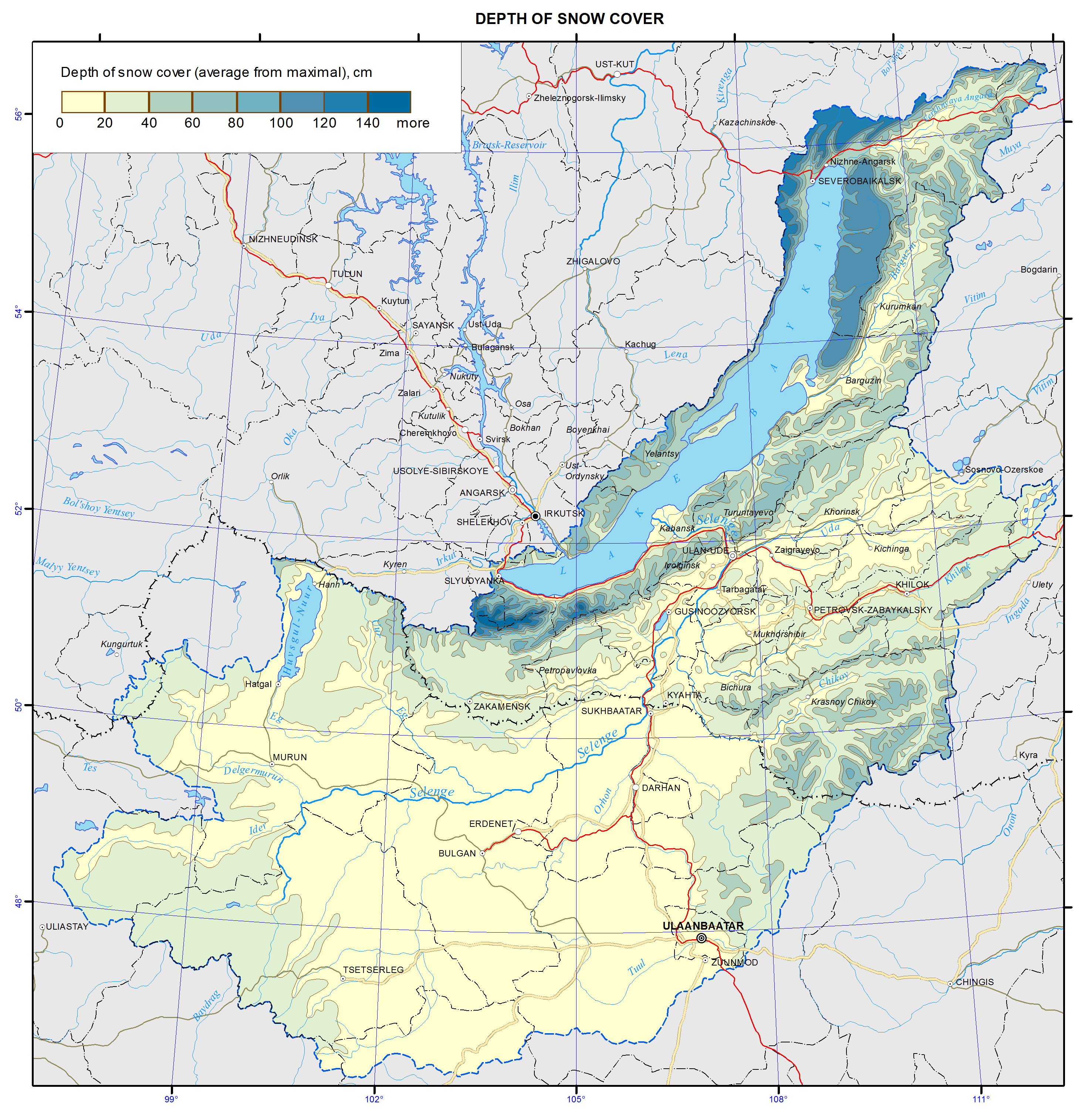
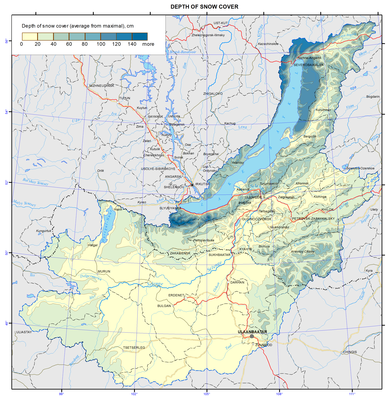
<p>The snow cover of the Baikal basin is formed inhomogenously. Its height decreases from the northeast of the Lena-Angara plateau (50-80 cm) to 5-10 cm in the vast plains of Mongolia and Transbaikalia. This is caused by the interaction of powerful north-eastern air flows with weakened Pacific ones, as well as by precipitation increasing with the altitude and by an increase in the share of their solid constituents. Therefore, in the valleys the snow depth is small, and in the mountains of Cisbaikalia and on the Stanovoe highland it reaches up to 60-100 cm.</p>
<p>Continuous snow cover is typical for the whole Baikal basin, but due to wind transport within basins with inversions, on the windward and leeward slopes it occurs unevenly. These factors make it difficult to reflect its spatial and temporal state, which is traced according to the data of the snow cover measurements. So, on the shores of Lake Baikal within 460-500 m there are about 70 meteorological stations, and on the slopes of the ranges there are no more than 5 stations. This factor defined the search for correlations of the measurement data of snow depth with better studied factors: with precipitation of the cold period, and with altitudes of the area. In this respect, the snow cover was analyzed at least on 900 meteorological stations within the entire Baikal-Mongolian region and adjacent territories. At the same time, a geographical-functional approach to spatial and temporal analysis of the snow cover was developed. Particular attention was given to determining the depth of snow on the slopes of different exposures. On the windward slopes the snow depths increase up to 70 cm at 1500 m of true altitude and up to 125 cm at 2000 m. Within the goletz zone on the leeward slopes the snow cover is constantly reducing up to 7-12 cm at 2000 m. On the plains its average height ranges from 30 to 40 cm. The exception is provided by the Mongolian Plateau, where in February and March, the snow depth does not exceed a few centimeters. It should be emphasized that in snowy winters the snow occurrence over 23-35 cm is covered by ice coating: due to fodder shortage in 2010 the number of livestock in Mongolia decreased from 40 to 28 million.</p>
<p>All contemporary background information is presented in references on climate, published at the end of the last century; after that the planetary warming came. Therefore a map of snow depths based on the data obtained till 1968 was compiled. Further, a correlation between the components of the snow cover of the last century with contemporary data for the warming period (1976-2010) is revealed. Using this approach, the opportunity to evaluate the past changes in snow cover over recent decades presented itself.</p>
<p>From 1975 to 2010, the average annual temperatures increased by 2ºC in extremely arid deserts of southern Mongolia, and by 1ºC in the northern mountain Transbaikalia. However, in Northern Transbaikalia the growth ΣT ≥ 10ºC turned out to be more, i.e. 600ºC, and in arid deserts only 200ºC. In the mountain-taiga landscapes the precipitation remained intact and in arid landscapes it decreased. Consequently, the height of the snow cover in the mountain-taiga landscapes decreased, and the avalanche danger became less threatening. At the same time Mongolian ice coating in Dauria became more active. Livestock deaths increased. Thus, according to the identified correlations, the snow cover map compiled according to the data till 1968 can be considered a basic one.</p>
<p>Regional peculiarity of snow depth formation should be emphasized. First of all, it is dictated by the meeting of wet air masses with the surface of mountain slopes. It is possible to distinguish graphically the snow accumulation on the windward and leeward slopes. Air masses, transporting over the water surface of rivers and lakes, are saturated with water and enhance the amount of snow on opposite slopes. These are the locations of weather stations near Vydrino, Snezhnaya, Tankhoi, Vorontsovka and others. The effect of windward and leeward slopes is leveled by depression inversion and generally irregular dynamics of air masses. The data of meteorological stations are more reliable. On their basis, the reading of snow changes according to the generalized spatial and temporal altitudinal gradient is carried out. So, at the levels of 1000 and 1500 m, the snow depth is 58 - 90 and 56 - 86 cm on the north-western slope and on the south-eastern slope, respectively.</p>
<p><b> </b></p>
<p align="center">References</p>
<p><i>Atlas of Irkutsk oblast</i>. (1968). Moscow-Irkutsk: Main Department of Geodesy and Cartography, 182 p.</p>
<p><i>Atlas of Transbaikalia.</i> (1967). Moscow-Irkutsk: Main Department of Geodesy and Cartography, 176 p.</p>
<p><i>Atlas of Cisbaikalia and Transbaikalia.</i> (1965). Moscow: Izd-vo "Nauka", 485 p.</p>
<p><i>Atlas: The economic potential of the Republic of Tuva</i>. (2005). Kyzyl: TuvIKOPR SO RAN, 60 p.</p>
<p><i>Climate Handbooks</i>. (1968). Leningrad: Gidrometeoizdat, vol. 21-23.</p>]]></content:encoded>
    <dc:publisher>No publisher</dc:publisher>
    <dc:creator>Alexander Ayurzhanaev</dc:creator>
    <dc:rights></dc:rights>
    <dc:date>2014-10-07T02:35:00Z</dc:date>
    <dc:type>Page</dc:type>
  </item>


  <item rdf:about="http://bic.iwlearn.org/en/atlas/atlas/20-average-annual-rainfall-in-mm-map/average-annual-rainfall-in-mm-map">
    <title>Average annual rainfall in mm map</title>
    <link>http://bic.iwlearn.org/en/atlas/atlas/20-average-annual-rainfall-in-mm-map/average-annual-rainfall-in-mm-map</link>
    <description></description>
    <content:encoded xmlns:content="http://purl.org/rss/1.0/modules/content/"><![CDATA[<p><img class="image-inline" src="../../../resolveuid/8800bf7b8f894145bcebc3dd7315f45f/@@images/image/preview" /></p>
<p><a href="http://bic.iwlearn.org/en/atlas/photos/copy_of__20_Averageannualrainfallinmm.png" class="internal-link">Open full size</a></p>
<p align="center"><b>Mean annual precipitation</b></p>
<p align="center"><b> </b></p>
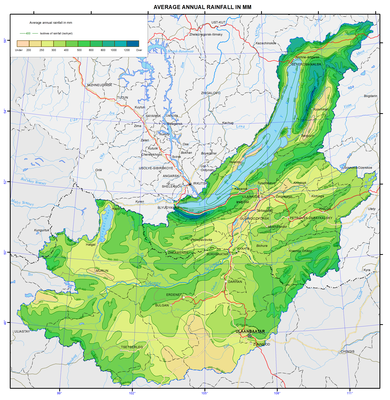
<p>Particular features of the mountainous topography have a significant impact on the formation and distribution of precipitation over the study area. The altitude and especially the location of mountains with respect to moisture-laden air flows lead to uneven distribution of precipitation. Different precipitation amount is observed at the same altitudes of mountain ranges. The greatest precipitation amount characterizes the north-western and western slopes of primary (with regard to prevailing air flows) ridges bordering Lake Baikal, i.e. up to 1400 mm; on the windward slopes of secondary ridges and within the plateau inner areas it reaches up to 400-700 mm. Precipitation amount of 200-250 mm fall out in the steppe part of the western shore of Lake Baikal and on its islands, and up to 300 mm precipitate in the intermontane depressions and in the Selenga and Uda river valleys.</p>
<p>Annual precipitation amount of 250-300 mm falls out in the mountains of Khentei at altitudes above 1000 m, in the mountains of the Khovsgol area at altitudes above 1500 m, and in the mountains of Khangai at altitudes above 2000 m. Summer precipitation predominate, constituting 60-70% of the annual amount.</p>]]></content:encoded>
    <dc:publisher>No publisher</dc:publisher>
    <dc:creator>Alexander Ayurzhanaev</dc:creator>
    <dc:rights></dc:rights>
    <dc:date>2014-10-07T02:35:00Z</dc:date>
    <dc:type>Page</dc:type>
  </item>


  <item rdf:about="http://bic.iwlearn.org/en/atlas/atlas/19-amounts-of-air-temperatures-for-the-period-with-temperatures-above-10-map/amounts-of-air-temperatures-for-the-period-with-temperatures-above-10-map">
    <title>Amounts of air temperatures for the period with temperatures above 10 map</title>
    <link>http://bic.iwlearn.org/en/atlas/atlas/19-amounts-of-air-temperatures-for-the-period-with-temperatures-above-10-map/amounts-of-air-temperatures-for-the-period-with-temperatures-above-10-map</link>
    <description></description>
    <content:encoded xmlns:content="http://purl.org/rss/1.0/modules/content/"><![CDATA[<p><img class="image-inline" src="../../../resolveuid/f7cd3065f0644907bc34cf3c12ed62ee/@@images/image/preview" /></p>
<p><a href="http://bic.iwlearn.org/en/atlas/photos/copy2_of__19_Amountsofairtemperaturesfortheperiodwithtemperaturesabove10.png" class="internal-link">Open full size</a></p>
<p align="center"><strong>Air temperature</strong></p>
<p align="center"><strong> </strong></p>
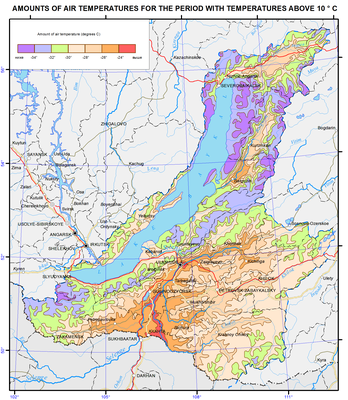
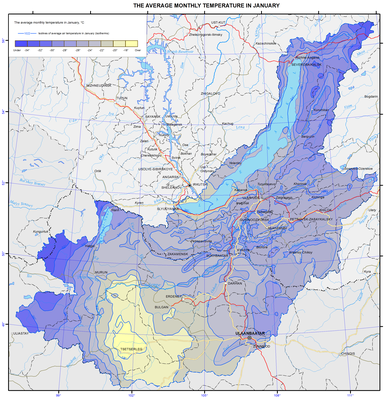
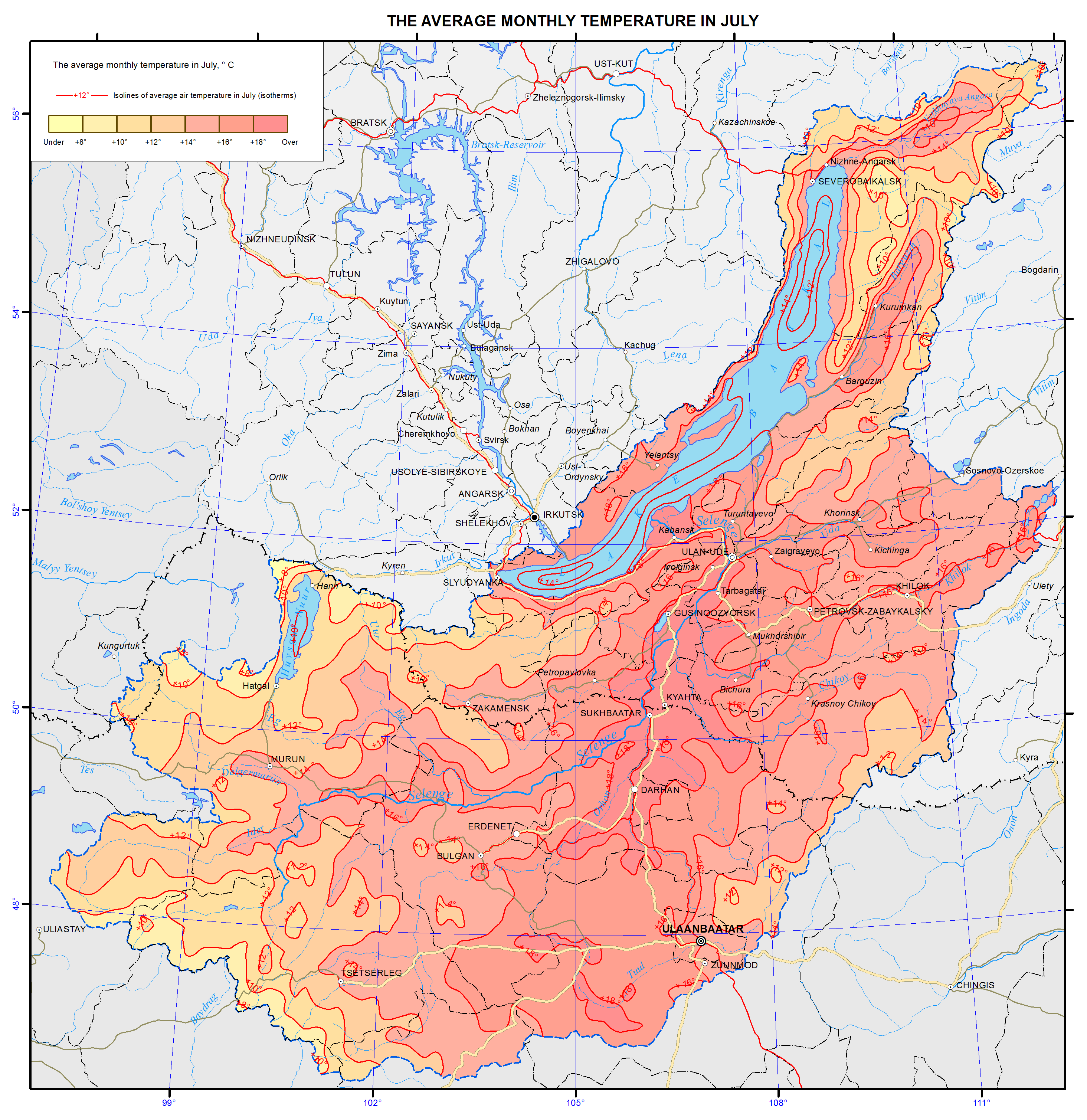
<p>Lake Baikal influences the climate of the surrounding area within the Baikal hollow. The climate of inland areas of Irkutsk oblast, Republic of Buryatia, Zabaikalsky krai, and Mongolia may be called sharply continental, and the climate of the shore of Lake Baikal is close to the coastal one. Winter month’s temperature on the shores of southern Baikal is on average 5°C higher than in the central areas, and summer month’s temperature is lower at the same rate. In summer temperature inversions are observed over the cold lake surface that impedes upward motions. The set of radiation and circulating factors and local conditions determine the features of the thermal regime.</p>
<p>In winter, due to the predominance of anticyclonic weather, the air temperature depends mainly on the radiation conditions, and the air cools over the underlying surface. In summer, radiation factors also play a dominant role in the temperature regime formation.</p>
<p>Long-term mean annual temperature is almost everywhere negative. At stations located on the shores of Lake Baikal, air temperature is higher than on the continental stations located at the same latitudes. The coldest month is January, and the warmest one is July.</p>]]></content:encoded>
    <dc:publisher>No publisher</dc:publisher>
    <dc:creator>Alexander Ayurzhanaev</dc:creator>
    <dc:rights></dc:rights>
    <dc:date>2014-10-07T02:35:00Z</dc:date>
    <dc:type>Page</dc:type>
  </item>


  <item rdf:about="http://bic.iwlearn.org/en/atlas/atlas/18-the-average-monthly-temperature-in-july-map/the-average-monthly-temperature-in-july-map">
    <title>018. The average monthly temperature in July map</title>
    <link>http://bic.iwlearn.org/en/atlas/atlas/18-the-average-monthly-temperature-in-july-map/the-average-monthly-temperature-in-july-map</link>
    <description></description>
    <content:encoded xmlns:content="http://purl.org/rss/1.0/modules/content/"><![CDATA[<p><img class="image-inline" src="../../../resolveuid/b3b79f5f843a474e8d5abe8306083d0a/@@images/image/preview" /></p>
<p><a href="http://bic.iwlearn.org/en/atlas/photos/copy_of__18_TheaveragemonthlytemperatureinJuly.png" class="internal-link">Open full size</a></p>
<p align="center"><strong>Air temperature</strong></p>
<p align="center"><strong> </strong></p>
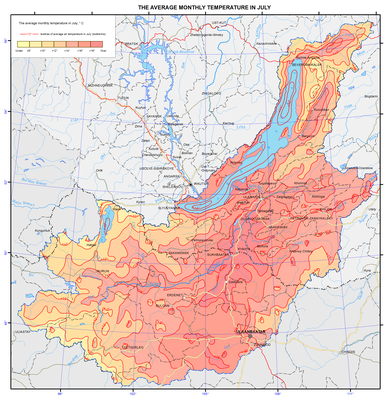
<p>Lake Baikal influences the climate of the surrounding area within the Baikal hollow. The climate of inland areas of Irkutsk oblast, Republic of Buryatia, Zabaikalsky krai, and Mongolia may be called sharply continental, and the climate of the shore of Lake Baikal is close to the coastal one. Winter month’s temperature on the shores of southern Baikal is on average 5°C higher than in the central areas, and summer month’s temperature is lower at the same rate. In summer temperature inversions are observed over the cold lake surface that impedes upward motions. The set of radiation and circulating factors and local conditions determine the features of the thermal regime.</p>
<p>In winter, due to the predominance of anticyclonic weather, the air temperature depends mainly on the radiation conditions, and the air cools over the underlying surface. In summer, radiation factors also play a dominant role in the temperature regime formation.</p>
<p>Long-term mean annual temperature is almost everywhere negative. At stations located on the shores of Lake Baikal, air temperature is higher than on the continental stations located at the same latitudes. The coldest month is January, and the warmest one is July.</p>]]></content:encoded>
    <dc:publisher>No publisher</dc:publisher>
    <dc:creator>Alexander Ayurzhanaev</dc:creator>
    <dc:rights></dc:rights>
    <dc:date>2014-10-07T02:30:00Z</dc:date>
    <dc:type>Page</dc:type>
  </item>


  <item rdf:about="http://bic.iwlearn.org/en/atlas/atlas/16-mean-sea-level-pressure-in-october-map/mean-sea-level-pressure-in-october-map">
    <title>016. Mean sea level pressure in October map</title>
    <link>http://bic.iwlearn.org/en/atlas/atlas/16-mean-sea-level-pressure-in-october-map/mean-sea-level-pressure-in-october-map</link>
    <description></description>
    <content:encoded xmlns:content="http://purl.org/rss/1.0/modules/content/"><![CDATA[<p><img class="image-inline" src="../../../resolveuid/3201c074e72a4a67a3a225a3aa427ef0/@@images/image/preview" /></p>
<p><a href="http://bic.iwlearn.org/en/atlas/photos/copy_of__16_MeansealevelpressureinOctober.png" class="internal-link">Open full size</a></p>
<p align="center"><strong>C</strong><strong>limate</strong></p>
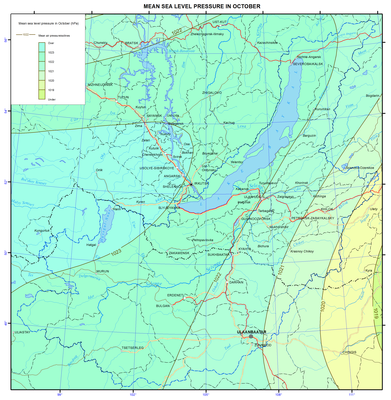
<p>Observational data of meteorological stations on the air temperature and precipitation in the period of 1961 to 2008 serve as initial data for climate maps here. Mean monthly and annual values are considered.</p>
<p align="center"><strong>Atmospheric pressure</strong></p>
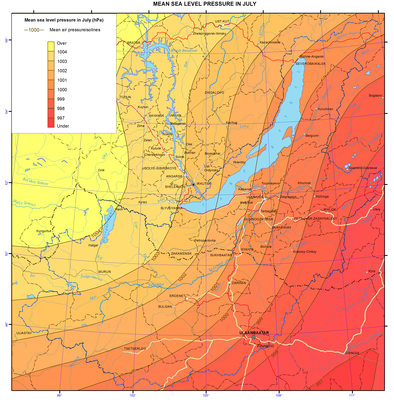
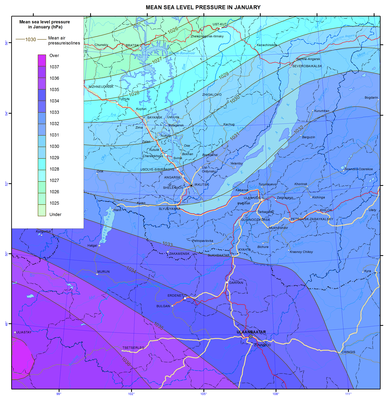
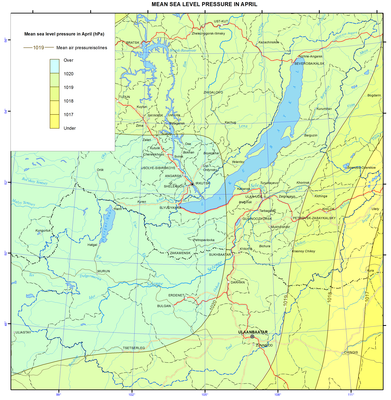
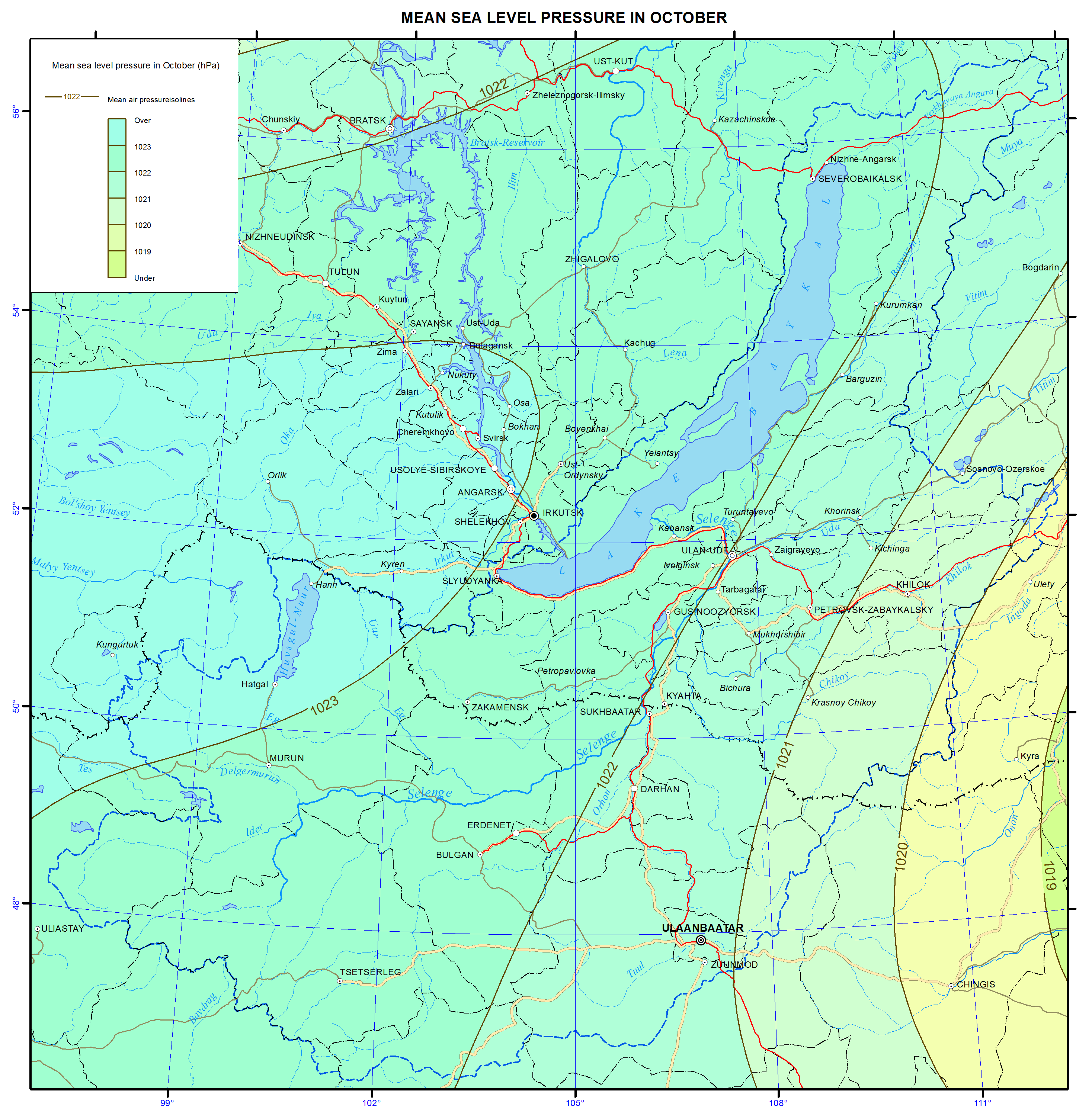
<p>A primary role in shaping climate is played by atmospheric circulation - one of the main climate factors. Atmospheric circulation is presented in the maps of pressure fields in the central months of seasons. The maps are compiled based on the monthly mean pressure values reduced to sea level (NCEP / NCAR reanalysis base). In winter, the main pressure system at the surface is Asian (Siberian) anticyclone centered on the north-west of Mongolia, reaching maximum development in January. In spring, the action of the Asian maximum weakens. Differences in the properties of the underlying surface of the continent and ocean reduce dramatically, thereby the zonal circulation factors begin to dominate, that determine the west-east transport. Together with the transfer of pressure formations from west to east the cyclones outputs from Central Asia and Kazakhstan are observed in spring. Summer circulation processes are characterized by the weakening of the west-east transport. The pressure field of low pressure dominates at the earth's surface. Circulation processes are characterized by the weakening of the west-east transport. At the earth's surface the pressure field of low pressure with light winds dominates. When the blocking warm anticyclone locates over the central regions of Yakutia, south cyclones from Mongolia move to the Baikal region and then they slowly travel to the west or northwest. Central forms of summer circulation, which are characterized by blockage of the zonal flow and split of planetary altitude frontal zone (PAFZ) of temperate latitudes, occur conditioned upon intensive development of the typical summer tall crests and troughs. Circulation conditions of the autumn period are characterized by the development of general west-east transport, which is interrupted by meridional invasions of cold air masses from the north. Siberian anticyclone is in its formation stage. Compared with the spring season the autumn west-east movement of pressure systems is slower. Final transition to winter conditions of circulation takes place around the middle of November, when the Siberian anticyclone is sufficiently stable.</p>]]></content:encoded>
    <dc:publisher>No publisher</dc:publisher>
    <dc:creator>Alexander Ayurzhanaev</dc:creator>
    <dc:rights></dc:rights>
    <dc:date>2014-10-07T02:30:00Z</dc:date>
    <dc:type>Page</dc:type>
  </item>


  <item rdf:about="http://bic.iwlearn.org/en/atlas/atlas/17-the-average-monthly-temperature-in-january-map/the-average-monthly-temperature-in-january-map">
    <title>017. The average monthly temperature in January map</title>
    <link>http://bic.iwlearn.org/en/atlas/atlas/17-the-average-monthly-temperature-in-january-map/the-average-monthly-temperature-in-january-map</link>
    <description></description>
    <content:encoded xmlns:content="http://purl.org/rss/1.0/modules/content/"><![CDATA[<p><img class="image-inline" src="../../../resolveuid/09a7e8a833fc4d759f83f322a9d55924/@@images/image/preview" /></p>
<p><a href="http://bic.iwlearn.org/en/atlas/photos/copy_of__17_TheaveragemonthlytemperatureinJanuary.png" class="internal-link">Open full size</a></p>
<p align="center"><strong>Air temperature</strong></p>
<p align="center"><strong> </strong></p>
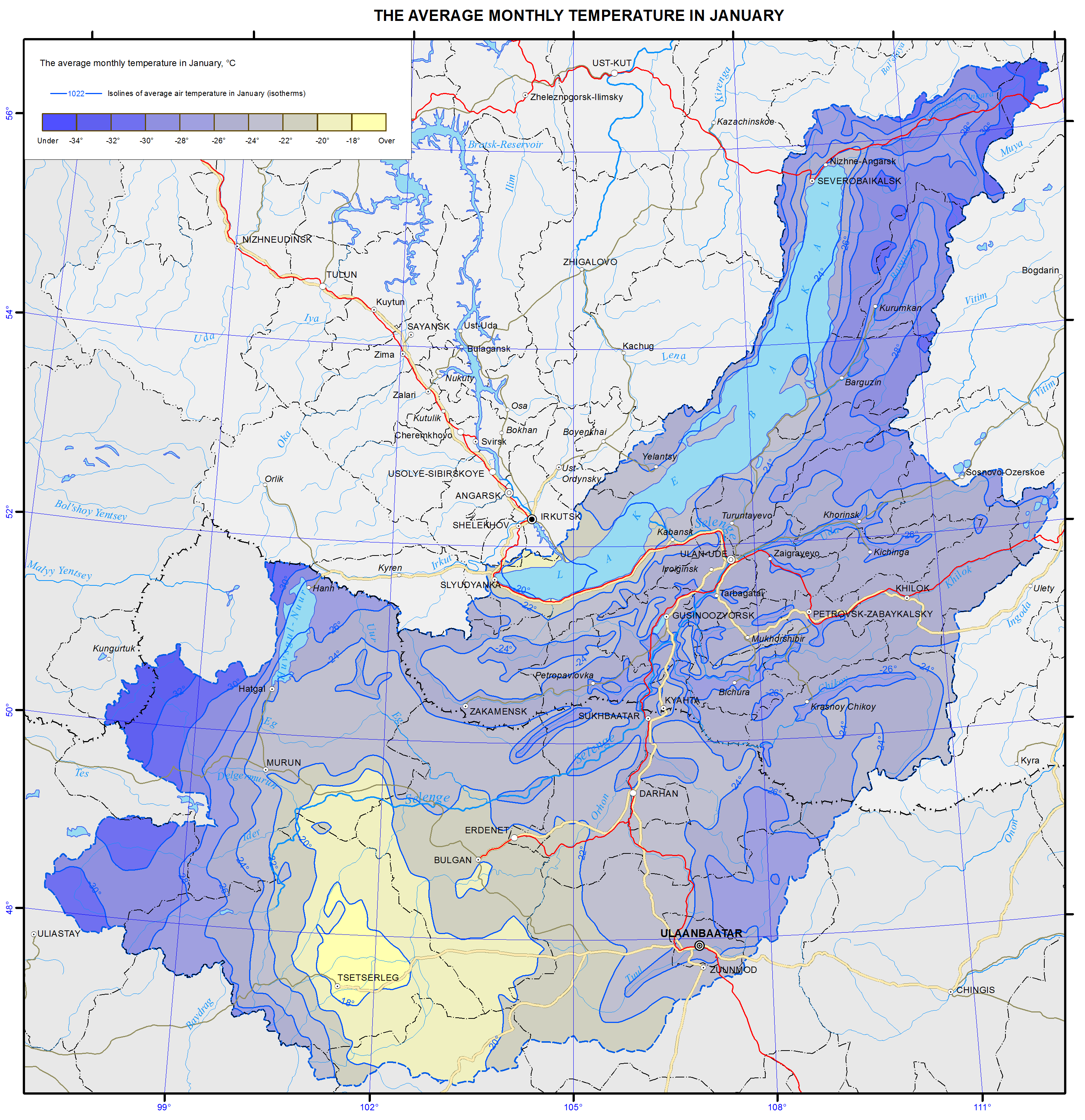
<p>Lake Baikal influences the climate of the surrounding area within the Baikal hollow. The climate of inland areas of Irkutsk oblast, Republic of Buryatia, Zabaikalsky krai, and Mongolia may be called sharply continental, and the climate of the shore of Lake Baikal is close to the coastal one. Winter month’s temperature on the shores of southern Baikal is on average 5°C higher than in the central areas, and summer month’s temperature is lower at the same rate. In summer temperature inversions are observed over the cold lake surface that impedes upward motions. The set of radiation and circulating factors and local conditions determine the features of the thermal regime.</p>
<p>In winter, due to the predominance of anticyclonic weather, the air temperature depends mainly on the radiation conditions, and the air cools over the underlying surface. In summer, radiation factors also play a dominant role in the temperature regime formation.</p>
<p>Long-term mean annual temperature is almost everywhere negative. At stations located on the shores of Lake Baikal, air temperature is higher than on the continental stations located at the same latitudes. The coldest month is January, and the warmest one is July.</p>]]></content:encoded>
    <dc:publisher>No publisher</dc:publisher>
    <dc:creator>Alexander Ayurzhanaev</dc:creator>
    <dc:rights></dc:rights>
    <dc:date>2014-10-07T02:30:00Z</dc:date>
    <dc:type>Page</dc:type>
  </item>


  <item rdf:about="http://bic.iwlearn.org/en/atlas/atlas/15-mean-sea-level-pressure-in-july-map/mean-sea-level-pressure-in-july-map">
    <title>015. Mean sea level pressure in July map</title>
    <link>http://bic.iwlearn.org/en/atlas/atlas/15-mean-sea-level-pressure-in-july-map/mean-sea-level-pressure-in-july-map</link>
    <description></description>
    <content:encoded xmlns:content="http://purl.org/rss/1.0/modules/content/"><![CDATA[<p><img class="image-inline" src="../../../resolveuid/b6eb3286f92c47edb9dd998eac42bb27/@@images/image/preview" /></p>
<p><a href="http://bic.iwlearn.org/en/atlas/photos/copy_of__15_MeansealevelpressureinJuly.png" class="internal-link">Open full size</a></p>
<p align="center"><strong>C</strong><strong>limate</strong><span> </span></p>
<p>Observational data of meteorological stations on the air temperature and precipitation in the period of 1961 to 2008 serve as initial data for climate maps here. Mean monthly and annual values are considered.</p>
<p align="center"><strong>Atmospheric pressure</strong><span> </span></p>
<p>A primary role in shaping climate is played by atmospheric circulation - one of the main climate factors. Atmospheric circulation is presented in the maps of pressure fields in the central months of seasons. The maps are compiled based on the monthly mean pressure values reduced to sea level (NCEP / NCAR reanalysis base). In winter, the main pressure system at the surface is Asian (Siberian) anticyclone centered on the north-west of Mongolia, reaching maximum development in January. In spring, the action of the Asian maximum weakens. Differences in the properties of the underlying surface of the continent and ocean reduce dramatically, thereby the zonal circulation factors begin to dominate, that determine the west-east transport. Together with the transfer of pressure formations from west to east the cyclones outputs from Central Asia and Kazakhstan are observed in spring. Summer circulation processes are characterized by the weakening of the west-east transport. The pressure field of low pressure dominates at the earth's surface. Circulation processes are characterized by the weakening of the west-east transport. At the earth's surface the pressure field of low pressure with light winds dominates. When the blocking warm anticyclone locates over the central regions of Yakutia, south cyclones from Mongolia move to the Baikal region and then they slowly travel to the west or northwest. Central forms of summer circulation, which are characterized by blockage of the zonal flow and split of planetary altitude frontal zone (PAFZ) of temperate latitudes, occur conditioned upon intensive development of the typical summer tall crests and troughs. Circulation conditions of the autumn period are characterized by the development of general west-east transport, which is interrupted by meridional invasions of cold air masses from the north. Siberian anticyclone is in its formation stage. Compared with the spring season the autumn west-east movement of pressure systems is slower. Final transition to winter conditions of circulation takes place around the middle of November, when the Siberian anticyclone is sufficiently stable.</p>]]></content:encoded>
    <dc:publisher>No publisher</dc:publisher>
    <dc:creator>Alexander Ayurzhanaev</dc:creator>
    <dc:rights></dc:rights>
    <dc:date>2014-10-07T02:25:00Z</dc:date>
    <dc:type>Page</dc:type>
  </item>


  <item rdf:about="http://bic.iwlearn.org/en/atlas/atlas/13-mean-sea-level-pressure-in-january-map/mean-sea-level-pressure-in-january-map">
    <title>013. Mean sea level pressure in January map</title>
    <link>http://bic.iwlearn.org/en/atlas/atlas/13-mean-sea-level-pressure-in-january-map/mean-sea-level-pressure-in-january-map</link>
    <description></description>
    <content:encoded xmlns:content="http://purl.org/rss/1.0/modules/content/"><![CDATA[<p><img class="image-inline" src="../../../resolveuid/dadde0a0dd7c41af8359527b1bd93715/@@images/image/preview" /></p>
<p><a href="http://bic.iwlearn.org/en/atlas/photos/copy_of__13_MeansealevelpressureinJanuary.png" class="internal-link">Open full size</a></p>
<p align="center"><strong>C</strong><strong>limate</strong></p>
<p align="center"><strong> </strong></p>
<p>Observational data of meteorological stations on the air temperature and precipitation in the period of 1961 to 2008 serve as initial data for climate maps here. Mean monthly and annual values are considered.</p>
<p align="center"><strong>Atmospheric pressure</strong></p>
<p align="center"><strong> </strong></p>
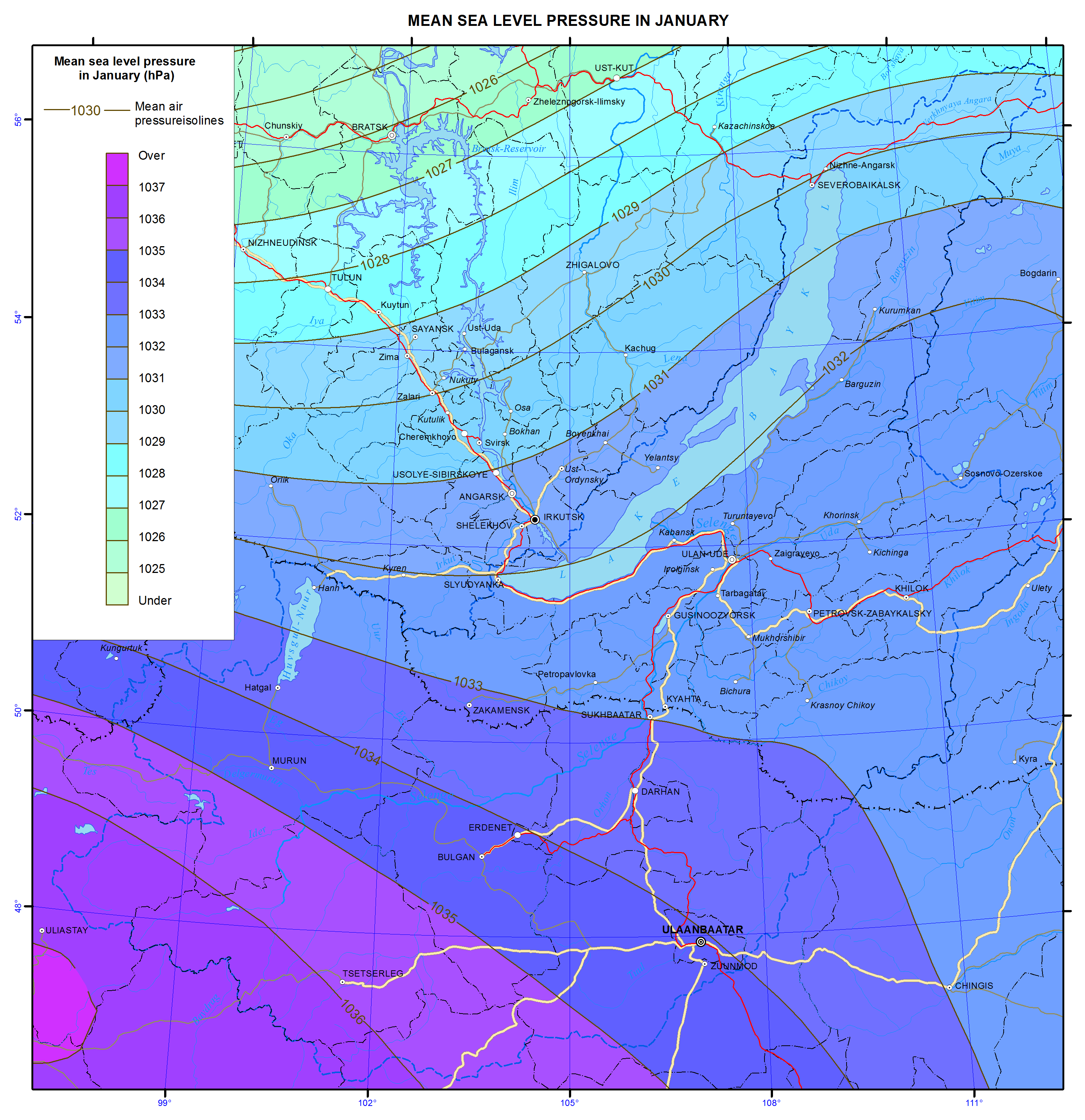
<p>A primary role in shaping climate is played by atmospheric circulation - one of the main climate factors. Atmospheric circulation is presented in the maps of pressure fields in the central months of seasons. The maps are compiled based on the monthly mean pressure values reduced to sea level (NCEP / NCAR reanalysis base). In winter, the main pressure system at the surface is Asian (Siberian) anticyclone centered on the north-west of Mongolia, reaching maximum development in January. In spring, the action of the Asian maximum weakens. Differences in the properties of the underlying surface of the continent and ocean reduce dramatically, thereby the zonal circulation factors begin to dominate, that determine the west-east transport. Together with the transfer of pressure formations from west to east the cyclones outputs from Central Asia and Kazakhstan are observed in spring. Summer circulation processes are characterized by the weakening of the west-east transport. The pressure field of low pressure dominates at the earth's surface. Circulation processes are characterized by the weakening of the west-east transport. At the earth's surface the pressure field of low pressure with light winds dominates. When the blocking warm anticyclone locates over the central regions of Yakutia, south cyclones from Mongolia move to the Baikal region and then they slowly travel to the west or northwest. Central forms of summer circulation, which are characterized by blockage of the zonal flow and split of planetary altitude frontal zone (PAFZ) of temperate latitudes, occur conditioned upon intensive development of the typical summer tall crests and troughs. Circulation conditions of the autumn period are characterized by the development of general west-east transport, which is interrupted by meridional invasions of cold air masses from the north. Siberian anticyclone is in its formation stage. Compared with the spring season the autumn west-east movement of pressure systems is slower. Final transition to winter conditions of circulation takes place around the middle of November, when the Siberian anticyclone is sufficiently stable.</p>]]></content:encoded>
    <dc:publisher>No publisher</dc:publisher>
    <dc:creator>Alexander Ayurzhanaev</dc:creator>
    <dc:rights></dc:rights>
    <dc:date>2014-10-07T02:20:00Z</dc:date>
    <dc:type>Page</dc:type>
  </item>


  <item rdf:about="http://bic.iwlearn.org/en/atlas/atlas/14-mean-sea-level-pressure-in-april-map/mean-sea-level-pressure-in-april-map">
    <title>014. Mean sea level pressure in April map</title>
    <link>http://bic.iwlearn.org/en/atlas/atlas/14-mean-sea-level-pressure-in-april-map/mean-sea-level-pressure-in-april-map</link>
    <description></description>
    <content:encoded xmlns:content="http://purl.org/rss/1.0/modules/content/"><![CDATA[<p><img class="image-inline" src="../../../resolveuid/fd26487eb3ea4ec5966d84609ea88860/@@images/image/preview" /></p>
<p><a href="http://bic.iwlearn.org/en/atlas/photos/copy_of__14_MeansealevelpressureinApril.png" class="internal-link">Open full size</a></p>
<p align="center"><strong>C</strong><strong>limate</strong></p>
<p>Observational data of meteorological stations on the air temperature and precipitation in the period of 1961 to 2008 serve as initial data for climate maps here. Mean monthly and annual values are considered.</p>
<p align="center"><strong>Atmospheric pressure</strong><span> </span></p>
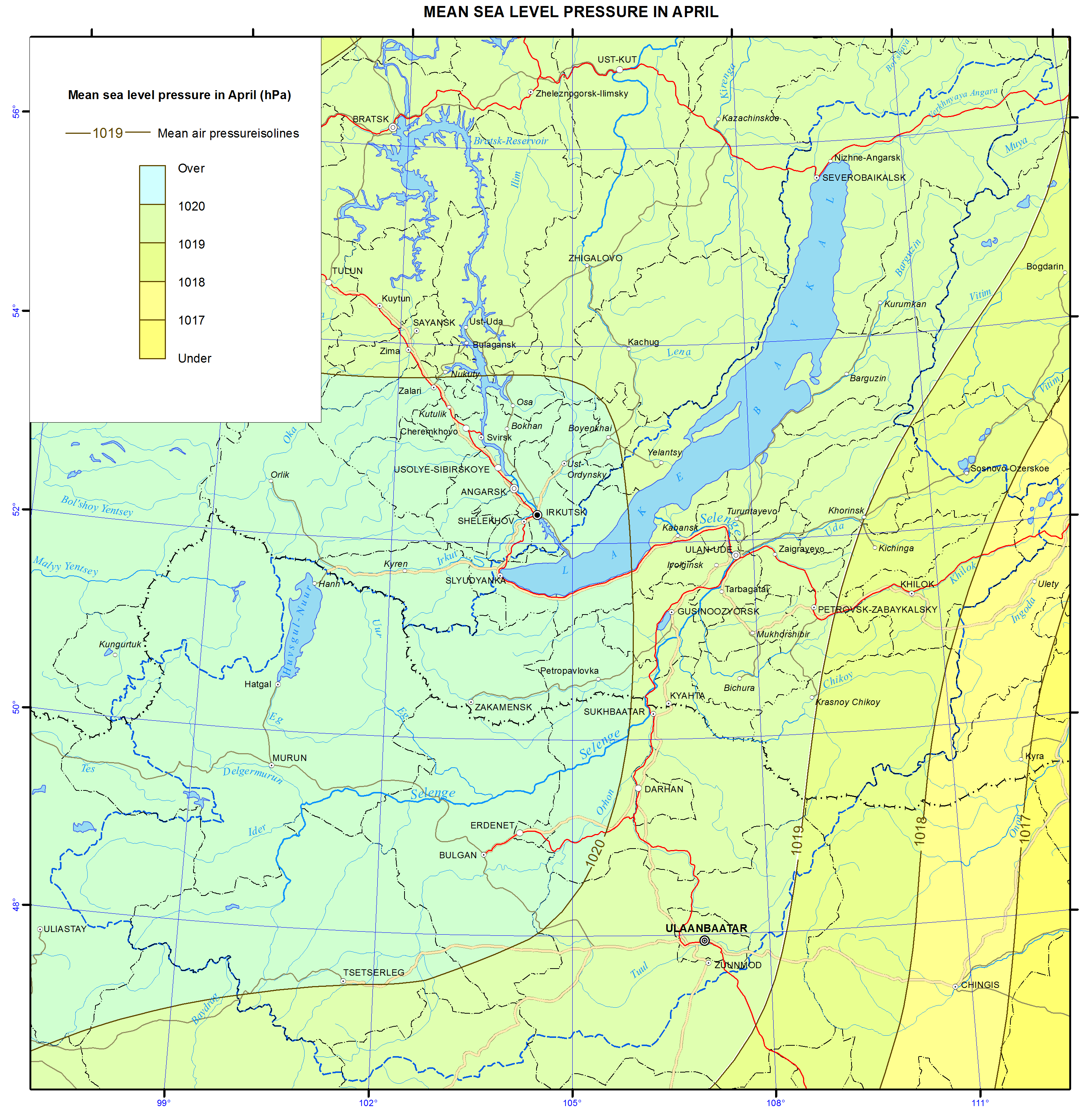
<p>A primary role in shaping climate is played by atmospheric circulation - one of the main climate factors. Atmospheric circulation is presented in the maps of pressure fields in the central months of seasons. The maps are compiled based on the monthly mean pressure values reduced to sea level (NCEP / NCAR reanalysis base). In winter, the main pressure system at the surface is Asian (Siberian) anticyclone centered on the north-west of Mongolia, reaching maximum development in January. In spring, the action of the Asian maximum weakens. Differences in the properties of the underlying surface of the continent and ocean reduce dramatically, thereby the zonal circulation factors begin to dominate, that determine the west-east transport. Together with the transfer of pressure formations from west to east the cyclones outputs from Central Asia and Kazakhstan are observed in spring. Summer circulation processes are characterized by the weakening of the west-east transport. The pressure field of low pressure dominates at the earth's surface. Circulation processes are characterized by the weakening of the west-east transport. At the earth's surface the pressure field of low pressure with light winds dominates. When the blocking warm anticyclone locates over the central regions of Yakutia, south cyclones from Mongolia move to the Baikal region and then they slowly travel to the west or northwest. Central forms of summer circulation, which are characterized by blockage of the zonal flow and split of planetary altitude frontal zone (PAFZ) of temperate latitudes, occur conditioned upon intensive development of the typical summer tall crests and troughs. Circulation conditions of the autumn period are characterized by the development of general west-east transport, which is interrupted by meridional invasions of cold air masses from the north. Siberian anticyclone is in its formation stage. Compared with the spring season the autumn west-east movement of pressure systems is slower. Final transition to winter conditions of circulation takes place around the middle of November, when the Siberian anticyclone is sufficiently stable.</p>]]></content:encoded>
    <dc:publisher>No publisher</dc:publisher>
    <dc:creator>Alexander Ayurzhanaev</dc:creator>
    <dc:rights></dc:rights>
    <dc:date>2014-10-07T02:20:00Z</dc:date>
    <dc:type>Page</dc:type>
  </item>


  <item rdf:about="http://bic.iwlearn.org/en/atlas/atlas/12-modern-exogenous-processes-of-morphogenesis-map/modern-exogenous-processes-of-morphogenesis-map">
    <title>012. Modern exogenous processes of morphogenesis map</title>
    <link>http://bic.iwlearn.org/en/atlas/atlas/12-modern-exogenous-processes-of-morphogenesis-map/modern-exogenous-processes-of-morphogenesis-map</link>
    <description></description>
    <content:encoded xmlns:content="http://purl.org/rss/1.0/modules/content/"><![CDATA[<p><img class="image-inline" src="../../../resolveuid/234afefba30c4bd0afa15d0b1013192d/@@images/image/preview" /></p>
<p><a href="http://bic.iwlearn.org/en/atlas/photos/copy_of__12_Modernexogenousprocessesofmorphogenesis.png" class="internal-link">Open full size</a></p>
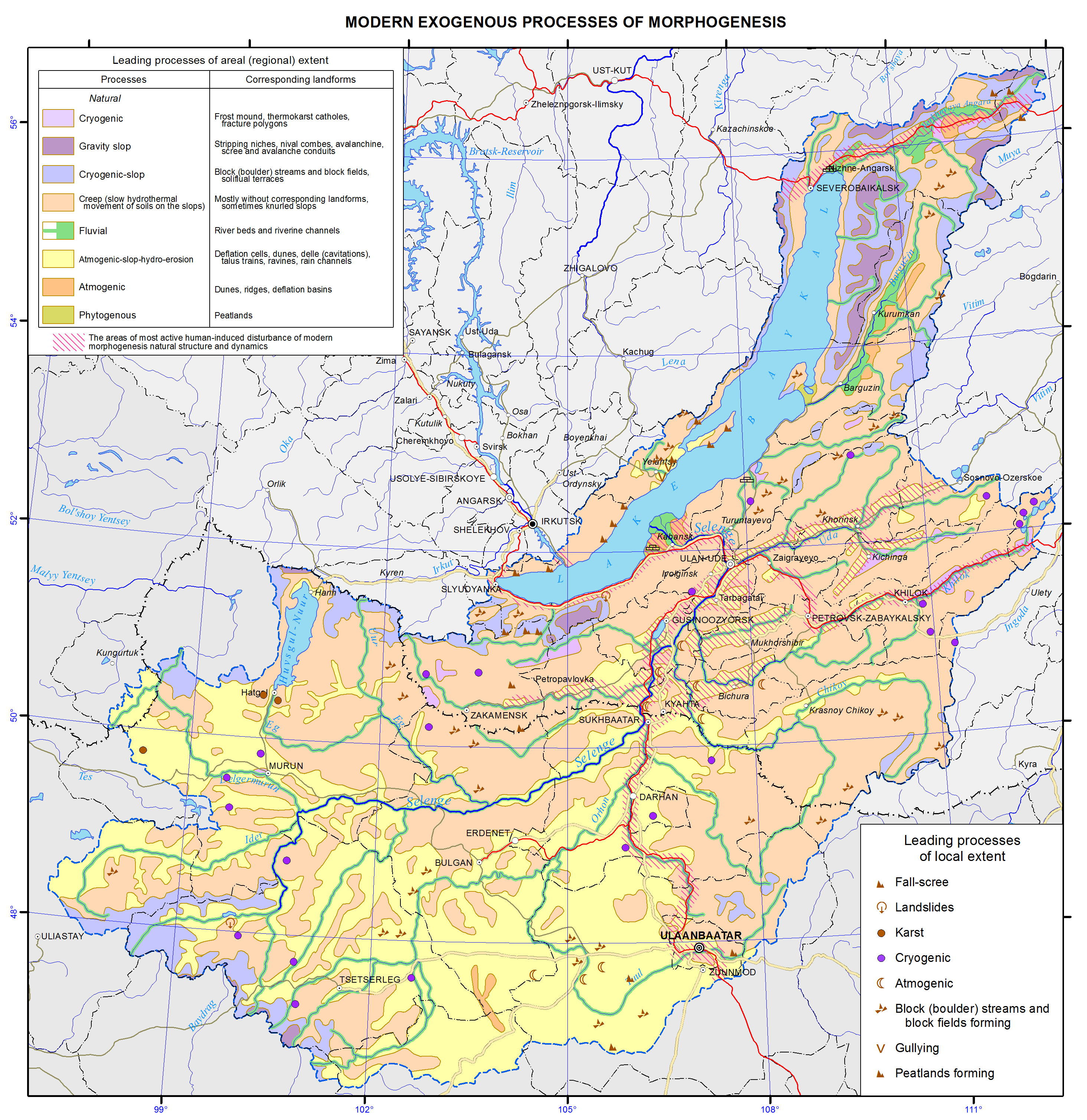
<p align="center"><strong>Contemporary exogenous processes of morphogenesis</strong></p>
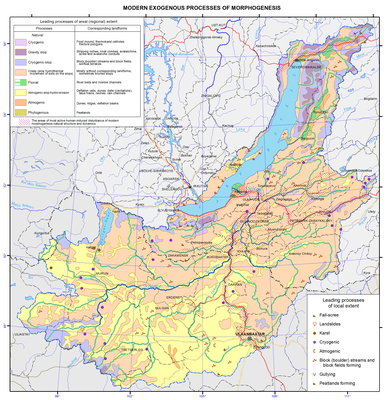
<p class="NormalWeb">For purposes of mapping, the leading processes were identified on the basis of a classification of the exogenous processes of morphogenesis of land, suggested by V. B. Vyrkin [1986], from taxonomic geomorphological units in accordance with the scale. At a small scale, the objects of geomorphological mapping are the types, subtypes and complexes of topography which are basic to identifying classes and groups of leading processes. The legend is based on identifying one leading process (the one exception to this rule is represented by the display of areas on the map where the contemporary morphogenesis is due to a combination of two leading classes of processes). Identification of the leading processes of the territory took into account their three main parameters: the coverage area, the duration of a continuous occurrence, and the intensity of development.</p>
<p class="NormalWeb">The process is identified through a process interpretation of the relief, deposits, landscapes, vegetation and other natural formations. The procedure brings to the fore the interpretation of the relief, its morphology, genesis and age, and the identification of the genetic types of deposits. Only an integral investigation into the landforms and correlative deposits, complemented with station-based observations of the intensity of processes, does make it possible to identify in the mapping procedure the leading processes, and of paramount importance is a knowledge of the geomorphological structure of the region being mapped. Vital to the generation of small- and medium-scale maps of the processes, especially for poorly explored spaces of Siberia and Mongolia, are space images. In Siberia’s remote regions difficult of access, space images provide the main information base for map compilation.</p>
<p>Thus the methodological framework for mapping the contemporary exogenous processes of morphogenesis involves determining and depicting the leading processes. Maps as produced by such a method offer a means of investigating the structure and functioning of the processes of contemporary exogenous morphogenesis. They can be used in developing and generating regionalization schemes for contemporary exogenous processes of morphogenesis.</p>
<p>The map as created on the basis of the aforementioned principles constitutes a wealth of information which can be employed in dealing with issues relating to rational management of natural resources, assessments of the relief and contemporary morphogenetic processes, and to implementation of measures for the protection of land surface against hazardous and adverse geomorphological processes.</p>]]></content:encoded>
    <dc:publisher>No publisher</dc:publisher>
    <dc:creator>Alexander Ayurzhanaev</dc:creator>
    <dc:rights></dc:rights>
    <dc:date>2014-10-07T02:20:00Z</dc:date>
    <dc:type>Page</dc:type>
  </item>


  <item rdf:about="http://bic.iwlearn.org/en/atlas/atlas/10-geomorphology-map/geomorphology-map">
    <title>010. Geomorphology map</title>
    <link>http://bic.iwlearn.org/en/atlas/atlas/10-geomorphology-map/geomorphology-map</link>
    <description></description>
    <content:encoded xmlns:content="http://purl.org/rss/1.0/modules/content/"><![CDATA[<p><img class="image-inline" src="../../../resolveuid/c774bed0354a4476a8456f4f05882d31/@@images/image/preview" /></p>
<p><a href="http://bic.iwlearn.org/en/atlas/photos/copy_of__10_Geomorphology.png" class="internal-link">Open full size</a></p>
<p align="center"><strong>Geomorphology</strong></p>
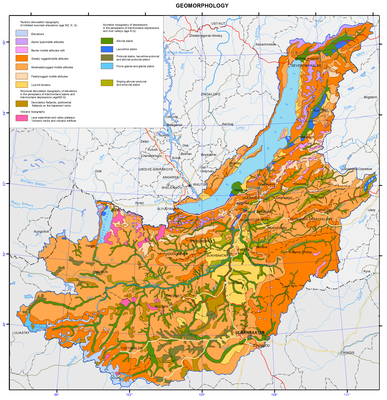
<p>The Baikal basin is located in the center of Eurasia, which determines its specific traits as well as the main features of nature. Paleogeography and geology of the region govern its peculiar landforms.</p>
<p>Vertical tectonic movements of the Late Mesozoic and the Cenozoic developed a mountain-basin type of topography.</p>
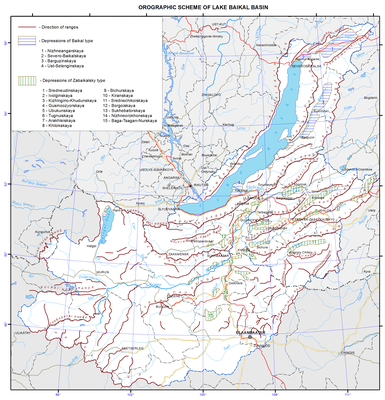
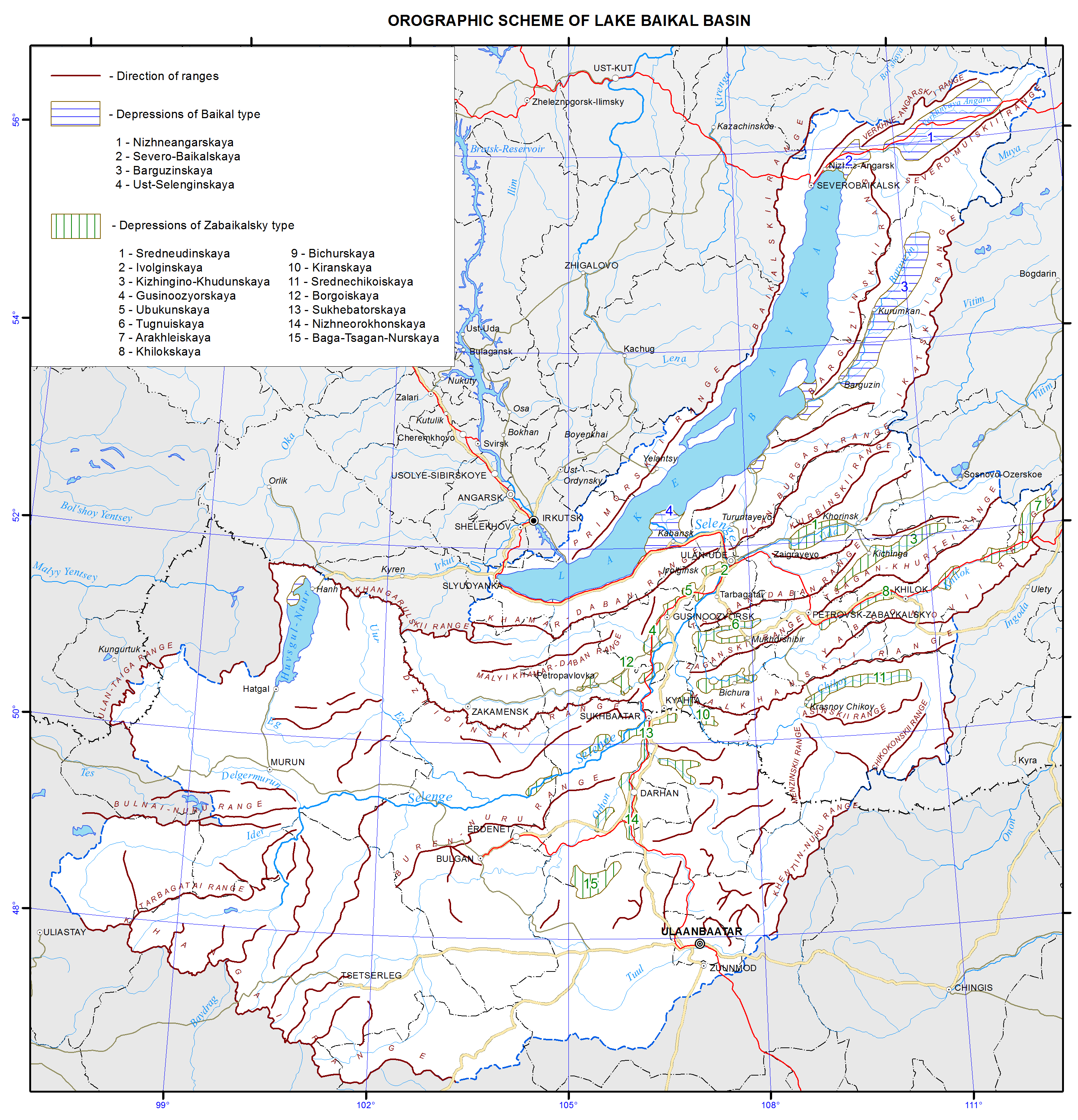
<p>The orographic structure of the Baikal basin is rather complex. The topography as a whole is a unified Pliocene-Quaternary formation [Ecosystems, 2005]. Significant subsidence of individual blocks in the midst of general uplift developed grabens of two types. The first type (the Baikal type) is associated with the intensification of tectonic activity in the inland Baikal Rift Zone. The amplitude of vertical neotectonic movements, as well as the thickness of loose deposits reach their maximum here. Crustal movements in this area are still quite intense; they cause a high seismic activity with frequent and sometimes strong earthquakes. The second type (the Transbaikalian type) is represented by wide intermountain lowlands, which are very common in the Selenga river basin. They formed as a result of recent deep-seated tectonic dislocations superimposed on the rejuvenated Mesozoic depressions.</p>
<p>Intermountain basins are separated by mountain ranges varying in height and geological structure. They are noticeably dissected by exogenous processes of erosion.</p>
<p>In the Quaternary, the highest orographic units (the Baikalsky, Verkhneangarsky, Barguzinsky, Khamar-Daban, Khangai and other mountain ranges), especially their north-western and northern slopes, were exposed to glaciation, which is indicated by the presence of the alpine landforms (cirques, avalanche chutes, through valleys, moraines, etc.)</p>
<p>Both positive and negative landforms within the Selenga river catchment area basin and up to the Uda river mouth are generally directed northeastward with a dominant altitude lowering northward. The mountains surrounding of three Baikal intermountain basins (Barguzin, Verkhneangarsk and Khovsgol lowlands) are characterized by higher absolute altitudes and deeply cut river valleys. These factors predetermine a wide range of elements typical of mountain landform, or plain landform in the wide intermountain basins.</p>
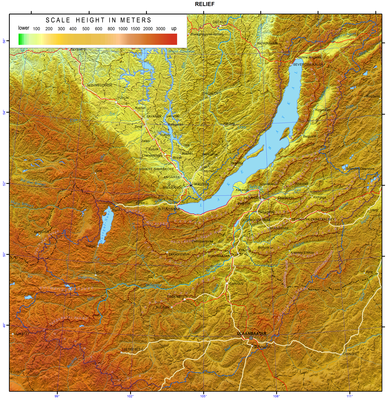
<p>According to the geomorphological zoning [Highlands…, 1974; National Atlas of the Mongolian People’s Republic, 1990] the area of the Baikal basin is made up of the following features: Khangai and Khentei-Dauria highlands, Khovsgol mountains, Orkhon-Selenga middle mountains and its continuation in the north - Selenga (Selenginskaya Dauria) middle mountains, mountain systems of the Dzhidinsky mountainous region, mountain ranges of Khamar-Daban, Ulan-Burgasy, Ikatsky, Barguzinsky, Verkhneangarsky, Severomuisky, Baikalsky, and Primorsky, and the western side of the Vitim Plateau. Minimum absolute altitude is the Lake Baikal waterline; since it is regulated, it is subjected to slight fluctuations at around 460 m a.s.l. Maximum absolute altitude is 3,539 m a.s.l. (the Khangai Highland).</p>
<p>The highest mountain range in the area is the Khangai Highland located in the south-western part of the basin; it has generally subdued delineation and slight changes of relative altitudes. The mountains become more prominent towards the central part of the basin due to Alpine landforms. Tarbagatai and Telin-Tsagan are the largest northern spurs of Khangai Highlands with individual peaks reaching 2,500 m.</p>
<p>The maximum altitudes of the Khentei Highland mountains go up to 2,200-2,400 m a.s.l. Their wide and long spurs stretch westward and eastward, forming a large highland, gradually descending to low hills in the west and in the south, and joining the mountains of Transbaikalia in the north. Generally, this is a gently sloping landscape with wide-spread residual hills, rocks, and scattered stones. Traces of ancient glaciation are preserved to a limited extent.</p>
<p>The Orkhon-Selenga middle mountains are located in the central part of the watershed basin between the ranges of the Dzhida river basin in the north and the Khentei Highlands in the south. It features a flattened relief and its spatial configuration resembles a huge amphitheater descending towards the northeast.</p>
<p>The Selenga middle mountains consist of sublatitudinal medium-altitude mountain ranges with rounded summits (Tsagan-Daban, Borgoisky, Chikoysky, Tsagan-Khurteisky, Zagansky, and others) separated by wide intermountain valleys distinctly stretching along the main riverbeds. The valley bottoms are drained by the Selenga tributaries (Chikoy, Khilok, Uda, Dzhida) and composed of alluvial and proluvial deposits of different age arranged in terraces and wide piedmont plains. The Selenga river valley lies among low hills with granite residuals, rocks, and cliffs.</p>
<p>The Khovsgol area relief has a complex structure. Its west side features sharp-crested, steep-sided, and hard to access ridges of Bayan-Ula and Khoridol-Saryag. The outlines of the mountains to the east of Lake Khovsgol resemble those of the northern Khentei with altitudes over 2,000 m. Extensive Late Cenosoic lava plateaus are specific features of these mountains.</p>
<p class="a">The Dzhida and Khamar-Damban Mountain Ranges have a lot in common. They stretch from the south-west to the north-east. In the west, they are relatively flattened and marked by bald peaks, gradually turning into the alpinotype middle mountains of the Big Khamar-Daban Mountain Range, which drops steeply to the shores of Lake Baikal. In the east, the mountains have a lower altitude. The Selenga river cuts through their spurs.</p>
<p>The northern part of Lake Baikal and the Verkhneangarskaya basin are surrounded by Alpine landforms with harsh outlines of the axial and piedmont parts of the Baikalsky, Verkhneangarsky, Severomuisky, and Barguzinsky mountain ranges. In spite of the relatively moderate elevations, there are many glacial traces here, and in some places there are small vanishing mountain glaciers (e.g. the Chersky Glacier – about 0.4 km2) The Vekhneangarsky basin relief shows little elevation changes at the bottom. It is formed by the alluvial deposits of the Verkhnyaya Angara (the Upper Angara) river, and by lacustrine alluvial deposits of paleobasins. Extensive proluvial and fluvioglacial piedmont plains are typical of the basin.</p>
<p>The structure of the Barguzinskya basin is typical of the Baikal-type depressions: large swampy plain areas at the basin bottom, and relatively uplifted ancient alluvial lacustrine terraces made of sandstone deposits. The presence of large areas of sandstone deposits predetermines high eolian activity.</p>
<p>In the south, the Barguzinskaya depression is framed by massive, but relatively flat landforms of the Ikatsky range. The highest summits of the Ikatsky range as well as those of the ranges lying further south (Ulan-Burgasy and Kurbinsky ranges) are treeless and flat with mountain terraces. <b> </b></p>
<p align="center"><b> </b></p>
<p align="center">References<i></i></p>
<p>Logachev, N.A., Antoshchenko-Olenev, I.V., Bazarov, D.B. et al. (1974). <i>Highlands of Cisbaikalia and Transbaikalia.</i> Moscow: Nauka, 360 p.</p>
<p> </p>
<p><i>Ecosystems of the Selenga  basin (Biological Resources and Natural Conditions of Mongolia: Proceedings of the Joint Russian-Mongolian Complex Biological Expedition; vol. 44)</i>, (2005). Executive Editors: E.A. Vostokova and P.D. Gunin. Moscow: Nauka, 359 p.</p>]]></content:encoded>
    <dc:publisher>No publisher</dc:publisher>
    <dc:creator>Alexander Ayurzhanaev</dc:creator>
    <dc:rights></dc:rights>
    <dc:date>2014-10-07T02:15:00Z</dc:date>
    <dc:type>Page</dc:type>
  </item>


  <item rdf:about="http://bic.iwlearn.org/en/atlas/atlas/11-orographic-scheme-of-lake-baikal-basin-map/orographic-scheme-of-lake-baikal-basin-map">
    <title>011. Orographic scheme of Lake Baikal basin map</title>
    <link>http://bic.iwlearn.org/en/atlas/atlas/11-orographic-scheme-of-lake-baikal-basin-map/orographic-scheme-of-lake-baikal-basin-map</link>
    <description></description>
    <content:encoded xmlns:content="http://purl.org/rss/1.0/modules/content/"><![CDATA[<p><img class="image-inline" src="../../../resolveuid/0230445935314ef28902e25f9ddbcc45/@@images/image/preview" /></p>
<p><a href="http://bic.iwlearn.org/en/atlas/photos/copy_of__11_OrographicSchemeofLakeBaikalBasin.png" class="internal-link">Open full size</a></p>
<p align="center"><strong>Geomorphology</strong></p>
<p>The Baikal basin is located in the center of Eurasia, which determines its specific traits as well as the main features of nature. Paleogeography and geology of the region govern its peculiar landforms.</p>
<p>Vertical tectonic movements of the Late Mesozoic and the Cenozoic developed a mountain-basin type of topography.</p>
<p>The orographic structure of the Baikal basin is rather complex. The topography as a whole is a unified Pliocene-Quaternary formation [Ecosystems, 2005]. Significant subsidence of individual blocks in the midst of general uplift developed grabens of two types. The first type (the Baikal type) is associated with the intensification of tectonic activity in the inland Baikal Rift Zone. The amplitude of vertical neotectonic movements, as well as the thickness of loose deposits reach their maximum here. Crustal movements in this area are still quite intense; they cause a high seismic activity with frequent and sometimes strong earthquakes. The second type (the Transbaikalian type) is represented by wide intermountain lowlands, which are very common in the Selenga river basin. They formed as a result of recent deep-seated tectonic dislocations superimposed on the rejuvenated Mesozoic depressions.</p>
<p>Intermountain basins are separated by mountain ranges varying in height and geological structure. They are noticeably dissected by exogenous processes of erosion.</p>
<p>In the Quaternary, the highest orographic units (the Baikalsky, Verkhneangarsky, Barguzinsky, Khamar-Daban, Khangai and other mountain ranges), especially their north-western and northern slopes, were exposed to glaciation, which is indicated by the presence of the alpine landforms (cirques, avalanche chutes, through valleys, moraines, etc.)</p>
<p>Both positive and negative landforms within the Selenga river catchment area basin and up to the Uda river mouth are generally directed northeastward with a dominant altitude lowering northward. The mountains surrounding of three Baikal intermountain basins (Barguzin, Verkhneangarsk and Khovsgol lowlands) are characterized by higher absolute altitudes and deeply cut river valleys. These factors predetermine a wide range of elements typical of mountain landform, or plain landform in the wide intermountain basins.</p>
<p>According to the geomorphological zoning [Highlands…, 1974; National Atlas of the Mongolian People’s Republic, 1990] the area of the Baikal basin is made up of the following features: Khangai and Khentei-Dauria highlands, Khovsgol mountains, Orkhon-Selenga middle mountains and its continuation in the north - Selenga (Selenginskaya Dauria) middle mountains, mountain systems of the Dzhidinsky mountainous region, mountain ranges of Khamar-Daban, Ulan-Burgasy, Ikatsky, Barguzinsky, Verkhneangarsky, Severomuisky, Baikalsky, and Primorsky, and the western side of the Vitim Plateau. Minimum absolute altitude is the Lake Baikal waterline; since it is regulated, it is subjected to slight fluctuations at around 460 m a.s.l. Maximum absolute altitude is 3,539 m a.s.l. (the Khangai Highland).</p>
<p>The highest mountain range in the area is the Khangai Highland located in the south-western part of the basin; it has generally subdued delineation and slight changes of relative altitudes. The mountains become more prominent towards the central part of the basin due to Alpine landforms. Tarbagatai and Telin-Tsagan are the largest northern spurs of Khangai Highlands with individual peaks reaching 2,500 m.</p>
<p>The maximum altitudes of the Khentei Highland mountains go up to 2,200-2,400 m a.s.l. Their wide and long spurs stretch westward and eastward, forming a large highland, gradually descending to low hills in the west and in the south, and joining the mountains of Transbaikalia in the north. Generally, this is a gently sloping landscape with wide-spread residual hills, rocks, and scattered stones. Traces of ancient glaciation are preserved to a limited extent.</p>
<p>The Orkhon-Selenga middle mountains are located in the central part of the watershed basin between the ranges of the Dzhida river basin in the north and the Khentei Highlands in the south. It features a flattened relief and its spatial configuration resembles a huge amphitheater descending towards the northeast.</p>
<p>The Selenga middle mountains consist of sublatitudinal medium-altitude mountain ranges with rounded summits (Tsagan-Daban, Borgoisky, Chikoysky, Tsagan-Khurteisky, Zagansky, and others) separated by wide intermountain valleys distinctly stretching along the main riverbeds. The valley bottoms are drained by the Selenga tributaries (Chikoy, Khilok, Uda, Dzhida) and composed of alluvial and proluvial deposits of different age arranged in terraces and wide piedmont plains. The Selenga river valley lies among low hills with granite residuals, rocks, and cliffs.</p>
<p>The Khovsgol area relief has a complex structure. Its west side features sharp-crested, steep-sided, and hard to access ridges of Bayan-Ula and Khoridol-Saryag. The outlines of the mountains to the east of Lake Khovsgol resemble those of the northern Khentei with altitudes over 2,000 m. Extensive Late Cenosoic lava plateaus are specific features of these mountains.</p>
<p class="a">The Dzhida and Khamar-Damban Mountain Ranges have a lot in common. They stretch from the south-west to the north-east. In the west, they are relatively flattened and marked by bald peaks, gradually turning into the alpinotype middle mountains of the Big Khamar-Daban Mountain Range, which drops steeply to the shores of Lake Baikal. In the east, the mountains have a lower altitude. The Selenga river cuts through their spurs.</p>
<p>The northern part of Lake Baikal and the Verkhneangarskaya basin are surrounded by Alpine landforms with harsh outlines of the axial and piedmont parts of the Baikalsky, Verkhneangarsky, Severomuisky, and Barguzinsky mountain ranges. In spite of the relatively moderate elevations, there are many glacial traces here, and in some places there are small vanishing mountain glaciers (e.g. the Chersky Glacier – about 0.4 km2) The Vekhneangarsky basin relief shows little elevation changes at the bottom. It is formed by the alluvial deposits of the Verkhnyaya Angara (the Upper Angara) river, and by lacustrine alluvial deposits of paleobasins. Extensive proluvial and fluvioglacial piedmont plains are typical of the basin.</p>
<p>The structure of the Barguzinskya basin is typical of the Baikal-type depressions: large swampy plain areas at the basin bottom, and relatively uplifted ancient alluvial lacustrine terraces made of sandstone deposits. The presence of large areas of sandstone deposits predetermines high eolian activity.</p>
<p>In the south, the Barguzinskaya depression is framed by massive, but relatively flat landforms of the Ikatsky range. The highest summits of the Ikatsky range as well as those of the ranges lying further south (Ulan-Burgasy and Kurbinsky ranges) are treeless and flat with mountain terraces. <b> </b></p>
<p align="center"><b> </b></p>
<p align="center">References<i></i></p>
<p>Logachev, N.A., Antoshchenko-Olenev, I.V., Bazarov, D.B. et al. (1974). <i>Highlands of Cisbaikalia and Transbaikalia.</i> Moscow: Nauka, 360 p.</p>
<p> </p>
<p><i>Ecosystems of the Selenga  basin (Biological Resources and Natural Conditions of Mongolia: Proceedings of the Joint Russian-Mongolian Complex Biological Expedition; vol. 44)</i>, (2005). Executive Editors: E.A. Vostokova and P.D. Gunin. Moscow: Nauka, 359 p.</p>]]></content:encoded>
    <dc:publisher>No publisher</dc:publisher>
    <dc:creator>Alexander Ayurzhanaev</dc:creator>
    <dc:rights></dc:rights>
    <dc:date>2014-10-07T02:15:00Z</dc:date>
    <dc:type>Page</dc:type>
  </item>


  <item rdf:about="http://bic.iwlearn.org/en/atlas/atlas/09-steepness-of-slopes-map/steepness-of-slopes-map">
    <title>009. Steepness of slopes map</title>
    <link>http://bic.iwlearn.org/en/atlas/atlas/09-steepness-of-slopes-map/steepness-of-slopes-map</link>
    <description></description>
    <content:encoded xmlns:content="http://purl.org/rss/1.0/modules/content/"><![CDATA[<p><img class="image-inline" src="../../../resolveuid/037fa80b740a4d9f89e8e065c06ef306/@@images/image/preview" /></p>
<p><a href="http://bic.iwlearn.org/en/atlas/photos/copy_of__09_SteepnessofSlopes.png" class="internal-link">Open full size</a></p>
<p align="center"><b>Geomorphology map. Orographic scheme</b></p>
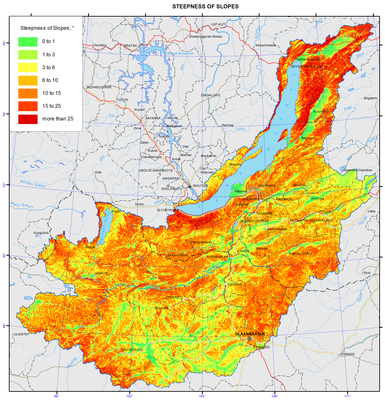
<p>The Baikal basin is located in the center of Eurasia, which determines its specific traits as well as the main features of nature. Paleogeography and geology of the region govern its peculiar landforms.</p>
<p>Vertical tectonic movements of the Late Mesozoic and the Cenozoic developed a mountain-basin type of topography.</p>
<p>The orographic structure of the Baikal basin is rather complex. The topography as a whole is a unified Pliocene-Quaternary formation [Ecosystems, 2005]. Significant subsidence of individual blocks in the midst of general uplift developed grabens of two types. The first type (the Baikal type) is associated with the intensification of tectonic activity in the inland Baikal Rift Zone. The amplitude of vertical neotectonic movements, as well as the thickness of loose deposits reach their maximum here. Crustal movements in this area are still quite intense; they cause a high seismic activity with frequent and sometimes strong earthquakes. The second type (the Transbaikalian type) is represented by wide intermountain lowlands, which are very common in the Selenga river basin. They formed as a result of recent deep-seated tectonic dislocations superimposed on the rejuvenated Mesozoic depressions.</p>
<p>Intermountain basins are separated by mountain ranges varying in height and geological structure. They are noticeably dissected by exogenous processes of erosion.</p>
<p>In the Quaternary, the highest orographic units (the Baikalsky, Verkhneangarsky, Barguzinsky, Khamar-Daban, Khangai and other mountain ranges), especially their north-western and northern slopes, were exposed to glaciation, which is indicated by the presence of the alpine landforms (cirques, avalanche chutes, through valleys, moraines, etc.)</p>
<p>Both positive and negative landforms within the Selenga river catchment area basin and up to the Uda river mouth are generally directed northeastward with a dominant altitude lowering northward. The mountains surrounding of three Baikal intermountain basins (Barguzin, Verkhneangarsk and Khovsgol lowlands) are characterized by higher absolute altitudes and deeply cut river valleys. These factors predetermine a wide range of elements typical of mountain landform, or plain landform in the wide intermountain basins.</p>
<p>According to the geomorphological zoning [Highlands…, 1974; National Atlas of the Mongolian People’s Republic, 1990] the area of the Baikal basin is made up of the following features: Khangai and Khentei-Dauria highlands, Khovsgol mountains, Orkhon-Selenga middle mountains and its continuation in the north - Selenga (Selenginskaya Dauria) middle mountains, mountain systems of the Dzhidinsky mountainous region, mountain ranges of Khamar-Daban, Ulan-Burgasy, Ikatsky, Barguzinsky, Verkhneangarsky, Severomuisky, Baikalsky, and Primorsky, and the western side of the Vitim Plateau. Minimum absolute altitude is the Lake Baikal waterline; since it is regulated, it is subjected to slight fluctuations at around 460 m a.s.l. Maximum absolute altitude is 3,539 m a.s.l. (the Khangai Highland).</p>
<p>The highest mountain range in the area is the Khangai Highland located in the south-western part of the basin; it has generally subdued delineation and slight changes of relative altitudes. The mountains become more prominent towards the central part of the basin due to Alpine landforms. Tarbagatai and Telin-Tsagan are the largest northern spurs of Khangai Highlands with individual peaks reaching 2,500 m.</p>
<p>The maximum altitudes of the Khentei Highland mountains go up to 2,200-2,400 m a.s.l. Their wide and long spurs stretch westward and eastward, forming a large highland, gradually descending to low hills in the west and in the south, and joining the mountains of Transbaikalia in the north. Generally, this is a gently sloping landscape with wide-spread residual hills, rocks, and scattered stones. Traces of ancient glaciation are preserved to a limited extent.</p>
<p>The Orkhon-Selenga middle mountains are located in the central part of the watershed basin between the ranges of the Dzhida river basin in the north and the Khentei Highlands in the south. It features a flattened relief and its spatial configuration resembles a huge amphitheater descending towards the northeast.</p>
<p>The Selenga middle mountains consist of sublatitudinal medium-altitude mountain ranges with rounded summits (Tsagan-Daban, Borgoisky, Chikoysky, Tsagan-Khurteisky, Zagansky, and others) separated by wide intermountain valleys distinctly stretching along the main riverbeds. The valley bottoms are drained by the Selenga tributaries (Chikoy, Khilok, Uda, Dzhida) and composed of alluvial and proluvial deposits of different age arranged in terraces and wide piedmont plains. The Selenga river valley lies among low hills with granite residuals, rocks, and cliffs.</p>
<p>The Khovsgol area relief has a complex structure. Its west side features sharp-crested, steep-sided, and hard to access ridges of Bayan-Ula and Khoridol-Saryag. The outlines of the mountains to the east of Lake Khovsgol resemble those of the northern Khentei with altitudes over 2,000 m. Extensive Late Cenosoic lava plateaus are specific features of these mountains.</p>
<p class="a">The Dzhida and Khamar-Damban Mountain Ranges have a lot in common. They stretch from the south-west to the north-east. In the west, they are relatively flattened and marked by bald peaks, gradually turning into the alpinotype middle mountains of the Big Khamar-Daban Mountain Range, which drops steeply to the shores of Lake Baikal. In the east, the mountains have a lower altitude. The Selenga river cuts through their spurs.</p>
<p>The northern part of Lake Baikal and the Verkhneangarskaya basin are surrounded by Alpine landforms with harsh outlines of the axial and piedmont parts of the Baikalsky, Verkhneangarsky, Severomuisky, and Barguzinsky mountain ranges. In spite of the relatively moderate elevations, there are many glacial traces here, and in some places there are small vanishing mountain glaciers (e.g. the Chersky Glacier – about 0.4 km2) The Vekhneangarsky basin relief shows little elevation changes at the bottom. It is formed by the alluvial deposits of the Verkhnyaya Angara (the Upper Angara) river, and by lacustrine alluvial deposits of paleobasins. Extensive proluvial and fluvioglacial piedmont plains are typical of the basin.</p>
<p>The structure of the Barguzinskya basin is typical of the Baikal-type depressions: large swampy plain areas at the basin bottom, and relatively uplifted ancient alluvial lacustrine terraces made of sandstone deposits. The presence of large areas of sandstone deposits predetermines high eolian activity.</p>
<p>In the south, the Barguzinskaya depression is framed by massive, but relatively flat landforms of the Ikatsky range. The highest summits of the Ikatsky range as well as those of the ranges lying further south (Ulan-Burgasy and Kurbinsky ranges) are treeless and flat with mountain terraces. <b> </b></p>
<p align="center"><b> </b></p>
<p align="center">References<i></i></p>
<p>Logachev, N.A., Antoshchenko-Olenev, I.V., Bazarov, D.B. et al. (1974). <i>Highlands of Cisbaikalia and Transbaikalia.</i> Moscow: Nauka, 360 p.</p>
<p> </p>
<p><i>Ecosystems of the Selenga  basin (Biological Resources and Natural Conditions of Mongolia: Proceedings of the Joint Russian-Mongolian Complex Biological Expedition; vol. 44)</i>, (2005). Executive Editors: E.A. Vostokova and P.D. Gunin. Moscow: Nauka, 359 p.</p>]]></content:encoded>
    <dc:publisher>No publisher</dc:publisher>
    <dc:creator>Alexander Ayurzhanaev</dc:creator>
    <dc:rights></dc:rights>
    <dc:date>2014-10-07T02:10:00Z</dc:date>
    <dc:type>Page</dc:type>
  </item>


  <item rdf:about="http://bic.iwlearn.org/en/atlas/atlas/08-relief-map/relief-map">
    <title>008. Relief map</title>
    <link>http://bic.iwlearn.org/en/atlas/atlas/08-relief-map/relief-map</link>
    <description></description>
    <content:encoded xmlns:content="http://purl.org/rss/1.0/modules/content/"><![CDATA[<p><img class="image-inline" src="../../../resolveuid/218a47365bc94e12b4d6060369a6493c/@@images/image/preview" /></p>
<p><a href="http://bic.iwlearn.org/en/atlas/photos/copy_of__08_Relief.png" class="internal-link">Open full size</a></p>
<p align="center"><strong>Geomorphology</strong></p>
<p>The Baikal basin is located in the center of Eurasia, which determines its specific traits as well as the main features of nature. Paleogeography and geology of the region govern its peculiar landforms.</p>
<p>Vertical tectonic movements of the Late Mesozoic and the Cenozoic developed a mountain-basin type of topography.</p>
<p>The orographic structure of the Baikal basin is rather complex. The topography as a whole is a unified Pliocene-Quaternary formation [Ecosystems, 2005]. Significant subsidence of individual blocks in the midst of general uplift developed grabens of two types. The first type (the Baikal type) is associated with the intensification of tectonic activity in the inland Baikal Rift Zone. The amplitude of vertical neotectonic movements, as well as the thickness of loose deposits reach their maximum here. Crustal movements in this area are still quite intense; they cause a high seismic activity with frequent and sometimes strong earthquakes. The second type (the Transbaikalian type) is represented by wide intermountain lowlands, which are very common in the Selenga river basin. They formed as a result of recent deep-seated tectonic dislocations superimposed on the rejuvenated Mesozoic depressions.</p>
<p>Intermountain basins are separated by mountain ranges varying in height and geological structure. They are noticeably dissected by exogenous processes of erosion.</p>
<p>In the Quaternary, the highest orographic units (the Baikalsky, Verkhneangarsky, Barguzinsky, Khamar-Daban, Khangai and other mountain ranges), especially their north-western and northern slopes, were exposed to glaciation, which is indicated by the presence of the alpine landforms (cirques, avalanche chutes, through valleys, moraines, etc.)</p>
<p>Both positive and negative landforms within the Selenga river catchment area basin and up to the Uda river mouth are generally directed northeastward with a dominant altitude lowering northward. The mountains surrounding of three Baikal intermountain basins (Barguzin, Verkhneangarsk and Khovsgol lowlands) are characterized by higher absolute altitudes and deeply cut river valleys. These factors predetermine a wide range of elements typical of mountain landform, or plain landform in the wide intermountain basins.</p>
<p>According to the geomorphological zoning [Highlands…, 1974; National Atlas of the Mongolian People’s Republic, 1990] the area of the Baikal basin is made up of the following features: Khangai and Khentei-Dauria highlands, Khovsgol mountains, Orkhon-Selenga middle mountains and its continuation in the north - Selenga (Selenginskaya Dauria) middle mountains, mountain systems of the Dzhidinsky mountainous region, mountain ranges of Khamar-Daban, Ulan-Burgasy, Ikatsky, Barguzinsky, Verkhneangarsky, Severomuisky, Baikalsky, and Primorsky, and the western side of the Vitim Plateau. Minimum absolute altitude is the Lake Baikal waterline; since it is regulated, it is subjected to slight fluctuations at around 460 m a.s.l. Maximum absolute altitude is 3,539 m a.s.l. (the Khangai Highland).</p>
<p>The highest mountain range in the area is the Khangai Highland located in the south-western part of the basin; it has generally subdued delineation and slight changes of relative altitudes. The mountains become more prominent towards the central part of the basin due to Alpine landforms. Tarbagatai and Telin-Tsagan are the largest northern spurs of Khangai Highlands with individual peaks reaching 2,500 m.</p>
<p>The maximum altitudes of the Khentei Highland mountains go up to 2,200-2,400 m a.s.l. Their wide and long spurs stretch westward and eastward, forming a large highland, gradually descending to low hills in the west and in the south, and joining the mountains of Transbaikalia in the north. Generally, this is a gently sloping landscape with wide-spread residual hills, rocks, and scattered stones. Traces of ancient glaciation are preserved to a limited extent.</p>
<p>The Orkhon-Selenga middle mountains are located in the central part of the watershed basin between the ranges of the Dzhida river basin in the north and the Khentei Highlands in the south. It features a flattened relief and its spatial configuration resembles a huge amphitheater descending towards the northeast.</p>
<p>The Selenga middle mountains consist of sublatitudinal medium-altitude mountain ranges with rounded summits (Tsagan-Daban, Borgoisky, Chikoysky, Tsagan-Khurteisky, Zagansky, and others) separated by wide intermountain valleys distinctly stretching along the main riverbeds. The valley bottoms are drained by the Selenga tributaries (Chikoy, Khilok, Uda, Dzhida) and composed of alluvial and proluvial deposits of different age arranged in terraces and wide piedmont plains. The Selenga river valley lies among low hills with granite residuals, rocks, and cliffs.</p>
<p>The Khovsgol area relief has a complex structure. Its west side features sharp-crested, steep-sided, and hard to access ridges of Bayan-Ula and Khoridol-Saryag. The outlines of the mountains to the east of Lake Khovsgol resemble those of the northern Khentei with altitudes over 2,000 m. Extensive Late Cenosoic lava plateaus are specific features of these mountains.</p>
<p class="a">The Dzhida and Khamar-Damban Mountain Ranges have a lot in common. They stretch from the south-west to the north-east. In the west, they are relatively flattened and marked by bald peaks, gradually turning into the alpinotype middle mountains of the Big Khamar-Daban Mountain Range, which drops steeply to the shores of Lake Baikal. In the east, the mountains have a lower altitude. The Selenga river cuts through their spurs.</p>
<p>The northern part of Lake Baikal and the Verkhneangarskaya basin are surrounded by Alpine landforms with harsh outlines of the axial and piedmont parts of the Baikalsky, Verkhneangarsky, Severomuisky, and Barguzinsky mountain ranges. In spite of the relatively moderate elevations, there are many glacial traces here, and in some places there are small vanishing mountain glaciers (e.g. the Chersky Glacier – about 0.4 km2) The Vekhneangarsky basin relief shows little elevation changes at the bottom. It is formed by the alluvial deposits of the Verkhnyaya Angara (the Upper Angara) river, and by lacustrine alluvial deposits of paleobasins. Extensive proluvial and fluvioglacial piedmont plains are typical of the basin.</p>
<p>The structure of the Barguzinskya basin is typical of the Baikal-type depressions: large swampy plain areas at the basin bottom, and relatively uplifted ancient alluvial lacustrine terraces made of sandstone deposits. The presence of large areas of sandstone deposits predetermines high eolian activity.</p>
<p>In the south, the Barguzinskaya depression is framed by massive, but relatively flat landforms of the Ikatsky range. The highest summits of the Ikatsky range as well as those of the ranges lying further south (Ulan-Burgasy and Kurbinsky ranges) are treeless and flat with mountain terraces. <b> </b></p>
<p align="center"><b> </b></p>
<p align="center">References<i></i></p>
<p>Logachev, N.A., Antoshchenko-Olenev, I.V., Bazarov, D.B. et al. (1974). <i>Highlands of Cisbaikalia and Transbaikalia.</i> Moscow: Nauka, 360 p.</p>
<p> </p>
<p><i>Ecosystems of the Selenga  basin (Biological Resources and Natural Conditions of Mongolia: Proceedings of the Joint Russian-Mongolian Complex Biological Expedition; vol. 44)</i>, (2005). Executive Editors: E.A. Vostokova and P.D. Gunin. Moscow: Nauka, 359 p.</p>]]></content:encoded>
    <dc:publisher>No publisher</dc:publisher>
    <dc:creator>Alexander Ayurzhanaev</dc:creator>
    <dc:rights></dc:rights>
    <dc:date>2014-10-07T02:05:00Z</dc:date>
    <dc:type>Page</dc:type>
  </item>


  <item rdf:about="http://bic.iwlearn.org/en/atlas/atlas/07-seismic-risk-zoning-map/seismic-risk-zoning-map">
    <title>007. Seismic risk zoning map</title>
    <link>http://bic.iwlearn.org/en/atlas/atlas/07-seismic-risk-zoning-map/seismic-risk-zoning-map</link>
    <description></description>
    <content:encoded xmlns:content="http://purl.org/rss/1.0/modules/content/"><![CDATA[<p><img class="image-inline" src="../../../resolveuid/d972d78bbbbf4eb98507a7ad18cb4d49/@@images/image/preview" /></p>
<p><a href="http://bic.iwlearn.org/en/atlas/photos/copy_of__07_Seismicriskzoning.png" class="internal-link">Open full size</a></p>
<p align="center"><strong>Seismic zoning. Epicenters of strong earthquakes</strong><span> </span></p>
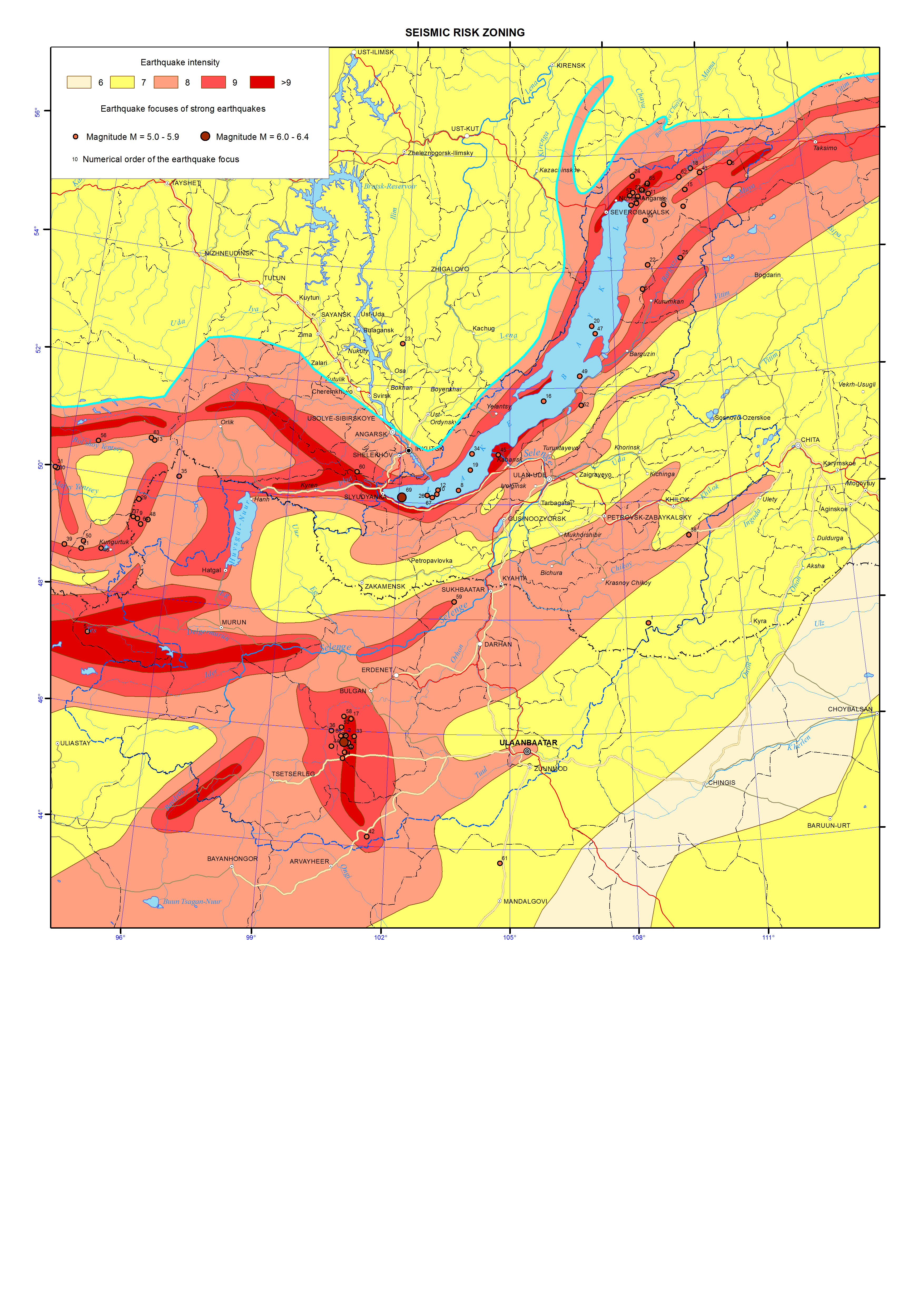
<p style="text-align: justify; ">Seismic zoning implies mapping of seismic risk due to maximum seismic impact, which might originate over this area and be exceeded with a certain probability during the assigned time interval [Ulomov and Bogdanov, 2013].</p>
<p style="text-align: justify; ">Total seismic zoning (TSZ) is implemented on the basis of studying regional and global seismicity-generating structures (SGS), determining recent geodynamics, seismicity and seismic regime over territories of states. TSZ serves as the foundation for a rational land use and securing the antiseismic construction. To specify the degree of seismic risk in appropriate regions and over the local areas the supplementary field surveys are performed, including instrumental surveys.</p>
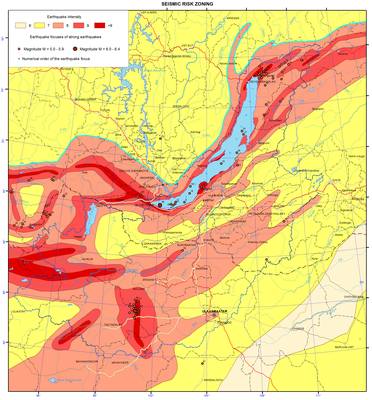
<p style="text-align: justify; ">The map of seismic zoning over the territory of the Lake Baikal catchment area depicts the materials collected through a systematic study of active faults within the territories of Cisbaikalia and Mongolia, where the strongest earthquakes might be the case. This type of mapping is methodologically based on the geological and geophysical evidence specifying the features of seismic and tectonic development of the territory including the elements of historic-structural, tectonophysic and paleo-seismic approaches applied for recognizing the zones of probable earthquake foci (PEF). The main goal of identified PEF zones is a maximally reality-approached reflection of projections of future focal zones of earthquakes of varying magnitude (М) occurring with a certain repeatability. Construction of PEF zones also includes extrapolation of possible M of earthquakes occurred in known geologic-geophysical environs onto the morphology-structural fault complexes with similar conditions, but in which the respective earthquakes have not taken place yet. This seismotectonic approach proposed by I.E. Gubin (1950) is applicable so far. On the map of seismic zoning from PEF zones with a certain seismic potential (М of an earthquake), according to a decay of seismic waves from quake epicenters, seismic zones are outlined following the MSK-64 intensity scale units [New map …., 1996; Recent geodynamics…, 1996].</p>
<p style="text-align: justify; ">The map of seismic zoning may be regarded as the long-term prognosis of strong earthquakes during 1000 years. The map was based on seismic statistical data on the seismicity recorded over the regional territory for over 100 years period of observations, as well as seismogeological evidence and maps of active faults [Smekalin et al., 2011].</p>
<p style="text-align: justify; ">The main goal of the map of seismic zoning is to reflect the realistic level of seismic risk as a magnitude in each point of the surveyed territory considering the quantification of the boundaries of regions with different seismic risk measured in probabilistic values.</p>
<p style="text-align: justify; ">The map representing modern concepts of seismogeological analysis developed by seismologists of Irkutsk [Seismic zoning…, 1977] distinctly displays a linear elongated mode of isolines with different seismic risk expressed in magnitude. This is because configuration of all these lines lies upon seismic lineaments. They represent the axes of the upper edges of 3D seismically active fault structures, related structured seismicity and framework of the lineament-domain-focal (LDF) model applied in this study.</p>
<p style="text-align: justify; ">The entire area of the Baikal basin is outlined by the intensity 7 to 9 isolines of seismic risk. As this takes place, the narrow linear zones of possible quakes with intensity 10 (on the map intensity &gt;9) are common for the southern termination of the lake basin, and they are associated with the Main Sayan fault and numerous paleo-seismic dislocations located nearby. The paleo events, they are related to, could generate quakes with intensity 10 to 11. The other similar spot of quakes with intensity 10 is located in the north of the lake, in the region of the Kichera paleo dislocations occurring within the Kichera seismically active faults capable to generate earthquakes with magnitude М= 7.0 – 7.5. The third spot in the Selenga river delta is linked with the Delta seismically active fault, its plane comprising the focus of the catastrophic Tsagan earthquake of 1862 with М=7.5 (with the M=10 effects observed on the surface). All the water area of Lake Baikal is contoured by the M=9 isoseism.</p>
<p style="text-align: justify; ">The isoline of M=8 intensity turns over M=9 isoseisms and extends in the north-eastern direction on both sides from Lake Baikal. This area includes such large populated localities as the cities of Irkutsk, Ulan-Ude and Ulaanbaatar. Over the Mongolian territory, to the south of Lake Khovsgol, there is a sublatitudinal zone of M=10 quakes (intensity &gt; 9 on the map), associated with the area of two faults, in which planes the foci of the Bolnay and Tsetserleg earthquakes of 1905 occur. These seismic events are referred to the strongest intra-continent earthquakes on the Earth of instrumental period (М=8.5, intensity 11-12). Lake Khovsgol and adjacent territories lie within the zone of intensity-9 quakes.</p>
<p style="text-align: justify; ">The city of Ulaanbaatar sits within the zone with seismic effect of intensity-8 quakes. This zone is contoured on both sides by M=7 isoseisms stretching northeastward to the city of Chita. The area of possible intensity-7 quakes extends from Ulan-Ude in the north to Sukhe-Baatar (Mongolia) in the south.</p>
<p style="text-align: justify; ">These materials were used as the basis to construct a new map of seismic zoning over the RF territory TSZ-2012, which in the future will become the normative and reference document for all research and design project organizations of Russia [Ulomov, Bogdanov, 2013].<strong> </strong></p>
<p style="text-align: justify; "> </p>
<p style="text-align: justify; ">References</p>
<p style="text-align: justify; ">Gubin, I. Е. (1950). <i>Seismotectonic approach of seismic zoning</i>. Moscow-Leningrad: Izd-vo AN SSSR,  63 p.</p>
<p style="text-align: justify; ">New map of seismic zoning of the North Eurasia territory. (1996) // V. S. Khromovskikh, V. V. Nikolaev, М.G.. Dem’yanovich, А. V. Chipizubov, R. М. Semenov, S. P. Serebrennikov, S. G.. Arzhannikov, О. P. Smekalin, and Е. А. Del’yanskii. In: <i>Geophysical Research in Eastern Siberia at the turn of the 21<sup>st</sup> century</i>. Novosibirsk: Nauka, pp. 94-99.</p>
<p style="text-align: justify; "><i>Seismic zoning of Eastern Siberia and its geologo-geophysical fundamentals.</i> (1977). Ed. Solonenko V. P. Novosibirsk: Nauka,.</p>
<p style="text-align: justify; ">Smekalin, О. P., Imaev, V. S., and Chipizubov, А. V. (2011). <i>Paleoseismology of Eastern Siberia</i>. Irkutsk: Izd-vo IZK SO RAN, 98 p.</p>
<p style="text-align: justify; ">Recent geodynamics: seismotectonics, earthquake prognosis, seismic risk (fundamental and applied aspects) (1996) // Levi, K. G., Khromovskikh, V. S., Kochetkov, V. М., Nikolaev, V. V., Semenov, R. М., Serebrennikov, S. P., Chipizubov, А. V., Dem’yanovich, М. G., Arzhannikov, S. G., Zhel’yanskii, E. A., Smekalin, O. P., Ruzhich, V. V., Buddo, V. Yu., Massal’skii, O. K., Potapov, V. А., Berzhinskii, Yu. A., Radziminovich, Ya. B. In: <i>Lithosphere of Central Asia</i>. Irkutsk: Izd-vo IZK SO RAN, pp. 150-183.</p>
<p style="text-align: justify; ">Ulomov, V. I. and Bogdanov, M. I. (2013). New set of maps of total seismic zoning on the RF territory TSZ-2012, <i>Inzhenernye izyskaniya</i>, , no. 8, pp. 8-17.</p>]]></content:encoded>
    <dc:publisher>No publisher</dc:publisher>
    <dc:creator>Alexander Ayurzhanaev</dc:creator>
    <dc:rights></dc:rights>
    <dc:date>2014-10-07T02:05:00Z</dc:date>
    <dc:type>Page</dc:type>
  </item>


</rdf:RDF>