<?xml version="1.0" encoding="utf-8" ?>
<rdf:RDF xmlns:rdf="http://www.w3.org/1999/02/22-rdf-syntax-ns#" xmlns:dc="http://purl.org/dc/elements/1.1/" xmlns:syn="http://purl.org/rss/1.0/modules/syndication/" xmlns="http://purl.org/rss/1.0/">


<channel rdf:about="http://bic.iwlearn.org/en/search_rss">
  <title>English</title>
  <link>http://bic.iwlearn.org</link>

  <description>
    
            These are the search results for the query, showing results 31 to 45.
        
  </description>


  <image rdf:resource="http://bic.iwlearn.org/logo.png"/>

  <items>
    <rdf:Seq>
      
        <rdf:li rdf:resource="http://bic.iwlearn.org/en/atlas/atlas/141-natural-managment-and-environmental-condition-of-central-ecological-zone-map"/>
      
      
        <rdf:li rdf:resource="http://bic.iwlearn.org/en/atlas/atlas/140-recreation-on-lake-baikal-shores-map/recreation-on-lake-baikal-shores-map"/>
      
      
        <rdf:li rdf:resource="http://bic.iwlearn.org/en/atlas/atlas/140-recreation-on-lake-baikal-shores-map"/>
      
      
        <rdf:li rdf:resource="http://bic.iwlearn.org/en/atlas/atlas/139-distribution-omul-map/distribution-omul-map"/>
      
      
        <rdf:li rdf:resource="http://bic.iwlearn.org/en/atlas/atlas/139-distribution-omul-map"/>
      
      
        <rdf:li rdf:resource="http://bic.iwlearn.org/en/atlas/atlas/138-bubble-the-gas-outlet-from-the-bottom-sediments-map/bubble-the-gas-outlet-from-the-bottom-sediments-map"/>
      
      
        <rdf:li rdf:resource="http://bic.iwlearn.org/en/atlas/atlas/138-bubble-the-gas-outlet-from-the-bottom-sediments-map"/>
      
      
        <rdf:li rdf:resource="http://bic.iwlearn.org/en/atlas/atlas/137-uninodal-binodal-trinodal-and-quadrinodal-seic_65-map/uninodal-binodal-trinodal-and-quadrinodal-seic_65-map"/>
      
      
        <rdf:li rdf:resource="http://bic.iwlearn.org/en/atlas/atlas/137-uninodal-binodal-trinodal-and-quadrinodal-seic_65-map"/>
      
      
        <rdf:li rdf:resource="http://bic.iwlearn.org/en/atlas/atlas/136-currents/currents-map"/>
      
      
        <rdf:li rdf:resource="http://bic.iwlearn.org/en/atlas/atlas/135-ice-regime-map/ice-regime-map"/>
      
      
        <rdf:li rdf:resource="http://bic.iwlearn.org/en/atlas/atlas/135-ice-regime-map"/>
      
      
        <rdf:li rdf:resource="http://bic.iwlearn.org/en/atlas/atlas/134-temperature-from-satellites-map/temperature-from-satellites-map"/>
      
      
        <rdf:li rdf:resource="http://bic.iwlearn.org/en/atlas/atlas/134-temperature-from-satellites-map"/>
      
      
        <rdf:li rdf:resource="http://bic.iwlearn.org/en/atlas/atlas/133-temperature-map/temperature-map"/>
      
    </rdf:Seq>
  </items>

</channel>


  <item rdf:about="http://bic.iwlearn.org/en/atlas/atlas/141-natural-managment-and-environmental-condition-of-central-ecological-zone-map">
    <title>141. Natural managment and environmental condition of central ecological zone map</title>
    <link>http://bic.iwlearn.org/en/atlas/atlas/141-natural-managment-and-environmental-condition-of-central-ecological-zone-map</link>
    <description></description>
    
    <dc:publisher>No publisher</dc:publisher>
    <dc:creator>Alexander Ayurzhanaev</dc:creator>
    <dc:rights></dc:rights>
    <dc:date>2014-10-15T07:57:30Z</dc:date>
    <dc:type>Folder</dc:type>
  </item>


  <item rdf:about="http://bic.iwlearn.org/en/atlas/atlas/140-recreation-on-lake-baikal-shores-map/recreation-on-lake-baikal-shores-map">
    <title>Recreation on Lake Baikal shores map</title>
    <link>http://bic.iwlearn.org/en/atlas/atlas/140-recreation-on-lake-baikal-shores-map/recreation-on-lake-baikal-shores-map</link>
    <description></description>
    <content:encoded xmlns:content="http://purl.org/rss/1.0/modules/content/"><![CDATA[<p><img class="image-inline" src="../../../../resolveuid/e16a12eb95bf4995a746b50dff491e9b/@@images/image/preview" /></p>
<p><a href="http://bic.iwlearn.org/en/photos/copy_of__140_RECREATIONONLAKEBAIKALSHORES.png" class="internal-link">Open full size</a></p>
<p class="a" style="text-align: center; "><b>Recreation on Lake Baikal</b></p>
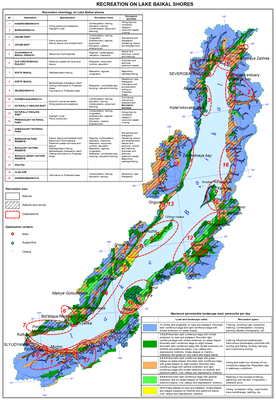
<p class="a">Recreation as an essential type of human activity is mapped as an integral phenomenon. The degree of territorial development of recreational activities is reflected through the use of zoning (natural and natural-social recreation zones). The zones' borders correspond to the isohypse of 1500 m. The contours are defined by a natural and landscape differentiation. Five levels of maximum permissible density (people/ha/day) have been identified.</p>
<p class="a">The main point in the explanatory note is the district and settlement zoning of recreation territories (the main and supplemental recreation centers) with due consideration to the typology of destinations and their specialization by forms and types of recreational activities.  <i></i></p>
<p class="a"><i>Assessment of the coastal landscapes for recreational activities.</i></p>
<p class="a">Natural landscapes untouched by human activity directly and comprehensively satisfy the requirements of the physiologically needed recreation (unconscious-reflectory), such as contemplation, solace, relaxation, and so on.  These landscapes (groups of landscapes) must be protected. The most accessible part of the Baikal coast demonstrates a certain degree of environmental transformation. Social and specific (purposeful and deliberate) forms of recreation dominate recreation activities on these territories. The accumulation of the problems connected to the anthropogenic impact leads to the digression of landscapes and even to the loss of landscape diversity and total uselessness of the territory in terms of meeting the needs of recreation.</p>
<p>The map shows the types and subtypes of natural landscapes within the Central Ecological Zone of Lake Baikal. It also shows the zones of natural resources management, where integrated targets of the landscape and territorial planning should be achieved (preservation, improvement, development), and the territories that should be protected and recultivated</p>]]></content:encoded>
    <dc:publisher>No publisher</dc:publisher>
    <dc:creator>Alexander Ayurzhanaev</dc:creator>
    <dc:rights></dc:rights>
    <dc:date>2014-10-15T07:55:00Z</dc:date>
    <dc:type>Page</dc:type>
  </item>


  <item rdf:about="http://bic.iwlearn.org/en/atlas/atlas/140-recreation-on-lake-baikal-shores-map">
    <title>140. Recreation on Lake Baikal shores map</title>
    <link>http://bic.iwlearn.org/en/atlas/atlas/140-recreation-on-lake-baikal-shores-map</link>
    <description></description>
    
    <dc:publisher>No publisher</dc:publisher>
    <dc:creator>Alexander Ayurzhanaev</dc:creator>
    <dc:rights></dc:rights>
    <dc:date>2014-10-15T07:44:34Z</dc:date>
    <dc:type>Folder</dc:type>
  </item>


  <item rdf:about="http://bic.iwlearn.org/en/atlas/atlas/139-distribution-omul-map/distribution-omul-map">
    <title>Distribution omul map</title>
    <link>http://bic.iwlearn.org/en/atlas/atlas/139-distribution-omul-map/distribution-omul-map</link>
    <description></description>
    <content:encoded xmlns:content="http://purl.org/rss/1.0/modules/content/"><![CDATA[<p><img class="image-inline" src="../../../../resolveuid/d21a970aef1f4c1e8a53d18ce0a39d10/@@images/image/preview" /></p>
<p><a href="http://bic.iwlearn.org/en/photos/copy_of__139_Distributionomul.png" class="internal-link">Open full size</a></p>
<p class="a" style="text-align: center; "><b>Hydroacoustic measurement of the Baikal omul resources</b></p>
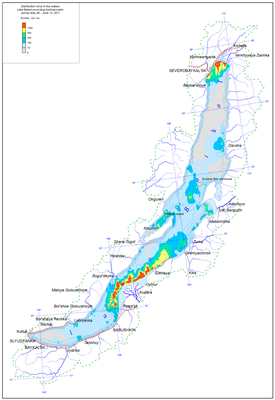
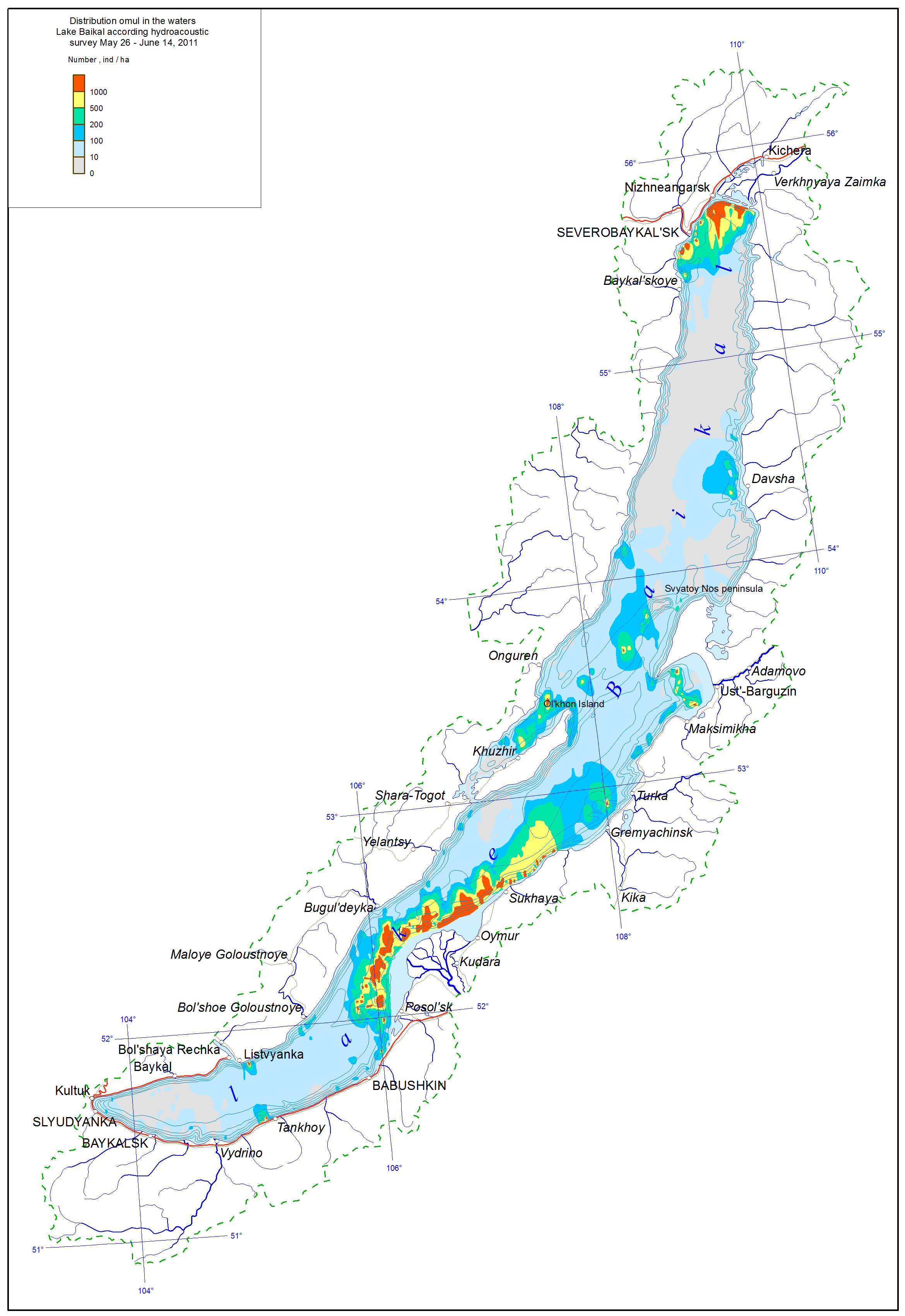
<p class="a">In 2011, the assessment of the number and biomass of the Baikal omul Coregonus migratorius was carried out using the hydroacoustic method [1].</p>
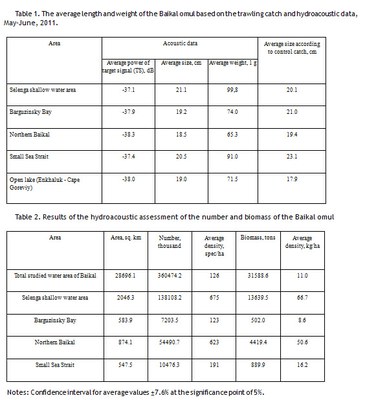
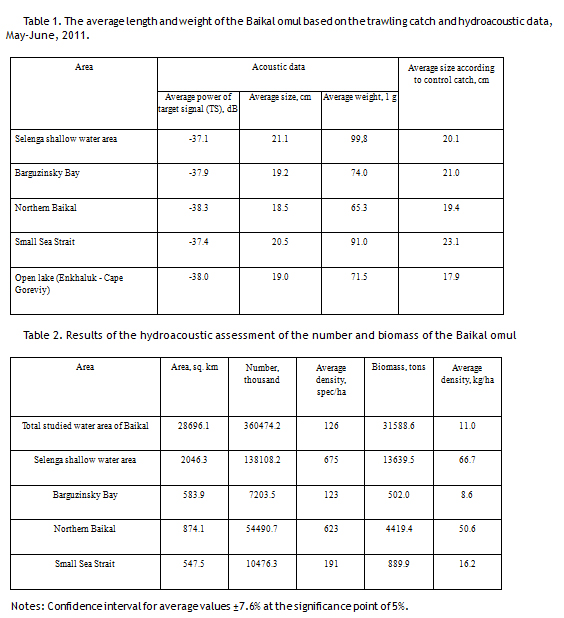
<p class="a">The results of the assessment are shown in Tables 1 and 2. The distribution of the number and biomass of the Baikal omul in the water area of Lake Baikal is uneven. Amassments with the density above average take less than a quarter of the examined area. However, they contain almost two thirds of the Baikal omul reserves. A general picture of the spatial distribution of the omul in the lake's water area corresponds with trawling and acoustic measurements. Our work confirmed the necessity of conducting such measurements immediately after ice clearance, but before the start of feeding migrations of the Baikal omul. During this period, the omul forms dense shoals that are easy to register using the hydroacoustic technique, which improves the accuracy of measurements. The derived number and biomass figures of the Baikal omul, especially in the Selenga shallow water area and Northern Baikal, correspond quite well with the forecast of the long-term dynamics based on the peculiarities of the size- and age-related composition of the fish population[2].</p>
<p class="a">We confirmed the findings about the presence of a significant part of the omul population in the deep-water zones of the lake.</p>
<p align="center" class="a">References:</p>
<p class="a">Makarov, M. M., Degtev, A. I., Kucher, K. M., Mamontov, A. M., Nebesnykh, I. A., Khanaev, I. V. &amp; Dzyuba, E. B. (2012). Assessment of the number and the biomass of the Baikal omul using trawling and acoustic techniques. <i>DAN, 447</i>(3). p 343-346.</p>
<p>Melnik, N. G., Smirnova-Zalumi, N. S., Smirnov, V. V., et al. (2009). <i>Hydroacoustic measurement of the Baikal omul resources</i>. Novosibirsk: Nauka. p 244.</p>
<p><img class="image-inline" src="../../../../resolveuid/9046812ec12c496393f9107a426d3f2a/@@images/image/preview" /></p>
<p><a href="http://bic.iwlearn.org/en/photos/139.jpg" class="internal-link">Open full size</a></p>]]></content:encoded>
    <dc:publisher>No publisher</dc:publisher>
    <dc:creator>Alexander Ayurzhanaev</dc:creator>
    <dc:rights></dc:rights>
    <dc:date>2014-10-15T05:10:00Z</dc:date>
    <dc:type>Page</dc:type>
  </item>


  <item rdf:about="http://bic.iwlearn.org/en/atlas/atlas/139-distribution-omul-map">
    <title>139. Distribution omul map</title>
    <link>http://bic.iwlearn.org/en/atlas/atlas/139-distribution-omul-map</link>
    <description></description>
    
    <dc:publisher>No publisher</dc:publisher>
    <dc:creator>Alexander Ayurzhanaev</dc:creator>
    <dc:rights></dc:rights>
    <dc:date>2014-10-15T04:51:24Z</dc:date>
    <dc:type>Folder</dc:type>
  </item>


  <item rdf:about="http://bic.iwlearn.org/en/atlas/atlas/138-bubble-the-gas-outlet-from-the-bottom-sediments-map/bubble-the-gas-outlet-from-the-bottom-sediments-map">
    <title>Bubble the gas outlet from the bottom sediments map</title>
    <link>http://bic.iwlearn.org/en/atlas/atlas/138-bubble-the-gas-outlet-from-the-bottom-sediments-map/bubble-the-gas-outlet-from-the-bottom-sediments-map</link>
    <description></description>
    <content:encoded xmlns:content="http://purl.org/rss/1.0/modules/content/"><![CDATA[<p><img class="image-inline" src="../../../../resolveuid/3db0cde9a6354efc8c79148fc3798900/@@images/image/preview" /></p>
<p><a href="http://bic.iwlearn.org/en/photos/138_Bubblethegasoutletfromthebottomsediments_Fixed.png" class="internal-link">Open full size</a></p>
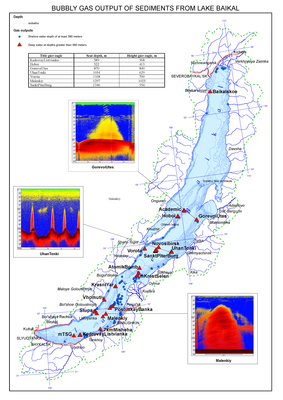
<p align="center"><b>Gas bubble emissions from bottom sediments of Lake Baikal</b></p>
<p align="center"><b> </b></p>
<p>Methane emissions from bottom sediments in Lake Baikal have been known for a long time. Even the first travelers, who visited the lake in the 17<sup>th</sup> century, noticed gas emissions. Later gas emissions in Baikal were explored by the East Siberian Branch of the Russian Imperial Geographical Society. A review of the available materials on gas seeps in Baikal is presented in the publication [Granin and Granina, 2002]. A new stage of research on gas seeps in Baikal started after the discovery of gas hydrates [Kuzmin et al., 1998] and mud volcanoes at the bottom of the lake [Van Rensbergen et al., 2002] at the turn of the 20<sup>th</sup> century.</p>
<p>Gas seeps are found in oceans, seas and freshwater bodies. To study gas seeps hydroacoustic methods are used, as they enable an extensive search due to the strong backscattering of sound from the bubbles of floating-up gas. To locate and monitor the activity of gas plumes a digital record of acoustic signals of the echo sounders FURUNO, installed on the research vessels “G. Yu. Vereshchagin”, “Titov” and “Papanin”, was organized.</p>
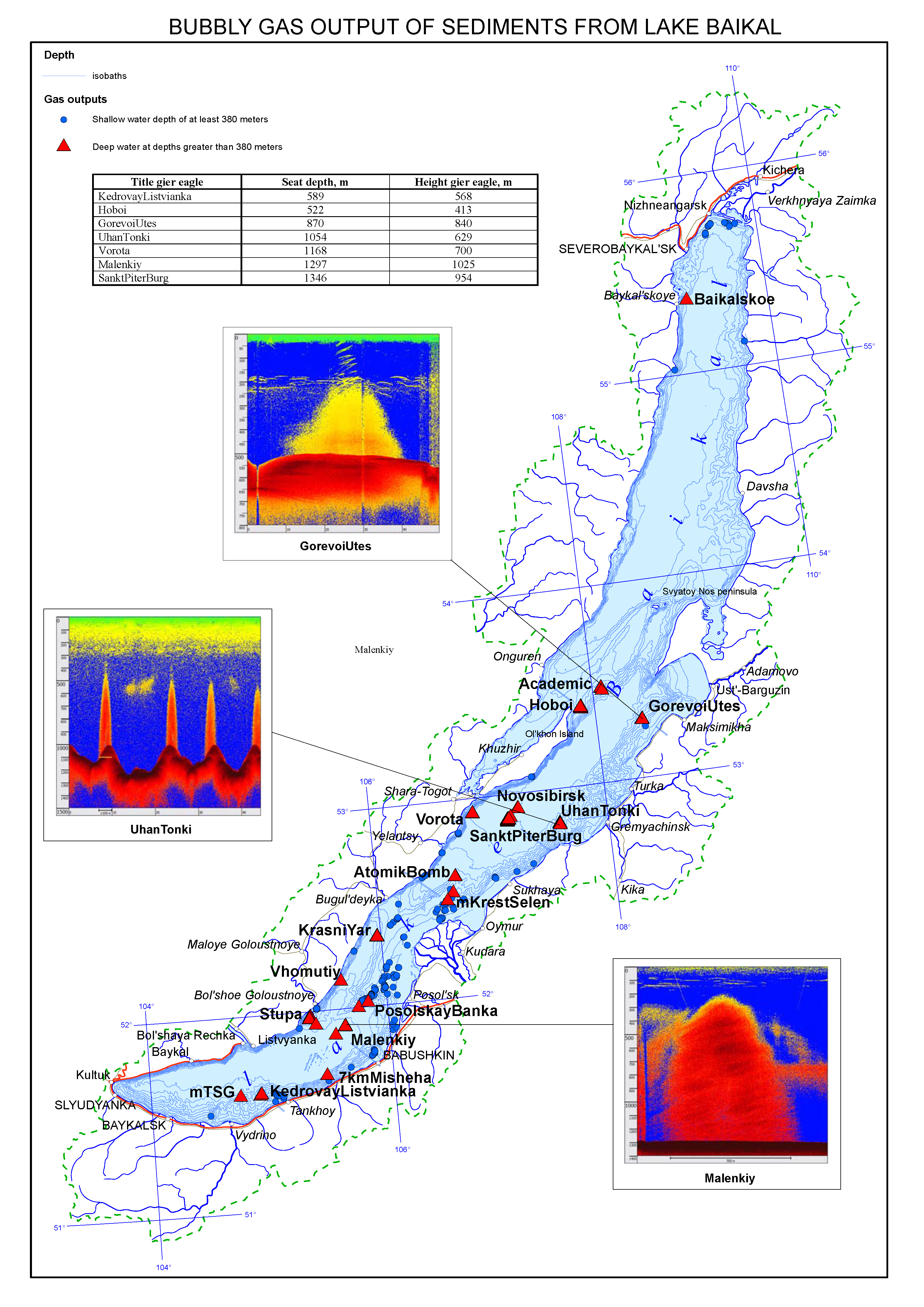
<p>We subdivide gas seeps into shallow- and deepwater [Granin et al., 2010]. Deepwater gas seeps (red triangles on the map) are the ones that are located at depths greater than the depth of the gas hydrate stability (380 m); gas seeps, located at shallower depths (blue circles), belong to shallow-water gas seeps.</p>
<p>A substantial proportion of the shallow gas seeps are located near the Selenga river delta and on the Posolskaya bank. Multi-year monitoring of the activity of gas seeps made it possible to identify long-term and periodic gas shows. A maximum flare height of more than 1000 m was recorded in the area of ​​the mud volcano Malenky on June 23, 2011 from the RV “Titov”. According to the echo sounders data, the rise rates of gas bubbles reach 25 cm/s or more. In the area of plumes there is a near-bottom layer, where the temperature gradient is equal to the adiabatic one. This is indicative of a complete mixing of a significant layer of water as a result of the gas emissions [Granin et al.]</p>
<p>Using the acoustic sounding, a gas flow from bottom sediments was estimated. The estimation of the flow was made for several deepwater plumes. For different plumes the methane flow from the bottom sediments of Lake Baikal ranged from 14 to 216 tons per year. Comparing the result obtained with corresponding estimates for other water bodies, it may be said that the gas flow for the largest bottom gas seeps in Lake Baikal is corresponding to the flows in the Norwegian Sea and the Sea of ​​Okhotsk [Granin et al., 2-12].<b> </b></p>
<p align="center"><b> </b></p>
<p align="center">References</p>
<p>Granin, N. G., Granina, L. Z. (2002). Gas hydrates and gas venting in Lake Baikal. <i>Russ. Geol. Geophys, 43</i>(7), p 629-637.</p>
<p>Kuzmin, M. I., Kalmychkov, G. V., &amp; Gelety, V. F. (1998). The first finding of gas hydrates in the sedimentation mass of Lake Baikal. <i>Proceedings of the Russian Academy of Sciences, 362</i>(4). p 541-543.</p>
<p>Van Rensbergen, P., De Batist M., Klerkx J., Hus R., Poort J., Vanneste M., Granin N., Khlystov O., &amp; Krinitsky P. (2002). Sublacustrine mud volcanoes and methane seeps caused by dissociation of gas hydrates in Lake Baikal. <i>Geology, 30</i>(7). p 631-634.</p>
<p>Granin, N. G., Makarov, M. M., Kucher, K. M., &amp; Gnatovsky, R. Y. (2010). Gas seeps in Lake Baikal: Detection, distribution, and implications for water column mixing. <i>Geo-Marine Letters, 30</i>(3-4). p 399-409.</p>
<p>Granin N. G., Muyakshin, S. I., Makarov, M. M., Kucher, K. M., Aslamov, I. A., Granina, L. Z., &amp; Mizandrontsev, I. B. (2012). Estimation of methane flows from bottom sediments of Lake Baikal. <i>Geo-Marine Letters, 32</i>(5-6). p 427-436. DOI 10.1007/s00367-012-0299-6</p>]]></content:encoded>
    <dc:publisher>No publisher</dc:publisher>
    <dc:creator>Alexander Ayurzhanaev</dc:creator>
    <dc:rights></dc:rights>
    <dc:date>2014-10-15T04:50:00Z</dc:date>
    <dc:type>Page</dc:type>
  </item>


  <item rdf:about="http://bic.iwlearn.org/en/atlas/atlas/138-bubble-the-gas-outlet-from-the-bottom-sediments-map">
    <title>138. Bubble the gas outlet from the bottom sediments map</title>
    <link>http://bic.iwlearn.org/en/atlas/atlas/138-bubble-the-gas-outlet-from-the-bottom-sediments-map</link>
    <description></description>
    
    <dc:publisher>No publisher</dc:publisher>
    <dc:creator>Alexander Ayurzhanaev</dc:creator>
    <dc:rights></dc:rights>
    <dc:date>2014-10-15T04:41:35Z</dc:date>
    <dc:type>Folder</dc:type>
  </item>


  <item rdf:about="http://bic.iwlearn.org/en/atlas/atlas/137-uninodal-binodal-trinodal-and-quadrinodal-seic_65-map/uninodal-binodal-trinodal-and-quadrinodal-seic_65-map">
    <title>Uninodal, binodal, trinodal, and quadrinodal seic_65 map</title>
    <link>http://bic.iwlearn.org/en/atlas/atlas/137-uninodal-binodal-trinodal-and-quadrinodal-seic_65-map/uninodal-binodal-trinodal-and-quadrinodal-seic_65-map</link>
    <description></description>
    <content:encoded xmlns:content="http://purl.org/rss/1.0/modules/content/"><![CDATA[<p><img class="image-inline" src="../../../../resolveuid/dd71b06dd46b4563ac843e1369873859/@@images/image/preview" /></p>
<p><a href="http://bic.iwlearn.org/en/photos/copy_of__137_UNINODALBINODALTRINODALANDQUADRINODALSEIC_65.png" class="internal-link">Open full size</a></p>
<p align="center" class="a"><b>Uninodal (bimodal, trinodal and quadrinodal) </b></p>
<p align="center" class="a"><b>seiche oscillations </b></p>
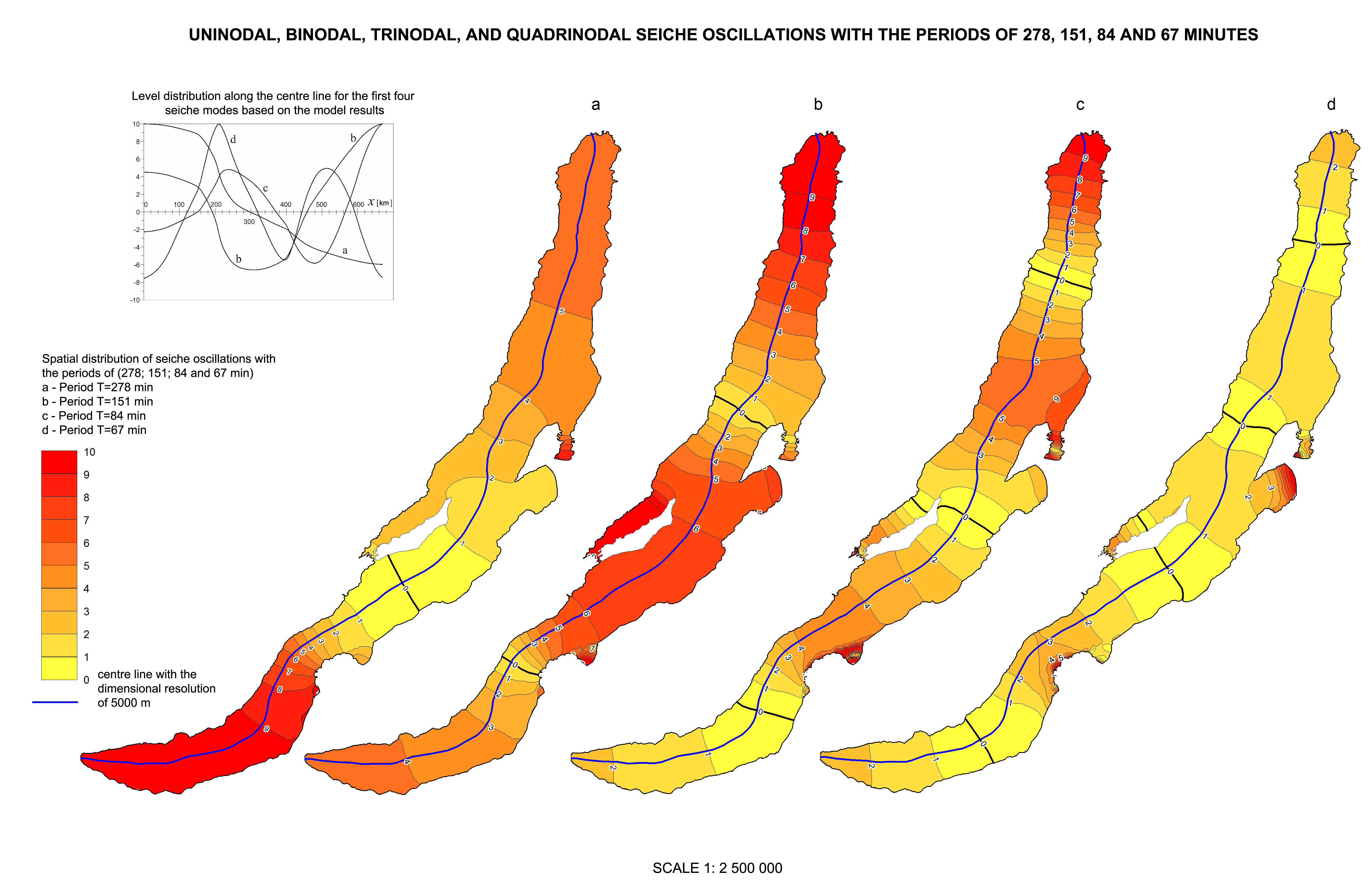
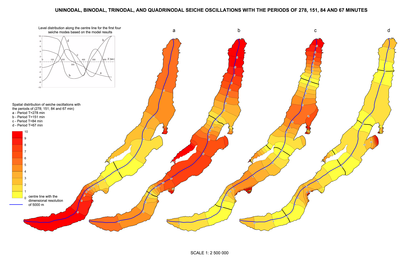
<p class="a" style="text-align: left; "><b></b><span>Seiches are standing waves in an enclosed or partially enclosed water body. Seiche oscillations in Lake Baikal are observed almost continuously throughout the whole year. Some characteristics of these oscillations were obtained from in-situ observations, laboratory experiments on a spatial hydraulic model and from appropriate theoretical calculations. The results of these studies have been published in the works (References). However, available information on Baikal seiches is scarce due to the difficulties of in-situ measurements and rather crude data on bottom topography. Sophisticated instrumental tools and advanced techniques for in-situ measurements were used to perform calculations of seiche oscillations in Lake Baikal based on a spectral difference model using specified bathymetric data obtained by researchers from Limnological Institute SB RAS. All these data are included in this atlas. The main aim of this study was to investigate solutions corresponding to oscillations with the periods of 277, 152, 84, 67, and 59 min, which were identified during in-situ observations.</span></p>
<p class="a">The spectral difference model is based on the linearized system of equations for shallow water in the spherical coordinate system. Difference approximation is based on irregular triangular spatial mesh. The side length of the calculation mesh is 30 m near the shoreline and about 1 km for the rest of the model area. The numerical model includes solution of the eigenvalues problem. It allows the researchers to get a set of frequencies and corresponding forms of seiche oscillations.</p>
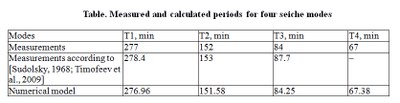
<p class="a">The calculations were obtained taking into consideration the Earth’s rotation. Complex solutions were normalised in such a way that imaginary component was minimal, whereas true components of solutions for the rest of the model area were within the range of -10 to 10. The values in the nodes with the depth less than 10 m and in the nodes within the contour of Maloye More (Small Sea) were not taken into account. Spatial distribution of seiche oscillations with the periods of 276.96; 151.58; 84.25; and 67.38 min corresponds to uninodal, binodal, trinodal, and quadrinodal longitudinal seiche modes of Lake Baikal. The level distribution along the centreline is shown for the enumerated modes in Figure. It should be noted that it is necessary to use other approaches for specification of solutions in shallow areas of Lake Baikal, such as Mukhor and Proval Bays and Cherkalovsky and Posolsk Sors, where the bottom friction is likely to play a significant role. The results for the first mode are consistent with the data on distribution of seiche oscillation height along the Baikal length in [Sudolsky, 1991, Fig. 5.2], in which the data on calculations and survey results from the spatial hydraulic model are compared.</p>
<p>Amplitudes of seiche oscillations in Lake Baikal and their seasonal variability were analysed from the data obtained at 3 stations located in the southern basin of the lake. Well-defined maxima for the oscillations with the periods of 277, 152, 84, and 67 min are observed within the range of density spectrum derived from the annual level record. No significant differences were recorded between the amplitudes for a uninodal seiche and amplitudes during the rest of the year when the lake is covered with ice and protected from wind. It was established that a seiche with the period of 67 min is observed in different seasons of the year. At three stations, level changes for the oscillation with the 277 min period differ in significantly. For the 152 min period they have slight differences, and for the 84 and 67 min periods they are similar only at those sites with relatively high amplitudes of oscillations. This is attributed to the effect of wind and atmospheric pressure. Measured and calculated periods for the first four seiche modes are given in Table.</p>
<p style="text-align: center; "><img class="image-inline" src="../../../../resolveuid/e9e95945b27643c6b6ebba950fc140a9/@@images/image/preview" /></p>
<p align="center" class="a">References</p>
<p class="a">Arsenyeva, N. M., Davydov, L. K., Dubrovina, L. N., &amp; Konkina, N. G. (1963). <i>Seiches in lakes of the USSR</i>. Leningrad: LSU Publishing. p 184.</p>
<p class="a">Verbolov, V. I. (1970). On Baikal seiches. In <i>Seiches in lakes: Surface and internal</i>. Leningrad: Nauka. p 50-52.</p>
<p class="a">Solovyev, V. N. (1925). Method of models and its application in seiche survey at Lake Baikal. <i>News of the Institute of Biology and Geography, 2</i>. p 9-26.</p>
<p class="a">Solovyev, V. N., Shostakovich, V. B. (1926). Seiches in Lake Baikal. <i>Proceedings of Magnetic and Meteorological Observatory, 1</i>.</p>
<p class="a">Sudolsky, A. S. (1991). <i>Dynamic phenomena in water bodies</i>. Leningrad: Hydrometeoizdat. p 263 p.</p>
<p class="a">Sudolsky, A. S. (1968) Laboratory experiments and calculations of Baikal seiches. <i>Proceedings of GGI, 155</i>. p 109-123.</p>
<p class="a">Timofeev, V. Y., Ardyukov, D. G., Granin, N. G., Zhdanov, A. A., Kucher, K. M., Boiko, E. V., &amp; Timofeev, A.V.  (2010). Deformation of ice cover, tidal and true level fluctuations of Lake Baikal. <i>Phys. Mesomech: Special Issue, 13</i>, p 58-71.</p>
<p>Timofeev, V. Y., Granin, N. G., Ardyukov, D. G., Zhdanov, A. A., Kucher, K. M., &amp; Ducarme, B. (2009). Tidal and seiche signals on Baikal Lake level. <i>Bulletin of Inf. MareesTerrestres</i>, 145. p 11635—11658.</p>]]></content:encoded>
    <dc:publisher>No publisher</dc:publisher>
    <dc:creator>Alexander Ayurzhanaev</dc:creator>
    <dc:rights></dc:rights>
    <dc:date>2014-10-15T03:20:00Z</dc:date>
    <dc:type>Page</dc:type>
  </item>


  <item rdf:about="http://bic.iwlearn.org/en/atlas/atlas/137-uninodal-binodal-trinodal-and-quadrinodal-seic_65-map">
    <title>137. Uninodal, binodal, trinodal, and quadrinodal seic_65 map</title>
    <link>http://bic.iwlearn.org/en/atlas/atlas/137-uninodal-binodal-trinodal-and-quadrinodal-seic_65-map</link>
    <description></description>
    
    <dc:publisher>No publisher</dc:publisher>
    <dc:creator>Alexander Ayurzhanaev</dc:creator>
    <dc:rights></dc:rights>
    <dc:date>2014-10-15T03:11:30Z</dc:date>
    <dc:type>Folder</dc:type>
  </item>


  <item rdf:about="http://bic.iwlearn.org/en/atlas/atlas/136-currents/currents-map">
    <title>Currents map</title>
    <link>http://bic.iwlearn.org/en/atlas/atlas/136-currents/currents-map</link>
    <description></description>
    <content:encoded xmlns:content="http://purl.org/rss/1.0/modules/content/"><![CDATA[<p><img class="image-inline" src="../../../../resolveuid/6d6617b36c194aa29e1367ad039a8a83/@@images/image/preview" /></p>
<p><a href="http://bic.iwlearn.org/en/photos/copy_of__136_CURRENTS.png" class="internal-link">Open full size</a></p>
<p align="center"><strong>C</strong><strong>urrents</strong></p>
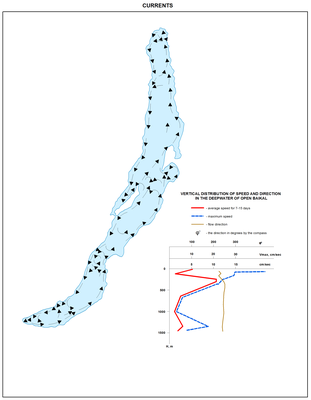
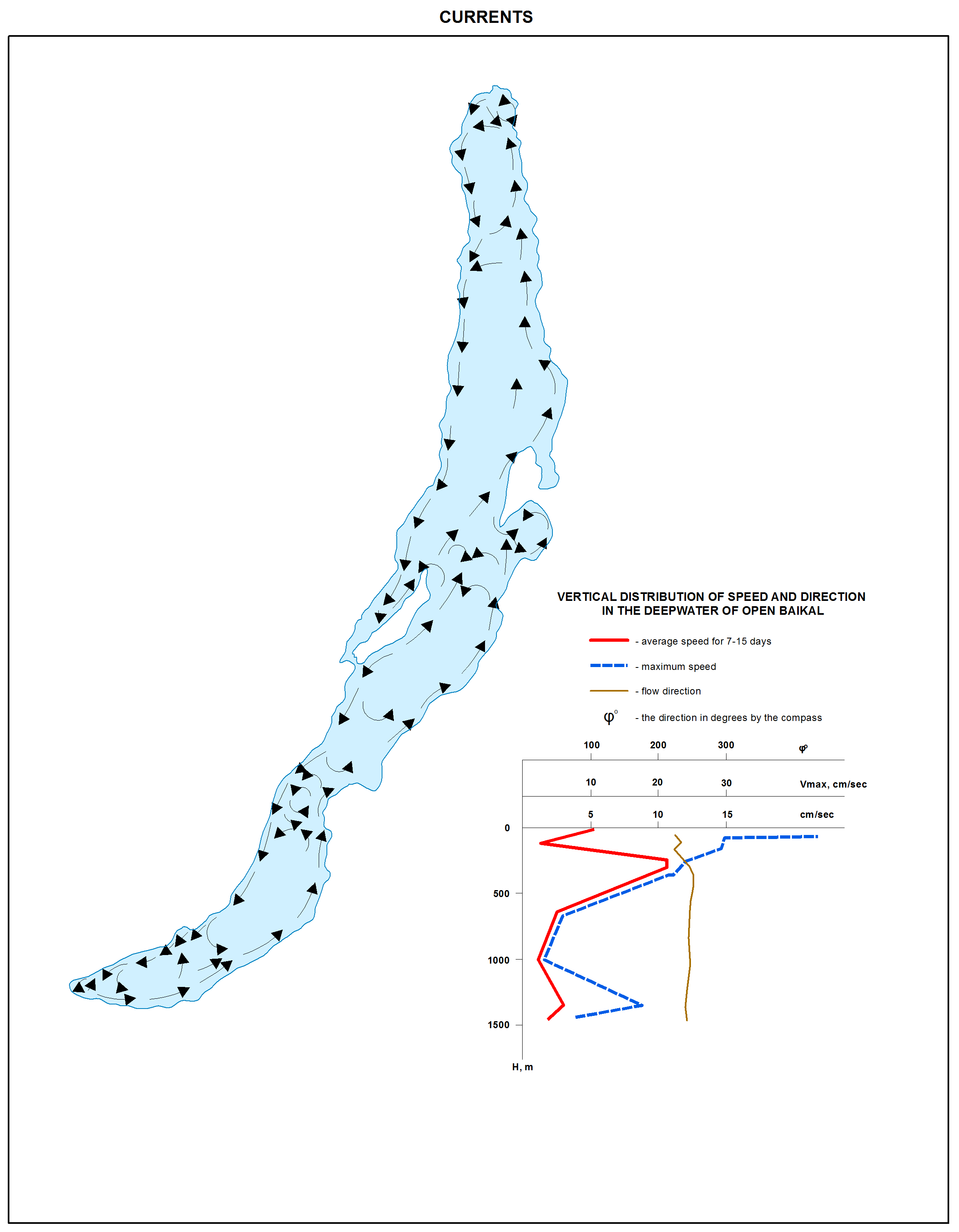
<p>The main cause of currents during the ice free period is the wind. Depending on changes of the wind velocities, wind (drift) currents intensify in May, subside in June-August and again intensify in autumn reaching its maximum in December. Wind-induced currents take place during strong winds, when the surface waters are transferred, thus causing the water level decrease by 10 cm. In summer and autumn, the negative water setout lasts approximately 40 h, and in winter about 35 h, whereas the wind setup continues 44 and 40 h, respectively. Average negative water setout height (decrease of the level near the windward shore) is 9-11 cm, and that of wind setup (increase of the level near leeward shore) is 7-8 cm. Moreover, geostrophic currents are formed at Lake Baikal, which are stationary currents retaining their main characteristics (location, direction and velocity) for a long period of time. They are induced by the difference in temperature (density) of coastal and lacustrine waters, deflecting force of the Earth’s rotation and other factors. These currents covering both the entire Lake Baikal and separate basins are observed throughout the whole year.</p>
<p>Water is transferred counter-clockwise (cyclonic circulation) under the deflecting force of the Earth’s rotation (Coriolis force). Secondary cyclonic circulations are observed in separate basins. The water at the interface of neighbouring cyclonic circulations is transferred across the lake (in Listvennichny Bay, the Selenga delta, Academichesky Ridge and Cape Kotelnikovsky). The same direction of water transfer is also observed in deep water layers of the lake.</p>
<p>The highest current velocities are recorded in the upper lake layers – in the epilimnion and sometimes below the thermocline. Their average velocities are up to tens of centimetres per second intensifying from summer to autumn. Maximal velocity registered near the surface can be over 1 m/sec. In winter, when the whole lake is covered with ice, the vertical structure of the velocity field is usually the same, although because of the ice cover the currents attenuate significantly. Their average velocity in the upper layers (up to 40-50 m) can be 2 cm/s and lower during “calm” periods. However, it can increase up to 3-5 cm/s and even to 10 cm/s during atmospheric pressure drop in case of atmospheric fronts. General character of water mass transfer corresponds to cyclonic circulation (Fig. 2.33) in the water column.</p>
<p>In the 1960-s, V. Sokolnikov [1964], working on the lake ice, discovered the effect of current intensification in the near-bottom layer at large depths of the lake, which was later observed in other seasons of the year. The studies of this phenomenon carried out by V. Verbolov [1996] and A. Zhdanov [2006] showed that the velocities in the near-bottom layer are seasonal. In winter, they episodically exceed 10 cm/s and in summer (July-early August) they are 4-8 cm/s during weak winds. In spring (May) and autumn (October-November) they become an order of magnitude at seasonal increase of the wind with the values corresponding to those in the upper 200-m layer (up to tens of centimetres per second). Usually current velocities decrease in the near-bottom layer with the distance from the foot of the underwater slope, their highest values being recorded at the bottom.</p>
<p> </p>
<p align="center">References</p>
<p>Ainbund. M. M. (1988). Currents and internal water exchange in Lake Baikal. Leningrad: Hydrometeoizdat. p 248.</p>
<p>Verbolov, V. I. (1996). Currents and water exchange in Lake Baikal. <i>Water Resources, 23</i>(4). P 413-423.</p>
<p>Zhdanov, A. A. (2006). Horizontal transfer and macroturbulent water exchange in Lake Baikal (Abstract of Ph.D. Thesis). Irkutsk. p 22.</p>
<p>Shimaraev, M. N. (2012). Horizontal currents<i>. </i>In <i>Baikal Studies</i>. Novosibirsk: Nauka. p 166-170.</p>]]></content:encoded>
    <dc:publisher>No publisher</dc:publisher>
    <dc:creator>Alexander Ayurzhanaev</dc:creator>
    <dc:rights></dc:rights>
    <dc:date>2014-10-15T03:00:00Z</dc:date>
    <dc:type>Page</dc:type>
  </item>


  <item rdf:about="http://bic.iwlearn.org/en/atlas/atlas/135-ice-regime-map/ice-regime-map">
    <title>Ice regime map</title>
    <link>http://bic.iwlearn.org/en/atlas/atlas/135-ice-regime-map/ice-regime-map</link>
    <description></description>
    <content:encoded xmlns:content="http://purl.org/rss/1.0/modules/content/"><![CDATA[<p><img class="image-inline" src="../../../resolveuid/47f116a898e04644908f0c15536b7d36/@@images/image/preview" /></p>
<p><a href="http://bic.iwlearn.org/en/atlas/photos/copy_of__135_Iceregime.png" class="internal-link">Open full size</a></p>
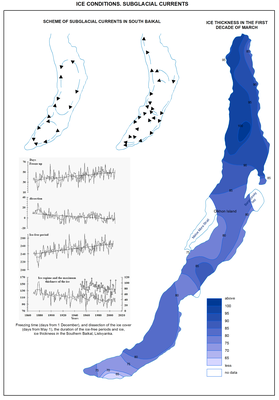
<p class="a" style="text-align: center; "><b>Ice regime. Subglacial currents</b></p>
<p><b>Air </b><b>temperature. </b>General trend of air temperature changes at Lake Baikal corresponded to the global temperature trend with its rise from the late 1910-s to the middle of the 20<sup>th</sup> century, to the temperature decrease by the early 1970-s and its significant rise by the end of the 20<sup>th</sup> century. The trend of annual temperature in the lake area (+1.2°C/100 years) was two times higher than the average Earth’s trend (+0.6°C/100 years). The rise of air temperature was recorded for all seasons of the year from 1986 to 2008 with the trend of +1.9, +1.5, +1.1 and +0.66°C/100 years in winter, spring, summer and autumn, respectively. Maximal trend (+2.1-2.2°C) was registered in December and January and minimal trend (+0.1-0.5°C) in August, September and October.  Statistical analysis showed both short-term (2-7 years) and long-term inter-annual (about 20 years) cycles with well-defined phases of increase and decrease of air temperature. The 20<sup>th</sup> century had two complete cycles (1912-1936 and 1937-1969) and phases of two incomplete cycles – decrease from 1896 to 1911 and increase from 1970. The increase phase at the end of the century to the mid 1990-s was characterized by anomalously long duration (25 years) and rise of air temperature (by 2.1°C). Beginning from 1995, there was a tendency to annual temperature decrease, which may be regarded as the beginning of the temperature drop phase in the current inter-annual climate cycle. <b></b></p>
<p><b>Temperature of water surface. </b>The temperature of water surface increased together with the rise of air temperature due to global warming. According to the observation data since 1941, the average temperature of water surface in Southern Baikal (the settlement of Listvennichnoye) decreased insignificantly in May-September from the 1950-s to the 1970-s, and then sharply increased by the mid 1990-s. The same temperature changes were recorded in other areas of the lake. The rate of its increase (0.64-0.60°C/10 years) was higher in the central and northern parts of Lake Baikal than in its southern part (0.25-0.35°C/10 years). The temperature of the warmer 1994-2005 decade exceeded the temperature of the cold 1964-1975 period by 0.9-1.5°C in the southern area and by 1.8-2°C in the central and northern regions of the lake. In some years of this period (e.g., several days in August of 2002), the increase of surface water temperature up to 18-20°C was recorded even in the deeper areas of the lake. <b></b></p>
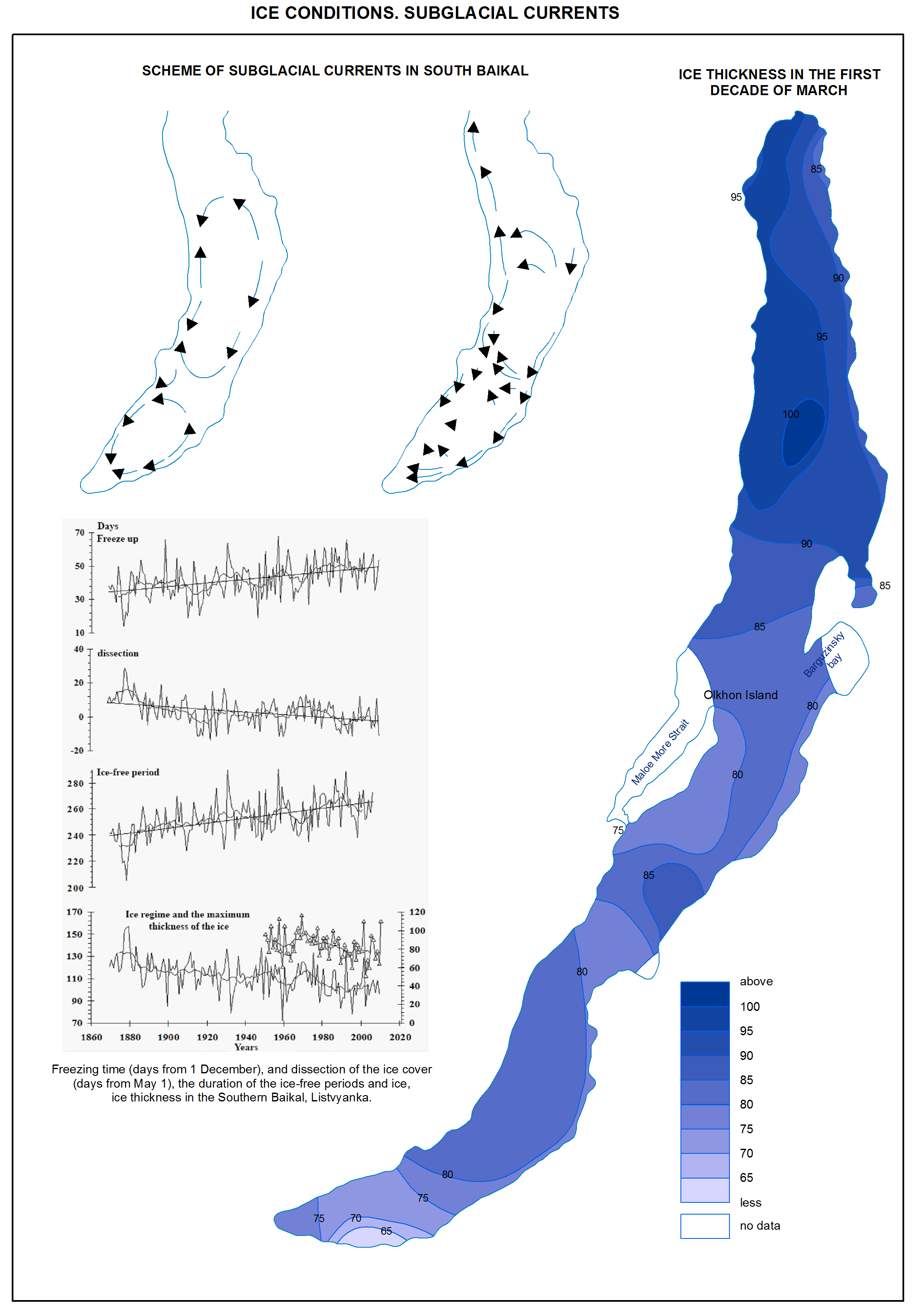
<p><b>Ice regime. </b>Beginning in the middle of the 20<sup>th</sup> century, the warming caused “mitigation” of the ice regime at Lake Baikal [Verbolov et al., 1965; Magnusson et al., 2000]. Freezing of the lake started later, whereas ice breaking began earlier. In1868-2010, in Southern Baikal (the settlement of Listvennichnoye) the trend of freezing and ice breaking terms were 10 and 7 days per 100 years, respectively. The duration of ice free period prolonged, whilst the ice cover period shortened by 17 days. According to the 1950-2010 data, the maximal ice thickness decreased on average by 2.4 cm every 10 years. During the phase of significant warming (1970-1995,) the rate of ice process changes sharply increased: freezing started by 10 days later and ice breaking by 15 days earlier; the ice period shortened by 25 days, and the ice thickness decreased on average by 8.8 cm per 10 years. The observation data from shore stations and satellites showed that beginning from the mid 1990-s to the middle of 2010 there was a tendency towards early freezing, late break-up of ice and prolongation of ice period [Kouraev et al., 2007]. These changes are consistent with inter-annual climate periodicity associated with fluctuations of atmospheric circulation in the Northern Hemisphere.</p>
<p>The main meteorological factor, which causes fluctuations of freezing terms (D<sub>fr</sub>) is the air temperature in November-December (T<sub>a</sub>) affecting the rate of heat losses from the water surface. The correlation between these characteristics in Southern Baikal is described by equation D<sub>fr</sub>=4.26Тa+75 (R<sup>2</sup>=0.57, p&lt;0.001) for the period of 1896-2010, where D<sub>fr</sub> is the number of days from December 1<sup>st</sup> to the freezing date. Temperature conditions in spring also affect the date of ice breaking. However, the correlation between ice breaking dates and air temperature is not high [Livingston, 1999]. It is attributed to the effect of both thermal and dynamic (wind) factors on the break-up of ice [Kouraev et al., 2007; Shimaraev, 2008], as well as to the influence of ice thickness, which depends on air temperature in winter months.</p>]]></content:encoded>
    <dc:publisher>No publisher</dc:publisher>
    <dc:creator>Alexander Ayurzhanaev</dc:creator>
    <dc:rights></dc:rights>
    <dc:date>2014-10-15T02:55:00Z</dc:date>
    <dc:type>Page</dc:type>
  </item>


  <item rdf:about="http://bic.iwlearn.org/en/atlas/atlas/135-ice-regime-map">
    <title>135. Ice regime map</title>
    <link>http://bic.iwlearn.org/en/atlas/atlas/135-ice-regime-map</link>
    <description></description>
    
    <dc:publisher>No publisher</dc:publisher>
    <dc:creator>Alexander Ayurzhanaev</dc:creator>
    <dc:rights></dc:rights>
    <dc:date>2014-10-15T02:50:00Z</dc:date>
    <dc:type>Folder</dc:type>
  </item>


  <item rdf:about="http://bic.iwlearn.org/en/atlas/atlas/134-temperature-from-satellites-map/temperature-from-satellites-map">
    <title>Temperature from satellites map</title>
    <link>http://bic.iwlearn.org/en/atlas/atlas/134-temperature-from-satellites-map/temperature-from-satellites-map</link>
    <description></description>
    <content:encoded xmlns:content="http://purl.org/rss/1.0/modules/content/"><![CDATA[<p><img class="image-inline" src="../../../resolveuid/09c3f28bfb39434c927a5c8469e147d0/@@images/image/preview" /></p>
<p><a href="http://bic.iwlearn.org/en/atlas/photos/copy_of__134_Temperaturefromsatellites.png" class="internal-link">Open full size</a></p>
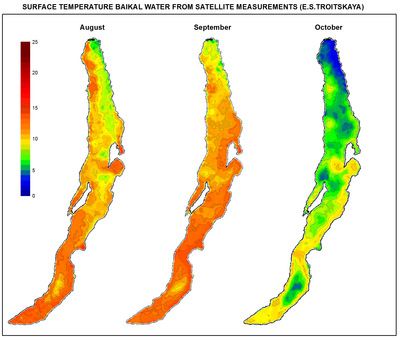
<p class="a" style="text-align: center; "><b>Temperature of  water  surface according to satellite data</b></p>
<p><b>Air </b><b>temperature. </b>General trend of air temperature changes at Lake Baikal corresponded to the global temperature trend with its rise from the late 1910-s to the middle of the 20<sup>th</sup> century, to the temperature decrease by the early 1970-s and its significant rise by the end of the 20<sup>th</sup> century. The trend of annual temperature in the lake area (+1.2°C/100 years) was two times higher than the average Earth’s trend (+0.6°C/100 years). The rise of air temperature was recorded for all seasons of the year from 1986 to 2008 with the trend of +1.9, +1.5, +1.1 and +0.66°C/100 years in winter, spring, summer and autumn, respectively. Maximal trend (+2.1-2.2°C) was registered in December and January and minimal trend (+0.1-0.5°C) in August, September and October.  Statistical analysis showed both short-term (2-7 years) and long-term inter-annual (about 20 years) cycles with well-defined phases of increase and decrease of air temperature. The 20<sup>th</sup> century had two complete cycles (1912-1936 and 1937-1969) and phases of two incomplete cycles – decrease from 1896 to 1911 and increase from 1970. The increase phase at the end of the century to the mid 1990-s was characterized by anomalously long duration (25 years) and rise of air temperature (by 2.1°C). Beginning from 1995, there was a tendency to annual temperature decrease, which may be regarded as the beginning of the temperature drop phase in the current inter-annual climate cycle. <b></b></p>
<p><b>Temperature of water surface. </b>The temperature of water surface increased together with the rise of air temperature due to global warming. According to the observation data since 1941, the average temperature of water surface in Southern Baikal (the settlement of Listvennichnoye) decreased insignificantly in May-September from the 1950-s to the 1970-s, and then sharply increased by the mid 1990-s. The same temperature changes were recorded in other areas of the lake. The rate of its increase (0.64-0.60°C/10 years) was higher in the central and northern parts of Lake Baikal than in its southern part (0.25-0.35°C/10 years). The temperature of the warmer 1994-2005 decade exceeded the temperature of the cold 1964-1975 period by 0.9-1.5°C in the southern area and by 1.8-2°C in the central and northern regions of the lake. In some years of this period (e.g., several days in August of 2002), the increase of surface water temperature up to 18-20°C was recorded even in the deeper areas of the lake. <b></b></p>
<p><b>Ice regime. </b>Beginning in the middle of the 20<sup>th</sup> century, the warming caused “mitigation” of the ice regime at Lake Baikal [Verbolov et al., 1965; Magnusson et al., 2000]. Freezing of the lake started later, whereas ice breaking began earlier. In1868-2010, in Southern Baikal (the settlement of Listvennichnoye) the trend of freezing and ice breaking terms were 10 and 7 days per 100 years, respectively. The duration of ice free period prolonged, whilst the ice cover period shortened by 17 days. According to the 1950-2010 data, the maximal ice thickness decreased on average by 2.4 cm every 10 years. During the phase of significant warming (1970-1995,) the rate of ice process changes sharply increased: freezing started by 10 days later and ice breaking by 15 days earlier; the ice period shortened by 25 days, and the ice thickness decreased on average by 8.8 cm per 10 years. The observation data from shore stations and satellites showed that beginning from the mid 1990-s to the middle of 2010 there was a tendency towards early freezing, late break-up of ice and prolongation of ice period [Kouraev et al., 2007]. These changes are consistent with inter-annual climate periodicity associated with fluctuations of atmospheric circulation in the Northern Hemisphere.</p>
<p>The main meteorological factor, which causes fluctuations of freezing terms (D<sub>fr</sub>) is the air temperature in November-December (T<sub>a</sub>) affecting the rate of heat losses from the water surface. The correlation between these characteristics in Southern Baikal is described by equation D<sub>fr</sub>=4.26Тa+75 (R<sup>2</sup>=0.57, p&lt;0.001) for the period of 1896-2010, where D<sub>fr</sub> is the number of days from December 1<sup>st</sup> to the freezing date. Temperature conditions in spring also affect the date of ice breaking. However, the correlation between ice breaking dates and air temperature is not high [Livingston, 1999]. It is attributed to the effect of both thermal and dynamic (wind) factors on the break-up of ice [Kouraev et al., 2007; Shimaraev, 2008], as well as to the influence of ice thickness, which depends on air temperature in winter months.</p>]]></content:encoded>
    <dc:publisher>No publisher</dc:publisher>
    <dc:creator>Alexander Ayurzhanaev</dc:creator>
    <dc:rights></dc:rights>
    <dc:date>2014-10-15T02:50:00Z</dc:date>
    <dc:type>Page</dc:type>
  </item>


  <item rdf:about="http://bic.iwlearn.org/en/atlas/atlas/134-temperature-from-satellites-map">
    <title>134. Temperature from satellites map</title>
    <link>http://bic.iwlearn.org/en/atlas/atlas/134-temperature-from-satellites-map</link>
    <description></description>
    
    <dc:publisher>No publisher</dc:publisher>
    <dc:creator>Alexander Ayurzhanaev</dc:creator>
    <dc:rights></dc:rights>
    <dc:date>2014-10-15T02:46:11Z</dc:date>
    <dc:type>Folder</dc:type>
  </item>


  <item rdf:about="http://bic.iwlearn.org/en/atlas/atlas/133-temperature-map/temperature-map">
    <title>Temperature map</title>
    <link>http://bic.iwlearn.org/en/atlas/atlas/133-temperature-map/temperature-map</link>
    <description></description>
    <content:encoded xmlns:content="http://purl.org/rss/1.0/modules/content/"><![CDATA[<p><img class="image-inline" src="../../../resolveuid/d0029ff48be64a5a82686b3779a621f2/@@images/image/preview" /></p>
<p><a href="http://bic.iwlearn.org/en/atlas/photos/copy_of__133_Temperature.png" class="internal-link">Open full size</a></p>
<p align="center"><b><b>Temperature of surface water layers</b></b></p>
<p align="center"><strong> </strong></p>
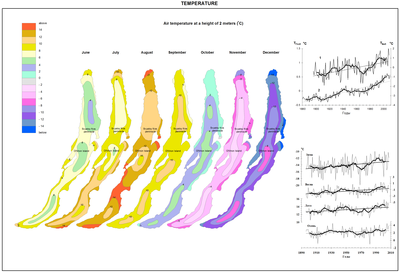
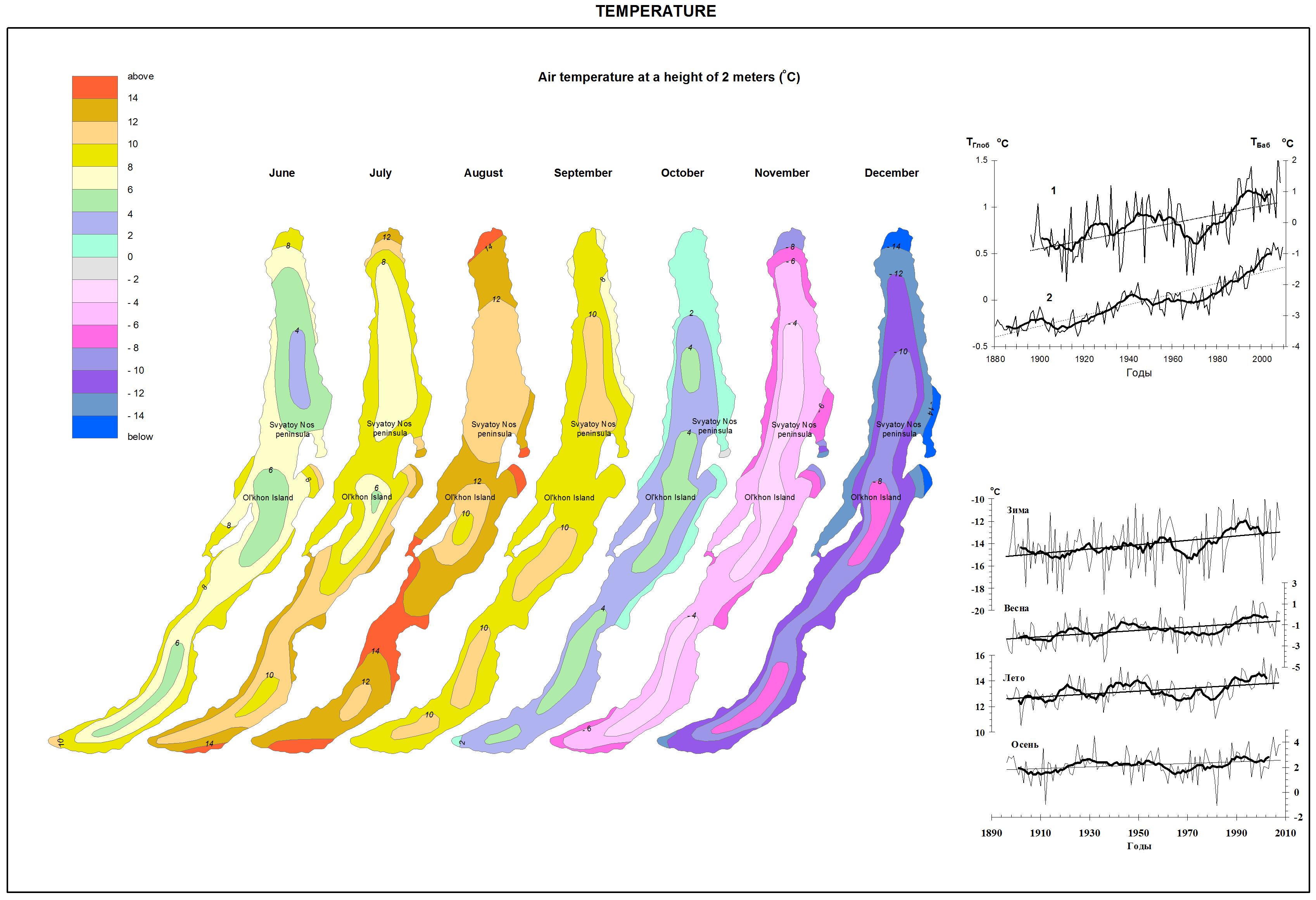
<p><b>Air </b><b>temperature. </b>General trend of air temperature changes at Lake Baikal corresponded to the global temperature trend with its rise from the late 1910-s to the middle of the 20<sup>th</sup> century, to the temperature decrease by the early 1970-s and its significant rise by the end of the 20<sup>th</sup> century. The trend of annual temperature in the lake area (+1.2°C/100 years) was two times higher than the average Earth’s trend (+0.6°C/100 years). The rise of air temperature was recorded for all seasons of the year from 1986 to 2008 with the trend of +1.9, +1.5, +1.1 and +0.66°C/100 years in winter, spring, summer and autumn, respectively. Maximal trend (+2.1-2.2°C) was registered in December and January and minimal trend (+0.1-0.5°C) in August, September and October.  Statistical analysis showed both short-term (2-7 years) and long-term inter-annual (about 20 years) cycles with well-defined phases of increase and decrease of air temperature. The 20<sup>th</sup> century had two complete cycles (1912-1936 and 1937-1969) and phases of two incomplete cycles – decrease from 1896 to 1911 and increase from 1970. The increase phase at the end of the century to the mid 1990-s was characterized by anomalously long duration (25 years) and rise of air temperature (by 2.1°C). Beginning from 1995, there was a tendency to annual temperature decrease, which may be regarded as the beginning of the temperature drop phase in the current inter-annual climate cycle. <b> </b></p>
<p><b>Temperature of water surface. </b>The temperature of water surface increased together with the rise of air temperature due to global warming. According to the observation data since 1941, the average temperature of water surface in Southern Baikal (the settlement of Listvennichnoye) decreased insignificantly in May-September from the 1950-s to the 1970-s, and then sharply increased by the mid 1990-s. The same temperature changes were recorded in other areas of the lake. The rate of its increase (0.64-0.60°C/10 years) was higher in the central and northern parts of Lake Baikal than in its southern part (0.25-0.35°C/10 years). The temperature of the warmer 1994-2005 decade exceeded the temperature of the cold 1964-1975 period by 0.9-1.5°C in the southern area and by 1.8-2°C in the central and northern regions of the lake. In some years of this period (e.g., several days in August of 2002), the increase of surface water temperature up to 18-20°C was recorded even in the deeper areas of the lake. <b></b></p>
<p><b>Ice regime. </b>Beginning in the middle of the 20<sup>th</sup> century, the warming caused “mitigation” of the ice regime at Lake Baikal [Verbolov et al., 1965; Magnusson et al., 2000]. Freezing of the lake started later, whereas ice breaking began earlier. In1868-2010, in Southern Baikal (the settlement of Listvennichnoye) the trend of freezing and ice breaking terms were 10 and 7 days per 100 years, respectively. The duration of ice free period prolonged, whilst the ice cover period shortened by 17 days. According to the 1950-2010 data, the maximal ice thickness decreased on average by 2.4 cm every 10 years. During the phase of significant warming (1970-1995,) the rate of ice process changes sharply increased: freezing started by 10 days later and ice breaking by 15 days earlier; the ice period shortened by 25 days, and the ice thickness decreased on average by 8.8 cm per 10 years. The observation data from shore stations and satellites showed that beginning from the mid 1990-s to the middle of 2010 there was a tendency towards early freezing, late break-up of ice and prolongation of ice period [Kouraev et al., 2007]. These changes are consistent with inter-annual climate periodicity associated with fluctuations of atmospheric circulation in the Northern Hemisphere.</p>
<p>The main meteorological factor, which causes fluctuations of freezing terms (D<sub>fr</sub>) is the air temperature in November-December (T<sub>a</sub>) affecting the rate of heat losses from the water surface. The correlation between these characteristics in Southern Baikal is described by equation D<sub>fr</sub>=4.26Тa+75 (R<sup>2</sup>=0.57, p&lt;0.001) for the period of 1896-2010, where D<sub>fr</sub> is the number of days from December 1<sup>st</sup> to the freezing date. Temperature conditions in spring also affect the date of ice breaking. However, the correlation between ice breaking dates and air temperature is not high [Livingston, 1999]. It is attributed to the effect of both thermal and dynamic (wind) factors on the break-up of ice [Kouraev et al., 2007; Shimaraev, 2008], as well as to the influence of ice thickness, which depends on air temperature in winter months.</p>]]></content:encoded>
    <dc:publisher>No publisher</dc:publisher>
    <dc:creator>Alexander Ayurzhanaev</dc:creator>
    <dc:rights></dc:rights>
    <dc:date>2014-10-15T02:40:00Z</dc:date>
    <dc:type>Page</dc:type>
  </item>


</rdf:RDF>