<?xml version="1.0" encoding="utf-8" ?>
<rdf:RDF xmlns:rdf="http://www.w3.org/1999/02/22-rdf-syntax-ns#" xmlns:dc="http://purl.org/dc/elements/1.1/" xmlns:syn="http://purl.org/rss/1.0/modules/syndication/" xmlns="http://purl.org/rss/1.0/">


<channel rdf:about="http://bic.iwlearn.org/en/search_rss">
  <title>English</title>
  <link>http://bic.iwlearn.org</link>

  <description>
    
            These are the search results for the query, showing results 51 to 65.
        
  </description>


  <image rdf:resource="http://bic.iwlearn.org/logo.png"/>

  <items>
    <rdf:Seq>
      
        <rdf:li rdf:resource="http://bic.iwlearn.org/en/atlas/atlas/130-fogs-map/fogs-map"/>
      
      
        <rdf:li rdf:resource="http://bic.iwlearn.org/en/atlas/atlas/130-fogs-map"/>
      
      
        <rdf:li rdf:resource="http://bic.iwlearn.org/en/atlas/atlas/129-cloudiness-map/cloudiness-map"/>
      
      
        <rdf:li rdf:resource="http://bic.iwlearn.org/en/atlas/atlas/129-cloudiness-map"/>
      
      
        <rdf:li rdf:resource="http://bic.iwlearn.org/en/atlas/atlas/128-slope-exposure-bottom-of-lake-baikal-map/slope-exposure-bottom-of-lake-baikal-map"/>
      
      
        <rdf:li rdf:resource="http://bic.iwlearn.org/en/atlas/atlas/128-slope-exposure-bottom-of-lake-baikal-map"/>
      
      
        <rdf:li rdf:resource="http://bic.iwlearn.org/en/atlas/atlas/127-angles-of-inclination-of-map/angles-of-inclination-of-map"/>
      
      
        <rdf:li rdf:resource="http://bic.iwlearn.org/en/atlas/atlas/127-angles-of-inclination-of-map"/>
      
      
        <rdf:li rdf:resource="http://bic.iwlearn.org/en/atlas/atlas/126-bottom-contour-map/bottom-contour-map"/>
      
      
        <rdf:li rdf:resource="http://bic.iwlearn.org/en/atlas/atlas/126-bottom-contour-map"/>
      
      
        <rdf:li rdf:resource="http://bic.iwlearn.org/en/atlas/atlas/124-specially-protected-natural-areas-map/specially-protected-natural-areas-map"/>
      
      
        <rdf:li rdf:resource="http://bic.iwlearn.org/en/atlas/atlas/125-non-profit-environmental-organizations-map/non-profit-environmental-organizations-map"/>
      
      
        <rdf:li rdf:resource="http://bic.iwlearn.org/en/atlas/atlas/125-non-profit-environmental-organizations-map"/>
      
      
        <rdf:li rdf:resource="http://bic.iwlearn.org/en/atlas/atlas/123-rare-animals-distribution-map"/>
      
      
        <rdf:li rdf:resource="http://bic.iwlearn.org/en/atlas/atlas/123-rare-animals-distribution-map/copy_of_rare-animals-distribution-map"/>
      
    </rdf:Seq>
  </items>

</channel>


  <item rdf:about="http://bic.iwlearn.org/en/atlas/atlas/130-fogs-map/fogs-map">
    <title>Fogs map</title>
    <link>http://bic.iwlearn.org/en/atlas/atlas/130-fogs-map/fogs-map</link>
    <description></description>
    <content:encoded xmlns:content="http://purl.org/rss/1.0/modules/content/"><![CDATA[<p><img class="image-inline" src="../../../resolveuid/2373960f555f475da742084bf54e7e49/@@images/image/preview" /></p>
<p><a href="http://bic.iwlearn.org/en/atlas/photos/copy_of__130_Fogs.png" class="internal-link">Open full size</a></p>
<p align="center"><strong>Fogs</strong></p>
<p align="center"><strong> </strong></p>
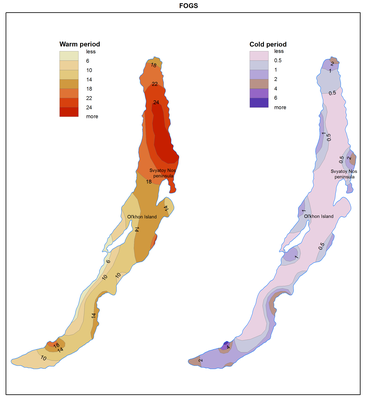
<p>Fogs at Lake Baikal form corresponding to sea fogs: they correlate with the relatively consistent seasonal drifting of air masses and with the seasonal distribution of winds. However due to the isolated inland location of the lake and the influence of the surrounding continental landmass, the Baikal fogs are to be classified as a separate type of advection fogs of large inland lakes and water reservoirs. The number of foggy days is the highest along the Northeast coast of Lake Baikal, and the lowest in the Central and the Southwest parts of the lake. The fogs lie mainly in the curves of the coastline, bays, coves, mouths of the rivers, flowing into Lake Baikal, and the numerous creek valleys that open towards the lake. In the annual cycle, the fogs are most frequent in July. The Northern stations report higher frequency of fogs in summer and register a single sharp peak in July. The Southern stations report lower frequency of fogs in the annual cycle, while the annual peak is extended over June, July and August.</p>
<p>At Lake Baikal, condensation prevails in summer, and evaporation – in winter. In the warm season, fogs are formed by passing of a warm front, or within a diffused pressure field above the wet underlying terrain. These fogs are formed by condensation of vapor in a mass of air warmed up above the land as it passes over the cold water. Summer fogs are very dense and persistent, especially in the first half of summer.</p>
<p>Evaporation fogs occur during the сold season. Until the lake freezes over, these fogs continuously stay above the water surface or can be lifted into low cloud. In winter, the Siberian Highland ground inversions accompanied by significant fall of temperature form radiation fogs. Winter fog formation is most commonly connected with advection of cold air over the warmer water surface. In cold season, as well as during the summer months, other types of fog can occur at Lake Baikal, caused by various reasons: temperature gradient between land and sea, the occurrence of floe patches and clear water surface, clearings in the fast ice of Lake Baikal.</p>
<p>Forecasting Baikal fogs requires an integrated approach with attention to such factors as their movability and the complexity of their formation processes. One has to take into account the general meteorological situation, the character of breeze/monsoon circulation in the area, the influence of coastline. It is important to consider the influence of West winds on the fog formation at the East coast, especially in winter.</p>]]></content:encoded>
    <dc:publisher>No publisher</dc:publisher>
    <dc:creator>Alexander Ayurzhanaev</dc:creator>
    <dc:rights></dc:rights>
    <dc:date>2014-10-15T02:00:00Z</dc:date>
    <dc:type>Page</dc:type>
  </item>


  <item rdf:about="http://bic.iwlearn.org/en/atlas/atlas/130-fogs-map">
    <title>130. Fogs map</title>
    <link>http://bic.iwlearn.org/en/atlas/atlas/130-fogs-map</link>
    <description></description>
    
    <dc:publisher>No publisher</dc:publisher>
    <dc:creator>Alexander Ayurzhanaev</dc:creator>
    <dc:rights></dc:rights>
    <dc:date>2014-10-15T01:58:30Z</dc:date>
    <dc:type>Folder</dc:type>
  </item>


  <item rdf:about="http://bic.iwlearn.org/en/atlas/atlas/129-cloudiness-map/cloudiness-map">
    <title>Cloudiness map</title>
    <link>http://bic.iwlearn.org/en/atlas/atlas/129-cloudiness-map/cloudiness-map</link>
    <description></description>
    <content:encoded xmlns:content="http://purl.org/rss/1.0/modules/content/"><![CDATA[<p><img class="image-inline" src="../../../resolveuid/3c4d55bba8e047cd832942b5ac3abf2c/@@images/image/preview" /></p>
<p><a href="http://bic.iwlearn.org/en/atlas/photos/copy_of__129_Cloudiness.png" class="internal-link">Open full size</a></p>
<p align="center"><strong>Cloud cover</strong></p>
<p><strong> </strong></p>
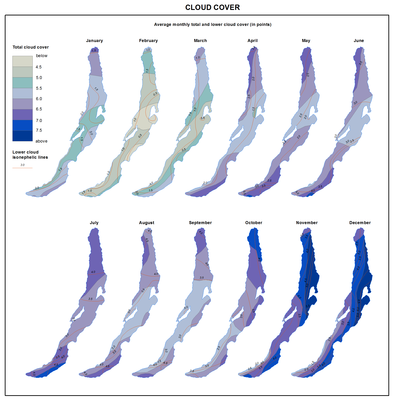
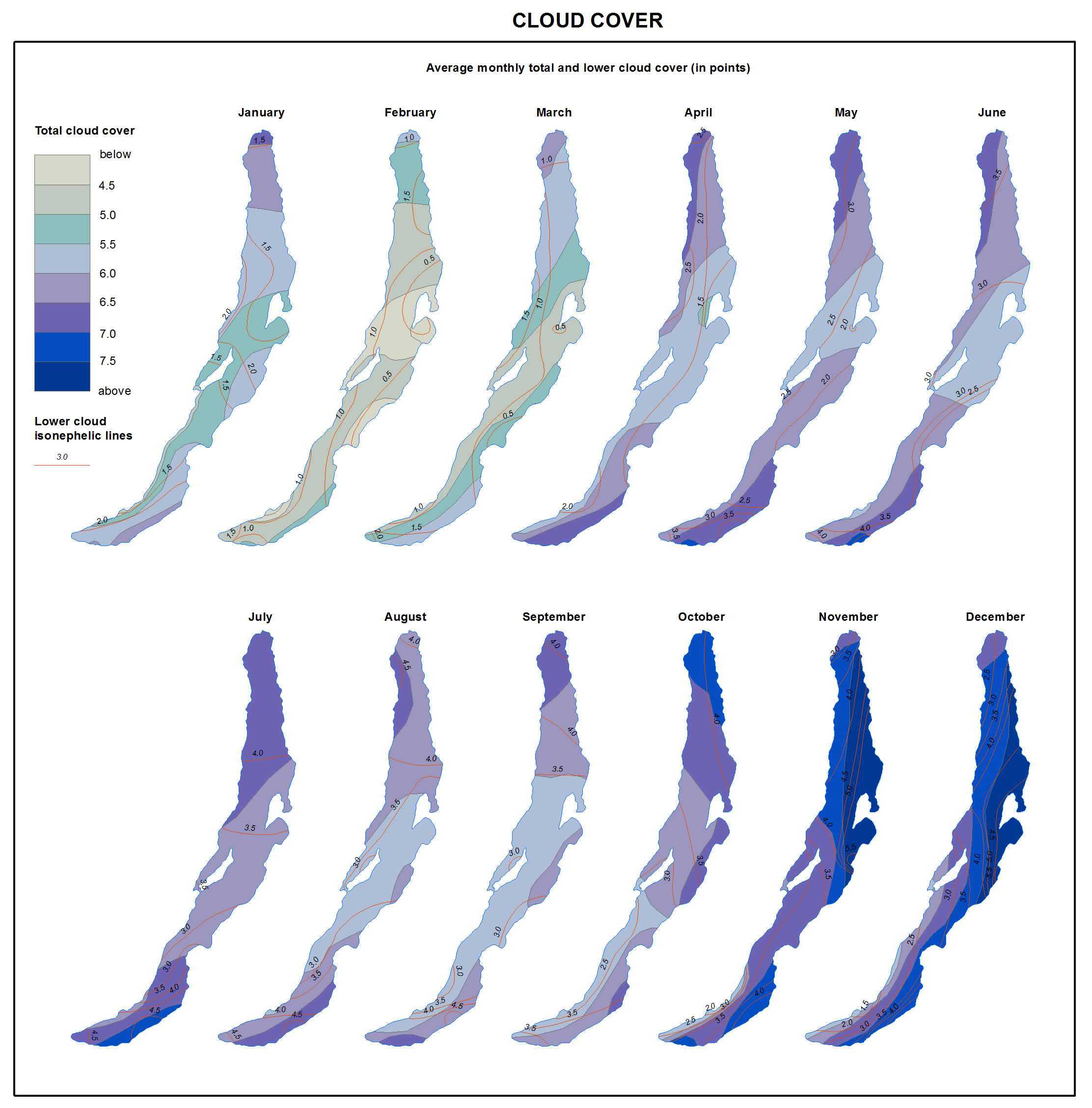
<p><span>Two maxima are recorded in the annual trend of cloud cover: summer (June-July) and pre-freeze-up (November-December). The latter prevails. The highest cloud cover values (7-8 oktas) and increased recurrence of overcast days (up to 75-80%) are registered in December on the north-eastern coast of the lake, whereas the lowest values (no higher than 4 oktas) are observed in February-March on the western shore, particularly within the territory of Maloye More (Small Sea). The foehn effect plays a significant role during the transfer of air masses over the Primorsky and Baikal Ridges, which causes a considerable drop of air humidity. In October-December, the cloud cover is very low above Lake Baikal due to the intense water evaporation from the ice free surface of the lake.</span></p>]]></content:encoded>
    <dc:publisher>No publisher</dc:publisher>
    <dc:creator>Alexander Ayurzhanaev</dc:creator>
    <dc:rights></dc:rights>
    <dc:date>2014-10-15T01:55:00Z</dc:date>
    <dc:type>Page</dc:type>
  </item>


  <item rdf:about="http://bic.iwlearn.org/en/atlas/atlas/129-cloudiness-map">
    <title>129. Cloudiness map</title>
    <link>http://bic.iwlearn.org/en/atlas/atlas/129-cloudiness-map</link>
    <description></description>
    
    <dc:publisher>No publisher</dc:publisher>
    <dc:creator>Alexander Ayurzhanaev</dc:creator>
    <dc:rights></dc:rights>
    <dc:date>2014-10-15T01:54:56Z</dc:date>
    <dc:type>Folder</dc:type>
  </item>


  <item rdf:about="http://bic.iwlearn.org/en/atlas/atlas/128-slope-exposure-bottom-of-lake-baikal-map/slope-exposure-bottom-of-lake-baikal-map">
    <title>Slope exposure bottom of Lake Baikal map</title>
    <link>http://bic.iwlearn.org/en/atlas/atlas/128-slope-exposure-bottom-of-lake-baikal-map/slope-exposure-bottom-of-lake-baikal-map</link>
    <description></description>
    <content:encoded xmlns:content="http://purl.org/rss/1.0/modules/content/"><![CDATA[<p><img class="image-inline" src="../../../resolveuid/d5d68e0b2c4747c6bd22da90aca23ead/@@images/image/preview" /></p>
<p><a href="http://bic.iwlearn.org/en/atlas/photos/copy_of__128_SlopeexposurebottomofLakeBaikal.png" class="internal-link">Open full size</a></p>
<p align="center"><strong>Slope exposure</strong></p>
<p>The history of depth measurements in Lake Baikal goes back to 1798, when E. Kopylov and S. Smetanin, employees of a mine plant, carried out 28 measurements between the head of the Angara river and the mouth of the Selenga river. One of such measurements yielded a maximum depth of 1,238 m. Lake Baikal was immediately recognised as the second deepest lake in the world.</p>
<p>In the period of 1869-1876, B. Dybovsky and V. Godlevsky compiled a detailed and precise (for that time) map of Southern Baikal, which covered 11 cross-sections. Measurements of depth were carried out from the ice, which provided high accuracy [Dybovsky, Godlevsky, 1871, 1877].</p>
<p>In 1902 and 1908, the Pilot Chart of Lake Baikal and Atlas of Lake Baikal were published as a result of numerous hydrographic expeditions under the leadership of F. Drizhenko, in which the depths were shown in detail for the coastal areas of the lake.</p>
<p>In 1925, the USSR Academy of Sciences developed a long-term project under the supervision of G. Vereshchagin to study bathymetry of Lake Baikal. This initiative resulted in the organisation of Limnological Station, later reorganised into Limnological Institute. This project helped discover the deepest place in the lake and an underwater shallow ridge named the Akademichesky Ridge, which separates the northern basin from the central one. New bathymetric maps (scales 1:300,000 and 1:500,000) were compiled. They were demonstrated at the International Limnological Congress held in Rome in 1934.</p>
<p>In 1962, A. Rogozin and B. Lut compiled a new bathymetric map (scale 1:300,000) as a result of long-term bathymetric expeditions. Based on this map, the Central Department for Navigation and Oceanography of the Ministry of Defence of the USSR (CDNO) published maps  “Northern and Southern Areas of Lake Baikal”  in 1973 and 1974.</p>
<p>In the period of 1979-1985, CDNO carried out new systematic echo-sounding bathymetric measurements throughout the entire Lake Baikal. Traverses had a spacing of 100 and 250 m in the coastal waters and 1 km in the abyssal areas. As a result of these investigations, a four-sheet bathymetric map of Lake Baikal was published in 1992 (scale of 1:200,000). To date, this is the most reliable bathymetric map of Lake Baikal. However, it has some shortcomings:</p>
<ul>
<li>Bathymetry is based only on some available original data;</li>
<li>Bathymetry      is presented by the contours of isobaths that were taken manually;</li>
<li>Bathymetry is mainly represented by isobaths with a step of 100 m      up to a depth of 1,000 m and 500 m for depths exceeding 1,000 m;</li>
<li>Recent investigations showed that significant discrepancies can      exist between true depth values and echo-sounding measurements, which are      attributed to discrepancies between the real acoustic speed in Lake Baikal      and the calculated rate for the echo-sounder.</li>
</ul>
<p>In 1999, an international group of experts was organised to jointly compile a new, more precise bathymetric map of Lake Baikal. It was necessary to carry out more detailed recalculations of measurement values, which were used for maps in 1992, to digitise and adjust them to the real acoustic speed, to integrate them with the echo-sounding data obtained earlier, and to compile a new more complete computer map of Lake Baikal based on all available measurement data. This project was financially supported by INTAS (International Association for the Promotion of Cooperation with Scientists from the New Independent States of the Former Soviet Union).</p>
<p>The CD ROM is available with final results of this project. Coordinates of points are in a Mercator’s projection, WGS 1984 ellipsoid. The latitude for all generated maps is 53<sup>o</sup> 0’ 00’’ N.</p>
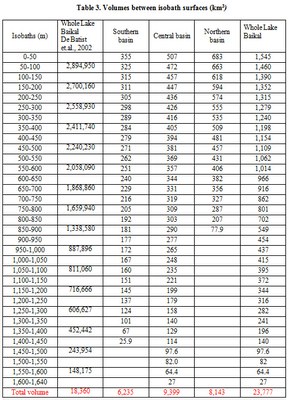
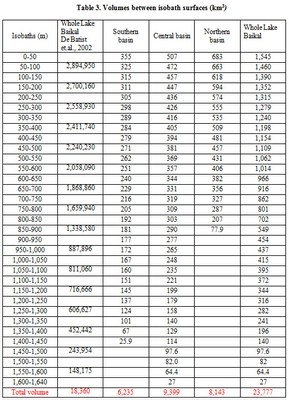
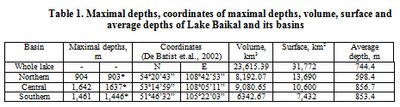
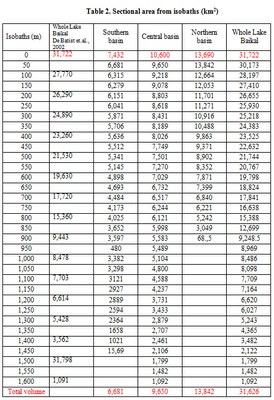
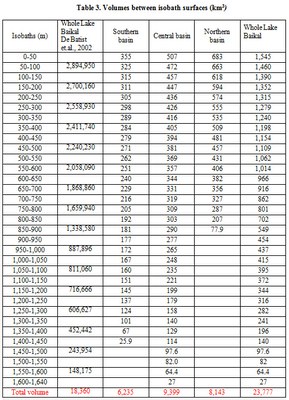
<p>New bathymetric data made it possible to obtain specified morphometric information on Lake Baikal and to present it in tables. Taking into account that the lake surface is at 455.5 m a.s.l. (Baltic System of Heights), the deepest point of Lake Baikal is situated at 1186.5 m below the sea level.</p>
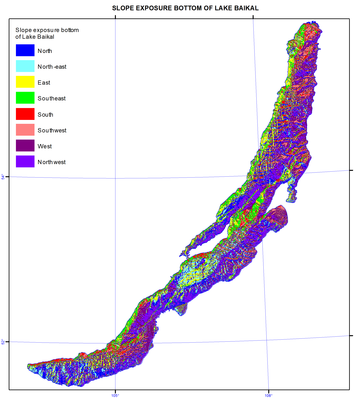
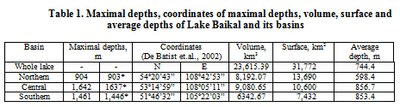
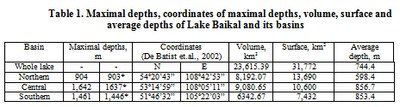
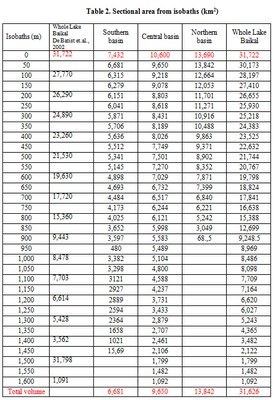
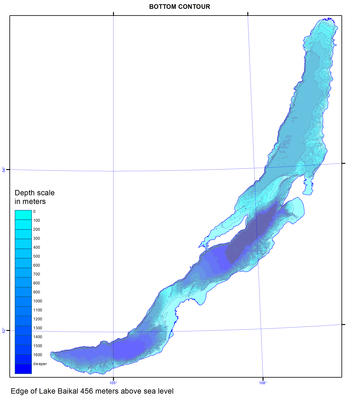
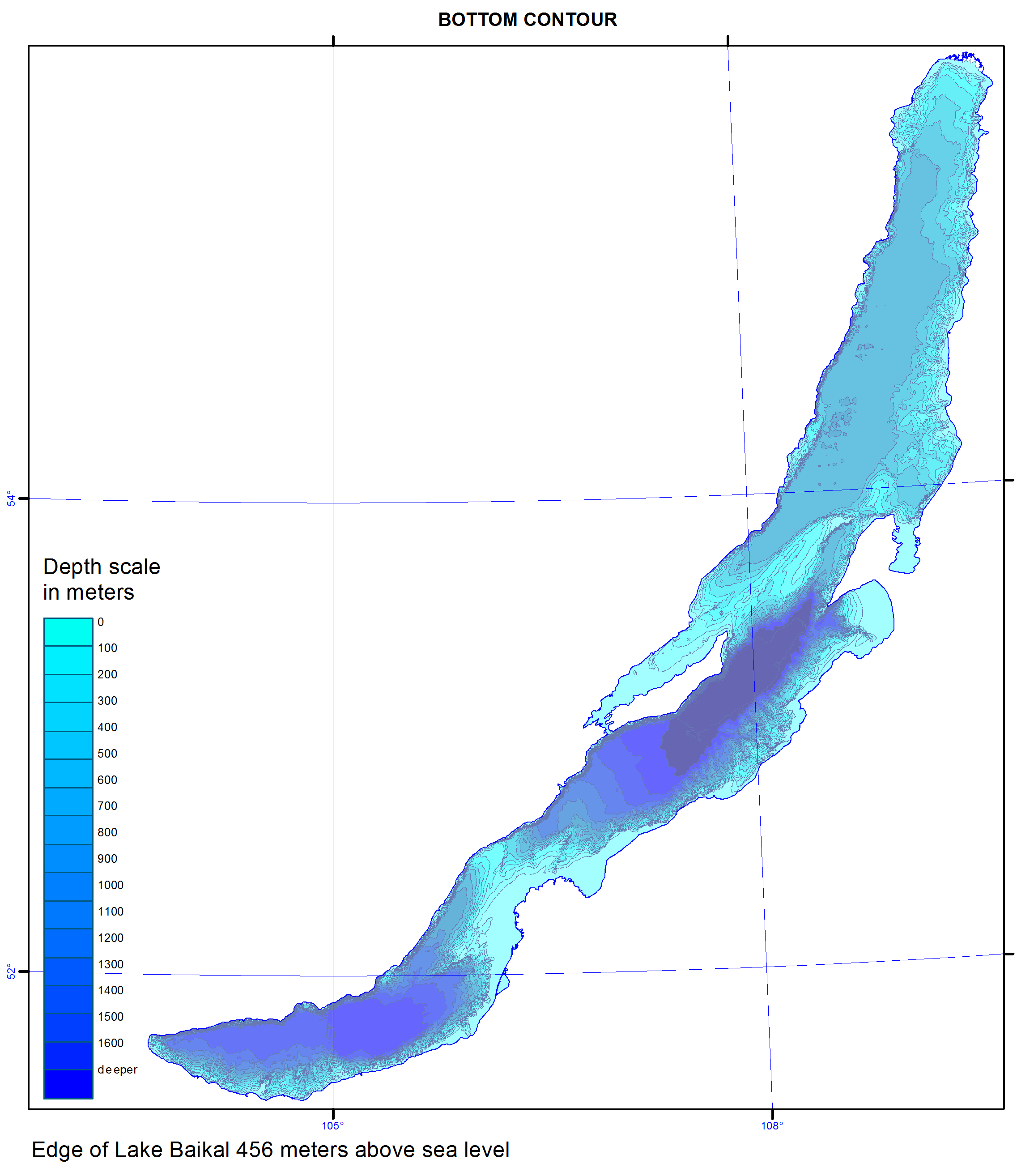
<p class="a">The relief of the bottom of Lake Baikal is represented by isobaths with a step of 100 m. The lake consists of three basins: Northern basin – the most shallow one with a maximum depth of 904 m and an average depth of 598.4 m. Central basin is the deepest one. Its maximum depth is 1637 m, while the average depth is 856.7 m. Southern basin’s maximum depth is 1461 m with the average depth of 853.4 m. The existing Baikal depression is asymmetric: its northern and northwestern slopes are very steep, while the southern and southwestern slopes are more flat. Maximum depths are located at a distance of one third of the lake’s width from the steep northwestern slope. There is a shallow platform – a shelf - on the lake's northern and northwestern side, which is weakly developed. The shelf on the southern and southwestern coast is more pronounced.</p>
<p class="a">Measurement results demonstrated that in the place of the supposed maximum depth of 1741 m, according to G. Y. Vereschagin, the actual depth is less than 1600 m - 1593-1596 m. Based on the data derived from echo sounding, the deepest part of Central Baikal is located between Cape Izhimei and Otto-Khushun. In 1972, control measurements using the NEL-5 echo-sounder showed the depth of 1637 m [Lut, 1987].</p>
<p class="a">Numerous underwater works using Pisces, Mir-1, and Mir-2 submersibles offered an opportunity to visually examine morphologic and morphometric features of the underwater slopes and compare these data with the results of echo sounding. Northern and northwestern slope is sporadically covered with silt deposits with bed rock monoliths protruding between silty patches.</p>
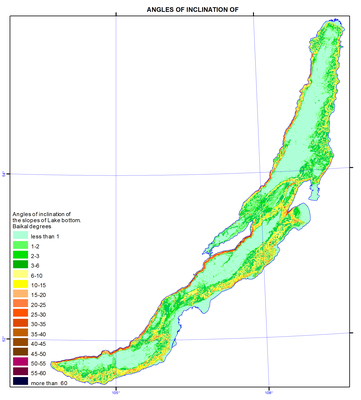
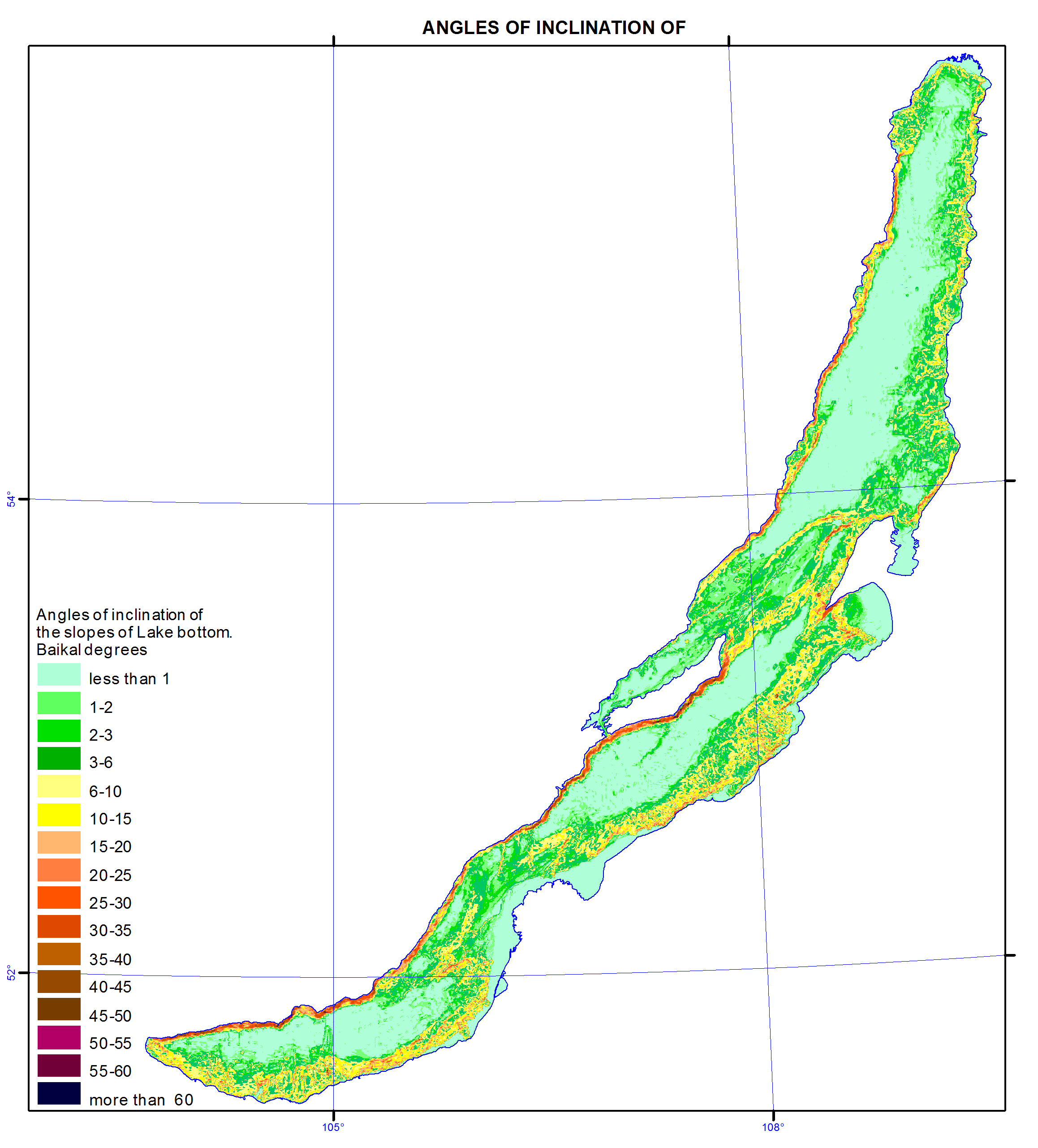
<p class="a">The steepest part of the underwater slope is located on the northern side of the depression near Cape Kolokolny, about 40 km from the southern edge of the depression. The total steepness of the slope here reaches 60-65 degrees, however, its steepness is lower than the steepness on the Baikal side of Olkhon Island by 10-15 degrees [Lut, 1987]. The steepness of northern and northwestern slopes reaches 60-40 degrees. According to the Pisces XI expedition on September 22, 1991, negative slopes at the depth of more than 700 m were observed. The steepness of the southern and southeastern slope is five to six times lower.  The average slope of the whole lake is four degrees.                                                                                                                                                                                                                                                                                                                                                     <b><i></i></b></p>
<p align="center">References</p>
<p>Drizhenko, F. K. (1902). Pilot Chart of Lake Baikal.</p>
<p>Drizhenko, F. K. (1908). Atlas of Lake Baikal.</p>
<p>Dybovsky, B., Godlevsky, V. (1871). Report on depth measurements in Lake Baikal carried out in spring of 1871. <i>Bulletin of the East Siberian Department of the Imperial Russian Geographical Society, 2</i>(5). p 6-16.</p>
<p>Dybovsky, B., Godlevsky, V. (1877). Report on experiments in 1876 (Profiles of Lake Baikal in the appendix<i> Bulletin of the East Siberian Department of the Imperial Russian Geographical Society, 8</i>. p 115-135.</p>
<p>Lut, V. F. (1987). <i>Morphology and morphometry of the Baikal basin. The way of knowing Baikal.</i> Novosibirsk: Nauka. p 34-47.</p>
<p>Northern Area of Lake Baikal. Scale 1:300,000. (1973). Leningrad: GUNIO.</p>
<p>Southern Area of Lake Baikal. Scale 1:300,000. (1974). Leningrad: GUNIO.</p>
<p>Lake Baikal (4 sheets). Scale 1:200,000. (1991, 1992). Leningrad-St. P: GUNIO.</p>
<p>De Batist, M., Canals, M., Sherstyankin, P. P., Alekseev, S. P., and Teams (2002). The INTAS Project 99-1669, October 2002.</p>
<p style="text-align: center; "><img class="image-inline" src="../../../resolveuid/9ff1a088aff84763a06d4a21da66500a/@@images/image/preview" /><img class="image-inline" src="../../../resolveuid/f7bb1d20c90544b898882537ad91b30e/@@images/image/preview" /><img class="image-inline" src="../../../resolveuid/02a2945f188c495d88811ddc56d2189b/@@images/image/preview" /></p>]]></content:encoded>
    <dc:publisher>No publisher</dc:publisher>
    <dc:creator>Alexander Ayurzhanaev</dc:creator>
    <dc:rights></dc:rights>
    <dc:date>2014-10-15T01:50:00Z</dc:date>
    <dc:type>Page</dc:type>
  </item>


  <item rdf:about="http://bic.iwlearn.org/en/atlas/atlas/128-slope-exposure-bottom-of-lake-baikal-map">
    <title>128. Slope exposure bottom of Lake Baikal map</title>
    <link>http://bic.iwlearn.org/en/atlas/atlas/128-slope-exposure-bottom-of-lake-baikal-map</link>
    <description></description>
    
    <dc:publisher>No publisher</dc:publisher>
    <dc:creator>Alexander Ayurzhanaev</dc:creator>
    <dc:rights></dc:rights>
    <dc:date>2014-10-15T01:46:49Z</dc:date>
    <dc:type>Folder</dc:type>
  </item>


  <item rdf:about="http://bic.iwlearn.org/en/atlas/atlas/127-angles-of-inclination-of-map/angles-of-inclination-of-map">
    <title>Angles of inclination of map</title>
    <link>http://bic.iwlearn.org/en/atlas/atlas/127-angles-of-inclination-of-map/angles-of-inclination-of-map</link>
    <description></description>
    <content:encoded xmlns:content="http://purl.org/rss/1.0/modules/content/"><![CDATA[<p><img class="image-inline" src="../../../resolveuid/71b36906b4dd4ea89d93618a165e16c0/@@images/image/preview" /></p>
<p><a href="http://bic.iwlearn.org/en/atlas/photos/copy_of__127_Anglesofinclinationof.png" class="internal-link">Open full size</a></p>
<p style="text-align: center; "><strong>Slope inclination </strong></p>
<p>The history of depth measurements in Lake Baikal goes back to 1798, when E. Kopylov and S. Smetanin, employees of a mine plant, carried out 28 measurements between the head of the Angara river and the mouth of the Selenga river. One of such measurements yielded a maximum depth of 1,238 m. Lake Baikal was immediately recognised as the second deepest lake in the world.</p>
<p>In the period of 1869-1876, B. Dybovsky and V. Godlevsky compiled a detailed and precise (for that time) map of Southern Baikal, which covered 11 cross-sections. Measurements of depth were carried out from the ice, which provided high accuracy [Dybovsky, Godlevsky, 1871, 1877].</p>
<p>In 1902 and 1908, the Pilot Chart of Lake Baikal and Atlas of Lake Baikal were published as a result of numerous hydrographic expeditions under the leadership of F. Drizhenko, in which the depths were shown in detail for the coastal areas of the lake.</p>
<p>In 1925, the USSR Academy of Sciences developed a long-term project under the supervision of G. Vereshchagin to study bathymetry of Lake Baikal. This initiative resulted in the organisation of Limnological Station, later reorganised into Limnological Institute. This project helped discover the deepest place in the lake and an underwater shallow ridge named the Akademichesky Ridge, which separates the northern basin from the central one. New bathymetric maps (scales 1:300,000 and 1:500,000) were compiled. They were demonstrated at the International Limnological Congress held in Rome in 1934.</p>
<p>In 1962, A. Rogozin and B. Lut compiled a new bathymetric map (scale 1:300,000) as a result of long-term bathymetric expeditions. Based on this map, the Central Department for Navigation and Oceanography of the Ministry of Defence of the USSR (CDNO) published maps  “Northern and Southern Areas of Lake Baikal”  in 1973 and 1974.</p>
<p>In the period of 1979-1985, CDNO carried out new systematic echo-sounding bathymetric measurements throughout the entire Lake Baikal. Traverses had a spacing of 100 and 250 m in the coastal waters and 1 km in the abyssal areas. As a result of these investigations, a four-sheet bathymetric map of Lake Baikal was published in 1992 (scale of 1:200,000). To date, this is the most reliable bathymetric map of Lake Baikal. However, it has some shortcomings:</p>
<ul>
<li>Bathymetry is based only on some available original data;</li>
<li>Bathymetry      is presented by the contours of isobaths that were taken manually;</li>
<li>Bathymetry is mainly represented by isobaths with a step of 100 m      up to a depth of 1,000 m and 500 m for depths exceeding 1,000 m;</li>
<li>Recent investigations showed that significant discrepancies can      exist between true depth values and echo-sounding measurements, which are      attributed to discrepancies between the real acoustic speed in Lake Baikal      and the calculated rate for the echo-sounder.</li>
</ul>
<p>In 1999, an international group of experts was organised to jointly compile a new, more precise bathymetric map of Lake Baikal. It was necessary to carry out more detailed recalculations of measurement values, which were used for maps in 1992, to digitise and adjust them to the real acoustic speed, to integrate them with the echo-sounding data obtained earlier, and to compile a new more complete computer map of Lake Baikal based on all available measurement data. This project was financially supported by INTAS (International Association for the Promotion of Cooperation with Scientists from the New Independent States of the Former Soviet Union).</p>
<p>The CD ROM is available with final results of this project. Coordinates of points are in a Mercator’s projection, WGS 1984 ellipsoid. The latitude for all generated maps is 53<sup>o</sup> 0’ 00’’ N.</p>
<p>New bathymetric data made it possible to obtain specified morphometric information on Lake Baikal and to present it in tables. Taking into account that the lake surface is at 455.5 m a.s.l. (Baltic System of Heights), the deepest point of Lake Baikal is situated at 1186.5 m below the sea level.</p>
<p class="a">The relief of the bottom of Lake Baikal is represented by isobaths with a step of 100 m. The lake consists of three basins: Northern basin – the most shallow one with a maximum depth of 904 m and an average depth of 598.4 m. Central basin is the deepest one. Its maximum depth is 1637 m, while the average depth is 856.7 m. Southern basin’s maximum depth is 1461 m with the average depth of 853.4 m. The existing Baikal depression is asymmetric: its northern and northwestern slopes are very steep, while the southern and southwestern slopes are more flat. Maximum depths are located at a distance of one third of the lake’s width from the steep northwestern slope. There is a shallow platform – a shelf - on the lake's northern and northwestern side, which is weakly developed. The shelf on the southern and southwestern coast is more pronounced.</p>
<p class="a">Measurement results demonstrated that in the place of the supposed maximum depth of 1741 m, according to G. Y. Vereschagin, the actual depth is less than 1600 m - 1593-1596 m. Based on the data derived from echo sounding, the deepest part of Central Baikal is located between Cape Izhimei and Otto-Khushun. In 1972, control measurements using the NEL-5 echo-sounder showed the depth of 1637 m [Lut, 1987].</p>
<p class="a">Numerous underwater works using Pisces, Mir-1, and Mir-2 submersibles offered an opportunity to visually examine morphologic and morphometric features of the underwater slopes and compare these data with the results of echo sounding. Northern and northwestern slope is sporadically covered with silt deposits with bed rock monoliths protruding between silty patches.</p>
<p class="a">The steepest part of the underwater slope is located on the northern side of the depression near Cape Kolokolny, about 40 km from the southern edge of the depression. The total steepness of the slope here reaches 60-65 degrees, however, its steepness is lower than the steepness on the Baikal side of Olkhon Island by 10-15 degrees [Lut, 1987]. The steepness of northern and northwestern slopes reaches 60-40 degrees. According to the Pisces XI expedition on September 22, 1991, negative slopes at the depth of more than 700 m were observed. The steepness of the southern and southeastern slope is five to six times lower.  The average slope of the whole lake is four degrees.                                                                                                                                                                                                                                                                                                                                                     <strong><i></i></strong></p>
<p align="center">References</p>
<p>Drizhenko, F. K. (1902). Pilot Chart of Lake Baikal.</p>
<p>Drizhenko, F. K. (1908). Atlas of Lake Baikal.</p>
<p>Dybovsky, B., Godlevsky, V. (1871). Report on depth measurements in Lake Baikal carried out in spring of 1871. <i>Bulletin of the East Siberian Department of the Imperial Russian Geographical Society, 2</i>(5). p 6-16.</p>
<p>Dybovsky, B., Godlevsky, V. (1877). Report on experiments in 1876 (Profiles of Lake Baikal in the appendix<i> Bulletin of the East Siberian Department of the Imperial Russian Geographical Society, 8</i>. p 115-135.</p>
<p>Lut, V. F. (1987). <i>Morphology and morphometry of the Baikal basin. The way of knowing Baikal.</i> Novosibirsk: Nauka. p 34-47.</p>
<p>Northern Area of Lake Baikal. Scale 1:300,000. (1973). Leningrad: GUNIO.</p>
<p>Southern Area of Lake Baikal. Scale 1:300,000. (1974). Leningrad: GUNIO.</p>
<p>Lake Baikal (4 sheets). Scale 1:200,000. (1991, 1992). Leningrad-St. P: GUNIO.</p>
<p>De Batist, M., Canals, M., Sherstyankin, P. P., Alekseev, S. P., and Teams (2002). The INTAS Project 99-1669, October 2002.</p>
<p style="text-align: center; "><img class="image-inline" src="../../../resolveuid/582e96c82b8346c89a4ae74b9baadf38/@@images/image/preview" /><img class="image-inline" src="../../../resolveuid/1275a37c480d4c6f912f65309d5d60c2/@@images/image/preview" /></p>
<p style="text-align: center; "><img class="image-inline" src="../../../resolveuid/55bb492a94304c849ba06b38b51f98b8/@@images/image/preview" /></p>
<p><img src="http://bic.iwlearn.org/en/atlas/atlas/127-angles-of-inclination-of-map/angles-of-inclination-of-map" alt="Angles of inclination of map" id="__mce_tmp" title="Angles of inclination of map" /></p>]]></content:encoded>
    <dc:publisher>No publisher</dc:publisher>
    <dc:creator>Alexander Ayurzhanaev</dc:creator>
    <dc:rights></dc:rights>
    <dc:date>2014-10-15T01:45:00Z</dc:date>
    <dc:type>Page</dc:type>
  </item>


  <item rdf:about="http://bic.iwlearn.org/en/atlas/atlas/127-angles-of-inclination-of-map">
    <title>127. Angles of inclination of map</title>
    <link>http://bic.iwlearn.org/en/atlas/atlas/127-angles-of-inclination-of-map</link>
    <description></description>
    
    <dc:publisher>No publisher</dc:publisher>
    <dc:creator>Alexander Ayurzhanaev</dc:creator>
    <dc:rights></dc:rights>
    <dc:date>2014-10-15T01:35:30Z</dc:date>
    <dc:type>Folder</dc:type>
  </item>


  <item rdf:about="http://bic.iwlearn.org/en/atlas/atlas/126-bottom-contour-map/bottom-contour-map">
    <title>Bottom contour map</title>
    <link>http://bic.iwlearn.org/en/atlas/atlas/126-bottom-contour-map/bottom-contour-map</link>
    <description></description>
    <content:encoded xmlns:content="http://purl.org/rss/1.0/modules/content/"><![CDATA[<p><img class="image-inline" src="../../../../resolveuid/ea99bdf4a99d4002b08ab8f2bd205eaa/@@images/image/preview" /></p>
<p><a href="http://bic.iwlearn.org/en/photos/copy2_of__126_Bottomcontour.png" class="internal-link">Open full size</a></p>
<p style="text-align: center; "><b>Bottom relief</b></p>
<p>The history of depth measurements in Lake Baikal goes back to 1798, when E. Kopylov and S. Smetanin, employees of a mine plant, carried out 28 measurements between the head of the Angara river and the mouth of the Selenga river. One of such measurements yielded a maximum depth of 1,238 m. Lake Baikal was immediately recognised as the second deepest lake in the world.</p>
<p>In the period of 1869-1876, B. Dybovsky and V. Godlevsky compiled a detailed and precise (for that time) map of Southern Baikal, which covered 11 cross-sections. Measurements of depth were carried out from the ice, which provided high accuracy [Dybovsky, Godlevsky, 1871, 1877].</p>
<p>In 1902 and 1908, the Pilot Chart of Lake Baikal and Atlas of Lake Baikal were published as a result of numerous hydrographic expeditions under the leadership of F. Drizhenko, in which the depths were shown in detail for the coastal areas of the lake.</p>
<p>In 1925, the USSR Academy of Sciences developed a long-term project under the supervision of G. Vereshchagin to study bathymetry of Lake Baikal. This initiative resulted in the organisation of Limnological Station, later reorganised into Limnological Institute. This project helped discover the deepest place in the lake and an underwater shallow ridge named the Akademichesky Ridge, which separates the northern basin from the central one. New bathymetric maps (scales 1:300,000 and 1:500,000) were compiled. They were demonstrated at the International Limnological Congress held in Rome in 1934.</p>
<p>In 1962, A. Rogozin and B. Lut compiled a new bathymetric map (scale 1:300,000) as a result of long-term bathymetric expeditions. Based on this map, the Central Department for Navigation and Oceanography of the Ministry of Defence of the USSR (CDNO) published maps  “Northern and Southern Areas of Lake Baikal”  in 1973 and 1974.</p>
<p>In the period of 1979-1985, CDNO carried out new systematic echo-sounding bathymetric measurements throughout the entire Lake Baikal. Traverses had a spacing of 100 and 250 m in the coastal waters and 1 km in the abyssal areas. As a result of these investigations, a four-sheet bathymetric map of Lake Baikal was published in 1992 (scale of 1:200,000). To date, this is the most reliable bathymetric map of Lake Baikal. However, it has some shortcomings:</p>
<ul>
<li>Bathymetry is based only on some available original data;</li>
<li>Bathymetry      is presented by the contours of isobaths that were taken manually;</li>
<li>Bathymetry is mainly represented by isobaths with a step of 100 m      up to a depth of 1,000 m and 500 m for depths exceeding 1,000 m;</li>
<li>Recent investigations showed that significant discrepancies can      exist between true depth values and echo-sounding measurements, which are      attributed to discrepancies between the real acoustic speed in Lake Baikal      and the calculated rate for the echo-sounder.</li>
</ul>
<p>In 1999, an international group of experts was organised to jointly compile a new, more precise bathymetric map of Lake Baikal. It was necessary to carry out more detailed recalculations of measurement values, which were used for maps in 1992, to digitise and adjust them to the real acoustic speed, to integrate them with the echo-sounding data obtained earlier, and to compile a new more complete computer map of Lake Baikal based on all available measurement data. This project was financially supported by INTAS (International Association for the Promotion of Cooperation with Scientists from the New Independent States of the Former Soviet Union).</p>
<p>The CD ROM is available with final results of this project. Coordinates of points are in a Mercator’s projection, WGS 1984 ellipsoid. The latitude for all generated maps is 53<sup>o</sup> 0’ 00’’ N.</p>
<p>New bathymetric data made it possible to obtain specified morphometric information on Lake Baikal and to present it in tables. Taking into account that the lake surface is at 455.5 m a.s.l. (Baltic System of Heights), the deepest point of Lake Baikal is situated at 1186.5 m below the sea level.</p>
<p class="a">The relief of the bottom of Lake Baikal is represented by isobaths with a step of 100 m. The lake consists of three basins: Northern basin – the most shallow one with a maximum depth of 904 m and an average depth of 598.4 m. Central basin is the deepest one. Its maximum depth is 1637 m, while the average depth is 856.7 m. Southern basin’s maximum depth is 1461 m with the average depth of 853.4 m. The existing Baikal depression is asymmetric: its northern and northwestern slopes are very steep, while the southern and southwestern slopes are more flat. Maximum depths are located at a distance of one third of the lake’s width from the steep northwestern slope. There is a shallow platform – a shelf - on the lake's northern and northwestern side, which is weakly developed. The shelf on the southern and southwestern coast is more pronounced.</p>
<p class="a">Measurement results demonstrated that in the place of the supposed maximum depth of 1741 m, according to G. Y. Vereschagin, the actual depth is less than 1600 m - 1593-1596 m. Based on the data derived from echo sounding, the deepest part of Central Baikal is located between Cape Izhimei and Otto-Khushun. In 1972, control measurements using the NEL-5 echo-sounder showed the depth of 1637 m [Lut, 1987].</p>
<p class="a">Numerous underwater works using Pisces, Mir-1, and Mir-2 submersibles offered an opportunity to visually examine morphologic and morphometric features of the underwater slopes and compare these data with the results of echo sounding. Northern and northwestern slope is sporadically covered with silt deposits with bed rock monoliths protruding between silty patches.</p>
<p class="a">The steepest part of the underwater slope is located on the northern side of the depression near Cape Kolokolny, about 40 km from the southern edge of the depression. The total steepness of the slope here reaches 60-65 degrees, however, its steepness is lower than the steepness on the Baikal side of Olkhon Island by 10-15 degrees [Lut, 1987]. The steepness of northern and northwestern slopes reaches 60-40 degrees. According to the Pisces XI expedition on September 22, 1991, negative slopes at the depth of more than 700 m were observed. The steepness of the southern and southeastern slope is five to six times lower.  The average slope of the whole lake is four degrees.                                                                                                                                                                                                                                                                                                                                                     <b><i></i></b></p>
<p align="center">References</p>
<p>Drizhenko, F. K. (1902). Pilot Chart of Lake Baikal.</p>
<p>Drizhenko, F. K. (1908). Atlas of Lake Baikal.</p>
<p>Dybovsky, B., Godlevsky, V. (1871). Report on depth measurements in Lake Baikal carried out in spring of 1871. <i>Bulletin of the East Siberian Department of the Imperial Russian Geographical Society, 2</i>(5). p 6-16.</p>
<p>Dybovsky, B., Godlevsky, V. (1877). Report on experiments in 1876 (Profiles of Lake Baikal in the appendix<i> Bulletin of the East Siberian Department of the Imperial Russian Geographical Society, 8</i>. p 115-135.</p>
<p>Lut, V. F. (1987). <i>Morphology and morphometry of the Baikal basin. The way of knowing Baikal.</i> Novosibirsk: Nauka. p 34-47.</p>
<p>Northern Area of Lake Baikal. Scale 1:300,000. (1973). Leningrad: GUNIO.</p>
<p>Southern Area of Lake Baikal. Scale 1:300,000. (1974). Leningrad: GUNIO.</p>
<p>Lake Baikal (4 sheets). Scale 1:200,000. (1991, 1992). Leningrad-St. P: GUNIO.</p>
<p>De Batist, M., Canals, M., Sherstyankin, P. P., Alekseev, S. P., and Teams (2002). The INTAS Project 99-1669, October 2002.</p>
<p><img class="image-inline" src="../../../../resolveuid/2a3e18c5c1c740c79edd980588808474/@@images/image/preview" /><img class="image-inline" src="../../../../resolveuid/23e939a5781f448f81c07101d0703962/@@images/image/preview" /></p>
<p><img class="image-inline" src="../../../../resolveuid/36964c3878ae4b3fae3fb1bf006b705b/@@images/image/preview" /></p>]]></content:encoded>
    <dc:publisher>No publisher</dc:publisher>
    <dc:creator>Alexander Ayurzhanaev</dc:creator>
    <dc:rights></dc:rights>
    <dc:date>2014-10-15T01:10:00Z</dc:date>
    <dc:type>Page</dc:type>
  </item>


  <item rdf:about="http://bic.iwlearn.org/en/atlas/atlas/126-bottom-contour-map">
    <title>126. Bottom contour map</title>
    <link>http://bic.iwlearn.org/en/atlas/atlas/126-bottom-contour-map</link>
    <description></description>
    
    <dc:publisher>No publisher</dc:publisher>
    <dc:creator>Alexander Ayurzhanaev</dc:creator>
    <dc:rights></dc:rights>
    <dc:date>2014-10-15T01:00:26Z</dc:date>
    <dc:type>Folder</dc:type>
  </item>


  <item rdf:about="http://bic.iwlearn.org/en/atlas/atlas/124-specially-protected-natural-areas-map/specially-protected-natural-areas-map">
    <title>Specially protected natural areas map</title>
    <link>http://bic.iwlearn.org/en/atlas/atlas/124-specially-protected-natural-areas-map/specially-protected-natural-areas-map</link>
    <description></description>
    <content:encoded xmlns:content="http://purl.org/rss/1.0/modules/content/"><![CDATA[<p><img class="image-inline" src="../../../../resolveuid/b4c32351a3474621b3176dc8d5e0a7a2/@@images/image/preview" /></p>
<p><a href="http://bic.iwlearn.org/en/photos/copy2_of__124_Speciallyprotectednaturalareas.png" class="internal-link">Open full size</a></p>
<p align="center"><strong>Protected areas</strong></p>
<p>The Baikal basin is a unique region with a high biotic and landscape diversity. Specially protected areas ensure the protection of the ecosystems of the basin.</p>
<p>The importance of the principle of territorial nature protection is shown by the history of creation of protected natural territories (PNT). The first protected area in the Baikal basin – near the Bogd mountain range – was created in 1778, which is documented in the Mongolian written sources. Barguzinsky Reserve, founded in 1916, became the first of the currently operating Russian state reserves. The international significance of PNTs in the Baikal basin is underlined by the inscription of Lake Baikal on the UNESCO World Heritage list, as well as by the inclusion of four PNTs of the basin into the network of natural biosphere reserves run by the UNESCO program “Man and Biosphere” (MAB). In the recent years, determining factors of environmental policy included the implementation of the concept of sustainable development and Convention on Biological Diversity and other international environmental conventions ratified by Russia, as well as the compliance with the requirements concerning the ecosystem of Lake Baikal as a World Heritage Site.</p>
<p>A special federal law "On the Protection of Lake Baikal" was passed by Russia to preserve the World Heritage Site. This law established two ecological zones – central and buffer zones – within the Russian part of the Baikal basin, which, in turn, is part of the Baikal Natural Territory (BNT). In order to determine the nature protection regime in each of the category of PNTs in Russia and Mongolia, quite similar laws were passed in both countries including the Russian federal law “On Specially Protected Areas” (dated March 14, 1995) and national law of Mongolia “On Specially Protected Areas” (dated November 15, 1994, entered into force on April 1, 1995) [Mongolian…, 1996]. Due to the differences in the definition, we use the general term “Protected Natural Territory” (PNT).</p>
<p>It should be noted that a significant number of PNTs are divided by the basin’s borders. Nevertheless, they are also discussed in this Atlas.</p>
<p>The PNTs within the basin are unevenly distributed [Savenkova, 2001, 2002]. The Irkutsk part of the basin is almost completely covered by the reserve regime (Pribaikalsky National Park, Baikal-Lena Reserve, Kochergatsky wildlife refuge) and represents an almost uninterrupted protected belt along the western shore of the lake. In Buryatia, the largest protected areas are located near Lake Baikal, while the rest represent only small-sized sanctuaries. In the Zabaikalsky part of the basin, PNTs are small, but they help protect the environment at the sources of key rivers. In the Mongolian part of the basin, PNTs are distributed along the basin’s boundary. Their number in the center of the basin is small. A small national park Tuzhiyn Nars can be mentioned among them. Thus, the ecosystems in the nearest surroundings of Lake Baikal are sufficiently protected, although the PNT distribution on the rest of the basin and the protection of the lake’s water area are not always optimal.</p>
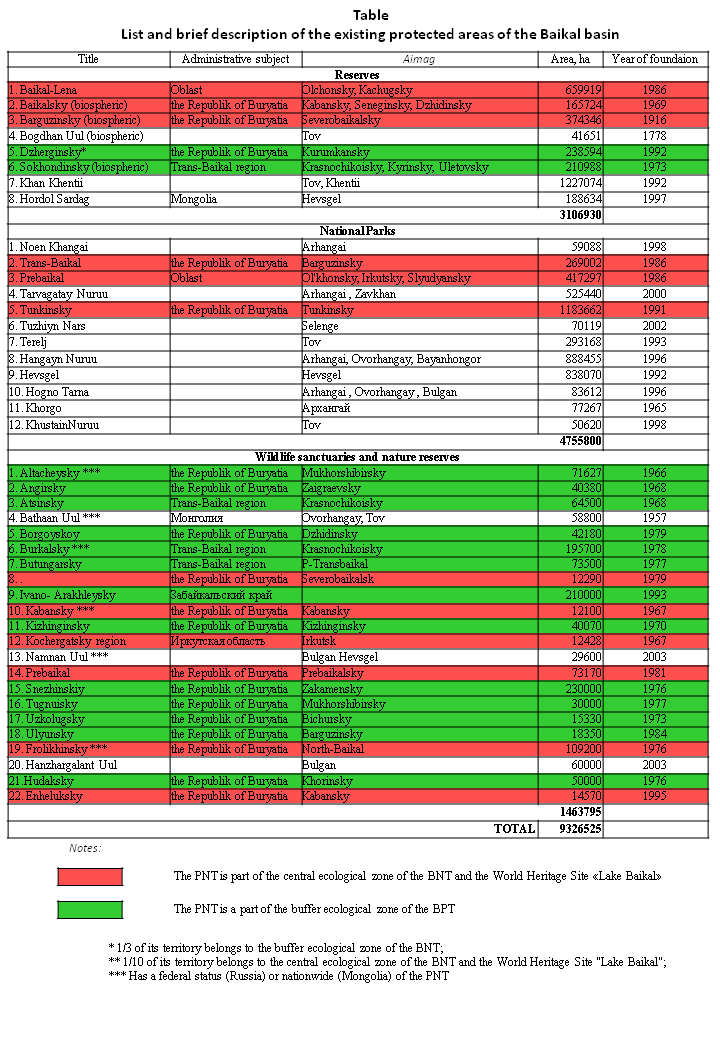
<p>As of 2009, there are 46 PNTs of the main categories (see table) with a total area of 10442,171 thousand hectares within the Baikal basin. They include 10 reserves (incl. four biosphere reserves), 13 national parks, 23 wildlife refuges and sanctuaries. Moreover, in the Russian part of the basin, there are the so-called recreational areas, which are basically PNTs under district jurisdiction. In the Mongolian part of the basin, there are PNTs under aimag jurisdiction [Mongolia’s Wild Heritage…, 1996; Mongolia’s tentative…, 1999; Savenkova, Erdentsetseg, 2000, 2002; Oyungerel, 2009]. The map also shows four National Natural Monuments of Mongolia: Khuisiin Naiman Nuur, Uran Togoo-Tulga Uul, Bulgan Uul, and Dayan Derkhi.</p>
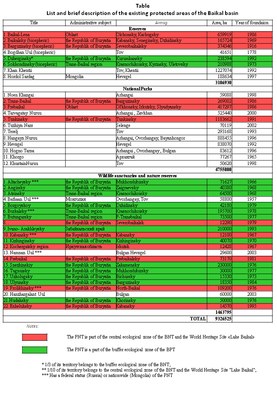
<p><img class="image-inline" src="../../../../resolveuid/774c005a6a094dffa18ec68a945bea49/@@images/image/preview" /></p>
<p><a href="http://bic.iwlearn.org/en/photos/copy_of__124_Table.png" class="internal-link">Open full size</a></p>
<p>There are plans to create 20 new PNTs of different categories in the Baikal basin.</p>
<p>In the Russian part these will include the “Selenga Delta” (Buryatia) and “Ikh Tayrisin” (Tuva) reserves, national parks "Chikoysky" (Zabaikalsky krai) and "Onotsky" (Irkutsk oblast), wildlife sanctuaries “Verhneulkansky” (Buryatia/Irkutsk oblast), "Khila" (Buryatia/Zabaikalsky krai), "Malkhansky" (Zabaikalsky krai), "Talovsky Lakes" (Irkutsk oblast), as well as the most numerous type of PNT – natural parks "Arey", "Yamarovka" (Zabaikalsky krai), "Utulik - Babkha", "Chersky Peak", "Warm Lakes" (Irkutsk oblast), "Upper Angara", "Kurkulinsky", "Mezhdurechye", "Posolsky Sor"," Slyudyanskiye Lakes", "Tagley", "Khakusy", "Yarki" (Buryatia) [Kalikhman, 2007].</p>
<p>In the Mongolian part of the basin, 11 territories will become new PNTs, including "Burengiyn Nuruu" reserve and nature reserves "Arkhan Buural-Badaryn Nuruu", "Bohloo-Chagtayn Nuruu", "Ikh Tunel-Emged Ovgod", "Tovhonhaan uul", "TerhenTsagaan uul", "Khalkhan bulnai" [Kalikhman, 2011; Special Protected Areas…, 2000].</p>
<p>Moreover, there are plans to organize five transboundary PNTs in the basin: "The Amur Source ", "Khentei – Chikoyskoye Highlands", "Selenga", "From Khovsgol to Baikal", "Delger - Muren" [Savenkova, 2001; Oyungerel, Savenkova, 2004]. A relative similarity in the legislature concerning the PNTs in Russia and Mongolia helps coordinate their activities, as well as the general nature protection efforts on neighboring territories. It can be proved by the already operating transboundary Russian-Mongolian PNTs outside the Baikal basin: the trilateral cluster transboundary reserve "Dauria", which includes the Russian reserve "Daursky" (Zabaikalsky krai), Mongolian reserve "Mongol Daguur", and Chinese reserve "Dalainor", has been working since 1994. A cluster transboundary World Heritage Site "The Uvs Nuur Basin" was founded in 2003. It consists of 12 different areas, five of which are in Mongolia and seven – in the Republic of Tuva, Russia [Kalikhman, 2012].</p>
<p>In general, it is possible to conclude that the currently existing system of the PNTs in the Baikal basin does not fully cover the region’s ecosystems and is unevenly distributed. In this regard, an increase in the number and size of PNTs is expected in order to improve the effectiveness of conservation measures.</p>
<p align="center"> </p>
<p align="center">References</p>
<p>Kalikhman, T. P. (2007). Specially protected natural areas within the boundaries of the Baikal Natural Territory. <i>Bulletin of the Russian Academy of Sciences: Geography, 3</i>, p 75-86.</p>
<p>Kalikhman, T. P.  (2011). <i>Territorial nature protection in the Baikal region</i>. Irkutsk: IG SB RAS Publishing. p 322.</p>
<p>Savenkova, T. P. (2001). <i>Protected areas of the Baikal basin</i>. Irkutsk: IG SB RAS Publishing. p 186.</p>
<p>Savenkova, T. P. (2002). <i>Atlas o</i>f p<i>rotected areas of the Baikal basin</i>. Irkutsk: p 96.</p>
<p>Savenkova, T. P., Erdenetsetseg, D. (2000). Development of a network of protected areas within the Baikal basin in Mongolia. <i>Geography and Natural Resources, 2</i>. p 131-138.</p>
<p>Savenkova, T. P., Erdenetsetseg, D. (2002). Protected areas of the Baikal Natural Territory. <i>Gazarzuyn Asuudluud</i>, 2. p 45-53.</p>
<p>Kalikhman, T. P.  (2012). The Nature Conservation of Baikal Region: Special Natural Protected Areas System in Three Environmental Models. In J. Tiefenbacher (Ed.,), <i>Perspectives on nature conservation: Patterns, pressures and prospects</i>. Rijeka, Croatia: InTech Open Access Publisher. p 199-222.</p>
<p>Mongolian Environmental Laws. (1996). Ulaanbaatar. p 152.</p>
<p>UNESCO Beijing office, Ministry of Education of Mongolia. (1999). Mongolia’s tentative list of cultural and natural heritage.  p 54.</p>
<p>Finch, C. (1996). <i>Mongolia’s wild heritage: Biological diversity, protected areas, and conservation in the land of Chingis Khaan</i>. Boulder, CO: Avery press. p 42.</p>
<p>Оyungerel, B. (2009). Tusgai khamgaalaltai gazar nutag. Scale 1 : 5,000,000. <i>Mongol ulsyn undesniy atlas, II khevlel</i>. Ulaanbaatar. p 156-157.</p>
<p>Special Protected Areas of Mongolia. (2000). Ulaanbaatar. p 105.</p>]]></content:encoded>
    <dc:publisher>No publisher</dc:publisher>
    <dc:creator>Alexander Ayurzhanaev</dc:creator>
    <dc:rights></dc:rights>
    <dc:date>2014-10-14T08:25:00Z</dc:date>
    <dc:type>Page</dc:type>
  </item>


  <item rdf:about="http://bic.iwlearn.org/en/atlas/atlas/125-non-profit-environmental-organizations-map/non-profit-environmental-organizations-map">
    <title>Non-profit environmental organizations map</title>
    <link>http://bic.iwlearn.org/en/atlas/atlas/125-non-profit-environmental-organizations-map/non-profit-environmental-organizations-map</link>
    <description></description>
    <content:encoded xmlns:content="http://purl.org/rss/1.0/modules/content/"><![CDATA[<p><img class="image-inline" src="../../../resolveuid/f6ab55b305224c44bf91beb880c2f77c/@@images/image/preview" /></p>
<p><a href="http://bic.iwlearn.org/en/atlas/photos/copy_of__125_Nonprofitenvironmentalorganizations.png" class="internal-link">Open full size</a></p>
<p align="center"><strong>Environmental non-profit organizations</strong></p>
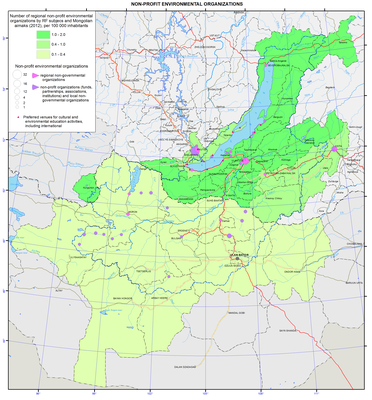
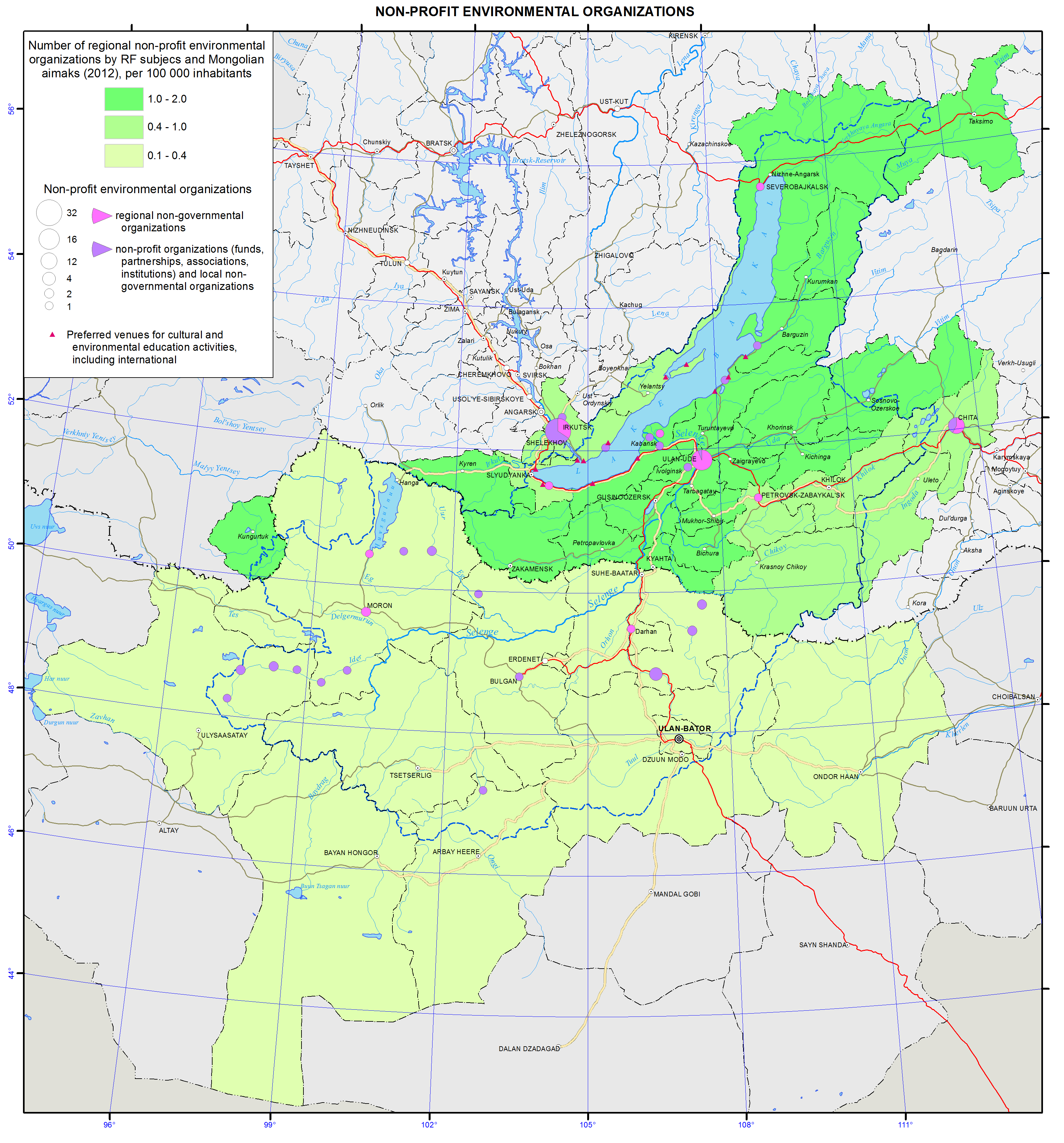
<p>The environmental well-being of the Baikal basin is largely determined by the activities of environmental non-governmental organizations (eco-NGOs). The main purpose of eco-NGOs is to protect nature. They see the foundation for sustainable development of society in nature preservation. Their effectiveness is determined by personal qualities and civic engagement of their activists and, especially, their leaders.</p>
<p>The number of eco-NGOs significantly increased in the 1990s, which was determined by state reforms in Russia and Mongolia and the growing interests of citizens towards the state of the environment.</p>
<p>Eco-NGOs operating in the Baikal basin differ by their territorial status (international, national, inter-regional, regional and local) and organizational and legal forms (community associations: community-based organizations, community-based foundations, community-based institutions, and community movements; nonprofit organizations: autonomous nonprofits, nonprofit foundations, nonprofit partnerships, associations (unions, alliances) of legal persons, and nonprofit institutions).</p>
<p>In Mongolia, the creation of eco-NGOs is mainly associated with the efforts to protect the Selenga and its tributaries from negative impacts of mining, construction of hydro-power plants, and the transfer of the Orkhon water to arid areas of the Gobi desert. Eco-NGOs are also created in all river basins, where open-pit mining operations are active. The largest community associations are the “United Movement of Rivers and Lakes of Mongolia” and “Nature Protection Coalition of Mongolia”. Eco-NGO campaigns usually involve 300-8,000 people.</p>
<p>In the Russian part of the Baikal basin, the organizations defining community-based environmental activities aimed to protect Lake Baikal are the community-based organization “All-Russian Nature Conservation Society” and the public organization “Russian Geographical Society”. Branches of these organizations are located in all the regions of the Baikal basin. In 2012, among the participants of the project initiated by the All-Russian Nature Conservation Society and entitled "Clean Waters of the Baikal Region" were over 60 environmental organizations created at educational institutions of 23 districts of Irkutsk oblast. Members of the Russian Geographical Society include both private individuals and legal persons. A widely known member of the Russian Geographical Society is the “Fund for Protection of Lake Baikal” established by Metropol Group of Companies. A lot of work is done by the nonprofit organization "WWF - Russia" and other all-Russian organization.</p>
<p>As of the beginning of 2013, the total number of registered eco-NGOs in Buryatia, Zabaikalsky krai and Irkutsk oblast was about 100 organizations. The overwhelming majority of them are community associations and community-based organizations.</p>
<p>In Buryatia, the most famous eco-NGOs include regional community associations "The Buryat Regional Association on Baikal", "Baikal Information Center Gran", "Baikal-Eco", "Ecological Association LAT", "Ecological and Humanitarian Center ETNA", "Ecological center The Planet and Delta", "Ecoleague", nonprofit partnership "The Great Baikal Trail - Buryatia", and a local environmental NGO "Turka". In Irkutsk oblast, they include regional nonprofit organizations "Baikal Environmental Wave" (BEW), "The Baikal Ecological Network Association", "Baikal Environmental Patrol", Inter-regional community-based organization "The Great Baikal Trail", private non-state research institution "The Baikal Center of Field Studies “Wildlife of Asia”, nonprofit partnership "Protecting Baikal Together", and the Irkutsk city community organization "Children’s Ecological Union". In Zabaikalsky krai, there is a regional public institution “Public Environmental Center “Dauria”. There are also many other successful organizations.</p>
<p>Regional and local eco-NGOs actively attract volunteers from different countries to implement their projects, so quite often these projects become international.</p>
<p>Information about the work of the most active eco-NGOs operating in the Russian part of the Baikal basin is provided in public reports on the state of Lake Baikal and governmental reports on the state and protection of the environment in Buryatia, Zabaikalsky krai and Irkutsk oblast. Brief descriptions about them in the form of short essays are also presented in the reference book entitled “The White Book”, prepared by the eco-NGO “Ecoleague” and published in 2010.</p>
<p>Among the organizations whose head-quarters are located outside of Russia and Mongolia, the Russian branch of the international non-governmental non-profit organization Greenpeace conducts a very active work on Lake Baikal.</p>
<p>In the Baikal basin, eco-NGOs conduct research, educational, and outreach activities among the population, boost its environmental activity, and involve local communities in the decision-making process. They organize community oversight and participate in the preparation and discussion of laws aimed at optimizing natural resources management. They take part in public hearings on the development of deposits and construction of industrial facilities and participate in the creation of protected areas. They also develop eco-tourism, conduct cleaning works on the lake’s shores and other activities, including the "Days of Baikal". Often, eco-NGOs receive federal or regional funding by winning competitions of socially-oriented projects.</p>
<p>Eco-NGOs help unite the efforts of government, science, business, and society in finding solutions of environmental problems. They become members of public environmental councils in the regions and conduct conferences, round tables, telethons, presentations, seminars, courses, summer schools, etc. In 2013, BEW conducted an international conference in Irkutsk and Listvyanka ("Rivers of Siberia and the Far East",). Also in 2013, the Russian Society for Ecological Economics jointly with the Irkutsk branches of the Russian Geographical Society and All-Russian Nature Conservation Society conducted a conference in Irkutsk entitled “The management of ecological and economic systems: Interaction of government, business, science, and society”.</p>
<p>The creation of eco-NGOs’ coalitions and international cooperation is extremely important for reaching the goals of sustainable development of the regions. It determined the creation of a network of eco-NGOs in Buryatia and Mongolia called "Friends of Baikal" and a long-term cooperation with the US organization "Tahoe-Baikal Institute" to share best practices in natural resources management in the watershed basins of Lake Baikal, Tahoe, Khovsgol, and the Great Lakes. Other joint projects promoting sustainable development of communities of different levels are also being implemented.</p>
<p>It is mostly due to the work of eco-NGOs that Lake Baikal was inscribed on the list of World Heritage Sites, the Baikal Natural Territory was zoned, over 700 kilometers of trails were built, and the operation of several environmentally hazardous production facilities, including the Baikalsk Pulp and Paper Mill, was stopped. On the site of this Pulp and Paper Mill, in December 2013, Russian government decided to create a nature protection complex, which will include a museum and exhibition, as well as information and educational facilities. In order to manage this complex, the government jointly with the Charitable Foundation for Environmental Protection "Green Future" (NF, Moscow) created ANO “Expocenter “Reserves of Russia””. Often, the results of the work of eco-NGOs become the foundation of major federal and regional programs.</p>]]></content:encoded>
    <dc:publisher>No publisher</dc:publisher>
    <dc:creator>Alexander Ayurzhanaev</dc:creator>
    <dc:rights></dc:rights>
    <dc:date>2014-10-14T08:10:00Z</dc:date>
    <dc:type>Page</dc:type>
  </item>


  <item rdf:about="http://bic.iwlearn.org/en/atlas/atlas/125-non-profit-environmental-organizations-map">
    <title>125. Non-profit environmental organizations map</title>
    <link>http://bic.iwlearn.org/en/atlas/atlas/125-non-profit-environmental-organizations-map</link>
    <description></description>
    
    <dc:publisher>No publisher</dc:publisher>
    <dc:creator>Alexander Ayurzhanaev</dc:creator>
    <dc:rights></dc:rights>
    <dc:date>2014-10-14T08:06:42Z</dc:date>
    <dc:type>Folder</dc:type>
  </item>


  <item rdf:about="http://bic.iwlearn.org/en/atlas/atlas/123-rare-animals-distribution-map">
    <title>123. Rare animals distribution. Birds. Coraciiformes, piciformes, passeriformes map</title>
    <link>http://bic.iwlearn.org/en/atlas/atlas/123-rare-animals-distribution-map</link>
    <description></description>
    
    <dc:publisher>No publisher</dc:publisher>
    <dc:creator>Alexander Ayurzhanaev</dc:creator>
    <dc:rights></dc:rights>
    <dc:date>2014-10-14T07:25:00Z</dc:date>
    <dc:type>Folder</dc:type>
  </item>


  <item rdf:about="http://bic.iwlearn.org/en/atlas/atlas/123-rare-animals-distribution-map/copy_of_rare-animals-distribution-map">
    <title>Rare animals distribution. Birds. Coraciiformes, piciformes, passeriformes map</title>
    <link>http://bic.iwlearn.org/en/atlas/atlas/123-rare-animals-distribution-map/copy_of_rare-animals-distribution-map</link>
    <description></description>
    <content:encoded xmlns:content="http://purl.org/rss/1.0/modules/content/"><![CDATA[<p><img class="image-inline" src="../../../resolveuid/476571550438466daf41c1939f618c2f/@@images/image/preview" /></p>
<p><a href="http://bic.iwlearn.org/en/atlas/photos/copy_of__123Rareanimalsdistribution.png" class="internal-link">Open full size</a></p>
<p align="center"><strong>Rare species of fauna</strong></p>
<p align="center"><strong> </strong></p>
<p>The animal kingdom of the Baikal basin is rich and diverse. The basin’s fauna is unique due to a peculiar geographic location of this region, which explains the extreme diversity of the species composition including many genetically and environmentally heterogeneous elements. In this region, the contact and overlapping of many systemically and ecologically close species and subspecies take place. A large number of forms is represented by the periphery and even isolated populations preserved in the local refugiums since the last glacial period. As a rule, all these species are relatively rare and small in number, and their habitats cover a small territory. Therefore, all of them have been listed in the Red Books and require special protection.</p>
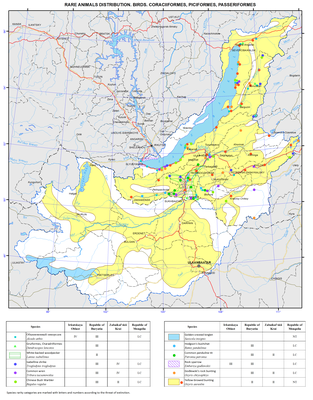
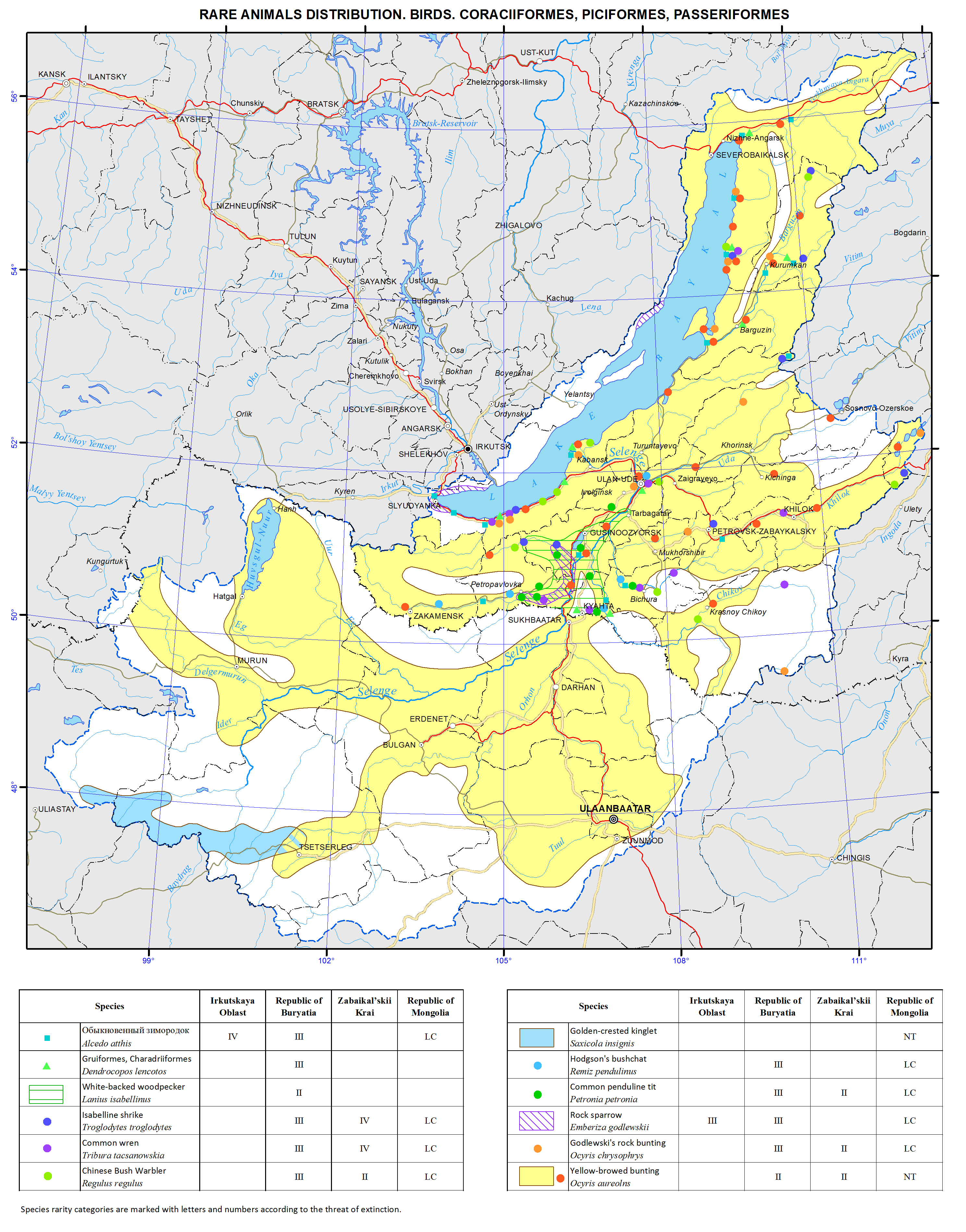
<p class="a">A series of maps of this section provides an insight about the spread of rare species of animals grouped according to their systematic features into separate categories: fish, amphibians and reptiles, birds and mammals. The maps show the main habitats of rare species based on the literature and museum collection research, as well as personal observations of the authors. The maps also show home ranges of certain species.</p>
<p class="a">More than 60 species of fish live in rivers and water bodies of the Baikal basin with half of them being endemic or relict species. The indigenous ichthyofauna of the Baikal basin’s rivers and lakes formed on the basis of the species of the boreal piedmont, boreal lowland, and arctic freshwater complexes; only the Siberian sturgeon and tench are remnants of the ancient late Tertiary faunal complex. Species representing other faunal complexes got into these water bodies as a result of introduction or invasion. In Lake Baikal, the level of endemism reaches 55% of all fish species, which is indicative of the autochthonous nature of the formation of the nucleus of the lake’s ichthyofauna. Only 10 species of fish are found in Lake Khovsgol, with half of them being valuable commercial fishery species. More than a half of the fish species listed in the regional Red Books of the Russian Federation and Mongolia are valuable commercial fishery species. However, their number has been significantly reduced due to the intensive human economic activities over the past 100 years. Overfishing, construction of hydro-technical facilities, and water body pollution negatively impacted their population and resulted in the partial loss of habitat. Today, 15 fish species in the Baikal basin require protection and artificial breeding in order to restore their number.</p>
<p>The Baikal basin is characterized by a low diversity of species of the herpetofauna (altogether about 20 species) due to harsh weather conditions in the region and the history of faunal formation. On the other hand, the basin is a place of contact of the habitats of the Western and Eastern Palearctic species, while representatives of the Central Asian and Daur-Mongolian fauna are wedging in from the south. Half of the species inhabiting this area are located on the periphery of their habitats. Anthropogenic transformation of habitats, drainage and contamination of water bodies, frequent fires, high recreational stress, and extermination by humans decrease the number and fragment the habitats of many herpetofauna species. At present, four amphibian species and six reptile species need protection.</p>
<p>Peculiarity of natural landscapes, climatic and geomorphological conditions, and the historical process of the formation of the ornithofauna resulted in its species diversity. The nucleus of the structure of the population of the basin’s ornithofauna is composed by representatives of the Siberian, Mongolian, Chinese, European and Arctic types of fauna. Transpalearctic species also make up a sizable proportion. Species of the Tibetan and Mediterranean types of fauna make up only a small share of species. Modern ornithofauna of the Baikal basin includes over 400 species; about 100 of them need protection. Human economic activity ambiguously impacts the structure of the ornithofauna. Transformation of the environment as a result of logging, fires, overgrazing, or steppe ploughing may decrease the number of some species, but, on the other hand, it may expand the habitats or the number of other species. Stenobiontic species are affected by economic activity the most. Transformation of habitats, changes in the hydrological regime of certain rivers and Lake Baikal, poaching, logging, fires, and technogenic emissions, all against the backdrop of fluctuations of environmental and climatic conditions, result in the decrease of diversity and number of the majority of bird species.</p>
<p>The fauna of mammals is quite specific and diverse including over 90 species. Many of these species are located on the periphery of their ranges. The modern mammal fauna of the basin is represented by almost 20 faunulas, the largest of which in terms of the number of species are the following: the Holarctic arctic boreal, taiga Palearctic, western Palearctic taiga, Holarctic tundra and golets, steppe southern Palearctic, and Central Asian elements, as well as the East Asian and southern Palearctic flying mammals. A small number of species of the basin either acclimatized or followed the humans. Compared to other animals, mammals are more affected by the direct anthropogenic impact. Thus, the majority of mammals listed as rare species in the near past were or still are considered as game animals, but their population was sharply reduced due to unregulated hunting and poaching. It is not uncommon that the activities aimed at preventing zoonotic infectious diseases led to a sharp decrease of infection hosts – rodents. Logging, steppe ploughing, overgrazing, frequent fires, and the fragmentation of natural territories devastatingly impacted the majority of mammalian species inhabiting the Baikal basin. Therefore, over 30 species now require special protection and reproduction.</p>
<p>The Red Books of the Russian Federation (2008) and Mongolia (1997), as well as regional Red Books of Irkutsk oblast (2010), Republic of Buryatia (2013), and Zabaikalsky krai (2012) were created to protect rare and endangered species. The categories set forth in the Red Book of the Russian Federation (2008) were used as a basis for the development of the regional categories of rarity and the degree of endangerment. Minor amendments were introduced to reflect regional characteristics of the biota. In particular, two regional categories (VI) and (VII) were included due to geographic features of the Republic of Buryatia (location near state border, existence of major biogeographic boundaries and important migration routes, and so on). The categories of the IUCN were used for rare species of vertebrate animals in Mongolia.</p>
<p> </p>
<p align="center" class="3">References</p>
<p>The Red Book of Zabaikalsky krai: Animals. (2012). Novosibirsk: Novosibirsk Publishing. p 344.</p>
<p>The Red Book of Irkutsk oblast (2010). Irkutsk: Wind of Travel Publishing. p 480.</p>
<p>The Red Book of the Republic of Buryatia: Rare and endangered species of animals, plants, and mushrooms. (2013). Ulan-Ude: BSC SB RAS Publishing. p 688.</p>
<p>The Red Book of the Russian Federation: Animals. (2001). Moscow: Astrel. p 862.</p>
<p>Mongolian Red List of birds. (2006). Ulaanbaatar: ADMON Printing. p 1036.</p>
<p>Mongolian Red List of fish. (2006). Ulaanbaatar: ADMON Printing. p 68.</p>
<p>Mongolian Red List of mammals. (2006). Ulaanbaatar: ADMON Printing. p 96.</p>
<p>Mongolian Red List of reptiles and amphibians. (2006). Ulaanbaatar: ADMON Printing. p 68.</p>]]></content:encoded>
    <dc:publisher>No publisher</dc:publisher>
    <dc:creator>Alexander Ayurzhanaev</dc:creator>
    <dc:rights></dc:rights>
    <dc:date>2014-10-14T07:25:00Z</dc:date>
    <dc:type>Page</dc:type>
  </item>


</rdf:RDF>