<?xml version="1.0" encoding="utf-8" ?>
<rdf:RDF xmlns:rdf="http://www.w3.org/1999/02/22-rdf-syntax-ns#" xmlns:dc="http://purl.org/dc/elements/1.1/" xmlns:syn="http://purl.org/rss/1.0/modules/syndication/" xmlns="http://purl.org/rss/1.0/">


<channel rdf:about="http://bic.iwlearn.org/en/search_rss">
  <title>English</title>
  <link>http://bic.iwlearn.org</link>

  <description>
    
            These are the search results for the query, showing results 71 to 85.
        
  </description>


  <image rdf:resource="http://bic.iwlearn.org/logo.png"/>

  <items>
    <rdf:Seq>
      
        <rdf:li rdf:resource="http://bic.iwlearn.org/en/atlas/atlas/120-rare-animals-distribution-map/rare-animals-distribution-map"/>
      
      
        <rdf:li rdf:resource="http://bic.iwlearn.org/en/atlas/atlas/119-distribution-of-rare-animal-species-map/distribution-of-rare-animal-species-map"/>
      
      
        <rdf:li rdf:resource="http://bic.iwlearn.org/en/atlas/atlas/118-distribution-of-rare-animal-species-map/distribution-of-rare-animal-species-map"/>
      
      
        <rdf:li rdf:resource="http://bic.iwlearn.org/en/atlas/atlas/119-distribution-of-rare-animal-species-map"/>
      
      
        <rdf:li rdf:resource="http://bic.iwlearn.org/en/atlas/atlas/118-distribution-of-rare-animal-species-map"/>
      
      
        <rdf:li rdf:resource="http://bic.iwlearn.org/en/atlas/atlas/117-distribution-of-rare-animal-species-map/distribution-of-rare-animal-species-map"/>
      
      
        <rdf:li rdf:resource="http://bic.iwlearn.org/en/atlas/atlas/117-distribution-of-rare-animal-species-map"/>
      
      
        <rdf:li rdf:resource="http://bic.iwlearn.org/en/atlas/atlas/116-endangered-vegetation-communities-map/endangered-vegetation-communities-map"/>
      
      
        <rdf:li rdf:resource="http://bic.iwlearn.org/en/atlas/atlas/115-rare-species-of-vascular-plants-of-regional-conservation-map/rare-species-of-vascular-plants-of-regional-conservation-map"/>
      
      
        <rdf:li rdf:resource="http://bic.iwlearn.org/en/atlas/atlas/114-rare-species-of-vascular-plants-map/rare-species-of-vascular-plants-map"/>
      
      
        <rdf:li rdf:resource="http://bic.iwlearn.org/en/atlas/atlas/113-recommended-landscape-use-provisions-of-the-lake-baikal-basin-map/recommended-landscape-use-provisions-of-the-lake-baikal-basin-map"/>
      
      
        <rdf:li rdf:resource="http://bic.iwlearn.org/en/atlas/atlas/112-environmental-protection-infrastructure-map/environmental-protection-infrastructure-map"/>
      
      
        <rdf:li rdf:resource="http://bic.iwlearn.org/en/atlas/atlas/111-working-age-population-disability-map/working-age-population-disability-map"/>
      
      
        <rdf:li rdf:resource="http://bic.iwlearn.org/en/atlas/atlas/109-adult-population-disability-map/adult-population-disability-map"/>
      
      
        <rdf:li rdf:resource="http://bic.iwlearn.org/en/atlas/atlas/110-child-population-disability-map/child-population-disability-map"/>
      
    </rdf:Seq>
  </items>

</channel>


  <item rdf:about="http://bic.iwlearn.org/en/atlas/atlas/120-rare-animals-distribution-map/rare-animals-distribution-map">
    <title>Rare animals distribution. Birds. Pelecaniformes, ciconiiformes, anseriformes map</title>
    <link>http://bic.iwlearn.org/en/atlas/atlas/120-rare-animals-distribution-map/rare-animals-distribution-map</link>
    <description></description>
    <content:encoded xmlns:content="http://purl.org/rss/1.0/modules/content/"><![CDATA[<p><img class="image-inline" src="../../../resolveuid/fe83558d833347a4a4543be7f1083239/@@images/image/preview" /></p>
<p><a href="http://bic.iwlearn.org/en/atlas/photos/copy_of__120_Rareanimalsdistribution.png" class="internal-link">Open full size</a></p>
<p align="center"><strong>Rare species of fauna</strong></p>
<p align="center"><strong> </strong></p>
<p>The animal kingdom of the Baikal basin is rich and diverse. The basin’s fauna is unique due to a peculiar geographic location of this region, which explains the extreme diversity of the species composition including many genetically and environmentally heterogeneous elements. In this region, the contact and overlapping of many systemically and ecologically close species and subspecies take place. A large number of forms is represented by the periphery and even isolated populations preserved in the local refugiums since the last glacial period. As a rule, all these species are relatively rare and small in number, and their habitats cover a small territory. Therefore, all of them have been listed in the Red Books and require special protection.</p>
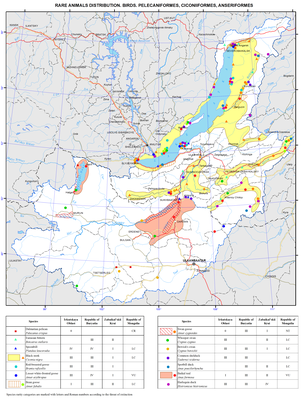
<p class="a">A series of maps of this section provides an insight about the spread of rare species of animals grouped according to their systematic features into separate categories: fish, amphibians and reptiles, birds and mammals. The maps show the main habitats of rare species based on the literature and museum collection research, as well as personal observations of the authors. The maps also show home ranges of certain species.</p>
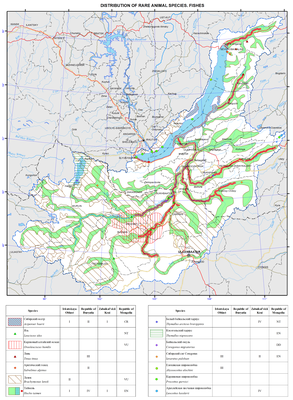
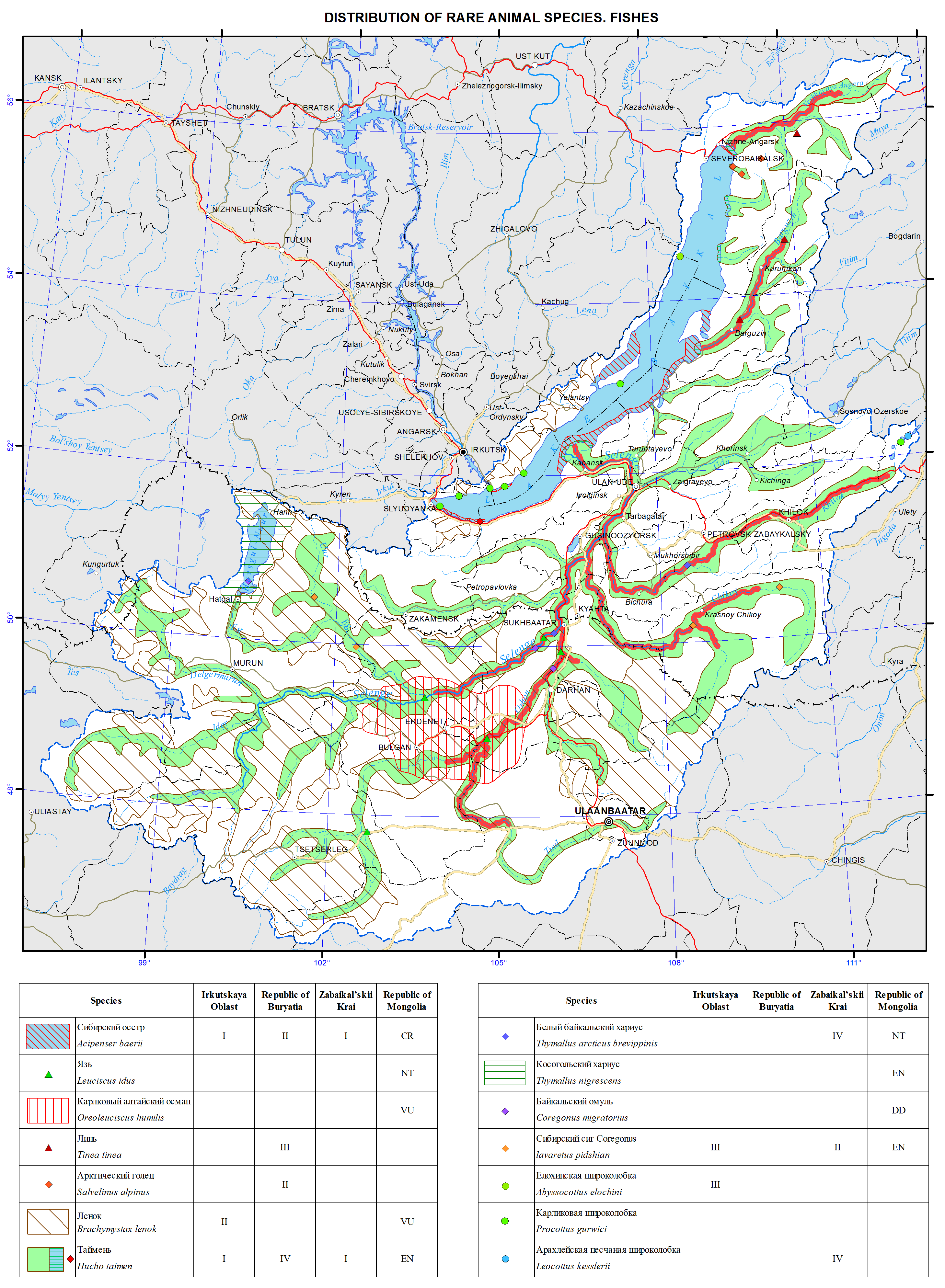
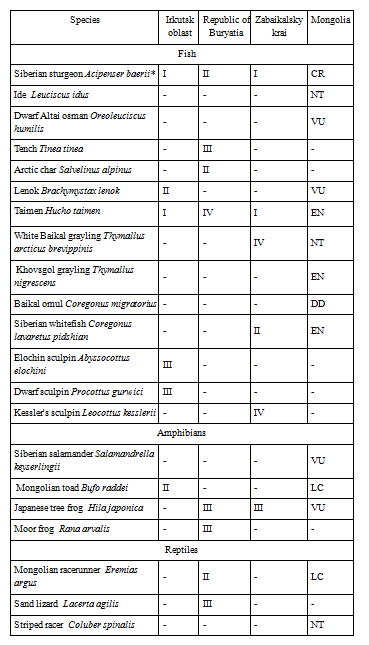
<p class="a">More than 60 species of fish live in rivers and water bodies of the Baikal basin with half of them being endemic or relict species. The indigenous ichthyofauna of the Baikal basin’s rivers and lakes formed on the basis of the species of the boreal piedmont, boreal lowland, and arctic freshwater complexes; only the Siberian sturgeon and tench are remnants of the ancient late Tertiary faunal complex. Species representing other faunal complexes got into these water bodies as a result of introduction or invasion. In Lake Baikal, the level of endemism reaches 55% of all fish species, which is indicative of the autochthonous nature of the formation of the nucleus of the lake’s ichthyofauna. Only 10 species of fish are found in Lake Khovsgol, with half of them being valuable commercial fishery species. More than a half of the fish species listed in the regional Red Books of the Russian Federation and Mongolia are valuable commercial fishery species. However, their number has been significantly reduced due to the intensive human economic activities over the past 100 years. Overfishing, construction of hydro-technical facilities, and water body pollution negatively impacted their population and resulted in the partial loss of habitat. Today, 15 fish species in the Baikal basin require protection and artificial breeding in order to restore their number.</p>
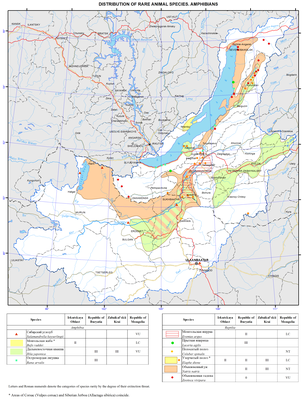
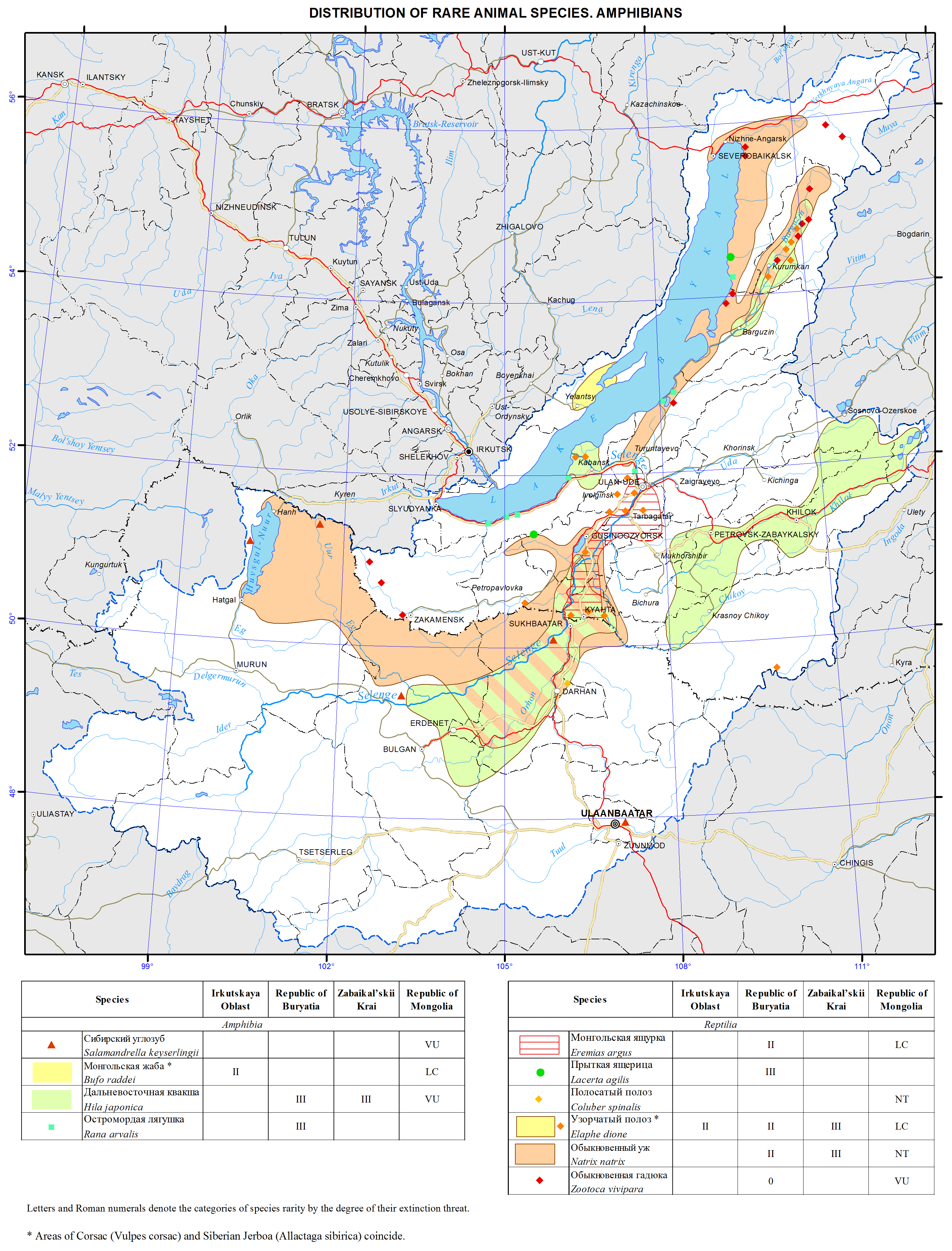
<p>The Baikal basin is characterized by a low diversity of species of the herpetofauna (altogether about 20 species) due to harsh weather conditions in the region and the history of faunal formation. On the other hand, the basin is a place of contact of the habitats of the Western and Eastern Palearctic species, while representatives of the Central Asian and Daur-Mongolian fauna are wedging in from the south. Half of the species inhabiting this area are located on the periphery of their habitats. Anthropogenic transformation of habitats, drainage and contamination of water bodies, frequent fires, high recreational stress, and extermination by humans decrease the number and fragment the habitats of many herpetofauna species. At present, four amphibian species and six reptile species need protection.</p>
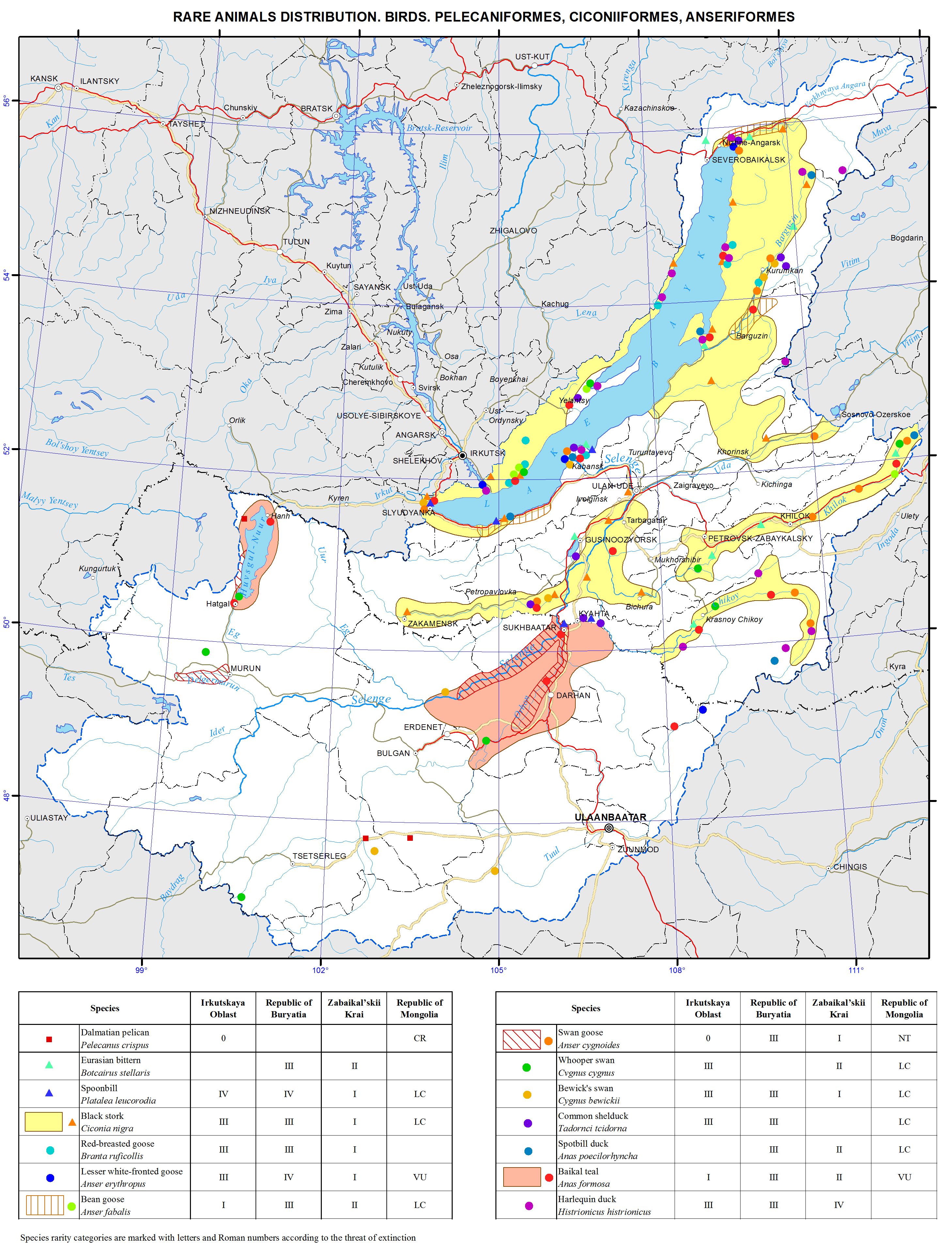
<p>Peculiarity of natural landscapes, climatic and geomorphological conditions, and the historical process of the formation of the ornithofauna resulted in its species diversity. The nucleus of the structure of the population of the basin’s ornithofauna is composed by representatives of the Siberian, Mongolian, Chinese, European and Arctic types of fauna. Transpalearctic species also make up a sizable proportion. Species of the Tibetan and Mediterranean types of fauna make up only a small share of species. Modern ornithofauna of the Baikal basin includes over 400 species; about 100 of them need protection. Human economic activity ambiguously impacts the structure of the ornithofauna. Transformation of the environment as a result of logging, fires, overgrazing, or steppe ploughing may decrease the number of some species, but, on the other hand, it may expand the habitats or the number of other species. Stenobiontic species are affected by economic activity the most. Transformation of habitats, changes in the hydrological regime of certain rivers and Lake Baikal, poaching, logging, fires, and technogenic emissions, all against the backdrop of fluctuations of environmental and climatic conditions, result in the decrease of diversity and number of the majority of bird species.</p>
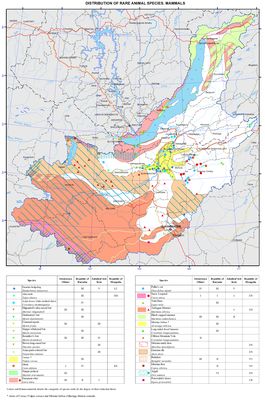
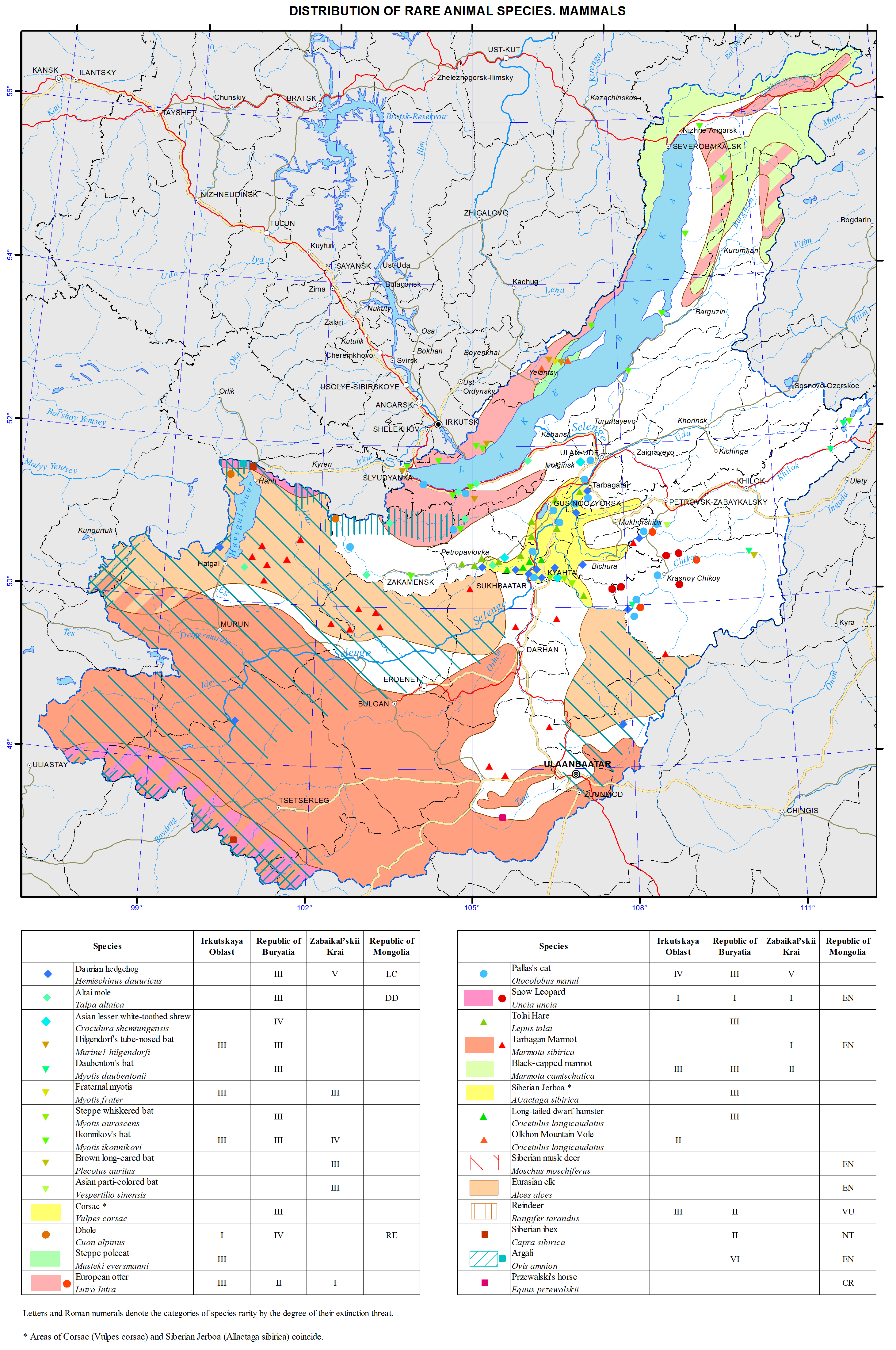
<p>The fauna of mammals is quite specific and diverse including over 90 species. Many of these species are located on the periphery of their ranges. The modern mammal fauna of the basin is represented by almost 20 faunulas, the largest of which in terms of the number of species are the following: the Holarctic arctic boreal, taiga Palearctic, western Palearctic taiga, Holarctic tundra and golets, steppe southern Palearctic, and Central Asian elements, as well as the East Asian and southern Palearctic flying mammals. A small number of species of the basin either acclimatized or followed the humans. Compared to other animals, mammals are more affected by the direct anthropogenic impact. Thus, the majority of mammals listed as rare species in the near past were or still are considered as game animals, but their population was sharply reduced due to unregulated hunting and poaching. It is not uncommon that the activities aimed at preventing zoonotic infectious diseases led to a sharp decrease of infection hosts – rodents. Logging, steppe ploughing, overgrazing, frequent fires, and the fragmentation of natural territories devastatingly impacted the majority of mammalian species inhabiting the Baikal basin. Therefore, over 30 species now require special protection and reproduction.<span> </span></p>
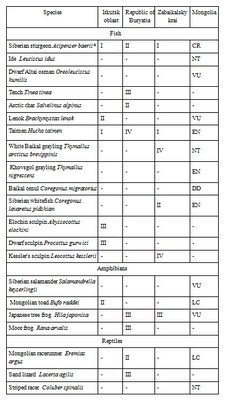
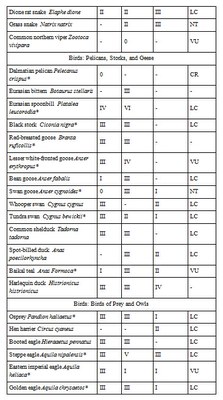
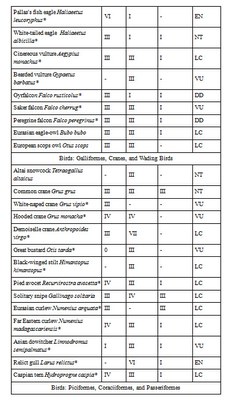
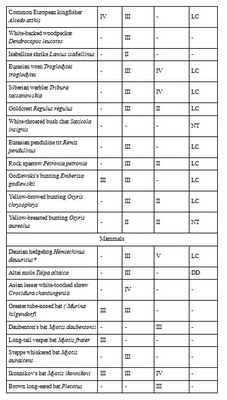
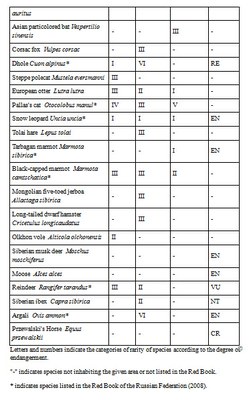
<p>The Red Books of the Russian Federation (2008) and Mongolia (1997), as well as regional Red Books of Irkutsk oblast (2010), Republic of Buryatia (2013), and Zabaikalsky krai (2012) were created to protect rare and endangered species. The categories set forth in the Red Book of the Russian Federation (2008) were used as a basis for the development of the regional categories of rarity and the degree of endangerment. Minor amendments were introduced to reflect regional characteristics of the biota. In particular, two regional categories (VI) and (VII) were included due to geographic features of the Republic of Buryatia (location near state border, existence of major biogeographic boundaries and important migration routes, and so on). The categories of the IUCN were used for rare species of vertebrate animals in Mongolia.</p>
<p> </p>
<p align="center" class="3">References</p>
<p>The Red Book of Zabaikalsky krai: Animals. (2012). Novosibirsk: Novosibirsk Publishing. p 344.</p>
<p>The Red Book of Irkutsk oblast (2010). Irkutsk: Wind of Travel Publishing. p 480.</p>
<p>The Red Book of the Republic of Buryatia: Rare and endangered species of animals, plants, and mushrooms. (2013). Ulan-Ude: BSC SB RAS Publishing. p 688.</p>
<p>The Red Book of the Russian Federation: Animals. (2001). Moscow: Astrel. p 862.</p>
<p>Mongolian Red List of birds. (2006). Ulaanbaatar: ADMON Printing. p 1036.</p>
<p>Mongolian Red List of fish. (2006). Ulaanbaatar: ADMON Printing. p 68.</p>
<p>Mongolian Red List of mammals. (2006). Ulaanbaatar: ADMON Printing. p 96.</p>
<p>Mongolian Red List of reptiles and amphibians. (2006). Ulaanbaatar: ADMON Printing. p 68.</p>]]></content:encoded>
    <dc:publisher>No publisher</dc:publisher>
    <dc:creator>Alexander Ayurzhanaev</dc:creator>
    <dc:rights></dc:rights>
    <dc:date>2014-10-14T07:05:00Z</dc:date>
    <dc:type>Page</dc:type>
  </item>


  <item rdf:about="http://bic.iwlearn.org/en/atlas/atlas/119-distribution-of-rare-animal-species-map/distribution-of-rare-animal-species-map">
    <title>Distribution of rare animal species. Fishes map</title>
    <link>http://bic.iwlearn.org/en/atlas/atlas/119-distribution-of-rare-animal-species-map/distribution-of-rare-animal-species-map</link>
    <description></description>
    <content:encoded xmlns:content="http://purl.org/rss/1.0/modules/content/"><![CDATA[<p><img class="image-inline" src="../../../resolveuid/358bc999a3ea401598cde02ab4006aa9/@@images/image/preview" /></p>
<p><a href="http://bic.iwlearn.org/en/atlas/photos/copy_of__119_Distributionofrareanimalspecies.png" class="internal-link">Open full size</a></p>
<p align="center"><strong>Rare species of fauna</strong></p>
<p align="center"><strong> </strong></p>
<p>The animal kingdom of the Baikal basin is rich and diverse. The basin’s fauna is unique due to a peculiar geographic location of this region, which explains the extreme diversity of the species composition including many genetically and environmentally heterogeneous elements. In this region, the contact and overlapping of many systemically and ecologically close species and subspecies take place. A large number of forms is represented by the periphery and even isolated populations preserved in the local refugiums since the last glacial period. As a rule, all these species are relatively rare and small in number, and their habitats cover a small territory. Therefore, all of them have been listed in the Red Books and require special protection.</p>
<p class="a">A series of maps of this section provides an insight about the spread of rare species of animals grouped according to their systematic features into separate categories: fish, amphibians and reptiles, birds and mammals. The maps show the main habitats of rare species based on the literature and museum collection research, as well as personal observations of the authors. The maps also show home ranges of certain species.</p>
<p class="a">More than 60 species of fish live in rivers and water bodies of the Baikal basin with half of them being endemic or relict species. The indigenous ichthyofauna of the Baikal basin’s rivers and lakes formed on the basis of the species of the boreal piedmont, boreal lowland, and arctic freshwater complexes; only the Siberian sturgeon and tench are remnants of the ancient late Tertiary faunal complex. Species representing other faunal complexes got into these water bodies as a result of introduction or invasion. In Lake Baikal, the level of endemism reaches 55% of all fish species, which is indicative of the autochthonous nature of the formation of the nucleus of the lake’s ichthyofauna. Only 10 species of fish are found in Lake Khovsgol, with half of them being valuable commercial fishery species. More than a half of the fish species listed in the regional Red Books of the Russian Federation and Mongolia are valuable commercial fishery species. However, their number has been significantly reduced due to the intensive human economic activities over the past 100 years. Overfishing, construction of hydro-technical facilities, and water body pollution negatively impacted their population and resulted in the partial loss of habitat. Today, 15 fish species in the Baikal basin require protection and artificial breeding in order to restore their number.</p>
<p>The Baikal basin is characterized by a low diversity of species of the herpetofauna (altogether about 20 species) due to harsh weather conditions in the region and the history of faunal formation. On the other hand, the basin is a place of contact of the habitats of the Western and Eastern Palearctic species, while representatives of the Central Asian and Daur-Mongolian fauna are wedging in from the south. Half of the species inhabiting this area are located on the periphery of their habitats. Anthropogenic transformation of habitats, drainage and contamination of water bodies, frequent fires, high recreational stress, and extermination by humans decrease the number and fragment the habitats of many herpetofauna species. At present, four amphibian species and six reptile species need protection.</p>
<p>Peculiarity of natural landscapes, climatic and geomorphological conditions, and the historical process of the formation of the ornithofauna resulted in its species diversity. The nucleus of the structure of the population of the basin’s ornithofauna is composed by representatives of the Siberian, Mongolian, Chinese, European and Arctic types of fauna. Transpalearctic species also make up a sizable proportion. Species of the Tibetan and Mediterranean types of fauna make up only a small share of species. Modern ornithofauna of the Baikal basin includes over 400 species; about 100 of them need protection. Human economic activity ambiguously impacts the structure of the ornithofauna. Transformation of the environment as a result of logging, fires, overgrazing, or steppe ploughing may decrease the number of some species, but, on the other hand, it may expand the habitats or the number of other species. Stenobiontic species are affected by economic activity the most. Transformation of habitats, changes in the hydrological regime of certain rivers and Lake Baikal, poaching, logging, fires, and technogenic emissions, all against the backdrop of fluctuations of environmental and climatic conditions, result in the decrease of diversity and number of the majority of bird species.</p>
<p>The fauna of mammals is quite specific and diverse including over 90 species. Many of these species are located on the periphery of their ranges. The modern mammal fauna of the basin is represented by almost 20 faunulas, the largest of which in terms of the number of species are the following: the Holarctic arctic boreal, taiga Palearctic, western Palearctic taiga, Holarctic tundra and golets, steppe southern Palearctic, and Central Asian elements, as well as the East Asian and southern Palearctic flying mammals. A small number of species of the basin either acclimatized or followed the humans. Compared to other animals, mammals are more affected by the direct anthropogenic impact. Thus, the majority of mammals listed as rare species in the near past were or still are considered as game animals, but their population was sharply reduced due to unregulated hunting and poaching. It is not uncommon that the activities aimed at preventing zoonotic infectious diseases led to a sharp decrease of infection hosts – rodents. Logging, steppe ploughing, overgrazing, frequent fires, and the fragmentation of natural territories devastatingly impacted the majority of mammalian species inhabiting the Baikal basin. Therefore, over 30 species now require special protection and reproduction.</p>
<p>The Red Books of the Russian Federation (2008) and Mongolia (1997), as well as regional Red Books of Irkutsk oblast (2010), Republic of Buryatia (2013), and Zabaikalsky krai (2012) were created to protect rare and endangered species. The categories set forth in the Red Book of the Russian Federation (2008) were used as a basis for the development of the regional categories of rarity and the degree of endangerment. Minor amendments were introduced to reflect regional characteristics of the biota. In particular, two regional categories (VI) and (VII) were included due to geographic features of the Republic of Buryatia (location near state border, existence of major biogeographic boundaries and important migration routes, and so on). The categories of the IUCN were used for rare species of vertebrate animals in Mongolia.</p>
<p> </p>
<p align="center" class="3">References</p>
<p>The Red Book of Zabaikalsky krai: Animals. (2012). Novosibirsk: Novosibirsk Publishing. p 344.</p>
<p>The Red Book of Irkutsk oblast (2010). Irkutsk: Wind of Travel Publishing. p 480.</p>
<p>The Red Book of the Republic of Buryatia: Rare and endangered species of animals, plants, and mushrooms. (2013). Ulan-Ude: BSC SB RAS Publishing. p 688.</p>
<p>The Red Book of the Russian Federation: Animals. (2001). Moscow: Astrel. p 862.</p>
<p>Mongolian Red List of birds. (2006). Ulaanbaatar: ADMON Printing. p 1036.</p>
<p>Mongolian Red List of fish. (2006). Ulaanbaatar: ADMON Printing. p 68.</p>
<p>Mongolian Red List of mammals. (2006). Ulaanbaatar: ADMON Printing. p 96.</p>
<p>Mongolian Red List of reptiles and amphibians. (2006). Ulaanbaatar: ADMON Printing. p 68.</p>]]></content:encoded>
    <dc:publisher>No publisher</dc:publisher>
    <dc:creator>Alexander Ayurzhanaev</dc:creator>
    <dc:rights></dc:rights>
    <dc:date>2014-10-14T06:55:00Z</dc:date>
    <dc:type>Page</dc:type>
  </item>


  <item rdf:about="http://bic.iwlearn.org/en/atlas/atlas/118-distribution-of-rare-animal-species-map/distribution-of-rare-animal-species-map">
    <title>Distribution of rare animal species. Amphibians map</title>
    <link>http://bic.iwlearn.org/en/atlas/atlas/118-distribution-of-rare-animal-species-map/distribution-of-rare-animal-species-map</link>
    <description></description>
    <content:encoded xmlns:content="http://purl.org/rss/1.0/modules/content/"><![CDATA[<p><img class="image-inline" src="../../../resolveuid/a3505ea8dec34ce3995f73e4f52423d8/@@images/image/preview" /></p>
<p><a href="http://bic.iwlearn.org/en/atlas/photos/copy_of__118Distributionofrareanimalspecies.png" class="internal-link">Open full size</a></p>
<p align="center"><strong>Rare species of fauna</strong></p>
<p align="center"><strong> </strong></p>
<p>The animal kingdom of the Baikal basin is rich and diverse. The basin’s fauna is unique due to a peculiar geographic location of this region, which explains the extreme diversity of the species composition including many genetically and environmentally heterogeneous elements. In this region, the contact and overlapping of many systemically and ecologically close species and subspecies take place. A large number of forms is represented by the periphery and even isolated populations preserved in the local refugiums since the last glacial period. As a rule, all these species are relatively rare and small in number, and their habitats cover a small territory. Therefore, all of them have been listed in the Red Books and require special protection.</p>
<p class="a">A series of maps of this section provides an insight about the spread of rare species of animals grouped according to their systematic features into separate categories: fish, amphibians and reptiles, birds and mammals. The maps show the main habitats of rare species based on the literature and museum collection research, as well as personal observations of the authors. The maps also show home ranges of certain species.</p>
<p class="a">More than 60 species of fish live in rivers and water bodies of the Baikal basin with half of them being endemic or relict species. The indigenous ichthyofauna of the Baikal basin’s rivers and lakes formed on the basis of the species of the boreal piedmont, boreal lowland, and arctic freshwater complexes; only the Siberian sturgeon and tench are remnants of the ancient late Tertiary faunal complex. Species representing other faunal complexes got into these water bodies as a result of introduction or invasion. In Lake Baikal, the level of endemism reaches 55% of all fish species, which is indicative of the autochthonous nature of the formation of the nucleus of the lake’s ichthyofauna. Only 10 species of fish are found in Lake Khovsgol, with half of them being valuable commercial fishery species. More than a half of the fish species listed in the regional Red Books of the Russian Federation and Mongolia are valuable commercial fishery species. However, their number has been significantly reduced due to the intensive human economic activities over the past 100 years. Overfishing, construction of hydro-technical facilities, and water body pollution negatively impacted their population and resulted in the partial loss of habitat. Today, 15 fish species in the Baikal basin require protection and artificial breeding in order to restore their number.</p>
<p>The Baikal basin is characterized by a low diversity of species of the herpetofauna (altogether about 20 species) due to harsh weather conditions in the region and the history of faunal formation. On the other hand, the basin is a place of contact of the habitats of the Western and Eastern Palearctic species, while representatives of the Central Asian and Daur-Mongolian fauna are wedging in from the south. Half of the species inhabiting this area are located on the periphery of their habitats. Anthropogenic transformation of habitats, drainage and contamination of water bodies, frequent fires, high recreational stress, and extermination by humans decrease the number and fragment the habitats of many herpetofauna species. At present, four amphibian species and six reptile species need protection.</p>
<p>Peculiarity of natural landscapes, climatic and geomorphological conditions, and the historical process of the formation of the ornithofauna resulted in its species diversity. The nucleus of the structure of the population of the basin’s ornithofauna is composed by representatives of the Siberian, Mongolian, Chinese, European and Arctic types of fauna. Transpalearctic species also make up a sizable proportion. Species of the Tibetan and Mediterranean types of fauna make up only a small share of species. Modern ornithofauna of the Baikal basin includes over 400 species; about 100 of them need protection. Human economic activity ambiguously impacts the structure of the ornithofauna. Transformation of the environment as a result of logging, fires, overgrazing, or steppe ploughing may decrease the number of some species, but, on the other hand, it may expand the habitats or the number of other species. Stenobiontic species are affected by economic activity the most. Transformation of habitats, changes in the hydrological regime of certain rivers and Lake Baikal, poaching, logging, fires, and technogenic emissions, all against the backdrop of fluctuations of environmental and climatic conditions, result in the decrease of diversity and number of the majority of bird species.</p>
<p>The fauna of mammals is quite specific and diverse including over 90 species. Many of these species are located on the periphery of their ranges. The modern mammal fauna of the basin is represented by almost 20 faunulas, the largest of which in terms of the number of species are the following: the Holarctic arctic boreal, taiga Palearctic, western Palearctic taiga, Holarctic tundra and golets, steppe southern Palearctic, and Central Asian elements, as well as the East Asian and southern Palearctic flying mammals. A small number of species of the basin either acclimatized or followed the humans. Compared to other animals, mammals are more affected by the direct anthropogenic impact. Thus, the majority of mammals listed as rare species in the near past were or still are considered as game animals, but their population was sharply reduced due to unregulated hunting and poaching. It is not uncommon that the activities aimed at preventing zoonotic infectious diseases led to a sharp decrease of infection hosts – rodents. Logging, steppe ploughing, overgrazing, frequent fires, and the fragmentation of natural territories devastatingly impacted the majority of mammalian species inhabiting the Baikal basin. Therefore, over 30 species now require special protection and reproduction.</p>
<p>The Red Books of the Russian Federation (2008) and Mongolia (1997), as well as regional Red Books of Irkutsk oblast (2010), Republic of Buryatia (2013), and Zabaikalsky krai (2012) were created to protect rare and endangered species. The categories set forth in the Red Book of the Russian Federation (2008) were used as a basis for the development of the regional categories of rarity and the degree of endangerment. Minor amendments were introduced to reflect regional characteristics of the biota. In particular, two regional categories (VI) and (VII) were included due to geographic features of the Republic of Buryatia (location near state border, existence of major biogeographic boundaries and important migration routes, and so on). The categories of the IUCN were used for rare species of vertebrate animals in Mongolia.</p>
<p> </p>
<p align="center" class="3">References</p>
<p>The Red Book of Zabaikalsky krai: Animals. (2012). Novosibirsk: Novosibirsk Publishing. p 344.</p>
<p>The Red Book of Irkutsk oblast (2010). Irkutsk: Wind of Travel Publishing. p 480.</p>
<p>The Red Book of the Republic of Buryatia: Rare and endangered species of animals, plants, and mushrooms. (2013). Ulan-Ude: BSC SB RAS Publishing. p 688.</p>
<p>The Red Book of the Russian Federation: Animals. (2001). Moscow: Astrel. p 862.</p>
<p>Mongolian Red List of birds. (2006). Ulaanbaatar: ADMON Printing. p 1036.</p>
<p>Mongolian Red List of fish. (2006). Ulaanbaatar: ADMON Printing. p 68.</p>
<p>Mongolian Red List of mammals. (2006). Ulaanbaatar: ADMON Printing. p 96.</p>
<p>Mongolian Red List of reptiles and amphibians. (2006). Ulaanbaatar: ADMON Printing. p 68.</p>]]></content:encoded>
    <dc:publisher>No publisher</dc:publisher>
    <dc:creator>Alexander Ayurzhanaev</dc:creator>
    <dc:rights></dc:rights>
    <dc:date>2014-10-14T06:55:00Z</dc:date>
    <dc:type>Page</dc:type>
  </item>


  <item rdf:about="http://bic.iwlearn.org/en/atlas/atlas/119-distribution-of-rare-animal-species-map">
    <title>119. Distribution of rare animal species. Fishes map</title>
    <link>http://bic.iwlearn.org/en/atlas/atlas/119-distribution-of-rare-animal-species-map</link>
    <description></description>
    
    <dc:publisher>No publisher</dc:publisher>
    <dc:creator>Alexander Ayurzhanaev</dc:creator>
    <dc:rights></dc:rights>
    <dc:date>2014-10-14T06:55:00Z</dc:date>
    <dc:type>Folder</dc:type>
  </item>


  <item rdf:about="http://bic.iwlearn.org/en/atlas/atlas/118-distribution-of-rare-animal-species-map">
    <title>118. Distribution of rare animal species. Amphibians map</title>
    <link>http://bic.iwlearn.org/en/atlas/atlas/118-distribution-of-rare-animal-species-map</link>
    <description></description>
    
    <dc:publisher>No publisher</dc:publisher>
    <dc:creator>Alexander Ayurzhanaev</dc:creator>
    <dc:rights></dc:rights>
    <dc:date>2014-10-14T06:55:00Z</dc:date>
    <dc:type>Folder</dc:type>
  </item>


  <item rdf:about="http://bic.iwlearn.org/en/atlas/atlas/117-distribution-of-rare-animal-species-map/distribution-of-rare-animal-species-map">
    <title>Distribution of rare animal species. Mammals map</title>
    <link>http://bic.iwlearn.org/en/atlas/atlas/117-distribution-of-rare-animal-species-map/distribution-of-rare-animal-species-map</link>
    <description></description>
    <content:encoded xmlns:content="http://purl.org/rss/1.0/modules/content/"><![CDATA[<p><img class="image-inline" src="../../../resolveuid/c0c7643035c14784872a56082d55d1cc/@@images/image/preview" /></p>
<p><a href="http://bic.iwlearn.org/en/atlas/photos/copy_of__117_Distributionofrareanimalspecies.png" class="internal-link">Open full size</a></p>
<p align="center"><strong>Rare species of fauna</strong></p>
<p align="center"><strong> </strong></p>
<p>The animal kingdom of the Baikal basin is rich and diverse. The basin’s fauna is unique due to a peculiar geographic location of this region, which explains the extreme diversity of the species composition including many genetically and environmentally heterogeneous elements. In this region, the contact and overlapping of many systemically and ecologically close species and subspecies take place. A large number of forms is represented by the periphery and even isolated populations preserved in the local refugiums since the last glacial period. As a rule, all these species are relatively rare and small in number, and their habitats cover a small territory. Therefore, all of them have been listed in the Red Books and require special protection.</p>
<p class="a">A series of maps of this section provides an insight about the spread of rare species of animals grouped according to their systematic features into separate categories: fish, amphibians and reptiles, birds and mammals. The maps show the main habitats of rare species based on the literature and museum collection research, as well as personal observations of the authors. The maps also show home ranges of certain species.</p>
<p class="a">More than 60 species of fish live in rivers and water bodies of the Baikal basin with half of them being endemic or relict species. The indigenous ichthyofauna of the Baikal basin’s rivers and lakes formed on the basis of the species of the boreal piedmont, boreal lowland, and arctic freshwater complexes; only the Siberian sturgeon and tench are remnants of the ancient late Tertiary faunal complex. Species representing other faunal complexes got into these water bodies as a result of introduction or invasion. In Lake Baikal, the level of endemism reaches 55% of all fish species, which is indicative of the autochthonous nature of the formation of the nucleus of the lake’s ichthyofauna. Only 10 species of fish are found in Lake Khovsgol, with half of them being valuable commercial fishery species. More than a half of the fish species listed in the regional Red Books of the Russian Federation and Mongolia are valuable commercial fishery species. However, their number has been significantly reduced due to the intensive human economic activities over the past 100 years. Overfishing, construction of hydro-technical facilities, and water body pollution negatively impacted their population and resulted in the partial loss of habitat. Today, 15 fish species in the Baikal basin require protection and artificial breeding in order to restore their number.</p>
<p>The Baikal basin is characterized by a low diversity of species of the herpetofauna (altogether about 20 species) due to harsh weather conditions in the region and the history of faunal formation. On the other hand, the basin is a place of contact of the habitats of the Western and Eastern Palearctic species, while representatives of the Central Asian and Daur-Mongolian fauna are wedging in from the south. Half of the species inhabiting this area are located on the periphery of their habitats. Anthropogenic transformation of habitats, drainage and contamination of water bodies, frequent fires, high recreational stress, and extermination by humans decrease the number and fragment the habitats of many herpetofauna species. At present, four amphibian species and six reptile species need protection.</p>
<p>Peculiarity of natural landscapes, climatic and geomorphological conditions, and the historical process of the formation of the ornithofauna resulted in its species diversity. The nucleus of the structure of the population of the basin’s ornithofauna is composed by representatives of the Siberian, Mongolian, Chinese, European and Arctic types of fauna. Transpalearctic species also make up a sizable proportion. Species of the Tibetan and Mediterranean types of fauna make up only a small share of species. Modern ornithofauna of the Baikal basin includes over 400 species; about 100 of them need protection. Human economic activity ambiguously impacts the structure of the ornithofauna. Transformation of the environment as a result of logging, fires, overgrazing, or steppe ploughing may decrease the number of some species, but, on the other hand, it may expand the habitats or the number of other species. Stenobiontic species are affected by economic activity the most. Transformation of habitats, changes in the hydrological regime of certain rivers and Lake Baikal, poaching, logging, fires, and technogenic emissions, all against the backdrop of fluctuations of environmental and climatic conditions, result in the decrease of diversity and number of the majority of bird species.</p>
<p>The fauna of mammals is quite specific and diverse including over 90 species. Many of these species are located on the periphery of their ranges. The modern mammal fauna of the basin is represented by almost 20 faunulas, the largest of which in terms of the number of species are the following: the Holarctic arctic boreal, taiga Palearctic, western Palearctic taiga, Holarctic tundra and golets, steppe southern Palearctic, and Central Asian elements, as well as the East Asian and southern Palearctic flying mammals. A small number of species of the basin either acclimatized or followed the humans. Compared to other animals, mammals are more affected by the direct anthropogenic impact. Thus, the majority of mammals listed as rare species in the near past were or still are considered as game animals, but their population was sharply reduced due to unregulated hunting and poaching. It is not uncommon that the activities aimed at preventing zoonotic infectious diseases led to a sharp decrease of infection hosts – rodents. Logging, steppe ploughing, overgrazing, frequent fires, and the fragmentation of natural territories devastatingly impacted the majority of mammalian species inhabiting the Baikal basin. Therefore, over 30 species now require special protection and reproduction.</p>
<p>The Red Books of the Russian Federation (2008) and Mongolia (1997), as well as regional Red Books of Irkutsk oblast (2010), Republic of Buryatia (2013), and Zabaikalsky krai (2012) were created to protect rare and endangered species. The categories set forth in the Red Book of the Russian Federation (2008) were used as a basis for the development of the regional categories of rarity and the degree of endangerment. Minor amendments were introduced to reflect regional characteristics of the biota. In particular, two regional categories (VI) and (VII) were included due to geographic features of the Republic of Buryatia (location near state border, existence of major biogeographic boundaries and important migration routes, and so on). The categories of the IUCN were used for rare species of vertebrate animals in Mongolia.</p>
<p> </p>
<p align="center" class="3">References</p>
<p>The Red Book of Zabaikalsky krai: Animals. (2012). Novosibirsk: Novosibirsk Publishing. p 344.</p>
<p>The Red Book of Irkutsk oblast (2010). Irkutsk: Wind of Travel Publishing. p 480.</p>
<p>The Red Book of the Republic of Buryatia: Rare and endangered species of animals, plants, and mushrooms. (2013). Ulan-Ude: BSC SB RAS Publishing. p 688.</p>
<p>The Red Book of the Russian Federation: Animals. (2001). Moscow: Astrel. p 862.</p>
<p>Mongolian Red List of birds. (2006). Ulaanbaatar: ADMON Printing. p 1036.</p>
<p>Mongolian Red List of fish. (2006). Ulaanbaatar: ADMON Printing. p 68.</p>
<p>Mongolian Red List of mammals. (2006). Ulaanbaatar: ADMON Printing. p 96.</p>
<p>Mongolian Red List of reptiles and amphibians. (2006). Ulaanbaatar: ADMON Printing. p 68.</p>
<p> </p>
<p align="center"><strong><i> </i></strong></p>
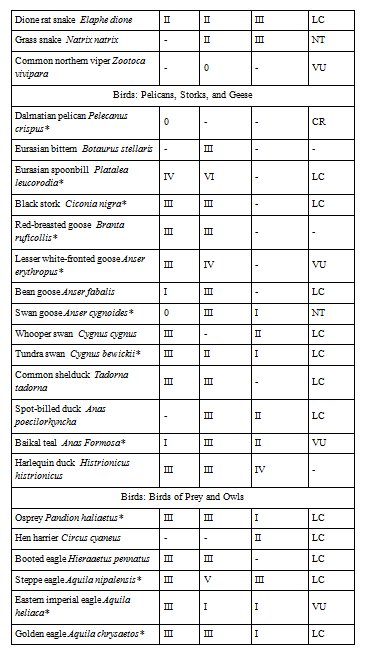
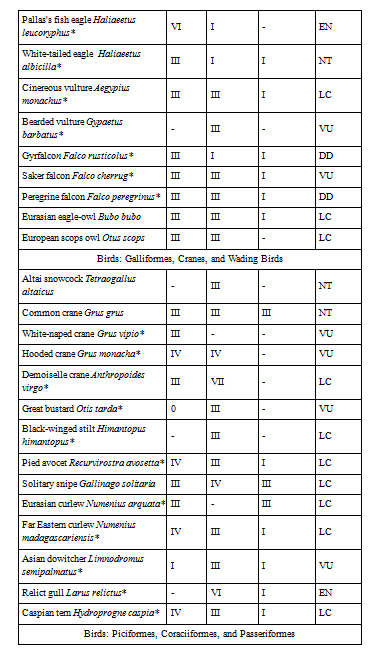
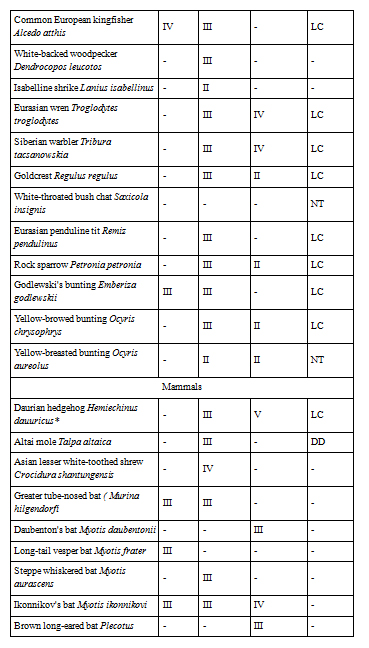
<p align="center"><strong><i>Categories of rarity of species and subspecies according to the risk of their extinction</i></strong></p>
<p align="center"><strong><i> (The Irkutsk Oblast, the Buryat Republic and the Zabaikalye Region)</i></strong></p>
<p><strong>Category 0</strong> – apparently extinct</p>
<p><strong>Category I</strong> – near extinct; species (subspecies), the number of animals of which has critically decreased</p>
<p><strong>Category II</strong>– species (subspecies), constantly decreasing in the number of animals</p>
<p><strong>Category III</strong> –species (subspecies), naturally low in the number of animals, distributed sporadically or on a limited territory</p>
<p><strong>Category IV</strong> – species (subspecies) of uncertain status, apparently falling into one of the above categories</p>
<p><strong>Category V</strong> – species (subspecies), which have been restored or undergoing restoration</p>
<p><strong>Category VI</strong> – rare species (subspecies) with irregular occurrence</p>
<p><strong>Category VII </strong>– species (subspecies) apparently secure in the Buryat Republic, but Red Listed in the Russian Federation, Mongolia or the neighbor regions</p>
<p> </p>
<p align="center"><strong><i>Categories of rarity of species and subspecies according to the risk of their extinction</i></strong><strong><i> (Mongolia)</i></strong></p>
<p><strong>Regionally Extinct (RE)</strong></p>
<p><strong>Critically Endangered (CR)</strong></p>
<p><strong>Endangered (EN)</strong></p>
<p><strong>Vulnerable (VU)</strong></p>
<p><strong>Near Threatened (NT)</strong></p>
<p><strong>Least Concern (LC)</strong></p>
<p><strong>Data Deficient (DD)</strong></p>
<p><strong><img class="image-inline" src="../../../../resolveuid/0363cc80277b4ae89f3c30edb64d3cdf/@@images/image/preview" /></strong></p>
<p><strong><a href="http://bic.iwlearn.org/en/photos/117.jpg" class="internal-link">Open full size</a></strong></p>
<p><strong><img class="image-inline" src="../../../../resolveuid/40794457e4574aa3add85ad70fc99159/@@images/image/preview" /></strong></p>
<p><strong><a href="http://bic.iwlearn.org/en/photos/1171.jpg" class="internal-link">Open full size</a></strong></p>
<p><strong><img class="image-inline" src="../../../../resolveuid/6b5f82bc386848dc8f3fbb3b9f764b0d/@@images/image/preview" /></strong></p>
<p><strong><a href="http://bic.iwlearn.org/en/photos/1172.jpg" class="internal-link">Open full size</a></strong></p>
<p><strong><img class="image-inline" src="../../../../resolveuid/c2f01706783e467780766c69643bd4cf/@@images/image/preview" /></strong></p>
<p><strong><a href="http://bic.iwlearn.org/en/photos/1173.jpg" class="internal-link">Open full size</a></strong></p>
<p><strong><img class="image-inline" src="../../../../resolveuid/aace67a3ab6647089ecba3b773352616/@@images/image/preview" /></strong></p>
<p><strong><a href="http://bic.iwlearn.org/en/photos/1174.jpg" class="internal-link">Open full size</a></strong></p>
<p><strong><br /></strong></p>]]></content:encoded>
    <dc:publisher>No publisher</dc:publisher>
    <dc:creator>Alexander Ayurzhanaev</dc:creator>
    <dc:rights></dc:rights>
    <dc:date>2014-10-14T06:50:00Z</dc:date>
    <dc:type>Page</dc:type>
  </item>


  <item rdf:about="http://bic.iwlearn.org/en/atlas/atlas/117-distribution-of-rare-animal-species-map">
    <title>117. Distribution of rare animal species. Mammals map</title>
    <link>http://bic.iwlearn.org/en/atlas/atlas/117-distribution-of-rare-animal-species-map</link>
    <description></description>
    
    <dc:publisher>No publisher</dc:publisher>
    <dc:creator>Alexander Ayurzhanaev</dc:creator>
    <dc:rights></dc:rights>
    <dc:date>2014-10-14T06:45:00Z</dc:date>
    <dc:type>Folder</dc:type>
  </item>


  <item rdf:about="http://bic.iwlearn.org/en/atlas/atlas/116-endangered-vegetation-communities-map/endangered-vegetation-communities-map">
    <title>Endangered vegetation communities map</title>
    <link>http://bic.iwlearn.org/en/atlas/atlas/116-endangered-vegetation-communities-map/endangered-vegetation-communities-map</link>
    <description></description>
    <content:encoded xmlns:content="http://purl.org/rss/1.0/modules/content/"><![CDATA[<p><img class="image-inline" src="../../../resolveuid/826a20fec52044d4ad792297140add32/@@images/image/preview" /></p>
<p><a href="http://bic.iwlearn.org/en/atlas/photos/copy_of__116_Endangeredvegetationcommunities.png" class="internal-link">Open full size</a></p>
<p align="center"><strong>Rare species of plants</strong><span> </span></p>
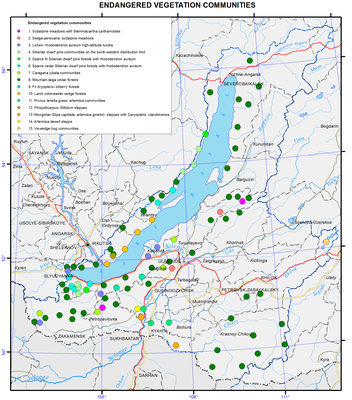
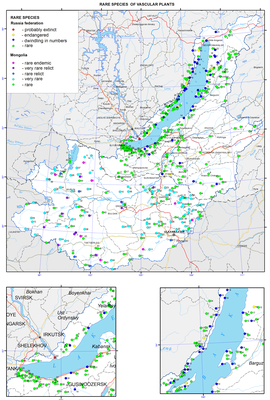
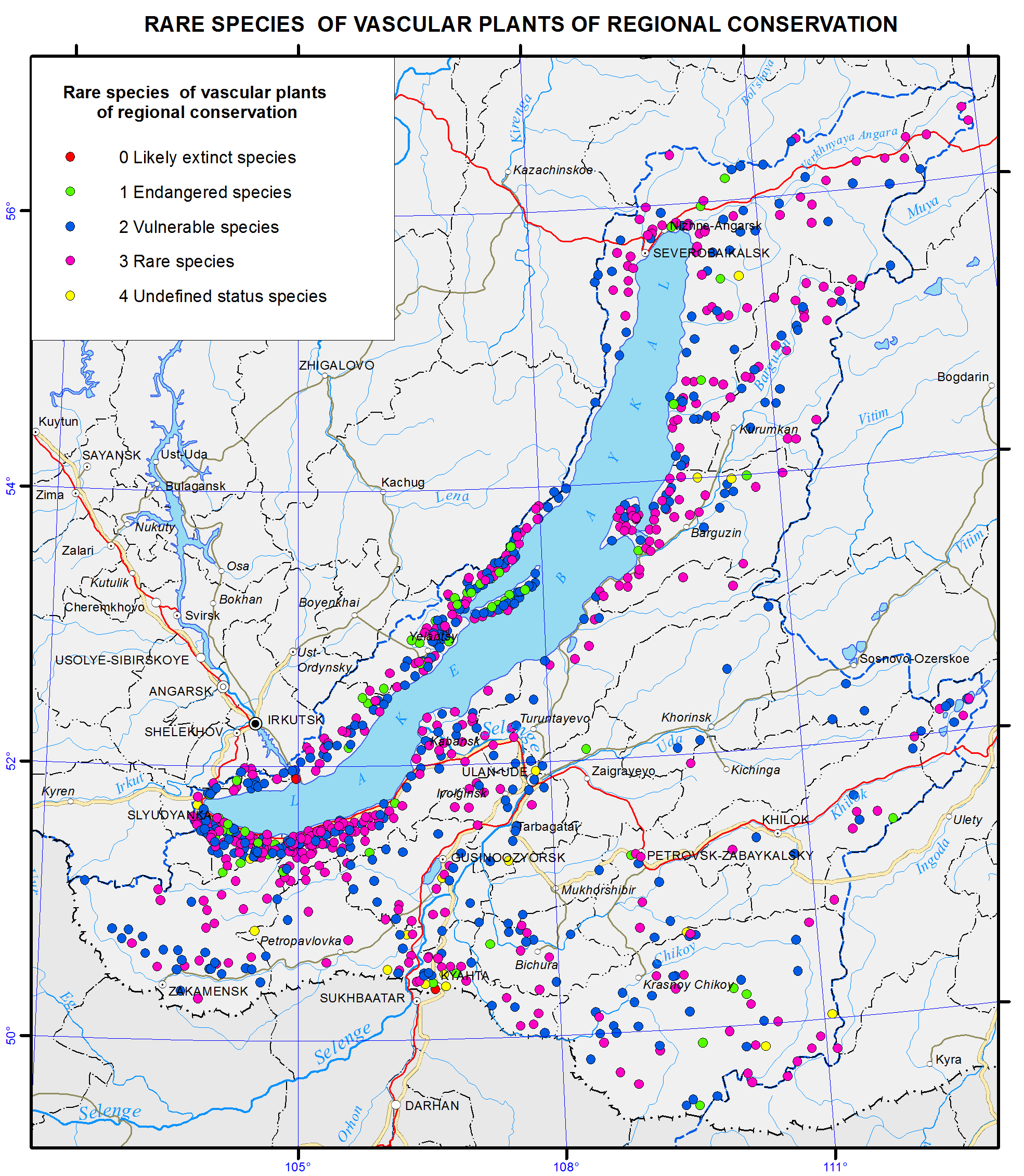
<p>The habitats of rare species of plants in the Russian and Mongolian parts of the Baikal basin are visually presented on the map “Rare species of vascular plants” using the cartographic interpretation technique. In order to create this map for the Russian part of the basin, the authors used the lists and characteristics of rare species included in the Red Book of the Russian Federation (Plants and Fungi). In this part of the basin, the map shows the habitats of 31 vascular plants (see the list) with different categories of the extinction risk according to the Red List of Threatened Species of the International Union for the Conservation of Nature. Category 0 (probably extinct, but the possibility of their preservation cannot be excluded) includes Isoetes lacustris. Category 1 (endangered) includes four species: Astragalus olchonensis, Vicia tsydenii, Festuca bargusinensis, and Viola incisa. Category 2 (decreasing in number) also includes four species: Caulinia flexilis, Hedysarum zundukii, Epipogium aphyllum, and Deschampsia turczaninowii. Category 3 (rare) includes 25 species represented by small populations that are currently not endangered and vulnerable. Often, these species are distributed within a limited area or have a narrow ecological amplitude.</p>
<p>For the map of the Mongolian part of the Baikal basin, we used information on the species composition and location of rare species of vascular plants from the electronic version of Mongolian Red Book. Habitats of 51 species are identified including a rare endemic species Saxifraga hirculus, six very rare relics: Adonis mongolica, Vicia tsydenii, Kobresia robusta, Nymphaea tetragona, Lancea tibetica, and Tulipa uniflora, as well as rare relics: Zigadenus sibiricus and Caryopteris mongolica are marked. Altogether, there are 31 very rare and 11 rare species.</p>
<p>The map “Rare species of vascular plants under regional protection” shows the Baikal basin’s habitats of rare species under regional protection in Irkutsk oblast (Red Book of Irkutsk oblast), Buryatia (Red Book of the Republic of Buryatia), and Zabaikalsky krai (Red Book of Chita oblast). Altogether, there are 868 habitats of 201 species of vascular plants listed in the regional Red Books and the Red Book of the Russian Federation. Species in different regions have different status depending on the state of species population. Among the regional species, Lagopsis eriostachya and Isoetes lacustris have Category 0 (probably extinct), while 28 species are endangered (Category 1).</p>
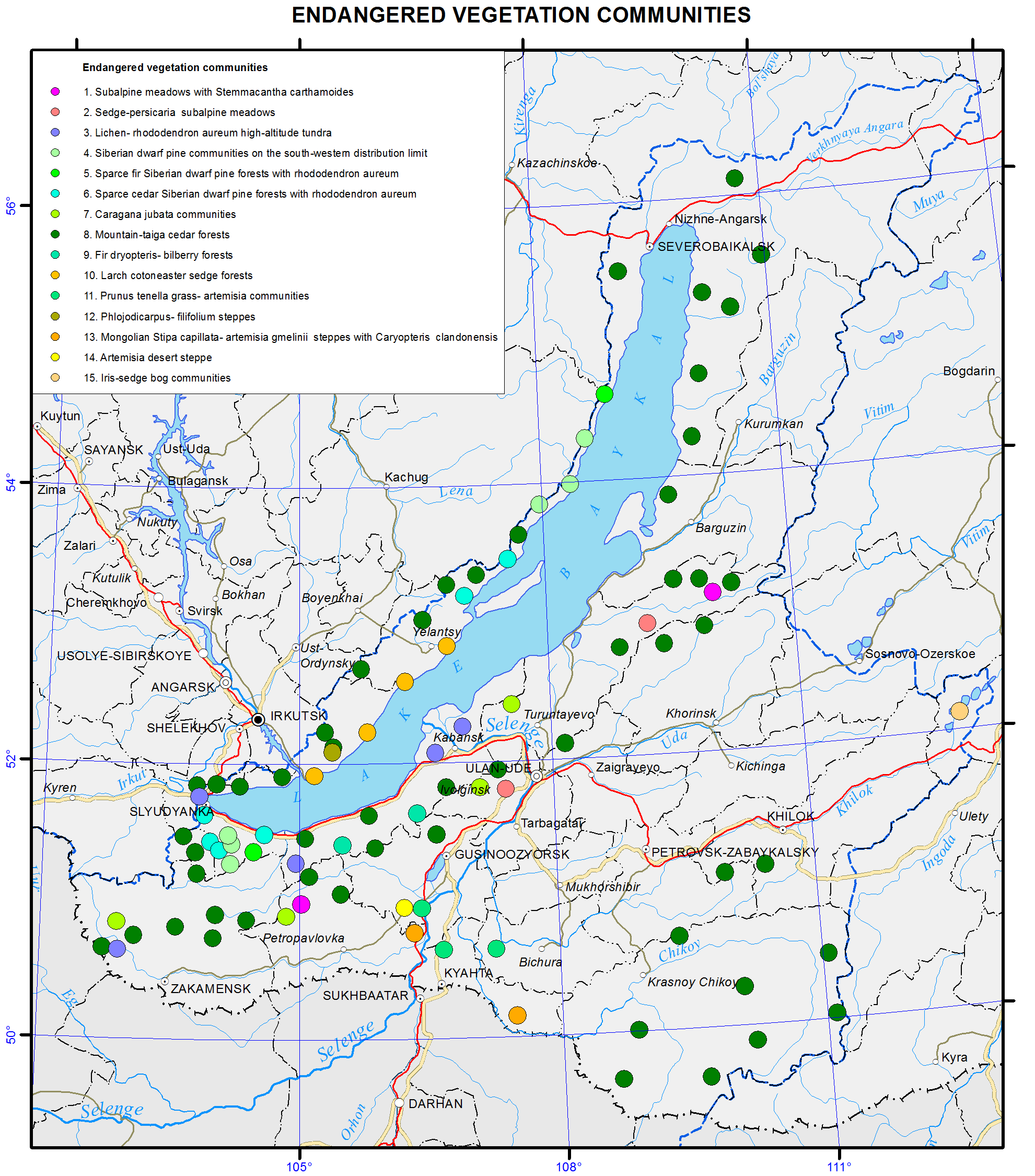
<p>The map “Plant communities requiring protection” uses conventional symbols and is created based on the information from the Green Book of Siberia, Atlas of Irkutsk Oblast, and Electronic Atlas of the Slyudyansky District. According to the Forest Code of the Russian Federation, forests under protection of Group 1 and forests in specially protected territories must be conserved in the Baikal basin because of their economic and social values. These forests serve to protect water resources, preserve the environment, and perform sanitary, hygienic, therapeutic, and other functions. The following communities also require protection due to their scientific importance as standards of indigenous vegetation: the Polygonum bistorta + Carex aterrima and Stemmacantha carthamoides meadows; Rhododendron aureum alpine tundras of the subalpine zone; Filifolium sibiricum, Festuca litvinovii, and Stipa klemenzii - S. Baicalensis - Eremogone capillaries steppes; Ulmus macrocarpa + Spiraea pubescens shrub steppe communities; Betula davurica - Artemisia desertorum + Calamagrostis brachytricha + Carex reventa forest communities; and Carex lasiocarpa + C. pseudocuraica + Iris laevigata marsh communities. Among the protected communities are very rare (Spodiopogon sibiricus; Armeniaca sibirica + Spiraea pubescens), relict (Arundinella anomala + Lespedeza hedysaroides), and unique (Stipa baicalensis + Paeonia lactiflora) communities, as well as communities located on the margins of their habitats (Pinus pumila; Caragana jubata) and reducing their habitat due to a high resource-related importance (Filifolium sibiricum + Phlojodicarpus sibiricus). The maps showing the distribution of rare vascular plant species and plant communities requiring protection can be used in the development of environmental policy aimed at optimizing nature resources management in the Baikal region to protect its biodiversity.</p>]]></content:encoded>
    <dc:publisher>No publisher</dc:publisher>
    <dc:creator>Alexander Ayurzhanaev</dc:creator>
    <dc:rights></dc:rights>
    <dc:date>2014-10-14T06:40:00Z</dc:date>
    <dc:type>Page</dc:type>
  </item>


  <item rdf:about="http://bic.iwlearn.org/en/atlas/atlas/115-rare-species-of-vascular-plants-of-regional-conservation-map/rare-species-of-vascular-plants-of-regional-conservation-map">
    <title>Rare species  of vascular plants of regional conservation map</title>
    <link>http://bic.iwlearn.org/en/atlas/atlas/115-rare-species-of-vascular-plants-of-regional-conservation-map/rare-species-of-vascular-plants-of-regional-conservation-map</link>
    <description></description>
    <content:encoded xmlns:content="http://purl.org/rss/1.0/modules/content/"><![CDATA[<p><img class="image-inline" src="../../../resolveuid/65f824963a6a48619188568105640a9e/@@images/image/preview" /></p>
<p><a href="http://bic.iwlearn.org/en/atlas/photos/copy_of__115_Rarespeciesofvascularplantsofregionalconservation.png" class="internal-link">Open full size</a></p>
<p align="center"><strong>Rare species of plants</strong></p>
<p>The habitats of rare species of plants in the Russian and Mongolian parts of the Baikal basin are visually presented on the map “Rare species of vascular plants” using the cartographic interpretation technique. In order to create this map for the Russian part of the basin, the authors used the lists and characteristics of rare species included in the Red Book of the Russian Federation (Plants and Fungi). In this part of the basin, the map shows the habitats of 31 vascular plants (see the list) with different categories of the extinction risk according to the Red List of Threatened Species of the International Union for the Conservation of Nature. Category 0 (probably extinct, but the possibility of their preservation cannot be excluded) includes Isoetes lacustris. Category 1 (endangered) includes four species: Astragalus olchonensis, Vicia tsydenii, Festuca bargusinensis, and Viola incisa. Category 2 (decreasing in number) also includes four species: Caulinia flexilis, Hedysarum zundukii, Epipogium aphyllum, and Deschampsia turczaninowii. Category 3 (rare) includes 25 species represented by small populations that are currently not endangered and vulnerable. Often, these species are distributed within a limited area or have a narrow ecological amplitude.</p>
<p>For the map of the Mongolian part of the Baikal basin, we used information on the species composition and location of rare species of vascular plants from the electronic version of Mongolian Red Book. Habitats of 51 species are identified including a rare endemic species Saxifraga hirculus, six very rare relics: Adonis mongolica, Vicia tsydenii, Kobresia robusta, Nymphaea tetragona, Lancea tibetica, and Tulipa uniflora, as well as rare relics: Zigadenus sibiricus and Caryopteris mongolica are marked. Altogether, there are 31 very rare and 11 rare species.</p>
<p>The map “Rare species of vascular plants under regional protection” shows the Baikal basin’s habitats of rare species under regional protection in Irkutsk oblast (Red Book of Irkutsk oblast), Buryatia (Red Book of the Republic of Buryatia), and Zabaikalsky krai (Red Book of Chita oblast). Altogether, there are 868 habitats of 201 species of vascular plants listed in the regional Red Books and the Red Book of the Russian Federation. Species in different regions have different status depending on the state of species population. Among the regional species, Lagopsis eriostachya and Isoetes lacustris have Category 0 (probably extinct), while 28 species are endangered (Category 1).</p>
<p>The map “Plant communities requiring protection” uses conventional symbols and is created based on the information from the Green Book of Siberia, Atlas of Irkutsk Oblast, and Electronic Atlas of the Slyudyansky District. According to the Forest Code of the Russian Federation, forests under protection of Group 1 and forests in specially protected territories must be conserved in the Baikal basin because of their economic and social values. These forests serve to protect water resources, preserve the environment, and perform sanitary, hygienic, therapeutic, and other functions. The following communities also require protection due to their scientific importance as standards of indigenous vegetation: the Polygonum bistorta + Carex aterrima and Stemmacantha carthamoides meadows; Rhododendron aureum alpine tundras of the subalpine zone; Filifolium sibiricum, Festuca litvinovii, and Stipa klemenzii - S. Baicalensis - Eremogone capillaries steppes; Ulmus macrocarpa + Spiraea pubescens shrub steppe communities; Betula davurica - Artemisia desertorum + Calamagrostis brachytricha + Carex reventa forest communities; and Carex lasiocarpa + C. pseudocuraica + Iris laevigata marsh communities. Among the protected communities are very rare (Spodiopogon sibiricus; Armeniaca sibirica + Spiraea pubescens), relict (Arundinella anomala + Lespedeza hedysaroides), and unique (Stipa baicalensis + Paeonia lactiflora) communities, as well as communities located on the margins of their habitats (Pinus pumila; Caragana jubata) and reducing their habitat due to a high resource-related importance (Filifolium sibiricum + Phlojodicarpus sibiricus). The maps showing the distribution of rare vascular plant species and plant communities requiring protection can be used in the development of environmental policy aimed at optimizing nature resources management in the Baikal region to protect its biodiversity.</p>]]></content:encoded>
    <dc:publisher>No publisher</dc:publisher>
    <dc:creator>Alexander Ayurzhanaev</dc:creator>
    <dc:rights></dc:rights>
    <dc:date>2014-10-14T06:35:00Z</dc:date>
    <dc:type>Page</dc:type>
  </item>


  <item rdf:about="http://bic.iwlearn.org/en/atlas/atlas/114-rare-species-of-vascular-plants-map/rare-species-of-vascular-plants-map">
    <title>Rare species  of vascular plants map</title>
    <link>http://bic.iwlearn.org/en/atlas/atlas/114-rare-species-of-vascular-plants-map/rare-species-of-vascular-plants-map</link>
    <description></description>
    <content:encoded xmlns:content="http://purl.org/rss/1.0/modules/content/"><![CDATA[<p><img class="image-inline" src="../../../resolveuid/f652d6387855449db8e53fb43bcccea5/@@images/image/preview" /></p>
<p><a href="http://bic.iwlearn.org/en/atlas/photos/copy_of__114_Rarespeciesofvascularplants.png" class="internal-link">Open full size</a></p>
<p><b>Rare species of vascular plants</b></p>
<p>RUSSIA</p>
<p>1. Astragalusolchonensis</p>
<p>2. Borodinia macrophylla</p>
<p>3. Cypripediym ventricosum</p>
<p>4. Cypripedium macranthon</p>
<p>5. Cypripedium calceolus</p>
<p>6. Anemone baikalensis</p>
<p>7. Vicia tsydenii</p>
<p>8. Calypso bulbosa</p>
<p>9. Caulinia flexilis</p>
<p>10. Cotoneaster lucidus</p>
<p>11. Stipa pennata</p>
<p>12. Hedysarum zundukii</p>
<p>13. Astragalus olchonensis</p>
<p>14. Deschampsia turczaninowii</p>
<p>15. Mertensia serrulata</p>
<p>16. Epipogium aphyllum</p>
<p>17. Neottianthe cucullata</p>
<p>18. Festuca bargusinensis</p>
<p>19. Caryopteris mongholica</p>
<p>20. Oxytropis triphylla</p>
<p>21. Primula pinnata</p>
<p>22. Isoёtes lacustris</p>
<p>23. Isoёtes setacea</p>
<p>24. Rhodiola rosea</p>
<p>25. Fritillaria dagana</p>
<p>26. Swertia baicalensis</p>
<p>27. Aegopodium latifolium</p>
<p>28. Stemmacantha carthamoides</p>
<p>29. Tridactylina kirilowii</p>
<p>30. Viola incise</p>
<p>31. Orchis militaris</p>
<p><i> </i></p>
<p> </p>
<p>MONGOLIA</p>
<p>1. Saxifraga hirculus</p>
<p>2.Adonis mongolica</p>
<p>3.Vicia tsydenii</p>
<p>4.Kobresia robusta</p>
<p>5.Nymphaea tetragona</p>
<p>6. Lancea tibetica</p>
<p>7. Tulipa uniflora</p>
<p>8.Zigadenus sibiricus</p>
<p>9.Caryopteris mongolica</p>
<p>10. Acorus calamus</p>
<p>11.Sambucus manshurica</p>
<p>12. Gentiana algida</p>
<p>13.Botrychium lanceolatum</p>
<p>14.Neottia camtschatea</p>
<p>15.Neottianthe cucullata</p>
<p>16.Lycopodium  alpinum</p>
<p>17. Pinus pumila</p>
<p>18.Convallaria keiskei</p>
<p>19.Lilium dahuricum</p>
<p>20.Platanthera bifolia</p>
<p>21.Juniperus sabina</p>
<p>22.Mitella nuda</p>
<p>23.Epipogium aphyllum</p>
<p>24.Carex parva</p>
<p>25.Carex selengensis</p>
<p>26.Oxytropis acanthacea</p>
<p>27.Orchis   fuchsia</p>
<p>28. Abies sibirica</p>
<p>29.Lycopodium clavatum</p>
<p>30. Physochlana albiflora</p>
<p>31. Drosera anglica</p>
<p>32.Rhodiola rosea</p>
<p>33.Drosera rotundifolia</p>
<p>34.Rhododendron  adamsii</p>
<p>35.Rhododendron dauricum</p>
<p>36.Rhododendron aureum</p>
<p>37.Rhododendron ledebourii</p>
<p>38.Rhododendron parvifolium</p>
<p>39.Vaccinium myrtilus</p>
<p>40. Orchis militars</p>
<p>41. Adonis sibirica</p>
<p>42.Valeriana  officinalis</p>
<p>43.Stellaria dichotoma.</p>
<p>44. Aium altaicum</p>
<p>45.Juniperus pseudosabina</p>
<p>46.Melica nutans</p>
<p>47. Lycopodium complanatum</p>
<p>48.Paeonia anomala</p>
<p>49.Saussurea dorogostaiskii</p>
<p>50.Saussurea involucrate</p>
<p>51. Ephedra equisetina</p>
<p> </p>
<p align="center"><b>Rare species of plants</b><span> </span></p>
<p>The habitats of rare species of plants in the Russian and Mongolian parts of the Baikal basin are visually presented on the map “Rare species of vascular plants” using the cartographic interpretation technique. In order to create this map for the Russian part of the basin, the authors used the lists and characteristics of rare species included in the Red Book of the Russian Federation (Plants and Fungi). In this part of the basin, the map shows the habitats of 31 vascular plants (see the list) with different categories of the extinction risk according to the Red List of Threatened Species of the International Union for the Conservation of Nature. Category 0 (probably extinct, but the possibility of their preservation cannot be excluded) includes Isoetes lacustris. Category 1 (endangered) includes four species: Astragalus olchonensis, Vicia tsydenii, Festuca bargusinensis, and Viola incisa. Category 2 (decreasing in number) also includes four species: Caulinia flexilis, Hedysarum zundukii, Epipogium aphyllum, and Deschampsia turczaninowii. Category 3 (rare) includes 25 species represented by small populations that are currently not endangered and vulnerable. Often, these species are distributed within a limited area or have a narrow ecological amplitude.</p>
<p>For the map of the Mongolian part of the Baikal basin, we used information on the species composition and location of rare species of vascular plants from the electronic version of Mongolian Red Book. Habitats of 51 species are identified including a rare endemic species Saxifraga hirculus, six very rare relics: Adonis mongolica, Vicia tsydenii, Kobresia robusta, Nymphaea tetragona, Lancea tibetica, and Tulipa uniflora, as well as rare relics: Zigadenus sibiricus and Caryopteris mongolica are marked. Altogether, there are 31 very rare and 11 rare species.</p>
<p>The map “Rare species of vascular plants under regional protection” shows the Baikal basin’s habitats of rare species under regional protection in Irkutsk oblast (Red Book of Irkutsk oblast), Buryatia (Red Book of the Republic of Buryatia), and Zabaikalsky krai (Red Book of Chita oblast). Altogether, there are 868 habitats of 201 species of vascular plants listed in the regional Red Books and the Red Book of the Russian Federation. Species in different regions have different status depending on the state of species population. Among the regional species, Lagopsis eriostachya and Isoetes lacustris have Category 0 (probably extinct), while 28 species are endangered (Category 1).</p>
<p>The map “Plant communities requiring protection” uses conventional symbols and is created based on the information from the Green Book of Siberia, Atlas of Irkutsk Oblast, and Electronic Atlas of the Slyudyansky District. According to the Forest Code of the Russian Federation, forests under protection of Group 1 and forests in specially protected territories must be conserved in the Baikal basin because of their economic and social values. These forests serve to protect water resources, preserve the environment, and perform sanitary, hygienic, therapeutic, and other functions. The following communities also require protection due to their scientific importance as standards of indigenous vegetation: the Polygonum bistorta + Carex aterrima and Stemmacantha carthamoides meadows; Rhododendron aureum alpine tundras of the subalpine zone; Filifolium sibiricum, Festuca litvinovii, and Stipa klemenzii - S. Baicalensis - Eremogone capillaries steppes; Ulmus macrocarpa + Spiraea pubescens shrub steppe communities; Betula davurica - Artemisia desertorum + Calamagrostis brachytricha + Carex reventa forest communities; and Carex lasiocarpa + C. pseudocuraica + Iris laevigata marsh communities. Among the protected communities are very rare (Spodiopogon sibiricus; Armeniaca sibirica + Spiraea pubescens), relict (Arundinella anomala + Lespedeza hedysaroides), and unique (Stipa baicalensis + Paeonia lactiflora) communities, as well as communities located on the margins of their habitats (Pinus pumila; Caragana jubata) and reducing their habitat due to a high resource-related importance (Filifolium sibiricum + Phlojodicarpus sibiricus). The maps showing the distribution of rare vascular plant species and plant communities requiring protection can be used in the development of environmental policy aimed at optimizing nature resources management in the Baikal region to protect its biodiversity.</p>]]></content:encoded>
    <dc:publisher>No publisher</dc:publisher>
    <dc:creator>Alexander Ayurzhanaev</dc:creator>
    <dc:rights></dc:rights>
    <dc:date>2014-10-14T06:30:00Z</dc:date>
    <dc:type>Page</dc:type>
  </item>


  <item rdf:about="http://bic.iwlearn.org/en/atlas/atlas/113-recommended-landscape-use-provisions-of-the-lake-baikal-basin-map/recommended-landscape-use-provisions-of-the-lake-baikal-basin-map">
    <title>Recommended landscape use provisions of the lake Baikal basin map</title>
    <link>http://bic.iwlearn.org/en/atlas/atlas/113-recommended-landscape-use-provisions-of-the-lake-baikal-basin-map/recommended-landscape-use-provisions-of-the-lake-baikal-basin-map</link>
    <description></description>
    <content:encoded xmlns:content="http://purl.org/rss/1.0/modules/content/"><![CDATA[<p><img class="image-inline" src="../../../resolveuid/b9c508c4fcd948ae9a74646d086cfda9/@@images/image/preview" /></p>
<p><a href="http://bic.iwlearn.org/en/atlas/photos/copy_of__113_RecommendedlandscapeuseprovisionsofthelakeBaikalbasin.png" class="internal-link">Open full size</a></p>
<p align="center"><strong>Recommended regimes for nature management</strong></p>
<p align="center"><strong> </strong></p>
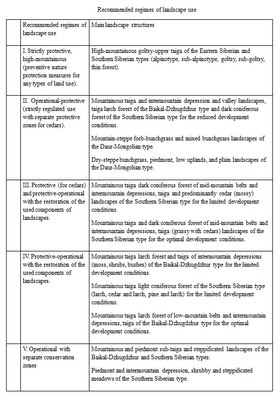
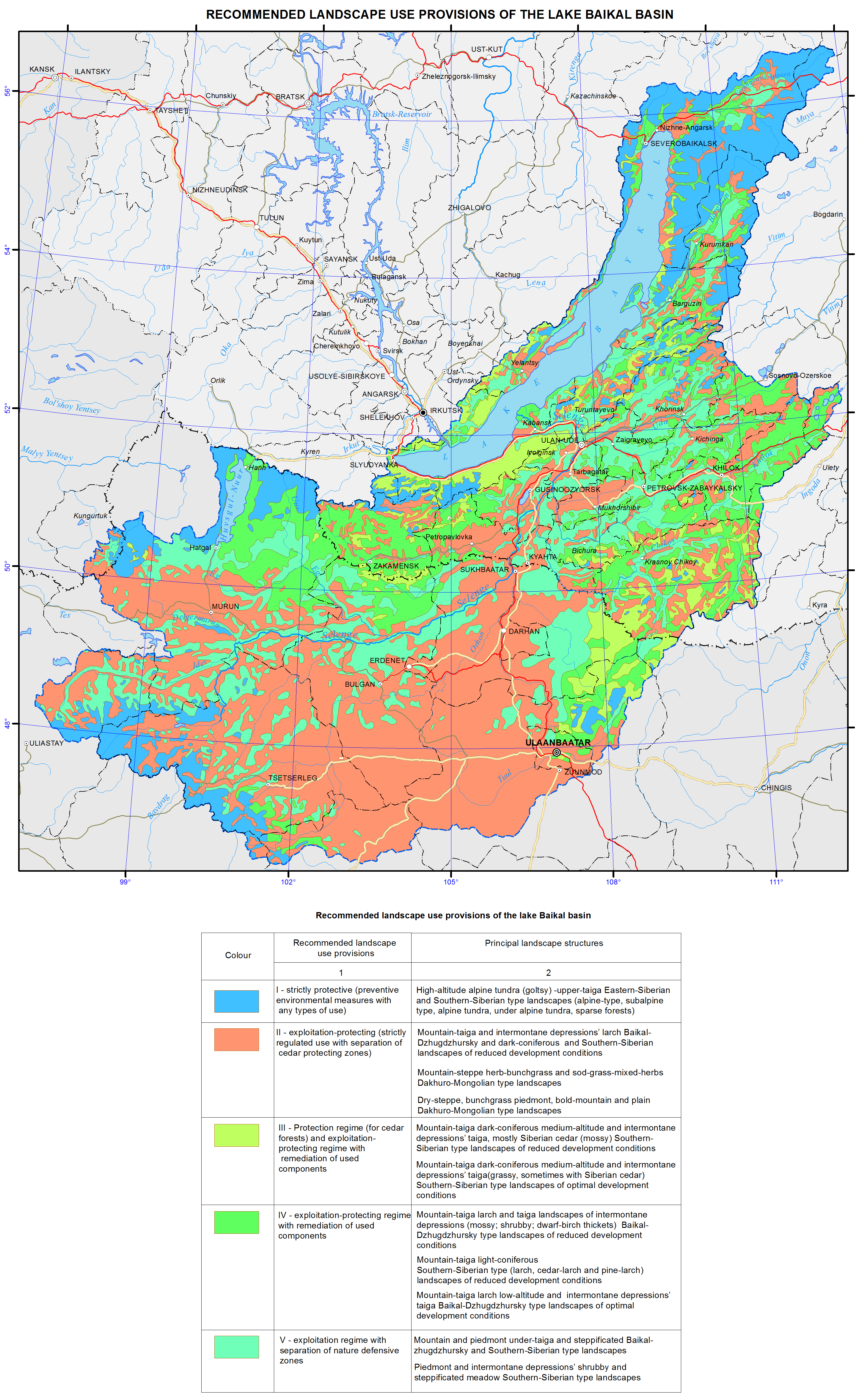
<p>In this map, environmental functions of landscapes correlate with the recommended regimes of natural resources management. For example, a strictly protective regime of natural resources management is recommended for the goltsy-tundra-thin forest landscapes with the environment-forming function. This type of regime implies the implementation of preventive nature protection measures for any type of the use of the territory. These landscapes are characterized by their high sensitivity towards anthropogenic stresses. In this case, it is always necessary to consider the possibility of the development of any hazardous natural phenomena.</p>
<p>Steppe and dry steppe landscapes characterized by the moistening deficit are no less susceptible to anthropogenic stresses. They have a relatively low ecological potential. Steppe landscapes are more densely populated and developed by humans. Therefore, an operational-protective regime of natural resources management is recommended for these landscapes. It implies the continuous monitoring of the landscape’s condition throughout its use and implementation of scheduled activities aimed at its improvement.</p>
<p>Dark coniferous forests with cedar stands belong to the category of protected forests and are used for cedar nut harvesting and hunting. A protection regime of natural resources management is recommended for these forests.</p>
<p>The operational-protective regime of natural resources management is recommended for moss landscapes with the environment-stabilising function. In these landscapes, anthropogenic impacts accompanied by logging may lead to the increase of soil drying on slopes, and, at the same time, cause marsh formation on flat surfaces with slow runoff. In order to preserve the mossy taiga, which has a great importance for the environment and forest management, it is necessary to constantly monitor its state and control the compliance to the rules of forest management.</p>
<p>The herb taiga and subtaiga landscapes with the environment-protection function are of great economic value. Therefore, a protective-operational regime of natural resources management is recommended for such landscapes. These landscapes have a high ecological potential. Despite experiencing some moistening deficit, they are characterized by relatively favourable conditions for their natural resources management. Therefore, it is necessary to develop and comply to the production and environmental specialisation of nature protection measures.</p>
<p><img class="image-inline" src="../../../../resolveuid/1a1db3add60349d3a2466225b0f53d3a/@@images/image/preview" /></p>
<p><a href="http://bic.iwlearn.org/en/photos/copy_of_113.jpg" class="internal-link">Open full size</a></p>]]></content:encoded>
    <dc:publisher>No publisher</dc:publisher>
    <dc:creator>Alexander Ayurzhanaev</dc:creator>
    <dc:rights></dc:rights>
    <dc:date>2014-10-14T06:10:00Z</dc:date>
    <dc:type>Page</dc:type>
  </item>


  <item rdf:about="http://bic.iwlearn.org/en/atlas/atlas/112-environmental-protection-infrastructure-map/environmental-protection-infrastructure-map">
    <title>Environmental protection infrastructure map</title>
    <link>http://bic.iwlearn.org/en/atlas/atlas/112-environmental-protection-infrastructure-map/environmental-protection-infrastructure-map</link>
    <description></description>
    <content:encoded xmlns:content="http://purl.org/rss/1.0/modules/content/"><![CDATA[<p><img class="image-inline" src="../../../resolveuid/5ddf580d230f4a738c712732281c8455/@@images/image/preview" /></p>
<p><a href="http://bic.iwlearn.org/en/atlas/photos/copy_of__112_Environmentalprotectioninfrastructure.png" class="internal-link">Open full size</a></p>
<p align="center"><strong>Environment-protective infrastructure </strong></p>
<p align="center"><strong> </strong></p>
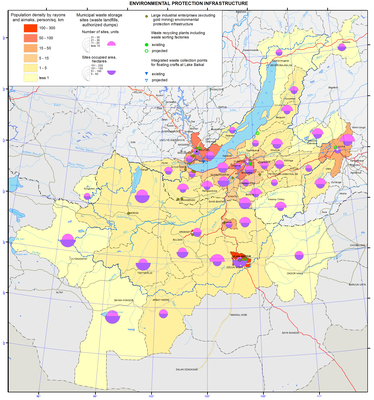
<p>The environment-protection infrastructure (EPI) is a component of ecological infrastructure and the most important sector of the current economic complex of the territory. The basic function of the EPI is to minimize the effect on the environment of deposited and utilized wastes (on the territory), discharges (into water bodies), production and consumer emissions (into the atmosphere), provided there is a developed selective (separate) collection of the secondary material resources. The EPI activity helps preserve a favorable environment for humans and use the territory’s resources in a rational manner. This map reflects only the EPI that deals with solid production and consumer wastes, with the latter often referred to as “municipal wastes” in the international practice.</p>
<p>The database includes the data of territorial offices of the Ministry of Natural Resources of Russia, the Russian governmental report on the state of Lake Baikal and measures for its protection (2013), Ministry of Nature, Environment and Tourism of Mongolia (2012), as well as project materials of regional development initiatives. It should be noted that the register of sites for storing (stockpiling or deposition) and burying of production and consumer wastes for individual regions is far from complete (based on  Form 2-TP (Wastes)).</p>
<p>In the Baikal catchment zone (in the lower level administrative districts of the Russian part and aimags in Mongolia), the annual volume of production and consumer waste reaches about 86 million tons. The majority of these wastes goes to the EPI facilities of production enterprises (sludge dumps, tailings ponds, mining waste piles, slag and ash dumps, etc.) and municipalities (predominantly waste dumps and landfills). The official statistics recorded over 600 sites for depositing waste. There is a waste recycling plant (WRP) in Ulan-Ude. There are plans to build three more WRPs (Irkutsk, Ulaanbaatar, and the Special Economic Zone “Baikal Harbor” in the Republic of Buryatia), a waste sorting plant in Chita (Zabaikalsky krai), and several waste collection facilities for processing waste from ships on Lake Baikal.</p>
<p>The total volume of production and consumer waste generation in the Baikal basin is growing annually. The leader is Zabaikalsky krai with almost 2/3 of all registered wastes in the Baikal basin. Irkutsk oblast is leading in terms of the speed of waste generation per unit of Gross Regional Product (tons/million rubles). In terms of the number of registered EPI facilities and their area, Mongolia tops the list, with Buryatia being the second, which corresponds to the territory they occupy in the Baikal basin. The average size of EPI facilities of municipalities and aimags is 4.3 hectares. The size of EPI facilities of Mongolian aimags (6.3 ha) exceeds this indicator by almost 1.5 times, while the size of such facilities in Irkutsk oblast exceeds the average by 1.3 times. There are plans to restart the selective (separate) collection of the utilized portion of generated consumer wastes in the future, which will significantly reduce the size of authorized waste dumps and landfills, as well as numerous unauthorized landfills of solid consumer wastes.</p>
<p>By the structure of economic activity, mining wastes and wastes generated by the thermal power sector make up the largest share in the total volume of generated waste (in Zabaikalsky krai, Irkutsk oblast, and Buryatia their share is over 90%). Wastes of mining companies weighing millions of tons, as well as construction wastes, slag, and ash are classified as Class V by their hazard impact on the environment (not dangerous or low-hazard wastes).</p>
<p> </p>
<p align="center">Reference:</p>
<p>Rosgeolfond. Siberian Branch. (2013). <i>On the state of Lake Baikal and measures for its protection in 2012: State report. </i>Irkutsk: Rosgeolfond. p 436.</p>]]></content:encoded>
    <dc:publisher>No publisher</dc:publisher>
    <dc:creator>Alexander Ayurzhanaev</dc:creator>
    <dc:rights></dc:rights>
    <dc:date>2014-10-14T05:55:00Z</dc:date>
    <dc:type>Page</dc:type>
  </item>


  <item rdf:about="http://bic.iwlearn.org/en/atlas/atlas/111-working-age-population-disability-map/working-age-population-disability-map">
    <title>Working-age population disability map</title>
    <link>http://bic.iwlearn.org/en/atlas/atlas/111-working-age-population-disability-map/working-age-population-disability-map</link>
    <description></description>
    <content:encoded xmlns:content="http://purl.org/rss/1.0/modules/content/"><![CDATA[<p><img class="image-inline" src="../../../resolveuid/9fa73668abee4a6dbb7645f7037df021/@@images/image/preview" /></p>
<p><a href="http://bic.iwlearn.org/en/atlas/photos/copy_of__111_Workingagepopulationdisability.png" class="internal-link">Open full size</a></p>
<p align="center"><strong>Healthcare</strong><strong> </strong></p>
<p align="center"><strong> </strong></p>
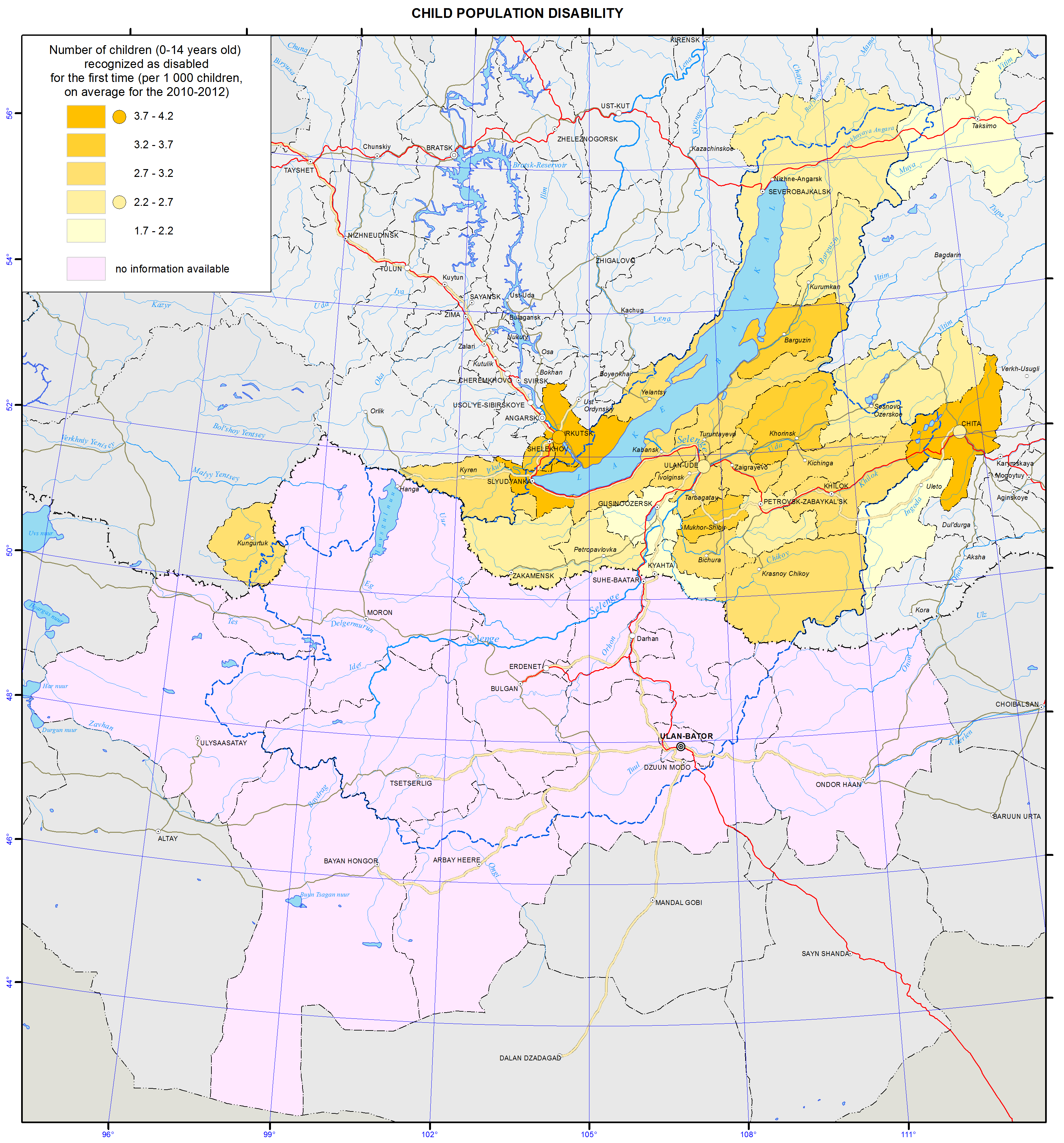
<p>Harsh climatic conditions across the entire territory of the Baikal basin and the surface and ground water used for drinking and food purposes that do not meet the drinking water quality standards (first and foremost in Mongolia and Buryatia) coupled with atmospheric emissions from industrial facilities and motor vehicles (in some parts of the territory) are responsible for the state of human health influencing the organization of healthcare. The ecological situation becomes substantially worse during winter months, which is encouraged by the topography of the terrain. In Mongolia, the spring period is very hard time to bear, with sharp temperature differences, abrupt variations in atmospheric pressure, and frequent dust and magnetic storms.</p>
<p class="NormalWeb">The organizational pattern of healthcare in Russia and Mongolia has much in common. This is a result of the cooperation of the two countries in this sphere and the fact that medical education and healthcare in Mongolia are organized using Russian experience. Today, Mongolian medical facilities operate on the principles of the state-private partnership concurrent with the demonopolization of the state system of medical services. The country has a mandatory and voluntary medical insurance system, in which state-owned and private medical institutions take part. The country also has various health institutes and centers.</p>
<p class="a">The territory of the Baikal basin is experiencing a deficit of medical workers. As of 2012, the availability of physicians varied from 13.8 to 30.1 per 10,000 people in Russian districts and from 16.1 to 29.0 per 10,000 people in Mongolian aimags. The availability of nurses varies from 25.1 to 112.2 per 10,000 people in Russian districts and from 26.4 to 38.2 per 10,000 people in Mongolian aimags. In Ulan-Ude, these indicators have the values of 53.9 and 117.3, while in Ulaanbaatar – 44.1 and 41.2, respectively.</p>
<p>The ratio of doctors and nurses in the Russian part of the basin is between 1:2 to 1:4, while in the Mongolian part it does not exceed 1:2. The World Health Organization (WHO) recommends that this ratio should be 1:4. A narrowing of this indicator causes imbalances in the healthcare system thereby limiting possibilities for further development of the after-treatment, casework and rehabilitation services.</p>
<p>Target indicators of healthcare activity are the standard volume of medical care per inhabitant. Currently, there are plans to decrease the per capita volume of in-patient services and increase the per capita volume of the hospital-replacing care. Accordingly, the number of hospital beds available 27/7 will decrease, while the number of beds in day hospitals will grow. Overall, the available number of hospital beds complies with the calculated standards and meets the demand of the population for the in-patient medical aid.</p>
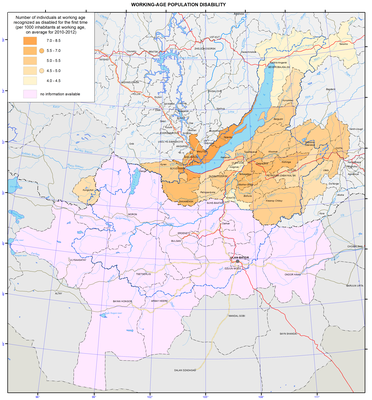
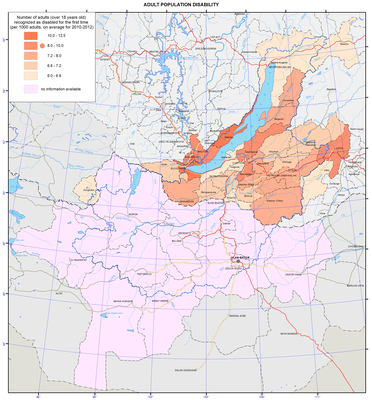
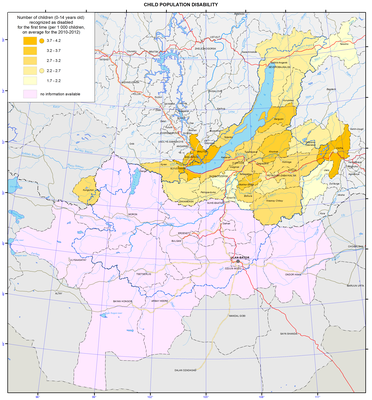
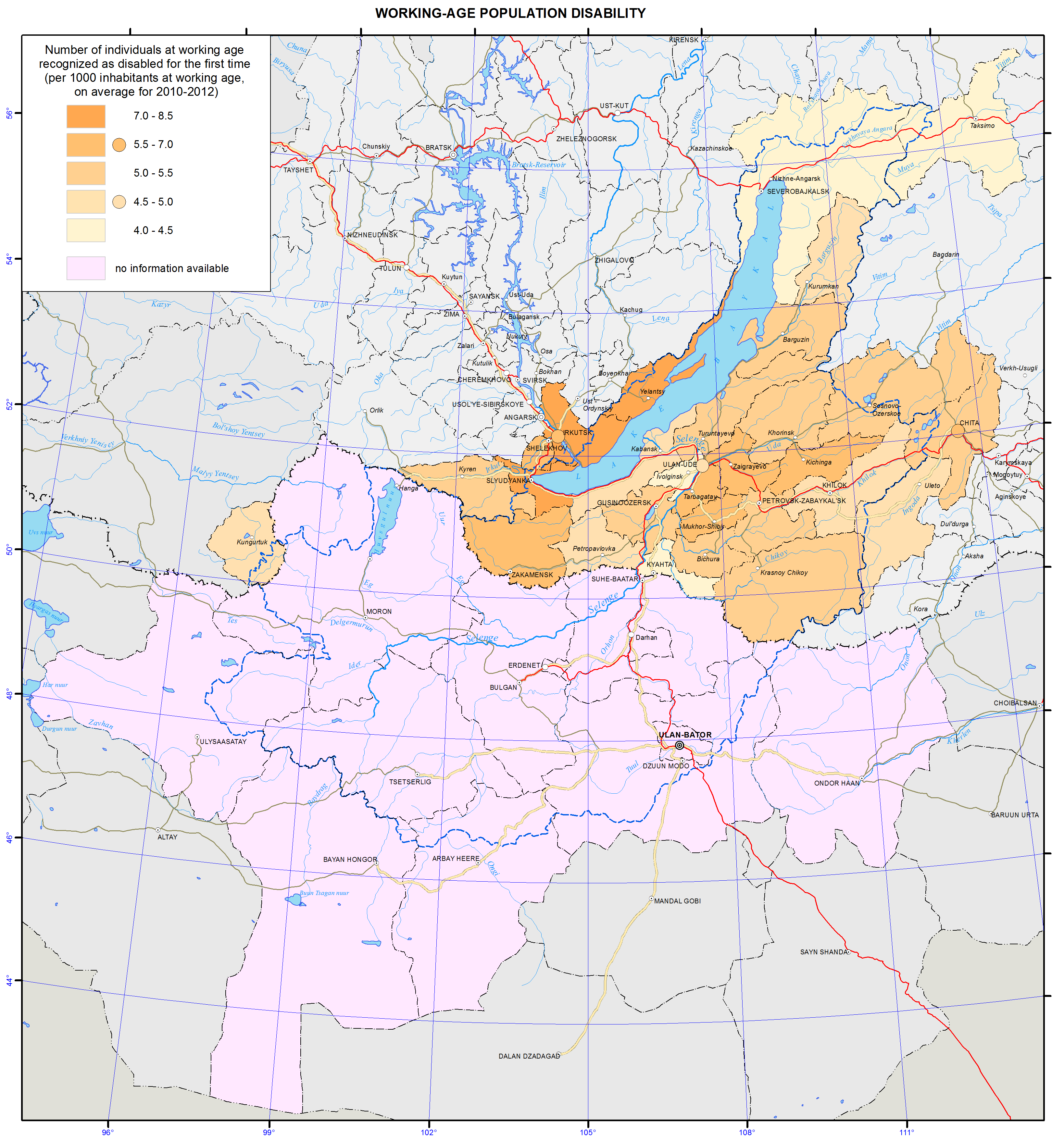
<p class="ConsPlusNormal">As of today, in Russia, there is an array of problems relating to the high level of illnesses and disability incidences among the population, and these indicators are continuously growing. Such a situation is the result of inadequate preventive measures. Another important contributing factor to this situation is the increase of the proportion of elderly population and the improved effectiveness of illness detection using new diagnostic methods in the process of the increased number of medical checkups.</p>
<p class="ConsPlusNormal">The leading illnesses in the structure of morbidity are respiratory illnesses, bloodstream, eye, and digestive and musculoskeletal system diseases, as well as traumas. For many years, circulatory system diseases, neoplasms, and injuries have been the main causes of mortality and disability among the population.</p>
<p class="a">A complex of anthropogenic environmental factors contributes to the growth of morbidity and disability rates among the population with the most important one being air pollution. According to the WHO, atmospheric air pollution is the cause of up to 23% of all illnesses. The amount of pollutant emissions in the atmosphere produced by static sources in different administrative divisions in the Baikal basin differs by more than a thousand times. The most polluted air in the Baikal basin is in the Selenginsky district of Buryatia.</p>
<p>The health of the population and further development of healthcare depend on ecological, social, and economic factors. These problems can be resolved only through comprehensive approaches to the improvement of the quality of life of the population.</p>
<p>The strategic goal of the healthcare systems of Russia and Mongolia is to build a system, which ensures the quality and accessibility of medical services, primarily first aid, and increases the efficiency of medical services, based on the improvement of territorial planning of healthcare. The volume, types, and quality of these services should correspond to the rate of morbidity, population requirements, and the latest achievements of medical science, based on perfecting the system of territorial planning of public health services.</p>]]></content:encoded>
    <dc:publisher>No publisher</dc:publisher>
    <dc:creator>Alexander Ayurzhanaev</dc:creator>
    <dc:rights></dc:rights>
    <dc:date>2014-10-14T03:10:00Z</dc:date>
    <dc:type>Page</dc:type>
  </item>


  <item rdf:about="http://bic.iwlearn.org/en/atlas/atlas/109-adult-population-disability-map/adult-population-disability-map">
    <title>Adult population disability map</title>
    <link>http://bic.iwlearn.org/en/atlas/atlas/109-adult-population-disability-map/adult-population-disability-map</link>
    <description></description>
    <content:encoded xmlns:content="http://purl.org/rss/1.0/modules/content/"><![CDATA[<p><img class="image-inline" src="../../../resolveuid/3c939443aad74b3fa512b9b6ec48d3b4/@@images/image/preview" /></p>
<p><a href="http://bic.iwlearn.org/en/atlas/photos/copy_of__109_Adultpopulationdisability.png" class="internal-link">Open full size</a></p>
<p align="center"><strong>Healthcare</strong><strong> </strong></p>
<p align="center"><strong> </strong></p>
<p>Harsh climatic conditions across the entire territory of the Baikal basin and the surface and ground water used for drinking and food purposes that do not meet the drinking water quality standards (first and foremost in Mongolia and Buryatia) coupled with atmospheric emissions from industrial facilities and motor vehicles (in some parts of the territory) are responsible for the state of human health influencing the organization of healthcare. The ecological situation becomes substantially worse during winter months, which is encouraged by the topography of the terrain. In Mongolia, the spring period is very hard time to bear, with sharp temperature differences, abrupt variations in atmospheric pressure, and frequent dust and magnetic storms.</p>
<p class="NormalWeb">The organizational pattern of healthcare in Russia and Mongolia has much in common. This is a result of the cooperation of the two countries in this sphere and the fact that medical education and healthcare in Mongolia are organized using Russian experience. Today, Mongolian medical facilities operate on the principles of the state-private partnership concurrent with the demonopolization of the state system of medical services. The country has a mandatory and voluntary medical insurance system, in which state-owned and private medical institutions take part. The country also has various health institutes and centers.</p>
<p class="a">The territory of the Baikal basin is experiencing a deficit of medical workers. As of 2012, the availability of physicians varied from 13.8 to 30.1 per 10,000 people in Russian districts and from 16.1 to 29.0 per 10,000 people in Mongolian aimags. The availability of nurses varies from 25.1 to 112.2 per 10,000 people in Russian districts and from 26.4 to 38.2 per 10,000 people in Mongolian aimags. In Ulan-Ude, these indicators have the values of 53.9 and 117.3, while in Ulaanbaatar – 44.1 and 41.2, respectively.</p>
<p>The ratio of doctors and nurses in the Russian part of the basin is between 1:2 to 1:4, while in the Mongolian part it does not exceed 1:2. The World Health Organization (WHO) recommends that this ratio should be 1:4. A narrowing of this indicator causes imbalances in the healthcare system thereby limiting possibilities for further development of the after-treatment, casework and rehabilitation services.</p>
<p>Target indicators of healthcare activity are the standard volume of medical care per inhabitant. Currently, there are plans to decrease the per capita volume of in-patient services and increase the per capita volume of the hospital-replacing care. Accordingly, the number of hospital beds available 27/7 will decrease, while the number of beds in day hospitals will grow. Overall, the available number of hospital beds complies with the calculated standards and meets the demand of the population for the in-patient medical aid.</p>
<p class="ConsPlusNormal">As of today, in Russia, there is an array of problems relating to the high level of illnesses and disability incidences among the population, and these indicators are continuously growing. Such a situation is the result of inadequate preventive measures. Another important contributing factor to this situation is the increase of the proportion of elderly population and the improved effectiveness of illness detection using new diagnostic methods in the process of the increased number of medical checkups.</p>
<p class="ConsPlusNormal">The leading illnesses in the structure of morbidity are respiratory illnesses, bloodstream, eye, and digestive and musculoskeletal system diseases, as well as traumas. For many years, circulatory system diseases, neoplasms, and injuries have been the main causes of mortality and disability among the population.</p>
<p class="a">A complex of anthropogenic environmental factors contributes to the growth of morbidity and disability rates among the population with the most important one being air pollution. According to the WHO, atmospheric air pollution is the cause of up to 23% of all illnesses. The amount of pollutant emissions in the atmosphere produced by static sources in different administrative divisions in the Baikal basin differs by more than a thousand times. The most polluted air in the Baikal basin is in the Selenginsky district of Buryatia.</p>
<p>The health of the population and further development of healthcare depend on ecological, social, and economic factors. These problems can be resolved only through comprehensive approaches to the improvement of the quality of life of the population.</p>
<p>The strategic goal of the healthcare systems of Russia and Mongolia is to build a system, which ensures the quality and accessibility of medical services, primarily first aid, and increases the efficiency of medical services, based on the improvement of territorial planning of healthcare. The volume, types, and quality of these services should correspond to the rate of morbidity, population requirements, and the latest achievements of medical science, based on perfecting the system of territorial planning of public health services.</p>]]></content:encoded>
    <dc:publisher>No publisher</dc:publisher>
    <dc:creator>Alexander Ayurzhanaev</dc:creator>
    <dc:rights></dc:rights>
    <dc:date>2014-10-14T02:55:00Z</dc:date>
    <dc:type>Page</dc:type>
  </item>


  <item rdf:about="http://bic.iwlearn.org/en/atlas/atlas/110-child-population-disability-map/child-population-disability-map">
    <title>Child population disability map</title>
    <link>http://bic.iwlearn.org/en/atlas/atlas/110-child-population-disability-map/child-population-disability-map</link>
    <description></description>
    <content:encoded xmlns:content="http://purl.org/rss/1.0/modules/content/"><![CDATA[<p><img class="image-inline" src="../../../resolveuid/7b407d27104245d988eb8434ba442e1f/@@images/image/preview" /></p>
<p><a href="http://bic.iwlearn.org/en/atlas/photos/copy_of__110_Childpopulationdisability.png" class="internal-link">Open full size</a></p>
<p align="center"><strong>Healthcare</strong><strong> </strong></p>
<p align="center"><strong> </strong></p>
<p>Harsh climatic conditions across the entire territory of the Baikal basin and the surface and ground water used for drinking and food purposes that do not meet the drinking water quality standards (first and foremost in Mongolia and Buryatia) coupled with atmospheric emissions from industrial facilities and motor vehicles (in some parts of the territory) are responsible for the state of human health influencing the organization of healthcare. The ecological situation becomes substantially worse during winter months, which is encouraged by the topography of the terrain. In Mongolia, the spring period is very hard time to bear, with sharp temperature differences, abrupt variations in atmospheric pressure, and frequent dust and magnetic storms.</p>
<p class="NormalWeb">The organizational pattern of healthcare in Russia and Mongolia has much in common. This is a result of the cooperation of the two countries in this sphere and the fact that medical education and healthcare in Mongolia are organized using Russian experience. Today, Mongolian medical facilities operate on the principles of the state-private partnership concurrent with the demonopolization of the state system of medical services. The country has a mandatory and voluntary medical insurance system, in which state-owned and private medical institutions take part. The country also has various health institutes and centers.</p>
<p class="a">The territory of the Baikal basin is experiencing a deficit of medical workers. As of 2012, the availability of physicians varied from 13.8 to 30.1 per 10,000 people in Russian districts and from 16.1 to 29.0 per 10,000 people in Mongolian aimags. The availability of nurses varies from 25.1 to 112.2 per 10,000 people in Russian districts and from 26.4 to 38.2 per 10,000 people in Mongolian aimags. In Ulan-Ude, these indicators have the values of 53.9 and 117.3, while in Ulaanbaatar – 44.1 and 41.2, respectively.</p>
<p>The ratio of doctors and nurses in the Russian part of the basin is between 1:2 to 1:4, while in the Mongolian part it does not exceed 1:2. The World Health Organization (WHO) recommends that this ratio should be 1:4. A narrowing of this indicator causes imbalances in the healthcare system thereby limiting possibilities for further development of the after-treatment, casework and rehabilitation services.</p>
<p>Target indicators of healthcare activity are the standard volume of medical care per inhabitant. Currently, there are plans to decrease the per capita volume of in-patient services and increase the per capita volume of the hospital-replacing care. Accordingly, the number of hospital beds available 27/7 will decrease, while the number of beds in day hospitals will grow. Overall, the available number of hospital beds complies with the calculated standards and meets the demand of the population for the in-patient medical aid.</p>
<p class="ConsPlusNormal">As of today, in Russia, there is an array of problems relating to the high level of illnesses and disability incidences among the population, and these indicators are continuously growing. Such a situation is the result of inadequate preventive measures. Another important contributing factor to this situation is the increase of the proportion of elderly population and the improved effectiveness of illness detection using new diagnostic methods in the process of the increased number of medical checkups.</p>
<p class="ConsPlusNormal">The leading illnesses in the structure of morbidity are respiratory illnesses, bloodstream, eye, and digestive and musculoskeletal system diseases, as well as traumas. For many years, circulatory system diseases, neoplasms, and injuries have been the main causes of mortality and disability among the population.</p>
<p class="a">A complex of anthropogenic environmental factors contributes to the growth of morbidity and disability rates among the population with the most important one being air pollution. According to the WHO, atmospheric air pollution is the cause of up to 23% of all illnesses. The amount of pollutant emissions in the atmosphere produced by static sources in different administrative divisions in the Baikal basin differs by more than a thousand times. The most polluted air in the Baikal basin is in the Selenginsky district of Buryatia.</p>
<p>The health of the population and further development of healthcare depend on ecological, social, and economic factors. These problems can be resolved only through comprehensive approaches to the improvement of the quality of life of the population.</p>
<p>The strategic goal of the healthcare systems of Russia and Mongolia is to build a system, which ensures the quality and accessibility of medical services, primarily first aid, and increases the efficiency of medical services, based on the improvement of territorial planning of healthcare. The volume, types, and quality of these services should correspond to the rate of morbidity, population requirements, and the latest achievements of medical science, based on perfecting the system of territorial planning of public health services.</p>]]></content:encoded>
    <dc:publisher>No publisher</dc:publisher>
    <dc:creator>Alexander Ayurzhanaev</dc:creator>
    <dc:rights></dc:rights>
    <dc:date>2014-10-14T02:55:00Z</dc:date>
    <dc:type>Page</dc:type>
  </item>


</rdf:RDF>