<?xml version="1.0" encoding="utf-8" ?>
<rdf:RDF xmlns:rdf="http://www.w3.org/1999/02/22-rdf-syntax-ns#" xmlns:dc="http://purl.org/dc/elements/1.1/" xmlns:syn="http://purl.org/rss/1.0/modules/syndication/" xmlns="http://purl.org/rss/1.0/">


<channel rdf:about="http://bic.iwlearn.org/en/search_rss">
  <title>English</title>
  <link>http://bic.iwlearn.org</link>

  <description>
    
            These are the search results for the query, showing results 91 to 105.
        
  </description>


  <image rdf:resource="http://bic.iwlearn.org/logo.png"/>

  <items>
    <rdf:Seq>
      
        <rdf:li rdf:resource="http://bic.iwlearn.org/en/atlas/atlas/103-respiratory-diseases-map/respiratory-diseases-map"/>
      
      
        <rdf:li rdf:resource="http://bic.iwlearn.org/en/atlas/atlas/102-infectious-and-parasitic-diseases-map/infectious-and-parasitic-diseases-map"/>
      
      
        <rdf:li rdf:resource="http://bic.iwlearn.org/en/atlas/atlas/101-general-population-morbidity-map/general-population-morbidity-map"/>
      
      
        <rdf:li rdf:resource="http://bic.iwlearn.org/en/atlas/atlas/100-hospital-bed-capacity-map/hospital-bed-capacity-map"/>
      
      
        <rdf:li rdf:resource="http://bic.iwlearn.org/en/atlas/atlas/99-medical-service-density-nursing-staff-map/medical-service-density-nursing-staff-map"/>
      
      
        <rdf:li rdf:resource="http://bic.iwlearn.org/en/atlas/atlas/99-medical-service-density-nursing-staff-map"/>
      
      
        <rdf:li rdf:resource="http://bic.iwlearn.org/en/atlas/atlas/98-medical-service-density-doctors-map"/>
      
      
        <rdf:li rdf:resource="http://bic.iwlearn.org/en/atlas/atlas/98-medical-service-density-doctors-map/medical-service-density-doctors-map"/>
      
      
        <rdf:li rdf:resource="http://bic.iwlearn.org/en/atlas/atlas/97-free-medical-care-system-map/free-medical-care-system-map"/>
      
      
        <rdf:li rdf:resource="http://bic.iwlearn.org/en/atlas/atlas/97-free-medical-care-system-map"/>
      
      
        <rdf:li rdf:resource="http://bic.iwlearn.org/en/atlas/atlas/96-ecological-preconditions-for-the-spread-of-zooanthroponoses-map/ecological-preconditions-for-the-spread-of-zooanthroponoses-map"/>
      
      
        <rdf:li rdf:resource="http://bic.iwlearn.org/en/atlas/atlas/96-ecological-preconditions-for-the-spread-of-zooanthroponoses-map"/>
      
      
        <rdf:li rdf:resource="http://bic.iwlearn.org/en/atlas/atlas/95-disturbance-of-wildlife-map/disturbance-of-wildlife-map"/>
      
      
        <rdf:li rdf:resource="http://bic.iwlearn.org/en/atlas/atlas/95-disturbance-of-wildlife-map"/>
      
      
        <rdf:li rdf:resource="http://bic.iwlearn.org/en/atlas/atlas/94-disturbance-of-forest-lands-map/disturbance-of-forest-lands-map"/>
      
    </rdf:Seq>
  </items>

</channel>


  <item rdf:about="http://bic.iwlearn.org/en/atlas/atlas/103-respiratory-diseases-map/respiratory-diseases-map">
    <title>Respiratory diseases map</title>
    <link>http://bic.iwlearn.org/en/atlas/atlas/103-respiratory-diseases-map/respiratory-diseases-map</link>
    <description></description>
    <content:encoded xmlns:content="http://purl.org/rss/1.0/modules/content/"><![CDATA[<p><img class="image-inline" src="../../../resolveuid/d9269e4938b9420ea944ea5d9fcd58b2/@@images/image/preview" /></p>
<p><a href="http://bic.iwlearn.org/en/atlas/photos/copy_of__103_Respiratorydiseases.png" class="internal-link">Open full size</a></p>
<p align="center"><strong>Healthcare</strong><strong> </strong></p>
<p align="center"><strong> </strong></p>
<p>Harsh climatic conditions across the entire territory of the Baikal basin and the surface and ground water used for drinking and food purposes that do not meet the drinking water quality standards (first and foremost in Mongolia and Buryatia) coupled with atmospheric emissions from industrial facilities and motor vehicles (in some parts of the territory) are responsible for the state of human health influencing the organization of healthcare. The ecological situation becomes substantially worse during winter months, which is encouraged by the topography of the terrain. In Mongolia, the spring period is very hard time to bear, with sharp temperature differences, abrupt variations in atmospheric pressure, and frequent dust and magnetic storms.</p>
<p class="NormalWeb">The organizational pattern of healthcare in Russia and Mongolia has much in common. This is a result of the cooperation of the two countries in this sphere and the fact that medical education and healthcare in Mongolia are organized using Russian experience. Today, Mongolian medical facilities operate on the principles of the state-private partnership concurrent with the demonopolization of the state system of medical services. The country has a mandatory and voluntary medical insurance system, in which state-owned and private medical institutions take part. The country also has various health institutes and centers.</p>
<p class="a">The territory of the Baikal basin is experiencing a deficit of medical workers. As of 2012, the availability of physicians varied from 13.8 to 30.1 per 10,000 people in Russian districts and from 16.1 to 29.0 per 10,000 people in Mongolian aimags. The availability of nurses varies from 25.1 to 112.2 per 10,000 people in Russian districts and from 26.4 to 38.2 per 10,000 people in Mongolian aimags. In Ulan-Ude, these indicators have the values of 53.9 and 117.3, while in Ulaanbaatar – 44.1 and 41.2, respectively.</p>
<p>The ratio of doctors and nurses in the Russian part of the basin is between 1:2 to 1:4, while in the Mongolian part it does not exceed 1:2. The World Health Organization (WHO) recommends that this ratio should be 1:4. A narrowing of this indicator causes imbalances in the healthcare system thereby limiting possibilities for further development of the after-treatment, casework and rehabilitation services.</p>
<p>Target indicators of healthcare activity are the standard volume of medical care per inhabitant. Currently, there are plans to decrease the per capita volume of in-patient services and increase the per capita volume of the hospital-replacing care. Accordingly, the number of hospital beds available 27/7 will decrease, while the number of beds in day hospitals will grow. Overall, the available number of hospital beds complies with the calculated standards and meets the demand of the population for the in-patient medical aid.</p>
<p class="ConsPlusNormal">As of today, in Russia, there is an array of problems relating to the high level of illnesses and disability incidences among the population, and these indicators are continuously growing. Such a situation is the result of inadequate preventive measures. Another important contributing factor to this situation is the increase of the proportion of elderly population and the improved effectiveness of illness detection using new diagnostic methods in the process of the increased number of medical checkups.</p>
<p class="ConsPlusNormal">The leading illnesses in the structure of morbidity are respiratory illnesses, bloodstream, eye, and digestive and musculoskeletal system diseases, as well as traumas. For many years, circulatory system diseases, neoplasms, and injuries have been the main causes of mortality and disability among the population.</p>
<p class="a">A complex of anthropogenic environmental factors contributes to the growth of morbidity and disability rates among the population with the most important one being air pollution. According to the WHO, atmospheric air pollution is the cause of up to 23% of all illnesses. The amount of pollutant emissions in the atmosphere produced by static sources in different administrative divisions in the Baikal basin differs by more than a thousand times. The most polluted air in the Baikal basin is in the Selenginsky district of Buryatia.</p>
<p>The health of the population and further development of healthcare depend on ecological, social, and economic factors. These problems can be resolved only through comprehensive approaches to the improvement of the quality of life of the population.</p>
<p>The strategic goal of the healthcare systems of Russia and Mongolia is to build a system, which ensures the quality and accessibility of medical services, primarily first aid, and increases the efficiency of medical services, based on the improvement of territorial planning of healthcare. The volume, types, and quality of these services should correspond to the rate of morbidity, population requirements, and the latest achievements of medical science, based on perfecting the system of territorial planning of public health services.</p>]]></content:encoded>
    <dc:publisher>No publisher</dc:publisher>
    <dc:creator>Alexander Ayurzhanaev</dc:creator>
    <dc:rights></dc:rights>
    <dc:date>2014-10-13T07:05:00Z</dc:date>
    <dc:type>Page</dc:type>
  </item>


  <item rdf:about="http://bic.iwlearn.org/en/atlas/atlas/102-infectious-and-parasitic-diseases-map/infectious-and-parasitic-diseases-map">
    <title>Infectious and parasitic diseases map</title>
    <link>http://bic.iwlearn.org/en/atlas/atlas/102-infectious-and-parasitic-diseases-map/infectious-and-parasitic-diseases-map</link>
    <description></description>
    <content:encoded xmlns:content="http://purl.org/rss/1.0/modules/content/"><![CDATA[<p><img class="image-inline" src="../../../resolveuid/9301c927659a44f18468af82d153b030/@@images/image/preview" /></p>
<p><a href="http://bic.iwlearn.org/en/atlas/photos/copy_of__102_Infectiousandparasiticdiseases.png" class="internal-link">Open full size</a></p>
<p align="center"><strong>Healthcare</strong><strong> </strong></p>
<p align="center"><strong> </strong></p>
<p>Harsh climatic conditions across the entire territory of the Baikal basin and the surface and ground water used for drinking and food purposes that do not meet the drinking water quality standards (first and foremost in Mongolia and Buryatia) coupled with atmospheric emissions from industrial facilities and motor vehicles (in some parts of the territory) are responsible for the state of human health influencing the organization of healthcare. The ecological situation becomes substantially worse during winter months, which is encouraged by the topography of the terrain. In Mongolia, the spring period is very hard time to bear, with sharp temperature differences, abrupt variations in atmospheric pressure, and frequent dust and magnetic storms.</p>
<p class="NormalWeb">The organizational pattern of healthcare in Russia and Mongolia has much in common. This is a result of the cooperation of the two countries in this sphere and the fact that medical education and healthcare in Mongolia are organized using Russian experience. Today, Mongolian medical facilities operate on the principles of the state-private partnership concurrent with the demonopolization of the state system of medical services. The country has a mandatory and voluntary medical insurance system, in which state-owned and private medical institutions take part. The country also has various health institutes and centers.</p>
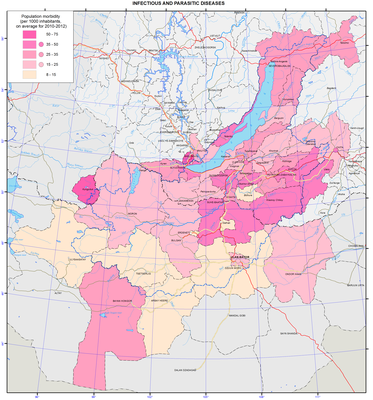
<p class="a">The territory of the Baikal basin is experiencing a deficit of medical workers. As of 2012, the availability of physicians varied from 13.8 to 30.1 per 10,000 people in Russian districts and from 16.1 to 29.0 per 10,000 people in Mongolian aimags. The availability of nurses varies from 25.1 to 112.2 per 10,000 people in Russian districts and from 26.4 to 38.2 per 10,000 people in Mongolian aimags. In Ulan-Ude, these indicators have the values of 53.9 and 117.3, while in Ulaanbaatar – 44.1 and 41.2, respectively.</p>
<p>The ratio of doctors and nurses in the Russian part of the basin is between 1:2 to 1:4, while in the Mongolian part it does not exceed 1:2. The World Health Organization (WHO) recommends that this ratio should be 1:4. A narrowing of this indicator causes imbalances in the healthcare system thereby limiting possibilities for further development of the after-treatment, casework and rehabilitation services.</p>
<p>Target indicators of healthcare activity are the standard volume of medical care per inhabitant. Currently, there are plans to decrease the per capita volume of in-patient services and increase the per capita volume of the hospital-replacing care. Accordingly, the number of hospital beds available 27/7 will decrease, while the number of beds in day hospitals will grow. Overall, the available number of hospital beds complies with the calculated standards and meets the demand of the population for the in-patient medical aid.</p>
<p class="ConsPlusNormal">As of today, in Russia, there is an array of problems relating to the high level of illnesses and disability incidences among the population, and these indicators are continuously growing. Such a situation is the result of inadequate preventive measures. Another important contributing factor to this situation is the increase of the proportion of elderly population and the improved effectiveness of illness detection using new diagnostic methods in the process of the increased number of medical checkups.</p>
<p class="ConsPlusNormal">The leading illnesses in the structure of morbidity are respiratory illnesses, bloodstream, eye, and digestive and musculoskeletal system diseases, as well as traumas. For many years, circulatory system diseases, neoplasms, and injuries have been the main causes of mortality and disability among the population.</p>
<p class="a">A complex of anthropogenic environmental factors contributes to the growth of morbidity and disability rates among the population with the most important one being air pollution. According to the WHO, atmospheric air pollution is the cause of up to 23% of all illnesses. The amount of pollutant emissions in the atmosphere produced by static sources in different administrative divisions in the Baikal basin differs by more than a thousand times. The most polluted air in the Baikal basin is in the Selenginsky district of Buryatia.</p>
<p>The health of the population and further development of healthcare depend on ecological, social, and economic factors. These problems can be resolved only through comprehensive approaches to the improvement of the quality of life of the population.</p>
<p>The strategic goal of the healthcare systems of Russia and Mongolia is to build a system, which ensures the quality and accessibility of medical services, primarily first aid, and increases the efficiency of medical services, based on the improvement of territorial planning of healthcare. The volume, types, and quality of these services should correspond to the rate of morbidity, population requirements, and the latest achievements of medical science, based on perfecting the system of territorial planning of public health services.</p>]]></content:encoded>
    <dc:publisher>No publisher</dc:publisher>
    <dc:creator>Alexander Ayurzhanaev</dc:creator>
    <dc:rights></dc:rights>
    <dc:date>2014-10-13T06:50:00Z</dc:date>
    <dc:type>Page</dc:type>
  </item>


  <item rdf:about="http://bic.iwlearn.org/en/atlas/atlas/101-general-population-morbidity-map/general-population-morbidity-map">
    <title>General population morbidity map</title>
    <link>http://bic.iwlearn.org/en/atlas/atlas/101-general-population-morbidity-map/general-population-morbidity-map</link>
    <description></description>
    <content:encoded xmlns:content="http://purl.org/rss/1.0/modules/content/"><![CDATA[<p><img class="image-inline" src="../../../resolveuid/3abb86890b1e478e8d12c2cdcb002cd4/@@images/image/preview" /></p>
<p><a href="http://bic.iwlearn.org/en/atlas/photos/copy_of__101_Generalpopulationmorbidity.png" class="internal-link">Open full size</a></p>
<p align="center"><strong>Healthcare</strong><strong> </strong></p>
<p align="center"><strong> </strong></p>
<p>Harsh climatic conditions across the entire territory of the Baikal basin and the surface and ground water used for drinking and food purposes that do not meet the drinking water quality standards (first and foremost in Mongolia and Buryatia) coupled with atmospheric emissions from industrial facilities and motor vehicles (in some parts of the territory) are responsible for the state of human health influencing the organization of healthcare. The ecological situation becomes substantially worse during winter months, which is encouraged by the topography of the terrain. In Mongolia, the spring period is very hard time to bear, with sharp temperature differences, abrupt variations in atmospheric pressure, and frequent dust and magnetic storms.</p>
<p class="NormalWeb">The organizational pattern of healthcare in Russia and Mongolia has much in common. This is a result of the cooperation of the two countries in this sphere and the fact that medical education and healthcare in Mongolia are organized using Russian experience. Today, Mongolian medical facilities operate on the principles of the state-private partnership concurrent with the demonopolization of the state system of medical services. The country has a mandatory and voluntary medical insurance system, in which state-owned and private medical institutions take part. The country also has various health institutes and centers.</p>
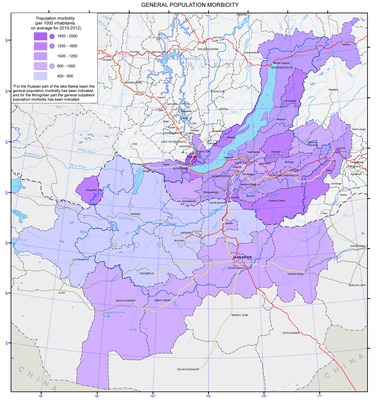
<p class="a">The territory of the Baikal basin is experiencing a deficit of medical workers. As of 2012, the availability of physicians varied from 13.8 to 30.1 per 10,000 people in Russian districts and from 16.1 to 29.0 per 10,000 people in Mongolian aimags. The availability of nurses varies from 25.1 to 112.2 per 10,000 people in Russian districts and from 26.4 to 38.2 per 10,000 people in Mongolian aimags. In Ulan-Ude, these indicators have the values of 53.9 and 117.3, while in Ulaanbaatar – 44.1 and 41.2, respectively.</p>
<p>The ratio of doctors and nurses in the Russian part of the basin is between 1:2 to 1:4, while in the Mongolian part it does not exceed 1:2. The World Health Organization (WHO) recommends that this ratio should be 1:4. A narrowing of this indicator causes imbalances in the healthcare system thereby limiting possibilities for further development of the after-treatment, casework and rehabilitation services.</p>
<p>Target indicators of healthcare activity are the standard volume of medical care per inhabitant. Currently, there are plans to decrease the per capita volume of in-patient services and increase the per capita volume of the hospital-replacing care. Accordingly, the number of hospital beds available 27/7 will decrease, while the number of beds in day hospitals will grow. Overall, the available number of hospital beds complies with the calculated standards and meets the demand of the population for the in-patient medical aid.</p>
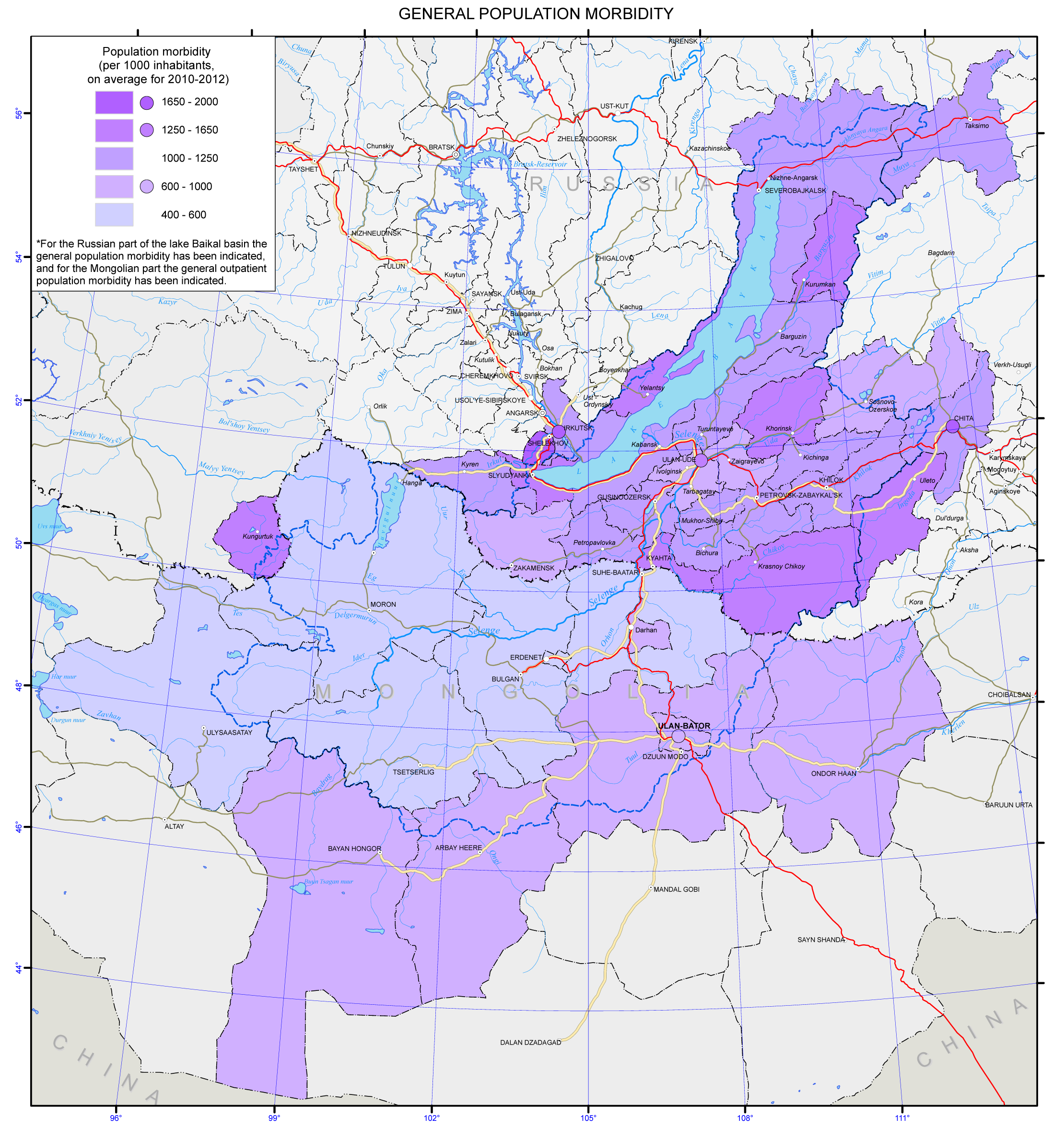
<p class="ConsPlusNormal">As of today, in Russia, there is an array of problems relating to the high level of illnesses and disability incidences among the population, and these indicators are continuously growing. Such a situation is the result of inadequate preventive measures. Another important contributing factor to this situation is the increase of the proportion of elderly population and the improved effectiveness of illness detection using new diagnostic methods in the process of the increased number of medical checkups.</p>
<p class="ConsPlusNormal">The leading illnesses in the structure of morbidity are respiratory illnesses, bloodstream, eye, and digestive and musculoskeletal system diseases, as well as traumas. For many years, circulatory system diseases, neoplasms, and injuries have been the main causes of mortality and disability among the population.</p>
<p class="a">A complex of anthropogenic environmental factors contributes to the growth of morbidity and disability rates among the population with the most important one being air pollution. According to the WHO, atmospheric air pollution is the cause of up to 23% of all illnesses. The amount of pollutant emissions in the atmosphere produced by static sources in different administrative divisions in the Baikal basin differs by more than a thousand times. The most polluted air in the Baikal basin is in the Selenginsky district of Buryatia.</p>
<p>The health of the population and further development of healthcare depend on ecological, social, and economic factors. These problems can be resolved only through comprehensive approaches to the improvement of the quality of life of the population.</p>
<p>The strategic goal of the healthcare systems of Russia and Mongolia is to build a system, which ensures the quality and accessibility of medical services, primarily first aid, and increases the efficiency of medical services, based on the improvement of territorial planning of healthcare. The volume, types, and quality of these services should correspond to the rate of morbidity, population requirements, and the latest achievements of medical science, based on perfecting the system of territorial planning of public health services.</p>]]></content:encoded>
    <dc:publisher>No publisher</dc:publisher>
    <dc:creator>Alexander Ayurzhanaev</dc:creator>
    <dc:rights></dc:rights>
    <dc:date>2014-10-13T06:40:00Z</dc:date>
    <dc:type>Page</dc:type>
  </item>


  <item rdf:about="http://bic.iwlearn.org/en/atlas/atlas/100-hospital-bed-capacity-map/hospital-bed-capacity-map">
    <title>Hospital bed capacity map</title>
    <link>http://bic.iwlearn.org/en/atlas/atlas/100-hospital-bed-capacity-map/hospital-bed-capacity-map</link>
    <description></description>
    <content:encoded xmlns:content="http://purl.org/rss/1.0/modules/content/"><![CDATA[<p><img class="image-inline" src="../../../resolveuid/088be0f97562433f9f533d08bb957f53/@@images/image/preview" /></p>
<p><a href="http://bic.iwlearn.org/en/atlas/photos/copy_of__100_Hospitalbedcapacity.png" class="internal-link">Open full size</a></p>
<p align="center"><strong>Healthcare</strong><strong> </strong></p>
<p align="center"><strong> </strong></p>
<p>Harsh climatic conditions across the entire territory of the Baikal basin and the surface and ground water used for drinking and food purposes that do not meet the drinking water quality standards (first and foremost in Mongolia and Buryatia) coupled with atmospheric emissions from industrial facilities and motor vehicles (in some parts of the territory) are responsible for the state of human health influencing the organization of healthcare. The ecological situation becomes substantially worse during winter months, which is encouraged by the topography of the terrain. In Mongolia, the spring period is very hard time to bear, with sharp temperature differences, abrupt variations in atmospheric pressure, and frequent dust and magnetic storms.</p>
<p class="NormalWeb">The organizational pattern of healthcare in Russia and Mongolia has much in common. This is a result of the cooperation of the two countries in this sphere and the fact that medical education and healthcare in Mongolia are organized using Russian experience. Today, Mongolian medical facilities operate on the principles of the state-private partnership concurrent with the demonopolization of the state system of medical services. The country has a mandatory and voluntary medical insurance system, in which state-owned and private medical institutions take part. The country also has various health institutes and centers.</p>
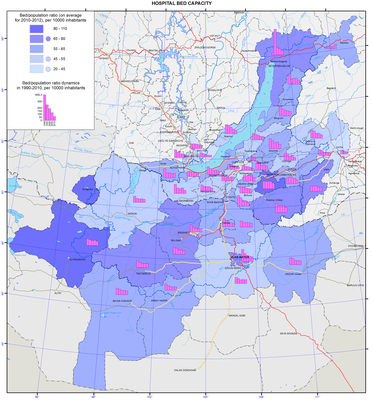
<p class="a">The territory of the Baikal basin is experiencing a deficit of medical workers. As of 2012, the availability of physicians varied from 13.8 to 30.1 per 10,000 people in Russian districts and from 16.1 to 29.0 per 10,000 people in Mongolian aimags. The availability of nurses varies from 25.1 to 112.2 per 10,000 people in Russian districts and from 26.4 to 38.2 per 10,000 people in Mongolian aimags. In Ulan-Ude, these indicators have the values of 53.9 and 117.3, while in Ulaanbaatar – 44.1 and 41.2, respectively.</p>
<p>The ratio of doctors and nurses in the Russian part of the basin is between 1:2 to 1:4, while in the Mongolian part it does not exceed 1:2. The World Health Organization (WHO) recommends that this ratio should be 1:4. A narrowing of this indicator causes imbalances in the healthcare system thereby limiting possibilities for further development of the after-treatment, casework and rehabilitation services.</p>
<p>Target indicators of healthcare activity are the standard volume of medical care per inhabitant. Currently, there are plans to decrease the per capita volume of in-patient services and increase the per capita volume of the hospital-replacing care. Accordingly, the number of hospital beds available 27/7 will decrease, while the number of beds in day hospitals will grow. Overall, the available number of hospital beds complies with the calculated standards and meets the demand of the population for the in-patient medical aid.</p>
<p class="ConsPlusNormal">As of today, in Russia, there is an array of problems relating to the high level of illnesses and disability incidences among the population, and these indicators are continuously growing. Such a situation is the result of inadequate preventive measures. Another important contributing factor to this situation is the increase of the proportion of elderly population and the improved effectiveness of illness detection using new diagnostic methods in the process of the increased number of medical checkups.</p>
<p class="ConsPlusNormal">The leading illnesses in the structure of morbidity are respiratory illnesses, bloodstream, eye, and digestive and musculoskeletal system diseases, as well as traumas. For many years, circulatory system diseases, neoplasms, and injuries have been the main causes of mortality and disability among the population.</p>
<p class="a">A complex of anthropogenic environmental factors contributes to the growth of morbidity and disability rates among the population with the most important one being air pollution. According to the WHO, atmospheric air pollution is the cause of up to 23% of all illnesses. The amount of pollutant emissions in the atmosphere produced by static sources in different administrative divisions in the Baikal basin differs by more than a thousand times. The most polluted air in the Baikal basin is in the Selenginsky district of Buryatia.</p>
<p>The health of the population and further development of healthcare depend on ecological, social, and economic factors. These problems can be resolved only through comprehensive approaches to the improvement of the quality of life of the population.</p>
<p>The strategic goal of the healthcare systems of Russia and Mongolia is to build a system, which ensures the quality and accessibility of medical services, primarily first aid, and increases the efficiency of medical services, based on the improvement of territorial planning of healthcare. The volume, types, and quality of these services should correspond to the rate of morbidity, population requirements, and the latest achievements of medical science, based on perfecting the system of territorial planning of public health services.</p>]]></content:encoded>
    <dc:publisher>No publisher</dc:publisher>
    <dc:creator>Alexander Ayurzhanaev</dc:creator>
    <dc:rights></dc:rights>
    <dc:date>2014-10-13T06:30:00Z</dc:date>
    <dc:type>Page</dc:type>
  </item>


  <item rdf:about="http://bic.iwlearn.org/en/atlas/atlas/99-medical-service-density-nursing-staff-map/medical-service-density-nursing-staff-map">
    <title>Medical service density - Nursing staff map</title>
    <link>http://bic.iwlearn.org/en/atlas/atlas/99-medical-service-density-nursing-staff-map/medical-service-density-nursing-staff-map</link>
    <description></description>
    <content:encoded xmlns:content="http://purl.org/rss/1.0/modules/content/"><![CDATA[<p><img class="image-inline" src="../../../resolveuid/c581f72dfaff4a92abe0d96a88b48956/@@images/image/preview" /></p>
<p><a href="http://bic.iwlearn.org/en/atlas/photos/copy_of__99_MedicalservicedensityNursingstaff.png" class="internal-link">Open full size</a></p>
<p align="center"><strong>Healthcare</strong><strong> </strong></p>
<p align="center"><strong> </strong></p>
<p>Harsh climatic conditions across the entire territory of the Baikal basin and the surface and ground water used for drinking and food purposes that do not meet the drinking water quality standards (first and foremost in Mongolia and Buryatia) coupled with atmospheric emissions from industrial facilities and motor vehicles (in some parts of the territory) are responsible for the state of human health influencing the organization of healthcare. The ecological situation becomes substantially worse during winter months, which is encouraged by the topography of the terrain. In Mongolia, the spring period is very hard time to bear, with sharp temperature differences, abrupt variations in atmospheric pressure, and frequent dust and magnetic storms.</p>
<p class="NormalWeb">The organizational pattern of healthcare in Russia and Mongolia has much in common. This is a result of the cooperation of the two countries in this sphere and the fact that medical education and healthcare in Mongolia are organized using Russian experience. Today, Mongolian medical facilities operate on the principles of the state-private partnership concurrent with the demonopolization of the state system of medical services. The country has a mandatory and voluntary medical insurance system, in which state-owned and private medical institutions take part. The country also has various health institutes and centers.</p>
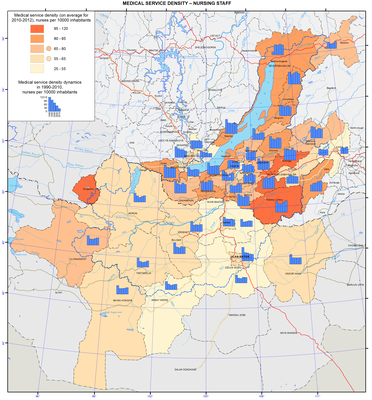
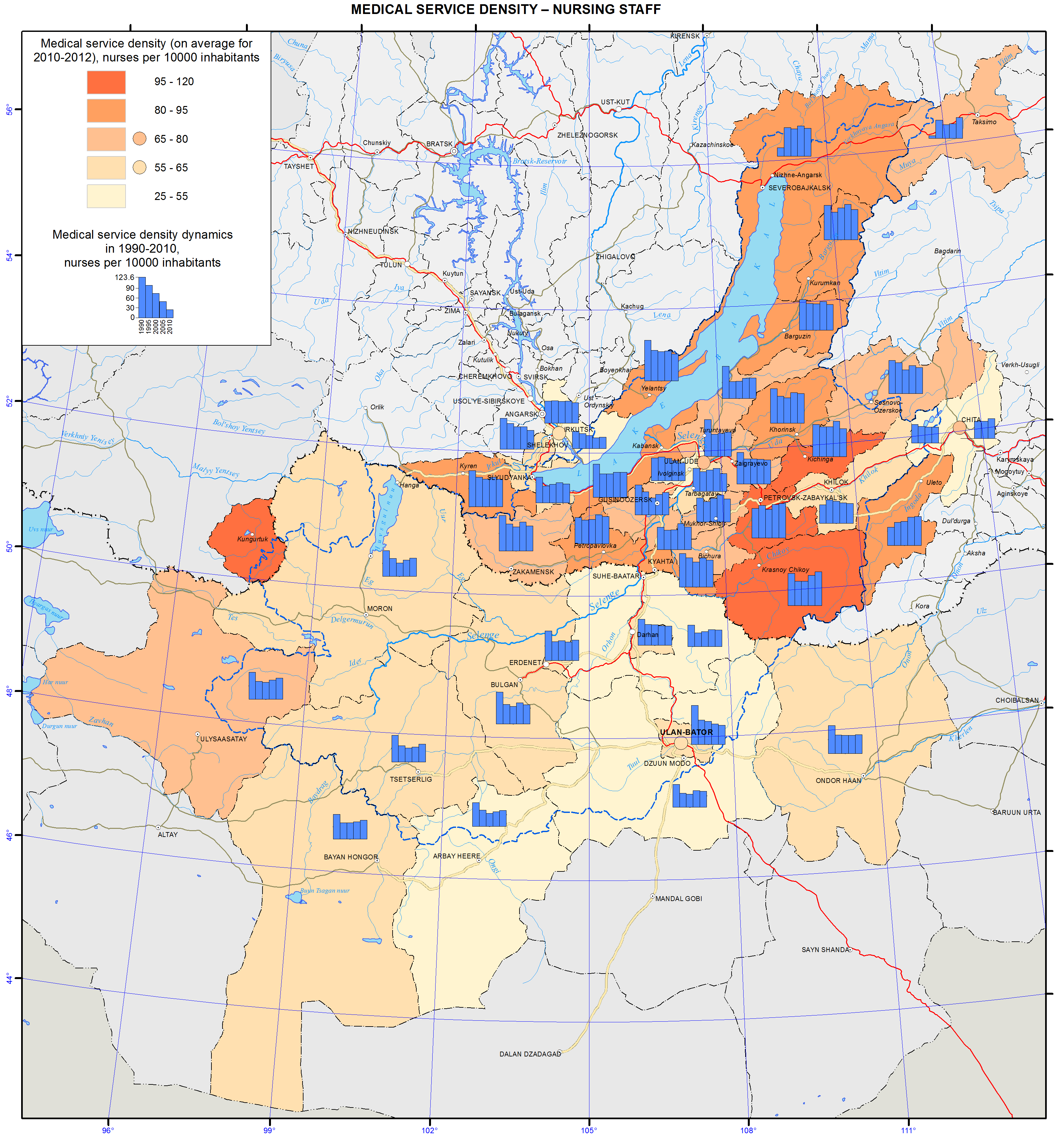
<p class="a">The territory of the Baikal basin is experiencing a deficit of medical workers. As of 2012, the availability of physicians varied from 13.8 to 30.1 per 10,000 people in Russian districts and from 16.1 to 29.0 per 10,000 people in Mongolian aimags. The availability of nurses varies from 25.1 to 112.2 per 10,000 people in Russian districts and from 26.4 to 38.2 per 10,000 people in Mongolian aimags. In Ulan-Ude, these indicators have the values of 53.9 and 117.3, while in Ulaanbaatar – 44.1 and 41.2, respectively.</p>
<p>The ratio of doctors and nurses in the Russian part of the basin is between 1:2 to 1:4, while in the Mongolian part it does not exceed 1:2. The World Health Organization (WHO) recommends that this ratio should be 1:4. A narrowing of this indicator causes imbalances in the healthcare system thereby limiting possibilities for further development of the after-treatment, casework and rehabilitation services.</p>
<p>Target indicators of healthcare activity are the standard volume of medical care per inhabitant. Currently, there are plans to decrease the per capita volume of in-patient services and increase the per capita volume of the hospital-replacing care. Accordingly, the number of hospital beds available 27/7 will decrease, while the number of beds in day hospitals will grow. Overall, the available number of hospital beds complies with the calculated standards and meets the demand of the population for the in-patient medical aid.</p>
<p class="ConsPlusNormal">As of today, in Russia, there is an array of problems relating to the high level of illnesses and disability incidences among the population, and these indicators are continuously growing. Such a situation is the result of inadequate preventive measures. Another important contributing factor to this situation is the increase of the proportion of elderly population and the improved effectiveness of illness detection using new diagnostic methods in the process of the increased number of medical checkups.</p>
<p class="ConsPlusNormal">The leading illnesses in the structure of morbidity are respiratory illnesses, bloodstream, eye, and digestive and musculoskeletal system diseases, as well as traumas. For many years, circulatory system diseases, neoplasms, and injuries have been the main causes of mortality and disability among the population.</p>
<p class="a">A complex of anthropogenic environmental factors contributes to the growth of morbidity and disability rates among the population with the most important one being air pollution. According to the WHO, atmospheric air pollution is the cause of up to 23% of all illnesses. The amount of pollutant emissions in the atmosphere produced by static sources in different administrative divisions in the Baikal basin differs by more than a thousand times. The most polluted air in the Baikal basin is in the Selenginsky district of Buryatia.</p>
<p>The health of the population and further development of healthcare depend on ecological, social, and economic factors. These problems can be resolved only through comprehensive approaches to the improvement of the quality of life of the population.</p>
<p>The strategic goal of the healthcare systems of Russia and Mongolia is to build a system, which ensures the quality and accessibility of medical services, primarily first aid, and increases the efficiency of medical services, based on the improvement of territorial planning of healthcare. The volume, types, and quality of these services should correspond to the rate of morbidity, population requirements, and the latest achievements of medical science, based on perfecting the system of territorial planning of public health services.</p>]]></content:encoded>
    <dc:publisher>No publisher</dc:publisher>
    <dc:creator>Alexander Ayurzhanaev</dc:creator>
    <dc:rights></dc:rights>
    <dc:date>2014-10-13T06:15:00Z</dc:date>
    <dc:type>Page</dc:type>
  </item>


  <item rdf:about="http://bic.iwlearn.org/en/atlas/atlas/99-medical-service-density-nursing-staff-map">
    <title>099. Medical service density - Nursing staff map</title>
    <link>http://bic.iwlearn.org/en/atlas/atlas/99-medical-service-density-nursing-staff-map</link>
    <description></description>
    
    <dc:publisher>No publisher</dc:publisher>
    <dc:creator>Alexander Ayurzhanaev</dc:creator>
    <dc:rights></dc:rights>
    <dc:date>2014-10-13T06:10:00Z</dc:date>
    <dc:type>Folder</dc:type>
  </item>


  <item rdf:about="http://bic.iwlearn.org/en/atlas/atlas/98-medical-service-density-doctors-map">
    <title>098. Medical service density - Doctors map</title>
    <link>http://bic.iwlearn.org/en/atlas/atlas/98-medical-service-density-doctors-map</link>
    <description></description>
    
    <dc:publisher>No publisher</dc:publisher>
    <dc:creator>Alexander Ayurzhanaev</dc:creator>
    <dc:rights></dc:rights>
    <dc:date>2014-10-13T06:05:00Z</dc:date>
    <dc:type>Folder</dc:type>
  </item>


  <item rdf:about="http://bic.iwlearn.org/en/atlas/atlas/98-medical-service-density-doctors-map/medical-service-density-doctors-map">
    <title>Medical service density - Doctors map</title>
    <link>http://bic.iwlearn.org/en/atlas/atlas/98-medical-service-density-doctors-map/medical-service-density-doctors-map</link>
    <description></description>
    <content:encoded xmlns:content="http://purl.org/rss/1.0/modules/content/"><![CDATA[<p><img class="image-inline" src="../../../resolveuid/639ff5082bd24d74bbb798a5ee9123f1/@@images/image/preview" /></p>
<p><a href="http://bic.iwlearn.org/en/atlas/photos/copy_of__98_MedicalservicedensityDoctors.png" class="internal-link">Open full size</a></p>
<p align="center"><strong>Healthcare</strong><strong> </strong></p>
<p align="center"><strong> </strong></p>
<p>Harsh climatic conditions across the entire territory of the Baikal basin and the surface and ground water used for drinking and food purposes that do not meet the drinking water quality standards (first and foremost in Mongolia and Buryatia) coupled with atmospheric emissions from industrial facilities and motor vehicles (in some parts of the territory) are responsible for the state of human health influencing the organization of healthcare. The ecological situation becomes substantially worse during winter months, which is encouraged by the topography of the terrain. In Mongolia, the spring period is very hard time to bear, with sharp temperature differences, abrupt variations in atmospheric pressure, and frequent dust and magnetic storms.</p>
<p class="NormalWeb">The organizational pattern of healthcare in Russia and Mongolia has much in common. This is a result of the cooperation of the two countries in this sphere and the fact that medical education and healthcare in Mongolia are organized using Russian experience. Today, Mongolian medical facilities operate on the principles of the state-private partnership concurrent with the demonopolization of the state system of medical services. The country has a mandatory and voluntary medical insurance system, in which state-owned and private medical institutions take part. The country also has various health institutes and centers.</p>
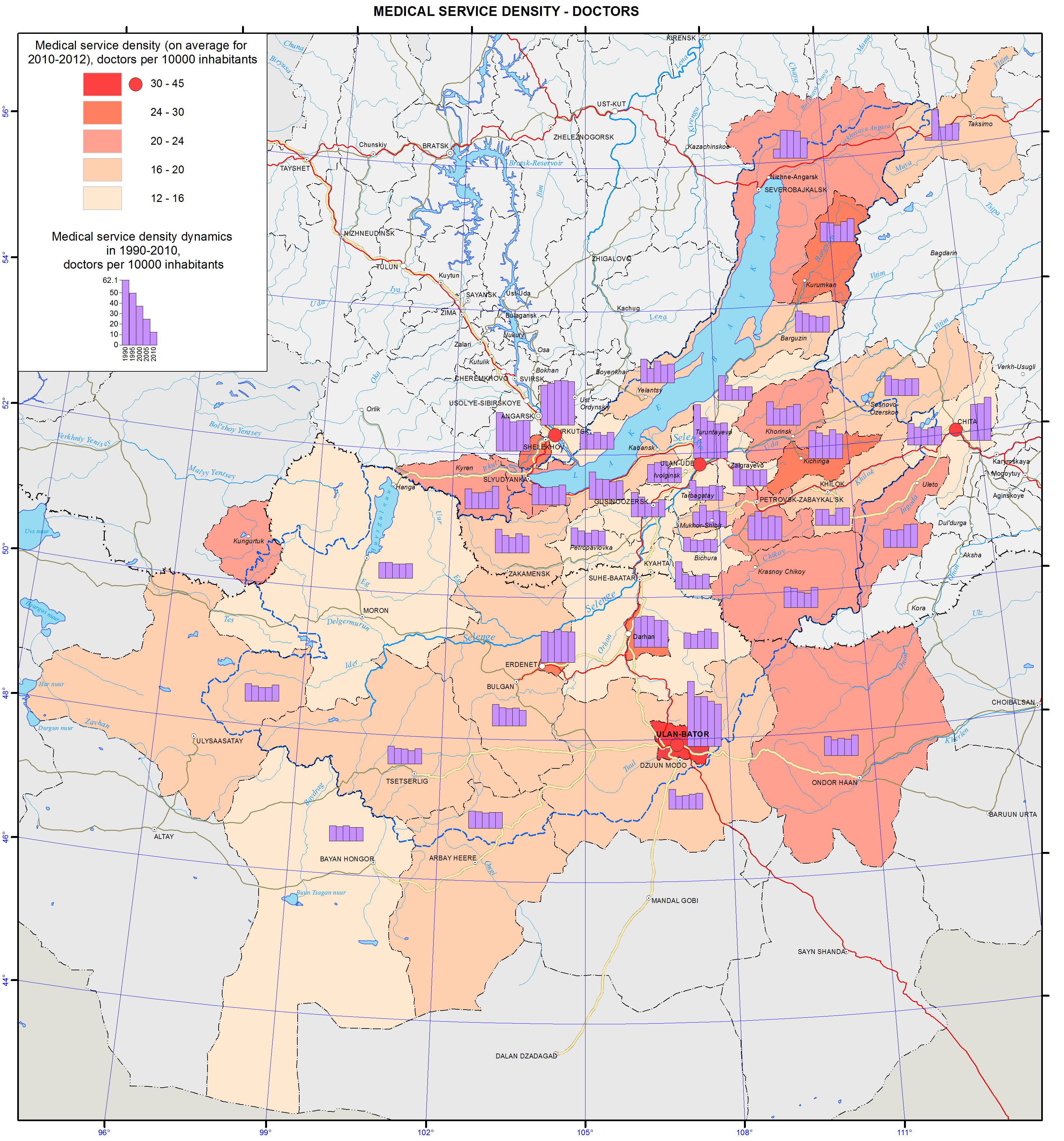
<p class="a">The territory of the Baikal basin is experiencing a deficit of medical workers. As of 2012, the availability of physicians varied from 13.8 to 30.1 per 10,000 people in Russian districts and from 16.1 to 29.0 per 10,000 people in Mongolian aimags. The availability of nurses varies from 25.1 to 112.2 per 10,000 people in Russian districts and from 26.4 to 38.2 per 10,000 people in Mongolian aimags. In Ulan-Ude, these indicators have the values of 53.9 and 117.3, while in Ulaanbaatar – 44.1 and 41.2, respectively.</p>
<p>The ratio of doctors and nurses in the Russian part of the basin is between 1:2 to 1:4, while in the Mongolian part it does not exceed 1:2. The World Health Organization (WHO) recommends that this ratio should be 1:4. A narrowing of this indicator causes imbalances in the healthcare system thereby limiting possibilities for further development of the after-treatment, casework and rehabilitation services.</p>
<p>Target indicators of healthcare activity are the standard volume of medical care per inhabitant. Currently, there are plans to decrease the per capita volume of in-patient services and increase the per capita volume of the hospital-replacing care. Accordingly, the number of hospital beds available 27/7 will decrease, while the number of beds in day hospitals will grow. Overall, the available number of hospital beds complies with the calculated standards and meets the demand of the population for the in-patient medical aid.</p>
<p class="ConsPlusNormal">As of today, in Russia, there is an array of problems relating to the high level of illnesses and disability incidences among the population, and these indicators are continuously growing. Such a situation is the result of inadequate preventive measures. Another important contributing factor to this situation is the increase of the proportion of elderly population and the improved effectiveness of illness detection using new diagnostic methods in the process of the increased number of medical checkups.</p>
<p class="ConsPlusNormal">The leading illnesses in the structure of morbidity are respiratory illnesses, bloodstream, eye, and digestive and musculoskeletal system diseases, as well as traumas. For many years, circulatory system diseases, neoplasms, and injuries have been the main causes of mortality and disability among the population.</p>
<p class="a">A complex of anthropogenic environmental factors contributes to the growth of morbidity and disability rates among the population with the most important one being air pollution. According to the WHO, atmospheric air pollution is the cause of up to 23% of all illnesses. The amount of pollutant emissions in the atmosphere produced by static sources in different administrative divisions in the Baikal basin differs by more than a thousand times. The most polluted air in the Baikal basin is in the Selenginsky district of Buryatia.</p>
<p>The health of the population and further development of healthcare depend on ecological, social, and economic factors. These problems can be resolved only through comprehensive approaches to the improvement of the quality of life of the population.</p>
<p>The strategic goal of the healthcare systems of Russia and Mongolia is to build a system, which ensures the quality and accessibility of medical services, primarily first aid, and increases the efficiency of medical services, based on the improvement of territorial planning of healthcare. The volume, types, and quality of these services should correspond to the rate of morbidity, population requirements, and the latest achievements of medical science, based on perfecting the system of territorial planning of public health services.</p>]]></content:encoded>
    <dc:publisher>No publisher</dc:publisher>
    <dc:creator>Alexander Ayurzhanaev</dc:creator>
    <dc:rights></dc:rights>
    <dc:date>2014-10-13T06:05:00Z</dc:date>
    <dc:type>Page</dc:type>
  </item>


  <item rdf:about="http://bic.iwlearn.org/en/atlas/atlas/97-free-medical-care-system-map/free-medical-care-system-map">
    <title>Free medical care system map</title>
    <link>http://bic.iwlearn.org/en/atlas/atlas/97-free-medical-care-system-map/free-medical-care-system-map</link>
    <description></description>
    <content:encoded xmlns:content="http://purl.org/rss/1.0/modules/content/"><![CDATA[<p><img class="image-inline" src="../../../resolveuid/3fbe9a4e710e4c318f0c03d56460881e/@@images/image/preview" /></p>
<p><a href="http://bic.iwlearn.org/en/atlas/photos/copy_of__97_FreeMedicalCaresystem.png" class="internal-link">Open full size</a></p>
<p align="center"><strong>Healthcare</strong></p>
<p align="center"><strong> </strong></p>
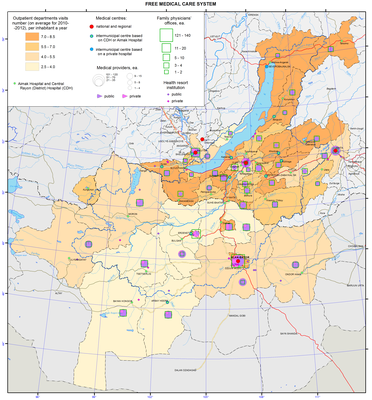
<p>Harsh climatic conditions across the entire territory of the Baikal basin and the surface and ground water used for drinking and food purposes that do not meet the drinking water quality standards (first and foremost in Mongolia and Buryatia) coupled with atmospheric emissions from industrial facilities and motor vehicles (in some parts of the territory) are responsible for the state of human health influencing the organization of healthcare. The ecological situation becomes substantially worse during winter months, which is encouraged by the topography of the terrain. In Mongolia, the spring period is very hard time to bear, with sharp temperature differences, abrupt variations in atmospheric pressure, and frequent dust and magnetic storms.</p>
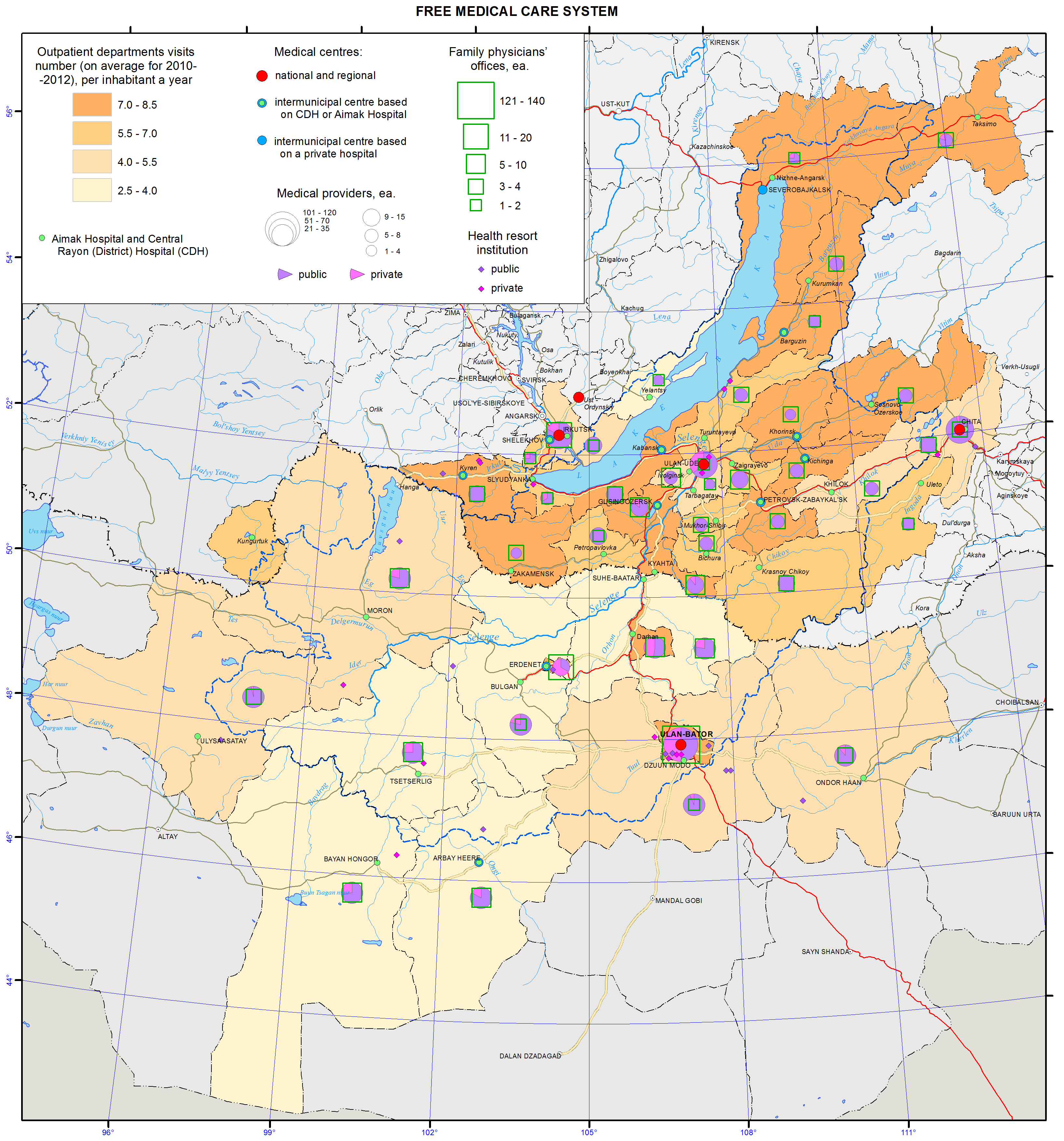
<p class="NormalWeb">The organizational pattern of healthcare in Russia and Mongolia has much in common. This is a result of the cooperation of the two countries in this sphere and the fact that medical education and healthcare in Mongolia are organized using Russian experience. Today, Mongolian medical facilities operate on the principles of the state-private partnership concurrent with the demonopolization of the state system of medical services. The country has a mandatory and voluntary medical insurance system, in which state-owned and private medical institutions take part. The country also has various health institutes and centers.</p>
<p class="a">The territory of the Baikal basin is experiencing a deficit of medical workers. As of 2012, the availability of physicians varied from 13.8 to 30.1 per 10,000 people in Russian districts and from 16.1 to 29.0 per 10,000 people in Mongolian aimags. The availability of nurses varies from 25.1 to 112.2 per 10,000 people in Russian districts and from 26.4 to 38.2 per 10,000 people in Mongolian aimags. In Ulan-Ude, these indicators have the values of 53.9 and 117.3, while in Ulaanbaatar – 44.1 and 41.2, respectively.</p>
<p>The ratio of doctors and nurses in the Russian part of the basin is between 1:2 to 1:4, while in the Mongolian part it does not exceed 1:2. The World Health Organization (WHO) recommends that this ratio should be 1:4. A narrowing of this indicator causes imbalances in the healthcare system thereby limiting possibilities for further development of the after-treatment, casework and rehabilitation services.</p>
<p>Target indicators of healthcare activity are the standard volume of medical care per inhabitant. Currently, there are plans to decrease the per capita volume of in-patient services and increase the per capita volume of the hospital-replacing care. Accordingly, the number of hospital beds available 27/7 will decrease, while the number of beds in day hospitals will grow. Overall, the available number of hospital beds complies with the calculated standards and meets the demand of the population for the in-patient medical aid.</p>
<p class="ConsPlusNormal">As of today, in Russia, there is an array of problems relating to the high level of illnesses and disability incidences among the population, and these indicators are continuously growing. Such a situation is the result of inadequate preventive measures. Another important contributing factor to this situation is the increase of the proportion of elderly population and the improved effectiveness of illness detection using new diagnostic methods in the process of the increased number of medical checkups.</p>
<p class="ConsPlusNormal">The leading illnesses in the structure of morbidity are respiratory illnesses, bloodstream, eye, and digestive and musculoskeletal system diseases, as well as traumas. For many years, circulatory system diseases, neoplasms, and injuries have been the main causes of mortality and disability among the population.</p>
<p class="a">A complex of anthropogenic environmental factors contributes to the growth of morbidity and disability rates among the population with the most important one being air pollution. According to the WHO, atmospheric air pollution is the cause of up to 23% of all illnesses. The amount of pollutant emissions in the atmosphere produced by static sources in different administrative divisions in the Baikal basin differs by more than a thousand times. The most polluted air in the Baikal basin is in the Selenginsky district of Buryatia.</p>
<p>The health of the population and further development of healthcare depend on ecological, social, and economic factors. These problems can be resolved only through comprehensive approaches to the improvement of the quality of life of the population.</p>
<p>The strategic goal of the healthcare systems of Russia and Mongolia is to build a system, which ensures the quality and accessibility of medical services, primarily first aid, and increases the efficiency of medical services, based on the improvement of territorial planning of healthcare. The volume, types, and quality of these services should correspond to the rate of morbidity, population requirements, and the latest achievements of medical science, based on perfecting the system of territorial planning of public health services.</p>]]></content:encoded>
    <dc:publisher>No publisher</dc:publisher>
    <dc:creator>Alexander Ayurzhanaev</dc:creator>
    <dc:rights></dc:rights>
    <dc:date>2014-10-13T05:55:00Z</dc:date>
    <dc:type>Page</dc:type>
  </item>


  <item rdf:about="http://bic.iwlearn.org/en/atlas/atlas/97-free-medical-care-system-map">
    <title>097. Free medical care system map</title>
    <link>http://bic.iwlearn.org/en/atlas/atlas/97-free-medical-care-system-map</link>
    <description></description>
    
    <dc:publisher>No publisher</dc:publisher>
    <dc:creator>Alexander Ayurzhanaev</dc:creator>
    <dc:rights></dc:rights>
    <dc:date>2014-10-13T05:50:00Z</dc:date>
    <dc:type>Folder</dc:type>
  </item>


  <item rdf:about="http://bic.iwlearn.org/en/atlas/atlas/96-ecological-preconditions-for-the-spread-of-zooanthroponoses-map/ecological-preconditions-for-the-spread-of-zooanthroponoses-map">
    <title>Ecological preconditions for the spread of zooanthroponoses map</title>
    <link>http://bic.iwlearn.org/en/atlas/atlas/96-ecological-preconditions-for-the-spread-of-zooanthroponoses-map/ecological-preconditions-for-the-spread-of-zooanthroponoses-map</link>
    <description></description>
    <content:encoded xmlns:content="http://purl.org/rss/1.0/modules/content/"><![CDATA[<p><img class="image-inline" src="../../../resolveuid/4a82e413db8e4342a234cf1f9b12e673/@@images/image/preview" /></p>
<p><a href="http://bic.iwlearn.org/en/atlas/photos/copy_of__96_ECOLOGICALPRECONDITIONSFORTHESPREADOFZOOANTHROPONOSES.png" class="internal-link">Open full size</a></p>
<p align="center"><b>Environmental prerequisites of the spread of zooanthroponoses</b></p>
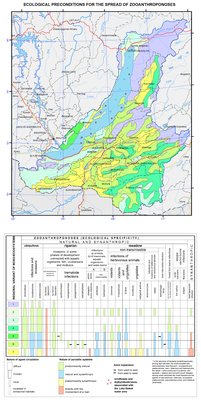
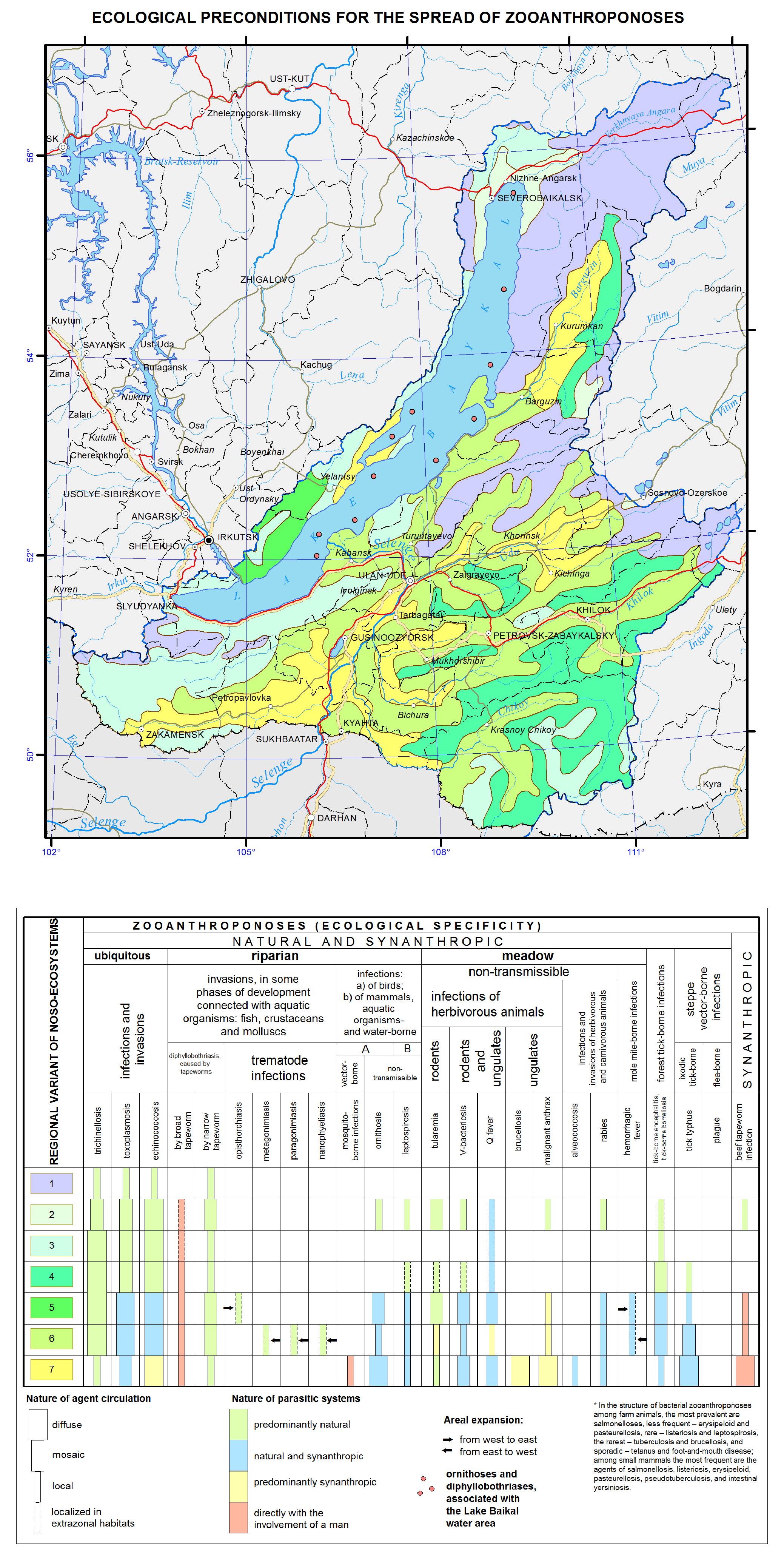
<p>The synthetic map “Environmental prerequisites of the spread of zooanthroponoses” is intended primarily for institutions working on the issues of nature conservation, environmental management, and human safety (in a broad sense of the term), as well as for the territory development planners. In the process of compiling the map, an ecological classification of zooanthroponoses was developed based on their relations with natural complexes and groups of animals. This classification subdivides them into ubiquitous (widely, almost universally spread), riparian, meadow, forest, and steppe groups. Each of these groups combines ecologically close species of pathogens with similar needs for heat and moisture and circulating in the same type of biocenosis.</p>
<p>The map shows a territorial distribution of spatial units of the nosoecological division of different taxonomic ranks: nosoecological belts, zones, and regional variants of zonal nosoecosystems. The aforementioned ecological groups of pathogens dominate in corresponding nosoecosystems of the high rank (zonal). In this case, representatives of other ecological groups are usually widespread in local habitats. The map gives a key to the development of a strategy aimed at preventing the spread of zooanthroponoses in the system of sustainable environmental management. There is a reason to believe that different ecological groups of pathogens perform different roles in maintaining the stability of biocenoses and preserving the natural environment. Representatives of the riparian and meadow groups regulate the quantitative composition of the vertebrate animals’ population (mostly rodents), stopping their mass reproduction and thus preventing the destruction of vegetation. Apparently, pathogens of the forest group (in particular, the tick-borne encephalitis virus) are able to regulate the qualitative composition of a biocenosis, protecting it from alien species, i.e. inhabitants of other (neighboring) terrain types (meadow, steppe), the number of which is subject to significant fluctuations. In seems that pathogens of the group of ubiquitous zooanthroponoses can perform various functions regulating qualitative and quantitative characteristics, but only in the group of parasites associated with vertebrates in a given biocenosis, thereby ensuring survival and well-being to their hosts.</p>
<p>These functional differences can become the basis for the development of a system of the differentiated (by landscape types) prevention of the spread of zooanthroponoses taking into account the issue of the nature and human health protection. The current level of research gives grounds to consider the regulation of the epizootic process as reasonable in those parasitic systems (riparian and meadow), where the function of pathogens is the reduction of the hosts’ number. The prevention of the spread of most zooanthroponoses (included in the riparian and meadow groups) should be carried out to optimize the density of animal population through a sustainable use of meadow vegetation by humans and the timely crops harvesting. The consequences of the human intervention in the process of circulation of pathogens regulating qualitative parameters of the structure of biocenoses are less obvious. The intensity of pathogen circulation of almost all zooanthroponoses (infections and invasions) increases in habitable and populated areas, which is due both to the introduction of farm animals, the increased concentration of which favors the development of infections, and to the human impact on the environment accompanied by the increase in the number of rodents, a change in the chemistry of soils, creation of artificial ponds, etc.</p>]]></content:encoded>
    <dc:publisher>No publisher</dc:publisher>
    <dc:creator>Alexander Ayurzhanaev</dc:creator>
    <dc:rights></dc:rights>
    <dc:date>2014-10-13T05:30:00Z</dc:date>
    <dc:type>Page</dc:type>
  </item>


  <item rdf:about="http://bic.iwlearn.org/en/atlas/atlas/96-ecological-preconditions-for-the-spread-of-zooanthroponoses-map">
    <title>096. Ecological preconditions for the spread of zooanthroponoses map</title>
    <link>http://bic.iwlearn.org/en/atlas/atlas/96-ecological-preconditions-for-the-spread-of-zooanthroponoses-map</link>
    <description></description>
    
    <dc:publisher>No publisher</dc:publisher>
    <dc:creator>Alexander Ayurzhanaev</dc:creator>
    <dc:rights></dc:rights>
    <dc:date>2014-10-13T05:20:00Z</dc:date>
    <dc:type>Folder</dc:type>
  </item>


  <item rdf:about="http://bic.iwlearn.org/en/atlas/atlas/95-disturbance-of-wildlife-map/disturbance-of-wildlife-map">
    <title>Disturbance of wildlife map</title>
    <link>http://bic.iwlearn.org/en/atlas/atlas/95-disturbance-of-wildlife-map/disturbance-of-wildlife-map</link>
    <description></description>
    <content:encoded xmlns:content="http://purl.org/rss/1.0/modules/content/"><![CDATA[<p><img class="image-inline" src="../../../resolveuid/aa5f1fc957814c299126182a77b64f96/@@images/image/preview" /></p>
<p><a href="http://bic.iwlearn.org/en/atlas/photos/copy_of__95_Disturbanceofwildlife.png" class="internal-link">Open full size</a></p>
<p align="center"><strong>Disturbance of fauna</strong></p>
<p align="center"><strong> </strong></p>
<p>The growth of industry and agriculture, increase of population and its demands from the second half of the 20th century have interfered with the Lake Baikal ecosystems, leaving very few places untouched by people’s activities. Anthropogenic impact on the wild animals of the Baikal basin was also quite considerable. Indigenous animals and intact habitats are preserved only on the restricted territories, where human activities are limited by special factors (reserve status, hard access, harsh natural conditions, etc.)</p>
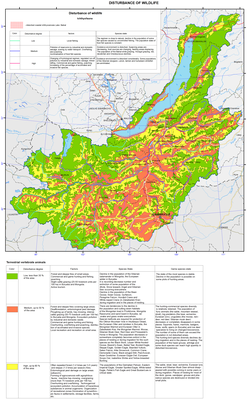
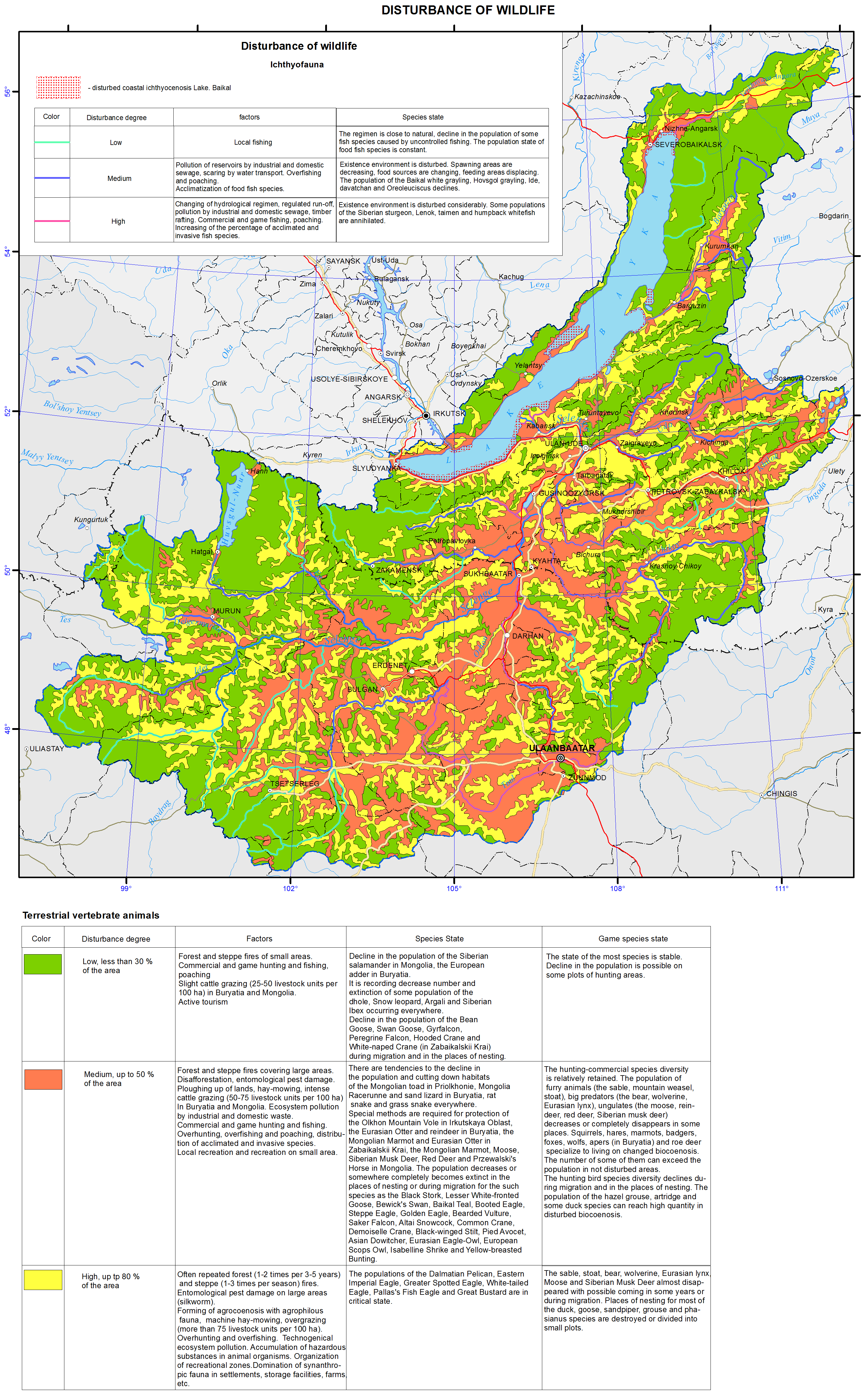
<p>The disturbance of wild animals is regarded as any change of the existing populations and communities manifested in the decrease in size, loss, and fragmentation of habitats, variations in species composition, including introduction of new species, and changes in the ecosystems. As a result, the indigenous species or communities can no longer exist [Belov et al., 2002] The disturbance of zoocenosis directly correlates with the intensity of human activities. As a rule, the mostly disturbed fauna complexes are located in the basins of major rivers, where people settled long time ago. The composition of species in these areas is represented by flexible eurytopic species, as well as synanthropic and invasive animals. Quite often the species not common for the biocenosis of some ecosystems start to dominate, when the ecosystem has been disturbed.</p>
<p>Plowing, cattle grazing, forest cuts, fires, construction works, mining, and solid and gaseous pollutant emissions influence the vertebrates fauna directly or indirectly causing changes of ecosystems, reduction in the size of animal populations, and fragmentation or full transformation of communities. Agriculture is the major factor that determines the fauna of the most part of the basin. Overgrazing and plowing deteriorate habitats, transform structure and species composition of vertebrates, and destroy nests of ground-nestling birds. Fauna complexes of the steppe zone suffer most from the abovementioned two factors. In highly degraded steppes, vertebrates are extinct almost totally. Logging and steppe and forest fires greatly affect the habitats of vertebrate animals, its species’ composition, structure, and abundance of certain species. A complex multilayered ecosystem is replaced by open spaces with altered protective, feeding, and microclimatic conditions that bring about significant changes of vertebrates. Post-fire changes in ecosystems are so drastic that restoration of certain species of vertebrates does not happen for decades.</p>
<p>Invasive alien species are justly regarded as one of the two most hazardous threats to biodiversity, coming second only to the devastation of habitats. In the XX century, intentional and unintentional introduction of various animals as a result of intensive economic activities became a global problem of the biotic exchange between biogeographical regions [Tishkov et al., 1995]. The significance of this problem has not been fully recognized yet. In the Baikal basin, the zones where fauna suffers from the introduction of alien species, are localized in the areas of long-term anthropogenic activities; however, there is a clear trend towards areal expansion of the adventive species of fauna. Introduction of alien species has an adverse impact on biodiversity and the structure and functioning of ecosystems. Synanthropes invade settlements, warehouses, industrial buildings, causing economic loss.</p>
<p><span>Diversity of fauna and the abundance of animals made hunting very attractive in the Baikal basin. As a result of long-term and intensive harvesting of birds and animals, their populations were put at risk of extinction; many of these species were listed in the regional Red Books. At present, hunting is not so popular, which has an ambiguous effect on the animal populations. Some species (Far Eastern red deer, wolf, squirrel, muskrat, Siberian striped weasel, and ermine) grow in number due to the reduced harvesting pressure and the extension of the areas disturbed by anthropogenic factor (deforested and post-fire lands). Populations of other species (roe deer, Siberian musk deer, and sable) are shrinking in size due to poaching. Hoofed mammals in Mongolia are on the margin of their habitats; therefore, their populations are rather small and require special protection and size regulation. Populations of other species are stable in size over the years, and the fluctuations are determined by natural dynamics.</span></p>
<p>Pollution and drainage of water bodies, changes in their hydrological regime due to damming, increase of water intake, disposal of wastewater by dilution, and unlimited fishing had a negative effect on the populations of many fish species, especially valuable commercial species. The rise of the Baikal water level by one meter after the construction of the Irkutsk hydro power plant reduced spawning areas of some fish species, changed nutritive base and feeding places that caused weight loss of some fish species [Monitoring …, 1991; Hydropower …, 1999] Some nestling grounds of semi-aquatic birds in the river estuaries were flooded. There is also evidence that some species of fish and freshwater seal (nerpa) accumulate heavy metals, radioactive isotopes, and chlororganic compounds [Grachev, 2002].</p>
<p>The map “Disturbance of fauna” gives an idea about the present state of the communities of the vertebrate animals in the Baikal basin. The map was created with the use of methodological guidelines for making evaluation maps developed by scientists at the V.B. Sochava Institute of Geography SB RAS [Belov et al., 2002]. The key information about the changes of the regional fauna complexes was obtained from the cartographic materials, Landsat space images, statistics on forest fires, forest cuts, and industrial pollution, and from other published materials [Atlas of the Trans-Baikal region, 1967; National atlas: Mongolian People’s Republic, 1990; Atlas of ecosystems of Mongolia, 2005]. The map was developed on the basis of vegetation maps and flora disturbance maps published in the abovementioned atlases. The map’s explanatory note distinguishes three stages of disturbance of the indigenous ecological fauna complexes and ichthyofauna. Additionally, we provide information about extinct and near-extinct vertebrate animals and primary causes of the fauna complexes’ disturbance and degradation. This map can serve as a resource for developing recommendations on the protection and rational use of the Baikal basin’s wildlife.</p>
<p> </p>
<p align="center">References</p>
<p>Atlas of the Trans-Baikal region. (1967). Moscow-Irkutsk. p 176.</p>
<p>Belov, A. V., Lyamkin, V. F., &amp; Sokolova, L. P. (2002). <i>The cartographic study of the biota</i>. Irkutsk: Oblmashinform. p 160.</p>
<p>Atutov, A. A., Pronin, N. M., &amp; Tulokhonov, A. K. (1999). <i>Hydropower industry and the ecosystem conditions of Lake Baikal</i>. Novosibirsk: SB RAS Publishing. p 281.</p>
<p>Grachev, M. A. (2002). <i>On the current state of the Baikal ecosystem</i>. Novosibirsk: SB RAS Publishing. p 156.</p>
<p>National atlas: Mongolian People’s Republic. (1990). Moscow-Ulaanbaatar. p 144.</p>
<p>Israel, Y. A., Anokhin, Y. A. (1991). <i>Monitoring of the state of Lake Baikal</i>. Leningrad: Hydrometeoizdat. p 262.</p>
<p>Tishkov, A. A., Maslyakov, V. Y., &amp; Tsarevskaya, N. G. (1995). Anthropogenic transformation of biodiversity in the process of unintentional introduction of organisms (biogeographical consequences). <i>Bulletin of the Russian Academy of Sciences: Geography</i>, 4. p 74-85.</p>
<p>Atlas of ecosystems of Mongolia. (2005). Moscow. p 48.</p>]]></content:encoded>
    <dc:publisher>No publisher</dc:publisher>
    <dc:creator>Alexander Ayurzhanaev</dc:creator>
    <dc:rights></dc:rights>
    <dc:date>2014-10-13T05:20:00Z</dc:date>
    <dc:type>Page</dc:type>
  </item>


  <item rdf:about="http://bic.iwlearn.org/en/atlas/atlas/95-disturbance-of-wildlife-map">
    <title>095. Disturbance of wildlife map</title>
    <link>http://bic.iwlearn.org/en/atlas/atlas/95-disturbance-of-wildlife-map</link>
    <description></description>
    
    <dc:publisher>No publisher</dc:publisher>
    <dc:creator>Alexander Ayurzhanaev</dc:creator>
    <dc:rights></dc:rights>
    <dc:date>2014-10-13T05:15:00Z</dc:date>
    <dc:type>Folder</dc:type>
  </item>


  <item rdf:about="http://bic.iwlearn.org/en/atlas/atlas/94-disturbance-of-forest-lands-map/disturbance-of-forest-lands-map">
    <title>Disturbance of forest lands map</title>
    <link>http://bic.iwlearn.org/en/atlas/atlas/94-disturbance-of-forest-lands-map/disturbance-of-forest-lands-map</link>
    <description></description>
    <content:encoded xmlns:content="http://purl.org/rss/1.0/modules/content/"><![CDATA[<p><img class="image-inline" src="../../../resolveuid/1511981ab9c346ecad42fcaa40699021/@@images/image/preview" /></p>
<p><a href="http://bic.iwlearn.org/en/atlas/photos/copy_of__94_DisturbanceofForestLands.png" class="internal-link">Open full size</a></p>
<p align="center"><strong>Disturbance of forest land</strong></p>
<p align="center"><strong> </strong></p>
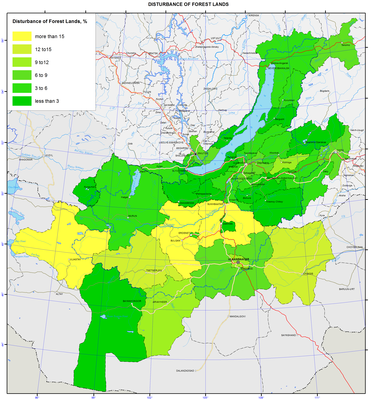
<p>Under the disturbed land we understand the value that reflects the ratio of the reforestation fund area to the area of forest lands (on the forest fund lands and other land categories, where forests are located). Reforestation Fund consolidates the areas of forest land with stands, damaged by fires, pests and logging. Forest land in contrast to non-forest one represents a category with the following main functions: cultivation, conservation, improving the properties of the main forest forming species. The major part of the forest land is forested and the rest is not covered by forest (burnt areas, dead stands, slashes, clearing sand wastelands). There the reforestation measures are conducted, thus, they contribute to natural regeneration.</p>
<p>On the territory of the Russian part of the Baikal basin, the average disturbance of forest land is 6.1%. It is fluctuating from 0.06 % in the Krasnochikoysky district of Zabaikalsky krai to 9% in the Kizhinginsky district of the Republic of Buryatia. In the Mongolian part of the basin, the disturbance of forest land is higher than in Russia – on the average 9.7%. However, in aimags it is fluctuating from 0.1 to 19.9 %. In six aimags the disturbance of forest lands is more considerable – more than 10%. Such a situation in Mongolia is possibly caused by more accurate description of forest areas with damaged forest stands.</p>]]></content:encoded>
    <dc:publisher>No publisher</dc:publisher>
    <dc:creator>Alexander Ayurzhanaev</dc:creator>
    <dc:rights></dc:rights>
    <dc:date>2014-10-13T05:10:00Z</dc:date>
    <dc:type>Page</dc:type>
  </item>


</rdf:RDF>