<?xml version="1.0" encoding="utf-8" ?>
<rdf:RDF xmlns:rdf="http://www.w3.org/1999/02/22-rdf-syntax-ns#" xmlns:dc="http://purl.org/dc/elements/1.1/" xmlns:syn="http://purl.org/rss/1.0/modules/syndication/" xmlns="http://purl.org/rss/1.0/">


<channel rdf:about="http://bic.iwlearn.org/search_rss">
  <title>Байкальский информационный центр</title>
  <link>http://bic.iwlearn.org</link>

  <description>
    
            These are the search results for the query, showing results 112 to 126.
        
  </description>


  <image rdf:resource="http://bic.iwlearn.org/logo.png"/>

  <items>
    <rdf:Seq>
      
        <rdf:li rdf:resource="http://bic.iwlearn.org/en/atlas/atlas/124-specially-protected-natural-areas-map/specially-protected-natural-areas-map"/>
      
      
        <rdf:li rdf:resource="http://bic.iwlearn.org/en/atlas/atlas/116-endangered-vegetation-communities-map/endangered-vegetation-communities-map"/>
      
      
        <rdf:li rdf:resource="http://bic.iwlearn.org/en/atlas/atlas/115-rare-species-of-vascular-plants-of-regional-conservation-map/rare-species-of-vascular-plants-of-regional-conservation-map"/>
      
      
        <rdf:li rdf:resource="http://bic.iwlearn.org/en/atlas/atlas/114-rare-species-of-vascular-plants-map/rare-species-of-vascular-plants-map"/>
      
      
        <rdf:li rdf:resource="http://bic.iwlearn.org/en/atlas/atlas/112-environmental-protection-infrastructure-map/environmental-protection-infrastructure-map"/>
      
      
        <rdf:li rdf:resource="http://bic.iwlearn.org/en/atlas/atlas/111-working-age-population-disability-map/working-age-population-disability-map"/>
      
      
        <rdf:li rdf:resource="http://bic.iwlearn.org/en/atlas/atlas/109-adult-population-disability-map/adult-population-disability-map"/>
      
      
        <rdf:li rdf:resource="http://bic.iwlearn.org/en/atlas/atlas/110-child-population-disability-map/child-population-disability-map"/>
      
      
        <rdf:li rdf:resource="http://bic.iwlearn.org/en/atlas/atlas/108-malignant-neoplasms-map/malignant-neoplasms-map"/>
      
      
        <rdf:li rdf:resource="http://bic.iwlearn.org/en/atlas/atlas/107-injuries-and-toxications-map/injuries-and-toxications-map"/>
      
      
        <rdf:li rdf:resource="http://bic.iwlearn.org/en/atlas/atlas/106-circulatory-system-diseases-map/circulatory-system-diseases-map"/>
      
      
        <rdf:li rdf:resource="http://bic.iwlearn.org/en/atlas/atlas/105-genitourinary-system-diseases-map/genitourinary-system-diseases-map"/>
      
      
        <rdf:li rdf:resource="http://bic.iwlearn.org/en/atlas/atlas/104-digestive-system-diseases-map/digestive-system-diseases-map"/>
      
      
        <rdf:li rdf:resource="http://bic.iwlearn.org/en/atlas/atlas/103-respiratory-diseases-map/respiratory-diseases-map"/>
      
      
        <rdf:li rdf:resource="http://bic.iwlearn.org/en/atlas/atlas/102-infectious-and-parasitic-diseases-map/infectious-and-parasitic-diseases-map"/>
      
    </rdf:Seq>
  </items>

</channel>


  <item rdf:about="http://bic.iwlearn.org/en/atlas/atlas/124-specially-protected-natural-areas-map/specially-protected-natural-areas-map">
    <title>Specially protected natural areas map</title>
    <link>http://bic.iwlearn.org/en/atlas/atlas/124-specially-protected-natural-areas-map/specially-protected-natural-areas-map</link>
    <description></description>
    <content:encoded xmlns:content="http://purl.org/rss/1.0/modules/content/"><![CDATA[<p><img class="image-inline" src="../../../../resolveuid/b4c32351a3474621b3176dc8d5e0a7a2/@@images/image/preview" /></p>
<p><a href="http://bic.iwlearn.org/en/photos/copy2_of__124_Speciallyprotectednaturalareas.png" class="internal-link">Open full size</a></p>
<p align="center"><strong>Protected areas</strong></p>
<p>The Baikal basin is a unique region with a high biotic and landscape diversity. Specially protected areas ensure the protection of the ecosystems of the basin.</p>
<p>The importance of the principle of territorial nature protection is shown by the history of creation of protected natural territories (PNT). The first protected area in the Baikal basin – near the Bogd mountain range – was created in 1778, which is documented in the Mongolian written sources. Barguzinsky Reserve, founded in 1916, became the first of the currently operating Russian state reserves. The international significance of PNTs in the Baikal basin is underlined by the inscription of Lake Baikal on the UNESCO World Heritage list, as well as by the inclusion of four PNTs of the basin into the network of natural biosphere reserves run by the UNESCO program “Man and Biosphere” (MAB). In the recent years, determining factors of environmental policy included the implementation of the concept of sustainable development and Convention on Biological Diversity and other international environmental conventions ratified by Russia, as well as the compliance with the requirements concerning the ecosystem of Lake Baikal as a World Heritage Site.</p>
<p>A special federal law "On the Protection of Lake Baikal" was passed by Russia to preserve the World Heritage Site. This law established two ecological zones – central and buffer zones – within the Russian part of the Baikal basin, which, in turn, is part of the Baikal Natural Territory (BNT). In order to determine the nature protection regime in each of the category of PNTs in Russia and Mongolia, quite similar laws were passed in both countries including the Russian federal law “On Specially Protected Areas” (dated March 14, 1995) and national law of Mongolia “On Specially Protected Areas” (dated November 15, 1994, entered into force on April 1, 1995) [Mongolian…, 1996]. Due to the differences in the definition, we use the general term “Protected Natural Territory” (PNT).</p>
<p>It should be noted that a significant number of PNTs are divided by the basin’s borders. Nevertheless, they are also discussed in this Atlas.</p>
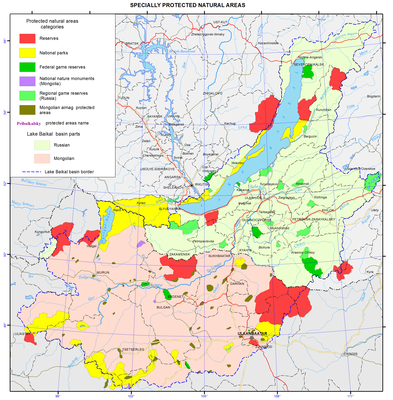
<p>The PNTs within the basin are unevenly distributed [Savenkova, 2001, 2002]. The Irkutsk part of the basin is almost completely covered by the reserve regime (Pribaikalsky National Park, Baikal-Lena Reserve, Kochergatsky wildlife refuge) and represents an almost uninterrupted protected belt along the western shore of the lake. In Buryatia, the largest protected areas are located near Lake Baikal, while the rest represent only small-sized sanctuaries. In the Zabaikalsky part of the basin, PNTs are small, but they help protect the environment at the sources of key rivers. In the Mongolian part of the basin, PNTs are distributed along the basin’s boundary. Their number in the center of the basin is small. A small national park Tuzhiyn Nars can be mentioned among them. Thus, the ecosystems in the nearest surroundings of Lake Baikal are sufficiently protected, although the PNT distribution on the rest of the basin and the protection of the lake’s water area are not always optimal.</p>
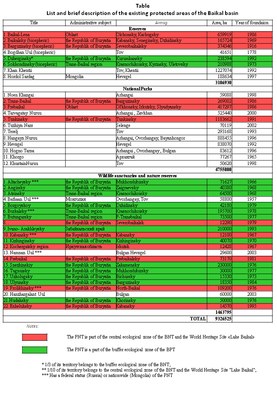
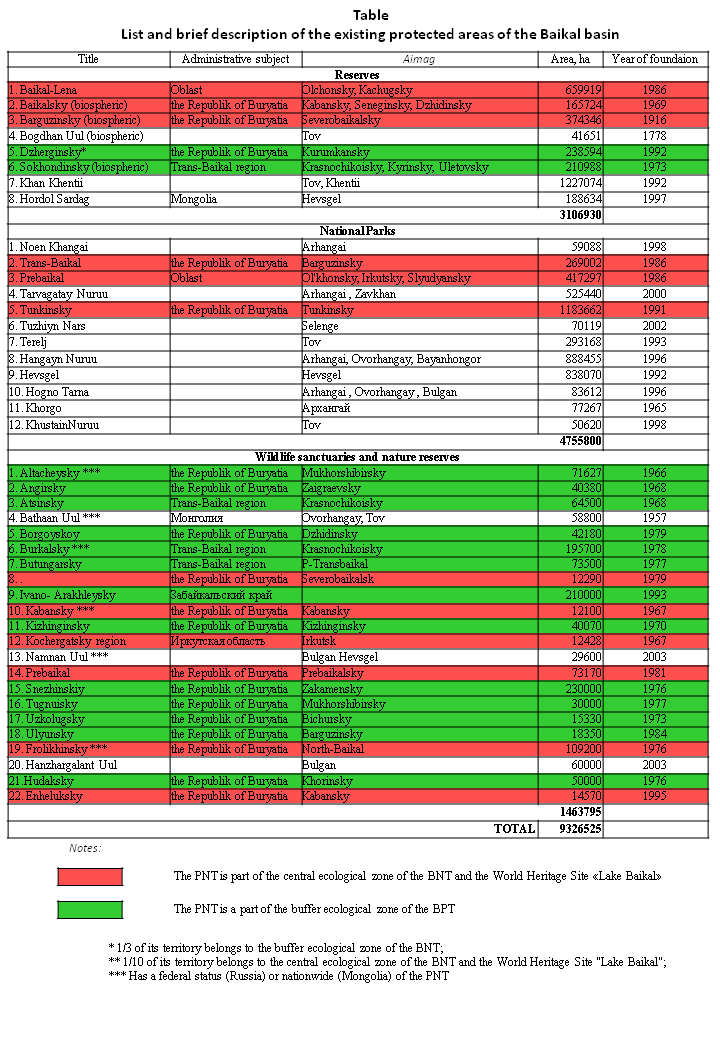
<p>As of 2009, there are 46 PNTs of the main categories (see table) with a total area of 10442,171 thousand hectares within the Baikal basin. They include 10 reserves (incl. four biosphere reserves), 13 national parks, 23 wildlife refuges and sanctuaries. Moreover, in the Russian part of the basin, there are the so-called recreational areas, which are basically PNTs under district jurisdiction. In the Mongolian part of the basin, there are PNTs under aimag jurisdiction [Mongolia’s Wild Heritage…, 1996; Mongolia’s tentative…, 1999; Savenkova, Erdentsetseg, 2000, 2002; Oyungerel, 2009]. The map also shows four National Natural Monuments of Mongolia: Khuisiin Naiman Nuur, Uran Togoo-Tulga Uul, Bulgan Uul, and Dayan Derkhi.</p>
<p><img class="image-inline" src="../../../../resolveuid/774c005a6a094dffa18ec68a945bea49/@@images/image/preview" /></p>
<p><a href="http://bic.iwlearn.org/en/photos/copy_of__124_Table.png" class="internal-link">Open full size</a></p>
<p>There are plans to create 20 new PNTs of different categories in the Baikal basin.</p>
<p>In the Russian part these will include the “Selenga Delta” (Buryatia) and “Ikh Tayrisin” (Tuva) reserves, national parks "Chikoysky" (Zabaikalsky krai) and "Onotsky" (Irkutsk oblast), wildlife sanctuaries “Verhneulkansky” (Buryatia/Irkutsk oblast), "Khila" (Buryatia/Zabaikalsky krai), "Malkhansky" (Zabaikalsky krai), "Talovsky Lakes" (Irkutsk oblast), as well as the most numerous type of PNT – natural parks "Arey", "Yamarovka" (Zabaikalsky krai), "Utulik - Babkha", "Chersky Peak", "Warm Lakes" (Irkutsk oblast), "Upper Angara", "Kurkulinsky", "Mezhdurechye", "Posolsky Sor"," Slyudyanskiye Lakes", "Tagley", "Khakusy", "Yarki" (Buryatia) [Kalikhman, 2007].</p>
<p>In the Mongolian part of the basin, 11 territories will become new PNTs, including "Burengiyn Nuruu" reserve and nature reserves "Arkhan Buural-Badaryn Nuruu", "Bohloo-Chagtayn Nuruu", "Ikh Tunel-Emged Ovgod", "Tovhonhaan uul", "TerhenTsagaan uul", "Khalkhan bulnai" [Kalikhman, 2011; Special Protected Areas…, 2000].</p>
<p>Moreover, there are plans to organize five transboundary PNTs in the basin: "The Amur Source ", "Khentei – Chikoyskoye Highlands", "Selenga", "From Khovsgol to Baikal", "Delger - Muren" [Savenkova, 2001; Oyungerel, Savenkova, 2004]. A relative similarity in the legislature concerning the PNTs in Russia and Mongolia helps coordinate their activities, as well as the general nature protection efforts on neighboring territories. It can be proved by the already operating transboundary Russian-Mongolian PNTs outside the Baikal basin: the trilateral cluster transboundary reserve "Dauria", which includes the Russian reserve "Daursky" (Zabaikalsky krai), Mongolian reserve "Mongol Daguur", and Chinese reserve "Dalainor", has been working since 1994. A cluster transboundary World Heritage Site "The Uvs Nuur Basin" was founded in 2003. It consists of 12 different areas, five of which are in Mongolia and seven – in the Republic of Tuva, Russia [Kalikhman, 2012].</p>
<p>In general, it is possible to conclude that the currently existing system of the PNTs in the Baikal basin does not fully cover the region’s ecosystems and is unevenly distributed. In this regard, an increase in the number and size of PNTs is expected in order to improve the effectiveness of conservation measures.</p>
<p align="center"> </p>
<p align="center">References</p>
<p>Kalikhman, T. P. (2007). Specially protected natural areas within the boundaries of the Baikal Natural Territory. <i>Bulletin of the Russian Academy of Sciences: Geography, 3</i>, p 75-86.</p>
<p>Kalikhman, T. P.  (2011). <i>Territorial nature protection in the Baikal region</i>. Irkutsk: IG SB RAS Publishing. p 322.</p>
<p>Savenkova, T. P. (2001). <i>Protected areas of the Baikal basin</i>. Irkutsk: IG SB RAS Publishing. p 186.</p>
<p>Savenkova, T. P. (2002). <i>Atlas o</i>f p<i>rotected areas of the Baikal basin</i>. Irkutsk: p 96.</p>
<p>Savenkova, T. P., Erdenetsetseg, D. (2000). Development of a network of protected areas within the Baikal basin in Mongolia. <i>Geography and Natural Resources, 2</i>. p 131-138.</p>
<p>Savenkova, T. P., Erdenetsetseg, D. (2002). Protected areas of the Baikal Natural Territory. <i>Gazarzuyn Asuudluud</i>, 2. p 45-53.</p>
<p>Kalikhman, T. P.  (2012). The Nature Conservation of Baikal Region: Special Natural Protected Areas System in Three Environmental Models. In J. Tiefenbacher (Ed.,), <i>Perspectives on nature conservation: Patterns, pressures and prospects</i>. Rijeka, Croatia: InTech Open Access Publisher. p 199-222.</p>
<p>Mongolian Environmental Laws. (1996). Ulaanbaatar. p 152.</p>
<p>UNESCO Beijing office, Ministry of Education of Mongolia. (1999). Mongolia’s tentative list of cultural and natural heritage.  p 54.</p>
<p>Finch, C. (1996). <i>Mongolia’s wild heritage: Biological diversity, protected areas, and conservation in the land of Chingis Khaan</i>. Boulder, CO: Avery press. p 42.</p>
<p>Оyungerel, B. (2009). Tusgai khamgaalaltai gazar nutag. Scale 1 : 5,000,000. <i>Mongol ulsyn undesniy atlas, II khevlel</i>. Ulaanbaatar. p 156-157.</p>
<p>Special Protected Areas of Mongolia. (2000). Ulaanbaatar. p 105.</p>]]></content:encoded>
    <dc:publisher>No publisher</dc:publisher>
    <dc:creator>Alexander Ayurzhanaev</dc:creator>
    <dc:rights></dc:rights>
    <dc:date>2014-10-14T08:25:00Z</dc:date>
    <dc:type>Page</dc:type>
  </item>


  <item rdf:about="http://bic.iwlearn.org/en/atlas/atlas/116-endangered-vegetation-communities-map/endangered-vegetation-communities-map">
    <title>Endangered vegetation communities map</title>
    <link>http://bic.iwlearn.org/en/atlas/atlas/116-endangered-vegetation-communities-map/endangered-vegetation-communities-map</link>
    <description></description>
    <content:encoded xmlns:content="http://purl.org/rss/1.0/modules/content/"><![CDATA[<p><img class="image-inline" src="../../../resolveuid/826a20fec52044d4ad792297140add32/@@images/image/preview" /></p>
<p><a href="http://bic.iwlearn.org/en/atlas/photos/copy_of__116_Endangeredvegetationcommunities.png" class="internal-link">Open full size</a></p>
<p align="center"><strong>Rare species of plants</strong><span> </span></p>
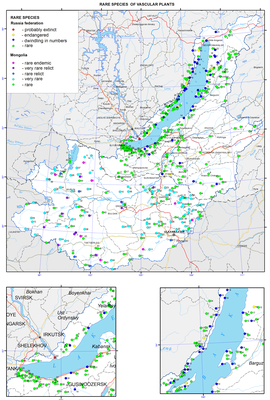
<p>The habitats of rare species of plants in the Russian and Mongolian parts of the Baikal basin are visually presented on the map “Rare species of vascular plants” using the cartographic interpretation technique. In order to create this map for the Russian part of the basin, the authors used the lists and characteristics of rare species included in the Red Book of the Russian Federation (Plants and Fungi). In this part of the basin, the map shows the habitats of 31 vascular plants (see the list) with different categories of the extinction risk according to the Red List of Threatened Species of the International Union for the Conservation of Nature. Category 0 (probably extinct, but the possibility of their preservation cannot be excluded) includes Isoetes lacustris. Category 1 (endangered) includes four species: Astragalus olchonensis, Vicia tsydenii, Festuca bargusinensis, and Viola incisa. Category 2 (decreasing in number) also includes four species: Caulinia flexilis, Hedysarum zundukii, Epipogium aphyllum, and Deschampsia turczaninowii. Category 3 (rare) includes 25 species represented by small populations that are currently not endangered and vulnerable. Often, these species are distributed within a limited area or have a narrow ecological amplitude.</p>
<p>For the map of the Mongolian part of the Baikal basin, we used information on the species composition and location of rare species of vascular plants from the electronic version of Mongolian Red Book. Habitats of 51 species are identified including a rare endemic species Saxifraga hirculus, six very rare relics: Adonis mongolica, Vicia tsydenii, Kobresia robusta, Nymphaea tetragona, Lancea tibetica, and Tulipa uniflora, as well as rare relics: Zigadenus sibiricus and Caryopteris mongolica are marked. Altogether, there are 31 very rare and 11 rare species.</p>
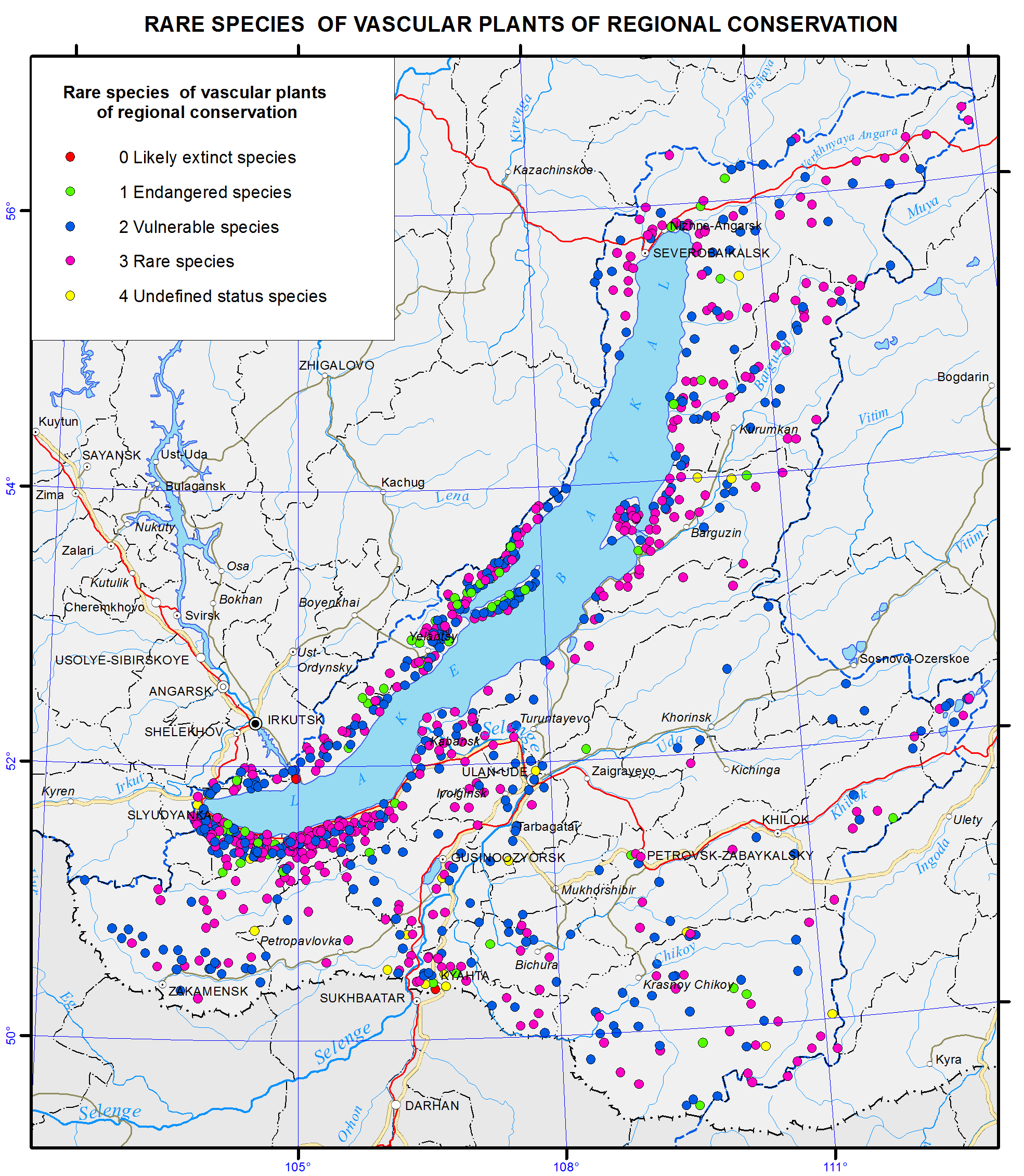
<p>The map “Rare species of vascular plants under regional protection” shows the Baikal basin’s habitats of rare species under regional protection in Irkutsk oblast (Red Book of Irkutsk oblast), Buryatia (Red Book of the Republic of Buryatia), and Zabaikalsky krai (Red Book of Chita oblast). Altogether, there are 868 habitats of 201 species of vascular plants listed in the regional Red Books and the Red Book of the Russian Federation. Species in different regions have different status depending on the state of species population. Among the regional species, Lagopsis eriostachya and Isoetes lacustris have Category 0 (probably extinct), while 28 species are endangered (Category 1).</p>
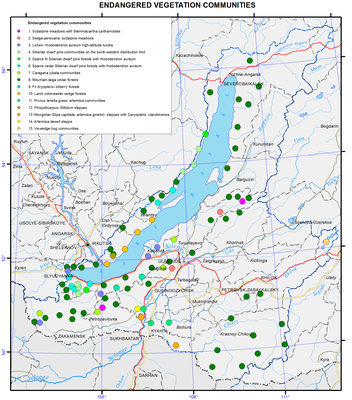
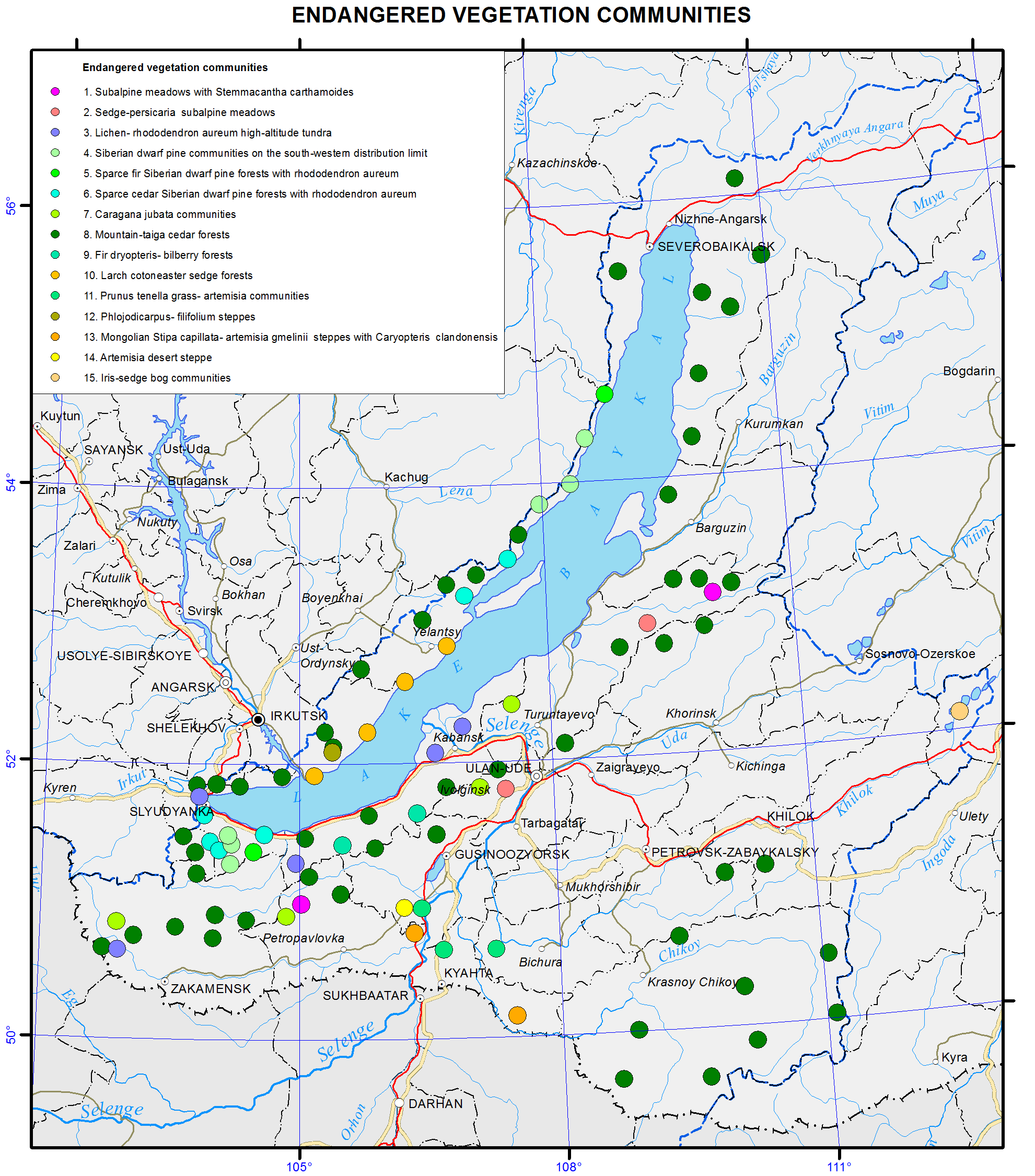
<p>The map “Plant communities requiring protection” uses conventional symbols and is created based on the information from the Green Book of Siberia, Atlas of Irkutsk Oblast, and Electronic Atlas of the Slyudyansky District. According to the Forest Code of the Russian Federation, forests under protection of Group 1 and forests in specially protected territories must be conserved in the Baikal basin because of their economic and social values. These forests serve to protect water resources, preserve the environment, and perform sanitary, hygienic, therapeutic, and other functions. The following communities also require protection due to their scientific importance as standards of indigenous vegetation: the Polygonum bistorta + Carex aterrima and Stemmacantha carthamoides meadows; Rhododendron aureum alpine tundras of the subalpine zone; Filifolium sibiricum, Festuca litvinovii, and Stipa klemenzii - S. Baicalensis - Eremogone capillaries steppes; Ulmus macrocarpa + Spiraea pubescens shrub steppe communities; Betula davurica - Artemisia desertorum + Calamagrostis brachytricha + Carex reventa forest communities; and Carex lasiocarpa + C. pseudocuraica + Iris laevigata marsh communities. Among the protected communities are very rare (Spodiopogon sibiricus; Armeniaca sibirica + Spiraea pubescens), relict (Arundinella anomala + Lespedeza hedysaroides), and unique (Stipa baicalensis + Paeonia lactiflora) communities, as well as communities located on the margins of their habitats (Pinus pumila; Caragana jubata) and reducing their habitat due to a high resource-related importance (Filifolium sibiricum + Phlojodicarpus sibiricus). The maps showing the distribution of rare vascular plant species and plant communities requiring protection can be used in the development of environmental policy aimed at optimizing nature resources management in the Baikal region to protect its biodiversity.</p>]]></content:encoded>
    <dc:publisher>No publisher</dc:publisher>
    <dc:creator>Alexander Ayurzhanaev</dc:creator>
    <dc:rights></dc:rights>
    <dc:date>2014-10-14T06:40:00Z</dc:date>
    <dc:type>Page</dc:type>
  </item>


  <item rdf:about="http://bic.iwlearn.org/en/atlas/atlas/115-rare-species-of-vascular-plants-of-regional-conservation-map/rare-species-of-vascular-plants-of-regional-conservation-map">
    <title>Rare species  of vascular plants of regional conservation map</title>
    <link>http://bic.iwlearn.org/en/atlas/atlas/115-rare-species-of-vascular-plants-of-regional-conservation-map/rare-species-of-vascular-plants-of-regional-conservation-map</link>
    <description></description>
    <content:encoded xmlns:content="http://purl.org/rss/1.0/modules/content/"><![CDATA[<p><img class="image-inline" src="../../../resolveuid/65f824963a6a48619188568105640a9e/@@images/image/preview" /></p>
<p><a href="http://bic.iwlearn.org/en/atlas/photos/copy_of__115_Rarespeciesofvascularplantsofregionalconservation.png" class="internal-link">Open full size</a></p>
<p align="center"><strong>Rare species of plants</strong></p>
<p>The habitats of rare species of plants in the Russian and Mongolian parts of the Baikal basin are visually presented on the map “Rare species of vascular plants” using the cartographic interpretation technique. In order to create this map for the Russian part of the basin, the authors used the lists and characteristics of rare species included in the Red Book of the Russian Federation (Plants and Fungi). In this part of the basin, the map shows the habitats of 31 vascular plants (see the list) with different categories of the extinction risk according to the Red List of Threatened Species of the International Union for the Conservation of Nature. Category 0 (probably extinct, but the possibility of their preservation cannot be excluded) includes Isoetes lacustris. Category 1 (endangered) includes four species: Astragalus olchonensis, Vicia tsydenii, Festuca bargusinensis, and Viola incisa. Category 2 (decreasing in number) also includes four species: Caulinia flexilis, Hedysarum zundukii, Epipogium aphyllum, and Deschampsia turczaninowii. Category 3 (rare) includes 25 species represented by small populations that are currently not endangered and vulnerable. Often, these species are distributed within a limited area or have a narrow ecological amplitude.</p>
<p>For the map of the Mongolian part of the Baikal basin, we used information on the species composition and location of rare species of vascular plants from the electronic version of Mongolian Red Book. Habitats of 51 species are identified including a rare endemic species Saxifraga hirculus, six very rare relics: Adonis mongolica, Vicia tsydenii, Kobresia robusta, Nymphaea tetragona, Lancea tibetica, and Tulipa uniflora, as well as rare relics: Zigadenus sibiricus and Caryopteris mongolica are marked. Altogether, there are 31 very rare and 11 rare species.</p>
<p>The map “Rare species of vascular plants under regional protection” shows the Baikal basin’s habitats of rare species under regional protection in Irkutsk oblast (Red Book of Irkutsk oblast), Buryatia (Red Book of the Republic of Buryatia), and Zabaikalsky krai (Red Book of Chita oblast). Altogether, there are 868 habitats of 201 species of vascular plants listed in the regional Red Books and the Red Book of the Russian Federation. Species in different regions have different status depending on the state of species population. Among the regional species, Lagopsis eriostachya and Isoetes lacustris have Category 0 (probably extinct), while 28 species are endangered (Category 1).</p>
<p>The map “Plant communities requiring protection” uses conventional symbols and is created based on the information from the Green Book of Siberia, Atlas of Irkutsk Oblast, and Electronic Atlas of the Slyudyansky District. According to the Forest Code of the Russian Federation, forests under protection of Group 1 and forests in specially protected territories must be conserved in the Baikal basin because of their economic and social values. These forests serve to protect water resources, preserve the environment, and perform sanitary, hygienic, therapeutic, and other functions. The following communities also require protection due to their scientific importance as standards of indigenous vegetation: the Polygonum bistorta + Carex aterrima and Stemmacantha carthamoides meadows; Rhododendron aureum alpine tundras of the subalpine zone; Filifolium sibiricum, Festuca litvinovii, and Stipa klemenzii - S. Baicalensis - Eremogone capillaries steppes; Ulmus macrocarpa + Spiraea pubescens shrub steppe communities; Betula davurica - Artemisia desertorum + Calamagrostis brachytricha + Carex reventa forest communities; and Carex lasiocarpa + C. pseudocuraica + Iris laevigata marsh communities. Among the protected communities are very rare (Spodiopogon sibiricus; Armeniaca sibirica + Spiraea pubescens), relict (Arundinella anomala + Lespedeza hedysaroides), and unique (Stipa baicalensis + Paeonia lactiflora) communities, as well as communities located on the margins of their habitats (Pinus pumila; Caragana jubata) and reducing their habitat due to a high resource-related importance (Filifolium sibiricum + Phlojodicarpus sibiricus). The maps showing the distribution of rare vascular plant species and plant communities requiring protection can be used in the development of environmental policy aimed at optimizing nature resources management in the Baikal region to protect its biodiversity.</p>]]></content:encoded>
    <dc:publisher>No publisher</dc:publisher>
    <dc:creator>Alexander Ayurzhanaev</dc:creator>
    <dc:rights></dc:rights>
    <dc:date>2014-10-14T06:35:00Z</dc:date>
    <dc:type>Page</dc:type>
  </item>


  <item rdf:about="http://bic.iwlearn.org/en/atlas/atlas/114-rare-species-of-vascular-plants-map/rare-species-of-vascular-plants-map">
    <title>Rare species  of vascular plants map</title>
    <link>http://bic.iwlearn.org/en/atlas/atlas/114-rare-species-of-vascular-plants-map/rare-species-of-vascular-plants-map</link>
    <description></description>
    <content:encoded xmlns:content="http://purl.org/rss/1.0/modules/content/"><![CDATA[<p><img class="image-inline" src="../../../resolveuid/f652d6387855449db8e53fb43bcccea5/@@images/image/preview" /></p>
<p><a href="http://bic.iwlearn.org/en/atlas/photos/copy_of__114_Rarespeciesofvascularplants.png" class="internal-link">Open full size</a></p>
<p><b>Rare species of vascular plants</b></p>
<p>RUSSIA</p>
<p>1. Astragalusolchonensis</p>
<p>2. Borodinia macrophylla</p>
<p>3. Cypripediym ventricosum</p>
<p>4. Cypripedium macranthon</p>
<p>5. Cypripedium calceolus</p>
<p>6. Anemone baikalensis</p>
<p>7. Vicia tsydenii</p>
<p>8. Calypso bulbosa</p>
<p>9. Caulinia flexilis</p>
<p>10. Cotoneaster lucidus</p>
<p>11. Stipa pennata</p>
<p>12. Hedysarum zundukii</p>
<p>13. Astragalus olchonensis</p>
<p>14. Deschampsia turczaninowii</p>
<p>15. Mertensia serrulata</p>
<p>16. Epipogium aphyllum</p>
<p>17. Neottianthe cucullata</p>
<p>18. Festuca bargusinensis</p>
<p>19. Caryopteris mongholica</p>
<p>20. Oxytropis triphylla</p>
<p>21. Primula pinnata</p>
<p>22. Isoёtes lacustris</p>
<p>23. Isoёtes setacea</p>
<p>24. Rhodiola rosea</p>
<p>25. Fritillaria dagana</p>
<p>26. Swertia baicalensis</p>
<p>27. Aegopodium latifolium</p>
<p>28. Stemmacantha carthamoides</p>
<p>29. Tridactylina kirilowii</p>
<p>30. Viola incise</p>
<p>31. Orchis militaris</p>
<p><i> </i></p>
<p> </p>
<p>MONGOLIA</p>
<p>1. Saxifraga hirculus</p>
<p>2.Adonis mongolica</p>
<p>3.Vicia tsydenii</p>
<p>4.Kobresia robusta</p>
<p>5.Nymphaea tetragona</p>
<p>6. Lancea tibetica</p>
<p>7. Tulipa uniflora</p>
<p>8.Zigadenus sibiricus</p>
<p>9.Caryopteris mongolica</p>
<p>10. Acorus calamus</p>
<p>11.Sambucus manshurica</p>
<p>12. Gentiana algida</p>
<p>13.Botrychium lanceolatum</p>
<p>14.Neottia camtschatea</p>
<p>15.Neottianthe cucullata</p>
<p>16.Lycopodium  alpinum</p>
<p>17. Pinus pumila</p>
<p>18.Convallaria keiskei</p>
<p>19.Lilium dahuricum</p>
<p>20.Platanthera bifolia</p>
<p>21.Juniperus sabina</p>
<p>22.Mitella nuda</p>
<p>23.Epipogium aphyllum</p>
<p>24.Carex parva</p>
<p>25.Carex selengensis</p>
<p>26.Oxytropis acanthacea</p>
<p>27.Orchis   fuchsia</p>
<p>28. Abies sibirica</p>
<p>29.Lycopodium clavatum</p>
<p>30. Physochlana albiflora</p>
<p>31. Drosera anglica</p>
<p>32.Rhodiola rosea</p>
<p>33.Drosera rotundifolia</p>
<p>34.Rhododendron  adamsii</p>
<p>35.Rhododendron dauricum</p>
<p>36.Rhododendron aureum</p>
<p>37.Rhododendron ledebourii</p>
<p>38.Rhododendron parvifolium</p>
<p>39.Vaccinium myrtilus</p>
<p>40. Orchis militars</p>
<p>41. Adonis sibirica</p>
<p>42.Valeriana  officinalis</p>
<p>43.Stellaria dichotoma.</p>
<p>44. Aium altaicum</p>
<p>45.Juniperus pseudosabina</p>
<p>46.Melica nutans</p>
<p>47. Lycopodium complanatum</p>
<p>48.Paeonia anomala</p>
<p>49.Saussurea dorogostaiskii</p>
<p>50.Saussurea involucrate</p>
<p>51. Ephedra equisetina</p>
<p> </p>
<p align="center"><b>Rare species of plants</b><span> </span></p>
<p>The habitats of rare species of plants in the Russian and Mongolian parts of the Baikal basin are visually presented on the map “Rare species of vascular plants” using the cartographic interpretation technique. In order to create this map for the Russian part of the basin, the authors used the lists and characteristics of rare species included in the Red Book of the Russian Federation (Plants and Fungi). In this part of the basin, the map shows the habitats of 31 vascular plants (see the list) with different categories of the extinction risk according to the Red List of Threatened Species of the International Union for the Conservation of Nature. Category 0 (probably extinct, but the possibility of their preservation cannot be excluded) includes Isoetes lacustris. Category 1 (endangered) includes four species: Astragalus olchonensis, Vicia tsydenii, Festuca bargusinensis, and Viola incisa. Category 2 (decreasing in number) also includes four species: Caulinia flexilis, Hedysarum zundukii, Epipogium aphyllum, and Deschampsia turczaninowii. Category 3 (rare) includes 25 species represented by small populations that are currently not endangered and vulnerable. Often, these species are distributed within a limited area or have a narrow ecological amplitude.</p>
<p>For the map of the Mongolian part of the Baikal basin, we used information on the species composition and location of rare species of vascular plants from the electronic version of Mongolian Red Book. Habitats of 51 species are identified including a rare endemic species Saxifraga hirculus, six very rare relics: Adonis mongolica, Vicia tsydenii, Kobresia robusta, Nymphaea tetragona, Lancea tibetica, and Tulipa uniflora, as well as rare relics: Zigadenus sibiricus and Caryopteris mongolica are marked. Altogether, there are 31 very rare and 11 rare species.</p>
<p>The map “Rare species of vascular plants under regional protection” shows the Baikal basin’s habitats of rare species under regional protection in Irkutsk oblast (Red Book of Irkutsk oblast), Buryatia (Red Book of the Republic of Buryatia), and Zabaikalsky krai (Red Book of Chita oblast). Altogether, there are 868 habitats of 201 species of vascular plants listed in the regional Red Books and the Red Book of the Russian Federation. Species in different regions have different status depending on the state of species population. Among the regional species, Lagopsis eriostachya and Isoetes lacustris have Category 0 (probably extinct), while 28 species are endangered (Category 1).</p>
<p>The map “Plant communities requiring protection” uses conventional symbols and is created based on the information from the Green Book of Siberia, Atlas of Irkutsk Oblast, and Electronic Atlas of the Slyudyansky District. According to the Forest Code of the Russian Federation, forests under protection of Group 1 and forests in specially protected territories must be conserved in the Baikal basin because of their economic and social values. These forests serve to protect water resources, preserve the environment, and perform sanitary, hygienic, therapeutic, and other functions. The following communities also require protection due to their scientific importance as standards of indigenous vegetation: the Polygonum bistorta + Carex aterrima and Stemmacantha carthamoides meadows; Rhododendron aureum alpine tundras of the subalpine zone; Filifolium sibiricum, Festuca litvinovii, and Stipa klemenzii - S. Baicalensis - Eremogone capillaries steppes; Ulmus macrocarpa + Spiraea pubescens shrub steppe communities; Betula davurica - Artemisia desertorum + Calamagrostis brachytricha + Carex reventa forest communities; and Carex lasiocarpa + C. pseudocuraica + Iris laevigata marsh communities. Among the protected communities are very rare (Spodiopogon sibiricus; Armeniaca sibirica + Spiraea pubescens), relict (Arundinella anomala + Lespedeza hedysaroides), and unique (Stipa baicalensis + Paeonia lactiflora) communities, as well as communities located on the margins of their habitats (Pinus pumila; Caragana jubata) and reducing their habitat due to a high resource-related importance (Filifolium sibiricum + Phlojodicarpus sibiricus). The maps showing the distribution of rare vascular plant species and plant communities requiring protection can be used in the development of environmental policy aimed at optimizing nature resources management in the Baikal region to protect its biodiversity.</p>]]></content:encoded>
    <dc:publisher>No publisher</dc:publisher>
    <dc:creator>Alexander Ayurzhanaev</dc:creator>
    <dc:rights></dc:rights>
    <dc:date>2014-10-14T06:30:00Z</dc:date>
    <dc:type>Page</dc:type>
  </item>


  <item rdf:about="http://bic.iwlearn.org/en/atlas/atlas/112-environmental-protection-infrastructure-map/environmental-protection-infrastructure-map">
    <title>Environmental protection infrastructure map</title>
    <link>http://bic.iwlearn.org/en/atlas/atlas/112-environmental-protection-infrastructure-map/environmental-protection-infrastructure-map</link>
    <description></description>
    <content:encoded xmlns:content="http://purl.org/rss/1.0/modules/content/"><![CDATA[<p><img class="image-inline" src="../../../resolveuid/5ddf580d230f4a738c712732281c8455/@@images/image/preview" /></p>
<p><a href="http://bic.iwlearn.org/en/atlas/photos/copy_of__112_Environmentalprotectioninfrastructure.png" class="internal-link">Open full size</a></p>
<p align="center"><strong>Environment-protective infrastructure </strong></p>
<p align="center"><strong> </strong></p>
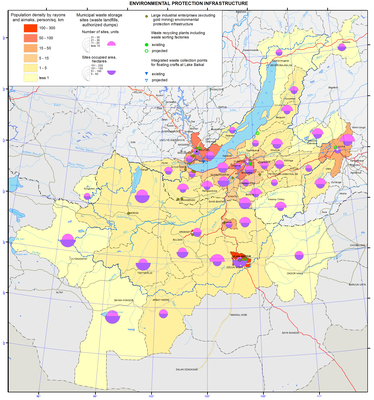
<p>The environment-protection infrastructure (EPI) is a component of ecological infrastructure and the most important sector of the current economic complex of the territory. The basic function of the EPI is to minimize the effect on the environment of deposited and utilized wastes (on the territory), discharges (into water bodies), production and consumer emissions (into the atmosphere), provided there is a developed selective (separate) collection of the secondary material resources. The EPI activity helps preserve a favorable environment for humans and use the territory’s resources in a rational manner. This map reflects only the EPI that deals with solid production and consumer wastes, with the latter often referred to as “municipal wastes” in the international practice.</p>
<p>The database includes the data of territorial offices of the Ministry of Natural Resources of Russia, the Russian governmental report on the state of Lake Baikal and measures for its protection (2013), Ministry of Nature, Environment and Tourism of Mongolia (2012), as well as project materials of regional development initiatives. It should be noted that the register of sites for storing (stockpiling or deposition) and burying of production and consumer wastes for individual regions is far from complete (based on  Form 2-TP (Wastes)).</p>
<p>In the Baikal catchment zone (in the lower level administrative districts of the Russian part and aimags in Mongolia), the annual volume of production and consumer waste reaches about 86 million tons. The majority of these wastes goes to the EPI facilities of production enterprises (sludge dumps, tailings ponds, mining waste piles, slag and ash dumps, etc.) and municipalities (predominantly waste dumps and landfills). The official statistics recorded over 600 sites for depositing waste. There is a waste recycling plant (WRP) in Ulan-Ude. There are plans to build three more WRPs (Irkutsk, Ulaanbaatar, and the Special Economic Zone “Baikal Harbor” in the Republic of Buryatia), a waste sorting plant in Chita (Zabaikalsky krai), and several waste collection facilities for processing waste from ships on Lake Baikal.</p>
<p>The total volume of production and consumer waste generation in the Baikal basin is growing annually. The leader is Zabaikalsky krai with almost 2/3 of all registered wastes in the Baikal basin. Irkutsk oblast is leading in terms of the speed of waste generation per unit of Gross Regional Product (tons/million rubles). In terms of the number of registered EPI facilities and their area, Mongolia tops the list, with Buryatia being the second, which corresponds to the territory they occupy in the Baikal basin. The average size of EPI facilities of municipalities and aimags is 4.3 hectares. The size of EPI facilities of Mongolian aimags (6.3 ha) exceeds this indicator by almost 1.5 times, while the size of such facilities in Irkutsk oblast exceeds the average by 1.3 times. There are plans to restart the selective (separate) collection of the utilized portion of generated consumer wastes in the future, which will significantly reduce the size of authorized waste dumps and landfills, as well as numerous unauthorized landfills of solid consumer wastes.</p>
<p>By the structure of economic activity, mining wastes and wastes generated by the thermal power sector make up the largest share in the total volume of generated waste (in Zabaikalsky krai, Irkutsk oblast, and Buryatia their share is over 90%). Wastes of mining companies weighing millions of tons, as well as construction wastes, slag, and ash are classified as Class V by their hazard impact on the environment (not dangerous or low-hazard wastes).</p>
<p> </p>
<p align="center">Reference:</p>
<p>Rosgeolfond. Siberian Branch. (2013). <i>On the state of Lake Baikal and measures for its protection in 2012: State report. </i>Irkutsk: Rosgeolfond. p 436.</p>]]></content:encoded>
    <dc:publisher>No publisher</dc:publisher>
    <dc:creator>Alexander Ayurzhanaev</dc:creator>
    <dc:rights></dc:rights>
    <dc:date>2014-10-14T05:55:00Z</dc:date>
    <dc:type>Page</dc:type>
  </item>


  <item rdf:about="http://bic.iwlearn.org/en/atlas/atlas/111-working-age-population-disability-map/working-age-population-disability-map">
    <title>Working-age population disability map</title>
    <link>http://bic.iwlearn.org/en/atlas/atlas/111-working-age-population-disability-map/working-age-population-disability-map</link>
    <description></description>
    <content:encoded xmlns:content="http://purl.org/rss/1.0/modules/content/"><![CDATA[<p><img class="image-inline" src="../../../resolveuid/9fa73668abee4a6dbb7645f7037df021/@@images/image/preview" /></p>
<p><a href="http://bic.iwlearn.org/en/atlas/photos/copy_of__111_Workingagepopulationdisability.png" class="internal-link">Open full size</a></p>
<p align="center"><strong>Healthcare</strong><strong> </strong></p>
<p align="center"><strong> </strong></p>
<p>Harsh climatic conditions across the entire territory of the Baikal basin and the surface and ground water used for drinking and food purposes that do not meet the drinking water quality standards (first and foremost in Mongolia and Buryatia) coupled with atmospheric emissions from industrial facilities and motor vehicles (in some parts of the territory) are responsible for the state of human health influencing the organization of healthcare. The ecological situation becomes substantially worse during winter months, which is encouraged by the topography of the terrain. In Mongolia, the spring period is very hard time to bear, with sharp temperature differences, abrupt variations in atmospheric pressure, and frequent dust and magnetic storms.</p>
<p class="NormalWeb">The organizational pattern of healthcare in Russia and Mongolia has much in common. This is a result of the cooperation of the two countries in this sphere and the fact that medical education and healthcare in Mongolia are organized using Russian experience. Today, Mongolian medical facilities operate on the principles of the state-private partnership concurrent with the demonopolization of the state system of medical services. The country has a mandatory and voluntary medical insurance system, in which state-owned and private medical institutions take part. The country also has various health institutes and centers.</p>
<p class="a">The territory of the Baikal basin is experiencing a deficit of medical workers. As of 2012, the availability of physicians varied from 13.8 to 30.1 per 10,000 people in Russian districts and from 16.1 to 29.0 per 10,000 people in Mongolian aimags. The availability of nurses varies from 25.1 to 112.2 per 10,000 people in Russian districts and from 26.4 to 38.2 per 10,000 people in Mongolian aimags. In Ulan-Ude, these indicators have the values of 53.9 and 117.3, while in Ulaanbaatar – 44.1 and 41.2, respectively.</p>
<p>The ratio of doctors and nurses in the Russian part of the basin is between 1:2 to 1:4, while in the Mongolian part it does not exceed 1:2. The World Health Organization (WHO) recommends that this ratio should be 1:4. A narrowing of this indicator causes imbalances in the healthcare system thereby limiting possibilities for further development of the after-treatment, casework and rehabilitation services.</p>
<p>Target indicators of healthcare activity are the standard volume of medical care per inhabitant. Currently, there are plans to decrease the per capita volume of in-patient services and increase the per capita volume of the hospital-replacing care. Accordingly, the number of hospital beds available 27/7 will decrease, while the number of beds in day hospitals will grow. Overall, the available number of hospital beds complies with the calculated standards and meets the demand of the population for the in-patient medical aid.</p>
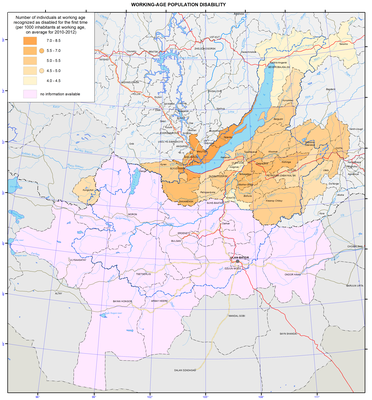
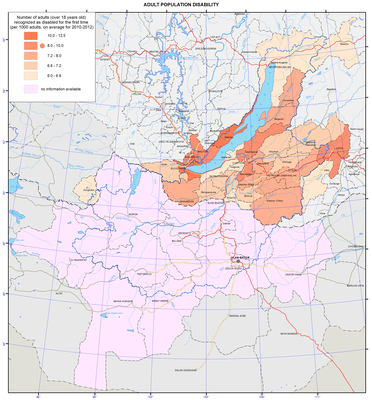
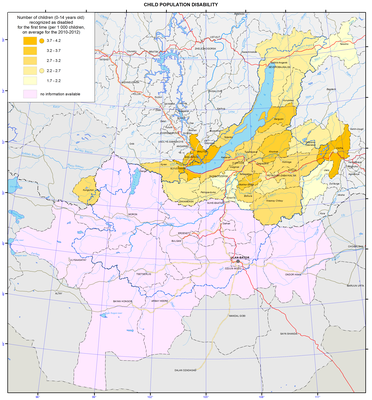
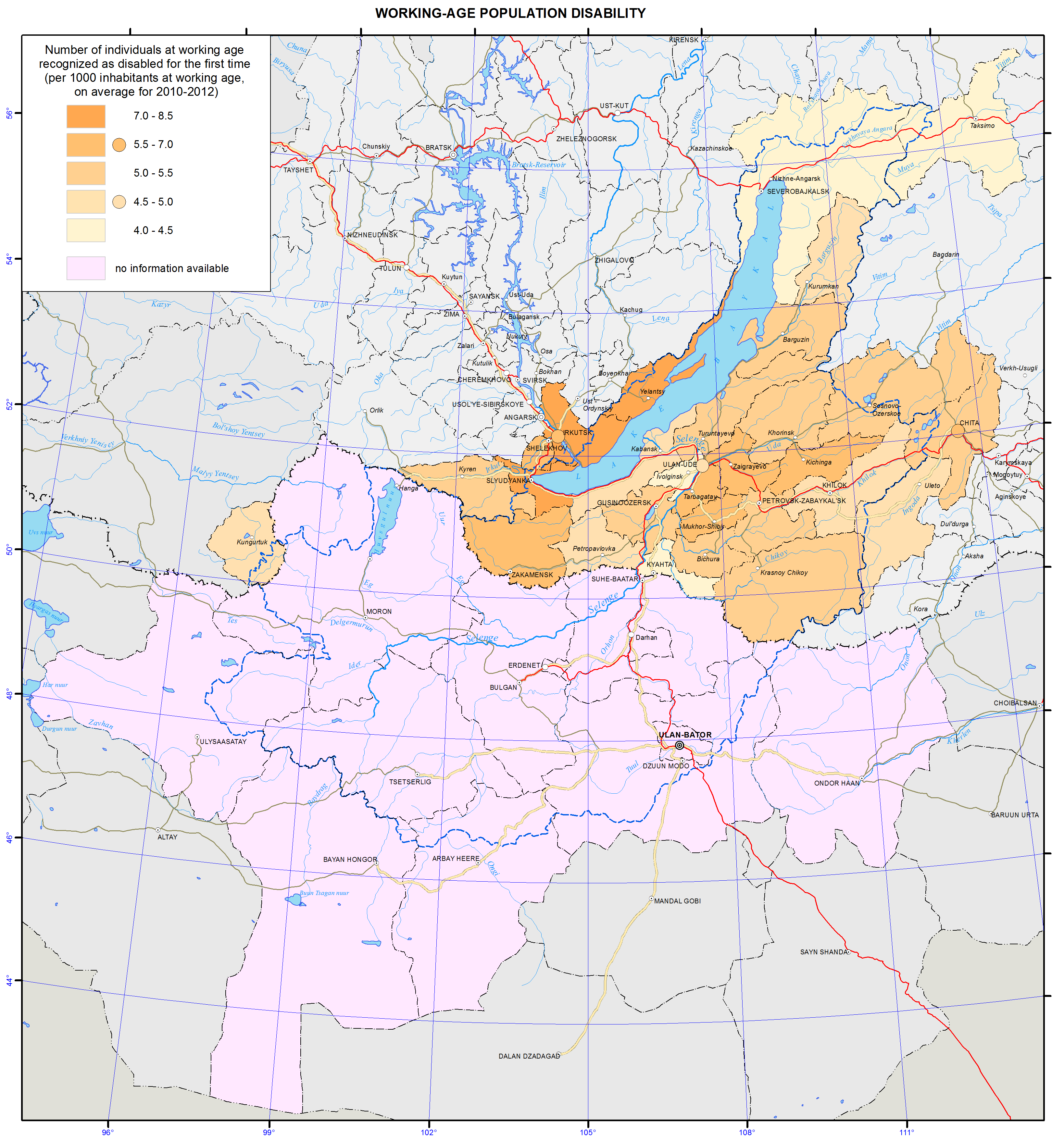
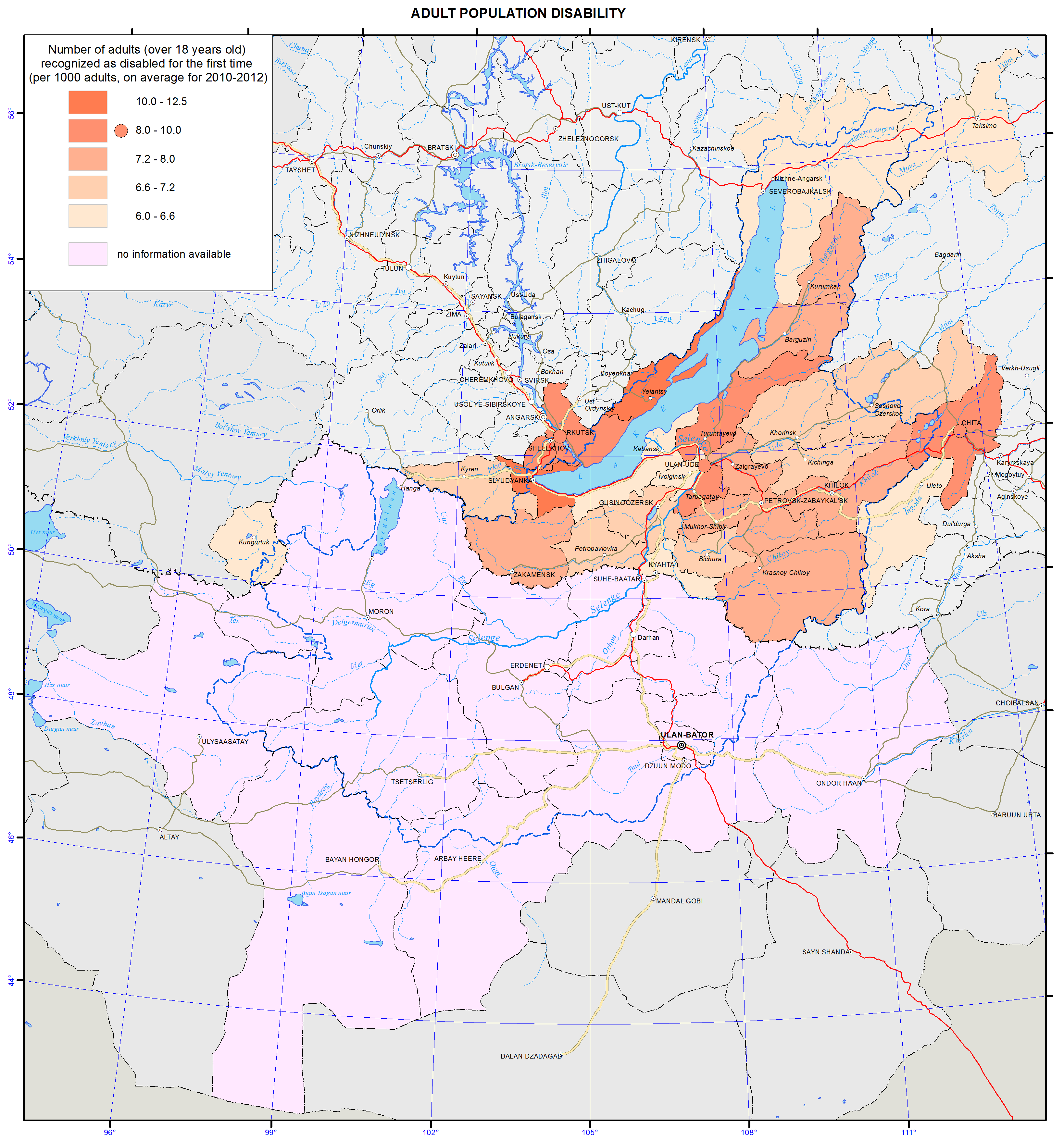
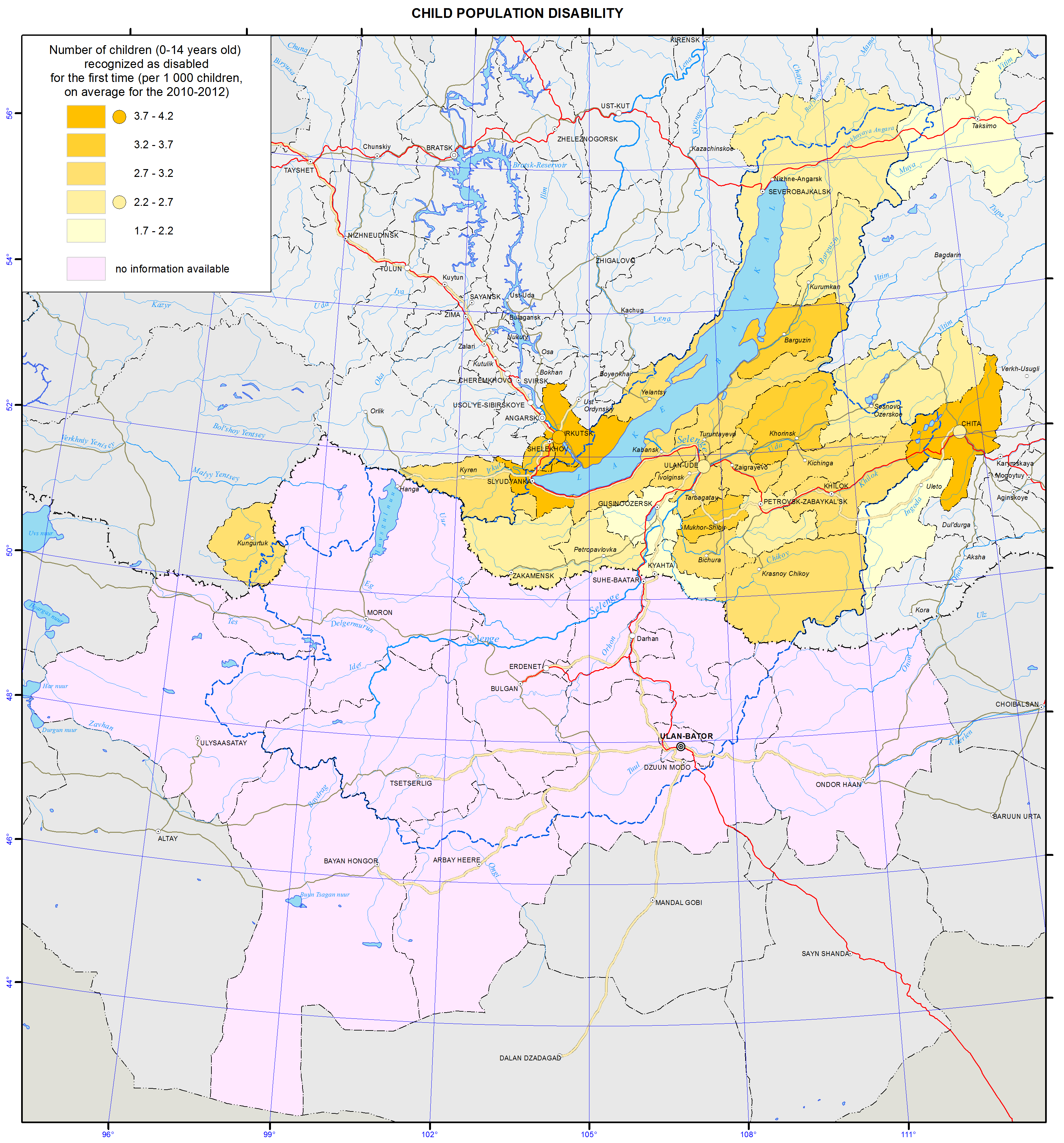
<p class="ConsPlusNormal">As of today, in Russia, there is an array of problems relating to the high level of illnesses and disability incidences among the population, and these indicators are continuously growing. Such a situation is the result of inadequate preventive measures. Another important contributing factor to this situation is the increase of the proportion of elderly population and the improved effectiveness of illness detection using new diagnostic methods in the process of the increased number of medical checkups.</p>
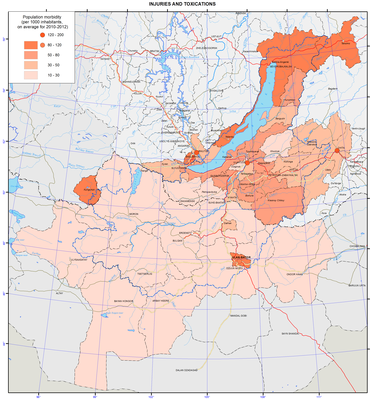
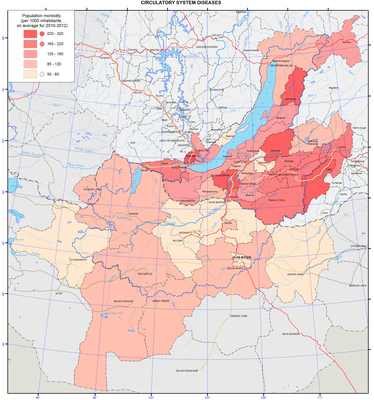
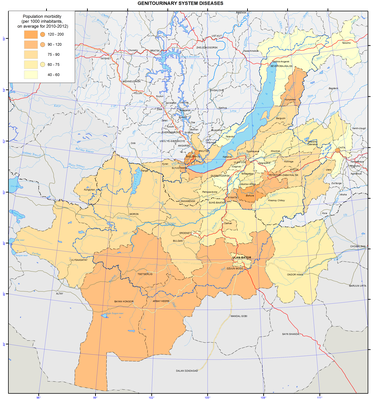
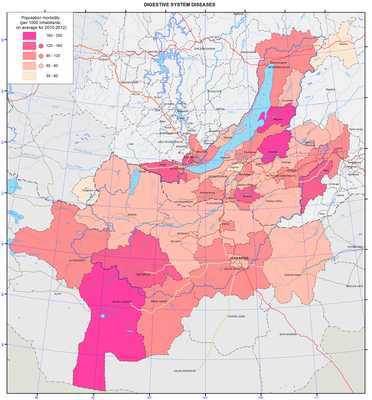
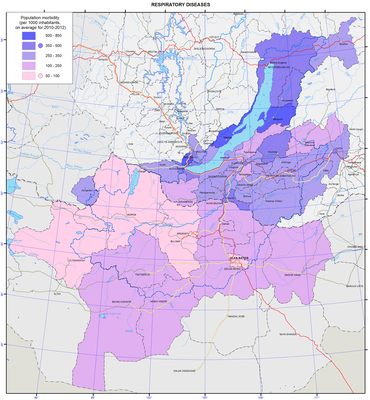
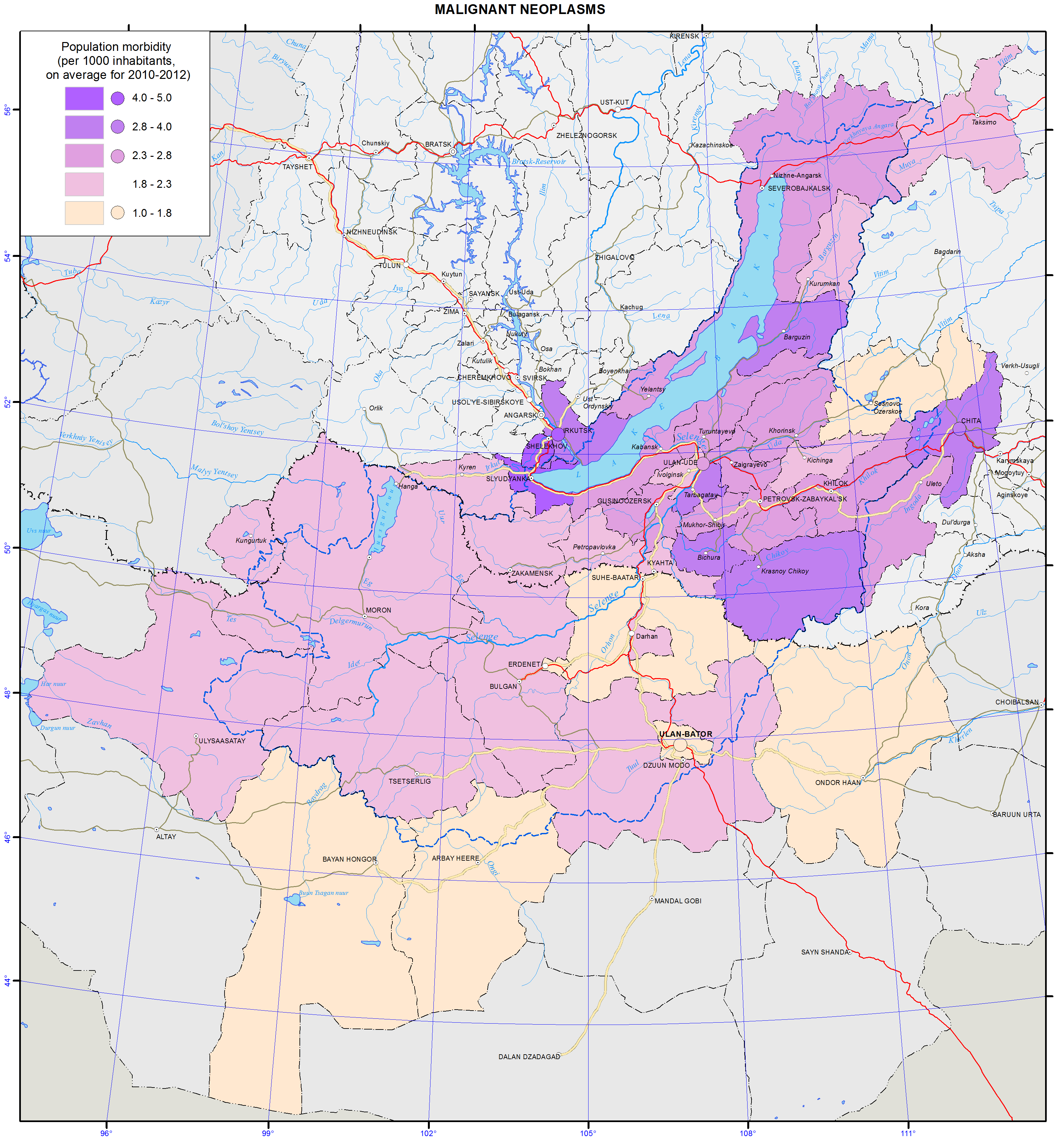
<p class="ConsPlusNormal">The leading illnesses in the structure of morbidity are respiratory illnesses, bloodstream, eye, and digestive and musculoskeletal system diseases, as well as traumas. For many years, circulatory system diseases, neoplasms, and injuries have been the main causes of mortality and disability among the population.</p>
<p class="a">A complex of anthropogenic environmental factors contributes to the growth of morbidity and disability rates among the population with the most important one being air pollution. According to the WHO, atmospheric air pollution is the cause of up to 23% of all illnesses. The amount of pollutant emissions in the atmosphere produced by static sources in different administrative divisions in the Baikal basin differs by more than a thousand times. The most polluted air in the Baikal basin is in the Selenginsky district of Buryatia.</p>
<p>The health of the population and further development of healthcare depend on ecological, social, and economic factors. These problems can be resolved only through comprehensive approaches to the improvement of the quality of life of the population.</p>
<p>The strategic goal of the healthcare systems of Russia and Mongolia is to build a system, which ensures the quality and accessibility of medical services, primarily first aid, and increases the efficiency of medical services, based on the improvement of territorial planning of healthcare. The volume, types, and quality of these services should correspond to the rate of morbidity, population requirements, and the latest achievements of medical science, based on perfecting the system of territorial planning of public health services.</p>]]></content:encoded>
    <dc:publisher>No publisher</dc:publisher>
    <dc:creator>Alexander Ayurzhanaev</dc:creator>
    <dc:rights></dc:rights>
    <dc:date>2014-10-14T03:10:00Z</dc:date>
    <dc:type>Page</dc:type>
  </item>


  <item rdf:about="http://bic.iwlearn.org/en/atlas/atlas/109-adult-population-disability-map/adult-population-disability-map">
    <title>Adult population disability map</title>
    <link>http://bic.iwlearn.org/en/atlas/atlas/109-adult-population-disability-map/adult-population-disability-map</link>
    <description></description>
    <content:encoded xmlns:content="http://purl.org/rss/1.0/modules/content/"><![CDATA[<p><img class="image-inline" src="../../../resolveuid/3c939443aad74b3fa512b9b6ec48d3b4/@@images/image/preview" /></p>
<p><a href="http://bic.iwlearn.org/en/atlas/photos/copy_of__109_Adultpopulationdisability.png" class="internal-link">Open full size</a></p>
<p align="center"><strong>Healthcare</strong><strong> </strong></p>
<p align="center"><strong> </strong></p>
<p>Harsh climatic conditions across the entire territory of the Baikal basin and the surface and ground water used for drinking and food purposes that do not meet the drinking water quality standards (first and foremost in Mongolia and Buryatia) coupled with atmospheric emissions from industrial facilities and motor vehicles (in some parts of the territory) are responsible for the state of human health influencing the organization of healthcare. The ecological situation becomes substantially worse during winter months, which is encouraged by the topography of the terrain. In Mongolia, the spring period is very hard time to bear, with sharp temperature differences, abrupt variations in atmospheric pressure, and frequent dust and magnetic storms.</p>
<p class="NormalWeb">The organizational pattern of healthcare in Russia and Mongolia has much in common. This is a result of the cooperation of the two countries in this sphere and the fact that medical education and healthcare in Mongolia are organized using Russian experience. Today, Mongolian medical facilities operate on the principles of the state-private partnership concurrent with the demonopolization of the state system of medical services. The country has a mandatory and voluntary medical insurance system, in which state-owned and private medical institutions take part. The country also has various health institutes and centers.</p>
<p class="a">The territory of the Baikal basin is experiencing a deficit of medical workers. As of 2012, the availability of physicians varied from 13.8 to 30.1 per 10,000 people in Russian districts and from 16.1 to 29.0 per 10,000 people in Mongolian aimags. The availability of nurses varies from 25.1 to 112.2 per 10,000 people in Russian districts and from 26.4 to 38.2 per 10,000 people in Mongolian aimags. In Ulan-Ude, these indicators have the values of 53.9 and 117.3, while in Ulaanbaatar – 44.1 and 41.2, respectively.</p>
<p>The ratio of doctors and nurses in the Russian part of the basin is between 1:2 to 1:4, while in the Mongolian part it does not exceed 1:2. The World Health Organization (WHO) recommends that this ratio should be 1:4. A narrowing of this indicator causes imbalances in the healthcare system thereby limiting possibilities for further development of the after-treatment, casework and rehabilitation services.</p>
<p>Target indicators of healthcare activity are the standard volume of medical care per inhabitant. Currently, there are plans to decrease the per capita volume of in-patient services and increase the per capita volume of the hospital-replacing care. Accordingly, the number of hospital beds available 27/7 will decrease, while the number of beds in day hospitals will grow. Overall, the available number of hospital beds complies with the calculated standards and meets the demand of the population for the in-patient medical aid.</p>
<p class="ConsPlusNormal">As of today, in Russia, there is an array of problems relating to the high level of illnesses and disability incidences among the population, and these indicators are continuously growing. Such a situation is the result of inadequate preventive measures. Another important contributing factor to this situation is the increase of the proportion of elderly population and the improved effectiveness of illness detection using new diagnostic methods in the process of the increased number of medical checkups.</p>
<p class="ConsPlusNormal">The leading illnesses in the structure of morbidity are respiratory illnesses, bloodstream, eye, and digestive and musculoskeletal system diseases, as well as traumas. For many years, circulatory system diseases, neoplasms, and injuries have been the main causes of mortality and disability among the population.</p>
<p class="a">A complex of anthropogenic environmental factors contributes to the growth of morbidity and disability rates among the population with the most important one being air pollution. According to the WHO, atmospheric air pollution is the cause of up to 23% of all illnesses. The amount of pollutant emissions in the atmosphere produced by static sources in different administrative divisions in the Baikal basin differs by more than a thousand times. The most polluted air in the Baikal basin is in the Selenginsky district of Buryatia.</p>
<p>The health of the population and further development of healthcare depend on ecological, social, and economic factors. These problems can be resolved only through comprehensive approaches to the improvement of the quality of life of the population.</p>
<p>The strategic goal of the healthcare systems of Russia and Mongolia is to build a system, which ensures the quality and accessibility of medical services, primarily first aid, and increases the efficiency of medical services, based on the improvement of territorial planning of healthcare. The volume, types, and quality of these services should correspond to the rate of morbidity, population requirements, and the latest achievements of medical science, based on perfecting the system of territorial planning of public health services.</p>]]></content:encoded>
    <dc:publisher>No publisher</dc:publisher>
    <dc:creator>Alexander Ayurzhanaev</dc:creator>
    <dc:rights></dc:rights>
    <dc:date>2014-10-14T02:55:00Z</dc:date>
    <dc:type>Page</dc:type>
  </item>


  <item rdf:about="http://bic.iwlearn.org/en/atlas/atlas/110-child-population-disability-map/child-population-disability-map">
    <title>Child population disability map</title>
    <link>http://bic.iwlearn.org/en/atlas/atlas/110-child-population-disability-map/child-population-disability-map</link>
    <description></description>
    <content:encoded xmlns:content="http://purl.org/rss/1.0/modules/content/"><![CDATA[<p><img class="image-inline" src="../../../resolveuid/7b407d27104245d988eb8434ba442e1f/@@images/image/preview" /></p>
<p><a href="http://bic.iwlearn.org/en/atlas/photos/copy_of__110_Childpopulationdisability.png" class="internal-link">Open full size</a></p>
<p align="center"><strong>Healthcare</strong><strong> </strong></p>
<p align="center"><strong> </strong></p>
<p>Harsh climatic conditions across the entire territory of the Baikal basin and the surface and ground water used for drinking and food purposes that do not meet the drinking water quality standards (first and foremost in Mongolia and Buryatia) coupled with atmospheric emissions from industrial facilities and motor vehicles (in some parts of the territory) are responsible for the state of human health influencing the organization of healthcare. The ecological situation becomes substantially worse during winter months, which is encouraged by the topography of the terrain. In Mongolia, the spring period is very hard time to bear, with sharp temperature differences, abrupt variations in atmospheric pressure, and frequent dust and magnetic storms.</p>
<p class="NormalWeb">The organizational pattern of healthcare in Russia and Mongolia has much in common. This is a result of the cooperation of the two countries in this sphere and the fact that medical education and healthcare in Mongolia are organized using Russian experience. Today, Mongolian medical facilities operate on the principles of the state-private partnership concurrent with the demonopolization of the state system of medical services. The country has a mandatory and voluntary medical insurance system, in which state-owned and private medical institutions take part. The country also has various health institutes and centers.</p>
<p class="a">The territory of the Baikal basin is experiencing a deficit of medical workers. As of 2012, the availability of physicians varied from 13.8 to 30.1 per 10,000 people in Russian districts and from 16.1 to 29.0 per 10,000 people in Mongolian aimags. The availability of nurses varies from 25.1 to 112.2 per 10,000 people in Russian districts and from 26.4 to 38.2 per 10,000 people in Mongolian aimags. In Ulan-Ude, these indicators have the values of 53.9 and 117.3, while in Ulaanbaatar – 44.1 and 41.2, respectively.</p>
<p>The ratio of doctors and nurses in the Russian part of the basin is between 1:2 to 1:4, while in the Mongolian part it does not exceed 1:2. The World Health Organization (WHO) recommends that this ratio should be 1:4. A narrowing of this indicator causes imbalances in the healthcare system thereby limiting possibilities for further development of the after-treatment, casework and rehabilitation services.</p>
<p>Target indicators of healthcare activity are the standard volume of medical care per inhabitant. Currently, there are plans to decrease the per capita volume of in-patient services and increase the per capita volume of the hospital-replacing care. Accordingly, the number of hospital beds available 27/7 will decrease, while the number of beds in day hospitals will grow. Overall, the available number of hospital beds complies with the calculated standards and meets the demand of the population for the in-patient medical aid.</p>
<p class="ConsPlusNormal">As of today, in Russia, there is an array of problems relating to the high level of illnesses and disability incidences among the population, and these indicators are continuously growing. Such a situation is the result of inadequate preventive measures. Another important contributing factor to this situation is the increase of the proportion of elderly population and the improved effectiveness of illness detection using new diagnostic methods in the process of the increased number of medical checkups.</p>
<p class="ConsPlusNormal">The leading illnesses in the structure of morbidity are respiratory illnesses, bloodstream, eye, and digestive and musculoskeletal system diseases, as well as traumas. For many years, circulatory system diseases, neoplasms, and injuries have been the main causes of mortality and disability among the population.</p>
<p class="a">A complex of anthropogenic environmental factors contributes to the growth of morbidity and disability rates among the population with the most important one being air pollution. According to the WHO, atmospheric air pollution is the cause of up to 23% of all illnesses. The amount of pollutant emissions in the atmosphere produced by static sources in different administrative divisions in the Baikal basin differs by more than a thousand times. The most polluted air in the Baikal basin is in the Selenginsky district of Buryatia.</p>
<p>The health of the population and further development of healthcare depend on ecological, social, and economic factors. These problems can be resolved only through comprehensive approaches to the improvement of the quality of life of the population.</p>
<p>The strategic goal of the healthcare systems of Russia and Mongolia is to build a system, which ensures the quality and accessibility of medical services, primarily first aid, and increases the efficiency of medical services, based on the improvement of territorial planning of healthcare. The volume, types, and quality of these services should correspond to the rate of morbidity, population requirements, and the latest achievements of medical science, based on perfecting the system of territorial planning of public health services.</p>]]></content:encoded>
    <dc:publisher>No publisher</dc:publisher>
    <dc:creator>Alexander Ayurzhanaev</dc:creator>
    <dc:rights></dc:rights>
    <dc:date>2014-10-14T02:55:00Z</dc:date>
    <dc:type>Page</dc:type>
  </item>


  <item rdf:about="http://bic.iwlearn.org/en/atlas/atlas/108-malignant-neoplasms-map/malignant-neoplasms-map">
    <title>Malignant neoplasms map</title>
    <link>http://bic.iwlearn.org/en/atlas/atlas/108-malignant-neoplasms-map/malignant-neoplasms-map</link>
    <description></description>
    <content:encoded xmlns:content="http://purl.org/rss/1.0/modules/content/"><![CDATA[<p><img class="image-inline" src="../../../resolveuid/2796c2e4f47c4d5093b848d5d5a557d4/@@images/image/preview" /></p>
<p><a href="http://bic.iwlearn.org/en/atlas/photos/copy_of__108_Malignantneoplasms.png" class="internal-link">Open full size</a></p>
<p align="center"><strong>Healthcare</strong><strong> </strong></p>
<p align="center"><strong> </strong></p>
<p>Harsh climatic conditions across the entire territory of the Baikal basin and the surface and ground water used for drinking and food purposes that do not meet the drinking water quality standards (first and foremost in Mongolia and Buryatia) coupled with atmospheric emissions from industrial facilities and motor vehicles (in some parts of the territory) are responsible for the state of human health influencing the organization of healthcare. The ecological situation becomes substantially worse during winter months, which is encouraged by the topography of the terrain. In Mongolia, the spring period is very hard time to bear, with sharp temperature differences, abrupt variations in atmospheric pressure, and frequent dust and magnetic storms.</p>
<p class="NormalWeb">The organizational pattern of healthcare in Russia and Mongolia has much in common. This is a result of the cooperation of the two countries in this sphere and the fact that medical education and healthcare in Mongolia are organized using Russian experience. Today, Mongolian medical facilities operate on the principles of the state-private partnership concurrent with the demonopolization of the state system of medical services. The country has a mandatory and voluntary medical insurance system, in which state-owned and private medical institutions take part. The country also has various health institutes and centers.</p>
<p class="a">The territory of the Baikal basin is experiencing a deficit of medical workers. As of 2012, the availability of physicians varied from 13.8 to 30.1 per 10,000 people in Russian districts and from 16.1 to 29.0 per 10,000 people in Mongolian aimags. The availability of nurses varies from 25.1 to 112.2 per 10,000 people in Russian districts and from 26.4 to 38.2 per 10,000 people in Mongolian aimags. In Ulan-Ude, these indicators have the values of 53.9 and 117.3, while in Ulaanbaatar – 44.1 and 41.2, respectively.</p>
<p>The ratio of doctors and nurses in the Russian part of the basin is between 1:2 to 1:4, while in the Mongolian part it does not exceed 1:2. The World Health Organization (WHO) recommends that this ratio should be 1:4. A narrowing of this indicator causes imbalances in the healthcare system thereby limiting possibilities for further development of the after-treatment, casework and rehabilitation services.</p>
<p>Target indicators of healthcare activity are the standard volume of medical care per inhabitant. Currently, there are plans to decrease the per capita volume of in-patient services and increase the per capita volume of the hospital-replacing care. Accordingly, the number of hospital beds available 27/7 will decrease, while the number of beds in day hospitals will grow. Overall, the available number of hospital beds complies with the calculated standards and meets the demand of the population for the in-patient medical aid.</p>
<p class="ConsPlusNormal">As of today, in Russia, there is an array of problems relating to the high level of illnesses and disability incidences among the population, and these indicators are continuously growing. Such a situation is the result of inadequate preventive measures. Another important contributing factor to this situation is the increase of the proportion of elderly population and the improved effectiveness of illness detection using new diagnostic methods in the process of the increased number of medical checkups.</p>
<p class="ConsPlusNormal">The leading illnesses in the structure of morbidity are respiratory illnesses, bloodstream, eye, and digestive and musculoskeletal system diseases, as well as traumas. For many years, circulatory system diseases, neoplasms, and injuries have been the main causes of mortality and disability among the population.</p>
<p class="a">A complex of anthropogenic environmental factors contributes to the growth of morbidity and disability rates among the population with the most important one being air pollution. According to the WHO, atmospheric air pollution is the cause of up to 23% of all illnesses. The amount of pollutant emissions in the atmosphere produced by static sources in different administrative divisions in the Baikal basin differs by more than a thousand times. The most polluted air in the Baikal basin is in the Selenginsky district of Buryatia.</p>
<p>The health of the population and further development of healthcare depend on ecological, social, and economic factors. These problems can be resolved only through comprehensive approaches to the improvement of the quality of life of the population.</p>
<p>The strategic goal of the healthcare systems of Russia and Mongolia is to build a system, which ensures the quality and accessibility of medical services, primarily first aid, and increases the efficiency of medical services, based on the improvement of territorial planning of healthcare. The volume, types, and quality of these services should correspond to the rate of morbidity, population requirements, and the latest achievements of medical science, based on perfecting the system of territorial planning of public health services.</p>]]></content:encoded>
    <dc:publisher>No publisher</dc:publisher>
    <dc:creator>Alexander Ayurzhanaev</dc:creator>
    <dc:rights></dc:rights>
    <dc:date>2014-10-14T02:50:00Z</dc:date>
    <dc:type>Page</dc:type>
  </item>


  <item rdf:about="http://bic.iwlearn.org/en/atlas/atlas/107-injuries-and-toxications-map/injuries-and-toxications-map">
    <title>Injuries and toxications map</title>
    <link>http://bic.iwlearn.org/en/atlas/atlas/107-injuries-and-toxications-map/injuries-and-toxications-map</link>
    <description></description>
    <content:encoded xmlns:content="http://purl.org/rss/1.0/modules/content/"><![CDATA[<p><img class="image-inline" src="../../../resolveuid/b1536411b08143dcaccefe57abf13fe3/@@images/image/preview" /></p>
<p><a href="http://bic.iwlearn.org/en/atlas/photos/copy_of__107_Injuriesandtoxications.png" class="internal-link">Open full size</a></p>
<p align="center"><strong>Healthcare</strong><strong> </strong></p>
<p align="center"><strong> </strong></p>
<p>Harsh climatic conditions across the entire territory of the Baikal basin and the surface and ground water used for drinking and food purposes that do not meet the drinking water quality standards (first and foremost in Mongolia and Buryatia) coupled with atmospheric emissions from industrial facilities and motor vehicles (in some parts of the territory) are responsible for the state of human health influencing the organization of healthcare. The ecological situation becomes substantially worse during winter months, which is encouraged by the topography of the terrain. In Mongolia, the spring period is very hard time to bear, with sharp temperature differences, abrupt variations in atmospheric pressure, and frequent dust and magnetic storms.</p>
<p class="NormalWeb">The organizational pattern of healthcare in Russia and Mongolia has much in common. This is a result of the cooperation of the two countries in this sphere and the fact that medical education and healthcare in Mongolia are organized using Russian experience. Today, Mongolian medical facilities operate on the principles of the state-private partnership concurrent with the demonopolization of the state system of medical services. The country has a mandatory and voluntary medical insurance system, in which state-owned and private medical institutions take part. The country also has various health institutes and centers.</p>
<p class="a">The territory of the Baikal basin is experiencing a deficit of medical workers. As of 2012, the availability of physicians varied from 13.8 to 30.1 per 10,000 people in Russian districts and from 16.1 to 29.0 per 10,000 people in Mongolian aimags. The availability of nurses varies from 25.1 to 112.2 per 10,000 people in Russian districts and from 26.4 to 38.2 per 10,000 people in Mongolian aimags. In Ulan-Ude, these indicators have the values of 53.9 and 117.3, while in Ulaanbaatar – 44.1 and 41.2, respectively.</p>
<p>The ratio of doctors and nurses in the Russian part of the basin is between 1:2 to 1:4, while in the Mongolian part it does not exceed 1:2. The World Health Organization (WHO) recommends that this ratio should be 1:4. A narrowing of this indicator causes imbalances in the healthcare system thereby limiting possibilities for further development of the after-treatment, casework and rehabilitation services.</p>
<p>Target indicators of healthcare activity are the standard volume of medical care per inhabitant. Currently, there are plans to decrease the per capita volume of in-patient services and increase the per capita volume of the hospital-replacing care. Accordingly, the number of hospital beds available 27/7 will decrease, while the number of beds in day hospitals will grow. Overall, the available number of hospital beds complies with the calculated standards and meets the demand of the population for the in-patient medical aid.</p>
<p class="ConsPlusNormal">As of today, in Russia, there is an array of problems relating to the high level of illnesses and disability incidences among the population, and these indicators are continuously growing. Such a situation is the result of inadequate preventive measures. Another important contributing factor to this situation is the increase of the proportion of elderly population and the improved effectiveness of illness detection using new diagnostic methods in the process of the increased number of medical checkups.</p>
<p class="ConsPlusNormal">The leading illnesses in the structure of morbidity are respiratory illnesses, bloodstream, eye, and digestive and musculoskeletal system diseases, as well as traumas. For many years, circulatory system diseases, neoplasms, and injuries have been the main causes of mortality and disability among the population.</p>
<p class="a">A complex of anthropogenic environmental factors contributes to the growth of morbidity and disability rates among the population with the most important one being air pollution. According to the WHO, atmospheric air pollution is the cause of up to 23% of all illnesses. The amount of pollutant emissions in the atmosphere produced by static sources in different administrative divisions in the Baikal basin differs by more than a thousand times. The most polluted air in the Baikal basin is in the Selenginsky district of Buryatia.</p>
<p>The health of the population and further development of healthcare depend on ecological, social, and economic factors. These problems can be resolved only through comprehensive approaches to the improvement of the quality of life of the population.</p>
<p>The strategic goal of the healthcare systems of Russia and Mongolia is to build a system, which ensures the quality and accessibility of medical services, primarily first aid, and increases the efficiency of medical services, based on the improvement of territorial planning of healthcare. The volume, types, and quality of these services should correspond to the rate of morbidity, population requirements, and the latest achievements of medical science, based on perfecting the system of territorial planning of public health services.</p>]]></content:encoded>
    <dc:publisher>No publisher</dc:publisher>
    <dc:creator>Alexander Ayurzhanaev</dc:creator>
    <dc:rights></dc:rights>
    <dc:date>2014-10-14T02:45:00Z</dc:date>
    <dc:type>Page</dc:type>
  </item>


  <item rdf:about="http://bic.iwlearn.org/en/atlas/atlas/106-circulatory-system-diseases-map/circulatory-system-diseases-map">
    <title>Circulatory system diseases map</title>
    <link>http://bic.iwlearn.org/en/atlas/atlas/106-circulatory-system-diseases-map/circulatory-system-diseases-map</link>
    <description></description>
    <content:encoded xmlns:content="http://purl.org/rss/1.0/modules/content/"><![CDATA[<p><img class="image-inline" src="../../../resolveuid/9e6e2be9b8e4499fb284e922163f7b58/@@images/image/preview" /></p>
<p><a href="http://bic.iwlearn.org/en/atlas/photos/copy_of__106_Circulatorysystemdiseases.png" class="internal-link">Open full size</a></p>
<p align="center"><strong>Healthcare</strong><strong> </strong></p>
<p align="center"><strong> </strong></p>
<p>Harsh climatic conditions across the entire territory of the Baikal basin and the surface and ground water used for drinking and food purposes that do not meet the drinking water quality standards (first and foremost in Mongolia and Buryatia) coupled with atmospheric emissions from industrial facilities and motor vehicles (in some parts of the territory) are responsible for the state of human health influencing the organization of healthcare. The ecological situation becomes substantially worse during winter months, which is encouraged by the topography of the terrain. In Mongolia, the spring period is very hard time to bear, with sharp temperature differences, abrupt variations in atmospheric pressure, and frequent dust and magnetic storms.</p>
<p class="NormalWeb">The organizational pattern of healthcare in Russia and Mongolia has much in common. This is a result of the cooperation of the two countries in this sphere and the fact that medical education and healthcare in Mongolia are organized using Russian experience. Today, Mongolian medical facilities operate on the principles of the state-private partnership concurrent with the demonopolization of the state system of medical services. The country has a mandatory and voluntary medical insurance system, in which state-owned and private medical institutions take part. The country also has various health institutes and centers.</p>
<p class="a">The territory of the Baikal basin is experiencing a deficit of medical workers. As of 2012, the availability of physicians varied from 13.8 to 30.1 per 10,000 people in Russian districts and from 16.1 to 29.0 per 10,000 people in Mongolian aimags. The availability of nurses varies from 25.1 to 112.2 per 10,000 people in Russian districts and from 26.4 to 38.2 per 10,000 people in Mongolian aimags. In Ulan-Ude, these indicators have the values of 53.9 and 117.3, while in Ulaanbaatar – 44.1 and 41.2, respectively.</p>
<p>The ratio of doctors and nurses in the Russian part of the basin is between 1:2 to 1:4, while in the Mongolian part it does not exceed 1:2. The World Health Organization (WHO) recommends that this ratio should be 1:4. A narrowing of this indicator causes imbalances in the healthcare system thereby limiting possibilities for further development of the after-treatment, casework and rehabilitation services.</p>
<p>Target indicators of healthcare activity are the standard volume of medical care per inhabitant. Currently, there are plans to decrease the per capita volume of in-patient services and increase the per capita volume of the hospital-replacing care. Accordingly, the number of hospital beds available 27/7 will decrease, while the number of beds in day hospitals will grow. Overall, the available number of hospital beds complies with the calculated standards and meets the demand of the population for the in-patient medical aid.</p>
<p class="ConsPlusNormal">As of today, in Russia, there is an array of problems relating to the high level of illnesses and disability incidences among the population, and these indicators are continuously growing. Such a situation is the result of inadequate preventive measures. Another important contributing factor to this situation is the increase of the proportion of elderly population and the improved effectiveness of illness detection using new diagnostic methods in the process of the increased number of medical checkups.</p>
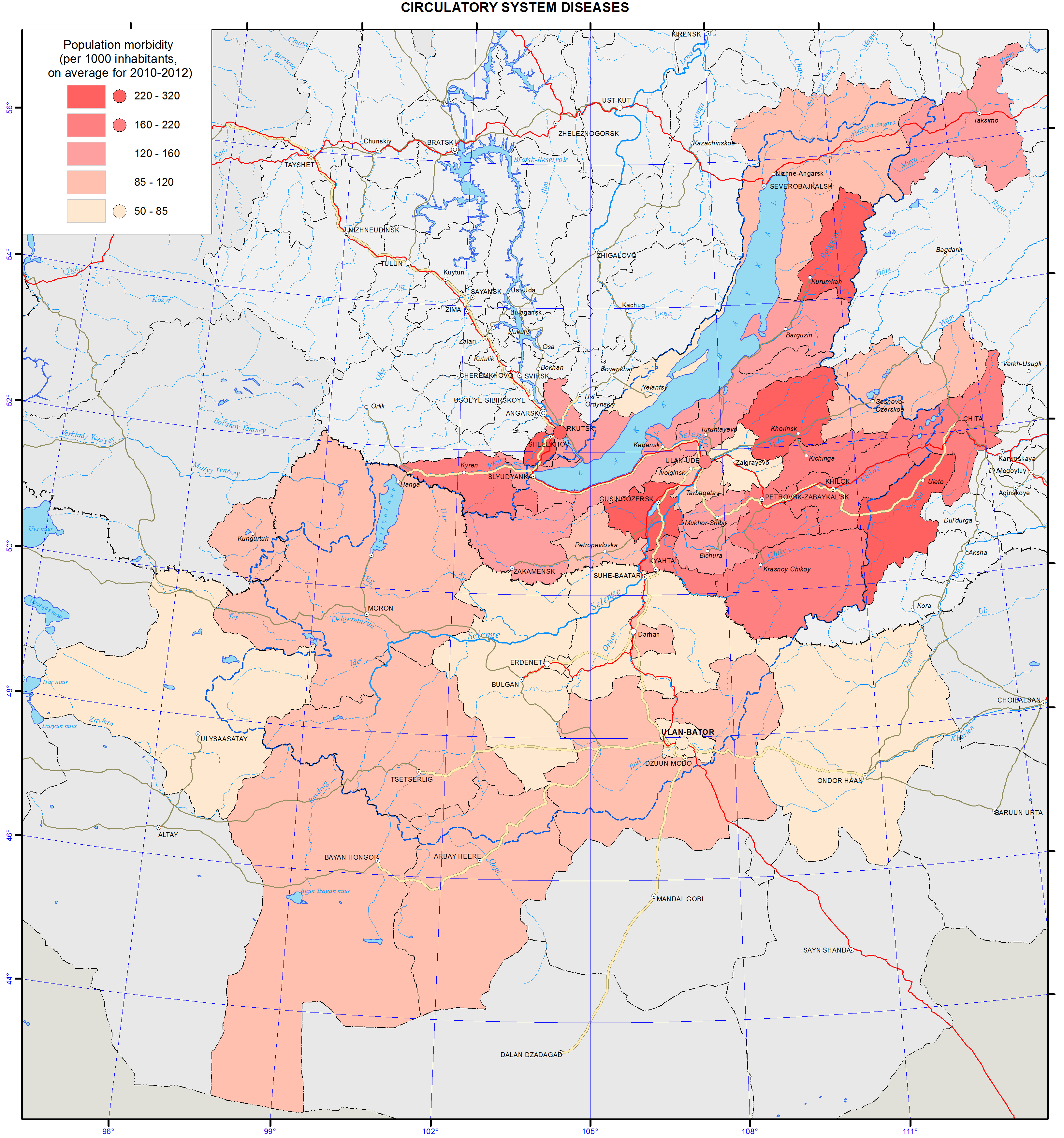
<p class="ConsPlusNormal">The leading illnesses in the structure of morbidity are respiratory illnesses, bloodstream, eye, and digestive and musculoskeletal system diseases, as well as traumas. For many years, circulatory system diseases, neoplasms, and injuries have been the main causes of mortality and disability among the population.</p>
<p class="a">A complex of anthropogenic environmental factors contributes to the growth of morbidity and disability rates among the population with the most important one being air pollution. According to the WHO, atmospheric air pollution is the cause of up to 23% of all illnesses. The amount of pollutant emissions in the atmosphere produced by static sources in different administrative divisions in the Baikal basin differs by more than a thousand times. The most polluted air in the Baikal basin is in the Selenginsky district of Buryatia.</p>
<p>The health of the population and further development of healthcare depend on ecological, social, and economic factors. These problems can be resolved only through comprehensive approaches to the improvement of the quality of life of the population.</p>
<p>The strategic goal of the healthcare systems of Russia and Mongolia is to build a system, which ensures the quality and accessibility of medical services, primarily first aid, and increases the efficiency of medical services, based on the improvement of territorial planning of healthcare. The volume, types, and quality of these services should correspond to the rate of morbidity, population requirements, and the latest achievements of medical science, based on perfecting the system of territorial planning of public health services.</p>]]></content:encoded>
    <dc:publisher>No publisher</dc:publisher>
    <dc:creator>Alexander Ayurzhanaev</dc:creator>
    <dc:rights></dc:rights>
    <dc:date>2014-10-14T02:35:00Z</dc:date>
    <dc:type>Page</dc:type>
  </item>


  <item rdf:about="http://bic.iwlearn.org/en/atlas/atlas/105-genitourinary-system-diseases-map/genitourinary-system-diseases-map">
    <title>Genitourinary system diseases map</title>
    <link>http://bic.iwlearn.org/en/atlas/atlas/105-genitourinary-system-diseases-map/genitourinary-system-diseases-map</link>
    <description></description>
    <content:encoded xmlns:content="http://purl.org/rss/1.0/modules/content/"><![CDATA[<p><img class="image-inline" src="../../../resolveuid/1d11cd4d91854cccb9812f837359f2ab/@@images/image/preview" /></p>
<p><a href="http://bic.iwlearn.org/en/atlas/photos/copy_of__105_Genitourinarysystemdiseases.png" class="internal-link">Open full size</a></p>
<p align="center"><strong>Healthcare</strong><strong> </strong></p>
<p align="center"><strong> </strong></p>
<p>Harsh climatic conditions across the entire territory of the Baikal basin and the surface and ground water used for drinking and food purposes that do not meet the drinking water quality standards (first and foremost in Mongolia and Buryatia) coupled with atmospheric emissions from industrial facilities and motor vehicles (in some parts of the territory) are responsible for the state of human health influencing the organization of healthcare. The ecological situation becomes substantially worse during winter months, which is encouraged by the topography of the terrain. In Mongolia, the spring period is very hard time to bear, with sharp temperature differences, abrupt variations in atmospheric pressure, and frequent dust and magnetic storms.</p>
<p class="NormalWeb">The organizational pattern of healthcare in Russia and Mongolia has much in common. This is a result of the cooperation of the two countries in this sphere and the fact that medical education and healthcare in Mongolia are organized using Russian experience. Today, Mongolian medical facilities operate on the principles of the state-private partnership concurrent with the demonopolization of the state system of medical services. The country has a mandatory and voluntary medical insurance system, in which state-owned and private medical institutions take part. The country also has various health institutes and centers.</p>
<p class="a">The territory of the Baikal basin is experiencing a deficit of medical workers. As of 2012, the availability of physicians varied from 13.8 to 30.1 per 10,000 people in Russian districts and from 16.1 to 29.0 per 10,000 people in Mongolian aimags. The availability of nurses varies from 25.1 to 112.2 per 10,000 people in Russian districts and from 26.4 to 38.2 per 10,000 people in Mongolian aimags. In Ulan-Ude, these indicators have the values of 53.9 and 117.3, while in Ulaanbaatar – 44.1 and 41.2, respectively.</p>
<p>The ratio of doctors and nurses in the Russian part of the basin is between 1:2 to 1:4, while in the Mongolian part it does not exceed 1:2. The World Health Organization (WHO) recommends that this ratio should be 1:4. A narrowing of this indicator causes imbalances in the healthcare system thereby limiting possibilities for further development of the after-treatment, casework and rehabilitation services.</p>
<p>Target indicators of healthcare activity are the standard volume of medical care per inhabitant. Currently, there are plans to decrease the per capita volume of in-patient services and increase the per capita volume of the hospital-replacing care. Accordingly, the number of hospital beds available 27/7 will decrease, while the number of beds in day hospitals will grow. Overall, the available number of hospital beds complies with the calculated standards and meets the demand of the population for the in-patient medical aid.</p>
<p class="ConsPlusNormal">As of today, in Russia, there is an array of problems relating to the high level of illnesses and disability incidences among the population, and these indicators are continuously growing. Such a situation is the result of inadequate preventive measures. Another important contributing factor to this situation is the increase of the proportion of elderly population and the improved effectiveness of illness detection using new diagnostic methods in the process of the increased number of medical checkups.</p>
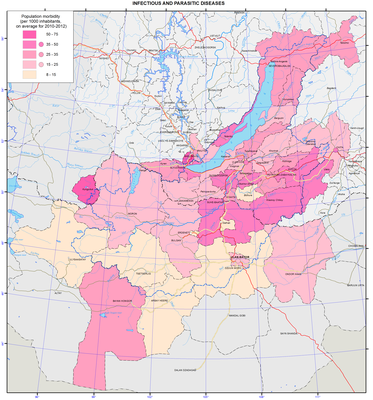
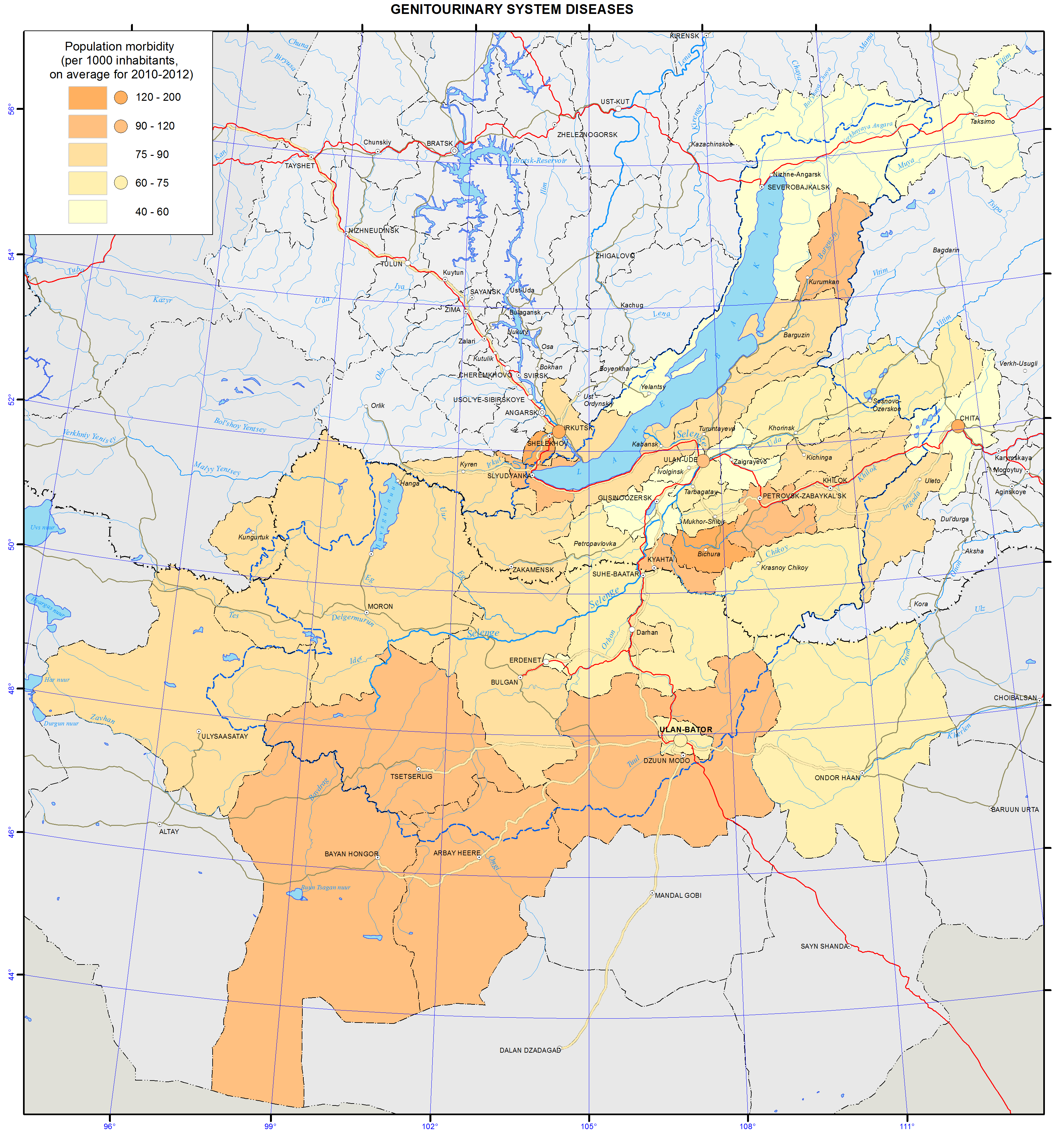
<p class="ConsPlusNormal">The leading illnesses in the structure of morbidity are respiratory illnesses, bloodstream, eye, and digestive and musculoskeletal system diseases, as well as traumas. For many years, circulatory system diseases, neoplasms, and injuries have been the main causes of mortality and disability among the population.</p>
<p class="a">A complex of anthropogenic environmental factors contributes to the growth of morbidity and disability rates among the population with the most important one being air pollution. According to the WHO, atmospheric air pollution is the cause of up to 23% of all illnesses. The amount of pollutant emissions in the atmosphere produced by static sources in different administrative divisions in the Baikal basin differs by more than a thousand times. The most polluted air in the Baikal basin is in the Selenginsky district of Buryatia.</p>
<p>The health of the population and further development of healthcare depend on ecological, social, and economic factors. These problems can be resolved only through comprehensive approaches to the improvement of the quality of life of the population.</p>
<p>The strategic goal of the healthcare systems of Russia and Mongolia is to build a system, which ensures the quality and accessibility of medical services, primarily first aid, and increases the efficiency of medical services, based on the improvement of territorial planning of healthcare. The volume, types, and quality of these services should correspond to the rate of morbidity, population requirements, and the latest achievements of medical science, based on perfecting the system of territorial planning of public health services.</p>]]></content:encoded>
    <dc:publisher>No publisher</dc:publisher>
    <dc:creator>Alexander Ayurzhanaev</dc:creator>
    <dc:rights></dc:rights>
    <dc:date>2014-10-14T02:30:00Z</dc:date>
    <dc:type>Page</dc:type>
  </item>


  <item rdf:about="http://bic.iwlearn.org/en/atlas/atlas/104-digestive-system-diseases-map/digestive-system-diseases-map">
    <title>Digestive system diseases map</title>
    <link>http://bic.iwlearn.org/en/atlas/atlas/104-digestive-system-diseases-map/digestive-system-diseases-map</link>
    <description></description>
    <content:encoded xmlns:content="http://purl.org/rss/1.0/modules/content/"><![CDATA[<p><img class="image-inline" src="../../../resolveuid/12668bfbb732446ea8f0064765ead5ec/@@images/image/preview" /></p>
<p><a href="http://bic.iwlearn.org/en/atlas/photos/copy_of__104_Digestivesystemdiseases.png" class="internal-link">Open full size</a></p>
<p align="center"><strong>Healthcare</strong><strong> </strong></p>
<p align="center"><strong> </strong></p>
<p>Harsh climatic conditions across the entire territory of the Baikal basin and the surface and ground water used for drinking and food purposes that do not meet the drinking water quality standards (first and foremost in Mongolia and Buryatia) coupled with atmospheric emissions from industrial facilities and motor vehicles (in some parts of the territory) are responsible for the state of human health influencing the organization of healthcare. The ecological situation becomes substantially worse during winter months, which is encouraged by the topography of the terrain. In Mongolia, the spring period is very hard time to bear, with sharp temperature differences, abrupt variations in atmospheric pressure, and frequent dust and magnetic storms.</p>
<p class="NormalWeb">The organizational pattern of healthcare in Russia and Mongolia has much in common. This is a result of the cooperation of the two countries in this sphere and the fact that medical education and healthcare in Mongolia are organized using Russian experience. Today, Mongolian medical facilities operate on the principles of the state-private partnership concurrent with the demonopolization of the state system of medical services. The country has a mandatory and voluntary medical insurance system, in which state-owned and private medical institutions take part. The country also has various health institutes and centers.</p>
<p class="a">The territory of the Baikal basin is experiencing a deficit of medical workers. As of 2012, the availability of physicians varied from 13.8 to 30.1 per 10,000 people in Russian districts and from 16.1 to 29.0 per 10,000 people in Mongolian aimags. The availability of nurses varies from 25.1 to 112.2 per 10,000 people in Russian districts and from 26.4 to 38.2 per 10,000 people in Mongolian aimags. In Ulan-Ude, these indicators have the values of 53.9 and 117.3, while in Ulaanbaatar – 44.1 and 41.2, respectively.</p>
<p>The ratio of doctors and nurses in the Russian part of the basin is between 1:2 to 1:4, while in the Mongolian part it does not exceed 1:2. The World Health Organization (WHO) recommends that this ratio should be 1:4. A narrowing of this indicator causes imbalances in the healthcare system thereby limiting possibilities for further development of the after-treatment, casework and rehabilitation services.</p>
<p>Target indicators of healthcare activity are the standard volume of medical care per inhabitant. Currently, there are plans to decrease the per capita volume of in-patient services and increase the per capita volume of the hospital-replacing care. Accordingly, the number of hospital beds available 27/7 will decrease, while the number of beds in day hospitals will grow. Overall, the available number of hospital beds complies with the calculated standards and meets the demand of the population for the in-patient medical aid.</p>
<p class="ConsPlusNormal">As of today, in Russia, there is an array of problems relating to the high level of illnesses and disability incidences among the population, and these indicators are continuously growing. Such a situation is the result of inadequate preventive measures. Another important contributing factor to this situation is the increase of the proportion of elderly population and the improved effectiveness of illness detection using new diagnostic methods in the process of the increased number of medical checkups.</p>
<p class="ConsPlusNormal">The leading illnesses in the structure of morbidity are respiratory illnesses, bloodstream, eye, and digestive and musculoskeletal system diseases, as well as traumas. For many years, circulatory system diseases, neoplasms, and injuries have been the main causes of mortality and disability among the population.</p>
<p class="a">A complex of anthropogenic environmental factors contributes to the growth of morbidity and disability rates among the population with the most important one being air pollution. According to the WHO, atmospheric air pollution is the cause of up to 23% of all illnesses. The amount of pollutant emissions in the atmosphere produced by static sources in different administrative divisions in the Baikal basin differs by more than a thousand times. The most polluted air in the Baikal basin is in the Selenginsky district of Buryatia.</p>
<p>The health of the population and further development of healthcare depend on ecological, social, and economic factors. These problems can be resolved only through comprehensive approaches to the improvement of the quality of life of the population.</p>
<p>The strategic goal of the healthcare systems of Russia and Mongolia is to build a system, which ensures the quality and accessibility of medical services, primarily first aid, and increases the efficiency of medical services, based on the improvement of territorial planning of healthcare. The volume, types, and quality of these services should correspond to the rate of morbidity, population requirements, and the latest achievements of medical science, based on perfecting the system of territorial planning of public health services.</p>]]></content:encoded>
    <dc:publisher>No publisher</dc:publisher>
    <dc:creator>Alexander Ayurzhanaev</dc:creator>
    <dc:rights></dc:rights>
    <dc:date>2014-10-13T07:25:00Z</dc:date>
    <dc:type>Page</dc:type>
  </item>


  <item rdf:about="http://bic.iwlearn.org/en/atlas/atlas/103-respiratory-diseases-map/respiratory-diseases-map">
    <title>Respiratory diseases map</title>
    <link>http://bic.iwlearn.org/en/atlas/atlas/103-respiratory-diseases-map/respiratory-diseases-map</link>
    <description></description>
    <content:encoded xmlns:content="http://purl.org/rss/1.0/modules/content/"><![CDATA[<p><img class="image-inline" src="../../../resolveuid/d9269e4938b9420ea944ea5d9fcd58b2/@@images/image/preview" /></p>
<p><a href="http://bic.iwlearn.org/en/atlas/photos/copy_of__103_Respiratorydiseases.png" class="internal-link">Open full size</a></p>
<p align="center"><strong>Healthcare</strong><strong> </strong></p>
<p align="center"><strong> </strong></p>
<p>Harsh climatic conditions across the entire territory of the Baikal basin and the surface and ground water used for drinking and food purposes that do not meet the drinking water quality standards (first and foremost in Mongolia and Buryatia) coupled with atmospheric emissions from industrial facilities and motor vehicles (in some parts of the territory) are responsible for the state of human health influencing the organization of healthcare. The ecological situation becomes substantially worse during winter months, which is encouraged by the topography of the terrain. In Mongolia, the spring period is very hard time to bear, with sharp temperature differences, abrupt variations in atmospheric pressure, and frequent dust and magnetic storms.</p>
<p class="NormalWeb">The organizational pattern of healthcare in Russia and Mongolia has much in common. This is a result of the cooperation of the two countries in this sphere and the fact that medical education and healthcare in Mongolia are organized using Russian experience. Today, Mongolian medical facilities operate on the principles of the state-private partnership concurrent with the demonopolization of the state system of medical services. The country has a mandatory and voluntary medical insurance system, in which state-owned and private medical institutions take part. The country also has various health institutes and centers.</p>
<p class="a">The territory of the Baikal basin is experiencing a deficit of medical workers. As of 2012, the availability of physicians varied from 13.8 to 30.1 per 10,000 people in Russian districts and from 16.1 to 29.0 per 10,000 people in Mongolian aimags. The availability of nurses varies from 25.1 to 112.2 per 10,000 people in Russian districts and from 26.4 to 38.2 per 10,000 people in Mongolian aimags. In Ulan-Ude, these indicators have the values of 53.9 and 117.3, while in Ulaanbaatar – 44.1 and 41.2, respectively.</p>
<p>The ratio of doctors and nurses in the Russian part of the basin is between 1:2 to 1:4, while in the Mongolian part it does not exceed 1:2. The World Health Organization (WHO) recommends that this ratio should be 1:4. A narrowing of this indicator causes imbalances in the healthcare system thereby limiting possibilities for further development of the after-treatment, casework and rehabilitation services.</p>
<p>Target indicators of healthcare activity are the standard volume of medical care per inhabitant. Currently, there are plans to decrease the per capita volume of in-patient services and increase the per capita volume of the hospital-replacing care. Accordingly, the number of hospital beds available 27/7 will decrease, while the number of beds in day hospitals will grow. Overall, the available number of hospital beds complies with the calculated standards and meets the demand of the population for the in-patient medical aid.</p>
<p class="ConsPlusNormal">As of today, in Russia, there is an array of problems relating to the high level of illnesses and disability incidences among the population, and these indicators are continuously growing. Such a situation is the result of inadequate preventive measures. Another important contributing factor to this situation is the increase of the proportion of elderly population and the improved effectiveness of illness detection using new diagnostic methods in the process of the increased number of medical checkups.</p>
<p class="ConsPlusNormal">The leading illnesses in the structure of morbidity are respiratory illnesses, bloodstream, eye, and digestive and musculoskeletal system diseases, as well as traumas. For many years, circulatory system diseases, neoplasms, and injuries have been the main causes of mortality and disability among the population.</p>
<p class="a">A complex of anthropogenic environmental factors contributes to the growth of morbidity and disability rates among the population with the most important one being air pollution. According to the WHO, atmospheric air pollution is the cause of up to 23% of all illnesses. The amount of pollutant emissions in the atmosphere produced by static sources in different administrative divisions in the Baikal basin differs by more than a thousand times. The most polluted air in the Baikal basin is in the Selenginsky district of Buryatia.</p>
<p>The health of the population and further development of healthcare depend on ecological, social, and economic factors. These problems can be resolved only through comprehensive approaches to the improvement of the quality of life of the population.</p>
<p>The strategic goal of the healthcare systems of Russia and Mongolia is to build a system, which ensures the quality and accessibility of medical services, primarily first aid, and increases the efficiency of medical services, based on the improvement of territorial planning of healthcare. The volume, types, and quality of these services should correspond to the rate of morbidity, population requirements, and the latest achievements of medical science, based on perfecting the system of territorial planning of public health services.</p>]]></content:encoded>
    <dc:publisher>No publisher</dc:publisher>
    <dc:creator>Alexander Ayurzhanaev</dc:creator>
    <dc:rights></dc:rights>
    <dc:date>2014-10-13T07:05:00Z</dc:date>
    <dc:type>Page</dc:type>
  </item>


  <item rdf:about="http://bic.iwlearn.org/en/atlas/atlas/102-infectious-and-parasitic-diseases-map/infectious-and-parasitic-diseases-map">
    <title>Infectious and parasitic diseases map</title>
    <link>http://bic.iwlearn.org/en/atlas/atlas/102-infectious-and-parasitic-diseases-map/infectious-and-parasitic-diseases-map</link>
    <description></description>
    <content:encoded xmlns:content="http://purl.org/rss/1.0/modules/content/"><![CDATA[<p><img class="image-inline" src="../../../resolveuid/9301c927659a44f18468af82d153b030/@@images/image/preview" /></p>
<p><a href="http://bic.iwlearn.org/en/atlas/photos/copy_of__102_Infectiousandparasiticdiseases.png" class="internal-link">Open full size</a></p>
<p align="center"><strong>Healthcare</strong><strong> </strong></p>
<p align="center"><strong> </strong></p>
<p>Harsh climatic conditions across the entire territory of the Baikal basin and the surface and ground water used for drinking and food purposes that do not meet the drinking water quality standards (first and foremost in Mongolia and Buryatia) coupled with atmospheric emissions from industrial facilities and motor vehicles (in some parts of the territory) are responsible for the state of human health influencing the organization of healthcare. The ecological situation becomes substantially worse during winter months, which is encouraged by the topography of the terrain. In Mongolia, the spring period is very hard time to bear, with sharp temperature differences, abrupt variations in atmospheric pressure, and frequent dust and magnetic storms.</p>
<p class="NormalWeb">The organizational pattern of healthcare in Russia and Mongolia has much in common. This is a result of the cooperation of the two countries in this sphere and the fact that medical education and healthcare in Mongolia are organized using Russian experience. Today, Mongolian medical facilities operate on the principles of the state-private partnership concurrent with the demonopolization of the state system of medical services. The country has a mandatory and voluntary medical insurance system, in which state-owned and private medical institutions take part. The country also has various health institutes and centers.</p>
<p class="a">The territory of the Baikal basin is experiencing a deficit of medical workers. As of 2012, the availability of physicians varied from 13.8 to 30.1 per 10,000 people in Russian districts and from 16.1 to 29.0 per 10,000 people in Mongolian aimags. The availability of nurses varies from 25.1 to 112.2 per 10,000 people in Russian districts and from 26.4 to 38.2 per 10,000 people in Mongolian aimags. In Ulan-Ude, these indicators have the values of 53.9 and 117.3, while in Ulaanbaatar – 44.1 and 41.2, respectively.</p>
<p>The ratio of doctors and nurses in the Russian part of the basin is between 1:2 to 1:4, while in the Mongolian part it does not exceed 1:2. The World Health Organization (WHO) recommends that this ratio should be 1:4. A narrowing of this indicator causes imbalances in the healthcare system thereby limiting possibilities for further development of the after-treatment, casework and rehabilitation services.</p>
<p>Target indicators of healthcare activity are the standard volume of medical care per inhabitant. Currently, there are plans to decrease the per capita volume of in-patient services and increase the per capita volume of the hospital-replacing care. Accordingly, the number of hospital beds available 27/7 will decrease, while the number of beds in day hospitals will grow. Overall, the available number of hospital beds complies with the calculated standards and meets the demand of the population for the in-patient medical aid.</p>
<p class="ConsPlusNormal">As of today, in Russia, there is an array of problems relating to the high level of illnesses and disability incidences among the population, and these indicators are continuously growing. Such a situation is the result of inadequate preventive measures. Another important contributing factor to this situation is the increase of the proportion of elderly population and the improved effectiveness of illness detection using new diagnostic methods in the process of the increased number of medical checkups.</p>
<p class="ConsPlusNormal">The leading illnesses in the structure of morbidity are respiratory illnesses, bloodstream, eye, and digestive and musculoskeletal system diseases, as well as traumas. For many years, circulatory system diseases, neoplasms, and injuries have been the main causes of mortality and disability among the population.</p>
<p class="a">A complex of anthropogenic environmental factors contributes to the growth of morbidity and disability rates among the population with the most important one being air pollution. According to the WHO, atmospheric air pollution is the cause of up to 23% of all illnesses. The amount of pollutant emissions in the atmosphere produced by static sources in different administrative divisions in the Baikal basin differs by more than a thousand times. The most polluted air in the Baikal basin is in the Selenginsky district of Buryatia.</p>
<p>The health of the population and further development of healthcare depend on ecological, social, and economic factors. These problems can be resolved only through comprehensive approaches to the improvement of the quality of life of the population.</p>
<p>The strategic goal of the healthcare systems of Russia and Mongolia is to build a system, which ensures the quality and accessibility of medical services, primarily first aid, and increases the efficiency of medical services, based on the improvement of territorial planning of healthcare. The volume, types, and quality of these services should correspond to the rate of morbidity, population requirements, and the latest achievements of medical science, based on perfecting the system of territorial planning of public health services.</p>]]></content:encoded>
    <dc:publisher>No publisher</dc:publisher>
    <dc:creator>Alexander Ayurzhanaev</dc:creator>
    <dc:rights></dc:rights>
    <dc:date>2014-10-13T06:50:00Z</dc:date>
    <dc:type>Page</dc:type>
  </item>


</rdf:RDF>