<?xml version="1.0" encoding="utf-8" ?>
<rdf:RDF xmlns:rdf="http://www.w3.org/1999/02/22-rdf-syntax-ns#" xmlns:dc="http://purl.org/dc/elements/1.1/" xmlns:syn="http://purl.org/rss/1.0/modules/syndication/" xmlns="http://purl.org/rss/1.0/">


<channel rdf:about="http://bic.iwlearn.org/search_rss">
  <title>Байкальский информационный центр</title>
  <link>http://bic.iwlearn.org</link>

  <description>
    
            These are the search results for the query, showing results 141 to 155.
        
  </description>


  <image rdf:resource="http://bic.iwlearn.org/logo.png"/>

  <items>
    <rdf:Seq>
      
        <rdf:li rdf:resource="http://bic.iwlearn.org/en/atlas/atlas/88-2-atmospheric-air-condition-ulaanbatar_the-isolines-of-concentration-of-dust-in-ulaanbaatar-when-western-wind-is-5-mps-map/atmospheric-air-condition-ulaanbatar_the-isolines-of-concentration-of-dust-in-ulaanbaatar-when-western-wind-is-5-mps-map"/>
      
      
        <rdf:li rdf:resource="http://bic.iwlearn.org/en/atlas/atlas/88-1-atmospheric-air-condition-ulaanbatar_the-isolines-of-concentration-of-dust-in-ulaanbaatar-when-eastern-wind-is-5-mps-map/atmospheric-air-condition-ulaanbatar_the-isolines-of-concentration-of-dust-in-ulaanbaatar-when-eastern-wind-is-5-mps-map"/>
      
      
        <rdf:li rdf:resource="http://bic.iwlearn.org/en/atlas/atlas/88-1-atmospheric-air-condition-ulaanbatar_the-isolines-of-concentration-of-dust-in-ulaanbaatar-when-eastern-wind-is-5-mps-map"/>
      
      
        <rdf:li rdf:resource="http://bic.iwlearn.org/en/atlas/atlas/87-atmospheric-air-condition-ulan-ude_frequency-of-excess-average-daily-mpc-nitrogen-dioxide-in-ulan-ude-in-december-map/atmospheric-air-condition-ulan-ude_frequency-of-excess-average-daily-mpc-nitrogen-dioxide-in-ulan-ude-in-december-map"/>
      
      
        <rdf:li rdf:resource="http://bic.iwlearn.org/en/atlas/atlas/86-4-atmospheric-air-condition-irkutsk_the-isolines-of-excess-frequency-of-the-average-daily-maximum-allowable-concentration-of-soot-in-december-map/atmospheric-air-condition-irkutsk_the-isolines-of-excess-frequency-of-the-average-daily-maximum-allowable-concentration-of-soot-in-december-map"/>
      
      
        <rdf:li rdf:resource="http://bic.iwlearn.org/en/atlas/atlas/86-3-atmospheric-air-condition-irkutsk_the-isolines-of-excess-frequency-of-the-average-daily-maximum-allowable-concentration-of-nitrogen-dioxide-in-december-map/atmospheric-air-condition-irkutsk_the-isolines-of-excess-frequency-of-the-average-daily-maximum-allowable-concentration-of-nitrogen-dioxide-in-december-map"/>
      
      
        <rdf:li rdf:resource="http://bic.iwlearn.org/en/atlas/atlas/86-2-atmospheric-air-condition-irkutsk_the-isolines/atmospheric-air-condition-irkutsk_the-isolines-map"/>
      
      
        <rdf:li rdf:resource="http://bic.iwlearn.org/en/atlas/atlas/86-1-atmospheric-air-condition-irkutsk_the-isolines-of-absolute-concentration-of-soot-in-wintertime-map/atmospheric-air-condition-irkutsk_the-isolines-of-absolute-concentration-of-soot-in-wintertime-map"/>
      
      
        <rdf:li rdf:resource="http://bic.iwlearn.org/en/atlas/atlas/86-1-atmospheric-air-condition-irkutsk_the-isolines-of-absolute-concentration-of-soot-in-wintertime-map"/>
      
      
        <rdf:li rdf:resource="http://bic.iwlearn.org/en/atlas/atlas/85-atmospheric-air-condition-map/atmospheric-air-condition-map"/>
      
      
        <rdf:li rdf:resource="http://bic.iwlearn.org/en/atlas/atlas/81-religions-map/religions-map"/>
      
      
        <rdf:li rdf:resource="http://bic.iwlearn.org/en/atlas/atlas/80-education-map/education-map"/>
      
      
        <rdf:li rdf:resource="http://bic.iwlearn.org/en/atlas/atlas/79-sulture-map/sulture-map"/>
      
      
        <rdf:li rdf:resource="http://bic.iwlearn.org/en/atlas/atlas/78a-comfort-of-available-housing-russian-part-map/comfort-of-available-housing-russian-part-map"/>
      
      
        <rdf:li rdf:resource="http://bic.iwlearn.org/en/atlas/atlas/77-housing-conditions-map-1/housing-conditions-map"/>
      
    </rdf:Seq>
  </items>

</channel>


  <item rdf:about="http://bic.iwlearn.org/en/atlas/atlas/88-2-atmospheric-air-condition-ulaanbatar_the-isolines-of-concentration-of-dust-in-ulaanbaatar-when-western-wind-is-5-mps-map/atmospheric-air-condition-ulaanbatar_the-isolines-of-concentration-of-dust-in-ulaanbaatar-when-western-wind-is-5-mps-map">
    <title>Atmospheric air condition - Ulaanbatar_The isolines of concentration of dust in Ulaanbaatar when western wind is 5 MPs map</title>
    <link>http://bic.iwlearn.org/en/atlas/atlas/88-2-atmospheric-air-condition-ulaanbatar_the-isolines-of-concentration-of-dust-in-ulaanbaatar-when-western-wind-is-5-mps-map/atmospheric-air-condition-ulaanbatar_the-isolines-of-concentration-of-dust-in-ulaanbaatar-when-western-wind-is-5-mps-map</link>
    <description></description>
    <content:encoded xmlns:content="http://purl.org/rss/1.0/modules/content/"><![CDATA[<p><img class="image-inline" src="../../../resolveuid/32ecd4beda8d431fbaf4854c22b094d3/@@images/image/preview" /></p>
<p>Open full size</p>
<p align="center"><b>Atmospheric air condition</b></p>
<p align="center"><b> </b></p>
<p>The atmospheric air deterioration in populated areas continues to be the result of:</p>
<ol>
<li>Emissions from industrial enterprises:</li>
</ol>
<p>-          Due to the use of raw products with a high content of pollutants;</p>
<p>-          Due to the substantial aging of equipment and/or absence of the waste treatment facilities;</p>
<p>-          Due to breakdowns in technological processes, etc.</p>
<ol>
<li>Vehicle emissions:</li>
</ol>
<p>-          Due to the growing number of motor vehicles including old cars;</p>
<p>-          Due to poor technical condition of vehicles;</p>
<p>-        Due to numerous traffic jams [On the sanitary and epidemiologic situation…, 2012].</p>
<p>Emissions from industrial enterprises and vehicles have a very high concentration of various pollutants, such as sulfur dioxide, dust, carbon oxide, nitrogen oxides, benzopyrene, methylmercaptan, and so on that enter the air basin from numerous sources. As a result of photochemical reactions with oxygen and hydrocarbons, these substances generate other pollutants. Therefore, the study of spatiotemporal volatility of air pollutants remains a topical issue. Moreover, it appears important to determine not only the way pollutants spread through the atmosphere around industrial centers, but also the way they distribute over reference areas, one of which being the Baikal basin.</p>
<p>The wind regime over the Baikal shores is composed of windblasts resulted from the macro-scale processes of general circulation and of local origin that include breezes, highland-valley circulation, and gravity windblasts. The basic large-scale windblast over the Baikal basin and its shores is the northwestern air-mass transport. However, under the influence of complex orographic conditions, some typical Baikal winds are also observed here. In the cold period of the year, off-shore winds along with a large-scale air transport are observed at the coast. In the warm period – onshore winds, which is common to seashores. This fact has an apparent impact on the spread of pollutants from industrial enterprises of Irkutsk oblast and the Republic of Buryatia.</p>
<p>Today, almost entire coastal territory of the lake is under a protected status aiming to preserve Lake Baikal and its surroundings. However, despite the existence of specially protected territories around the lake, industrial activity continues to negatively impact the lake’s environment.</p>
<p class="NormalWeb">The main economic specialization of the Baikal Region is determined by its considerable fuel-and-power and primary natural resources. This fact stipulated the development of energy-intensive industries – ferrous and non-ferrous metallurgy, mining, chemical, wood-processing, pulp and paper, and fuel and energy industries. Enterprises of the above-listed industries emit such common pollutants as dust, channel black, sulfur and nitrogen oxides, heavy metals, etc. Moreover, every production has its own specific list of pollutants.</p>
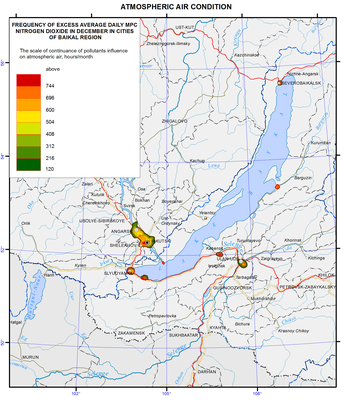
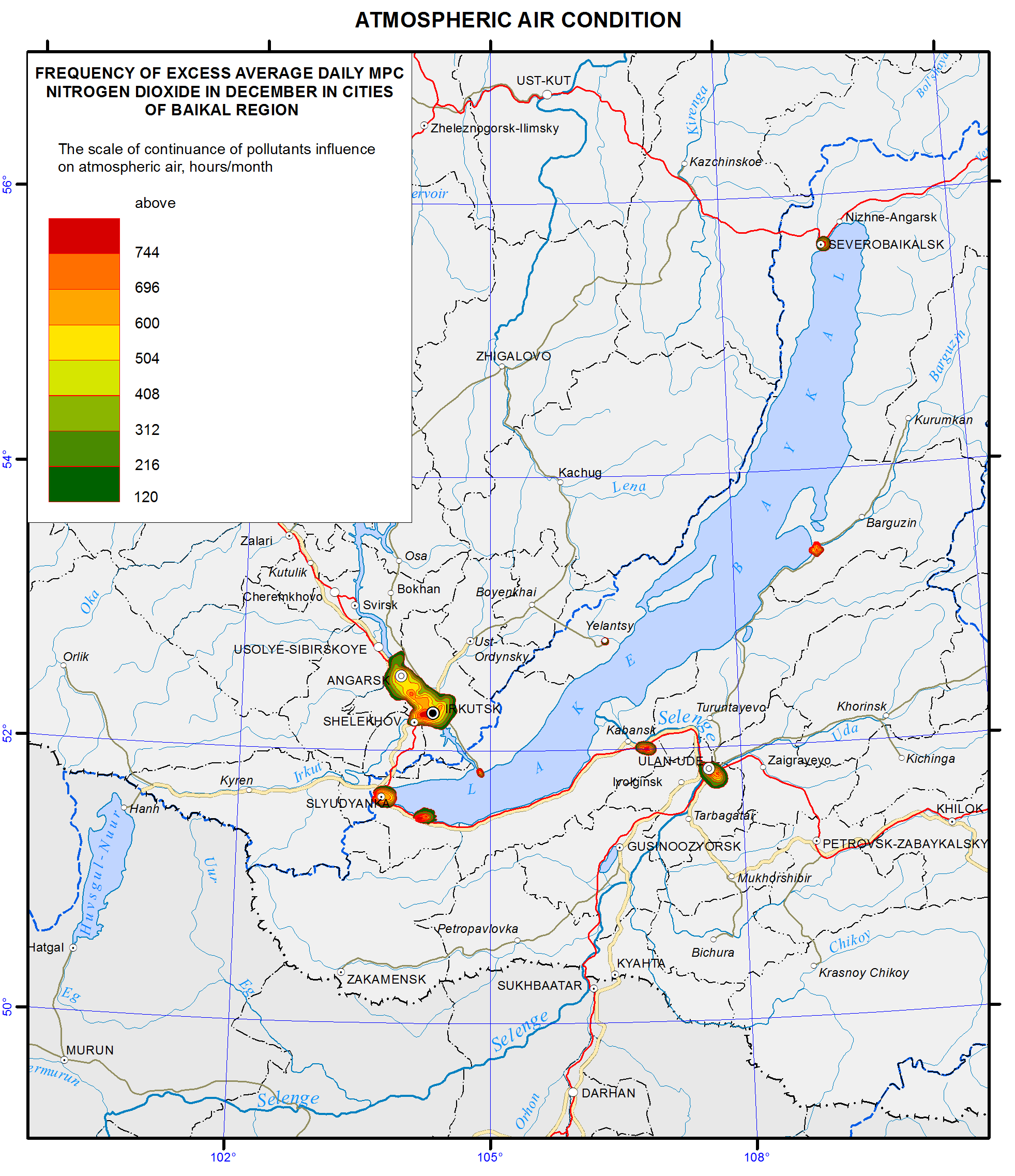
<p>Atmospheric pollution in the basin of Lake Baikal was assessed using a numerically simulated model based on analytical calculations of the differential equation of the transmission and eddy mixing of pollutants. The characteristics of the area of the atmosphere polluted from anthropogenic sources were evaluated. In addition, the critical concentration excess zones (MPC daily average), as well as the duration of such excess in hours per month were determined.</p>
<p>Inventory data on the parameters of the emission sources and long-term data of wind velocity and air temperature derived from daily weather observations conducted every 8 hours<b> </b>were used as input information for calculations to obtain statistically stable climatological characteristics.</p>
<p>The results demonstrate that the environmental situation in several settlements of the Baikal region does not meet the established standard (MPC daily average) for air quality. Furthermore, pollutants from industrial enterprises spread not only over the territory of the settlement, but go far beyond it.</p>
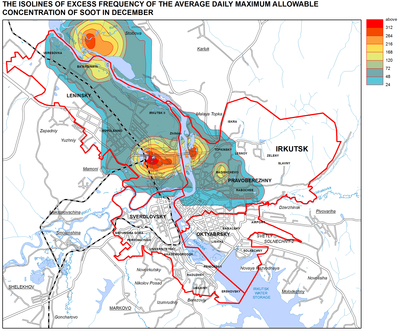
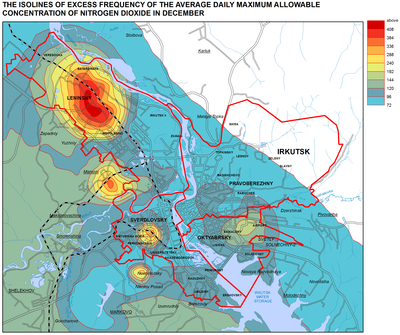
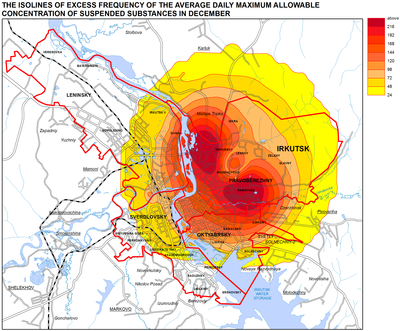
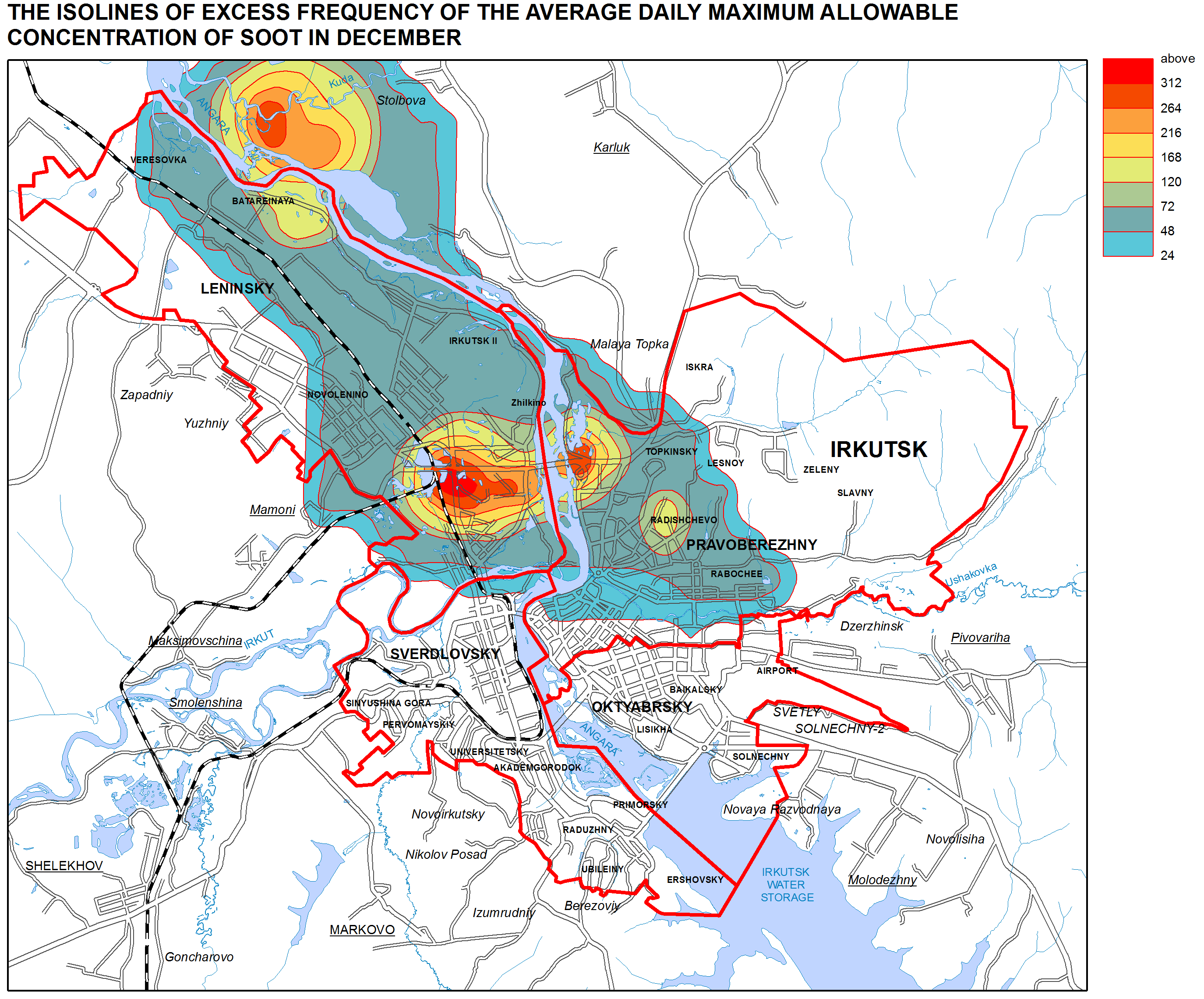
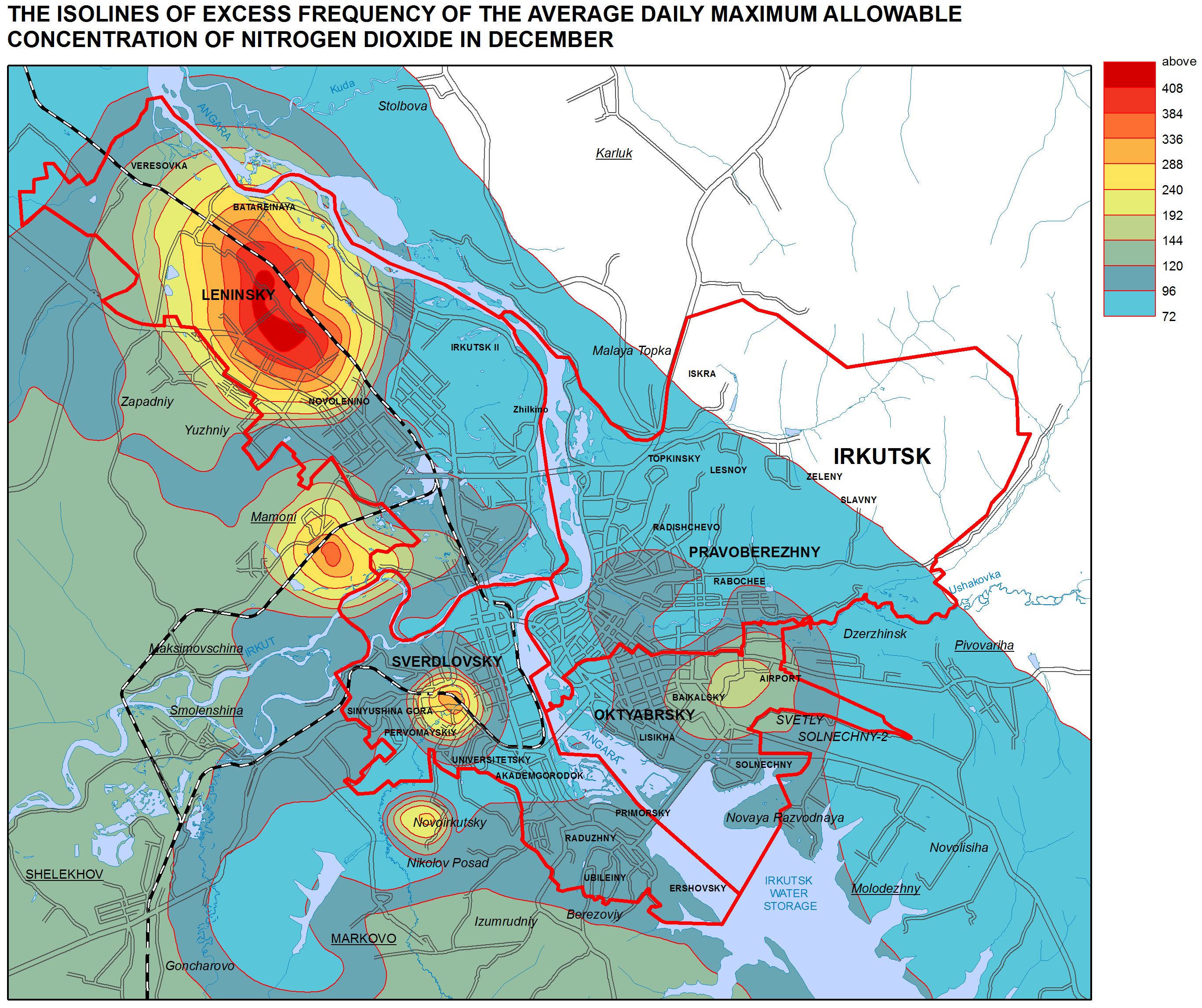
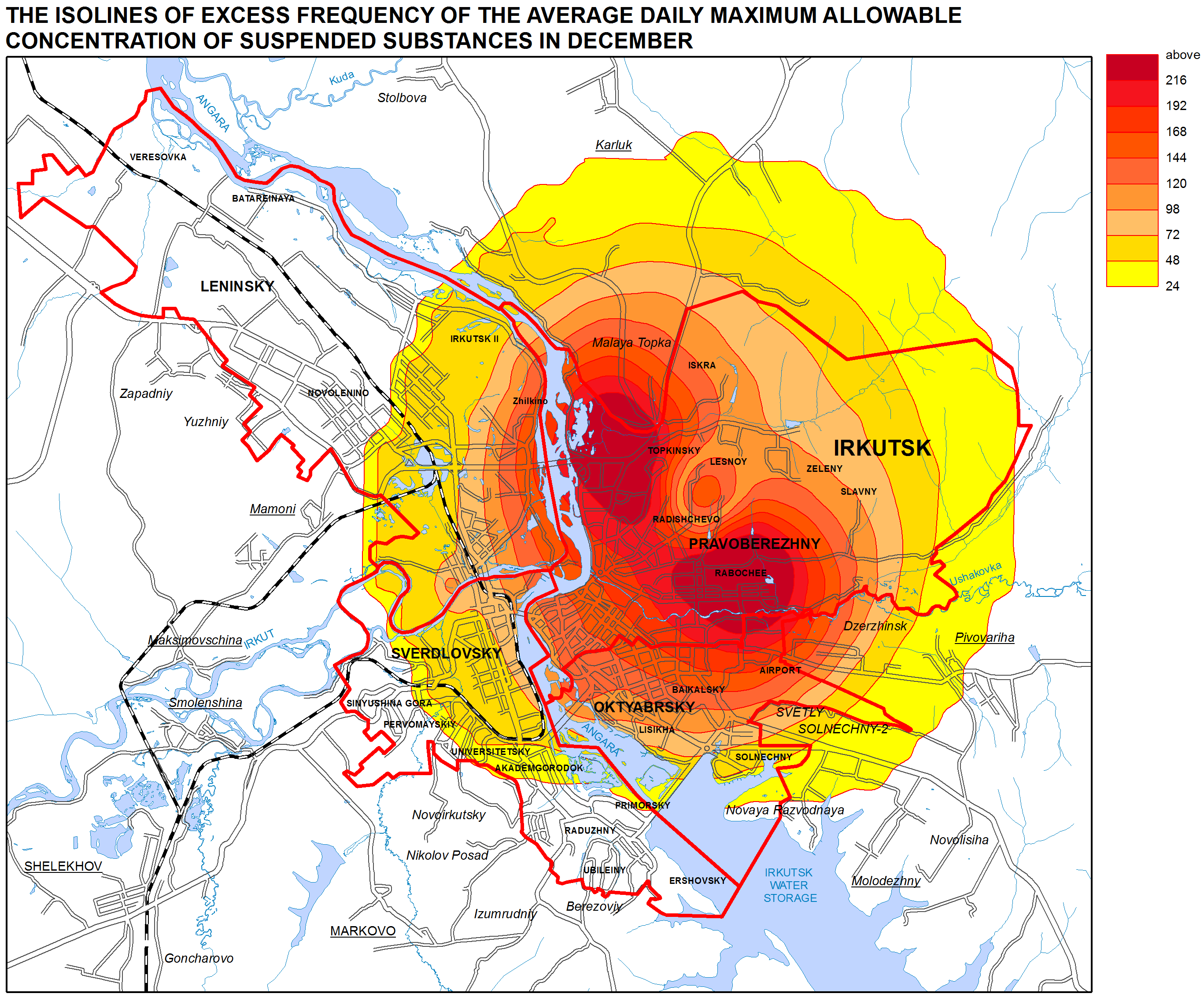
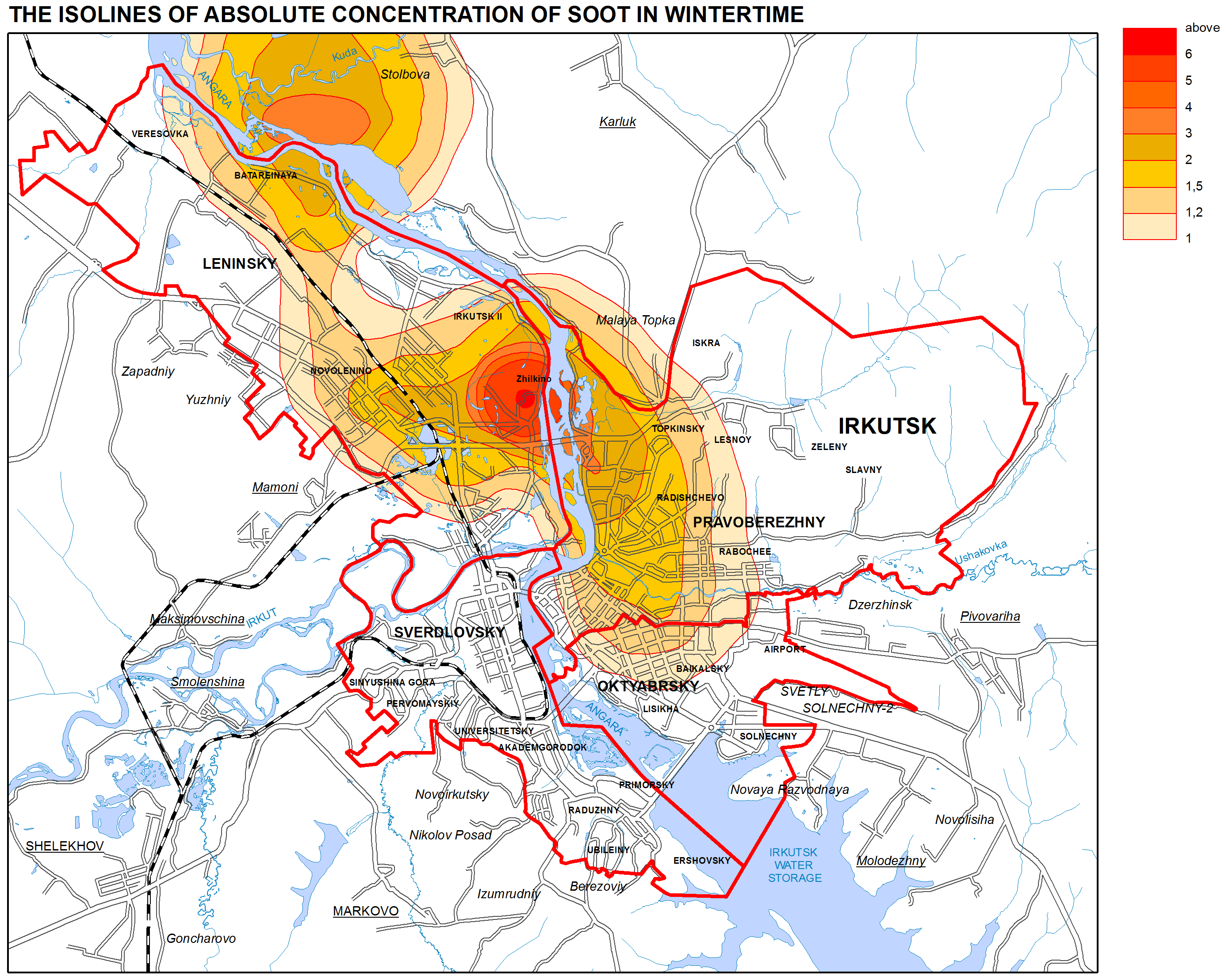
<p class="NormalWeb">In Irkutsk, there are approximately 250 industrial enterprises with over 3,000 stationary anthropogenic air pollution sources. They emit 113 different pollutants and cause a high level of pollution. It is proved by the fact that for the past 10 years Irkutsk has been regularly listed as a top-priority Russian city with the highest level of air pollution. The main production enterprises contributing to the increase of the concentration of harmful substances are JSC “Irkutskenergo” (contributes about 52.9% of pollutants), JSC “Baikalenergo”, and JSC “Irkut Corporation”. It should be noted that the energy sector is the leading industry in terms of air pollution emissions accounting for 82.7% of the total emissions of pollutants into the atmosphere of Irkutsk [Akhtimankina, 2013]. According to the results of calculations, almost the whole territory of the city is affected by the concentration of air pollutants exceeding the established hygienic standards and reaching maximum values in the vicinity of emission sources. Especially difficult situation takes place in winter months (Fig.1, 2).</p>
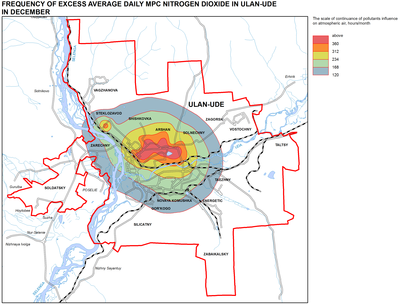
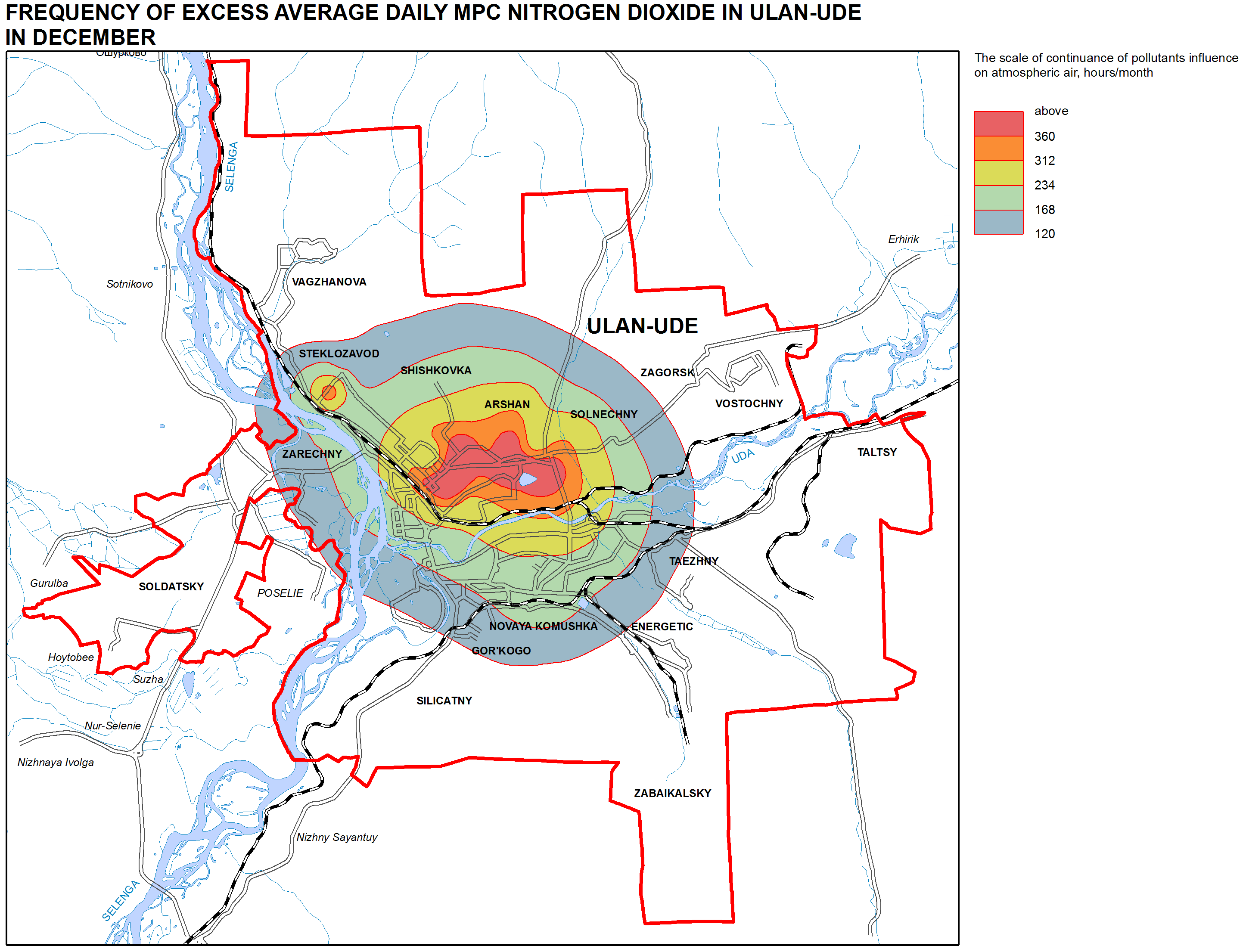
<p class="NormalWeb">The main stationary air pollution sources in Ulan-Ude are the city’s Central Heating and Power Plant (CHHP)-1 and CHPP-2, Locomotive Repair Plant, Aviation Plant, as well as construction and food processing companies and other enterprises [On the state of …, 2009] that have about 2,000 point-source and distributed pollution sources. The fuel-and-power complex of Ulan-Ude emits almost half of the total volume of the citywide pollution. Combustion gases from cogeneration and boiler plants and other power facilities travel long distances with the prevailing winds (about several kilometers) contributing to the regional environmental pollution. However, the most harmful emissions in Ulan-Ude are those that settle on the territory in the immediate vicinity of the pollution sources within the area of the so-called intensive technogenic pollution. This risk is further compounded by the fact that the majority of the fuel-and-power enterprises are located near the densely populated areas of the city (e.g. CHPP-1). Together with flue gases from power plants, a great number of solid and gaseous pollutants, such as refuse burnout, carbon oxide, and sulfur and nitrogen dioxides also get into the air basin (Fig. 3). Machine building enterprises emit dust, various acids and lye, nitriles and other compounds, phenol, methanol, polycyclic aromatic hydrocarbons, solvents vapors (toluene, xylol, paint thinner, benzene chloride, dichloroethane, spirits, acetates, etc.), ingredients of organic and inorganic fillers (salts and oxides of titanium, zinc, lead, chrome and other metals), as well as components of the film-forming agents (styrole, formaldehyde, etc.). Major contamination sources are galvanizing, paint, and foundry plants, galvanic and accumulator shops, repair workshops, etc [Imetkhenov, 2001]. The research has also demonstrated that the environmental situation in Ulan-Ude is unfavorable due to, on the one hand, the high level of technogenic stress, and, on the other, poor dissipative capacity of the atmosphere resulting in the long-lasting persistence of polluted air. The city’s location in an intermountain basin contributes to the accumulation of industrial emissions.</p>
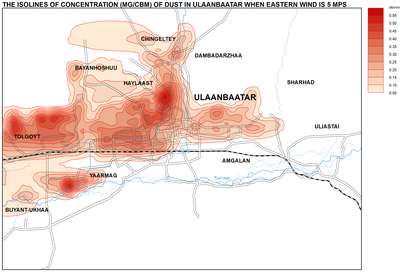
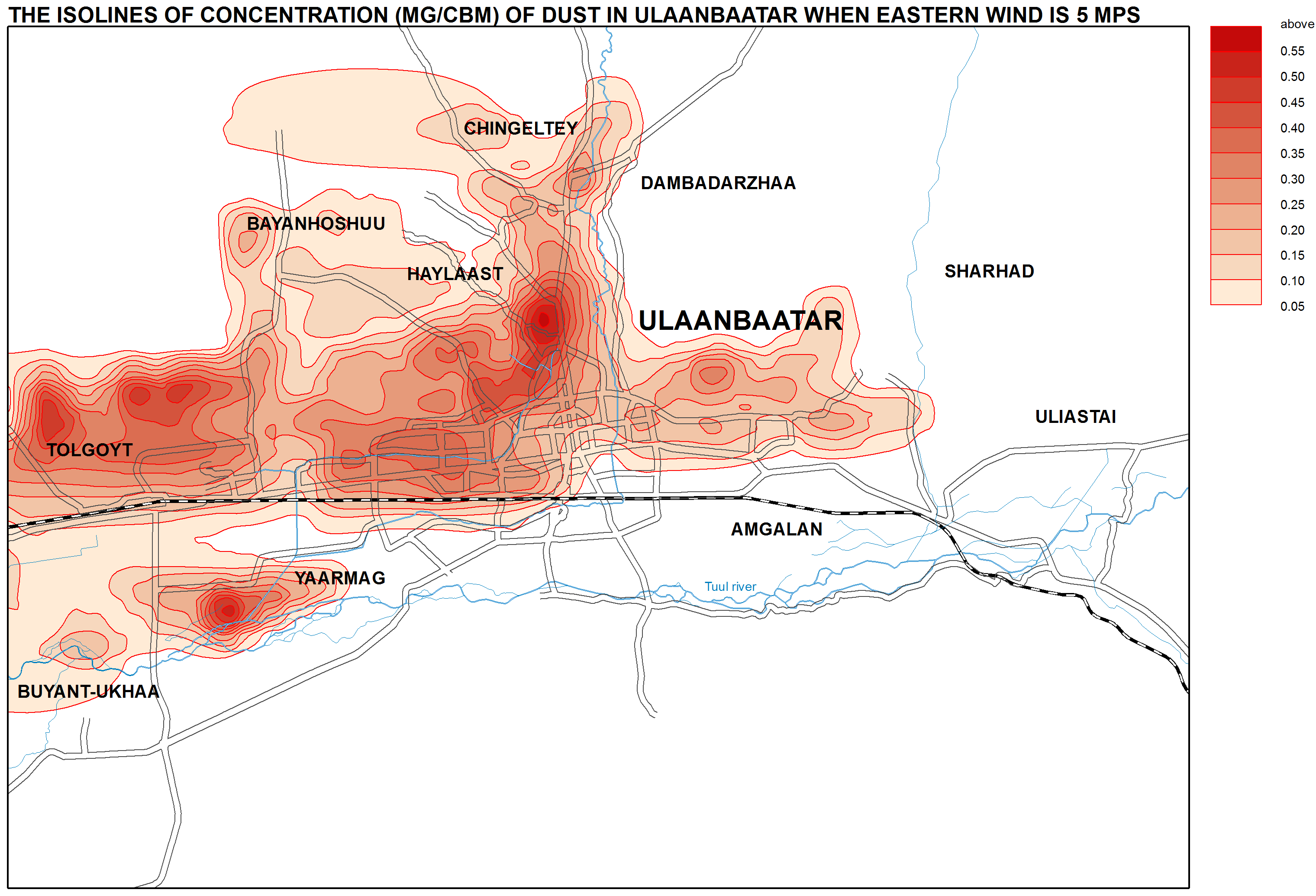
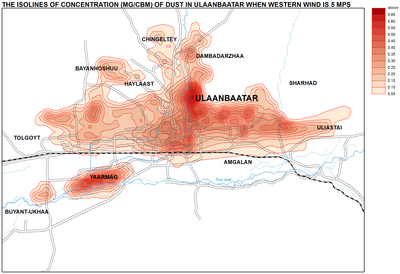
<p class="NormalWeb">In Ulaanbaatar, there are 860 areal sources of pollution that mostly represent household ovens [Arguchintseva, 2011]. According to the results of calculations, the highest level of air pollution was registered in the areas of concentration of gers (traditional mobile homes) that make up the entire northern part of the city and stretch from the west to the east from the center of Ulaanbaatar. Another high-level air pollution zone is situated on the southwestern edge of the city near Buyant-Ukhaa Airport, where there is a ger village. Here, the wind direction and relief facilitate the transmission of emissions towards the airport (Fig. 4, 5). Air emissions from heating in the ger village lead to the continuous excess of maximum permissible concentrations of pollutants in the area of the airport. Combined with unfavorable meteorological conditions, this means that the airport can experience difficulties with take-off and landing operations for almost half a month, which leads to risks and considerable financial losses due to the idling of aircrafts.</p>
<p class="NormalWeb">These data demonstrate that many settlements in the Baikal basin, especially large ones, have an unfavorable environmental situation, which undoubtedly affects the health of local communities. The population continuously living in the conditions of atmospheric pollution experiences an overall deterioration of health and higher disease incidence especially affecting the respiratory system.</p>
<p class="NormalWeb"> </p>
<p align="center" class="2">References:</p>
<p>Akhtimankina, A. V., Arguchintseva, A. V. (2013). Air pollution from industrial plants of Irkutsk. <i>The Bulletin of Irkutsk State University: Earth Sciences, 6</i>(1), 3-19.</p>
<p>Arguchintseva, A. V., Arguchintsev, V. K., &amp; Ariunsanaa, B-E. (2011). Distribution of pollutants in the atmosphere of Ulaanbaatar. <i>The Bulletin of Irkutsk State University: Earth Sciences 4</i>(2), 17-27.</p>
<p>Imetkhenov, A. B., Kulkov, A. I., &amp; Atutov, A. A. (2001). <i>Ecology, nature protection, and environmental management: Textbook for universities.</i> Ulan-Ude: ESSTU Publishing. p 422.</p>
<p>Russian Agency for Health and Consumer Rights (Rospotrebnadzor). (2012). <i>On the sanitary and epidemiologic situation in Irkutsk oblast in 2011: State report</i>. Irkutsk. p 256.</p>
<p>Ministry of Natural Resources of the Russian Federation. (2009). <i>On the state of Lake Baikal and measures for its protection in 2008: State report</i>. Irkutsk. p 455.</p>]]></content:encoded>
    <dc:publisher>No publisher</dc:publisher>
    <dc:creator>Alexander Ayurzhanaev</dc:creator>
    <dc:rights></dc:rights>
    <dc:date>2014-10-10T03:50:00Z</dc:date>
    <dc:type>Page</dc:type>
  </item>


  <item rdf:about="http://bic.iwlearn.org/en/atlas/atlas/88-1-atmospheric-air-condition-ulaanbatar_the-isolines-of-concentration-of-dust-in-ulaanbaatar-when-eastern-wind-is-5-mps-map/atmospheric-air-condition-ulaanbatar_the-isolines-of-concentration-of-dust-in-ulaanbaatar-when-eastern-wind-is-5-mps-map">
    <title>Atmospheric air condition - Ulaanbatar_The isolines of concentration of dust in Ulaanbaatar when eastern wind is 5 MPs map</title>
    <link>http://bic.iwlearn.org/en/atlas/atlas/88-1-atmospheric-air-condition-ulaanbatar_the-isolines-of-concentration-of-dust-in-ulaanbaatar-when-eastern-wind-is-5-mps-map/atmospheric-air-condition-ulaanbatar_the-isolines-of-concentration-of-dust-in-ulaanbaatar-when-eastern-wind-is-5-mps-map</link>
    <description></description>
    <content:encoded xmlns:content="http://purl.org/rss/1.0/modules/content/"><![CDATA[<p><img class="image-inline" src="../../../resolveuid/b7421e47722b4435955543d1816732f8/@@images/image/preview" /></p>
<p><a href="http://bic.iwlearn.org/en/atlas/photos/copy_of__881_AtmosphericairconditionUlaanbatar_TheisolinesofconcentrationofdustinUlaanbaatarwheneasternwindis5MPs.png" class="internal-link">Open full size</a></p>
<p align="center"><b>Atmospheric air condition</b></p>
<p align="center"><b> </b></p>
<p>The atmospheric air deterioration in populated areas continues to be the result of:</p>
<ol>
<li>Emissions from industrial enterprises:</li>
</ol>
<p>-          Due to the use of raw products with a high content of pollutants;</p>
<p>-          Due to the substantial aging of equipment and/or absence of the waste treatment facilities;</p>
<p>-          Due to breakdowns in technological processes, etc.</p>
<ol>
<li>Vehicle emissions:</li>
</ol>
<p>-          Due to the growing number of motor vehicles including old cars;</p>
<p>-          Due to poor technical condition of vehicles;</p>
<p>-        Due to numerous traffic jams [On the sanitary and epidemiologic situation…, 2012].</p>
<p>Emissions from industrial enterprises and vehicles have a very high concentration of various pollutants, such as sulfur dioxide, dust, carbon oxide, nitrogen oxides, benzopyrene, methylmercaptan, and so on that enter the air basin from numerous sources. As a result of photochemical reactions with oxygen and hydrocarbons, these substances generate other pollutants. Therefore, the study of spatiotemporal volatility of air pollutants remains a topical issue. Moreover, it appears important to determine not only the way pollutants spread through the atmosphere around industrial centers, but also the way they distribute over reference areas, one of which being the Baikal basin.</p>
<p>The wind regime over the Baikal shores is composed of windblasts resulted from the macro-scale processes of general circulation and of local origin that include breezes, highland-valley circulation, and gravity windblasts. The basic large-scale windblast over the Baikal basin and its shores is the northwestern air-mass transport. However, under the influence of complex orographic conditions, some typical Baikal winds are also observed here. In the cold period of the year, off-shore winds along with a large-scale air transport are observed at the coast. In the warm period – onshore winds, which is common to seashores. This fact has an apparent impact on the spread of pollutants from industrial enterprises of Irkutsk oblast and the Republic of Buryatia.</p>
<p>Today, almost entire coastal territory of the lake is under a protected status aiming to preserve Lake Baikal and its surroundings. However, despite the existence of specially protected territories around the lake, industrial activity continues to negatively impact the lake’s environment.</p>
<p class="NormalWeb">The main economic specialization of the Baikal Region is determined by its considerable fuel-and-power and primary natural resources. This fact stipulated the development of energy-intensive industries – ferrous and non-ferrous metallurgy, mining, chemical, wood-processing, pulp and paper, and fuel and energy industries. Enterprises of the above-listed industries emit such common pollutants as dust, channel black, sulfur and nitrogen oxides, heavy metals, etc. Moreover, every production has its own specific list of pollutants.</p>
<p>Atmospheric pollution in the basin of Lake Baikal was assessed using a numerically simulated model based on analytical calculations of the differential equation of the transmission and eddy mixing of pollutants. The characteristics of the area of the atmosphere polluted from anthropogenic sources were evaluated. In addition, the critical concentration excess zones (MPC daily average), as well as the duration of such excess in hours per month were determined.</p>
<p>Inventory data on the parameters of the emission sources and long-term data of wind velocity and air temperature derived from daily weather observations conducted every 8 hours<b> </b>were used as input information for calculations to obtain statistically stable climatological characteristics.</p>
<p>The results demonstrate that the environmental situation in several settlements of the Baikal region does not meet the established standard (MPC daily average) for air quality. Furthermore, pollutants from industrial enterprises spread not only over the territory of the settlement, but go far beyond it.</p>
<p class="NormalWeb">In Irkutsk, there are approximately 250 industrial enterprises with over 3,000 stationary anthropogenic air pollution sources. They emit 113 different pollutants and cause a high level of pollution. It is proved by the fact that for the past 10 years Irkutsk has been regularly listed as a top-priority Russian city with the highest level of air pollution. The main production enterprises contributing to the increase of the concentration of harmful substances are JSC “Irkutskenergo” (contributes about 52.9% of pollutants), JSC “Baikalenergo”, and JSC “Irkut Corporation”. It should be noted that the energy sector is the leading industry in terms of air pollution emissions accounting for 82.7% of the total emissions of pollutants into the atmosphere of Irkutsk [Akhtimankina, 2013]. According to the results of calculations, almost the whole territory of the city is affected by the concentration of air pollutants exceeding the established hygienic standards and reaching maximum values in the vicinity of emission sources. Especially difficult situation takes place in winter months (Fig.1, 2).</p>
<p class="NormalWeb">The main stationary air pollution sources in Ulan-Ude are the city’s Central Heating and Power Plant (CHHP)-1 and CHPP-2, Locomotive Repair Plant, Aviation Plant, as well as construction and food processing companies and other enterprises [On the state of …, 2009] that have about 2,000 point-source and distributed pollution sources. The fuel-and-power complex of Ulan-Ude emits almost half of the total volume of the citywide pollution. Combustion gases from cogeneration and boiler plants and other power facilities travel long distances with the prevailing winds (about several kilometers) contributing to the regional environmental pollution. However, the most harmful emissions in Ulan-Ude are those that settle on the territory in the immediate vicinity of the pollution sources within the area of the so-called intensive technogenic pollution. This risk is further compounded by the fact that the majority of the fuel-and-power enterprises are located near the densely populated areas of the city (e.g. CHPP-1). Together with flue gases from power plants, a great number of solid and gaseous pollutants, such as refuse burnout, carbon oxide, and sulfur and nitrogen dioxides also get into the air basin (Fig. 3). Machine building enterprises emit dust, various acids and lye, nitriles and other compounds, phenol, methanol, polycyclic aromatic hydrocarbons, solvents vapors (toluene, xylol, paint thinner, benzene chloride, dichloroethane, spirits, acetates, etc.), ingredients of organic and inorganic fillers (salts and oxides of titanium, zinc, lead, chrome and other metals), as well as components of the film-forming agents (styrole, formaldehyde, etc.). Major contamination sources are galvanizing, paint, and foundry plants, galvanic and accumulator shops, repair workshops, etc [Imetkhenov, 2001]. The research has also demonstrated that the environmental situation in Ulan-Ude is unfavorable due to, on the one hand, the high level of technogenic stress, and, on the other, poor dissipative capacity of the atmosphere resulting in the long-lasting persistence of polluted air. The city’s location in an intermountain basin contributes to the accumulation of industrial emissions.</p>
<p class="NormalWeb">In Ulaanbaatar, there are 860 areal sources of pollution that mostly represent household ovens [Arguchintseva, 2011]. According to the results of calculations, the highest level of air pollution was registered in the areas of concentration of gers (traditional mobile homes) that make up the entire northern part of the city and stretch from the west to the east from the center of Ulaanbaatar. Another high-level air pollution zone is situated on the southwestern edge of the city near Buyant-Ukhaa Airport, where there is a ger village. Here, the wind direction and relief facilitate the transmission of emissions towards the airport (Fig. 4, 5). Air emissions from heating in the ger village lead to the continuous excess of maximum permissible concentrations of pollutants in the area of the airport. Combined with unfavorable meteorological conditions, this means that the airport can experience difficulties with take-off and landing operations for almost half a month, which leads to risks and considerable financial losses due to the idling of aircrafts.</p>
<p class="NormalWeb">These data demonstrate that many settlements in the Baikal basin, especially large ones, have an unfavorable environmental situation, which undoubtedly affects the health of local communities. The population continuously living in the conditions of atmospheric pollution experiences an overall deterioration of health and higher disease incidence especially affecting the respiratory system.</p>
<p class="NormalWeb"> </p>
<p align="center" class="2">References:</p>
<p>Akhtimankina, A. V., Arguchintseva, A. V. (2013). Air pollution from industrial plants of Irkutsk. <i>The Bulletin of Irkutsk State University: Earth Sciences, 6</i>(1), 3-19.</p>
<p>Arguchintseva, A. V., Arguchintsev, V. K., &amp; Ariunsanaa, B-E. (2011). Distribution of pollutants in the atmosphere of Ulaanbaatar. <i>The Bulletin of Irkutsk State University: Earth Sciences 4</i>(2), 17-27.</p>
<p>Imetkhenov, A. B., Kulkov, A. I., &amp; Atutov, A. A. (2001). <i>Ecology, nature protection, and environmental management: Textbook for universities.</i> Ulan-Ude: ESSTU Publishing. p 422.</p>
<p>Russian Agency for Health and Consumer Rights (Rospotrebnadzor). (2012). <i>On the sanitary and epidemiologic situation in Irkutsk oblast in 2011: State report</i>. Irkutsk. p 256.</p>
<p>Ministry of Natural Resources of the Russian Federation. (2009). <i>On the state of Lake Baikal and measures for its protection in 2008: State report</i>. Irkutsk. p 455.</p>]]></content:encoded>
    <dc:publisher>No publisher</dc:publisher>
    <dc:creator>Alexander Ayurzhanaev</dc:creator>
    <dc:rights></dc:rights>
    <dc:date>2014-10-10T03:45:00Z</dc:date>
    <dc:type>Page</dc:type>
  </item>


  <item rdf:about="http://bic.iwlearn.org/en/atlas/atlas/88-1-atmospheric-air-condition-ulaanbatar_the-isolines-of-concentration-of-dust-in-ulaanbaatar-when-eastern-wind-is-5-mps-map">
    <title>088-1. Atmospheric air condition - Ulaanbatar_The isolines of concentration of dust in Ulaanbaatar when eastern wind is 5 MPs map</title>
    <link>http://bic.iwlearn.org/en/atlas/atlas/88-1-atmospheric-air-condition-ulaanbatar_the-isolines-of-concentration-of-dust-in-ulaanbaatar-when-eastern-wind-is-5-mps-map</link>
    <description></description>
    
    <dc:publisher>No publisher</dc:publisher>
    <dc:creator>Alexander Ayurzhanaev</dc:creator>
    <dc:rights></dc:rights>
    <dc:date>2014-10-10T03:45:00Z</dc:date>
    <dc:type>Folder</dc:type>
  </item>


  <item rdf:about="http://bic.iwlearn.org/en/atlas/atlas/87-atmospheric-air-condition-ulan-ude_frequency-of-excess-average-daily-mpc-nitrogen-dioxide-in-ulan-ude-in-december-map/atmospheric-air-condition-ulan-ude_frequency-of-excess-average-daily-mpc-nitrogen-dioxide-in-ulan-ude-in-december-map">
    <title>Atmospheric air condition - Ulan-Ude_Frequency of excess average daily mpc nitrogen dioxide in Ulan-Ude in December map</title>
    <link>http://bic.iwlearn.org/en/atlas/atlas/87-atmospheric-air-condition-ulan-ude_frequency-of-excess-average-daily-mpc-nitrogen-dioxide-in-ulan-ude-in-december-map/atmospheric-air-condition-ulan-ude_frequency-of-excess-average-daily-mpc-nitrogen-dioxide-in-ulan-ude-in-december-map</link>
    <description></description>
    <content:encoded xmlns:content="http://purl.org/rss/1.0/modules/content/"><![CDATA[<p><img class="image-inline" src="../../../resolveuid/e074595f3a7b4a81a8f6e48fd4fd7028/@@images/image/preview" /></p>
<p><a href="http://bic.iwlearn.org/en/atlas/photos/copy_of__87_AtmosphericairconditionUlanUde_FrequencyofexcessaveragedailympcnitrogendioxideinUlanUdeinDecember.png" class="internal-link">Open full size</a></p>
<p align="center"><b>Atmospheric air condition (85-88)</b></p>
<p align="center"><b> </b></p>
<p>The atmospheric air deterioration in populated areas continues to be the result of:</p>
<ol>
<li>Emissions from industrial enterprises:</li>
</ol>
<p>- Due to the use of raw products with a high content of pollutants;</p>
<p>- Due to the substantial aging of equipment and/or absence of the waste treatment facilities;</p>
<p>- Due to breakdowns in technological processes, etc.</p>
<ol>
<li>Vehicle emissions:</li>
</ol>
<p>- Due to the growing number of motor vehicles including old cars;</p>
<p>- Due to poor technical condition of vehicles;</p>
<p>- Due to numerous traffic jams [On the sanitary and epidemiologic situation…, 2012].</p>
<p>Emissions from industrial enterprises and vehicles have a very high concentration of various pollutants, such as sulfur dioxide, dust, carbon oxide, nitrogen oxides, benzopyrene, methylmercaptan, and so on that enter the air basin from numerous sources. As a result of photochemical reactions with oxygen and hydrocarbons, these substances generate other pollutants. Therefore, the study of spatiotemporal volatility of air pollutants remains a topical issue. Moreover, it appears important to determine not only the way pollutants spread through the atmosphere around industrial centers, but also the way they distribute over reference areas, one of which being the Baikal basin.</p>
<p>The wind regime over the Baikal shores is composed of windblasts resulted from the macro-scale processes of general circulation and of local origin that include breezes, highland-valley circulation, and gravity windblasts. The basic large-scale windblast over the Baikal basin and its shores is the northwestern air-mass transport. However, under the influence of complex orographic conditions, some typical Baikal winds are also observed here. In the cold period of the year, off-shore winds along with a large-scale air transport are observed at the coast. In the warm period – onshore winds, which is common to seashores. This fact has an apparent impact on the spread of pollutants from industrial enterprises of Irkutsk oblast and the Republic of Buryatia.</p>
<p>Today, almost entire coastal territory of the lake is under a protected status aiming to preserve Lake Baikal and its surroundings. However, despite the existence of specially protected territories around the lake, industrial activity continues to negatively impact the lake’s environment.</p>
<p class="NormalWeb">The main economic specialization of the Baikal Region is determined by its considerable fuel-and-power and primary natural resources. This fact stipulated the development of energy-intensive industries – ferrous and non-ferrous metallurgy, mining, chemical, wood-processing, pulp and paper, and fuel and energy industries. Enterprises of the above-listed industries emit such common pollutants as dust, channel black, sulfur and nitrogen oxides, heavy metals, etc. Moreover, every production has its own specific list of pollutants.</p>
<p>Atmospheric pollution in the basin of Lake Baikal was assessed using a numerically simulated model based on analytical calculations of the differential equation of the transmission and eddy mixing of pollutants. The characteristics of the area of the atmosphere polluted from anthropogenic sources were evaluated. In addition, the critical concentration excess zones (MPC daily average), as well as the duration of such excess in hours per month were determined.</p>
<p>Inventory data on the parameters of the emission sources and long-term data of wind velocity and air temperature derived from daily weather observations conducted every 8 hours<b> </b>were used as input information for calculations to obtain statistically stable climatological characteristics.</p>
<p>The results demonstrate that the environmental situation in several settlements of the Baikal region does not meet the established standard (MPC daily average) for air quality. Furthermore, pollutants from industrial enterprises spread not only over the territory of the settlement, but go far beyond it.</p>
<p class="NormalWeb">In Irkutsk, there are approximately 250 industrial enterprises with over 3,000 stationary anthropogenic air pollution sources. They emit 113 different pollutants and cause a high level of pollution. It is proved by the fact that for the past 10 years Irkutsk has been regularly listed as a top-priority Russian city with the highest level of air pollution. The main production enterprises contributing to the increase of the concentration of harmful substances are JSC “Irkutskenergo” (contributes about 52.9% of pollutants), JSC “Baikalenergo”, and JSC “Irkut Corporation”. It should be noted that the energy sector is the leading industry in terms of air pollution emissions accounting for 82.7% of the total emissions of pollutants into the atmosphere of Irkutsk [Akhtimankina, 2013]. According to the results of calculations, almost the whole territory of the city is affected by the concentration of air pollutants exceeding the established hygienic standards and reaching maximum values in the vicinity of emission sources. Especially difficult situation takes place in winter months (Fig.1, 2).</p>
<p class="NormalWeb">The main stationary air pollution sources in Ulan-Ude are the city’s Central Heating and Power Plant (CHHP)-1 and CHPP-2, Locomotive Repair Plant, Aviation Plant, as well as construction and food processing companies and other enterprises [On the state of …, 2009] that have about 2,000 point-source and distributed pollution sources. The fuel-and-power complex of Ulan-Ude emits almost half of the total volume of the citywide pollution. Combustion gases from cogeneration and boiler plants and other power facilities travel long distances with the prevailing winds (about several kilometers) contributing to the regional environmental pollution. However, the most harmful emissions in Ulan-Ude are those that settle on the territory in the immediate vicinity of the pollution sources within the area of the so-called intensive technogenic pollution. This risk is further compounded by the fact that the majority of the fuel-and-power enterprises are located near the densely populated areas of the city (e.g. CHPP-1). Together with flue gases from power plants, a great number of solid and gaseous pollutants, such as refuse burnout, carbon oxide, and sulfur and nitrogen dioxides also get into the air basin (Fig. 3). Machine building enterprises emit dust, various acids and lye, nitriles and other compounds, phenol, methanol, polycyclic aromatic hydrocarbons, solvents vapors (toluene, xylol, paint thinner, benzene chloride, dichloroethane, spirits, acetates, etc.), ingredients of organic and inorganic fillers (salts and oxides of titanium, zinc, lead, chrome and other metals), as well as components of the film-forming agents (styrole, formaldehyde, etc.). Major contamination sources are galvanizing, paint, and foundry plants, galvanic and accumulator shops, repair workshops, etc [Imetkhenov, 2001]. The research has also demonstrated that the environmental situation in Ulan-Ude is unfavorable due to, on the one hand, the high level of technogenic stress, and, on the other, poor dissipative capacity of the atmosphere resulting in the long-lasting persistence of polluted air. The city’s location in an intermountain basin contributes to the accumulation of industrial emissions.</p>
<p class="NormalWeb">In Ulaanbaatar, there are 860 areal sources of pollution that mostly represent household ovens [Arguchintseva, 2011]. According to the results of calculations, the highest level of air pollution was registered in the areas of concentration of gers (traditional mobile homes) that make up the entire northern part of the city and stretch from the west to the east from the center of Ulaanbaatar. Another high-level air pollution zone is situated on the southwestern edge of the city near Buyant-Ukhaa Airport, where there is a ger village. Here, the wind direction and relief facilitate the transmission of emissions towards the airport (Fig. 4, 5). Air emissions from heating in the ger village lead to the continuous excess of maximum permissible concentrations of pollutants in the area of the airport. Combined with unfavorable meteorological conditions, this means that the airport can experience difficulties with take-off and landing operations for almost half a month, which leads to risks and considerable financial losses due to the idling of aircrafts.</p>
<p class="NormalWeb">These data demonstrate that many settlements in the Baikal basin, especially large ones, have an unfavorable environmental situation, which undoubtedly affects the health of local communities. The population continuously living in the conditions of atmospheric pollution experiences an overall deterioration of health and higher disease incidence especially affecting the respiratory system.</p>
<p class="NormalWeb"> </p>
<p align="center" class="2">References:</p>
<p>Akhtimankina, A. V., Arguchintseva, A. V. (2013). Air pollution from industrial plants of Irkutsk. <i>The Bulletin of Irkutsk State University: Earth Sciences, 6</i>(1), 3-19.</p>
<p>Arguchintseva, A. V., Arguchintsev, V. K., &amp; Ariunsanaa, B-E. (2011). Distribution of pollutants in the atmosphere of Ulaanbaatar. <i>The Bulletin of Irkutsk State University: Earth Sciences 4</i>(2), 17-27.</p>
<p>Imetkhenov, A. B., Kulkov, A. I., &amp; Atutov, A. A. (2001). <i>Ecology, nature protection, and environmental management: Textbook for universities.</i> Ulan-Ude: ESSTU Publishing. p 422.</p>
<p>Russian Agency for Health and Consumer Rights (Rospotrebnadzor). (2012). <i>On the sanitary and epidemiologic situation in Irkutsk oblast in 2011: State report</i>. Irkutsk. p 256.</p>
<p>Ministry of Natural Resources of the Russian Federation. (2009). <i>On the state of Lake Baikal and measures for its protection in 2008: State report</i>. Irkutsk. p 455.</p>]]></content:encoded>
    <dc:publisher>No publisher</dc:publisher>
    <dc:creator>Alexander Ayurzhanaev</dc:creator>
    <dc:rights></dc:rights>
    <dc:date>2014-10-10T03:40:00Z</dc:date>
    <dc:type>Page</dc:type>
  </item>


  <item rdf:about="http://bic.iwlearn.org/en/atlas/atlas/86-4-atmospheric-air-condition-irkutsk_the-isolines-of-excess-frequency-of-the-average-daily-maximum-allowable-concentration-of-soot-in-december-map/atmospheric-air-condition-irkutsk_the-isolines-of-excess-frequency-of-the-average-daily-maximum-allowable-concentration-of-soot-in-december-map">
    <title>Atmospheric air condition - Irkutsk_The isolines of excess frequency of the average daily maximum allowable concentration of soot in December map</title>
    <link>http://bic.iwlearn.org/en/atlas/atlas/86-4-atmospheric-air-condition-irkutsk_the-isolines-of-excess-frequency-of-the-average-daily-maximum-allowable-concentration-of-soot-in-december-map/atmospheric-air-condition-irkutsk_the-isolines-of-excess-frequency-of-the-average-daily-maximum-allowable-concentration-of-soot-in-december-map</link>
    <description></description>
    <content:encoded xmlns:content="http://purl.org/rss/1.0/modules/content/"><![CDATA[<p><img class="image-inline" src="../../../resolveuid/9023dd1a47fb4c9f96754d47ba1df384/@@images/image/preview" /></p>
<p><a href="http://bic.iwlearn.org/en/atlas/photos/copy_of__864_AtmosphericairconditionIrkutsk_TheisolinesofexcessfrequencyoftheaveragedailymaximumallowableconcentrationofsootinDecember.png" class="internal-link">Open full size</a></p>
<p align="center"><b>Atmospheric air condition</b></p>
<p align="center"><b> </b></p>
<p>The atmospheric air deterioration in populated areas continues to be the result of:</p>
<ol>
<li>Emissions from industrial enterprises:</li>
</ol>
<p>- Due to the use of raw products with a high content of pollutants;</p>
<p>- Due to the substantial aging of equipment and/or absence of the waste treatment facilities;</p>
<p>- Due to breakdowns in technological processes, etc.</p>
<ol>
<li>Vehicle emissions:</li>
</ol>
<p>- Due to the growing number of motor vehicles including old cars;</p>
<p>- Due to poor technical condition of vehicles;</p>
<p>- Due to numerous traffic jams [On the sanitary and epidemiologic situation…, 2012].</p>
<p>Emissions from industrial enterprises and vehicles have a very high concentration of various pollutants, such as sulfur dioxide, dust, carbon oxide, nitrogen oxides, benzopyrene, methylmercaptan, and so on that enter the air basin from numerous sources. As a result of photochemical reactions with oxygen and hydrocarbons, these substances generate other pollutants. Therefore, the study of spatiotemporal volatility of air pollutants remains a topical issue. Moreover, it appears important to determine not only the way pollutants spread through the atmosphere around industrial centers, but also the way they distribute over reference areas, one of which being the Baikal basin.</p>
<p>The wind regime over the Baikal shores is composed of windblasts resulted from the macro-scale processes of general circulation and of local origin that include breezes, highland-valley circulation, and gravity windblasts. The basic large-scale windblast over the Baikal basin and its shores is the northwestern air-mass transport. However, under the influence of complex orographic conditions, some typical Baikal winds are also observed here. In the cold period of the year, off-shore winds along with a large-scale air transport are observed at the coast. In the warm period – onshore winds, which is common to seashores. This fact has an apparent impact on the spread of pollutants from industrial enterprises of Irkutsk oblast and the Republic of Buryatia.</p>
<p>Today, almost entire coastal territory of the lake is under a protected status aiming to preserve Lake Baikal and its surroundings. However, despite the existence of specially protected territories around the lake, industrial activity continues to negatively impact the lake’s environment.</p>
<p class="NormalWeb">The main economic specialization of the Baikal Region is determined by its considerable fuel-and-power and primary natural resources. This fact stipulated the development of energy-intensive industries – ferrous and non-ferrous metallurgy, mining, chemical, wood-processing, pulp and paper, and fuel and energy industries. Enterprises of the above-listed industries emit such common pollutants as dust, channel black, sulfur and nitrogen oxides, heavy metals, etc. Moreover, every production has its own specific list of pollutants.</p>
<p>Atmospheric pollution in the basin of Lake Baikal was assessed using a numerically simulated model based on analytical calculations of the differential equation of the transmission and eddy mixing of pollutants. The characteristics of the area of the atmosphere polluted from anthropogenic sources were evaluated. In addition, the critical concentration excess zones (MPC daily average), as well as the duration of such excess in hours per month were determined.</p>
<p>Inventory data on the parameters of the emission sources and long-term data of wind velocity and air temperature derived from daily weather observations conducted every 8 hours<b> </b>were used as input information for calculations to obtain statistically stable climatological characteristics.</p>
<p>The results demonstrate that the environmental situation in several settlements of the Baikal region does not meet the established standard (MPC daily average) for air quality. Furthermore, pollutants from industrial enterprises spread not only over the territory of the settlement, but go far beyond it.</p>
<p class="NormalWeb">In Irkutsk, there are approximately 250 industrial enterprises with over 3,000 stationary anthropogenic air pollution sources. They emit 113 different pollutants and cause a high level of pollution. It is proved by the fact that for the past 10 years Irkutsk has been regularly listed as a top-priority Russian city with the highest level of air pollution. The main production enterprises contributing to the increase of the concentration of harmful substances are JSC “Irkutskenergo” (contributes about 52.9% of pollutants), JSC “Baikalenergo”, and JSC “Irkut Corporation”. It should be noted that the energy sector is the leading industry in terms of air pollution emissions accounting for 82.7% of the total emissions of pollutants into the atmosphere of Irkutsk [Akhtimankina, 2013]. According to the results of calculations, almost the whole territory of the city is affected by the concentration of air pollutants exceeding the established hygienic standards and reaching maximum values in the vicinity of emission sources. Especially difficult situation takes place in winter months (Fig.1, 2).</p>
<p class="NormalWeb">The main stationary air pollution sources in Ulan-Ude are the city’s Central Heating and Power Plant (CHHP)-1 and CHPP-2, Locomotive Repair Plant, Aviation Plant, as well as construction and food processing companies and other enterprises [On the state of …, 2009] that have about 2,000 point-source and distributed pollution sources. The fuel-and-power complex of Ulan-Ude emits almost half of the total volume of the citywide pollution. Combustion gases from cogeneration and boiler plants and other power facilities travel long distances with the prevailing winds (about several kilometers) contributing to the regional environmental pollution. However, the most harmful emissions in Ulan-Ude are those that settle on the territory in the immediate vicinity of the pollution sources within the area of the so-called intensive technogenic pollution. This risk is further compounded by the fact that the majority of the fuel-and-power enterprises are located near the densely populated areas of the city (e.g. CHPP-1). Together with flue gases from power plants, a great number of solid and gaseous pollutants, such as refuse burnout, carbon oxide, and sulfur and nitrogen dioxides also get into the air basin (Fig. 3). Machine building enterprises emit dust, various acids and lye, nitriles and other compounds, phenol, methanol, polycyclic aromatic hydrocarbons, solvents vapors (toluene, xylol, paint thinner, benzene chloride, dichloroethane, spirits, acetates, etc.), ingredients of organic and inorganic fillers (salts and oxides of titanium, zinc, lead, chrome and other metals), as well as components of the film-forming agents (styrole, formaldehyde, etc.). Major contamination sources are galvanizing, paint, and foundry plants, galvanic and accumulator shops, repair workshops, etc [Imetkhenov, 2001]. The research has also demonstrated that the environmental situation in Ulan-Ude is unfavorable due to, on the one hand, the high level of technogenic stress, and, on the other, poor dissipative capacity of the atmosphere resulting in the long-lasting persistence of polluted air. The city’s location in an intermountain basin contributes to the accumulation of industrial emissions.</p>
<p class="NormalWeb">In Ulaanbaatar, there are 860 areal sources of pollution that mostly represent household ovens [Arguchintseva, 2011]. According to the results of calculations, the highest level of air pollution was registered in the areas of concentration of gers (traditional mobile homes) that make up the entire northern part of the city and stretch from the west to the east from the center of Ulaanbaatar. Another high-level air pollution zone is situated on the southwestern edge of the city near Buyant-Ukhaa Airport, where there is a ger village. Here, the wind direction and relief facilitate the transmission of emissions towards the airport (Fig. 4, 5). Air emissions from heating in the ger village lead to the continuous excess of maximum permissible concentrations of pollutants in the area of the airport. Combined with unfavorable meteorological conditions, this means that the airport can experience difficulties with take-off and landing operations for almost half a month, which leads to risks and considerable financial losses due to the idling of aircrafts.</p>
<p class="NormalWeb">These data demonstrate that many settlements in the Baikal basin, especially large ones, have an unfavorable environmental situation, which undoubtedly affects the health of local communities. The population continuously living in the conditions of atmospheric pollution experiences an overall deterioration of health and higher disease incidence especially affecting the respiratory system.</p>
<p class="NormalWeb"> </p>
<p align="center" class="2">References:</p>
<p>Akhtimankina, A. V., Arguchintseva, A. V. (2013). Air pollution from industrial plants of Irkutsk. <i>The Bulletin of Irkutsk State University: Earth Sciences, 6</i>(1), 3-19.</p>
<p>Arguchintseva, A. V., Arguchintsev, V. K., &amp; Ariunsanaa, B-E. (2011). Distribution of pollutants in the atmosphere of Ulaanbaatar. <i>The Bulletin of Irkutsk State University: Earth Sciences 4</i>(2), 17-27.</p>
<p>Imetkhenov, A. B., Kulkov, A. I., &amp; Atutov, A. A. (2001). <i>Ecology, nature protection, and environmental management: Textbook for universities.</i> Ulan-Ude: ESSTU Publishing. p 422.</p>
<p>Russian Agency for Health and Consumer Rights (Rospotrebnadzor). (2012). <i>On the sanitary and epidemiologic situation in Irkutsk oblast in 2011: State report</i>. Irkutsk. p 256.</p>
<p>Ministry of Natural Resources of the Russian Federation. (2009). <i>On the state of Lake Baikal and measures for its protection in 2008: State report</i>. Irkutsk. p 455.</p>]]></content:encoded>
    <dc:publisher>No publisher</dc:publisher>
    <dc:creator>Alexander Ayurzhanaev</dc:creator>
    <dc:rights></dc:rights>
    <dc:date>2014-10-10T03:35:00Z</dc:date>
    <dc:type>Page</dc:type>
  </item>


  <item rdf:about="http://bic.iwlearn.org/en/atlas/atlas/86-3-atmospheric-air-condition-irkutsk_the-isolines-of-excess-frequency-of-the-average-daily-maximum-allowable-concentration-of-nitrogen-dioxide-in-december-map/atmospheric-air-condition-irkutsk_the-isolines-of-excess-frequency-of-the-average-daily-maximum-allowable-concentration-of-nitrogen-dioxide-in-december-map">
    <title>Atmospheric air condition - Irkutsk_The isolines of excess frequency of the average daily maximum allowable concentration of nitrogen dioxide in December map</title>
    <link>http://bic.iwlearn.org/en/atlas/atlas/86-3-atmospheric-air-condition-irkutsk_the-isolines-of-excess-frequency-of-the-average-daily-maximum-allowable-concentration-of-nitrogen-dioxide-in-december-map/atmospheric-air-condition-irkutsk_the-isolines-of-excess-frequency-of-the-average-daily-maximum-allowable-concentration-of-nitrogen-dioxide-in-december-map</link>
    <description></description>
    <content:encoded xmlns:content="http://purl.org/rss/1.0/modules/content/"><![CDATA[<p><img class="image-inline" src="../../../resolveuid/ad7b37054d8f43d2a2aac1d7310d35f6/@@images/image/preview" /></p>
<p><a href="http://bic.iwlearn.org/en/atlas/photos/copy_of__863_AtmosphericairconditionIrkutsk_TheisolinesofexcessfrequencyoftheaveragedailymaximumallowableconcentrationofnitrogendioxideinDecember.png" class="internal-link">Open full size</a></p>
<p align="center"><b>Atmospheric air condition</b></p>
<p align="center"><b> </b></p>
<p>The atmospheric air deterioration in populated areas continues to be the result of:</p>
<ol>
<li>Emissions from industrial enterprises:</li>
</ol>
<p>- Due to the use of raw products with a high content of pollutants;</p>
<p>- Due to the substantial aging of equipment and/or absence of the waste treatment facilities;</p>
<p>- Due to breakdowns in technological processes, etc.</p>
<ol>
<li>Vehicle emissions:</li>
</ol>
<p>- Due to the growing number of motor vehicles including old cars;</p>
<p>- Due to poor technical condition of vehicles;</p>
<p>- Due to numerous traffic jams [On the sanitary and epidemiologic situation…, 2012].</p>
<p>Emissions from industrial enterprises and vehicles have a very high concentration of various pollutants, such as sulfur dioxide, dust, carbon oxide, nitrogen oxides, benzopyrene, methylmercaptan, and so on that enter the air basin from numerous sources. As a result of photochemical reactions with oxygen and hydrocarbons, these substances generate other pollutants. Therefore, the study of spatiotemporal volatility of air pollutants remains a topical issue. Moreover, it appears important to determine not only the way pollutants spread through the atmosphere around industrial centers, but also the way they distribute over reference areas, one of which being the Baikal basin.</p>
<p>The wind regime over the Baikal shores is composed of windblasts resulted from the macro-scale processes of general circulation and of local origin that include breezes, highland-valley circulation, and gravity windblasts. The basic large-scale windblast over the Baikal basin and its shores is the northwestern air-mass transport. However, under the influence of complex orographic conditions, some typical Baikal winds are also observed here. In the cold period of the year, off-shore winds along with a large-scale air transport are observed at the coast. In the warm period – onshore winds, which is common to seashores. This fact has an apparent impact on the spread of pollutants from industrial enterprises of Irkutsk oblast and the Republic of Buryatia.</p>
<p>Today, almost entire coastal territory of the lake is under a protected status aiming to preserve Lake Baikal and its surroundings. However, despite the existence of specially protected territories around the lake, industrial activity continues to negatively impact the lake’s environment.</p>
<p class="NormalWeb">The main economic specialization of the Baikal Region is determined by its considerable fuel-and-power and primary natural resources. This fact stipulated the development of energy-intensive industries – ferrous and non-ferrous metallurgy, mining, chemical, wood-processing, pulp and paper, and fuel and energy industries. Enterprises of the above-listed industries emit such common pollutants as dust, channel black, sulfur and nitrogen oxides, heavy metals, etc. Moreover, every production has its own specific list of pollutants.</p>
<p>Atmospheric pollution in the basin of Lake Baikal was assessed using a numerically simulated model based on analytical calculations of the differential equation of the transmission and eddy mixing of pollutants. The characteristics of the area of the atmosphere polluted from anthropogenic sources were evaluated. In addition, the critical concentration excess zones (MPC daily average), as well as the duration of such excess in hours per month were determined.</p>
<p>Inventory data on the parameters of the emission sources and long-term data of wind velocity and air temperature derived from daily weather observations conducted every 8 hours<b> </b>were used as input information for calculations to obtain statistically stable climatological characteristics.</p>
<p>The results demonstrate that the environmental situation in several settlements of the Baikal region does not meet the established standard (MPC daily average) for air quality. Furthermore, pollutants from industrial enterprises spread not only over the territory of the settlement, but go far beyond it.</p>
<p class="NormalWeb">In Irkutsk, there are approximately 250 industrial enterprises with over 3,000 stationary anthropogenic air pollution sources. They emit 113 different pollutants and cause a high level of pollution. It is proved by the fact that for the past 10 years Irkutsk has been regularly listed as a top-priority Russian city with the highest level of air pollution. The main production enterprises contributing to the increase of the concentration of harmful substances are JSC “Irkutskenergo” (contributes about 52.9% of pollutants), JSC “Baikalenergo”, and JSC “Irkut Corporation”. It should be noted that the energy sector is the leading industry in terms of air pollution emissions accounting for 82.7% of the total emissions of pollutants into the atmosphere of Irkutsk [Akhtimankina, 2013]. According to the results of calculations, almost the whole territory of the city is affected by the concentration of air pollutants exceeding the established hygienic standards and reaching maximum values in the vicinity of emission sources. Especially difficult situation takes place in winter months (Fig.1, 2).</p>
<p class="NormalWeb">The main stationary air pollution sources in Ulan-Ude are the city’s Central Heating and Power Plant (CHHP)-1 and CHPP-2, Locomotive Repair Plant, Aviation Plant, as well as construction and food processing companies and other enterprises [On the state of …, 2009] that have about 2,000 point-source and distributed pollution sources. The fuel-and-power complex of Ulan-Ude emits almost half of the total volume of the citywide pollution. Combustion gases from cogeneration and boiler plants and other power facilities travel long distances with the prevailing winds (about several kilometers) contributing to the regional environmental pollution. However, the most harmful emissions in Ulan-Ude are those that settle on the territory in the immediate vicinity of the pollution sources within the area of the so-called intensive technogenic pollution. This risk is further compounded by the fact that the majority of the fuel-and-power enterprises are located near the densely populated areas of the city (e.g. CHPP-1). Together with flue gases from power plants, a great number of solid and gaseous pollutants, such as refuse burnout, carbon oxide, and sulfur and nitrogen dioxides also get into the air basin (Fig. 3). Machine building enterprises emit dust, various acids and lye, nitriles and other compounds, phenol, methanol, polycyclic aromatic hydrocarbons, solvents vapors (toluene, xylol, paint thinner, benzene chloride, dichloroethane, spirits, acetates, etc.), ingredients of organic and inorganic fillers (salts and oxides of titanium, zinc, lead, chrome and other metals), as well as components of the film-forming agents (styrole, formaldehyde, etc.). Major contamination sources are galvanizing, paint, and foundry plants, galvanic and accumulator shops, repair workshops, etc [Imetkhenov, 2001]. The research has also demonstrated that the environmental situation in Ulan-Ude is unfavorable due to, on the one hand, the high level of technogenic stress, and, on the other, poor dissipative capacity of the atmosphere resulting in the long-lasting persistence of polluted air. The city’s location in an intermountain basin contributes to the accumulation of industrial emissions.</p>
<p class="NormalWeb">In Ulaanbaatar, there are 860 areal sources of pollution that mostly represent household ovens [Arguchintseva, 2011]. According to the results of calculations, the highest level of air pollution was registered in the areas of concentration of gers (traditional mobile homes) that make up the entire northern part of the city and stretch from the west to the east from the center of Ulaanbaatar. Another high-level air pollution zone is situated on the southwestern edge of the city near Buyant-Ukhaa Airport, where there is a ger village. Here, the wind direction and relief facilitate the transmission of emissions towards the airport (Fig. 4, 5). Air emissions from heating in the ger village lead to the continuous excess of maximum permissible concentrations of pollutants in the area of the airport. Combined with unfavorable meteorological conditions, this means that the airport can experience difficulties with take-off and landing operations for almost half a month, which leads to risks and considerable financial losses due to the idling of aircrafts.</p>
<p class="NormalWeb">These data demonstrate that many settlements in the Baikal basin, especially large ones, have an unfavorable environmental situation, which undoubtedly affects the health of local communities. The population continuously living in the conditions of atmospheric pollution experiences an overall deterioration of health and higher disease incidence especially affecting the respiratory system.</p>
<p class="NormalWeb"> </p>
<p align="center" class="2">References:</p>
<p>Akhtimankina, A. V., Arguchintseva, A. V. (2013). Air pollution from industrial plants of Irkutsk. <i>The Bulletin of Irkutsk State University: Earth Sciences, 6</i>(1), 3-19.</p>
<p>Arguchintseva, A. V., Arguchintsev, V. K., &amp; Ariunsanaa, B-E. (2011). Distribution of pollutants in the atmosphere of Ulaanbaatar. <i>The Bulletin of Irkutsk State University: Earth Sciences 4</i>(2), 17-27.</p>
<p>Imetkhenov, A. B., Kulkov, A. I., &amp; Atutov, A. A. (2001). <i>Ecology, nature protection, and environmental management: Textbook for universities.</i> Ulan-Ude: ESSTU Publishing. p 422.</p>
<p>Russian Agency for Health and Consumer Rights (Rospotrebnadzor). (2012). <i>On the sanitary and epidemiologic situation in Irkutsk oblast in 2011: State report</i>. Irkutsk. p 256.</p>
<p>Ministry of Natural Resources of the Russian Federation. (2009). <i>On the state of Lake Baikal and measures for its protection in 2008: State report</i>. Irkutsk. p 455.</p>]]></content:encoded>
    <dc:publisher>No publisher</dc:publisher>
    <dc:creator>Alexander Ayurzhanaev</dc:creator>
    <dc:rights></dc:rights>
    <dc:date>2014-10-10T03:25:00Z</dc:date>
    <dc:type>Page</dc:type>
  </item>


  <item rdf:about="http://bic.iwlearn.org/en/atlas/atlas/86-2-atmospheric-air-condition-irkutsk_the-isolines/atmospheric-air-condition-irkutsk_the-isolines-map">
    <title>Atmospheric air condition - Irkutsk_The isolines map</title>
    <link>http://bic.iwlearn.org/en/atlas/atlas/86-2-atmospheric-air-condition-irkutsk_the-isolines/atmospheric-air-condition-irkutsk_the-isolines-map</link>
    <description></description>
    <content:encoded xmlns:content="http://purl.org/rss/1.0/modules/content/"><![CDATA[<p><img class="image-inline" src="../../../resolveuid/7780d1cf564f4234a52423cc7a64133b/@@images/image/preview" /></p>
<p><a href="http://bic.iwlearn.org/en/atlas/photos/copy_of__862_AtmosphericairconditionIrkutsk_Theisolines_73.png" class="internal-link">Open full size</a></p>
<p align="center"><b>Atmospheric air condition</b></p>
<p align="center"><b> </b></p>
<p>The atmospheric air deterioration in populated areas continues to be the result of:</p>
<ol>
<li>Emissions from industrial enterprises:</li>
</ol>
<p>- Due to the use of raw products with a high content of pollutants;</p>
<p>- Due to the substantial aging of equipment and/or absence of the waste treatment facilities;</p>
<p>- Due to breakdowns in technological processes, etc.</p>
<ol>
<li>Vehicle emissions:</li>
</ol>
<p>- Due to the growing number of motor vehicles including old cars;</p>
<p>- Due to poor technical condition of vehicles;</p>
<p>- Due to numerous traffic jams [On the sanitary and epidemiologic situation…, 2012].</p>
<p>Emissions from industrial enterprises and vehicles have a very high concentration of various pollutants, such as sulfur dioxide, dust, carbon oxide, nitrogen oxides, benzopyrene, methylmercaptan, and so on that enter the air basin from numerous sources. As a result of photochemical reactions with oxygen and hydrocarbons, these substances generate other pollutants. Therefore, the study of spatiotemporal volatility of air pollutants remains a topical issue. Moreover, it appears important to determine not only the way pollutants spread through the atmosphere around industrial centers, but also the way they distribute over reference areas, one of which being the Baikal basin.</p>
<p>The wind regime over the Baikal shores is composed of windblasts resulted from the macro-scale processes of general circulation and of local origin that include breezes, highland-valley circulation, and gravity windblasts. The basic large-scale windblast over the Baikal basin and its shores is the northwestern air-mass transport. However, under the influence of complex orographic conditions, some typical Baikal winds are also observed here. In the cold period of the year, off-shore winds along with a large-scale air transport are observed at the coast. In the warm period – onshore winds, which is common to seashores. This fact has an apparent impact on the spread of pollutants from industrial enterprises of Irkutsk oblast and the Republic of Buryatia.</p>
<p>Today, almost entire coastal territory of the lake is under a protected status aiming to preserve Lake Baikal and its surroundings. However, despite the existence of specially protected territories around the lake, industrial activity continues to negatively impact the lake’s environment.</p>
<p class="NormalWeb">The main economic specialization of the Baikal Region is determined by its considerable fuel-and-power and primary natural resources. This fact stipulated the development of energy-intensive industries – ferrous and non-ferrous metallurgy, mining, chemical, wood-processing, pulp and paper, and fuel and energy industries. Enterprises of the above-listed industries emit such common pollutants as dust, channel black, sulfur and nitrogen oxides, heavy metals, etc. Moreover, every production has its own specific list of pollutants.</p>
<p>Atmospheric pollution in the basin of Lake Baikal was assessed using a numerically simulated model based on analytical calculations of the differential equation of the transmission and eddy mixing of pollutants. The characteristics of the area of the atmosphere polluted from anthropogenic sources were evaluated. In addition, the critical concentration excess zones (MPC daily average), as well as the duration of such excess in hours per month were determined.</p>
<p>Inventory data on the parameters of the emission sources and long-term data of wind velocity and air temperature derived from daily weather observations conducted every 8 hours<b> </b>were used as input information for calculations to obtain statistically stable climatological characteristics.</p>
<p>The results demonstrate that the environmental situation in several settlements of the Baikal region does not meet the established standard (MPC daily average) for air quality. Furthermore, pollutants from industrial enterprises spread not only over the territory of the settlement, but go far beyond it.</p>
<p class="NormalWeb">In Irkutsk, there are approximately 250 industrial enterprises with over 3,000 stationary anthropogenic air pollution sources. They emit 113 different pollutants and cause a high level of pollution. It is proved by the fact that for the past 10 years Irkutsk has been regularly listed as a top-priority Russian city with the highest level of air pollution. The main production enterprises contributing to the increase of the concentration of harmful substances are JSC “Irkutskenergo” (contributes about 52.9% of pollutants), JSC “Baikalenergo”, and JSC “Irkut Corporation”. It should be noted that the energy sector is the leading industry in terms of air pollution emissions accounting for 82.7% of the total emissions of pollutants into the atmosphere of Irkutsk [Akhtimankina, 2013]. According to the results of calculations, almost the whole territory of the city is affected by the concentration of air pollutants exceeding the established hygienic standards and reaching maximum values in the vicinity of emission sources. Especially difficult situation takes place in winter months (Fig.1, 2).</p>
<p class="NormalWeb">The main stationary air pollution sources in Ulan-Ude are the city’s Central Heating and Power Plant (CHHP)-1 and CHPP-2, Locomotive Repair Plant, Aviation Plant, as well as construction and food processing companies and other enterprises [On the state of …, 2009] that have about 2,000 point-source and distributed pollution sources. The fuel-and-power complex of Ulan-Ude emits almost half of the total volume of the citywide pollution. Combustion gases from cogeneration and boiler plants and other power facilities travel long distances with the prevailing winds (about several kilometers) contributing to the regional environmental pollution. However, the most harmful emissions in Ulan-Ude are those that settle on the territory in the immediate vicinity of the pollution sources within the area of the so-called intensive technogenic pollution. This risk is further compounded by the fact that the majority of the fuel-and-power enterprises are located near the densely populated areas of the city (e.g. CHPP-1). Together with flue gases from power plants, a great number of solid and gaseous pollutants, such as refuse burnout, carbon oxide, and sulfur and nitrogen dioxides also get into the air basin (Fig. 3). Machine building enterprises emit dust, various acids and lye, nitriles and other compounds, phenol, methanol, polycyclic aromatic hydrocarbons, solvents vapors (toluene, xylol, paint thinner, benzene chloride, dichloroethane, spirits, acetates, etc.), ingredients of organic and inorganic fillers (salts and oxides of titanium, zinc, lead, chrome and other metals), as well as components of the film-forming agents (styrole, formaldehyde, etc.). Major contamination sources are galvanizing, paint, and foundry plants, galvanic and accumulator shops, repair workshops, etc [Imetkhenov, 2001]. The research has also demonstrated that the environmental situation in Ulan-Ude is unfavorable due to, on the one hand, the high level of technogenic stress, and, on the other, poor dissipative capacity of the atmosphere resulting in the long-lasting persistence of polluted air. The city’s location in an intermountain basin contributes to the accumulation of industrial emissions.</p>
<p class="NormalWeb">In Ulaanbaatar, there are 860 areal sources of pollution that mostly represent household ovens [Arguchintseva, 2011]. According to the results of calculations, the highest level of air pollution was registered in the areas of concentration of gers (traditional mobile homes) that make up the entire northern part of the city and stretch from the west to the east from the center of Ulaanbaatar. Another high-level air pollution zone is situated on the southwestern edge of the city near Buyant-Ukhaa Airport, where there is a ger village. Here, the wind direction and relief facilitate the transmission of emissions towards the airport (Fig. 4, 5). Air emissions from heating in the ger village lead to the continuous excess of maximum permissible concentrations of pollutants in the area of the airport. Combined with unfavorable meteorological conditions, this means that the airport can experience difficulties with take-off and landing operations for almost half a month, which leads to risks and considerable financial losses due to the idling of aircrafts.</p>
<p class="NormalWeb">These data demonstrate that many settlements in the Baikal basin, especially large ones, have an unfavorable environmental situation, which undoubtedly affects the health of local communities. The population continuously living in the conditions of atmospheric pollution experiences an overall deterioration of health and higher disease incidence especially affecting the respiratory system.</p>
<p class="NormalWeb"> </p>
<p align="center" class="2">References:</p>
<p>Akhtimankina, A. V., Arguchintseva, A. V. (2013). Air pollution from industrial plants of Irkutsk. <i>The Bulletin of Irkutsk State University: Earth Sciences, 6</i>(1), 3-19.</p>
<p>Arguchintseva, A. V., Arguchintsev, V. K., &amp; Ariunsanaa, B-E. (2011). Distribution of pollutants in the atmosphere of Ulaanbaatar. <i>The Bulletin of Irkutsk State University: Earth Sciences 4</i>(2), 17-27.</p>
<p>Imetkhenov, A. B., Kulkov, A. I., &amp; Atutov, A. A. (2001). <i>Ecology, nature protection, and environmental management: Textbook for universities.</i> Ulan-Ude: ESSTU Publishing. p 422.</p>
<p>Russian Agency for Health and Consumer Rights (Rospotrebnadzor). (2012). <i>On the sanitary and epidemiologic situation in Irkutsk oblast in 2011: State report</i>. Irkutsk. p 256.</p>
<p>Ministry of Natural Resources of the Russian Federation. (2009). <i>On the state of Lake Baikal and measures for its protection in 2008: State report</i>. Irkutsk. p 455.</p>]]></content:encoded>
    <dc:publisher>No publisher</dc:publisher>
    <dc:creator>Alexander Ayurzhanaev</dc:creator>
    <dc:rights></dc:rights>
    <dc:date>2014-10-10T03:15:00Z</dc:date>
    <dc:type>Page</dc:type>
  </item>


  <item rdf:about="http://bic.iwlearn.org/en/atlas/atlas/86-1-atmospheric-air-condition-irkutsk_the-isolines-of-absolute-concentration-of-soot-in-wintertime-map/atmospheric-air-condition-irkutsk_the-isolines-of-absolute-concentration-of-soot-in-wintertime-map">
    <title>Atmospheric air condition - Irkutsk_The isolines of absolute concentration of soot in wintertime map</title>
    <link>http://bic.iwlearn.org/en/atlas/atlas/86-1-atmospheric-air-condition-irkutsk_the-isolines-of-absolute-concentration-of-soot-in-wintertime-map/atmospheric-air-condition-irkutsk_the-isolines-of-absolute-concentration-of-soot-in-wintertime-map</link>
    <description></description>
    <content:encoded xmlns:content="http://purl.org/rss/1.0/modules/content/"><![CDATA[<p><img class="image-inline" src="../../../resolveuid/6e2e7efdd89a47469b7384667ab4a4a1/@@images/image/preview" /></p>
<p><a href="http://bic.iwlearn.org/en/atlas/photos/copy_of__861_AtmosphericairconditionIrkutsk_Theisolinesofabsoluteconcentrationofsootinwintertime.png" class="internal-link">Open full size</a></p>
<p align="center"><strong><strong>Atmospheric air condition</strong></strong></p>
<p>The atmospheric air deterioration in populated areas continues to be the result of:</p>
<ol>
<li>Emissions from industrial enterprises:</li>
</ol>
<p>- Due to the use of raw products with a high content of pollutants;</p>
<p>- Due to the substantial aging of equipment and/or absence of the waste treatment facilities;</p>
<p>- Due to breakdowns in technological processes, etc.</p>
<ol>
<li>Vehicle emissions:</li>
</ol>
<p>- Due to the growing number of motor vehicles including old cars;</p>
<p>- Due to poor technical condition of vehicles;</p>
<p>- Due to numerous traffic jams [On the sanitary and epidemiologic situation…, 2012].</p>
<p>Emissions from industrial enterprises and vehicles have a very high concentration of various pollutants, such as sulfur dioxide, dust, carbon oxide, nitrogen oxides, benzopyrene, methylmercaptan, and so on that enter the air basin from numerous sources. As a result of photochemical reactions with oxygen and hydrocarbons, these substances generate other pollutants. Therefore, the study of spatiotemporal volatility of air pollutants remains a topical issue. Moreover, it appears important to determine not only the way pollutants spread through the atmosphere around industrial centers, but also the way they distribute over reference areas, one of which being the Baikal basin.</p>
<p>The wind regime over the Baikal shores is composed of windblasts resulted from the macro-scale processes of general circulation and of local origin that include breezes, highland-valley circulation, and gravity windblasts. The basic large-scale windblast over the Baikal basin and its shores is the northwestern air-mass transport. However, under the influence of complex orographic conditions, some typical Baikal winds are also observed here. In the cold period of the year, off-shore winds along with a large-scale air transport are observed at the coast. In the warm period – onshore winds, which is common to seashores. This fact has an apparent impact on the spread of pollutants from industrial enterprises of Irkutsk oblast and the Republic of Buryatia.</p>
<p>Today, almost entire coastal territory of the lake is under a protected status aiming to preserve Lake Baikal and its surroundings. However, despite the existence of specially protected territories around the lake, industrial activity continues to negatively impact the lake’s environment.</p>
<p class="NormalWeb">The main economic specialization of the Baikal Region is determined by its considerable fuel-and-power and primary natural resources. This fact stipulated the development of energy-intensive industries – ferrous and non-ferrous metallurgy, mining, chemical, wood-processing, pulp and paper, and fuel and energy industries. Enterprises of the above-listed industries emit such common pollutants as dust, channel black, sulfur and nitrogen oxides, heavy metals, etc. Moreover, every production has its own specific list of pollutants.</p>
<p>Atmospheric pollution in the basin of Lake Baikal was assessed using a numerically simulated model based on analytical calculations of the differential equation of the transmission and eddy mixing of pollutants. The characteristics of the area of the atmosphere polluted from anthropogenic sources were evaluated. In addition, the critical concentration excess zones (MPC daily average), as well as the duration of such excess in hours per month were determined.</p>
<p>Inventory data on the parameters of the emission sources and long-term data of wind velocity and air temperature derived from daily weather observations conducted every 8 hours<strong> </strong>were used as input information for calculations to obtain statistically stable climatological characteristics.</p>
<p>The results demonstrate that the environmental situation in several settlements of the Baikal region does not meet the established standard (MPC daily average) for air quality. Furthermore, pollutants from industrial enterprises spread not only over the territory of the settlement, but go far beyond it.</p>
<p class="NormalWeb">In Irkutsk, there are approximately 250 industrial enterprises with over 3,000 stationary anthropogenic air pollution sources. They emit 113 different pollutants and cause a high level of pollution. It is proved by the fact that for the past 10 years Irkutsk has been regularly listed as a top-priority Russian city with the highest level of air pollution. The main production enterprises contributing to the increase of the concentration of harmful substances are JSC “Irkutskenergo” (contributes about 52.9% of pollutants), JSC “Baikalenergo”, and JSC “Irkut Corporation”. It should be noted that the energy sector is the leading industry in terms of air pollution emissions accounting for 82.7% of the total emissions of pollutants into the atmosphere of Irkutsk [Akhtimankina, 2013]. According to the results of calculations, almost the whole territory of the city is affected by the concentration of air pollutants exceeding the established hygienic standards and reaching maximum values in the vicinity of emission sources. Especially difficult situation takes place in winter months (Fig.1, 2).</p>
<p class="NormalWeb">The main stationary air pollution sources in Ulan-Ude are the city’s Central Heating and Power Plant (CHHP)-1 and CHPP-2, Locomotive Repair Plant, Aviation Plant, as well as construction and food processing companies and other enterprises [On the state of …, 2009] that have about 2,000 point-source and distributed pollution sources. The fuel-and-power complex of Ulan-Ude emits almost half of the total volume of the citywide pollution. Combustion gases from cogeneration and boiler plants and other power facilities travel long distances with the prevailing winds (about several kilometers) contributing to the regional environmental pollution. However, the most harmful emissions in Ulan-Ude are those that settle on the territory in the immediate vicinity of the pollution sources within the area of the so-called intensive technogenic pollution. This risk is further compounded by the fact that the majority of the fuel-and-power enterprises are located near the densely populated areas of the city (e.g. CHPP-1). Together with flue gases from power plants, a great number of solid and gaseous pollutants, such as refuse burnout, carbon oxide, and sulfur and nitrogen dioxides also get into the air basin (Fig. 3). Machine building enterprises emit dust, various acids and lye, nitriles and other compounds, phenol, methanol, polycyclic aromatic hydrocarbons, solvents vapors (toluene, xylol, paint thinner, benzene chloride, dichloroethane, spirits, acetates, etc.), ingredients of organic and inorganic fillers (salts and oxides of titanium, zinc, lead, chrome and other metals), as well as components of the film-forming agents (styrole, formaldehyde, etc.). Major contamination sources are galvanizing, paint, and foundry plants, galvanic and accumulator shops, repair workshops, etc [Imetkhenov, 2001]. The research has also demonstrated that the environmental situation in Ulan-Ude is unfavorable due to, on the one hand, the high level of technogenic stress, and, on the other, poor dissipative capacity of the atmosphere resulting in the long-lasting persistence of polluted air. The city’s location in an intermountain basin contributes to the accumulation of industrial emissions.</p>
<p class="NormalWeb">In Ulaanbaatar, there are 860 areal sources of pollution that mostly represent household ovens [Arguchintseva, 2011]. According to the results of calculations, the highest level of air pollution was registered in the areas of concentration of gers (traditional mobile homes) that make up the entire northern part of the city and stretch from the west to the east from the center of Ulaanbaatar. Another high-level air pollution zone is situated on the southwestern edge of the city near Buyant-Ukhaa Airport, where there is a ger village. Here, the wind direction and relief facilitate the transmission of emissions towards the airport (Fig. 4, 5). Air emissions from heating in the ger village lead to the continuous excess of maximum permissible concentrations of pollutants in the area of the airport. Combined with unfavorable meteorological conditions, this means that the airport can experience difficulties with take-off and landing operations for almost half a month, which leads to risks and considerable financial losses due to the idling of aircrafts.</p>
<p class="NormalWeb">These data demonstrate that many settlements in the Baikal basin, especially large ones, have an unfavorable environmental situation, which undoubtedly affects the health of local communities. The population continuously living in the conditions of atmospheric pollution experiences an overall deterioration of health and higher disease incidence especially affecting the respiratory system.</p>
<p class="NormalWeb"> </p>
<p align="center" class="2">References:</p>
<p>Akhtimankina, A. V., Arguchintseva, A. V. (2013). Air pollution from industrial plants of Irkutsk. <i>The Bulletin of Irkutsk State University: Earth Sciences, 6</i>(1), 3-19.</p>
<p>Arguchintseva, A. V., Arguchintsev, V. K., &amp; Ariunsanaa, B-E. (2011). Distribution of pollutants in the atmosphere of Ulaanbaatar. <i>The Bulletin of Irkutsk State University: Earth Sciences 4</i>(2), 17-27.</p>
<p>Imetkhenov, A. B., Kulkov, A. I., &amp; Atutov, A. A. (2001). <i>Ecology, nature protection, and environmental management: Textbook for universities.</i> Ulan-Ude: ESSTU Publishing. p 422.</p>
<p>Russian Agency for Health and Consumer Rights (Rospotrebnadzor). (2012). <i>On the sanitary and epidemiologic situation in Irkutsk oblast in 2011: State report</i>. Irkutsk. p 256.</p>
<p>Ministry of Natural Resources of the Russian Federation. (2009). <i>On the state of Lake Baikal and measures for its protection in 2008: State report</i>. Irkutsk. p 455.</p>]]></content:encoded>
    <dc:publisher>No publisher</dc:publisher>
    <dc:creator>Alexander Ayurzhanaev</dc:creator>
    <dc:rights></dc:rights>
    <dc:date>2014-10-10T03:10:00Z</dc:date>
    <dc:type>Page</dc:type>
  </item>


  <item rdf:about="http://bic.iwlearn.org/en/atlas/atlas/86-1-atmospheric-air-condition-irkutsk_the-isolines-of-absolute-concentration-of-soot-in-wintertime-map">
    <title>086-1. Atmospheric air condition - Irkutsk_The isolines of absolute concentration of soot in wintertime map</title>
    <link>http://bic.iwlearn.org/en/atlas/atlas/86-1-atmospheric-air-condition-irkutsk_the-isolines-of-absolute-concentration-of-soot-in-wintertime-map</link>
    <description></description>
    
    <dc:publisher>No publisher</dc:publisher>
    <dc:creator>Alexander Ayurzhanaev</dc:creator>
    <dc:rights></dc:rights>
    <dc:date>2014-10-10T03:05:00Z</dc:date>
    <dc:type>Folder</dc:type>
  </item>


  <item rdf:about="http://bic.iwlearn.org/en/atlas/atlas/85-atmospheric-air-condition-map/atmospheric-air-condition-map">
    <title>Atmospheric air condition map</title>
    <link>http://bic.iwlearn.org/en/atlas/atlas/85-atmospheric-air-condition-map/atmospheric-air-condition-map</link>
    <description></description>
    <content:encoded xmlns:content="http://purl.org/rss/1.0/modules/content/"><![CDATA[<p><img class="image-inline" src="../../../resolveuid/c03172eef48f4c6381d12f54ae2048b4/@@images/image/preview" /></p>
<p><a href="http://bic.iwlearn.org/en/atlas/photos/copy_of__85_Atmosphericaircondition.png" class="internal-link">Open full size</a></p>
<p align="center"><strong><strong>Atmospheric air condition</strong></strong></p>
<p>The atmospheric air deterioration in populated areas continues to be the result of:</p>
<ol>
<li>Emissions from industrial enterprises:</li>
</ol>
<p>- Due to the use of raw products with a high content of pollutants;</p>
<p>- Due to the substantial aging of equipment and/or absence of the waste treatment facilities;</p>
<p>- Due to breakdowns in technological processes, etc.</p>
<ol>
<li>Vehicle emissions:</li>
</ol>
<p>- Due to the growing number of motor vehicles including old cars;</p>
<p>- Due to poor technical condition of vehicles;</p>
<p>- Due to numerous traffic jams [On the sanitary and epidemiologic situation…, 2012].</p>
<p>Emissions from industrial enterprises and vehicles have a very high concentration of various pollutants, such as sulfur dioxide, dust, carbon oxide, nitrogen oxides, benzopyrene, methylmercaptan, and so on that enter the air basin from numerous sources. As a result of photochemical reactions with oxygen and hydrocarbons, these substances generate other pollutants. Therefore, the study of spatiotemporal volatility of air pollutants remains a topical issue. Moreover, it appears important to determine not only the way pollutants spread through the atmosphere around industrial centers, but also the way they distribute over reference areas, one of which being the Baikal basin.</p>
<p>The wind regime over the Baikal shores is composed of windblasts resulted from the macro-scale processes of general circulation and of local origin that include breezes, highland-valley circulation, and gravity windblasts. The basic large-scale windblast over the Baikal basin and its shores is the northwestern air-mass transport. However, under the influence of complex orographic conditions, some typical Baikal winds are also observed here. In the cold period of the year, off-shore winds along with a large-scale air transport are observed at the coast. In the warm period – onshore winds, which is common to seashores. This fact has an apparent impact on the spread of pollutants from industrial enterprises of Irkutsk oblast and the Republic of Buryatia.</p>
<p>Today, almost entire coastal territory of the lake is under a protected status aiming to preserve Lake Baikal and its surroundings. However, despite the existence of specially protected territories around the lake, industrial activity continues to negatively impact the lake’s environment.</p>
<p class="NormalWeb">The main economic specialization of the Baikal Region is determined by its considerable fuel-and-power and primary natural resources. This fact stipulated the development of energy-intensive industries – ferrous and non-ferrous metallurgy, mining, chemical, wood-processing, pulp and paper, and fuel and energy industries. Enterprises of the above-listed industries emit such common pollutants as dust, channel black, sulfur and nitrogen oxides, heavy metals, etc. Moreover, every production has its own specific list of pollutants.</p>
<p>Atmospheric pollution in the basin of Lake Baikal was assessed using a numerically simulated model based on analytical calculations of the differential equation of the transmission and eddy mixing of pollutants. The characteristics of the area of the atmosphere polluted from anthropogenic sources were evaluated. In addition, the critical concentration excess zones (MPC daily average), as well as the duration of such excess in hours per month were determined.</p>
<p>Inventory data on the parameters of the emission sources and long-term data of wind velocity and air temperature derived from daily weather observations conducted every 8 hours<strong> </strong>were used as input information for calculations to obtain statistically stable climatological characteristics.</p>
<p>The results demonstrate that the environmental situation in several settlements of the Baikal region does not meet the established standard (MPC daily average) for air quality. Furthermore, pollutants from industrial enterprises spread not only over the territory of the settlement, but go far beyond it.</p>
<p class="NormalWeb">In Irkutsk, there are approximately 250 industrial enterprises with over 3,000 stationary anthropogenic air pollution sources. They emit 113 different pollutants and cause a high level of pollution. It is proved by the fact that for the past 10 years Irkutsk has been regularly listed as a top-priority Russian city with the highest level of air pollution. The main production enterprises contributing to the increase of the concentration of harmful substances are JSC “Irkutskenergo” (contributes about 52.9% of pollutants), JSC “Baikalenergo”, and JSC “Irkut Corporation”. It should be noted that the energy sector is the leading industry in terms of air pollution emissions accounting for 82.7% of the total emissions of pollutants into the atmosphere of Irkutsk [Akhtimankina, 2013]. According to the results of calculations, almost the whole territory of the city is affected by the concentration of air pollutants exceeding the established hygienic standards and reaching maximum values in the vicinity of emission sources. Especially difficult situation takes place in winter months (Fig.1, 2).</p>
<p class="NormalWeb">The main stationary air pollution sources in Ulan-Ude are the city’s Central Heating and Power Plant (CHHP)-1 and CHPP-2, Locomotive Repair Plant, Aviation Plant, as well as construction and food processing companies and other enterprises [On the state of …, 2009] that have about 2,000 point-source and distributed pollution sources. The fuel-and-power complex of Ulan-Ude emits almost half of the total volume of the citywide pollution. Combustion gases from cogeneration and boiler plants and other power facilities travel long distances with the prevailing winds (about several kilometers) contributing to the regional environmental pollution. However, the most harmful emissions in Ulan-Ude are those that settle on the territory in the immediate vicinity of the pollution sources within the area of the so-called intensive technogenic pollution. This risk is further compounded by the fact that the majority of the fuel-and-power enterprises are located near the densely populated areas of the city (e.g. CHPP-1). Together with flue gases from power plants, a great number of solid and gaseous pollutants, such as refuse burnout, carbon oxide, and sulfur and nitrogen dioxides also get into the air basin (Fig. 3). Machine building enterprises emit dust, various acids and lye, nitriles and other compounds, phenol, methanol, polycyclic aromatic hydrocarbons, solvents vapors (toluene, xylol, paint thinner, benzene chloride, dichloroethane, spirits, acetates, etc.), ingredients of organic and inorganic fillers (salts and oxides of titanium, zinc, lead, chrome and other metals), as well as components of the film-forming agents (styrole, formaldehyde, etc.). Major contamination sources are galvanizing, paint, and foundry plants, galvanic and accumulator shops, repair workshops, etc [Imetkhenov, 2001]. The research has also demonstrated that the environmental situation in Ulan-Ude is unfavorable due to, on the one hand, the high level of technogenic stress, and, on the other, poor dissipative capacity of the atmosphere resulting in the long-lasting persistence of polluted air. The city’s location in an intermountain basin contributes to the accumulation of industrial emissions.</p>
<p class="NormalWeb">In Ulaanbaatar, there are 860 areal sources of pollution that mostly represent household ovens [Arguchintseva, 2011]. According to the results of calculations, the highest level of air pollution was registered in the areas of concentration of gers (traditional mobile homes) that make up the entire northern part of the city and stretch from the west to the east from the center of Ulaanbaatar. Another high-level air pollution zone is situated on the southwestern edge of the city near Buyant-Ukhaa Airport, where there is a ger village. Here, the wind direction and relief facilitate the transmission of emissions towards the airport (Fig. 4, 5). Air emissions from heating in the ger village lead to the continuous excess of maximum permissible concentrations of pollutants in the area of the airport. Combined with unfavorable meteorological conditions, this means that the airport can experience difficulties with take-off and landing operations for almost half a month, which leads to risks and considerable financial losses due to the idling of aircrafts.</p>
<p class="NormalWeb">These data demonstrate that many settlements in the Baikal basin, especially large ones, have an unfavorable environmental situation, which undoubtedly affects the health of local communities. The population continuously living in the conditions of atmospheric pollution experiences an overall deterioration of health and higher disease incidence especially affecting the respiratory system.</p>
<p class="NormalWeb"> </p>
<p align="center" class="2">References:</p>
<p>Akhtimankina, A. V., Arguchintseva, A. V. (2013). Air pollution from industrial plants of Irkutsk. <i>The Bulletin of Irkutsk State University: Earth Sciences, 6</i>(1), 3-19.</p>
<p>Arguchintseva, A. V., Arguchintsev, V. K., &amp; Ariunsanaa, B-E. (2011). Distribution of pollutants in the atmosphere of Ulaanbaatar. <i>The Bulletin of Irkutsk State University: Earth Sciences 4</i>(2), 17-27.</p>
<p>Imetkhenov, A. B., Kulkov, A. I., &amp; Atutov, A. A. (2001). <i>Ecology, nature protection, and environmental management: Textbook for universities.</i> Ulan-Ude: ESSTU Publishing. p 422.</p>
<p>Russian Agency for Health and Consumer Rights (Rospotrebnadzor). (2012). <i>On the sanitary and epidemiologic situation in Irkutsk oblast in 2011: State report</i>. Irkutsk. p 256.</p>
<p>Ministry of Natural Resources of the Russian Federation. (2009). <i>On the state of Lake Baikal and measures for its protection in 2008: State report</i>. Irkutsk. p 455.</p>]]></content:encoded>
    <dc:publisher>No publisher</dc:publisher>
    <dc:creator>Alexander Ayurzhanaev</dc:creator>
    <dc:rights></dc:rights>
    <dc:date>2014-10-10T02:55:00Z</dc:date>
    <dc:type>Page</dc:type>
  </item>


  <item rdf:about="http://bic.iwlearn.org/en/atlas/atlas/81-religions-map/religions-map">
    <title>Religions map</title>
    <link>http://bic.iwlearn.org/en/atlas/atlas/81-religions-map/religions-map</link>
    <description></description>
    <content:encoded xmlns:content="http://purl.org/rss/1.0/modules/content/"><![CDATA[<p><img class="image-inline" src="../../../resolveuid/3d26c14de33f41b6ad5073b66c147fca/@@images/image/preview" /></p>
<p><a href="http://bic.iwlearn.org/en/atlas/photos/copy_of__81_Religions.png" class="internal-link">Open full size</a></p>
<p align="center"><strong>Religions</strong></p>
<p>Traditional religions in the Baikal basin include Shamanism, Buddhism in the form of Lamaism, and Russian Orthodox Christianity. Current religious situation is, to a large measure, determined by political reforms that were carried out in Mongolia and Russia in the 1990s. Now, there are a plethora of religious denominations and practices.</p>
<p class="1">The majority of the population is religious. In most cases, undecided and non-believers still associate themselves with a particular traditional religion. In Mongolia, for example, about 90% of the population identify themselves with Buddhism, while 6% - with Shamanism. On the other hand, according to the 2010 census, 61.4% of the population 15 years of age or older identified themselves as believers. Buddhists, Muslims, Shamanists, Christians and adherents of other religions constituted 53, 3, 3, 2, and &lt;1%, respectively. In Buryatia, the most widespread self-identifications are with two religions: Buddhism and Russian Orthodox Christianity. In Zabaikalsky krai and Irkutsk oblast, the overwhelming majority of the people identify themselves as Russian Orthodox Christians, whereas Buddhism holds the lead in Tuva. According to the opinion poll data collected in 2012 by the Nonprofit Research Service “Sreda”, the proportion of residents professing Buddhism in the aforementioned regions constituted, respectively, 20; 6; &lt;1; 62; Christianity: 32; 32; 48; 2 (including Russian Orthodox: 27; 25; 41; 1), Islam: &lt;1; &lt;1; 7; ; &lt;1; Shamanism: 2; &lt;1; 1; 8; and other religions: &lt;1; &lt;1;&lt;1; &lt;1%.</p>
<p>Although religious organizations must register, there are some unregistered groups. They steadily grow in number with the fastest growth among Protestant and Evangelical groups.</p>
<p>The population is tolerant toward different religions. Contradictory and mixed religious views often coexist. <b></b></p>
<p>Buddhism in the Baikal basin (its concepts, rites, rituals, mythology, and spirits) was influenced by the religious customs that had existed before it was introduced in this region.</p>
<p>Buddhist monasteries take an important place in the social (and ecological) life. They organize the dialog with science and education. Not only Buddhist monks, but also secular specialists are invited to give lectures at monasteries. Publishing is a major activity of monastic centers. Much attention is given to the formation and preservation of the cultural memory of the people, as well as to the issues related to the adjustment of the Buddhist teaching to current conditions and its further development, including among the ethnically Russian population. <b></b></p>
<p>Christianity in the Russian part of the Baikal basin is mostly represented by the Russian Orthodox Church. In the Mongolian part of the basin, it is mainly Protestant and Evangelical organizations (90% Protestants, mainly Evangelicals and Baptists, 9% Mormons, 1% Catholics and Russian Orthodox believers).</p>
<p>Christianity views the resolution of environmental issues as a component of the ministerial and missionary services to God. According to the Bible, everything on Earth was created by God. Nature was created to satisfy human needs. However, it is not just a reservoir of resources for egoistic and irresponsible consumption, but a temple, in which an individual serves God. The individual is responsible for his/her thoughts and acts and must treat the nature with care. Life in all its different manifestations has a sacred character; its destruction or disturbance is a challenge to God.</p>
<p class="1">According to Christianity, ecological problems are the consequences of egoistic and consumer impulses. Therefore, ecological activity will fail to reach the desired results, unless people begin to live by Christian commandments. <b></b></p>
<p>Islam (mostly Sunni Islam) has an ethnic character. In the Russian territory, the majority of Muslims are ethnic Tatars. In Mongolia, they are the not-so-numerous Kazakhs, Uzbeks, Uighurs, Tatars, and other Muslim ethnicities.</p>
<p>According to the Quran, the Man and the Nature are the great sacred creations of Allah. People are responsible for the preservation, purity, and beauty of the nature. All living beings on Earth are like the Man. Torturing them is absolutely prohibited. Any good done to an animal is equally beneficial as any good done to the Man. The efforts of the Man to do good to the nature is regarded as a virtue, which helps him or her gain blessings and Paradise in the future life.</p>
<p>Islam pays much attention to the improvement in the condition of Earth with human hands. It poses the question about the union of science and religion in dealing with environmental problems.</p>
<p class="1">Shamanism is the oldest religion of Siberia and Central Asia. It is thought to be originated on Olkhon Island (on Lake Baikal), which is considered to be a sacred place. According to the concepts of Shamanism, there are three worlds: upper (heavenly), middle (terrestrial), and lower (subterranean). Nowadays, Shamanism also includes the followers of Tengrism, a global religion, which demonstrates a tendency towards a philosophical-metaphysical monotheism practiced by early nomadic communities in Mongolia.</p>
<p class="1">A careful use of natural resources is based on the cultural and religious traditions. Local natural sites play an important role in the concepts of the universe. Previously, Shamanism “served” the communal-tribal sphere, and each tribe and clan had their own sacred places, where rituals were conducted. In such places, they built ovoos and tied ribbons to tree branches.</p>
<p class="1">The ecological concepts of other religions in the Baikal basin are also directed towards nature conservation.</p>
<p>According to all religions, the resolution of environmental problems must begin with the spiritual and moral improvement of human beings.</p>]]></content:encoded>
    <dc:publisher>No publisher</dc:publisher>
    <dc:creator>Alexander Ayurzhanaev</dc:creator>
    <dc:rights></dc:rights>
    <dc:date>2014-10-10T00:30:00Z</dc:date>
    <dc:type>Page</dc:type>
  </item>


  <item rdf:about="http://bic.iwlearn.org/en/atlas/atlas/80-education-map/education-map">
    <title>Education map</title>
    <link>http://bic.iwlearn.org/en/atlas/atlas/80-education-map/education-map</link>
    <description></description>
    <content:encoded xmlns:content="http://purl.org/rss/1.0/modules/content/"><![CDATA[<p><img class="image-inline" src="../../../resolveuid/30b4588a61dc43cf8071a239b46ead4c/@@images/image/preview" /></p>
<p><a href="http://bic.iwlearn.org/en/atlas/photos/copy_of__80_Education.png" class="internal-link">Open full size</a></p>
<p align="center"><strong>Educational</strong></p>
<p>Education is an important factor of economic and social development. An individual, her or his knowledge and skills, and the ability to make nonstandard decisions in a rapidly changing economic environment are the most valuable element of society. Educational services can become a lever that can push the economy to a qualitatively new stage of development.<b></b></p>
<p>Preschool education aims to support mental, personal, and physical development of children aged 2 to 8 years. Depending on the laws, traditions and cultures, the approach to preschool education varies. It can have different basic and specific tasks. It can be compulsory or voluntary, and it may be implemented through a variety of traditional institutions. Within the study area, there are 1,436 preschool educational institutions with about 237.6 thousand children.</p>
<p>Secondary education is the first level of education. Currently, it usually includes primary, basic secondary, and secondary (complete) education, as well as additional education of children. In the Baikal basin, there are 1,412 secondary schools with about 637.5 thousand children.</p>
<p>In the Irkutsk part of the basin, there are 206 kindergartens with 35,268 children and 182 secondary schools with 86,982 students. In the Republic of Buryatia, there are 394 kindergartens with 45,007 children and 517 secondary schools with 123,362 students. In Zabaikalsky krai, there are 150 kindergartens with 24,119 children and 187 secondary schools with 57,210 students. In Mongolia, there are 685 kindergartens with 133,239 children and 523 secondary schools with 369,900 students.</p>
<p>Secondary vocational education (SVE) is a level of professional education, which aims to train practical specialists and mid-level employees for all industries. The training is carried out on the basis of basic secondary (after the 9<sup>th </sup>grade), complete secondary (after the 11<sup>th </sup>grade), or primary vocational education.</p>
<p>Today, there are 100 secondary vocational schools in the Russian part of the Baikal basin. In Mongolia, secondary vocational education is represented by 35 professional and technical schools.<b></b></p>
<p>Higher professional education (HPE) is a level of professional education, which aims to train specialists in any field of science on the basis of the complete secondary or secondary vocational education.</p>
<p>Higher professional education in the Russian territory of the Baikal basin is provided by 40 universities (state and private and their branches). In the Mongolian part, there are 29 state and 40 private universities, mostly located in the capital.</p>
<p>The scientific complex of the territory includes nine academic institutes of the Irkutsk Scientific Center SB RAS, five institutes of the East-Siberian Scientific Center SB RAMS, three research organizations SB RAAS, and over 30 applied research and design institutes. The system of academic science of the Republic of Buryatia includes the Buryat Scientific Center SB RAS (BSC SB RAS) and the Buryat Research Institute of Agriculture SB RAAS.</p>
<p>The university sector of scientific activities includes research divisions of four universities of the Republic. The scientific and innovation potential of Zabaikalsky krai is represented by the academic and university science. Currently, five academic and research institutions, including branches, operate in Zabaikalsky krai.</p>
<p>Mongolian Academy of Sciences was founded in 1961 in Ulaanbaatar on the basis of the Committee of Sciences (1921 to 1929 – Scientific Committee). Currently, it includes seven sections and over 60 research institutes, observatories, and research stations.</p>
<p> </p>
<p align="center">References</p>
<p>Federal State Statistics Service. Retrieved from http://www.gks.ru</p>
<p>National Statistical Office of Mongolia. (2013). <i>Soyol, sport, ayalal, zhuulchlalyn salbaryn lavlakh</i>. Ulaanbaatar. p. 285.</p>
<p>National Statistical Office of Mongolia. (2012). <i>Mongol ulsyn statistikiyn Emkhetgel</i>. Ulaanbaatar.</p>]]></content:encoded>
    <dc:publisher>No publisher</dc:publisher>
    <dc:creator>Alexander Ayurzhanaev</dc:creator>
    <dc:rights></dc:rights>
    <dc:date>2014-10-09T07:20:00Z</dc:date>
    <dc:type>Page</dc:type>
  </item>


  <item rdf:about="http://bic.iwlearn.org/en/atlas/atlas/79-sulture-map/sulture-map">
    <title>Culture map</title>
    <link>http://bic.iwlearn.org/en/atlas/atlas/79-sulture-map/sulture-map</link>
    <description></description>
    <content:encoded xmlns:content="http://purl.org/rss/1.0/modules/content/"><![CDATA[<p><img class="image-inline" src="../../../resolveuid/5bbc6860c7fd439f9ece1c841e59deb4/@@images/image/preview" /></p>
<p><a href="http://bic.iwlearn.org/en/atlas/photos/copy_of__79_ulture.png" class="internal-link">Open full size</a></p>
<p align="center"><strong>Culture. Education</strong></p>
<p>Education and culture are important parameters of the quality of life of population in particular areas. To some extent, they characterize the standard of life and “spiritual environment”. The main source of information for creating these maps included official statistical data for 2012 (in some cases for 2011). Materials of the Russian Federal State Statistics Service and Mongolian statistical yearbooks were also used in this work.<b> </b></p>
<p align="center"><b> </b></p>
<p align="center"><b>Cultural establishments</b></p>
<p>Cultural establishments are keepers and successors of the historical and cultural memory of the people, as well as mediators in its transfer to the next generations. Usually, cultural establishments include libraries, museums, theaters, clubs, cultural centers, cinemas, leisure centers, and cultural complexes.</p>
<p>In the Baikal basin, there are about 1,770 cultural establishments. The total number of cultural-and-leisure centers in this region is 875. There are 720 libraries, 106 museums, 30 theaters, 36 cinemas, and 4 circuses. In the Russian part of the basin, there are 247 children’s music, art, and dance schools. Each administrative district has cultural-and-leisure centers (clubs) and libraries. Most of the districts also have museums.</p>
<p>Cultural life is most vividly represented in the major cities of Ulaanbaatar, Irkutsk, Chita, and Ulan-Ude. There are famous theaters, museums, circuses, large libraries, and cinemas.<b></b></p>
<p class="1">Museums<b> </b>serve as the main tool of memory materialization. Often, they focus on local history and ethnography. Museums give tourists information emphasizing the originality and specificity of a particular place, its nature, history, and culture. Thematically, museums of regional centers (Ulaanbaatar, Irkutsk, Ulan-Ude, and Chita) are quite diverse. In the Irkutsk part of the basin, the most valuable collections are kept at the oldest museums, such as the V. P. Sukachev Museum of Art, Irkutsk Museum of Regional Studies, Taltsy Museum of Wooden Architecture and Ethnography, Historical and Memorial Museum of Decembrists, and Baikal Museum of the Irkutsk Scientific Center SB RAS in Listvyanka. Among the largest museums in the Republic of Buryatia are the Sampilov Museum of Fine Arts, Museum of Natural History of Buryatia, and Ethnographic Museum (all in Ulan-Ude), as well as the Kyakhta Museum of Regional Studies. The prevailing type of museums in Zabaikalsky krai are historical museums of regional studies illustrating the rich history of the region’s development and the life of Decembrists and other exiles. The State Central Museum of Mongolia holds a comprehensive and unique collection of artifacts offering an opportunity to learn about the country’s natural history.<b></b></p>
<p class="1">Theatrical life in the region is represented by a number of establishments. There are the Okhlopkov Academic Drama Theatre, Zagursky Musical Theatre, Puppet Theatre “Aistenok”, Vampilov Youth Theatre, and Children’s Circus in Irkutsk. In the Republic of Buryatia, there are the Buryat State Academic Opera and Ballet Theatre, steeped in tradition Khotsa Namsaraev Buryat State Academic Drama Theatre, and Nikolay Bestuzhev State Russian Drama Theatre, which is the oldest theatre company in the Republic. In Buryatia, there are also avant-garde theaters, namely, the Ulan-Ude Youth Theatre-Studio and Theatre-Studio of Modern Body Movement and Pantomime “AzArt”. There are also Buryat State Philharmonic, song and dance ensemble “Baikal”, state theatre of folk dance “Badma-Seseg”, and Puppet Theatre “Uliger”. In Chita, there are the Zabaikalsky Regional Drama Theatre and Zabaikalsky Puppet Theater “Tridevyatoe Tsarstvo” (“Far Away Kingdom”). Famous Mongolian theatres include the State Academic Opera and Ballet Theatre and Mongolian State Drama Theater (D. Natsagdorzh State Drama Theatre). The Mongolian circus has existed for more than 60 years and is the “Brand of Mongolia”. It has a circus school.</p>
<p><span>Libraries collect books and other publications and specifically process them. They also promote and organize mass campaigns with readers. Libraries have different specializations and subject matters. There are libraries of the Ministry of Culture, schools, universities and colleges, departmental libraries, and so on. In Irkutsk, there is the I. I. Molchanov-Sibirsky Irkutsk State Universal Scientific Library, which has been serving readers of the Angara region since 1861. In Ulan-Ude, there is the National Library of Buryatia, which is a modern informational institution. In Chita, there is the A. S. Pushkin Zabaikalsky Regional Universal Scientific Library. In Ulaanbaatar, there is the State Public Library of Mongolia. Its collections include the smallest Buddhist sutra in the country “The Story of the Green Tara”.</span></p>
<p>Cinemas are designed to entertain the population. Modern cinemas also perform different forms of leisure functions. In Irkutsk, Ulaanbaatar, Ulan-Ude, and Chita, there are 15, 6, 5, and 4 cinemas, respectively.</p>]]></content:encoded>
    <dc:publisher>No publisher</dc:publisher>
    <dc:creator>Alexander Ayurzhanaev</dc:creator>
    <dc:rights></dc:rights>
    <dc:date>2014-10-09T07:15:00Z</dc:date>
    <dc:type>Page</dc:type>
  </item>


  <item rdf:about="http://bic.iwlearn.org/en/atlas/atlas/78a-comfort-of-available-housing-russian-part-map/comfort-of-available-housing-russian-part-map">
    <title>Comfort of available housing (Russian part) map</title>
    <link>http://bic.iwlearn.org/en/atlas/atlas/78a-comfort-of-available-housing-russian-part-map/comfort-of-available-housing-russian-part-map</link>
    <description></description>
    <content:encoded xmlns:content="http://purl.org/rss/1.0/modules/content/"><![CDATA[<p><img class="image-inline" src="../../../resolveuid/e572f2f71eb24baf94284a47db833b51/@@images/image/preview" /></p>
<p><a href="http://bic.iwlearn.org/en/atlas/photos/copy_of__78a_ComfortofAvailableHousingRussianpart.png" class="internal-link">Open full size</a></p>
<p align="center"><b><b>Urban amenities of the housing fund in </b></b></p>
<p align="center"><b><b>the Russian part of the basin</b></b></p>
<p>The share of housing properties with urban amenities is an important factor for ecological well-being of the Baikal basin. Russian statistical data identify the following components of urban amenities: running water, sewage, central heating, hot water supply, baths (showers), and gas and electric stoves. According to the current statistical regulations, all housing properties today are considered to be equipped with central heating irrespectively of the source of heat supply (heat and electric power plant, industrial or local boiler plants, individual boilers). As a rule, the characteristics of the degree of provision with urban amenities is calculated using relative indicators – a percentage of the area of housing properties equipped with the above listed amenities compared to the total area of the housing fund (in %).</p>
<p>Spatial differences in the comfort level are quite significant in the region. Such regional centres as Irkutsk, Chita, and Ulan-Ude, as well as a town of the republican subordination Severobaikalsk have relatively high levels of urban development. However, a specific share of the housing fund equipped with urban amenities of every second administrative district of the region is less than 25%. Engineering amenities are absent in the Tere-Khol district of Tuva, Yeravna District of Buryatia (except for gas and electric stoves), and Olkhon district of Irkutsk oblast (indicators for running water, heating, gas and electric stoves do not exceed 20%).</p>
<p>The standard indicators of engineering amenities exceed 50% only in every sixth administrative district. The leaders are the Muisky district in Buryatia (due to new housing built during the Baikal-Amur Mainline construction) and Shelekhov and Slyudyanka Districts in the industrial belt surrounding Big Irkutsk (Irkutsk oblast). Almost half of the housing in three more districts has water supply, sewage and central heating: the Severobaikalsk and Kabansk districts in the Republic of Buryatia and the Irkutsk district in Irkutsk oblast.</p>
<p>Rural housing of the region has the lowest indicators of the degree of provision with urban amenities. The map shows the degree of availability of engineering amenities in rural settlements in administrative districts split into four conventionally identified groups according to the first four amenity indicators (i.e., without gas and electric stoves, as it will artificially improve the situation). In every second rural district, less than 10% of housing facilities are equipped with water supply, sewage, central heating, and baths (4<sup>th</sup> group). In five districts, this indicator is 10-25% (3<sup>rd</sup> group) (an average level for the region, but two times lower than the average for rural areas of the SFD): the Zaigraevsky, Ivolginsky, Kabansky and Kizhingsky districts in the Republic of Buryatia and Chita district in Zabaikalsky krai. The leader is the Pribaikalsky district of the Republic of Buryatia (1<sup>st</sup> group: 45-65 %, which is close to the average indicator of the SFD). This district is followed by three other districts with relatively high levels of development of the rural housing fund: the Severobaikalsky and Selenginsky districts in the Republic of Buryatia and the Irkutsk district in Irkutsk oblast (2<sup>nd</sup> group).</p>
<p>The analysis of indicators of housing development (as of 2012) in the administrative districts of the Russian part of the Baikal basin demonstrates a very low level of modern housing development, high contrasts between urban and rural settlements, and an extremely low level of comfort of rural territories.</p>
<p> </p>
<p align="center">References</p>
<p>Statistical Compendium. (2013). <i>Housing and communal services of Zabaikalsky krai</i>. Chita: Zabaikalkraistat. p 112.</p>
<p>Statistical Compendium. (2013). <i>Housing and communal services of the Irkutsk oblast in 2012</i>. Irkutsk: Irkutskstat, 2013. p 76.</p>
<p>Statistical Compendium. (2013). <i>Housing services of the Republic of Buryatia</i>. Ulan-Ude: Buryatstat. p 35.</p>]]></content:encoded>
    <dc:publisher>No publisher</dc:publisher>
    <dc:creator>Alexander Ayurzhanaev</dc:creator>
    <dc:rights></dc:rights>
    <dc:date>2014-10-09T07:05:00Z</dc:date>
    <dc:type>Page</dc:type>
  </item>


  <item rdf:about="http://bic.iwlearn.org/en/atlas/atlas/77-housing-conditions-map-1/housing-conditions-map">
    <title>Housing conditions map</title>
    <link>http://bic.iwlearn.org/en/atlas/atlas/77-housing-conditions-map-1/housing-conditions-map</link>
    <description></description>
    <content:encoded xmlns:content="http://purl.org/rss/1.0/modules/content/"><![CDATA[<p><img class="image-inline" src="../../../resolveuid/266abffde1814cdfabfc19269b5171ad/@@images/image/preview" /></p>
<p><a href="http://bic.iwlearn.org/en/atlas/photos/copy_of__77_HousingConditions.png" class="internal-link">Open full size</a></p>
<p align="center"><strong>Housing</strong></p>
<p>The most important indicator of the quality of modern life is the character of living conditions (“roof over head”), which combines a specific indicator of housing supply and an especially important from the ecological standpoint specific indicator of the meterage of old and dilapidated housing. The main information resources used for calculations included the data of the territorial bodies of the Federal State Statistics Service of Irkutsk oblast, the Republics of Buryatia and Tuva, and Zabaikalsky krai, as well as online resources.</p>
<p>Spatial differences in the living conditions in the low-level administrative divisions (district municipalities) and urban settlements (urban municipalities) are represented by: a) a total indicator and b) a specific per capita (m²/person) indicator. According to Russian definitions, a housing fund is a collection of all housing properties regardless of the forms of ownership including residential properties, special properties (hostels, shelters, temporary public housing, nursery homes for lonely seniors, orphanages, boarding homes for persons with disabilities and veterans, and boarding schools), apartments, residential properties of businesses, and other residential properties in buildings suitable for residence. Meanwhile, the housing fund does not include residential properties of the cottage-recreational complex, i.e. summer cottages, sports and tourist facilities, rest homes and other. It should be noted that the total area of residential buildings does not include communal space (stairwells, elevator lobbies, common corridors, lobbies and other), as well as non-residential space occupied by any institutions.</p>
<p>The background of the map is the per capita housing supply in administrative districts and cities. The cartogram shows a specific provision of the population with housing in district municipalities and urban entities. This rate for all four subjects of Russia in the basin is much lower than both the Russian and Siberian Federal District (SFD) averages (23.4 m²/person and 22.1 m²/person, respectively).</p>
<p>Spatial differences in the region according to this indicator of housing conditions are quite sharp (a two-fold difference between the minimum and maximum values – 14.1 and 29.9 m²/person (in the Tere-Khol district of the Republic of Tuva and the Zaigraevsky district in the Republic of Buryatia, respectively). Among urban settlements, Petrovsk-Zabaikalsky has the highest per capita rate of housing provision – 23.4 m²/pers., which equals to the average Russian indicators (2012), while the outsider is Chita (19.9 m²/person).</p>
<p>In terms of specific housing supply, all district and urban entities in the region are divided into four groups taking into account the average index for the SFD ( 22.1 m²/person). The category of high-status areas (Group 1 with more than 22.1 m²/person) includes slightly over 20% of the total number of territories. Thus, almost 4/5 of municipalities of the district and city levels in the Baikal basin belong to the areas, where a specific housing supply indicator is lower than the average for the SFD.</p>
<p>The housing fund in the Baikal basin is 46.8 million m² (2012). More than two fifths of it belong to the Republic of Buryatia (41.3 %), about two fifths to the Irkutsk oblast (37.5%), and more than one fifth to the Zabaikalsky krai (21.5%), while the contribution of Tuva is only 0.1%. The urban sector predominates – more than 3/4 (75. 8%). In the Baikal basin’s regions, this picture is highly contrasting: in Irkutsk oblast the share of the urban housing fund exceeds 9/10 (90.7%), while in the neighboring Republic of Buryatia it is less than 2/3 (59.8%).</p>
<p>The share of old and dilapidated housing is an indicative negative indicator of the quality of the housing fund. It represents a total share of more than 5% (this indicator has increased manifold in comparison with 1990).</p>
<p> </p>
<p align="center">References</p>
<p>Statistical Compendium. (2013). <i>Housing and utilities of Zabaikalsky krai</i>. Chita: Zabaikalkraistat. p 112.</p>
<p>Statistical Compendium. (2013). <i>Housing and utilities of Irkutsk oblast in 2012</i>. Irkutsk: Irkutskstat. p 76.</p>
<p>Statistical Compendium. (2013). <i>Housing of the Republic of Buryatia</i>. Ulan-Ude: Buryatstat. p 35.</p>
<p>Statistical Compendium. (2013). <i>Districts of the Republic of Buryatia</i>. Ulan-Ude: Buryatstat. p 102.</p>
<p>Federal State Statistics Service. <i>Database of municipal indicators</i>. Retrieved from http://www.gks.ru/dbscripts/munst/munst.htm</p>]]></content:encoded>
    <dc:publisher>No publisher</dc:publisher>
    <dc:creator>Alexander Ayurzhanaev</dc:creator>
    <dc:rights></dc:rights>
    <dc:date>2014-10-09T06:55:00Z</dc:date>
    <dc:type>Page</dc:type>
  </item>


</rdf:RDF>