<?xml version="1.0" encoding="utf-8" ?>
<rdf:RDF xmlns:rdf="http://www.w3.org/1999/02/22-rdf-syntax-ns#" xmlns:dc="http://purl.org/dc/elements/1.1/" xmlns:syn="http://purl.org/rss/1.0/modules/syndication/" xmlns="http://purl.org/rss/1.0/">


<channel rdf:about="http://bic.iwlearn.org/search_rss">
  <title>Байкальский информационный центр</title>
  <link>http://bic.iwlearn.org</link>

  <description>
    
            These are the search results for the query, showing results 200 to 214.
        
  </description>


  <image rdf:resource="http://bic.iwlearn.org/logo.png"/>

  <items>
    <rdf:Seq>
      
        <rdf:li rdf:resource="http://bic.iwlearn.org/en/atlas/atlas/06-geology-map/geology-map"/>
      
      
        <rdf:li rdf:resource="http://bic.iwlearn.org/en/atlas/atlas/82-tourism-map/tourism-map"/>
      
      
        <rdf:li rdf:resource="http://bic.iwlearn.org/en/atlas/atlas/28-maximum-runoff-during-the-flood-map/maximum-runoff-during-the-flood-map"/>
      
      
        <rdf:li rdf:resource="http://bic.iwlearn.org/en/friends/mongolian/ngo-network-report"/>
      
      
        <rdf:li rdf:resource="http://bic.iwlearn.org/en/documents/documents/papers/Geoinformational%20of%20Monitoring%20of%20Natural%20Landscape%20Baikal%20Basin%20-english.pdf"/>
      
      
        <rdf:li rdf:resource="http://bic.iwlearn.org/en/documents/documents/papers/Spatio-temporal%20dynamics%20of%20vegetation%20cover%20of%20arid%20and%20semiarid%20climatic%20zones%20in%20central%20Mongolia%20on%20the%20basis%20of%20time%20series%20NDVI%20and%20field%20studies%20-rus.pdf"/>
      
      
        <rdf:li rdf:resource="http://bic.iwlearn.org/en/documents/documents/papers/Spatial%20and%20temporal%20dynamics%20of%20the%20Baikal%20coastal%20line%20caused%20by%20control%20of%20the%20lake%20level%20regime%20-english.pdf"/>
      
      
        <rdf:li rdf:resource="http://bic.iwlearn.org/en/documents/documents/papers/Identifying%20desertified%20territories%20based%20on%20comprehensive%20analysis%20of%20multispectral%20-LANDSAT-%20and%20radar%20-SRTM-%20satellite%20data%20-rus.pdf"/>
      
      
        <rdf:li rdf:resource="http://bic.iwlearn.org/en/documents/documents/proceedings/2013/TOM%202_Environment%20and%20sustainable%20development%20in%20Mongolian%20plateau%20and%20surrounding%20regions%20-rus.pdf"/>
      
      
        <rdf:li rdf:resource="http://bic.iwlearn.org/en/documents/documents/proceedings/2013/TOM%201_Environment%20and%20sustainable%20development%20in%20Mongolian%20plateau%20and%20surrounding%20regions%20-rus.pdf"/>
      
      
        <rdf:li rdf:resource="http://bic.iwlearn.org/en/documents/documents/monographs/Anthropogenic%20transformation%20of%20natural%20systems%20and%20their%20socio-economic%20impacts%20in%20the%20Selenga%20river%20basin%20-rus.pdf"/>
      
      
        <rdf:li rdf:resource="http://bic.iwlearn.org/en/documents/documents/papers/Fish%20nutrition%20in%20some%20small%20reservoirs%20of%20the%20Ivan-Arakhley%20system%20and%20their%20potential%20for%20piscicultural%20operations%20-rus.pdf"/>
      
      
        <rdf:li rdf:resource="http://bic.iwlearn.org/en/documents/documents/papers/Estimation%20of%20forest%20biomass%20using%20satellite%20%20radar%20data%20-rus.pdf"/>
      
      
        <rdf:li rdf:resource="http://bic.iwlearn.org/en/documents/documents/papers/Geoinformational%20of%20Monitoring%20of%20Natural%20Landscape%20Baikal%20Basin%20-rus.pdf"/>
      
      
        <rdf:li rdf:resource="http://bic.iwlearn.org/en/documents/documents/papers/Identification%20of%20%20the%20sources%20of%20water%20%20pollution%20on%20the%20basis%20the%20GIS-technologies%20-rus.pdf"/>
      
    </rdf:Seq>
  </items>

</channel>


  <item rdf:about="http://bic.iwlearn.org/en/atlas/atlas/06-geology-map/geology-map">
    <title>006. Geology map</title>
    <link>http://bic.iwlearn.org/en/atlas/atlas/06-geology-map/geology-map</link>
    <description></description>
    <content:encoded xmlns:content="http://purl.org/rss/1.0/modules/content/"><![CDATA[<p><img class="image-inline" src="../../../resolveuid/3b2a087fe66e4f55a4b768dc954b0152/@@images/image/preview" /></p>
<p><span><a href="http://bic.iwlearn.org/en/photos/copy2_of__06_Geology.png" class="internal-link">Open full size</a></span></p>
<p><span> </span><img class="image-inline" src="../../../resolveuid/368b7708f6054d33a4ec7c0d8142a5b2/@@images/image/preview" /></p>
<p><a href="http://bic.iwlearn.org/en/atlas/photos/copy_of__06_Geology_Legend.png" class="internal-link">Open full size</a></p>
<p align="center"><strong><strong>Geological structure</strong></strong></p>
<p align="center"><strong> </strong></p>
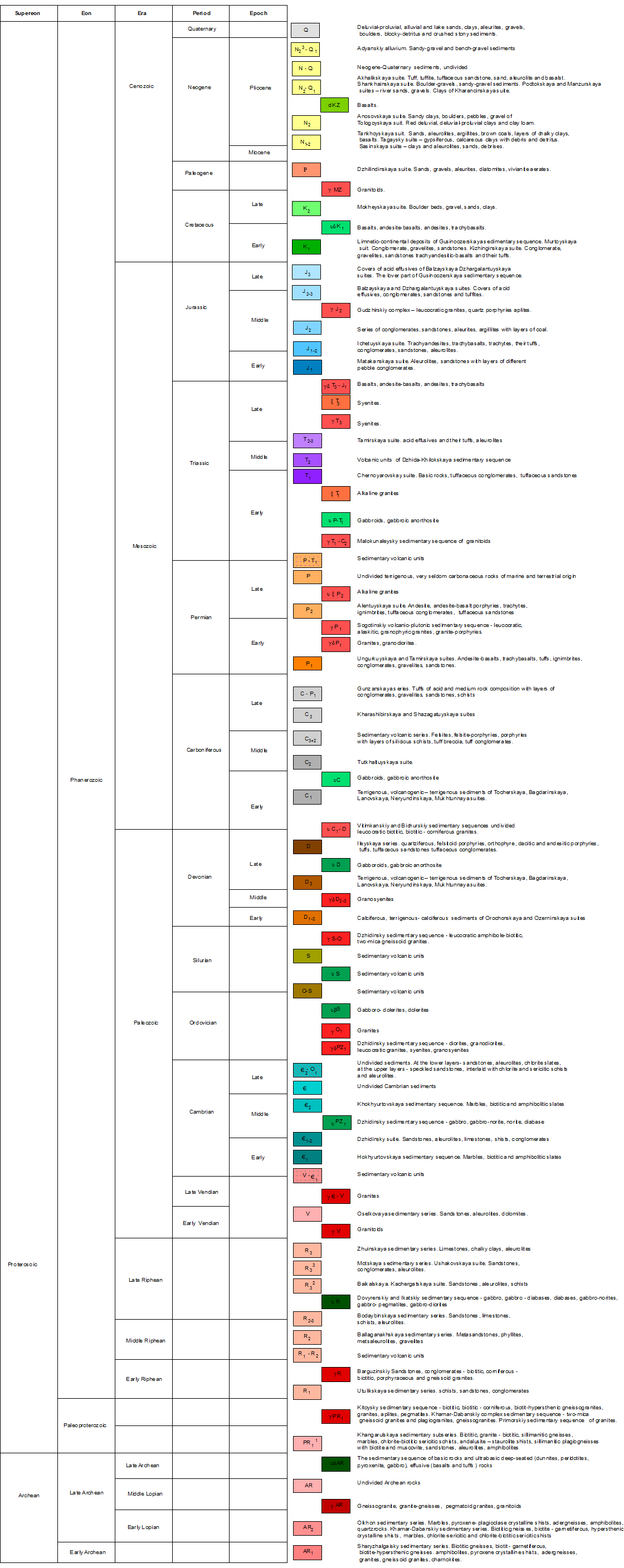
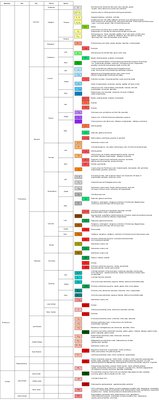
<p class="1" style="text-align: justify; ">Many features inherent in the geological structure of the territory of the watershed basin are due to the fact that the territory lies at the interface between the two main lithospheric plates of East Siberia, namely the old Siberian platform, and the younger Central-Asian mobile belt. Formation of the geological structure of both Russian and Mongolian parts of the territory began in the Early Precambrian. For this reason, the geological structures, presented on the map, preserved traces of both Precambrian and Phanerozoic eras of tectogenesis.</p>
<p class="1" style="text-align: justify; ">Precambrian formations have been ascertained essentially within the mountain framing of the Baikal hollow and to the south and south-west of it, within the north-west of Mongolia.</p>
<p class="1" style="text-align: justify; ">The Precambrian sedimentary-metamorphic complexes within the mountain framing of the Baikal hollow, presumably of Archean age, are separated into three series differing in the set of rocks building them up, the degree of metamorphism, the type of magmatic manifestations, and the pattern of fold structures: the Sharyzhalgai, Khamar-Daban and Olkhon series. The occurrence area of rocks of the Sharyzhalgai series in the south is clearly delineated – it is a near-rectilinear shore of Lake Baikal between the source of the Angara river and the settlement of Kultuk, and in the south-west – by the zone of the Main Sayan Fault. Its composition includes rocks of two types: biotite, biotite-garnet and biotite-hypersthene migmatizated gneisses among which there occur, in the form of separate interlayers and thicker bedsets, amphibolites, pyroxene and amphibolite-pyroxene schists as well as granites differing in composition and structural-textural characteristics. The complex of sedimentary-metamorphic formations of the Khamar-Daban series is of widespread occurrence along the southern shores of Lake Baikal and within the confines of the Khamar-Daban mountain range. The composition of the series is notable for the Slyudyanka and Kharangul subseries. The Slyudyanka subseries is comprised of thick terrigenous-carbonate layers (carbonate bedsets, and specific silicious-dolomite apatite-bearing rocks), while the Kharangul subseries is dominated by flyschoid deposits (aluminous slates, and gneisses with rarely occurring interlayers and bedsets of carbonates). Deposits of the Olkhon series occur widely in Priolkhonie and on Olkhon Island; they are represented by marbles, pyroxene-plagioclase crystalline schists, amphibole-biotite gneisses, and magmatites with interbeds of amphibolites and quartzites. The Precambrian ophiolitic complex, confined to the suture zones of the fold belt, is registered in the north-western part of Mongolia.</p>
<p style="text-align: justify; ">The Lower-Proterozoic deposits of the Muya series are exposed on the watersheds of the Primorskii ridge along the coastal stripe of Maloe More and are represented by quartzites, slates and metamorphized effusives.</p>
<p style="text-align: justify; ">The Upper-Proterozoic (Riphean) deposits occur mainly within the Baikal mountain region. The Patom series occurs in the north of the region and divides into the Ballaganakh, Kadalikan and Bodaibo subseries which, in turn, subdivide into formations. In Western Cisbaikalia there occurs the Baikal series of the Upper Proterozoic consisting of three formations: the Goloustnoe, Uluntui and Kachergat formations. In the south, within the Olkha−Goloustnoe plateau there occur deposits of the Ushakovka formation of the Moty series.</p>
<p style="text-align: justify; ">Cambrian rocks occur widely in the Middle-Vitim, Angara-Barguzin, and Khamar-Daban mountain regions as well as in the mountain framing of Lake Khovsgol, and within the Uda river basin. The composition of Cambrian deposits is quite varied, ranging from conglomerates and sandstones to very fine carbonate differences. The Devonian deposits are represented by a rather broad spectrum of separate isolated areas; they are arbitrarily subdivided into two stratigraphic complexes. The lower Devonian layers are dominated by carbonate deposits, while the upper level is comprised of terrigenous and volcanogenic-terrigenous deposits. The Carboniferous deposits occur in many isolated areas.  The Carboniferous is represented largely by terrigenous marine deposits (sandstones, aleurites, gravelites, conglomerates, and slates). The Permian deposits are also extremely isolated. The largest field of Permian deposits is the Borzya deposit; it lies in Eastern Transbaikalia, and in Western Transbaikalia in the Khilok area. They are represented by relatively uniform terrigenous (and very rarely, carbonate) rocks of a marine and continental origin.</p>
<p style="text-align: justify; ">The Triassic deposits include widely occurring volcanogenic formations that are assigned to the Dzhida-Khilok series occurring with scouring on Paleozoic granitoids and other rocks. The lower layers are comprised of the Chernoyarovo formation consisting of major effusives, tuff conglomerates and tuff sandstones. The upper layers include the Tamirskaya formation consisting of acid effusives and their tuffs, and aleurites. Sedimentary and sedimentary-volcanic deposits of the Triassic occupy large areas in the western part of Mongolia, where they are interrupted in some places by the Jurassic sediments. The Lower-Jurassic formations are dominant in the eastern part of Transbaikalia, while marine deposits of the Lower- and partially Mid-Jurassic period are found only in the central part of Eastern Transbaikalia. In the north-west and south-east marine deposits are replaced by continental formations. Starting largely in the Mid-Jurassic period, the western and northern parts of Transbaikalia had been accumulating layers of conglomerates, sandstones, aleurites and argillites with interbeds of bituminous coal. The upper division includes covers of acid effusives. Such effusive-sedimentary formations also extend over the Vitim upland. The syncline cores, usually with their north-eastward strike line, occur in the area of Cretaceous freshwater-continental deposits. The lower part of these deposits refers to the Jurassic, while the upper part corresponds to the Cretaceous. The lower Cretaceous layers are comprised of conglomerates, sandstones, aleurites, slates and strata of brown coal, whereas the upper layers include boulder beds, shingle, sands and clays of the Mokheiskaya formation. In the central parts of Mongolia Cretaceous deposits are somewhat controlled spatially by deep faults and unconformably lie on the Devonian and Cambrian deposits.</p>
<p style="text-align: justify; ">Paleogene deposits occur very fragmentarily and are most commonly regarded as Upper Cretaceous−Paleogene deposits, because their detailed partition is unfeasible to date.  They are represented by covers of red and variegated-red clays, sandy-shingle deposits and lacustrine clays. Paleogene deposits are characterized by successive link of their composition with the laterite-kaolinite weathering crust. Miocene deposits of the Tankhoi formation are of widespread occurrence on the south-eastern shore of the lake; they were also found at different depths in the course of drilling in the sediments of the Ust-Selenginskaya depression, within the Barguzinskaya depression, and in intermountain depressions of Northern Pribaikalie. In the Dzhida mountainous area and on the Khamar-Daban range, basalt covers, overlaying the watershed areas, belong to the Miocene. On Olkhon Island, deposits of the Tagai formation, which are overlapped with an angular unconformity by deposits of the Sasinskaya formation (Upper Miocene - Lower Pliocene), are referred to the Lower-Middle Miocene. The Upper Pliocene and Eo-pleistocene in most cases compose a single rock mass, which resists dissection. Deposits of this age are registered in South Baikal (Shankhaikhinskaya formation), and in a number of areas of the eastern, western and southern surrounding of the Baikal hollow. On Olkhon Island the Upper Pliocene is represented by clays of the Kharantsy formation. Quaternary formations are characterized by a diversity of lithogenetic and facial types and occupy different geomorphological positions. Most often, the lower half of the profile of the quaternary system clearly shows a thick, complicated sandy layer, while the upper layers of the Pleistocene and Holocene are dominated by rudaceous deposits, including morainic.</p>
<p style="text-align: justify; ">The Siberian block of the Eurasian plate and adjoining spaces which, as a result of a long-lasting development, had transformed to the Sayan-Baikal orogenic belt, were characterized by the differing trends of geological events.</p>
<p style="text-align: justify; ">In the Early Precambrian, the sialic masses that merged together to form a single block, i.e. Siberia, comprised several Archean blocks with the well-developed continental crust. They were separated by proto-oceanic basins. Toward the end of the Early Proterozoic, the proto-continental blocks had formed a massif with a mature continental crust, i.e. a basement of the Siberian platform. As a result of the Early-Proterozoic orogeny, the marginal zone of the continent developed the mountain terrain which had been destroyed by the beginning of the Riphean. The Mid-Riphean stage started to accumulate the proper sedimentary cover of the Siberian platform. At the close of the Riphean−Vendian time, most of the paleocontinent was covered by the sea. On the other hand, orogenic movements resulted in the formation of elevated blocks of the Barguzin and Bokson−Khovsgol microcontinents. They produced a discontinuous chain of mountain ridges separating the Siberia paleocontinent from the Paleo-Asian Ocean. In the late Vendian−early Cambrian, the mountain massifs underwent substantial planation. Starting in the early Cambrian and during the Ordovician−Silurian, the eastern and southern margins of the basements of the microcontinents were represented by shelf zones, and by the upper parts of the continental slope of the oceanic basin. In the latter half of the early Paleozoic and at the beginning of the late Paleozoic, the collision of the Barguzin microcontinent with the Siberian platform triggered the formation of Barguzin granitoids. The latter half of the Paleozoic witnessed the collision of the Barguzin, Bokson-Khovsgol and other microcontinents with the margin of the Siberia paleocontinent. The Paleo-Asian Ocean stretched out southward of the Siberia paleocontinent. In the Hercynian era, the active processes in the Mongol−Okhotsk belt were responsible for the tectonic-magmatic intensification of the Sayan-Baikal region and the southern part of the Siberian platform. At the beginning of the Mesozoic, an attenuation of the vertical tectonic movements led to peneplanation with the formation of a thick weathering crust. The subsequent Mesozoic intensification was responsible for a growth of the mountains in the Sayan-Baikal region, and for an intensification of intrusive magmatism.</p>
<p style="text-align: justify; ">The end of the Cretaceous−Paleogene was marked by a long-lasting period of peneplanation and crust formation which preceded directly the Cenozoic riftogenesis and the formation of the morphostructural plan of the Baikal Rift Zone and the Baikal basin.</p>
<p style="text-align: justify; ">The distinguished tectonic stages are very clearly registered in three tectonic blocks in the territory of Mongolia, namely: western – Caledonian; central – Early Caledonian, with numerous outthrusts of rocks of the crystalline basement and Hercynian and Mesozoic structures overlaying them, and southern – Hercynian. In general, the modern overlapped-folded structure of the Mongolian territory outlines certain spatial and temporal patterns, consisting in a directional change of more ancient structures, located in the north and west, by younger ones, clearly manifested in the south.</p>
<p style="text-align: justify; ">The territory of the the Baikal basin is unique as regards the occurrence, range and diversity of granitoids, which occupy more than 70% of the area, while the formation of acid magmas was taking place from the Archean to the early Cretaceous. They tend to occur within the Mongol−Okhotsk (Mongol-Transbaikalian) mobile belt, having a complex long-lasting history. The following stages of magmatism are identified:</p>
<p style="text-align: justify; ">1. Archean early-orogenic – formation of migmatites and lenticular concordant bodies of gneissogranites and granites. Archean late-orogenic – intrusive bodies of pink and red leucocratic significantly potassic granites and alaskites.</p>
<p style="text-align: justify; ">2. Early Proterozoic late-orogenic fissure intrusions of the seaside granite complex.</p>
<p style="text-align: justify; ">3. Late Baikalian−early Caledonian (Vendian−early Cambrian) – basic volcanism, ultrabasic intrusions.</p>
<p style="text-align: justify; ">4. Late Caledonian (Cambrian−Silurian) – formation of granitoids on a mass scale.</p>
<p style="text-align: justify; ">5. Early Hercynian (Devonian) – local occurrence of acid and mixed volcanism. Intrusions of alkali-earth syenites, granites, and alaskite granites.</p>
<p style="text-align: justify; ">6. Late Hercynian (Carboniferous−Permian) – intrusive series of gabbro-monzonite-syenite, alkali-syenite and alkali-granite composition.</p>
<p style="text-align: justify; "><a href="http://dic.academic.ru/dic.nsf/ruwiki/1261431">7. Triassic−Cretaceous</a> – series of tectono-magma activations with the establishment of volcano-tectonic structures, formation of intrusions of normal and alkali-earth granodiorite−leucogranite series and effusion of basaltoids.</p>
<p style="text-align: justify; ">8. Quaternary period – riftogenesis and effusion of alkali basaltoids.</p>]]></content:encoded>
    <dc:publisher>No publisher</dc:publisher>
    <dc:creator>Alexander Ayurzhanaev</dc:creator>
    <dc:rights></dc:rights>
    <dc:date>2014-10-07T02:00:00Z</dc:date>
    <dc:type>Page</dc:type>
  </item>


  <item rdf:about="http://bic.iwlearn.org/en/atlas/atlas/82-tourism-map/tourism-map">
    <title>Tourism map</title>
    <link>http://bic.iwlearn.org/en/atlas/atlas/82-tourism-map/tourism-map</link>
    <description></description>
    <content:encoded xmlns:content="http://purl.org/rss/1.0/modules/content/"><![CDATA[<p><img class="image-inline" src="../../../resolveuid/b05baa84669049b9888661f593b652bd/@@images/image/preview" /></p>
<p><a href="http://bic.iwlearn.org/en/atlas/photos/copy_of__82_Tourism.png" class="internal-link">Open full size</a></p>
<p align="center"><strong>Tourism</strong></p>
<p align="center"><strong> </strong></p>
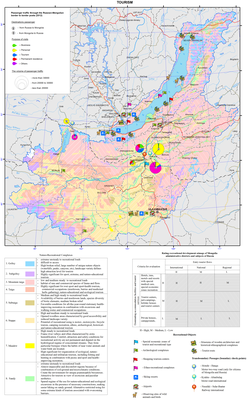
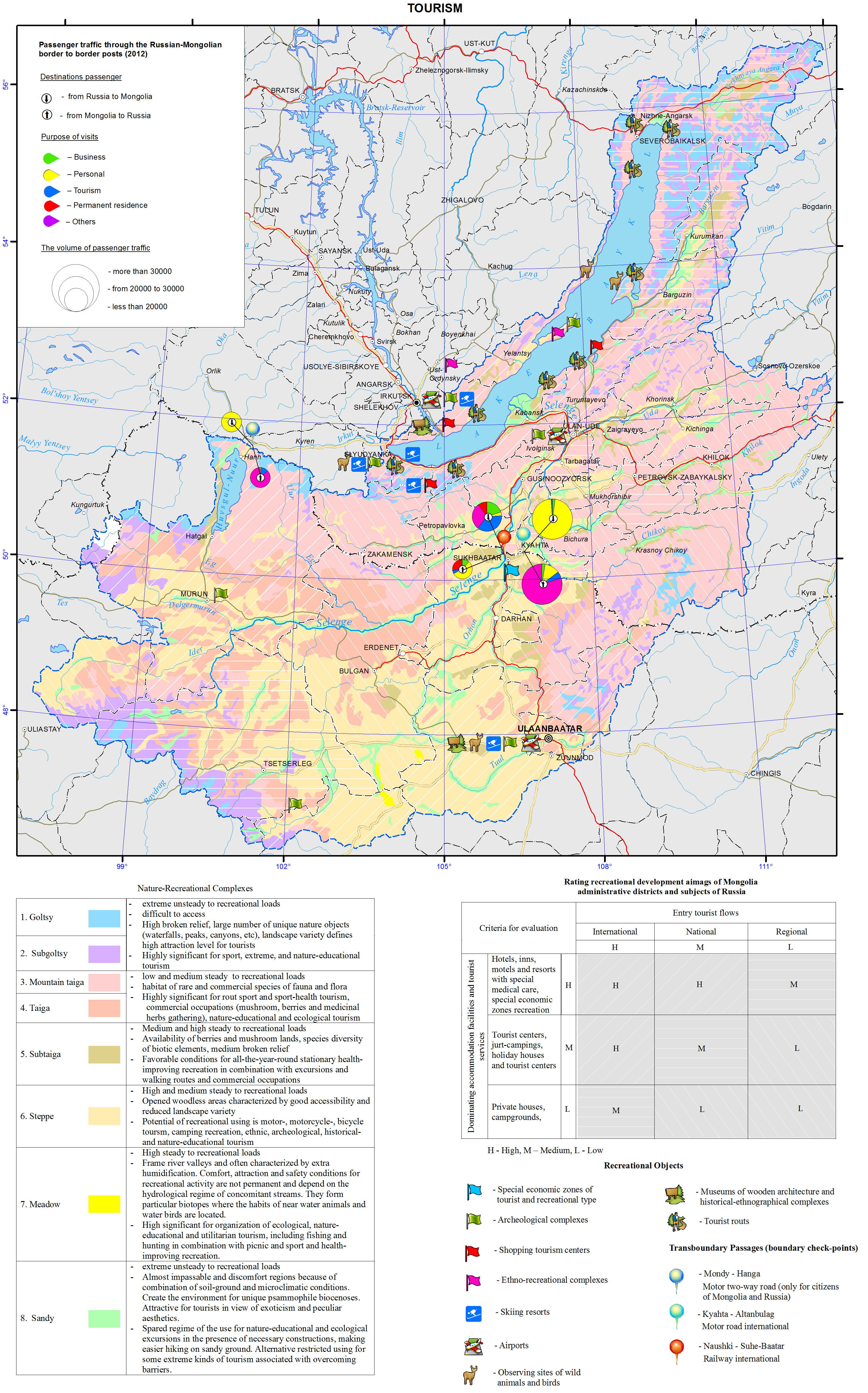
<p>The Baikal basin is a unique area that draws attention of tourists from all over the world. Its location in the heart of the Eurasian landmass has defined its high ethno-cultural and natural diversity. The history of development of the lands around Baikal is connected with the rise of two giant empires – Mongolian and Russian, as well as with the historical development of trade and transport routes.</p>
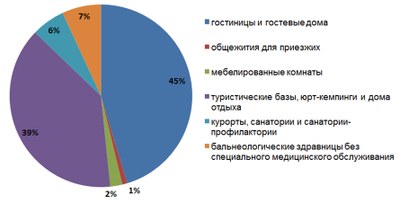
<p>The natural and resource nucleus of the recreational system of the Baikal basin is the oldest and deepest lake in the world itself. Infrastructural centers for tourism development are major cities of Ulaanbaatar, Irkutsk, and Ulan-Ude. They play the role of major international transport hubs and have administrative, educational, and cultural tourism resources, as well as a significant hospitality potential. In 2012, Ulaanbaatar had the largest hotel fund (over 170 hotels). There were about 80 hotels in Irkutsk and up to 20 in Ulan-Ude. In general, the transboundary area of the Baikal basin has over a thousand places for tourist accommodation of general and special purpose (Fig. 1).</p>
<p style="text-align: center; "><img class="image-inline" src="../../../resolveuid/e1da5a0a1de942da8b51036648fbd2bb/@@images/image/preview" /></p>
<ul>
<li>hotels and guest houses </li>
<li>hostel for visitors </li>
<li>hostels, yurt camping and rest houses </li>
<li>resorts, motels and sanatorium </li>
<li>balneologic resorts without special health care</li>
</ul>
<p style="text-align: justify; "><b>Figure 1. Recreational accommodation facilities in the transboundary Baikal basin [Business of the Angara region…, 2012; Activities of tourism firms..., 2011; Culture, tourism, and recreation…, 2012; Tourism in Sunny Buryatia, 2011; Soyol ..., 2013]</b></p>
<p>The number of accommodation facilities, as well as the level of offered services in conjunction with the configuration and nature of the tourist traffic help identify the most important areas for the tourism industry, assess the degree of tourism development, and get a general picture of a territorial structure of recreational activities. A matrix integrating the character of tourist traffic and a predominant type of accommodation was used as the basis for the expert assessment of tourism development of administrative units of Russia and Mongolia.</p>
<p>The main distinctive characteristics of the recreational system of the Baikal basin is its transboundary position. Therefore, the neighboring aimags of Mongolia and administrative districts of Irkutsk oblast and the Republic of Buryatia that are located along the state border and have cross-border corridors (ports of entry) are of a special significance.</p>
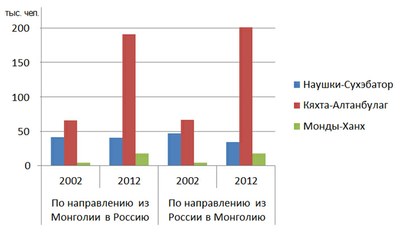
<p>The process of development of cross-border tourism in the neighboring territories of Russia and Mongolia is taking place under conditions, where both countries with a unique culture and nature are an integral part of the international recreational space, have a special interest for tourists from other countries, and make mutual contribution to the formation of the inbound tourist traffic. The Russian-Mongolian border, which crosses the basin, has three checkpoints that not only facilitate the exchange of foreign and domestic tour groups, but also serve as a prerequisite for the development of cross-border trade. Within 10 years, the total volume of passenger traffic through the existing checkpoints has more than doubled – from 229 thousand people in 2002 to 502.5 thousand people in 2012 (Fig. 2).</p>
<p style="text-align: center; "><img class="image-inline" src="../../../resolveuid/1c774d490c45475d9df1908773c75d9d/@@images/image/preview" /></p>
<p align="center"> </p>
<ul>
<li>Naushki-Sükhbaatar</li>
<li>Kyakhta-Altabulag</li>
<li>Mondy-Khankh</li>
</ul>
<p style="text-align: justify; "><b>Figure 2. Passenger traffic through the Russian-Mongolian border [Mongolian..., 2013; Mongolian ..., 2006]</b></p>
<p>Development of cross-border tourism requires joint decisions to promote a common tourism product on the state level. Such projects as “Baikal-Khovsgol”, which connects two great lakes of Asia, and “The Tea Road” have already become popular. The establishment of transboundary special protected areas have great prospects for the bilateral cooperation in the field of eco-tourism. They represent a particular organizational resource, which is important not only for the resolution of shared environmental problems, but also for the coordination of efforts aimed at implementing cross-border tourism projects.</p>
<p>Active cooperation between Russia and Mongolia in promoting tourism within the unique natural object – the Baikal basin not only opens the possibilities for increasing inbound foreign tourism in both countries, but also contributes to the expansion of similar relationships with other neighboring countries, such as China, Kazakhstan, and Japan.</p>
<p> </p>
<p align="center">References</p>
<p>Statistical Compendium. (2012). <i>Business of the Angara region: Tourism and hospitality</i>. Irkutsk: Irkutskstat. p 35-62.</p>
<p>Statistical Compendium. (2011). <i>Activities of tourism firms and collective accommodation facilities in the Republic of Buryatia in 2011</i>. Ulan-Ude: Buryatstat. p 7-12.</p>
<p>Statistical Compendium. (2012). <i>Culture, tourism, and recreation in the Angara region</i>. Irkutsk: Irkutskstat. p 45-52.</p>
<p>Statistical Compendium. (2011). <i>Tourism in Sunny Buryatia</i>. Ulan-Ude: Buryatstat. p 59.</p>
<p>National Statistical Office of Mongolia. (2013). <i>Soyol, sport, ayalal, zhuulchlalyn salbaryn lavlakh</i>. Ulaanbaatar. p 285.</p>
<p>National Statistical Office of Mongolia. (2012). <i>Mongolian statistical yearbook 2012</i>. Ulaanbaatar. p 297-299.</p>
<p>National Statistical Office of Mongolia. (2007). <i>Mongolian statistical yearbook 2006</i>. Ulaanbaatar. p 265-269.</p>]]></content:encoded>
    <dc:publisher>No publisher</dc:publisher>
    <dc:creator>Alexander Ayurzhanaev</dc:creator>
    <dc:rights></dc:rights>
    <dc:date>2014-10-07T00:56:13Z</dc:date>
    <dc:type>Page</dc:type>
  </item>


  <item rdf:about="http://bic.iwlearn.org/en/atlas/atlas/28-maximum-runoff-during-the-flood-map/maximum-runoff-during-the-flood-map">
    <title>Maximum runoff during the flood map</title>
    <link>http://bic.iwlearn.org/en/atlas/atlas/28-maximum-runoff-during-the-flood-map/maximum-runoff-during-the-flood-map</link>
    <description></description>
    <content:encoded xmlns:content="http://purl.org/rss/1.0/modules/content/"><![CDATA[<p><img class="image-inline" src="../../../resolveuid/7e21331f5819408badfa79e4240cb100/@@images/image/preview" /></p>
<p><a href="http://bic.iwlearn.org/en/atlas/photos/copy_of__28_Maximumrunoffduringtheflood.png" class="internal-link">Open full size</a></p>
<p align="center"><strong>Flow</strong></p>
<p>The map “Mean annual flow” reflects the formation patterns of the water regime of the territory, which are determined by the properties of landscapes to transform atmospheric moisture into the runoff.</p>
<p>For a water body basin, the surface runoff is the total amount of water loss from the watershed landscapes. The runoff rate from landscape complexes is determined by solving the inverse problem, i.e. identification of the connection of flow rate at the main stream station of a catchment with the runoff from landscapes, occupying its area, and is calculated based on the equation Q<sub>j</sub> = ∑q<sub>i</sub> f<sub>ij</sub><i>,</i><i> </i>where <i>j</i> is the index of the river basin, Q<sub>j</sub> is its runoff, L/s; q<sub>i</sub> is a modification of flow from the i-th landscape complex, L/s km<sup>2</sup>; f<sub>ij</sub> is an area of the j-th basin occupied by the i-th landscape, km<sup>2</sup>. Long-term average runoff data for small and medium-sized rivers of theLake Baikal basin were used in calculations for the map construction [Long-term…, 1986, http://www.r-arcticnet.sr.unh.edu]. Characteristics of landscape components were obtained on the basis of the materials on landscape of the Baikal region [Landscapes…, 1977, Natural..., 2009, Landscapes…, 1990, Lysanova et al., 2009]. In accordance with the regional dimension, generalization degree is chosen at the geom level, and their average annual flow moduli are determined. The territory on the map is divided into regions according to five gradations of the module - from less than 1 to more than 10 L/s km<sup>2</sup>.</p>
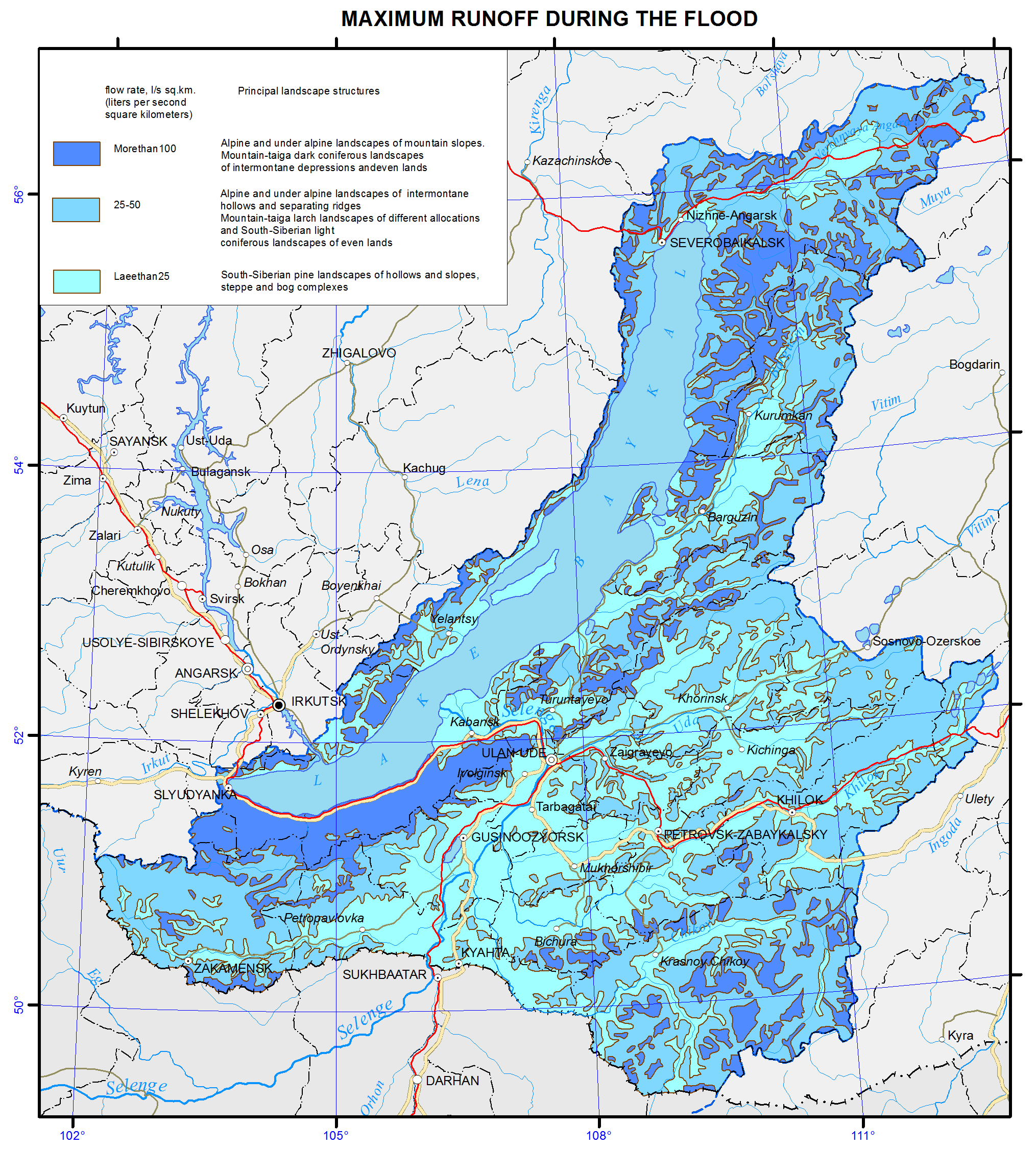
<p>The catchment area of the lake covers a variety of landscape zones and altitudinal belts, which makes a great contrast between the runoff rates. The highest annual flow moduli are formed within the goletz and mountain-taiga landscapes. Steppe and forest-steppe areas are distinguished by the minimum runoff rates, and in the desert regions of Mongolia (the Selenga river basin) flow formation almost does not take place.</p>
<p>The maps of minimum and maximum flow were compiled based on the typological landscape classification represented on the map [Landscapes…, 1977]. In the course of investigation, landscapes of different types were generalized by identifying the most hydrologically informative properties (morphological characteristics, vegetation structure, altitudinal zonation, etc.). As a result, more than 200 landscapes were combined into sixteen types of natural complexes, and runoff rates were determined for them. The moduli of maximum snow runoff and minimum summer runoff were calculated as described above.</p>
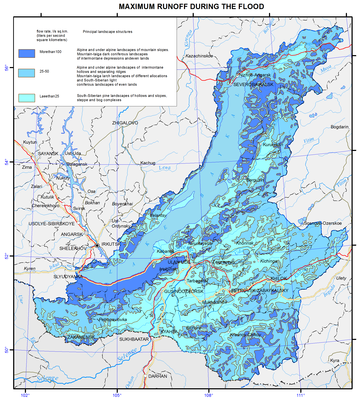
<p>Areas with the highest runoff of floods are confined to the mountain ranges and systems with goletz open woodlands and mountain-taiga landscapes. The main areas, distinguished by formation of frequent and high floods are the Baikalsky Range on the north-eastern end of the lake; Barguzinsky Range, located in the south-eastern part of the catchment, and the Khamar-Daban, covering the south-western shore of Lake Baikal. The values of the maximum flow modification are shown in three gradations on the map, namely: less than 25, 25-70, and more than 100 L/s km<sup>2</sup>.</p>
<p>Features of formation of the minimum summer runoff in the Baikal basin are associated with the regime of atmospheric moisture, as well as with the effects of altitude and exposition. The calculations and analysis of the minimum summer runoff have shown a relatively high water yield in the low-flow period from high-mountain taiga landscapes and extremely low river flow formation in the central areas of the Selenga river catchment and in Priolkhonie, which are covered with light coniferous landscapes and steppe complexes on slopes and plains. The map shows the value of the minimum flow in three gradations, namely: less than 1.5, 3.0-5.0, and more than 5.0 L/s km<sup>2</sup>.</p>
<p>Landscape-hydrological mapping based on the quantitative characteristics of water yield of landscape complexes objectively reflects the hydrological organization of the territory.</p>
<p><b> </b></p>
<p align="center">References</p>
<p>Kuznetsova T.I. (2009). Map "Natural landscapes of the Baikal region and their use: purpose, structure, and content”.  T.I. Kuznetsova, A.R. Batuev, and A.V. Bardash. <i>Geodeziya i kartografiya,</i> , no 9, pp. 18-28.</p>
<p>Landscapes of southern East Siberia [Maps]: [physical map] (1977) / compiled and prep. for printing by factory no. 4 GUGK in 1976, authors: V.S. Mikheev and V.A. Ryashin. 1: 1 500 000, Moscow: GUGK, 1 map (4 sheets): col.</p>
<p>Landscapes [Maps] [physical map] / The National Atlas of the Mongolian People's Republic. / comp .and prep to print by GUGK in 1989, authors: B.M. Ishmuratov, K.N. Misevich, I.L. Savelyeva, et al.</p>
<p>Lysanova, G.I., Semenov, Yu.M., Shekhovtsov, A.I., and Sorokovoy, A.A. (2013). Geosystems of the Republic of Tuva. <i>Geografiya i prirodnye resursy</i>, no. 3, pp. 181-185.</p>
<p>Long-term data on the regime and surface water resources. The Baikal basin. (1986). Vol. 1, no. 14, Leningrad: Gidrometeoizdat, 361 p.</p>
<p><b><i>A Regional, Electronic, Hydrographic Data Network For the Arctic Region.</i></b> <b>URL: </b><a href="http://www.r-arcticnet.sr.unh.edu/"><b>http://www.r-arcticnet.sr.unh.edu</b></a></p>]]></content:encoded>
    <dc:publisher>No publisher</dc:publisher>
    <dc:creator>Alexander Ayurzhanaev</dc:creator>
    <dc:rights></dc:rights>
    <dc:date>2014-10-06T04:20:00Z</dc:date>
    <dc:type>Page</dc:type>
  </item>


  <item rdf:about="http://bic.iwlearn.org/en/friends/mongolian/ngo-network-report">
    <title>NGO network report</title>
    <link>http://bic.iwlearn.org/en/friends/mongolian/ngo-network-report</link>
    <description></description>
    
    <dc:publisher>No publisher</dc:publisher>
    <dc:creator>silbi_747@yahoo.com</dc:creator>
    <dc:rights></dc:rights>
    <dc:date>2014-09-02T08:27:28Z</dc:date>
    <dc:type>File</dc:type>
  </item>


  <item rdf:about="http://bic.iwlearn.org/en/documents/documents/papers/Geoinformational%20of%20Monitoring%20of%20Natural%20Landscape%20Baikal%20Basin%20-english.pdf">
    <title>Geoinformational support of monitoring of natural landscape transformation in the basin of lake Baikal on the basis of retrospective cartographic materials (english).</title>
    <link>http://bic.iwlearn.org/en/documents/documents/papers/Geoinformational%20of%20Monitoring%20of%20Natural%20Landscape%20Baikal%20Basin%20-english.pdf</link>
    <description></description>
    
    <dc:publisher>No publisher</dc:publisher>
    <dc:creator>Alexander Ayurzhanaev</dc:creator>
    <dc:rights></dc:rights>
    <dc:date>2014-04-15T00:50:12Z</dc:date>
    <dc:type>File</dc:type>
  </item>


  <item rdf:about="http://bic.iwlearn.org/en/documents/documents/papers/Spatio-temporal%20dynamics%20of%20vegetation%20cover%20of%20arid%20and%20semiarid%20climatic%20zones%20in%20central%20Mongolia%20on%20the%20basis%20of%20time%20series%20NDVI%20and%20field%20studies%20-rus.pdf">
    <title>Spatio-temporal dynamics of vegetation cover of arid and semiarid climatic zones in central Mongolia on the basis of time series NDVI and field studies (rus).</title>
    <link>http://bic.iwlearn.org/en/documents/documents/papers/Spatio-temporal%20dynamics%20of%20vegetation%20cover%20of%20arid%20and%20semiarid%20climatic%20zones%20in%20central%20Mongolia%20on%20the%20basis%20of%20time%20series%20NDVI%20and%20field%20studies%20-rus.pdf</link>
    <description></description>
    
    <dc:publisher>No publisher</dc:publisher>
    <dc:creator>Alexander Ayurzhanaev</dc:creator>
    <dc:rights></dc:rights>
    <dc:date>2014-04-11T06:20:00Z</dc:date>
    <dc:type>File</dc:type>
  </item>


  <item rdf:about="http://bic.iwlearn.org/en/documents/documents/papers/Spatial%20and%20temporal%20dynamics%20of%20the%20Baikal%20coastal%20line%20caused%20by%20control%20of%20the%20lake%20level%20regime%20-english.pdf">
    <title>Spatial and temporal dynamics of the Baikal coastal line caused by control of the lake level regime (english).</title>
    <link>http://bic.iwlearn.org/en/documents/documents/papers/Spatial%20and%20temporal%20dynamics%20of%20the%20Baikal%20coastal%20line%20caused%20by%20control%20of%20the%20lake%20level%20regime%20-english.pdf</link>
    <description></description>
    
    <dc:publisher>No publisher</dc:publisher>
    <dc:creator>Alexander Ayurzhanaev</dc:creator>
    <dc:rights></dc:rights>
    <dc:date>2014-04-11T06:20:00Z</dc:date>
    <dc:type>File</dc:type>
  </item>


  <item rdf:about="http://bic.iwlearn.org/en/documents/documents/papers/Identifying%20desertified%20territories%20based%20on%20comprehensive%20analysis%20of%20multispectral%20-LANDSAT-%20and%20radar%20-SRTM-%20satellite%20data%20-rus.pdf">
    <title>Identifying desertified territories based on comprehensive analysis of multispectral (LANDSAT) and radar (SRTM) satellite data (rus).</title>
    <link>http://bic.iwlearn.org/en/documents/documents/papers/Identifying%20desertified%20territories%20based%20on%20comprehensive%20analysis%20of%20multispectral%20-LANDSAT-%20and%20radar%20-SRTM-%20satellite%20data%20-rus.pdf</link>
    <description></description>
    
    <dc:publisher>No publisher</dc:publisher>
    <dc:creator>Alexander Ayurzhanaev</dc:creator>
    <dc:rights></dc:rights>
    <dc:date>2014-04-11T06:18:18Z</dc:date>
    <dc:type>File</dc:type>
  </item>


  <item rdf:about="http://bic.iwlearn.org/en/documents/documents/proceedings/2013/TOM%202_Environment%20and%20sustainable%20development%20in%20Mongolian%20plateau%20and%20surrounding%20regions%20-rus.pdf">
    <title>Тom 2_Environment and sustainable development in Mongolian plateau and surrounding regions (rus).</title>
    <link>http://bic.iwlearn.org/en/documents/documents/proceedings/2013/TOM%202_Environment%20and%20sustainable%20development%20in%20Mongolian%20plateau%20and%20surrounding%20regions%20-rus.pdf</link>
    <description></description>
    
    <dc:publisher>No publisher</dc:publisher>
    <dc:creator>Alexander Ayurzhanaev</dc:creator>
    <dc:rights></dc:rights>
    <dc:date>2014-04-10T03:05:00Z</dc:date>
    <dc:type>File</dc:type>
  </item>


  <item rdf:about="http://bic.iwlearn.org/en/documents/documents/proceedings/2013/TOM%201_Environment%20and%20sustainable%20development%20in%20Mongolian%20plateau%20and%20surrounding%20regions%20-rus.pdf">
    <title>Тom 1_Environment and sustainable development in Mongolian plateau and surrounding regions (rus).</title>
    <link>http://bic.iwlearn.org/en/documents/documents/proceedings/2013/TOM%201_Environment%20and%20sustainable%20development%20in%20Mongolian%20plateau%20and%20surrounding%20regions%20-rus.pdf</link>
    <description></description>
    
    <dc:publisher>No publisher</dc:publisher>
    <dc:creator>Alexander Ayurzhanaev</dc:creator>
    <dc:rights></dc:rights>
    <dc:date>2014-04-10T03:05:00Z</dc:date>
    <dc:type>File</dc:type>
  </item>


  <item rdf:about="http://bic.iwlearn.org/en/documents/documents/monographs/Anthropogenic%20transformation%20of%20natural%20systems%20and%20their%20socio-economic%20impacts%20in%20the%20Selenga%20river%20basin%20-rus.pdf">
    <title>Anthropogenic transformation of natural systems and their socio-economic impacts in the Selenga river basin (rus).</title>
    <link>http://bic.iwlearn.org/en/documents/documents/monographs/Anthropogenic%20transformation%20of%20natural%20systems%20and%20their%20socio-economic%20impacts%20in%20the%20Selenga%20river%20basin%20-rus.pdf</link>
    <description></description>
    
    <dc:publisher>No publisher</dc:publisher>
    <dc:creator>Alexander Ayurzhanaev</dc:creator>
    <dc:rights></dc:rights>
    <dc:date>2014-04-10T02:50:00Z</dc:date>
    <dc:type>File</dc:type>
  </item>


  <item rdf:about="http://bic.iwlearn.org/en/documents/documents/papers/Fish%20nutrition%20in%20some%20small%20reservoirs%20of%20the%20Ivan-Arakhley%20system%20and%20their%20potential%20for%20piscicultural%20operations%20-rus.pdf">
    <title>Fish nutrition in some small reservoirs of the Ivan-Arakhley system and their potential for piscicultural operations (rus).</title>
    <link>http://bic.iwlearn.org/en/documents/documents/papers/Fish%20nutrition%20in%20some%20small%20reservoirs%20of%20the%20Ivan-Arakhley%20system%20and%20their%20potential%20for%20piscicultural%20operations%20-rus.pdf</link>
    <description></description>
    
    <dc:publisher>No publisher</dc:publisher>
    <dc:creator>Alexander Ayurzhanaev</dc:creator>
    <dc:rights></dc:rights>
    <dc:date>2014-03-28T13:15:00Z</dc:date>
    <dc:type>File</dc:type>
  </item>


  <item rdf:about="http://bic.iwlearn.org/en/documents/documents/papers/Estimation%20of%20forest%20biomass%20using%20satellite%20%20radar%20data%20-rus.pdf">
    <title>Estimation of forest biomass using satellite  radar data (rus).</title>
    <link>http://bic.iwlearn.org/en/documents/documents/papers/Estimation%20of%20forest%20biomass%20using%20satellite%20%20radar%20data%20-rus.pdf</link>
    <description></description>
    
    <dc:publisher>No publisher</dc:publisher>
    <dc:creator>Alexander Ayurzhanaev</dc:creator>
    <dc:rights></dc:rights>
    <dc:date>2014-03-28T13:15:00Z</dc:date>
    <dc:type>File</dc:type>
  </item>


  <item rdf:about="http://bic.iwlearn.org/en/documents/documents/papers/Geoinformational%20of%20Monitoring%20of%20Natural%20Landscape%20Baikal%20Basin%20-rus.pdf">
    <title>Geoinformational support of monitoring of natural landscape transformation in the basin of lake Baikal on the basis of retrospective cartographic materials (rus).</title>
    <link>http://bic.iwlearn.org/en/documents/documents/papers/Geoinformational%20of%20Monitoring%20of%20Natural%20Landscape%20Baikal%20Basin%20-rus.pdf</link>
    <description></description>
    
    <dc:publisher>No publisher</dc:publisher>
    <dc:creator>Alexander Ayurzhanaev</dc:creator>
    <dc:rights></dc:rights>
    <dc:date>2014-03-28T09:25:00Z</dc:date>
    <dc:type>File</dc:type>
  </item>


  <item rdf:about="http://bic.iwlearn.org/en/documents/documents/papers/Identification%20of%20%20the%20sources%20of%20water%20%20pollution%20on%20the%20basis%20the%20GIS-technologies%20-rus.pdf">
    <title>Identification of  the sources of water  pollution on the basis the GIS-technologies (rus).</title>
    <link>http://bic.iwlearn.org/en/documents/documents/papers/Identification%20of%20%20the%20sources%20of%20water%20%20pollution%20on%20the%20basis%20the%20GIS-technologies%20-rus.pdf</link>
    <description></description>
    
    <dc:publisher>No publisher</dc:publisher>
    <dc:creator>Alexander Ayurzhanaev</dc:creator>
    <dc:rights></dc:rights>
    <dc:date>2014-03-28T09:25:00Z</dc:date>
    <dc:type>File</dc:type>
  </item>


</rdf:RDF>