<?xml version="1.0" encoding="utf-8" ?>
<rdf:RDF xmlns:rdf="http://www.w3.org/1999/02/22-rdf-syntax-ns#" xmlns:dc="http://purl.org/dc/elements/1.1/" xmlns:syn="http://purl.org/rss/1.0/modules/syndication/" xmlns="http://purl.org/rss/1.0/">


<channel rdf:about="http://bic.iwlearn.org/search_rss">
  <title>Байкальский информационный центр</title>
  <link>http://bic.iwlearn.org</link>

  <description>
    
            These are the search results for the query, showing results 92 to 106.
        
  </description>


  <image rdf:resource="http://bic.iwlearn.org/logo.png"/>

  <items>
    <rdf:Seq>
      
        <rdf:li rdf:resource="http://bic.iwlearn.org/en/documents/documents/complex-reports/2010/integrated-water-management-model-on-the-selenge-river-basin-english"/>
      
      
        <rdf:li rdf:resource="http://bic.iwlearn.org/en/documents/documents/complex-reports/bic-conception-for-mongolia-english"/>
      
      
        <rdf:li rdf:resource="http://bic.iwlearn.org/en/documents/documents/complex-reports/reports-of-the-un-experts-mission-to-khongor-sum-darkhan-uul-aimag-mongolia-english"/>
      
      
        <rdf:li rdf:resource="http://bic.iwlearn.org/en/documents/documents/papers/wild-life-issues-in-mongolia-english"/>
      
      
        <rdf:li rdf:resource="http://bic.iwlearn.org/en/friends/conception-of-ngo-network-201cfriends-of-baikal-basin201d"/>
      
      
        <rdf:li rdf:resource="http://bic.iwlearn.org/ru/druzya/koncepciya-seti-nko-druzya-basseina-baikala"/>
      
      
        <rdf:li rdf:resource="http://bic.iwlearn.org/en/documents/documents/complex-reports/2013/baikal-basin-transboundry-diagnostic-analysis"/>
      
      
        <rdf:li rdf:resource="http://bic.iwlearn.org/en/atlas/atlas/about-the-project/about-the-project-1"/>
      
      
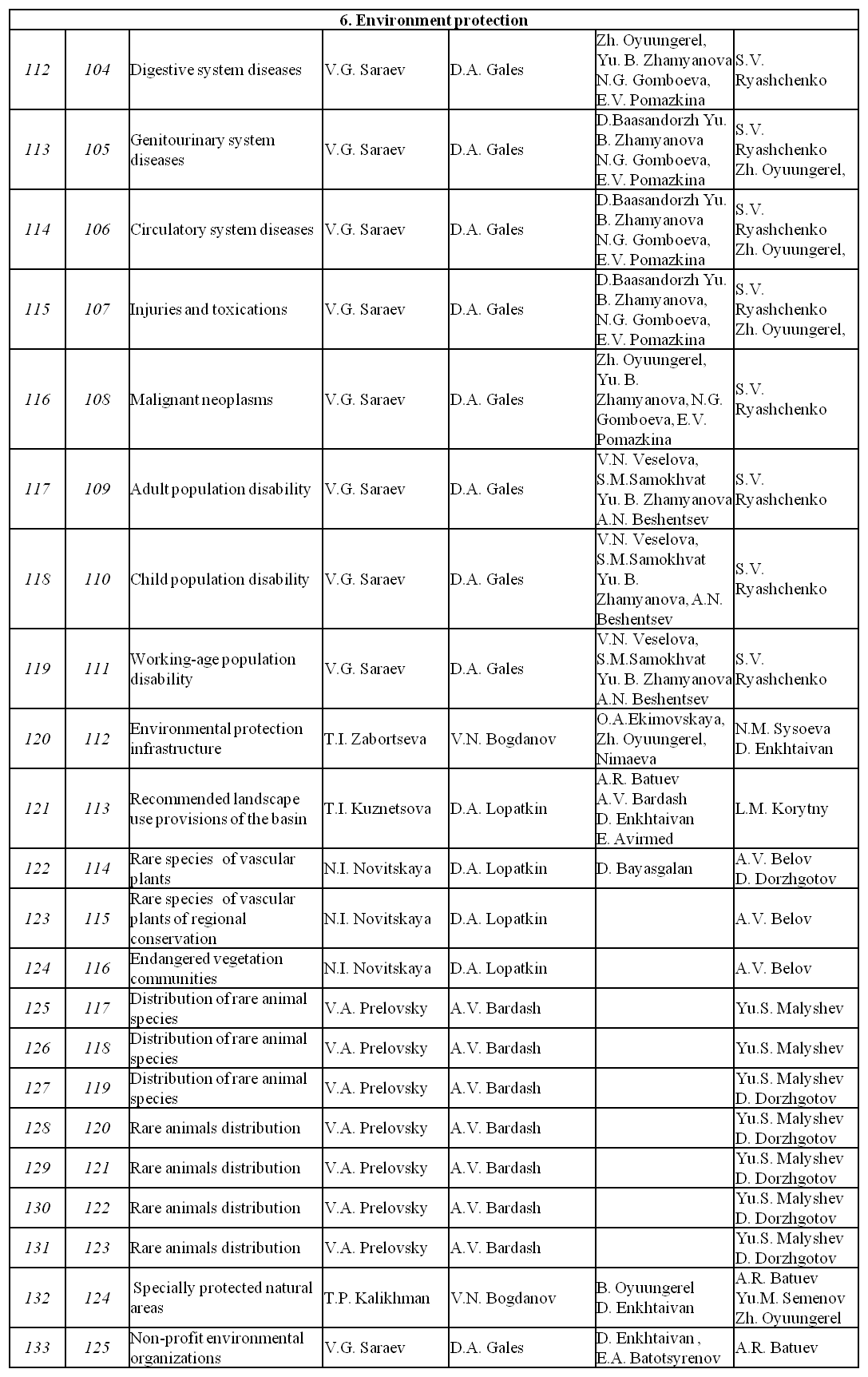
        <rdf:li rdf:resource="http://bic.iwlearn.org/en/atlas/atlas/141-natural-managment-and-environmental-condition-of-central-ecological-zone-map/natural-managment-and-environmental-condition-of-central-ecological-zone-map"/>
      
      
        <rdf:li rdf:resource="http://bic.iwlearn.org/en/atlas/atlas/139-distribution-omul-map/distribution-omul-map"/>
      
      
        <rdf:li rdf:resource="http://bic.iwlearn.org/en/atlas/atlas/137-uninodal-binodal-trinodal-and-quadrinodal-seic_65-map/uninodal-binodal-trinodal-and-quadrinodal-seic_65-map"/>
      
      
        <rdf:li rdf:resource="http://bic.iwlearn.org/en/atlas/atlas/136-currents/currents-map"/>
      
      
        <rdf:li rdf:resource="http://bic.iwlearn.org/en/atlas/atlas/135-ice-regime-map/ice-regime-map"/>
      
      
        <rdf:li rdf:resource="http://bic.iwlearn.org/en/atlas/atlas/134-temperature-from-satellites-map/temperature-from-satellites-map"/>
      
      
        <rdf:li rdf:resource="http://bic.iwlearn.org/en/atlas/atlas/133-temperature-map/temperature-map"/>
      
    </rdf:Seq>
  </items>

</channel>


  <item rdf:about="http://bic.iwlearn.org/en/documents/documents/complex-reports/2010/integrated-water-management-model-on-the-selenge-river-basin-english">
    <title>Integrated Water Management Model on the Selenge River Basin (English)</title>
    <link>http://bic.iwlearn.org/en/documents/documents/complex-reports/2010/integrated-water-management-model-on-the-selenge-river-basin-english</link>
    <description></description>
    
    <dc:publisher>No publisher</dc:publisher>
    <dc:creator>puntsagsurenchoimpog@yahoo.com</dc:creator>
    <dc:rights></dc:rights>
    <dc:date>2014-12-25T03:09:46Z</dc:date>
    <dc:type>File</dc:type>
  </item>


  <item rdf:about="http://bic.iwlearn.org/en/documents/documents/complex-reports/bic-conception-for-mongolia-english">
    <title>BIC Conception for Mongolia (English)</title>
    <link>http://bic.iwlearn.org/en/documents/documents/complex-reports/bic-conception-for-mongolia-english</link>
    <description></description>
    
    <dc:publisher>No publisher</dc:publisher>
    <dc:creator>puntsagsurenchoimpog@yahoo.com</dc:creator>
    <dc:rights></dc:rights>
    <dc:date>2014-12-25T02:10:14Z</dc:date>
    <dc:type>File</dc:type>
  </item>


  <item rdf:about="http://bic.iwlearn.org/en/documents/documents/complex-reports/reports-of-the-un-experts-mission-to-khongor-sum-darkhan-uul-aimag-mongolia-english">
    <title>Reports of the UN experts' mission to Khongor sum, Darkhan-Uul aimag, MONGOLIA (English)</title>
    <link>http://bic.iwlearn.org/en/documents/documents/complex-reports/reports-of-the-un-experts-mission-to-khongor-sum-darkhan-uul-aimag-mongolia-english</link>
    <description></description>
    
    <dc:publisher>No publisher</dc:publisher>
    <dc:creator>puntsagsurenchoimpog@yahoo.com</dc:creator>
    <dc:rights></dc:rights>
    <dc:date>2014-12-25T01:52:47Z</dc:date>
    <dc:type>File</dc:type>
  </item>


  <item rdf:about="http://bic.iwlearn.org/en/documents/documents/papers/wild-life-issues-in-mongolia-english">
    <title>Wild life issues in Mongolia (English)</title>
    <link>http://bic.iwlearn.org/en/documents/documents/papers/wild-life-issues-in-mongolia-english</link>
    <description></description>
    
    <dc:publisher>No publisher</dc:publisher>
    <dc:creator>puntsagsurenchoimpog@yahoo.com</dc:creator>
    <dc:rights></dc:rights>
    <dc:date>2014-12-23T16:29:34Z</dc:date>
    <dc:type>File</dc:type>
  </item>


  <item rdf:about="http://bic.iwlearn.org/en/friends/conception-of-ngo-network-201cfriends-of-baikal-basin201d">
    <title>Conception of NGO network «Friends of Baikal Basin»</title>
    <link>http://bic.iwlearn.org/en/friends/conception-of-ngo-network-201cfriends-of-baikal-basin201d</link>
    <description></description>
    <content:encoded xmlns:content="http://purl.org/rss/1.0/modules/content/"><![CDATA[<p align="center"><strong>Conception of NGO network «Friends of Baikal Basin»</strong></p>
<p align="right"><i>When you have friends you are vast as a steppe, without friends you are narrow as a palm</i></p>
<p align="right"><i>(Mongolian proverb)</i><i> </i></p>
<p align="center"><strong><i> </i></strong></p>
<p>Today, there are many environmental non-governmental organizations (NGOs) operating in Russia. Many have extensive experience of  successfully implementing projects concerning nature protection, practical aspects of sustainable development, environmental education, and effective forms of self-maintenance. Such experience is very important for the development of public activity, unfortunately this experience is often lacking in regional NGOs which often don’t have the close contacts with colleagues enjoyed by national organizations (Sobolev, 2006).</p>
<p> </p>
<p>Some regions of Russia have reputable environmental organizations which have strong links with governmental organizations. Members of these organizations are experienced in preparing official documents and can find meaningful solutions to ecological problems. The NGO “Baikal Ecological Wave” from Irkutsk city is a good example of such an organization (Yablokov, 2004).</p>
<p> </p>
<p>Well-known scientist Vladimir Yakimets who studied non-governmental organizations in Russia proposes that there have been three hypothetical periods in the development of NGOs in Russia: 1991-1995 “romantic period”, 1996-2000 – “meaningful and controversial period”, 2001 – present (this period doesn’t have a symbolic name because of contradictive evaluation into ongoing processes: decreasing or increasing of public initiatives). The author analyzed this process by investigating the system of interactions between government and civil society in the frame of dominating in Russian research tendencies, which reflect the condition of official and non-official rhetoric in civil society. Such models have some shortcomings and need to be corrected. However, this represents one of the few attempts to study the history and development of non-governmental organizations in Russia (Demidov, 2008).</p>
<p> </p>
<p>Improving the environmental awareness of the public is an important factor in securing the sustainable development of society and non-governmental organizations make great contributions to such processes. These organizations include environmental NGOs which are specifically targeted on nature protection and sustainable management. Their main goals are environmental education, practical preservation of natural objects, leading public ecological control and promoting the alignment of the economy and society to environmental protection and sustainable development. They develop public initiatives and involve the public in decision-making processes.</p>
<p> </p>
<p>Lake Baikal (UNESCO World Heritage Site) has the potential to develop the environmental awareness not only of Irkutsk Oblast’, Republic of Buryatia, Zabaikalsky Krai of Russia, and Mongolia, but of the whole world.</p>
<p> </p>
<p>Implementation of the proposed network can help in strengthening and facilitating cooperation between Russian and Mongolian NGOs in the field of sustainable development of the Baikal Basin.</p>
<p>It should be noted that environmental NGOs play an important role in the facilitation, elaboration and implementation of different projects, such as</p>
<ul>
<li>Nature conservation and improvement;</li>
<li>Facilitating social and educational activities for training of scientific and creative forces in local communities;</li>
<li>Promoting of local community to participate in environmental and natural resources protection and their sustainable use.</li>
</ul>
<p> </p>
<p>Creation of the transboundary NGO network “Friends of Baikal Basin” will be the first step towards enhancing the involvement of civil society in the transboundary collaborative process.</p>
<p> </p>
<p>The network will form structured, well-defined and efficient NGO partnerships to allow for adequate and coordinated representation of civil society in the context of the implementation of the transboundary and national strategy action plan (SAP). Virtual web-based tools for creating and maintaining partnerships will include a website and an email list-serve. It will encourage the membership of community-based organizations (CBOs) and NGOs (registered and non-registered). The virtual partnership will operate in Russian, Mongolian, and English, with country-specific content managed in each country respectively.</p>
<p> </p>
<p>This Friends of Baikal Basin Network will also be engaged under a UNDP/Coca Cola funded, practical, hands-on initiative to benefit Baikal and to see the benefits called “Every Drop Matters”. The Every Drop Matters Project in Russia is part of the regional UNDP-Coke water partnership and is one of the five pilot projects planned in five countries (Russia, Romania, Turkey, Kazakhstan, andCroatia). One of the purposes of the initiative is the protection of drinking water resources and promoting the sustainable economic development of local communities and their water resources, as well as awareness-raising on water issues (Project document, 2010).</p>
<p> </p>
<p align="center"><strong>1. Experience of international cooperation of NGOs</strong></p>
<p align="center"><strong> </strong></p>
<p align="center"><strong>1.1. Questions of international cooperation of NGOs </strong></p>
<p align="center"><strong> </strong></p>
<p>International cooperation between NGOs started in the former USSR in 1988 through the organization of Nature Protection Brigades and the Socio-Ecological Union. The first step was the joint project with German conservationists “Green Movement” (Larin et al.,). One of its significant breakthroughs was a conference which was organized by the Socio-Ecological Union. This organization later formed the professional – Center for Independent Ecological Programs (CIEP) together with American environmental non-governmental organizations. Many organizations participated at this conference, such as ISAR, Sacred Earth Network, Earth Island Institute, etc. This conference was very important for the Soviet conservation community, especially for leaders and activists of regional NGOs.</p>
<p>At the same time top international environmental NGOs began to work in the country. After the second visit of David McTaggard (one of Greenpeace’s founders) the Greenpeace Department opened in Moscow. At the same time the first international field projects financed by World Wildlife Fund (WWF) began operations.</p>
<p>International collaboration between Russia and Mongolia started during the Soviet era. T.B. Tsyrenova (2011) gave the historical digression of formation and development of both governments cooperation in the field of protection and sustainable use of transboundary water bodies. At the current time the political base of Russia and Mongolia cooperation is an Agreement signed in 1995. This Agreement defined the political and legal framework for the implementation of interstate policy based on principles of “reasonable and equitable use” of transboundary waters. Such cooperation to a large extent ensured the holding of international status of Russia as the guarantor country for preserving the unique UNESCO World Heritage Site – Lake Baikal.</p>
<p>The problem of distribution and sharing of transboundary waters is a big concern for the Mongolian economy given the limited water resources available in the country. On the other hand, cooperation with Russia in the field of sustainable use and protection of water resources give the opportunity to explore the positive Russian experience in scientific and educational studies.</p>
<p>In the Baikal region the active collaboration between Russian and Mongolian NGOs also started from international projects, notable projects include: Davis Plan (1991-1993), Cambridge University project “Preserving of natural and cultural environment of Inner Asia” (1993-1996), project with Scientific Committee of NATO (1994, 1998), TACIS project on technical assistance at the Baikal region (1997-2000), GEF project “Biodiversity conservation in the Baikal region” (1998-2003), etc.</p>
<p>The Tahoe-Baikal Institute (TBI) Summer Environmental Exchange Program worked in the Baikal region from 1992 in the frame of international exchange, where in addition to Russian and American participants projects often included young scientists and conservationists from Mongolia. Besides, some TBI projects have been implemented in the Mongolian portion of Baikal basin. The oldest NGO of our region “Buryat Regional Association on Lake Baikal” has good experience in cooperating with colleagues from Mongolia. It is one of the few examples of effective cooperation between Russian and Mongolian NGOs.</p>
<p align="center"> </p>
<p align="center"><strong>1.2. Challenges of cooperation between Russian and Mongolian NGOs</strong></p>
<p>The conservation of Lake Baikal’s ecosystem cannot be realized without Russian-Mongolian interaction in the field of transboundary water protection, because the great portion of the Selenga river basin (the main water resource of Lake Baikal) is situated within the territory of Mongolia.</p>
<p>Cooperation between Russian and Mongolian NGOs is far from perfect, something which can be attributed partly to the following factors:</p>
<p>-          State border is a barrier to mobile interaction between Russian and Mongolian NGOs. The distance between Ulan-Ude and Ulan-Bator is about 580 km (about 8 hours drive), but people often spend a lot of time at customs during the border crossing.</p>
<p>-          Language restrictions. Few representatives of environmental NGOs in Russia and Mongolia can speak fluent English. Organizing the communication only on Russian or Mongolian can be complicated.</p>
<p>-          Cooperation between NGOs of Irkutsk Oblast’, Republic of Buryatia, and Zabaikalsky Krai of Russia is not coordinated which does not give the opportunity to organize systematic policy with NGOs of Mongolia.</p>
<p>-          Small budgets of NGOs. Usually, Russian and Mongolian NGOs operate mostly on the basis of small grants.</p>
<p>In conclusion, significant barriers hamper both countries’ ability to move ahead both within their national envelopes and jointly on a robust transboundary level. These barriers include: policy and regulatory gaps, institutional weaknesses, poor utilization of Best Available Techniques and Best Environmental Practices relevant to key issues facing the Baikal Basin, and low levels of awareness of transboundary Baikal Basin issues.</p>
<p align="center"><strong> </strong></p>
<p align="center"><strong>2. Goals and tasks of NGO Network “Friends of Baikal Basin”</strong></p>
<p>There were about 80 registered environmental NGOs in the Baikal Region of Russia at the beginning of 2013. A quarter of these are non-profit organizations – autonomous non-profits, non-profit partnerships, coalitions, and unions (Saraev, 2013).</p>
<p> </p>
<p>There are around 25 environmental NGOs in Mongolia right now, with the number of active participants ranging from 300 to 8000 people. People from the countryside (herders, farmers, local people of small settlements, representatives of small tourist companies, etc.) are actively participating in public awareness actions. The activity of Mongolian environmental NGOs is coordinated by Mongolian Nature Protection Coalition (Shirapova, 2010).</p>
<p>Directions of activity of the NGO Network “Friends of Baikal Basin”:</p>
<p>-          Establishing constructive dialogue between government and society in the field of ecological safety and protection of citizens rights for a better environment;</p>
<p>-          Development of relations between NGOs and state authorities on the basis of partnership for solving environmental problems of the transboundary Baikal Basin;</p>
<p>-          Participation of NGOs in realizing the GEF/UNOPS project “Integrated Natural Resource Management in the Baikal Basin Transboundary Ecosystem”;</p>
<p>-          Organizing the Baikal Forum of NGOs;</p>
<p>-          Analysis, summarization and practical implication of Russian and international experience in NGO partnerships</p>
<p>-          Preparing and organizing of joint social actions and activities.</p>
<p>-          Organization and leading the discussions using email list-serve on the base of a web portal <a href="http://www.baikalcenter.info/">www.baikalcenter.info</a> (which will be created by the Baikal Information Center);</p>
<p>-          Creation of a unified register (White Book of Baikal Region) of the CBOs and NGOs (registered and non-registered);</p>
<p>-          Enhancement of relations between NGOs and mass-media;</p>
<p>-          Supporting of purposeful Web sites, publishing and distribution of information bulletins and other information resources about CBOs and NGOs activities for the citizens.</p>
<p> </p>
<p style="text-align: center; "><strong>3. How the NGO Network “Friends of Baikal Basin” will work</strong></p>
<p>Organization of the transboundary network “Friends of Baikal Basin” will be developed by the Baikal Information Center (BIC) on the BIC web portal <a href="http://www.baikalcenter.info/">www.baikalcenter.info</a> in Russian, Mongolian, and English for creating different discussions. Participants who have problems with registration, communication, etc will receive free consulting.</p>
<p>“White book of the Baikal region - 2010” will be republished and become available on the BIC web portal. Representatives of environmental NGOs of the Baikal Basin will be invited to participate at the interactive Baikal Forum of NGOs. Information will be distributed by list-serve. Thus, environmental NGOs will have constant contact and connections with each other.</p>
<p><strong> </strong></p>
<p align="center"><strong>4. Expected results</strong></p>
<p>Implementation of the NGO network “Friends of Baikal Basin” will increase the prestige of NGOs, social responsibilities of businesses, civil activity in the Baikal region, consolidate efforts of government, NGOs and business in order to obtain effective results in complex management of natural resources of Baikal region which will provide sustainable development of tranboundary Baikal Basin.</p>
<p>According to defined tasks we expect the following results:</p>
<p>-          Improvement of interactions between Russian and Mongolian environmental NGOs;</p>
<p>-          Preparing an analytic report detailing activity of environmental NGOs in the transboundary basin;</p>
<p>-          Creation of a platform for discussion of cooperation problems and development of social partnership technologies (public expertise, social project fair, etc.)</p>
<p>-          Conducting regular information exchange between Russian and Mongolian NGOs;</p>
<p>-          Launching special TV programs about activities of NGOs on local TV.</p>
<p>-          NGO network “Friends of Baikal Basin” members are able to quickly respond to pertinent and burning issues;</p>
<p>-          Increasing the number of joint Russia-Mongolian projects and volunteers participate in projects;</p>
<p>-          NGOs take active part in the creation of transboundary protected areas (“Baikal-Hovsgol”).</p>]]></content:encoded>
    <dc:publisher>No publisher</dc:publisher>
    <dc:creator>Alexander Ayurzhanaev</dc:creator>
    <dc:rights></dc:rights>
    <dc:date>2014-12-23T08:30:00Z</dc:date>
    <dc:type>Page</dc:type>
  </item>


  <item rdf:about="http://bic.iwlearn.org/ru/druzya/koncepciya-seti-nko-druzya-basseina-baikala">
    <title>Концепция сети НКО «Друзья бассейна Байкала»</title>
    <link>http://bic.iwlearn.org/ru/druzya/koncepciya-seti-nko-druzya-basseina-baikala</link>
    <description></description>
    <content:encoded xmlns:content="http://purl.org/rss/1.0/modules/content/"><![CDATA[<p align="center"><strong>Концепция сети НКО «Друзья бассейна Байкала»</strong></p>
<p align="right"><i>Имеешь друзей - широк как степь; не имеешь - узок, как ладонь</i></p>
<p align="right"><i>(монгольская поговорка)</i></p>
<p align="center"><strong> </strong></p>
<p style="text-align: justify; ">К настоящему времени в России имеется немало разнообразных природоохранных общественных объединений. Они накопили богатый опыт успешной деятельности в таких сферах, как охрана природы, практическое применение принципов устойчивого развития общества, экологическое просвещение, нашли эффективные формы самоорганизации. Этот опыт очень важен для развития общественной активности, но, к сожалению, он часто неизвестен организациям, работающим на местном уровне и ещё не установившим тесных связей с коллегами (Соболев, 2006).</p>
<p style="text-align: justify; ">В ряде регионов России возникли авторитетные экологические организации, с которыми считаются органы власти. Члены экологических организаций составляют документы, находят конструктивные решения экологических проблем. В качестве примера можно отметить НКО «Байкальскую экологическую волну» из г. Иркутска (Яблоков, 2004).</p>
<p style="text-align: justify; ">Известный исследователь развития феномена третьего сектора в России В. Якимец предлагает выделять три условных периода в эволюции НКО в России: 1991- 1995- «романтический период», 1996-2000- «конструктивный и противоречивый период», 2001- настоящее время (этот период остается без символического названия в силу неоднозначности оценок идущих процессов: сворачивание или активное развитие гражданских инициатив). Он анализирует этот процесс через призму построения системы взаимоотношений власти и структур гражданского общества, в рамках доминирующей исследовательской тенденции в сфере изучения гражданских институтов в России, отражающей состояние официальной и неофициальной риторики, когда речь заходит о феномене гражданского общества. Модель не лишена недостатков и требует уточнений, однако представляет собой одну из немногих попыток проследить историю развития третьего сектора в России (Демидов, 2008).</p>
<p style="text-align: justify; ">Совершенствование экологической культуры населения является важнейшим фактором устойчивого развития общества и весомый вклад в него вносят некоммерческие организации. Среди них существует ряд организаций (экологических НКО), для которых вопросы экологии и природопользования являются приоритетными. Их основными целями являются экологическое воспитание и просвещение, практическое содействие сохранению природных объектов, осуществление общественного экологического контроля, содействие ориентированию экономики и общества на защиту окружающей среды и устойчивое развитие. Они выступают с гражданскими инициативами, осуществляют вовлечение общественности в процесс принятия решений.</p>
<p style="text-align: justify; ">Статус озера Байкал - как участка Всемирного природного наследия способствует развитию экологической культуры населения не только в Иркутской области, Республики Бурятия, Забайкальском крае, в России, в Монголии, но и во всем мире.</p>
<p style="text-align: justify; ">Реализация данной Концепции будет способствовать в первую очередь усилению связей между российскими и монгольскими НКО в деле устойчивого развития Байкальской природной территории.</p>
<p style="text-align: justify; ">Необходимо отметить, что экологические НКО играют активную роль в содействии, разработке и реализации проектов в различных сферах, таких как:</p>
<ul style="text-align: justify; ">
<li>Охрана, сохранение и улучшение окружающей среды;</li>
<li>Социальная и образовательная деятельность для культивирования научных и творческих способностей местного населения;</li>
<li>Содействие местному населению в лучшем участии в деятельности по охране окружающей среды и использовании природных ресурсов.</li>
</ul>
<p style="text-align: justify; ">Создание трансграничной сети НКО «Друзья бассейна Байкала» явится первым шагом к расширенному вовлечению гражданского общества в процесс трансграничного сотрудничества. Сеть сформирует структурированные, четко определенные и эффективные партнерства НКО для адекватной и координированной репрезентативности гражданского общества в контексте трансграничной и национальной реализации стратегического плана действия. Виртуальные облачные средства для формирования и поддержания партнерств будут включать веб-сайт и электронную почту с технологией лист-сёрв (list-serve)<a href="file:///C:/Users/1/Desktop/%D0%9A%D0%BE%D0%BD%D1%86%D0%B5%D0%BF%D1%86%D0%B8%D1%8F%20%D1%81%D0%B5%D1%82%D0%B8%20%D0%9D%D0%9A%D0%9E.docx#_ftn1">[1]</a>. Это будет поощрять участие общественных организаций, как официально зарегистрированных, так и групп активных людей или сообществ, занимающихся вопросами охраны окружающей среды. Виртуальные партнерства будут функционировать на русском, монгольском и английском языках, а контент, имеющий отношение к разным странам, будет регулироваться с особенностями каждой страны.</p>
<p style="text-align: justify; ">Указанная сеть «Друзья бассейна Байкала» будет также привлекаться в рамках финансируемой ПРООН/Кока-Кола инициативы «Каждая капля имеет значение». Проект «Каждая капля имеет значение» в России представляет собой часть регионального партнерства ПРООН/Кока-Кола по воде и является одним из пяти пилотных проектов запланированных в пяти странах (Россия, Румыния, Турция, Казахстан и Хорватия). Одной из целей инициативы является охрана ресурсов питьевой воды и устойчивое экономическое развитие местных сообществ и их водных ресурсов, а также повышение осведомленности о проблемах, связанных с водой (Проектный документ, 2010).</p>
<hr size="1" style="text-align: justify; " width="33%" />
<p style="text-align: justify; "><a href="file:///C:/Users/1/Desktop/%D0%9A%D0%BE%D0%BD%D1%86%D0%B5%D0%BF%D1%86%D0%B8%D1%8F%20%D1%81%D0%B5%D1%82%D0%B8%20%D0%9D%D0%9A%D0%9E.docx#_ftnref1">[1]</a> <i>Технология </i><i>list</i><i>-</i><i>serve</i> – телекоммуникационное информирование малых групп пользователей путем автоматической рассылки по e-mailадресам.</p>
<p style="text-align: justify; "><span> </span></p>
<p style="text-align: justify; "><strong>1.Опыт международного взаимодействия НКО</strong></p>
<p style="text-align: justify; "><strong> </strong></p>
<p style="text-align: justify; "><strong>1.1. Вопросы международного взаимодействия НКО</strong></p>
<p style="text-align: justify; ">Международное взаимодействие общественных организаций берет начало еще со времен СССР (Дружины охраны природы, Социально-Экологический Союз) - с 1988 года. Первым был совместный проект германских «зеленых» с «Зеленым движением» (Ларин и др.,). Одним из наиболее существенных прорывов в этом направлении стала конференция, которую организовал Социально-Экологический Союз и возникшая в его составе одна из первых профессиональных структур – «Центр независимых экологических программ» (ЦНЭП) совместно с различными американскими неправительственными природоохранными экологическими организациями. В конференции приняли участие такие организации как ISAR, Sacred Earth Network, Earth Island Institute и многие другие. Для отечественного природоохранного сообщества эта конференция сыграла роль настоящего прорыва для руководителей и активистов многих региональных общественных экологических организаций.</p>
<p style="text-align: justify; ">В это же время в стране начали работать и ведущие международные природоохранные организации. После повторного приезда в страну основателя Гринпис Дэвида Мактаггарта открывается офис Гринпис. В этот же период начинаются и первые международные полевые проекты, финансируемые Всемирным фондом дикой природы (WWF).</p>
<p style="text-align: justify; ">Международное взаимодействие между Россией и Монголией началось в советский период. В работе Т.Б. Цыреновой (Цыренова, 2011) дается исторический экскурс формирования и развития взаимодействия двух государств в области охраны и рационального использования трансграничных водных объектов. В настоящий момент политической основой взаимодействия России и Монголии является подписанное в 1995 г. Соглашение между Правительством Российской Федерации и Монголии, в котором определены политические и правовые механизмы реализации межгосударственной политики, основанной на принципах «разумного и справедливого использования» трансграничных вод. Кроме того, такое взаимодействие в немалой степени обеспечивает сохранение международного статуса России как гаранта сохранения уникальной экосистемы объекта Всемирного природного наследия ЮНЕСКО – озера Байкал.</p>
<p style="text-align: justify; ">Для Монголии проблема распределения и совместного использования трансграничных вод в условиях лимитированности ее водных ресурсов затрагивает жизненно важные сферы экономики. С одной стороны, взаимодействие с Россией в вопросах использования и охраны водных ресурсов позволяет использовать позитивный российский опыт в научных и образовательных сферах в области охраны и использования водных ресурсов.</p>
<p style="text-align: justify; ">В Байкальском регионе активное сотрудничество российских и монгольских НКО так же началось с международных проектов: План Девиса 1991–1993 г., проект с Кембриджским университетом «Сохранение природной и культурной среды Внутренней Азии» (1993–1996 г.), проекты с Научным комитетом NATO (1994, 1998), проекты ТАСИС по техническому содействию Байкальскому региону (1997–2000 г.), проект ГЭФ «Сохранение биоразнообразия в Байкальском регионе» (1998–2003 г.) и ряд других.</p>
<p style="text-align: justify; ">В рамках программ международного обмена с 1992 года работает общественная организация «Тахо-Байкал Институт» (ТБИ), в которой часто принимают участие помимо россиян и американцев представители Монголии. Кроме того, несколько проектов «ТБИ» было реализовано на территории Монголии. Опыт сотрудничества с монгольскими коллегами имеет старейшее НКО нашего региона – «Бурятское региональное объединение по Байкалу». Однако, это только несколько примеров взаимодействия российских и монгольских НКО.</p>
<p style="text-align: justify; "><strong>1.2. Проблемы взаимодействий НКО России и Монголии</strong></p>
<p style="text-align: justify; ">Полноценная охрана байкальской экосистемы невозможна вне контекста российско-монгольского взаимодействия в области охраны трансграничных вод, поскольку большая часть бассейна реки Селенги приходится на территорию Монголии. Взаимодействие НКО России и Монголии еще далеко от совершенства, что обусловлено следующими объективными причинами:</p>
<p style="text-align: justify; ">- государственная граница как барьер для оперативного взаимодействия НКО России и Монголии. Хотя расстояние от Улан-Удэ до Улан-Батора составляет 580 км или 8 часов езды на автомобиле, не всегда можно быстро пересечь границу.</p>
<p style="text-align: justify; ">- языковые ограничения. Английским, как языком международного общения на достаточном уровне владеют небольшое число представителей общественных экологических организаций Монголии и России. Организовывать общение только на русском или только на монгольском языке также не представляется возможным;</p>
<p style="text-align: justify; ">- не скоординированы взаимоотношения между НКО Бурятии, Иркутской области и Забайкальского края, что не позволяет проводить планомерную политику взаимодействия с монгольскими НКО.</p>
<p style="text-align: justify; ">- скромные финансовые ресурсы. Как правило, НКО России и Монголии существуют в основном за счет грантовой деятельности.</p>
<p style="text-align: justify; "><strong>2. Цели и задачи сети НКО «Друзья бассейна Байкала»</strong></p>
<p style="text-align: justify; ">На начало 2013 года общее количество зарегистрированных экологических НКО в Байкальском региона (в России) составляло около 80 организаций. Четверть из них являются некоммерческими объединениями - автономные некоммерческие организации, некоммерческие фонды, некоммерческие партнерства, учреждения, объединения юридических лиц (Сараев, 2013).</p>
<p style="text-align: justify; ">В данное время в Монголии насчитывается порядка 25 общественных экологических организаций. Число участников в отдельных акциях достигает от 300 до 8000 человек. Активно участвуют жители районов: скотоводы, жители поселений, представители мелкого бизнеса (туристического и др.). Создалась коалиция Общественных организаций Монголии – MNPC (Mongolian Nature Protection Coalition), где они вместе решают общие проблемы (Ширапова, 2010).</p>
<p style="text-align: justify; ">Направлениями деятельности НКО «Друзья бассейна Байкала» могут следующими:</p>
<p style="text-align: justify; ">- Установление конструктивного диалога между властью и обществом по вопросам экологической безопасности и защиты прав граждан на благоприятную окружающую среду;</p>
<p style="text-align: justify; ">- Развитие отношений между неправительственными экологическими организациями и государственными структурами в решении экологических проблем трансграничного бассейна озера Байкал на основе партнерства;</p>
<p style="text-align: justify; ">- Участие НКО в реализации проекта ГЭФ/ПРОООН «Комплексное управление природными ресурсами трансграничной экосистемы бассейна Байкала»;</p>
<p style="text-align: justify; ">- Учреждение Байкальского форума НКО;</p>
<p style="text-align: justify; ">- Анализ, обобщение и практическое применение отечественного и зарубежного опыта партнерства НКО;</p>
<p style="text-align: justify; ">- Подготовка и проведение совместных социально значимых акций и мероприятий;</p>
<p style="text-align: justify; ">- Организация и проведение дискуссий за счет технология list-serve на базе сайта www.baikalcenter.info (который будет создан Байкальским информационным центром)</p>
<p style="text-align: justify; ">- Создание единого реестра (Белая книга Байкальского региона) общественных и иных некоммерческих экологических организаций Байкальского региона;</p>
<p style="text-align: justify; ">- Совершенствование механизмов освещения деятельности НКО со стороны СМИ;</p>
<p style="text-align: justify; ">- Поддержка целевых сайтов, издание и распространение информационных бюллетеней, других средств информирования граждан о деятельности общественных объединений и некоммерческих организаций;</p>
<p style="text-align: justify; "><strong>3. Механизмы работы сети НКО «Друзья бассейна Байкала»</strong></p>
<p style="text-align: justify; ">Организация трансграничной сети «Друзья бассейна Байкала» предполагается на базе сайта www.baikalcenter.info (который будет создан Байкальским информационным центром) портального типа на русском, монгольском и английском языках для организации и проведения дискуссий. У кого будут возникать сложности (регистрация, коммуникация и т.д.), тем будут оказаны бесплатные консультационные услуги.</p>
<p style="text-align: justify; ">Будет переиздана «Белая книга бассейна озера Байкал» и размещена на данном сайте. Представители общественных экологических организаций бассейна озера Байкал (как России, так и Монголии) будут приглашены для участия в интерактивном Байкальском форуме НКО. Рассылка будет осуществляться за счет технология list-serve.</p>
<p style="text-align: justify; ">Таким образом, будут постепенно налажены постоянные связи и экологи-общественники станут тесно поддерживать свои контакты.</p>
<p style="text-align: justify; "><strong> </strong></p>
<p style="text-align: justify; "><strong>4. Ожидаемые результаты</strong></p>
<p style="text-align: justify; ">Реализация Концепции сети НКО «Друзья бассейна Байкала» будет способствовать укреплению авторитета общественных организаций, повышению социальной ответственности бизнеса, росту гражданской активности Байкальского региона, позволит консолидировать усилия органов государственной власти, общественного сектора и бизнес сообщества в целях достижения эффективных результатов в осуществлении комплексному управлению природными ресурсами Байкальского региона, что обеспечит устойчивое развитие трансграничного бассейна озера Байкал.</p>
<p style="text-align: justify; ">Применительно к сформулированным задачам ожидаемые результаты концепции следующие:</p>
<p style="text-align: justify; ">- совершенствуется система взаимодействия российско-монгольский экологических общественных организаций;</p>
<p style="text-align: justify; ">- составляется информационно-аналитический отчет о деятельности экологических общественных объединений и некоммерческих организаций трансграничного бассейна;</p>
<p style="text-align: justify; ">- создана площадка для обсуждения проблем взаимодействия, развиваются иные технологии социального партнерства (общественная экспертиза, ярмарка социальных проектов и др.);</p>
<p style="text-align: justify; ">- налажен регулярный информационный обмен между НКО России и Монголии;</p>
<p style="text-align: justify; ">- на региональном телевидении появляются программы/цикл передач о деятельности НКО;</p>
<p style="text-align: justify; ">- члены сети НКО «Друзья бассейна Байкала» оперативно реагируют на актуальные и злободневные вопросы;</p>
<p style="text-align: justify; ">- увеличивается численность совместных российско-монгольских проектов и волонтеров, в них участвующих;</p>
<p style="text-align: justify; ">- общественные экологические организации принимают активное участие в создании трансграничных ООПТ («Байкал-Хубсугул»).</p>
<p style="text-align: justify; "><span> </span></p>
<p style="text-align: justify; ">Список литературы</p>
<ol style="text-align: justify; ">
<li>Демидов А.А.. Некоммерческие организации в государственной политике и управлении: участие в разработке и реализации социальной политики: на примере Республики Карелия: Дисс... канд. полит. наук. – Санкт-Петербург, 2008. – 193 с.</li>
<li>Зелёные страницы Байкальского региона, 2002 г. </li>
<li>Белая книга, 2003, 2004 гг.</li>
<li>Сараев В.Г. Некоммерческие организации Байкальского региона в формировании экологической культуры населения // Материалы Третьей Всероссийской научной конференции по социальной географии (Иркутск, 22-24 октября 2013 г.). – Иркутск: Изд-во ИГ СО РАН, 2013. – С.83-85.</li>
<li>Белая книга Байкальского региона. – Улан-Удэ:  Изд-во «Экос», 2009. – 73 с </li>
<li>Цыренова Т.Б. Государственное управление водными ресурсами в условиях межгосударственного взаимодействия России и Монголии: Автореф. дисс… докт. полит. наук. – Чита, 2011.</li>
<li>Яблоков А.В. Зеленое движение и гражданское общество: документы 2000-2004 гг. М.: Товарищество научных изданий КМК, 2004. – 343 с.</li>
<li>Ларин В., Мнацаканян Р., Честин И., Шварц Е. Охрана природы России: от Горбачева до Путина. – М.: КМК, 2003. – 416 с.</li>
<li>Соболев Н.А. Успех «безнадежного дела»: положительный опыт общественной природоохранной работы. – М.: Изд-во Центра охраны дикой природы, 2006. – 232 с.</li>
</ol>
<p style="text-align: justify; ">10.  Проектный документ «Комплексное управление природными ресурсами трансграничной экосистемы бассейна Байкала», 2010 г.</p>
<p style="text-align: justify; ">11.  Ширапова С.Д. Социально-экологические проблемы Монголии, связанные с добычей золота на реках — притоках реки Селенга // Реки Сибири: Материалы V Международной конференции (г. Томск, 16–18 апреля 2010 г.). – Томск: Дельтаплан, 2010. – С. 115-116.</p>
<p style="text-align: justify; ">12. Экологическое движение в России. Сб. научн. статей / Под ред. Здравомысловой Е., Тысячнюк М. СПб.: ЦНСИ, 1999. Труды. Вып. 6. 108 с.  <br clear="all" /></p>]]></content:encoded>
    <dc:publisher>No publisher</dc:publisher>
    <dc:creator>Alexander Ayurzhanaev</dc:creator>
    <dc:rights></dc:rights>
    <dc:date>2014-12-23T08:30:00Z</dc:date>
    <dc:type>Page</dc:type>
  </item>


  <item rdf:about="http://bic.iwlearn.org/en/documents/documents/complex-reports/2013/baikal-basin-transboundry-diagnostic-analysis">
    <title>Baikal basin transboundry diagnostic analysis</title>
    <link>http://bic.iwlearn.org/en/documents/documents/complex-reports/2013/baikal-basin-transboundry-diagnostic-analysis</link>
    <description></description>
    
    <dc:publisher>No publisher</dc:publisher>
    <dc:creator>puntsagsurenchoimpog@yahoo.com</dc:creator>
    <dc:rights></dc:rights>
    <dc:date>2014-12-21T13:37:48Z</dc:date>
    <dc:type>File</dc:type>
  </item>


  <item rdf:about="http://bic.iwlearn.org/en/atlas/atlas/about-the-project/about-the-project-1">
    <title>   About the project</title>
    <link>http://bic.iwlearn.org/en/atlas/atlas/about-the-project/about-the-project-1</link>
    <description></description>
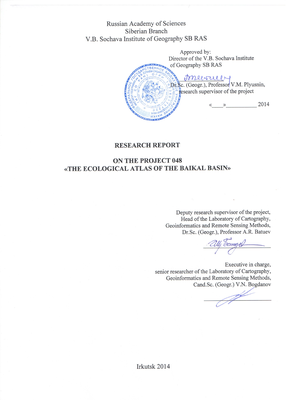
    <content:encoded xmlns:content="http://purl.org/rss/1.0/modules/content/"><![CDATA[<p><img class="image-inline" src="../../../../resolveuid/919a5f09931346e38d46061930c14f29/@@images/image/preview" /></p>
<p><a href="http://bic.iwlearn.org/en/photos/0.png" class="internal-link">Open full size</a></p>
<p class="a"><strong>Editorial Council</strong></p>
<p class="a">N. S. KASIMOV</p>
<p class="a">M. V. SLIPENCHUK</p>
<p class="a">A. K. TULOKHONOV (Chair)</p>
<p class="a">V. M. PLYUSNIN (Deputy Chair)</p>
<p class="a">S. V. KUDELYA (Deputy Chair)</p>
<p class="a">S. ENKH-AMGALAN</p>
<p class="a">D. DORZHGOTOV</p>
<p class="a">S. OYUN</p>
<p class="a">B. TULGA</p>
<p class="a">Z. BATBOLD</p>
<p class="a">R. R. GIZATULIN</p>
<p class="a">A. M. AMIRKHANOV</p>
<p class="a">B. O. MAMAEV</p>
<p class="a">Z. TSOGTBAATAR</p>
<p class="a">O. E. KRAVCHUK</p>
<p class="a">O. A. POLYAKOV</p>
<p class="a">Y. P. SAFYANOV</p>
<p class="a">A. V. LBOV</p>
<p class="a">A. N. BESHENTSEV (Executive Secretary)</p>
<p class="a"> </p>
<p class="a"><strong>Editorial Board</strong></p>
<p class="a">V. M. PLYUSNIN, Dr.Sc. Geogr., (Co-chair, Editor-in-Chief)</p>
<p class="a">D. DORZHGOTOV, Academician of the Mongolian Academy of Sciences, (Co-chair)</p>
<p class="a">A. R. BATUEV, Dr.Sc. Geogr., (Deputy Chair, Executive Editor)</p>
<p class="a">E. Z. GARMAEV, Dr.Sc. Geogr., (Deputy Chair)</p>
<p class="a">L. M. KORYTNY, Dr.Sc. Geogr., (Deputy Chair, Executive Editor)</p>
<p class="a">Z. OYUUNGEREL, Dr.Sc. Geogr., (Deputy Chair, Executive Editor)</p>
<p class="a">V. S. TIKUNOV, Dr.Sc. Geogr., (Deputy Chair)</p>
<p class="a">D. ENKHTAIVAN, Dr.Sc. Geogr., (Deputy Chair, Executive Editor)</p>
<p class="a">V. N. BOGDANOV, Cand.Sc. Geogr., (Executive Secretary)</p>
<p class="a">A. V. ARGUCHINTSEVA, Dr.Sc. Tech.</p>
<p class="a">A. N. BESHENTSEV, Dr.Sc. Geogr.</p>
<p class="a">S. R. CHALOV, Cand.Sc. Geogr.</p>
<p class="a">I. A. BELOZERTSEVA, Cand.Sc. Geogr.</p>
<p class="a">G. DAVAA, Dr.Sc. Geogr.</p>
<p class="a">T. I. ZABORTSEVA, Dr.Sc. Geogr.</p>
<p class="a">E. E. KONONOV, Cand.Sc. Geogr.</p>
<p class="a">T. I. KUZNETSOV, Cand.Sc. Geogr.</p>
<p class="a">K. G. LEVI, Dr.Sc. Geol.</p>
<p class="a">T. V. KHODZHER, Dr.Sc. Geogr.</p>
<p class="a">S. SHIYREV-ADYA, Dr.Sc. Geogr.</p>
<p class="a">M. N. SHIMARAEV, Dr.Sc. Geogr.</p>
<p class="a"> </p>
<p class="a" style="text-align: justify; "><i>Dear Reader </i><i> </i></p>
<p class="a" style="text-align: justify; "><i> </i></p>
<p class="a" style="text-align: justify; "><i>Geographical maps offering a clear picture of how great and at the same time how tiny our world of Planet Earth is accompany one's life journey for the most of its part. Earth still has places, where wonderful landscapes of untouched nature have been preserved. Among them is Lake Baikal - one of the most beautiful places attracting tourists from all over the world.</i><i> </i></p>
<p class="a" style="text-align: justify; "><i>In 1996, by UNESCO’s decision Lake Baikal was listed as a World Heritage Site. In doing so, Russia and Mongolia jointly with the international community took responsibility to protect its nature. However, both the lake itself and its surrounding territory, where over three million people live, cannot be turned into a nature reserve. In our plans, here there should be a modern, high-tech, and environmentally friendly economy ensuring the necessary living standards for the local community.</i><i> </i></p>
<p class="a" style="text-align: justify; "><i>A poor and deprived individual cannot protect the environment. He or she is more concerned about providing food, clothes, and other necessary resources for oneself and family. From this perspective, the Baikal basin has all the riches to have spiritually and materially affluent people living on its shores.</i><i> </i></p>
<p class="a" style="text-align: justify; "><i>In order to achieve this, both local residents and visitors should have ample information to develop the economy and address social issues. This Atlas has been created precisely for this purpose. It includes data about the structure and wealth of mineral resources, flora, and fauna, climate, and hydrosphere. Some of the maps feature information, which helps understand the impact of the anthropogenic activity on the environment.</i><i> </i></p>
<p class="a" style="text-align: justify; "><i> </i></p>
<p class="a" style="text-align: justify; "><i>A. K. Tulokhonov, Chair of Editorial Council </i><i> </i></p>
<p class="a" style="text-align: justify; "><i> </i></p>
<p class="a" style="text-align: justify; "> </p>
<p class="a" style="text-align: justify; "><i>About the Project</i><i> </i></p>
<p class="a" style="text-align: justify; "><i> </i></p>
<p class="a" style="text-align: justify; "><i>The Project "The Ecological Atlas of the Baikal Basin" has been commissioned by and implemented with the support of the Global Environment Facility. It aims to integrate current information and knowledge about the key factors driving the development of the environmental situation in the Baikal basin and the existing state of natural environment. It presents this information in a form, which is adequate for addressing the issues of economically and environmentally balanced development of the region. </i><i> </i></p>
<p class="a" style="text-align: justify; "><i>The Atlas considers the Baikal basin as a special trans-border and inter-regional development system and part of the all-Russian and all-Mongolian territorial development systems. Therefore, the creation of the Atlas required an integrated study of environmental problems from both territorial and content-related perspectives. From the territorial perspective, the formed structure of the Atlas </i><i><br /> </i><i>database comprehensively localizes municipalities of the second level (city and municipal districts) on the Russian part of the Baikal basin and aimags on the Mongolian part. In terms of the content, the combination of economic, social, demographic, natural resource, and biotic factors of the development of the environmental situation became possible thanks to a purposefully developed and integrated program of environmental mapping. The state-of-the-art developments in the thematic atlas mapping, GIS-technologies, remote sensing techniques, and constantly supplemented and updated databases of the research organizations-executing agencies of the Project, such as the V.B. Sochava Institute of Geography SB RAS, Limnological Institute SB RAS, Institute of the Earth's Crust SB RAS, Irkutsk State University (Irkutsk), Baikal Institute of Nature Management SB RAS (Ulan-Ude), Institute of Natural Resources, Ecology and Cryology SB RAS (Chita), and the Sh. Tsegmid Institute of Geography of the Mongolian Academy of Sciences (Ulaanbaatar) were used to create this Atlas.</i><i> </i></p>
<p class="a" style="text-align: justify; "><i>The mapping of the Baikal basin was carried out using two main scale levels: 1:5 000 000 for physical maps and 1: 6 000 000 for the maps showing social and economic factors of the development of the environmental situation. The thematic database of the map series had the following requirements: it must be contemporaneous, i.e. its quantitative data on all variables must belong to the same point in time; sufficiently detailed; positionally accurate; completely compatible with other data; adequately reflect the nature of phenomena; and be available to users. When developing the content of the maps, even when referring to individual topics, not to mention complex characteristics, the task was not just to show the actual state of the mapped phenomenon or process, but also to emphasize the patterns in their development and highlight the dynamic aspects as far as possible. For the first time ever, the Atlas reflects spatial patterns of the development of the environmental situation within the whole catchment basin of Lake Baikal and its water area, which makes it possible to define and substantiate the directions for environmentally balanced and sustainable territorial development in the future. </i><i> </i></p>
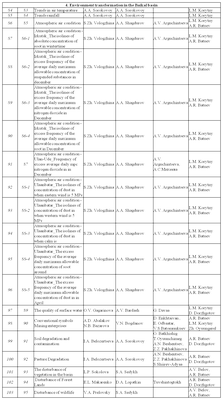
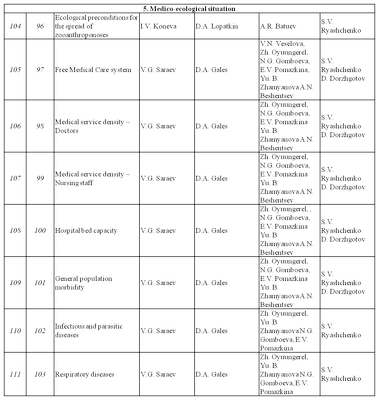
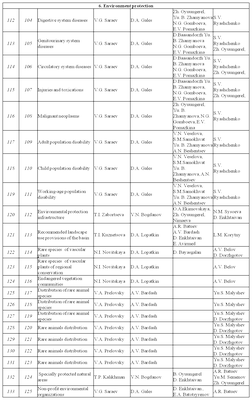
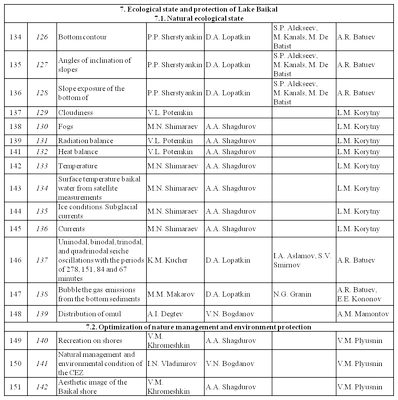
<p class="a" style="text-align: justify; "><i>Structurally, the Atlas consists of eight blocs, including an introduction and seven thematic sections: 1) Natural conditions of the development of the environmental situation; 2) Resource factors of the development of the environmental situation; 3) Socio-economic factors of the development of the environmental situation; 4) Environmental transformation; 5) Medico-ecological situation, 6) Environmental protection; and 7) Ecological state of Lake Baikal. </i><i> </i></p>
<p class="a" style="text-align: justify; "><i>The Atlas is published in digital and hard-copy formats. A digital copy of the Atlas will be incorporated as an electronic resource with a database into the Geoportal of the Baikal Region, which is being created by the Global Environment Facility. A hard-copy of the Atlas will be released as a fundamental reference atlas.</i><i> </i></p>
<p class="a" style="text-align: justify; "><i>The Atlas is a collective work of many scientists who are experts in various fields of knowledge. The maps were created using library and published statistical materials provided not only by research institutions, but also by government authorities of the regions of the Russian Federation: Irkutsk oblast, Republic of Buryatia and Zabaikalsky krai, as well as research organizations and government authorities of Mongolia, and the authors of the Atlas are </i><i><br /> </i><i>deeply grateful for it.</i><i> </i></p>
<p class="a" style="text-align: justify; "><i> </i></p>
<p class="a" style="text-align: justify; "><i>V. M. Plyusnin, Chair of Editorial Board</i><i> </i></p>
<p align="center"> </p>
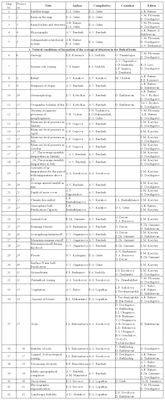
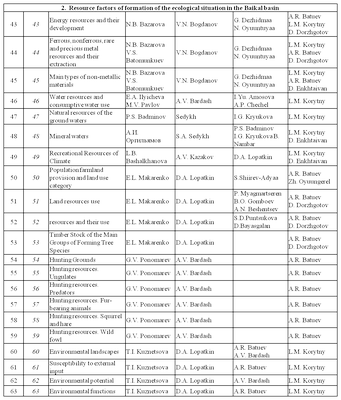
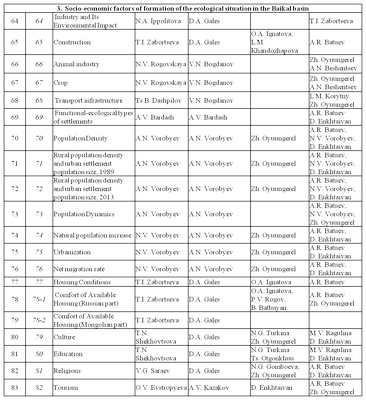
<p align="center"><span>List of Creators</span></p>
<p style="text-align: left; "><img class="image-inline" src="../../../../resolveuid/04c1f8f55c82417bb037939ae3d545be/@@images/image/preview" /></p>
<p style="text-align: left; "><a href="http://bic.iwlearn.org/en/photos/1.png" class="internal-link">Open full size</a></p>
<p style="text-align: left; "><img class="image-inline" src="../../../../resolveuid/a8db3187025f414aa113f089f8348298/@@images/image/preview" /></p>
<p style="text-align: left; "><a href="http://bic.iwlearn.org/en/photos/copy_of_2.png" class="internal-link">Open full size</a></p>
<p style="text-align: left; "><img class="image-inline" src="../../../../resolveuid/8a95db494775414787e70359d25b53de/@@images/image/preview" /></p>
<p style="text-align: left; "><a href="http://bic.iwlearn.org/en/photos/copy_of_3.png" class="internal-link">Open full size</a></p>
<p style="text-align: left; "><img class="image-inline" src="../../../../resolveuid/7d20d2ffe061475286eb49d4651c4782/@@images/image/preview" /></p>
<p style="text-align: left; "><a href="http://bic.iwlearn.org/en/photos/copy_of_4.png" class="internal-link">Open full size</a></p>
<p style="text-align: left; "><img class="image-inline" src="../../../../resolveuid/1ab7fb7b8cd64ed19af7cf004284bc5f/@@images/image/preview" /></p>
<p style="text-align: left; "><a href="http://bic.iwlearn.org/en/photos/copy_of_5.png" class="internal-link">Open full size</a></p>
<p style="text-align: left; "><img class="image-inline" src="../../../../resolveuid/c2faf8c328bc4c37bf6b2e3da4908b9a/@@images/image/preview" /></p>
<p style="text-align: left; "><a href="http://bic.iwlearn.org/en/photos/copy_of_6.png" class="internal-link">Open full size</a></p>
<p style="text-align: left; "><a href="http://bic.iwlearn.org/en/photos/copy_of_6.png" class="internal-link"></a><img class="image-inline" src="../../../../resolveuid/d32432c42ca243389126e305c8d209a1/@@images/image/preview" /></p>
<p style="text-align: left; "><a href="http://bic.iwlearn.org/en/photos/copy_of_7.png" class="internal-link">Open full size</a></p>]]></content:encoded>
    <dc:publisher>No publisher</dc:publisher>
    <dc:creator>Alexander Ayurzhanaev</dc:creator>
    <dc:rights></dc:rights>
    <dc:date>2014-10-24T02:05:00Z</dc:date>
    <dc:type>Page</dc:type>
  </item>


  <item rdf:about="http://bic.iwlearn.org/en/atlas/atlas/141-natural-managment-and-environmental-condition-of-central-ecological-zone-map/natural-managment-and-environmental-condition-of-central-ecological-zone-map">
    <title>Natural managment and environmental condition of central ecological zone map</title>
    <link>http://bic.iwlearn.org/en/atlas/atlas/141-natural-managment-and-environmental-condition-of-central-ecological-zone-map/natural-managment-and-environmental-condition-of-central-ecological-zone-map</link>
    <description></description>
    <content:encoded xmlns:content="http://purl.org/rss/1.0/modules/content/"><![CDATA[<p><img class="image-inline" src="../../../../resolveuid/21728bd36dac488cb470339c94e9a1b1/@@images/image/preview" /></p>
<p><a href="http://bic.iwlearn.org/en/photos/copy_of__141_NaturalmanagmentandenvironmentalconditionofCEZ.png" class="internal-link">Open full size</a></p>
<p align="center"><strong>Ecological state of the Central Ecological Zone of the Baikal Natural Territory</strong></p>
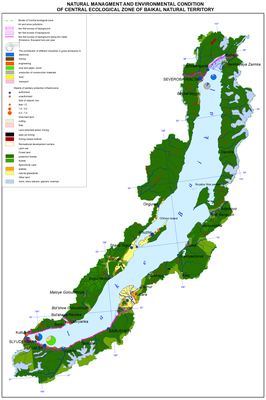
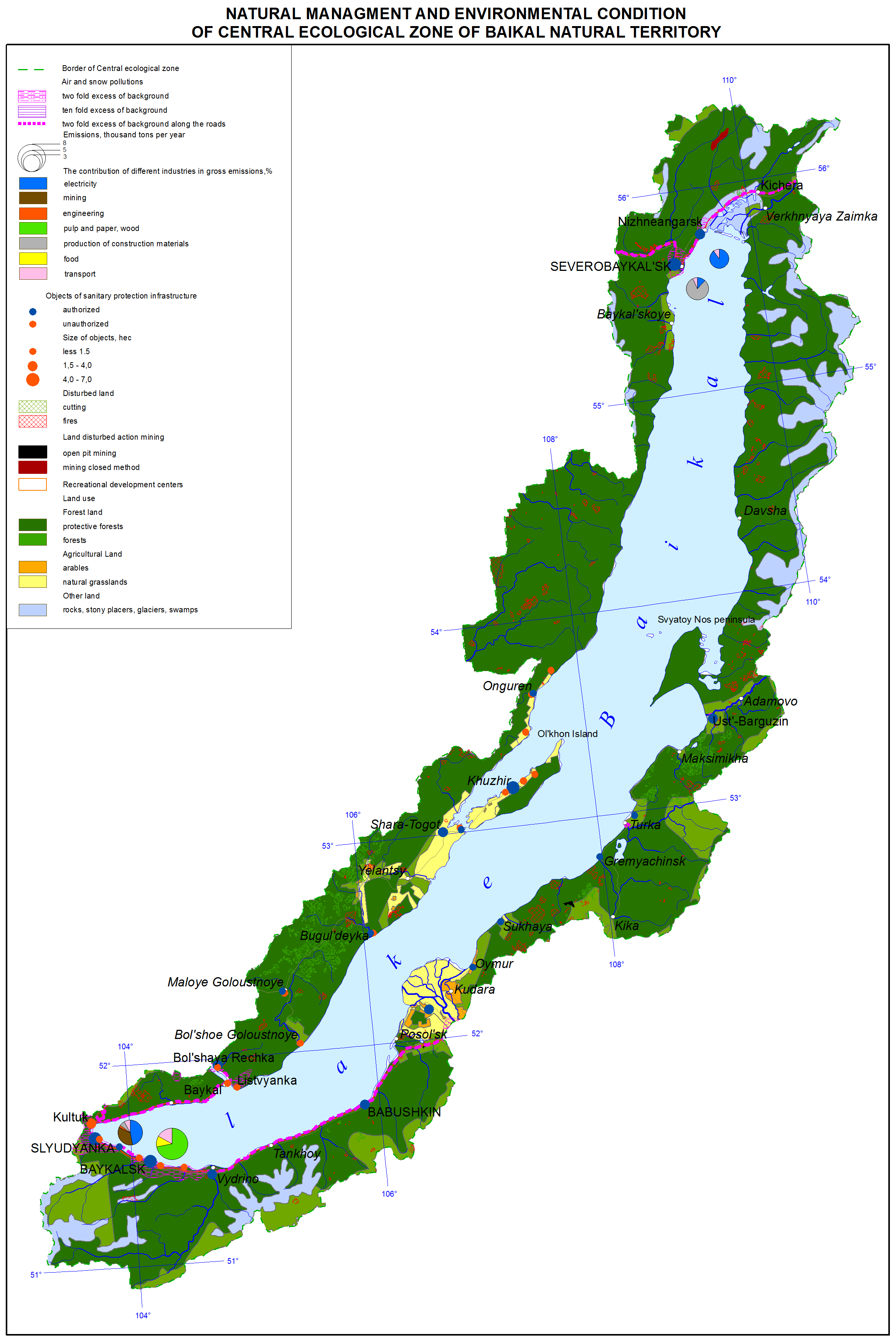
<p>The Central Ecological Zone of the Baikal Natural Territory (CEZ BNT) includes Lake Baikal itself with its islands, the adjacent water protection zone, and specially protected natural areas (SPNA) (Federal Law No. 94-FZ “On Protection of Lake Baikal” dated May 1, 1999). Its boundaries coincide with the boundary of the World Natural Heritage site “Lake Baikal” and follow the outer boundaries of the Baikal-Lena, Barguzinsky, and Baikalsky reserves (zapovedniks), Pribaikalsky, Zabaikalsky, and Tunkinsky national parks, Frolikhinsky, Pribaikalsky, Enkhaluksky, and Snezhinsky nature-sanctuaries (zakazniks), as well as the main watersheds of the Primorsky, Baikalsky, Verkhne-Angarsky, Barguzinsky, Golondinsky, Ulan-Burgasy, Morskoy, and Khamar-Daban ridges. The main function of the central ecological zone is to preserve the unique ecological system of Lake Baikal and to prevent the negative impact of economic and other activity on its state.</p>
<p class="BodyTextIndent2">The main sources of the atmospheric impact on Lake Baikal are industrial enterprises located in the basin and on the shores of the lake, and sections of the Trans-Siberian Railway and Baikal-Amur Mainline. Air emissions from industrial enterprises and boiler stations of the towns of Baikalsk, Slyudyanka, Severobaikalsk, and Nizhneangarsk and villages located in the Baikal basin have the highest probability of falling into the lake. Air transport products from the Irkutsk-Cheremkhovo agglomeration constitute a much smaller part of the total air pollution over Lake Baikal because of the remoteness and a large number of calms and fogs. Emissions of sulfur dioxide, nitrogen oxides, hydrogen sulphide and hydrocarbon, methyl mercaptan, formaldehyde, and phenol, produced by coastal enterprises have a negative impact on the ecological situation.</p>
<p>On the northern shore of Lake Baikal a single zone of the atmospheric pollution distribution, stretched along Lake Baikal, is formed. Its area for the town of Severobaikalsk amounts to approximately 150 km, and for Nizhneangarsk – to 60 km. Despite the fact that the content of certain impurities tends to decrease, the level of air pollution remains high.</p>
<p>The snow cover, having a high sorption capacity, is the most informative object in identifying the technogenic pollution of the atmosphere. According to the data of the Irkutsk Territorial Administration for Hydrometeorology and Environmental Monitoring, in the CEZ BNT there are several zones of technogenic pollution with the solids concentration in snow ranging from 0.5 to 10 g/kg. Mineralization of snow waters near the sources may exceed the background one by 10 times. The maximum amount of solids in snow reaches 200 g/m<sup>2</sup>. Zones with increased concentration of calcium, magnesium, sodium, and potassium were identified. Concerning the cations, which are soluble in snow, the predominance of sodium and potassium was revealed. The maximum values ​​of the insoluble residue of snow associated with the operation of CHP plants, boiler stations, and stove heating, are registered in the vicinity of Kultuk and Sludyanka; as regards the soluble residue, its maximum values are recorded in the area around Baikalsk. The total area of snow pollution with chemical elements extends 60 km from the southeast to the northwest with a width of 10-15 km.</p>
<p>In connection with the spontaneous development of tourism on the shores of Lake Baikal in the CEZ BNT, one of the most pressing issues is the problem of collecting, processing, and recycling of solid household wastes. Most of the garbage goes to disposal sites, both approved and unauthorized.</p>
<p>Within the CEZ BNT, cement and quartz raw materials, facing and ornamental stones, and different kinds of building materials are produced with local environmental disturbances. Significant anthropogenic changes of the natural environment (felled and burnt areas, etc.) are also observed near settlements, roads, and tourist centers and camps.</p>
<p>In order to establish a long-term strategy for the organization of the use of the CEZ BNT, which would ensure a sustainable development and preservation of the unique ecological system of Lake Baikal through reducing the anthropogenic impact and preventing the damage, a technique and scheme of territorial planning of the CEZ BNT was developed [Plyusnin and Vladimirov, 2013].<b> </b></p>
<p align="center"><b> </b></p>
<p align="center">References</p>
<p>Plyusnin, V. M., Vladimirov, I. N. (2013). <i>Territorial planning of the Central Ecological Zone of the Baikal Natural Territory</i>. Novosibirsk: Geo. p 407.</p>]]></content:encoded>
    <dc:publisher>No publisher</dc:publisher>
    <dc:creator>Alexander Ayurzhanaev</dc:creator>
    <dc:rights></dc:rights>
    <dc:date>2014-10-15T08:00:00Z</dc:date>
    <dc:type>Page</dc:type>
  </item>


  <item rdf:about="http://bic.iwlearn.org/en/atlas/atlas/139-distribution-omul-map/distribution-omul-map">
    <title>Distribution omul map</title>
    <link>http://bic.iwlearn.org/en/atlas/atlas/139-distribution-omul-map/distribution-omul-map</link>
    <description></description>
    <content:encoded xmlns:content="http://purl.org/rss/1.0/modules/content/"><![CDATA[<p><img class="image-inline" src="../../../../resolveuid/d21a970aef1f4c1e8a53d18ce0a39d10/@@images/image/preview" /></p>
<p><a href="http://bic.iwlearn.org/en/photos/copy_of__139_Distributionomul.png" class="internal-link">Open full size</a></p>
<p class="a" style="text-align: center; "><b>Hydroacoustic measurement of the Baikal omul resources</b></p>
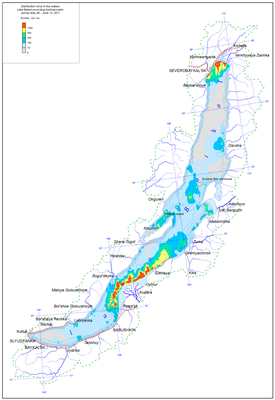
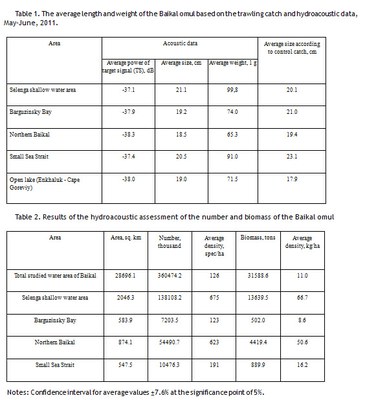
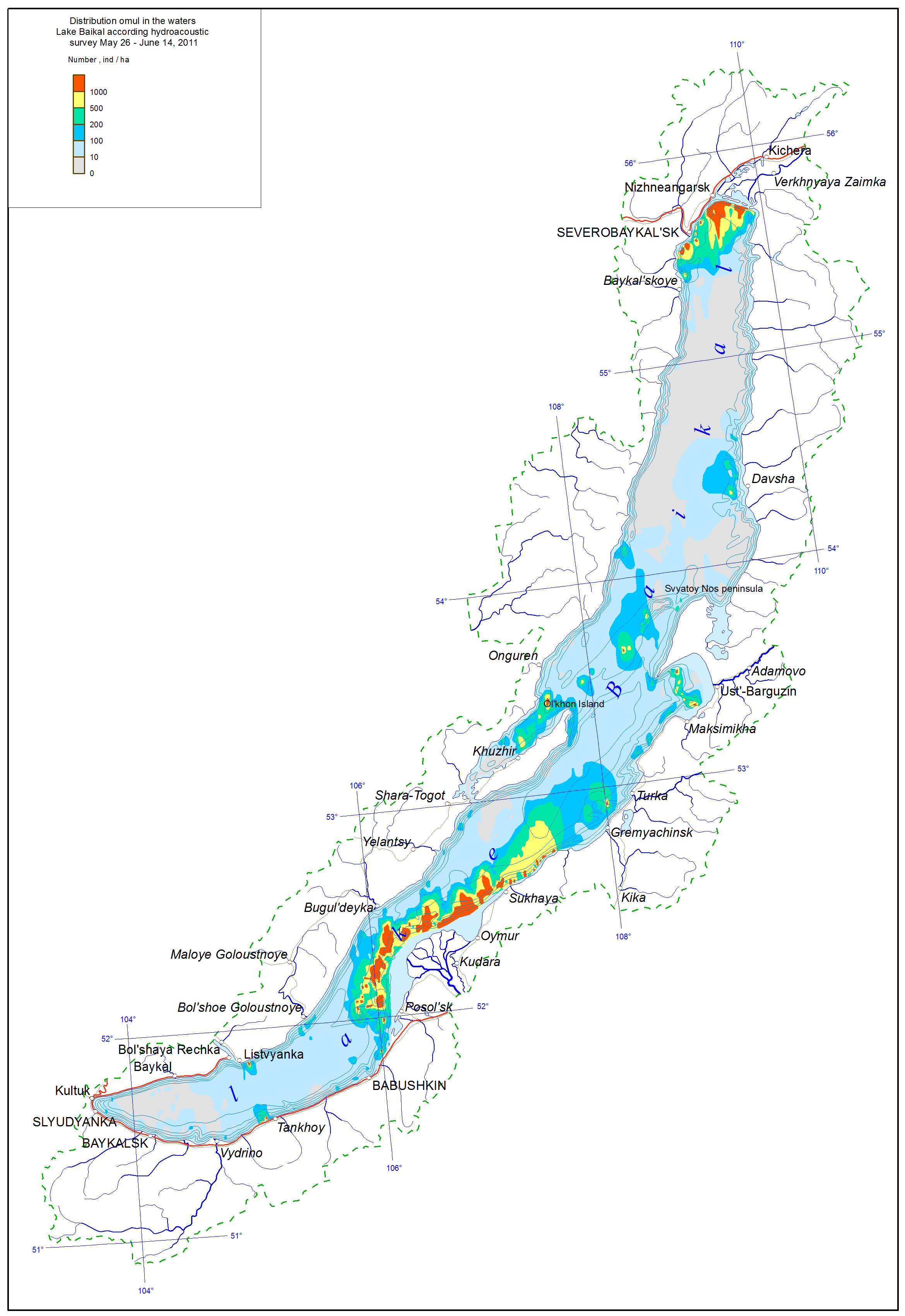
<p class="a">In 2011, the assessment of the number and biomass of the Baikal omul Coregonus migratorius was carried out using the hydroacoustic method [1].</p>
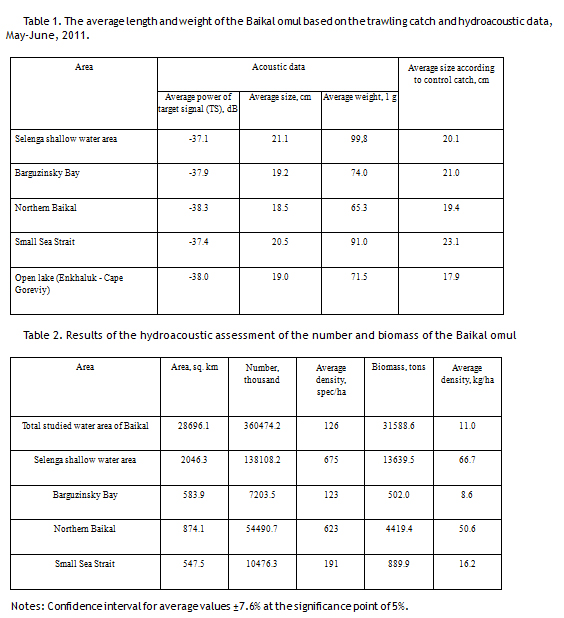
<p class="a">The results of the assessment are shown in Tables 1 and 2. The distribution of the number and biomass of the Baikal omul in the water area of Lake Baikal is uneven. Amassments with the density above average take less than a quarter of the examined area. However, they contain almost two thirds of the Baikal omul reserves. A general picture of the spatial distribution of the omul in the lake's water area corresponds with trawling and acoustic measurements. Our work confirmed the necessity of conducting such measurements immediately after ice clearance, but before the start of feeding migrations of the Baikal omul. During this period, the omul forms dense shoals that are easy to register using the hydroacoustic technique, which improves the accuracy of measurements. The derived number and biomass figures of the Baikal omul, especially in the Selenga shallow water area and Northern Baikal, correspond quite well with the forecast of the long-term dynamics based on the peculiarities of the size- and age-related composition of the fish population[2].</p>
<p class="a">We confirmed the findings about the presence of a significant part of the omul population in the deep-water zones of the lake.</p>
<p align="center" class="a">References:</p>
<p class="a">Makarov, M. M., Degtev, A. I., Kucher, K. M., Mamontov, A. M., Nebesnykh, I. A., Khanaev, I. V. &amp; Dzyuba, E. B. (2012). Assessment of the number and the biomass of the Baikal omul using trawling and acoustic techniques. <i>DAN, 447</i>(3). p 343-346.</p>
<p>Melnik, N. G., Smirnova-Zalumi, N. S., Smirnov, V. V., et al. (2009). <i>Hydroacoustic measurement of the Baikal omul resources</i>. Novosibirsk: Nauka. p 244.</p>
<p><img class="image-inline" src="../../../../resolveuid/9046812ec12c496393f9107a426d3f2a/@@images/image/preview" /></p>
<p><a href="http://bic.iwlearn.org/en/photos/139.jpg" class="internal-link">Open full size</a></p>]]></content:encoded>
    <dc:publisher>No publisher</dc:publisher>
    <dc:creator>Alexander Ayurzhanaev</dc:creator>
    <dc:rights></dc:rights>
    <dc:date>2014-10-15T05:10:00Z</dc:date>
    <dc:type>Page</dc:type>
  </item>


  <item rdf:about="http://bic.iwlearn.org/en/atlas/atlas/137-uninodal-binodal-trinodal-and-quadrinodal-seic_65-map/uninodal-binodal-trinodal-and-quadrinodal-seic_65-map">
    <title>Uninodal, binodal, trinodal, and quadrinodal seic_65 map</title>
    <link>http://bic.iwlearn.org/en/atlas/atlas/137-uninodal-binodal-trinodal-and-quadrinodal-seic_65-map/uninodal-binodal-trinodal-and-quadrinodal-seic_65-map</link>
    <description></description>
    <content:encoded xmlns:content="http://purl.org/rss/1.0/modules/content/"><![CDATA[<p><img class="image-inline" src="../../../../resolveuid/dd71b06dd46b4563ac843e1369873859/@@images/image/preview" /></p>
<p><a href="http://bic.iwlearn.org/en/photos/copy_of__137_UNINODALBINODALTRINODALANDQUADRINODALSEIC_65.png" class="internal-link">Open full size</a></p>
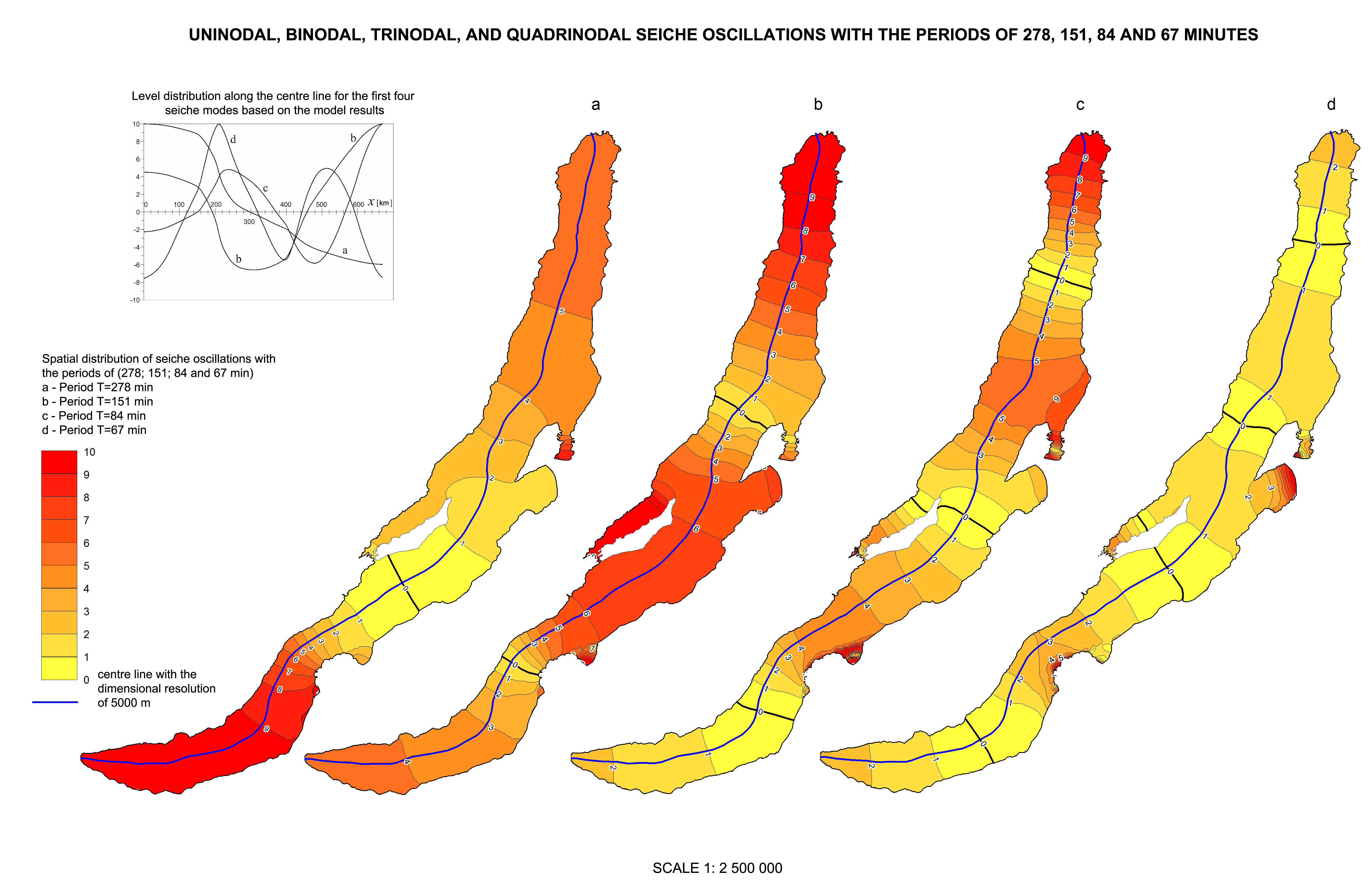
<p align="center" class="a"><b>Uninodal (bimodal, trinodal and quadrinodal) </b></p>
<p align="center" class="a"><b>seiche oscillations </b></p>
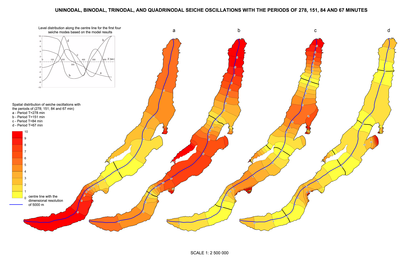
<p class="a" style="text-align: left; "><b></b><span>Seiches are standing waves in an enclosed or partially enclosed water body. Seiche oscillations in Lake Baikal are observed almost continuously throughout the whole year. Some characteristics of these oscillations were obtained from in-situ observations, laboratory experiments on a spatial hydraulic model and from appropriate theoretical calculations. The results of these studies have been published in the works (References). However, available information on Baikal seiches is scarce due to the difficulties of in-situ measurements and rather crude data on bottom topography. Sophisticated instrumental tools and advanced techniques for in-situ measurements were used to perform calculations of seiche oscillations in Lake Baikal based on a spectral difference model using specified bathymetric data obtained by researchers from Limnological Institute SB RAS. All these data are included in this atlas. The main aim of this study was to investigate solutions corresponding to oscillations with the periods of 277, 152, 84, 67, and 59 min, which were identified during in-situ observations.</span></p>
<p class="a">The spectral difference model is based on the linearized system of equations for shallow water in the spherical coordinate system. Difference approximation is based on irregular triangular spatial mesh. The side length of the calculation mesh is 30 m near the shoreline and about 1 km for the rest of the model area. The numerical model includes solution of the eigenvalues problem. It allows the researchers to get a set of frequencies and corresponding forms of seiche oscillations.</p>
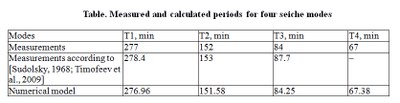
<p class="a">The calculations were obtained taking into consideration the Earth’s rotation. Complex solutions were normalised in such a way that imaginary component was minimal, whereas true components of solutions for the rest of the model area were within the range of -10 to 10. The values in the nodes with the depth less than 10 m and in the nodes within the contour of Maloye More (Small Sea) were not taken into account. Spatial distribution of seiche oscillations with the periods of 276.96; 151.58; 84.25; and 67.38 min corresponds to uninodal, binodal, trinodal, and quadrinodal longitudinal seiche modes of Lake Baikal. The level distribution along the centreline is shown for the enumerated modes in Figure. It should be noted that it is necessary to use other approaches for specification of solutions in shallow areas of Lake Baikal, such as Mukhor and Proval Bays and Cherkalovsky and Posolsk Sors, where the bottom friction is likely to play a significant role. The results for the first mode are consistent with the data on distribution of seiche oscillation height along the Baikal length in [Sudolsky, 1991, Fig. 5.2], in which the data on calculations and survey results from the spatial hydraulic model are compared.</p>
<p>Amplitudes of seiche oscillations in Lake Baikal and their seasonal variability were analysed from the data obtained at 3 stations located in the southern basin of the lake. Well-defined maxima for the oscillations with the periods of 277, 152, 84, and 67 min are observed within the range of density spectrum derived from the annual level record. No significant differences were recorded between the amplitudes for a uninodal seiche and amplitudes during the rest of the year when the lake is covered with ice and protected from wind. It was established that a seiche with the period of 67 min is observed in different seasons of the year. At three stations, level changes for the oscillation with the 277 min period differ in significantly. For the 152 min period they have slight differences, and for the 84 and 67 min periods they are similar only at those sites with relatively high amplitudes of oscillations. This is attributed to the effect of wind and atmospheric pressure. Measured and calculated periods for the first four seiche modes are given in Table.</p>
<p style="text-align: center; "><img class="image-inline" src="../../../../resolveuid/e9e95945b27643c6b6ebba950fc140a9/@@images/image/preview" /></p>
<p align="center" class="a">References</p>
<p class="a">Arsenyeva, N. M., Davydov, L. K., Dubrovina, L. N., &amp; Konkina, N. G. (1963). <i>Seiches in lakes of the USSR</i>. Leningrad: LSU Publishing. p 184.</p>
<p class="a">Verbolov, V. I. (1970). On Baikal seiches. In <i>Seiches in lakes: Surface and internal</i>. Leningrad: Nauka. p 50-52.</p>
<p class="a">Solovyev, V. N. (1925). Method of models and its application in seiche survey at Lake Baikal. <i>News of the Institute of Biology and Geography, 2</i>. p 9-26.</p>
<p class="a">Solovyev, V. N., Shostakovich, V. B. (1926). Seiches in Lake Baikal. <i>Proceedings of Magnetic and Meteorological Observatory, 1</i>.</p>
<p class="a">Sudolsky, A. S. (1991). <i>Dynamic phenomena in water bodies</i>. Leningrad: Hydrometeoizdat. p 263 p.</p>
<p class="a">Sudolsky, A. S. (1968) Laboratory experiments and calculations of Baikal seiches. <i>Proceedings of GGI, 155</i>. p 109-123.</p>
<p class="a">Timofeev, V. Y., Ardyukov, D. G., Granin, N. G., Zhdanov, A. A., Kucher, K. M., Boiko, E. V., &amp; Timofeev, A.V.  (2010). Deformation of ice cover, tidal and true level fluctuations of Lake Baikal. <i>Phys. Mesomech: Special Issue, 13</i>, p 58-71.</p>
<p>Timofeev, V. Y., Granin, N. G., Ardyukov, D. G., Zhdanov, A. A., Kucher, K. M., &amp; Ducarme, B. (2009). Tidal and seiche signals on Baikal Lake level. <i>Bulletin of Inf. MareesTerrestres</i>, 145. p 11635—11658.</p>]]></content:encoded>
    <dc:publisher>No publisher</dc:publisher>
    <dc:creator>Alexander Ayurzhanaev</dc:creator>
    <dc:rights></dc:rights>
    <dc:date>2014-10-15T03:20:00Z</dc:date>
    <dc:type>Page</dc:type>
  </item>


  <item rdf:about="http://bic.iwlearn.org/en/atlas/atlas/136-currents/currents-map">
    <title>Currents map</title>
    <link>http://bic.iwlearn.org/en/atlas/atlas/136-currents/currents-map</link>
    <description></description>
    <content:encoded xmlns:content="http://purl.org/rss/1.0/modules/content/"><![CDATA[<p><img class="image-inline" src="../../../../resolveuid/6d6617b36c194aa29e1367ad039a8a83/@@images/image/preview" /></p>
<p><a href="http://bic.iwlearn.org/en/photos/copy_of__136_CURRENTS.png" class="internal-link">Open full size</a></p>
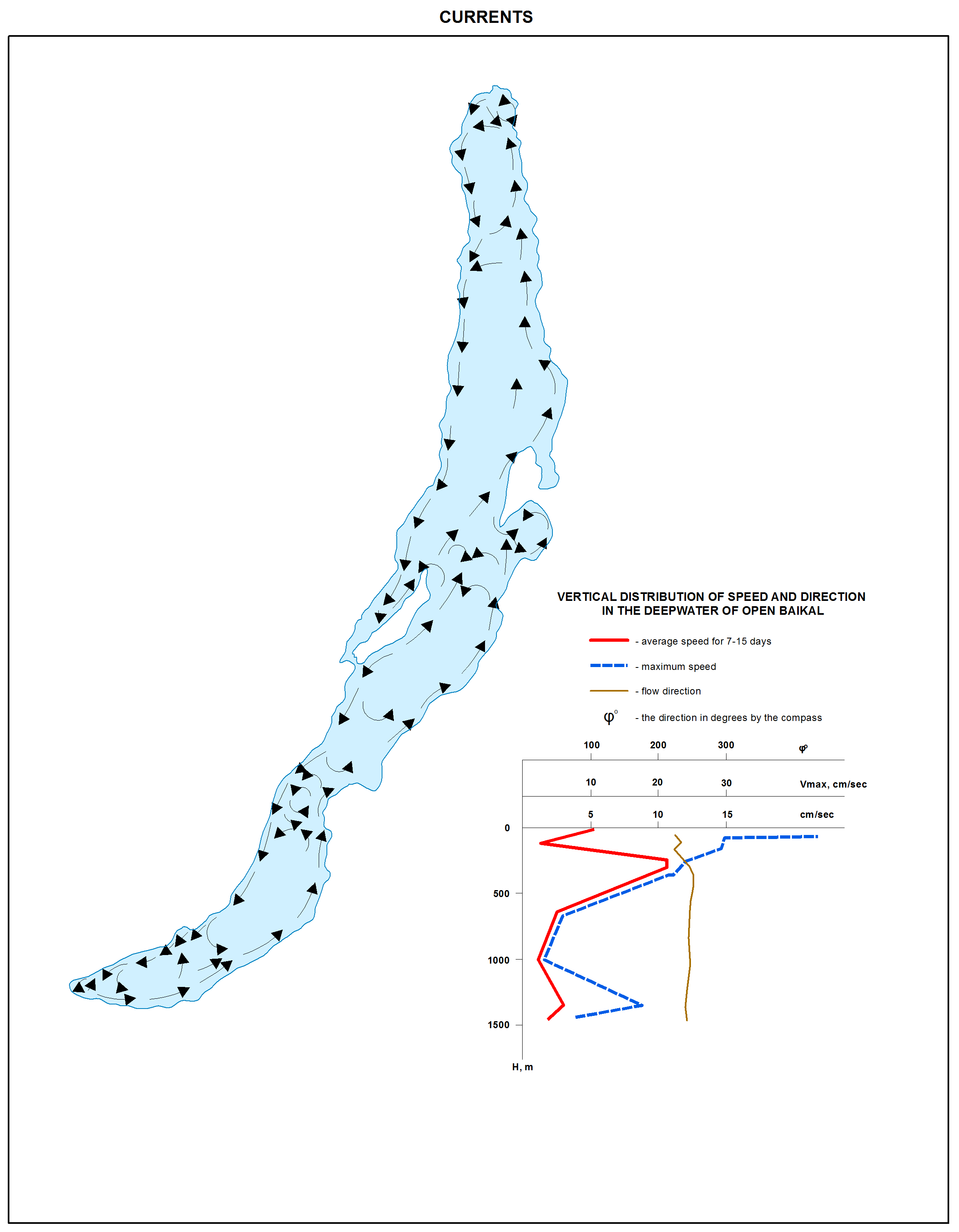
<p align="center"><strong>C</strong><strong>urrents</strong></p>
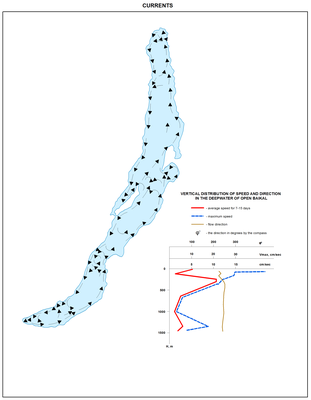
<p>The main cause of currents during the ice free period is the wind. Depending on changes of the wind velocities, wind (drift) currents intensify in May, subside in June-August and again intensify in autumn reaching its maximum in December. Wind-induced currents take place during strong winds, when the surface waters are transferred, thus causing the water level decrease by 10 cm. In summer and autumn, the negative water setout lasts approximately 40 h, and in winter about 35 h, whereas the wind setup continues 44 and 40 h, respectively. Average negative water setout height (decrease of the level near the windward shore) is 9-11 cm, and that of wind setup (increase of the level near leeward shore) is 7-8 cm. Moreover, geostrophic currents are formed at Lake Baikal, which are stationary currents retaining their main characteristics (location, direction and velocity) for a long period of time. They are induced by the difference in temperature (density) of coastal and lacustrine waters, deflecting force of the Earth’s rotation and other factors. These currents covering both the entire Lake Baikal and separate basins are observed throughout the whole year.</p>
<p>Water is transferred counter-clockwise (cyclonic circulation) under the deflecting force of the Earth’s rotation (Coriolis force). Secondary cyclonic circulations are observed in separate basins. The water at the interface of neighbouring cyclonic circulations is transferred across the lake (in Listvennichny Bay, the Selenga delta, Academichesky Ridge and Cape Kotelnikovsky). The same direction of water transfer is also observed in deep water layers of the lake.</p>
<p>The highest current velocities are recorded in the upper lake layers – in the epilimnion and sometimes below the thermocline. Their average velocities are up to tens of centimetres per second intensifying from summer to autumn. Maximal velocity registered near the surface can be over 1 m/sec. In winter, when the whole lake is covered with ice, the vertical structure of the velocity field is usually the same, although because of the ice cover the currents attenuate significantly. Their average velocity in the upper layers (up to 40-50 m) can be 2 cm/s and lower during “calm” periods. However, it can increase up to 3-5 cm/s and even to 10 cm/s during atmospheric pressure drop in case of atmospheric fronts. General character of water mass transfer corresponds to cyclonic circulation (Fig. 2.33) in the water column.</p>
<p>In the 1960-s, V. Sokolnikov [1964], working on the lake ice, discovered the effect of current intensification in the near-bottom layer at large depths of the lake, which was later observed in other seasons of the year. The studies of this phenomenon carried out by V. Verbolov [1996] and A. Zhdanov [2006] showed that the velocities in the near-bottom layer are seasonal. In winter, they episodically exceed 10 cm/s and in summer (July-early August) they are 4-8 cm/s during weak winds. In spring (May) and autumn (October-November) they become an order of magnitude at seasonal increase of the wind with the values corresponding to those in the upper 200-m layer (up to tens of centimetres per second). Usually current velocities decrease in the near-bottom layer with the distance from the foot of the underwater slope, their highest values being recorded at the bottom.</p>
<p> </p>
<p align="center">References</p>
<p>Ainbund. M. M. (1988). Currents and internal water exchange in Lake Baikal. Leningrad: Hydrometeoizdat. p 248.</p>
<p>Verbolov, V. I. (1996). Currents and water exchange in Lake Baikal. <i>Water Resources, 23</i>(4). P 413-423.</p>
<p>Zhdanov, A. A. (2006). Horizontal transfer and macroturbulent water exchange in Lake Baikal (Abstract of Ph.D. Thesis). Irkutsk. p 22.</p>
<p>Shimaraev, M. N. (2012). Horizontal currents<i>. </i>In <i>Baikal Studies</i>. Novosibirsk: Nauka. p 166-170.</p>]]></content:encoded>
    <dc:publisher>No publisher</dc:publisher>
    <dc:creator>Alexander Ayurzhanaev</dc:creator>
    <dc:rights></dc:rights>
    <dc:date>2014-10-15T03:00:00Z</dc:date>
    <dc:type>Page</dc:type>
  </item>


  <item rdf:about="http://bic.iwlearn.org/en/atlas/atlas/135-ice-regime-map/ice-regime-map">
    <title>Ice regime map</title>
    <link>http://bic.iwlearn.org/en/atlas/atlas/135-ice-regime-map/ice-regime-map</link>
    <description></description>
    <content:encoded xmlns:content="http://purl.org/rss/1.0/modules/content/"><![CDATA[<p><img class="image-inline" src="../../../resolveuid/47f116a898e04644908f0c15536b7d36/@@images/image/preview" /></p>
<p><a href="http://bic.iwlearn.org/en/atlas/photos/copy_of__135_Iceregime.png" class="internal-link">Open full size</a></p>
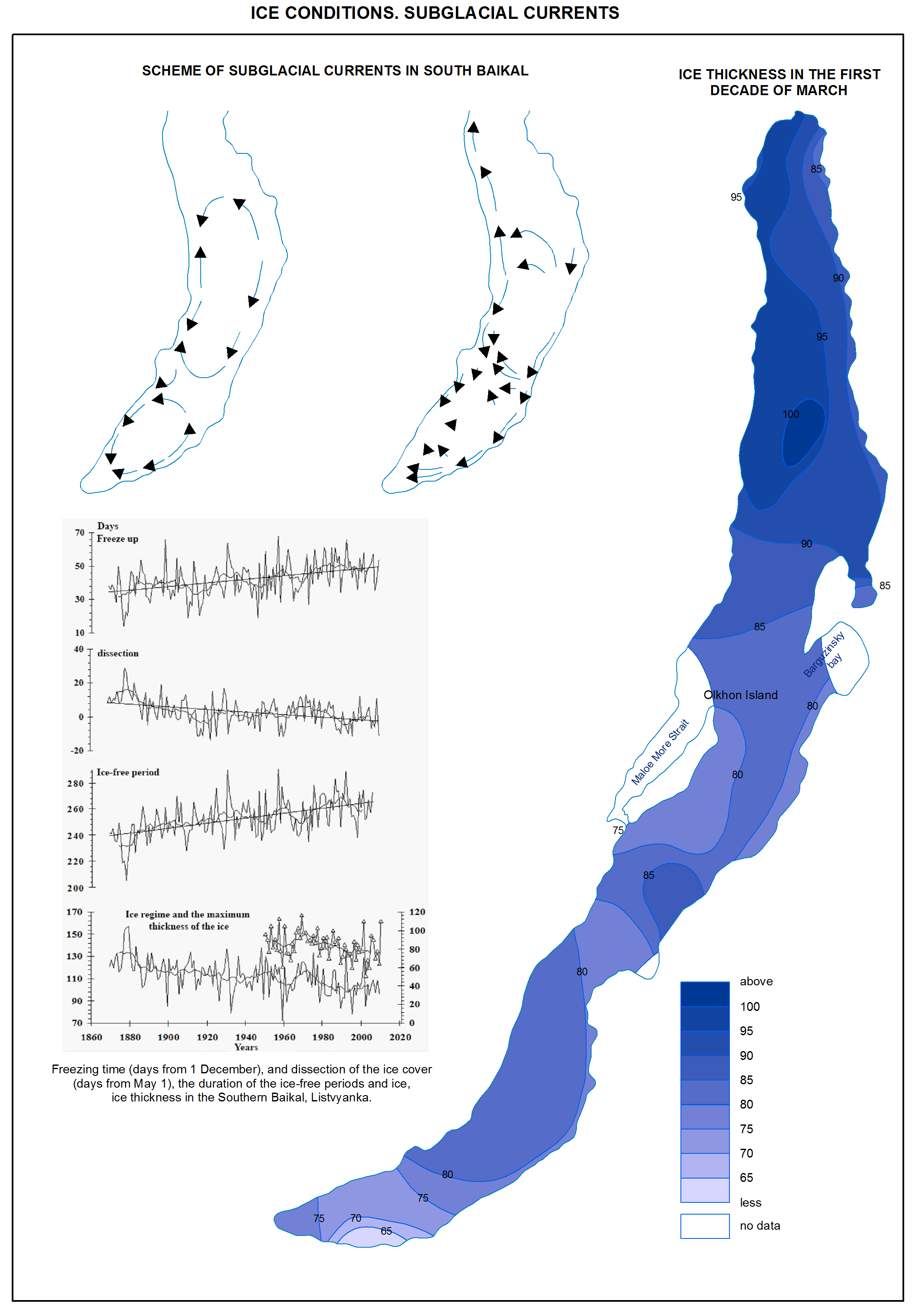
<p class="a" style="text-align: center; "><b>Ice regime. Subglacial currents</b></p>
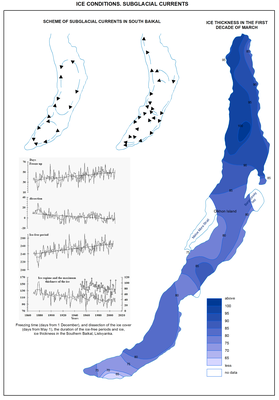
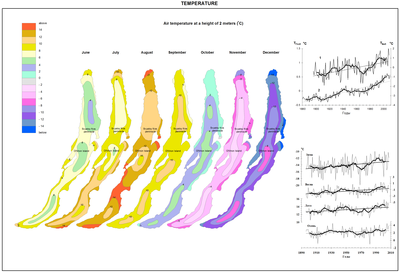
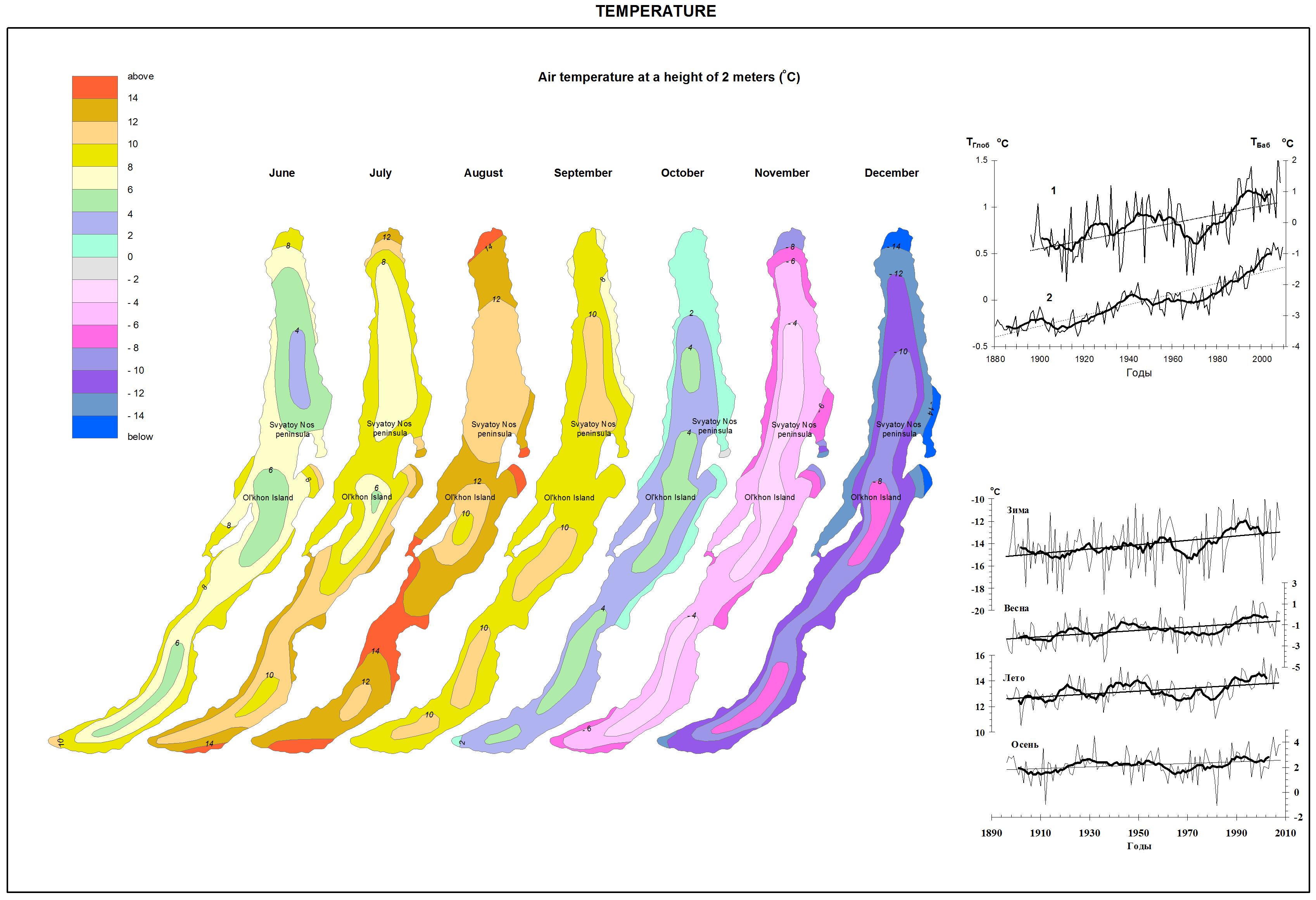
<p><b>Air </b><b>temperature. </b>General trend of air temperature changes at Lake Baikal corresponded to the global temperature trend with its rise from the late 1910-s to the middle of the 20<sup>th</sup> century, to the temperature decrease by the early 1970-s and its significant rise by the end of the 20<sup>th</sup> century. The trend of annual temperature in the lake area (+1.2°C/100 years) was two times higher than the average Earth’s trend (+0.6°C/100 years). The rise of air temperature was recorded for all seasons of the year from 1986 to 2008 with the trend of +1.9, +1.5, +1.1 and +0.66°C/100 years in winter, spring, summer and autumn, respectively. Maximal trend (+2.1-2.2°C) was registered in December and January and minimal trend (+0.1-0.5°C) in August, September and October.  Statistical analysis showed both short-term (2-7 years) and long-term inter-annual (about 20 years) cycles with well-defined phases of increase and decrease of air temperature. The 20<sup>th</sup> century had two complete cycles (1912-1936 and 1937-1969) and phases of two incomplete cycles – decrease from 1896 to 1911 and increase from 1970. The increase phase at the end of the century to the mid 1990-s was characterized by anomalously long duration (25 years) and rise of air temperature (by 2.1°C). Beginning from 1995, there was a tendency to annual temperature decrease, which may be regarded as the beginning of the temperature drop phase in the current inter-annual climate cycle. <b></b></p>
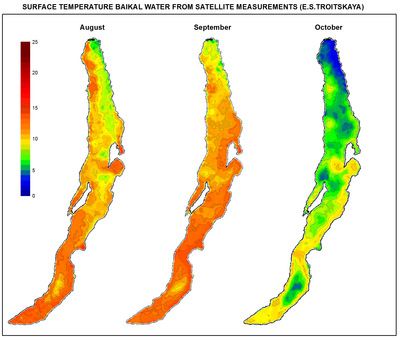
<p><b>Temperature of water surface. </b>The temperature of water surface increased together with the rise of air temperature due to global warming. According to the observation data since 1941, the average temperature of water surface in Southern Baikal (the settlement of Listvennichnoye) decreased insignificantly in May-September from the 1950-s to the 1970-s, and then sharply increased by the mid 1990-s. The same temperature changes were recorded in other areas of the lake. The rate of its increase (0.64-0.60°C/10 years) was higher in the central and northern parts of Lake Baikal than in its southern part (0.25-0.35°C/10 years). The temperature of the warmer 1994-2005 decade exceeded the temperature of the cold 1964-1975 period by 0.9-1.5°C in the southern area and by 1.8-2°C in the central and northern regions of the lake. In some years of this period (e.g., several days in August of 2002), the increase of surface water temperature up to 18-20°C was recorded even in the deeper areas of the lake. <b></b></p>
<p><b>Ice regime. </b>Beginning in the middle of the 20<sup>th</sup> century, the warming caused “mitigation” of the ice regime at Lake Baikal [Verbolov et al., 1965; Magnusson et al., 2000]. Freezing of the lake started later, whereas ice breaking began earlier. In1868-2010, in Southern Baikal (the settlement of Listvennichnoye) the trend of freezing and ice breaking terms were 10 and 7 days per 100 years, respectively. The duration of ice free period prolonged, whilst the ice cover period shortened by 17 days. According to the 1950-2010 data, the maximal ice thickness decreased on average by 2.4 cm every 10 years. During the phase of significant warming (1970-1995,) the rate of ice process changes sharply increased: freezing started by 10 days later and ice breaking by 15 days earlier; the ice period shortened by 25 days, and the ice thickness decreased on average by 8.8 cm per 10 years. The observation data from shore stations and satellites showed that beginning from the mid 1990-s to the middle of 2010 there was a tendency towards early freezing, late break-up of ice and prolongation of ice period [Kouraev et al., 2007]. These changes are consistent with inter-annual climate periodicity associated with fluctuations of atmospheric circulation in the Northern Hemisphere.</p>
<p>The main meteorological factor, which causes fluctuations of freezing terms (D<sub>fr</sub>) is the air temperature in November-December (T<sub>a</sub>) affecting the rate of heat losses from the water surface. The correlation between these characteristics in Southern Baikal is described by equation D<sub>fr</sub>=4.26Тa+75 (R<sup>2</sup>=0.57, p&lt;0.001) for the period of 1896-2010, where D<sub>fr</sub> is the number of days from December 1<sup>st</sup> to the freezing date. Temperature conditions in spring also affect the date of ice breaking. However, the correlation between ice breaking dates and air temperature is not high [Livingston, 1999]. It is attributed to the effect of both thermal and dynamic (wind) factors on the break-up of ice [Kouraev et al., 2007; Shimaraev, 2008], as well as to the influence of ice thickness, which depends on air temperature in winter months.</p>]]></content:encoded>
    <dc:publisher>No publisher</dc:publisher>
    <dc:creator>Alexander Ayurzhanaev</dc:creator>
    <dc:rights></dc:rights>
    <dc:date>2014-10-15T02:55:00Z</dc:date>
    <dc:type>Page</dc:type>
  </item>


  <item rdf:about="http://bic.iwlearn.org/en/atlas/atlas/134-temperature-from-satellites-map/temperature-from-satellites-map">
    <title>Temperature from satellites map</title>
    <link>http://bic.iwlearn.org/en/atlas/atlas/134-temperature-from-satellites-map/temperature-from-satellites-map</link>
    <description></description>
    <content:encoded xmlns:content="http://purl.org/rss/1.0/modules/content/"><![CDATA[<p><img class="image-inline" src="../../../resolveuid/09c3f28bfb39434c927a5c8469e147d0/@@images/image/preview" /></p>
<p><a href="http://bic.iwlearn.org/en/atlas/photos/copy_of__134_Temperaturefromsatellites.png" class="internal-link">Open full size</a></p>
<p class="a" style="text-align: center; "><b>Temperature of  water  surface according to satellite data</b></p>
<p><b>Air </b><b>temperature. </b>General trend of air temperature changes at Lake Baikal corresponded to the global temperature trend with its rise from the late 1910-s to the middle of the 20<sup>th</sup> century, to the temperature decrease by the early 1970-s and its significant rise by the end of the 20<sup>th</sup> century. The trend of annual temperature in the lake area (+1.2°C/100 years) was two times higher than the average Earth’s trend (+0.6°C/100 years). The rise of air temperature was recorded for all seasons of the year from 1986 to 2008 with the trend of +1.9, +1.5, +1.1 and +0.66°C/100 years in winter, spring, summer and autumn, respectively. Maximal trend (+2.1-2.2°C) was registered in December and January and minimal trend (+0.1-0.5°C) in August, September and October.  Statistical analysis showed both short-term (2-7 years) and long-term inter-annual (about 20 years) cycles with well-defined phases of increase and decrease of air temperature. The 20<sup>th</sup> century had two complete cycles (1912-1936 and 1937-1969) and phases of two incomplete cycles – decrease from 1896 to 1911 and increase from 1970. The increase phase at the end of the century to the mid 1990-s was characterized by anomalously long duration (25 years) and rise of air temperature (by 2.1°C). Beginning from 1995, there was a tendency to annual temperature decrease, which may be regarded as the beginning of the temperature drop phase in the current inter-annual climate cycle. <b></b></p>
<p><b>Temperature of water surface. </b>The temperature of water surface increased together with the rise of air temperature due to global warming. According to the observation data since 1941, the average temperature of water surface in Southern Baikal (the settlement of Listvennichnoye) decreased insignificantly in May-September from the 1950-s to the 1970-s, and then sharply increased by the mid 1990-s. The same temperature changes were recorded in other areas of the lake. The rate of its increase (0.64-0.60°C/10 years) was higher in the central and northern parts of Lake Baikal than in its southern part (0.25-0.35°C/10 years). The temperature of the warmer 1994-2005 decade exceeded the temperature of the cold 1964-1975 period by 0.9-1.5°C in the southern area and by 1.8-2°C in the central and northern regions of the lake. In some years of this period (e.g., several days in August of 2002), the increase of surface water temperature up to 18-20°C was recorded even in the deeper areas of the lake. <b></b></p>
<p><b>Ice regime. </b>Beginning in the middle of the 20<sup>th</sup> century, the warming caused “mitigation” of the ice regime at Lake Baikal [Verbolov et al., 1965; Magnusson et al., 2000]. Freezing of the lake started later, whereas ice breaking began earlier. In1868-2010, in Southern Baikal (the settlement of Listvennichnoye) the trend of freezing and ice breaking terms were 10 and 7 days per 100 years, respectively. The duration of ice free period prolonged, whilst the ice cover period shortened by 17 days. According to the 1950-2010 data, the maximal ice thickness decreased on average by 2.4 cm every 10 years. During the phase of significant warming (1970-1995,) the rate of ice process changes sharply increased: freezing started by 10 days later and ice breaking by 15 days earlier; the ice period shortened by 25 days, and the ice thickness decreased on average by 8.8 cm per 10 years. The observation data from shore stations and satellites showed that beginning from the mid 1990-s to the middle of 2010 there was a tendency towards early freezing, late break-up of ice and prolongation of ice period [Kouraev et al., 2007]. These changes are consistent with inter-annual climate periodicity associated with fluctuations of atmospheric circulation in the Northern Hemisphere.</p>
<p>The main meteorological factor, which causes fluctuations of freezing terms (D<sub>fr</sub>) is the air temperature in November-December (T<sub>a</sub>) affecting the rate of heat losses from the water surface. The correlation between these characteristics in Southern Baikal is described by equation D<sub>fr</sub>=4.26Тa+75 (R<sup>2</sup>=0.57, p&lt;0.001) for the period of 1896-2010, where D<sub>fr</sub> is the number of days from December 1<sup>st</sup> to the freezing date. Temperature conditions in spring also affect the date of ice breaking. However, the correlation between ice breaking dates and air temperature is not high [Livingston, 1999]. It is attributed to the effect of both thermal and dynamic (wind) factors on the break-up of ice [Kouraev et al., 2007; Shimaraev, 2008], as well as to the influence of ice thickness, which depends on air temperature in winter months.</p>]]></content:encoded>
    <dc:publisher>No publisher</dc:publisher>
    <dc:creator>Alexander Ayurzhanaev</dc:creator>
    <dc:rights></dc:rights>
    <dc:date>2014-10-15T02:50:00Z</dc:date>
    <dc:type>Page</dc:type>
  </item>


  <item rdf:about="http://bic.iwlearn.org/en/atlas/atlas/133-temperature-map/temperature-map">
    <title>Temperature map</title>
    <link>http://bic.iwlearn.org/en/atlas/atlas/133-temperature-map/temperature-map</link>
    <description></description>
    <content:encoded xmlns:content="http://purl.org/rss/1.0/modules/content/"><![CDATA[<p><img class="image-inline" src="../../../resolveuid/d0029ff48be64a5a82686b3779a621f2/@@images/image/preview" /></p>
<p><a href="http://bic.iwlearn.org/en/atlas/photos/copy_of__133_Temperature.png" class="internal-link">Open full size</a></p>
<p align="center"><b><b>Temperature of surface water layers</b></b></p>
<p align="center"><strong> </strong></p>
<p><b>Air </b><b>temperature. </b>General trend of air temperature changes at Lake Baikal corresponded to the global temperature trend with its rise from the late 1910-s to the middle of the 20<sup>th</sup> century, to the temperature decrease by the early 1970-s and its significant rise by the end of the 20<sup>th</sup> century. The trend of annual temperature in the lake area (+1.2°C/100 years) was two times higher than the average Earth’s trend (+0.6°C/100 years). The rise of air temperature was recorded for all seasons of the year from 1986 to 2008 with the trend of +1.9, +1.5, +1.1 and +0.66°C/100 years in winter, spring, summer and autumn, respectively. Maximal trend (+2.1-2.2°C) was registered in December and January and minimal trend (+0.1-0.5°C) in August, September and October.  Statistical analysis showed both short-term (2-7 years) and long-term inter-annual (about 20 years) cycles with well-defined phases of increase and decrease of air temperature. The 20<sup>th</sup> century had two complete cycles (1912-1936 and 1937-1969) and phases of two incomplete cycles – decrease from 1896 to 1911 and increase from 1970. The increase phase at the end of the century to the mid 1990-s was characterized by anomalously long duration (25 years) and rise of air temperature (by 2.1°C). Beginning from 1995, there was a tendency to annual temperature decrease, which may be regarded as the beginning of the temperature drop phase in the current inter-annual climate cycle. <b> </b></p>
<p><b>Temperature of water surface. </b>The temperature of water surface increased together with the rise of air temperature due to global warming. According to the observation data since 1941, the average temperature of water surface in Southern Baikal (the settlement of Listvennichnoye) decreased insignificantly in May-September from the 1950-s to the 1970-s, and then sharply increased by the mid 1990-s. The same temperature changes were recorded in other areas of the lake. The rate of its increase (0.64-0.60°C/10 years) was higher in the central and northern parts of Lake Baikal than in its southern part (0.25-0.35°C/10 years). The temperature of the warmer 1994-2005 decade exceeded the temperature of the cold 1964-1975 period by 0.9-1.5°C in the southern area and by 1.8-2°C in the central and northern regions of the lake. In some years of this period (e.g., several days in August of 2002), the increase of surface water temperature up to 18-20°C was recorded even in the deeper areas of the lake. <b></b></p>
<p><b>Ice regime. </b>Beginning in the middle of the 20<sup>th</sup> century, the warming caused “mitigation” of the ice regime at Lake Baikal [Verbolov et al., 1965; Magnusson et al., 2000]. Freezing of the lake started later, whereas ice breaking began earlier. In1868-2010, in Southern Baikal (the settlement of Listvennichnoye) the trend of freezing and ice breaking terms were 10 and 7 days per 100 years, respectively. The duration of ice free period prolonged, whilst the ice cover period shortened by 17 days. According to the 1950-2010 data, the maximal ice thickness decreased on average by 2.4 cm every 10 years. During the phase of significant warming (1970-1995,) the rate of ice process changes sharply increased: freezing started by 10 days later and ice breaking by 15 days earlier; the ice period shortened by 25 days, and the ice thickness decreased on average by 8.8 cm per 10 years. The observation data from shore stations and satellites showed that beginning from the mid 1990-s to the middle of 2010 there was a tendency towards early freezing, late break-up of ice and prolongation of ice period [Kouraev et al., 2007]. These changes are consistent with inter-annual climate periodicity associated with fluctuations of atmospheric circulation in the Northern Hemisphere.</p>
<p>The main meteorological factor, which causes fluctuations of freezing terms (D<sub>fr</sub>) is the air temperature in November-December (T<sub>a</sub>) affecting the rate of heat losses from the water surface. The correlation between these characteristics in Southern Baikal is described by equation D<sub>fr</sub>=4.26Тa+75 (R<sup>2</sup>=0.57, p&lt;0.001) for the period of 1896-2010, where D<sub>fr</sub> is the number of days from December 1<sup>st</sup> to the freezing date. Temperature conditions in spring also affect the date of ice breaking. However, the correlation between ice breaking dates and air temperature is not high [Livingston, 1999]. It is attributed to the effect of both thermal and dynamic (wind) factors on the break-up of ice [Kouraev et al., 2007; Shimaraev, 2008], as well as to the influence of ice thickness, which depends on air temperature in winter months.</p>]]></content:encoded>
    <dc:publisher>No publisher</dc:publisher>
    <dc:creator>Alexander Ayurzhanaev</dc:creator>
    <dc:rights></dc:rights>
    <dc:date>2014-10-15T02:40:00Z</dc:date>
    <dc:type>Page</dc:type>
  </item>


</rdf:RDF>