<?xml version="1.0" encoding="utf-8" ?>
<rdf:RDF xmlns:rdf="http://www.w3.org/1999/02/22-rdf-syntax-ns#" xmlns:dc="http://purl.org/dc/elements/1.1/" xmlns:syn="http://purl.org/rss/1.0/modules/syndication/" xmlns="http://purl.org/rss/1.0/">


<channel rdf:about="http://bic.iwlearn.org/search_rss">
  <title>Байкальский информационный центр</title>
  <link>http://bic.iwlearn.org</link>

  <description>
    
            These are the search results for the query, showing results 26 to 40.
        
  </description>


  <image rdf:resource="http://bic.iwlearn.org/logo.png"/>

  <items>
    <rdf:Seq>
      
        <rdf:li rdf:resource="http://bic.iwlearn.org/en/documents/state-of-the-environment-report-the-lake-baikal-basin-1/socio-economic-conditions/3-1-mineral-raw-resources"/>
      
      
        <rdf:li rdf:resource="http://bic.iwlearn.org/en/documents/state-of-the-environment-report-the-lake-baikal-basin-1/natural-conditions/2-4-animal-world"/>
      
      
        <rdf:li rdf:resource="http://bic.iwlearn.org/en/documents/state-of-the-environment-report-the-lake-baikal-basin-1/natural-conditions/2-3-vegetation"/>
      
      
        <rdf:li rdf:resource="http://bic.iwlearn.org/en/documents/state-of-the-environment-report-the-lake-baikal-basin-1/natural-conditions/2-2-soils"/>
      
      
        <rdf:li rdf:resource="http://bic.iwlearn.org/en/documents/state-of-the-environment-report-the-lake-baikal-basin-1/natural-conditions/2-1-surface-and-ground-waters"/>
      
      
        <rdf:li rdf:resource="http://bic.iwlearn.org/en/documents/state-of-the-environment-report-the-lake-baikal-basin-1/general-conditions-of-the-baikal-lake-basin/1-6-lake-baikal-2013-unesco-world-heritage-site"/>
      
      
        <rdf:li rdf:resource="http://bic.iwlearn.org/en/documents/state-of-the-environment-report-the-lake-baikal-basin-1/general-conditions-of-the-baikal-lake-basin/1-5-water-level-of-lake-baikal"/>
      
      
        <rdf:li rdf:resource="http://bic.iwlearn.org/en/documents/state-of-the-environment-report-the-lake-baikal-basin-1/general-conditions-of-the-baikal-lake-basin/1-4-climatic-conditions"/>
      
      
        <rdf:li rdf:resource="http://bic.iwlearn.org/en/documents/state-of-the-environment-report-the-lake-baikal-basin-1/general-conditions-of-the-baikal-lake-basin/1-3-specially-protected-natural-territories"/>
      
      
        <rdf:li rdf:resource="http://bic.iwlearn.org/en/documents/report"/>
      
      
        <rdf:li rdf:resource="http://bic.iwlearn.org/en/documents/state-of-the-environment-report-the-lake-baikal-basin-1/general-conditions-of-the-baikal-lake-basin/1-2-territorial-administrative-division"/>
      
      
        <rdf:li rdf:resource="http://bic.iwlearn.org/en/documents/state-of-the-environment-report-the-lake-baikal-basin-1/general-conditions-of-the-baikal-lake-basin/introduction"/>
      
      
        <rdf:li rdf:resource="http://bic.iwlearn.org/en/documents/state-of-the-environment-report-the-lake-baikal-basin-1/general-conditions-of-the-baikal-lake-basin/physical-and-geographical-position"/>
      
      
        <rdf:li rdf:resource="http://bic.iwlearn.org/en/atlas/atlas-2"/>
      
      
        <rdf:li rdf:resource="http://bic.iwlearn.org/en/atlas/atlas/atlas"/>
      
    </rdf:Seq>
  </items>

</channel>


  <item rdf:about="http://bic.iwlearn.org/en/documents/state-of-the-environment-report-the-lake-baikal-basin-1/socio-economic-conditions/3-1-mineral-raw-resources">
    <title>3.1 Mineral raw resources</title>
    <link>http://bic.iwlearn.org/en/documents/state-of-the-environment-report-the-lake-baikal-basin-1/socio-economic-conditions/3-1-mineral-raw-resources</link>
    <description></description>
    <content:encoded xmlns:content="http://purl.org/rss/1.0/modules/content/"><![CDATA[<p align="center"><strong>3.1 Mineral raw resources</strong></p>
<p align="center"><strong> </strong></p>
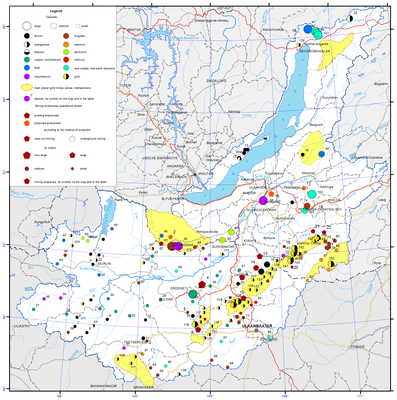
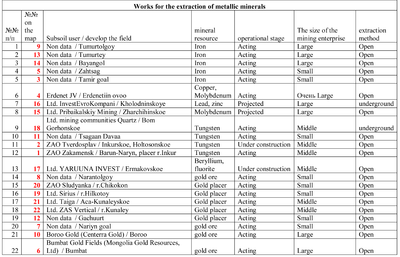
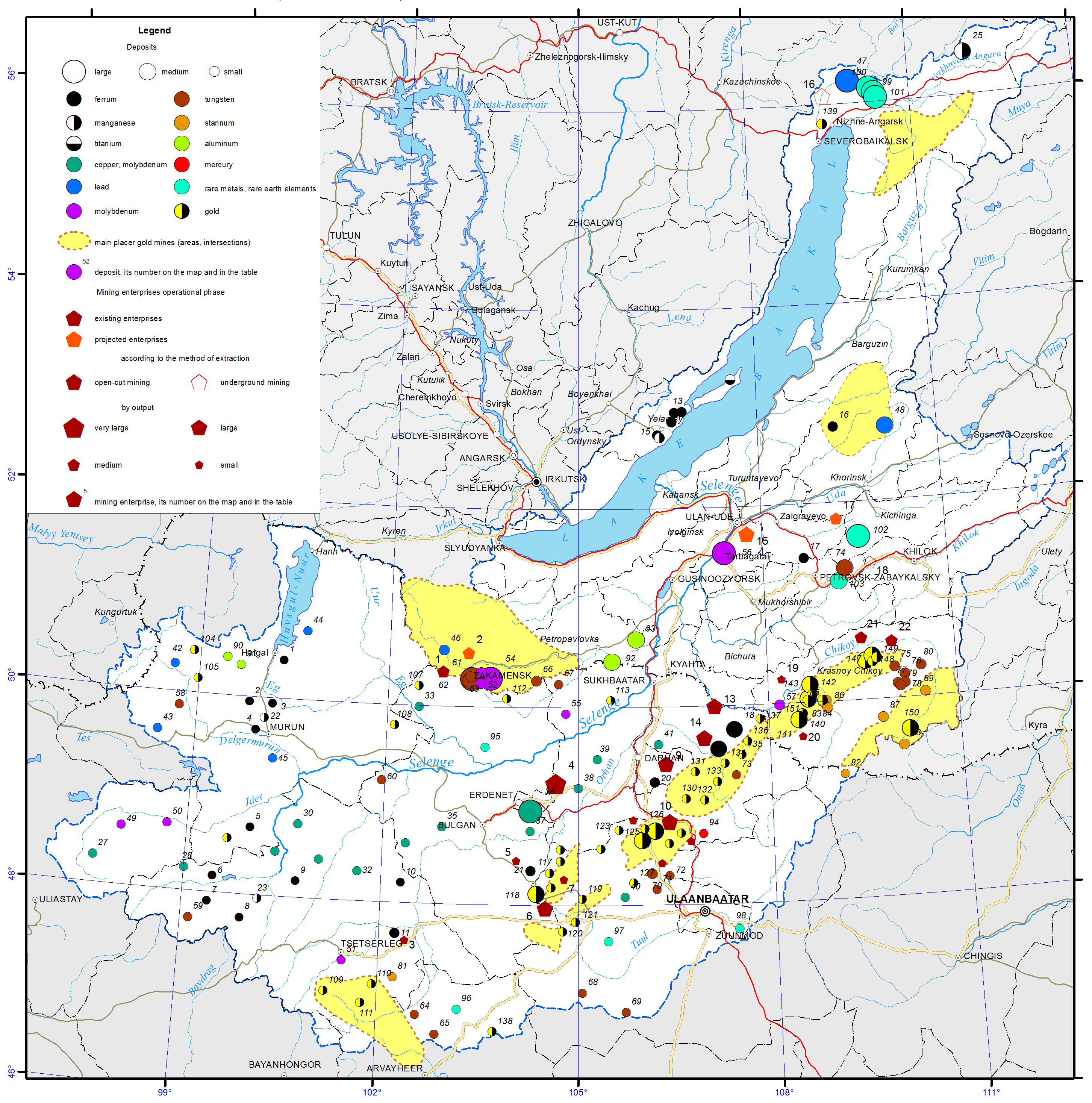
<p style="text-align: justify; ">Mining industry<i> </i>within the basin is based on the extraction of non-ferrous and precious metals, coal, chemically pure limestone and uranium (pic. 3.1.1). The overall gross value of the explored mineral reserves in Buryatia is almost $135 billion. Two thirds of this are accounted by fuel and energy resources, precious and rare metals, including rich fields of nepheline ores, fluorite, phosphates, brown coal, potassium and iron ores. Geological surveys have discovered 228 deposits of alluvial gold along the tributaries of the Verkhneya Angara and Barguzin rivers, valleys of the Dzhida, Temnik and Chikoi rivers. Buryat Republic possesses large deposits of uranium, coal, fluorite, lead, zinc, tungsten, apatite and granular quartz situated within the 140-200 km zone of Lake Baikal [1,2].</p>
<p align="center"><img class="image-inline" src="../../../resolveuid/fe06f76c662843b2a9072eedc9161927/@@images/image/preview" /></p>
<p align="center"><a href="http://bic.iwlearn.org/en/documents/photos/3.1.1e.png" class="internal-link">Open full size </a></p>
<p align="center">Pic. 3.1.1 Ferrous, nonferrous, rare and precious metal resourses and their extraction [1]</p>
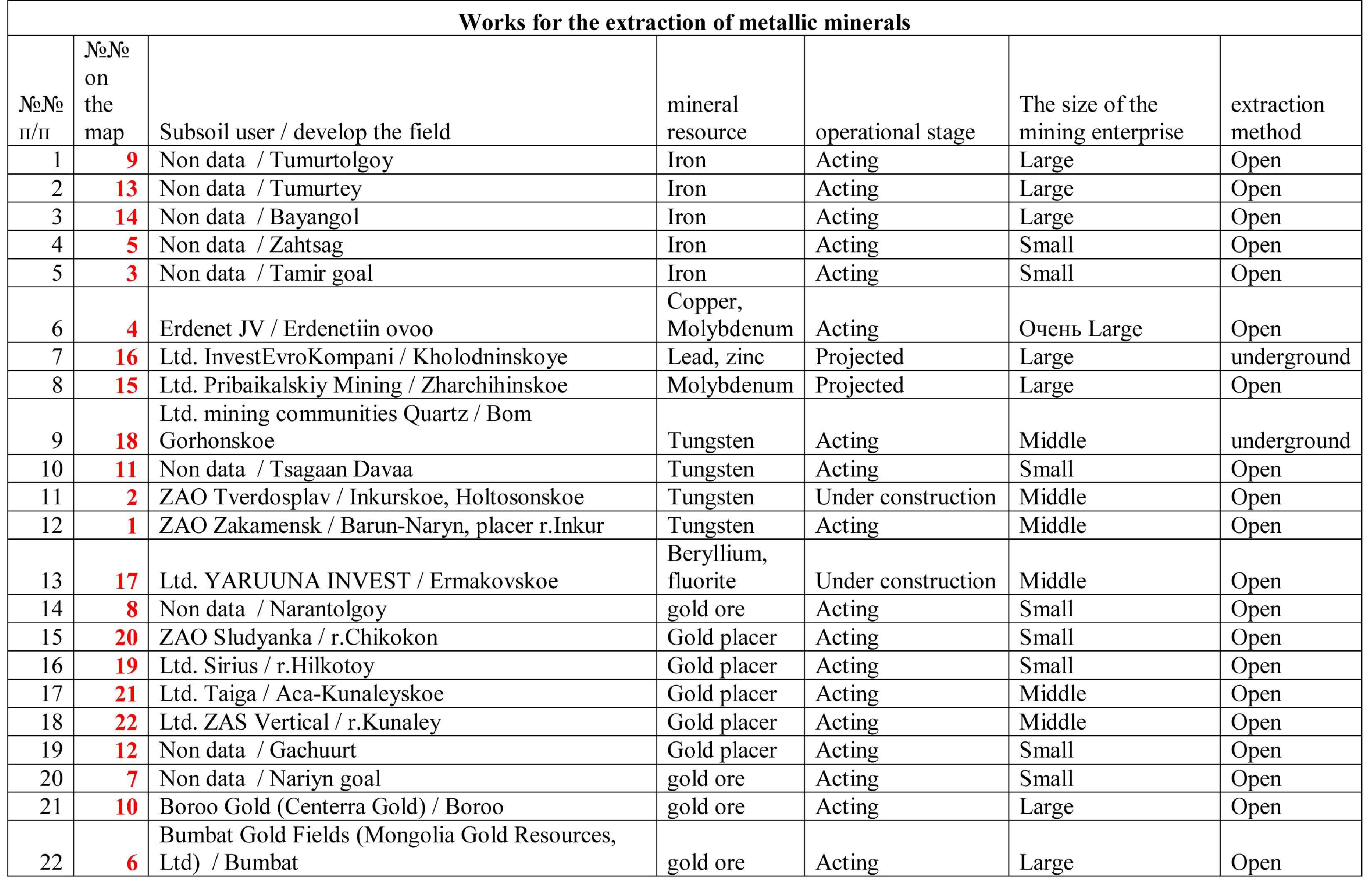
<p style="text-align: center; "><span>Legend to the pic. 3.1.1</span></p>
<p style="text-align: center; "><img class="image-inline" src="../../../resolveuid/e98d0fc263ac44ed804b6b4afb925820/@@images/image/preview" /></p>
<p style="text-align: center; "><a href="http://bic.iwlearn.org/en/documents/photos/copy_of_3.1.1e.png" class="internal-link">Open full size</a></p>
<p style="text-align: justify; ">In Irkutsk part of the basin, mining industry is based on the extraction of marble. There is a considerable number of discovered, but yet unexplored deposits, including quartz deposits in Olkhon district, and deposits of syenites, lazurites, wollastonite in Slyudyansky district [4]. Slyudyansky, Irkutsky and Olkhonsky districts of Irkutsk region, lying within CEZ, have 29 registered mineral deposits, including 16 deposits of technical and chemical materials and gemstones (none is being exploited) and 13 deposits of construction materials (6 of them are being exploited). Among the 6 exploited deposits, the biggest deposits are Pereval (Slyudyanskoe), which produced 902 and 776 thousand tons of marble and 311 and 266 thousand m<sup>3 </sup>of limestone in 2012 and 2013, respectively, and Angasolskoe, which produced 505.8 and 447.9 thousand m<sup>3</sup> of gravel in 2012 and 2013, respectively [3,4].</p>
<p style="text-align: justify; ">The major exhaustible energy sources within the Russian part of the basin are coal and oil. Considerable coal reserves are located within the Selenga river basin. Oil and natural gas were discovered in Lake Baikal basin as early as in the XVII century; however the exploitation of these reserves is impossible as they are located within the CEZ BNT.</p>
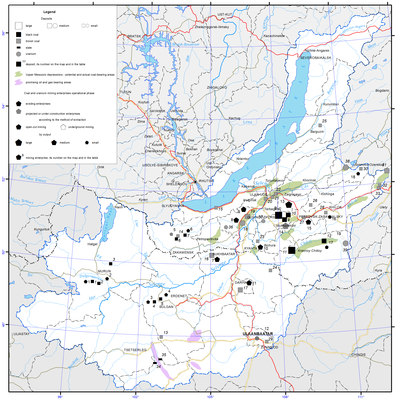
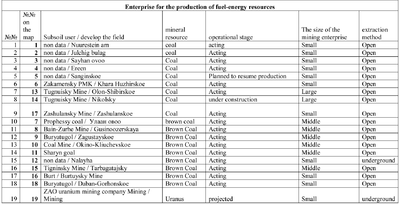
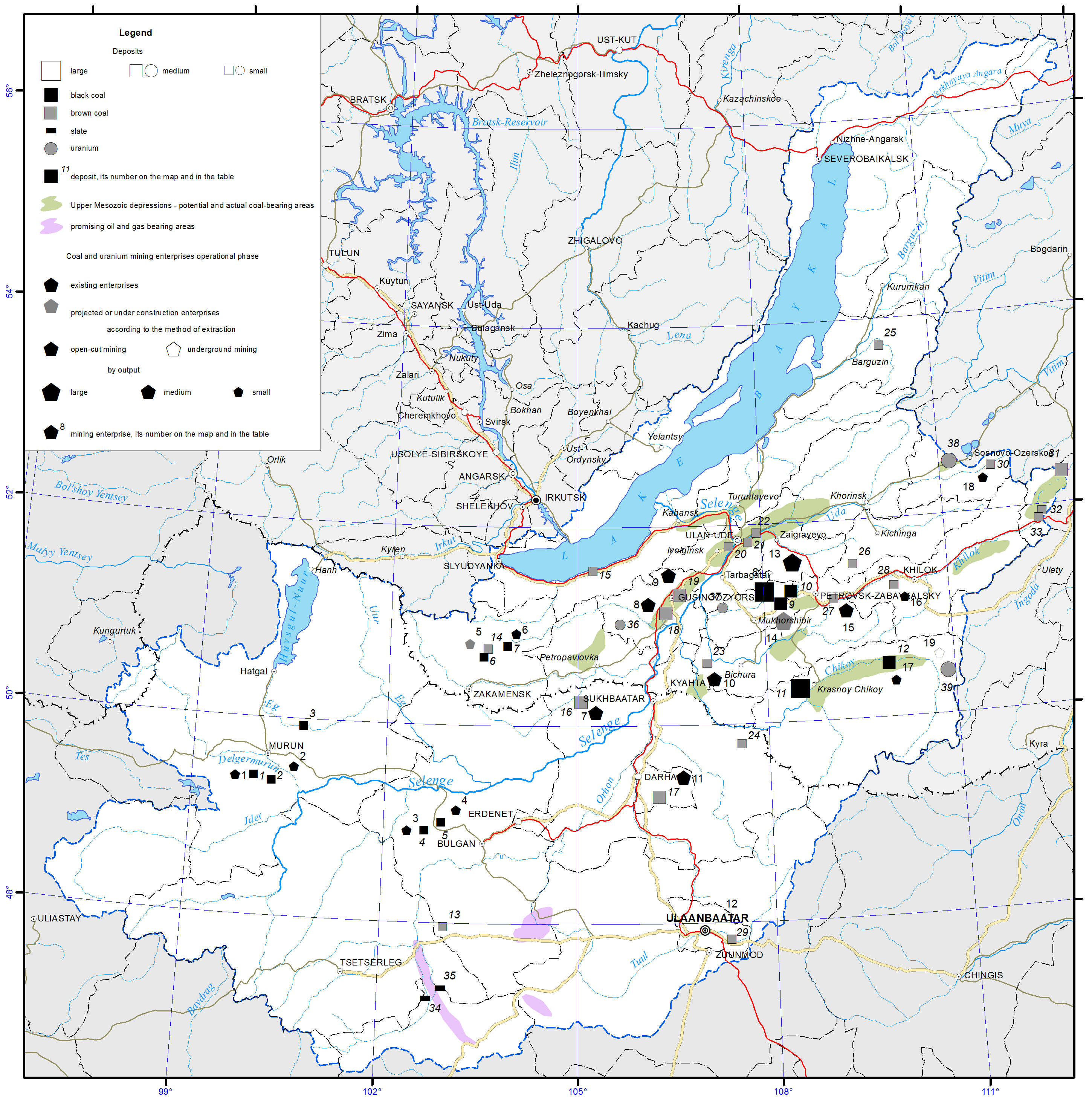
<p style="text-align: justify; ">In 2012, 5 deposits of brown coal and 3 deposits of bituminous coal were being exploited in the Republic of Buryatia (pic. 3.1.2).</p>
<p align="center"><img class="image-inline" src="../../../resolveuid/028be750d1bf43ceb6a949a5b353215b/@@images/image/preview" /></p>
<p align="center"><a href="http://bic.iwlearn.org/en/documents/photos/3.1.2e.png" class="internal-link">Open full size</a></p>
<p align="center">Pic. 3.1.2 Energy resources and their development [1]</p>
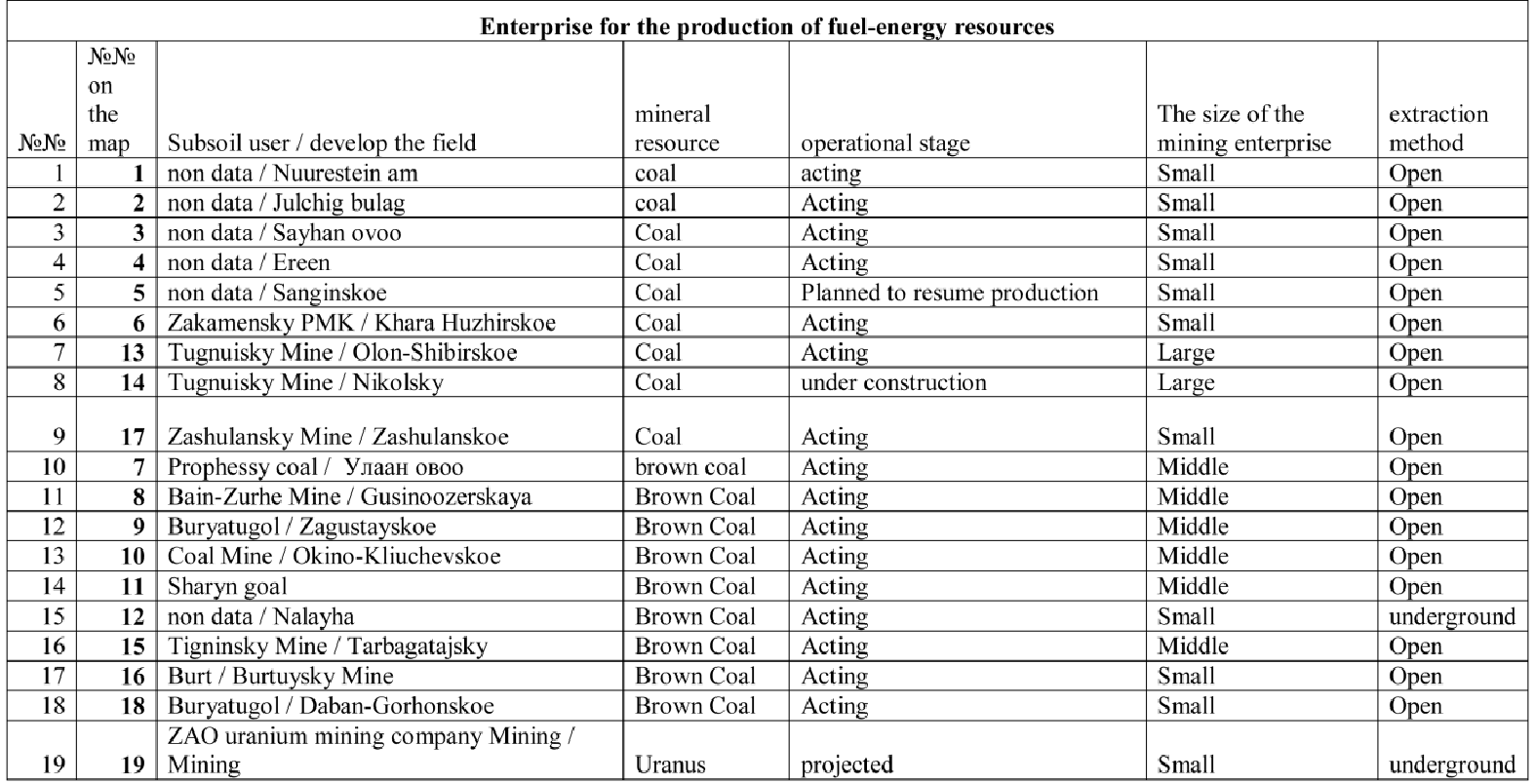
<p style="text-align: center; "><span>Legend to the pic. 3.1.2</span></p>
<p align="center"><span><img class="image-inline" src="../../../resolveuid/872a936bcc7747bb99a605a78ed5f3a7/@@images/image/preview" /></span></p>
<p align="center"><span><a href="http://bic.iwlearn.org/en/documents/photos/copy_of_3.1.2e.png" class="internal-link">Open full size</a></span></p>
<p style="text-align: justify; ">In 2012, the coal company «Bain-Zurkhe» extracted 932.1 thousand tons of coal, which was 146% of 2011 level. 1,150 thousand tons of coal were extracted in 2013.  The company «Coal razrez» extracted 1,200 (2.6 times more than in 2011) and 1,650 thousand tons in 2012 and 2013, respectively. The company «Buryat Coal» extracted 255.6 and 298.3 thousand tons in 2012 and 2013, respectively. The company «Tuguniskiy razrez» extracted 12.5 million tons of coal in 2012 [3,4].</p>
<p style="text-align: justify; ">The amount of extracted placer gold in 2012 was 1.35 tons, and in 2013 it was 1.56 tons, 15.6% more than in 2012. About 4.6 tons of lode gold were mined in 2012, 4.4 tons were mined in 2013. The biggest gold-mining enterprises in 2012 were «Buryat Gold Company» and the «Western gold-mining cooperative».</p>
<p style="text-align: justify; ">In Zakamensky district there are 4 tungsten deposits. Dzhida tungsten and molybdenum plant was exploiting Inkurskoe and Kholtosonkoe deposits on the right bank of the Dzhida river. After the closing down of the plant, there remained a tailing dump with the area of more than 1 km<sup>2</sup>, which is the anthropogenic Barun-Naryn deposit with the tungsten trioxide reserves of 21 thousand tons. From 2010 «Zakamensk» Company started the exploitation of this anthropogenic deposit, setting up new production sites, building a modern ore-processing factory, a hydrometallurgical unit for processing of tungsten concentrates [3].</p>
<p style="text-align: justify; ">In Zakamensky district there are also registered reserves of molybdenum of the Malo-Oynogorsky deposit. Zharchikhinskoe deposit of molybdenum ores (Tarbagataisky district) and Ermakovskoe deposit of fluorite-phenacite-bertrandite ores have been included in the state fund of distributed mineral reserves.</p>
<p style="text-align: justify; ">In 2012 and 2013, within the Republic of Buryatia several deposits of nonmetallic mineral resources were exploited, among which the major ones in terms of the production amount were Tatarskiy Kluch with 209 and 82 thousand tons, respectively, of limestone, Tarabukinskoe with 160 and 122 thousand tons, respectively, of dolomite (Zaigraevskiy district), Cheremshanskoe with 202 and 223 thousand tons, respectively, of quartzite (Pribaikalskiy district), Timluyskoe with 35 and 31 thousand tons, respectively, of cement clay loam, as well as Oshurkovskoe deposit of apatite ores (Ivolginskiy district) and Tarakanovskoe deposit with 602 thousand tons of limestone (Kabansky district). JSC “Khiagda” exploits the Khiagda ore field and extracts uranium in its pilot plant. In 2012, it extracted 331.7 tons of uranium, which was 124.5% of the level in 2011 (266.4 tons) [11,12]. In 2013, the company further increased the amount of extracted uranium to 440 tons, which was 33% more than in 2012 [13,14]. In total, the production output of the mining enterprises in the Republic of Buryatia was worth 13.8 billion rubles in 2012, which was 106.4% of 2011 value. In 2013, the production output was estimated at 13.4 billion rubles [5,6].</p>
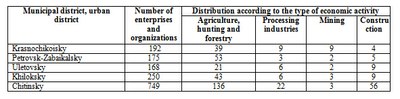
<p style="text-align: justify; ">The territory of Zabaikalsky Krai incorporates enterprises of different forms of property and types of economic activity (table 3.1.1) [6,7].</p>
<p style="text-align: justify; "><span>Table 3.1.1 Enterprises and organizations recorded in the statistic register according to the type of economic activity (as of January 1, 2013)</span></p>
<p style="text-align: center; "><span><img class="image-inline" src="../../../resolveuid/706f6e566943421a9a800a5bcbd124fe/@@images/image/preview" /></span></p>
<p style="text-align: center; "><span><a href="http://bic.iwlearn.org/en/documents/photos/copy6_of_1.jpg" class="internal-link">Open full size</a></span></p>
<p style="text-align: justify; ">The total output of the enterprises of Krasnochikoisky, Petrovsk-Zabaikalsky,  Uletovsky, Khiloksky and Chitinsky districts in such sectors as rock mining, processing industry, production and redistribution of energy, gas and water amounted to 26.2 billion rubles. The leader among the districts is Petrovsk-Zabaikalsky district with its share of 22.1 billion rubles.</p>
<p style="text-align: justify; ">In 2012, the enterprises of the Khilok river basin (Petrovsk-Zabaikalsky and Khiloksky districts) were entitled to 10 licenses for extraction of mineral resources, while the enterprises in the Chikoi river basin (Krasnochikoisky district) to 16 licenses. Petrovsk-Zabaikalsky district is rich in the bituminous and brown coal reserves. At «Tugnuiskiy Razrez», Oblon-Shibarkoe deposit 13 million tons of bituminous coal were mined in both 2012 and 2013, while at Tarbagataiskiy brown coal deposit of «Tugnuiskiy Razrez», 260 and 227 thousand tons of brown coal were mined in 2012 and 2013, respectively.</p>
<p style="text-align: justify; ">Krasnochikoisky district possesses 14 primarily small deposits of placer gold. Some enterprises, such as Khikotoi, Gutai, «Taiga» Ltd, Kunalei, Fedotovka, and Dauriya, extracted up to 200 kg of gold. Nonmetallic mineral deposits, located in Khiloksky district, include Kholinskoe deposit with the amount of extracted zeolite of 0.6 tons in 2012 and Zhipkhegenskoe with 380 thousand tons of granite per year.</p>
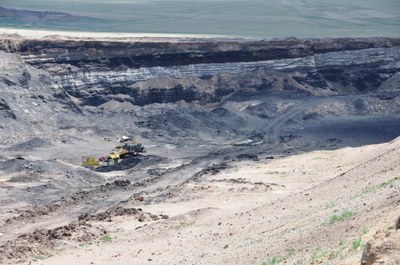
<p style="text-align: justify; ">Mining industry is the leading sector of <strong>Mongolia’s</strong> economy accounting for 22% of GDP, 94% of gross export value and 85% of foreign direct investment in 2012, according to figures from the National Statistics Office [9]. Mongolia’s main proven reserves include coal (pic. 3.1.2 and pic. 3.1.3), copper, hard-rock and placer gold, silver, iron, molybdenum, fluorspar, zinc, tungsten, lead, tin, uranium and rare earths.</p>
<p align="center"><img class="image-inline" src="../../../resolveuid/ac3c64d5a27a439ca5e2f5b933d7f705/@@images/image/preview" /></p>
<p align="center">Pic. 3.1.3 Coal cut brown coal in the area Tevshin Nuruu</p>
<p style="text-align: justify; ">In Khangai region, there are discovered and expected reserves of 15 types of mineral resources. There are 89 deposits of 9 types of mineral resources and other minerals are encountered is occurrences. Among the deposits, there are 46 gold, 22 phosphor and 15 coal deposits and mixed deposits of gold, silver, copper, iron, manganese, and fluorite.</p>
<p style="text-align: justify; ">As of 2013, 4.6% of working age people or 50.3 thousand people were officially employed in mining industry in Mongolia. Another 40 thousand people were illegally working in mining of coal, gold, tungsten, gravel, sands, gypsum, etc. Among the illegal miners, about 90% is working on exploitation of abandoned gold deposits. The illegal mining is prominent in Zaamar soum of Tuv aimag, Buregkhangai soum of Bulgan aimag and Tsenkher soum of Arkhangai aimag, all located in the Selenga river basin. The illegal mining has an adverse impact on the environment and, in recent years, rehabilitation of the lands has been underway.</p>
<p style="text-align: justify; ">During 1992-2005, the Government of Mongolia implemented Programme «Gold» aimed at developing gold mining industry. Between 1992 and 2005 the amount of extracted gold increased from 773.6 to 21,900 kg, i.e. more than 28.3 times (3.1.4).</p>
<p align="center"><img class="image-inline" src="../../../resolveuid/201bd890a7f1494a99bfda509da20087/@@images/image/preview" /></p>
<p align="center">Pic. 3.1.4 Industrial gold mining (Zamaar sum, Tuv aimag)</p>
<p style="text-align: justify; ">Boroo gold deposit is located in Mandal soum of Selenge aimag. In 1982-1990, a Mongolian and Eastern Germany joint geological expedition carried out a detailed exploration and estimated geological reserves of gold at 42.56 tons. In March 2004, an ore processing factory was put into operation with capacity of 1.8 million tons per year, and till 2013 the factory produced 1,628,000 ounces or 46.15 tons of gold. Boroo gold deposit is exploited by the Canadian mining company «Сеntеrra gold». The company has also received permission to exploit Gachuurt gold deposit located in Mandal soum of Selenge aimag. As of December 2010, the proven gold reserves of this deposit are 1.8 million ounces and prognostic reserves are 491,000 ounces. The exploitation of the deposit has not yet started.</p>
<p style="text-align: justify; ">The major metal ore deposits being exploited are the Tumurtologoi deposit in Tuvshruulekh soum of Arkhangai aimag («Beren» company), another Tumurtologoi deposit in Khongor soum of Darkhan-Uul aimag («Darkhan steel factory»), Bayangol iron deposit in Eruu soum of Selenge aimag («Boldtumur Eruu Gol» company), and the deposits Khust Uul and Tumurtei («Darkhan steel factory»). The main ore mineral of these deposits is skarn magnetite and content of iron in ore varies from 51.2 to 55.8%, while content of sulfur varies from 0.1 to 3.8%.</p>
<p style="text-align: justify; ">In Altanbulag soum of Tuv aimag, Darkhan soum of Darkhan-Uul aimag, Saikhan soum of Bylgan aimag, districts neighboring Ulaanbaatar (such as Khan-Uul), and along the rivers Tuul, Orkhon and Kharaa, citizens and organizations mine mineral materials such as sands, gravel and rocks, limestone, and gypsum. The activities, often unauthorized, have negative impact on the environment [15].</p>
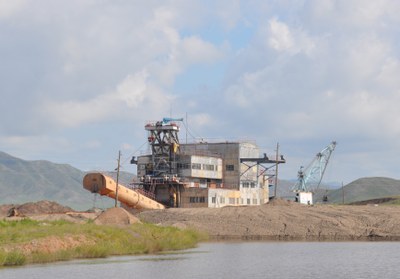
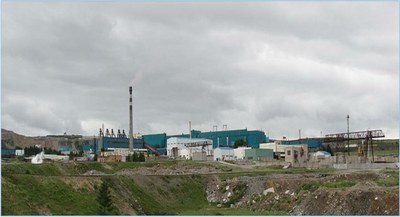
<p style="text-align: justify; ">Metallurgical enterprises of Mongolia are Darkhan steel factory built in 1994 year and Erdenet copper-molybdenum concentration factory (pic. 3.1.5). Darkhan steel processing factory has built a new concentration facility using dry magnet concentration method at the Tumurtei deposit.</p>
<p style="text-align: center; "><img class="image-inline" src="../../../resolveuid/eb569852667a4e42b0e45a5b1b2f918d/@@images/image/preview" /></p>
<p align="center"><i> </i></p>
<p align="center">Pic. 3.1.5   Erdenet ore-processing plant</p>
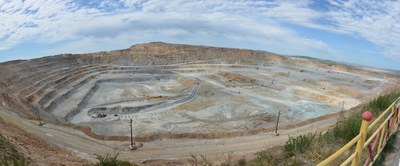
<p style="text-align: justify; ">A Mongolian-Russian joint venture, the ore-processing plant «Erdenet» started its operations in 1978. About 25 million tons of sulfide ore of complex mineralogical composition are processed per year yielding about 530 thousand tons of copper and 3 thousand tons of molybdenum concentrates (pic. 3.1.6) [2]. Enrichment tailings and pyrite concentrate are accumulated in the combined tailing ponds that, on one hand, pose a significant threat to the environment and, on the other hand, are a resource for extracting valuable components such as copper, iron, precious metals. The ore reserves of Erdenetiin-Ovoo deposit are 1,060,367 tons, copper and molybdenum reserves are estimated at 4.632 million tons and 125,414 tons, respectively. Explorations conducted recently have discovered new reserves of copper (3 million tons) and molybdenum (55 thousand tons).</p>
<p style="text-align: center; "><img class="image-inline" src="../../../resolveuid/a3ca80d031ef40faac33126d21ae49da/@@images/image/preview" /></p>
<p align="center">Pic. 3.1.6 The Erdenet open cast mine</p>
<p style="text-align: justify; ">Since 1997, «Erdmin» LLC produces cathode copper using tailings of the ore-processing plant «Erdenet». Over the years the company expanded the range of its products and now produces rolled copper and various types of copper wires.</p>]]></content:encoded>
    <dc:publisher>No publisher</dc:publisher>
    <dc:creator>Zorigma</dc:creator>
    <dc:rights></dc:rights>
    <dc:date>2015-04-24T01:15:10Z</dc:date>
    <dc:type>Page</dc:type>
  </item>


  <item rdf:about="http://bic.iwlearn.org/en/documents/state-of-the-environment-report-the-lake-baikal-basin-1/natural-conditions/2-4-animal-world">
    <title>2.4 Animal world</title>
    <link>http://bic.iwlearn.org/en/documents/state-of-the-environment-report-the-lake-baikal-basin-1/natural-conditions/2-4-animal-world</link>
    <description></description>
    <content:encoded xmlns:content="http://purl.org/rss/1.0/modules/content/"><![CDATA[<p align="center"><strong>2.4 Animal world</strong></p>
<p style="text-align: justify; ">A considerable number of natural landscapes in Lake Baikal basin determine a great diversity of animal species there. The region has 446 vertebrate species, including:</p>
<p style="text-align: justify; ">- 348 bird species of 18 orders (4% of the world avifauna);</p>
<p style="text-align: justify; ">- 85 mammal species of 7 orders (23% of the world theriofauna);</p>
<p style="text-align: justify; ">- 7 vermigrade species of one order (0.1%  reptiles of the world);</p>
<p style="text-align: justify; ">- 6 amphibian species of 2 orders [3,4,22].</p>
<p style="text-align: justify; ">Mongolian fauna consists of 138 species of mammals, 75 species of fish, 22 species of reptiles, 6 species of amphibians, 472 species of birds, 13 000 species of insects, 516 species of mollusks and protozoa [21].</p>
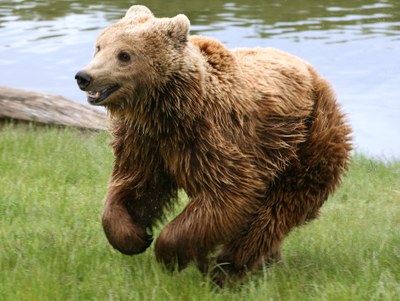
<p style="text-align: justify; ">On the Russian territory of the basin, <strong>brown bear </strong>(Ursus arctos)<strong> </strong>inhabits the coastal and northern districts, large forests, in particular, in Eastern Pribaikalie and the Khamar-Daban (pic. 2.4.1) [3,4]. Among different habitats it prefers cedar forests. The brown bear is dormant in winter, digging lairs on dry slopes with sandy and sabulous soil, sometimes under rocks. He starts hibernation in the latter half of October, usually before the first big snow and leaves the lair in April or May. The oestrum period is in June or July, cubs are born in January-February. The number of cubs is1-3, most commonly 2. It feeds on vegetation and animal food. In the years of poor harvest of berries and nuts, insomniac bears may wander around. The bears wander alone on an area of about 70-400 km<sup>2</sup>. The number of brown bears is growing at present – from 2690 animals in 2001 to 4878 in 2010.</p>
<p align="center"><img class="image-inline" src="../../../resolveuid/bf6a5e0417434c1dae6c320fc16c90e3/@@images/image/preview" /></p>
<p align="center">Pic. 2.4.1 The brown bear</p>
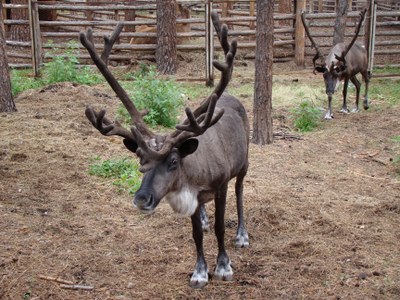
<p style="text-align: justify; ">By taxonomic parameters, <strong>the reindeer </strong>(Rangifer tarandus) inhabiting the Russian territory of the basin, is identified as Rangifer tarandus (pic. 2.4.2) [3,4]. Today, reindeers dwell in the disparate sections of mountain areas, including Ulan-Burgasy, Ikatsky, Barguzinsky, Severobaikalsky, Vitimsky and Muysky mountain ranges. Since the reindeer inhabits isolated and remote places, the assessment of the present-day number is based not only on the data of winter route tracking, experts emphasized gathering survey data from forest managers of natural protected territories and hunters. The number over the last five years was 16-19 thousand animals. The results of the winter route tracking in 2012 revealed the number of 18417 animals, which is in agreement with the assessment by forest managers and hunters.</p>
<p align="center"><img class="image-inline" src="../../../resolveuid/6f896c943aa647f9ba8234927031aac5/@@images/image/preview" /></p>
<p align="center">Pic. 2.4.2 The reindeer</p>
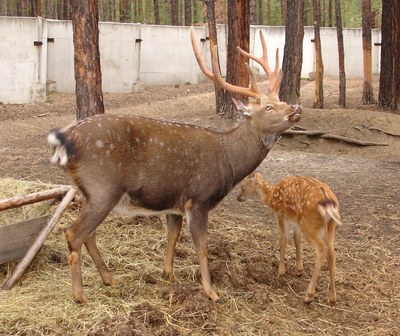
<p style="text-align: justify; "><strong>Red deer </strong>(Cervus elaphus xanthopygus)<strong> </strong>migrates seasonally from the zone of bald mountains to the foothills of mountain ranges, concentrating in the area of little snow with ample fodder reserves and minimal disturbing factors (pic. 2.4.3) [3,4].</p>
<p style="text-align: center; "><img class="image-inline" src="../../../resolveuid/826970ae7f8d4dd2822bd2418ea08ce1/@@images/image/preview" /></p>
<p align="center">Pic. 2.4.3 The red deer</p>
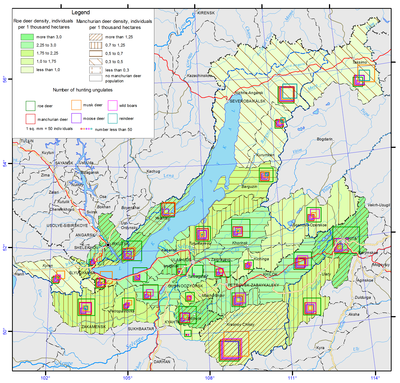
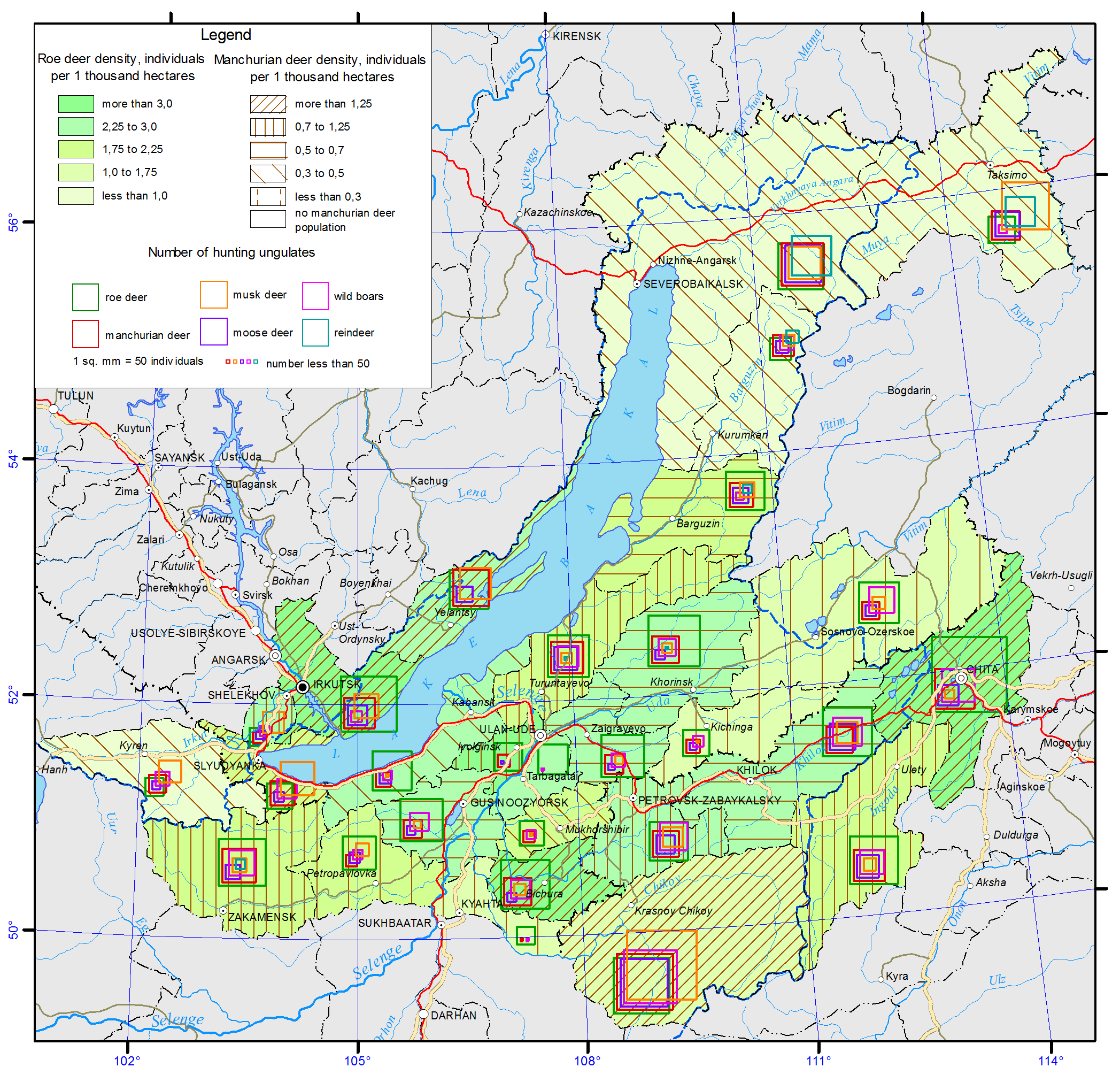
<p style="text-align: justify; ">According to the assessment of forest managers, the lengthy and high snow cover in the winter period of 2010-2012 caused forced migration of the red deer to the hitherto uncharacteristic areas of little snow, more favorable habitats (pic. 2.4.4). Thus, forced migration of the red deer led to the growth in number of intersections on the permanent routes, which impacted the winter route tracking assessment in 2011-2012 and made it difficult to assess the number of animals.</p>
<p align="center"><img class="image-inline" src="../../../resolveuid/87f07c5f632f4314899fadcdf7b0760e/@@images/image/preview" /></p>
<p align="center"><a href="http://bic.iwlearn.org/en/documents/photos/2.4.4e.png" class="internal-link">Open full size</a></p>
<p style="text-align: center; "><span>Pic. 2.4.4 Hunting resources [1]</span><span> </span></p>
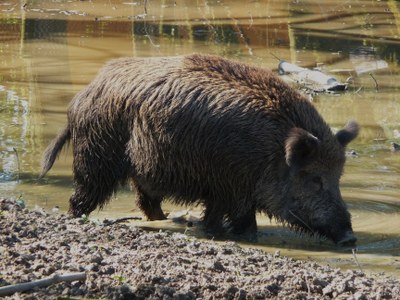
<p style="text-align: justify; "><strong>The bore </strong>(Sus scrofa)<strong> </strong>is widely spread on the Russian territory of the basin (pic. 2.4.5) [3,4]. The distribution areal of the bore has been influenced by agricultural practices. The poorly harvested crops in some areas produced a good fodder basis for the bore and allowed it proliferate in the hitherto less available places. In the dynamics of the last ten years the number of bores rose from 4 to 8 thousand animals. At present, the number tends to grow and according to the 2012 data the number of bores is estimated at 8508.</p>
<p align="center"><img class="image-inline" src="../../../resolveuid/1c77c4526d2b4fdca713be0495cac8e8/@@images/image/preview" /></p>
<p align="center">Pic. 2.4.5 The bore</p>
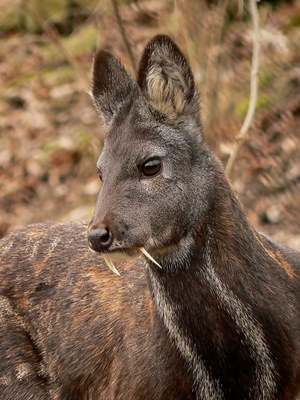
<p style="text-align: justify; "><strong>Musk deer </strong>(Moschus moschiferus)<strong> </strong>was listed by the International Union for Conservation of Nature (2003) as an «endangered» species due to the considerable amount of international trade in products derived from it (pic. 2.4.6) [3,4]. Considering these circumstances, the counting of musk deer is conducted based on the methods adapted to the biological peculiarities of this animal. According to the winter route tracking of 2012, the number of musk deer was 16.4 thousand animals, which is higher than the average long-term number over the last ten years. These data suggest stability in the number of animals, even though the musk deer population is affected by forest cutting and frequent forest fires.</p>
<p style="text-align: justify; ">In Mongolia found in Khentii, Khuvsgul, and Khangai mountain ranges, some mountain forests in the southern part of Mongol Altai.</p>
<p align="center"><img class="image-inline" src="../../../resolveuid/065b10e71d4b4a6aa1794e09785ed460/@@images/image/preview" /></p>
<p align="center">Pic. 2.4.6 The musk deer</p>
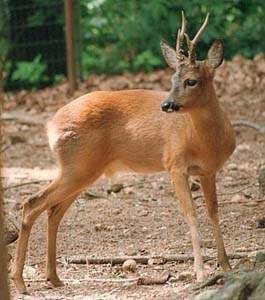
<p style="text-align: justify; "><strong>Siberian roe deer </strong>(Capreolus pugargus)<strong> </strong>is the most widely spread animal among large mammals in Buryatia (pic. 2.4.7). The area of distribution covers the whole territory of the Russian part of the basin. In spring, following the boundary of snow melting roe deer migrate from valleys to mountains and elevated wetlands, which serve them as protection, providing less sources of disturbance and simultaneously a good fodder basis and ample water sources [3,4].  Thus, watershed ranges provide home not only to the roe deer, but also all the hoofed animals. In autumn, starting from the end of August, roe deer migrate to their winter habitats in small groups of 2-4. Migration is usually started by females with calves born in the year, while males migrate later on. The period of autumn migration is usually from September to December, and spring migration is from March to May. According to the assessment of 2012, the number of roe deer was 42873 animals.</p>
<p align="center"><img class="image-inline" src="../../../resolveuid/be09e1f9234643358bbd40e5ddea97a1/@@images/image/preview" /></p>
<p align="center">Pic. 2.4.7 The Siberian roe deer</p>
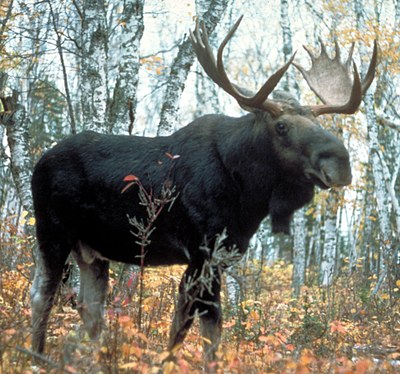
<p style="text-align: justify; ">The territory of the basin is the habitat of one of the four biggest mammals in the country – East Siberian <strong>elk </strong>(Alces alces) (pic. 2.4.8). Seasonal migrations of the elk are determined by the availability of fodder [3,4]. The habitat of elk is usually dominated by young coniferous forests, pine, larch, aspen trees and elks particularly tend to dwell in burnt-out places, in the thickets of low-height birch, shrubs, meadows and river valleys. In summer, life of the elk is closely related with lakes and rivers. In addition to the availability of fodder, the areal distribution of elk is also determined by snow cover and anthropogenic impact. The number of animals over the last ten years varies from 6 to 8.5 thousand animals, which has to do with the above mentioned biotic and abiotic factors. According to 2012 assessment, the number of elks in the republic was 7851 animals. Widespread in northern Mongolia</p>
<p align="center"><img class="image-inline" src="../../../resolveuid/a7d97e62efd645a8a2175759de319198/@@images/image/preview" /></p>
<p align="center">Pic. 2.4.8 The elk</p>
<p style="text-align: justify; ">The territory of the basin is home to <strong>squirrel </strong>(Sciurus vulgaris), which inhabits mountain larch forests of Dahurian larch as well as cedar, pine and larch-pine forests (pic. 2.4.9). The dynamics of squirrel number over the five years varies within 145-170 thousand animals [3,4]. According to the data of the winter route tracking in 2012, the number of squirrels was estimated at 161.6 thousand animals. The number tends to fluctuate in cycles depending on solar activity and the fodder productivity.</p>
<p align="center"><img class="image-inline" src="../../../resolveuid/3c3c69b0e5d144debd22752f896cf4a6/@@images/image/preview" /></p>
<p align="center">Pic. 2.4.9 The squirrel</p>
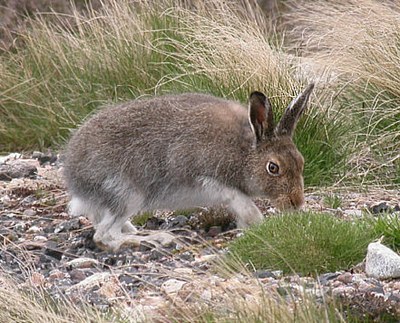
<p style="text-align: justify; ">Dynamics in the number of <strong>mountain hare</strong> has a cyclic character with the decade-long growth cycles (pic. 2.4.10). The major causes influencing the reproduction of the species are climatic conditions in spring-summer period, having to do with the birth of the young and their first days of life [3,4]. The dynamics of the species within the last ten years vary within 37 to 95 thousand animals. According to the assessment of 2012, the number of mountain hare showed a decreasing trend and was estimated at 43.5 thousand animals, which is higher than the figure for 2011, yet lower than for the previous 5years.</p>
<p align="center"><img class="image-inline" src="../../../resolveuid/ef74f560bd774f559baf46e15be6b014/@@images/image/preview" /></p>
<p align="center">Pic. 2.4.10 The mountain hare</p>
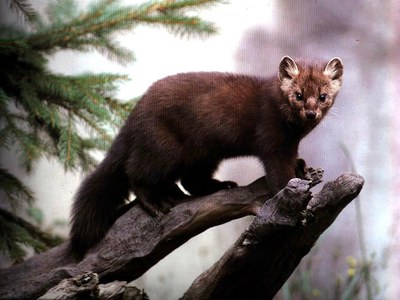
<p style="text-align: justify; ">The habitat of <strong>sable </strong>(Martes zibellina) on the territory of the basin is cedar forests on the stony soil, cedar elfin wood, old burned places with coniferous and deciduous trees, larch-fir and pine-cedar forests with stony deposits (pic. 2.4.11). The number of sable over the last ten years has varied considerably across years. According to the assessment of 2012, the number of animals was 22.5 thousand, which is about the same for the preceding year [3,4]. In the winter period, both in 2011 and 2012, there were no signs of considerable vertical migrations of sable. Considering the ten-year dynamics, the number of sable in 2012 remained above the average level.</p>
<p align="center"><img class="image-inline" src="../../../resolveuid/016253a7cda44885b1ce6ff4dfdf92d5/@@images/image/preview" /></p>
<p align="center">Pic. 2.4.11 The sable</p>
<p style="text-align: justify; "><strong>Ermine </strong>(Mustela erminea) inhabits mountain-taiga, forest-steppe biotopes, on stony deposits. Forest cutting is advantageous for the ermine [3,4]. However, it has been clearly identified that in dark coniferous forests and pure cedar forests ermine is rarely observed. It is virtually not to be found in the area with the high concentration of sable. Within the last ten years, the number of sable has varied from 9 to 15 thousand animals which is typical for fur-bearing animals. According to the 2012 assessment, the number of ermine is estimated at around 10 thousand animals, which is higher than their number in the previous 2 years.</p>
<p style="text-align: justify; "><strong>Siberian weasel </strong>(Mustela sibirica) is widely spread [3,4]. In taiga, forest-steppe and mountainous areas it can be observed in the river valleys, brooks, stony deposits, overgrowing burned places, river banks and shores of lakes and shrubs. It can be seldom found in dark coniferous forests and mixed taiga, as its main competitor here is the sable. It does not dwell on barren mountains and dry steppes. According to the state monitoring, the number of Siberian weasel was 7310 in 2012, which is above the level for the previous four years. There is no specifically organized hunting of the weasel, as the reproduction of weasel runs in parallel with the reproduction of other animals.</p>
<p style="text-align: justify; "><strong>Fox</strong> (Vulpes vulpes)<strong> </strong>is spread across the whole territory of the basin, however, the distribution is uneven [3,4]. During the ten years preceding 2012, the number of foxes has risen, particularly in the last three years, reaching 5290 animals in 2012. The amount of production through hunting also varies from 100 to 800 animals, which is explained by the high demand for the fur on the market and price politics. Due to shrinking demand and low purchasing cost for the fur over the last four years, the amount of production dropped and averaged at no more than 200 animals per year.</p>
<p style="text-align: justify; "><strong>The wolf </strong>(Canis lupus) is widely distributed, inhabiting all the districts of the basin. In the course of many years, the state authorities of the Buryat Republic have taken measures to regulate the population of wolves [3,4]. On average, the amount of production was 300-400 animals annually during 1995-2005. In 2006-2007, the amount dropped to110-140 animals. In most cases, guns are used for hunting. According to the assessments, the number of wolves was 2517 animals at the beginning of 2012, which testifies to the efficiency of regulation measures. At the same time, some further regulation measures are required, considering frequent migrations of wolf packs from the neighboring regions and Mongolia, to reduce possible damage to agriculture and hunting grounds.</p>
<p style="text-align: justify; ">The state of<strong> lynx</strong> (Felis lunx) habitat in the region can be considered satisfactory [3,4]. The most typical landscape habitats include mountains, pine and larch forest-steppe, pure and mixed forests, lowlands on the slopes of hills, sometimes intersected by cut or burned area, where young aspen and birch trees grow. During the last ten years, the number was stable and varied from 630 to 1300 animals. In 2012, the number of lynx was estimated at 1258, which was higher than for the previous year but about the same as during the preceding six years.</p>
<p style="text-align: justify; ">The distribution area of <strong>Siberian marmot </strong>(Marmota sibirica) on the Russian part of the basin is 32.3 thousand ha [3,4]. There are around 20-30 thousand marmots. The number of animals may vary. Spring counting of 2012 was conducted on the territory of steppe and forest-steppe districts of the republic, where the number of marmot was estimated at 20166.</p>
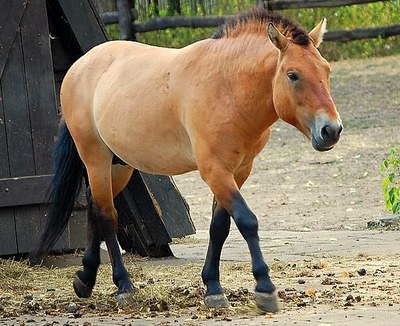
<p style="text-align: justify; ">Wild <strong>Przewalski's horse</strong><strong> </strong>(Equus ferus przewalskii)  that inhabits semidesert steppe and steppe. Found in Hustai mountain range located in Altanbulag soum of Tuv aimag (pic. 2.4.12) [23].</p>
<p align="center"><img class="image-inline" src="../../../resolveuid/1f896fc7833a40b9a9580a83972baa92/@@images/image/preview" /></p>
<p align="center">Pic. 2.4.12 The Przewalski's horse</p>
<p style="text-align: justify; ">Birds are the most diverse group of fauna on the Russian part of the basin [3,4]. Of 348 species, 260 are breeding birds, 34 are birds of passage, 7 wintering, 1 is flying and 46 are vagrant.</p>
<p style="text-align: justify; "><strong>Grouse </strong>as a typical forest bird, leading a secluded way of life and spending most of the time, especially in summer, on land. In the period of collecting gastorolites, when the birds come to the sand bars and roads, grouse is rarely found. The number of grouse in the republic is recovering now after the forest fires of 2003-2004 and was estimated at 150.5 thousand in 2012. The winter period of 2012 was good for the grouse and it did not affect the number and reproduction conditions of the bird.</p>
<p style="text-align: justify; ">According to the assessment of 2011, the number of <strong>black grouse</strong> reached 311.8 thousand [3]. According to the state monitoring data, there were 252.7 thousand animals in 2012, which is comparable to the level of 2009-2010 and can be considered as the most plausible estimation. The analysis revealed that black grouse hunting is of little significance in the republic and the bird is hunted simultaneously during hunting for other animals. Overall, thanks to the favorable conditions during the last five years, the number of black grouse rose significantly.</p>
<p style="text-align: justify; "><strong>Hazel grouse </strong>is a typical forest bird leading a secluded way of life and spending most of the time on the land. The number of the bird is subject to cyclic fluctuations. Based on the assessments of 2004, 2006 and 2008, the number of hazel grouse has been on the decline and was estimated to be one thousand birds. According to the same assessment, the number of hazel grouse rose in 2009-2012. Hazel grouse hunting is not practiced, it is concurrently done while hunting fur-bearing animals. The exception is hunting with the use of the call.</p>
<p style="text-align: justify; "><strong>Dahurian partridge </strong>is sedentary species making short-distance and non-regular migratory trips [3]. The number of partridge has been declining during the last 3 years after reaching its maximum in 2009. According to the state monitoring of 2012, the number of Dahurian partridge was 78.4 thousand. The number has been about the same during the last 15 years.</p>
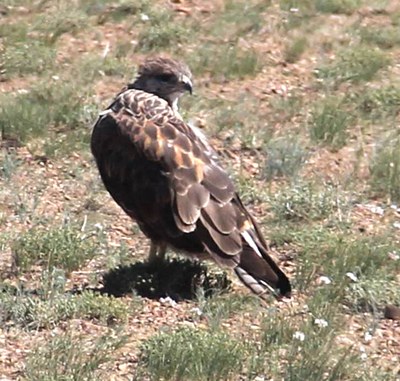
<p style="text-align: justify; "><strong>Short-toed snake-eagle</strong> <em>(</em><em>Circaetus gallicus</em><em>). </em>Found in the west-south part of Khentii mountains during reproduction period. Generally inhabits Selenga river valley. During summer and laying of eggs, mostly found in Umnugobi aimag, Gobi desert (pic. 2.4.13) [23].</p>
<p style="text-align: center; "><img class="image-inline" src="../../../resolveuid/8308919053ef481ba47208ed1b431edc/@@images/image/preview" /></p>
<p align="center">Pic. 2.4.13 The short-toed snake-eagle</p>
<p style="text-align: justify; "><strong>Greater spotted eagle</strong> <em>(</em><em>Aguila clanga</em><em>).</em><i> </i>A scarce summer visitor and passage migrant, presumably breeding in the taiga and/or forest-steppe of northern Mongolia. Was recorded in Khentii mountains and taiga or forest-steppe area along the Selenga river, in Zavhan, Bulgan, Arkhangai and Tuv aimags [23].<i> </i><strong> </strong></p>
<p style="text-align: justify; "><strong>Pallas's Sea</strong><strong>(fish)</strong><strong>-Eagle</strong> <em>(</em>Haliaeetus leucoryphus<em>) </em>Found along banks of rivers and lakes. Have been spotted near the lakes Khuvsgul, Achit, Khar Us, Khar, Dorgon, Hyargas and Uvs, and the basins of the rivers Zavkhan, Kharaa, Tuul, and Orkhon [23].</p>
<p style="text-align: justify; "> </p>
<p style="text-align: justify; "><strong>Bibliography</strong></p>
<ol style="text-align: justify; ">
<li>Ecological atlas of the Lake Baikal basin – Irkutsk: Institute of Geography SB RAS. 2014. <a href="http://bic.iwlearn.org/en/ru/atlas/atlas">http://bic.iwlearn.org/ru/atlas/atlas</a></li>
<li>Garmaev E.Z., Khristoforov A.V. Water resources of the rivers within Lake Baikla basin: basis for their use and protection. Novosibirsk: “Geo” Academic Publishing, 2010. 231 pp. </li>
<li>State report “On the state of Lake Baikal and measures for its conservation in 2012” - Irkutsk. Siberian branch of “Rosgeolfond”, 2013. - pp. 436. <a href="http://www.mnr.gov.ru/regulatory/list.php?part=1258">http://www.mnr.gov.ru/regulatory/list.php?part=1258</a> (in Russian)</li>
<li>State report “On the state of Lake Baikal and measures for its conservation in 2013” - Irkutsk. Siberian branch of “Rosgeolfond”,  2014. - pp. 462. <a href="http://www.mnr.gov.ru/regulatory/list.php?part=1258">http://www.mnr.gov.ru/regulatory/list.php?part=1258</a> (in Russian)</li>
<li>Tulokhonov A.K., Plyusnin A.M., Namsaraev B.B. et al. The Selenga river delta – the natural filter and indicator of the state of Lake Baikal. Novosibirsk: SB RAS Publishing, 2008. 314 pp. </li>
<li>State report “On the state of the environment and its proptection in the Republic of Buryataia in 2012”. <a href="http://minpriroda-rb.ru/upload/iblock/9cb/frmoytmrq2013.pdf">http://minpriroda-rb.ru/upload/iblock/9cb/frmoytmrq2013.pdf</a> (in Russian) </li>
<li>State report “On the state of the environment and its proptection in the Republic of Buryataia in 2013”. <a href="http://minpriroda-rb.ru/upload/iblock/26b/gocdoclad_2013.pdf">http://minpriroda-rb.ru/upload/iblock/26b/gocdoclad_2013.pdf</a> (in Russian)</li>
<li>MEGD, «Strengthening Integrated Water Resource Management in Mongolia» project,  «Integrated Water Management Assessment Report, Volume I», <a href="http://www.tuulgol.mn/dmdocuments/reports/national_report_volume1_english.pdf">http://www.tuulgol.mn/dmdocuments/reports/national_report_volume1_english.pdf</a></li>
<li>Water resource of Mongolia <a href="http://www.travelnews.mn/index.php?songolt=content&amp;task=content_item&amp;id=833&amp;menu_id=579">http://www.travelnews.mn/index.php?songolt=content&amp;task=content_item&amp;id=833&amp;menu_id=579</a><span style="text-decoration: underline;"></span></li>
</ol>
<p style="text-align: justify; ">10.  MEGD, «Strengthening Integrated Water Resource Management in Mongolia» project, “Tuul River Basin integrated water resources management assessment report”, UB city 2012, <a href="http://www.tuulgol.mn/dmdocuments/reports/tuul_r_b_report_english.pdf">http://www.tuulgol.mn/dmdocuments/reports/tuul_r_b_report_english.pdf</a></p>
<p style="text-align: justify; ">11.  «Mongolian water forum-ushelts» NGO, «Baseline study on Socio-economic and ecological conditions of Ider river basin», UB city 2013<span style="text-decoration: underline;"></span></p>
<p style="text-align: justify; ">12.  «Mongolian water forum-ushelts» NGO, «Baseline study on Socio-economic and ecological conditions of Khuvsgul lake-Eg river basin», UB city 2013.<a href="http://baikal.iwlearn.org/en/project/project-tender-reports-2012/010-eg-sub-basin-watershed-management-plan-mongolia">http://baikal.iwlearn.org/en/project/project-tender-reports-2012/010-eg-sub-basin-watershed-management-plan-mongolia</a><span style="text-decoration: underline;"></span></p>
<p style="text-align: justify; ">13.  Performance report on the convention on wetlands of international importance,especially as water fowl habitator RAMSAR convention, 2012.<span style="text-decoration: underline;"></span></p>
<p style="text-align: justify; ">14.  The Institute of Geography of Mongolian Academy of Science, the National Atlas of Mongolia, 2009<span style="text-decoration: underline;"></span></p>
<p style="text-align: justify; ">15. Mongolian Law on Soil Protection and Desertification Prevention, 2012.05.17, <a href="http://www.legalinfo.mn/law/details/8664?lawid=8664">http://www.legalinfo.mn/law/details/8664?lawid=8664</a></p>
<p style="text-align: justify; ">16. The Environmental Information Center, Desertification database, <a href="http://www.eic.mn/DLDbase/">http://www.eic.mn/DLDbase/</a>, <a href="http://www.eic.mn/DLDbase/upload/2013/tadesertcontent/jpg/20131021_8432.jpg">eic.mn/DLDbase/upload/2013/tadesertcontent/jpg/20131021_8432.jpg</a></p>
<p style="text-align: justify; ">17.  Mongolian Law on Natural Vegetation, 1995.04.11, <a href="http://www.legalinfo.mn/law/details/76?lawid=76">http://www.legalinfo.mn/law/details/76?lawid=76</a><span style="text-decoration: underline;"></span></p>
<p style="text-align: justify; ">18.  Plant and Forest Conservation, <a href="https://mn.wikipedia.org/wiki/%D0%A3%D1%80%D0%B3%D0%B0%D0%BC%D0%B0%D0%BB_%D0%BE%D0%B9_%D1%85%D0%B0%D0%BC%D0%B3%D0%B0%D0%B0%D0%BB%D0%B0%D0%BB">https://mn.wikipedia.org/wiki/Ургамал_ой_хамгаалал</a><span style="text-decoration: underline;"></span></p>
<p style="text-align: justify; ">19.  National Statistical Office of Mongolia, «Mongolian Statistical Yearbook», UB city, 2013<span style="text-decoration: underline;"></span></p>
<p style="text-align: justify; ">20.  MEGD, Mongolian Red book, UB city 2014<span style="text-decoration: underline;"></span></p>
<p style="text-align: justify; ">21.  Red book of the Republic of Buryatia. Rare and endangered species of animals, plants and fungi. - 3rd edition, revised and enlarged. Ulan-Ude, BSC SB RAS Publishing house, 2013, 687 pp.<span style="text-decoration: underline;"></span></p>
<p style="text-align: justify; ">22.  The National Program for endangered animals and rare animals, Appendix of the resolution № 277 of the Government in 2011, <a href="http://www.legalinfo.mn/annex/details/2927?lawid=5500">legalinfo.mn/annex/details/2927?lawid=5500</a></p>
<p style="text-align: justify; "><a href="http://www.legalinfo.mn/annex/details/2927?lawid=5500"></a><span>23. Voloshin A.L. Geoekologicheskie osobennosti sovremennykh ekzogennykh rel’efoobrazuyushchikh protsessov mezhgornykh kotlovin Selenginskogo srednegor’ya. Avtoreferat diss. Na soiskanie uchenoi stepeni kandidata geograficheskikh nauk. – Ulan-Ude. – 2011. [The Geoecological Peculiarities of Contemporary Exogeneous Landscape Forming Processes of Intermontane Hollows of the Selenga Mid-Mountains]</span></p>]]></content:encoded>
    <dc:publisher>No publisher</dc:publisher>
    <dc:creator>Zorigma</dc:creator>
    <dc:rights></dc:rights>
    <dc:date>2015-04-23T09:18:42Z</dc:date>
    <dc:type>Page</dc:type>
  </item>


  <item rdf:about="http://bic.iwlearn.org/en/documents/state-of-the-environment-report-the-lake-baikal-basin-1/natural-conditions/2-3-vegetation">
    <title>2.3 Vegetation</title>
    <link>http://bic.iwlearn.org/en/documents/state-of-the-environment-report-the-lake-baikal-basin-1/natural-conditions/2-3-vegetation</link>
    <description></description>
    <content:encoded xmlns:content="http://purl.org/rss/1.0/modules/content/"><![CDATA[<p align="center"><strong>2.3 Vegetation</strong></p>
<p style="text-align: justify; ">The territory of Lake Baikal basin is part of the forest-steppe and forest taiga zone [3,4]. However, a considerable degree of territorial disintegration and the presence of intermountain depressions determined vertical zonality in the distribution of the vegetation cover. Within the area of the basin the following belts are distinguished: steppe, forest-steppe, mountain-steppe, goltsy-forest with cedar shrubs and goltsy belt.</p>
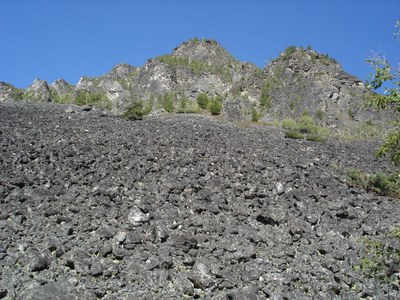
<p style="text-align: justify; "><strong>Goltsy belt </strong>stands out clearly on the ranges of Baikal mountain chain. The height of the lower level of the belt varies from 1100—1500 m in the north to1600—2000 m in the south. The goltsy belt is dominated by high mountain and wilderness landscapes. Vegetation of high mountain wilderness is represented by sparse low heather grass and lichen as well low heather shrubs.  A characteristic feature of the goltsy belt is wide distribution of stone placers without vegetation (pic. 2.3.1). Comparatively small areas embrace portions of mountain tundra with shrub-lichen and small shrub-lichen vegetation. Barguzinsky range is abundant in the areas with mountainous sub-Alpine meadows (in the lower part of goltsy range). They do not constitute considerable land mass but alternate with the sections of mountain rocks and cedar forests, being located on the bottom of kar and in the upper part of trough valleys. Mountain meadows are characterized with dense and high grass (up to 40-60 cm) consisting of aquilegia, anemone and other species. Among sub-Alpine meadows one can observe portions of sedge-sphagnum and sedge wetlands.</p>
<p align="center"><img class="image-inline" src="../../../resolveuid/8514b787fbc44bccb1671fe1b05a2ef8/@@images/image/preview" /></p>
<p align="center">Pic. 2.3.1 Goltsy belt of vegetation, Barguzinsky range</p>
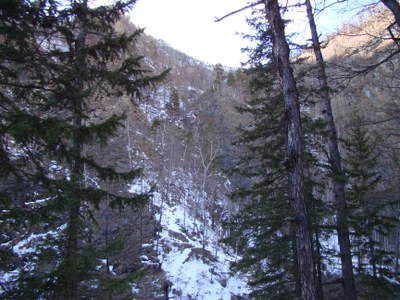
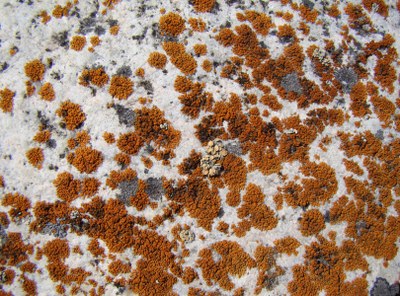
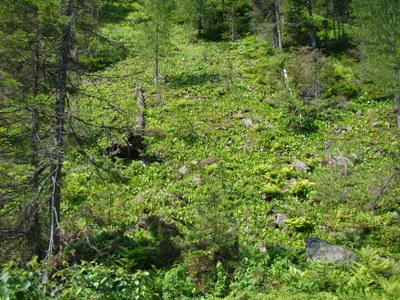
<p style="text-align: justify; "><strong>Belt of goltsy forest and cedar shrubs </strong>is found above mountain taiga at the elevation of 1000-1500 m in the north and 1500-2000 m in the south. It takes comparatively small territory on the mountain ranges having flattened contours and flat tops, rising above the upper boundary of the forest. The mountain slopes are covered by cedar forests with a height from 0.5 to 2 m and goltsy sparse forest on the flattened sides. The latter is a sparse and depressed larch and cedar-larch forest with cedar shrubs, dwarf birch and other shrubs (pic. 2.3.2). The soil cover is dominated by lichen and occasionally moss (pic. 2.3.3). In some areas, where considerable and stable inversions of air temperature are observed, goltsy forests are found within the mountain-taiga belt (on the northern slopes of mountains, facing narrow shadowed valleys, on river and lake terraces.</p>
<p align="center"><img class="image-inline" src="../../../resolveuid/388e56173adc4b06ac04b524132a1a9c/@@images/image/preview" /></p>
<p align="center">Pic. 2.3.2 Belt of goltsy forest and cedar shrubs on the Khamar-Daban range</p>
<p align="center"><img class="image-inline" src="../../../resolveuid/6624575e8fe74af2a18e37f25626b2a0/@@images/image/preview" /></p>
<p align="center"><strong> </strong></p>
<p align="center">Pic. 2.3.3 Lichens on the Barguzinsky range</p>
<p style="text-align: justify; "><strong>Mountain taiga </strong>is the most widespread landscape on the considered territory [3,4]. It takes up to about 70% of the Russian part of Lake Baikal basin and constitutes a bulk of its vegetation cover. The mountain taiga is mainly comprised by coniferous trees – Dahurian and Siberian larch as well as pine, cedar and in rare instances silver-fir and fir-tree. Of deciduous trees the most widespread species are birch and aspen. Depending on the latitudinal position of the place, the mountain-taiga belt occupies different altitudinal position. In the north, in the Verkhnyaya Angara basin, taiga is situated at an elevation of 460-600 to 1000-1500 m, and in the south at an elevation of 1000-1400 to 1500-1800 m. Along the coast of Lake Baikal, the lower boundary of taiga runs till the edge of water. The altitudinal position of the upper boundary of taiga depends on the exposition of mountain slopes. On the western slope of Barguzin range, facing Lake Baikal, the upper boundary of the forest is located at an elevation of 900-1400 m and on the better warmed eastern slope rises to 1400-1800 m.</p>
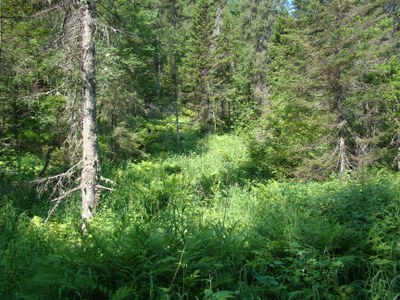
<p style="text-align: justify; ">Mountain-taiga zone is divided into three altitude belts, corresponding to the southern, middle and northern taiga. Southern taiga is located to the south of 52° N below 1100-1200 m. It includes sparse larch-pine and pine forests with addition of birch. The underbrush is sparse and is dominated by dahurian rhododendron and spiraea. The soil cover incorporates shrubs and grass (pic. 2.3.4). Middle taiga is most widely spread. The major kind of tree is larch, other important species include pine, cedar and birch. In some portions, especially on the slopes of hills facing Lake Baikal, aspen, silver fir and fir can be found. The stand of trees is rather sparse, the underbrush is well developed and includes dwarf birch and dahurian rhododendron. The soil cover includes dense shrubs of red bilberry, blueberry and foxberry. Moss can also be found but it does not form a continuous cover.</p>
<p align="center"><img class="image-inline" src="../../../resolveuid/2b76d0850f8d4150a02ee2fb8b790e45/@@images/image/preview" /></p>
<p align="center">Pic. 2.3.4 The mountain taiga, the Khamar-Daban range</p>
<p style="text-align: justify; ">The composition of tree stand and underbrush changes depending on the slope exposition. Northern slopes have sections with depressed tree stand and dense underbrush of alder and cedar with a continuous moss cover. On the southern slopes, the tree stand is always better, pine tree is widespread, grass and shrubs are dominant in the soil cover. The belt of northern taiga is characterized by sparse and depressed tree stand, consisting of larch with the mixture of cedar. The underbrush always has cedar and dwarf birch trees as well as small-leaf rhododendron and alder. The grass and shrub layer includes wild rosemary, blueberry, red bilberry and sedge. The soil cover is dominated by moss while flat water-divide mountain tops have sphagnum. Forests in the mountain taiga zone protect soils from being washed away during snow melting and summer rain floods. Taiga protects soil from wind erosion, exerting a great impact on the conditions of snow cover formation. On the abrupt slopes, taiga reduces the risk of avalanches taking place.</p>
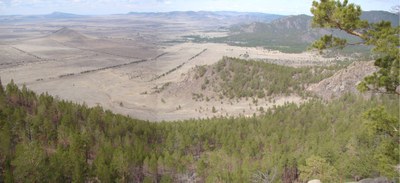
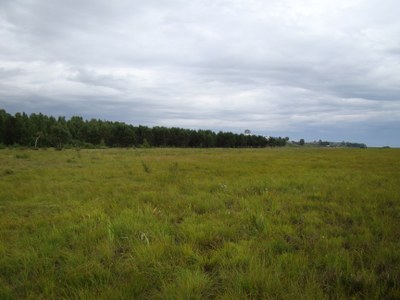
<p style="text-align: justify; "><strong>Forest-steppe areas </strong>are usually bounded by the places with steppe vegetation (pic. 2.3.5). Baikal forest and steppe zone is commonly characterized by the alternation of steppe sections, lying on the southern slopes of mountains, with the deforested sections on the northern slopes [3,4]. The forest and steppe zone does not form a continuous belt and consists of disparate portions separated by mountain-steppe and mountain-taiga vegetation clusters. The sections of forest-steppe vegetation are located at an elevation of 900-1200 m. Forests of this belt are primarily sparse and are made up of pine, larch and birch; the underbrush is weakly developed or is gone. Steppe and forest-steppe areas are widely used in agriculture as plough lands, hay-making ground and pastures.</p>
<p style="text-align: center; "><img class="image-inline" src="../../../resolveuid/ada54acc7a11437288308b9aa253e65a/@@images/image/preview" /></p>
<p align="center">Pic. 2.3.5 The forest-steppe, Valley of Tugnui River</p>
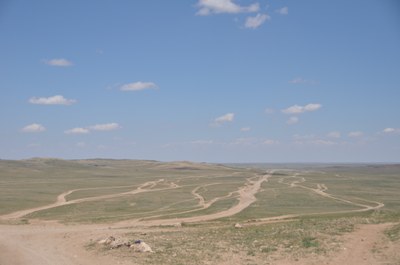
<p style="text-align: justify; "><strong>Steppes </strong>do not form a continuous landmass but incorporate separate sections, related with tectonic depressions and river valleys [3,4]. Two groups of formations are clearly distinguished – steppes of mountains and steppes of foothills, elevated plains and hummocky topography. In each of them one can distinguish two large ecological-morphological groups – meadow and dry steppes. For each of such groups one can distinguish separate regional steppe complexes – South Siberian, North Mongolian and Central Asian formations (pic. 2.3.6).</p>
<p align="center"><img class="image-inline" src="../../../resolveuid/0537afe111cb42dbb57dc9023ab9b724/@@images/image/preview" /></p>
<p align="center">Pic. 2.3.6 The North Mongolian steppe</p>
<p style="text-align: justify; ">The upper border of the steppe does not rise above 900-1100 m. Dry steppes with hazel soils are characterized by the presence of low plants (average height is from 10-15 to 25-35 cm) and sparse density (with the project cover of 60-70%). Black humus soils have steppes with different herbs characterized by denser and higher grass level. Steppe plants have well developed root systems reaching the depths from 10 to 70 cm. Vegetation groups are quite diverse. Of gramineous plants, the most widely spread plants are mat-grass, cleistogenes, sheep fescue, meadow grass, and june grass [4,18]. Of wild grasses, widely present ones are tansy, potentilla, oxytrope, astragal, sedge, wormwood, pea shrub, etc. Saline soils typically have jiji grass and flag-leaf as well as salt grass and saltwort (pic. 2.3.7).</p>
<p align="center"><img class="image-inline" src="../../../resolveuid/dd1b0ac1ea8f412db4518e4b4f3a90cd/@@images/image/preview" /></p>
<p align="center">Pic. 2.3.7 The area of salinity in the Mongolian steppe</p>
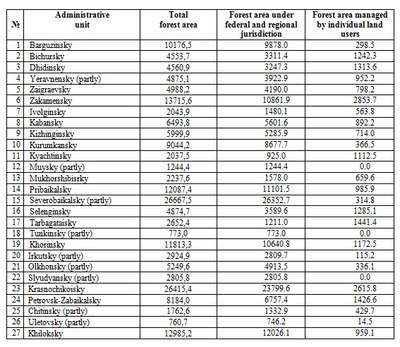
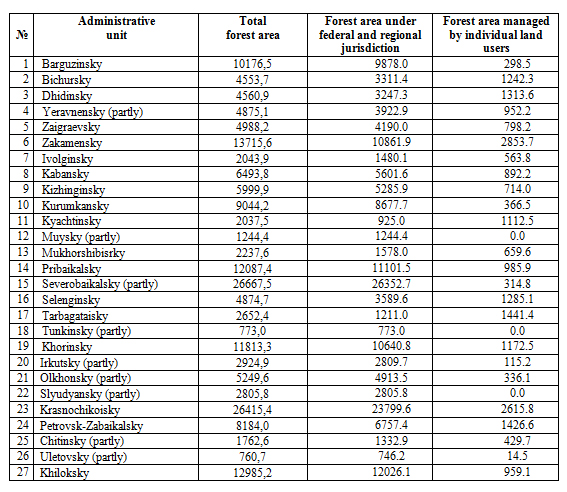
<p><strong>Forests. </strong>The total area of forested land within the Russian part of the Lake Baikal basin is 191982.5 km<sup>2</sup>, of which 169118.7 km<sup>2</sup> is under the jurisdiction of the federal government and 22863.9 km<sup>2</sup> is managed by individual land users (data of the digital topographic basis of BINM SB RAS) (табл. 2.3.1).</p>
<p style="text-align: center; ">Table 2.3.1 Forest area within the Russian part of the Lake Baikal basin by administrative districts, km<sup>2</sup></p>
<p style="text-align: center; "><img class="image-inline" src="../../../resolveuid/eacf6c6930814a25a62f91747ed42639/@@images/image/preview" /></p>
<p style="text-align: center; "><a href="http://bic.iwlearn.org/en/documents/photos/copy5_of_1.jpg" class="internal-link">Open full size</a></p>
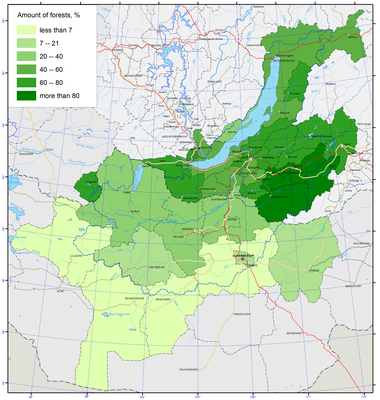
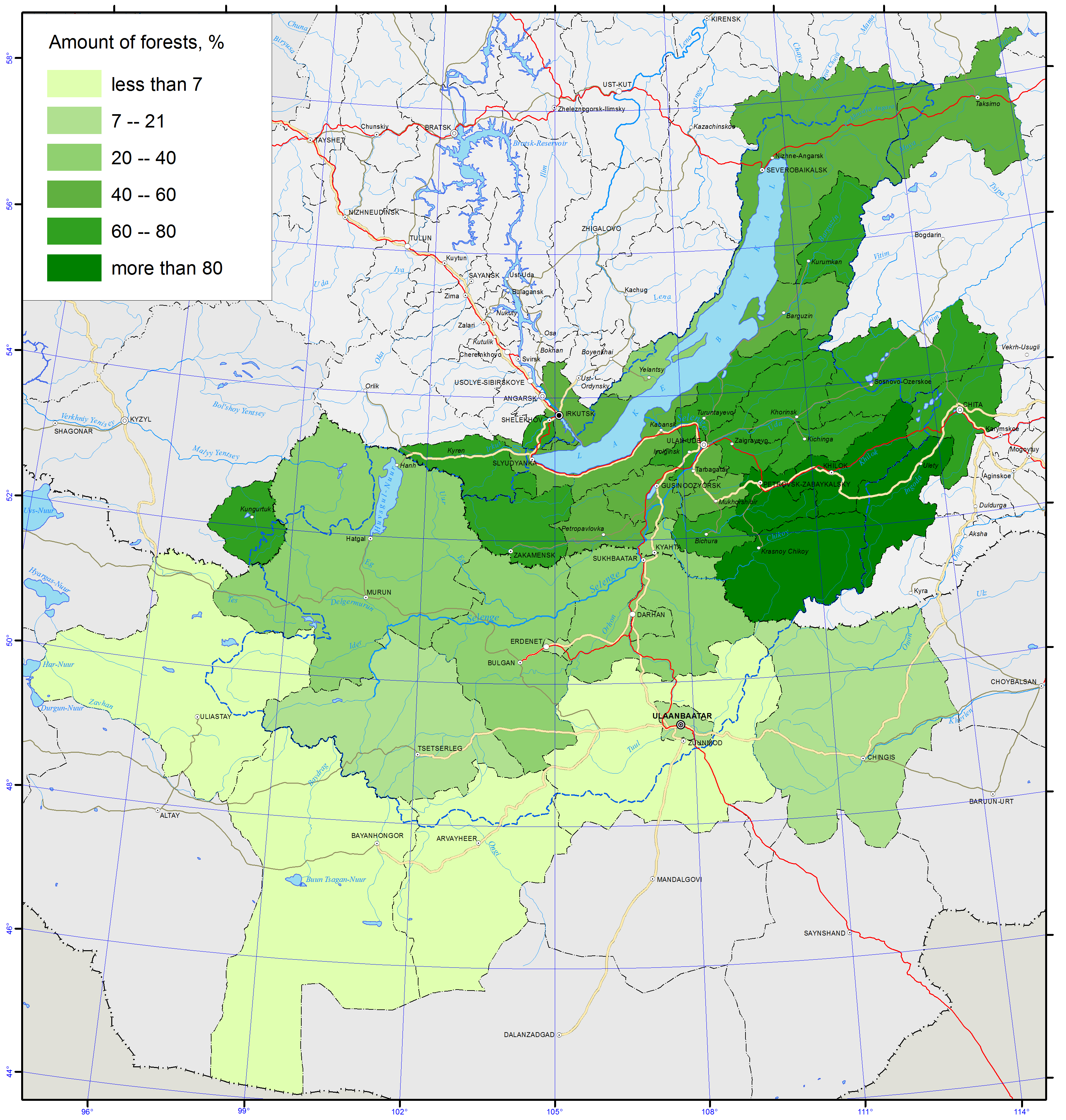
<p style="text-align: justify; ">The total area of lands covered by forests in the Republic of Buryatia, including forest fund lands and other land categories, was 29638.4 thousand ha or 84.4 % of the total land area as of 01.01.2013 (pic. 2.3.8) [4,7].</p>
<p align="center" style="padding-left: 30px; "><img class="image-inline" src="../../../resolveuid/c4801ca818f84563aa768175202f7391/@@images/image/preview" /></p>
<p align="center" style="padding-left: 30px; "><a href="http://bic.iwlearn.org/en/documents/photos/2.3.8e.png" class="internal-link">Open full size</a></p>
<p align="center">Pic.  2.3.8 Amount of forests of Lake Baikal basin [1]</p>
<p style="text-align: justify; ">The Republic Forest Agency is responsible for supervising the forests of the forest fund with the total area of 27010.3 thousand ha or 91.1% of the entire forest lands in Buryatia. In terms of use, forests are divided into 3 major categories: protected forests occupying 9308.1 thousand ha, exploited forests occupying 9436.4 thousand ha, and reserve forests occupying 8265.8 thousand ha.</p>
<p style="text-align: justify; ">Forests, not included in the forest fund, are the forests located on lands of other categories: forests located on the specially protected natural territories affiliated with the Ministry of natural resources and ecology of the Russian Federation – 2065.1 thousand ha (7% of all forests); forests, not included in the forest fund of the republic, are represented by the lands within human settlements with a total area of 29.6 thousand ha (0.1% of the forests), lands of other categories (lands of the water fund, land occupied by industries, reserve lands) with a total area of 85.1 thousand ha (0.3% of all forests) [7].</p>
<p style="text-align: justify; "><strong>Mongolia’s</strong> forests are located in the transitional zone between the great Siberian taiga and the Mongolian plateau of grassland steppe (pic. 2.3.9). These forests play a critical role in preventing soil erosion and land degradation, in regulating the water regime in mountain areas, maintaining permafrost distribution, providing habitats for wildlife and preserving biodiversity. Even though Mongolia is a country with limited forest resources, there are more than 140 species of trees and shrubs and forests cover 12.9 million ha, which is about 8.2% of the total area of the country (pic. 2.3.8). According to the Law on Forestry approved in 2012, the lands already covered by forest and required for forest extension are determined as the forest fund [18,19].<span> </span></p>
<p style="text-align: center; "><img class="image-inline" src="../../../resolveuid/924754bd8dcf4ae0b3cd37c2719c7928/@@images/image/preview" /></p>
<p align="center">Pic. 2.3.9 The coniferous forest in Mongolia</p>
<p style="text-align: justify; ">Forests are classified as strictly protected forests, protected forests, and utilization forests (pic. 2.3.10). Utilization forests are designated primarily for commercial timber harvest with contracts and the payment of fees required. The strict zone forest consists of sub-alpine forests, pristine and conservation zone forests within strictly protected areas, and special zone forests within national conservation parks.</p>
<p style="text-align: justify; ">The protected zone category is much broader, consisting of four sub-zones including certain forests within specially protected areas - national conservation parks, nature reserves, and monuments - as well as green zones around towns and villages, prohibited strips along riparian zones, national roads, and railways, and locally protected forests (pic. 2.3.10). Locally protected forests may consist of areas containing different forest types, including saxaul forests, oases, forest stands covering up to 100 hectares, forest groves, shrubs, sun-exposed forest areas, and forests on slopes steeper than 30 degrees.</p>
<p align="center"><img class="image-inline" src="../../../resolveuid/67caef23a00e4c6396d453feb5b59296/@@images/image/preview" /></p>
<p align="center">Pic. 2.3.10 The locally protected forest</p>
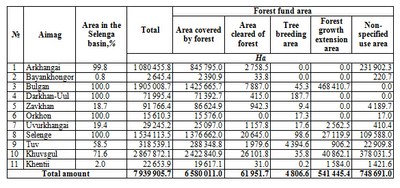
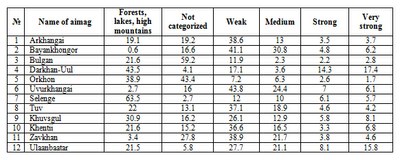
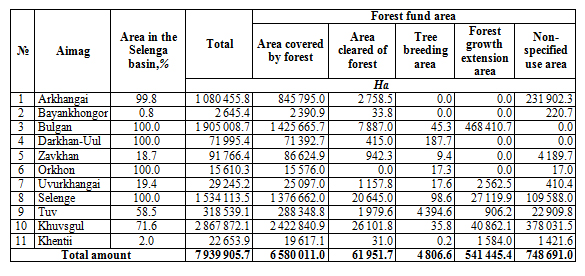
<p style="text-align: justify; ">By 2012, the total area occupied by Mongolian forest fund was 18 592.4 thousand ha, of which 12 552.9 thousand ha were covered by forests. 75.4% of the total forest fund area is covered by coniferous and deciduous forests (pic. 2.3.11) and 24.6% by saxaul forests. 15.3 million ha of the forest fund area is the protected forest zone, and 10.8 million ha of this zone are covered by coniferous and deciduous forests and 4.5 million ha by saxaul forests. Every year the Government Implementation Agency reports the total forest fund area by administrative regions based on information from Geodesy and Cartography Agency and National Statistics Committee (table 2.3.2) [18,19,20].</p>
<p align="center"><img class="image-inline" src="../../../resolveuid/6d2932976c63459fb325a0bdbd54f8b7/@@images/image/preview" /></p>
<p align="center">Pic. 2.3.11 The forest on Lake Khuvsgul</p>
<p style="text-align: center; ">Table 2.3.2 Forest fund area in aimags within the Selenga river basin (2013)</p>
<p style="text-align: center; "><img class="image-inline" src="../../../resolveuid/87a6386a8bd24609857de96cdfdfc97d/@@images/image/preview" /></p>
<p style="text-align: center; "><a href="http://bic.iwlearn.org/en/documents/photos/copy7_of_2.jpg" class="internal-link">Open full size</a></p>
<p><span> </span></p>
<p style="text-align: justify; ">The Selenga River basin in the northern part of Mongolia is covered by mixed forests (pine, larch, and cedar) and grassy plants (pic. 2.3.13). During the summer of 2013, Ministry of Environment and Green Development conducted a research expedition to catalogue endangered and beneficial plants. The expedition covered 17 aimags and various natural zones - forest steppe, steppe, and semi-desert steppe. The researchers have found and recorded 188 species of beneficial and 70 species of endangered plants growing in Khovd, Gobi-Altai, Uvurkhangai, Bayankhongor and Umnugobi aimags and 54 species endangered plants in Selenge, Orkhon, Bulgan, Arkhangai, Zavkhan and Tuv aimags. Among all these endangered plants, 23 were found and recorded in Khangai region.</p>
<p style="text-align: justify; ">According to the Mongolian vegetation list, there are more than 2 800 plant species in the country [19]. Among them, 382 species of plants can be used for food and drug manufacturing (pic. 2.3.12), 195 species of them need to be protected. Researchers have presented a list of 102 plants that have commercial value and recommended the ways the plants could be used. Ten species, such as licorice, ephedra, etc., are liable to illegal plant trade, eight more species were added into Mongolian endangered plant list, and 37 species require to be further inspected.</p>
<p align="center"><img class="image-inline" src="../../../resolveuid/229dd903c8314a65bcf190df08fa53ba/@@images/image/preview" /></p>
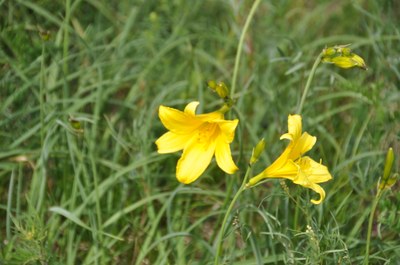
<p align="center">Pic. 2.3.12 Hemerocallis minor, the upper river Tuul</p>
<p style="text-align: justify; ">In Mongolia, there are 75 endangered species of medicinal plants, 20 species of which are on the brink of extinction [21]. Furthermore, in danger of extinction there are 11 species of food plants, 6 species of which are on the brink of extinction; 16 species of technical plants; and 55 species of ornamental plants, 5 species of which are on the brink of extinction.</p>]]></content:encoded>
    <dc:publisher>No publisher</dc:publisher>
    <dc:creator>Zorigma</dc:creator>
    <dc:rights></dc:rights>
    <dc:date>2015-04-23T08:58:47Z</dc:date>
    <dc:type>Page</dc:type>
  </item>


  <item rdf:about="http://bic.iwlearn.org/en/documents/state-of-the-environment-report-the-lake-baikal-basin-1/natural-conditions/2-2-soils">
    <title>2.2 Soils</title>
    <link>http://bic.iwlearn.org/en/documents/state-of-the-environment-report-the-lake-baikal-basin-1/natural-conditions/2-2-soils</link>
    <description></description>
    <content:encoded xmlns:content="http://purl.org/rss/1.0/modules/content/"><![CDATA[<p align="center"><strong>2.2 </strong><strong>Soils</strong><strong> </strong></p>
<p style="text-align: justify; ">The great distance of the Lake basin from south to north determines latitudinal changes of the thermal factor and the related soil and vegetation cover. In addition to these main regularities, there is also the influence of exposition, meridional and mountain zonality. Of great significance is the role of permafrost, heterogeneity of soil-forming rocks, complex evolution of landscapes in the past and their transformation as a result of anthropogenic impact. The prevalence of mountain relief led to the domination in the region of East-Siberian mountain-taiga landscapes. A considerable part of the territory is covered with mountain taiga, while portions of grassland landscapes, associated with intermountain depressions, run far into the northern regions.</p>
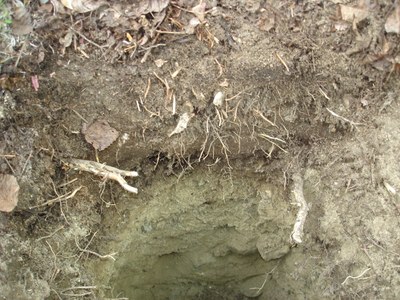
<p style="text-align: justify; ">Lake Baikal basin is characterized with two types of soil: soils of mountain territories and soils of intermountain depressions [3,4]. Soils of mountain territories are thin and formed as a rule on eluvium and eluvium-deluvium of intrusive mountain rocks and to a lesser extent – on eluvium and eluvium-delivium of effusive, sediment and metamorphic rocks. Soils of intermountain depressions are formed on different loose sediments, on sandy and clay layers (pic. 2.2.1).</p>
<p align="center"><img class="image-inline" src="../../../resolveuid/9d5272b382954d4990a8cea93e752331/@@images/image/preview" /></p>
<p align="center">Fig. 2.2.1 Soil profile in the Valley of Verkhnyaya Angara River</p>
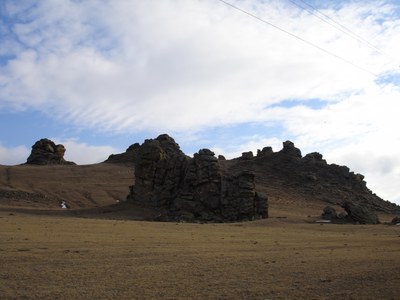
<p style="text-align: justify; ">In the north of the territory, the upper part of the taiga belt is dominated by mountain permafrost soils containing iron, among which there are certain types with the signs of gleization. The latter manifest themselves most clearly on the sites with a more powerful (5-8 сm) organic horizon in form of a condensed and constantly wet layer of lichen and moss. In the zone of bald mountains, soils are widespread on the sites of fine earth. The places covered with large-block stony deposits and outcrops of solid rocks and do not have soils (pic. 2.2.2).</p>
<p align="center"><img class="image-inline" src="../../../resolveuid/9bfc78108fac4ac680ea6b18bc0cf67c/@@images/image/preview" /></p>
<p align="center">Pic. 2.2.2 Stone deposits and rock outcrops</p>
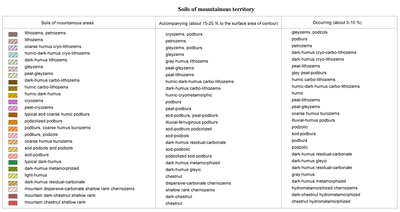
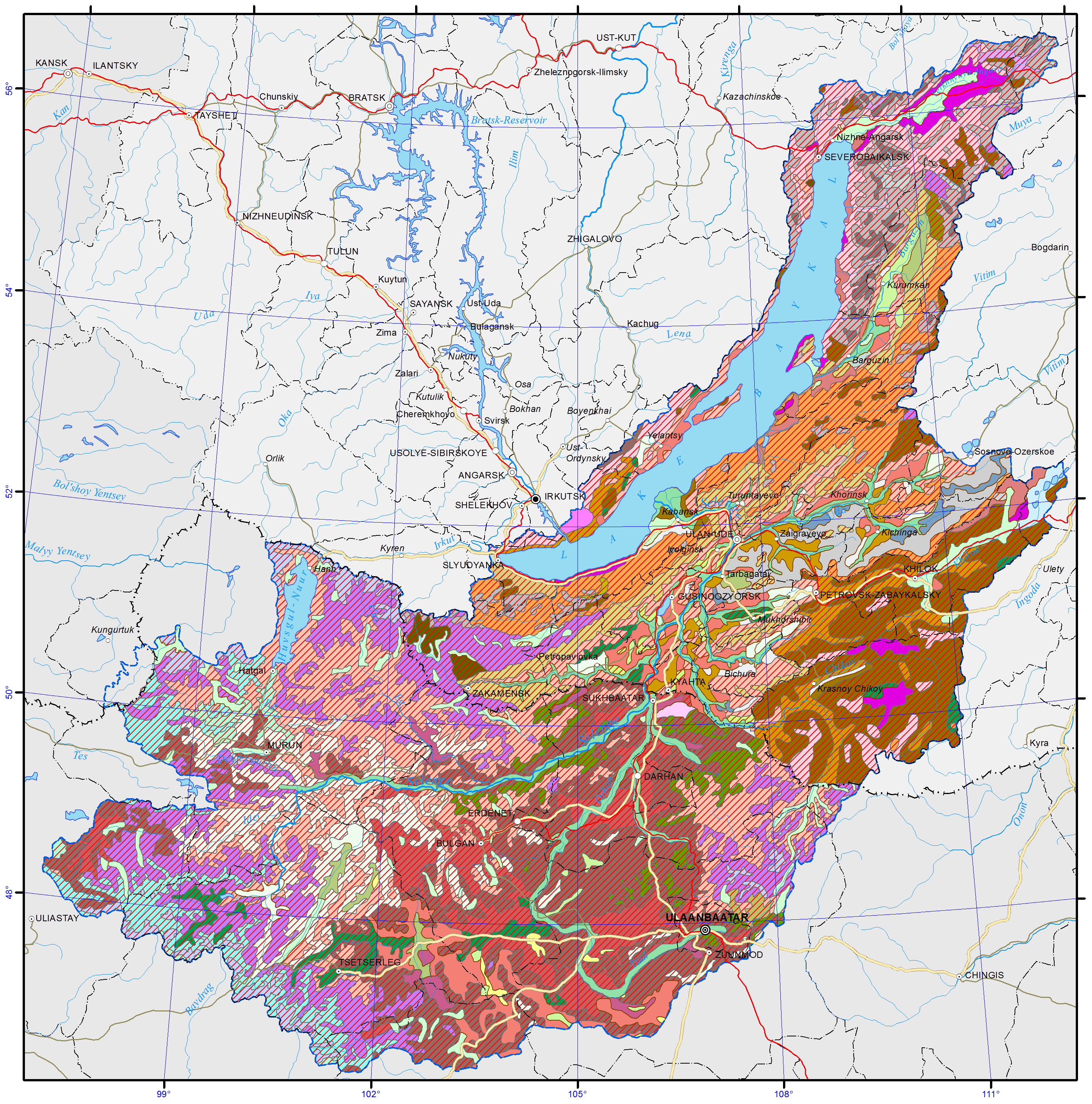
<p style="text-align: justify; ">Verkhneanagrskaya depression and mountains are dominated by bleach alluvium-ferriferous soils, while the slopes of mountains are dominated by permafrost-taiga soils. The latter are characterized with slight differentiation of soil profile and high concentration of mobile form of iron and shape on loose sediments of small thickness. The major property, uniting all the types of soils in the northern part of the basin, is their cryolithic character (pic. 2.2.3-a,b,c).</p>
<p style="text-align: center; "><img class="image-inline" src="../../../resolveuid/b580a338f3594bf68819faba059a2393/@@images/image/preview" /></p>
<p style="text-align: center; "><a href="http://bic.iwlearn.org/en/documents/photos/2.2.3e.png" class="internal-link">Open full size</a></p>
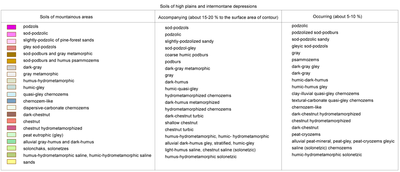
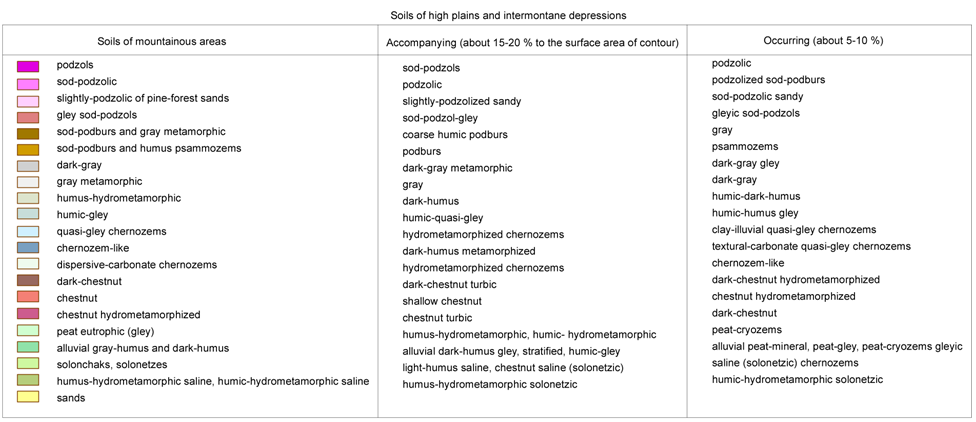
<p align="center">Pic. 2.2.3  Soils of Lake Baikal basin [1]</p>
<p align="center"><span>(Legend to the pic. 2.2.3)</span></p>
<p align="center"><span> <img class="image-inline" src="../../../resolveuid/1ee0584281cc4615a6e54b343a559ab5/@@images/image/preview" /></span></p>
<p align="center"><span><a href="http://bic.iwlearn.org/en/documents/photos/1.2.2.3e.png" class="internal-link">Open full size</a></span></p>
<p align="center"><span><img class="image-inline" src="../../../resolveuid/45fa37294a6d4a709a344557ffb30433/@@images/image/preview" /></span></p>
<p align="center"><span><a href="http://bic.iwlearn.org/en/documents/photos/2.2.2.3e.png" class="internal-link">Open full size</a></span></p>
<p style="text-align: justify; ">The area showing the simultaneous features of continuous and intermittent permafrost, embrace more than 90% of land resources. The geocryological feature of the territory is the correlation between permafrost and the lowering of relief. Soils in the bottoms of valleys and depressions have a lower temperature and the permafrost has the greatest thickness. Permafrost meadow-chernozem soils occupy flat or slightly sloping valleys on deluvium clay and sandy areas and ancient lake sands. Permafrost-taiga soils and ash gray soil are shaped at the elevation from 1000 to 1300 m. The most fertile are permafrost meadow-chernozem soils which yield the highest amount of harvest. These soils are characterized with a high concentration of humus and nitrogen as well as average concentration of sodium. Out of permafrost soils, the least productivity is observed on permafrost grey forest soils. Of intermediary importance are permafrost meadow soils.</p>
<p style="text-align: justify; ">The permafrost is related with other cryosolic processes and phenomena such as frost mold, thermokarst, soilfluction, polygon form of relief and ice [3,4]. Frost molds are associated mainly with the powerful layer of loose sediment. Seasonal frost molds are shaped in January and February on the sites of permanent springs, while their height can be 3 m and their diameter - 20-50 m. Thermokarst processes are well developed on the west shore of Lake Baikal, in the Barguzin river valley and at some portions of trough valleys. Thermokarst manifests itself through the formation of thermokarst lakes, swampy lowlands and funnels. The size of thermokarst depressions varies from 10-20 to 150-200 m. The high-mountain belt has well-developed forms of soilfluction: overmoistened melted soil float up from the places free of vegetation. Not infrequently soilfluction covers entire blocks of mountain rocks, sometimes with big trees. In the medium mountains area this phenomenon is slightly manifested and is observed mainly on the northern slopes.</p>
<p style="text-align: justify; ">The area of mountain taiga incorporates soils with eluvium-illuvium and non-differentiated profiles (pic. 2.2.4). Baikal range and Severobaikalsky uplands are dominated by ashen-grey and podzolized brown soils with the admixture of peat-brown soils. They are characterized with small thickness of profile, which in the layers of ashen-grey soil can be 30 cm, and in the mountains of Baikal region is about 40 cm. The thickness of brown soils, which can be seen as being at the incipient stage of soil-formation, is even smaller.</p>
<p align="center" class="normalnavy"><img class="image-inline" src="../../../resolveuid/5f1766645aca4b639b0288ec5cba1fac/@@images/image/preview" /></p>
<p align="center" class="normalnavy">Pic. 2.2.4 The mountain taiga</p>
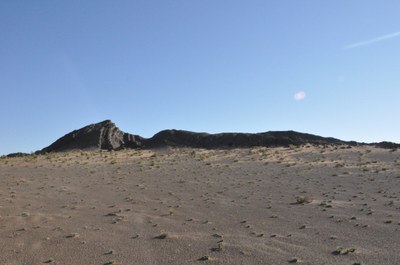
<p style="text-align: justify; ">The soils of piedmont dry grasslands of Baikal region are widespread on Olkhon Island, the adjacent area and in the southern part of the basin (pic. 2.2.5). The formation of dry steppe landscapes with chestnut soils is related with arid mountain zonality. Lack of precipitation is exacerbated by high water permeability of loamy soils. Low bio-productivity is a consequence of the extreme natural-climatic conditions. Agroecosystems are in the state of crisis here while the vegetation cover degrades.</p>
<p align="center" class="normalnavy"><img class="image-inline" src="../../../resolveuid/7eb179da824b45e2887577a323f33a9a/@@images/image/preview" /></p>
<p align="center" class="normalnavy">Pic. 2.2.5 The dry grasslands</p>
<p style="text-align: justify; ">The high-mountain part of the Khamar-Daban, Muysky, Verkhneangarsky and Barguzinsky ranges the main types of soil are petrozems, peat-lithozem. Hard-humus, humic and humic-dark humus soils are formed underneath sub-Alpine meadows. Brown gley soils are formed on the northern slopes in relatively lowered parts of relief and the sections composed of soil-forming elements of heavier granulometric composition.</p>
<p style="text-align: justify; ">Kryozems (hard humus), peat-kryozems are well-developed in the zone of bald mountains, being located in a comparatively narrow strip close to the upper margin of the forest. Soils of taiga area have frequently zones of permafrost as well as seasonal permafrost, kryoturbation phenomena and soilfluction.</p>
<p style="text-align: justify; ">The structure of soil cover in mountain-taiga zone is heterogeneous and is related with vertical zonality, slope exposition and permafrost. The major types of soils are brown soils, ashen-grey soil, sod-ashen-grey soil, sod-brown soils, grey humus, humic and other soils. The upper part of taiga belt is dominated by kryozems and brown soils, followed by peat –lithozems. Mountain taiga has steppe “islands” with the soils of black humus earth. They can be found on the abrupt slopes of southern exposition, facing wide sections of intermountain depressions.</p>
<p style="text-align: justify; ">The steppe zone is dominated by grey metamorphic soils, formed on the foothill parts of depressions and northern slopes of hills inside intermountain depressions or lower parts of deforested slopes, facing steppe depressions. Most of the territory is occupied by these soils in the southern part of Selenginsky uplands. The forest and steppe belt of light coniferous and grass facies can have dark humus metamorphosed soils found mainly on the southern slopes of hills. Grey humus soils were formed on carbonate rocks under the vegetation cover. This combination of soils, inherent to different ecological conditions is the main property of the soil cover at the juncture of taiga and steppe.</p>
<p style="text-align: justify; ">In the steppe landscapes of Lake Baikal basin soil cover is represented mainly by black humus soil. It is formed under the meadow steppes. The main portions of these soils are located in Tugnui-Sukharinskaya depression – on Tugnuisky range and southern slopes of Zagansky range, northern slopes of Kudarinskya mountain chain, Minor Khamar-Daba, Monostoiskiy, and Borgoisky ranges. In the north, black humus soil is formed in disparate spots on the north-western slopes of Unegetei range and the Uda and Itantsa river valleys.</p>
<p style="text-align: justify; ">The soil cover of dry steppe area is dominated by chestnut soils. They take up a vast territory of Udinsky, Priselenginsky and Borgoiskaya steppe, wide and flat terraces widespread on the southern slopes of hills. The watershed of high ridges can have lithozem soils. On the aeolian deposits of sand of the dry steppe zone, particularly in the areas between the Selenga and Chikoi rivers and Chikoi and Khilok rivers, humus psammozem soils are formed.</p>
<p style="text-align: justify; ">Soils of river valleys in the basin are represented mainly by alluvial humus-gley soils, peat-gley soils, dark humus, grey humus and dark humus quasi-gley soils. Within the structure of the soil cover of the upper and middle reaches of the rivers, alluvial layered soil can be found. In steppe and particularly in the dry steppe zone of Baikal region, saline soils and sodium soils are formed in river beds. They are found mainly in the lake depression and lower parts of flat slopes, adjacent to the flood plains where the zone of accumulation of water flow enriched with dissolved salts or the emission of mineralized ground waters to the surface. The most widespread types of salification include sulphate-sodium, sodium-sulphate, sulphate and chloride-sulphate.</p>
<p style="text-align: justify; ">Vast areas of saline soils are widespread in Borgoiskaya steppe and lake depressions of Verkhnee and Nizhnee Beloe lakes. Their role is rather significant in Ivolginskaya depression. Also saline forms of relief are observed in the lake depressions of Bichursky district and Tugnui steppe. The Selenga river delta, the Barguzin and some other large portions of land are taken by swamps where peat eutrophic and peat eutrophic gley soils are shaped.</p>
<p style="text-align: justify; ">Soils of swampy meadows and lake-wetland complexes are formed in fluvial plains on elevated places, in deltas and the progression cones of temporary water flows (pic. 2.2.6). Alluvial gley soils are formed under the conditions of additional humidity. The elevated parts of mountain rivers on the sand and pebble deposits have alluvial grey humus and layered soils. Alluvial peat-gley (peat mineral) soils are shaped in relatively low locations of river bed under the conditions of lengthy surface and ground moistening as well as on the fringes of the water bodies overgrowing with wetland vegetation. Humus-hydrometamorphic soils are shaped in the central plain of rivers. The lake part of the depression havs predominantly hydrometamorphic permafrost soils.</p>
<p align="center"><img class="image-inline" src="../../../resolveuid/b5c47bff883f466aa85629875802174b/@@images/image/preview" /></p>
<p align="center">Pic.  2.2.6 Swampy meadow in the Selenga River delta</p>
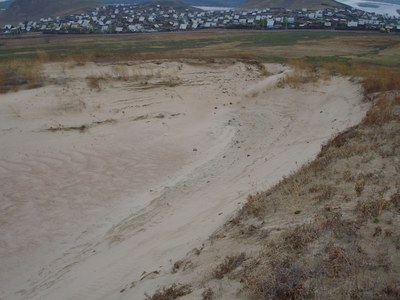
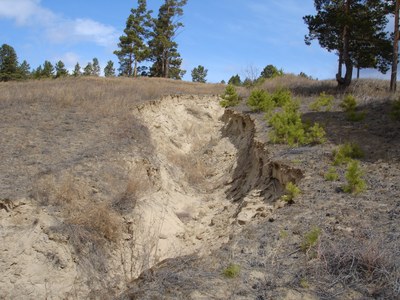
<p style="text-align: justify; ">Soils of the basin are subject to destructive processes: wash-away, erosion and deflation (pic. 2.2.7) [3,4]. As a consequence of these processes the loss in harvest production is annually 15-20 %. Agrohydrological properties of soils are determined largely by their mechanical composition. The greatest amount of productive dampness is characterized by sandy soils (90-105 mm). Following an increase in the concentration of smaller fractions, the amount of productive dampness rises reaching 160-190 mm for light loamy soils and 215 mm for heavy loamy soils. The coefficient of water-yielding capacity is around 65-75%.</p>
<p align="center"><img class="image-inline" src="../../../resolveuid/ab5a7a723b0043baa7a2f569d28cf0a4/@@images/image/preview" /></p>
<p align="center">Pic. 2.2.7 The deflation</p>
<p style="text-align: justify; ">According to observation data, in spring the reserves of productive dampness in the meter-deep layer of soil is on the average 80 mm, for sandy soils and for loamy soils it is 100 and 160 mm, respectively. In summer, in July and August, they shrink for sandy soils up to 60 mm and for loamy soils up to 100 mm. Due to the low concentration of productive dampness in the soils of light mechanical composition and their insufficient moistening in the vegetation period, the acquisition of stable harvests is only possible through irrigation. Of great significance are agrotechnical devices aimed at preserving dampness in soil and the protection of soil from water and wind erosion (pic. 2.2.8).</p>
<p align="center"><img class="image-inline" src="../../../resolveuid/03d8219a510e4235b599203f97caf74a/@@images/image/preview" /></p>
<p align="center">Pic. 2.2.8 The water erosion</p>
<p style="text-align: justify; ">The reduced anthropogenic impact on ecosystems of the Lake Baikal basin during the last decade contributes to the restoration of natural landscapes and the lowered rate of aridification. Therefore, desertification is not observed within the Russian part of the basin, in contrast to Mongolia [23].</p>
<p style="text-align: justify; ">Scientists have identified 34 types of soils in <strong>Mongolia</strong>. The most common type of soil - brown soil - comprises 40.4% of the total territory, of which 22.6% is located in mountainous areas and 17.8% is in plain areas (pic. 2.3.2). The brown soil is further classified into three sub-types, including dark brown, genuine brown and light brown soil. The most widespread is dark brown soil (17.6%), followed by genuine brown soil (11.9%), and light brown soil (10.9%) [15].</p>
<p style="text-align: justify; ">The Law on Soil Protection and Prevention of Desertification introduced a classification of the extent of soil degradation and desertification, categorizing it as «weak», «medium» and «strong» [16]. «Weak» extent of soil degradation implies that less than 5% of the soil is polluted or eroded; «medium» extent of degradation implies that 5-20% of soil is polluted or eroded; and «strong» extent of degradation implies 20-50% of soil is polluted or eroded.</p>
<p style="text-align: justify; ">In Mongolia, precipitation increases from the central part to the north following the changing relief and climate, and steppe landscape is replaced by meadow-steppes, meadows, swamps, forests and taiga-forests. In the mountainous region in the north of the country, the soil moisture is relatively higher due to more precipitation as well as humidification by big and small rivers and multi-year permafrost.</p>
<p style="text-align: justify; ">In the wide valley between the Khangai and Khentii mountain ranges, arid plain soil and desert-plain soil are spanning till the Tagna mountain range. Arid-steppe brown soil covers a significant area of the valleys located in Orkhon-Selenge basin. The Orkhon and Tuul river basins have mountain dernotaiga soils, low mountain chestnut soils, steppe valley brown and dark brown soils, while meadow and river valley soils are dominant (table 2.2.1).</p>
<p style="text-align: center; ">Table 2.2.1  Percentage of soil sub-types in the Orkhon and Tuul river basins</p>
<p style="text-align: center; "><img class="image-inline" src="../../../resolveuid/919bbc004a9b46cc946de452934e1262/@@images/image/preview" /></p>
<p style="text-align: center; "><a href="http://bic.iwlearn.org/en/documents/photos/copy2_of_4.jpg" class="internal-link">Open full size</a></p>
<p><strong><i> </i></strong></p>
<p style="text-align: justify; ">The extent of land degradation <span>can be defined as «wea</span><span>k» for 35.3% of lands, «medium» and «strong» for 25.9% and 6.7% of lands, respectively (pic. 2.2.9) [17].</span></p>
<p align="center"><img class="image-inline" src="../../../resolveuid/b831c05c0b354e3fbb238b026c3c4021/@@images/image/preview" /></p>
<p align="center">Pic. 2.2.9 The soil degradation</p>
<p style="text-align: justify; ">The desertification maps created by Geoecological Institute of Mongolian Science Academy in 2006 and 2010 were compared, and it was revealed that distribution of the areas with «strong» desertification changed during the period, i.e. numerous new desertification hotspots have formed [15]. For instance, new desertification hotspots were observed in the north of Bayankhongor aimag and Orkhon river basin. However, along the border of Uvurkhangai and Dundgobi aimags the area of lands affected by desertification have reduced (Table 2.2.2).</p>
<p style="text-align: center; ">Table 2.2.2 Extent of desertification in the aimags within the Selenga River basin  (%)</p>
<p style="text-align: center; "><img class="image-inline" src="../../../resolveuid/e114bc6862b04a6998f6012cee64e209/@@images/image/preview" /></p>
<p style="text-align: center; "><img src="http://bic.iwlearn.org/en/documents/state-of-the-environment-report-the-lake-baikal-basin-1/natural-conditions/2-2-soils" alt="2.2 Soils" id="__mce_tmp" title="2.2 Soils" /></p>
<p style="text-align: center; "><a href="http://bic.iwlearn.org/en/documents/photos/copy2_of_5.jpg" class="internal-link">Open full size</a></p>
<p style="text-align: justify; ">Increased logging, forest fires, vegetation damage by pests, mining (mineral extraction) and unauthorized tree-cuttings cause imbalance in forest ecosystems and facilitate desertification processes. The Law on Soil Conservation and Prevention of Desertification approved by State Great Khural in 2012 established incentive measures for individuals and organizations conducting soil conservation and desertification prevention activities (pic. 2.2.10).</p>
<p align="center"><img class="image-inline" src="../../../resolveuid/94ae0853d9ea433dad39fb34654738bf/@@images/image/preview" /></p>
<p align="center">Pic. 2.2.10 The hotbed of desertification</p>]]></content:encoded>
    <dc:publisher>No publisher</dc:publisher>
    <dc:creator>Zorigma</dc:creator>
    <dc:rights></dc:rights>
    <dc:date>2015-04-23T08:38:35Z</dc:date>
    <dc:type>Page</dc:type>
  </item>


  <item rdf:about="http://bic.iwlearn.org/en/documents/state-of-the-environment-report-the-lake-baikal-basin-1/natural-conditions/2-1-surface-and-ground-waters">
    <title>2.1 Surface and ground waters</title>
    <link>http://bic.iwlearn.org/en/documents/state-of-the-environment-report-the-lake-baikal-basin-1/natural-conditions/2-1-surface-and-ground-waters</link>
    <description></description>
    <content:encoded xmlns:content="http://purl.org/rss/1.0/modules/content/"><![CDATA[<p align="center"><b>2.1 Surface and </b><b>ground</b><b> waters</b></p>
<p class="u" style="text-align: justify; ">In the north of the Russian part of the basin, the biggest rivers are the rivers Angara, Barguzin and Turka. The middle part of the basin includes Selenga River with its major tributaries – the rivers Uda, Khilok, Chikoi and Dzhida. In the Mongolian part of the basin, the biggest rivers are the rivers Selenga, Ider, Chuluut, Khanui, Orkhon, Eruu, Kharaa, Tuul, Egiin-Gol, and Delgermurun.</p>
<p style="text-align: justify; ">Differentiation of the river network density of the Lake Baikal basin has a clearly pronounced zonal nature: from 0.1 km/km<sup>2</sup> at the south-eastern boundary to 0.9 km/km<sup>2</sup> on the coastal ridges and in the northern territories [1]. A high river network density is characteristic of the taiga zone, especially of ridges and valleys immediately adjacent to the lake. In general, the northern part of the basin is characterized by favorable conditions of flow. Mountainous terrain, steep slopes and the presence of permafrost contribute to a rapid discharge of water into the main water streams, namely, the Upper Angara and the Barguzin, and to the development of the river network. The highest density is specific to the western slopes of the Barguzinsky (0.92 km/km<sup>2</sup>) and Khamar-Daban ridges (0.69 km/km<sup>2</sup>). Among the plain territories, the most watered areas are the Barguzinskaya valley (0.89 km/km<sup>2</sup>) and the area of the Selenga river delta (0.68 km/km<sup>2</sup>) (pic. 2.1.1).</p>
<p align="center" class="u"><img class="image-inline" src="../../../resolveuid/21557f86860142b59821e67beb73e8f0/@@images/image/preview" /></p>
<p align="center" class="u"><a href="http://bic.iwlearn.org/en/documents/photos/2.1.1e.png" class="internal-link">Open full size</a></p>
<p align="center">Pic. 2.1.1 River network density [1]</p>
<p style="text-align: justify; ">The middle part of the basin represents a border of forest and steppe, and is characterized by the mid-mountain terrain and a high occurrence of sandy and sandy loam soils. The presence of these factors provides for the average river network density ranging from 0.35 km/km<sup>2</sup> in the middle reaches of the Selenga River and 0.55 km/km<sup>2</sup> for the Chikoi river basin to 0.61 km/km<sup>2</sup> for the Khilok and Dzhida river basins.</p>
<p style="text-align: justify; ">In physical and geographical terms, the south-western part of the basin, i.e. the area of Lake Khuvsgul, represents a forest-steppe with the high-mountain depression terrain, and is characterized by a lower river network density ranging from 0.32 km/km<sup>2</sup> for the Delgermurun river basin to 0.34 km/km<sup>2</sup> for the Egiin-Gol river basin. In the southern dry steppe part of the basin a low river network density is registered. This is especially typical for the Tuul and Kharaa river basins; here this index is below 0.2 km/km<sup>2</sup>.</p>
<p style="text-align: justify; ">Because of the disintegration of relief and a considerable contrast in the precipitation regime of the depressions and mountain ranges in the Russian part of basin, the average amount of annual runoff varies to a great extent – in the depressions it is seldom less than 2.5 l/s·km<sup>2</sup>, that is including some sites without an outflow, while the runoff on the range slopes exceeds 25 l/s·km<sup>2</sup>, averaging 5-10 l/s·km<sup>2 </sup>for the most part of the territory. The regime of most of the rivers is of Far East type with the maximum runoff in the rainy period and rain alimentation in the second half of summer. Many medium-sized rivers freeze in winter thereby contributing to the issue of winter water supply.</p>
<p style="text-align: justify; ">In the North of basin <b>the Verkhnyaya Angara River</b> flows from the southern slope of the Delun-Uransky mountain range and falls into Angarsky Sor bay, located in the northern part of Lake Baikal. The river forms a vast delta with a great number of river channels and lakes (pic. 2.1.2).</p>
<p align="center"><img class="image-inline" src="../../../resolveuid/b2cb0b18a1274c43b037555de81c976d/@@images/image/preview" /></p>
<p align="center">Pic. 2.1.2 The delta of Verkhnyaya Angara River (digital relief model, BINM SB RAS)</p>
<p style="text-align: justify; ">The length of the river is 438 km, water catchment area is 21400 km<sup>2</sup>, the general fall is 120 m. The total number of tributaries is 2291 with the overall length of 10363 km (0.45 km/km<sup>2</sup>). The average long-term water discharge is 265 m<sup>3</sup>/s (8.4 km<sup>3</sup>/year) [3,4].</p>
<p style="text-align: justify; "><b>The Barguzin River </b>originates at the spurs of the South-Muysky mountain range; falls into the Bay of Barguzin of Lake Baikal. The length of the river is 480 km, water-catchment area is 21100 km<sup>2</sup>, the general fall is 1344 m (pic. 2.1.3). The number of rivers within the basin is 2544 with the total length of 10747 km (0.51 km/km<sup>2</sup>). During the high water period, the river is navigable at the extent of 250 km and has a great significance for fishing. The basin economy is based on agriculture, and in particular irrigational agriculture. The average long-term water discharge is 130 m<sup>3</sup>/s (4.1 km<sup>3</sup>/year) [3,4].</p>
<p align="center"><img class="image-inline" src="../../../resolveuid/83597ce598f541c99c1a7b416a39f89b/@@images/image/preview" /></p>
<p align="center">Pic. 2.1.3 The Barguzin River</p>
<p style="text-align: justify; "><b>The Turka River </b>originates in the southern slopes of Ikatsky range at the elevation of 1430 m and falls from the east into the middle part of Lake Baikal, 140 km to the north-east of the Selenga delta. The length of the river is 272 km, water-catchment area is 5870 km<sup>2</sup>, and general fall is 975 m. The lower part of the basin includes Lake Kotokelskoe with an area of 68.9 km<sup>2</sup>. The river has a great significance for fishing industry. The upper stream of the river is the center of exploration works for placer gold. The average long-term water discharge is 1.6 km<sup>3</sup>/year [3,4].</p>
<p style="text-align: justify; "><b>The Selenga River</b> of Mongolian part takes its origin from the confluence point of the rivers Delgermurun and Ider. The total basin area of the Selenga river is 445 272 км<sup>2</sup> km<sup>2</sup>, among this 67% is located in Mongolia. The Mongolian part of the Selenga river basin spans over 6 aimags - Bulgan (46.3%), Selenge (27.6%), Khuvsgul (25.3%), Arkhangai (0.7%) and Orkhon (0.04%) [2].</p>
<p style="text-align: justify; ">The Selenga River<b> </b>in the Russian part<b> </b>flows across the middle-mountain heavily indented location. The channel slope is 0.36 ‰. The width of the river valley varies from 2 to 25 km. In narrow places the river consists of one slightly meandering channel, in the wider parts the river channel divides into arms. The main channel and the river arms are meandering, at the abrupt turns the shores are intensely eroded (pic. 2.1.4). The width of the river in the low-water period is 100-150 m, depth at the river pool is 4-5 m, at the bar area is 0.5 – 1 m, at shallow places – 0.5 m. The velocity of current in the low-water period is 1 m/s, at disparate bars rising to 2-2.5 m/s. The bottom of the river is predominantly composed of pebble, or pebble and sand. The height of the shores is 1-2 m.</p>
<p align="center"><img class="image-inline" src="../../../resolveuid/173e8b9101a04a27a4f779ad3257dd4f/@@images/image/preview" /></p>
<p align="center">Pic. 2.1.4   The Selenga River</p>
<p style="text-align: justify; ">The Selenga has a delta with the area of about 1120 km<sup>2</sup>, made up of river channels and islands, formed of river sediment (pic. 2.1.5).</p>
<p style="text-align: center; "><img class="image-inline" src="../../../resolveuid/c9ccb95a96924cd28c8503d0472105c2/@@images/image/preview" /></p>
<p align="center">Pic. 2.1.5   The delta of Selenga river</p>
<p style="text-align: justify; ">Annually, the Selenga river discharges about 2.7 million of sediment load, increasing the area of the delta [3,4]. It is the delta area which has the shortest distance between the two shores of the lake – 26 km. The Selenga section of Lake Baikal is the area of accumulative shores, having the maximal length and consisting of the external part of the Selenga delta and bars, separating the lake from the bay: Bay of Proval, located to the north-east of the Selenga delta the bay of Sor Cherkalov, located to the south and south-west of it. Analysis of multi-temporal cartographic and space-image materials, fieldwork data suggest that the delta area grows disproportionately at its disparate parts. The maximal growth of the delta takes place in the north-eastern section, adjacent to the Bay of Proval, in particular, in the area of Lobanovsky water channel, reaching several tens of meters per year in some periods. The western sector of the Selenga delta, adjacent to the Bay of Sor Cherkalov protrudes with less velocity.  Relatively stable in terms of growth is the northern section of the delta, located between the Srednyaya and Northen Ust’ channels [5].</p>
<p style="text-align: justify; "><b>The Dzhida River </b>originates on the southern slope of the Khangarulsky mountain range. The upper part of the basin has an average absolute elevation of more than 1500 m, as the river flows through a ragged heavily indented location (pic. 2.1.6). The average slope of the river is 2.7 ‰, in the middle stream – 1 ‰, slopes - 200–300 ‰. The Dzhida river is the fourth largest tributary of the Selenga river (12.5 % of the Selenga river basin), the amount of the river runoff is 15 % of the overall amount within Russia [3,4]. The ratio of water influx from the area of 4920 km<sup>2</sup> from Mongolia is 25 % (0.61 km<sup>3</sup>). The river is fed primarily through rains, the inundation stage does not exist, the ratio of winter runoff to underground alimentation is 6%. The upper, north-western part of the basin lies in the zone with episodic freezing, and the lower – with annual freezing. Some sections of the Dzhida River are characterized with karst rocks, but in general the impact of karst phenomena on the river flow is insignificant.</p>
<p align="center"><img class="image-inline" src="../../../resolveuid/593c42efde8d461fa3a89e90986e2e8e/@@images/image/preview" /></p>
<p align="center">Pic. 2.1.6 The Dzida river</p>
<p style="text-align: justify; "><b>The Temnik River </b>rises on the northern slope of the Khamar-Daban mountain range. The river basin is predominantly mountainous, since only the lower part of the basin has grassland landscapes. The average slope of the river is 3.6 ‰. The river is fed through rains, and inundations are observed from May to September. The specific runoff is 7 %, of the flow into the Selenga on the Russian territory. The ratio of winter runoff is 7 %, the river freezes in an episodic way, once in five years.</p>
<p style="text-align: justify; "><b>The Chikoi River </b>is the biggest in terms of the basin area and the amount of water runoff among the Selenga tributaries, while its water catchment is about 10 % of the Selenga basin and 31 % of the catchment in Russia (pic. 2.1.7). About 25 % (2.14 km<sup>3</sup>) of the runoff comes from Mongolia. The average slope is 1.65 ‰, in the middle stream – 1.2 ‰ and lower stream – 0.58 ‰, mountain slopes - 200–300 ‰. The average river runoff, formed in Russia, accounts for 40 % of the water influx into the Selenga. The conditions of runoff formation in the upper and lower parts of the Chikoi basin as well as on the water catchment area of the left-bank and right-bank tributaries are quite different. The river alimentation comes from rains, inundation due to the spring snow melting is rare and constitutes no more than 20 % of the annual runoff, winter runoff – 6 %, on tributaries - 2 – 3 %. The upper part of the basin lies within the zone of non-freezing or rarely freezing rivers, the middle part in the zone of episodic freezing and the lower part within the zone of annual freezing. In terms of the specific runoff, the Chikoi river ranks second place among the major tributaries of the Selenga following the Temnik [3,4,6].</p>
<p align="center"><img class="image-inline" src="../../../resolveuid/dcc72df2c93244a3a94ecb98463c266a/@@images/image/preview" /></p>
<p align="center">Pic. 2.1.7 The Chikoi river</p>
<p style="text-align: justify; "><b>The Khilok River </b>originates from Lake Shakshinskoe to flow through the bottoms of prolonged intermountain depressions at the elevation of 500-800 m, between the chain of mountain ridges with flattened forms and absolute marks of 1300–1800 m. Slopes of the basin valleys are covered mainly with mountain and taiga vegetation, while the bottoms of the valleys tend to be taken up by grassland and forest-grassland sections. The average slope is 0.52 ‰. The area of the river basin is 26 % of the Selenga basin within Russia and the amount of water influx is 19 %. River alimentation is from rain, the stage of spring snow melting is weakly manifested and does not exceed 20% of the annual runoff. Winter runoff is less than 6 % for the mouth part, while in the upper and middle part of the Khilok River there is no runoff as a result of freezing. The specific runoff indicators are 1.5 times less than those for the Dzhida River, and more than 2 times less than for combined runoff for the Temnik and Dzhida rivers.</p>
<p style="text-align: justify; "><b>The Uda River </b>originates in the south-western part of the Vitim plateau at the elevation of 1055 m, flows into the Selenga on the right side, 156 km off its mouth (pic. 2.1.8).</p>
<p align="center"><img class="image-inline" src="../../../resolveuid/9d19c0a9318140e9a6a64fd5fd1185d8/@@images/image/preview" /></p>
<p align="center">Pic. 2.1.8 The Uda river empties into the river Selenga (Google)</p>
<p style="text-align: justify; ">The length of the river is 467 km, water catchment area is 34800 km<sup>2</sup>, general fall of the river is 583 m. Average absolute elevation of the upper part of the Uda basin is 900 –1100 m. The average fall of the river is 1.2 ‰, in the lower stream – 0.7 ‰. The river basin is the third largest among the tributaries of the Selenga (23% of the water catchment area of the Selenga in Russia) and fourth largest in terms of the amount of water influx (13.4 %). The river network in the basin area is moderately developed, average value of density coefficient is equal to 0.39 km/km<sup>2</sup>. The upper part of the basin has vast spaces of wetlands as well as a great number of small lakes with the surface area of less than 1 km<sup>2</sup>) [4,7].</p>
<p style="text-align: justify; ">The modulus of flow is 2.0 l/s km<sup>2</sup>, the lowest as compared to other five largest tributaries of the Selenga. The river alienation is from rain, but as a result of spring snow melting water runoff reaches 30 % of the annual amount (pic. 2.1.9). The inundation stage manifests itself in the low-water years and the medium-water years. The ratio of the winter runoff of 10 – 12 %, formed due to the flow of non-freezing right-hand tributaries in the middle and lower parts of the basin. The tributaries of the upper part of the basin and the Uda itself in the middle stream freeze on the annual basis, while the left-bank tributaries in the middle and lower part of the basin freeze occasionally [2].</p>
<p style="text-align: center; "><img class="image-inline" src="../../../resolveuid/6fc4ce586ed8461a867026c308059ae8/@@images/image/preview" /></p>
<p align="center">Pic. 2.1.9 The Uda river in Ulan-Ude</p>
<p style="text-align: justify; "><b>The Er</b><b>uu</b><b> </b><b>R</b><b>iver</b> originates in the high reaches of the Khentii mountain range. The Sharlan River joins the Hongi River, and the Eruu River starts from the junction point of these two rivers (pic. 2.1.10). The river basin spans over four aimags, namely Selenge (69.1%), Tuv (23.8%), Khentii (7.0%), Darkhan-Uul (0.1%), and has a total area of 22 282 km<sup>2</sup>. The Eruu river basin authority is located in the center of Eruu soum in Selenge aimag.</p>
<p style="text-align: center; "><img class="image-inline" src="../../../resolveuid/260c859e18cf4c1b8e8292bf0ce3ea0b/@@images/image/preview" /></p>
<p align="center">Pic. 2.1.10  The Eruu river</p>
<p style="text-align: justify; ">The Bayan River takes its origin from the south-western branch of Khentii mountain range. The river’s confluence point with the Sognogor River is the source of the <b>Kharaa </b><b>R</b><b>iver</b><b> </b>(pic. 2.1.11). The area of the Kharaa river basin is 17 667 km<sup>2</sup><sup> </sup>and extends over Tuv (41.5%), Selenge (36.6%), and Darkhan-Uul (17.2%) aimags and several districts of Ulaanbaatar city (4.8%) [8,9].</p>
<p align="center"><img class="image-inline" src="../../../resolveuid/be5dc8aede924750827670294ff072fc/@@images/image/preview" /></p>
<p align="center">Pic. 2.1.11 The Kharaa River</p>
<p style="text-align: justify; "><b>The Tuul River</b> takes its origin at an elevation of 2 000 m above sea level at the Chisaalai mountain. The river source is the confluence point of the rivers Namya and Nergui. The total area of the Tuul river basin is 50 074 km<sup>2</sup><sup> </sup>and the basin spans over 5 aimags, i.e. Tuv (59.2%), Bulgan (20.5%), Uvurkhangai (7.3%), Arkhangai (5.0%), and Selenge (1.7%), as well as 7 districts of Ulaanbaatar city(6.3%). The capital city of Mongolia, Ulaanbaatar, is located in the river basin; the central part of the basin is, therefore, a densely populated urban area (pic. 2.1.12) [8,10].</p>
<p align="center"><img class="image-inline" src="../../../resolveuid/05d578ce189140178ddbbcde8b239cd4/@@images/image/preview" /></p>
<p align="center">Рис. 2.1.12  The river Tuul in Ulaanbaatar (Google)</p>
<p style="text-align: justify; "><b>The Orkhon </b><b>R</b><b>iver</b> originates in the east-northern part of the Khangai mountain range and flows northward joining the Selenga river in Sukhbaatar city in Selenge aimag. The total basin area of the Orkhon River, including basin areas of its tributaries - Tuul, Kharaa and Eruu, is 143 479.3 km<sup>2</sup>, 48.0% of which is part of the Selenga River basin. The biggest waterfall of Mongolia – Ulaantsutgalan – is located in the upstream of the Orkhon river (pic. 2.1.13). The river basin spans over 8 aimags - Arkhangai (38.2%), Bulgan (21.9%), Selenge (18.5%), Uvurkhangai (15.9%), Tuv (1.9%), Bayankhongor (1.6%), Orkhon (1.6%) and Darkhan-Uul (0.4%) [8,11].</p>
<p style="text-align: center; "><img class="image-inline" src="../../../resolveuid/85cbfa02e133487ebfeb6f8ead4e095e/@@images/image/preview" /></p>
<p align="center">Pic. 2.1.13  The biggest waterfall of Mongolia – Ulaantsutgalan.</p>
<p style="text-align: justify; "><b>The Khanui</b><b> </b><b>R</b><b>iver</b> takes its source in the Khan-Undur mountains, which are in the central part of the Khangai mountain range. The river flows about 421 km towards the east-north before joining the Selenga River. The total area of the river basin is 15755 km<sup>2</sup>, which is divided between 3 aimags - Arkhangai (77.1%), Bulgan (22.7%) and Khuvsgul (0.1%) [8].</p>
<p style="text-align: justify; "><b>The Chuluut </b><b>R</b><b>iver</b> originates in the western part of Gurvan-Angarkhai mountain in the Khangai mountain range. The Chuluut River flows 415 km till its confluence with the Ider river. The total river basin area is 20078 km<sup>2</sup><b><sup> </sup></b>that span over 4 aimags - Arkhangai (95.7%), Khuvsgul (3.8%), Bayankhongor (0.4%), and Zavkhan (0.2%) [8].</p>
<p style="text-align: justify; "><b>The Ider</b><b> </b><b>R</b><b>iver</b> takes its source at the north side of Otgontenger mountain in the Khangai mountain range. There are several small and big tributaries, including the rivers Suman and Chuluut. The length of the river is about 465 km from its source to the mouth – its confluence with the Selenge River. The total area of the river basin is 23061 km<sup>2</sup>,<sup> </sup>which covers parts of Zavkhan (65 %), Khuvsgul (32.1%) and Arkhangai (2.9%) aimags of Mongolia [8,12].</p>
<p style="text-align: justify; "><b>The Delgermurun</b> originates in Ulaantaiga mountain in Khuvsgul aimag. The river flows about 445 km till its confluence with the Ider River, together forming the Selenga River. This river basin area is 23324 km<sup>2</sup><sup> </sup>extending over Khuvsgul (98.5%) and Zavkhan (1.5%) aimags of Mongolia [8].</p>
<p style="text-align: justify; "><b>Lakes</b> are<b> </b>distributed unevenly across the Selenga basin which is due to the diverse relief, climate and water alimentation. The greatest number of large natural water objects is concentrated in intermountain depressions. The Selenga river basin has 5549 lakes with a total area of 616 km<sup>2</sup>. The density of lakes in the basin is less than 1 %. The more prevalent are small water objects with an area of 0.5 km<sup>2</sup>, and only 17 lakes have the area from 1 to 10 km<sup>2</sup> and 4 lakes with the area of more than 10 km<sup>2</sup>. The biggest lake in the Selenga river basin is Gusinoe with an area of 163 km<sup>2</sup>. The biggest lakes are Kotokel (pic. 2.1.14), Shakshinskoe and Arakhlei (with surface areas of 52.6 and 58.5 km<sup>2</sup>, respectively) located in the outlet of the Khilok River [3,4].</p>
<p align="center"><img class="image-inline" src="../../../resolveuid/ffa5ca5c795844f088dd93da62b0371d/@@images/image/preview" /></p>
<p align="center">Pic. 2.1.14  The Lake Kotokel</p>
<p style="text-align: justify; ">Lake Khuvsgul is the largest lake in Mongolia that contains 3/4 or 74.6% of the total surface water supply (380 km<sup>3</sup>) in Mongolia (pic. 2.1.15) [9,13].</p>
<p align="center"><img class="image-inline" src="../../../resolveuid/ddaf2ac362bb49999a6c6de1705d97a8/@@images/image/preview" /></p>
<p align="center">Рис. 2.1.15 The Lake Khuvsugul</p>
<p style="text-align: justify; ">The water level in Lake Khuvsgul have increased by 1 m since 1963, the exact reason for which is unknown. However, it might be related to melting of permafrosts, increased precipitation, decreased outflow due to accumulation of sand an the bottom of the Eg river, water temperature decline and, thus, reduced evaporation from the lake surface, etc. In 1979 and 1995-1996, the water level in the lake declined significantly. It was attributed to the lower amount of precipitation during these years (table 2.1.1).</p>
<p style="text-align: center; ">Table 2.1.1 Morphometric characteristics of lakes within the Mongolian part of Baikal basin [8,9].</p>
<p style="text-align: justify; "><b><i> </i></b></p>
<p style="text-align: center; "><img class="image-inline" src="../../../resolveuid/9dc8d5cdd0934458860f12fe3de44397/@@images/image/preview" /></p>
<p style="text-align: center; "><a href="http://bic.iwlearn.org/en/documents/photos/copy4_of_1.jpg" class="internal-link">Open full size</a></p>
<p style="text-align: justify; "><b>Wetlands </b>in the Selenga river basin are comparatively rarely to be found. In most cases, wetlands are to be found in the river valleys and river mouths as well as on the shores of lakes. In the river valleys and river mouths, the most widely spread are sedge and moss types while the more drained parts have bushy wetlands. In the wetland depressions, located in the Khamar-Daban mountains (the Dzhida and Temnik river basins) there are some areas covered with sphagnum (pic. 2.1.16 ).</p>
<p align="center"><img class="image-inline" src="../../../resolveuid/348b6ba1b12a4bf6b4be594534d3d443/@@images/image/preview" /></p>
<p align="center">Pic. 2.1.16  The swamp on Khamar-Daban range</p>
<p style="text-align: justify; ">Large places of swampy valleys are found nearly everywhere in all the valleys. The density of wetlands varies within the range of 1 – 5 %. The most significant wetlands are found in the Khilok basin (about 10% of the catchment area) [5,14].</p>
<p style="text-align: justify; "><b>Ground waters </b>are quite varied in terms of chemical composition and are subject to certain geochemical zonality. Artesian basins occupy intermountain depressions, composed of loose rocks of sedimentary cover and crystal rocks. They are characterized with porous zones of active water circulation. Hydrogeological massifs are composed of crystallic rocks of mountain-infolded framing and contain interstitial waters of exogenic fracture pattern. The capacity of active water exchange zone does not exceed 100-150 m. The most water-abundant are karstified carbonate rocks as well as zones of tectonic dislocations, cutting the basal complex or stretching alongside the contacts with sediment-metamorphic formations with erupted and metamorphic rocks. They are often traced by the rising water load of both cold and thermal waters. Fault waters of mountain ridges are ultra-fresh waters (with salinity of 0.003 to 0.005 g/l). In artesian basins of Baikal type (Barguzin, Verkhneangarsky), the water salinity does not exceed 0.5-1 g/l up to the depth of 2000 m, while the composition of water is mainly of hydrocarbonate-sodium and calcium-sodium type (pic. 2.1.17).</p>
<p align="center"><img class="image-inline" src="../../../resolveuid/2843b592cd534d97a1833d84fbfe5e8f/@@images/image/preview" /></p>
<p align="center"><a href="http://bic.iwlearn.org/en/documents/photos/2.1.17e.png" class="internal-link">Open full size</a></p>
<p align="center">Рис. 2.1.17  Groundwater of Lake Baikal basin [1]</p>
<p style="text-align: justify; ">The major way of ground water alimentation is through infiltration of atmospheric precipitation and melted waters. Permafrost plays a significant role in the formation of ground water reserves and their regime. The replenishment of reserves takes place in the warm season, when the amount of infiltration exceeds the amount of unloading. In the course of the cold period, their unloading happens and their water levels decrease in this period. The amplitude of fluctuations during the year does not exceed 1.5-2 m.</p>
<p style="text-align: justify; ">Ground alimentation of rivers relies on both the ground water and pressure artesian waters. Ground water flow on the considered territory is quite significant in scope. Deep compartmentalization of surface, dense river network, considerable gradients facilitate intensive ground flow (table 2.1.2).</p>
<p class="Table" style="text-align: center; ">Table 2.1.2 Groundwater reserves in the river basins Russian part of Baikal basin</p>
<p class="Table" style="text-align: center; "><img class="image-inline" src="../../../resolveuid/b469c374b83d47448b3d77a4bf433630/@@images/image/preview" /></p>
<p class="Table" style="text-align: center; "><a href="http://bic.iwlearn.org/en/documents/photos/copy6_of_2.jpg" class="internal-link">Open full size</a></p>
<p style="text-align: justify; "><span>In terms of availability of ground water, three groups of regions can be distinguished in the territory: with good availability, medium availability and little availability. The first group includes ground waters of intermountain depressions of Baikal type with virtually unlimited reserves – up to 3-5 m</span><sup>3</sup><span>/s and more. The second group includes artesian basins of Transbaikalian type with the amount of fresh water sampling up to 1.0 m</span><sup>3</sup><span>/s.  The third group includes ground fault-veined waters of mountain ranges with limited (up to 5-10 m</span><sup>3</sup><span>/s) exploitation resources [3,4].</span></p>
<p style="text-align: justify; ">The territory of middle-sized and northern rivers of Lake Baikal has almost all the known types of curative mineral waters (thermal, cold carbon, hydrogen sulphide, radon, ferriferous). Thermal nitrogen-siliceous waters of Goryachinsk resort, located on the eastern shore of Lake Baikal, are used to treat the diseases of nervous system, skin diseases and other ailments (pic. 2.1.18).</p>
<p align="center"><img class="image-inline" src="../../../resolveuid/d2f83828e4e54044a1a1c7b25febfde9/@@images/image/preview" /></p>
<p align="center">Pic. 2.1.18 The hot springs of resort Goryachinsk<span> </span></p>
<p style="text-align: justify; ">Barguzin valley has a number of resorts of the local level, such as Garga, Alla and Kuchiger. High temperature of thermal waters makes it possible to use them for acquiring thermal and electric energy. Thus, waters with the temperature of 40-70ºС can be used for greenhouse planting and hot water supply. In terms of curative properties, these waters are fit for curing the diseases of the locomotor system, peripheral nervous system and other diseases [3,4].</p>
<p style="text-align: justify; ">In <b>Mongolia</b>, groundwater is the main source of drinking water and water used for domestic and industrial purposes. According to some estimates, 95% of the domestic and industrial water demand is supplied by groundwater (pic. 2.1.17).</p>
<p style="text-align: justify; ">In the Selenga River basin, surface water mainly is used for irrigation but, in recent years, groundwater consumption has increased. In addition, most of mines and industries remove groundwater from exploration fields (during open pit and underground mining) to keep it dry. Industries located in cities usually use water from centralized water supply networks or own groundwater wells. Seosonal groundwater level decrease in Ulaanbaatar city is due to the fact that the rate of groundwater extraction is higher than the rate of its replenishment.</p>
<p style="text-align: justify; ">According to the Integrated Water Resource Management Plan of Mongolia [8], it is estimated that the renewable groundwater reserves are 8.1 million km<sup>3</sup>/year, the potential exploitable groundwater reserves are about 3.6 million km<sup>3</sup>/year and, in the Selenga River basin, the potential reserves are 316.7 million m<sup>3</sup>/year. However, these estimates should be treated as approximate. The groundwater reserves in each river basin were estimated based on hydrological data for the region, the type of geological formation in the area, estimates of groundwater recharge, regional field surveys (including test drilling), etc. (Table 2.1.3)</p>
<p class="Table" style="text-align: center; ">Table 2.1.3 Groundwater reserves in the river basins Mongolian part of Baikal basin</p>
<p class="Table" style="text-align: center; "><img class="image-inline" src="../../../resolveuid/35ec160ee09444c1a489dbb65d2077d3/@@images/image/preview" /></p>
<p class="Table" style="text-align: center; "><a href="http://bic.iwlearn.org/en/documents/photos/copy2_of_3.jpg" class="internal-link">Open full size</a></p>]]></content:encoded>
    <dc:publisher>No publisher</dc:publisher>
    <dc:creator>Zorigma</dc:creator>
    <dc:rights></dc:rights>
    <dc:date>2015-04-23T07:14:42Z</dc:date>
    <dc:type>Page</dc:type>
  </item>


  <item rdf:about="http://bic.iwlearn.org/en/documents/state-of-the-environment-report-the-lake-baikal-basin-1/general-conditions-of-the-baikal-lake-basin/1-6-lake-baikal-2013-unesco-world-heritage-site">
    <title>1.6 Lake Baikal – UNESCO World Heritage Site</title>
    <link>http://bic.iwlearn.org/en/documents/state-of-the-environment-report-the-lake-baikal-basin-1/general-conditions-of-the-baikal-lake-basin/1-6-lake-baikal-2013-unesco-world-heritage-site</link>
    <description></description>
    <content:encoded xmlns:content="http://purl.org/rss/1.0/modules/content/"><![CDATA[<p align="center"><strong>1.6 Lake Baikal – UNESCO World Heritage Site</strong></p>
<p style="text-align: justify; ">In December 1996, Lake Baikal was listed as a UNESCO world heritage site by the resolution of the 20<sup>th</sup> session of UNESCO World Heritage Committee, which took place in a Mexican city of Merida [5,6]. The major objective of the world heritage list is to make widely known and to protect unique natural and historic sites. For this purpose, assessment criteria have been established. The first six criteria are in place from 1978 and identify cultural heritage, while the four criteria for natural heritage sites were introduced in 2002. From 2005, all the 10 criteria are put together in a single list. Out of thousands of natural heritage sites included in the list, about ten sites match all the four criteria, and Lake Baikal is one of them (pic. 1.6.1).</p>
<p align="center"><img class="image-inline" src="../../../resolveuid/e8e0c2e1bdf4455d9fb6126c688267da/@@images/image/preview" /></p>
<p align="center">Pic. 1.6.1  The lake Baikal</p>
<p style="text-align: justify; ">In the UNESCO resolution it was stated that «Lake Baikal is a classic world heritage site, matching all the four criteria for natural sites. The lake itself is the centerpiece of the site and its largely unseen underwater features are the core of its value to both science and conservation. The late is surrounded by a system of protected areas that have high scenic and other natural values» (pic. 1.6.2).</p>
<p align="center"><img class="image-inline" src="../../../resolveuid/095fcc2d678c41eab9349eb1fbe2fc08/@@images/image/preview" /></p>
<p align="center">Pic. 1.6.2 The coast of Baikal lake</p>
<p style="text-align: justify; ">Baikal was formed in the Mesozoic period as a result of the tectonic activities at the rift fault. Tectonic processes are still ongoing, which is manifested in the relatively high seismicity of Baikal region. Lake Baikal is the most ancient and the deepest lake on the Earth with the age of several tens of millions years. It is situated in a huge depression bounded by faults in the earth crust and continuing to expand with a rate of about 2 cm per year. Lake Baikal is a mountainous lake with the water level of between 455.4 m and 455.9 m (the Selenga river delta) above the sea level. The bottom of the lake is about 1200 m below the sea level. The layer of lake sediments reaches 10 km at some places. The sediments inside the lake contain “ciphered” information on climate change and geological history of Asia over the last 25-30 million years.</p>
<p style="text-align: justify; ">Baikal water is extraordinarily clean, transparent and saturated with oxygen. The high transparency of Baikal water is due to numerous aquatic organisms purifying the water and making its hydrochemical parameters very close to those of distilled water. Baikal is the biggest fresh-water reservoir on the Earth which makes it a truly unique phenomenon.</p>
<p style="text-align: justify; ">The volume of water in the lake is about 23 thousand km<sup>3</sup>, which constitutes 20% of the world and 90% of the Russian fresh water reserves. Annually, Lake Baikal ecosystem reproduces around 60 km<sup>3</sup> of transparent and oxygen-rich water. East Siberia has an extremely continental climate, but the huge amount of water in Lake Baikal and its mountain surroundings produce a specific microclimate. The lake serves as a big heat stabilizer; it is warmer in winter and cooler in summer around the lake as compared to the areas farther away from the lake. The difference in temperatures is about 10 degrees C. This effect is largely caused by the forests growing along the lake shores. Because evaporation of cold water from the lake surface is rather insignificant, clouds do not usually form over the lake. Besides, the air masses bringing clouds from land are heated and the clouds get dissipated. As a result, the sky over the lake is clear most of the time.</p>
<p style="text-align: justify; ">Evolution of aquatic species, lasting over a long period of time, led to the formation of the unique endemic flora and fauna, which are of significant value for the study of evolution. Lake Baikal is one of the most biologically diverse lakes on the planet and the habitat of 1340 species of animals (745 endemic species) and 570 species of plants (150 endemics) (pic.1.6.3).</p>
<p align="center"><img class="image-inline" src="../../../resolveuid/1b0e45721cde43cc9fef3dc8d9740690/@@images/image/preview" /></p>
<p align="center">Pic.1.6.3 Baikalian the endemic crayfish (<i>Eulimnogammarus</i> sp.)</p>
<p style="text-align: justify; ">Occasionally, scholars discover new species in the lake, which suggests that we know just 70-80% of all the species inhabiting the lake. On top of the trophic pyramid in the lake ecosystem is Baikal seal (nerpa), whose ancestors were Arctic seals, which arrived here through the Lena and Yenisei rivers. Forests around the lake have 10 plant species, recorded by the Red book of the International Union for Conservation of Nature and the area includes a full range of typical boreal forests.</p>
<p style="text-align: justify; ">The lake is surrounded by mountain-taiga landscapes and specially protected natural territories preserved in their natural state and having an additional value. More than a half of the lake’s shoreline is protected as state reserves, national parks and wildlife refuges. There are three nature reserves located immediately on the shore of the lake - Barguzinsky, Baikalo-Lensky and Baikalsky (the reserve has its own museum); two national parks - Pribaikalsky and Zabaikalsky; 6 wildlife refuges of the federal level - Frolihinsky, Kabansky, Pribaikalsky, Stepnodvoretsky, Verkhneangarsky and Enkheluksky.</p>
<p style="text-align: justify; ">The area of Lake Baikal can be considered as a tourist multi-functional zone possessing considerable recreational resources where all types of tourism are possible. It incorporates unique monuments of nature, while its flora and fauna are rich and variegated. The picturesque locations around Baikal depression with mountain ranges, boreal forests, tundra, lakes, islands and grassland form beautiful landscapes. Traditional types of tourism in the area include hunting and fishing. Recent years saw an increasing interest in sport hunting from local and foreign tourists. Other types of tourism in the area include diving, horse riding, trekking, rafting, sports hunting and fishing, and ecotourism.</p>
<p style="text-align: justify; ">While nominating Baikal as a world heritage site, the following recommendations were forwarded to the government of Russia:</p>
<p style="text-align: justify; ">- to pass a federal law on Lake Baikal</p>
<p style="text-align: justify; ">- to re-orient Baikal pulp-and-paper mill with the purpose of eliminating it as a source of pollution;</p>
<p style="text-align: justify; ">- to reduce the discharge of pollutants into the Selenga river;</p>
<p style="text-align: justify; ">- to improve the resource provision to nature reserves and national parks adjacent to the lake;</p>
<p style="text-align: justify; ">- to provide support to scientific research and surveys on Lake Baikal.</p>
<p style="text-align: justify; ">By now, the law on Lake Baikal has been adopted and, in December 2013, Baikal pulp-and-paper mill ceased its operation. The territory of the closed plant has been transformed to host the expo center “Nature reserves of Russia” [6].</p>
<p style="text-align: justify; ">The conservation of Lake Baikal for the future generations as a world source of clean fresh water and as a natural site with the original landscapes and unique fauna and flora is the most important task of the Russian government and the most important condition for the sustainable development of Baikal region.</p>
<p style="text-align: justify; "> </p>
<p style="text-align: center; "><strong>Bibliography</strong></p>
<p style="text-align: justify; "><strong> </strong></p>
<ol style="text-align: justify; ">
<li>Batuev A.P., Buyantuev A.B., Snytko V.A. Geosystems and cartography of ecological and geographycal situations of the Selenga river hollows of the Baikal region – Novosibirsk: SB RAS Publishing House, 2000. – 164 pp.</li>
<li>Mikheev V.S., Ryashin V.A. Landscapes of the south of East Siberia (Maps). Head Office of Geodesy and Cartography, Moscow, 1977. </li>
<li>The scheme of integrated use and conservation of the water bodies within the basins of the rivers of the southern, middle and northern parts of Lake Baikal.  –<a href="http://www.enbvu.ru/">http://www.enbvu.ru/</a></li>
<li><span>Geomorphology of the Mongolian People’s Republic. Florensov N.A., Kozhuhov S.S.  (eds). “Nauka” Publishing, Moscow, 1982, 258 pp.</span></li>
<li><span>State report “On the state of Lake Baikal and measures for its conservation in 2012” - Irkutsk. Siberian branch of “Rosgeolfond”, 2013. - pp. 436. </span><a href="http://www.mnr.gov.ru/regulatory/list.php?part=1258">http://www.mnr.gov.ru/regulatory/list.php?part=1258</a><span> (in Russian)</span></li>
<li><span>State report “On the state of Lake Baikal and measures for its conservation in 2013” - Irkutsk. Siberian branch of “Rosgeolfond”,  2014. - pp. 462. </span><a href="http://www.mnr.gov.ru/regulatory/list.php?part=1258">http://www.mnr.gov.ru/regulatory/list.php?part=1258</a><span> (in Russian)</span></li>
<li><span>National Action Programme on Climate change (NAPCC) of Mongolia, approved by Parliament resolution №02,  2011.01.06 </span><a href="http://www.legalinfo.mn/law/details/6709?lawid=6709">http://www.legalinfo.mn/law/details/6709?lawid=6709</a></li>
<li><span>MEGD, «State of the Environment Report Mongolia, 2011-2012», UB city 2013</span></li>
<li><span>MEGD, «Strengthening Integrated Water Resource Management in Mongolia» project, «Orkhon River Basin integrated water resources management assessment report», UB city 2012, </span><a href="http://www.tuulgol.mn/dmdocuments/reports/orkhon_r_b_report_english.pdf">http://www.tuulgol.mn/dmdocuments/reports/orkhon_r_b_report_english.pdf</a></li>
</ol>
<p style="text-align: justify; ">10.  Mongolian Law on Special Protected Area, 1994.11.15, (<a href="http://www.mne.mn/mn/880">http://www.mne.mn/mn/880</a>,<i> </i>Law of Mongolian</p>
<p style="text-align: justify; "><span>on Special Protected Area, Word file by English, unofficial translation)</span></p>
<p style="text-align: justify; "><span style="text-decoration: underline;"></span></p>
<p style="text-align: justify; ">11.  MEGD, «State of the Environment Report Mongolia, 2011-2012», UB city 2013</p>
<p style="text-align: justify; "><span>12. Kuimova K.L.,      Sherstyankin P.P. Analiz izmenchivosti kharakteristik ledovogo rezhima      ozera Baikal I Arktiki po materialam nablyudenii s 1959 g. // Izmenenie      klimata Tsentral’noi Azii: sotsial’no-ekonomicheskie i ekologicheskie      posledstviya: materialy Mezhdunarodnogo simposiuma. – Chita: Izd-vo      ZabGGPU, 2008. [The Variability Analysis of Ice Conditions Characteristics of Lake      Baikal and the Arctic since 1950]</span></p>
<p style="text-align: justify; "><span>13. </span><span>Obyazov V.A.      Prostranstvenno-vremennaya izmenchivost’ atmosfernykh osadkov v      yugo-vostochnom Zabaikal’e. – Izv. RGO, vyp. 2, 1996. – s. 73-80. [The      Space-Time Variability of Atmospheric Precipitation in the Southeast      Transbaikalia]</span></p>
<p style="text-align: justify; "><span> </span><span>14. Obyazov V.A. Adaptatsiya k izmeneniyam      klimata: regional’nyi podkhod // Geografiya i prirodnye resursy. – 2010. –      № 2. [Adaptation to Climate Changes: A Regional Approach]</span></p>
<p style="text-align: justify; "><span> </span><span>15. Smirnova I.I. Vliyanie prirodnykh      faktorov na produktivnost’ agrosistem v usloviyakh krioaridnogo klimata (na      primere Zapadnogo Zabaikal’ya): avtoreferat diss. na soiskanie uchenoi      stepeni kandidata geografich. nauk. – Ulan-Ude. -2001. [The Effect of      Natural Factors on the Productivity of Agrosystems in the Conditions of A      Cryoarid Climate (A Case Study of West Transbaikalia].</span></p>
<p style="text-align: justify; "><span>16. </span><span>Shimraev M.N., Sinyakovich V.N., Kuimova      L.M., Troitskaya E.S. Tendentsii izmeneniya klimata i gidrologicheskikh      protsessov v ozere Baikal v usloviyakh global’nogo potepleniya // Analiz i      stokhasticheskoe modelirovanie ekstremal’nogo stoka na rekakh Evrazii v      usloviyakh izmeneniya klimata / Materialy mezhdunarodnogo seminara. –      Irkutsk: Izd-vo Instituta geografii SO RAN, 2004. – s. 213-220.      [Tendencies and Climate Changes and Hydrologic Processes in Lake Baikal      during the Global Warming].</span></p>
<p style="text-align: justify; "><span> </span><span>17. Shimaraev M.N., Kuimova L.N., Sinyukevich      V.N., Tsekhanovskii V.V.  O      proyavlenii na Baikale global’nykh izmenenii klimata v 20 stoletii //      Doklady Akademii nauk, 2000. – T. 383. - № 3. – S. 397-400. [On the      Manifestation of Global Climate Changes on Lake Baikal in the 20</span><sup>th</sup><span> Century].</span></p>
<p style="text-align: justify; ">18. Mongolia Assessment Report on Climate Change (MARCC, 2009), Ulaanbaator. – 2009 – 228 p.</p>
<p style="text-align: justify; "><span>19. Gunin P.D., Kazantsev T.I., Baja S.N.,      Danzhalova E.V., Drobyshev Y.I. Environmental effects of exposure to arid      climate on ecosystems Central Mongolia // Climate Change in Central Asia:      the socio-economic and environmental impacts: Proceedings of the      International Symposium - Chita Univ ZabGGPU, 2008 - p. 77-83. [Gunin      P.D., Kazantseva T.I. et al. Ecological Consequences of Climate Aridization      Influence on the Ecosystems of Central Mongolia. In Russian]</span></p>
<p style="text-align: justify; ">20. Ecological atlas of the Lake Baikal basin – Irkutsk: Institute of Geography SB RAS. 2014. <a href="http://bic.iwlearn.org/en/ru/atlas/atlas">http://bic.iwlearn.org/ru/atlas/atlas</a></p>]]></content:encoded>
    <dc:publisher>No publisher</dc:publisher>
    <dc:creator>Zorigma</dc:creator>
    <dc:rights></dc:rights>
    <dc:date>2015-04-23T06:44:10Z</dc:date>
    <dc:type>Page</dc:type>
  </item>


  <item rdf:about="http://bic.iwlearn.org/en/documents/state-of-the-environment-report-the-lake-baikal-basin-1/general-conditions-of-the-baikal-lake-basin/1-5-water-level-of-lake-baikal">
    <title>1.5 Water Level of Lake Baikal</title>
    <link>http://bic.iwlearn.org/en/documents/state-of-the-environment-report-the-lake-baikal-basin-1/general-conditions-of-the-baikal-lake-basin/1-5-water-level-of-lake-baikal</link>
    <description></description>
    <content:encoded xmlns:content="http://purl.org/rss/1.0/modules/content/"><![CDATA[<p align="center"><b>1.5 Water Level of Lake Baikal</b></p>
<p><b> </b></p>
<p style="text-align: justify; ">In the average long-term water budget of Lake Baikal, the inflow components are:</p>
<p style="text-align: justify; ">- surface water inflow (57.77 km<sup>3</sup>/year – 82.4 %);</p>
<p style="text-align: justify; ">- precipitation (9.26 km<sup>3</sup>/year – 13.2%);</p>
<p style="text-align: justify; ">- ground water inflow (3.12 km<sup>3</sup>/year – 4.4 %) [6].</p>
<p style="text-align: justify; ">The outflow components are the following: surface water outflow – the Angara River (60.89 km<sup>3</sup> – 86.8 %) (<em>pic.</em> 1.5.1); and evaporation (9.26 км<sup>3</sup> – 13.2 %).<span> </span></p>
<p align="center"><img class="image-inline" src="../../../resolveuid/cf9ca64eb18743b2931209d358d48ce2/@@images/image/preview" /></p>
<p align="center">Pic. 1.5.1 The Angara River in Irkutsk city</p>
<p style="text-align: justify; ">The water level in the lake depends on the operating modes of Irkutsk Hydroelectric Power Station (HEPS), Bratsk HEPS and Ust-Ilimsk HEPS, all working interdependently.  Boguchanskaya HEPS has been in commercial operation since December 1, 2012, and filling of its water reservoir began in summer 2012 and finished in 2014. After construction of the dam of Irkutsk HEPS (44 m high and 2.5 km long) (<em>pic. </em>1.5.2) 70 km downstream of the Angara River source and filling of Irkutsk Reservoir (1956-1958), the backup water reached Lake Baikal in 1959 and caused its long-term water level to rise by 1.3 m (456.8 m) in 1964.</p>
<p align="center"><img class="image-inline" src="../../../resolveuid/e6b9e35ac6f74dce9a86f6529a4d3599/@@images/image/preview" /></p>
<p align="center">Pic. 1.5.2  The dam of Irkutsk HEPS<span> </span></p>
<p style="text-align: justify; ">Further, the average long-term regulated water level of the lake (equal to the water level of Irkutsk Reservoir) was maintained at 1 m above the average water level prior to the construction of HEPS. This allowed using a part of the lake volume for controlling outflow by artificially regulating the water level on a seasonal and long-term basis. With its outflow backed up, the annual changes in Lake Baikal water level remained generally close to its natural values. The artificial regulation of the lake level resulted in increased amplitude of level fluctuations (from 80 to 113 cm) and a shift towards delayed in time maximum discharge of water and filling of reservoir. The annual changes in the level of Lake Baikal are characterized by a gradual rise until the levels become close to the normal dammed levels (in May-September), stabilization of maximum levels in October and a decrease during November to April.</p>
<p style="text-align: justify; ">As of January 1, 2013, the average water level of Lake Baikal was 456.46 m, which was 0.07 higher than in the previous year and 0.03 m higher than the long-term average (456.43 m) (<em>pic. </em>1.5.3) [6]. In 2013, during the period when the lake was filled up, the water levels were within the range of long-term values, as a result of smooth regulation of discharge without abrupt fluctuations. The amplitude of level fluctuations was 0.76 m in 2013.</p>
<p align="center"><b> </b><b> </b></p>
<p align="center"><img class="image-inline" src="../../../resolveuid/2db85bc21bd84ffd9f931dc0df8c2aa8/@@images/image/preview" /></p>
<p align="center"><a href="http://bic.iwlearn.org/en/documents/photos/1.5.3e.jpg" class="internal-link">Open full size</a></p>
<p style="text-align: center; ">Pic<em>.</em> 1.5.3 Average monthly water levels of Lake Baikal in 2012 and 2013 compared with the years of the highest (1964) and lowest (1981) levels and long-term values.</p>]]></content:encoded>
    <dc:publisher>No publisher</dc:publisher>
    <dc:creator>Zorigma</dc:creator>
    <dc:rights></dc:rights>
    <dc:date>2015-04-23T06:34:15Z</dc:date>
    <dc:type>Page</dc:type>
  </item>


  <item rdf:about="http://bic.iwlearn.org/en/documents/state-of-the-environment-report-the-lake-baikal-basin-1/general-conditions-of-the-baikal-lake-basin/1-4-climatic-conditions">
    <title>1.4 Climatic conditions</title>
    <link>http://bic.iwlearn.org/en/documents/state-of-the-environment-report-the-lake-baikal-basin-1/general-conditions-of-the-baikal-lake-basin/1-4-climatic-conditions</link>
    <description></description>
    <content:encoded xmlns:content="http://purl.org/rss/1.0/modules/content/"><![CDATA[<p align="center"><strong>1.4 Climatic conditions</strong></p>
<p style="text-align: justify; ">The location of Lake Baikal basin in the central part of the vast Eurasian continent and its mountain-depression relief have equally determined the particular and, in a sense, unique climatic conditions. The specific feature of the climate is its abrupt and frequent spatial variability due to the presence of mountain ranges of different heights and orientation, intermountain depressions and valleys, orographic forms, which produces a strong impact on the local circulation of air masses, changing abruptly the main orographic indicators and producing uneven climate.</p>
<p style="text-align: justify; ">The territory is characterized with extremely continental climate with considerable annual and daily fluctuations of air temperature and uneven distribution of precipitation by seasons [3]. The exception is a narrow strip along the lake, where the signs of maritime climate with cooler summer and milder winters as compared to the surrounding territories. Extremely continental climate is characterized with cold winters and hot summers. One of its specialties is that, during the cold period, the region faces a powerful northeastern extension of the Siberian anticyclone, which comes in September-October and disappears in April-May.</p>
<p style="text-align: justify; ">Low winter temperatures are easily tolerated due to dry air. Severe windless winter is followed by late windy and dry spring with night frost, lasting till the first decade of June.  High summer temperatures can be felt only at noon hours, while the morning and evening hours are enjoyable for their cool temperature. Summer is short, its first half is droughty and second half (July-August) – rainy. Autumn is rather warm and lasts until Baikal is covered with snow.</p>
<p style="text-align: justify; ">Climatic conditions in Lake Baikal basin are determined by the character of atmospheric circulation and radiation regime as well as by the structure of the surface and the impact of water masses on the shore regions (table 1.4.1).</p>
<p style="text-align: center; ">Table 1.4.1 Distribution of temperatures, precipitation, speed of winds in correlation with relief</p>
<p style="text-align: center; "><img class="image-inline" src="../../../resolveuid/3804e0c733b941a98e25e94e252fafb1/@@images/image/preview" /></p>
<p style="text-align: center; "><a href="http://bic.iwlearn.org/en/documents/photos/copy3_of_1.jpg" class="internal-link">Open full size</a></p>
<p style="text-align: justify; "><strong>Atmospheric pressure. </strong>In winter, the major atmospheric phenomenon is the Asian (Siberian) anticyclone with the center in the north-west of Mongolia, reaching its maximum power in January [3]. In spring, the power of the anticyclone subsides, which makes dominant the factors of zonal circulation, conditioning the west-east transfer. Apart from the transfer of atmospheric entities from west to east, spring is marked with the arrival of cyclones from Central Asia. In summer, circulatory processes are characterized with the weakening of the west-east transfer. On the land surface, the baric field of reduced pressure with weak winds prevails (pic. 1.4.1).</p>
<p align="center"><img class="image-inline" src="../../../resolveuid/fa0d8f0af0ba4204a9f28482e4104e42/@@images/image/preview" /></p>
<p align="center">Pic. 1.4.1 The clouds over the Mongolian steppe</p>
<p style="text-align: justify; ">When the blocking warm anticyclone is located over the central regions of Yakutia, southern cyclones come from Mongolia to the area of Lake Baikal, moving subsequently to the west or north-west.  Central forms of summer circulation occur under the intensive development of pressure ridges and troughs. Circulatory conditions in autumn are characterized with the formation of the general west-east transfer, interrupted by meridional intrusions of cold masses from the north. Siberian anticyclone is at the stage of inception. In comparison with the spring season, autumn west-east movements of baric systems occur slower. The final transition to winter conditions of circulation is due in mid-November, when the Siberian anticyclone becomes rather stable.</p>
<p style="text-align: justify; "><strong>Air temperature. </strong>Within the territory of Baikal depression, climatic conditions of the surrounding areas are heavily influenced by Lake Baikal [3]. While climate of the inland territories of Irkutsk region, Republic of Buryatia, Zabaikalsky Krai and Mongolia can be considered as extremely continental, local climatic conditions of Baikal shore area are close to maritime climate. Temperature of winter months on the shore of south Baikal is on the average 5<sup>о</sup><sup> </sup>С higher, and in summer months is as much lower than in the central areas. In summer time, temperature inversions are observed above the lake surface, impeding the ascending movements. The totality of radiological and circulatory factors and local conditions determine the peculiarities of the thermal regime.</p>
<p style="text-align: justify; ">In winter, due to the prevalence of anticyclone weather, air temperature depends mainly on the radiological conditions and air is cooled considerably above the surface. In summer, radiological factors play the dominant role in the formation of the temperature regime as well. The average long-term air temperature on most of the territory is below zero. The stations, located on the shore of Baikal, enjoy higher temperatures than the inland stations located on the same latitudes. The coldest month is January, the hottest month is July.</p>
<p style="text-align: justify; ">Spatial differentiation of temperature indicators within the basin is essential. Average daily temperature in the uplands does not reach 10 <sup>0</sup>С, and its total value varies from 2400 <sup>0</sup>С in the south of the basin to 500 <sup>0</sup>С on the north-eastern shore of the lake (табл. 1.3.2).</p>
<p style="text-align: center; ">Table 1.4.2 Monthly averages of air temperature, <sup>°</sup>С (by meteorological station)</p>
<p style="text-align: center; "><img class="image-inline" src="../../../resolveuid/5ddc51070e1a4acf834b8654ab88e59f/@@images/image/preview" /></p>
<p style="text-align: center; "><a href="http://bic.iwlearn.org/en/documents/photos/copy5_of_2.jpg" class="internal-link">Open full size</a></p>
<p style="text-align: justify; "><strong>Atmospheric precipitation. </strong>The patterns of precipitation formation and distribution on the research territory are considerably influenced by the peculiarities of mountainous relief [3]. The altitude of the area and, more specifically, the location of mountains in relation to the moisture-carrying air currents make the distribution of precipitation highly uneven. The same altitudes of mountain ridges are characterized with different amount of precipitation (pic 1.4.2).</p>
<p align="center"><img class="image-inline" src="../../../resolveuid/a8804e4b9a064334a1862109539f4018/@@images/image/preview" /></p>
<p align="center">Pic 1.4.2  Snow on the mountain pass Mandrik</p>
<p style="text-align: justify; ">The maximum amount of precipitation is typical of the north-western and western slopes of the ridges, primary towards the prevalent air currents and bounding Lake Baikal – up to 1400 mm on the wind-faced slopes of the secondary ridges and in the interior regions of the uplands – 400-700 mm. In the grassland area of the western shore of Lake Baikal and its islands the amount of precipitation is 200-250 mm, in the intermountain depressions and valleys of the Uda and Selenga rivers – up to 300 mm (table 1.3.3).</p>
<p style="text-align: center; ">Table 1.4.3 Monthly and Annual precipitation, mm (by meteorological station)</p>
<p style="text-align: center; "><img class="image-inline" src="../../../resolveuid/d22e239c9a5c48b4a982aa913dfbcc57/@@images/image/preview" /></p>
<p style="text-align: center; "><a href="http://bic.iwlearn.org/en/documents/photos/copy_of_3.jpg" class="internal-link">Open full size</a></p>
<p style="text-align: justify; "><strong>Snow cover. </strong>Snow cover is formed unevenly [3]. Its height decreases from the north-east of Lena-Angara plateau (50-80 cm) to 5-10 cm on the vast plains of Transbaikalia and Mongolia. This  is conditioned by the interaction of powerful northeastern air currents with the weakened Pacific currents as well as the rising amount of precipitation with increasing ratio of solid particles. This is why the snow level in valleys is not high, and in the mountains of Lake Baikal and Stanovoi mountain ridge rises up to 60-100 cm. Uninterrupted snow cover is characteristic of the whole basin of Lake Baikal, but because of the snow-storm transfer, it is distributed unevenly inside the depressions with inversions, on the windward and leeward slopes of mountains. On the windward slopes, the height of snow cover rises by 70 cm at 1500 m and by 125 cm – at 2000 m. On the leeward slopes of barren mountains snow cover constantly decreases to 7-12 cm at 2000 m. On the plains and coast of lake Baikal, its average altitude varies within the range of 30-40 см (pic. 1.4.3). The exception is the Mongolian plateau, where in February-March the snow level does not exceed several centimeters. One should note regional specificity of the snow cover formation. It is determined by the confrontation of humid air masses with the surface of mountain slopes. Passing over water surface, air masses are additionally saturated with water and enhance the amount of snow on the slopes.</p>
<p align="center"><img class="image-inline" src="../../../resolveuid/c7b0d535d2f341fca8fc6ec9804abc27/@@images/image/preview" /></p>
<p align="center">Pic. 1.4.3 Snow on the lake Baikal</p>
<p style="text-align: justify; "><strong>Radiation regime. </strong>Meridional position of the sun changes in winter from 3º in the north to 17º in the south, and in summer from 50 to 64º; the duration of solar illumination varies from 4 hours in the north to 8 hours in the south, and in the south (due to the duration of day in high latitudes) from 21 to 16.5 hours [3]. The duration of solar illumination in Cis-Baikalia and on the shore of Lake Baikal is 1500 hours per year in the north to 2600 hours in the south, whereas in Transbaikalia – from 1770 to 3000 hours, respectively.</p>
<p style="text-align: justify; ">At the bottom of depressions, bounded by mountain ranges, in which the recurrence of fogs is significant, the duration of solar illumination diminishes by 300-500 hours. In this respect, the territory of Transbaikalia surpasses all the regions on these latitudes and even the well-known resorts of the Caucasus (in Kislovodsk – 2000 hours). The minimal amount of solar illumination is observed in November-December (22-100 hours) and the maximum amount – in May-June (240-280 hours), when the concentration of clouds is insignificant. The ratio of the observed solar illumination to the potential amount of illumination is 60-80% in February-March, 50-55% in July-August, 25-30% in November-December. Therefore, the sunniest period is the latter half of winter and spring, while the least sunny days are at the end of autumn and beginning of winter.</p>
<p style="text-align: justify; ">Biological impact of ultra-violet radiation on humans is only possible in the periods when the position of the sun exceeds 25-30º from February to October in the south of the territory. With the position of the sun exceeding 45%, the period of intense ultra-violet radiation occurs (75 days in the north and 165 days in the south), when under the excess of sunshine overheating of the human organism, sunburns are possible.</p>
<p style="text-align: justify; ">Overall amount of radiation in the south is 100-110 kk/sm<sup>2</sup>·year. The maximum value for radiation is in June (14-16 kk/sm<sup>2</sup>·month), and the least is in December. According to Budyko et al, theoretical values of radiation for these latitudes under the conditions of cloudless sky are considerably higher – in June 22-23 kk/sm<sup>2</sup>. Thus, high concentration of clouds diminishes radiation by 60-65%. In addition to the natural rise of radiation from north to south, one can observe some decrease in its intensity from west to east due to the increased intensity of clouds in Transbaikalia in the second half of summer.</p>
<p style="text-align: justify; "><strong>Mongolia</strong> has an extreme continental climate with significant fluctuations of daily and seasonal temperatures [7]. The winter is typically long and cold, while the summer is warm and short. The central and northern parts of Mongolia are elevated above the sea level by about 1,580 m. The region is mountainous and Khangai and Khentii mountains located here as well as the mountains around Lake Khuvsgul constitute part of Syberian Great Taiga. The weather is bright on most of the days (pic. 1.4.4).</p>
<p align="center"><img class="image-inline" src="../../../resolveuid/99dbdddf50d54070810d7876c5da8737/@@images/image/preview" /></p>
<p align="center">Pic. 1.4.4 The sun over Khuvsgul<i><span style="text-decoration: underline;"></span></i></p>
<p style="text-align: justify; ">In 2012, the maximum recorded temperatures were 38.1-31.4°C and were recorded near the Ider River, in Khuvsgul mountainous region, Darkhad depression, Orkhon and Selenge river basin area [8]. The coldest temperatures observed in Orkhon and Selenge river basin were between -43.9 and -38.1°C,  in Ider river basin, Khuvsgul Mountainous region and Darkhad depression the range was between -50.0 and -45.1°C, and from -41.5 to -32.5°C in other areas. The average air temperatures observed at meteorological stations in Selenge river basin are shown in table 1.4.4.</p>
<p style="text-align: center; ">Table 1.4.4 Monthly averages of air temperature, <sup>°</sup>С (by meteorological station)</p>
<p style="text-align: center; "><img class="image-inline" src="../../../resolveuid/70908db2e5744a0e986fece34b11ee6c/@@images/image/preview" /></p>
<p style="text-align: center; "><a href="http://bic.iwlearn.org/en/documents/photos/copy_of_4.jpg" class="internal-link">Open full size</a></p>
<p style="text-align: justify; ">The annual average precipitation is around 200-350 mm in Khangai, Khentii and Khuvsgul mountainous region and Orkhon and Selenge river basins (pic. 1.4.5) [8]. The sum of the monthly and total annual precipitation recorded at meteorological stations in Selenge river basin are shown in the table 1.4.5.</p>
<p align="center"><img class="image-inline" src="../../../resolveuid/1b086fdf150643c09375435f53312153/@@images/image/preview" /></p>
<p align="center">Pic. 1.4.5 Rain in the Orkhon River Basin</p>
<p style="text-align: center; ">Table 1.4.5 Monthly and Annual precipitation, mm (by meteorological station)</p>
<p style="text-align: center; "><img class="image-inline" src="../../../resolveuid/c4db861a2a5a453da3238bfbf4f016d3/@@images/image/preview" /></p>
<p style="text-align: center; "><a href="http://bic.iwlearn.org/en/documents/photos/copy_of_5.jpg" class="internal-link">Open full size</a></p>
<p style="text-align: justify; ">In 2012, the annual precipitation was 339.5-559.5 mm in Khuvsgul, Bulgan area and Orkhon and Selenge river basins. The surface water evaporation over the country is significant, particularly in forest steppe zones where evaporation reached 300-400 mm. In 2011, the annual average humidity was 64-79% in Khangai, Khentii and Khuvsgul mountainous region.</p>
<p style="text-align: justify; ">Annual average wind speed was 0.8-0.9 m/s in Bulgan area and 1.2-3.8 m/s in other areas, and the maximum wind speed reached 14 m/s in Jargalant area of Khuvsgul, Altanbulag area of Tuv aimag, and 15-34 m/s in other areas [8].</p>
<p style="text-align: justify; ">In Selengа River basin, prevailing winds change depending on the season. The winds from the north and west-north prevail in spring season (27%), winds from the east, north and west north are about 17-25% of winds in summer, while the east, west-north and south winds blow in autumn (16-20%). Winds from other directions are very rare. There are almost no winds in winter. In spring, summer and autumn, the average wind speeds are 3.0-6.9 m/s, depending on the direction. The annual average of wind speed is 2.7 m/s, not considering the direction.</p>
<p style="text-align: justify; "><strong>Climate </strong><strong>с</strong><strong>hange. </strong>According to Ulan-Ude weather station over 103 years the warming of the climate is estimated by the <i>air temperature</i> growth by 2.5° C (fig. 1). At the same time in Novoselenginsk the average annual air temperature rose by 1.8° C, while in Kyakhta it rose by 1.6° C [15].</p>
<p style="text-align: justify; ">Global changes reflect in the length of seasons (fig. 2). Increases of spring, summer and autumn and, consequently, decrease of the winter period were established. If in the early 1970s the length of seasons with positive and negative temperatures was approximately equal to 180-185 days, in the early 2000s the length of period with temperatures exceeding 0° C amount to over 200 days [15].</p>
<p style="text-align: justify; ">According to the data of the Limnological Institute of the Siberian Branch of the Russian Academy of Sciences annual air temperature growth at Lake Baikal (1.2° C over 100 years) turned out to be twice higher than the globe’s average (0.6° C). This corresponds to the known fact of intensification of warming pace from low to middle to high latitudes. It may be expected that the annual air temperature at Lake Baikal by 2025 will rise by 2° C, and by 2100 by 4° C [17].</p>
<p style="text-align: justify; ">Reconstruction of hydrological regime show that over the recent 250 years the <i>dynamics of precipitation</i> and water level did not undergo significant (trend) changes. A growth of winter temperatures has not yet led to a drastic changes of hydrological budget of the Transbaikalian territory, where natural changes prevail. [15]. Cyclicity is the most characteristic part of the longstanding regime of annual run-off of the rivers of the Baikal region and changes in atmospheric precipitation.</p>
<p style="text-align: justify; ">From the middle of the last century average duration of <i>snow cover</i> in Transbaikalia shortened approximately by 5 days. This was caused by an increase of warm period duration connected with the increase of air temperature. The most significant decrease of the duration of snow cover is observed in the regions adjacent to Lake Baikal. On the contrary, in eastern regions the increase prevails. At the same time some precipitation enhancement during the cold season of the year results in a growth of snow cover depth. A tendency to increase is exposed in the longstanding changes of snow cover depth by 2-4 cm in average since the mid-1960s [13].</p>
<p style="text-align: justify; ">Climate change influences<strong> </strong><i>ice conditions</i> on the lake. It is manifested in delayed freezing time and earlier breaking up of ice. At this time the change of freezing time in 1896-2000 was higher (by 11 days over 100 years) than for break up (7 days over 100 years) due to more active late autumn warming – early winter (November-December by 1.6° C) in comparison with the second half of spring (in April-May by 0.9°). The duration of an ice-free season increased, while that of the ice season decreased by 18 days. According to the observations, in 1949-2000 a maximum ice thickness in winter decreased by 2.4 cm over 10 years in average [16]. During the observation period from 1950 to 2007 a steady decrease of maximum ice-thickness on Lake Baikal amounts to 15-24 cm by different points. The duration of ice-formation decreased from 12 to 25 days for various areas of Lake Baikal and, consequently, the duration of ice-free period increased by 12-25 days [12].</p>
<p style="text-align: justify; ">According to forecasts the maximum ice-thickness on Lake Baikal will decrease to ~ 50 cm by 2050 and ~ 31 cm by 2100 [12]. Meanwhile the duration of ice season will decrease by 1 and 2 months respectively and by the end of the century will total 56-60 days on South and Middle Baikal and 76 days on North Baikal. It may be expected that in the end of the century in southern and middle areas of the lake there will be winters with short or unstable ice-formation [16].</p>
<p style="text-align: justify; ">The global warming affects <strong>Mongolia</strong> stronger in comparison with other regions of the globe. According to the data of 48 meteorological stations evenly spread on the territory of Mongolia, over past 70 years the average annual <i>temperature</i> in Mongolia rose by 2.14ºC. At the same time, in the period from 1990 to 2006 a small (-0.119ºC/year) temperature fall has been observed [18]. In the period from 1940-2004 winter air temperature rose by 3.6ºC, air temperature in spring rose by 1.4ºC, summer air temperature rose by 0.6ºC and autumn air temperature rose by 1.9º C. Climatic forecasts show that the territorial average monthly temperature of a warm season is expected to rise by 1.2-2.3º C in 2010-2039, by 3.3-3.6ºC in 2040-2069 and by 4.0-7.0º C in 2070-2099 [19].</p>
<p style="text-align: justify; ">Nowadays a gradual increase of evaporating capacity from the ground surface it taking place practically in all natural zones of Mongolia: in semi-arid and steppe and desert zone by 3.2-10 per cent, while in the highland and taiga areas by 10-15 per cent. Over the last 65 years the gross <i>precipitation</i> amount region-wise decreased by 8.7 – 12.5 per cent. Simultaneously, an annual redistribution of precipitation by seasons occurred. The winter precipitation amount rose while the precipitation amount in the warm season insignificantly fell. The amount of autumn precipitation rose by 5.2 per cent, winter precipitation rose by 10.7 per cent, while summer and spring rainfall, contrastingly, fell by 3.0 and 9.1 per cent respectively. This dynamics of humifying and the increase of the average annual temperature contributes to climate aridization  [18]. Changes in rainfall will fluctuate approximately within ± 4% or 6-17 mm in the course of 2010-2039 with the expected rise by 7-8 per cent (27-33 mm) in 2040-2069 [19].</p>
<p style="text-align: justify; ">According to the research data gathered over the recent years  changes in <i>ice formation</i> on rivers and lakes are concerned with the dates of ice cover formation and deterioration of condition and thickness of ice.</p>]]></content:encoded>
    <dc:publisher>No publisher</dc:publisher>
    <dc:creator>Zorigma</dc:creator>
    <dc:rights></dc:rights>
    <dc:date>2015-04-23T06:25:00Z</dc:date>
    <dc:type>Page</dc:type>
  </item>


  <item rdf:about="http://bic.iwlearn.org/en/documents/state-of-the-environment-report-the-lake-baikal-basin-1/general-conditions-of-the-baikal-lake-basin/1-3-specially-protected-natural-territories">
    <title>1.3 Specially protected natural territories</title>
    <link>http://bic.iwlearn.org/en/documents/state-of-the-environment-report-the-lake-baikal-basin-1/general-conditions-of-the-baikal-lake-basin/1-3-specially-protected-natural-territories</link>
    <description></description>
    <content:encoded xmlns:content="http://purl.org/rss/1.0/modules/content/"><![CDATA[<p align="center"><strong>1.3 Specially protected natural territories</strong></p>
<p style="text-align: justify; ">At present, the Russian territory of the basin incorporates all the major categories of specially protected natural territories (SPNT) distinguished by the federal law «On specially protected natural territories» (1995): state nature reserves, national parks and wildlife sanctuaries of the federal and regional level as well as resorts and recreation locations, botanic gardens and monuments of nature (pic. 1.3.1) [3,4]. The total area of SPNT within Russian part of basin is 31252 km<sup>2 </sup>(data of the digital topographic basis of BINM SB RAS). In 2013, the number of reported violations in protected areas compared with 2012 increased by 29% and amounted to 1 110 violations.</p>
<p align="center"><img class="image-inline" src="../../../resolveuid/971455b4330b49c3ae96926ca34b5d8d/@@images/image/preview" /></p>
<p align="center"><a href="http://bic.iwlearn.org/en/documents/photos/1.3.1e.png" class="internal-link">Open full size</a></p>
<p align="center">Pic. 1.3.1 The specially protected natural territories [1]</p>
<p style="text-align: justify; "><strong>Reserves. </strong>Of the five state natural reserves three natural reserves are biospheric in accordance with the international UNESCO «Man and Biosphere» program: Barguzinsky (having a biospheric polygon), Baikalsky (pic. 1.3.2) and Sokhondinsky [3,4]. The boundaries of Barguzinsky reserve include a three-kilometer area along the coast of Lake Baikal. Sokhondinsky and Baikalsky reserves have protection zones – buffer territories, mitigating the transition from the strictly protected areas to the exploited areas. The reserves of the region preserve high-mountain taiga ecosystems: Baikal-Lena nature reserve preserves Baikal range; Barguzinsky reserve -Barguzinsky range, Baikalsky-Khamar-Daban mountains; Dzherginsky reserve – the juncture of Barguzinsky, Ikatskt and South-Muysky ranges; and Sokhondinsky reserve – Sokhondo mountains.</p>
<p align="center"><img class="image-inline" src="../../../resolveuid/2a591ba84bf34540b1642c33fc4d3c74/@@images/image/preview" /></p>
<p align="center">Pic. 1.3.2 The office of Baikal Reserve</p>
<p style="text-align: justify; ">The Baikal Natural Biospheric Reserve on the south coast of Lake Baikal is the major hub of the Eurasian ecological network and serves the research and nature conservation purposes. The biospheric reserve includes the Museum of Nature, which keeps its collection of animal and bird collection regularly updated (pic. 1.3.3).</p>
<p align="center"><img class="image-inline" src="../../../resolveuid/7a5b59411afb4091a30f4a588f41d12c/@@images/image/preview" /></p>
<p align="center">Pic. 1.3.3 The Museum of Nature of Baikal Reserve</p>
<p style="text-align: justify; ">The reserve also provides premises to the “Ethno-town” complex with a total area of 0.25 ha. In 2012, the museum managers conducted 61 excursions, while the number of museum visitors was 633 persons. The territory of the reserve is traversed with 6 ecological trails. The «Khamar-Daban Wilderness Trail» with a length of 12 km (2.5 km of which are within the protected area) passes through the Osinovka River and offers a good view of the bald mountain landscape. The path is reconstructed and maintained by volunteers of the «Great Baikal Trail Association» (pic. 1.3.4). The second excursion trail is designed as an ecological trail along the Vydrinnaya River and has a length of 44 km (22 km of which are outside the protected area). In 2012, the territory of the reserve and the protected area within it were visited by 357 groups of a total of 4 thousand people, as well as 25 foreign groups totally numbering more than 100 people.</p>
<p align="center"><img class="image-inline" src="../../../resolveuid/642baf5843fb486c9fd353cec2f602b3/@@images/image/preview" /></p>
<p align="center">Pic. 1.3.4 The Great Baikal Trail</p>
<p style="text-align: justify; "><strong>National parks. </strong>The region has four national parks being a type of specially protected natural territories more geared towards the development of tourism and recreational activities [3,4]. National parks are supposed to incorporate some of the following types of functional zones: a wilderness area, a specially protected area, a learning tourism area, a recreational area, and an area for historical and cultural objects. The functional zoning of national parks in Lake Baikal basin is different. For instance, in addition to the above-mentioned zones, Zabaikalsky National Park (pic. 1.3.5) has a defined water protection zone and a zone for traditional economic activities, where regulated fishing is allowed (6165 ha, or 2.7 %). Pribaikalsky park has a zone of traditional nature management (33 900 ha, or 8.1 %), but it does not have a specially protected area.</p>
<p align="center"><img class="image-inline" src="../../../resolveuid/35a42c223aa345078a1dfe2ebee190a5/@@images/image/preview" /></p>
<p align="center">Pic. 1.3.5 The Zabaikalsky National Park (Google)</p>
<p style="text-align: justify; ">The territory of Pribaikalsky national park stretches over 600 km as a narrow strip along the southwestern coast of Lake Baikal. The park is composed of clusters of five separated sections: Olkhon Island, mainland Olkhon district area, Maritime range and Baikal range. The boundaries of Pribaikalsky national park embrace about 40 locations as well as 112 thousand ha of agricultural lands, some of which are disputed. In terms of agricultural land disputes, the situation is relatively successful at Zabaikalsky national park. Its territory is compact and access is easily regulated. A 2011resolution of the Ministry of Natural Resources and Ecology of the Russian Federation stipulated merging of Barguzinsky state reserve and Zabaikalsky national park into a single entity under the official name of «Zapovednoe Podlemorye».</p>
<p style="text-align: justify; "><strong>Wildlife sanctuaries of the federal level. </strong>The territory of the three federation subjects have seven wildlife sanctuaries of the federal level, being located mainly on their peripheral part [3,4]. «Frolikhinskiy» wildlife sanctuary is situated on the northeastern coast of Baikal and on the western slope of Barguzinsky range. Lake Frolikha as a unique natural object, a habitat to endemic species of flora and fauna. Part of Lake Baikal coast, adjacent to the SPNT, belongs to the protected area of the sanctuary. The water-spa resort «Khakusy» is part of the wildlife sanctuary.</p>
<p style="text-align: justify; ">«Kabansky» wildlife sanctuary is located in the Selenga river delta and is recognized as a structural part of Baikal biospheric reserve (pic. 1.3.6). The sanctuary incorporates aquatic and semi-aquatic complexes of multiple water channels and wetlands. This area is considered as an internationally significant territory with the status of «key ornithological territory» recognized by the Convention on the Conservation of Migratory Species of Wild Animals as well as the Convention on Wetlands of International Importance (Ramsar Convention). The reason for that is that the sanctuary is the major node on the migration trajectory of the birds of passage, many of which are numbered as rare or endangered species (pic. 1.3.6).</p>
<p align="center"><img class="image-inline" src="../../../resolveuid/e3b1ffd7129f444083d801d560484d78/@@images/image/preview" /></p>
<p align="center">Рис. 1.3.6  The trap for birds</p>
<p style="text-align: justify; ">«Altacheisky» wildlife sanctuary is at the confluence of the rivers Sulkhara and Khilok (right-hand tributary of the Selenga River) and represents a transition between middle-mountain pine forest and typical Selenga dry steppe area. The main protected species are roe deer, Siberian stag, bustard, demoiselle crane and Daurian hedgehog.</p>
<p style="text-align: justify; ">«Burkalsky» wildlife sanctuary is centrally located amid Khentei-Chikoi mountains and preserves cedar (Siberian larch) taiga. The population of Chikoi sable is endemic to this place, which unlike Barguzin sable has darker fur and is bigger in size.</p>
<p style="text-align: justify; "><strong>Wildlife sanctuaries of regional significance. </strong>Irkutsk region numbers 12 wildlife sanctuaries of regional significance (nine of them are of comprehensive character, while Zulumaisky, Irkutniy and Kochegarsky are species-oriented). In the Republic of Buryatia, there are 13 sanctuaries all of which have the status of «state natural biological» entities. In Zabaikalsky Krai there are 15 sanctuaries [3,4]. This category of SPNT is affiliated with the special departments of the executive power of the federation subjects. According to the federal legislation, such sanctuaries are established for a definite period, after which the decision on the prolongation or abolition is to be made. It should be noted that at present all the wildlife sanctuaries of Irkutsk region have been made to exist for an unlimited period of time. In Irkutsk region, some wildlife sanctuaries (Irkutniy, Magdansky, Kochergatsky and Boyskiy wetlands) have been functioning this way from 2003, while all other sanctuaries assumes the status in 2008. The Republic of Buryatia abolished time limits for wildlife sanctuaries in 2005, and Zabaikalsky Krai in February 2009.</p>
<p style="text-align: justify; ">Most of the wildlife sanctuaries of Irkutsk region cover river valleys and lake depressions of the middle-height mountains as hubs on the migratory routes of hoofed animals, nesting places of commercial birds, including semi-aquatic and swimming birds. In Buryatia, coastal SPNTs near Lake Baikal include Verkhne-Angarsky (the Kichera and Upper Angara river deltas), Pribaikalsky and Enkhelukskiy wildlife sanctuaries; high mountain-taiga type SPNTs include Muyskiy, Snezhinsky, and Ulyunsky (serves as a protection zone for Zabaikalsky national park); mountain-taiga SPNTs include Angirsky, Kizhinginsky, Kondinsky, Uzkolugsky, and Khudaksky sanctuaries; steppe SPNTs are Tugnuisky and Borgoisky. In Zabaikalsky Krai mountain-taiga sanctuaries include Atsynsky, Butungarsky, Nikishinsky, Uldurginsky and Chitinsky. A significant part of Ivano-Arakhleisky wildlife sanctuary is made up of lake and wetland complexes.</p>
<p style="text-align: justify; "><strong>Monuments of nature </strong>are the most numerous group of SPNTs, but these territories are insignificant in size and least protected legally [3,4]. In many cases, monuments of nature are seen as being supervised by non-existent organizations such as collective farms. Irkutsk region numbers 75 monuments of nature, including 4 of the federal level, 28 of the regional level and 43 of the local level. Out of the two latter groups, 23 monuments of nature are geological and geomorphological, 18 are hydrological, 9 are botanical, 4 are zoological, 5 are landscape monuments and 12 are complex. Monuments of nature also included archeological monuments, even though these objects are supervised by the state bodies responsible for the preservation of historical-cultural legacy but not by nature-protection bodies.</p>
<p style="text-align: justify; ">In the Republic of Buryatia, all the 152 monuments of nature have the regional status. The following types of them are distinguished: geological – 43, hydrological – 53, botanic – 19, zoological – 9, landscape – 19, complex (including natural-historical) – 9.</p>
<p style="text-align: justify; ">In Zabaikalsky Krai, the total number of monuments of nature of regional level is 66, including geological – 21, hydrological – 17, botanic – 9, zoological – 1, and complex (including recreational and natural-historical) – 18.</p>
<p style="text-align: justify; "><strong>Mongolian</strong> Law on Specially Protected Areas provides for four categories of protected areas, such as «Strictly protected area» (SPA), «National conservation parks» (NCP) (pic. 1.3.1 and pic. 1.3.7), «Natural reserves» (NR) and «Monuments» (NM) [10].</p>
<p style="text-align: center; "><img class="image-inline" src="../../../resolveuid/83442e9e81e847a8a840e88278ff3722/@@images/image/preview" /></p>
<p align="center"><strong> </strong></p>
<p align="center">Pic. 1.3.7 The National conservation park Gorhi-Terelj</p>
<p style="text-align: justify; ">As of 2012, 99 locations covering 27.2 million ha are considered as specially protected areas. These areas occupy 17.4% of the country’s total territory and are to be further expanded to reach 30%. According to the classification of the specially protected areas, there are 20 Strictly Protected Areas occupying 12 402 429 ha of land, 32 Natural Conservation Parks spanning over 11 711 815 ha, 34 Natural Reserves covering 2 958 142 ha, and 13 Monuments over 126 848 ha. Mongolian Government further increases the number of Specially Protected Areas year by year [11].</p>
<p style="text-align: justify; ">Eleven Mongolian lakes and the areas surrounding them (wetlands, meadows, etc.) are registered under RAMSAR convention [14,24]. Among these, Lake Ugii (47º46’N 102º46'E) located in Ugii soum and Lake Terhyn Tsagaan (48°10'N, 99°43'E) located in Tariat soum of Arkhangai aimag were registered under RAMSAR convention in 1998.</p>
<p style="text-align: justify; ">The Orkhon valley with its numerous archaeological remains dating back to the 6th century was recognized as a World Heritage Site by UNESCO in 2004 [9]. Collectively the remains within the valley reflect the symbiotic links between nomadic, pastoral societies and their administrative and religious centers, and the importance of the Orkhon valley in the history of central Asia. The site includes Kharkhorum, the 13th- and 14th-century capital of Chingis (Genghis) Khan’s vast Empire (pic. 1.3.8). Within the cultural landscape are a number of archaeological remains and standing structures, including Turkic memorial sites of the 6th-7th centuries, the 8<sup>th</sup>-9th centuries’ Uighur capital of Khar Balgas. Erdene Zuu, the earliest surviving Mongol Buddhist monastery, Tuvkhun Hermitage, etc.</p>
<p align="center"><img class="image-inline" src="../../../resolveuid/d3f540cdc1944a0e972916a6371a86e7/@@images/image/preview" /></p>
<p style="text-align: center; ">Pic. 1.3.8 The modern Erdenezuu in Kharkhorin</p>]]></content:encoded>
    <dc:publisher>No publisher</dc:publisher>
    <dc:creator>Zorigma</dc:creator>
    <dc:rights></dc:rights>
    <dc:date>2015-04-23T06:06:23Z</dc:date>
    <dc:type>Page</dc:type>
  </item>


  <item rdf:about="http://bic.iwlearn.org/en/documents/report">
    <title>Report</title>
    <link>http://bic.iwlearn.org/en/documents/report</link>
    <description></description>
    <content:encoded xmlns:content="http://purl.org/rss/1.0/modules/content/"><![CDATA[<p><a href="http://bic.iwlearn.org/en/documents/state-of-the-environment-report-the-lake-baikal-basin-1" class="external-link"><img class="image-inline" src="../../resolveuid/b5cb97be8c794ca8bdaf445db2890a0e/@@images/image/mini" /></a></p>]]></content:encoded>
    <dc:publisher>No publisher</dc:publisher>
    <dc:creator>Zorigma</dc:creator>
    <dc:rights></dc:rights>
    <dc:date>2015-04-23T04:31:13Z</dc:date>
    <dc:type>Page</dc:type>
  </item>


  <item rdf:about="http://bic.iwlearn.org/en/documents/state-of-the-environment-report-the-lake-baikal-basin-1/general-conditions-of-the-baikal-lake-basin/1-2-territorial-administrative-division">
    <title>1.2 Territorial-administrative division</title>
    <link>http://bic.iwlearn.org/en/documents/state-of-the-environment-report-the-lake-baikal-basin-1/general-conditions-of-the-baikal-lake-basin/1-2-territorial-administrative-division</link>
    <description></description>
    <content:encoded xmlns:content="http://purl.org/rss/1.0/modules/content/"><![CDATA[<p style="text-align: center; "><strong>1.2 Territorial-administrative division </strong></p>
<p style="text-align: justify; "><span>Administratively, the transboundary basin of Lake Baikal is situated on the territories of two states – Russian Federation and Mongolia (pic. 1.2.1).</span></p>
<p align="center"><img class="image-inline" src="../../../resolveuid/30fca3c6da87485c901866cefb279b5b/@@images/image/preview" /></p>
<p style="text-align: center; "><a href="http://bic.iwlearn.org/en/documents/photos/1.2.1e.jpg" class="internal-link">Open full size </a></p>
<p align="center">Pic. 1.2.1 Administrative division of Lake Baikal basin</p>
<p style="text-align: justify; ">The total area of the basin is 576,5 thousand km<sup>2</sup>, of which 44,6 %<sup> </sup>are in Russia and 55,4 % are in Mongolia [20]. The Russian part of the basin incorporates the territory of four administrative units (federation subjects) of the Siberian federal district and in Mongolia – the territory of 12 aimags.</p>
<p style="text-align: justify; ">In terms of the administrative division, the south-eastern part of Lake Baikal basin belongs to Zabaikalsky Krai (ZK), the central and northern parts – to the Republic of Buryatia (RB) and the western part – to Irkutsk region (IR). On the side of Irkutsk region, the region includes Olkhon district with the biggest island on Lake Baikal and the shore territories of Irkutsk (north of the Angara River) and Slyudyanka districts. From the north-eastern part of Lake Baikal, the lake basin incorporates the following administrative districts of RB: Severobaikalsky, Barguzinsky, Kurumkansky district, the western part of Muysky district and Pribaikalsky district. A considerable part of the territory is part of the Central ecological zone of Baikal natural territory (BNT). The central part of the basin of Lake Baikal in RB includes 15 municipal units: Ulan-Ude city, Bichursky district, Dzhidinsky district, Zaigraevsky, Ivolginsly, Kabansky, Kizhinginsky, Kyachtinsky, Mukhorshibirsky, Selenginsky, Tarbagataisky, Khorinsky, Zakamensky districts, parts of Yeravnensky and Tunkinsky districts.</p>
<p style="text-align: justify; ">The western part of Lake Baikal basin is represented by ZK and includes 5 administrative districts: Krasnochikoisky, Petrovsk-Zabaikalsky, Khiloksky districts, part of Chitinsky and Uletovsky districts, located in the tributary area of the Khilok and Chikoi rivers (table 1.2.1).</p>
<p style="text-align: center; ">Table 1.2.1 Administrative units of Lake Baikal basin</p>
<p style="text-align: center; "><img class="image-inline" src="../../../resolveuid/17b0b5cebf7d4bbebf56d9d7e10cb849/@@images/image/preview" /></p>
<p style="text-align: center; "><a href="http://bic.iwlearn.org/en/documents/photos/copy2_of_1.jpg" class="internal-link">Open full size</a></p>
<p style="text-align: justify; ">The Russian territory of the basin is part of Baikal natural territory (BNT), divided into three ecological zones [5,6]. The central ecological zone covers the water area and the shore of the lake. Ecological buffer zone is coextensive with the Russian part of the lake basin. The zone of atmospheric effect occupies the eastern part of Irkutsk region, adjoining the western border of the basin (pic. 1.2.2).</p>
<p align="center"><img class="image-inline" src="../../../resolveuid/adcd33fc05ab47748475a8cbede896b8/@@images/image/preview" /></p>
<p align="center"><a href="http://bic.iwlearn.org/en/documents/photos/1.2.2e.jpg" class="internal-link">Open full size</a></p>
<p style="text-align: center; ">Pic. 1.2.2 Basins of the major rivers of Lake Baikal basin</p>]]></content:encoded>
    <dc:publisher>No publisher</dc:publisher>
    <dc:creator>Zorigma</dc:creator>
    <dc:rights></dc:rights>
    <dc:date>2015-04-23T03:49:17Z</dc:date>
    <dc:type>Page</dc:type>
  </item>


  <item rdf:about="http://bic.iwlearn.org/en/documents/state-of-the-environment-report-the-lake-baikal-basin-1/general-conditions-of-the-baikal-lake-basin/introduction">
    <title>Introduction</title>
    <link>http://bic.iwlearn.org/en/documents/state-of-the-environment-report-the-lake-baikal-basin-1/general-conditions-of-the-baikal-lake-basin/introduction</link>
    <description></description>
    <content:encoded xmlns:content="http://purl.org/rss/1.0/modules/content/"><![CDATA[<p align="center"><strong>INTRODUCTION</strong><span> </span></p>
<p style="text-align: justify; ">Lake Baikal was included in the world heritage list by a UNESCO resolution in 1996. Thereby Russia and Mongolia together with the world community pledged to protect the lake. The lake and the adjacent area inhabited by more than 3 million people have all the necessary resources for the people in the region to be spiritually and materially wealthy. Therefore, a modern high-tech economy needs to be build that would support a high standard of living and environmentally sustainable development of the unique region. Among other measures aimed at achieving that, the local citizens and guests should be provided with reliable and objective information about the state of the environment, economy and social sphere in the region. The present report was written to serve the purpose.</p>
<p style="text-align: justify; ">An effective policy in the field of environmental protection and rational use of natural resources within the transboundary basin of Lake Baikal can be securely implemented only if a common information space is established over the two countries. The present report is the first attempt to combine information resources of the Russian Federation and Mongolia for creating a complete socio-natural picture of the great lake’s geosystem.</p>
<p style="text-align: justify; ">The report was created upon request and with the assistance from the United Nations Development Programme and Global Environment Facility aimed at facilitating the integrated management of natural resources within Lake Baikal basin for achieving ecosystem resilience and improving water quality within the wider context of sustainable development. With the purpose of creating the report, a Russian-Mongolian team was formed consisting of highly qualified researchers and government officials dealing with the issues of sustainable development of the transboundary area.</p>
<p style="text-align: justify; ">The content of the report is based on the Russian and Mongolian official documents published in 2012-2014 – state reports on the state of the environment, strategic reports - as well as fundamental and applied research conducted in the frameworks of the UNDP project «Integrated management of natural resources of the transboundary ecosystem of Lake Baikal»</p>
<p style="text-align: center; "><img class="image-inline" src="../../../resolveuid/1f745f667d174ca082ed8c80fa658df8/@@images/image/preview" /></p>
<p style="text-align: center; "><img class="image-inline" src="../../../resolveuid/944f7e1cba1947f4b21a3805a5a2dfa0/@@images/image/preview" /></p>
<p style="text-align: center; "><a href="http://bic.iwlearn.org/en/documents/photos/copy45_of_.jpg" class="internal-link">Open full size</a></p>
<p style="text-align: center; "><img class="image-inline" src="../../../resolveuid/cf18dbe37c794a0c9a2a65302d7e93d4/@@images/image/preview" /></p>
<p style="text-align: center; "><a href="http://bic.iwlearn.org/en/documents/photos/copy46_of_.jpg" class="internal-link">Open full size</a></p>
<p align="center"> </p>
<p align="center"><strong>THE LIST OF ABBREVIATIONS</strong></p>
<p> </p>
<p>BINM Baikal Institute of Nature Management</p>
<p>BNT Baikal Natural Territory</p>
<p>BPPM Baikalsk Pulp and Paper Mill</p>
<p>CEZ Central Ecological Zone</p>
<p>FSA Federal State Agency</p>
<p>GDP Gross Domestic Product</p>
<p>GEF Global Environment Facility</p>
<p>GIS Geo Information System</p>
<p>JSC Joint Stock Company</p>
<p>LLC Limited Liability Company</p>
<p>MECC Mongolian Environmental Civil Council</p>
<p>MNT Mongolian Tugrik</p>
<p>MPC Maximum Permissible Concentration</p>
<p>NGO Non-Governmental Organization</p>
<p>PM Particulate Matter</p>
<p>SB RAS Siberian Branch of the Russian Academy of Sciences</p>
<p>SEZ Special Economic Zone</p>
<p>SPNT Specially Protected Natural Territories</p>
<p>SPPM Selenginsk Pulp and Paper Mill</p>
<p>UES United Energy System</p>
<p>UNDP United Nations Development Programme</p>
<p>UNESCO United Nations Educational, Scientific and Cultural Organization</p>
<p>WHO World Health Organization</p>]]></content:encoded>
    <dc:publisher>No publisher</dc:publisher>
    <dc:creator>Zorigma</dc:creator>
    <dc:rights></dc:rights>
    <dc:date>2015-04-23T03:35:00Z</dc:date>
    <dc:type>Page</dc:type>
  </item>


  <item rdf:about="http://bic.iwlearn.org/en/documents/state-of-the-environment-report-the-lake-baikal-basin-1/general-conditions-of-the-baikal-lake-basin/physical-and-geographical-position">
    <title>1.1 Physical and geographical position</title>
    <link>http://bic.iwlearn.org/en/documents/state-of-the-environment-report-the-lake-baikal-basin-1/general-conditions-of-the-baikal-lake-basin/physical-and-geographical-position</link>
    <description></description>
    <content:encoded xmlns:content="http://purl.org/rss/1.0/modules/content/"><![CDATA[<p style="text-align: center; "><span>1.1 Physical and geographical position</span></p>
<p style="text-align: justify; ">The transboundary basin of Lake Baikal is located on the boundary of North and Central Asia between 46º 28′ and 56º 42′ in the north-south direction and between 96º 52′ and 113º 50′ in the west-east direction. The longest stretch of the basin from south-west to north-east is 1470 km, from west to east it is 962 km, and its minimal length from west to east is 193 km. In the north, the basin is conterminous with the Lena river basin, bounded by the mountain range of Synnyr, Verkhneangarsk and Delun-Uransky. In the east, it is bounded by the Vitim uplands and the border is formed by the Ikatskiy mountain range. In the south-east, it borders the Amour river basin, where the water divide is constituted by the Yablonovy mountain range and is coextensive with the World watershed, separating surface waters of the Arctic Ocean and the Pacific Ocean, extending into the Khentei Mountains (World watershed). In the south, the basin is bounded by the inland drainage area of North Mongolia, while its south-western border is the formed by the Khangai range (World watershed). In the west, it is conterminous with the upper stream of the Yenisei and Lena rivers. At this point, the watershed line is coextensive with the state border and the Khangarulsky range, traversing the Khamar-Daban Mountains and reaching the outlet of the Angara River along the shore of Lake Baikal, extending along the Primorski and Baikal ranges (pic. 1.1.1).</p>
<p style="text-align: center; "><img class="image-inline" src="../../../resolveuid/a335d9919c30434ca541341d4c4b7228/@@images/image/preview" /></p>
<p style="text-align: center; "><a href="http://bic.iwlearn.org/en/documents/photos/1.1.1e.jpg" class="internal-link">Open full size</a></p>
<p align="center">Pic.  1.1.1  Physical and geographical position of Lake Baikal</p>
<p style="text-align: justify; ">The territory of Lake Baikal is considerably elevated above sea level and is characterized with mid-mountain relief. The lowest elevation point is that of Lake Baikal - 456 m (Baltic system of altitude), and its highest point is Munku-Sardyk (3491 m). The land surface of the region is the ancient folded area, encompassing huge mountain ranges and vast, deep and in some cases isolated intermountain depressions. It is composed of ancient crystalline rocks, which are in some sections (predominantly in tectonic depressions) covered with a comparatively small (up to 0.5-2 km) layer of Mesozoic and Cenozoic deposits. Regional tectonics structure exerts considerable influence on the formation of relief and the regime of surface and ground waters. The rift area is the major element of the basin, incorporating the northern, central and southern depressions, filled with water and constituting the single Baikal depression (pic. 1.1.2). It is surrounded by mountain ranges, has a crescent-like form and stretches from the south-west to the north-east. The length of the lake is 636 km, and its width varies from 25 to 80 km. The average depth of the lake is 758 m, while its maximum depth is 1637 m.</p>
<p style="text-align: center; "><img class="image-inline" src="../../../resolveuid/d4464d3140b54691b2a169b719e3d21d/@@images/image/preview" /></p>
<p align="center">Pic 1.1.2  Relief of Baikal depression</p>
<p style="text-align: justify; ">Flat surfaces on the territory of the basin can only be found in tectonic depressions and the valleys of big rivers, which can in turn be divided into two major types - intramountanous (depressions of Baikal type) and intermountanous (depressions of Trans-Baikalian type) [1]. The depressions of Baikal type (Baikal, Verkhneangarsk, Barguzin, and Khuvsgul), formed as a result of curved deformation of the earth crust, are comparatively deep and large in size. Their northern and north-western sides are usually steeper. The depressions are filled with Cenozoic sediments, accumulated under the conditions of crustal warping. It is for this reason that rivers, flowing across this territory, have well-shaped and broad flood plains. The most significant of them is the one of Lake Baikal as well as Verkneangarsk and Barguzin depressions.</p>
<p style="text-align: justify; ">The depressions of Trans-Baikalian type have predominantly a tectonic and erosion-accumulative origin, while their number is more than 50 (Gusinoozerk, Ust-Selenginsk, Tugnui-Sukharisnk, Ivolginsko-Udinsk etc). They are surrounded by plateau mountains, which have at their base flattened and gently rugged foothills, separated by proluvian valleys. The submontane strips of the valleys embrace isolated mountains, low conic hills and small mountain groups. Some sections of the Selenga basin at the sabulous and sandy sites incorporate a dense network of ravines and are dominated by the eolian relief (dunes and deflation basins) (pic. 1.1.3).</p>
<p style="text-align: center; "><img class="image-inline" src="../../../resolveuid/c90236c57f774467b1186767450e8edf/@@images/image/preview" /></p>
<p align="center">Pic. 1.1.3  Elements of eolian relief in Ivolginsk-Udinsk depression: ravines and deflation basins</p>
<p style="text-align: justify; ">Mid-level and high terrains in the Trans-Baikalian depressions are gone, low terrains are composed of gravel and sandy soil, while the terrain steps, cut by rivers, as well as subaerial deltas of tributaries and foothill shelves are composed of sandy and sabulous material. Trans-Baikalian depressions include the big fresh-water Lake Gusinoe – the third biggest lake in the basin in the center of Gusinoozersk depression, as well as the major rivers of the area (pic. 1.1.4).</p>
<p style="text-align: center; "><img class="image-inline" src="../../../resolveuid/d59574512efb4a9b93d8822d471e6af5/@@images/image/preview" /></p>
<p align="center">Pic. 1.1.4 Lake Gusinoe</p>
<p style="text-align: justify; ">Of special significance is Ust-Selenginsk depression, located in the tectonic downwarp area, protruded into the south-eastern shore of Baikal rift zone (pic. 1.1.5).  It is characterized with active neotectonic processes. The depression is filled with a huge layer of loose sediments, while its ground waters are connected with Lake Baikal water by a hydraulic way at the depth of 200-250 m.</p>
<p style="text-align: center; "><img class="image-inline" src="../../../resolveuid/9b954bb1d97a45989dc9b7275e7a39fd/@@images/image/preview" /></p>
<p align="center">Рic. 1.1.5  Ust-Selenginsk  depression</p>
<p style="text-align: justify; ">According to the geographic zoning scheme of IG SB RAS, the northern part of Lake Baikal basin is situated on the territory of Baikal  Dzhugdzhursky mountain-taiga area, the middle part – on the territory of South-Siberian mountain area and its southern part – on the territory of North-Mongolian semi-desert and grassland area [2]. The relief of the basin territory is constituted by the following geomorphological formations:</p>
<p>1. Baikal-Stanovoe uplands;</p>
<p>2. Selenga middle mountains;</p>
<p>3. Orkhon-Selenga middle mountains</p>
<p>4. Khentei-Chikoi uplands;</p>
<p>5. Lake Khuvsgul uplands;</p>
<p>6. Khangai uplands.</p>
<p style="text-align: justify; "><strong>Baikal-Stanovoe uplands </strong>incorporate those parts of the Siberian platform which are highly elevated and greatly dissected as a result of neotectonic movements. The heights of some mountain ranges range between 2000-2500 m, while the elevation of the depression bottom above sea level is 456 – 600 m. The highlands have significant traces of mountain-valley glaciation with the glacial forms of relief and a great number of lakes (pic. 1.1.6).</p>
<p style="text-align: center; "><img class="image-inline" src="../../../resolveuid/8cc02284a1894e88ac7c736415bf0c1b/@@images/image/preview" /></p>
<p align="center">Pic. 1.1.6 Baikal-Stanovoe uplands (Landsat space image)</p>
<p style="text-align: justify; ">In the west, Baikal depression is bounded by the Primorsky range (with the heights ranging between 1100-1700 m), which does not have clear-cut water divide, but rather softly-shaped or flat peaks with incised valleys. To the north-east lies the heavily dissected Baikal range with mountain heights of 2000-2500 m. To the north, broadening in width to 80-100 km, it grows into the Ungdar highlands.  Starting from the highlands, Verkhneangarski mountain range runs in the north-eastern direction (above 2000 m) (pic. 1.1.7) [3].</p>
<p style="text-align: center; "><img class="image-inline" src="../../../resolveuid/2e504e8657f04994a606bb798759593e/@@images/image/preview" /></p>
<p align="center">Pic. 1.1.7 Verkhneangarski range</p>
<p style="text-align: justify; ">In the east, parallel to the northern part of Baikal depression, run the Barguzin and Ikatsky ranges, between which lie Barguzin depression. The Barguzin range is the highest one among the highlands in the region (the height of some peaks reaches 2500-2840 m). Its distinctive feature is a strongly pronounced asymmetry: its southeastern slopes end abruptly towards Barguzin depression, and northwestern slopes run gradually to Lake Baikal (pic. 1.1.8).</p>
<p style="text-align: center; "><img class="image-inline" src="../../../resolveuid/5cd81d8628124ba4add368b00a48e32c/@@images/image/preview" /></p>
<p align="center">Pic. 1.1.8 Spurs of Barguzinsky range</p>
<p style="text-align: justify; ">Barguzin depression has the length of about 200 km, while its maximum width is 25-35 km. The bottom of the depression is characterized by a flat relief (with elevation of 470-600 m), at the foot of which runs a foothill terrace.</p>
<p style="text-align: justify; ">The southern part of the range belongs to the zone of the specific Trans-Baikalian pine-larch (more rarely – birch) mountainous forest-steppes. The northern part of the upland is a typical mountain-taiga area.</p>
<p style="text-align: justify; ">The whole territory is a permafrost area. The southern part of the depression belongs to the zone of insular permafrost, while the northern (in particular the intermountain basins) – to the glaciation zone with the width of up to 120 m. The upland is characterized by increased tectonic activity and high seismicity.</p>
<p style="text-align: justify; "><strong>Selenga middle mountains </strong>are a huge lowered area between the Khamar-Daban, Ulan-Burgasy and Khentei-Chikoi ranges and bounded by the water divide of the Selenga basin (pic. 1.1.9) [1]. The peneplainized Khamar-Daban is a relatively flat plateau with the elevation of up to 1500 m, has the direction from the south-west to the north-east. The more prominent elements are massive round-shaped tops, exceeding 2700 m above sea level. To the south lies the middle-mountain Minor Khamar-Daban with the heights below 1700-1800 m, being heavily dissected by the many tributaries of the Dzhida River. The Dzhida range, made up of mid-level mountains with the maximum elevation of 1612 m above sea level, extends in the west as far as the Selenga river valley.</p>
<p style="text-align: center; "><img class="image-inline" src="../../../resolveuid/798a5039e7d840cb8a0b13621080c1f7/@@images/image/preview" /></p>
<p align="center">Pic. 1.1.9 Selenga middle mountains (Landsat space image)</p>
<p style="text-align: justify; ">The relief of the territory incorporates a considerable number of open, isolated and half-isolated depressions of Trans-Baikalian type, alternating with vast flat-topped ranges slightly varied in height (1300-1800 m). The intermountain depressions of Trans-Baikalian type are comparatively shallow, stretching in the same direction as the mountain ranges. The bottom of the depressions is at about 550-700 m above sea level in the western and central parts, and 700-850 m in the eastern part. The elevation fluctuates within 500-900 m. The depressions are relatively small in size, but their total area is rather large (pic. 1.1.10).</p>
<p style="text-align: center; "><img class="image-inline" src="../../../resolveuid/235aff9d7b1547818af068fe0a63cdaa/@@images/image/preview" /></p>
<p align="center">Pic. 1.1.10 Tugnuy-Sukharinskaya depression</p>
<p style="text-align: justify; ">Since intermountain depressions are bounded by the Khamar-Daban in the west, and the Khentei-Chikoi range in the east, and are open to the south, they receive just a small amount of precipitation, while their snow cover is thin and is not always formed in the driest regions.</p>
<p style="text-align: justify; ">The piedmont river fans, occupying a considerable part of the depressions’ bottom, have in their western section steppe and dry-steppe environment, and in their eastern section – forest and steppe environment. The more widely distributed are dry sod grasslands on chestnut soil and less widely distributed – bunchgrass steppe as well as forb and grassland on leached chernozem. The grassland belt has the elevation of up to 900-1000 m, forest and grassland – from 900-1000 to 1200 m. The lowest belt of the vertical zonation is the grassland-forest of the Selenga delta.</p>
<p style="text-align: justify; ">The bottoms and slopes of the depressions house dry pine forests. Considerable in size, the fluvial meadow plains and terraces as well as meadow-swamp plains are characterized by salination. The slopes of the ridges, facing south, are commonly covered by pine and pine-larch south-taiga forests, which include meadow-grassland plots – “uburs”. The northern slopes are grown by larch taiga, while the upper sections of the slopes (at the elevation of 1400-1600 m) one can find larch-cedar and cedar taiga. The middle mountains of the Selenga are the most economically advanced region of Lake Baikal basin.</p>
<p style="text-align: justify; "><strong>Orkhon-Selenga middle mountains </strong>(Orkhon-Selenga erosion mountains)<strong> </strong>occupy a transitory area of the depression, located between the Khantai and Khentei-Chikoi mountains [4]. Territorially, this depression is coextensive with the heavily dissected basins of the Selenga and Orkhon rivers. The total length of the Orkhon-Selenga Mountains from east to west is about 1000 km, and its width – 300-350 km. This vast area consists for the most part of orographically branched and predominantly low mountains with unequal height. The area is dominated by low and narrow heavily flattened ridges and hills, separated by wide intermountain depressions and river valleys (pic. 1.1.11).</p>
<p style="text-align: center; "><img class="image-inline" src="../../../resolveuid/87f09f676c5b4e339d33214aec4da07a/@@images/image/preview" /></p>
<p align="center">Pic. 1.1.11 Orkhon-Selenga middle mountains (Landsat space image)</p>
<p style="text-align: justify; ">The average height of the Orkhon-Selenga mountains is 1500-2000 m, and their maximum height is 2132 m (the Khantai range), while the bottom of depressions and valleys reaches the elevation of 800-1200 m. The landscape of low and heavily destructed mountains is dominated by the big range of the Khantai, Bulgan-Khan, Burin-Nuru and Burelyin-Nuru, with the heights up to 1600-2000 m. They occupy the extreme northeastern part of the Orkhon-Selenga mountains, adjacent to the Khentei range and extending in the same north-eastern direction. The other part of the Orkhon-Selenga mountains, gravitating towards the Khangai range, is considerably lower in elevation and is composed of heavily dissected low-height massifs, ridges and mountains (pic. 1.1.12).</p>
<p style="text-align: center; "><img class="image-inline" src="../../../resolveuid/a3513280207e4d869dd32193459e3472/@@images/image/preview" /></p>
<p align="center">Pic. 1.1.12 The Suvarga Khairkhan mountain, origin of the Orkhon River</p>
<p style="text-align: justify; "><strong>Khentei-Chikoi uplands </strong>are on the Russian-Mongolian border and, for the most part in north-eastern Mongolia, where the ranges and depressions do not have considerable length [4].<strong> </strong>Khentei-Chikoi uplands are typical low and flattened vault-like uphills with the barren relief on top of the vault (pic. 1.1.13).</p>
<p style="text-align: center; "><img class="image-inline" src="../../../resolveuid/64391cd29b6f4f0585e4f81d84c10d6c/@@images/image/preview" /></p>
<p align="center">Pic. 1.1.13  Khentei-Chikoi uplands (Landsat space image)</p>
<p style="text-align: justify; ">This area lacks the single pronounced orographic core, but instead has a zone of bald mountains which assume the functions of the orographic core. The latter takes up the most elevated central part of the highlands, located in the upstream of the Onon, Tuul, Iro, Kherlen and Menza rivers. The bare mountains and ridges are commonly huge and have round-shaped or flattened tops, while their slopes, round-shaped and asymmetric, are covered with stones (pic. 1.1.14).</p>
<p style="text-align: center; "><img class="image-inline" src="../../../resolveuid/6935c4db1d854df783407540b003ca10/@@images/image/preview" /></p>
<p align="center">Pic. 1.1.14  Khentei mountain range</p>
<p style="text-align: justify; ">Of particular interest is the fluvial network of the highlands. Even though the rivers, originating in the barren mountains, flow in different directions, but none of them flows beyond their realm to the south – drainless Central Asian basin. All of them flow either into the basin of the Arctic Ocean, or the basin of the Pacific Ocean. Apart from that, some of them form abrupt and characteristic meanders and loops close to the boundaries of the drainless basin (Tuul, Kherlen). The world water divide in Khentei is not always coextensive with the maximum relief elevation, being second to the local water divides and forming a sinuous line.</p>
<p style="text-align: justify; ">The area is dominated by mountain taiga.  The lower sections of the hills are taken by larch forests with the underwood of Rhododendron dauricum. At the heights, exceeding 1200-1300 m, larch forests are supplanted by cedar and larch forests. Purely cedar forests are rare and found predominantly at upper edges of mountainous taiga and damp places. At the height of 1700-1800 m, the sparse forest and barren mountains come to the fore. The upper stream of the Chikoi River has separate sites, the formation of which has been facilitated by glaciers. The most elevated places may have snow fields. The highlands also have permafrost of the island type.</p>
<p style="text-align: justify; "><strong>Lake Khuvsgul uplands</strong> form the southwestern node in the system of Baikal rift, ending without further visible extension [4]. The highlands protrude deeply into the mountain systems of Tuva and Eastern Sayans, forming a complex structural and orographic node, connecting their spurs with the spurs of the Khangai (pic. 1.1.15).</p>
<p style="text-align: center; "><img class="image-inline" src="../../../resolveuid/2db30efeaabf4911adc93e691d7bad64/@@images/image/preview" /></p>
<p align="center">Pic. 1.1.15 Lake Khuvsgul uplands (Landsat space image)</p>
<p style="text-align: justify; ">Khuvsgul uplands are represented by a number of mountain ranges and intermountain depressions, occupied by the valley of the Uree-Gol River, Lake Khuvsgul depression and Darkhat depression. The position of these depressions and ranges is strictly conditioned by submeridional rift, cutting across the extension of the sublatitudinal formations of Khangai mountains. Lake Khuvsgul serves as the orographic center of the area (pic. 1.1.16).</p>
<p style="text-align: center; "><img class="image-inline" src="../../../resolveuid/dd8677bc61a84e06b247eff4263370a7/@@images/image/preview" /></p>
<p align="center">Pic 1.1.16 Lake Khuvsgol</p>
<p style="text-align: justify; ">North of the lake runs the borer-area range of Munku-Sardyk, whose tops are permanently covered with snow and small modern glaciers. Along the western shore of lake Khuvsgol lie the huge and hard-to-access ranges of Bayan-Ula (3002 m) and Khardyl-Sardyk (3189 m), forming the boundary of the basin here. For the most part they exceed the elevation of 2000 m and have a relative elevation up to 500 m. Lake Khuvsgul rift area is the only mountainous area in Mongolia, which has a well pronounced Alpine relief (pic. 1.1.17).</p>
<p style="text-align: center; "><img class="image-inline" src="../../../resolveuid/aef686c1eb354fedabde3065803c8150/@@images/image/preview" /></p>
<p align="center">Pic. 1.1.17 Top of Munku-Sardyk</p>
<p style="text-align: justify; ">The slopes of the ranges, facing Lake Khuvsgul (Bayan-Ula range) and Darkhad depression (Khardyl-Sardyk range), form high and steep stone benches with the relative high elevation of up to 500-1000 m over Lake Khuvsgul. The southern part of the area has a mid-mountain relief, characterized with relatively flat tops of dividing ranges, comparatively flat and smooth slopes and wide valleys.</p>
<p style="text-align: justify; "><strong>Khangai uplands </strong>are located in the southern part of the basin, forming the peculiar inland mountains of Mongolia. In the west, their slopes stop at the Great Lakes Depression, and in the south and the southeast at the Valley of the Lakes and the Central Gobi pereplain (pic. 1.1.18) [4]. The boundaries of the mountain area are clear-cut and distinct, conditioned by the deep faults of Dzabkhansky and Bayankhongorsky. The transition to valleys is marked either with benches, or the ridges of low mountains and hummocks, protruding deeply into their realm.</p>
<p style="text-align: center; "><img class="image-inline" src="../../../resolveuid/2a1c3bb0b986446bbe1315fa153a85bc/@@images/image/preview" /></p>
<p align="center">Pic. 1.1.18 Khangai mountains (Landsat space image)</p>
<p style="text-align: justify; ">The orographic core of the area is its main water divide range, which stretches in the northwestern direction for 700 km and is coextensive with the World water divide. It reaches the maximum elevation in the west, where there is the most powerful mountain plexus with the well-preserved ancient glacial relief. The largest of them is the mountain group of Otgon-Khairkhan-Nuru. Its top Otgon-Tenger, 4008 m high, permanently covered with snow, is the highest mountain of the Khangai (pic. 1.1.19).</p>
<p style="text-align: center; "><img class="image-inline" src="../../../resolveuid/89960c6d4a7a47d6947d9f7f806832cb/@@images/image/preview" /></p>
<p align="center">Pic. 1.1.19 The Otgon Tenger Mountain, origin of the Ider River</p>
<p style="text-align: justify; ">The northern slope of the Khangai forms vast foothills, deeply indented with the dense river network. Apart from the washed-out and peneplainized spurs of the main range, the area abounds in closed lake depressions predominantly with small, and more rarely large water bodies, which imparts this indented and flattened area the character of lake plateau and lake peneplain. In the latitudinal direction it is traversed by the aforementioned asymmetric ranges of the Tarbagatai and Bolnai, which underwent a considerable elevation.</p>]]></content:encoded>
    <dc:publisher>No publisher</dc:publisher>
    <dc:creator>Zorigma</dc:creator>
    <dc:rights></dc:rights>
    <dc:date>2015-04-21T09:35:00Z</dc:date>
    <dc:type>Page</dc:type>
  </item>


  <item rdf:about="http://bic.iwlearn.org/en/atlas/atlas-2">
    <title>Ecological Atlas</title>
    <link>http://bic.iwlearn.org/en/atlas/atlas-2</link>
    <description></description>
    <content:encoded xmlns:content="http://purl.org/rss/1.0/modules/content/"><![CDATA[<p><a href="http://bic.iwlearn.org/en/atlas/atlas" class="external-link"><img class="image-left" src="../../resolveuid/8dbe3e45870947b8bf96255bdf201bc5/@@images/image/mini" /></a></p>]]></content:encoded>
    <dc:publisher>No publisher</dc:publisher>
    <dc:creator>Dmitry Popov</dc:creator>
    <dc:rights></dc:rights>
    <dc:date>2015-04-13T04:25:00Z</dc:date>
    <dc:type>Page</dc:type>
  </item>


  <item rdf:about="http://bic.iwlearn.org/en/atlas/atlas/atlas">
    <title>Atlas</title>
    <link>http://bic.iwlearn.org/en/atlas/atlas/atlas</link>
    <description></description>
    <content:encoded xmlns:content="http://purl.org/rss/1.0/modules/content/"><![CDATA[]]></content:encoded>
    <dc:publisher>No publisher</dc:publisher>
    <dc:creator>Dmitry Popov</dc:creator>
    <dc:rights></dc:rights>
    <dc:date>2015-04-13T03:50:00Z</dc:date>
    <dc:type>Collection</dc:type>
  </item>


</rdf:RDF>