<?xml version="1.0" encoding="utf-8" ?>
<rdf:RDF xmlns:rdf="http://www.w3.org/1999/02/22-rdf-syntax-ns#" xmlns:dc="http://purl.org/dc/elements/1.1/" xmlns:syn="http://purl.org/rss/1.0/modules/syndication/" xmlns="http://purl.org/rss/1.0/">


<channel rdf:about="http://bic.iwlearn.org/search_rss">
  <title>Байкальский информационный центр</title>
  <link>http://bic.iwlearn.org</link>

  <description>
    
            These are the search results for the query, showing results 186 to 200.
        
  </description>


  <image rdf:resource="http://bic.iwlearn.org/logo.png"/>

  <items>
    <rdf:Seq>
      
        <rdf:li rdf:resource="http://bic.iwlearn.org/en/atlas/atlas/48-mineral-waters-map/mineral-waters-map"/>
      
      
        <rdf:li rdf:resource="http://bic.iwlearn.org/en/documents/documents/papers/mercury-exposure-in-female-artisanal-small-scale-gold-miners-asgm-in-mongolia-english"/>
      
      
        <rdf:li rdf:resource="http://bic.iwlearn.org/en/atlas/atlas/99-medical-service-density-nursing-staff-map/medical-service-density-nursing-staff-map"/>
      
      
        <rdf:li rdf:resource="http://bic.iwlearn.org/en/atlas/atlas/98-medical-service-density-doctors-map/medical-service-density-doctors-map"/>
      
      
        <rdf:li rdf:resource="http://bic.iwlearn.org/en/atlas/atlas/28-maximum-runoff-during-the-flood-map/maximum-runoff-during-the-flood-map"/>
      
      
        <rdf:li rdf:resource="http://bic.iwlearn.org/en/photos/map_baikalbasin"/>
      
      
        <rdf:li rdf:resource="http://bic.iwlearn.org/en/atlas/atlas/108-malignant-neoplasms-map/malignant-neoplasms-map"/>
      
      
        <rdf:li rdf:resource="http://bic.iwlearn.org/en/atlas/atlas/45-main-types-of-non-metallic-materials-map/main-types-of-non-metallic-materials-map"/>
      
      
        <rdf:li rdf:resource="http://bic.iwlearn.org/en/friends/local-environmental-public-organization-turka-russia-buryat-republic"/>
      
      
        <rdf:li rdf:resource="http://bic.iwlearn.org/en/atlas/atlas/42-landscape-stability-map/landscape-stability-map"/>
      
      
        <rdf:li rdf:resource="http://bic.iwlearn.org/en/documents/documents/papers/land-use-types-in-mongolia-and-results-of-landuse-condition-monitoring-english"/>
      
      
        <rdf:li rdf:resource="http://bic.iwlearn.org/en/documents/documents/papers/land-use-caused-water-contamination-analysis-prevention-and-self-purification-potentials-lucwaca-psp-within-the-selenga-baikal-research-english"/>
      
      
        <rdf:li rdf:resource="http://bic.iwlearn.org/en/atlas/atlas/51-land-resources-use-map/land-resources-use-map"/>
      
      
        <rdf:li rdf:resource="http://bic.iwlearn.org/ru/druzya/koncepciya-seti-nko-druzya-basseina-baikala"/>
      
      
        <rdf:li rdf:resource="http://bic.iwlearn.org/en/news/the-baikal-project/e365b0754684e32acb464df564a3efb7"/>
      
    </rdf:Seq>
  </items>

</channel>


  <item rdf:about="http://bic.iwlearn.org/en/atlas/atlas/48-mineral-waters-map/mineral-waters-map">
    <title>Mineral waters map</title>
    <link>http://bic.iwlearn.org/en/atlas/atlas/48-mineral-waters-map/mineral-waters-map</link>
    <description></description>
    <content:encoded xmlns:content="http://purl.org/rss/1.0/modules/content/"><![CDATA[<p><img class="image-inline" src="../../../resolveuid/c6afd68e36b64110bdddd43d637b238c/@@images/image/preview" /></p>
<p><a href="http://bic.iwlearn.org/en/atlas/photos/copy_of__48_Mineralwaters.png" class="internal-link">Open full size</a></p>
<p align="center"><strong>Mineral springs</strong></p>
<p align="center"><strong> </strong></p>
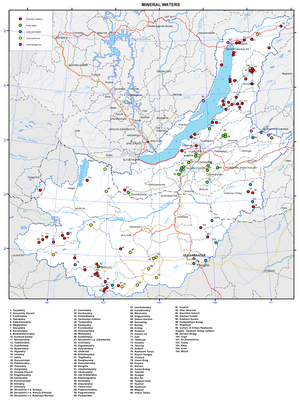
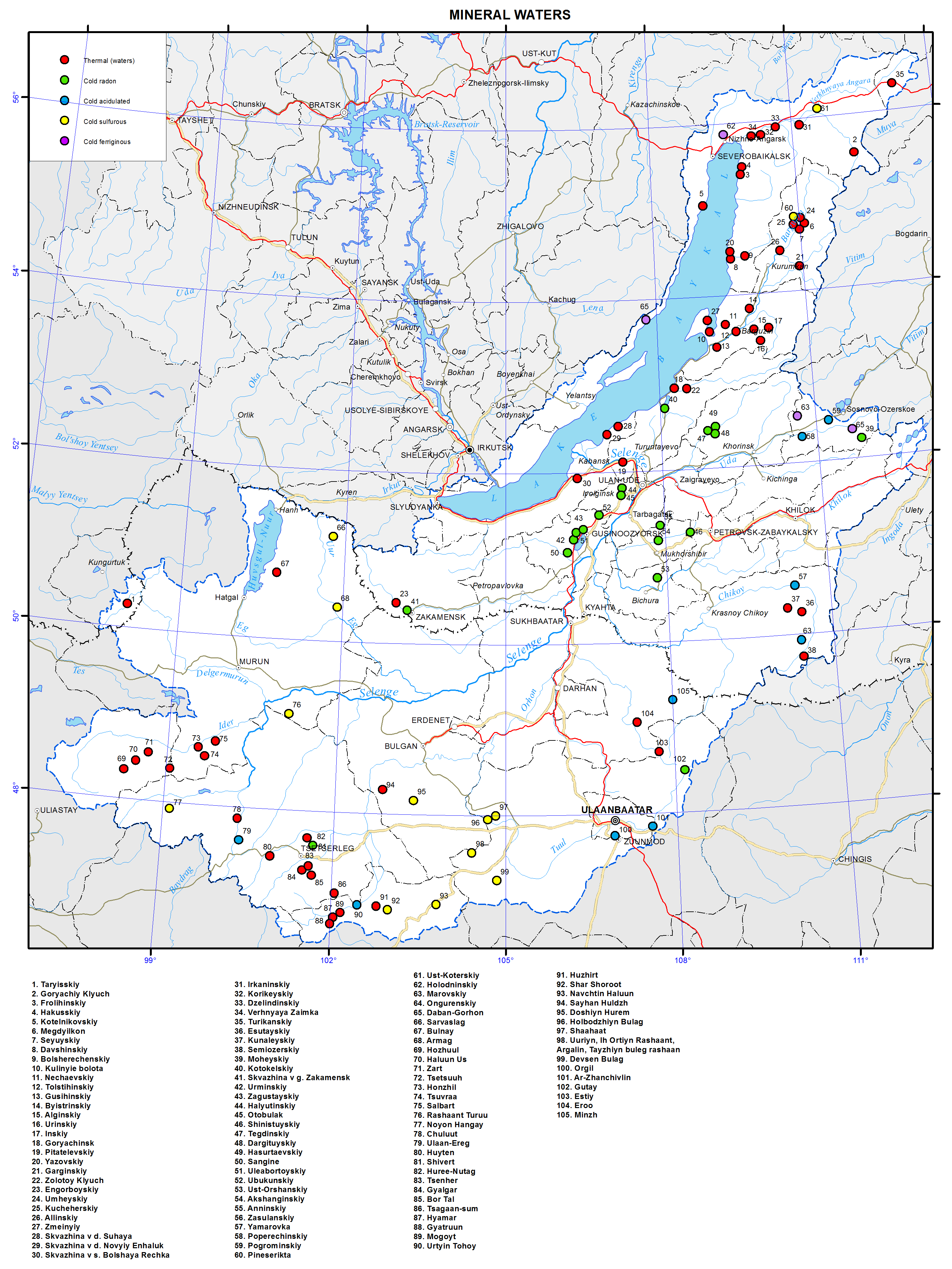
<p>The map is based on generalizing monographs, maps of mineral waters and field research data obtained by the authors.</p>
<p>The map depicts mineral springs, the water of which can be used for balneological purposes according to its physical and chemical properties. These characteristics include: water temperature (hot springs); radon content (cold radon springs), content of free carbon dioxide (carbonic cold springs), content of sulphate sulfur (cold hydrogen sulfide springs) and iron (ferrous cold springs).</p>
<p>This map can be used for the organization of sanatorium-and-spa construction, as well as for planning of underground thermal water use in thermal engineering.<b> </b></p>
<p align="center">References</p>
<p>Borisenko, I.M., Zamana, L. (1978). <i>Mineral water of Buryatia</i>. - Ulan-Ude: Buryat kn. izd-vo. - 163 p.</p>
<p>Map of the Republic of Tyva (tourism objects, objects of nature, arzhaans, photos).(2012). - M1:1000000, Kyzyl.</p>
<p>Lomonosov, I.S., Kustov, Yu.I., Pinneker, E.V. (1977). <i>Mineral water in Baikal region</i>. – Irkutsk: Vost. Sib . kn. izd-vo. - 224 p.</p>
<p><i>Mineral water of southern part of Eastern Siberia.</i> Vol.II. (1962) – M.-L.: Izd. AN USSR. - 199 p.</p>
<p>Pissarsky, B.I., Nambar, B, Ariyadagva, B. (2003). <i>Map of mineral waters in Mongolia</i>. 1:2500000, - Ulaanbaatar.</p>]]></content:encoded>
    <dc:publisher>No publisher</dc:publisher>
    <dc:creator>Alexander Ayurzhanaev</dc:creator>
    <dc:rights></dc:rights>
    <dc:date>2014-10-08T05:50:00Z</dc:date>
    <dc:type>Page</dc:type>
  </item>


  <item rdf:about="http://bic.iwlearn.org/en/documents/documents/papers/mercury-exposure-in-female-artisanal-small-scale-gold-miners-asgm-in-mongolia-english">
    <title>Mercury exposure in female artisanal small-scale gold miners (ASGM) in Mongolia (English)</title>
    <link>http://bic.iwlearn.org/en/documents/documents/papers/mercury-exposure-in-female-artisanal-small-scale-gold-miners-asgm-in-mongolia-english</link>
    <description></description>
    
    <dc:publisher>No publisher</dc:publisher>
    <dc:creator>puntsagsurenchoimpog@yahoo.com</dc:creator>
    <dc:rights></dc:rights>
    <dc:date>2014-12-30T01:28:11Z</dc:date>
    <dc:type>File</dc:type>
  </item>


  <item rdf:about="http://bic.iwlearn.org/en/atlas/atlas/99-medical-service-density-nursing-staff-map/medical-service-density-nursing-staff-map">
    <title>Medical service density - Nursing staff map</title>
    <link>http://bic.iwlearn.org/en/atlas/atlas/99-medical-service-density-nursing-staff-map/medical-service-density-nursing-staff-map</link>
    <description></description>
    <content:encoded xmlns:content="http://purl.org/rss/1.0/modules/content/"><![CDATA[<p><img class="image-inline" src="../../../resolveuid/c581f72dfaff4a92abe0d96a88b48956/@@images/image/preview" /></p>
<p><a href="http://bic.iwlearn.org/en/atlas/photos/copy_of__99_MedicalservicedensityNursingstaff.png" class="internal-link">Open full size</a></p>
<p align="center"><strong>Healthcare</strong><strong> </strong></p>
<p align="center"><strong> </strong></p>
<p>Harsh climatic conditions across the entire territory of the Baikal basin and the surface and ground water used for drinking and food purposes that do not meet the drinking water quality standards (first and foremost in Mongolia and Buryatia) coupled with atmospheric emissions from industrial facilities and motor vehicles (in some parts of the territory) are responsible for the state of human health influencing the organization of healthcare. The ecological situation becomes substantially worse during winter months, which is encouraged by the topography of the terrain. In Mongolia, the spring period is very hard time to bear, with sharp temperature differences, abrupt variations in atmospheric pressure, and frequent dust and magnetic storms.</p>
<p class="NormalWeb">The organizational pattern of healthcare in Russia and Mongolia has much in common. This is a result of the cooperation of the two countries in this sphere and the fact that medical education and healthcare in Mongolia are organized using Russian experience. Today, Mongolian medical facilities operate on the principles of the state-private partnership concurrent with the demonopolization of the state system of medical services. The country has a mandatory and voluntary medical insurance system, in which state-owned and private medical institutions take part. The country also has various health institutes and centers.</p>
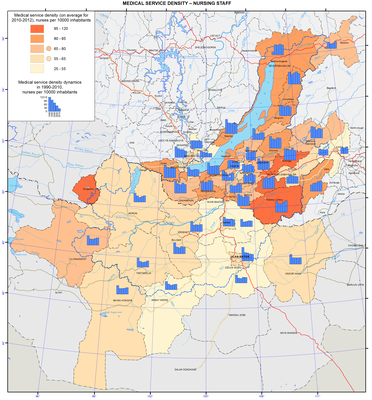
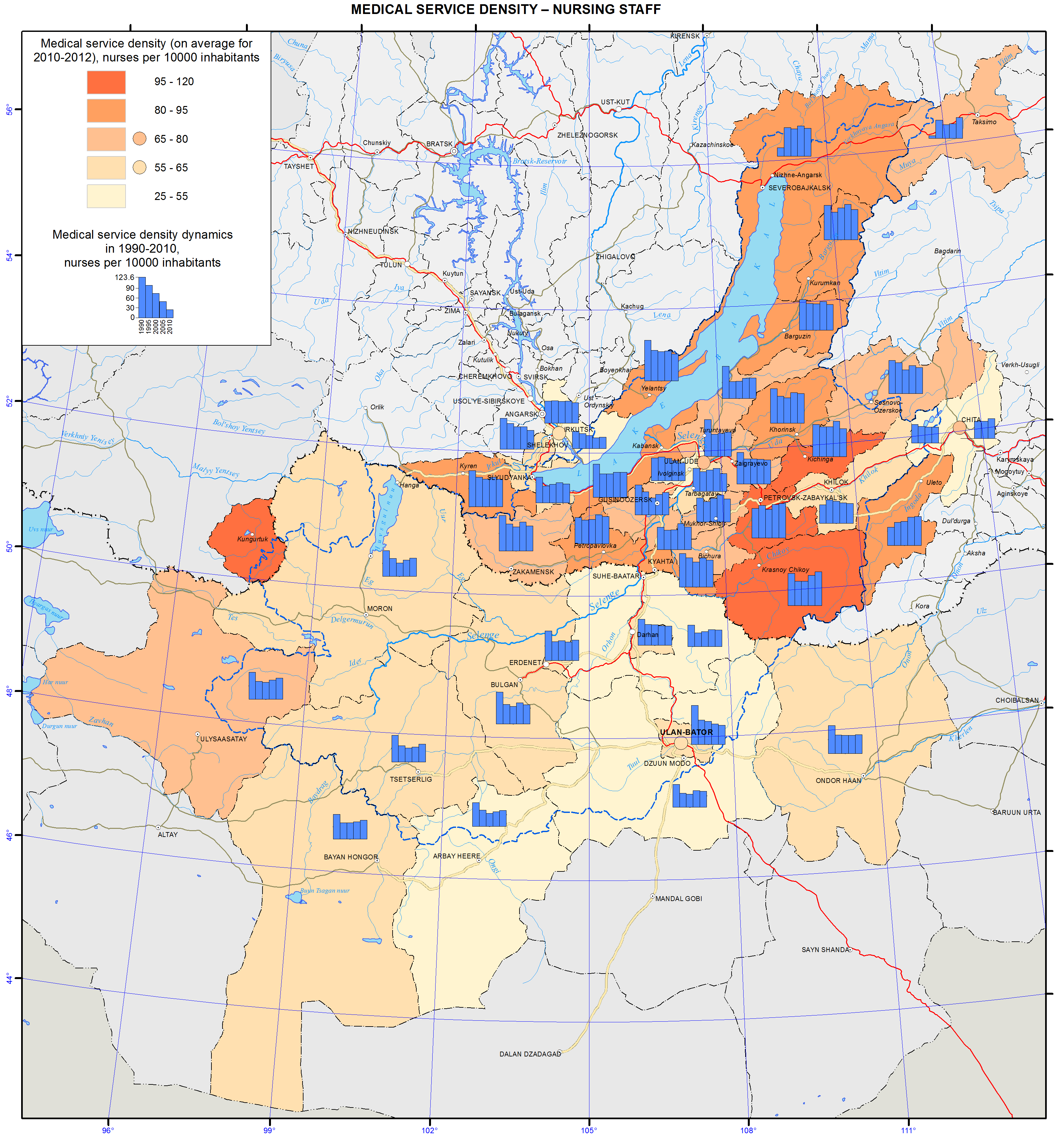
<p class="a">The territory of the Baikal basin is experiencing a deficit of medical workers. As of 2012, the availability of physicians varied from 13.8 to 30.1 per 10,000 people in Russian districts and from 16.1 to 29.0 per 10,000 people in Mongolian aimags. The availability of nurses varies from 25.1 to 112.2 per 10,000 people in Russian districts and from 26.4 to 38.2 per 10,000 people in Mongolian aimags. In Ulan-Ude, these indicators have the values of 53.9 and 117.3, while in Ulaanbaatar – 44.1 and 41.2, respectively.</p>
<p>The ratio of doctors and nurses in the Russian part of the basin is between 1:2 to 1:4, while in the Mongolian part it does not exceed 1:2. The World Health Organization (WHO) recommends that this ratio should be 1:4. A narrowing of this indicator causes imbalances in the healthcare system thereby limiting possibilities for further development of the after-treatment, casework and rehabilitation services.</p>
<p>Target indicators of healthcare activity are the standard volume of medical care per inhabitant. Currently, there are plans to decrease the per capita volume of in-patient services and increase the per capita volume of the hospital-replacing care. Accordingly, the number of hospital beds available 27/7 will decrease, while the number of beds in day hospitals will grow. Overall, the available number of hospital beds complies with the calculated standards and meets the demand of the population for the in-patient medical aid.</p>
<p class="ConsPlusNormal">As of today, in Russia, there is an array of problems relating to the high level of illnesses and disability incidences among the population, and these indicators are continuously growing. Such a situation is the result of inadequate preventive measures. Another important contributing factor to this situation is the increase of the proportion of elderly population and the improved effectiveness of illness detection using new diagnostic methods in the process of the increased number of medical checkups.</p>
<p class="ConsPlusNormal">The leading illnesses in the structure of morbidity are respiratory illnesses, bloodstream, eye, and digestive and musculoskeletal system diseases, as well as traumas. For many years, circulatory system diseases, neoplasms, and injuries have been the main causes of mortality and disability among the population.</p>
<p class="a">A complex of anthropogenic environmental factors contributes to the growth of morbidity and disability rates among the population with the most important one being air pollution. According to the WHO, atmospheric air pollution is the cause of up to 23% of all illnesses. The amount of pollutant emissions in the atmosphere produced by static sources in different administrative divisions in the Baikal basin differs by more than a thousand times. The most polluted air in the Baikal basin is in the Selenginsky district of Buryatia.</p>
<p>The health of the population and further development of healthcare depend on ecological, social, and economic factors. These problems can be resolved only through comprehensive approaches to the improvement of the quality of life of the population.</p>
<p>The strategic goal of the healthcare systems of Russia and Mongolia is to build a system, which ensures the quality and accessibility of medical services, primarily first aid, and increases the efficiency of medical services, based on the improvement of territorial planning of healthcare. The volume, types, and quality of these services should correspond to the rate of morbidity, population requirements, and the latest achievements of medical science, based on perfecting the system of territorial planning of public health services.</p>]]></content:encoded>
    <dc:publisher>No publisher</dc:publisher>
    <dc:creator>Alexander Ayurzhanaev</dc:creator>
    <dc:rights></dc:rights>
    <dc:date>2014-10-13T06:15:00Z</dc:date>
    <dc:type>Page</dc:type>
  </item>


  <item rdf:about="http://bic.iwlearn.org/en/atlas/atlas/98-medical-service-density-doctors-map/medical-service-density-doctors-map">
    <title>Medical service density - Doctors map</title>
    <link>http://bic.iwlearn.org/en/atlas/atlas/98-medical-service-density-doctors-map/medical-service-density-doctors-map</link>
    <description></description>
    <content:encoded xmlns:content="http://purl.org/rss/1.0/modules/content/"><![CDATA[<p><img class="image-inline" src="../../../resolveuid/639ff5082bd24d74bbb798a5ee9123f1/@@images/image/preview" /></p>
<p><a href="http://bic.iwlearn.org/en/atlas/photos/copy_of__98_MedicalservicedensityDoctors.png" class="internal-link">Open full size</a></p>
<p align="center"><strong>Healthcare</strong><strong> </strong></p>
<p align="center"><strong> </strong></p>
<p>Harsh climatic conditions across the entire territory of the Baikal basin and the surface and ground water used for drinking and food purposes that do not meet the drinking water quality standards (first and foremost in Mongolia and Buryatia) coupled with atmospheric emissions from industrial facilities and motor vehicles (in some parts of the territory) are responsible for the state of human health influencing the organization of healthcare. The ecological situation becomes substantially worse during winter months, which is encouraged by the topography of the terrain. In Mongolia, the spring period is very hard time to bear, with sharp temperature differences, abrupt variations in atmospheric pressure, and frequent dust and magnetic storms.</p>
<p class="NormalWeb">The organizational pattern of healthcare in Russia and Mongolia has much in common. This is a result of the cooperation of the two countries in this sphere and the fact that medical education and healthcare in Mongolia are organized using Russian experience. Today, Mongolian medical facilities operate on the principles of the state-private partnership concurrent with the demonopolization of the state system of medical services. The country has a mandatory and voluntary medical insurance system, in which state-owned and private medical institutions take part. The country also has various health institutes and centers.</p>
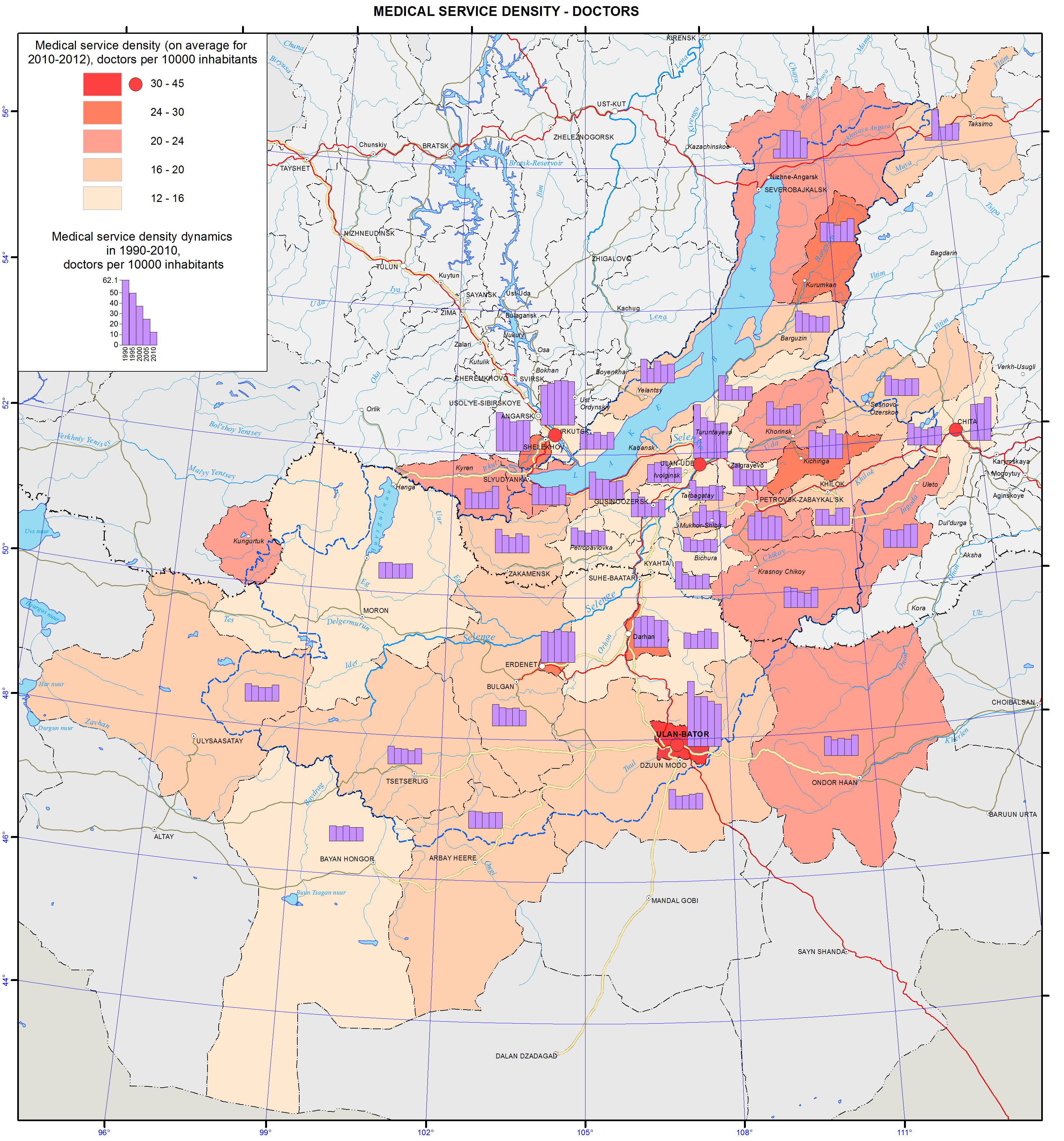
<p class="a">The territory of the Baikal basin is experiencing a deficit of medical workers. As of 2012, the availability of physicians varied from 13.8 to 30.1 per 10,000 people in Russian districts and from 16.1 to 29.0 per 10,000 people in Mongolian aimags. The availability of nurses varies from 25.1 to 112.2 per 10,000 people in Russian districts and from 26.4 to 38.2 per 10,000 people in Mongolian aimags. In Ulan-Ude, these indicators have the values of 53.9 and 117.3, while in Ulaanbaatar – 44.1 and 41.2, respectively.</p>
<p>The ratio of doctors and nurses in the Russian part of the basin is between 1:2 to 1:4, while in the Mongolian part it does not exceed 1:2. The World Health Organization (WHO) recommends that this ratio should be 1:4. A narrowing of this indicator causes imbalances in the healthcare system thereby limiting possibilities for further development of the after-treatment, casework and rehabilitation services.</p>
<p>Target indicators of healthcare activity are the standard volume of medical care per inhabitant. Currently, there are plans to decrease the per capita volume of in-patient services and increase the per capita volume of the hospital-replacing care. Accordingly, the number of hospital beds available 27/7 will decrease, while the number of beds in day hospitals will grow. Overall, the available number of hospital beds complies with the calculated standards and meets the demand of the population for the in-patient medical aid.</p>
<p class="ConsPlusNormal">As of today, in Russia, there is an array of problems relating to the high level of illnesses and disability incidences among the population, and these indicators are continuously growing. Such a situation is the result of inadequate preventive measures. Another important contributing factor to this situation is the increase of the proportion of elderly population and the improved effectiveness of illness detection using new diagnostic methods in the process of the increased number of medical checkups.</p>
<p class="ConsPlusNormal">The leading illnesses in the structure of morbidity are respiratory illnesses, bloodstream, eye, and digestive and musculoskeletal system diseases, as well as traumas. For many years, circulatory system diseases, neoplasms, and injuries have been the main causes of mortality and disability among the population.</p>
<p class="a">A complex of anthropogenic environmental factors contributes to the growth of morbidity and disability rates among the population with the most important one being air pollution. According to the WHO, atmospheric air pollution is the cause of up to 23% of all illnesses. The amount of pollutant emissions in the atmosphere produced by static sources in different administrative divisions in the Baikal basin differs by more than a thousand times. The most polluted air in the Baikal basin is in the Selenginsky district of Buryatia.</p>
<p>The health of the population and further development of healthcare depend on ecological, social, and economic factors. These problems can be resolved only through comprehensive approaches to the improvement of the quality of life of the population.</p>
<p>The strategic goal of the healthcare systems of Russia and Mongolia is to build a system, which ensures the quality and accessibility of medical services, primarily first aid, and increases the efficiency of medical services, based on the improvement of territorial planning of healthcare. The volume, types, and quality of these services should correspond to the rate of morbidity, population requirements, and the latest achievements of medical science, based on perfecting the system of territorial planning of public health services.</p>]]></content:encoded>
    <dc:publisher>No publisher</dc:publisher>
    <dc:creator>Alexander Ayurzhanaev</dc:creator>
    <dc:rights></dc:rights>
    <dc:date>2014-10-13T06:05:00Z</dc:date>
    <dc:type>Page</dc:type>
  </item>


  <item rdf:about="http://bic.iwlearn.org/en/atlas/atlas/28-maximum-runoff-during-the-flood-map/maximum-runoff-during-the-flood-map">
    <title>Maximum runoff during the flood map</title>
    <link>http://bic.iwlearn.org/en/atlas/atlas/28-maximum-runoff-during-the-flood-map/maximum-runoff-during-the-flood-map</link>
    <description></description>
    <content:encoded xmlns:content="http://purl.org/rss/1.0/modules/content/"><![CDATA[<p><img class="image-inline" src="../../../resolveuid/7e21331f5819408badfa79e4240cb100/@@images/image/preview" /></p>
<p><a href="http://bic.iwlearn.org/en/atlas/photos/copy_of__28_Maximumrunoffduringtheflood.png" class="internal-link">Open full size</a></p>
<p align="center"><strong>Flow</strong></p>
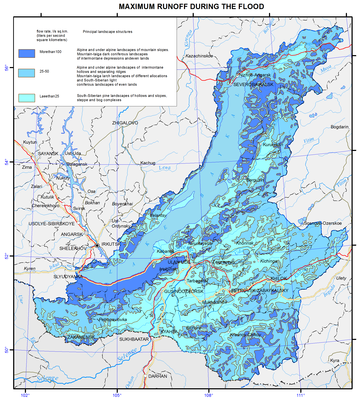
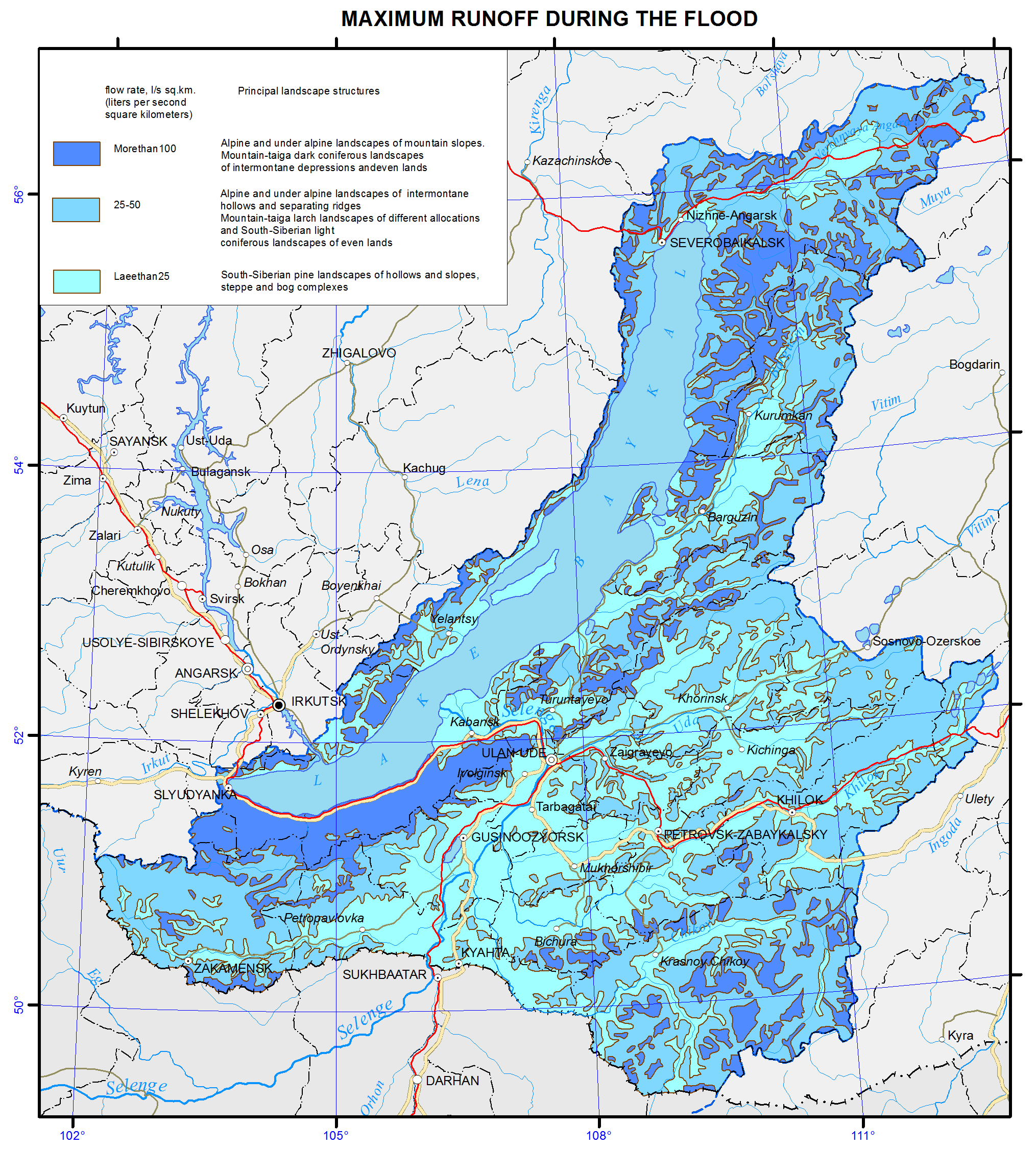
<p>The map “Mean annual flow” reflects the formation patterns of the water regime of the territory, which are determined by the properties of landscapes to transform atmospheric moisture into the runoff.</p>
<p>For a water body basin, the surface runoff is the total amount of water loss from the watershed landscapes. The runoff rate from landscape complexes is determined by solving the inverse problem, i.e. identification of the connection of flow rate at the main stream station of a catchment with the runoff from landscapes, occupying its area, and is calculated based on the equation Q<sub>j</sub> = ∑q<sub>i</sub> f<sub>ij</sub><i>,</i><i> </i>where <i>j</i> is the index of the river basin, Q<sub>j</sub> is its runoff, L/s; q<sub>i</sub> is a modification of flow from the i-th landscape complex, L/s km<sup>2</sup>; f<sub>ij</sub> is an area of the j-th basin occupied by the i-th landscape, km<sup>2</sup>. Long-term average runoff data for small and medium-sized rivers of theLake Baikal basin were used in calculations for the map construction [Long-term…, 1986, http://www.r-arcticnet.sr.unh.edu]. Characteristics of landscape components were obtained on the basis of the materials on landscape of the Baikal region [Landscapes…, 1977, Natural..., 2009, Landscapes…, 1990, Lysanova et al., 2009]. In accordance with the regional dimension, generalization degree is chosen at the geom level, and their average annual flow moduli are determined. The territory on the map is divided into regions according to five gradations of the module - from less than 1 to more than 10 L/s km<sup>2</sup>.</p>
<p>The catchment area of the lake covers a variety of landscape zones and altitudinal belts, which makes a great contrast between the runoff rates. The highest annual flow moduli are formed within the goletz and mountain-taiga landscapes. Steppe and forest-steppe areas are distinguished by the minimum runoff rates, and in the desert regions of Mongolia (the Selenga river basin) flow formation almost does not take place.</p>
<p>The maps of minimum and maximum flow were compiled based on the typological landscape classification represented on the map [Landscapes…, 1977]. In the course of investigation, landscapes of different types were generalized by identifying the most hydrologically informative properties (morphological characteristics, vegetation structure, altitudinal zonation, etc.). As a result, more than 200 landscapes were combined into sixteen types of natural complexes, and runoff rates were determined for them. The moduli of maximum snow runoff and minimum summer runoff were calculated as described above.</p>
<p>Areas with the highest runoff of floods are confined to the mountain ranges and systems with goletz open woodlands and mountain-taiga landscapes. The main areas, distinguished by formation of frequent and high floods are the Baikalsky Range on the north-eastern end of the lake; Barguzinsky Range, located in the south-eastern part of the catchment, and the Khamar-Daban, covering the south-western shore of Lake Baikal. The values of the maximum flow modification are shown in three gradations on the map, namely: less than 25, 25-70, and more than 100 L/s km<sup>2</sup>.</p>
<p>Features of formation of the minimum summer runoff in the Baikal basin are associated with the regime of atmospheric moisture, as well as with the effects of altitude and exposition. The calculations and analysis of the minimum summer runoff have shown a relatively high water yield in the low-flow period from high-mountain taiga landscapes and extremely low river flow formation in the central areas of the Selenga river catchment and in Priolkhonie, which are covered with light coniferous landscapes and steppe complexes on slopes and plains. The map shows the value of the minimum flow in three gradations, namely: less than 1.5, 3.0-5.0, and more than 5.0 L/s km<sup>2</sup>.</p>
<p>Landscape-hydrological mapping based on the quantitative characteristics of water yield of landscape complexes objectively reflects the hydrological organization of the territory.</p>
<p><b> </b></p>
<p align="center">References</p>
<p>Kuznetsova T.I. (2009). Map "Natural landscapes of the Baikal region and their use: purpose, structure, and content”.  T.I. Kuznetsova, A.R. Batuev, and A.V. Bardash. <i>Geodeziya i kartografiya,</i> , no 9, pp. 18-28.</p>
<p>Landscapes of southern East Siberia [Maps]: [physical map] (1977) / compiled and prep. for printing by factory no. 4 GUGK in 1976, authors: V.S. Mikheev and V.A. Ryashin. 1: 1 500 000, Moscow: GUGK, 1 map (4 sheets): col.</p>
<p>Landscapes [Maps] [physical map] / The National Atlas of the Mongolian People's Republic. / comp .and prep to print by GUGK in 1989, authors: B.M. Ishmuratov, K.N. Misevich, I.L. Savelyeva, et al.</p>
<p>Lysanova, G.I., Semenov, Yu.M., Shekhovtsov, A.I., and Sorokovoy, A.A. (2013). Geosystems of the Republic of Tuva. <i>Geografiya i prirodnye resursy</i>, no. 3, pp. 181-185.</p>
<p>Long-term data on the regime and surface water resources. The Baikal basin. (1986). Vol. 1, no. 14, Leningrad: Gidrometeoizdat, 361 p.</p>
<p><b><i>A Regional, Electronic, Hydrographic Data Network For the Arctic Region.</i></b> <b>URL: </b><a href="http://www.r-arcticnet.sr.unh.edu/"><b>http://www.r-arcticnet.sr.unh.edu</b></a></p>]]></content:encoded>
    <dc:publisher>No publisher</dc:publisher>
    <dc:creator>Alexander Ayurzhanaev</dc:creator>
    <dc:rights></dc:rights>
    <dc:date>2014-10-06T04:20:00Z</dc:date>
    <dc:type>Page</dc:type>
  </item>


  <item rdf:about="http://bic.iwlearn.org/en/photos/map_baikalbasin">
    <title>Map_BaikalBasin</title>
    <link>http://bic.iwlearn.org/en/photos/map_baikalbasin</link>
    <description></description>
    
    <dc:publisher>No publisher</dc:publisher>
    <dc:creator>Alexander Ayurzhanaev</dc:creator>
    <dc:rights></dc:rights>
    <dc:date>2014-04-03T06:34:02Z</dc:date>
    <dc:type>Image</dc:type>
  </item>


  <item rdf:about="http://bic.iwlearn.org/en/atlas/atlas/108-malignant-neoplasms-map/malignant-neoplasms-map">
    <title>Malignant neoplasms map</title>
    <link>http://bic.iwlearn.org/en/atlas/atlas/108-malignant-neoplasms-map/malignant-neoplasms-map</link>
    <description></description>
    <content:encoded xmlns:content="http://purl.org/rss/1.0/modules/content/"><![CDATA[<p><img class="image-inline" src="../../../resolveuid/2796c2e4f47c4d5093b848d5d5a557d4/@@images/image/preview" /></p>
<p><a href="http://bic.iwlearn.org/en/atlas/photos/copy_of__108_Malignantneoplasms.png" class="internal-link">Open full size</a></p>
<p align="center"><strong>Healthcare</strong><strong> </strong></p>
<p align="center"><strong> </strong></p>
<p>Harsh climatic conditions across the entire territory of the Baikal basin and the surface and ground water used for drinking and food purposes that do not meet the drinking water quality standards (first and foremost in Mongolia and Buryatia) coupled with atmospheric emissions from industrial facilities and motor vehicles (in some parts of the territory) are responsible for the state of human health influencing the organization of healthcare. The ecological situation becomes substantially worse during winter months, which is encouraged by the topography of the terrain. In Mongolia, the spring period is very hard time to bear, with sharp temperature differences, abrupt variations in atmospheric pressure, and frequent dust and magnetic storms.</p>
<p class="NormalWeb">The organizational pattern of healthcare in Russia and Mongolia has much in common. This is a result of the cooperation of the two countries in this sphere and the fact that medical education and healthcare in Mongolia are organized using Russian experience. Today, Mongolian medical facilities operate on the principles of the state-private partnership concurrent with the demonopolization of the state system of medical services. The country has a mandatory and voluntary medical insurance system, in which state-owned and private medical institutions take part. The country also has various health institutes and centers.</p>
<p class="a">The territory of the Baikal basin is experiencing a deficit of medical workers. As of 2012, the availability of physicians varied from 13.8 to 30.1 per 10,000 people in Russian districts and from 16.1 to 29.0 per 10,000 people in Mongolian aimags. The availability of nurses varies from 25.1 to 112.2 per 10,000 people in Russian districts and from 26.4 to 38.2 per 10,000 people in Mongolian aimags. In Ulan-Ude, these indicators have the values of 53.9 and 117.3, while in Ulaanbaatar – 44.1 and 41.2, respectively.</p>
<p>The ratio of doctors and nurses in the Russian part of the basin is between 1:2 to 1:4, while in the Mongolian part it does not exceed 1:2. The World Health Organization (WHO) recommends that this ratio should be 1:4. A narrowing of this indicator causes imbalances in the healthcare system thereby limiting possibilities for further development of the after-treatment, casework and rehabilitation services.</p>
<p>Target indicators of healthcare activity are the standard volume of medical care per inhabitant. Currently, there are plans to decrease the per capita volume of in-patient services and increase the per capita volume of the hospital-replacing care. Accordingly, the number of hospital beds available 27/7 will decrease, while the number of beds in day hospitals will grow. Overall, the available number of hospital beds complies with the calculated standards and meets the demand of the population for the in-patient medical aid.</p>
<p class="ConsPlusNormal">As of today, in Russia, there is an array of problems relating to the high level of illnesses and disability incidences among the population, and these indicators are continuously growing. Such a situation is the result of inadequate preventive measures. Another important contributing factor to this situation is the increase of the proportion of elderly population and the improved effectiveness of illness detection using new diagnostic methods in the process of the increased number of medical checkups.</p>
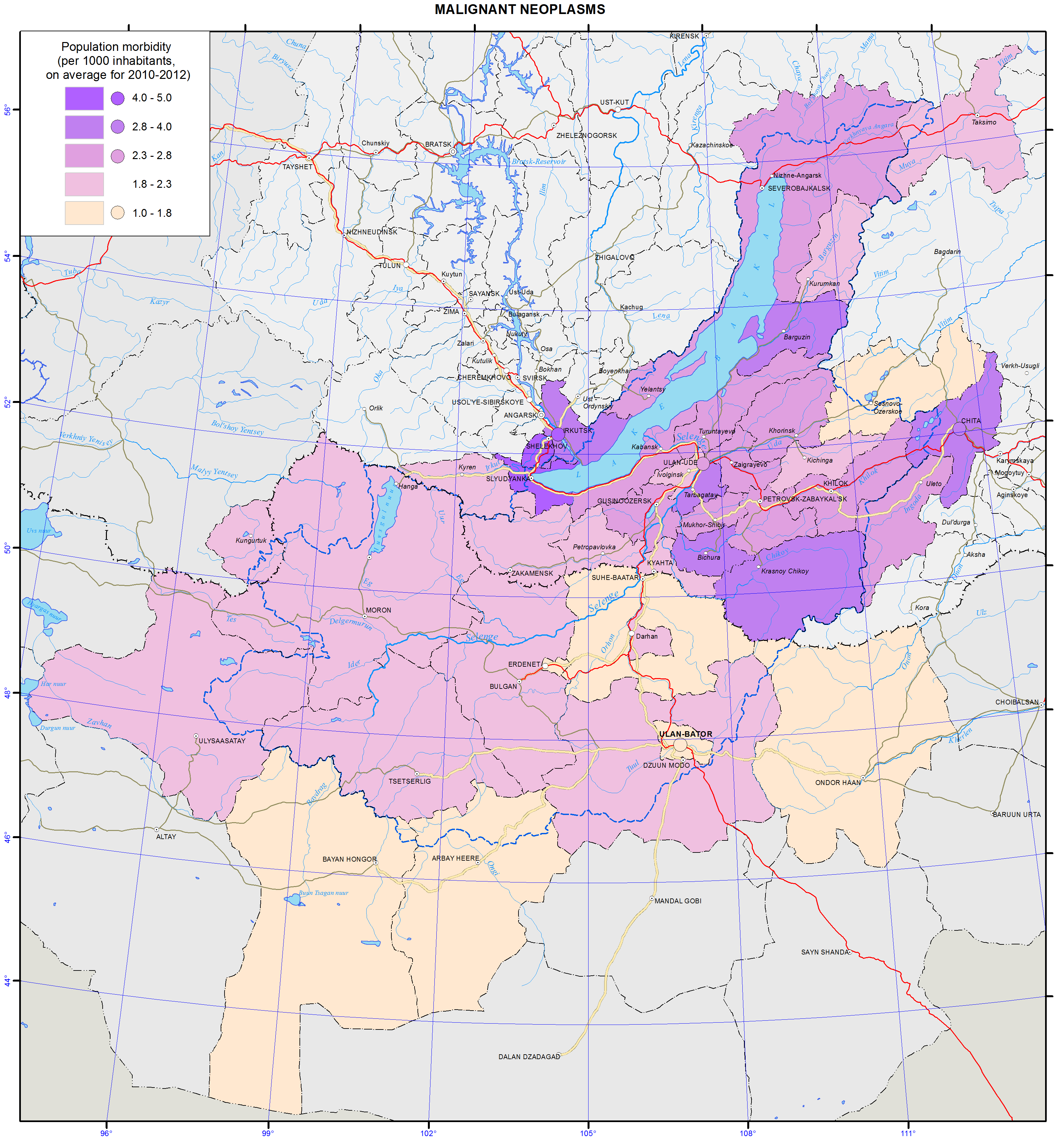
<p class="ConsPlusNormal">The leading illnesses in the structure of morbidity are respiratory illnesses, bloodstream, eye, and digestive and musculoskeletal system diseases, as well as traumas. For many years, circulatory system diseases, neoplasms, and injuries have been the main causes of mortality and disability among the population.</p>
<p class="a">A complex of anthropogenic environmental factors contributes to the growth of morbidity and disability rates among the population with the most important one being air pollution. According to the WHO, atmospheric air pollution is the cause of up to 23% of all illnesses. The amount of pollutant emissions in the atmosphere produced by static sources in different administrative divisions in the Baikal basin differs by more than a thousand times. The most polluted air in the Baikal basin is in the Selenginsky district of Buryatia.</p>
<p>The health of the population and further development of healthcare depend on ecological, social, and economic factors. These problems can be resolved only through comprehensive approaches to the improvement of the quality of life of the population.</p>
<p>The strategic goal of the healthcare systems of Russia and Mongolia is to build a system, which ensures the quality and accessibility of medical services, primarily first aid, and increases the efficiency of medical services, based on the improvement of territorial planning of healthcare. The volume, types, and quality of these services should correspond to the rate of morbidity, population requirements, and the latest achievements of medical science, based on perfecting the system of territorial planning of public health services.</p>]]></content:encoded>
    <dc:publisher>No publisher</dc:publisher>
    <dc:creator>Alexander Ayurzhanaev</dc:creator>
    <dc:rights></dc:rights>
    <dc:date>2014-10-14T02:50:00Z</dc:date>
    <dc:type>Page</dc:type>
  </item>


  <item rdf:about="http://bic.iwlearn.org/en/atlas/atlas/45-main-types-of-non-metallic-materials-map/main-types-of-non-metallic-materials-map">
    <title>Main types of nonmetallic materials map</title>
    <link>http://bic.iwlearn.org/en/atlas/atlas/45-main-types-of-non-metallic-materials-map/main-types-of-non-metallic-materials-map</link>
    <description></description>
    <content:encoded xmlns:content="http://purl.org/rss/1.0/modules/content/"><![CDATA[<p><img class="image-inline" src="../../../resolveuid/e609421c005a4d33a8cad29965afb9ce/@@images/image/preview" /></p>
<p><a href="http://bic.iwlearn.org/en/atlas/photos/copy_of__45_Maintypesofnonmetallicmaterials.png" class="internal-link">Open full size</a></p>
<p><img class="image-inline" src="../../../../resolveuid/b1d7d06c2c2f41659de254b9f3dcf0e7/@@images/image/preview" /></p>
<p><a href="http://bic.iwlearn.org/en/photos/copy_of__45_Table_Legend_Maintypesofnonmetallicmaterials.png" class="internal-link">Open full size</a></p>
<p align="center"><strong>The main types of nonmetallic raw materials: resources and development</strong></p>
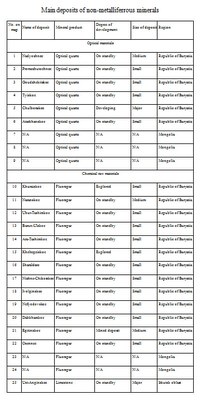
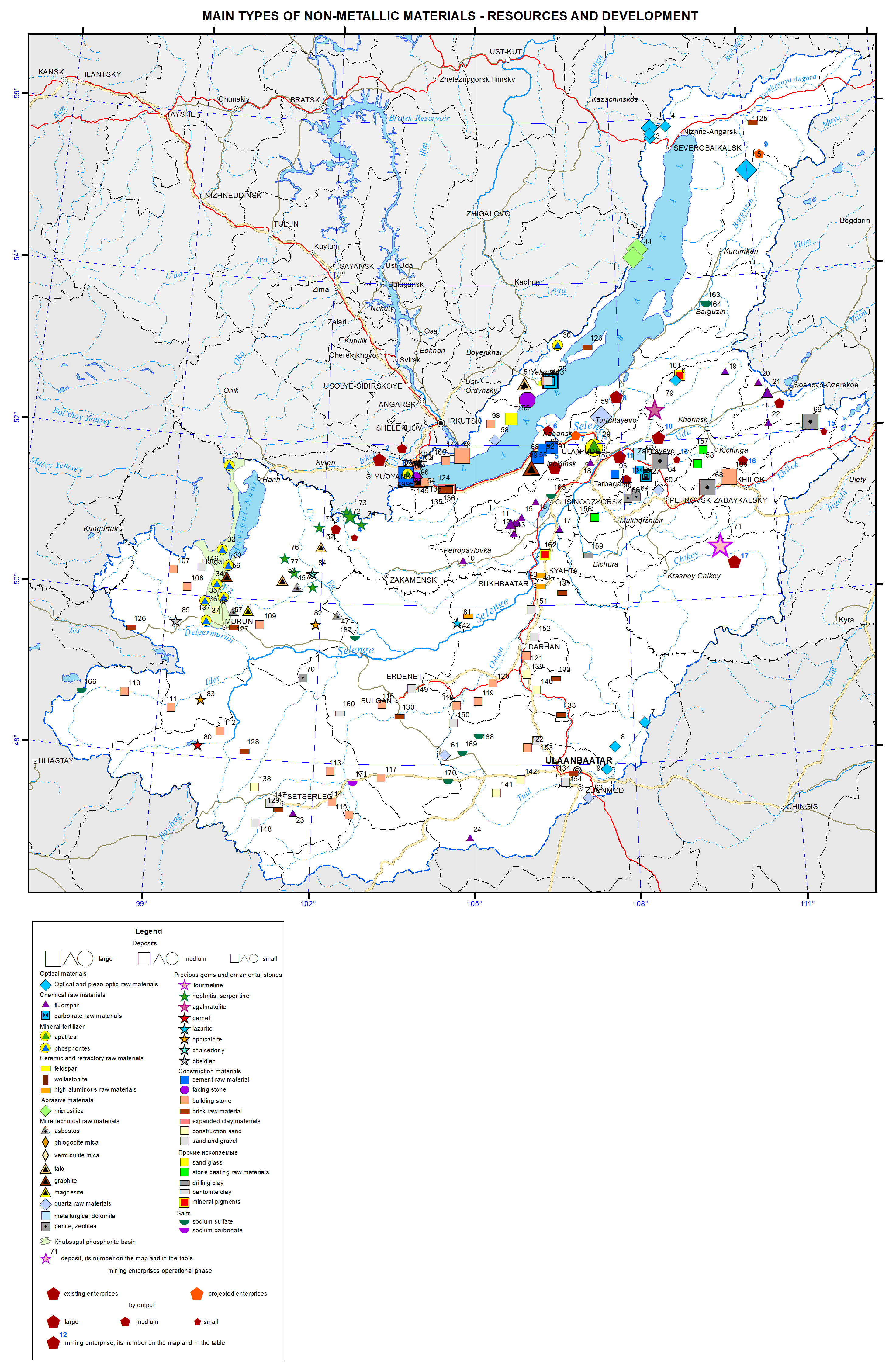
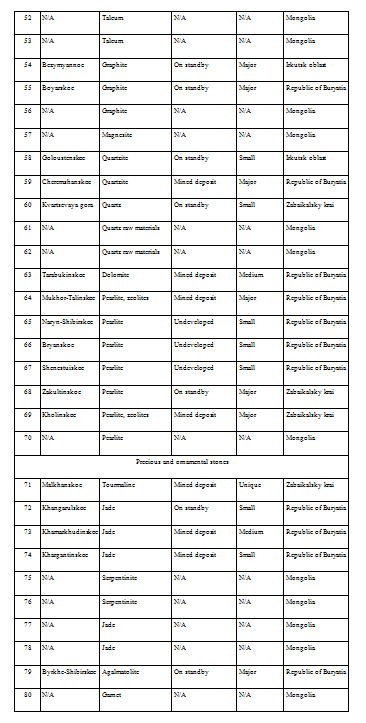
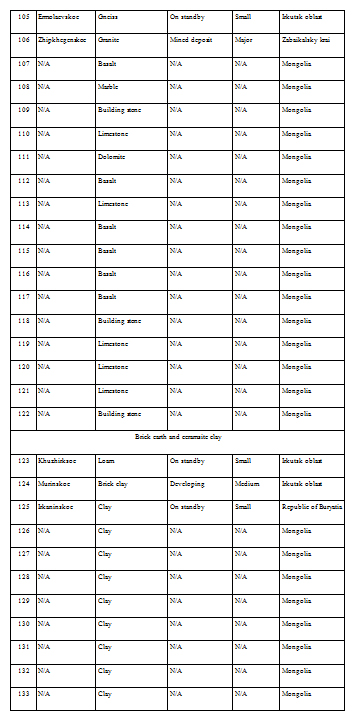
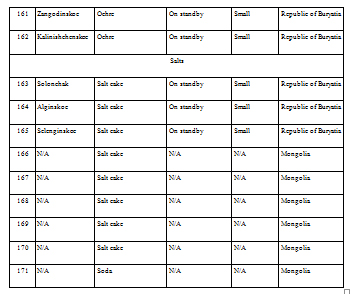
<p>Nonmetallic mineral resources of the region are of great industrial importance. Within the Baikal basin there are deposits of mining-chemical, thermo-chemical, and optical raw materials, construction materials, mineral fertilizers, ornamental and precious stones.</p>
<p>Deposits of <i>raw quartz </i>belong to strategic types of mineral resources. The region has a large raw materials base explored and prepared for industrial development: there are deposits of especially pure granular quartz (Chulbonskoe, Nadyozhnoe, Goudzhekitskoe, and others) and quartzites (Cheremshanskoe and Goloustenskoe). The vast majority of deposits are located in the territory of Buryatia; there are all prerequisites for creating a large complex of plants for deep processing of raw quartz for high-tech industries. In prospect, the republic can become the largest producer and exporter of polysilicon and total energy systems. Currently, there is a development project of the Chulbonskoe granular quartz deposit in the Severobaikalsky municipal district to get the end-product in the form of photovoltaic systems.</p>
<p>Quartzites of the mined Cheremshanskoe deposit are of exceptionally high raw materials quality meeting industrial requirements for the production of industrial silicon, silicon carbide and ferrosilicon; in recent years, research is carried out on the purest varieties to produce high-purity silicon for  helioenergetics and growing of single crystals of piezoelectric quartz. The deposit has been mined since 1992 by ZAO (Closed Joint Stock Company) “Cheremshansky quartsit” with an annual output of about 200 thousand tons and is a mineral resource base of ZAO (Closed Joint Stock Company) “Kremniy” of the OK (United Company) RUSAL, one of the most cutting edge silicon production facilities in Russia and the country's only producer of refined silicon .</p>
<p>Quartzites of the Goloustenskoe deposit can be used in metallurgy, and in the production of silica bricks. Sources of high-quality abrasive raw materials are microquartzites of two large deposits, located in the Olkhonsky municipal district on the eastern slope of the Baikal Range, namely, Srednekedrovoe and Zavorotninskoe. The latter was developed from 1975 till 1993 by “Baikalkvartssamotsvety”; currently, the deposits are on the governmental standby.</p>
<p>Considerable reserves of raw <i>fluorspar </i>were explored in the Baikal basin in the Republic of Buryatia. Currently, one deposit is mined here. It is the medium Egitinskoe deposit in the Eravninsky district; extracted ore is processed at the ore-dressing plant of the Zabaikalsky mining complex. The Naranskoe deposit in the Selenginsky district was prepared for operation and was mined for some time. The Kyakhtinskaya fluorspar factory operated near the settlement of Khoronkhoy from 1966; first it worked on local raw materials, and then on raw materials imported from Mongolia. Currently, the factory is out of operation.</p>
<p>The region possesses large reserves of chemically pure <i>limestone</i>s: in the Olkhonsky municipal district there is the Ust-Anginskoe deposit, and in the Zaigraevsky district there is the Bilyutinskoe deposit developed for the production of calcium carbide and the Tatarsky Klyuch for the paint and coatings industry. Dolomites of the Tarabukinskoe deposit are used as a raw material for glass and metallurgical production.</p>
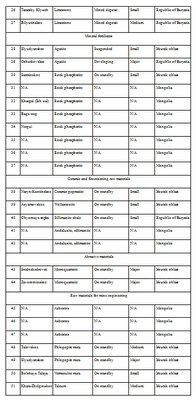
<p>Deposits of <i>phosphate</i> raw materials are known in Cisbaikalia. They are the Sarminskoe phosphorite deposit in the Olkhon municipal district and the Slyudyanskoe apatite deposit in the Sludyansky municipal district; in northern Mongolia large reserves of formation phosphorites in the Khovsgol phosphorite basin were discovered and previously explored. The main deposits of the basin are located in the immediate vicinity of Lake Khovsgol, which is an obstacle to their development. The large Oshurkovskoe apatite deposit is prepared for exploitation near the city of Ulan-Ude. On the basis of the approved ready reserves the Zabaikalsky apatite plant was under construction; it was closed down at the building phase of an ore-dressing plant because of possible deterioration of the environmental situation in the Baikal basin. Currently, there is a project of the deposit’s development based on environmentally friendly technologies for the extraction and beneficiation of ores. Taking into account a sustained deficit of phosphate raw materials in the country, an increase of the raw materials base for the production of phosphate fertilizers is a matter of economic security of Russia. The planned standard of production of apatite concentrate is 500 thousand tons per annum. Breakstone will be produced as a by-product in the same amount of 500 thousand tons per annum.</p>
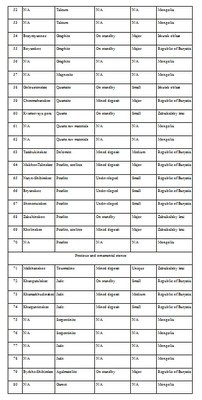
<p>Considering the <i>ceramic and fire-resisting raw materials</i>, deposits of Irkutsk oblast should be pointed out. They are the Naryn-Kuntinskoe microcline pegmatite deposit, developed earlier for the needs of the “Sibfarfor” factory, the Kharginskoe glass sands deposit, on the basis of which the Taltsy plant was established in 1784 producing a variety of glass products for 170 years, and the Asyamovskoe deposit of wollastonite, a relatively new kind of mineral products with a number of unique properties and a growing range of applications. In the south of Buryatia a sillimanite (high-alumina) shales deposit named Chyornaya Sopka is known; its ores have simple mineral composition and are easily dressed. On the basis of the deposit a non-waste production with the release of sillimanite and quartz as commercial products can be created. All the above mentioned deposits are currently on the governmental standby.<i> </i></p>
<p><i>Phlogopite mica</i> deposits in the south of Lake Baikal have been known since the second half of the 18<sup>th</sup> century. Its regular commercial production using a ramified system of underground (tunnels, mines) and open (open pits) mine openings began in 1924 with the development of the electrical engineering industry in the country and lasted until 1973. From four to seven thousand tons of high-quality raw materials were mined annually in the Sludyansky district.<i></i></p>
<p><i>Graphite </i>is represented in the region by two large deposits, namely, the Bezymyannoe (the Slyudyansky municipal district) and Boyarskoe (the Kabansky municipal district) deposits. Ores of the Bezymyannoe deposit are high quality and free-milling according to the manufacturer's tests, but the deposit is located in close proximity to Lake Baikal. The Boyarskoe deposit has the largest reserves. Economic efficiency of its development in compliance with all environmental requirements can be quite high despite low average graphite content in the ore, thanks to its favorable transportation and geographical location.</p>
<p>In the past, a considerable part of the Baikal basin experienced intense volcanic activity, the product of which is <i>pearlite</i> deposits, among which the largest ones are Mukhor-Talinskoe, Zakultinskoe, and Kholinskoe. Currently, this raw material is produced by OAO (Joint Stock Company) “Perlit” on the Mukhor-Talinskoe deposit with the production output amounting to 1-10 thousand m<sup>3</sup> of raw material per annum over the last three years. The Kholinskoe pearlite and zeolite deposit is located on the border of the Republic of Buryatia and Zabaikalsky krai; the mining OOO (Limited Liability Company) “Kholinskie tseolity” develops the deposit. Nowadays, the capacity of the company mining such a valuable kind of mineral product as zeolites is small and amounts to only about 0.8 thousand tons.</p>
<p>Within the region there are a number of deposits of <i>precious and ornamental stones</i>. In Zabaikalsky krai, ZAO (Closed Joint Stock Company) “Turmalkhan” develops a unique deposit of jewelry tourmaline, which is the only one in Russia to date. In the Republic of Buryatia, OOO (Limited Liability Company) “Kaskad” exploits the Khargantinskoe deposit with an annual production of 20 tons of raw jade; ZAO (Closed Joint Stock Company) “MS Holding” started to develop the Khamarkhudinskoe jade deposit, where 510 tons were produced in 2012.</p>
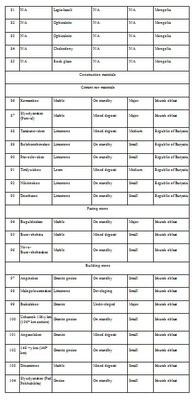
<p>To meet the needs of the construction industry the region possesses significant resources of <i>mineral construction materials</i>: numerous deposits of cement, brick, sand and gravel raw materials, building and facing stone are explored in the area. The raw materials base of the Angarsky cement plant is the large Slyudyanskoe deposit of cement marbles, being developed by the OOO (Limited Liability Company) “Karyer Pereval” with an annual output of about 900 thousand tons. The Tarakanovskoe deposit of cement limestone and Timlyuiskoe deposit of loam supply the Timlyuisky cement plant with raw materials. OOO (Limited Liability Company) “Timlyuitsement” produces 250-400 thousand tons of limestone and 20-35 thousand tons of loam annually.</p>
<p>Facing stone deposits are located on the western and south-eastern shores of Lake Baikal; they are Burovshchina and Novo-Burovshchinskoe deposits of pink marbles and Buguldeiskoe deposit of highly-ornamental statuary marble of various color shades: from snow-white to smoky-gray. Currently, stone is not produced on any of these deposits. Among building stone deposits AO (Joint Stock Company) RZhD exploits two: one of them is the medium Angasolskoe deposit in Irkutsk oblast and the other is the large Zhipkhegenskoe deposit in Zabaikalsky krai forming the raw materials base of the same-name crushed stone plants. Several deposits of building stone are situated in the coastal zone of Lake Baikal, namely, Baikalskoe, Ermolaevskoe, Dinamitnoe and others, rendering their development impossible.</p>
<p>The following deposits of brick and keramzite claysand loams were discovered: the Murinskoe and Khuzhirskoe deposits in Cisbaikalia and Irkaninskoe deposit in the Severobaikalsky municipal district, deposits of sand-gravel mix, including the Utulikskoe deposit of high-quality raw materials, the Pankovskoe deposit of building sands, and so on.</p>
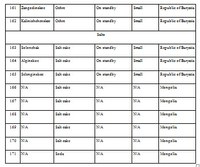
<p>Among <i>other</i> mineral resources of the region, the Zangodinskoe and Kalinishenskoe deposits of mineral paints, Khayanskoe deposit of drilling clays, several deposits of raw materials for stone casting, as well as deposits of mineral salts (sodium sulfate) should be mentioned. All deposits of these raw materials are small in terms of reserves and are on the governmental standby.</p>
<p>In Mongolia small deposits of asbestos, gypsum, graphite, talcum, magnesite, bentonite, ornamental stones (nephrite, serpentinite, lapis lasuli, ophicalcite, chalcedony, etc.), raw quartz, and mineral salts are known within the Baikal basin. As for construction materials there are deposits of building sand, brick, keramzite and ceramic clays, sand-gravel mix, building stone, etc.</p>
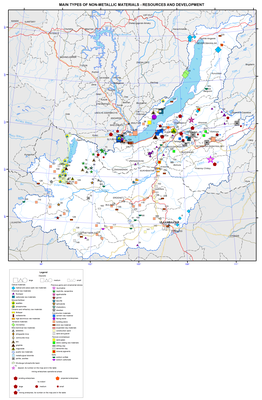
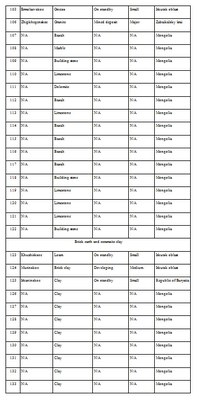
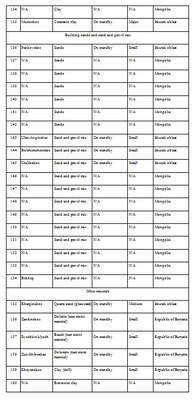
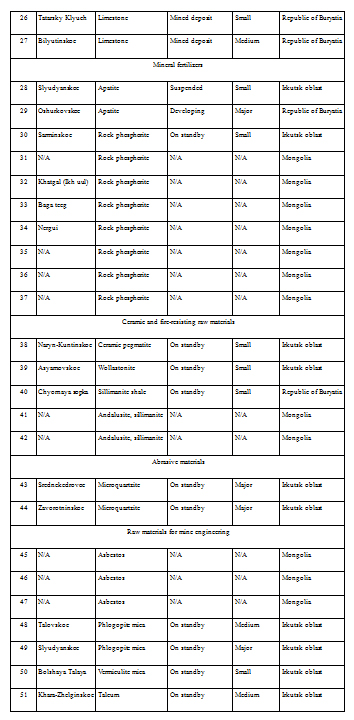
<p>The map presents the main nonmetallic mineral raw materials deposits, depending on their size and type of mineral product, as well as mining companies using symbols. The size of the symbol designating a company depends on the average production output over the recent three to five years or on the planned capacity of the objects designed and under construction; gradation is presented in the summary table. The color of the symbol corresponds to the operational phase of an enterprise. The Khubsugulsky phosphorite basin is shown with an areal.</p>
<p>Map construction required the use of the materials of the Regional Funds of Geological Information, maps of mineral resources of the A.P. Karpinsky Russian Geological Research Institute; materials of State Reports “On the Condition of Lake Baikal and Measures of its Protection” for 2010–2012; “National Atlas of the Mongolian People's Republic” (1990), “Atlas of Mongolia” in the Mongolian language (2010), and “Atlas of Socioeconomic Development of Russia” (2009). Information on deposits according to the types of raw materials and on mining companies is presented in the summary table.</p>
<p><img class="image-inline" src="../../../../resolveuid/d284b6f61e4c44f8ad43d46a668322d3/@@images/image/preview" /></p>
<p><a href="http://bic.iwlearn.org/en/photos/45.jpg" class="internal-link">Open full size</a></p>
<p><img class="image-inline" src="../../../../resolveuid/98bbb5cc2eef41158328f7f0eeb57425/@@images/image/preview" /></p>
<p><a href="http://bic.iwlearn.org/en/photos/451.jpg" class="internal-link">Open full size</a></p>
<p><img class="image-inline" src="../../../../resolveuid/a62eb843c052454cb3739df217414e92/@@images/image/preview" /></p>
<p><a href="http://bic.iwlearn.org/en/photos/452.jpg" class="internal-link">Open full size</a></p>
<p><img class="image-inline" src="../../../../resolveuid/6a6a2fd6be0d47ea9f98156bdefaf7d7/@@images/image/preview" /></p>
<p><a href="http://bic.iwlearn.org/en/photos/453.jpg" class="internal-link">Open full size</a></p>
<p><img class="image-inline" src="../../../../resolveuid/ae9af4a5656a4070a90f7207e47a3c60/@@images/image/preview" /></p>
<p><a href="http://bic.iwlearn.org/en/photos/454.jpg" class="internal-link">Open full size</a></p>
<p><img class="image-inline" src="../../../../resolveuid/dd33f181df6e436c924598b054fbd494/@@images/image/preview" /></p>
<p><a href="http://bic.iwlearn.org/en/photos/455.jpg" class="internal-link">Open full size</a></p>
<p><img class="image-inline" src="../../../../resolveuid/17b13986651f47f7bbddb28738053f17/@@images/image/mini" /></p>
<p><a href="http://bic.iwlearn.org/en/photos/456.jpg" class="internal-link">Open full size</a></p>]]></content:encoded>
    <dc:publisher>No publisher</dc:publisher>
    <dc:creator>Alexander Ayurzhanaev</dc:creator>
    <dc:rights></dc:rights>
    <dc:date>2014-10-08T01:50:00Z</dc:date>
    <dc:type>Page</dc:type>
  </item>


  <item rdf:about="http://bic.iwlearn.org/en/friends/local-environmental-public-organization-turka-russia-buryat-republic">
    <title>Local environmental public organization «Turka» (Russia, Republic of Buryatia)</title>
    <link>http://bic.iwlearn.org/en/friends/local-environmental-public-organization-turka-russia-buryat-republic</link>
    <description></description>
    <content:encoded xmlns:content="http://purl.org/rss/1.0/modules/content/"><![CDATA[<p align="center"><strong>LOCAL ENVIRONMENTAL PUBLIC</strong></p>
<p align="center"><strong>ORGANIZATION «TURKA»</strong></p>
<p><span style="text-decoration: underline;">Contact information:</span></p>
<p>671273, Republic of Buryatia, Pribaikalskiy district,</p>
<p>village Turka, October st., 89</p>
<p>Tel .: (301-44) 54-8-97, 25/9/54, 54-7-76. Fax: 8 (30144) 54-6-98.</p>
<p>E-mail: tivikova-t@mail.ru</p>
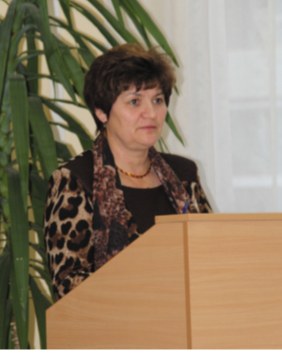
<p><span style="text-decoration: underline;">Chair:</span> Tatyana Alekseevna Tivikova</p>
<p><span style="text-decoration: underline;">Year of establishment:</span> 21 November 2001</p>
<p><span style="text-decoration: underline;"> </span></p>
<p><span style="text-decoration: underline;">The purposes of establishment:</span> the association of intellectual potential, basic and financial resources, institutional capacity of members for activities aimed to the nature preservation and environmental education.</p>
<p><span style="text-decoration: underline;">Main activities</span></p>
<p>- The collection, storage, analysis and dissemination of information about the condition of the environment;</p>
<p>- Research and develop recommendations for the nature protection in Turka village;</p>
<p>- Assistance to stakeholders, both legal and physical, in activities aimed to nature preservation in Turka village;</p>
<p>- Promoting the efficiency of environmental education.</p>
<p style="text-align: center; "><img class="image-inline" src="../../resolveuid/354409f538c2493eb8869ae03d708de9/@@images/image/preview" /></p>
<p align="center">Head of the organization Tatyana Tivikova</p>
<p><span style="text-decoration: underline;">Implementation of projects</span></p>
<p><strong>UNDP «Every Drop Matters - Lake Baikal»</strong></p>
<p>In 2011, executed projects:</p>
<p>- «Clean shore for the Lake Baikal». Cleanup activities at the shore of Lake Baikal, started landscaping. The recreation places are provided by tables, benches, gazebos, and equipped campfire places. Everything was made from natural materials.</p>
<p>- «Turkinsky Bazaar». In the center of Turka village built a shed with a counter for selling to tourists environmentally friendly products which collected in the forest or grown by local residents in their backyards (wild plants, vegetables, fish, meat, milk, etc.);</p>
<p>- «Clean shore for Lake Baikal, comfortable rest for tourists». In 2012, organized student’s work with tourists: raids, distribution of leaflets and booklets on environmental topics.</p>
<p>- «Baikal – clean rivers and streams». In 2013 was developed study of rivers and streams in the territory of the municipality «Turkinskoe». By method of bioindication collected baseline data of water quality in the river Turka above and downstream treatment facilities of Special economic zone (SEZ) «Baikal Harbor». The recreation places near the bridges, near the river banks along the road Ulan-Ude – Barguzin were equipped by gazebos, tables, benches and campfire places made from natural materials.</p>
<p>- «Berendeev forest». Implemented in the summer of 2013 with the support of Global Greengrants. Inside Turka village on the shore of the Lake Baikal, in the area of the forest, where grow ancient cedars and pines, have been built playground from natural materials (gnarled trees), installed a fabulous figure of Berendey and other heroes of the Russian tales, built a hut, gates, seasaw, bridge, and benches. On the playground «grow» mushrooms – boletus (ceps). This place is now popular among adults and children.</p>
<p>- Participation in the action «360 minutes for Baikal» in autumn 2013, cleanup activities at Turkinsky beach.</p>
<p>Together with local residents defended the transfer of parts of the coast of Lake Baikal area «Turkinsky beach» and section «Turka-Goryachinsk» where there is a stone «Cherepakha» (Turtle), from the extension of SEZ «Baikal Harbor».</p>
<p>Currently implementing project <strong>«Providing by clean water local people of the Turka and Goryachinsk»</strong>. Planned to repair two water carriers, overhaul two wells with the replacement of deep-well pumps in villages Goryachinsk and Turka.</p>]]></content:encoded>
    <dc:publisher>No publisher</dc:publisher>
    <dc:creator>Alexander Ayurzhanaev</dc:creator>
    <dc:rights></dc:rights>
    <dc:date>2015-02-06T03:35:00Z</dc:date>
    <dc:type>Page</dc:type>
  </item>


  <item rdf:about="http://bic.iwlearn.org/en/atlas/atlas/42-landscape-stability-map/landscape-stability-map">
    <title>Landscape stability map</title>
    <link>http://bic.iwlearn.org/en/atlas/atlas/42-landscape-stability-map/landscape-stability-map</link>
    <description></description>
    <content:encoded xmlns:content="http://purl.org/rss/1.0/modules/content/"><![CDATA[<p><img class="image-inline" src="../../../../resolveuid/def380b90f9b43e4b12b647035d988e2/@@images/image/preview" /></p>
<p><a href="http://bic.iwlearn.org/en/photos/copy2_of__42_LandscapeStability.png" class="internal-link">Open full size</a></p>
<p><img class="image-inline" src="../../../../resolveuid/145d45f9d03741aa8547a78a340e3803/@@images/image/preview" /></p>
<p><img class="image-inline" src="../../../../resolveuid/e1c273139cad4e6d90a1922fc5d06091/@@images/image/preview" /></p>
<p align="center"><strong>Landscapes stability </strong></p>
<p align="center"><strong> </strong></p>
<p>Landscape stability is one of the most important parameters determining the state of the environment and changes occurring in it under the influence of natural and anthropogenic factors. The nature of landscape changes depends on the location in the geographical environment, their properties, and type and extent of the anthropogenic impact. Of particular importance is the estimation of landscapes stability of the Baikal basin, which is an environmentally critical area.</p>
<p>Landscape stability is a property of a geosystem to maintain its structure and the mode of functioning under changing conditions of its environment [Protection of landscapes..., 1982]. An assessment and mapping of landscapes stability are made according to the complex of natural and anthropogenic factors of influence. The natural factor is mainly determined by the influence of climate (indicators of heat-moisture supply) and the properties of lithological-and-geomorphological basis. The anthropogenic influencing factor is associated with the background nature management, which is based on spatially extensive use of natural resources, and lands, closely related to the zonal-belt features of natural landscapes. The background types of nature management in the study area include agriculture, mainly in steppe landscapes, forestry in taiga landscapes, as well as recreation.</p>
<p>Stability is considered in relation to landscapes of two levels: regional (geoms) and topological (groups of facies). A landscape map, compiled by the authors on the basis of landscape maps of the territory under consideration [Landscapes..., 1977; Landscapes..., 1990], was used for its mapping.</p>
<p>Stability of landscapes of the regional level – geoms – is determined based on the level of natural ecological potential of a landscape (EPL), the main indicator of which is the index of biological effectiveness of climate (TK) according to N.N. Ivanov [Ecological..., 2007, Ecological..., 2007]. Characterization and comparative assessment of this indicator is based on the ratio of heat and moisture, on which the biological productivity of a landscape and ecological capacity primarily depend. At the same time, the influence of latitudinal and altitudinal zonality on their distribution is traced. A single and continuous process of moisture and heat exchange not only forms the spatial differentiation and a type of a landscape, but also determines its stability. Landscapes with high values of TK and EPL are the most stable, while low values ​​of these parameters characterize unstable landscapes.</p>
<p>Twenty-two geoms are represented in the landscape structure of the territory under consideration. Mountain terrain predominates in the catchment area of ​​Lake Baikal. Therefore, this territory is characterized by the altitudinal belt differentiation of landscapes, which determines the degree of their stability.</p>
<p>At the regional level, according to the values ​​of these indicators, landscapes are subdivided into five ecological groups of geoms, to which the corresponding values ​​of stability, ranged on a five-point scale, are assigned. These values ​​are considered as the starting point, or background stability.</p>
<p>A geom unites groups of facies similar in structural-dynamic characteristics [Sochava, 1978]. This taxonomic unit is important in generalization of geotopological works. Inside a geom, stability was readjusted in respect of groups of facies with different dynamic categories. A set of variable states of these categories includes indigenous, pseudo-indigenous, serial and derivative geosystems under one epifacie. The highest natural and anthropogenic stability characterizes indigenous landscapes with well-established intrasystemic and external relations; many of them are notable for durability. Pseudo-indigenous landscapes, unlike indigenous ones, are modified as a result of hypertrophy of one of the components of the system. Serial facies in most cases are nondurable, quickly alternating with each other spontaneous geosystems, formed under the significant hypertrophy influence of various natural factors. In a range of transformation of geosystems they are characterized by the greatest variability and are prone to damage, and therefore they are classified as landscapes unstable to anthropogenic impacts. Derivative landscapes are variable states of geosystems caused by human influence. They are characterized by different degrees of stability.</p>
<p>The highest values ​​of stability, considered as the initial point corresponding to the background rate of stability of a geom, are set for indigenous facies. Further on, the initial point is reduced to three gradations, namely, for pseudo-indigenous, serial and derivative facies. For pseudo-indigenous facies a decrease in the stability by 1 point in relation to the initial point is possible; for serial facies it can amount to 1-2 points. For derivative facies deviations from the norm can reach 1-2 points towards an increase or decrease in the stability depending on the type of succession, namely, progressive stabilizing or digressive destabilizing.</p>
<p>To assess the anthropogenic stability of landscapes an analysis was made of disturbances of natural environment, arising under the influence of various types of human activities related to the background land use. According to the predominant nature of the background land use, the following types of functional load on the environment were distinguished: agricultural arable and grazing (mainly for steppe and forest-steppe landscapes), and forestry (for taiga landscapes) and recreation.</p>
<p>Stability of arable lands was largely determined by the intensity of erosion loss, soil deflation and pesticide pollution, and natural self-purification potential of soils. Stability of natural-forage lands was determined in respect of plant communities to grazing and haymaking and was assessed according to the degree of degradation of hayfields and pastures, susceptibility to erosion and deflation, and recoverability of vegetation and soils.</p>
<p>The most significant impact on the state of forests is made by commercial logging using the clear felling approach. Stability of forest landscapes was determined according to the degree of disturbance of forests by felling and fires, recreation, and agricultural use. Reforestation is influenced by changing temperature conditions, hydrophysical properties of soils, evolving erosion and cryogenic processes, deflation and waterlogging in felled and burnt areas. An important criterion for stability, i.e. forest bonitet, is an indicator of productivity and environmental growth conditions, evaluated by richness (trophicity) and moisture content of soil. Environmental factors, spontaneous and associated with the human activity, prevent natural reforestation; their progressive successions do not reach the original state. Such landscapes fall in the category of the most unstable.</p>
<p>Recreational stability is assessed referring to the mass recreation and tourist-excursion activities. Indicators of the degree of recreational digression of landscapes, depending on the type and intensity of recreational influence, sensitivity and recoverability of landscapes, which together define their recreational potential, served as stability criteria. Stability of landscapes is a key indicator, based on which the regulation of recreational loads is made.</p>
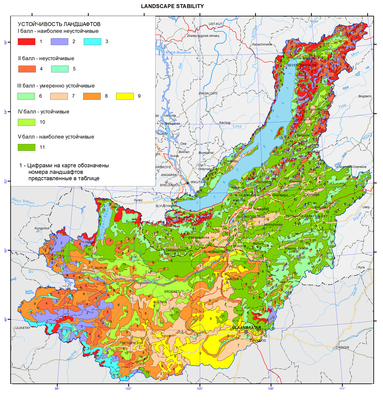
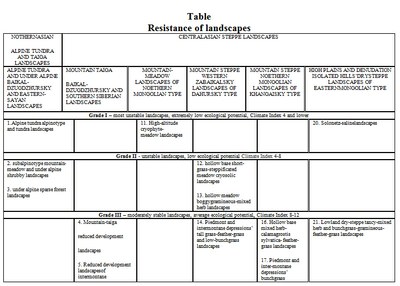
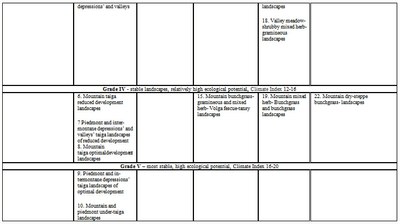
<p>The compiled map reflects the territorial diversity of landscape stability, characteristics of which is presented in the table.</p>
<p>The lowest and low (I-II points) stability characterize goletz and sub-goletz landscapes presented in major mountain ranges in the north-eastern and south-western parts of the territory. In the north-east, they are goletz and sub-goletz landscapes of the Baikalsky, Verkhne-Angarsky, Barguzinsky, and Ikatsky ridges in the framing of the Severo-Baikalskaya, Verkhne-Angarskaya and Barguzinskaya depressions. In the Khovsgol region and in Southern Cisbaikalia they include the Eastern Sayan mountain structures. In the south-west, alpine meadows, and subalpinotype and subgoletz landscapes of the Khangai and Khentei uplands are characterized by low stability.</p>
<p>Ecological potential of these landscapes is very low; TK is less than 8. The structure of geoms is dominated by serial groups of facies. They are characterized by severe climatic conditions and dissected mountainous terrain, active development of exogenous geological processes, and lack of heat and excess of moisture. The same values ​​of stability are assigned to steppe landscapes of depressions and valley bottoms, characterized by the excess of heat together with the lack of moisture, with manifestations of cryomorphism, waterlogging, water erosion and deflation, and soil salinization.</p>
<p>In general, the Baikal basin is dominated by moderately stable and stable landscapes (III-IV points), distributed mainly in the central part of the territory. They are characterized by medium and relatively high ecological potential; the index of biological effectiveness of climate amounts to 8-16. Pseudo-indigenous geosystems with a relatively stable landscape structure predominate.</p>
<p>Landscapes of reduced development of mountain-taiga and taiga intermountain depressions and valleys, having dispersed distributional pattern and occurring in the Selenga-Vitim interfluve and to the north of the Khangai upland, are referred to the stability of III points.</p>
<p>The stability of III points also characterizes piedmont and plain relatively dry and arid steppes. They are located in the Barguzinskaya depression, in hollows of the Trans-Baikal type, to the north of the Khangai upland, and in the surroundings of the Khentei upland.</p>
<p>The group of geoms with the stability of IV points includes mountain-taiga landscapes of restrictive and optimal development, taiga piedmont landscapes of intermontane depressions and valleys of restrictive development, mountain low-bunchgrass and forbs-bunchgrass, and mountain dry steppes. The main areas of development of taiga landscapes of this stability group are low- and middle mountains to the south of the Eastern Sayan, the Primorsky ridge, Selenginskoe middle mountains, Vitimskoe plateau, Olekminsky Stanovik, Khentei-Chikoy upland, and others. Mountain steppes with IV points of stability are most commonly found in the Selenge-Orkhon interfluve.</p>
<p>Landscapes with the highest ecological potential for the region, and TK amounting to 16-20, are classified as the most stable (V points). In the Russian part of the territory, they are landscapes of piedmont and intermountain depressions of optimal development, as well as piedmont subtaiga landscapes. They are found in the Verkhne-Angarskaya and Barguzinskaya depressions, in the Selenga river delta, and in depressions of the Trans-Baikal type. In Mongolia they are represented by mountain subtaiga landscapes, the large area of which is middle and low mountains lying to the north of the Khangai upland in the central part of the basin of the Selenge and Orkhon rivers. The structure of geoms is dominated by pseudo-indigenous and indigenous geosystems. They are the nuclei of the ecological stability and reproduction of the environment [Mikheev, 2001]. In the landscape structure of the region their distribution area is in the transition zone between taiga and steppe landscapes with low background stability.</p>
<p>The conducted mapping of landscape stability is the basis for the assessment of the anthropogenic impact on the environment, and for substantiation of environmentally acceptable nature management in the Baikal basin.</p>
<p><b> </b></p>
<p align="center">References</p>
<p>Landscapes of the south of Eastern Siberia (map, scale 1:1500000). (1977). V.S. Mikheev and V.A. Ryashin. Moscow: GUGK, , 4 sheets.</p>
<p>Landscapes (map, scale 1:3000000) (1990). in <i>National Atlas. Mongolian People's Republic. </i>Ulaanbaatar–Moscow, pp. 83-85.</p>
<p>Mikheev, V.S. (2001). <i>Landscape synthesis of geographic knowledge.</i> Novosibirsk: Nauka, 216 p.</p>
<p><i>Protection of Landscapes. Explanatory Dictionary.</i> (1982). Moscow: Progress, 272 p.</p>
<p>Sochava, V.B. (1978). Introduction to the Theory of Geosystems. Novosibirsk: Nauka, 320 p.</p>
<p>Ecological potential of landscapes (map, scale 1:15000000). (2007). In <i>National Atlas of Russia.</i> Vol 2: Nature and Ecology. Moscow: PKO “Kartografiya”, p. 417.</p>
<p>Ecologo-geographical map (scale 1:15000000). (2007). In <i>National Atlas of Russia.</i> Vol. 2: Nature and Ecology. Moscow: PKO “Kartografiya”, pp. 454-456.</p>]]></content:encoded>
    <dc:publisher>No publisher</dc:publisher>
    <dc:creator>Alexander Ayurzhanaev</dc:creator>
    <dc:rights></dc:rights>
    <dc:date>2014-10-08T01:10:00Z</dc:date>
    <dc:type>Page</dc:type>
  </item>


  <item rdf:about="http://bic.iwlearn.org/en/documents/documents/papers/land-use-types-in-mongolia-and-results-of-landuse-condition-monitoring-english">
    <title>Land use types in Mongolia and results of landuse condition monitoring (English)</title>
    <link>http://bic.iwlearn.org/en/documents/documents/papers/land-use-types-in-mongolia-and-results-of-landuse-condition-monitoring-english</link>
    <description></description>
    
    <dc:publisher>No publisher</dc:publisher>
    <dc:creator>puntsagsurenchoimpog@yahoo.com</dc:creator>
    <dc:rights></dc:rights>
    <dc:date>2014-12-30T01:24:30Z</dc:date>
    <dc:type>File</dc:type>
  </item>


  <item rdf:about="http://bic.iwlearn.org/en/documents/documents/papers/land-use-caused-water-contamination-analysis-prevention-and-self-purification-potentials-lucwaca-psp-within-the-selenga-baikal-research-english">
    <title>Land use caused water contamination analysis, prevention and self-purification potentials (LUCWACA-PSP) within the Selenga-Baikal research (English)</title>
    <link>http://bic.iwlearn.org/en/documents/documents/papers/land-use-caused-water-contamination-analysis-prevention-and-self-purification-potentials-lucwaca-psp-within-the-selenga-baikal-research-english</link>
    <description></description>
    
    <dc:publisher>No publisher</dc:publisher>
    <dc:creator>puntsagsurenchoimpog@yahoo.com</dc:creator>
    <dc:rights></dc:rights>
    <dc:date>2014-12-30T01:30:36Z</dc:date>
    <dc:type>File</dc:type>
  </item>


  <item rdf:about="http://bic.iwlearn.org/en/atlas/atlas/51-land-resources-use-map/land-resources-use-map">
    <title>Land resources use map</title>
    <link>http://bic.iwlearn.org/en/atlas/atlas/51-land-resources-use-map/land-resources-use-map</link>
    <description></description>
    <content:encoded xmlns:content="http://purl.org/rss/1.0/modules/content/"><![CDATA[<p><img class="image-inline" src="../../../resolveuid/8ba0f7f48b7741d9bb3d492e6981fac2/@@images/image/preview" /></p>
<p><a href="http://bic.iwlearn.org/en/atlas/photos/copy_of__51_Landresourcesuse.png" class="internal-link">Open full size</a></p>
<p align="center"><strong>L</strong><strong>and resources and their use</strong></p>
<p align="center"><strong> </strong></p>
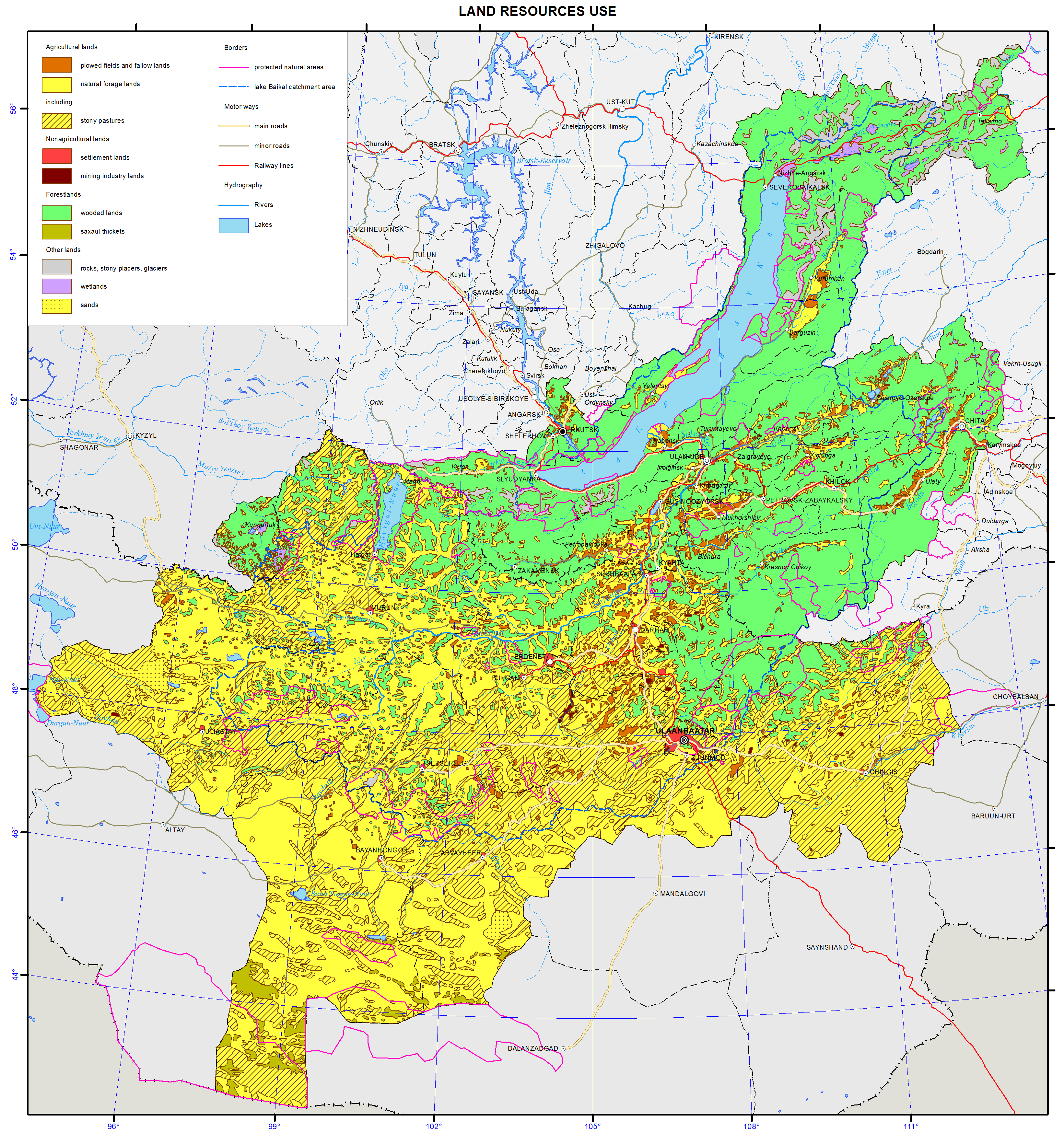
<p>Land resources are the main spatial basis, a store of various types of mineral resources for many branches of industry, as well as a basic means of production for agriculture and forestry. For the latter branches land resources and soil fertility are important means of growing crops and forest stands. For other types of land use (residential, transport, etc.) the role of land resources is reduced mainly to the role of the operational basis for spatial location of specific objects inherent to these types of land use.</p>
<p>Under the working legislation and established practice state land registration in the Russian Federation is carried out on land categories and agricultural lands, forms of ownership and types of land rights, as well as their use for agricultural production and other needs. Land registration in Mongolia is carried out similarly (with minor changes).</p>
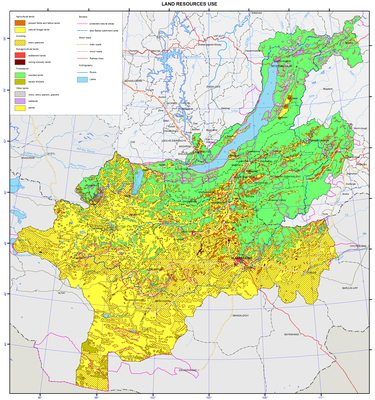
<p>On the basic map the land fund structure on agricultural lands is presented as a quality background. The latter ones are defined as land, systematically used or usable for specific economic purposes and different in their natural and historical features. Land carries material properties typical of land use as an economic phenomenon.</p>
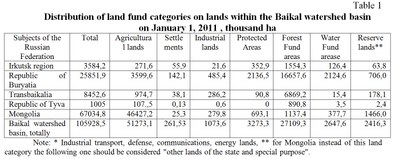
<p>The second map and the Table represent the layout of the land fund on land categories and the index of availability of agricultural land. Land categories are land plots distinguished according to their intended use (agricultural land, settlements, industry, energy, transport, communication, defense and security, etc., forest, water resources, reserves, etc.). Mongolia is characterized by the absence of the concept of "land reserve". However, a large share of the land fund structure there belongs to public land for special purposes, which consists not only of lands of defense and security and protected areas, but lands, used in ways uncharacteristic of Russia. Therefore, in the map legend the category "lands of state and special purpose" applies only to Mongolia, excluding the land of specially protected natural areas and defense and security lands. The latter ones are included in the respective land categories.</p>
<p>The availability index of farmland is the ratio of agricultural land area (in hectares) belonging to the agricultural land to the number of residents living in the municipality. Farmland is an essential part of land, which is a potential resource for the formation of local food base. The average area of agricultural land per capita (within Russian territory, except Tere-Khol district of the Republic of Tyva) amounts to 3.7 hectares; it ranges from 0.06 ha within Sludyansky district of Irkutsk oblast to 22.9 ha in the Eravninsky district of the Republic of Buryatia. Within the Mongolian territory the indicators of the agricultural land per aimak inhabitant, is on the average significantly higher than in the Russian part of the basin as it amounts to about 45 hectares. Minimum rates are found in the Ulaanbaatar, Darkhan, and Orkhon aimaks, which is connected, first of all, with the high population numbers in these aimaks and relatively smaller areas of agricultural land compared to other aimaks.</p>
<p style="text-align: center; "><img class="image-inline" src="../../../resolveuid/fac9e5ab3b094d459f6b4045e311a305/@@images/image/preview" /></p>
<p>In 1990 – 2010 the reduction of agricultural area for most municipalities is registered in the Russian part of the basin, which is directly linked to their withdrawal from agricultural use. The main reason of the reduction of such agricultural areas was shutdown of many agricultural enterprises, organizations, and farms and transfer of the withdrawn lands, for the most part, to the land redistribution fund. Another reason is the expiration of the land leasehold (or temporary use) and non renewal of its agricultural productivity. The agricultural land reduction is caused by negative processes became widespread due to the sharp reduction of valuable land protection measures from water and wind erosion, flooding, bogging, waterlogging and other processes. It should be noted that the actual outflow of productive land is much higher. Previously transferred farmland reserves are overgrown with shrubs and low forests and lose their agricultural value.</p>
<p>In Mongolia problems of agricultural lands reduction are currently not registered because of their significant amount due to natural factors and historical specific features of agriculture.<b> </b></p>]]></content:encoded>
    <dc:publisher>No publisher</dc:publisher>
    <dc:creator>Alexander Ayurzhanaev</dc:creator>
    <dc:rights></dc:rights>
    <dc:date>2014-10-08T07:40:00Z</dc:date>
    <dc:type>Page</dc:type>
  </item>


  <item rdf:about="http://bic.iwlearn.org/ru/druzya/koncepciya-seti-nko-druzya-basseina-baikala">
    <title>Концепция сети НКО «Друзья бассейна Байкала»</title>
    <link>http://bic.iwlearn.org/ru/druzya/koncepciya-seti-nko-druzya-basseina-baikala</link>
    <description></description>
    <content:encoded xmlns:content="http://purl.org/rss/1.0/modules/content/"><![CDATA[<p align="center"><strong>Концепция сети НКО «Друзья бассейна Байкала»</strong></p>
<p align="right"><i>Имеешь друзей - широк как степь; не имеешь - узок, как ладонь</i></p>
<p align="right"><i>(монгольская поговорка)</i></p>
<p align="center"><strong> </strong></p>
<p style="text-align: justify; ">К настоящему времени в России имеется немало разнообразных природоохранных общественных объединений. Они накопили богатый опыт успешной деятельности в таких сферах, как охрана природы, практическое применение принципов устойчивого развития общества, экологическое просвещение, нашли эффективные формы самоорганизации. Этот опыт очень важен для развития общественной активности, но, к сожалению, он часто неизвестен организациям, работающим на местном уровне и ещё не установившим тесных связей с коллегами (Соболев, 2006).</p>
<p style="text-align: justify; ">В ряде регионов России возникли авторитетные экологические организации, с которыми считаются органы власти. Члены экологических организаций составляют документы, находят конструктивные решения экологических проблем. В качестве примера можно отметить НКО «Байкальскую экологическую волну» из г. Иркутска (Яблоков, 2004).</p>
<p style="text-align: justify; ">Известный исследователь развития феномена третьего сектора в России В. Якимец предлагает выделять три условных периода в эволюции НКО в России: 1991- 1995- «романтический период», 1996-2000- «конструктивный и противоречивый период», 2001- настоящее время (этот период остается без символического названия в силу неоднозначности оценок идущих процессов: сворачивание или активное развитие гражданских инициатив). Он анализирует этот процесс через призму построения системы взаимоотношений власти и структур гражданского общества, в рамках доминирующей исследовательской тенденции в сфере изучения гражданских институтов в России, отражающей состояние официальной и неофициальной риторики, когда речь заходит о феномене гражданского общества. Модель не лишена недостатков и требует уточнений, однако представляет собой одну из немногих попыток проследить историю развития третьего сектора в России (Демидов, 2008).</p>
<p style="text-align: justify; ">Совершенствование экологической культуры населения является важнейшим фактором устойчивого развития общества и весомый вклад в него вносят некоммерческие организации. Среди них существует ряд организаций (экологических НКО), для которых вопросы экологии и природопользования являются приоритетными. Их основными целями являются экологическое воспитание и просвещение, практическое содействие сохранению природных объектов, осуществление общественного экологического контроля, содействие ориентированию экономики и общества на защиту окружающей среды и устойчивое развитие. Они выступают с гражданскими инициативами, осуществляют вовлечение общественности в процесс принятия решений.</p>
<p style="text-align: justify; ">Статус озера Байкал - как участка Всемирного природного наследия способствует развитию экологической культуры населения не только в Иркутской области, Республики Бурятия, Забайкальском крае, в России, в Монголии, но и во всем мире.</p>
<p style="text-align: justify; ">Реализация данной Концепции будет способствовать в первую очередь усилению связей между российскими и монгольскими НКО в деле устойчивого развития Байкальской природной территории.</p>
<p style="text-align: justify; ">Необходимо отметить, что экологические НКО играют активную роль в содействии, разработке и реализации проектов в различных сферах, таких как:</p>
<ul style="text-align: justify; ">
<li>Охрана, сохранение и улучшение окружающей среды;</li>
<li>Социальная и образовательная деятельность для культивирования научных и творческих способностей местного населения;</li>
<li>Содействие местному населению в лучшем участии в деятельности по охране окружающей среды и использовании природных ресурсов.</li>
</ul>
<p style="text-align: justify; ">Создание трансграничной сети НКО «Друзья бассейна Байкала» явится первым шагом к расширенному вовлечению гражданского общества в процесс трансграничного сотрудничества. Сеть сформирует структурированные, четко определенные и эффективные партнерства НКО для адекватной и координированной репрезентативности гражданского общества в контексте трансграничной и национальной реализации стратегического плана действия. Виртуальные облачные средства для формирования и поддержания партнерств будут включать веб-сайт и электронную почту с технологией лист-сёрв (list-serve)<a href="file:///C:/Users/1/Desktop/%D0%9A%D0%BE%D0%BD%D1%86%D0%B5%D0%BF%D1%86%D0%B8%D1%8F%20%D1%81%D0%B5%D1%82%D0%B8%20%D0%9D%D0%9A%D0%9E.docx#_ftn1">[1]</a>. Это будет поощрять участие общественных организаций, как официально зарегистрированных, так и групп активных людей или сообществ, занимающихся вопросами охраны окружающей среды. Виртуальные партнерства будут функционировать на русском, монгольском и английском языках, а контент, имеющий отношение к разным странам, будет регулироваться с особенностями каждой страны.</p>
<p style="text-align: justify; ">Указанная сеть «Друзья бассейна Байкала» будет также привлекаться в рамках финансируемой ПРООН/Кока-Кола инициативы «Каждая капля имеет значение». Проект «Каждая капля имеет значение» в России представляет собой часть регионального партнерства ПРООН/Кока-Кола по воде и является одним из пяти пилотных проектов запланированных в пяти странах (Россия, Румыния, Турция, Казахстан и Хорватия). Одной из целей инициативы является охрана ресурсов питьевой воды и устойчивое экономическое развитие местных сообществ и их водных ресурсов, а также повышение осведомленности о проблемах, связанных с водой (Проектный документ, 2010).</p>
<hr size="1" style="text-align: justify; " width="33%" />
<p style="text-align: justify; "><a href="file:///C:/Users/1/Desktop/%D0%9A%D0%BE%D0%BD%D1%86%D0%B5%D0%BF%D1%86%D0%B8%D1%8F%20%D1%81%D0%B5%D1%82%D0%B8%20%D0%9D%D0%9A%D0%9E.docx#_ftnref1">[1]</a> <i>Технология </i><i>list</i><i>-</i><i>serve</i> – телекоммуникационное информирование малых групп пользователей путем автоматической рассылки по e-mailадресам.</p>
<p style="text-align: justify; "><span> </span></p>
<p style="text-align: justify; "><strong>1.Опыт международного взаимодействия НКО</strong></p>
<p style="text-align: justify; "><strong> </strong></p>
<p style="text-align: justify; "><strong>1.1. Вопросы международного взаимодействия НКО</strong></p>
<p style="text-align: justify; ">Международное взаимодействие общественных организаций берет начало еще со времен СССР (Дружины охраны природы, Социально-Экологический Союз) - с 1988 года. Первым был совместный проект германских «зеленых» с «Зеленым движением» (Ларин и др.,). Одним из наиболее существенных прорывов в этом направлении стала конференция, которую организовал Социально-Экологический Союз и возникшая в его составе одна из первых профессиональных структур – «Центр независимых экологических программ» (ЦНЭП) совместно с различными американскими неправительственными природоохранными экологическими организациями. В конференции приняли участие такие организации как ISAR, Sacred Earth Network, Earth Island Institute и многие другие. Для отечественного природоохранного сообщества эта конференция сыграла роль настоящего прорыва для руководителей и активистов многих региональных общественных экологических организаций.</p>
<p style="text-align: justify; ">В это же время в стране начали работать и ведущие международные природоохранные организации. После повторного приезда в страну основателя Гринпис Дэвида Мактаггарта открывается офис Гринпис. В этот же период начинаются и первые международные полевые проекты, финансируемые Всемирным фондом дикой природы (WWF).</p>
<p style="text-align: justify; ">Международное взаимодействие между Россией и Монголией началось в советский период. В работе Т.Б. Цыреновой (Цыренова, 2011) дается исторический экскурс формирования и развития взаимодействия двух государств в области охраны и рационального использования трансграничных водных объектов. В настоящий момент политической основой взаимодействия России и Монголии является подписанное в 1995 г. Соглашение между Правительством Российской Федерации и Монголии, в котором определены политические и правовые механизмы реализации межгосударственной политики, основанной на принципах «разумного и справедливого использования» трансграничных вод. Кроме того, такое взаимодействие в немалой степени обеспечивает сохранение международного статуса России как гаранта сохранения уникальной экосистемы объекта Всемирного природного наследия ЮНЕСКО – озера Байкал.</p>
<p style="text-align: justify; ">Для Монголии проблема распределения и совместного использования трансграничных вод в условиях лимитированности ее водных ресурсов затрагивает жизненно важные сферы экономики. С одной стороны, взаимодействие с Россией в вопросах использования и охраны водных ресурсов позволяет использовать позитивный российский опыт в научных и образовательных сферах в области охраны и использования водных ресурсов.</p>
<p style="text-align: justify; ">В Байкальском регионе активное сотрудничество российских и монгольских НКО так же началось с международных проектов: План Девиса 1991–1993 г., проект с Кембриджским университетом «Сохранение природной и культурной среды Внутренней Азии» (1993–1996 г.), проекты с Научным комитетом NATO (1994, 1998), проекты ТАСИС по техническому содействию Байкальскому региону (1997–2000 г.), проект ГЭФ «Сохранение биоразнообразия в Байкальском регионе» (1998–2003 г.) и ряд других.</p>
<p style="text-align: justify; ">В рамках программ международного обмена с 1992 года работает общественная организация «Тахо-Байкал Институт» (ТБИ), в которой часто принимают участие помимо россиян и американцев представители Монголии. Кроме того, несколько проектов «ТБИ» было реализовано на территории Монголии. Опыт сотрудничества с монгольскими коллегами имеет старейшее НКО нашего региона – «Бурятское региональное объединение по Байкалу». Однако, это только несколько примеров взаимодействия российских и монгольских НКО.</p>
<p style="text-align: justify; "><strong>1.2. Проблемы взаимодействий НКО России и Монголии</strong></p>
<p style="text-align: justify; ">Полноценная охрана байкальской экосистемы невозможна вне контекста российско-монгольского взаимодействия в области охраны трансграничных вод, поскольку большая часть бассейна реки Селенги приходится на территорию Монголии. Взаимодействие НКО России и Монголии еще далеко от совершенства, что обусловлено следующими объективными причинами:</p>
<p style="text-align: justify; ">- государственная граница как барьер для оперативного взаимодействия НКО России и Монголии. Хотя расстояние от Улан-Удэ до Улан-Батора составляет 580 км или 8 часов езды на автомобиле, не всегда можно быстро пересечь границу.</p>
<p style="text-align: justify; ">- языковые ограничения. Английским, как языком международного общения на достаточном уровне владеют небольшое число представителей общественных экологических организаций Монголии и России. Организовывать общение только на русском или только на монгольском языке также не представляется возможным;</p>
<p style="text-align: justify; ">- не скоординированы взаимоотношения между НКО Бурятии, Иркутской области и Забайкальского края, что не позволяет проводить планомерную политику взаимодействия с монгольскими НКО.</p>
<p style="text-align: justify; ">- скромные финансовые ресурсы. Как правило, НКО России и Монголии существуют в основном за счет грантовой деятельности.</p>
<p style="text-align: justify; "><strong>2. Цели и задачи сети НКО «Друзья бассейна Байкала»</strong></p>
<p style="text-align: justify; ">На начало 2013 года общее количество зарегистрированных экологических НКО в Байкальском региона (в России) составляло около 80 организаций. Четверть из них являются некоммерческими объединениями - автономные некоммерческие организации, некоммерческие фонды, некоммерческие партнерства, учреждения, объединения юридических лиц (Сараев, 2013).</p>
<p style="text-align: justify; ">В данное время в Монголии насчитывается порядка 25 общественных экологических организаций. Число участников в отдельных акциях достигает от 300 до 8000 человек. Активно участвуют жители районов: скотоводы, жители поселений, представители мелкого бизнеса (туристического и др.). Создалась коалиция Общественных организаций Монголии – MNPC (Mongolian Nature Protection Coalition), где они вместе решают общие проблемы (Ширапова, 2010).</p>
<p style="text-align: justify; ">Направлениями деятельности НКО «Друзья бассейна Байкала» могут следующими:</p>
<p style="text-align: justify; ">- Установление конструктивного диалога между властью и обществом по вопросам экологической безопасности и защиты прав граждан на благоприятную окружающую среду;</p>
<p style="text-align: justify; ">- Развитие отношений между неправительственными экологическими организациями и государственными структурами в решении экологических проблем трансграничного бассейна озера Байкал на основе партнерства;</p>
<p style="text-align: justify; ">- Участие НКО в реализации проекта ГЭФ/ПРОООН «Комплексное управление природными ресурсами трансграничной экосистемы бассейна Байкала»;</p>
<p style="text-align: justify; ">- Учреждение Байкальского форума НКО;</p>
<p style="text-align: justify; ">- Анализ, обобщение и практическое применение отечественного и зарубежного опыта партнерства НКО;</p>
<p style="text-align: justify; ">- Подготовка и проведение совместных социально значимых акций и мероприятий;</p>
<p style="text-align: justify; ">- Организация и проведение дискуссий за счет технология list-serve на базе сайта www.baikalcenter.info (который будет создан Байкальским информационным центром)</p>
<p style="text-align: justify; ">- Создание единого реестра (Белая книга Байкальского региона) общественных и иных некоммерческих экологических организаций Байкальского региона;</p>
<p style="text-align: justify; ">- Совершенствование механизмов освещения деятельности НКО со стороны СМИ;</p>
<p style="text-align: justify; ">- Поддержка целевых сайтов, издание и распространение информационных бюллетеней, других средств информирования граждан о деятельности общественных объединений и некоммерческих организаций;</p>
<p style="text-align: justify; "><strong>3. Механизмы работы сети НКО «Друзья бассейна Байкала»</strong></p>
<p style="text-align: justify; ">Организация трансграничной сети «Друзья бассейна Байкала» предполагается на базе сайта www.baikalcenter.info (который будет создан Байкальским информационным центром) портального типа на русском, монгольском и английском языках для организации и проведения дискуссий. У кого будут возникать сложности (регистрация, коммуникация и т.д.), тем будут оказаны бесплатные консультационные услуги.</p>
<p style="text-align: justify; ">Будет переиздана «Белая книга бассейна озера Байкал» и размещена на данном сайте. Представители общественных экологических организаций бассейна озера Байкал (как России, так и Монголии) будут приглашены для участия в интерактивном Байкальском форуме НКО. Рассылка будет осуществляться за счет технология list-serve.</p>
<p style="text-align: justify; ">Таким образом, будут постепенно налажены постоянные связи и экологи-общественники станут тесно поддерживать свои контакты.</p>
<p style="text-align: justify; "><strong> </strong></p>
<p style="text-align: justify; "><strong>4. Ожидаемые результаты</strong></p>
<p style="text-align: justify; ">Реализация Концепции сети НКО «Друзья бассейна Байкала» будет способствовать укреплению авторитета общественных организаций, повышению социальной ответственности бизнеса, росту гражданской активности Байкальского региона, позволит консолидировать усилия органов государственной власти, общественного сектора и бизнес сообщества в целях достижения эффективных результатов в осуществлении комплексному управлению природными ресурсами Байкальского региона, что обеспечит устойчивое развитие трансграничного бассейна озера Байкал.</p>
<p style="text-align: justify; ">Применительно к сформулированным задачам ожидаемые результаты концепции следующие:</p>
<p style="text-align: justify; ">- совершенствуется система взаимодействия российско-монгольский экологических общественных организаций;</p>
<p style="text-align: justify; ">- составляется информационно-аналитический отчет о деятельности экологических общественных объединений и некоммерческих организаций трансграничного бассейна;</p>
<p style="text-align: justify; ">- создана площадка для обсуждения проблем взаимодействия, развиваются иные технологии социального партнерства (общественная экспертиза, ярмарка социальных проектов и др.);</p>
<p style="text-align: justify; ">- налажен регулярный информационный обмен между НКО России и Монголии;</p>
<p style="text-align: justify; ">- на региональном телевидении появляются программы/цикл передач о деятельности НКО;</p>
<p style="text-align: justify; ">- члены сети НКО «Друзья бассейна Байкала» оперативно реагируют на актуальные и злободневные вопросы;</p>
<p style="text-align: justify; ">- увеличивается численность совместных российско-монгольских проектов и волонтеров, в них участвующих;</p>
<p style="text-align: justify; ">- общественные экологические организации принимают активное участие в создании трансграничных ООПТ («Байкал-Хубсугул»).</p>
<p style="text-align: justify; "><span> </span></p>
<p style="text-align: justify; ">Список литературы</p>
<ol style="text-align: justify; ">
<li>Демидов А.А.. Некоммерческие организации в государственной политике и управлении: участие в разработке и реализации социальной политики: на примере Республики Карелия: Дисс... канд. полит. наук. – Санкт-Петербург, 2008. – 193 с.</li>
<li>Зелёные страницы Байкальского региона, 2002 г. </li>
<li>Белая книга, 2003, 2004 гг.</li>
<li>Сараев В.Г. Некоммерческие организации Байкальского региона в формировании экологической культуры населения // Материалы Третьей Всероссийской научной конференции по социальной географии (Иркутск, 22-24 октября 2013 г.). – Иркутск: Изд-во ИГ СО РАН, 2013. – С.83-85.</li>
<li>Белая книга Байкальского региона. – Улан-Удэ:  Изд-во «Экос», 2009. – 73 с </li>
<li>Цыренова Т.Б. Государственное управление водными ресурсами в условиях межгосударственного взаимодействия России и Монголии: Автореф. дисс… докт. полит. наук. – Чита, 2011.</li>
<li>Яблоков А.В. Зеленое движение и гражданское общество: документы 2000-2004 гг. М.: Товарищество научных изданий КМК, 2004. – 343 с.</li>
<li>Ларин В., Мнацаканян Р., Честин И., Шварц Е. Охрана природы России: от Горбачева до Путина. – М.: КМК, 2003. – 416 с.</li>
<li>Соболев Н.А. Успех «безнадежного дела»: положительный опыт общественной природоохранной работы. – М.: Изд-во Центра охраны дикой природы, 2006. – 232 с.</li>
</ol>
<p style="text-align: justify; ">10.  Проектный документ «Комплексное управление природными ресурсами трансграничной экосистемы бассейна Байкала», 2010 г.</p>
<p style="text-align: justify; ">11.  Ширапова С.Д. Социально-экологические проблемы Монголии, связанные с добычей золота на реках — притоках реки Селенга // Реки Сибири: Материалы V Международной конференции (г. Томск, 16–18 апреля 2010 г.). – Томск: Дельтаплан, 2010. – С. 115-116.</p>
<p style="text-align: justify; ">12. Экологическое движение в России. Сб. научн. статей / Под ред. Здравомысловой Е., Тысячнюк М. СПб.: ЦНСИ, 1999. Труды. Вып. 6. 108 с.  <br clear="all" /></p>]]></content:encoded>
    <dc:publisher>No publisher</dc:publisher>
    <dc:creator>Alexander Ayurzhanaev</dc:creator>
    <dc:rights></dc:rights>
    <dc:date>2014-12-23T08:30:00Z</dc:date>
    <dc:type>Page</dc:type>
  </item>


  <item rdf:about="http://bic.iwlearn.org/en/news/the-baikal-project/e365b0754684e32acb464df564a3efb7">
    <title>Joint monitoring program</title>
    <link>http://bic.iwlearn.org/en/news/the-baikal-project/e365b0754684e32acb464df564a3efb7</link>
    <description>Harmonized water quality monitoring program for the Selenga Basin</description>
    <content:encoded xmlns:content="http://purl.org/rss/1.0/modules/content/"><![CDATA[<p>Executors: Hydrochemical Institute of RosHydromet (Russia) and Institute of hydrometeorology (Mongolia). End of works: December 2012.</p>
<p>Final products:</p>
<ul>
<li>Integrated with Mongolia approaches to analytical measures quality system.</li>
<li>List of methods of physical-chemical analysis and technical tools, recommended for stationary and movable laboratories in the system of the Selenga basin monitoring by Russian and Mongolian sides.</li>
<li>Harmonized water quality monitoring program for the Selenga basin.</li>
</ul>
<p>Currently, harmonized surface water quality monitoring program (developed by Hydrochemical Institute, Russia) for the Baikal Basin is under agreement with Mongolian side.</p>
<p><a class="internal-link" href="http://baikal.iwlearn.org/en/project/project-tender-reports-2012/012-harmonized-program">Download the Russian Final Report (RUS)</a></p>
<p><a class="internal-link" href="http://baikal.iwlearn.org/en/project/project-tender-reports-2012/027-harmonized-program-and-hotspot-analysis-mongolia">Download the Mongolian Final Report (RUS)</a></p>
<p><a class="internal-link" href="http://baikal.iwlearn.org/en/project/project-tender-reports-2012/rfq_emo_2012-012-rfq_emo_2012-027">Download the draft Harmonized water quality monitoring program (RUS)</a></p>]]></content:encoded>
    <dc:publisher>No publisher</dc:publisher>
    <dc:creator>Sergey Kudelya</dc:creator>
    <dc:rights></dc:rights>
    <dc:date>2013-03-02T08:05:28Z</dc:date>
    <dc:type>Feed Item</dc:type>
  </item>


</rdf:RDF>