

<?xml version="1.0" encoding="utf-8" ?>
<rdf:RDF xmlns:rdf="http://www.w3.org/1999/02/22-rdf-syntax-ns#" xmlns:dc="http://purl.org/dc/elements/1.1/" xmlns:syn="http://purl.org/rss/1.0/modules/syndication/" xmlns="http://purl.org/rss/1.0/">


<channel rdf:about="http://bic.iwlearn.org/search_rss">
  <title>Байкальский информационный центр</title>
  <link>http://bic.iwlearn.org</link>

  <description>
    
            These are the search results for the query, showing results 301 to 315.
        
  </description>


  <image rdf:resource="http://bic.iwlearn.org/logo.png"/>

  <items>
    <rdf:Seq>
      
        <rdf:li rdf:resource="http://bic.iwlearn.org/en/atlas/atlas/90-conventional-symbols-mining-enterprises-map/conventional-symbols-mining-enterprises-map"/>
      
      
        <rdf:li rdf:resource="http://bic.iwlearn.org/en/contacts"/>
      
      
        <rdf:li rdf:resource="http://bic.iwlearn.org/en/atlas/atlas/65-construction-map/construction-map"/>
      
      
        <rdf:li rdf:resource="http://bic.iwlearn.org/en/friends/conservation-of-willow-along-kharaa-river-mongolia"/>
      
      
        <rdf:li rdf:resource="http://bic.iwlearn.org/en/friends/conception-of-ngo-network-201cfriends-of-baikal-basin201d"/>
      
      
        <rdf:li rdf:resource="http://bic.iwlearn.org/en/friends/russian/conception-of-ngo-network-201cfriends-of-baikal-basin201d"/>
      
      
        <rdf:li rdf:resource="http://bic.iwlearn.org/en/documents/documents/complex-reports"/>
      
      
        <rdf:li rdf:resource="http://bic.iwlearn.org/en/atlas/atlas/78a-comfort-of-available-housing-russian-part-map/comfort-of-available-housing-russian-part-map"/>
      
      
        <rdf:li rdf:resource="http://bic.iwlearn.org/en/atlas/atlas/78b-comfort-of-available-housing-mongolian-part-map/comfort-of-available-housing-mongolian-part-map"/>
      
      
        <rdf:li rdf:resource="http://bic.iwlearn.org/en/atlas/atlas/129-cloudiness-map/cloudiness-map"/>
      
      
        <rdf:li rdf:resource="http://bic.iwlearn.org/en/atlas/atlas/22-climate-discomfort-map/climate-discomfort-map"/>
      
      
        <rdf:li rdf:resource="http://bic.iwlearn.org/en/news/the-baikal-project/e2a9ae389d9f2cbb2bc8f06bb0a3a3af"/>
      
      
        <rdf:li rdf:resource="http://bic.iwlearn.org/en/friends/city-public-organization-baikal-society-for-animal-protection-russia-buryat-republic"/>
      
      
        <rdf:li rdf:resource="http://bic.iwlearn.org/en/atlas/atlas/106-circulatory-system-diseases-map/circulatory-system-diseases-map"/>
      
      
        <rdf:li rdf:resource="http://bic.iwlearn.org/en/friends/chita-regional-public-institution-environmental-center-public-dauria-russia-zabaykalsky-krai"/>
      
    </rdf:Seq>
  </items>

</channel>


  <item rdf:about="http://bic.iwlearn.org/en/atlas/atlas/90-conventional-symbols-mining-enterprises-map/conventional-symbols-mining-enterprises-map">
    <title>Conventional symbols mining enterprises map</title>
    <link>http://bic.iwlearn.org/en/atlas/atlas/90-conventional-symbols-mining-enterprises-map/conventional-symbols-mining-enterprises-map</link>
    <description></description>
    <content:encoded xmlns:content="http://purl.org/rss/1.0/modules/content/"><![CDATA[<p><img class="image-inline" src="../../../resolveuid/de155f20f4d84770a2d77f9a7045b9b5/@@images/image/preview" /></p>
<p><a href="http://bic.iwlearn.org/en/atlas/photos/copy_of__90_ConventionalsymbolsMiningenterprises.png" class="internal-link">Open full size</a></p>
<p><img class="image-inline" src="../../../../resolveuid/08757ef24dc744fe811734814b13d6b5/@@images/image/preview" /></p>
<p><a href="http://bic.iwlearn.org/en/photos/copy_of__90_Table_1_Legend_ConventionalsymbolsMiningenterprises.png" class="internal-link">Open full size</a></p>
<p><img class="image-inline" src="../../../../resolveuid/3798776aa21f476a9973ead6458c2523/@@images/image/preview" /></p>
<p><a href="http://bic.iwlearn.org/en/photos/copy_of__90_Table_2_Legend_ConventionalsymbolsMiningenterprises.png" class="internal-link">Open full size</a></p>
<p align="center"><strong>Environmental impact of mining industry</strong></p>
<p>Mining industry is one of the sectors strongly and comprehensively affecting the environment. The intensive use of land lots for mining mineral resources leads to the destruction of the surface ground layer, creation of mining openings, disturbance of the hydrological regime of rivers, soil and surface and underground water pollution, and destruction of the environmental integrity and natural landscapes.</p>
<p>The importance of mining industry for Siberia and Mongolia is explained by their mineral resources specialization. Within the context of transitioning to sustainable (balanced) development, the high cost-effectiveness of the mining industry along with environmental compliance and the increase of social and living standards of the population are especially important.</p>
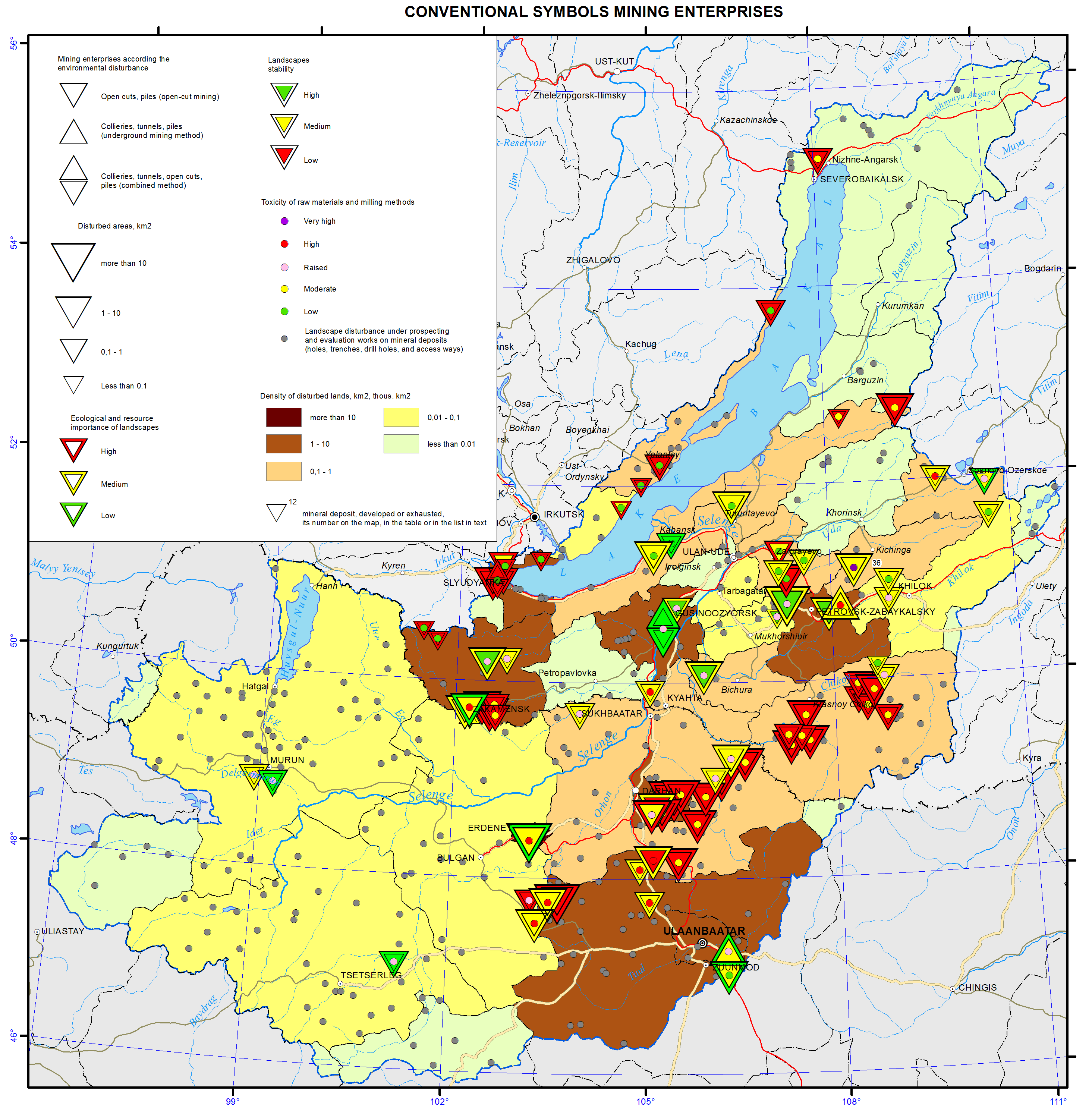
<p>This map reflecting the impact of mining on the environment was created to reveal the ecological component of sustainable development in the Baikal basin.</p>
<p>In the process of creating this map, the following library and published data were used: “National atlas of the Mongolian People’s Republic” (1990), “The ecological and geographic map of the Russian Federation” (1996), “Atlas of social and economic development of Russia” (2009), and “National atlas of Mongolia” (2009), etc. High-resolution satellite images (made in 2010-2013) were deciphered and used to examine the landscape structure of the territory. The state of the industrial sector and environment in the areas of mineral resources management was determined.</p>
<p>The objects of ecological evaluation were mineral deposits and mining enterprises. The information about them is provided on the basic maps that are part of this Atlas: “Fuel-energy resources and their development”, “Resources of ferrous, non-ferrous, and rare metals and their extraction”, “Basic types of nonmetallic materials, resources, and development”.</p>
<p>The biggest part of the researched area is part of the central and buffer zones of the Baikal Natural Territory within the Russian Federation. The Baikal basin in Mongolia is a natural continuation of this buffer zone. According to the Russian law “On the Protection of Lake Baikal”, the ecological zoning of the Baikal Natural Territory is the main tool for its implementation. Specific conservation restrictions are applied in the central ecological zone surrounding the Lake Baikal depression. Among the types of activities prohibited in this zone are the extraction of crude oil, natural gas, and radioactive and metal ores and the exploration and mining of previously undeveloped new deposits. The extraction of mineral resources within the water area of Baikal, in its water-protection zone, and in spawning rivers and their water-protection zones is prohibited.</p>
<p>In the buffer zone, the prospected and prepared for the development deposits, as well as mining operations are located within the ecological districts of Type 6, which includes industrial districts with a regulated intensive development. This type of districts is characterized by highly valuable landscapes and their components with an average or low sensitivity to stress. They mostly include the valley, piedmont, steppe and sub-taiga landscapes. The reason for singling out these districts is the importance of mining for the economy of the region. However, mining operations should not negatively affect the ecological system of Lake Baikal.</p>
<p>The cartographic evaluation of the technogenic disturbances of landscapes within the studied territories is provided for 380 mineral deposits. At present, 75 deposits are being developed. At 12 deposits mining operations are suspended, and they are either moth-balled or turned into reserves. The impact of mining enterprises on the environment is primarily determined by mining methods, the toxicity of raw materials and reagents used in processing, and landscape features.</p>
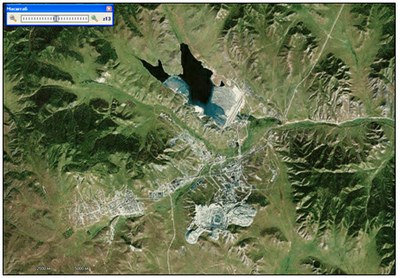
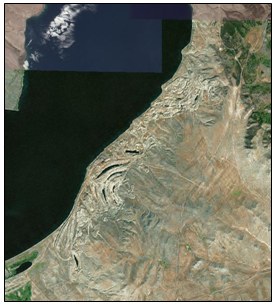
<p>The maximum impact on the environment, which is manifested in the drastic transformation of the relief with the formation of the technogenic denudation and accumulated forms, is caused by open-pit mining operations that remain a preferred mining method in the majority of cases due to economic considerations. On the territory under observation, 73 deposits are being developed by the open-pit mining method, and only 2 deposits are developed by the underground mining methods (the Bom-Gorkhon tungsten deposit and Nalaikh brown coal deposit). The main indicator of technogenic impact on the lithosphere is the area of disturbed land in square km, which is assessed using the following grades: I – over 10 km<sup>2 </sup>– the strongest impact, II – 1-10 km<sup>2</sup> – strong impact, III – 0.1-1 km<sup>2 </sup>– moderate impact, IV – less than 0.1 km<sup>2 </sup>– weak impact. The largest disturbed land areas have been formed as a result of mining operations at the deposits of Erdenetiyn ovoo (Fig. 1), Gusinoozersky (Fig. 2), and Olon-Shibirskoe.</p>
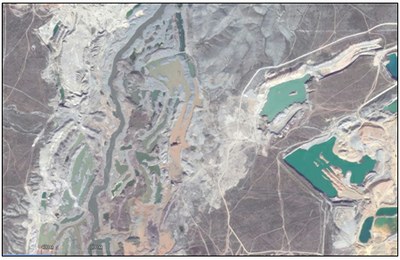
<p>Sizable areas of disturbed lands in river valleys form due to the placer gold mining, which results in the intensification of erosion, change of structure and productivity of floodplains, pollution and deformation of riverbeds, decrease of groundwater level, and destruction of biotic components of ecosystems. On the surveyed territory, there are about 30 sites, where placer gold is being mined. Nearly all of them are located in the mountain river valleys of the Krasny Chikoy and Zakamensk district and the Selenge and Tov aimags. The maximum size of the disturbed land (about 40 sq. km) was found in the Tuul river valley (Fig. 3).</p>
<p>At the undeveloped deposits, the main source of the impact on the lithosphere are exploration works, including the development of drill holes and trenches, drilling, construction and exploitation of temporary roads and settlements. The area of such disturbances is relatively small and conventionally accepted as 0.01 sq. km.</p>
<p>The background indicator of technogenic disturbances of lands is the density (prevalence) of disturbances. This indicator is determined as a ratio of the total area of the disturbed land in an administrative district to the total area of this district. The following grades of disturbance are used (sq. km / thou. sq. km): I – over 10 – very high, II – 1.0 to 10 – high, III – 0.1 to 1.0 –intermediate, IV – 0.01 to 0.1 – low, V – less than 0.01 – lowest. Using this scale, the following aimags and districts have been classified as territories with a very high and high levels of land disturbance: the Orkhon, Darkhan-Uul, and Tuv aimags, Ulaanbaatar, the Petrovsk-Zabaikalsky, Zakamensky, Slyudyansky and Selenginsky districts.</p>
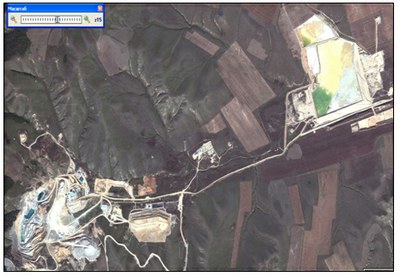
<p>At several operating mines, such as Olon-Shibirsky (coal), Tumurtolgoy (iron), Erdenetiyn ovoo (copper, molybdenum), Bom-Gorkhon (tungsten), Boroo (gold), etc., the extracted mineral resources undergo primary processing. In order to store or bury tailings, tailings ponds and dumps are created (Fig. 4). If built without paying due attention to filtering and other factors, they pose environmental risks and become the source of contamination of surface and ground water, as well as the atmosphere (dust). The most serious environmental consequences are found at the tailings ponds of the Erdenet Mining Company, Dzhidinsky tungsten-molybdenum mill (now shut down) and Kyakhta mill (currently not operating).</p>
<p>Extracted raw materials and enrichment products are classified into five categories of toxicity according to the degree of their ecological risk: I – very high: rare metal and radioactive ores, II – high: ores of nonferrous and precious metals, fluorite, III – increased: coal and brown coal, iron ores, IV – moderate: placer gold and tungsten, V – low: nonmetallic raw materials.</p>
<p>For every mining enterprise, environmental components (nature, economy, and people’s health) are differentiated by the degree of technogenic impact.</p>
<p>A negative impact on the environment and health is exemplified by the dumps and tailings ponds of the non-operating Dzhidinsky tungsten-molybdenum mill, which is located within the administrative borders of Zakamensk (Fig. 5). The production waste accumulated during the 50 years of the mill’s operations is a strong source of pollution contaminating the surface and ground water with toxic components and the air (dusting).</p>
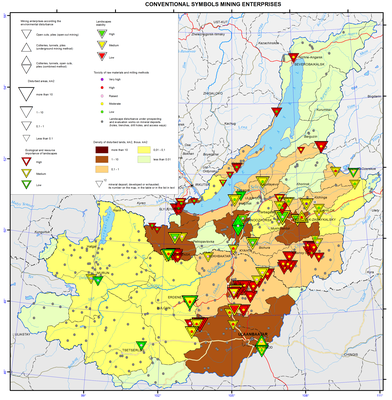
<p>The mining enterprises are shown as symbols of varying shapes, sizes, structures and colors. The shape designates a mining method, the size shows the degree of land disturbance. The external contour (rim) shows landscape stability, while the internal contour points at its significance. The color of the contour corresponds to the values of indicators. A circle in the center of the map and its color show the level of toxicity or ecological risk of extracted materials and their enrichment products. The circles on the map designate the deposits undergoing different stages of geological exploration. The density of disturbed lands in administrative districts is reflected on the map using the quantitative background technique.</p>
<p>The map shows that the majority of mining enterprises is concentrated in the central most developed part of the territory. On the southwestern flank within the Mongolian part of the basin, there are many deposits, the majority of which are currently not developed. The lands are least disturbed in the northeast. In the central ecological zone of the Baikal Natural Territory, there are three operating non-ore deposits (the Angasolka deposit of construction stone, Slyudyanka cement marble deposit, and Tarakanovsky cement limestone deposit) located over 4 km away from the coast of Lake Baikal. The extracted materials belong to the low class of ecological risk. The development of these deposits is not included into the types of activities prohibited in the central ecological zone of the Baikal Natural Territory and does not significantly affect the ecosystem of Lake Baikal.</p>
<p> </p>
<p align="center">References</p>
<p class="2">National atlas of Mongolia. (2009).</p>
<p class="HTML2">Atlas of social and economic development of Russia. (2009). Мoscow: Cartography. p 155-215.</p>
<p class="2">The ecological and geographic map of the Russian Federation. Scale 1:4,000,000 (1996). Мoscow: GUGC.</p>
<p>National atlas of the Mongolian People’s Republic. (1990). Moscow-Ulaanbaatar. p 144</p>
<p><img class="image-inline" src="../../../../resolveuid/1b1af0f8ec3b418cbe232b3125811eb9/@@images/image/preview" /></p>
<p><span>Fig. 1. Production and social infrastructure facilities at the copper molybdenum deposit Erdenetiyn Ovoo. There is a tailings pond in the northern part of the photo. The open pit is shown in the southern part, while production and residential zones – in the southwest.</span></p>
<p><img class="image-inline" src="../../../../resolveuid/fd7e37dcc9df4a8bacaced41c825b59b/@@images/image/preview" /></p>
<p><span>Fig. 2. The nature of soil degradation at the Gusinoozersk brown coal field: open pits filled with water and waste rock dumps.</span><img class="image-inline" src="../../../../resolveuid/6d9ef6b6ca2f4b2ba064251afd75adf7/@@images/image/preview" /></p>
<p><span>Fig. 3. Technogenic damages to the Tuul valley landscapes at a placer gold mine.</span><img class="image-inline" src="../../../../resolveuid/a719c9aec59645b98782e559f3312ec7/@@images/image/preview" /></p>
<p><span>Fig. 4. Boroo gold mine: open pit is in the southwestern part of the photo, tailings pond is in the northeastern part of the photo.</span></p>]]></content:encoded>
    <dc:publisher>No publisher</dc:publisher>
    <dc:creator>Alexander Ayurzhanaev</dc:creator>
    <dc:rights></dc:rights>
    <dc:date>2014-10-10T06:15:00Z</dc:date>
    <dc:type>Page</dc:type>
  </item>


  <item rdf:about="http://bic.iwlearn.org/en/contacts">
    <title>Contacts</title>
    <link>http://bic.iwlearn.org/en/contacts</link>
    <description>The information about The Baikal Basin Information Center and contact details</description>
    
    <dc:publisher>No publisher</dc:publisher>
    <dc:creator>Sergey Kudelya</dc:creator>
    <dc:rights></dc:rights>
    <dc:date>2013-03-02T07:42:51Z</dc:date>
    <dc:type>Folder</dc:type>
  </item>


  <item rdf:about="http://bic.iwlearn.org/en/atlas/atlas/65-construction-map/construction-map">
    <title>Construction map</title>
    <link>http://bic.iwlearn.org/en/atlas/atlas/65-construction-map/construction-map</link>
    <description></description>
    <content:encoded xmlns:content="http://purl.org/rss/1.0/modules/content/"><![CDATA[<p><img class="image-inline" src="../../../resolveuid/8417731d026043d89b5977e9bbd4e6c2/@@images/image/preview" /></p>
<p><a href="http://bic.iwlearn.org/en/atlas/photos/copy_of__65_Construction.png" class="internal-link">Open full size</a></p>
<p align="center"><strong>Construction</strong></p>
<p align="center"><strong> </strong></p>
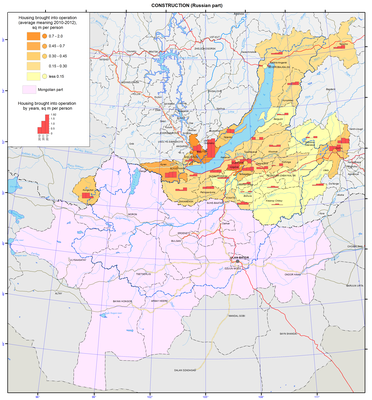
<p>Construction industry in the Baikal basin is one of the growth points of its economy and ecological well-being. One of the main indicators of the construction industry is the square meterage of the built civil and industrial facilities. Generally, it reflects its social and economic status in some regions. A current characterization of a segment of the construction sector – the residential construction – is conducted based on the observation of governmental statistical data [Districts…, 2013; Construction in Zabaikalsky krai, 2013; Construction in Russia, 2012; Construction and commissioning…, 2013] and the Internet resources [Federal State Statistics Service].</p>
<p>In the past three years (2010 to 2012), construction put-in-place increased three-fold (from 0.4 to 1.2 million sq. m). Judging by the growth of the absolute values of the residential construction put-in-place, Irkutsk oblast – the most urbanized region in the basin – tops the list with over a half of the volume of commissioned residential housing in the Baikal basin (2012).  The Republic of Buryatia is the second (26.2 %), and Zabaikalsky krai is the third (19.3 %).</p>
<p>The most important characteristics of residential development is the annual square meterage of the built housing (m²/person), which is presented as a background indicator of the map. By absolute indicators, Russia reached the pre-reform level of residential development in 2007. However, the specific indicator of the floor space of commissioned housing both in the country in general and in the Baikal basin in particular does not exceed 0.5 m²/person (in developed countries the annual construction capacity is at least 1 m² per capita, while the annual growth of housing put-in-place is 4.5-5.0 %) [Federal State Statistics Service]. Territorial differentiation of municipalities of the region according to this important indicator is quite contrasting. High specific indicators and the stable growth dynamics as a result of the implementation of targeted state programs facilitating residential development are observed across the whole territory except for the Republic of Tuva. Irkutsk oblast is leading, with its indicators being twice as high as the indicators of other regions (0.81 m²/person against the average regional indicator of 0.45 m²/person).</p>
<p>The residential construction sector of the region is distinguished by:</p>
<p>− The contrasting nature of its geography both in absolute and standard specific basic values;</p>
<p>− The current focal points of growth – Irkutsk and the Ivolginsky district (Republic of Buryatia).</p>
<p>The most important instruments for improving residential development are targeted state programs of regional and municipal levels. These programs focus on the implementation of comprehensive measures for the development of large-scale residential construction in the region. The key “driver” of the so-needed residential development in the municipalities of the lower level is the social and economic planning using various regional programs.</p>
<p align="center"> </p>
<p align="center">References</p>
<p>Statistical Compendium. (2013). <i>Districts of the Republic of Buryatia</i>. Ulan-Ude: Buryatstat. p 102.</p>
<p>Statistical Compendium. (2013). <i>Construction in Zabaikalsky krai</i>. Chita: Zabaikalkraistat. p 47.</p>
<p>Statistical Compendium. (2012). <i>Construction in Russia</i>. Moscow: Rosstat. p 220.</p>
<p>Statistical Compendium. (2013). <i>Construction and commissioning of facilities in Irkutsk oblast</i>. Irkutsk: Irkutskstat. p 36.</p>
<p>Federal State Statistics Service. <i>Database of municipal indicators</i>. Retrieved from http://www.gks.ru/dbscripts/munst/munst.htm</p>]]></content:encoded>
    <dc:publisher>No publisher</dc:publisher>
    <dc:creator>Alexander Ayurzhanaev</dc:creator>
    <dc:rights></dc:rights>
    <dc:date>2014-10-09T02:35:00Z</dc:date>
    <dc:type>Page</dc:type>
  </item>


  <item rdf:about="http://bic.iwlearn.org/en/friends/conservation-of-willow-along-kharaa-river-mongolia">
    <title>Conservation of willow along Kharaa river (Mongolia)</title>
    <link>http://bic.iwlearn.org/en/friends/conservation-of-willow-along-kharaa-river-mongolia</link>
    <description></description>
    <content:encoded xmlns:content="http://purl.org/rss/1.0/modules/content/"><![CDATA[<p align="center"><b>CONSERVATION OF WILLOW ALONG KHARAA RIVER</b></p>
<p> </p>
<p><span style="text-decoration: underline;">Contact details: </span>Bayangol soum, Selenge aimag, Mongolia</p>
<p>e-mail  <a href="mailto:toyunjav@yahoo.com">toyunjav@yahoo.com</a></p>
<p><span style="text-decoration: underline;">Year of Establishment</span> 2010</p>
<p><span style="text-decoration: underline;">Head of the organization</span> Mr. Gansukh D.</p>
<p><span style="text-decoration: underline;">Scope of the activities</span> Nature Conservation</p>
<p><span style="text-decoration: underline;">Mission</span> Nature conservation, Bush conservation among Kharaa River, combating with desertification</p>
<p><span style="text-decoration: underline;">List of the environmental related projects implemented</span> Self-funded public awareness activities for local herders on importance of bush conservation among Kharaa River</p>
<p><span style="text-decoration: underline;">Major results</span> Although local citizens understood the importance of bush conservation, there are still several occasions of illegal logging.</p>]]></content:encoded>
    <dc:publisher>No publisher</dc:publisher>
    <dc:creator>Alexander Ayurzhanaev</dc:creator>
    <dc:rights></dc:rights>
    <dc:date>2015-02-09T02:21:37Z</dc:date>
    <dc:type>Page</dc:type>
  </item>


  <item rdf:about="http://bic.iwlearn.org/en/friends/conception-of-ngo-network-201cfriends-of-baikal-basin201d">
    <title>Conception of NGO network «Friends of Baikal Basin»</title>
    <link>http://bic.iwlearn.org/en/friends/conception-of-ngo-network-201cfriends-of-baikal-basin201d</link>
    <description></description>
    <content:encoded xmlns:content="http://purl.org/rss/1.0/modules/content/"><![CDATA[<p align="center"><strong>Conception of NGO network «Friends of Baikal Basin»</strong></p>
<p align="right"><i>When you have friends you are vast as a steppe, without friends you are narrow as a palm</i></p>
<p align="right"><i>(Mongolian proverb)</i><i> </i></p>
<p align="center"><strong><i> </i></strong></p>
<p>Today, there are many environmental non-governmental organizations (NGOs) operating in Russia. Many have extensive experience of  successfully implementing projects concerning nature protection, practical aspects of sustainable development, environmental education, and effective forms of self-maintenance. Such experience is very important for the development of public activity, unfortunately this experience is often lacking in regional NGOs which often don’t have the close contacts with colleagues enjoyed by national organizations (Sobolev, 2006).</p>
<p> </p>
<p>Some regions of Russia have reputable environmental organizations which have strong links with governmental organizations. Members of these organizations are experienced in preparing official documents and can find meaningful solutions to ecological problems. The NGO “Baikal Ecological Wave” from Irkutsk city is a good example of such an organization (Yablokov, 2004).</p>
<p> </p>
<p>Well-known scientist Vladimir Yakimets who studied non-governmental organizations in Russia proposes that there have been three hypothetical periods in the development of NGOs in Russia: 1991-1995 “romantic period”, 1996-2000 – “meaningful and controversial period”, 2001 – present (this period doesn’t have a symbolic name because of contradictive evaluation into ongoing processes: decreasing or increasing of public initiatives). The author analyzed this process by investigating the system of interactions between government and civil society in the frame of dominating in Russian research tendencies, which reflect the condition of official and non-official rhetoric in civil society. Such models have some shortcomings and need to be corrected. However, this represents one of the few attempts to study the history and development of non-governmental organizations in Russia (Demidov, 2008).</p>
<p> </p>
<p>Improving the environmental awareness of the public is an important factor in securing the sustainable development of society and non-governmental organizations make great contributions to such processes. These organizations include environmental NGOs which are specifically targeted on nature protection and sustainable management. Their main goals are environmental education, practical preservation of natural objects, leading public ecological control and promoting the alignment of the economy and society to environmental protection and sustainable development. They develop public initiatives and involve the public in decision-making processes.</p>
<p> </p>
<p>Lake Baikal (UNESCO World Heritage Site) has the potential to develop the environmental awareness not only of Irkutsk Oblast’, Republic of Buryatia, Zabaikalsky Krai of Russia, and Mongolia, but of the whole world.</p>
<p> </p>
<p>Implementation of the proposed network can help in strengthening and facilitating cooperation between Russian and Mongolian NGOs in the field of sustainable development of the Baikal Basin.</p>
<p>It should be noted that environmental NGOs play an important role in the facilitation, elaboration and implementation of different projects, such as</p>
<ul>
<li>Nature conservation and improvement;</li>
<li>Facilitating social and educational activities for training of scientific and creative forces in local communities;</li>
<li>Promoting of local community to participate in environmental and natural resources protection and their sustainable use.</li>
</ul>
<p> </p>
<p>Creation of the transboundary NGO network “Friends of Baikal Basin” will be the first step towards enhancing the involvement of civil society in the transboundary collaborative process.</p>
<p> </p>
<p>The network will form structured, well-defined and efficient NGO partnerships to allow for adequate and coordinated representation of civil society in the context of the implementation of the transboundary and national strategy action plan (SAP). Virtual web-based tools for creating and maintaining partnerships will include a website and an email list-serve. It will encourage the membership of community-based organizations (CBOs) and NGOs (registered and non-registered). The virtual partnership will operate in Russian, Mongolian, and English, with country-specific content managed in each country respectively.</p>
<p> </p>
<p>This Friends of Baikal Basin Network will also be engaged under a UNDP/Coca Cola funded, practical, hands-on initiative to benefit Baikal and to see the benefits called “Every Drop Matters”. The Every Drop Matters Project in Russia is part of the regional UNDP-Coke water partnership and is one of the five pilot projects planned in five countries (Russia, Romania, Turkey, Kazakhstan, andCroatia). One of the purposes of the initiative is the protection of drinking water resources and promoting the sustainable economic development of local communities and their water resources, as well as awareness-raising on water issues (Project document, 2010).</p>
<p> </p>
<p align="center"><strong>1. Experience of international cooperation of NGOs</strong></p>
<p align="center"><strong> </strong></p>
<p align="center"><strong>1.1. Questions of international cooperation of NGOs </strong></p>
<p align="center"><strong> </strong></p>
<p>International cooperation between NGOs started in the former USSR in 1988 through the organization of Nature Protection Brigades and the Socio-Ecological Union. The first step was the joint project with German conservationists “Green Movement” (Larin et al.,). One of its significant breakthroughs was a conference which was organized by the Socio-Ecological Union. This organization later formed the professional – Center for Independent Ecological Programs (CIEP) together with American environmental non-governmental organizations. Many organizations participated at this conference, such as ISAR, Sacred Earth Network, Earth Island Institute, etc. This conference was very important for the Soviet conservation community, especially for leaders and activists of regional NGOs.</p>
<p>At the same time top international environmental NGOs began to work in the country. After the second visit of David McTaggard (one of Greenpeace’s founders) the Greenpeace Department opened in Moscow. At the same time the first international field projects financed by World Wildlife Fund (WWF) began operations.</p>
<p>International collaboration between Russia and Mongolia started during the Soviet era. T.B. Tsyrenova (2011) gave the historical digression of formation and development of both governments cooperation in the field of protection and sustainable use of transboundary water bodies. At the current time the political base of Russia and Mongolia cooperation is an Agreement signed in 1995. This Agreement defined the political and legal framework for the implementation of interstate policy based on principles of “reasonable and equitable use” of transboundary waters. Such cooperation to a large extent ensured the holding of international status of Russia as the guarantor country for preserving the unique UNESCO World Heritage Site – Lake Baikal.</p>
<p>The problem of distribution and sharing of transboundary waters is a big concern for the Mongolian economy given the limited water resources available in the country. On the other hand, cooperation with Russia in the field of sustainable use and protection of water resources give the opportunity to explore the positive Russian experience in scientific and educational studies.</p>
<p>In the Baikal region the active collaboration between Russian and Mongolian NGOs also started from international projects, notable projects include: Davis Plan (1991-1993), Cambridge University project “Preserving of natural and cultural environment of Inner Asia” (1993-1996), project with Scientific Committee of NATO (1994, 1998), TACIS project on technical assistance at the Baikal region (1997-2000), GEF project “Biodiversity conservation in the Baikal region” (1998-2003), etc.</p>
<p>The Tahoe-Baikal Institute (TBI) Summer Environmental Exchange Program worked in the Baikal region from 1992 in the frame of international exchange, where in addition to Russian and American participants projects often included young scientists and conservationists from Mongolia. Besides, some TBI projects have been implemented in the Mongolian portion of Baikal basin. The oldest NGO of our region “Buryat Regional Association on Lake Baikal” has good experience in cooperating with colleagues from Mongolia. It is one of the few examples of effective cooperation between Russian and Mongolian NGOs.</p>
<p align="center"> </p>
<p align="center"><strong>1.2. Challenges of cooperation between Russian and Mongolian NGOs</strong></p>
<p>The conservation of Lake Baikal’s ecosystem cannot be realized without Russian-Mongolian interaction in the field of transboundary water protection, because the great portion of the Selenga river basin (the main water resource of Lake Baikal) is situated within the territory of Mongolia.</p>
<p>Cooperation between Russian and Mongolian NGOs is far from perfect, something which can be attributed partly to the following factors:</p>
<p>-          State border is a barrier to mobile interaction between Russian and Mongolian NGOs. The distance between Ulan-Ude and Ulan-Bator is about 580 km (about 8 hours drive), but people often spend a lot of time at customs during the border crossing.</p>
<p>-          Language restrictions. Few representatives of environmental NGOs in Russia and Mongolia can speak fluent English. Organizing the communication only on Russian or Mongolian can be complicated.</p>
<p>-          Cooperation between NGOs of Irkutsk Oblast’, Republic of Buryatia, and Zabaikalsky Krai of Russia is not coordinated which does not give the opportunity to organize systematic policy with NGOs of Mongolia.</p>
<p>-          Small budgets of NGOs. Usually, Russian and Mongolian NGOs operate mostly on the basis of small grants.</p>
<p>In conclusion, significant barriers hamper both countries’ ability to move ahead both within their national envelopes and jointly on a robust transboundary level. These barriers include: policy and regulatory gaps, institutional weaknesses, poor utilization of Best Available Techniques and Best Environmental Practices relevant to key issues facing the Baikal Basin, and low levels of awareness of transboundary Baikal Basin issues.</p>
<p align="center"><strong> </strong></p>
<p align="center"><strong>2. Goals and tasks of NGO Network “Friends of Baikal Basin”</strong></p>
<p>There were about 80 registered environmental NGOs in the Baikal Region of Russia at the beginning of 2013. A quarter of these are non-profit organizations – autonomous non-profits, non-profit partnerships, coalitions, and unions (Saraev, 2013).</p>
<p> </p>
<p>There are around 25 environmental NGOs in Mongolia right now, with the number of active participants ranging from 300 to 8000 people. People from the countryside (herders, farmers, local people of small settlements, representatives of small tourist companies, etc.) are actively participating in public awareness actions. The activity of Mongolian environmental NGOs is coordinated by Mongolian Nature Protection Coalition (Shirapova, 2010).</p>
<p>Directions of activity of the NGO Network “Friends of Baikal Basin”:</p>
<p>-          Establishing constructive dialogue between government and society in the field of ecological safety and protection of citizens rights for a better environment;</p>
<p>-          Development of relations between NGOs and state authorities on the basis of partnership for solving environmental problems of the transboundary Baikal Basin;</p>
<p>-          Participation of NGOs in realizing the GEF/UNOPS project “Integrated Natural Resource Management in the Baikal Basin Transboundary Ecosystem”;</p>
<p>-          Organizing the Baikal Forum of NGOs;</p>
<p>-          Analysis, summarization and practical implication of Russian and international experience in NGO partnerships</p>
<p>-          Preparing and organizing of joint social actions and activities.</p>
<p>-          Organization and leading the discussions using email list-serve on the base of a web portal <a href="http://www.baikalcenter.info/">www.baikalcenter.info</a> (which will be created by the Baikal Information Center);</p>
<p>-          Creation of a unified register (White Book of Baikal Region) of the CBOs and NGOs (registered and non-registered);</p>
<p>-          Enhancement of relations between NGOs and mass-media;</p>
<p>-          Supporting of purposeful Web sites, publishing and distribution of information bulletins and other information resources about CBOs and NGOs activities for the citizens.</p>
<p> </p>
<p style="text-align: center; "><strong>3. How the NGO Network “Friends of Baikal Basin” will work</strong></p>
<p>Organization of the transboundary network “Friends of Baikal Basin” will be developed by the Baikal Information Center (BIC) on the BIC web portal <a href="http://www.baikalcenter.info/">www.baikalcenter.info</a> in Russian, Mongolian, and English for creating different discussions. Participants who have problems with registration, communication, etc will receive free consulting.</p>
<p>“White book of the Baikal region - 2010” will be republished and become available on the BIC web portal. Representatives of environmental NGOs of the Baikal Basin will be invited to participate at the interactive Baikal Forum of NGOs. Information will be distributed by list-serve. Thus, environmental NGOs will have constant contact and connections with each other.</p>
<p><strong> </strong></p>
<p align="center"><strong>4. Expected results</strong></p>
<p>Implementation of the NGO network “Friends of Baikal Basin” will increase the prestige of NGOs, social responsibilities of businesses, civil activity in the Baikal region, consolidate efforts of government, NGOs and business in order to obtain effective results in complex management of natural resources of Baikal region which will provide sustainable development of tranboundary Baikal Basin.</p>
<p>According to defined tasks we expect the following results:</p>
<p>-          Improvement of interactions between Russian and Mongolian environmental NGOs;</p>
<p>-          Preparing an analytic report detailing activity of environmental NGOs in the transboundary basin;</p>
<p>-          Creation of a platform for discussion of cooperation problems and development of social partnership technologies (public expertise, social project fair, etc.)</p>
<p>-          Conducting regular information exchange between Russian and Mongolian NGOs;</p>
<p>-          Launching special TV programs about activities of NGOs on local TV.</p>
<p>-          NGO network “Friends of Baikal Basin” members are able to quickly respond to pertinent and burning issues;</p>
<p>-          Increasing the number of joint Russia-Mongolian projects and volunteers participate in projects;</p>
<p>-          NGOs take active part in the creation of transboundary protected areas (“Baikal-Hovsgol”).</p>]]></content:encoded>
    <dc:publisher>No publisher</dc:publisher>
    <dc:creator>Alexander Ayurzhanaev</dc:creator>
    <dc:rights></dc:rights>
    <dc:date>2014-12-23T08:30:00Z</dc:date>
    <dc:type>Page</dc:type>
  </item>


  <item rdf:about="http://bic.iwlearn.org/en/friends/russian/conception-of-ngo-network-201cfriends-of-baikal-basin201d">
    <title>Conception of NGO Network “Friends of Baikal Basin”</title>
    <link>http://bic.iwlearn.org/en/friends/russian/conception-of-ngo-network-201cfriends-of-baikal-basin201d</link>
    <description></description>
    <content:encoded xmlns:content="http://purl.org/rss/1.0/modules/content/"><![CDATA[<p align="center"><b>Conception of NGO Network “Friends of Baikal Basin”</b></p>
<p align="right"><i>When you have friends you are vast as a steppe, without friends you are narrow as a palm</i></p>
<p align="right"><i>(Mongolian proverb)</i><i> </i></p>
<p align="center"><b><i> </i></b></p>
<p>Today, there are many environmental non-governmental organizations (NGOs) operating in Russia. Many have extensive experience of  successfully implementing projects concerning nature protection, practical aspects of sustainable development, environmental education, and effective forms of self-maintenance. Such experience is very important for the development of public activity, unfortunately this experience is often lacking in regional NGOs which often don’t have the close contacts with colleagues enjoyed by national organizations (Sobolev, 2006).</p>
<p> </p>
<p>Some regions of Russia have reputable environmental organizations which have strong links with governmental organizations. Members of these organizations are experienced in preparing official documents and can find meaningful solutions to ecological problems. The NGO “Baikal Ecological Wave” from Irkutsk city is a good example of such an organization (Yablokov, 2004).</p>
<p> </p>
<p>Well-known scientist Vladimir Yakimets who studied non-governmental organizations in Russia proposes that there have been three hypothetical periods in the development of NGOs in Russia: 1991-1995 “romantic period”, 1996-2000 – “meaningful and controversial period”, 2001 – present (this period doesn’t have a symbolic name because of contradictive evaluation into ongoing processes: decreasing or increasing of public initiatives). The author analyzed this process by investigating the system of interactions between government and civil society in the frame of dominating in Russian research tendencies, which reflect the condition of official and non-official rhetoric in civil society. Such models have some shortcomings and need to be corrected. However, this represents one of the few attempts to study the history and development of non-governmental organizations in Russia (Demidov, 2008).</p>
<p> </p>
<p>Improving the environmental awareness of the public is an important factor in securing the sustainable development of society and non-governmental organizations make great contributions to such processes. These organizations include environmental NGOs which are specifically targeted on nature protection and sustainable management. Their main goals are environmental education, practical preservation of natural objects, leading public ecological control and promoting the alignment of the economy and society to environmental protection and sustainable development. They develop public initiatives and involve the public in decision-making processes.</p>
<p> </p>
<p>Lake Baikal (UNESCO World Heritage Site) has the potential to develop the environmental awareness not only of Irkutsk Oblast’, Republic of Buryatia, Zabaikalsky Krai of Russia, and Mongolia, but of the whole world.</p>
<p> </p>
<p>Implementation of the proposed network can help in strengthening and facilitating cooperation between Russian and Mongolian NGOs in the field of sustainable development of the Baikal Basin.</p>
<p>It should be noted that environmental NGOs play an important role in the facilitation, elaboration and implementation of different projects, such as</p>
<ul>
<li>Nature conservation and improvement;</li>
<li>Facilitating social and educational activities for training of scientific and creative forces in local communities;</li>
<li>Promoting of local community to participate in environmental and natural resources protection and their sustainable use.</li>
</ul>
<p> </p>
<p>Creation of the transboundary NGO network “Friends of Baikal Basin” will be the first step towards enhancing the involvement of civil society in the transboundary collaborative process.</p>
<p> </p>
<p>The network will form structured, well-defined and efficient NGO partnerships to allow for adequate and coordinated representation of civil society in the context of the implementation of the transboundary and national strategy action plan (SAP). Virtual web-based tools for creating and maintaining partnerships will include a website and an email list-serve. It will encourage the membership of community-based organizations (CBOs) and NGOs (registered and non-registered). The virtual partnership will operate in Russian, Mongolian, and English, with country-specific content managed in each country respectively.</p>
<p> </p>
<p>This Friends of Baikal Basin Network will also be engaged under a UNDP/Coca Cola funded, practical, hands-on initiative to benefit Baikal and to see the benefits called “Every Drop Matters”. The Every Drop Matters Project in Russia is part of the regional UNDP-Coke water partnership and is one of the five pilot projects planned in five countries (Russia, Romania, Turkey, Kazakhstan, andCroatia). One of the purposes of the initiative is the protection of drinking water resources and promoting the sustainable economic development of local communities and their water resources, as well as awareness-raising on water issues (Project document, 2010).</p>
<p> </p>
<p align="center"><b>1. Experience of international cooperation of NGOs</b></p>
<p align="center"><b> </b></p>
<p align="center"><b>1.1. Questions of international cooperation of NGOs </b></p>
<p align="center"><b> </b></p>
<p>International cooperation between NGOs started in the former USSR in 1988 through the organization of Nature Protection Brigades and the Socio-Ecological Union. The first step was the joint project with German conservationists “Green Movement” (Larin et al.,). One of its significant breakthroughs was a conference which was organized by the Socio-Ecological Union. This organization later formed the professional – Center for Independent Ecological Programs (CIEP) together with American environmental non-governmental organizations. Many organizations participated at this conference, such as ISAR, Sacred Earth Network, Earth Island Institute, etc. This conference was very important for the Soviet conservation community, especially for leaders and activists of regional NGOs.</p>
<p>At the same time top international environmental NGOs began to work in the country. After the second visit of David McTaggard (one of Greenpeace’s founders) the Greenpeace Department opened in Moscow. At the same time the first international field projects financed by World Wildlife Fund (WWF) began operations.</p>
<p>International collaboration between Russia and Mongolia started during the Soviet era. T.B. Tsyrenova (2011) gave the historical digression of formation and development of both governments cooperation in the field of protection and sustainable use of transboundary water bodies. At the current time the political base of Russia and Mongolia cooperation is an Agreement signed in 1995. This Agreement defined the political and legal framework for the implementation of interstate policy based on principles of “reasonable and equitable use” of transboundary waters. Such cooperation to a large extent ensured the holding of international status of Russia as the guarantor country for preserving the unique UNESCO World Heritage Site – Lake Baikal.</p>
<p>The problem of distribution and sharing of transboundary waters is a big concern for the Mongolian economy given the limited water resources available in the country. On the other hand, cooperation with Russia in the field of sustainable use and protection of water resources give the opportunity to explore the positive Russian experience in scientific and educational studies.</p>
<p>In the Baikal region the active collaboration between Russian and Mongolian NGOs also started from international projects, notable projects include: Davis Plan (1991-1993), Cambridge University project “Preserving of natural and cultural environment of Inner Asia” (1993-1996), project with Scientific Committee of NATO (1994, 1998), TACIS project on technical assistance at the Baikal region (1997-2000), GEF project “Biodiversity conservation in the Baikal region” (1998-2003), etc.</p>
<p>The Tahoe-Baikal Institute (TBI) Summer Environmental Exchange Program worked in the Baikal region from 1992 in the frame of international exchange, where in addition to Russian and American participants projects often included young scientists and conservationists from Mongolia. Besides, some TBI projects have been implemented in the Mongolian portion of Baikal basin. The oldest NGO of our region “Buryat Regional Association on Lake Baikal” has good experience in cooperating with colleagues from Mongolia. It is one of the few examples of effective cooperation between Russian and Mongolian NGOs.</p>
<p align="center"> </p>
<p align="center"><b>1.2. Challenges of cooperation between Russian and Mongolian NGOs</b></p>
<p>The conservation of Lake Baikal’s ecosystem cannot be realized without Russian-Mongolian interaction in the field of transboundary water protection, because the great portion of the Selenga river basin (the main water resource of Lake Baikal) is situated within the territory of Mongolia.</p>
<p>Cooperation between Russian and Mongolian NGOs is far from perfect, something which can be attributed partly to the following factors:</p>
<p>-          State border is a barrier to mobile interaction between Russian and Mongolian NGOs. The distance between Ulan-Ude and Ulan-Bator is about 580 km (about 8 hours drive), but people often spend a lot of time at customs during the border crossing.</p>
<p>-          Language restrictions. Few representatives of environmental NGOs in Russia and Mongolia can speak fluent English. Organizing the communication only on Russian or Mongolian can be complicated.</p>
<p>-          Cooperation between NGOs of Irkutsk Oblast’, Republic of Buryatia, and Zabaikalsky Krai of Russia is not coordinated which does not give the opportunity to organize systematic policy with NGOs of Mongolia.</p>
<p>-          Small budgets of NGOs. Usually, Russian and Mongolian NGOs operate mostly on the basis of small grants.</p>
<p>In conclusion, significant barriers hamper both countries’ ability to move ahead both within their national envelopes and jointly on a robust transboundary level. These barriers include: policy and regulatory gaps, institutional weaknesses, poor utilization of Best Available Techniques and Best Environmental Practices relevant to key issues facing the Baikal Basin, and low levels of awareness of transboundary Baikal Basin issues.</p>
<p align="center"><b> </b></p>
<p align="center"><b>2. Goals and tasks of NGO Network “Friends of Baikal Basin”</b></p>
<p>There were about 80 registered environmental NGOs in the Baikal Region of Russia at the beginning of 2013. A quarter of these are non-profit organizations – autonomous non-profits, non-profit partnerships, coalitions, and unions (Saraev, 2013).</p>
<p> </p>
<p>There are around 25 environmental NGOs in Mongolia right now, with the number of active participants ranging from 300 to 8000 people. People from the countryside (herders, farmers, local people of small settlements, representatives of small tourist companies, etc.) are actively participating in public awareness actions. The activity of Mongolian environmental NGOs is coordinated by Mongolian Nature Protection Coalition (Shirapova, 2010).</p>
<p>Directions of activity of the NGO Network “Friends of Baikal Basin”:</p>
<p>-          Establishing constructive dialogue between government and society in the field of ecological safety and protection of citizens rights for a better environment;</p>
<p>-          Development of relations between NGOs and state authorities on the basis of partnership for solving environmental problems of the transboundary Baikal Basin;</p>
<p>-          Participation of NGOs in realizing the GEF/UNOPS project “Integrated Natural Resource Management in the Baikal Basin Transboundary Ecosystem”;</p>
<p>-          Organizing the Baikal Forum of NGOs;</p>
<p>-          Analysis, summarization and practical implication of Russian and international experience in NGO partnerships</p>
<p>-          Preparing and organizing of joint social actions and activities.</p>
<p>-          Organization and leading the discussions using email list-serve on the base of a web portal <a href="http://www.baikalcenter.info/">www.baikalcenter.info</a> (which will be created by the Baikal Information Center);</p>
<p>-          Creation of a unified register (White Book of Baikal Region) of the CBOs and NGOs (registered and non-registered);</p>
<p>-          Enhancement of relations between NGOs and mass-media;</p>
<p>-          Supporting of purposeful Web sites, publishing and distribution of information bulletins and other information resources about CBOs and NGOs activities for the citizens.</p>
<p> </p>
<p style="text-align: center; "><b>3. How the NGO Network “Friends of Baikal Basin” will work</b></p>
<p>Organization of the transboundary network “Friends of Baikal Basin” will be developed by the Baikal Information Center (BIC) on the BIC web portal <a href="http://www.baikalcenter.info/">www.baikalcenter.info</a> in Russian, Mongolian, and English for creating different discussions. Participants who have problems with registration, communication, etc will receive free consulting.</p>
<p>“White book of the Baikal region - 2010” will be republished and become available on the BIC web portal. Representatives of environmental NGOs of the Baikal Basin will be invited to participate at the interactive Baikal Forum of NGOs. Information will be distributed by list-serve. Thus, environmental NGOs will have constant contact and connections with each other.</p>
<p><b> </b></p>
<p align="center"><b>4. Expected results</b></p>
<p>Implementation of the NGO network “Friends of Baikal Basin” will increase the prestige of NGOs, social responsibilities of businesses, civil activity in the Baikal region, consolidate efforts of government, NGOs and business in order to obtain effective results in complex management of natural resources of Baikal region which will provide sustainable development of tranboundary Baikal Basin.</p>
<p>According to defined tasks we expect the following results:</p>
<p>-          Improvement of interactions between Russian and Mongolian environmental NGOs;</p>
<p>-          Preparing an analytic report detailing activity of environmental NGOs in the transboundary basin;</p>
<p>-          Creation of a platform for discussion of cooperation problems and development of social partnership technologies (public expertise, social project fair, etc.)</p>
<p>-          Conducting regular information exchange between Russian and Mongolian NGOs;</p>
<p>-          Launching special TV programs about activities of NGOs on local TV.</p>
<p>-          NGO network “Friends of Baikal Basin” members are able to quickly respond to pertinent and burning issues;</p>
<p>-          Increasing the number of joint Russia-Mongolian projects and volunteers participate in projects;</p>
<p>-          NGOs take active part in the creation of transboundary protected areas (“Baikal-Hovsgol”).</p>]]></content:encoded>
    <dc:publisher>No publisher</dc:publisher>
    <dc:creator>Alexander Ayurzhanaev</dc:creator>
    <dc:rights></dc:rights>
    <dc:date>2014-12-26T00:51:23Z</dc:date>
    <dc:type>Page</dc:type>
  </item>


  <item rdf:about="http://bic.iwlearn.org/en/documents/documents/complex-reports">
    <title>COMPLEX REPORTS</title>
    <link>http://bic.iwlearn.org/en/documents/documents/complex-reports</link>
    <description></description>
    
    <dc:publisher>No publisher</dc:publisher>
    <dc:creator>Alexander Ayurzhanaev</dc:creator>
    <dc:rights></dc:rights>
    <dc:date>2014-03-25T11:49:45Z</dc:date>
    <dc:type>Folder</dc:type>
  </item>


  <item rdf:about="http://bic.iwlearn.org/en/atlas/atlas/78a-comfort-of-available-housing-russian-part-map/comfort-of-available-housing-russian-part-map">
    <title>Comfort of available housing (Russian part) map</title>
    <link>http://bic.iwlearn.org/en/atlas/atlas/78a-comfort-of-available-housing-russian-part-map/comfort-of-available-housing-russian-part-map</link>
    <description></description>
    <content:encoded xmlns:content="http://purl.org/rss/1.0/modules/content/"><![CDATA[<p><img class="image-inline" src="../../../resolveuid/e572f2f71eb24baf94284a47db833b51/@@images/image/preview" /></p>
<p><a href="http://bic.iwlearn.org/en/atlas/photos/copy_of__78a_ComfortofAvailableHousingRussianpart.png" class="internal-link">Open full size</a></p>
<p align="center"><b><b>Urban amenities of the housing fund in </b></b></p>
<p align="center"><b><b>the Russian part of the basin</b></b></p>
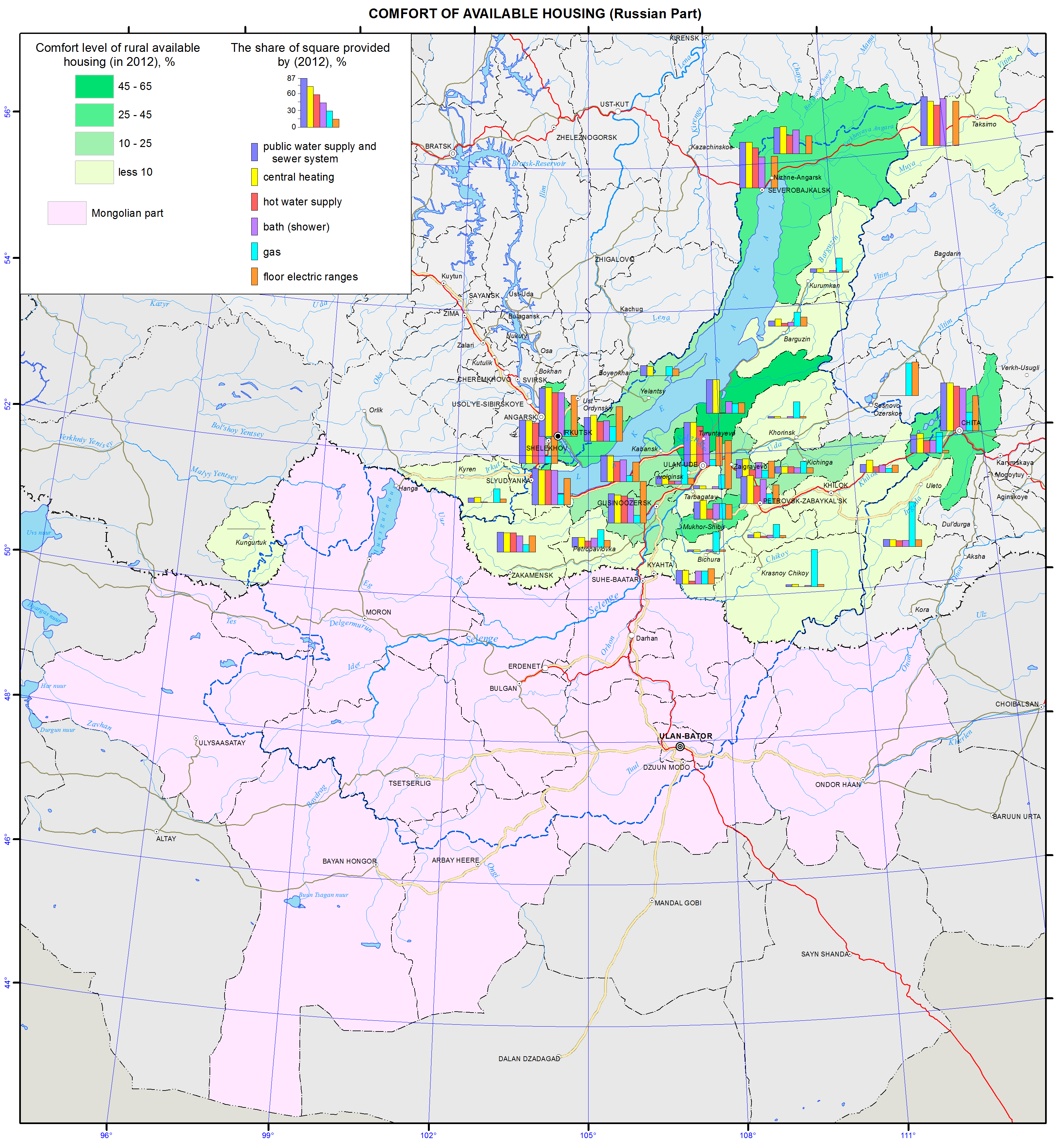
<p>The share of housing properties with urban amenities is an important factor for ecological well-being of the Baikal basin. Russian statistical data identify the following components of urban amenities: running water, sewage, central heating, hot water supply, baths (showers), and gas and electric stoves. According to the current statistical regulations, all housing properties today are considered to be equipped with central heating irrespectively of the source of heat supply (heat and electric power plant, industrial or local boiler plants, individual boilers). As a rule, the characteristics of the degree of provision with urban amenities is calculated using relative indicators – a percentage of the area of housing properties equipped with the above listed amenities compared to the total area of the housing fund (in %).</p>
<p>Spatial differences in the comfort level are quite significant in the region. Such regional centres as Irkutsk, Chita, and Ulan-Ude, as well as a town of the republican subordination Severobaikalsk have relatively high levels of urban development. However, a specific share of the housing fund equipped with urban amenities of every second administrative district of the region is less than 25%. Engineering amenities are absent in the Tere-Khol district of Tuva, Yeravna District of Buryatia (except for gas and electric stoves), and Olkhon district of Irkutsk oblast (indicators for running water, heating, gas and electric stoves do not exceed 20%).</p>
<p>The standard indicators of engineering amenities exceed 50% only in every sixth administrative district. The leaders are the Muisky district in Buryatia (due to new housing built during the Baikal-Amur Mainline construction) and Shelekhov and Slyudyanka Districts in the industrial belt surrounding Big Irkutsk (Irkutsk oblast). Almost half of the housing in three more districts has water supply, sewage and central heating: the Severobaikalsk and Kabansk districts in the Republic of Buryatia and the Irkutsk district in Irkutsk oblast.</p>
<p>Rural housing of the region has the lowest indicators of the degree of provision with urban amenities. The map shows the degree of availability of engineering amenities in rural settlements in administrative districts split into four conventionally identified groups according to the first four amenity indicators (i.e., without gas and electric stoves, as it will artificially improve the situation). In every second rural district, less than 10% of housing facilities are equipped with water supply, sewage, central heating, and baths (4<sup>th</sup> group). In five districts, this indicator is 10-25% (3<sup>rd</sup> group) (an average level for the region, but two times lower than the average for rural areas of the SFD): the Zaigraevsky, Ivolginsky, Kabansky and Kizhingsky districts in the Republic of Buryatia and Chita district in Zabaikalsky krai. The leader is the Pribaikalsky district of the Republic of Buryatia (1<sup>st</sup> group: 45-65 %, which is close to the average indicator of the SFD). This district is followed by three other districts with relatively high levels of development of the rural housing fund: the Severobaikalsky and Selenginsky districts in the Republic of Buryatia and the Irkutsk district in Irkutsk oblast (2<sup>nd</sup> group).</p>
<p>The analysis of indicators of housing development (as of 2012) in the administrative districts of the Russian part of the Baikal basin demonstrates a very low level of modern housing development, high contrasts between urban and rural settlements, and an extremely low level of comfort of rural territories.</p>
<p> </p>
<p align="center">References</p>
<p>Statistical Compendium. (2013). <i>Housing and communal services of Zabaikalsky krai</i>. Chita: Zabaikalkraistat. p 112.</p>
<p>Statistical Compendium. (2013). <i>Housing and communal services of the Irkutsk oblast in 2012</i>. Irkutsk: Irkutskstat, 2013. p 76.</p>
<p>Statistical Compendium. (2013). <i>Housing services of the Republic of Buryatia</i>. Ulan-Ude: Buryatstat. p 35.</p>]]></content:encoded>
    <dc:publisher>No publisher</dc:publisher>
    <dc:creator>Alexander Ayurzhanaev</dc:creator>
    <dc:rights></dc:rights>
    <dc:date>2014-10-09T07:05:00Z</dc:date>
    <dc:type>Page</dc:type>
  </item>


  <item rdf:about="http://bic.iwlearn.org/en/atlas/atlas/78b-comfort-of-available-housing-mongolian-part-map/comfort-of-available-housing-mongolian-part-map">
    <title>Comfort of available housing (Mongolian part) map</title>
    <link>http://bic.iwlearn.org/en/atlas/atlas/78b-comfort-of-available-housing-mongolian-part-map/comfort-of-available-housing-mongolian-part-map</link>
    <description></description>
    <content:encoded xmlns:content="http://purl.org/rss/1.0/modules/content/"><![CDATA[<p><img class="image-inline" src="../../../resolveuid/1bc5e76b7c7b4e78877642c01512efc1/@@images/image/preview" /></p>
<p><a href="http://bic.iwlearn.org/en/atlas/photos/copy_of__78b_ComfortofAvailableHousingMongolianpart.png" class="internal-link">Open full size</a></p>
<p align="center"><b>Urban amenities of </b><b>the housing fund in </b><b>Mongolia (78-2)</b></p>
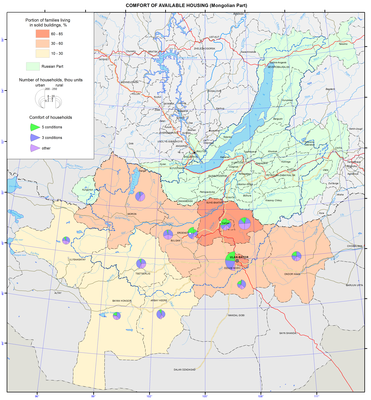
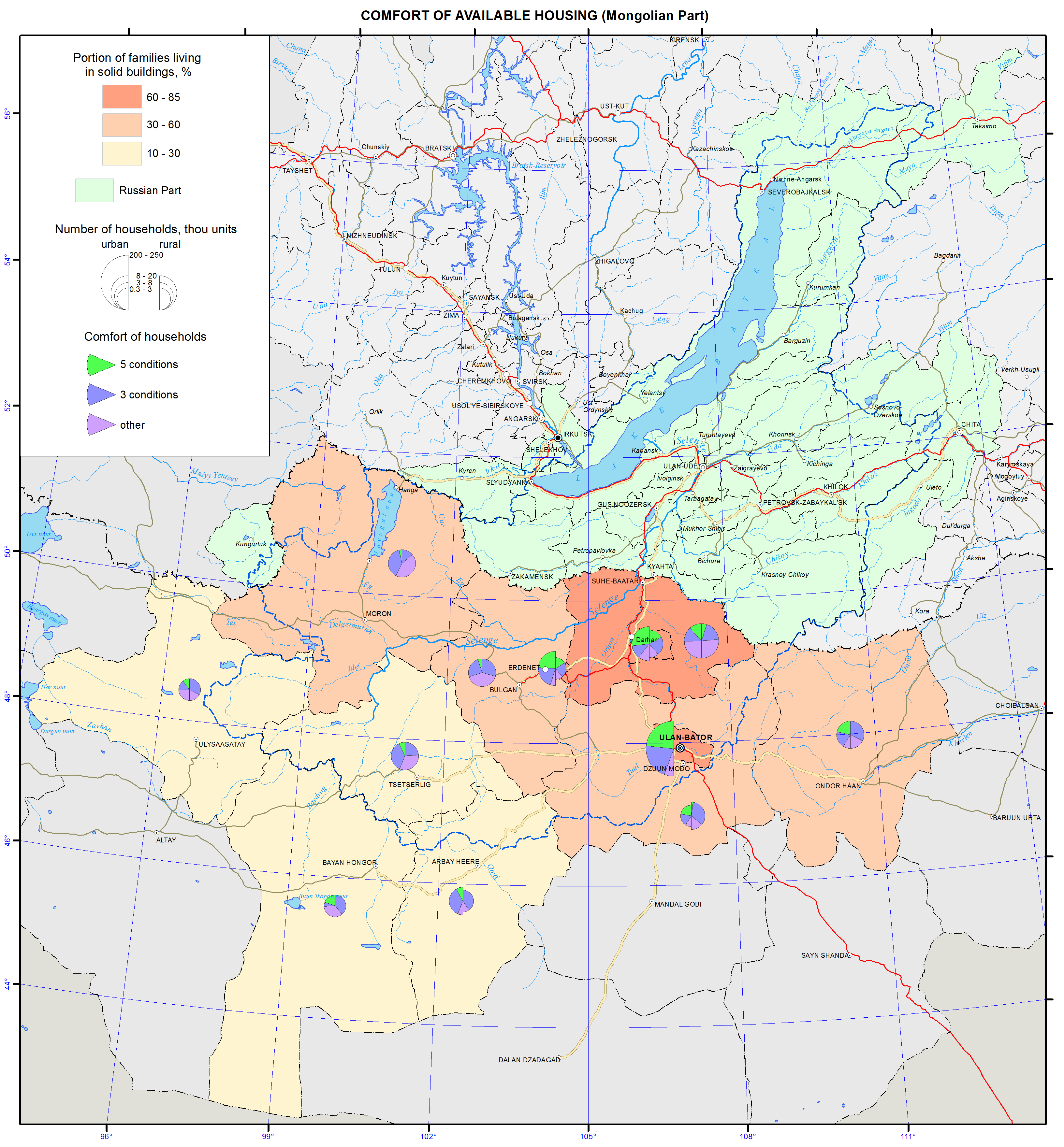
<p>The map shows a proportion of households in the country (%) living in residential houses with foundations (in permanent buildings – multi-apartment and low-rise buildings). According to the estimates, they account for over 17% of the housing fund of the country. Living conditions of households (families) in Mongolia that are statistically observed include the following five conditions:</p>
<p>- Households with a reliable source of drinking water, including households that have a reliable source of drinking water connected to a centralized system, protected well, or spring, as well as households that use purified and bottled water;</p>
<p>- Households with a source of electricity (electricity is supplied by the state electric power system, diesel power plants, renewable electric energy facilities, and small power generators);</p>
<p>- Households with a sewage system (inside or outside the house, but used only by the household);</p>
<p>- Households with a centralized and non-centralized sewage system for the disposal of wastewater through the central sewage system, independent system of sewage disposal, or cesspool;</p>
<p>- Households dispose of solid wastes through service companies or transport solid wastes to the designated areas or landfills themselves.</p>
<p>In Mongolia, more than two fifths of households (42.3%) living in permanent structures (buildings) use a centralized sewerage system, 0.4% use an independent sewage system, almost a half of households (48.3%) discharge wastewater into cesspools and 9% – on the terrain (directly into the ground).</p>
<p> </p>
<p align="center">References</p>
<p>National Statistical Office of Mongolia. (2011). <i>Population and housing census of Mongolia 2010: Housing conditions</i>. Ulaanbaatar.</p>]]></content:encoded>
    <dc:publisher>No publisher</dc:publisher>
    <dc:creator>Alexander Ayurzhanaev</dc:creator>
    <dc:rights></dc:rights>
    <dc:date>2014-10-09T07:10:00Z</dc:date>
    <dc:type>Page</dc:type>
  </item>


  <item rdf:about="http://bic.iwlearn.org/en/atlas/atlas/129-cloudiness-map/cloudiness-map">
    <title>Cloudiness map</title>
    <link>http://bic.iwlearn.org/en/atlas/atlas/129-cloudiness-map/cloudiness-map</link>
    <description></description>
    <content:encoded xmlns:content="http://purl.org/rss/1.0/modules/content/"><![CDATA[<p><img class="image-inline" src="../../../resolveuid/3c4d55bba8e047cd832942b5ac3abf2c/@@images/image/preview" /></p>
<p><a href="http://bic.iwlearn.org/en/atlas/photos/copy_of__129_Cloudiness.png" class="internal-link">Open full size</a></p>
<p align="center"><strong>Cloud cover</strong></p>
<p><strong> </strong></p>
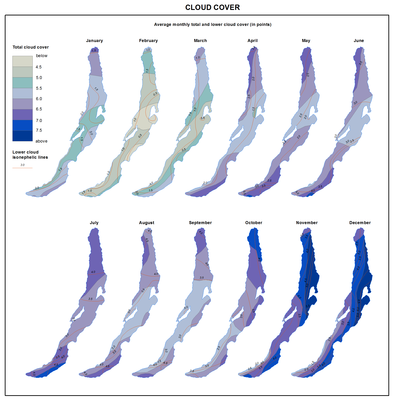
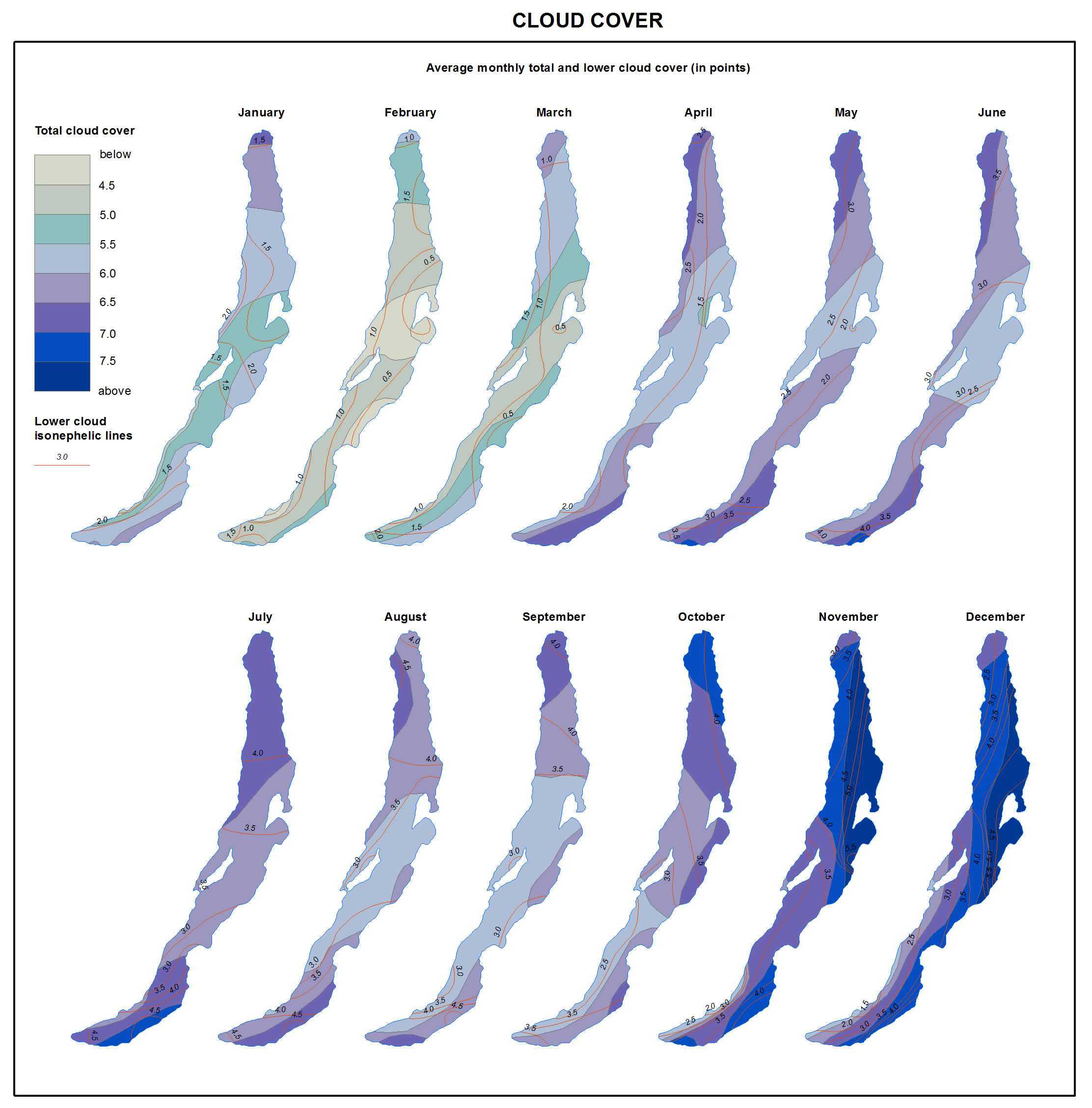
<p><span>Two maxima are recorded in the annual trend of cloud cover: summer (June-July) and pre-freeze-up (November-December). The latter prevails. The highest cloud cover values (7-8 oktas) and increased recurrence of overcast days (up to 75-80%) are registered in December on the north-eastern coast of the lake, whereas the lowest values (no higher than 4 oktas) are observed in February-March on the western shore, particularly within the territory of Maloye More (Small Sea). The foehn effect plays a significant role during the transfer of air masses over the Primorsky and Baikal Ridges, which causes a considerable drop of air humidity. In October-December, the cloud cover is very low above Lake Baikal due to the intense water evaporation from the ice free surface of the lake.</span></p>]]></content:encoded>
    <dc:publisher>No publisher</dc:publisher>
    <dc:creator>Alexander Ayurzhanaev</dc:creator>
    <dc:rights></dc:rights>
    <dc:date>2014-10-15T01:55:00Z</dc:date>
    <dc:type>Page</dc:type>
  </item>


  <item rdf:about="http://bic.iwlearn.org/en/atlas/atlas/22-climate-discomfort-map/climate-discomfort-map">
    <title>Climate discomfort map</title>
    <link>http://bic.iwlearn.org/en/atlas/atlas/22-climate-discomfort-map/climate-discomfort-map</link>
    <description></description>
    <content:encoded xmlns:content="http://purl.org/rss/1.0/modules/content/"><![CDATA[<p><img class="image-inline" src="../../../resolveuid/545c13bd05fd47189702e0b54bc5ecaf/@@images/image/preview" /></p>
<p><a href="http://bic.iwlearn.org/en/atlas/photos/copy_of__22_Climatediscomfort.png" class="internal-link">Open full size</a></p>
<p align="center"><strong>Discomfort of climate</strong></p>
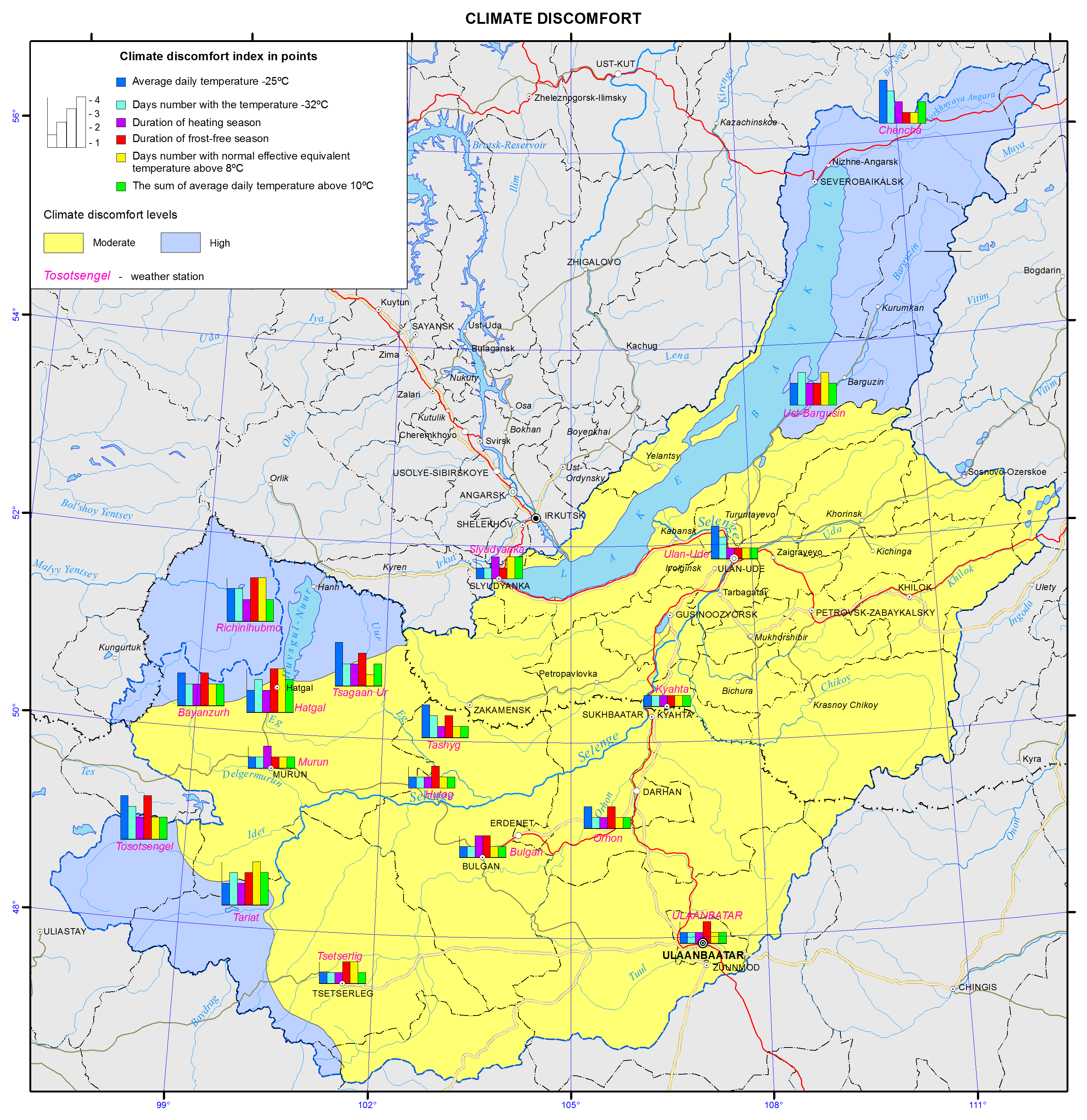
<p>The influence of climate on human beings manifests itself in a variety of fashions, primarily through man’s thermal state governed by external effects as well as by internal physiological processes. A comfortable perception of heat occurs when the input of heat and the thermal discharge in human body are in equilibrium. With an intensification of heat or cold, there is an increase in the tension of the physiological systems, which ensures this equilibrium. The intensity and duration of the impact from significant environmental parameters are responsible for the level of expenditures connected with the attainment of physiological comfort of the human life.</p>
<p>The number of days with normal-equivalent-effective temperature (NEET) above 8 °C is said to characterize indirectly the degree of comfort of a warm period for sensibly dressed people. The duration of periods with daily mean air temperatures below −25 °C and the sums above 10 °C represent the territory’s resources of heat and cold. The contrasts of the frost-free period determine the need for and the reliability of covering materials used in vegetable farming. In addition, a combination of low temperatures with wind velocity acts to enhance   heat output from open surfaces of human body. The risk of cold weather injuries when the values of reduced temperatures are below −32 °C serves as a forewarning in the case of arranging recreation and working in the open air [Khairullin and Karpenko, 2005]. The duration of the heating period makes it possible to calculate the future expenditures of heat necessary for heating various premises.</p>
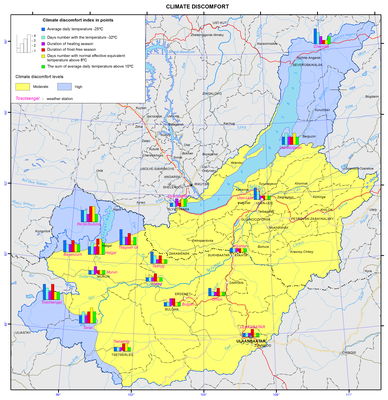
<p>The spatial differentiation of the indices under consideration is important within the confines of the basin [Scientific-applied…, 1989, 1991; <a href="http://www.meteo.ru/">http://www.meteo.ru</a>]. The mean daily temperature in the high mountains does not reach 10 °C, and its sum varies from 2400 °С in the southern part of the basin to 500 °С along the northeastern shores of Lake Baikal. The mean monthly NEET do not reach 8 °C in separate sections of the shores of Khovsgol and Baikal, and across the remaining territory they vary from 40 to 110 days. The frost-free period varies between 0 to 110 days. The smallest spatial fluctuations correspond to the duration of the heating season (230−305 days). The number of days with the mean daily air temperature below −25 °C is largest in the bottoms of closed depressions and valleys of the western part of the basin. With the wind factor taken into account, the differentiation of the severity of climate is enhanced. The mean values of reduced January temperature drop below −37 °C in Tosontsengel and Khatgal. In the former case, this is due to low air temperatures, whereas the increased wind activity is responsible for this in the latter case.</p>
<p>The combined effect of climatic resources has a substantial influence upon the aggregate volume of expenditures connected with the provision of physiological comfort for humans and the manufacture of products. The background characteristic features of the combined effect of the meteoparameters under consideration on humans and of their duration upon the degree of discomfort of habitation were revealed by using the resource-assessment approach [Bashalkhanova et al., 2012].</p>
<p>Throughout most of the basin’s territory the level of climatic discomfort is moderate, whereas it is strong on the northern, northwestern and western margins. The circle diagrams show the volume of the most differentiated parameters of climatic discomfort. The vertical axis is graduated in points from 1 to 5, and reflects the conditions of warm and cold periods. The diagrams corresponding to the most contrasting locations display the leading attributes of climatic discomfort of these territories.</p>
<p>A strong level of discomfort in the northern and western parts of the basin is due largely to the preceding low air temperatures, while on the shores of Khovsgol and in Tariat it is, to a larger extent, caused by a low heat availability in the summertime and, in the aggregate, by increased wind activity. The life of the population on such territories is more expensive and involves a limitation of the kinds of economic activities, shorter periods of stay in the open air, the requirement for a higher energy value of food, heat insulation of clothes and rooms, and a necessitous adjustment of production technologies, equipment and systems to low temperatures. On the other territory, the total duration of impacts of the parameters under consideration lies within moderate limits. The low duration of the period with NEET &lt;5 °C (within 40−70 days) in the middle mountains is compensated by favorable winter conditions.</p>
<p><b> </b></p>
<p align="center">References</p>
<p>Bashalkhanova, L.B., Veselova, V.N. and Korytny, L.M., (2012). <i>Resource Dimension of Social Conditions for the Life of the Population of East Siberia</i>, Novosibirsk: Geo, 221 p.</p>
<p><i>Scientific-Applied Handbook on the USSR Climate</i>. Ser. 3, Long-Term Data, Parts 1−6, (1989). Leningrad: Gidrometeoizdat, 1991, issue 22, 604 p.;, issue 23, 550 p.</p>
<p>Khairullin, K.Sh. and Karpenko, V.N., (2005). Bioclimatic resources of Russia, in <i>Climatic Reources and Methods of Representing Them for Applied Purposes</i>, St. Petersburg: Gidrometeoizdat, pp. 25−46 <i> </i></p>
<p><i>VNIIGMI-WDC Data Archives</i>. Retrieved from: <a href="http://www.meteo.ru/">http://www.meteo.ru</a></p>]]></content:encoded>
    <dc:publisher>No publisher</dc:publisher>
    <dc:creator>Alexander Ayurzhanaev</dc:creator>
    <dc:rights></dc:rights>
    <dc:date>2014-10-07T02:40:00Z</dc:date>
    <dc:type>Page</dc:type>
  </item>


  <item rdf:about="http://bic.iwlearn.org/en/news/the-baikal-project/e2a9ae389d9f2cbb2bc8f06bb0a3a3af">
    <title>Climate Change Assessment for TDA</title>
    <link>http://bic.iwlearn.org/en/news/the-baikal-project/e2a9ae389d9f2cbb2bc8f06bb0a3a3af</link>
    <description></description>
    <content:encoded xmlns:content="http://purl.org/rss/1.0/modules/content/"><![CDATA[<p>The following tasks have been accomplished:</p>
<ul>
<li>Review, analyse and summarise existing baseline information relevant to expected environmental and socio-economic impacts of global climate change in the Lake Baikal catchment region, with particular emphasis on transboundary problems as identified in the revised TDA. </li>
</ul>
<ul>
<li>Review and summarise existing policy and regulatory frameworks relevant for disaster risk reduction in Mongolia and Russia.</li>
<li>Review, analyse and summarise relevant activities by national governments, donors, NGO’s and private sector institutions that are relevant to adaptation to the expected impacts of global climate change in the Baikal basin region.</li>
<li>Formulate recommendations for strategic actions to adapt to the impacts of climate change in the Baikal basin region, with specific emphasis on transboundary problems as identified in the revised TDA. </li>
<li>Identify gaps in the available information, and provide a list of recommendations for further studies. </li>
<li>Identify potential sources for relevant data/information (e.g. reports, recent scientific papers) and include these as a reference list in the final consultancy document. </li>
<li>Provide inputs to improve the quality of the relevant climate change section in the draft revised TDA document.</li>
</ul>
<p> </p>
<p><a class="internal-link" href="http://baikal.iwlearn.org/en/project/project-tender-reports-2012/ica-reports/020-climate-change-expert">Download the Russian Final Report (ENG)</a></p>
<p><a class="internal-link" href="http://baikal.iwlearn.org/en/project/project-tender-reports-2012/ica-reports/020-climate-change-mongolia">Download the Mongolian Final Report (ENG)</a></p>]]></content:encoded>
    <dc:publisher>No publisher</dc:publisher>
    <dc:creator>Sergey Kudelya</dc:creator>
    <dc:rights></dc:rights>
    <dc:date>2013-03-02T08:05:26Z</dc:date>
    <dc:type>Feed Item</dc:type>
  </item>


  <item rdf:about="http://bic.iwlearn.org/en/friends/city-public-organization-baikal-society-for-animal-protection-russia-buryat-republic">
    <title>City public organization «Baikal society for animal protection» (Russia, Republic of Buryatia)</title>
    <link>http://bic.iwlearn.org/en/friends/city-public-organization-baikal-society-for-animal-protection-russia-buryat-republic</link>
    <description></description>
    <content:encoded xmlns:content="http://purl.org/rss/1.0/modules/content/"><![CDATA[<p align="center"><strong>CITY PUBLIC ORGANIZATION</strong></p>
<p align="center"><strong>«BAIKAL SOCIETY FOR ANIMAL PROTECTION»</strong></p>
<p><span style="text-decoration: underline;">Contact information:</span></p>
<p>Republic of Buryatia, Ulan-Ude, Zabaikalsky settlement</p>
<p>Tel .: 89025656486, 67-33-31</p>
<p>E-mail: LLevontueva@yandex.ru</p>
<p>Website: http: //priyut-nadezhda.rf/</p>
<p><span style="text-decoration: underline;">Director:</span> Lyudmila Alekseevna Levontueva</p>
<p><span style="text-decoration: underline;">Year establishment</span>: 2008</p>
<p> </p>
<p><span style="text-decoration: underline;">The purposes of creation:</span> education on mercy and love for animals; improving the living conditions of animals and protecting them from abuse; the creation of a real alternative to the practice of trapping and euthanasia of animals; improvement of sanitary-epidemiological situation in the city; veterinary care to animals left without owners; development and implementation of environmental programs to protect animals, opening a shelter for stray dogs «Nadezhda» (Hope).</p>
<p><span style="text-decoration: underline;">Main activities:</span></p>
<p>- Carrying out a protest action against animal cruelty. Collection of more than 2,000 signatures in support of animals;</p>
<p>- Preparing the draft Law «On Protection and maintenance of pets in the Buryat Republic»;</p>
<p>- Permanent work with local TV channels and media on the protection of stray animals;</p>
<p>- 5 large-issued leaflets, posters, billboards posted on the city,</p>
<p>- Prepared leaflets for children and adolescents which have been distributed in all schools of the city.</p>
<p>Together with the Ministry of Internal Affairs of the Buryat Republic held events:</p>
<p>- Training Seminar Chiefs juvenile inspectors, district, militia officers of Ulan-Ude on the organization of work with juveniles and citizens for the prevention of cruelty to animals;</p>
<p>- A competition among school students of the city of Ulan-Ude «My favorite pet»;</p>
<p>- Organized 20 letters to law-enforcement bodies of the Buryat Republic with allegations of ill-treatment of animals. According to one of the statements of the Society initiated a criminal case under article 245 «Cruelty to animals»;</p>
<p>- Appeal to the City Administration with a proposal for an alternative solution of the problem of stray animals instead of their capture and killing;</p>
<p>- During last four years 1036 animals have been saved and transferred to new hosts.</p>
<p><span style="text-decoration: underline;">Implementation of projects</span></p>
<p>Currently, there are 250 animals in our shelter. With the help of TV, media, etc. the work on finding the new owners is constantly working, the vacant places are taken by new animals</p>
<p><span style="text-decoration: underline;">Results, Lessons, and Prospects</span></p>
<p>- Continuation of the construction of a shelter for stray dogs «Nadezhda»;</p>
<p>- The annual action in defense of animals «Russia against cruelty»;</p>
<p>- Activities to regulate the number of homeless animals (castration and sterilization, preparation of leaflets about the benefits of castration and sterilization of animals as one of the most reliable, humane and safe methods of regulating of their quantity);</p>
<p>- Rescue stray animals, providing them with qualified veterinary care, searching for the new hosts;</p>
<p>- Newspaper articles, TV-programs about animal welfare.</p>
<p>Designed environmental program to protect animals «The problem of homeless animals and ways to solve it in a humane way» is the real alternative to practice of their capture and killing.</p>
<p>The proposed program is objectively difficult, but it is verified by experience in other regions of our country and in other countries. And most importantly, it gives reliable results. Simplified approaches are unacceptable and inappropriate. It is necessary the broad advertising of sterilization, not only homeless, but also domestic animals; construction and financing of shelters for animals.</p>
<p>Until the early start of the program it is necessary to stop the activity of catching services aimed at the destruction of the population of stray animals; review and develop additional laws; approve the Regulations on the tender for the execution of the municipal order of catching and sterilizing animals; adopt regulations on transport and trapping; introduce necessary changes to statutes of municipalities; use the positive experience of our neighbors from Irkutsk oblast' in humane solution of the problem of stray animals.</p>]]></content:encoded>
    <dc:publisher>No publisher</dc:publisher>
    <dc:creator>Alexander Ayurzhanaev</dc:creator>
    <dc:rights></dc:rights>
    <dc:date>2015-02-06T03:10:00Z</dc:date>
    <dc:type>Page</dc:type>
  </item>


  <item rdf:about="http://bic.iwlearn.org/en/atlas/atlas/106-circulatory-system-diseases-map/circulatory-system-diseases-map">
    <title>Circulatory system diseases map</title>
    <link>http://bic.iwlearn.org/en/atlas/atlas/106-circulatory-system-diseases-map/circulatory-system-diseases-map</link>
    <description></description>
    <content:encoded xmlns:content="http://purl.org/rss/1.0/modules/content/"><![CDATA[<p><img class="image-inline" src="../../../resolveuid/9e6e2be9b8e4499fb284e922163f7b58/@@images/image/preview" /></p>
<p><a href="http://bic.iwlearn.org/en/atlas/photos/copy_of__106_Circulatorysystemdiseases.png" class="internal-link">Open full size</a></p>
<p align="center"><strong>Healthcare</strong><strong> </strong></p>
<p align="center"><strong> </strong></p>
<p>Harsh climatic conditions across the entire territory of the Baikal basin and the surface and ground water used for drinking and food purposes that do not meet the drinking water quality standards (first and foremost in Mongolia and Buryatia) coupled with atmospheric emissions from industrial facilities and motor vehicles (in some parts of the territory) are responsible for the state of human health influencing the organization of healthcare. The ecological situation becomes substantially worse during winter months, which is encouraged by the topography of the terrain. In Mongolia, the spring period is very hard time to bear, with sharp temperature differences, abrupt variations in atmospheric pressure, and frequent dust and magnetic storms.</p>
<p class="NormalWeb">The organizational pattern of healthcare in Russia and Mongolia has much in common. This is a result of the cooperation of the two countries in this sphere and the fact that medical education and healthcare in Mongolia are organized using Russian experience. Today, Mongolian medical facilities operate on the principles of the state-private partnership concurrent with the demonopolization of the state system of medical services. The country has a mandatory and voluntary medical insurance system, in which state-owned and private medical institutions take part. The country also has various health institutes and centers.</p>
<p class="a">The territory of the Baikal basin is experiencing a deficit of medical workers. As of 2012, the availability of physicians varied from 13.8 to 30.1 per 10,000 people in Russian districts and from 16.1 to 29.0 per 10,000 people in Mongolian aimags. The availability of nurses varies from 25.1 to 112.2 per 10,000 people in Russian districts and from 26.4 to 38.2 per 10,000 people in Mongolian aimags. In Ulan-Ude, these indicators have the values of 53.9 and 117.3, while in Ulaanbaatar – 44.1 and 41.2, respectively.</p>
<p>The ratio of doctors and nurses in the Russian part of the basin is between 1:2 to 1:4, while in the Mongolian part it does not exceed 1:2. The World Health Organization (WHO) recommends that this ratio should be 1:4. A narrowing of this indicator causes imbalances in the healthcare system thereby limiting possibilities for further development of the after-treatment, casework and rehabilitation services.</p>
<p>Target indicators of healthcare activity are the standard volume of medical care per inhabitant. Currently, there are plans to decrease the per capita volume of in-patient services and increase the per capita volume of the hospital-replacing care. Accordingly, the number of hospital beds available 27/7 will decrease, while the number of beds in day hospitals will grow. Overall, the available number of hospital beds complies with the calculated standards and meets the demand of the population for the in-patient medical aid.</p>
<p class="ConsPlusNormal">As of today, in Russia, there is an array of problems relating to the high level of illnesses and disability incidences among the population, and these indicators are continuously growing. Such a situation is the result of inadequate preventive measures. Another important contributing factor to this situation is the increase of the proportion of elderly population and the improved effectiveness of illness detection using new diagnostic methods in the process of the increased number of medical checkups.</p>
<p class="ConsPlusNormal">The leading illnesses in the structure of morbidity are respiratory illnesses, bloodstream, eye, and digestive and musculoskeletal system diseases, as well as traumas. For many years, circulatory system diseases, neoplasms, and injuries have been the main causes of mortality and disability among the population.</p>
<p class="a">A complex of anthropogenic environmental factors contributes to the growth of morbidity and disability rates among the population with the most important one being air pollution. According to the WHO, atmospheric air pollution is the cause of up to 23% of all illnesses. The amount of pollutant emissions in the atmosphere produced by static sources in different administrative divisions in the Baikal basin differs by more than a thousand times. The most polluted air in the Baikal basin is in the Selenginsky district of Buryatia.</p>
<p>The health of the population and further development of healthcare depend on ecological, social, and economic factors. These problems can be resolved only through comprehensive approaches to the improvement of the quality of life of the population.</p>
<p>The strategic goal of the healthcare systems of Russia and Mongolia is to build a system, which ensures the quality and accessibility of medical services, primarily first aid, and increases the efficiency of medical services, based on the improvement of territorial planning of healthcare. The volume, types, and quality of these services should correspond to the rate of morbidity, population requirements, and the latest achievements of medical science, based on perfecting the system of territorial planning of public health services.</p>]]></content:encoded>
    <dc:publisher>No publisher</dc:publisher>
    <dc:creator>Alexander Ayurzhanaev</dc:creator>
    <dc:rights></dc:rights>
    <dc:date>2014-10-14T02:35:00Z</dc:date>
    <dc:type>Page</dc:type>
  </item>


  <item rdf:about="http://bic.iwlearn.org/en/friends/chita-regional-public-institution-environmental-center-public-dauria-russia-zabaykalsky-krai">
    <title>Chita regional public institution «Environmental center public Dauria» (Russia, Zabaykalsky krai)</title>
    <link>http://bic.iwlearn.org/en/friends/chita-regional-public-institution-environmental-center-public-dauria-russia-zabaykalsky-krai</link>
    <description></description>
    <content:encoded xmlns:content="http://purl.org/rss/1.0/modules/content/"><![CDATA[<p align="center"><b>CHITA REGIONAL PUBLIC INSTITUTION</b></p>
<p align="center"><b>«ENVIRONMENTAL CENTER PUBLIC DAURIA»</b></p>
<p><span style="text-decoration: underline;">Contact information:</span></p>
<p>672090, Chita, Chkalova st, 120</p>
<p>Tel. / Fax: + 7-3022-35-77-39 + 7-914-430-04-27</p>
<p>E-mail: http://www.dauria.chita.ru, Natalya_kvnk@mail.ru</p>
<p><span style="text-decoration: underline;">Director:</span> Kovalenok Natalia Valentinovna</p>
<p><span style="text-decoration: underline;">Objectives and main activities:</span></p>
<p>- The promotion and support of protected areas;</p>
<p>- Environmental education;</p>
<p>- Public monitoring of decisions and laws in the social and environmental spheres;</p>
<p>- Promote a favorable conservation legislation and mechanisms of citizen participation in decision-making and legislation;</p>
<p>- Cooperation, promotion of movements and coalitions.</p>
<p><span style="text-decoration: underline;">Implementation of projects</span>:</p>
<p>- Garbage collection on the lakes Arakhley-Shakshinskoe;</p>
<p>- Program to support NGOs and other civil society institutions;</p>
<p>- Administration of the program «Regional grant»;</p>
<p>- Participation in the All-Russian movement «Russian Rivers Network»;</p>
<p>- Awareness-raising campaigns;</p>
<p>- Administration of GGF grant competitions in local communities Zabaikalia;</p>
<p>- Work with the local business community;</p>
<p>- Work on the model of effective management in the territory of a municipality Zabaikalsky krai</p>]]></content:encoded>
    <dc:publisher>No publisher</dc:publisher>
    <dc:creator>Alexander Ayurzhanaev</dc:creator>
    <dc:rights></dc:rights>
    <dc:date>2015-02-06T07:46:06Z</dc:date>
    <dc:type>Page</dc:type>
  </item>


</rdf:RDF>